Perspectives; Thoughts; Comments; Opinions; Discussions

Posts tagged ‘Tax Cuts’

Trump’s Tariffs Are Only the Start. Congress Must Now Cut Taxes and Regulations.


Reported by Kevin Roberts | Richard Stern | April 11, 2025

Read more at https://www.dailysignal.com/2025/04/11/trumps-tariffs-are-only-start-congress-must-now-cut-taxes-regulations/
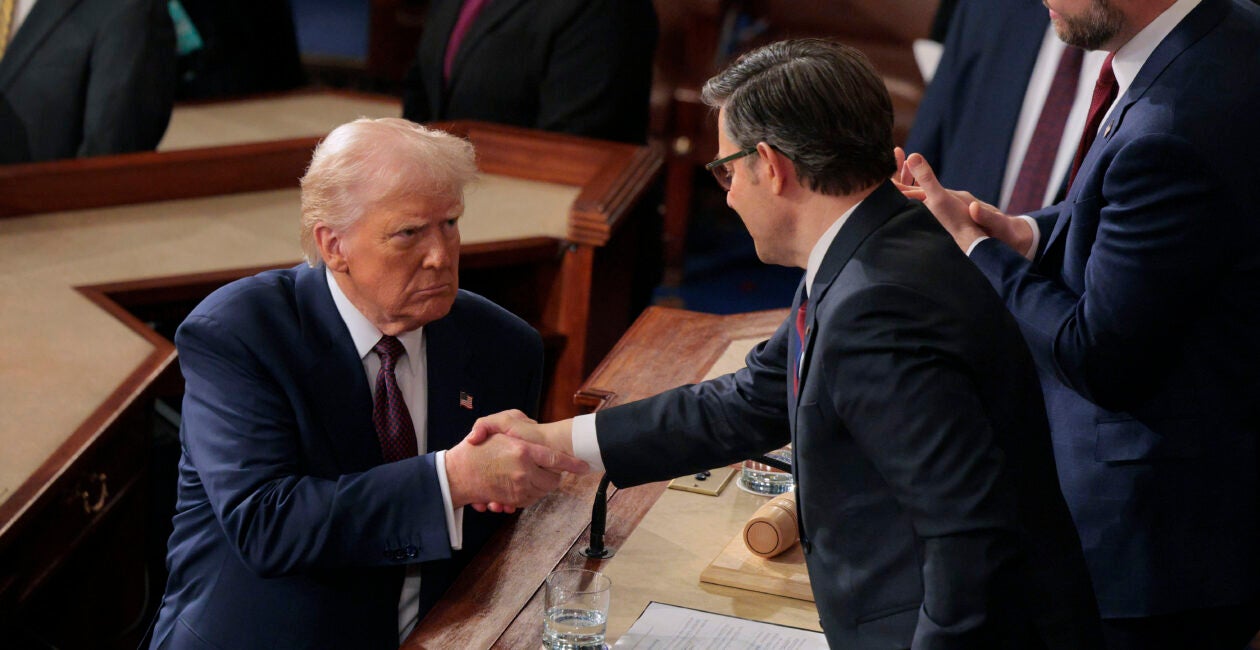
Donald Trump, in a darl blue suit, shakes hands with Mike Johnson, dressed in a dark grey suit.
(Chip Somodevilla via Getty Images)

President Donald Trump announced historic tariffs on April 2—“Liberation Day”—to ensure that America is no longer “looted, pillaged, raped, and plundered” by other nations.

On Wednesday, the president announced a 90-day pause on the tariffs and lowered the tariff rate on most nations to 10%. He also raised tariffs on China to 125%.

His bold leadership, which quickly brought 75 countries to the negotiating table, he said, should be applauded. Clearly, his strategy is working: America is gaining leverage, and China is becoming more and more isolated.

While conservatives have been divided and disorganized about how to respond to the president’s policy, with almost all Republicans in Washington still watching from the sidelines, we’re calling on Americans to unify around a “yes, and” agenda.

That means saying yes to strategic, reciprocal tariffs that target China and other trade abusers—based on their barriers, not simply the balance of trade—as we work toward true free and fair trade.

And it means insisting that tariffs are most effective when paired with a broad array of conservative policies that alleviate economic pain on the American people. While Trump works to liberate us from foreign abuses, congressional Republicans must fight to liberate Americans from the burdens of federal regulations, mandates, and taxes.

Republicans Must Make Tax Cuts Permanent

First, we must not settle for extending the status quo on tax relief. Thanks to the majorities Trump delivered in November, Republicans must pursue deeper tax reform through reconciliation. Every penny raised from tariffs should be offset with pro-growth tax cuts.

Making the Tax Cuts and Jobs Act permanent is a good start, but we also must remove every remaining tax penalty on expanding hiring and business operations in America by adopting full and immediate expensing for all investments. Pairing this with a simplified flat tax for all is even better. Congress should collapse the personal income and corporate tax rates to 15%.

Second, Congress should work alongside the Trump administration, using the reconciliation process, to transform the current 10% universal tariff into a true border-adjusted tariff. That means applying a universal 10% tariff on all imports, while granting a matching 10% credit to all American exports.

That isn’t just smart policy—it’s a long-overdue correction to a global tax system that has punished American industry for decades.

We’ve let foreign goods pour into our markets tax-free, while our manufacturers are taxed at home and slapped again abroad. That’s not free trade—it’s economic surrender. And no country has abused this broken system more brazenly than China, which has cheated on trade, exploited our openness, and gutted the U.S. industry while Washington looked the other way.

If we want to rebuild our economy, secure our supply chains, and end our dependence on adversarial regimes, then a border adjustment tariff must be part of the conservative economic playbook.

As a bonus, these revenues can be used to offset lost revenue from the lower tax rates we are calling for.

Congress Must Cut Federal Spending

Third, Republicans must finally get serious about cutting spending—not with half measures or messaging bills, but with real, structural reform. Through reconciliation, Congress should significantly cut mandatory spending riddled with waste, fraud, and abuse.

Now is not the time to settle for the lowest common denominator, which is always a temptation in politics. If we are to undo the fiscal and inflationary damage done by the previous administration and decades of fiscal irresponsibility, we must go big and take advantage of this historic electoral mandate.

Then, through the appropriations process, we must slash the bloated discretionary budget that fuels the unchecked growth of the federal bureaucracy.

In the meantime, the Department of Government Efficiency must be fully unleashed to do its job—scrutinizing every dollar, rooting out inefficiency, and holding agencies accountable. This is how we restore fiscal integrity and prove to the American people that their government works for them, not the other way around.

Businesses Need Deregulation

Fourth, American enterprise must be unleashed through sweeping deregulation. For too long, unelected bureaucrats have imposed crushing rules that stifle innovation, punish small businesses, and expand government control far beyond its proper bounds.

It’s time for Congress to reassert its constitutional authority, starting by empowering lawmakers to roll back legacy regulations that have accumulated over decades of executive overreach by passing the REINS Act and the Sunset Act.

At the same time, the administration should lead a coordinated effort—through executive orders and agency rulemaking—to dismantle the regulatory state piece by piece.

Fifth, permitting reform is long overdue, and it’s time we treat it like the national priority it is. For decades, radical environmentalists and bloated bureaucracies have used red tape to delay, derail, and destroy American energy and infrastructure projects. The result? Higher costs, energy dependence, and missed opportunities for American workers.

We need to streamline the permitting process from top to bottom—cut timelines, eliminate duplicative reviews, and ensure projects get approved on merit, not political ideology. If we’re serious about unleashing American energy, rebuilding our industrial base, and securing true energy independence, then Congress must act—the administration must lead—with bold, unapologetic reform.

In Washington, conservatives talk a lot about policies, but policies are not ends in themselves. They’re tools to achieve a certain end—the flourishing of the American people. Americans care about policy only insofar as it influences how they can purchase a home, build strong families, raise their children in safe communities, and live lives rooted in faith, purpose, and freedom.

For too long, America’s strength has been undermined by a bipartisan failure to defend our own economic foundation. Congress and previous presidents ran up our debt, piled up regulations, outsourced our manufacturing base, surrendered our supply chains, and signed trade deals that ignored Chinese cheating.

All of this served government bureaucrats, but not the American family. The result? Hollowed-out towns, lost jobs, and a working class forced to pay the price for decisions made in Washington and on Wall Street.

This result wasn’t inevitable—it was a choice. And it’s time we choose differently. It’s time to put American industry, families, and sovereignty back at the center of our national agenda.

As conservatives, we’re not just fighting for policies—we’re fighting for the American way of life. A way of life rooted in personal responsibility, bound by opportunity, and defined by human dignity. Every policy we advance—whether it’s tax reform, deregulation, tariffs, or border security—must serve that higher purpose: to strengthen families, empower communities, and preserve the blessings of liberty for the next generation.

Originally published by USA Today
Related posts:

  1. Trump and Our Return to the ‘American System’
  2. As Tariffs Tank Markets, Economy Craves Tax Cuts
  3. Capitol Hill Reacts to Trump’s ‘Liberation Day’ on Tariffs

Joe Biden Just Promised America A Massive Tax Hike


BY: DAVID HARSANYI | APRIL 24, 2024

Read more at https://thefederalist.com/2024/04/24/joe-biden-just-promised-america-a-massive-tax-hike/

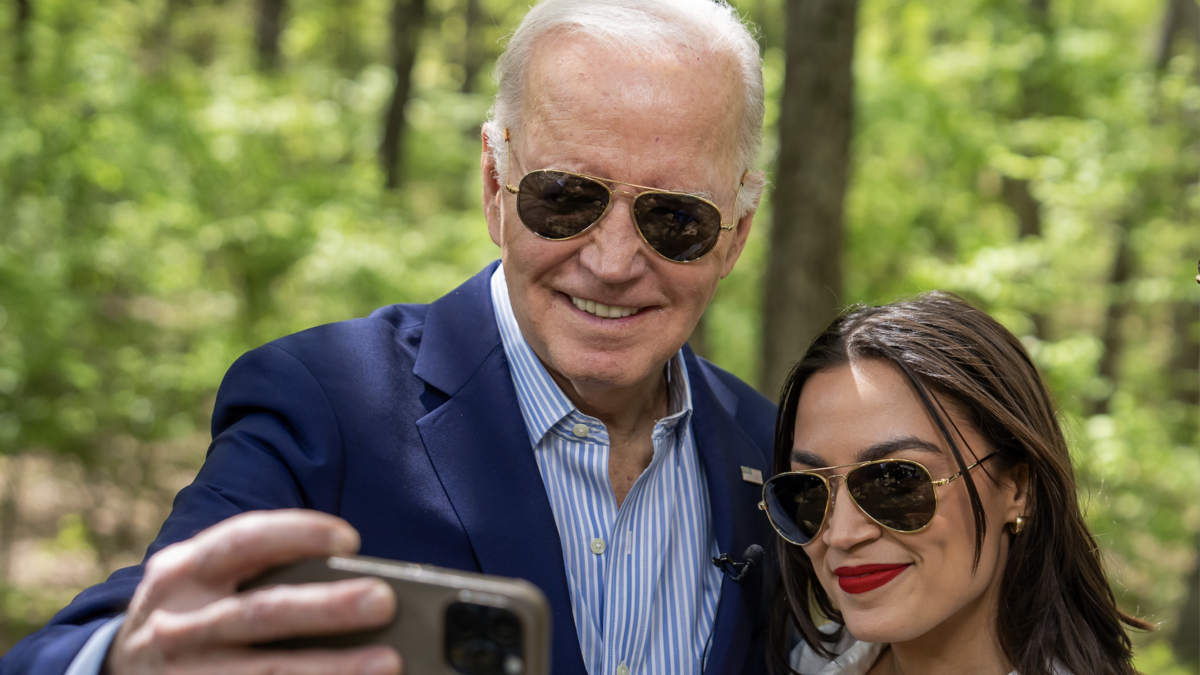
Joe Biden and AOC

Here is our president today:

Well, obviously Trump should be “proud” of the Tax Cuts and Jobs Act, which is set to expire at the end of 2025. If the GOP presidential candidate had any sense, he would be running Biden’s promise to enact a $2 trillion tax hike, one of the biggest in American history, in a perpetual ad loop. Of course the rich benefited. As did everyone else. Even the New York Times and Washington Post were compelled to admit as much.

In raw terms, as with any across-the-board tax cut, Trump’s reform helped higher earners most, because high earners pay most of our federal taxes. In 2023, the top 1 percent paid eight times the rate paid by the bottom half of taxpayers. The idea that the rich aren’t paying their share is a preposterous zero-sum economic myth spread by resentment-racket class warriors on left and right. If everyone actually paid his “fair share” in this country, we’d be years deep into a violent revolution.

If anything, the problem with Trump’s tax cuts was that the code became more progressive, although other downsides include the lack of any corresponding cuts or reforms of debt-driving entitlements. Quite the opposite.

As a percentage of income, though, the Trump tax cuts benefited the middle class most, as Justin Haskins explained:

A careful analysis of the IRS tax data, one that includes the effects of tax credits and other reforms to the tax code, shows that filers with an adjusted gross income (AGI) of $15,000 to $50,000 enjoyed an average tax cut of 16 percent to 26 percent in 2018, the first year Republicans’ Tax Cuts and Jobs Act went into effect and the most recent year for which data is available.

Filers who earned $50,000 to $100,000 received a tax break of about 15 percent to 17 percent, and those earning $100,000 to $500,000 in adjusted gross income saw their personal income taxes cut by around 11 percent to 13 percent.

By comparison, no income group with an AGI of at least $500,000 received an average tax cut exceeding 9 percent, and the average tax cut for brackets starting at $1 million was less than 6 percent. (For more detailed data, see my table published here.)

That means most middle-income and working-class earners enjoyed a tax cut that was at least double the size of tax cuts received by households earning $1 million or more.

Let’s not forget, as well, when “that tax cut is going to expire”—and there are no assurances anything would pass to take its place—that would slash child tax credits from $2,000 per child to $1,000 and cut additional credits for older children and dependents in half. It should also be remembered that corporate taxes—which Trump cut from 35 percent to 21 percent and Democrats raised again—are also just a tax on consumers.

You may also recall the fearmongering and performative meltdowns among Democrats over the tax reform. Larry Summers, a relatively moderate voice on the left, warned Trump’s bill was “a threat to democracy” and would lead to more than 10,000 dead Americans every year.

“Armageddon,” House Minority Leader Nancy Pelosi warned, declaring Trump’s tax cut “one of the worst bills in the history of the United States Congress”— potentially, then, in a category with the Fugitive Slave Act and the Espionage Act. Unhinged progressive economist Bruce Bartlett said on MSNBC the tax cuts were really akin to rapeof the poor, while the Washington Post ran an article from a “depression historian” who contended, “The GOP tax bill is straight out of 1929.”

What happened? The bill passed at the end of 2017. In 2018,

  • the real GDP increased 3.1 percent, compared with an increase of 2.5 percent the previous year.
  • The price index for GDP purchases increased 2.1 percent in 2018, compared to 1.9 percent in 2017.

Many “new right” populists don’t like defending tax cuts (Ronald Reagan talked about them a lot, so yuck). But the average American family — which is middle class, lives in the suburbs, and votes in high numbers — will surely be more concerned about a rising tax bill than about any issue animating the populist Internet influencer crowd.  


David Harsanyi is a senior editor at The Federalist, a nationally syndicated columnist, a Happy Warrior columnist at National Review, and author of five books—the most recent, Eurotrash: Why America Must Reject the Failed Ideas of a Dying Continent. Follow him on Twitter, @davidharsanyi.

Author David Harsanyi profile

DAVID HARSANYI

VISIT ON TWITTER@DAVIDHARSANYI

MORE ARTICLES

Today’s Politically INCORRECT Cartoon by A.F. Branco


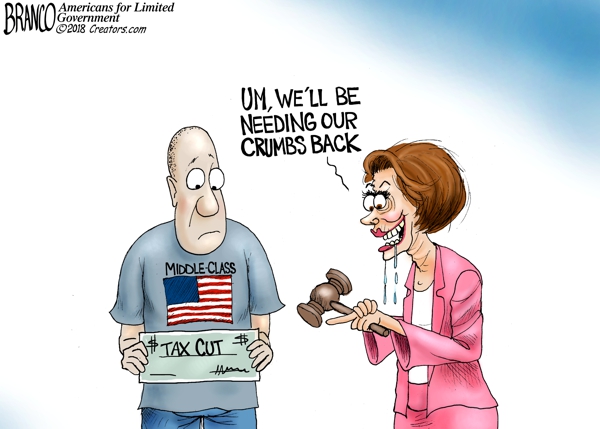
A.F. Branco Cartoon – High Tax Nancy

Nancy Pelosi may be back holding the gavel with a vengeance wanting her crumbs back from the taxpayers.

Nancy Pelosi Speaker AgainPolitical Cartoon by A.F. Branco ©2018.
More A.F. Branco Cartoons at The Daily Torch.

A.F. Branco 2019 13-Month Calendar <—- Order Here

take our poll – story continues below
  • Will the Democrats try to impeach President Trump now that they control the House?

A.F.Branco Coffee Table Book <—- Order Here.

A.F. Branco has taken his two greatest passions, (art and politics) and translated them into the cartoons that have been seen all over the country, in various news outlets including “Fox News”, MSNBC, CBS, ABC and “The Washington Post.” He has been recognized by such personalities as James Woods, Sarah Palin, Larry Elder, Lars Larson, and even the great El Rushbo.

More Politically INCORRECT Cartoons for February 26, 2018


More Politically INCORRECT Cartoons for January 17, 2018


Economists Credit Trump For Booming Economy, Growth Will Continue In 2018 Thanks To Trump’s Tax Bill


Economists Credit Trump For Booming Economy, Growth Will Continue In 2018 Thanks To Trump's Tax Bill

CNBC’s economic survey released prior to Christmas showed that for the first time in over a decade a majority was optimistic about the economy, and there was a shift as to who should receive credit for it: Donald J. Trump. The economic growth for the fourth quarter was near four percent. Over 100 companies gave bonuses of at least $1,000 or more to over a million workers, even some part-timers got a piece of that action. The GOP tax bill, which the Left said was going to be a prelude to Armageddon, was exactly the opposite for the American worker, who the Democratic Party decided to bet against to try and undercut Trump. Over 90% of middle class Americans will be receiving a tax cut. The Democratic Party is going to have to explain that move, especially when this tax bill becomes more popular. 

As for the economy, economists said we should expect to see unemployment continue to go down and the economy to grow in 2018. Economists credit two things: President Trump and his tax bill. For Obama, his polices received good grades for providing financial stability, though they led to anemic economic growth and job creation  (via WSJ):

Economists surveyed by The Wall Street Journal say President Donald Trump has had generally positive effects on U.S. economic growth, hiring and the performance of the stock market during his first year in office.

The professional forecasters also predicted 2018 would see solid growth and a continued decline in the jobless rate. One factor: the tax cuts signed into law by Mr. Trump in December, which most economists say will boost the economy for several years at least.

More broadly, most forecasters surveyed by the Journal suggested Mr. Trump’s election deserves at least some credit for the economy’s recent strength.

Asked to rate Mr. Trump’s policies and actions to date, a majority of economists said he had been somewhat or strongly positive for job creation, gross domestic product growth and the stock market. Most also said he had been either neutral or positive for the country’s long-term growth trajectory, while his influence on financial stability was seen as largely neutral.

“There is definitely a sense in the business community that the president’s actions on taxes and regulations have led to a more pro-growth environment for them to operate,” said Chad Moutray, chief economist at the National Association of Manufacturers.

[…]

A year ago, President Barack Obama got mixed grades as he prepared to leave office after eight years. Most economists surveyed by the Journal in January 2017 saw his policies as positive for financial stability, positive or neutral for job creation, negative or neutral for GDP growth and negative for long-term potential growth.

Democrats are confident about the 2018 midterms. With the current numbers now, they should be—but we’re 10 months away from the midterms elections. Anything can happen.  


More Politically INCORRECT Cartoons


More Politically INCORRECT Cartoons


Today’s Politically INCORRECT Cartoon by A.F. Branco


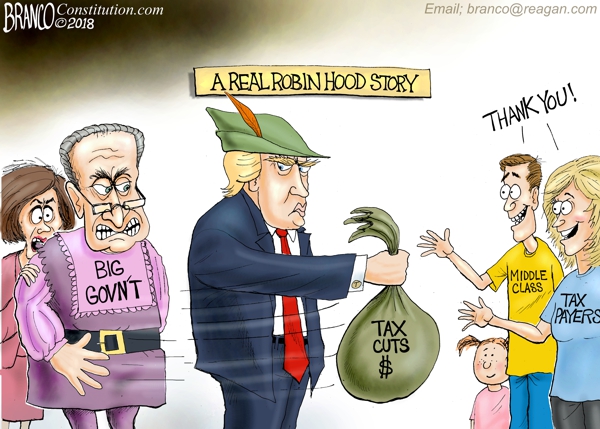
The Beltway Outlaw

The truth about Robin Hood is that he stole the people’s money back from the Government and returned it. Much in the way Trump is doing with tax cuts.

Trump Is Robin HoodPolitical Cartoon by A.F. Branco ©2017.

More Politically INCOORECT Cartoons and Memes


Today’s Politically INCORRECT Cartoon by A.F. Branco


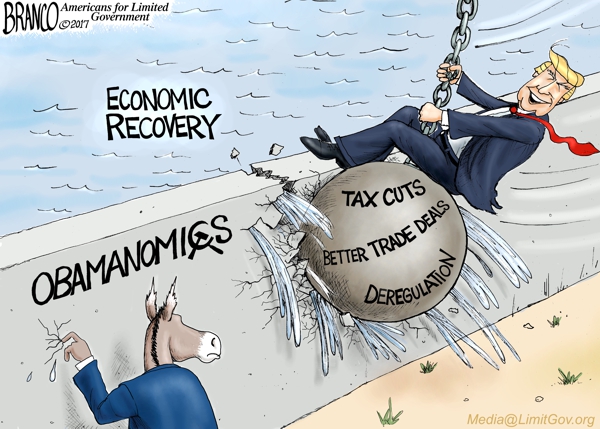
Myth Buster

Obama and the Democrats say a rotten economy with no job growth is the new normal, but President Trump is proving them wrong.

Trump Tax Cuts and DeregulationPolitical cartoon by A.F. Branco ©2017.

More Politically INCORRECT Cartoons


More Politically INCORRECT Cartoons


WSJ: The Tax Cuts Will Grow the Economy by Much More than Expected


Mark Wilson/Getty Images

Reported by John Carney | 18 Dec 2017

URL of the original posting site: http://www.breitbart.com/big-government/2017/12/18/wsj-the-tax-cuts-will-grow-the-economy-by-much-more-than-expected/

Tax cuts are going to grow the economy by much more than expected.

That’s the verdict of the Wall Street Journal‘s prestigious “Heard on the Street” column. Importantly, Heard on the Street is run by the news side of the WSJ, not its tax-cut loving editorial page. So there’s no particular pro-tax cut or pro-Republican bias at work here.

Justin Lahart of Heard writes:

There were several surprises for investors when Republicans unveiled their final tax bill Friday, but the most significant is that they add up to a bigger boost to economic growth next year.

The bigger stimulus could fundamentally change how the market behaves in 2018. Sales and profits will be stronger than most investors expect. But with the unemployment rate low, wage pressures will mount faster, and inflation should pick up more. If the tax plan passes, as seems likely, it could lead the Federal Reserve to raise rates faster, putting the bond market at risk.

The tax plan was always expected to juice the economy, but the Senate version, which passed after the House approved its bill, had relatively modest short-term stimulus. While the stock market kept rising in anticipation of a cut, the bond market hardly budged. The bill unveiled Friday front-loaded more than $200 billion in stimulus for next year. Economists had been penciling in a boost of about a third of a percentage point next year. Now that is looking way low.

Some of the pro-growth changes include eliminating any delay to the corporate tax cuts, lowering of the top individual rate, lowering rates for most taxpayers, and increasing the child tax credit. The latter is particularly important because middle-class households are “more likely to spend extra income than the rich.”

The tax bill could increase GDP by 1.3 percent, Lahart writes.

That’s an additional full percentage point gain from what economists had been expecting based on earlier bills.

(Full disclosure: I used to work for Heard on the Street and consider Lahart a personal friend. He’s had me over to his apartment for fish.)

More Politically INCORRECT Cartoons


More Politically INCORRECT Cartoons


More Politically INCORRECT Cartoons for Monday November 6, 2017


More Politically INCORRECT Cartoons for Thursday October 26, 2107


More PoliticallyINCORRECT Cartoons for Tuesday October 24, 2017


More Politically INCORRECT Cartoons for Monday October 16, 2017


Today’s Politically INCORRECT Cartoons for Monday October 2, 2017


Today’s Politically INCORRECT TOWNHALL.COM Cartoons


Trump Administration Promising “Biggest Tax Cut” and “Largest Tax Reform” in American History


Reported By Onan Coca |  April 26, 2017

This. Could. Be. HUGE. President Trump’s Treasury Secretary, Steve Mnuchin, broke some big news during a speech to the Washington forum on Wednesday afternoon. Mnuchin told the audience that the Trump administration would soon be proposing, and then hopefully passing, the “biggest tax cut” and “largest tax reform” in American history.

From Fox News:

Treasury Secretary Steve Mnuchin confirmed Wednesday that the Trump administration aims to lower business tax rates to 15 percent, saying a forthcoming proposal will constitute the “biggest tax cut” for Americans in history.

“This is going to be the biggest tax cut and the largest tax reform in the history of our country,” Mnuchin said, as administration officials prepare to outline Wednesday afternoon what he described as “principles” of their tax plan.

Mnuchin, speaking at a Washington forum, would not reveal many specifics but confirmed that they want to lower the business rate to 15 percent. 

“I will confirm that the business tax is going to be 15 percent,” he said. “[Trump] thinks that’s absolutely critical to drive growth.”

He indicated that the rate for small businesses and the corporate tax would both drop to 15 percent. The top small business rate is 39.6 percent; the current corporate tax is 35 percent.

Mnuchin also said the administration wants to “do the whole thing,” and not pursue tax reform piece by piece.

While there are concerns that such a large package would hurt government “revenue,” Mnuchin did not seem concerned by the possibility. He argued that economic growth would more than cover the possible shortfalls. Sadly, such a response (while probably right) won’t help the administration get the tax cuts (and reform) passed the Democrat minority, particularly in the Senate.

Speaker of the House Paul Ryan (R-WI) agreed with Mnuching that growth would increase exponentially if the GOP reforms are passed.

Larry Kudlow explained on CNBC that the tax cuts would pay for themselves.

Earlier in the day, the Nasdaq  seemed to presage Mnuchin’s comments as it soared past 6K for the first time. Ever.

ABOUT THE AUTHOR: Onan Coca

Onan is the Editor-in-Chief at Liberty Alliance media group. He’s also the managing editor at Eaglerising.com, Constitution.com and the managing partner at iPatriot.com. Onan is a graduate of Liberty University (2003) and earned his M.Ed. at Western Governors University in 2012. Onan lives in Atlanta with his wife and their three wonderful children. You can find his writing all over the web.

Scott Walker to Wisconsin: Here’s an $800 Million Tax Cut – It’s Your Money


Posted by Rodney Lee ConoverDecember 28, 2014

URL of the Original Posting Site: http://joeforamerica.com/2014/12/scott-walker-wisconsin-heres-800-million-tax-cut-money/

I guess I could tell you that Scott Walker inherited a huge deficit and in the middle of the Obama depression, he cut Corporate taxes, survived Democrats efforts to throw him out of office, listened as liberals said he did know what he was doing and promptly turned things around with a Reagan-esque flair.

Wisconsin Governor Scott Walker is proposing $800 million in tax cuts, representing most of the state’s $912 million revenue surplus. Half of the cuts will be achieved through property tax reductions, and the other half will consist of lower payroll taxes, as well as lower income tax rates for the lowest state bracket. 

“What do you do with a surplus?  Give it back to the people who earned it.  It’s your money,” Walker will tell the state legislature in his annual “State of the State Address,” according to an excerpt released to the press. The tax cuts will be a core part of Walker’s new budget for the state, entitled the “Blueprint for Prosperity.” 

Walker has presided over a remarkable turnaround in Wisconsin’s finances. When he took office in 2011, the state was running a $3.6 billion deficit. One of his first acts was to pass a corporate tax cut, which Democrats derided as a giveaway to the rich, but which helped grow the local economy and attract businesses and jobs. 

The collective bargaining reforms that Walker subsequently enacted, over vehement Democrat and union opposition, also helped state and local governments save money while preserving public sector jobs. To that achievement, Walker can now add a tax cut–something few other governors, even Republicans, have achieved.

Wow – shocker of shocks! Tax credits stimulate the economy and Democrats call you names when you don’t do what they want? Even when Barack Obama is trying to destroy the nation, you can prosper, it turns out. These Dems are not long for the country, because unlike their predecessors, they’re not helping at all. They’re working against us.Party of Deciet and lies

One group of potential candidates for president probably won’t be shuffling off to Iowa, New Hampshire or other early campaign spots in the new year. They’ll be hunkered down in statehouses across the Midwest, pushing bills through their legislatures. Few outside their home states will notice, but these governors and their policies could wind up in the national campaign picture. Scott Walker of Wisconsin, Mike Pence of Indiana, Rick Snyder of Michigan and John Kasich of Ohio were all elected after Republicans began taking political control of the middle of the country back in 2010. Since then, they have offered a glimpse of what some conservative policies would look like if put into wider effect. Should any of these governors join the race for the White House, their state records would become their chief qualification for higher office and might provide some distance from partisan battles in Washington. The governors could also benefit from being in a region rich with swing states.


By WhatDidYouSay.org

By WhatDidYouSay.org

Tag Cloud