
SCOTUS’ Timidity Triggers Constitutional Crisis
By: Margot Cleveland | April 14, 2025
Read more at https://thefederalist.com/2025/04/14/scotus-timidity-triggers-constitutional-crisis/

Margot Cleveland
Visit on Twitter@ProfMJCleveland
The Supreme Court has interceded six times in less than three months to rein in federal judges who improperly exceeded their Article III authority and infringed on the Article II authority of President Donald Trump. Yet the high court continues to issue mealy-mouthed opinions which serve only to exacerbate the ongoing battle between the Executive and Judicial branches of government. And now there is a constitutional crisis primed to explode this week in a federal court in Maryland over the removal of an El Salvadoran — courtesy of the justices’ latest baby-splitting foray on Thursday.
On Thursday last, in Noem v. Garcia, the Supreme Court issued a short two-page order on President Trump’s application asking the justices to vacate an injunction issued by Maryland federal judge Paula Xinis. That injunction, issued on April 4, 2025, ordered the Trump Administration “to facilitate and effectuate the return of Plaintiff Kilmar Armando Abrego Garcia to the United States by no later than 11:59 PM on Monday, April 7, 2025.” The lower court further held that the “preliminary relief is issued to restore the status quo and to preserve Abrego Garcia’s access to due process in accordance with the Constitution and governing immigration statutes.”
After the Fourth Circuit refused to stay Judge Xinis’ order, the Trump Administration filed an application with the Supreme Court seeking an immediate stay followed by vacatur of the injunction. In its application, the Trump Administration acknowledged that Garcia had been wrongly removed to El Salvador, agreeing that there was an order barring Garcia’s return to his native homeland. However, the Trump Administration stressed that the order also concluded Garcia, as an alien illegally present in the United States, was subject to removal under federal law — just not to El Salvador. The immigration judge also rejected Garcia’s petition for asylum and for withholding of removal under CAT, or the Convention Against Torture. The Board of Immigration Appeals upheld those decisions.
Further, while Garcia had been wrongly removed to El Salvador, the Trump Administration argued that Judge Xinis lacked the authority to order him to “facilitate and effectuate” Garcia’s return. First, it was not for a federal judge to tell the Executive branch how to engage in diplomatic relations. And second, the president lacks the ability to control a foreign sovereign, making it impossible for him to “effectuate” Garcia’s return to the United States. Finally, Judge Xinis’ order improperly directs the Trump Administration to admit Garcia even though he is a member of MS-13, which has been designated a terrorist organization.
Chief Judge John Roberts granted the Trump Administration an administrative stay, thereby nixing the April 7, 2025 deadline for the president to have “effectuated” Garcia’s return to the United States. Then on April 10, 2025, the Supreme Court entered an order stating the Trump Administration’s “application is granted in part and denied in part, subject to the direction of this order.”
But what precisely were those directions? Well, first, there was the deadline, which had already come and gone, and so the Court stated: “[T]he deadline imposed by the District Court has now passed. To that extent, the Government’s emergency application is effectively granted in part and the deadline in the challenged order is no longer effective.”
The Supreme Court then said that “[t]he rest of the District Court’s order remains in effect but requires clarification on remand.” Here, the high court explained what parts of the lower court order it believed proper, namely to “require the Government to ‘facilitate’ Abrego Garcia’s release from custody in El Salvador and to ensure that his case is handled as it would have been had he not been improperly sent to El Salvador.” However, “[t]he intended scope of the term ‘effectuate,” the Supreme Court explained, is “unclear, and may exceed the District Court’s authority.” The Supreme Court ended by stating “[t]he District Court should clarify its directive, with due regard for the deference owed to the Executive Branch in the conduct of foreign affairs.” But “the Government should be prepared to share what it can concerning the steps it has taken and the prospect of further steps,” the Supreme Court added.
What exactly does any of that mean?
To Judge Xinis it meant she merely needed to clarify what “effectuate” means. But rather than do that, the Barack Obama appointee just dropped that directive from her injunction, amending her order “to DIRECT that Defendants take all available steps to facilitate the return of Abrego Garcia to the United States as soon as possible.”
She further directed the Trump Administration to file “a supplemental declaration from an individual with personal knowledge, addressing the following: (1) the current physical location and custodial status of Abrego Garcia; (2) what steps, if any, Defendants have taken to facilitate Abrego Garcia’s immediate return to the United States; and (3) what additional steps Defendants will take, and when, to facilitate his return.”
Late Thursday, Judge Xinis ordered the Trump administration to file that declaration by 9:30 a.m. on Friday, even though the Supreme Court’s order only dropped Thursday evening around 7:00 p.m. The Maryland-based federal judge then denied the government’s motion for extension of time until Tuesday to file the declaration, but she gave them an additional two hours.
Unsurprisingly, 11:30 a.m. came and went without the declaration being filed. Soon after, the Trump Administration filed a response to the court’s amended injunction, noting it was “unable to provide the information requested by the Court on the impracticable deadline set by the Court hours after the Supreme Court issued its order.” The government’s response continued:
“Defendants are not in a position where they ‘can’ share any information requested by the Court. That is the reality. Defendants received the order late in the evening last night. They are reviewing the order and actively evaluating next steps. It is unreasonable and impracticable for Defendants to reveal potential steps before those steps are reviewed, agreed upon, and vetted. Foreign affairs cannot operate on judicial timelines, in part because it involves sensitive country-specific considerations wholly inappropriate for judicial review.”
Rather than re-evaluate her position, Judge Xinis doubled down, finding “Defendants have failed to comply with this Court’s Order,” and stating, “Defendants made no meaningful effort to comply.” She then entered a further order requiring the Trump Administration to file daily, on or before 5:00 p.m., “a declaration made by an individual with personal knowledge as to any information regarding: (1) the current physical location and custodial status of Abrego Garcia; (2) what steps, if any, Defendants have taken to facilitate his immediate return to the United States; (3) what additional steps Defendants will take, and when, to facilitate his return.”
Judge Xinis added that if plaintiffs wanted any additional relief, they should file a motion by Saturday at 5:00 p.m. Garcia’s attorneys filed the suggested Motion on Saturday, asking the court to grant “three additional types of relief.”
First, the El Salvadoran’s lawyers asked the Court to order the government to, by end of day on Monday: (a) request “its agents and contractors release Abrego Garcia from custody in El Salvador pursuant to the contract or arrangement providing for his detention there at the Government’s direction; (b) dispatch personnel to accompany Abrego Garcia upon his release from [the El Salvadoran prison] to ensure his safe passage to the aircraft that will return him to the United States; (c) [p]rovide air transportation for Abrego Garcia to return to Maryland, because he may not be in current possession of sufficient identification to board a commercial flight; and (d) “[g]rant Abrego Garcia parole” and “prepare all paperwork and forms required to allow him to reenter the United States.”
Second, Garcia’s attorneys asked for the Court to grant their client discovery including production of the Trump Administration’s contract with El Salvador concerning detentions at the prison. The illegal alien’s attorneys further requested the court direct the Trump Administration to produce witnesses for the hearing scheduled for Tuesday. Specifically, Garcia’s attorneys wanted to question representatives from the Department of Homeland Security, the Department of Justice, and the Department of State, concerning: “(i) Abrego Garcia’s current physical location and custodial status; (ii) what steps, if any, the Government has taken to facilitate Abrego Garcia’s return to the United States; (iii) whether the Government has informed officials at CECOT that it wishes Abrego Garcia to be released into U.S. custody; and (iv) what, if any, additional steps the Government intends to take, and when, to facilitate Abrego Garcia’s return.”
Finally, the plaintiff’s attorneys requested the court order the government to show cause why they should not be held in contempt for violating the Court’s command that they file a declaration by Friday at 11:30 a.m.
Shortly after Garcia’s motion hit the docket, the Trump Administration filed its first required daily declaration. That declaration attested that, based on official reporting from our Embassy in San Salvador, “Abrego Garcia is currently being held in the Terrorism Confinement Center in El Salvador.” “He is alive and secure in that facility,” the declaration continued, adding: “He is detained pursuant to the sovereign, domestic authority of El Salvador.” The second daily declaration, filed yesterday, stated the government’s declarant had nothing to add to those facts.
Judge Xinis has not yet ruled on the plaintiff’s motion, but given her refusal to respond reasonably to the Trump Administration’s request for an extension of time to file the declaration, her utter failure to show any deference to the Trump Administration’s handling of foreign affairs, and that the declarations said nothing of efforts by the Trump Administration to obtain Garcia’s release from prison, it seems likely she will grant Garcia much of what he requests.
Yet, those requests, as the Trump Administration pointed out yesterday in its response brief, directly infringe on the president’s Article II authority. “The federal courts have no authority to direct the Executive Branch to conduct foreign relations in a particular way or engage with a foreign sovereign in a given manner,” the Trump Administration wrote. Rather, “[t]hat is the ‘exclusive power of the President as the sole organ of the federal government in the field of international relations.’”
While the Supreme Court has declared that “[s]uch power is ‘conclusive and preclusive,’ and beyond the reach of the federal courts’ equitable authority,” given her orders to date, Judge Xinis is unlikely to stand down. Rather, expect the Obama appointee to enter another scathing order demanding details and actions. But with its core executive powers at stake, the Trump Administration cannot comply.
The justices should have foreseen this standoff and defused the situation last week by clearly defining the limits of the lower court’s authority. The Supreme Court’s continuing failure to do so is wreaking havoc on the reputation of the courts — and our constitutional order.
Margot Cleveland is an investigative journalist and legal analyst and serves as The Federalist’s senior legal correspondent. Margot’s work has been published at The Wall Street Journal, The American Spectator, the New Criterion, National Review Online, Townhall.com, the Daily Signal, USA Today, and the Detroit Free Press. She is also a regular guest on nationally syndicated radio programs and on Fox News, Fox Business, and Newsmax. Cleveland is a lawyer and a graduate of the Notre Dame Law School, where she earned the Hoynes Prize—the law school’s highest honor. She later served for nearly 25 years as a permanent law clerk for a federal appellate judge on the Seventh Circuit Court of Appeals. Cleveland is a former full-time university faculty member and now teaches as an adjunct from time to time. Cleveland is also of counsel for the New Civil Liberties Alliance. Cleveland is on Twitter at @ProfMJCleveland where you can read more about her greatest accomplishments—her dear husband and dear son. The views expressed here are those of Cleveland in her private capacity.










 By
By 



























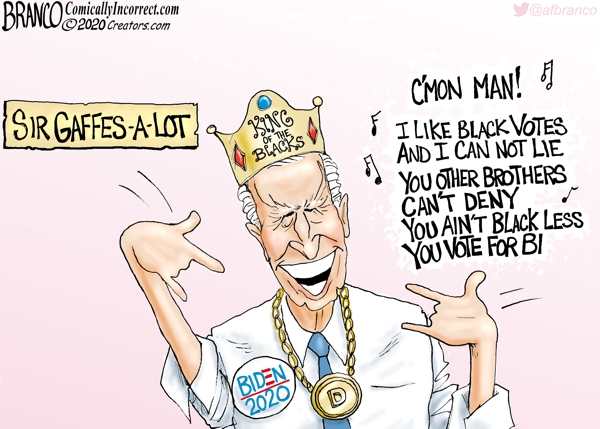 Political cartoon by A.F. Branco ©2020.
 Political cartoon by A.F. Branco ©2020.
 Political cartoon by A.F. Branco ©2020.








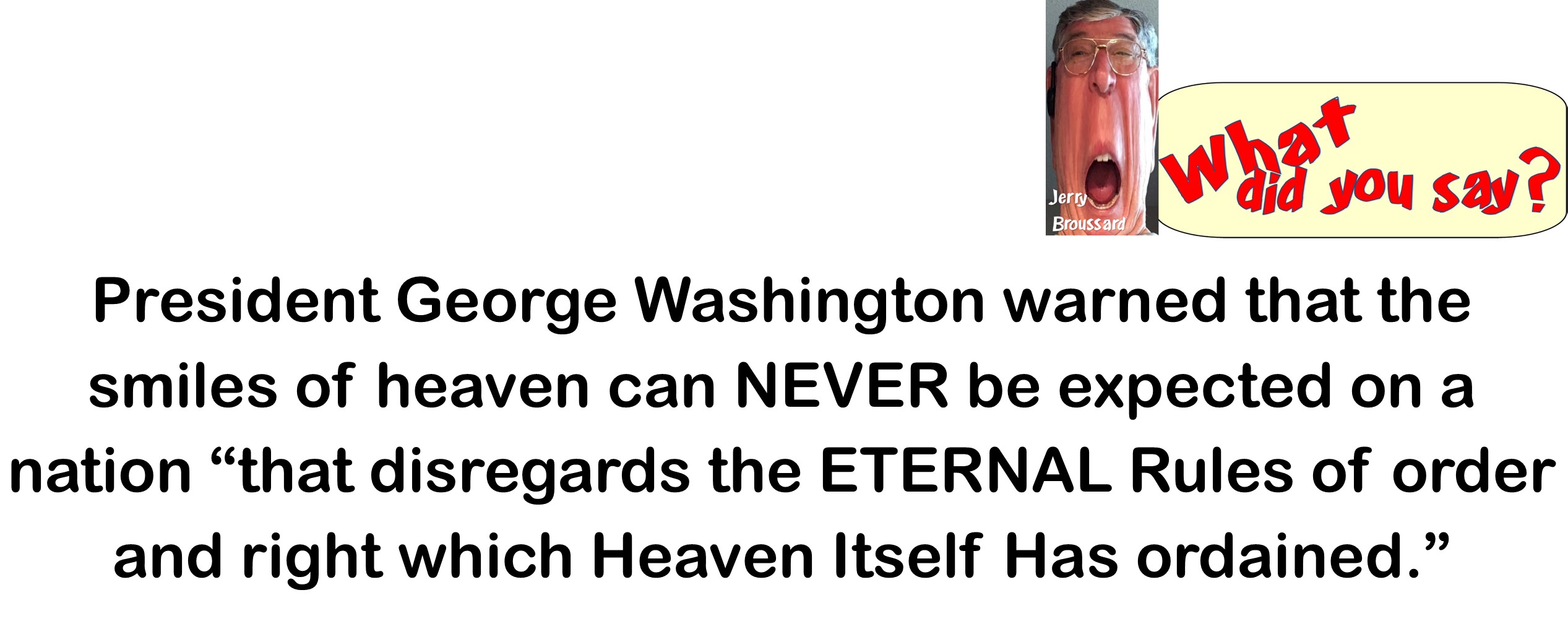









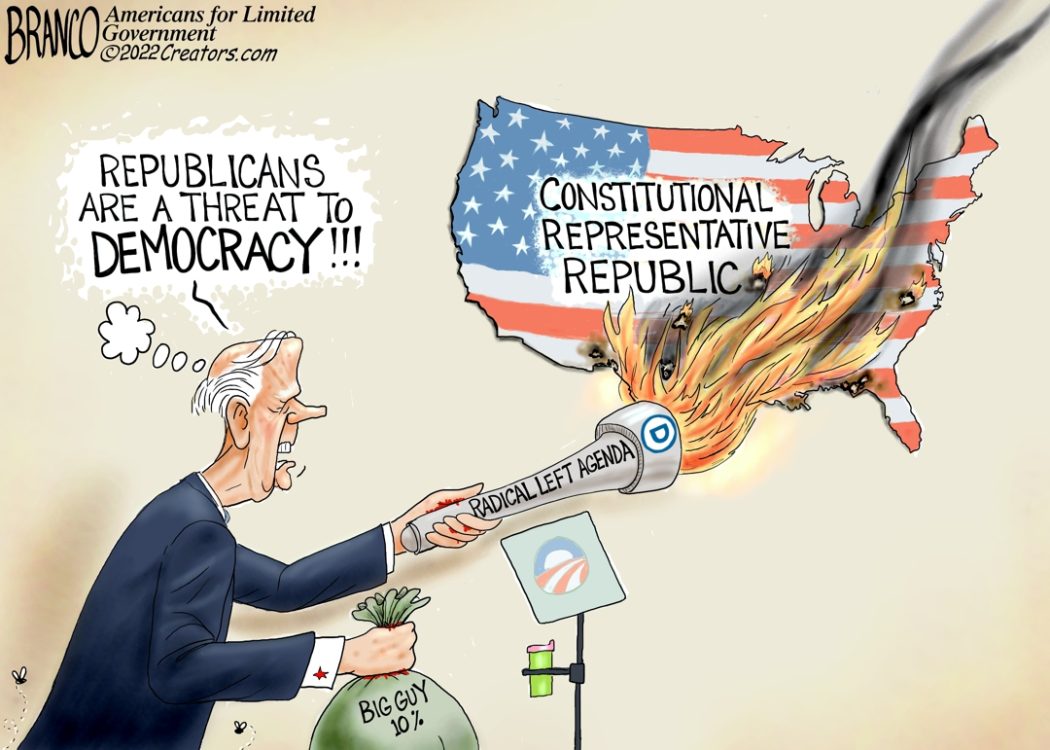
 Political Cartoon by A.F. Branco ©2019.









 after all, survivors of an unspeakable tragedy. They are also public figures and have made themselves so by their decision to lecture Americans on what constitutional and legal rights they should and should not have. The expectation that those they have chosen to lecture ought to sit down and stay silent ignore

 What Did You Say?
Religious tests for holding public office are banned in the Constitution and go against the very core of the American tradition. But you wouldn’t have learned that listening Wednesday to Sen. Bernie Sanders, I-Vt., as he questioned Russ Vought, the nominee for deputy director of the Office of Management and Budget.
His questioning of Vought was nothing less than theological interrogation, and in the end, excoriation.
Here’s what unfolded when Sanders took the mic.
In a disjointed line of questioning that had nothing to do with budgetary issues, Sanders veered into the theology of salvation, singling out an article Vought had written for a conservative publication in 2015 that outlined basic Christian doctrine about God in contrast to the Islamic view.
Here’s the heart of the exchange (transcript courtesy David French of National Review):
This exchange spotlights comprehensive ignorance on the part of Sanders—ignorance of the American tradition, of religious toleration, and even of what religion is. It’s unlikely that Sanders doesn’t realize religious tests for public office are banned in the Constitution. I suspect he would applaud that ban as much as the next person, at least in the abstract.
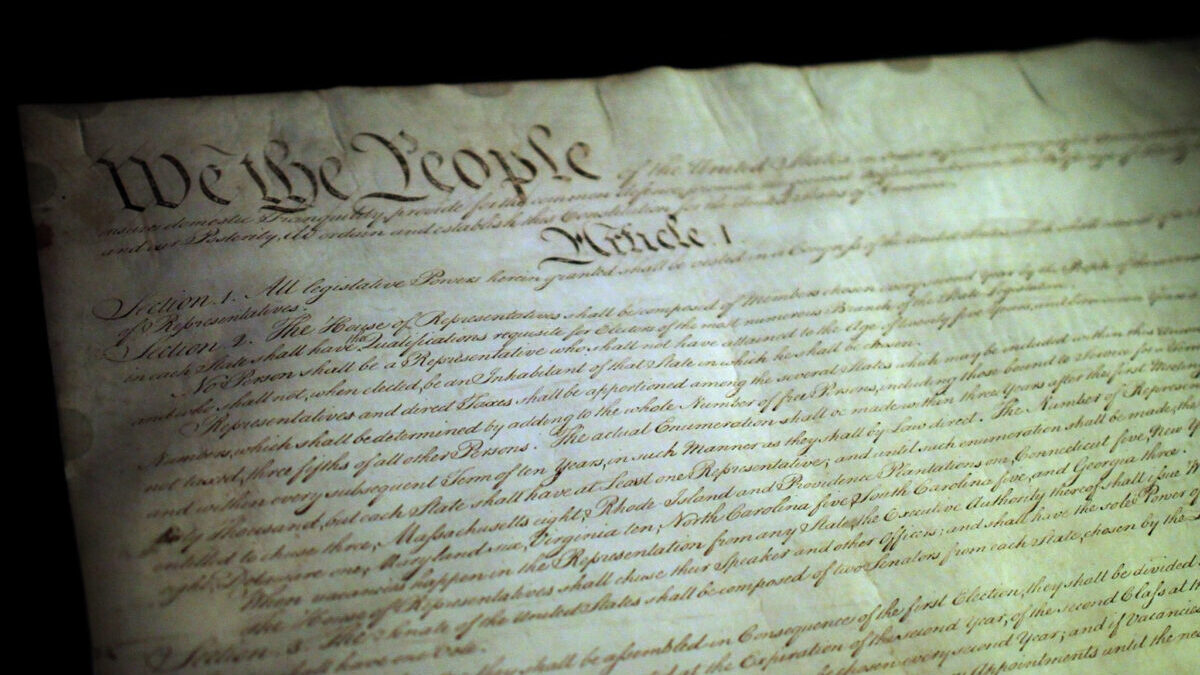
Yet his line of questioning seems to show an ignorance of Article VI of the Constitution, which states that “No religious test shall ever be required as a qualification to any office or public trust under the United States.”
Traditional Believers Need Not Apply
The implications of Sanders’ questioning are far-reaching. If taken to its logical conclusion, Sanders’ view would exclude all orthodox followers of an Abrahamic faith from holding public office.
Every Abrahamic religion—Christianity, Judaism, and Islam, in their historic forms—believes that some people either will, or may be, condemned in eternity. This is Abrahamic Religion 101.
But for Sanders, such mainstream beliefs demonstrate bigotry and racism. Just read the statement his office released after his exchange with Vought:
This statement crystalizes the problem. Sanders wants public officials to have religious freedom, except when their religious views contain something he might consider bigoted, such as a view of hell or condemnation.
What Sanders is really pushing for, whether he knows it or not, is a “Universalists Only” policy for those who would serve in public office. You can believe what you want, as long as your theology doesn’t teach that others might one day be judged.
And with that brush stroke, Sanders excludes historic Christianity, Judaism, and Islam from the public square. Ironically, his view of religion makes little room for some of the most devout followers of religion.
What’s at stake here is meaningful diversity in the public square. As Sen. James Lankford, R-Okla., noted in a statement:
Such beliefs have always been part of the fabric of American public life.
But that doesn’t deter Sanders. Religion that is pure and undefiled in the eyes of Bernie Sanders is progressive, nonjudgmental—in a word, unorthodox. Instead of a government that is truly of and by the people, Sanders’ logic would give us government of and by the unorthodox—a kind of theocracy of the heretical.
Have an Imagination, Bernie
But what is perhaps most tragic here is Sanders’ complete lack of imagination for how people with deep differences in worldview can coexist with each other. In Sanders’ view, if you think others will be condemned in eternity, you cannot possibly love or respect them, let alone live in peace with them. Your belief that they might be condemned is proof enough that you hate them.
But how is that logical? That’s as absurd as saying Joe sees a man in the street who is going to get hit by a bus, and therefore, Joe hates him.
Perhaps Sanders has only encountered hateful examples of religion in his 75 years of life. Perhaps the reason he can’t fathom true religious coexistence in the midst of deep disagreement is that he’s never seen it happen.
Yet it does happen, all the time.
To see a beautiful picture of this, Sanders need look no further than the conservative movement. Conservatives are a diverse smattering of evangelicals, Roman Catholics, Mormons, Jews, and secular Americans. We believe all kinds of things about each other’s eternal fate that Sanders would probably find abhorrent—yet here we are, arm in arm, working for a common political cause.
Sanders’ total lack of imagination here is tragic at a time when America’s ideological center is splintering. We’ve reached a critical time of polarization in which coexistence in the midst of profound disagreement is becoming more necessary than ever.
Yet it seems that only conservatives are prepared to deliver that kind of tolerance. The American left pays lip service to diversity, yet in practice routinely shuns the most important kind of diversity: diversity of viewpoint.
The left is very good at respecting diversity at the level of externals: skin color, religious tradition, ethnicity, etc. But when it comes to actual viewpoints, the left is a seamless monolith and wishes to stay that way.
Sanders is proof of this. He seemingly couldn’t care less whether Vought identified as Protestant, Catholic, Muslim, or Hindu. Those are just externals.
What he really cares about is the substance of Vought’s views. That’s the deep level of disagreement that the American left has not learned to coexist with.
Learning to Practice Actual Tolerance
Sanders’ line of questioning shows an alarming disregard for the Constitution’s ban on religious tests, but it also highlights the deeper problem of our cultural moment. Chiefly, it shows that the left needs to develop a greater imagination for how people with stark differences in worldview—including about other people’s eternal fate—might actually respect one another and live in harmony.
Until the secular left soaks this in, its lip service to diversity and tolerance will remain hollow and vacuous, constantly undermined by its own actions.
Disclosure: Russ Vought’s wife, Mary Vought, works for The Heritage Foundation, the parent organization of The Daily Signal. Russ Vought was formerly employed by Heritage Action for America, the think tank’s lobbying affiliate.
Commentary By
Daniel Davis/ @JDaniel_Davis
Daniel Davis is the commentary editor of The Daily Signal.