
When the Justice System Falls Apart, So Does the Republic
BY: ELLE PURNELL | AUGUST 15, 2023
Read more at https://thefederalist.com/2023/08/15/when-the-justice-system-falls-apart-so-does-the-republic/
 ELLE PURNELL
VISIT ON TWITTER@_ETREYNOLDS
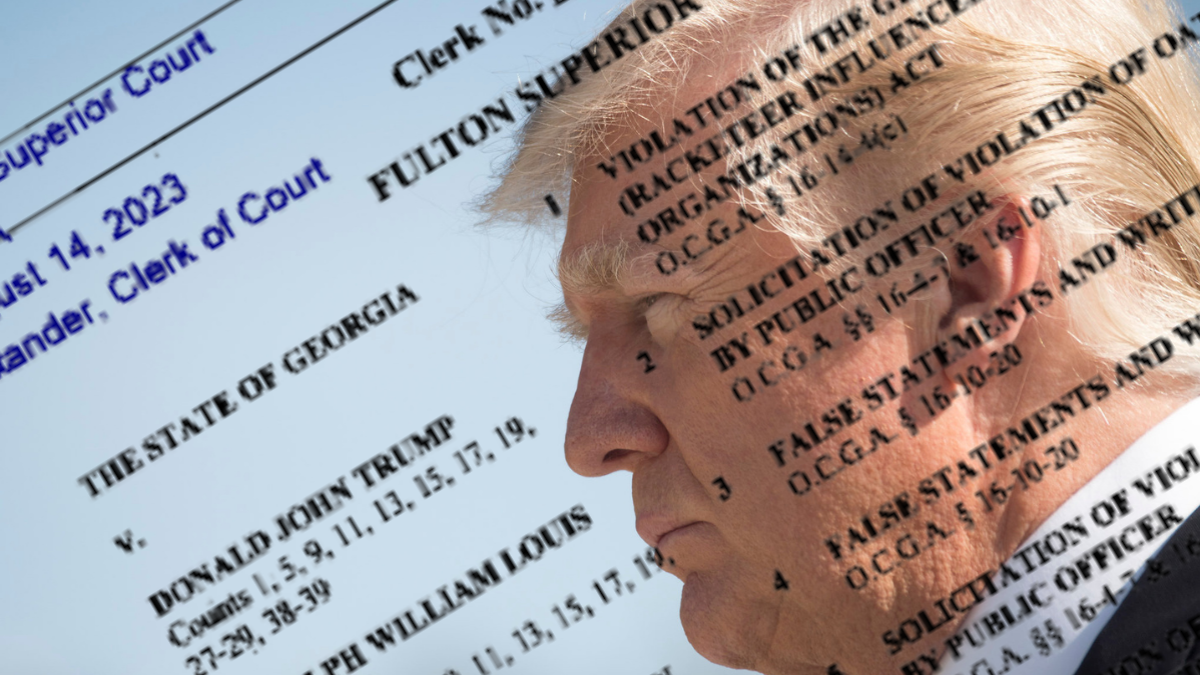
Democrats’ crusade to weaponize the criminal justice system to put their chief political opponent in jail escalated again Monday night, with the release of an indictment pursued by Georgia’s Fulton County District Attorney Fani Willis against former President Donald Trump. The indictment, targeting not just Trump but 18 of his lawyers and advisers, is a clear message that if you’re a Republican, challenging election results — something Democrats have done after every GOP presidential victory this century — is now a criminal offense.

Meanwhile, President Joe Biden’s Department of Justice is tripping over itself to insulate Biden and his son from scrutiny or criminal consequences for their apparent scheme to get rich off of peddling American political influence abroad.
The hacks at DOJ, by the way, also indicted Trump over a classified documents dispute, after raiding his house and rifling through his wife’s closet. Soon after, Biden was found to have classified documents lying around in his garage, but in his case, the feds are content to play nice. Oh, and Hillary Clinton also had a classified records scandal — in which her team destroyed emails and devices with BleachBit and literal hammers — but enjoyed the protection of then-FBI Director James Comey.
Speaking of Hillary, her campaign shopped a fake dossier full of lies about Trump to the FBI, which media and intelligence agencies used to smear Trump as a Russian stooge during and after the 2016 election. FBI lawyer Kevin Clinesmith, the one person handed criminal punishment for the operation, got 12 months probation. Oh, and Hillary was one of many, many Democrats who screeched for Donald Trump’s entire presidency that the 2016 election was stolen and Trump’s win was illegitimate.
[Read next: Hillary Clinton Doubts Election Results While Claiming Doing So Is Treason]
Lest you should think Trump is the only example of the double standard, remember that the DOJ raided the home of a pro-life pastor for pushing a threatening pro-abortion agitator away from his young son, while militant abortion activists firebombed Christian pregnancy clinics. Recall how they charged a man with homicide for defending subway riders from a threatening vagrant, but do nothing to stop criminals who terrorize law-abiding citizens. Think about the ongoing campaign to imprison anyone adjacent to a Republican protest that turned into a mob at the U.S. Capitol in 2021, after letting left-wing protests descend into fiery riots across the country for an entire summer. Excuse me, fiery but mostly peaceful riots.

The message couldn’t be clearer: Republicans can do nothing right in the eyes of the justice system, and Democrats can do nothing wrong. We have a two-tiered justice system, and 4 in 5 Americans know it.
Problems of hypocrisy are another day’s work in politics. The use of the criminal justice system — the leveler on which the basic functions of a society depend — to turn that hypocrisy into arrest warrants is something else entirely.
A functioning justice system is a citizen’s best peaceful defense of his liberty, assuring him that his lawful exercise of freedoms will be protected. There’s a reason four of the 10 original amendments the founders affixed to their newly minted Constitution regard the rights attendant to a fair trial. When the justice system forfeits citizens’ trust, trust in the integrity of the republic itself goes with it.
We don’t have real elections if candidates are jailed — or chilled by the threat of jail — to keep them from running. We don’t have real legal recourse if DAs indict lawyers until other lawyers become afraid to defend an ostracized client. For all Democrats’ pontificating about the rule of law, it doesn’t exist if it’s only applied and misapplied to half the country. If we no longer uphold equal justice under the law, we still have a country, but not the one we thought we had.

As my colleague Joy Pullmann wrote a year ago, “A country that harshly prosecutes people or lets them off Scot-free based on their political affiliation is a banana republic. A two-tier justice system is not a justice system. … Its purpose is not justice but population control.”
A fair justice system isn’t the first thing to crumble in a dying republic — there are plenty of warning signs — but it might be the hardest loss to come back from. After all, the law is supposed to be the authority to which Americans appeal when their rights are abused and trampled. What are they supposed to do when the law and its enforcers are doling out the abuse?








 What Did You Say?
States already do this in the context of child and elder abuse, requiring teachers, administrators, school nurses, and coaches to report suspected abuse to appropriate law enforcement agencies. Failure to report can trigger civil and criminal penalties against the individual and penalties against the institution.
These proposals would take the pressure off colleges to conduct quasi-criminal proceedings, which college administrators are ill equipped to do. No one would expect a college tribunal to handle a murder on campus.
It makes no sense for a college to handle other serious crimes such as sexual assaults and rapes. Rapists are criminals, not just college students who violate a school’s honor code. They should be prosecuted in criminal court, and if found guilty, punished accordingly, including having to register as convicted sex offenders.
But the Obama-era guidance led colleges to steer students away from reporting crimes to the authorities, and required use of the low “preponderance of the evidence” standard of proof when investigating and disciplining students accused of sexual assault.
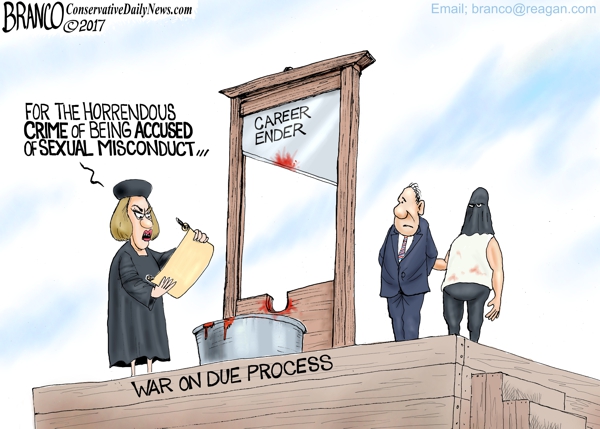
This led to colleges barring an accused student from reviewing the evidence against him or cross-examining his accuser; refusing to allow an accused to hire an attorney or, when attorneys were permitted, prohibiting them from speaking on the accused’s behalf; and implementing other procedures that fly in the face of the protections typically afforded to someone accused of a crime.
The guidance letter received criticism from liberal and conservative quarters, from law professors to think tank scholars to members of Congress and many others.
Law professors at the University of Pennsylvania wrote that this “approach exerts improper pressure upon universities to adopt procedures that do not afford fundamental fairness,” and that “due process of law is not window dressing.”
Harvard law professors similarly decried the procedures as “overwhelmingly stacked against the accused” and which were “in no way” required by federal law. It also led to numerous lawsuits filed by students who were punished in these kangaroo courts.
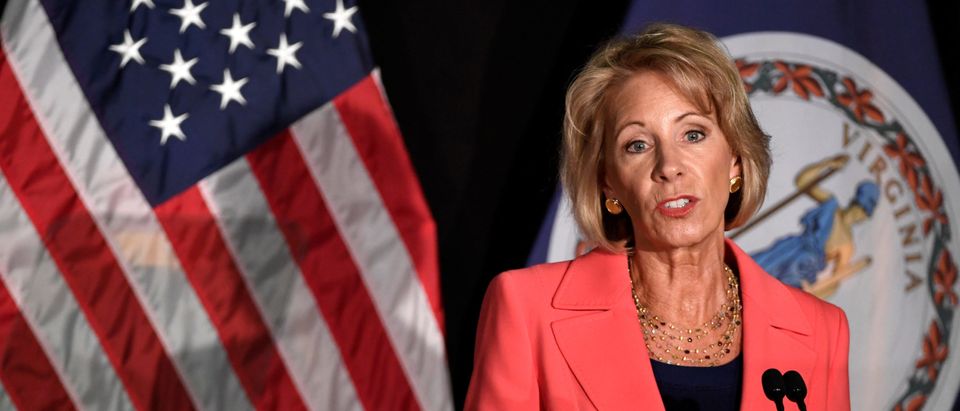
In her speech, DeVos stated, “The notion that a school must diminish due process rights to better serve the ‘victim’ only creates more victims.”
Instead, due process must be “the foundation of any system of justice that seeks a fair outcome. Due process either protects everyone, or it protects no one.”
Sexual assault investigations and adjudications are serious issues that involve complicated procedures designed to get at the truth and prevent further harm to victims and those falsely accused.
Compound this complexity with a massive federal bureaucracy and various interest groups with their own agendas, and it is little wonder that alleged victims, alleged perpetrators, and universities themselves are often left with no clear idea of their rights and responsibilities under the law.
Reversing the ill-advised Obama-era guidance is the first step to ensure that sexual assaults are properly investigated and adjudicated by trained professionals, leaving college administrators, as DeVos said, “to focus on what they do best: educate.”
Commentary By
Hans von Spakovsky/ @HvonSpakovsky
Hans von Spakovsky is an authority on a wide range of issues—including civil rights, civil justice, the First Amendment, immigration, the rule of law and government reform—as a senior legal fellow in The Heritage Foundation’s Edwin Meese III Center for Legal and Judicial Studies and manager of the think tank’s Election Law Reform Initiative. Read his research.
Elizabeth Slattery/ @EHSlattery
Elizabeth Slattery writes about the rule of law, the proper role of the courts, civil rights and equal protection, and the scope of constitutional provisions such as the Commerce Clause and the Recess Appointments Clause as a legal fellow in the Heritage Foundation’s Edwin Meese III Center for Legal and Judicial Studies. Read her research.