Perspectives; Thoughts; Comments; Opinions; Discussions

Posts tagged ‘church’

Politicians Won’t Fix America’s Child Deficit, But Churches Can


By: Nathanael Blake | August 26, 2024

Read more at https://thefederalist.com/2024/08/26/americans-forfeit-hope-by-forgoing-families/

couple sitting on a couch watching Netflix

Author Nathanael Blake profile

Nathanael Blake

More Articles

As Donald Trump and Kamala Harris race for the presidency, their boosters are insisting the stakes couldn’t be higher for the future of our nation. But Americans have already given up on the future and are demonstrating this despair in the most fundamental way: Americans are not begetting more Americans. 

The birthrate in the USA has hit another record low. Though the U.S. is not yet at complete demographic collapse (e.g. South Korea or Japan), American fertility is still way below replacement rate. Regardless of whom voters choose in November, they are already issuing a vote of no confidence in the future by literally refusing to beget people to live in it.

Collapsing fertility will cause a plethora of problems — good luck sustaining economic growth and paying for entitlement programs with an aging, shrinking population. Importing high levels of immigrants to maintain workforce levels is beset with its own difficulties. But highlighting the challenges of a future with few children will not encourage people to have more kids; people will not decide to breed just because it might boost GDP in a few decades. Indeed, dwelling on the problems of a below-replacement world might even be counterproductive from a pro-natal standpoint, as it just reinforces anxiety about the future.

Neither candidate can fix this. Harris may be trying to float on a media froth of “Joy!” but the DNC’s celebration of sterility and abortion, including Planned Parenthood providing not just free vasectomies but even free abortions right outside the convention, is perhaps the most grotesque example of baby-hating anti-natalism ever in American politics. And though the GOP might look better by comparison, Trump has been stampeding the GOP away from social conservatism (to say nothing of his personal example).

Politicians are not going to save America from despairing self-extinction. And tempting as it is, we cannot just blame them for the failures of American men and women to form stable relationships and have children together. Yes, there have been unfavorable cultural, economic, and political forces, but though these may be mitigating factors, they do not negate personal responsibility. Americans have chosen the decline of America.

However, there is an upside to this, which is that we can improve matters without relying on politicians. Yes, political action is important; policies from taxes to education to housing and more matter enormously to family formation and flourishing and thank God for the people doing good work on these issues. 

But we should not sit around waiting for government to fix everything. It is not just that even well-intentioned and generous pro-family policies have often proven disappointing but that individual choices still matter. People can choose to prioritize family life even when culture, policy, and the economy make it difficult. 

However, we need more than just exhortations to individual virtue: We need the help of others. Fortunately, government is not the only domain of collective action. As the process of family formation — from dating to raising children and sustaining a marriage — is breaking down to the point of incomprehensibility in much of our culture, America’s churches in particular have an opportunity to step into the gaps left by the fraying bonds of family and community. 

Men and women need guidance in coming together to form and sustain marriages. Likewise, it is not good for parents to have to handle child-rearing all by themselves. It does take a village — but the government, and especially the federal bureaucracy, is a behemoth, not a village. 

As important as help, from meals to rides to babysitting and beyond, can be, churches can provide that which is even more valuable: instruction, examples, belonging, and love. This community is what will actually make people want to marry, have children, and stay married while raising their kids well. Pundits worrying about the long-term political and economic implications of declining marriage and low birthrates won’t actually do it. What will work is if people believe in family life as important to what it means to live well and if they believe it is not only desirable but also attainable. For this, they need examples and assistance.

To be meaningful, pro-natalism has to mean more than just pumping out babies for the future of the nation. Rather, it must explain why babies are good in themselves and why marriage and parenthood are the vocations to which most of us are called and which we should joyfully embrace. Indeed, this will likely be one of the church’s most effective means of evangelization. Amid our cultural and relational wasteland, it will increasingly fall to the church to teach people how to live well despite the troubles of this life. And valuing babies’ overindulgence, ambition, and avarice is a good place to start.

Even the best efforts may not be enough to save our nation. But it is clear that there is only hope for our nation’s future if citizens place their hope in something greater than America.


Nathanael Blake is a senior contributor to The Federalist and a postdoctoral fellow at the Ethics and Public Policy Center.

Casey Chalk Op-ed: A Church Without God Is Dead On Arrival


BY: CASEY CHALK | SEPTEMBER 15, 2023

Read more at https://thefederalist.com/2023/09/15/a-church-without-god-is-dead-on-arrival/

Unitarian Universalists

Author Casey Chalk profile

CASEY CHALK

MORE ARTICLES

We need a church for the nones, or Americans who say they don’t belong to a particular religion. That’s what The Washington Post’s Perry Bacon calls for in a much-ballyhooed column last month. “Start the service with songs with positive messages. … Reserve time when church members can tell the congregation about their highs and lows from the previous week. Listen as the pastor gives a sermon on tolerance or some other universal value, while briefly touching on whatever issues are in the news,” Bacon suggests. Sunday services would be supplemented by volunteer, community-service activities, he adds.

Bacon, who grew up evangelical, communicates a yearning felt by many Americans in this atomized age. Surgeon General Vivek H. Murthy, in a recent advisory titled “Our Epidemic of Loneliness and Isolation,” asserted: “Religious or faith-based groups can be a source for regular social contact, serve as a community of support, provide meaning and purpose, create a sense of belonging around shared values and beliefs, and are associated with reduced risk-taking behaviors.” Church, even our post-Christian culture can admit, is healthy for us. Sen. Chris Murphy, D-Conn., argued much the same in a June speech, citing the values of churches to address our “epidemic of loneliness” by giving us “connection” and “meaning.”

A church without God, prayer, or the Bible; a church for fellowship not faith, service not sacraments: that’s supposedly what lonely Americans need. Yet can such a civically focused ecclesial institution, or set of institutions, replace our increasingly empty (or repurposed) churches? In fact, they already exist, and have proved just as incapable of replacing the role vacated by that “old time religion.”

Mainline Protestantism Has Already Failed at Church Without God

Some have recommended Unitarian Universalism, which welcomes a wide diversity of religious (or areligious) beliefs as long as their adherents accept various mantras associated with the political left (e.g. “justice, equity and compassion in human relations”). Yet Bacon doesn’t like the fact that the Unitarian Universalist church remains predominantly white and elderly, and lacks activities for children. He also cites a 10-year-old organization called Sunday Assembly that has attempted to establish “nonreligious congregations” around the world, though the group, which promotes “wonder and good” and “celebrat[ing] life,” is attracting few followers.

But let’s be frank. We don’t need to look to secular simulacrums of Christianity to identify craven appeasements to the gods of progressivism. Liberal Protestants long ago capitulated to the gods of the left and are little more than mouthpieces for the Democrat Party. Sure, the “Seven Sisters of American Protestantism” — American Baptist Churches USA, Christian Church (Disciples of Christ), the Episcopal Church, Evangelical Lutheran Church in America, Presbyterian Church (USA), United Church of Christ, United Methodist Church — still profess to uphold biblical doctrines. But would any of these mainline Protestant churches really discipline a member (or even a clergyman) who confessed they didn’t believe in various creedal documents or, for that matter, even Scripture?

Mainline Protestant denominations — or what’s left of them — are swimming with those whose membership is often attributed to the very same things endorsed by Bacon, Murthy, and Murphy. According to Pew, only a little over half said religion was important to their life, about 20 percent prayed little to never, more than half barely ever read the Bible, and 20 percent didn’t believe or didn’t know if heaven existed. And yet, these “tolerant” and “diverse” denominations are hemorrhaging even their like-minded attendees, some losing almost half of their total membership in little more than a decade.

America’s Abandonment of Religion Is About Apathy and Addiction

And it’s not as if the nones are champing at the bit to join secular civic organizations that, denuded of any deity, prayer, or Scripture, still offer camaraderie and community service. Between 2019 and 2021, formal volunteer participation in America fell 7 percent — the largest drop that the U.S. Census survey recorded since it began tracking it in 2002. Covid didn’t help any, but this is not a new trend: Volunteerism has been declining for decades.

No, Americans are not just abandoning God, but each other, escaping into their smartphones and streaming entertainment. “Americans spend an average of 13 hours and 11 minutes a day using digital media,” Forbes reported earlier this year. It’s not only unbelief with whom churches must compete, but Apple, Amazon, and Netflix. Loving your neighbor or the Lord your God doesn’t offer the same dopamine rush as Facebook, Twitter, or Instagram, I’m sorry to say.

This is why a church for the nones is dead on arrival. The nones don’t want it, as even Bacon must admit. “But I’ve not followed through on any of these options,” he writes of trying to find a new “ecclesial” home. “With all my reservations, I don’t really want to join an existing church. And I don’t think I am going to have much luck getting my fellow nones to join something I start. My sense is that … those who aren’t at church are fine spending their Sunday mornings eating brunch, doing yoga or watching Netflix.” Americans are too disenchanted with an “intolerant” and “illogical” religion and too addicted to its chemical proxies to think an areligious alternative will satisfy the longings in their soul. Choosing church for its social utility, liberal pundit E.J. Dionne acknowledges in a recent WaPo column, is not a particularly strong draw.

Only God Can Save Us from Ourselves

More than 16 centuries ago, a North African intellectual and private tutor heard a child playing a game and, curiously, felt compelled to pick up a book of the writings of St. Paul the Apostle. Less than a year later, he was baptized a Christian in Milan, Italy. By the time of his death in A.D. 430, he was already recognized as a man of unparalleled intellectual and moral acuity, as he still is today, even by non-Christians. “You have made us for yourself, O Lord, and our hearts are restless until they rest in you,” St. Augustine wrote in his Confessions, one of the earliest (and greatest) spiritual autobiographies ever composed.

Only when Americans relearn that we are, above all else, made for God, will our personal health improve and our communities once more move with brilliant energy and excitement, unanticipated byproducts of passionately orienting our hearts and minds to the transcendent and its transformative demands. Until then, expect little from ham-handed attempts to fashion church (and spirituality) to our personal preferences and peccadilloes. As a young Augustine himself learned, all that resides in such vain efforts is vapid self-worship.


Casey Chalk is a senior contributor at The Federalist and an editor and columnist at The New Oxford Review. He has a bachelor’s in history and master’s in teaching from the University of Virginia and a master’s in theology from Christendom College. He is the author of The Persecuted: True Stories of Courageous Christians Living Their Faith in Muslim Lands.

Finnish Grandmother Is Back In Court Facing ‘Hate Speech’ Charges For Tweeting Bible Verses


BY: ELYSSA KOREN | AUGUST 11, 2023

Read more at https://thefederalist.com/2023/08/11/finnish-grandmother-is-back-in-court-facing-hate-speech-charges-for-tweeting-bible-verses/

man and woman walking in snow in Finland

ELYSSA KOREN MORE ARTICLES

In 2019, Päivi Räsänen did what any one of us might do — she tweeted at her church. Her tweet was simple and peaceful. She questioned the choice to sponsor a local pride parade. She questioned, was this befitting of their Christian faith? And she attached a scripture passage to the tweet.

Räsänen will be headed to court for the second time on criminal charges of “hate speech.” This longstanding member of the Finnish Parliament, medical doctor, and grandmother has faced onerous prosecution for four years at the hands of Finland’s government for a tweet.

Subjected to 13 hours of police interrogation, authorities dug into her past, charging her with three counts of “agitation against a minority group” for the tweet, in addition to a 2004 church pamphlet and 2019 radio appearance. Bishop Juhana Pohjola of Finland’s Evangelical Lutheran Church also was criminally charged for publishing the pamphlet, which discusses a Biblical-based understanding of marriage and human sexuality. Their charges carried with them tens of thousands of euros in fines and even the possibility of a two-year prison sentence.

In March of last year, the Helsinki District Court delivered a unanimous acquittal, stating clearly that, “it is not for the district court to interpret biblical concepts.” However, the law in Finland allows for legal double jeopardy — prosecutors can appeal all the way to the Supreme Court on the mere basis of dissatisfaction with the verdict. On Aug. 31, Räsänen and the bishop will be back in court once again. Their legal defense is supported by ADF International.

Without free speech, there can be no freedom, and the enormous implications of this case for fundamental freedoms have triggered international outrage. Finland, regularly ranked as the “happiest” country on Earth, is known as a stable bastion of European democracy. If this can happen there, then we must all beware.

On Aug. 8, 16 U.S. members of Congress, sent a letter to Rashad Hussain, U.S. ambassador–at–large for international religious freedom, and Douglas Hickey, U.S. ambassador to Finland, in response to Räsänen’s “egregious and harassing” prosecution. The letter highlights the severity of what’s at stake: “This prosecutor is dead set on weaponizing the power of Finland’s legal system to silence not just a member of parliament and Lutheran bishop but millions of Finnish Christians who dare to exercise their natural rights to freedom of expression and freedom of religion in the public square.”

Free speech is a preeminent American value, but also one well-protected in international law. The U.S. should always stand against the criminalization of peaceful expression and especially should raise concerns when violations of free speech occur in countries we view as allies, especially on human rights. As the legislators’ letter states, “No American, no Fin, and no human should face legal harassment for simply living out their religious beliefs.”

Now is the time for the Biden administration to speak out loud and clear. While the administration has acknowledged that it has privately raised concerns over Räsänen’s case with the Finnish government, it is vitally important that the U.S. government take a public stance in defense of free speech so under threat in this case.

With regard to Räsänen’s case, the legislators’ letter makes clear, “The selective targeting of these high-profile individuals is designed to systematically chill others’ speech under the threat of legal harassment and social astigmatism.” Historically, the U.S. has been the strongest bulwark against international violations of freedom of speech. In standing up for Räsänen, the U.S. government would in turn send a signal that it is standing up for the right of every person who feels the rapidly encroaching winds of censorship.


Elyssa Koren is director of legal communications for ADF InternationalADF UK is supporting the legal defense of Isabel, Adam, and Father Sean. Follow her on Twitter: @Elyssa_Koren

Too Dead to Live and Too Alive to Die, Gen Z is Generation Zombie


BY: FORREST ROBINSON | APRIL 13, 2023

Read more at https://thefederalist.com/2023/04/13/too-dead-to-live-and-too-alive-to-die-gen-z-is-generation-zombie/

zombie crew walking toward the camera
An undead generation has emerged — a horde of Gen Z zombies mindlessly marching, ready to mobilize but not thrive.

Author Forrest Robinson profile

FORREST ROBINSON

VISIT ON TWITTER@FOZ89107323

MORE ARTICLES

Does Generation Z take anything seriously? Earnestness is “cringe,” being in love makes one a “simp,” and ambition makes one a “try-hard.”

There is a “deeper ideology lurking in the minds of younger millennials & Gen Z,” as Esmé Partridge writes, “the rejection of idealism in all its forms.” Disenchanted with the world, plagued by hopelessness and nihilism, we have become a generation of zombies — a group of youth that is too dead to live and too alive to die. 

No Purpose or Place

In the 1920s, famed novelist F. Scott Fitzgerald described his lost generation as one that had “grown up to find all gods dead, all wars fought, and all faith in man shaken.” 

A century later, Gen Z finds itself in a similar position. The past haunts us, and a stormy future looms over the horizon. Even in our happiest moments, we’ve come to expect something bad just around the corner. Anxiousness afflicts many Zoomers — more than half of us already think humanity is doomed.

Though we share similarities with past generations, Gen Z is unique. Some argue Zoomers will eventually outgrow their crazy beliefs in the same way hippies eventually got jobs and created families. Millennials, however, are only getting more liberal as they age, breaking one of the oldest rules in politics. According to a recent Gallup poll, roughly 1 in 5 Gen Z adults says he or she is LGBTQ.

First and foremost, Gen Z craves distinction. They want to differentiate themselves from the masses by changing the world through fighting climate change, institutional racism, capitalism — you name it. This might explain why 1 in 4 people aged 16-25 wants to become an influencer when he or she grows up.

Why the thirst for power and status? Humans need goals that require effort to attain. We are like archers who need a clear and higher target. The popularity of figures such as Jordan Peterson shows that, especially for young men, it is no longer clear what that target is.

A Developmental Crisis

In the book “iGen,” Jean Twenge observes that more than previous generations, Zoomers aren’t growing up. We don’t have a meaningful target anymore. Gen Z is dating less, quitting jobsnot attending church, and spending half its waking time online. If Zoomers need attention, they use Instagram. Bored? Netflix or Youtube. Horny? Pornhub. Hungry? UberEats.

It’s not surprising that pundits like Jesse Singal and Jonathan Haidt blame social media for Gen Z’s stunted growth. Apps such as TikTok and Instagram have no doubt profoundly affected us, but blaming social media for Gen Z’s mental health epidemic is only half-correct.

Before we had Instagram, we had liberalism. As Patrick Deneen once wrote, “It is less a matter of our technology ‘making us’ than of our deeper political commitments shaping our technology.”

Jaded and Conformist

Inauthenticity has reached its peak with Gen Z. To be part of the in-group, a Zoomer must adopt a live-and-let-live attitude and remain blasé at all times, unattached to all people and things. Like Gen X, they avoid sincerity, choosing instead to be ironic, humorous, or just plain passionless.

For Zoomers, being serious is “cringe.” They dislike partisan politics because it’s rooted in taking differences seriously. Gen Z is disproportionately liberal not because they are passionate card-carrying Democrats — although some of them are — but because they are apathetic. They just want to be left alone by what the media portray as Bible thumpers, old white politicians, and conservatives. 

It is revealing that the only time Gen Z ever seems mobilized to take things seriously is when a police officer kills a black man or abortion is restricted. Gen Z is so well catechized into its political religion that within minutes, like a flock of sheep, millions of Zoomers suddenly start sharing infographics, donation pages, and memes all over social media. Gen Z only cares about a particular issue when a so-called victim group is allegedly oppressed, or there’s a threat to its autonomy. As soon as the latest political trend goes away, Zoomers stop caring.

A Generation Without Love

The sexual revolution of the ’60s didn’t bring about communism, as Wilhelm Reich hoped, but capitalism in the sexual market. Now driven by a desire for recognition, Zoomers want sexual empowerment above all else.

To that end, Zoomers avoid caring about finding relationships. As one study found, “only one in 10 Gen Z members say they are ‘committed to being committed,’” preferring solitude (or situationships) to real relationships. 

Since seeking commitment is now perceived as exerting pressure, young people must put up a facade of unseriousness and just look for green flags so as not to alienate the person they desire.

Even in a relationship, the psychoanalyzing doesn’t cease. Zoomers analyze texts, obsess over appearance, and worry that their romantic interests are dating other people from Tinder. This perpetual state of uncertainty is so exhausting that many are choosing to either throw out sexual rules completely or abstain from relationships altogether.

Repressed and Insecure

With religious values and sexual norms no longer fixed, many Zoomers struggle to nail down a sense of worth and are thus insecure. Not expressing their real personalities or feelings, these Zoomers live in a perpetual state of “LARPing” and suffer from main character syndrome.

Given their repression of “cringe” thoughts and feelings the in-group might not like, Gen Z’s higher likelihood of engaging in self-harm is unsurprising. To escape the torturous emptiness so many Zoomers find themselves in today, many reach for a razor blade or a smartphone. Either Zoomers gobble down drugs for mental illness, harm themselves, or vainly attempt to produce a sense of self with endless selfies and videos for their followers.

The Zoomers’ obsession with “mental health” and “normalizing” certain behaviors is a byproduct of their unstable self-image. Without knowing how to make sense of their emotions, they outsource the task of understanding themselves to therapists. 

Godless and Selfish

More than anything, Gen Z wants to feel alive. They turned out in droves to support BLM in 2020 because it enabled them to experience the emotional highs and lows of religion without the responsibilities. As Twitter user Zero HP Lovecraft wrote, “Christians are persecuted by bureaucrats, tamely and passively,” while black people “are persecuted by cops with guns and gas grenades. … Only one of these is exciting.” In other words, one belief system feels boring and uninteresting, the other eventful and real — hence why many gravitate toward the latter.

Even many modern so-called Christians, as Rod Dreher observed, use religion as “a psychological adjunct to life, a buffer to the harshness of the materialistic, individualistic lives they actually want to lead.” In the context of Zoomers, that makes religion — and its secular woke derivatives — a supposed stimulant for attaining health and well-being. Since Gen Z now worships the “God within,” there has been a rise in gnostic beliefsself-improvement and wellness cults, astrology and tarot, and, of course, LGBT orthodoxy.

In our post-religious society, life has been reduced to a biological process that must be optimized for the sake of social approval. Instead of prayer, we use painkillers. Instead of aspiring toward good works that glorify God, we engage in meaningless activities that glorify ourselves. And out of that reality has emerged the next undead generation. The horde of Gen Z zombies is mindlessly marching, ready to mobilize but not thrive.


Forrest Robinson is a student at Gordon College in Wenham, Ma. He frequently posts threads on his Twitter @Foz89107323.

If Your Kids Are Unhappy, Take Them to Church


BY: MARY ROSE KULCZAK | DECEMBER 28, 2022

Read more at https://thefederalist.com/2022/12/28/if-your-kids-are-unhappy-take-them-to-church/

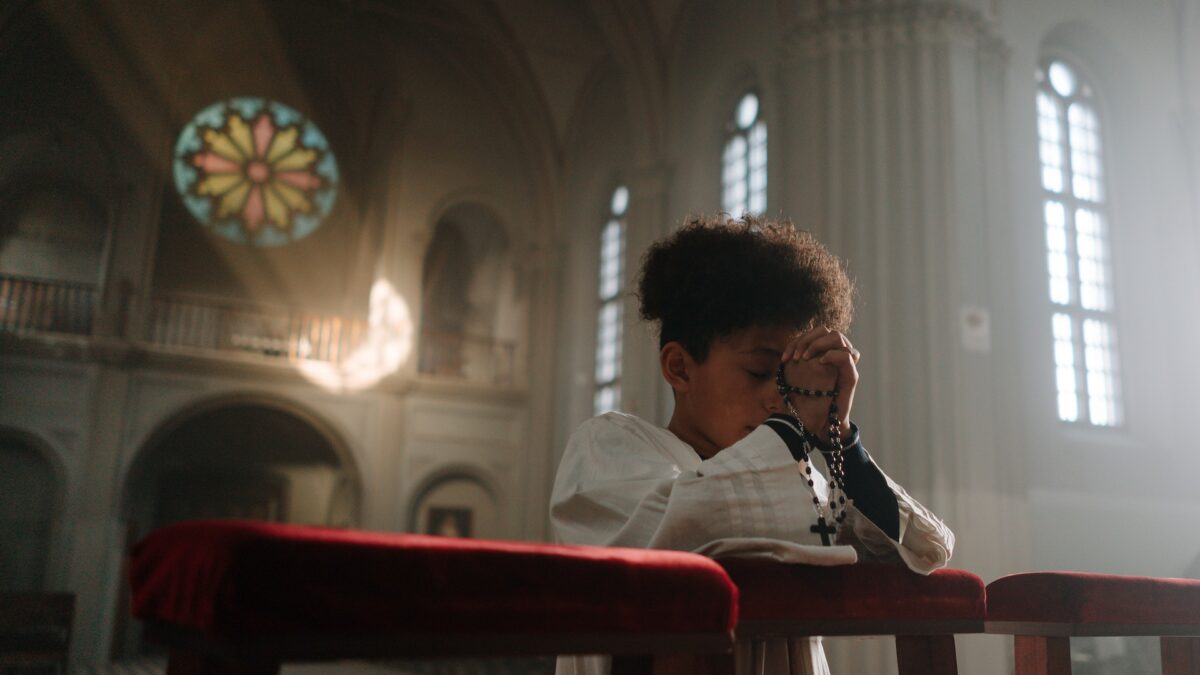
Altar boy praying in church with his rosary
A huge burden could be lifted from our children if they had a place to go each week that offered them grace and refuge from anxiety.

Author Mary Rose Kulczak profile

MARY ROSE KULCZAK

MORE ARTICLES

It seems like every time I turn around, an editor assigns me a story related to the mental health crises of our children. Most of the health experts I speak to correlate Covid lockdowns and our children’s fragile state. Closing schools played a major role in this phenomenon, but what if other crucial factors are being overlooked?

Another story, seemingly unrelated to the mental health crisis, is making the rounds in the corporate press. Church attendance is on a rapid decline. The “nones,” survey respondents who say they have no religious affiliation, are the fastest-growing group in the United States every year. We now have a generation of adults that grew up not attending worship services weekly, and they are raising their children in a similar fashion. 

The “nones” seem to prefer a parenting style that says: “We’re fine without church and worship and religious instruction and institutions, thank you very much.” But they are not fine. Their children are not coping and managing the day-to-day stresses and inconveniences thrown at them. They are fragile and increasingly so. 

The “nones” will tell you it is because we need to better embrace children’s differences and preferences (like their pronouns) while empowering them with positive affirmations and encouraging personal acceptance through self-esteem workshops. We clutter their calendars with sports, theater, STEM clubs, and dance classes. If none of that pans out, we allow our kids to self-medicate with hours spent on social media.

Parents will do all of this, but won’t take their families to church. Yet research shows that children who attend weekly worship services have higher GPAs, score higher on standardized tests, and are less likely to be held back a grade. They also are more likely to achieve a bachelor’s degree in college.

So why aren’t parents taking their children to weekly worship?

When surveyed, parents often respond that their children and teens do not want to attend worship. This democratic approach to family decision-making only seems to apply to church attendance, however. For other important decisions like wearing a seatbelt or vaccinations, parents balk at giving their children voting privileges. A child’s vote carries more weight when it aligns with a parent’s desire to stay home in pajamas on a Sunday morning.

Why should church attendance be considered a powerful tool for parents to boost their children’s mental health? We can look to the research for the answer.

In a 2018 study, Harvard’s T.H. Chan School of Public Health found some surprising benefits to children and adolescents who attend weekly worship. It turns out that children and teens who attend church grow up to be young adults with higher rates of reported happiness and life satisfaction. They were less likely to suffer from anxiety and depression, less likely to use illicit drugs, and less likely to engage in early sex and contract sexually transmitted infections.

In addition, these same young adults were more likely to embrace volunteering and reported feeling a sense of mission and purpose than their non-church-attending counterparts.

With all of these positive outcomes for children who attend weekly worship, should we be surprised that children who do not have a similar structure in their lives experience an inverse phenomenon? Is it any wonder that anxiety and depression among children and teens are on the rise when every day, their still-forming brains are bombarded with information about doom and destruction while they drown in a sea of gender confusion and racial animus?

We think we can combat all the negativity by telling children: “You are perfect! You are awesome! You keep being you!” We put these pithy platitudes on T-shirts and backpacks and stickers with unicorns and rainbows. At the end of a bad day, our kids know that this is no substitute for the real deal.

Each of us knows these sentiments are superficial. We are poor, miserable sinners in need of forgiveness. Where do we go with all our baggage when the church is not an option? We go to therapists and pharmacists, but trends show that the last place parents want to go is the place actually offering a solution.

What could families find at church that they won’t find anywhere else? Hopefully, something that is woefully lacking in the world around them: the truth.

Newsflash, kids! You are not perfect! You know that mean thing you did to your classmate in the cafeteria? That was a sin. And that nasty thought you had about that person? That was a sin. And the snide comment you made to your mom when you were hangry? Yep. Are you starting to see a pattern here?

Good news: you’ve come to the right place! Jesus came for sinners. As a matter of fact, the church is filled with them. Each week, they come to hear the message that even though we are sinful human beings, Jesus died for those sins. When we confess those nasty thoughts and horrible things we did, we can receive forgiveness — a clean slate! 

Will we mess up again on Monday? Of course. But that’s why we can look forward to church. Can we try harder to be better people? Kinder people? Yes, we can. Does our forgiveness depend upon what we do and how we perform each week? Nope. You are forgiven because God loves you that much, so much that he sent his son to take the punishment that should have been yours and mine.

Imagine what a burden could be lifted from our children if they had a place to go each week that offered them that grace. How much better could they cope with a bad day, knowing that each moment offers a fresh start? How much more resilient could our children become?

Parents, we put our children at a disadvantage when we do not give them the very thing they need for their mental and spiritual health. It is time to put a new priority on the family calendar every Sunday. If we won’t do it for ourselves (and we should), let’s do it for our children. The next generation depends on it.


Mary Rose Kulczak is a writer for various parent and child publications. She is a wife and mother of three sons, and currently resides in Saline, Michigan.

Church Leaders Who Cancel Christmas Services Are Clinging To Government Lies, Not Christ


Church Leaders Who Cancel Christmas Services Are Clinging To Government Lies, Not Christ

The Supreme Court’s ruling last Wednesday against discriminatory targeting of religious groups with COVID-19 restrictions marked a significant victory in the ongoing battle to preserve religious liberty. Since the outbreak of the pandemic, hostile stakeholders in public office have assaulted the first freedom through superciliously labeling religious services “nonessential.” Christians in much of the country now find themselves in the demeaning and intolerable position of being allowed to worship only in the manner and on terms dictated by politically motivated governors.

Respecting authorities’ claims about an unknown disease made sense early in the outbreak, but now after better scientific information shows many initial fears are false. Yet politicians refuse to come clean while ignoring their own rules forbidding us from fulfilling our Christian duties. So it is time for us once again to assert that church is the most essential activity, period. Instead of valiantly fighting in the vanguard, however, many religious leaders have quickly retreated.

It is one thing for a church leader to prayerfully consider the individual needs of his church, striving to maintain unity among members in disagreements, protecting the health of the vulnerable, and offering stability amid uncertainty. It is quite another for shepherds to forsake the assembling of their flocks and enable the propaganda that congregating freely to worship God is selfish and “could kill grandma.” This unbiblical stance also overlooks the hypocrites in public office and the media who don’t even play by their own silly rules and ignore the data, for much lesser purposes than the health of our souls.

Many such religious leaders are neglecting the soul-saving mission of the church. The notion that being a good Christian requires indefinite cessation of communal worship — and for Catholics, the suspension of the sacraments — to prevent the spread of illness is a falsehood that has confused the faithful and undermined religious freedom.

Supreme Court Upholds Religious Liberty

In the case brought by the Orthodox Jewish group Agudath Israel of America and the Roman Catholic Diocese of Brooklyn, New York, against Gov. Andrew Cuomo, the Supreme Court held that “the restrictions at issue here, by effectively barring many from attending religious services, strike at the very heart of the First Amendment’s guarantee of religious liberty.” In a concurring opinion, Justice Neil Gorsuch posed a pertinent rhetorical question: “Who knew that public health would so perfectly align with secular convenience?”

Gorsuch held that “the only explanation for treating religious places differently seems to be a judgment that what happens there just isn’t as ‘essential’ as what happens in secular spaces.” He warned that “in too many places, for far too long, our first freedom has fallen on deaf ears.”

For several months now, elected officials and many church leaders around the country have flagrantly ignored religious liberty. States such as California, Oregon, and Washington have witnessed a new wave of post-election crackdowns on religious services. In San Diego County, churches are currently prohibited from holding indoor services. Meanwhile, a San Diego court just issued a temporary order exempting coronavirus restrictions from applying to a strip club, ruling that such entertainment constitutes “constitutionally protected speech.”

In Oregon, new restrictions limit faith-based gatherings to a maximum of 25 people regardless of church size but allow businesses to continue operating at a reduced percentage of their total capacity. Archbishop of Portland Alexander Sample rightly argued that allowing a measly 25 worshipers in a cathedral that can seat 1,000 isn’t data-driven and doesn’t make sense.

The Church Is Essential

expressed concern back in May about politicians labeling religious services “nonessential” and allowing the state to determine on what terms churches can hold services. At that time, Washington bishops effectively thumbed their noses at President Trump for declaring that state governments should allow houses of worship to reopen.

The bishops instead hitched their wagon to Gov. Jay Inslee’s rogue horse. Hence six months down the road, Inslee again targeted Washington churches as part of his latest round of arbitrary fiats. Church capacity is reduced to 25 percent, and congregational and choral singing is prohibited.

Meanwhile, the very authorities who tut-tut and wag fingers clearly don’t adhere to or believe in the merits of their own nonsense rules. Sanctimonious public officeholders have lectured us about keeping business closed, taking unemployment on the chin, staying home, and wearing masks while they visit salons, attend private dinners, and jet off out of state for holidays with family. The duplicity of notorious mask shamers such as CNN’s Chris Cuomo and White House correspondents Kaitlan Collins and Jonathan Karl has similarly been on display.

The hypocrisy is not limited to the secular sphere. Pope Francis condemned peaceful lockdown protests despite the World Health Organization’s warning against using lockdowns as the primary means of controlling the virus. Francis believes that closing churches, businesses, and schools, and forcing people out of work are all “necessary for people’s protection.” He has even canceled public celebration of Christmas liturgies at the Vatican.

Yet Francis didn’t appear particularly worried about Wuhan virus transmission when, free from any semblance of social distancing and masks, he enjoyed a cozy chat about poverty and social justice with a group of handsomely paid NBA players and fellow pals of the Chinese Communist Party. Evidently, on protecting the freedom to assemble, to provide for one’s family, and even to freely worship, government-imposed restrictions are non-negotiable, but when it’s about racial and economic politics, the holy grail of neo-Marxists, lockdowns are a suggestion only.

Against this backdrop, Christians should be prepared for the usual suspects in public office and the press, facilitated by an array of religious leaders, to crack down on Christmas celebrations. We will no doubt hear more of the “we do this not out of fear but out of love” mantra. Given, however, that the survival rate is 94.6 percent for those 70 years and older and between 99.5-99.997 percent for those 69 and younger, rapid breakthroughs in therapeutics have been announced, three reportedly effective vaccines are on the way, and government authorities are flouting their own restrictions, the “love thy neighbor” lecture is becoming as tedious as it is false.

Christians Need Church to Obey God’s Commands

The Gospels tell us the greatest commandment is to love the Lord our God with all our heart, soul, and mind. We cannot fulfill the second greatest commandment to love our neighbor as ourselves if that love is not solidly founded in an encounter with God. This means gathering with the faithful in sung praise and thanksgiving, as we read in Psalms and was the custom from the earliest church, as well as explicitly commanded in scripture.

The Greek word for church, “ekklesia,” comes from the Old Testament and originally referred to the assembly of the people of Israel. When St. Paul first used the term, he intended it as the new community of believers in Christ. This “ekklesia” is not a human association borne of common interests and beliefs but a summoning by God himself.

For Catholics, the encounter with God is achieved even more profoundly through the sacrament of the Eucharist. Jesus is literally and wholly present — body and blood, soul and divinity — under the appearances of consecrated bread and wine. Whatever way you look at it, religious services are essential, and church leaders should say so.

Religious leaders must get their priorities straight. No doubt, pastors are genuinely concerned for the health of the most vulnerable in their communities and trying to accommodate the confusion and fears of their congregants. Some must feel their hands are tied by unsupportive leadership. Still others, I suspect, find themselves effectively cornered by congregants whose political indoctrination runs deeper than their catechesis.

Nevertheless, the role of preachers is to win souls for Christ, not to protect us or themselves from physical infirmity. St. Paul urges a return to God through Christ and cautions against domination by earthly pleasures and preoccupations. In other words, if, as St. Ambrose of Milan taught, we have a wound to heal, Christ is the doctor; if we are parched by fever, he is the spring; if we fear death, he is life; and if we are in darkness, he is light.

After a dismal year, and in sober anticipation of Joe Biden’s threatened “dark winter,” it is more important than ever for Christians to unite in praise of the Light that shines in the darkness and which the darkness has never put out. We should demand that our religious leaders mark the Nativity with fitting pomp and ceremony and refuse to support churches whose pastors spread or cower behind the lie that the celebration of Christmas is nonessential.

ABOUT TYHE AUTHOR:
Carina Benton is a native Australian living in Washington state. She is a practicing Catholic and has taught for many years in Catholic and Christian schools. She is a mother of two young children.
Photo Pikist

Church Vandalized In An Attempt To Silence Their Complaints


Posted by | September 10, 2019

URL of the original posting site: https://thepatriotchronicles.com/news-for-you/church-vandalized-in-an-attempt-to-silence-their-complaints/

A California church found out the hard way that the LGBTQ community does not take kindly to an opposing view. South Bay Pentecostal Church was vandalized after a pastor complained that “Drag Queen Storytime” with children is inappropriate.

A Los Angeles area church was vandalized over the weekend after opposing city-run events where men dressed in drag read books to children at public libraries.
A pastor of the South Bay Pentecostal Church said he believes “there is no doubt” the crime was committed against the house of worship for their opposition to “Drag Queen Storytime,” according to ABC 10 News San Diego.
The incident is being investigated by police as a possible hate crime.
“Sure enough, at every corner, there were phrases, hateful words, and graffiti on the walls of our church,” said pastor Amado Huizar. The messages were reportedly “associated with Satan,” according to the ABC affiliate.
“Huizar said the church’s surveillance system captured two men parking their sedan in the church parking lot at around 3:00 a.m. Sunday and walking toward the building,” the report detailed. “Fifteen minutes later, they are seen jumping back into the car with what looked to be spray cans in their hands.”

Huizer has been vocal in his opposition to taxpayer-funded drag queen events for children, deeming them age-inappropriate.”

“If the people want to make that happen, do it at a private setting, at a book store or at a home, but not at the Chula Vista Public Library,” Huizar said.
“I’m all about diversity. I am all about inclusiveness,” Huizar said. “When you do something like a ‘drag queen story hour,’ you are excluding a segment of the populous who are not in favor of this because of what we experienced today or scared to speak out.”

Despite what happened, Huizar said he will not back down.

“I’m very sad,” Huizar said. “I’m heartbroken, but I am going to continue to speak.”

The LGBTQ and Liberals are supposedly all about the rights of people but when someone makes one complaint or speaks a concern, they are targetted. This is just another example of the left and their divisive nature, where it is their way or the highway. But this is only natural for a true blue state like California.

Apostasy Cannot Unseat Truth


Commentary by Dr. Michael Brown Guest Blogger, Distinguished Author, Speaker and Christian Apologist | Monday, June 19, 2017 @ 1:51 PM

Apostasy Cannot Unseat Truth

There’s a bizarre argument I’m hearing these days which basically goes like this. “Look at how many churches are embracing homosexual practice. This proves we’re getting closer to the truth.” To the contrary, all it proves is that more and more churches are apostasizing. The logic behind this argument is as wrongheaded as it is unbiblical.

First, to argue that greater acceptance of homosexuality by churches is proof of spiritual growth is like arguing that greater acceptance of obesity by doctors is a proof of medical progress. The reverse is actually true.

Second, the Bible often warns us against compromise and apostasy, both moral and creedal. And in every generation, there have been heretics who have departed from the faith. Should we therefore celebrate every heretical doctrine and practice as proof of our spiritual maturity?

Jesus warned His disciples, saying “See that no one leads you astray” (Matt. 24:4). He also said, “And many false prophets will arise and lead many astray. And because lawlessness will be increased, the love of many will grow cold. But the one who endures to the end will be saved” (Matt. 24:11-13).

What is to be celebrated, then, is not apostasy but faithfulness, not deception but steadfastness, not moral laxity but moral firmness. And while the words of Jesus may have more specific application to certain times in history, there is certainly a general application to our day, in which “lawlessness” has greatly increased. Today, just about anything goes, and that is not something to celebrate.

Last month, the gay activist organization Faith in America announced its plans to call on the Southern Baptist Convention to remove homosexual practice “from the sin list.”

“Ultimately,” they said, “we at FIA believe LGBT people should be removed from the sin list. We know interpretations and new revelations come to light. We believe the Church will one day stop diminishing the lives of those who are LGBT and we strive to help this come to pass. We are optimistic people and see the glass 75% full!”

So, they are encouraged by what they have seen in recent years, as more and more churches in America and Europe are dropping homosexual practice “from the sin list.” Soon enough, they believe, the whole Church will follow suit. To paraphrase (but in my words, not theirs!), “We’re encouraged by the increasing apostasy we see in the Church, and we’re expectant that one day, the whole Church will be completely apostate.”

The facts are as follows.

First, as I’ve stated repeatedly, “no new textual, archeological, sociological, anthropological, or philological discoveries have been made in the last fifty years that would cause us to read any of these biblical texts differently. Put another way, it is not that we have gained some new insights into what the biblical text means based on the study of the Hebrew and Greek texts. Instead, people’s interaction with the LGBT community has caused them to understand the biblical text differently.”

The truth, then, hasn’t changed. Instead, some professing Christians have departed from God’s unchanging truth because of personal relationships and cultural decline.

Second, most church groups that have removed homosexual practice from the sin list are in numerical and spiritual decline. In contrast, most church groups that are holding to biblical truth and practice, especially overseas, are growing numerically and spiritually.

Third, the embrace of homosexual practice cannot be separated from the larger cultural embrace of the sexual revolution. This includes an increase in sex out of wedlock, babies born out of wedlock, pornography, and divorce, along with the embrace of all kinds of sexual perversions. That’s why the same society that celebrates same-sex “marriage” is increasingly celebrating polyamory, polygamy, and consensual adult incest. (I’ve documented this in many articles and several books. See, conveniently, the relevant chapters here.)

This points to spiritual and moral regress, not progress.

Fourth, the idea that the whole Church will one day embrace homosexual practice is as certain not to happen as the idea that the whole Church will one day deny Jesus. Forget about not holding your breath. Don’t even think about holding your breath.

It’s certainly possible that, in some locations, increasing parts of the Church will fall away, and this will be marked by numerous moral and spiritual compromises. But the notion that the whole Church will fall away is completely self-contradictory, since if there is a true Church, it has been established by Jesus Himself. And it was He who said that He would build His church and that “the gates of hell shall not prevail against it” (Matt. 16:18).

But it is not only theologically ignorant to imagine that the Church worldwide will one day embrace homosexual practice. It is also missiologically ignorant, since wherever the Church is growing worldwide, it is growing with a conservative message and morality.

I truly believe that the leaders of groups like Faith in Action mean well and believe they are doing God’s work. That makes their self-deception all the more tragic.

How Does Growing Apostasy Prove That Christians Are Getting Closer to the Truth?

Tag Cloud