Read more at https://thefederalist.com/2022/07/12/will-the-u-s-fall-just-as-rome-did/
When will we — or did we — pass the point of no return? Should we expect our own Julius Caesar? Rome’s example can furnish some guidance.

SPENCER KLAVAN
MORE ARTICLES
When exactly was Rome’s republic doomed? That ancient question has a special urgency now, as our American republic seems to be flirting with its own downfall. When will we — or did we — pass the point of no return? Maybe Rome’s example can furnish some guidance.
By the time Julius Caesar rose to prominence in Rome, the republic was so warped that few informed observers expected it to last the century. Rome’s borders had exploded outward during the 200s and 100s B.C. Legislators had devised a plan to distribute newly acquired land more or less equally among the citizenry, making room for an expanding population and a healthy middle class. But wealthy patricians, exploiting loopholes in the system, sucked up vast tracts and cultivated them with imported slave labor. Soldiers who fought to capture new territory found themselves dispossessed of it upon their return home.
Eventually a charismatic nobleman, Tiberius Gracchus, gave eloquent voice to the common people’s discontent, earning election as their official representative — a tribune of the plebs. In “Life of Gracchus,” the biographer Plutarch attributes to Tiberius a memorable policy speech in which he lamented that “men who fight and die for Italy enjoy shared access to air and sunlight—but nothing else.” His proposed solution was a land redistribution scheme, which met with furious opposition from those who stood to lose property.
Debates Settled by Sword
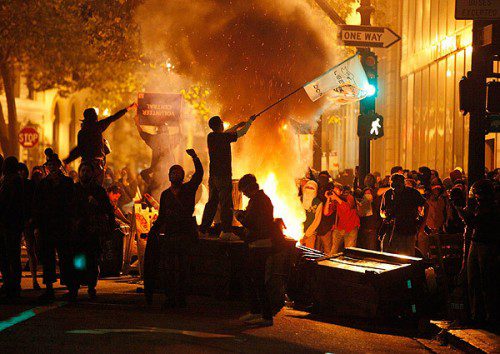
In hot pursuit of his aims and convinced of their virtue, Tiberius bent the rules of Roman politics almost to the breaking point. He ejected a fellow tribune from office and ran for what was probably an illegal second term as tribune. Things turned violent in the summer of 133 B.C., when Tiberius was clubbed to death by his senatorial detractors in a riot over the reelection campaign.
Until then, it had been understood that debates were not to be settled at sword-point. “There was no civil slaughter in Rome until Tiberius Gracchus became the first victim,” writes the Greek historian Appian in “Civil Wars.” Looking back, Tiberius’s death seemed like the beginning of the end. His brother Gaius proposed still more aggressive land reforms, which amounted, in the words of the great historian Theodor Mommsen in “History of Rome,” to “nothing other than an entirely new constitution.” When Gaius died in another political melee, a true crisis was underway.
The old constitutional system was hemorrhaging public trust, yet proposals for a new one only seemed to make things worse. Attempts to reimpose order through unilateral rule, most notably by the general Lucius Cornelius Sulla, ended in more bloodshed and recrimination. By the 50s B.C., bribery and threats of violence were standard electoral operating procedures. Corruption, always a feature of republican politics, became its essence. “Intelligent men,” wrote Plutarch in “Life of Caesar,” “would be happy if nothing worse than a monarchy resulted from this deranged state of affairs.” In the chaos, it was clear that a daring statesman — if he combined the popularity of a Gracchus with the military ruthlessness of a Sulla — stood a chance of seizing total control.
Rise of Julius Caesar
That statesman was Julius Caesar. As governor of the Gallic provinces, Caesar was granted authority by appointment to wage war in the regions north and west of a little stream called the Rubicon. Up there, for nearly ten years, he performed spectacular feats of domination and amassed an unstoppable fighting force. Then, in the winter of 49 B.C., the conquering hero returned to seek election as consul, the city’s highest office. He brought his army with him.
It was a severe breach of Roman law for anyone but an elected magistrate to lead military operations in Italy proper. But that is what Caesar now threatened to do, in part because his only remaining rival, Pompey the Great, stood at the head of his own army. The senate, acting collectively as a rather feckless middleman in this standoff between two giants, demanded that Caesar dismiss his troops before entering Italy and face trial for prior breaches of protocol. Caesar suspected this was a ruse designed by Pompey to strip him of his power — as he put it to his soldiers, “Pompey had been led astray by Caesar’s enemies through envy.” When negotiations collapsed, Caesar gathered his troops and marched across the Rubicon.
It is at this point that Caesar is supposed to have quoted the Greek playwright Menander: anerriphthō kubos, “let the die be cast.” Or, in the more famous Latin version recorded by the imperial court historian Suetonius in “Lives of the Caesars,” iacta alea est. The dice are rolled, and the rest is up to fate. But Caesar himself left behind no written record of any such momentous proclamation. The Rubicon moment only took on its quasi-legendary status years later, after Pompey lost the war and Caesar was named “dictator for life.” His heir Octavian would still have to fight another civil war to become Rome’s first emperor. But in retrospect, it came to look as if that one fateful river crossing sealed Rome’s fate.
Destined to Decay?
Did it? Or was the fall already foreordained long before Caesar? To many ancient philosophers, it seemed that governments inevitably declined and passed away in a process called anacyclosis — the cycle of regimes. This was a tragic view of life, informed as much by playwrights like Aeschylus as by historians like Herodotus. These observers saw arrogance and self-interest as fatal human flaws that consigned even the greatest civilizations to eventual replacement. “Everything that exists falls victim to decadence and change,” wrote the historian Polybius in “Histories,” his comprehensive account of anacyclosis.
Both Rome’s republic and ours were intended to forestall such decay by balancing the strengths and weaknesses of the three basic forms of government — monarchy, aristocracy, and democracy — against one another. An executive (for us, the president) leads his country as a monarch might, especially in times of war. Yet his power is restrained by a chosen few, the legislators, who are in turn accountable to the people — theoretically.
Our Oligarchs Bidding for Control?
But republics have their own vulnerabilities, one of which is despotic ambition among the rich and powerful. As Machiavelli observed, the “corrupt and insolent behavior” of those “undertaking to retain power” can be fatal to a republic’s legitimacy. When state authority becomes a mere pretext for class hierarchy, as the Gracchi suggested it had in Rome, the system starts to look like a sham.
Some would argue that this is exactly our situation. The ideological capture of major corporations and media outlets, the relentless exportation of American jobs and importation of foreign labor, the pretextual use of Covid-19 to transform election procedures, leaving them highly vulnerable to fraud — all these trends, and others besides, indicate that our elites are making a bid for oligarchic control.
Perhaps Donald Trump, then, was a kind of Gracchus — giving voice to justified populist frustration, encountering relentless subversion by entrenched state actors, then getting both implicated and defeated in a disastrous season of politics by riot. If so, then is our Caesar next? “We think we’re in a democracy; we’re actually in an oligarchy,” said the provocative theorist Curtis Yarvin recently. “The only thing that you’re left with, if you don’t like the way this oligarchy is trending, is…monarchy.”
Our Rubicon Moment
And yet… even in late stages of decline there is still that Rubicon moment, the moment before the end is set in stone. Both Suetonius and the last great republican, Cicero, suggested that Caesar might not have been destined to deal the republic its death blow. It was a choice he made, dictated more by ambition than by necessity. For there was another snatch of verse that shaped his career, besides Menander’s words of resignation. Apparently, Caesar never forgot the moment in Euripides’ tragedy, “Phoinissai,” when the would-be autocrat Eteocles says: “if we must ever do wrong, it is best to do it for the throne.” Like Eteocles, Caesar chose power over what was right.
He could have chosen otherwise, and so can we. Our own national lore begins with the inverse of that Rubicon story — with a man who led an army but foreswore a crown. George Washington is the foundational American hero because he surrendered sovereignty to the people when he could almost certainly have seized it for himself. The Supreme Court’s recent decision in Dobbs v. Jackson Women’s Health shows that this American spirit is still alive in some corners of our government. In Roe v. Wade, the Court unjustly usurped the prerogative to legislate about abortion. But Dobbs returned that prerogative to elected representatives. It is still possible to resist the will to power in the name of the common good.
And so, the most important line in “Phoinissai”for usis not the one Caesar kept close to his heart. A few lines later there comes a response from Eteocles’s mother Jocasta, who presents her son with a choice: “do you wish to rule your city or save it?” That is the choice each of us must face, in whatever sphere of influence is ours, if we hope to remain Americans. From the statesman to the average voter, from the Rubicon to Washington, D.C., nothing is written in the stars until it happens. We can still choose to live free.




.jpg)

















 Reported By
 Chambers and Lorraine Heist exchanged vows and toasted the crowd with cans of Budweiser on Sunday, May 29, 2016 in the Marine’s usual 23rd Street spot just before the annual Rolling Thunder ride commenced, according to
 Andrew Follett, Energy and Environmental Reporter, 06/20/2016


 BY:
BY: 
 Nearly half of Washington, D.C. employers said they have either laid off employees or reduced the hours of employees to adapt to the District of Columbia’s minimum wage hikes since 2014, according to
  $11.50 per hour. Mayor Muriel Bowser


 Chuck Ross, Reporter 06/24/2015


 What Did You Say?
Jack Smith Resigns as Special Counsel Amid Controversy Over Trump Cases
| American Patriot
Read more at https://libertyonenews.com/jack-smith-resigns-as-special-counsel-amid-controversy-over-trump-cases/
Jack Smith, the controversial special counsel tasked with investigating former President Donald Trump’s attempts to challenge the 2020 election, has officially stepped down. His resignation comes just weeks before President-elect Trump is set to take office, sparking heated debates over the legitimacy of the cases brought against Trump and their broader implications for justice in America.
Conservative commentator Mark Levin, host of LevinTV, was quick to weigh in, calling Smith’s resignation both predictable and overdue. Levin minced no words in his criticism, declaring that Smith’s departure underscores the collapse of the legal efforts aimed at Trump. “You know why? It’s simple. He’s an unconstitutional prosecutor. Donald Trump’s going to fire his ass,” Levin said.
Levin argued that the cases against Trump were doomed from the start, pointing to internal Department of Justice (DOJ) memos and procedural violations. He highlighted the dismissal of one of Smith’s cases in Florida as a clear sign of their instability.
Levin accused the DOJ and Smith of pursuing Trump with the sole intent of derailing his political career. He claimed this approach not only violated DOJ policies but also undermined the integrity of the judicial system.
Smith’s cases focused primarily on Trump’s efforts to challenge the 2020 election results, actions Levin described as entirely lawful and historically common.
Levin highlighted past instances where election challenges were not only permitted but celebrated by political leaders. He cited Al Gore’s legal battle in Florida during the 2000 presidential race and efforts in Minnesota that ultimately handed Al Franken a Senate seat.
Smith’s resignation has fueled speculation about its timing, particularly given Trump’s imminent return to power. Critics argue that Smith’s exit may be an attempt to avoid the embarrassment of being fired by the incoming administration or to shield himself from further scrutiny. Supporters of Trump see this as vindication of their belief that the legal cases against him were politically motivated and lacked substance. Levin emphasized that the abrupt nature of Smith’s departure only reinforces this narrative.
Smith’s resignation is part of a larger debate over the role of the justice system in political matters. Critics argue that targeting Trump for challenging the 2020 election has set a dangerous precedent, effectively criminalizing actions that were previously considered routine aspects of political contests. As Smith steps aside, attention shifts to how Trump’s incoming administration will handle the fallout. Levin and others are urging Trump’s attorney general to launch investigations into the motivations and conduct behind Smith’s cases, with some calling for accountability measures to restore public trust in the justice system.
For Trump, Smith’s resignation marks a significant victory, further energizing his supporters and reinforcing his narrative of political persecution. Yet it also raises questions about how his administration will navigate the legal and political challenges that remain.
The stage is set for a dramatic showdown as Trump prepares to re-enter the White House, with Smith’s resignation serving as a powerful symbol of the broader battles yet to come.
Share this:
Category:
corruption, Law, Political
Tagged with: