Perspectives; Thoughts; Comments; Opinions; Discussions

Posts tagged ‘SCREEN TIME’

Sen. Hawley Humiliates Mark Zuckerberg For Lying About How Big Tech Hurts Kids


BY: JORDAN BOYD | JANUARY 31, 2024

Read more at https://thefederalist.com/2024/01/31/sen-hawley-humiliates-mark-zuckerberg-for-lying-about-how-big-tech-hurts-kids/

Mark Zuckerberg

Republican Sen. Josh Hawley forced Meta CEO and Facebook founder Mark Zuckerberg to publicly apologize to the families of children victimized by his company’s addictive algorithms and practices.

During opening remarks to the Senate Judiciary Committee on Wednesday, Zuckerberg, who is on the record as encouraging his kids to play outside instead of use screens, falsely claimed social media doesn’t damage many kids’ happiness and health.

“Mental health is a complex issue, and the existing body of scientific work has not shown a causal link between using social media and young people having more mental health outcomes,” Zuckerberg said.

When Hawley pressed Zuckerberg about the statement later in the hearing, Zuckerberg doubled down.

“What I said is I think it’s important to look at the science. I know it’s — people widely talk about this as if that is something that’s already been proven and I think that the bulk of the scientific evidence does not support that,” Zuckerberg replied.

Hawley spent the next five minutes citing Meta-funded studies that find the opposite. One internal research project conducted by Meta in 2021 determined one in three teenage girls struggling with body image “reported that using Instagram made them feel worse.”

“Teens blame Instagram for increases in the rate of anxiety and depression. This reaction was unprompted and consistent across all groups,” a slide summarizing the study noted.

Wall Street Journal analysis of the study warned that Meta researchers “repeatedly” found that Instagram “is harmful for a sizable percentage of [young users], most notably teenage girls” but did nothing about it.

Zuckerberg tried to dispute his own company’s findings, but Hawley did not let his excuses slide.

“You’re here testifying to us in public that there’s no link. You’ve been doing this for years. For years, you’ve been coming in public and testifying under oath that there’s absolutely no link, your product is wonderful, the science is nascent, full speed ahead. While internally, you know full well your product is a disaster for teenagers,” Hawley countered, which elicited a round of applause from viewers.

“That’s not true,” Zuckerberg replied.

Hawley didn’t let Zuckerberg’s protests stop him.

“That’s not a question. Those are facts, Mr. Zuckerberg,” Hawley said, before continuing to list evidence that Meta knows its products endanger their users.

He listed several statistics uncovered by former Facebook executive Arturo Béjar. Béjar testified to a Senate subcommittee last year that high percentages of teen girls were exposed to nudity, unwanted sexual advances, and self-harm content within the last seven days on Meta social media platforms.

“I know you’re familiar with these stats because he sent you an email where he lined it all out. I mean, we’ve got a copy of it right here. My question is, who did you fire for this and who got fired because of that?” Hawley asked.

Zuckerberg danced around the question several times before Hawley answered it for him.

“You didn’t fire anybody, right? You didn’t take any significant actions,” Hawley said.

When Zuckerberg tried to deflect because he didn’t think it was “appropriate” to talk about his hiring and firing decisions, Hawley did not hold back.

“You know who’s sitting behind you? You’ve got families from across the nation whose children are either severely harmed or gone. And you don’t think it’s appropriate to talk about steps that you took? The fact that you didn’t fire somebody?” Hawley asked. “Let me ask you this. Have you compensated any of the victims?”

Zuckerberg confirmed he has not.

“Don’t you think they deserve some compensation for what your platform has done? Help with counseling services help with dealing with the issues that your service has caused?” Hawley pressed, noting that profit drove Meta’s decisions.

As Zuckerberg fumbled for a response, Hawley demanded he turn towards the gallery of onlookers and apologize to the families of children Big Tech has helped harm.

“There’s families of victims here today. Have you apologized to the victims? Would you like to do so now? Well, they’re here. You’re on national television,” Hawley said. “Would you like now to apologize to the victims who have been harmed, but you’re not showing the pictures? Would you like to apologize for what you’ve done to these good people?”

Zuckerberg stood, turned away from his mic, and told the parents holding pictures of their children’s faces that he understood “your families have suffered.”


Jordan Boyd is a staff writer at The Federalist and co-producer of The Federalist Radio Hour. Her work has also been featured in The Daily Wire, Fox News, and RealClearPolitics. Jordan graduated from Baylor University where she majored in political science and minored in journalism. Follow her on Twitter @jordanboydtx.

Author Jordan Boyd profile

JORDAN BOYD

VISIT ON TWITTER@JORDANBOYDTX

MORE ARTICLES

Study: Outside of School, America’s Teens Average 70 Hours Per Week Glued to Screens


BY: JOY PULLMANN | OCTOBER 31, 2022

Read more at https://thefederalist.com/2022/10/31/study-outside-of-school-americas-teens-average-70-hours-per-week-glued-to-screens/

little girl on smartphone
America’s young people are wasting almost all of their waking free time on entertainment instead of personal development or service to others.

Author Joy Pullmann profile

JOY PULLMANN

VISIT ON TWITTER@JOYPULLMANN

MORE ARTICLES

Americans ages 11 to 18 play online for an average of 10 hours per day, according to a study out today by a research team that includes psychologist Jean Twenge, author of “iGen” and “Generation Me.”

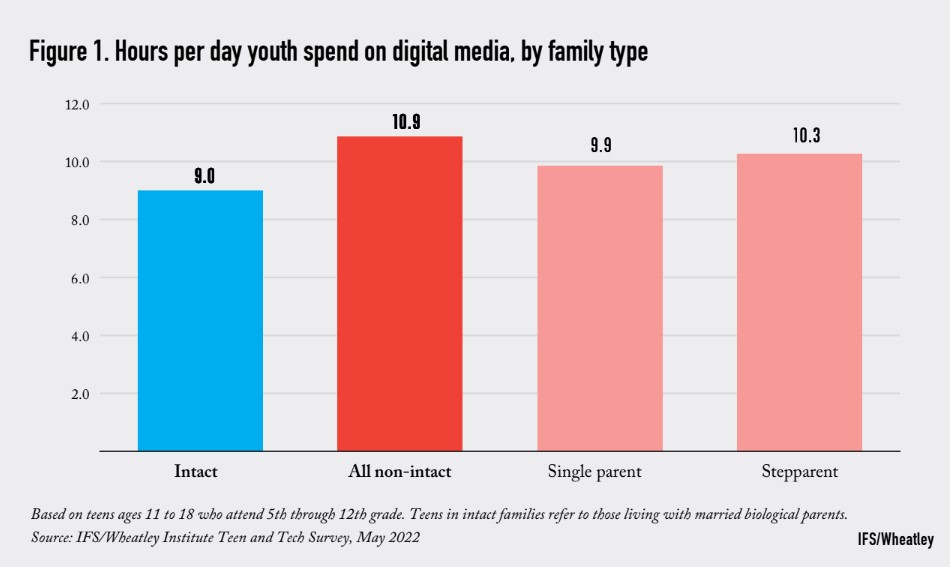
The researchers surveyed 1,600 Americans ages 11 to 18 in May 2022. On average, the study participants reported using digital media an average of 10 hours and four minutes per day, on such entertainment activities as social media, video chat, texting, shopping, and gaming.

That’s a total of 70 hours per week spent online, approximately double the average time spent in school. If teens were suddenly banned from screen time, they could use the time freed from solely that to instead hold down both a full-time and a part-time job. Some of this average may include multitasking, such as texting while scrolling Instagram, the study said, but this total of 70 hours per week spent on screens also did not include time spent watching TV.

Low-Class Behavior Rampant in Middle Class

The researchers say their Institute for Family Studies and Wheatley Institute study is the first to examine the effects of family structure on young people’s screen time. They found that teens living with their own biological and married parents still spent an astonishing amount of time on screens, at an average of nine hours per day. Still, that was nearly two hours fewer per day, on average, than children living without a biological parent, who spent an average of 11 hours per day online.

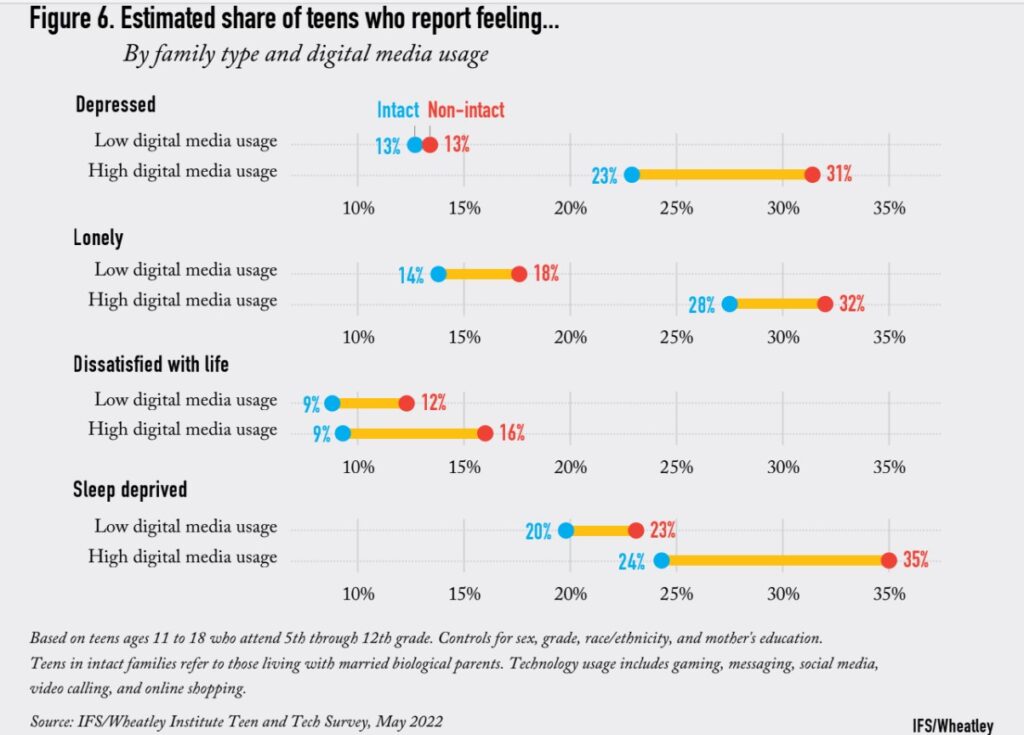
“The adolescents most likely to be depressed, lonely, and dissatisfied with life are heavy digital media users in stepparent, single-parent, or other non-intact families,” write study authors Twenge, Wendy Wang, Jenet Erickson, and Brad Wilcox. “The link between excessive technology use and poor mental health is larger for youth in non-intact families compared to those in intact families.”

So, according to this study’s findings, children in intact families spend an average of 63 hours per week amusing themselves online, while children in broken families spend an average of 77 hours per week amusing themselves online. The study discovered “especially large differences by family structure in youth time spent on gaming and texting. For example, youth in stepfamilies report spending about 50 minutes a day more texting than youth in intact families.”

Other studies on children’s screen use reinforce this finding — that America’s young people are wasting almost all of their waking free time on entertainment instead of personal growth or service to others. As this IFS/Wheatley study points out, this shift has happened extremely quickly, and it’s not all because of the 2020-2022 Covid lockdowns that also arrested American children’s development. Between 2009 and 2017, “the time high school students spent online doubled.”

The study points out that high screen time for adolescents is correlated with depression, loneliness, lack of sleep, and negative body image. It does not mention the opportunity cost of diverting young people’s free time to entertainment consumption instead of personal development that benefits others, such as learning to repair bicycles, playing outside, testing out jobs through work and internships, or working to save for college or marriage.

The study recommends that parents keep electronic devices out of kids’ bedrooms at night, limit screen time to a few hours per day, delay smartphone access to age 16 or 18, keep kids off social media as long as possible, and arrange for their kids to make friends with kids in families with similar boundaries about tech use to help their children socialize with people instead of robots.

Unchallenged mass tech addiction is one more way our morally bankrupt ruling class incentivizes destructive lower-class behaviors instead of encouraging lower classes to raise their standards. This works to erase the middle class by indulging laziness, like the shameful “quiet quitting” PR campaign. This is another form of societal suicide. Laziness cannot maintain, let alone keep advancing, the United States’ world-class level of scientific and cultural advancement.

Nothing worth having comes without strenuous and sustained effort. Internet addictions erase not only willpower but also self-discipline, excellence, and the communication skills needed to work with others and sustain key relationships such as marriages, as Twenge and others’ academic work shows.

This Is a National Crisis

If a child played with Legos for 10 hours a day, every day, his parents or teacher would have him screened for autism and developmental delays. If a child played pretend for 10 hours a day, at any age, he’d be sent to the school psychologist.

If your child did anything for 10 hours a day, you’d be worried about him and work strenuously to bring some balance to his life, for his own good. Parents need to man up and do the hard work of tightly restricting the addictive side of the internet from their kids, for not only their own good but for the sake of our country. Even 30 hours of screen time a week is obviously excessive for kids. Seventy hours of screen time a week is completely out of control, the willful destruction of our future.

“If an unfriendly foreign power had attempted to impose on America the mediocre educational performance that exists today, we might well have viewed it as an act of war,” wrote the National Commission on Excellence in Education in the famous 1983 report, “A Nation At Risk.” “As it stands, we have allowed this to happen to ourselves.”

The same sentiment applies to today’s American youth, but in a far more advanced condition. If a foreign nation had imposed on Americans the destruction of our mental and moral capacity that results from such rampant internet addiction as this study explores, we’d consider it an act of war. In fact, it’s pretty clear that our top foreign adversary created an addictive social media app for the same reason it helps Mexican drug cartels ship fentanyl across our border: because China knows that if they destroy America’s future, they rule the world.

The only thing standing between them and your kids is you, parents. Maybe a few elected officials could stand with us and take down these internet monopolies that make bank strip-mining our future, or at least require real proof of parental consent for children to use addictive tech products, such as a tiny credit card payment. But don’t wait for others to do your job for you. Put down your phone, grab your kids, and make your family motto the title of one of my childhood books: “Do Something Besides Watching TV.”

If your children enter adulthood having done nothing with 25,000 hours of their lives they can never get back, and with their brains destroyed by internet slot machines, that’s on you. You’re the one paying for their phone and letting them self-destruct. Tell them to get a job or read some books or do anything but sabotage themselves and our society. If you don’t, you deserve to be judged the same way as moms who put Mountain Dew in their babies’ bottles.


Joy Pullmann is executive editor of The Federalist, a happy wife, and the mother of six children. Here’s her printable household organizer for faith-centered holidays. Sign up here to get early access to her next ebook, “101 Strategies For Living Well Amid Inflation.” Her bestselling ebook is “Classic Books for Young Children.” Mrs. Pullmann identifies as native American and gender natural. She is the author of several books, including “The Education Invasion: How Common Core Fights Parents for Control of American Kids,” from Encounter Books. Joy is also a grateful graduate of the Hillsdale College honors and journalism programs.

Watching Phones Instead of Reading Good Books Is Starving Kids’ Souls


BY: KATIE SCHUERMANN | OCTOBER 11, 2022

Read more at https://thefederalist.com/2022/10/11/watching-phones-instead-of-reading-good-books-is-starving-kids-souls/

young man on his phone

Author Katie Schuermann profile

KATIE SCHUERMANN

MORE ARTICLES

Consortium for Classical Lutheran Education 2022 conference. It is excerpted here with CCLE permission.

My husband pastors a campus church at a Big Ten university, and we live amongst college students. It is a blessed life, one in which our evenings are longer and our mornings shorter, all because we have the privilege of fostering 50-plus Gen Z-ers in the faith.

What passion and curiosity reside in the hearts and heads of our young people! But do you know what else resides there? Fear and distrust of most everything coming out of the mouth of anyone older than them.

For so many of these students grew up reading, hearing, watching, and absorbing stories that assert that they are omniscient, that no outside source is as trustworthy as their own feelings. They are certain they know what is best for themselves, and anyone who asserts otherwise is an indoctrinated false prophet of the dead past who simply refuses to sing along with Elsa, “Let it go.”

How did these young people come to trust their own corrupted gut more than the wisdom of their parents? I suspect it has something to do with Cinderella, Ariel, Elsa, and Anna; as well as Monica, Ross, Rachel, Phoebe, Joey, and Chandler; and “Modern Family,” “Sex and the City,” “Parks and Recreation,” Marvel movies, and even “Veggie Tales,” for many of our present college students were raised in homes dominated by screens.

Much of their free time was spent absorbing serial television, and while not every televised program, movie, and YouTube channel necessarily tells false stories, much of modern programming follows a storytelling formula that ensures the pet social agendas of screenwriters are always being covered in the plot and in ways that narrate lies surrounding sexual identity, the sanctity of life, the good order of creation and marriage, the strength of men, and the reality of absolutes.

Stories have always been a part of how we pass down what is good and beautiful and true to our children, but depending on the storyteller, this practice can corrupt as easily as benefit. As more and more families turn over the care of their children to institutions, programs, clubs, teams, and devices, parents are no longer controlling the narrative of the stories being passed down to their children.

The loudest, most powerful propagandist holds the bullhorn, and he makes sure the story’s plot fits his personal agenda, no matter if it is evil and ugly and false. This proves especially dangerous in the classroom, where most children spend the greater part of everyday away from their parents.

We now have generations of children raised by bullhorns, and it is commonplace for a child to be occupied by some sort of program every moment of every day, whether it is a daycare program, school program, televised program, sports program, or an arts program — you name it. Many of today’s college students have had few opportunities in life to grow bored, to daydream, and to experience what happens to their bodies and minds and emotions when not occupied. They seem to have missed out on what used to be standard human experiences such as unregulated play, relating to peers of all shapes, sizes, and maturity levels, and making messy, wonderful, formative relationships with imperfect people.

I have observed that when young people are denied the opportunity to share experiences with other real people, they bond with the fake experiences and fake people they see on a screen instead. It is not uncommon for conversations amongst college students to be centered around Disney or “Game of Thrones” or the show “Friends” or countless other streamed programs. Sadly, those Hollywood-scripted shows are the memories peers share, and those designed-to-disorder plots are the common experiences with which they relate to each other.

So, what do we do about it? How do we reclaim the hearts and minds — the attention — of our children? We have to turn off the television, certainly, and power down our devices and pick out the books to be read before bedtime as well as model chastity and charity and temperance and kindness and patience in our own lives.

As Rod Dreher suggests in “The Benedict Option,” “Christians are going to have to become better tellers of our own story,” for the screenwriters are already pitching a relentless campaign for that position, programming our children into an understanding of humanity and of God that is false, an understanding that fools’ men, born free, into living as slaves to bullhorns.

Bo Giertz, the most celebrated storyteller in my own tradition of Lutheranism, writes: “People often think they are free when they put themselves above God’s commands and don’t do what He wants. Actually, they only stop serving one power and begin serving another. Jesus tells us there is only one way to find true freedom: to remain in His Word, listening, receiving, and understanding. Then we perceive truth, and the truth sets us free, truly free.” (“Wednesday after the Third Sunday in Lent,” To Live with Christ, Bo Giertz, 224.)

We need more of this truth that “sets us free” in the stories our children are consuming. We need to read and discuss books with them that teach toward virtue and away from vice, so our youth can recognize tyranny and slavery to sin when they see it.

And they need to know they are not alone. When the time of persecution inevitably comes — when their character and endurance are put to the ultimate test — it is helpful for them to know that they are in good company. They stand with Jesus and the Apostle Paul and Samwise Gamgee and Josip Lasta and Charles Wallace and Katniss and the Rev. John Ames and Robbie Jones and saints and angels and hundreds of years of fictional heroes who have been tested and tried and even triumphed.

Think of it this way. A child is born having no formative memories of virtues and vices. At least, we hope he doesn’t, for firsthand knowledge of tyranny and sloth and intemperance would suggest that the child has been abandoned or deceived by a parent or abused by an adult or has endured some unthinkable suffering.

But a child can still know that patience is a virtue, that joy accompanies charity, that self-sacrifice has its rewards, and that chastity is a beautiful, worthy aspiration, because he has heard the story of Joseph in Egypt and Isaac on the altar and Stephen in Jerusalem and Frodo in Mordor and Bigwig in “Watership Down” and Anne in Avonlea. These characters and stories — fiction or nonfiction — give children memories of virtues before they experience them themselves. These stories teach children into a thought pattern and into a mindset and behavior that is virtuous, that is free.

As Wendell Berry writes in his essay “A Native Hill”: “It is not from ourselves that we learn to be better than we are.” Our children need us to keep telling them good, true stories — especially the true story of their forefathers, both in the family and in the faith — so they can learn to be better than they are. For we have already seen that, if left to the world and its false stories, our children will learn to be worse than they are.


Katie Schuermann is a full-time homemaker, a part-time musician, and a seasonal writer. Find her books and more at katieschuermann.com.

Tag Cloud