The shooting at the Abundant Life Christian School in Madison, Wisconsin, immediately prompted renewed calls for gun control from President Joe Biden and others. As I have previously written, these calls often appear entirely disconnected from the actual crime or the constitutional protections afforded gun owners, including President Biden demanding a ban on assault weapons after a shooting with a handgun.
President Biden’s call for greater background checks and enforcement was a bit incongruous after he pardoned his own son on gun charges. More importantly, the Wisconsin case only highlighted why these standard demands for gun control would not have impacted that case.
This was a juvenile who is believed to have used a 9mm handgun in the attack. Natalie Rupnow, 15, was not supposed to have a gun and would not have gone through background checks. While both Biden and Kamala Harris have raised limiting or banning the popular 9mm, Harris admits that she is one of millions with the weapon and it would not be subject to any of these proposals.
The president once again denounced the availability of what he collectively calls “assault weapons,” a common reference to such popular models as the AR-15. Efforts to ban this model have already failed in the courts on constitutional grounds, though litigation is continuing on that issue.
In 2008, the Supreme Court handed down a landmark ruling in District of Columbia v. Heller, recognizing the Second Amendment as encompassing an individual right to bear arms. The Supreme Court further strengthened the right in New York State Rifle & Pistol Association Inc. v. Bruen.
That is why laws to ban or curtail sales of the AR-15 run into constitutional barriers. Even the U.S. Court of Appeals for the Ninth Circuit struck down a California ban on adults under 21 purchasing semi-automatic weapons like the AR-15.
These calls for greater gun controls remain either factually ambiguous or legally dubious. For example, former FBI Deputy Director Andrew McCabe declared after the Wisconsin shooting that it is time to “change the context of gun ownership.” While admitting that he did not know all of the facts, McCabe said:
We’re [going] nowhere because it keeps happening. We know it’s going to happen again. It’s happening today. It’s going to happen again in the near future. I can guarantee you that and every time it happens, we do just about nothing. That doesn’t mean there aren’t things we can’t do. We could do things. We could — we could support and enact legislation that changes the — the — the context of gun ownership in this country and emphasizes gun safety and responsibility with the firearms that you own and keeping them out of the hands of children and doing — and really vigorous, consistent background checks across the country. We could stop selling people — stop — you — eliminate the ability to purchase guns without a background check.
It is unclear what “changing the context” means, particularly when the context is first and foremost constitutional.
Likewise, Rep. Mark Pocan (D-WI) called for his House colleagues to “stand up to gun manufacturers” but stopped short of explaining what that would actually mean:
Thoughts and prayers without action means more school shootings, more dead kids.
More ACTION is needed by our elected officials.
And more BACKBONE to stand up to gun manufacturers.
This is uniquely a United States problem that doesn't have to happen.
Pocan has previously called for “common sense” laws without tackling the more difficult question of how to produce the sweeping changes given the narrow scope of constitutional limits for an individual right.
Wisconsin has robust gun control laws that did not prevent this shooting because Rupnow was not subject to the background checks and other regulations. She was not supposed to have the weapon and 9mm is not one of the guns that Democrats are calling to ban.
None of this means that people of good faith should not work on new initiatives and measures to combat gun violence. However, politicians like President Biden have misled the public for years about the narrow range of constitutional options for gun control legislation. The suggestion is that “this did not have to happen” despite the fact that none of these proposals would have stopped this from happening.
In a tragedy of this magnitude, our leaders have a duty, first and foremost, of honesty in speaking with the public.
Below is my column on Fox.com on the settlement of ABC News of the defamation case brought by President-elect Donald Trump. The settlement has enflamed many on the left as well as reportedly some at ABC News. However, ABC likely saw this as a no-win situation as it faced potentially embarrassing depositions.
Added by WhatDidYouSay.org
Here is the column:
The late Richard J. Daley famously declared that “we as Democrats have no apologies to make to anyone.”
That doctrine seems still to be alive and well with many in the party when it comes to President-elect Donald Trump. After ABC News and its anchor George Stephanopoulos apologized to Trump this week to settle a defamation lawsuit, many Democrats were apoplectic.
Marc Elias, the controversial lawyer involved in the funding of the infamous Steele dossier by the Clinton campaign, denounced ABC News for bending a knee to Trump. He then trolled for contributions for his own organization as “unapologetically pro-democracy.”
Of course, ABC was not apologizing for advancing democracy but for alleged defamation. The network and the anchor expressed “regret” for stating that Trump was found “liable for rape” in a New York civil case. (The jury found that Trump had sexually abused and defamed E. J. Carroll). While Trump was never convicted of rape, Stephanopoulos repeated the claim ten times in his interview with Re. Nancy Mace, (R., S.C.).
What made the settlement interesting is that ABC was previously relying on the statements of the judge in the New York case, Judge Lewis Kaplan, who declared that the charge of rape was “substantially true…as many people commonly understand the word ‘rape.’”
Stephanopoulos played up his defiance of Trump with CBS’s late-night host Stephen Colbert. To the delight of Colbert, who regularly attacked Trump on his show and openly supported both Joe Biden and Kamala Harris, Stephanopoulos proclaimed that he wouldn’t be “cowed out of doing my job because of a threat.” He added, “Trump sued me because I used the word ‘rape,’ even though a judge said that’s in fact what did happen. We filed a motion to dismiss.”
So what happened?
Well, two things and both are related to the timing of the settlement.
First, the settlement came just before ABC and Stephanopoulos were to be called for depositions, as ordered by U.S. Magistrate Judge Lisette M. Reid. That discovery was likely to prove more embarrassing for the network than it would Trump and could have revealed internal messages on the controversy.
The danger is on full display in another courtroom where CNN has been losing critical motions in a defamation case where punitive damages could result. Anchor Jake Tapper and CNN are being sued by Navy veteran Zachary Young after falsely suggesting that he and his organization were exploiting desperate Afghan refugees. Discovery uncovered malicious and unprofessional emails from producers promising to “nail” Young and making the segment his “funeral.” Disney was not eager to put its matinee personality, Stephanopoulos, through a similar meat grinder.
Second, the settlement occurred after an election in which Trump won the trifecta of the White House, Congress, and the popular vote.
Like most media, ABC was known for its unrelenting attacks on Trump and favorable coverage toward his opponents. The network’s iconic show, The View, has become an unhinged, partisan rave session against Trump, Republicans, and the majority of American voters. The show’s hosts now regularly read retractions or corrections to blunt allegedly defamatory screeds from its hosts. It has gotten to the point that the ABC General Counsel may soon need a chair at the table.
Disney is trying to adopt a more neutral stance after years of opposition for its stances on political issues and accusations of ultra-woke products. It is still struggling to appeal to over half of the country, including the most recent controversy involving the star of its soon-to-be-released remake of Snow White.
After the election, actress Rachel Zegler declared herself “speechless” over the results. That would have been a welcomed state for Disney, but the actress then found her voice in the most polarizing way, publicly praying “May Trump supporters and Trump voters and Trump himself never know peace.” Zegler was clearly miscast in the film. It was the evil Queen that was supposed to harken “a blast of wind to fan my hate.”
On top of these controversies, ABC News was attacked by many over its handling of the Trump debate with Vice President Kamala Harris and it’sbiased “fact-checking.” With networks like MSNBC and CNN in a ratings and revenue free fall after the election, Disney clearly wants to start fresh with the new administration. Both are facing possible sales at potentially bargain basement prices. The media echo chamber against Trump failed spectacularly in this election. With record levels of distrust of mainstream or legacy media, the public has increasingly shifted to new media.
In the meantime, Trump has been running the table on lawfare with the dismissal of the two federal cases and a victory on presidential immunity in the Supreme Court. The Georgia prosecution is falling apart over the conduct of the prosecutors rather than that of the defendant. The New York civil case faced a highly skeptical court over the grotesque award against Trump and his corporation. Even Democratic politicians like Sen. John Fetterman (D., Pa.) now feel comfortable admitting publicly that the New York hush money prosecution was “bullsh*t.”
For many politicians and pundits, the election seemed to flip the magnetic poles of the country. We now have ABC News giving millions to the Trump Presidential Library as democratic donors move toward a boycott of the Biden President Library.
With networks like MSNBC and CNN struggling for their very existence, ABC is intent on having a chair when the music stops. While the ABC settlement may not be an admission of guilt, it is a recognition of the reality after this historic election.
Almost twenty years ago, the country was outraged by allegations of an African-American stripper that she was hired and then gang raped by white Duke Lacrosse players. The story followed an all-too-familiar pattern. The media, professors, and pundits immediately treated the allegations as true and declared the crime as a manifestation of our racist society. Many demanded immediate suspensions of all of the students as the racial and class conflicts were emphasized in the media. As I wrote previously, Duke University joined the mob against its own students and discarded any semblance of due process or fairness. Now, the accuser Crystal Mangum has admitted that she made the whole thing up in an interview on the independent media outlet “Let’s Talk with Kat.” The problem is that little was likely learned in higher education from the experience.
The students found themselves in a nightmare as the media flash mob formed to call for their punishment. They were arrested and subject to the unethical and unprofessional treatment of former Durham County district attorney Mike Nifong. Nifong pandered to the press and the community in public speeches despite criticism from some of us that he was fueling the rage against the students despite serious questions over this account. He declared publicly:
“The information that I have does lead me to conclude that a rape did occur. The circumstances of the rape indicated a deep racial motivation for some of the things that were done. It makes a crime that is by its nature one of the most offensive and invasive even more so.”
From the outset, there were obvious problems with the account, including a lack of supporting forensic evidence that would ordinarily be found at the scene.
Nifong was later disbarred for his misconduct, including withholding exculpatory evidence. Even after the allegation was shown to be a hoax, former North Carolina Attorney General Roy Cooper took the easy way out and declined to charge Mangum despite her ruining the lives of these students. She was later arrested and convicted of murdering her boyfriend.
Now, Mangum is admitting, “I testified falsely against them by saying that they raped me when they didn’t, and that was wrong, and I betrayed the trust of a lot of other people who believed in me…[I] made up a story that wasn’t true because I wanted validation from people and not from God.”
It is heartening to see Mangum come to grips with what she did and ask for forgiveness. However, there remains a lack of such remorse from many in the press and higher education who helped lead this mob against these students. Years later, many continued to resist efforts to afford due process protections to those accused in higher education.
The media followed its usual pattern of dispensing with countervailing facts to fuel the racial elements or play up the class differences. Nancy Grace declared, “I’m so glad they didn’t miss a lacrosse game over a little thing like gang rape!”
Former prosecutor Wendy Murphy, who praised Nifong’s handling of the case, said publicly that “I never, ever met a false rape claim, by the way. My own statistics speak to the truth.”
Feminist and journalist Amanda Marcotte writes for publications such as Salon and Slate. She captured the blind rage even after ethics charges were raised against Nifong, stating:
“I’ve been sort of casually listening to CNN blaring throughout the waiting area and good f**king god is that channel pure evil. For awhile, I had to listen to how the poor dear lacrosse players at Duke are being persecuted just because they held someone down and f**ked her against her will—not rape, of course, because the charges have been thrown out. Can’t a few white boys sexually assault a black woman anymore without people getting all wound up about it? So unfair.”
Marcotte later deleted the statement and criticized Nifong.
The greatest unfairness to these students came not from such extreme voices but mainstream media, which showed little interest or comfort in exploring contradictions and gaps in the account.
As is often the case, the hoax was later revealed and there was a collective shrug from most in the media as we await the next cathartic case or controversy.
Sen. Elizabeth Warren D-Mass. is under fire for her statement to Joy Reid on MSNBC explaining why Luigi Mangione allegedly murdered UnitedHealthcare CEO Brian Thompson. Warren explained that this was a “warning” that “you can only push people so far.” After a public outcry, Warren walked back her statement. Yet, the statement captures the growing radicalism on the left, particularly among anti-capitalist, Democratic Socialists, and other groups. It is also notable how many of the same political and media figures who were apoplectic and unrelenting over the false claim about Trump’s “fine people on both sides” statement are largely disinterested in this and other extreme comments on the left.
Reid has long been criticized for racist and extremist commentary. Warren seemed eager to play to the far-left audience after first noting that “Violence is never the answer,” but then adding the warning to others that “you can only push people so far, and then they start to take matters into their own hands.”
The senator explained that “the visceral response from people across this country who feel cheated, ripped off, and threatened by the vile practices of their insurance companies should be a warning to everyone in the health care system.‘
“Violence is never the answer, but people can be pushed only so far. This is a warning that if you push people hard enough, they lose faith in the ability of their government to make change, lose faith in the ability of the people who are providing the health care to make change, and start to take matters into their own hands in ways that will ultimately be a threat to everyone.”
The comments came after various pundits and citizens celebrated the killing, including the former Washington Post journalist Taylor Lorenz, who expressed “joy” over the murder (only to walk that back like Warren). Some have defended Lorenz and explained how, while they may not express joy, they understand where “she is coming from” in celebrating the murder of a healthcare executive.
Wanted posters have appeared throughout New York with the images of other CEOs (and of Thompson with a red X across his face). It is the same moral relativism that we have long seen in higher education on the left where violent rhetoric against conservatives or capitalists is common.
It is unclear if Mangione’s anti-capitalist views brought him into contact with known violent groups on the left, including Antifa. Just days before the murder, I wrote about how a liberal media site was selling Antifa products in celebration of the anti-free speech, violent group.
The different treatment given the statements of Trump and Warren are striking. Notably, the false claim received endless coverage and is still reported by the media despite being debunked. The Charlottesville controversy occurred at the start of Trump’s presidency and showed how the media was not interested in whether stories were true in the shift to open advocacy journalism.
What was evident to many of us listening was that Trump was referring to the debate over the removal of controversial historical statutes and noting that there were “very fine people on both sides.” As Snopes belatedly recognized years later, “while Trump did say that there were ‘very fine people on both sides,’ he also specifically noted that he was not talking about neo-Nazis and white supremacists and said they should be ‘condemned totally.’”
None of that mattered (or continues to matter to some) in the media because the narrative was better than the facts. Many in the media did not even acknowledge that Trump denied the spin given by his opponents and said that he was referring to the underlying issue of the protest. The statement was treated as demonstrably and unequivocally endorsing violence. It is the same reason why the statement of Warren and many on the left have not been given the same level of public condemnation even in the face of an actual murder. It does not fit the narrative.
Many celebrated Warren’s warnings and the implied rationalization for the murder. Others praised her gutsy take. The far-left publication The New Republic reported the Warren statement in positive terms in an article titled “Senator Elizabeth Warren had an awfully real reaction to the shooting of the UnitedHealthcare CEO.”
TNR has been one of the promulgators of this story and attacked Trump in 2024 in what it called a “new” defense over his comments despite the fact that he has always maintained that he was referring to the overall protest over the monument. TNR also attacked Snopes for its fact check and “helping Trump.”
As I discuss in my book, “The Indispensable Right: Free Speech in an Age of Rage,” politicians use rage rhetoric to ride waves of public anger and garner supporters on the extremes of our political system. The same motive has led some Democratic leaders to embrace Antifa in the past. However, these establishment figures often find that being embraced as a revolutionary today often means that you are viewed as a reactionary tomorrow by the same radical allies in these movements.
Below is my column in USA Today on states and cities joining the “resistance” to the Trump Administration and its immigration policies. Last week, California Attorney General (AG) Rob Bonta joined that alliance after issuing new guidance to courthouses, healthcare facilities, universities, schools, labor agencies, public libraries and shelters on opposing federal enforcement efforts. However, the costs of the resistance will be borne by the citizens of these states and cities in a confrontation with federal authority.
Here is the column:
Denver Mayor Mike Johnston recently became the latest Democratic leader to engage in a chest-pounding call to arms in resistance to the incoming Trump administration’s plan to deport people who entered the United States unlawfully. While a post-election poll by YouGov for CBS News shows that a massive 73% of adults want President-elect Donald Trump to prioritize the repatriation of illegal migrants, the mayor pledged to not only have Denver police “stationed at the county line to keep (Immigration and Customs Enforcement) out” but also that “you would have 50,000 Denverites there.” Johnston said it would be like a “Tiananmen Square moment” and answered yes when questioned whether he’d be ready to go to jail.
That moment soon passed, however, as lawyers apparently explained to the mayor that armed resistance to the federal government is often called – wait for it – insurrection. It appears that Johnston was not keen on becoming the Jefferson Davis of the left, so he backpedaled, stating, “Would I have taken it back if I could? Yes, I probably wouldn’t have used that image.”
Yet, Johnston is not alone in pledging resistance to repatriation efforts. Cities are reaffirming or adopting sanctuary city status, including most recently Boston. The cities pledge to continue their ban on any cooperation with the federal government in detaining or removing unlawful migrants. Other mayors are pledging to use city funds to pay for the defense costs of those fighting deportation. The doubling down on sanctuary city promises will likely draw more migrants to those communities, which some mayors have welcomed despite the heavy costs of housing, education and other city services.
Immigration proved to be one of the top issues for voters in this year’s election, which brought control of both houses of Congress and the White House to the GOP. Citizens overwhelmingly supported new tough immigration measures, including deportations. With Democratic cities joining the “resistance,” they may find the costs even higher. Congress cannot compel cooperation without triggering constitutional concerns. In Federalist #46, James Madison recognized the right of state officials to oppose federal policies, including “the refusal to co-operate with officers of the Union.”
In cases such as Printz v. United States (1997), which involved federal requirements that states cooperate on gun control measures, the Supreme Court enforced an anti-commandeering line that allowed states to refuse such federal orders.
Cities rely on federal money to pay for migrant services
However, this is a two-way street. Just as cities and states do not have to carry water for the federal government, the federal government does not have to supply the water to the states. The second Trump administration and Congress can play hardball by barring federal funds in various areas for these cities. With their status as sanctuary cities, housing, law enforcement and social programming costs will continue to rise. Many of those budgets are heavily infused with federal funding. However, if cities resist or frustrate federal policy, there are ample reasons why the federal government might restrict funding.
Such measures can go too far. The Supreme Court has warned that financial penalties can be so coercive that they effectively commandeer states. However, the federal government is not required to spend money on services where costs are rising at least in part because of resistance to federal law. Under constitutional law, the federal government cannot be a bully, but it does not have to be a chump.
It’s clear that elected leaders like Johnston did not think very long or well before starting a war with the incoming administration. In addition to the possible loss of federal funds, acts of resistance can trigger criminal liability if they amount to actively shielding or hiding unlawful migrants sought by Immigration and Customs Enforcement. Under federal immigration law, it is a felony when anyone in “knowing or in reckless disregard of the fact that an alien has come to, entered, or remains in the United States in violation of law, conceals, harbors, or shields from detection, or attempts to conceal, harbor, or shield from detection, such alien in any place, including any building or any means of transportation.”
That is not triggered by a simple refusal to cooperate, but some officials have been accused of crossing the line, including state judges. It also could endanger private groups that work closely with these cities in housing and transporting unlawful migrants.
Obama defended federal government’s power over immigration
Moreover, as I wrote recently, Trump can cite a curious ally in this fight: Barack Obama. During the Obama administration, the federal government largely triumphed over states in barring their interference with federal immigration policies. Back then, Democrats supported President Obama in claiming that the federal government had overriding authority on immigration in cases like Arizona v. United States.
The pressure on cities could grow if the Trump administration prioritizes members of violent gangs such as Mara Salvatrucha (MS-13) or Tren de Aragua for deportation. To resist those efforts would be politically unpalatable in cities dealing with crime associated with such gangs. It could take years to hash out these efforts. However, if Denver’s Mayor Johnston is any measure of the resistance, the chest-pounding may decline when the federal funding dries up.
Below is my column in The Hill on the calls for “blanket pardons” for hundreds and even thousands of people. Despite Trump’s ill-considered statement about how the J6 Committee members should go to jail for what they did on NBC this weekend, Trump has also insisted that he wants “success” to be his revenge. Many in the media are also omitting that Trump immediately said “no” to whether he would direct either the Attorney General or the FBI director to indict or investigate. While I have been a vocal critic of the J6 Committee, I know of no crime that could be credibly pursued against the members, as I have written. More importantly, presidents do not just send people to jail. There will be no round-up of opponents and democracy will survive. We have an entire constitutional system designed to prevent arbitrary prosecutions or authoritarian measures. These White Knight pardons are meant to preserve a collapsing narrative of how Trump wants to round up his enemies and end democracy. It has resulted in a strange and uniquely Washington phenomenon: pardon envy.
Here is the column:
Liberal pundits and press in Washington are facing a growing nightmare in Washington. No, it is not the victory of President-elect Donald Trump or the Democrats’ loss of both houses of Congress and the popular vote in this election. It is the possibility that democracy may not collapse as predicted, and Trump might not even round up his opponents en masse.
For months, liberals have been telling voters that this will likely be their last election and that democracy is about to end in the U.S. ABC host Whoopi Goldberg declared on “The View” that Trump will immediately become a dictator who will “put you people away … take all the journalists … take all the gay folks … move you all around and disappear you.”
Many predicted they would be on the top of the enemies list and the first to be rounded up.
Now, the moment is nearly here, and pundits are dreading that the public may notice there is no line of democracy champions being frog-marched down Pennsylvania Avenue. Faced with such a scenario and a further loss of credibility, many are coming up with the next best thing — pretending they stopped the roundup by having Biden pardon everyone. The spin will be that Trump would have gone after rivals but was prevented from doing so by Biden.
The idea is to portray yourself as a white knight, riding down to protect the vulnerable and timid from the coming hoard.
Even if democracy inconveniently survives, Biden can preserve the narrative with sweeping pardons. The White House is reportedly exploring giving preemptive pardons to figures ranging from Dr. Anthony Fauci, Sen.-elect Adam Schiff (D-Calif.) and former Rep. Liz Cheney (R-Wyo.).
Cheney previously declared that this “may well be the last real vote you ever get to cast.” A pardon would preserve her persona as a modern-day Joan of Arc who avoided being burnt at the stake only by the grace of a Biden pardon. Others seem to be panicking that there may be a list of pardoned people, but they will be left off. Call it “Pardon Envy.” The only thing worse than not being on a Trump enemies list is not being on a Biden pardon list.
Before the election, MSNBC host Al Sharpton and regular Donny Deutsch warned viewers that they would likely be added to an “enemies list.” MSNBC host Rachel Maddow ominously told her viewers that, “Yes, I’m worried about me — but only as much as I’m worried about all of us.”
Washington Post columnist Jennifer Rubin seemed apoplectic that she and others might be omitted from both lists. One has to be somewhat sympathetic to Rubin. To be left both unpardoned and unarrested is to lose all standing among the “save democracy” social set.
Rubin, once dubbed the Post’s Republican columnist, has called for the Republican Party to be burned down and recently advised people how to keep panic alive despite the election: “You can’t talk broad themes. You have to boil it down to nuts and bolts, and you have to be pithy. What do I mean by pithy? How about this: Republicans want to kill your kids. It’s true.”
In a podcast, Rubin explained that Biden should pardon “thousands” to blunt Trump’s “initial round of revenge” from journalists to the “little guy and gal” counting votes. She advised that he should pardon whole “categories” of people to pardon anyone Trump may have “identified by name or type” to offer “protection from a maniac.”
In her most recent column, Rubin repeated the call for Biden to pardon “scores of Americans” due to a “reasonable fear that a weaponized FBI directed by a vengeful president will carry out threats to pursue his enemies.”
The key is to issue broad pardons to suggest that, absent such extraordinary action, “this maniac” would have purged whole areas of blue states. It is like telling everyone that you are wearing a tin-foil hat to prevent aliens from snatching you. When someone points out that they have not seen any aliens, you can respond, “See, it worked!”
The Biden White House is considering the use of such white-knight pardons to claim that the president did not protect just his son (and himself) with the pardon power but many others. Biden wants to remove the stain of his abuse of the pardon power to benefit his own family by turning it into a literal party favor for other Democrats and Trump critics. Even though Trump has denied any interest in retribution, saying that “my revenge will be a success,” preemptive pardons leave the impression that they did in fact preempt something that would have occurred.
A white-knight pardon can also work when you are protecting someone who does not want to be saved. That is the case with a Trump pardon. Such a pardon is absolutely not needed and would constitute the most hostile pardon in history. The federal cases against Trump are effectively dead. Even though they were dismissed without prejudice, it is extremely unlikely they would be resumed. Moreover, the cases brought by Special Counsel Jack Smith were riddled with constitutional problems and unlikely to be sustained even with a conviction.
The only ongoing legal threat to Trump is from Democratic prosecutors on the state level, such as Manhattan District Attorney Alvin Bragg and Fulton County District Attorney Fani Willis. A pardon would not apply to such cases anyway.
Yet, to pardon Trump for nonexistent federal cases would be to suggest that Biden saved him from prosecution. This is the same president who did nothing for years until the cases collapsed. He would now claim that he worked to bring the nation together after calling Trump a virtual Nazi and his supporters “garbage.”
Trump may be the only one who is not interested in a trophy pardon. What is the value of being part of the resistance if you are not being pursued, persecuted or pardoned?
It seems like some of the same people who had hoped to be on the list for the Biden Inaugural balls are now making calls to make the Biden pardon list. If Biden were to yield to calls for hundreds or even thousands of pardons, the loss of political standing for those not making the list could become intolerable. For any self-respecting armchair resistance fighter in 2025, a Biden pardon could become the latest status symbol.
We previously discussed the defamation lawsuit brought by Navy veteran Zachary Young against CNN and anchor Jake Tapper. Young has been doing well in court and last week he won on additional major issues against CNN. In a pair of orders, the jury will be allowed to award punitive damages, and his experts would be allowed to be heard by the jury on the damages in the case. It also found that the Navy veteran was not a public figure and thus is not subject to the higher standard of proof associated with that status.
The punitive damages decision is particularly interesting legally. It could prove financially onerous for the struggling network, which has plunging ratings and has reduced staff.
The court found that CNN’s “retraction” was insufficient to remove punitive damages from the table. In my torts class, we discuss retraction statutes and the requirements of time and clarity. I specifically discussed the CNN case.
The report at the heart of the case aired on a Nov. 11, 2021 segment on CNN’s “The Lead with Jake Tapper” and was shared on social media and (a different version) on CNN’s website. In the segment, Tapper tells his audience ominously how CNN correspondent Alex Marquardt discovered “Afghans trying to get out of the country face a black market full of promises, demands of exorbitant fees, and no guarantee of safety or success.”
Marquardt piled on in the segment, claiming that “desperate Afghans are being exploited” and need to pay “exorbitant, often impossible amounts” to flee the country. He then named Young and his company as an example of that startling claim.
The damages in the case could be massive but Young was facing the higher New York Times v. Sullivan standard of “actual malice,” requiring a showing of knowing falsehood or a reckless disregard of the truth. Judge Roberts previously found that “Young sufficiently proffered evidence of actual malice, express malice, and a level of conduct outrageous enough to open the door for him to seek punitive damages.”
The evidence included messages from Marquardt that he wanted to “nail this Zachary Young mfucker” and thought the story would be Young’s “funeral.” After promising to “nail” Young, CNN editor Matthew Philips responded: “gonna hold you to that cowboy!” Likewise, CNN senior editor Fuzz Hogan described Young as “a shit.”
As is often done by media, CNN allegedly gave Young only two hours to respond before the story ran. It is a typical ploy of the press to claim that they waited for a response while giving the target the smallest possible window. In this case, Young was able to respond in the short time and Marquardt messaged a colleague, “fucking Young just texted.”
That record supports a showing of actual malice. However, CNN wanted to avoid punitive damages with a claim of retraction. Under Florida’s Section §770.02(1), a publication seeking this protection must publish a “full and fair correction, apology or retraction.” While the statute does not define “full and fair” it does specify that the retraction shall be “published in the same editions or corresponding issues of the newspaper or periodical” where the original article appeared and ‘in as conspicuous place and type’ as the original, or for a broadcast “at a comparable time.”
In this case, Jake Tapper made the following statement on March 25, 2022:
“And before we go, a correction. In November, we ran a story about Afghans desperate to pay high sums beyond the reach of average Afghans. The story included a lead-in and banner throughout the story that referenced a black market. The use of the term black market in the story was in error. The story included reporting on Zachary Young, a private operator who had been contacted by family members of Afghans trying to flee the country. We didn’t mean to suggest that Mr. Young participated in the black market. We regret the error and to Mr. Young, we apologize.”
However, the court noted:
“The retraction/correction was not made during the other television shows in which the Segment aired. No retraction, correction or apology was posted on any online article or with any social media posting. Defendant’s representatives referred to the statement made on the Jake Tapper show as a correction rather than a retraction.”
Not only did the court find that insufficient, but it menacingly added, “the Court finds that there is an issue of material fact as to whether Defendant published a full and fair retraction as required by §770.02 for the televised segment and no retraction for the social media and online article postings, which could be additional evidence of actual malice.”
This is relatively new ground for the Florida courts and will undoubtedly be appealed in time. For now, punitive damages will remain an option for the jury. The message to news organizations is that minimizing retractions can produce a critical loss of the coverage of the common statutory provisions protecting the media.
It is also worth noting that Young was found to be a private individual and not a “public figure.” After the Supreme Court handed down New York Times v. Sullivan, it extended the actual malice standard from public officials to public figures. In Gertz v. Robert Welch, Inc., 418 U.S. 323, 345 (1974), the Court wrote:
“Hypothetically, it may be possible for someone to become a public figure through no purposeful action of his own, but the instances of truly involuntary public figures must be exceedingly rare. For the most part those who attain this status have assumed roles of especial prominence in the affairs of society. Some occupy positions of such persuasive power and influence that they are deemed public figures for all purposes. More commonly, those classed as public figures have thrust themselves to the forefront of particular public controversies in order to influence the resolution of the issues involved. In either event, they invite attention and comment.”
The Supreme Court has held that public figure status applies when someone “thrust[s] himself into the vortex of [the] public issue [and] engage[s] the public’s attention in an attempt to influence its outcome.” A limited-purpose public figure status applies if someone voluntarily “draw[s] attention to himself” or allows himself to become part of a controversy “as a fulcrum to create public discussion.” Wolston v. Reader’s Digest Association, 443 U.S. 157, 168 (1979).
In creating this higher burden, the Court sought to create “breathing space” for the media by articulating that standard for both public officials and public figures. Public figures are viewed as having an enhanced ability to defend themselves and engaging in “self-help” in the face of criticism. The Court also viewed these figures as thrusting themselves into the public eye, voluntarily assuming the risk of heightened criticism. I have previously written about the continuing questions over the inclusion of public figures with public officials in tort actions.
However, the court found that Young did not trip this wire.
“Young’s limited posts do not constitute him thrusting himself ‘to the forefront’ of the Afghanistan evacuation ‘controversy.’ In total, Plaintiffs worked for four companies and evacuated 22 people from Afghanistan. Per Defendant’s Segment, ‘[t]here [were] fewer than Page 13 of 34100 American citizens in Afghanistan who [were] ready to leave’ and ‘countless Afghans, including thousands who worked for or aided the US . . . who are frantically trying to leave.’ While Young was clearly trying to advertise his services, it can hardly be said that he played a sufficiently central role or was at the forefront in being able to influence the resolution of all those unable to escape Afghanistan. He was not going to get all these thousands of people out, nor was he ever intending to as he (according to his posts and testimony) was only assisting those with sponsors. He also was not going to convince the Taliban to let these folks leave the country. As such, Plaintiffs do not meet the test for this second suggested controversy to be labeled as limited public figures.”
The court also ruled that Young would be allowed to keep his economic damages expert witness, Richard Bolko, a ruling that, in conjunction with the punitive damages matter, could spell real trouble for CNN.
When now President-Elect Donald Trump was convicted, the thrill-kill atmosphere around the courthouse and the country was explosive, but no one was more ecstatic than liberal columnist and former prosecutor Harry Litman. The then L.A. Times columnist told MSNBC’s Nicolle Wallace that it was a “majestic day” and “a day to celebrate.” A lawfare advocate, Litman excitedly laid out how Trump could be barred from office, declaring that the raid in Mar-a-Lago was the “whole enchilada” in ending Trump’s political career. Now, Litman has resigned from the L.A. Times because the owner wants more diversity of opinion in the newspaper. Litman went on MSNBC to declare that “this is not a time for balance.”
Those seven words sum up much of what has destroyed American media with millions turning away from the echo chamber created by the Washington Post, L.A. Times, and other publications. Litman is not alone. Many liberals are dispensing with the pretense of declaring opposing views “disinformation” and are now openly fighting to preserve ideological echo chambers and media silos.
In my new book, The Indispensable Right, I write about the decline of newspapers as part of the “advocacy journalism” movement. Opinion pages became little more than screeds for the left, including legal commentators who have been consistently wrong and misleading on merits of challenges or cases.
Last year, Washington Post publisher and CEO William Lewis delivered a truth bomb in the middle of the newsroom by telling the staff, “Let’s not sugarcoat it…We are losing large amounts of money. Your audience has halved in recent years. People are not reading your stuff. Right? I can’t sugarcoat it anymore.”
Litman has been one of the most unabashed lawfare warriors. Even when the Justice Department was seeking to dismiss the Flynn case, Lipman wrote an L.A. Times column advising Judge Emmet Sullivan how to “make trouble” for the administration. Litman admitted there is “very little leeway to reject the government’s decisions to dismiss charges” but encouraged Sullivan to “accomplish what Congress, multiple inspectors general, and a majority of the electorate have not been able to do — hold the president and his allies accountable for their contemptuous disregard for the rule of law.”
On MSNBC’s Deadline: White House, Litman declared to Nicolle Wallace that Trump’s victory is “an absolute five-alarm fire.” He called the effort to restore a diversity of viewpoints as little more than an attempt “to curry favor with Trump.” He then added:
“And I just think this is not a time for balance when you have someone who’s not telling the truth on the other side. And it’s a deep responsibility. And instead, I think they cowered and are worried about their personal holdings and just being threatened by Trump. And that’s a really shameful capitulation, I think. So, I just felt I couldn’t be a part of it and had to resign.”
It was a telling moment. Litman appeared on a network that has lost half of its viewership and is fighting for its existence in an effort by NBCUniversal to unload it. Readers are fleeing to new media after papers like the L.A. Times and the Washington Post literally wrote off half of the country. Yet, these figures would rather lose their jobs and media platforms than their bias.
It appears no liberal Christmas is complete without the ultimate stocking stuffer: an actual stocking to wear over your face while rioting. While not yet selling face coverings for anonymous violence, Crooked Media, co-founded by former Obama staffers Jon Favreau, Jon Lovett, and Tommy Vietor, is selling a line of Antifa items for liberals wanting to make a statement against any “Peace on Earth.” (As of this posting, Antifa items were still being sold on the “Crooked Store” site). You can now proudly wear your “Antifa Dad” hat to signal your support for political violence and deplatforming. It is the ultimate naughty gift list for putting the slay back into your Sleigh Bells.
These liberal hosts and their “POD SAVE AMERICA” show have been featured on various shows and courted by figures like Hillary Clinton. There is no apparent backlash for their support of one of the most violent groups in the world, which routinely attacks journalists and anyone who holds opposing views. Imagine the media response if a conservative site started selling “Proud Boy” items. Yet, Crooked Media is now offering liberals the chance to buy “ANTIFA” onesies for babies, a T-shirt for toddlers reading “ANTIFA” and other items.
Just to make sure that everyone understands the support for the violent group, a spokesperson for Crooked Media told Fox News Digital that the clothes it has listed on its website “are not a joke.” The spokesman added that “all toddlers are antifa until their souls are broken by capitalism.”
“Antifa originated with European anarchist and Marxist groups from the 1920s, particularly Antifaschistische Aktion, a Communist group from the Weimar Republic before World War II. Its name resulted from the shortening of the German word antifaschistisch. In the United States, the modern movement emerged through the Anti- Racist Action (ARA) groups, which were dominated by anarchists and Marxists. It has an association with the anarchist organization Love and Rage, which was founded by former Trotsky and Marxist followers as well as offshoots like Mexico’s Amor Y Rabia. The oldest U.S. group is likely the Rose City Antifa (RCA) in Portland, Oregon, which would become the center of violent riots during the Trump years. The anarchist roots of the group give it the same organizational profile as such groups in the early twentieth century with uncertain leadership and undefined structures.”
Despite the denial of its existence by figures like Rep. Jerry Nadler (D., N.Y.), I have long written and spoken about the threat of Antifa to free speech on our campuses and in our communities. This includes testimony before Congress on Antifa’s central role in the anti-free speech movement nationally. As I have previously written, it has long been the “Keyser Söze” of the anti-free speech movement, a loosely aligned group that employs measures to avoid easy detection or association. Yet, FBI Director Chris Wray has repeatedly pushed back on the denials of Antifa’s work or violence. In one hearing, Wray stated, “And we have quite a number” — and “Antifa is a real thing. It’s not a fiction.”
Some Democrats have played a dangerous game in supporting or excusing the work of Antifa. Former Democratic National Committee deputy chair Keith Ellison, now the Minnesota attorney general, once said Antifa would “strike fear in the heart” of Trump. This was after Antifa had been involved in numerous acts of violence, and its website was banned in Germany.
Ellison’s son, Minneapolis City Council member Jeremiah Ellison, declared his allegiance to Antifa in the heat of the protests this summer. During a prior hearing, Democratic senators refused to clearly denounce Antifa and falsely suggested that the far right was the primary cause of recent violence. Likewise, Joe Biden has dismissed objections to Antifa as just “an idea.”
It is at its base a movement at war with free speech, defining the right itself as a tool of oppression. That purpose is evident in what is called the “bible” of the Antifa movement: Rutgers Professor Mark Bray’s Antifa: The Anti-Fascist Handbook.
Bray emphasizes the struggle of the movement against free speech: “At the heart of the anti-fascist outlook is a rejection of the classical liberal phrase that says, ‘I disapprove of what you say but I will defend to the death your right to say it.’”
Bray admits that “most Americans in Antifa have been anarchists or antiauthoritarian communists… From that standpoint, ‘free speech’ as such is merely a bourgeois fantasy unworthy of consideration.”
Now, liberal families can bring a small part of that political violence into their homes for the holiday to pledge that there will be no peace or silent nights so long as opposing views are heard. Antifa has gone retail, and there is no better way to celebrate political violence and rage than your Antifa onesie.
With tensions rising after the election, the embrace of organizations like Antifa will only fuel calls for violent action. Liberal figures like ex-Washington Post reporter Taylor Lorenz have even conveyed support for the assassination of UnitedHealthcare CEO Brian Thompson in Manhattan.
It is not the time to go full naughty list to celebrate a group that regularly beats reporters and others with opposing viewpoints. While this may appeal to your own special smash-mouth Santa, tis the season for political violence.
Fulton County District Attorney Fani Willis and her case against President-elect Donald Trump continue to trip wires in the courts with delays and losses. The latest is a fight with the organization Judicial Watch, which won a major records fight to gain access to any communications with Special Counsel Jack Smith and the House January 6th Committee. While it is not clear what records exist, it is the type of demand that most offices fight vigorously to protect their confidentiality and privileges of deliberation. Willis, however, lost by default after failing to make a substantive argument against the claim.
The Judicial Watch lawsuit was based on the Open Records Act (ORA), and Willis had defenses to make, but she failed to make them. Fulton County Superior Court Judge Robert McBurney ordered Fulton County District Attorney Fani Willis to hand over records within five business days. McBurney found that Willis violated Georgia’s Open Records Act by failing to respond to Judicial Watch’s lawsuit.
He wrote that Willis did not make any “meritorious defense” and that “Plaintiff is thus entitled to judgment by default as if every item and paragraph of the complaint were supported by proper and sufficient evidence.”
The case against Trump is on appeal after the court decided not to disqualify Willis from prosecuting the case.
Willis will also now have to pay Judicial Watch’s attorney’s fees. The hearing on the fees will appropriately come just before Christmas for Judicial Watch on Dec. 20, 2024. That will add to the towering costs for the people of Atlanta in funding this high-profile adventure.
Of course, she can insist “it is not my fault, it’s the default.”
California Gov. Gavin Newsom (D) is widely known to be angling to be the next Democratic presidential nominee after the implosion of Vice President Kamala Harris. This week, Newsom positioned not just his campaign but also his state as part of the “resistance” for the next four years against the Trump Administration. Newsom pushed a special session to secure a $25 million war chest to take the Trump Administration to court, even before the inauguration and release of policies by the incoming administration.
I wrote earlier about how the loss of both houses, as well as the White House, will mean that lawfare and obstructive efforts will shift to the states. Newsom is moving to out-position governors (and potential primary opponents) like Govs. Josh Shapiro of Pennsylvania and Gretchen Whitmer of Michigan. Illinois Gov. JB Pritzker moved first in a chest-pounding press conference that he would stop the incoming administration from trying to remove undocumented persons, declaring, “You come for my people, you come through me.”
New Jersey Gov. Phil Murphy (D) added that he will “fight to the death” against Trump’s agenda.
Newsom has upped the ante by demanding millions to pre-fund litigation against the new administration. With a massive budget debt burden, Newsom has continued to pile on new debt for politically popular initiatives.
I cannot recall any state pre-positioning funds for the sole purpose of litigating against any incoming administration. The most obvious area of disagreement is the effort to ramp up the enforcement of immigration laws and to carry out deportations. While polls show that the public overwhelmingly supports such enforcement, including deportations, California is seeking to take the lead in court actions designed to slow or frustrate such efforts.
It could prove costly, not just in litigation expenditures. The Trump Administration could seek to withhold federal funding from states and cities obstructing enforcement efforts. In the meantime, sanctuary cities are continuing to face rising costs associated with rising populations of undocumented migrants. For example, as we previously discussed, Denver Mayor Mike Johnson (D) declared that he was preparing the Mile-High City for its “Tiananmen Square moment” to fight the federal government in any attempt to deport unlawful migrants. Johnson warned that he would have not only Denver police “stationed at the county line to keep [ICE] out” but also “50,000 Denverites.” He later walked back the comments while repeating that the city is positioning itself to be part of the resistance.
Now the Common Sense Institute (CSI), a non-partisan research organization estimated that eight percent of the city’s 2025 budget of $4.4 billion is now dedicated to housing and services for undocumented persons. If true, that amounts to $356 million or $7,900 per migrant.
California has led other states in offering a wide array of benefits to undocumented persons.
Notably, Californian voters surprised many Democrats this election with almost 40% voting for President-elect Trump over California’s own Vice President Kamala Harris.
There is an obvious political advantage to Newsom in securing these public funds to assume the mantle as the leader of “the resistance” as a foundation for his 2028 campaign. The question is how such an obstructive position will prove to the advantage of Californians. As citizens sought to increase criminal penalties by passing Proposition 36 by over 70 percent (over the opposition of Newsom), the governor is focusing on setting aside millions to fund a high-profile legal campaign against Trump’s administration.
Ultimately, the litigation campaign is unlikely to change federal enforcement efforts significantly. However, Newsom hopes it will significantly change his electoral enhancement efforts.
Below is my column in The Hill on how some Democrats are joining a diaspora of the disgruntled and despondent in leaving the country or finding safe spaces away from opposing viewpoints. It appears that nothing succeeds like secession when you lose an election.
Democrats who campaigned on the need for “joy” and “saving democracy” are strikingly unjoyful about the results of the democratic process in 2024. Before the election, slips like the one of President Joe Biden calling Trump supporters “garbage” were immediately denied or deflected. But once voters had given the Republicans control of both houses of Congress, the popular vote and the White House, leading Democratic figures and celebrities dropped all pretense of civility. They are now being open about their contempt for voters, calling them “f—-ing morons” and “arrogant, ignorant” adolescents.
After calling for Americans to come together for Kamala Harris, MSNBC’s Joy Reid sent out a heart-warming holiday message to those who voted for the GOP to “make your own dinner, MAGA. Make your own sandwiches, wipe your own tears.”
Those not wallowing in Reid’s anger are increasingly voicing themes of isolation, insurrection and secession.
For years, the contempt for Trump voters has been open and obvious in much of the media. The “Let’s Go Brandon” movement captured the lunacy of the press and politicians simply denying what citizens could see, hear and experience for themselves.
When asked for answers on issues like the economy and immigration, Harris paraded an army of celebrities to tell the public how to vote — shiny objects that they thought would be enough for shallow American voters.
They were wrong. Now that the public has made its choice, leading figures are condemning the majority of voters as a mix of misogynists, self-haters and fascists. Whoopi Goldberg, 69, even joined the “4B” sex strike against men. Others seem to be morphing into exactly what they said Trump would become as president: isolationist and insurrectionist.
Some have responded to the losses by retreating further into echo chambers protected from opposing views. Many dumped X in favor of BlueSky, a new social media safe space for liberals who fear being triggered by opposing views. Notably, censorship advocates such as Nina Jankowisz have fled to BlueSky. The site is portrayed as a return to the good old days when liberals controlled all of the social media and maintained a massive censorship and blacklisting system over political discourse.
New York Times tech reporter Kevin Roose wrote a column last week that offered the familiar “I can breathe again” account: “After an hour or so of scrolling through Bluesky the other night, I felt something I haven’t felt on social media in a long time: free.”
It is the ultimate irony. This election shocked many on the left precisely because they were writing and commenting on each other within their hardened media and political silos. They are unlikely to improve themselves by receding further into that safe space to rave about the “f—ing morons” who make up the majority of America.
Other Democratic politicians have moved beyond the chest-pounding of leaders like Illinois Gov. J.B. Pritzker (D) to pledges of more direct obstruction or inflammatory rhetoric.
Denver mayor Mike Johnson (D) declared that he was preparing the Mile-High City for its “Tiananmen Square moment” to fight the federal government in any attempt to deport unlawful migrants. Johnson warned that he would have not only Denver police “stationed at the county line to keep [ICE] out” but also “50,000 Denverites.”
Not long ago, Democrats were calling similar protests an “insurrection.” Johnson later walked back his remarks but insisted that his city would fight federal efforts to enforce the immigration laws.
Rather than such trench warfare, most Democratic governors and mayors are simply pledging not to cooperate with federal authorities, which is a lawful choice. The concern, however, is how others will react to the overheated rhetoric for months that this will be “our last election” and that Trump is the new Hitler. Such rage rhetoric gives people license to say and do things they would not ordinarily say or do. Leaders calling on citizens to “fight” ICE and the “fascists” can easily inspire violence, as we have seen in past years. Indeed, that was the very premise of the criminal case against Trump supported by many of these same leaders, alleging that his calls to “fight” against certification was a call for insurrection.
Some liberals are very publicly fleeing the country. Sharon Stone (who called American voters “uneducated”) is reportedly off to Canada. Ellen DeGeneres and Portia de Rossi are off to a mansion in Cotswolds in England. Democratic megadonor Reid Hoffman is also reportedly exploring a departure from the country after his millions of dollars failed to produce a victory for Kamala Harris.
Some, however, want to take part of the country with them. New York State Sen. Liz Krueger (D-Upper East Side) has received praise for her call for New York to join Canada. Where Alexandre Dumas believed that ‘Nothing succeeds like success,” some believe that, after losing an election, nothing succeeds quite like secession.
Krueger previously sought to block Trump from the ballot in the name of protecting democracy. That would have barred the 45 percent of New Yorkers who voted for the president-elect, but those voters would find themselves either Canadians or refugees under her proposal.
Krueger suggested that secession simply makes sense when the majority of the country disagrees with you. She believes New York, Connecticut, Massachusetts and Vermont could form a new Canadian province.
“I got back some unofficial responses and heard this is probably sellable in Ottawa,” she said. “And look, if we were Europe, in the length of time we’ve been a nation, for Canada, if we were European countries, our borders would have moved around 20 times by now, right?”
She explained that this is all just “thinking outside of the box.” The box that she and other liberals find themselves in is called “democracy,” and they don’t like it.
Just for the record, the last time people thought “outside the box” and seceded, we got a war with roughly 700,000 people killed.
Yet, assuming New Yorkers can get used to milk in a bag and cheese curds as a snack, there may be an obvious appeal for the left in the True North. Formerly “strong and free,” Canada has become a nightmare for free speech with the ever-expanding criminalization of political speech. One professor, who said that Trump’s plans to combat censorship has left many frightened, said that if free speech protections are restored, “I will be on a plane [out of America].”
For New York Times reporters and officials alike, they will be able to “breathe again” in the controlled, regulated air of censorship countries like Canada.
The only challenge for our displaced and disgruntled diaspora will be that Canadians tend to be nice.
Yesterday, I was notified by the Justice Department confirming that a recent swatting indictment includes the person or persons responsible for my own swatting a year ago. One of the defendants, Thomasz Szabo, was arrested a couple weeks ago.
The indictment below charges two foreign nationals: Thomasz Szabo, 26, of Romania, and Nemanja Radovanovic, 21, of Serbia.
Szabo and Radovanovic are each charged with one count of conspiracy, 29 counts of threats and false information regarding explosives, and four counts of transmitting threats in interstate and foreign commerce.
Their alleged conspiracy began as early as December 2020. It continued through January 2024, using personal identifying information, including home addresses, to falsely report emergencies to provoke a police response at the victim’s home. According to the Justice Department, they used various monikers to communicate. Szabo used “Jonah,” “Jonah Goldberg,” “Plank,” “Rambler,” “War Lord,” “Shovel,” “Cypher,” “Kollectivist,” “Mortenberg Shekelstorms,” and “NotThuggin2”. Radovanovic used “XBD31,” “XDR,” “Angus,” “Thuggin,” “Thug Hunter,” “NotThuggin,” “DCL,” and “AOD.”
The indictment alleges that their crimes encompassed 40 private victims and 61 official victims, including members of Congress, cabinet-level executive branch officials, and senior federal law enforcement officials. It also included four businesses, four religious institutions, and one victim university.
Assistant U.S. Attorney Conor Mulroe is prosecuting the case. Under the Crime Victims Rights Act, 18 U.S.C. 3771 (1), the indictment triggers ten rights for me and the other alleged victims, including the right to be heard at a hearing involving any plea, sentencing, or parole proceeding. I was given my own Victim Identification Number (VIN) and Personal Identification Number (PIN) under the CVRA for future communications.
I am grateful to the Justice Department and these cooperating U.S. and foreign offices for their work in finding the alleged culprits who swatted my home between Christmas and New Year’s in 2023.
Whatever the role politics may have played, or our current divisions, swatting constitutes a very serious crime that can result in lethal accidents and trauma for victims. It also pulls law enforcement resources away from real crimes. In my case, five or six officers were needlessly pulled from their other duties to respond to the call.
For some, these stories become irresistible opportunities to vent against the victims or even bizarre attacks on conservative legal theory. The liberal gotcha site, Above the Law, covered my swatting with the usual ad hominem attacks while adding a truly unhinged spin to the story. Senior Editor Joe Patrice (who has defended“predominantly liberal faculties” and not hiring conservative or libertarian law professors) insisted that swatting is somehow the fault of gun owners, Second Amendment advocates, and “edgy” police:
“Swatting is a byproduct of a nation awash in more and more powerful weapons and more and more edgy cops. And that makes these false police reports regrettably a manifestation of our age of failing to confront the disconnect between the text and history of the Second Amendment and the lazy ahistorical interpretation of this Supreme Court.”
Prosecutors notably did not include the conservative justices as co-conspirators with Szabo and Radovanovic.
This indictment is a valuable addition to deterring a crime that has become all too common. The fact that this investigation stretched to Hungary and Romania showed the extraordinary effort needed to make these arrests. The arrests are the result of an investigation that involved a global effort, including the U.S. Secret Service Washington Field Office and Criminal Investigative Division, the FBI’s Washington Field Office and Minneapolis Field Office, the U.S. Capitol Police, the U.S. Secret Service’s Bucharest Resident Office, Miami Field Office, Syracuse Resident Office, Springfield Resident Office, the FBI’s Legat Office in Bucharest and the U.S. Attorney’s Offices for the Western District of Washington, the District of South Dakota, the Middle District of Florida, the Southern District of Florida, the Southern District of Illinois, and the Northern District of New York.
As more such cases are prosecuted, it will hopefully shatter the sense of anonymity and impunity of such culprits. Once again, I am very thankful for the effort of all of these agencies in bringing this case.
Below is my column in The Hill on new evidence released by the House related to the January 6th riot. The J6 Committee fueled doubts about the official accounts by using only Democratically appointed members and skewing the evidence. The new information further undermines the narrative pushed by both members and the media.
Here is the column:
On Jan. 6, 2021, the nation was rocked by the disruption of the certification of Joe Biden as our next president. With Donald Trump set to return to the White House in 2025, it is astonishing how much of that day remains a matter of intense debate. Those divisions are likely only to deepen after a slew of recent reports that have challenged the selective release of information from the House January 6 Committee.
January 6 remains as much a political litmus test as it is a historical event. Whether you refer to that day as a riot or an insurrection puts you on one side or the other of a giant political chasm. I viewed the attack on that day as a desecration of our constitutional process, but I did not view it as an insurrection. I still don’t.
It was a protest that became a riot when a woefully insufficient security plan collapsed. And that is a view shared by most Americans. One year after the riot, a CBS poll showed that 76 percent viewed it as a “protest gone too far.”
A Harvard study also found that those arrested on that day were motivated by loyalty to Trump rather than support for an insurrection.
A recent poll found that almost half of the public (43 percent) felt that “too much is being made” of the riot and that it is “time to move on.” Of course, that still leaves a little over half who view the day as “an attack on democracy.”
The continued distrust of the official accounts of Jan. 6 reflects a failure of the House Democrats, and specifically former House Speaker Nancy Pelosi (D-Calif.), to guarantee a credible and comprehensive investigation.
The House Select Committee to investigate January 6 was comprised of Democrat-selected members who offered only one possible view: that January 6 was an attempt to overthrow our democracy by Trump and his supporters. The committee hired a former ABC News producer to create a slick, made-for-television production that barred opposing views and countervailing evidence. The members, including Republican Vice Chair Liz Cheney, played edited videotapes of Trump’s speech that removed the portion where Trump called on his supporters to protest “peacefully.”
The committee fostered false accounts, including the claim that there was a violent episode with Trump trying to wrestle control of the presidential limousine. The Committee knew that the key Secret Service driver directly contradicted that account offered by former White House aide Cassidy Hutchinson.
While the Democrats insisted that Trump’s speech constituted criminal incitement, he was never charged with that crime — not even by the motivated prosecutors who pledged to pursue such charges. The reason is that Trump’s speech was entirely protected under the First Amendment. Such a charge of criminal incitement would have quickly collapsed in court.
Nevertheless, the Washington Post, NPR, other media and the committee members called Jan. 6 an “insurrection” engineered by Trump. Figures such as Rep. Jamie Raskin (D-Md.) insisted the committee had evidence that Trump organized a “coup” on Jan. 6, 2021. That evidence never materialized.
The lack of adequate security measures that day has long puzzled many of us. After all, there had been a violent riot at the White House before January 6, in which more officers were injured and Trump had to be moved to a secure location. The National Guard had to be called out to protect the White House, but those same measures (including a fence) were not ordered at the Capitol.
Two of the recent reports offered new details related to those questions.
One report confirmed that Trump did, in fact, offer the deployment of the National Guard in anticipation of the protest. The Jan. 6 Committee repeatedly dismissed this claim. After all, it would be a rather curious attempt at an insurrection if Trump was suggesting the use of thousands of troops to prevent any breach of Congress. The committee specifically found “no evidence” that the Trump administration called for 10,000 National Guard members to be sent to Washington, D.C., to protect the Capitol. The Washington Post even supposedly “debunked” Trump’s comments with an award of “Four Pinocchios.”
Yet evidence now shows that Trump personally suggested the deployment of 10,000 National Guard troops to prevent violence. For example, a transcript includes the testimony of former White House Deputy Chief of Staff Anthony Ornato in January 2022 with Liz Cheney present. Ornato states that he clearly recalled Trump’s offer of 10,000 troops.
Videotapes have also emerged showing Pelosi privately admitting that she and Democratic leadership were responsible for the security failure on Jan. 6.
Another new report from Rep. Barry Loudermilk (R-Ga.), who chairs the House Administration’s Subcommittee on Oversight, shows that it was the Defense Department that delayed the eventual deployment of National Guard in the critical hours of the riot. The evidence shows that, at 3:18 p.m., Army Secretary Ryan McCarthy “tells sheltering Members of Congress that he is not blocking the deployment of the National Guard and, while referencing the D.C. National Guard, shares that ‘We have the green light. We are moving.’” However, the secretary of the Army’s own timeline indicates that the DCNG did not physically leave the Armory until 5 pm.
That was the critical period for the riot. Around 2:10 p.m., people surged up the Capitol steps. Just an hour later, McCarthy said troops were on their way. At 4:17 p.m., Trump made his public statement asking rioters to stop — roughly an hour and a half later. Yet it was not until 5 pm that the troops actually left for the Capitol.
The House is also under greater scrutiny this week for new information on the shooting of the only person to die on Jan. 6. While Democrats have referred to many deaths on that day, the only person who died in the riot itself was Ashli Babbitt, a protester shot by Capitol Police. I have long disagreed with the findings of investigations by the Capitol Police and the Justice Department in clearing Captain Michael Byrd for this shooting. The media lionized Byrd and, in sharp contrast to other police shootings during that period, blamed the deceased. Again, an unjustified shooting of a protester would not fit the media narrative.
The concerns over the shooting were heightened by the Justice Department’s bizarre review and report, which notably did not state that the shooting was justified. Instead, it declared that it could not prove “a bad purpose to disregard the law” and that “evidence that an officer acted out of fear, mistake, panic, misperception, negligence, or even poor judgment cannot establish the high level of intent.”
Babbitt, 35, was an Air Force veteran who was clearly committing criminal acts of trespass, property damage and other offenses at the time she was shot. However, Babbitt was unarmed when she tried to climb through a broken window.
Byrd stated “I could not fully see her hands or what was in the backpack or what the intentions are.” In other words, Byrd admitted he did not see a weapon. He took Babbitt’s effort to crawl through the window as sufficient justification to kill her. It was not. And it is worth noting that Byrd could just as well have hit the officers standing just behind Babbitt.
The new report confirms that Byrd had prior disciplinary and training issues, including “a failed shotgun qualification test, a failed FBI background check for a weapon’s purchase, a 33-day suspension for a lost weapon and referral to Maryland state prosecutors for firing his gun at a stolen car fleeing his neighborhood.” In one incident, detailed in a letter from Loudermilk, Byrd was suspected of lying about the circumstances under which he shot at the fleeing car.
None of this means that Trump or even Babbitt are without fault in this matter. Trump’s speech was clearly “reckless and wrong,” and Babbitt herself was involved in that riot. However, these reports only further highlight what we still do not know about that day.
Ali Malekzadeh, president of Chicago’s Roosevelt University, has joined the “My Bad” School of Higher Education. In criticizing the election results, Malekzadeh is only the latest academic leader first to discard core principles of neutrality and inclusion and then offer a shrugging apology. After the GOP election victories, various university presidents and academic leaders denounced the results, and some pledged to join “the resistance.” Wesleyan University President Michael Roth was, if nothing else, honest. He called for universities to openly support Kamala Harris and resist Trump. Others signaled that they were appalled by the majority of voters in this country and then asked for forgiveness. This includes the heads of academic journals. The most bizarre was Laura Helmuth, the editor-in-chief, of Scientific American who posted a profanity-laced attack on the majority who voted for Trump and the Republicans. She then asked people to disregard her diatribe (She later resigned). It is obviously a complete jettisoning of the core political neutrality expected from presidents, and some, after currying favor with the political left, issued perfunctory apologies.
According to Campus Reform, after the election, Malekzadeh wrote,“Like many of you, I am discouraged by the final results and disheartened that many voters selected a candidate who casts aside unity and empathy in favor of divisiveness and fear.”
He denounced the “alarming trend” of not “welcom[ing] new immigrants,” “romanticizing the past” instead of “look[ing] forward,” and moving away from “reinforc[ing] democratic norms.”
This was an official statement coming from a university president to all faculty, students, and staff. Even in the solidly democratic Illinois, roughly 44 percent reportedly supported Trump. Harris won the state by roughly 55 percent. That means many voters associated with Roosevelt University likely voted for the GOP, particularly those on the Schaumburg campus.
These university statements are usually the subject of considerable drafting and editing. They are not simply dashed off like a posting on X. Malekzadeh was fully aware of the criticism of bias and intolerance at universities and the deep divisions in this election. However, he chose to pander to one side and then offer a muttering “my bad” response to criticism.
Malekzadeh’s biography states that he is “passionate about women’s and LGBTQ+ rights, immigration, [and] affirmative action.” That is all well and good. However, as university president, he is tasked with representing all those who teach, work, and learn at his institution. Malekzadeh must have known that his statement would thrill the left and alienate the right. He is not a clueless halfwit. He did it anyway and then asked for forgiveness. In that way, he showed the flag to the political left while maintaining the pretense of regret.
Imagine if a president issued statements after the election praising Trump and celebrating the rejection of liberal policies on immigration or transgender issues. The response would be overwhelming and likely result in removals. No shrugged apology would suffice.
The message to all those who voted for the GOP could not be clearer. They are not particularly welcomed in the “inclusive environment” described by Malekzadeh. Like most universities in the country, the sense of orthodoxy and intolerance is unmistakable and unavoidable.
Below is my column in the New York Post on the effort of Alvin Bragg to suspend the criminal case against President-Elect Donald Trump for almost five years. It would be a terrible choice for the court and for the country.
Here is the column:
Manhattan District Attorney Alvin Bragg pushed Tuesday to create a new constitutional creature: the layaway president. It was once common for stores to hold expensive items that you really wanted but could not make the payment. So, they were tagged and kept on the shelf until you were ready to redeem your item.
For Bragg, that leaves Donald Trump tagged until 2029.
In a filing before Manhattan Justice Juan Merchan, Bragg suggested that the court should stay the pending criminal case and defer any sentencing “until after the end of defendant’s upcoming presidential term.” That would allow a city prosecutor to put a leash on a sitting president for four years. Trump would govern by the grace of this local judge and district attorney. In the meantime, pundits and politicians could portray the president as free on a type of work release program.
The suggestion is appalling to most of the people in the country, including the majority of voters who voted for Trump. Vice President Kamala Harris and Democrats ran on this and other cases in the election. The result was arguably the largest jury decision in history.
That being said, I do not believe that the mere election of a president negates jury verdicts on 34 criminal counts. But ample reasons exist to overturn those verdicts or to dismiss this case. For example, after the verdict, the Supreme Court rendered its immunity decision barring the use of certain evidence against a president. Some of the evidence used in the Manhattan case likely fell within one of the protected categories. The prosecutors not only elicited testimony from Trump aides in the White House but then doubled down on the significance of that evidence in their closing arguments. Merchan could declare that the court cannot rule out the impact of such testimony on the final verdict.
Even if Merchan, as expected, does not dismiss the case on the basis for the immunity decision, the trial was rife with reversible error. This was a raw exercise of lawfare, and Merchan did little to ensure fairness toward the defendant. Yet none of those errors can be likely addressed until Merchan reaches final decisions on the motion to dismiss as well as the sentencing question.
While that will mean that Trump could, upon possible sentencing, formally become a convicted felon, the matter can then be finally pried out of the hands of Merchan and taken to higher courts for review. The worst possible option is the one suggested by Bragg, who would adopt the popular persona of Trump’s turnkey.
The President would be seen by many as governing on a type of conditional status from one of the most politically compromised prosecutors in the country. For Bragg and other Trump opponents, that may be far more satisfying than a sentencing now given the unlikelihood of any jail component.
After the years and millions spent on the case, it would be the ultimate buzz kill to have Trump sentenced to some fine or other non-carceral penalty. Many Democrats want to have Trump govern with an asterisk of a “President pending sentencing.” Instead, Trump would govern with the clock ticking toward a sentencing date.
It is a dangerous precedent. Such pending sentences can have a coercive impact on a president in dealing with given officials, including a state governor who might be willing to pardon a president.
Consider the effort of the governor of New York in restoring the lucrative state and local tax, or SALT, deductions. There is no reason to believe that Trump would succumb to such leverage (and he has already indicated that he would consider the change).
However, any decision on policies like SALT would be the subject of speculation of whether a reduction in taxation was made in the hope of a reduction in incarceration.
Critics would suggest that New York is yanking on the leash to achieve policy advantages. This is the same judge and prosecutor who gagged the leading candidate for the presidency in discussing aspects of the case in the months leading up to the election. Now, they would allow him to govern pending their own suspended decisions on his future.
The Trump case was always a thrill kill for Bragg. Under Bragg’s proposal, his supporters would prolong that thrill for four more years. The cost, however, would be devastating for the country.
This country needs a president, not a president on layaway from the Manhattan District Attorney.
According to Gallup’s latest polling, support for a handgun ban has fallen to just 20 percent and support for an “assault weapons” ban has cratered to just 52 percent. Gun bans were a constant call from both President Joe Biden and Vice President Kamala Harris over the last four years. President Biden often combined the call with dubious factual, legal, and historical arguments.
I previously wrote about the failure of politicians to acknowledge the limits posed by the Second Amendment and controlling case law. While there are good-faith objections to how the Second Amendment has been interpreted, the current case law makes such bans very difficult to defend.
In 2008, the Supreme Court handed down a landmark ruling in District of Columbia v. Heller, recognizing the Second Amendment as encompassing an individual right to bear arms. Yet, the 2024 campaign showed a belated recognition that the Administration has failed to galvanize public opinion in support of gun limits and bans. Harris came under fire during the campaign when she suddenly seemed to embrace one of the very guns that she previously vilified as it became clear that she was too far left from much of the country.
Years ago, I wrote that the rise in gun ownership in the United States, including among minority gun owners, was strikingly out of sync with the Democratic talking point. In 2019, support for an assault weapons ban stood at 61%. It is now barely at a majority.
The drop in support for a handgun ban is notable in that only 33 percent of Democrats support such a ban. The rise in gun ownership and the drop in polling raise another issue where Democratic candidates seem to be speaking to an increasingly empty room. The gun ownership rates are a problem for the party because most political issues do not involve a large personal investment by citizens. When someone becomes a gun owner, they spend hundreds of dollars on the weapon, ammunition, and other costs. The ban campaigns become more of a personal and financial issue for them.
Harris’s attempt to appeal to gun owners fell flat after years of calling for limits and bans. The question is whether the party is ready to pivot on this and other issues — and whether it can give its political base. That 33 percent is the core voting bloc in primaries even as the rest of the country moves toward the center of the political spectrum.
Below is my column in The Hill on the growing distemper on the left after the loss of both houses and the White House in this election. In Pennsylvania, the politics of despair has stripped away all principle and pretense. There is a concerted effort to reelect Sen. Bob Casey by any means necessary. Even the Washington Post is now criticizing the effort.
Here is the column:
“People violate laws any time they want.”
Those words, shrugging off an alleged unlawful move last week, did not come from some Chicago gangbanger or Washington car thief. Those words of wisdom came from Democrat Commissioner Diane Marseglia in Bucks County, Pennsylvania. They came in response to the fact that the Democratic majority on the election commission had decided to ignore a binding state Supreme Court ruling in an attempt to engineer the election of Democratic incumbent Sen. Bob Casey (D-Pa.). Rather than prompting a degree of introspection, the loss of both houses of Congress and the White House has had a curious effect on many Democrats, dropping any pretense of protecting democracy over partisanship.
Despite polls showing that the public trusted former president Donald Trump more than Vice President Harris in combatting threats to democracy, Democrats made “saving democracy” the thrust of this election.
The polls reflected a certain common sense of the public when harangued with predictions from President Biden, Harris and a host of politicians and pundits that this would likely be our last election. Few believed that after over two centuries as the most stable and successful democracy in history, all three branches would collapse in unison and embrace dictatorship. Even fewer believed the predictions of the rounding up of homosexuals, journalists and political critics for camps in what some described as an American Third Reich.
American voters are not chumps and what they saw were strikingly anti-democratic positions from those claiming to be the defenders of democracy, including:
• Seeking to strip Trump from ballots under an unfounded theory rejected unanimously by the Supreme Court.
• Fighting to block opponents of Biden from ballots in the primary and general elections.
• Suing to keep Robert F. Kennedy on ballots after his withdrawal in swing states, in order to confuse voters and reduce the vote for Trump.
• Calling for blocking dozens of incumbent GOP officials and legislators from ballots as “insurrectionists.”
• “Protecting democracy” through the most extensive censorship in history and the blacklisting of opponents.
• Engaging in open and raw lawfare in the prosecutions of Trump in places like New York.
Each of these efforts ultimately failed to stop Trump and was opposed by a majority of voters even before the election. So now, Democrats are dropping the pretense for open partisanship. That was evident in Bucks County, when a motion arose to reject a challenge to count provisional ballots, including undated or invalidly dated mail ballots.
It should have been easy. To its credit, the majority-Democratic Pennsylvania Supreme Court had already refused a Democratic push to change the rules shortly before the election and to ignore the plain language of the election laws. In ordering the rejection of ballots without dates, Justice Kevin Doughtery (joined by Chief Justice Debra Todd) wrote a concurrence declaring “This Court will neither impose nor countenance substantial alterations to existing laws and procedures during the pendency of an ongoing election.’ We said those carefully chosen words only weeks ago. Yet they apparently were not heard in the Commonwealth Court, the very court where the bulk of election litigation unfolds.”
It is apparently still not being heard. In the Bucks County hearing, Marseglia spoke as she and Democratic Board chairman Robert Harvie, Jr., dismissed the earlier rulings in order to accept ballots without required signatures or mandatory dates. She declared that she would not second the motion to enforce the rulings “mostly because I think we all know that precedent by a court doesn’t matter anymore in this country and people violate laws any time they want. So, for me, if I violate this law, it’s because I want a court to pay attention to it.”
That was a lot of words to say that she does not really seem to care if this is lawful. For his part, Casey has shown the same abandon as he clings to his Senate seat at any cost. That cost, in this case, was an alliance with Marc Elias, the controversial Democratic lawyer at the center of the infamous Steele Dossier scandal. Elias has been sanctioned in court and criticized for his work to flip elections. He is known for baselessly blaming voting machine errors for electing Republicans and pushing gerrymandering plans rejected by the courts as anti-democratic.
Casey is unlikely to change the result without counting defective or challenged ballots. Fortunately, law and precedent “does matter in this country.” There are still officials who can transcend their political preferences to maintain the rule of law.After the last presidential election, many Trump appointees ruled against the former president, and many Democratic judges rejected the effort to strip Trump from ballots.
That does not mean that Democrats who value the weaponization of law will not continue to embrace lawfare warriors like New York Attorney General Letitia James (D).
Others will use the rage of these times as a license to ignore legal and ethical obligations altogether. They are arguably the saddest manifestation of our political discord. They are people who have not just lost faith in our system but in themselves. They have become untethered from any defining principle for their own conduct. This election has left them adrift in a sea of moral and legal relativism, with only their rage as a following wind. They cling to that rage as reason vanishes like a distant shore.
For the rest of us, there is work to be done as a nation committed to the rule of law. We cannot win at any cost when that cost is the very thing that defines us.
Below is my column in the New York Post on the reappearance of Marc Elias in leading the effort to undo the victory of Dave McCormick in Pennsylvania. While some have distanced themselves from the controversial Democratic lawyer, Sen. Bob Casey has embraced Elias in his effort to retain the seat. Despite being sanctioned and ridiculed by courts in prior cases, Democrats continue to enrich Elias, who is the personification of the hypocrisy of some self-appointed “save democracy” champions. Casey continued on Tuesday to refuse to concede. Every candidate has a right to have all of the votes counted. However, regardless of the outcome of the effort, Casey’s association with Elias destroys any moral high ground for him and his campaign.
Here is the column:
Marc Elias is back and that is not good news. Despite the Pennsylvania race being called by the AP almost a week ago, Elias is working with Sen. Bob Casey (D-Pa.) to try to change that outcome. It is not surprising that Casey was left with Elias.
For many, Elias is a notorious figure who captures the hypocrisy of the “save democracy” crowd. Elias is an attorney who has been sanctioned in court and denounced by critics as a Democratic “dirty trickster” and even an “election denier.” Despite his checkered history, Elias remains the go-to lawyer for many Democratic campaigns.
It was Elias who was the general counsel to the Clinton presidential campaign when it funded the infamous Steele dossier and pushed the false Alfa Bank conspiracy. (His fellow Perkins Coie partner, Michael Sussmann, was indicted but acquitted in a criminal trial.) During the campaign, reporters asked about the possible connection to the campaign, but Clinton campaign officials denied any involvement in the Steele Dossier. When journalists discovered after the election that the Clinton campaign hid payments for the Steele dossier as “legal fees” among the $5.6 million paid to Perkins Coie, they met with nothing but shrugs from the Clinton staff.
Elias was back when John Podesta, Clinton’s campaign chairman, was questioned by Congress on the Steele dossier and denied categorically any contractual agreement with Fusion GPS. Sitting beside him was Elias, who reportedly said nothing to correct the misleading information given to Congress.
The Clinton campaign and the Democratic National Committee were ultimately sanctioned by the FEC over the handling of the funding of the dossier through his prior firm. (I previously discussed the comparison to the criminal charges against Trump for treating the mislabeling of payments as “legal expenses.”).
Elias continued to be accused of not defending but thwarting democracy. In Maryland, Elias filed in support of an abusive gerrymandering of the election districts that a court found not only violated Maryland law but the state constitution’s equal protection, free speech and free elections clauses. The court found that the map pushed by Elias “subverts the will of those governed.”
His work for New York redistricting was ridiculed as not only ignoring the express will of the voters to end such gerrymandering but effectively negating the votes of Republican voters. In 2024, the Chief Judge of the Western District of Wisconsin not only rejected but ridiculed the Elias Law Group for one of its challenges. Judge James Peterson (an Obama appointee) said that the argument “simply does not make any sense.”
The point is that it does not have to make sense. Democratic campaigns fund Elias and his various profitable enterprises to seek to change the outcome of called elections.
That is the case with Casey. Trump won Pennsylvania’s presidential election, and Dave McCormick received tens of thousands more votes. With 99 percent of the votes counted, even Senate Majority Leader Chuck Schumer relented in reversing his decision to bar McCormick from the orientation for new senators.
What is most striking is the strategy of Elias. The state has roughly 87,000 provisional ballots to count, but those ballots were generally challenged for defects or suspected invalidity. Even if they were to count, it is unlikely that they will break so overwhelmingly for Casey to overturn the result. Indeed, only about 30,000 were coming from Casey strongholds in Philadelphia and Allegheny County. However, Elias just wants to get within .5% to trigger a mandatory recount.
It is reminiscent of Trump demanding an additional recount in Georgia, maintaining on a call that all he needed was to “find 11,780 votes” to change the outcome. All Elias needs to do is find 40,000 votes.
Of course, when Trump made that comment, Elias and Democrats insisted that he was seeking to defraud the state by demanding a new recount.
It is not the first time Elias seemed to morph into those he denounced. Previously in New York, Elias unsuccessfully sought to flip the result in a congressional race by claiming that the Dominion voting machines somehow switched or changed votes. Sound familiar?
Casey will eventually have to accept defeat, but Elias will remain the break-the-glass option for Democratic campaigns when other lawyers have lost the appetite for challenging election results.
Democracy appears to be losing its appeal on the left. After campaigning on panic politics and predicting the imminent death of democracy, some on the left are now calling to burn the system down in light of Republicans not only taking both houses and the White House but Trump likely winning the popular vote.
Some seem to believe that what happened on November 5th is a license to become a modern version of Guy Fawkes (“Remember, remember, the 5th of November; Gunpowder, treason and plot; I see no reason; Why gunpowder treason; Should ever be forgot”).
Protesters after the election called for tearing down the system as a whole, insisting that “Trump is not an individual. He’s a figurehead of a system that’s rotten.” Even before the election, law professors and law deans called for a break from the Constitution. Those voices will likely be amplified after the massive electoral loss by Democrats.
Others are seeking to evade the results of the election to still bring Harris to power. CNN’s Bakari Sellers wants to pressure Supreme Court Justice Sonia Sotomayor to resign and replace her with Harris. Former Harris aide Jamal Simmons wants Biden to resign to allow Harris to become president despite the vote of the majority.
It is an ironic twist after Democratic politicians and pundits repeated the mantra that, if we did not elect Harris, this might be our last election. After losing that election, democracy appears to be the problem. The majority of Americans voting for Trump have been called“anti-American” by Gov. Hochul. Other politicians and pundits have called them racists, misogynists, or weaklings seeking domination by strongmen and bullies.
The problem is now with young and minority voters. Trump won white women voters by eight points at 53 percent. Harris actually fell slightly in the support of women overall. Conversely, roughly 43 percent of men voted for Harris. Forty percent of women under 30 voted for Trump. Even CNN reports that Trump’s performance was the best among young people (18-29 years old) in 20 years, Black voters in 48 years, and Hispanic voters in more than 50 years.
THIS IS A SPOOF. IT ASKS THE QUESTION, WHAT IF THIS DID HAPPEN?
So, it appears that it is time to move on. The call for Biden to simply do what the public did not want to do (in making Harris president) is particularly ironic. Many voters were repulsed by the Democrats simply making Harris the nominee after all the primaries were over. This was the candidate who could not garner any appreciable votes in the prior presidential primaries before being made Vice President by Biden. Now, the idea is that she would be elevated by the unilateral act of Biden.
Without a hint of self-awareness or recognition of the hypocrisy, Simmons insisted that this would “Fulfill [Biden’s] last promise — to be transitional.” Most people understood that to mean democratically transitional in opening the way for the election of new leadership. He did so after he was forced to step aside after winning every Democratic primary and tens of millions of votes.
Nevertheless, Simmons argued that “Democrats have to learn drama and transparency and doing things that the public wanna see is the time.” That would certainly be dramatic as well as anti-Democratic. Yet, Simmons explained that “this is the moment for us to change the entire perspective of how Democrats operate.” Indeed, it would. It would confirm that the Democratic Party is an effective oligarchy, the very thing that they just campaigned against.
Sellers is more modest. He just wants Harris on the Supreme Court. At no point in history has anyone suggested that Harris was a leading legal mind. Nothing in her history suggests that she is a competent, let alone promising, candidate for the highest court. Harris has previously suggested her support for possible radical changes on the Court, including court packing. She is also a decidedly anti-free speech figure in American politics.
None of that matters any more than the results of the election. Harris would be put on the Court not due to any specific talents or skills but because it would be “consequential.” He wrapped up by saying “let Republicans go crazy, ape, I’m even mentioning that option.”
Others are not pushing Harris but are pushing Sotomayor to resign to allow for one of the fastest confirmations in history. Under this theory, a lame duck president would muscle through a confirmation before Trump could come into power. Of course, that ignores the possibility that you could vacate the seat and then fall short in the sharply divided Senate. That includes the possible loss of senators who might balk at such a maneuver, including outgoing Democratic Sens. Joe Manchin and Kyrsten Sinema.
The one option that does not appear to be popular is to listen to the voters and actually return the Democratic Party back toward the center of our politics. The problem is now the voters themselves.
French Prime Minister Georges Clemenceau once famously insisted that “War is too important to be left to the generals.” The Democrats appear to be working on a new view that democracy is too important to be left to the voters.
Below is my column in The Hill on the collapse of the lawfare campaigns against Trump. The first to go will likely be the two cases by Special Counsel Jack Smith, who became a lame-duck prosecutor at around 2:30 am last Wednesday. We are also waiting for what is likely to be a reduction or even a rejection of the Trump civil case by Attorney General Letitia James. While Democratic prosecutors are likely to continue, if not ramp up, their lawfare efforts, Trump will enter office with a fraction of the existing legal threats that have dogged him for years. For prosecutors, they are left like the ancient mariner:
Day after day, day after day, We stuck, nor breath nor motion; As idle as a painted ship Upon a painted ocean.
Here is the column:
Nearly two years ago, I wrote that Democratic prosecutors’ lawfare campaign against Donald Trump would make the 2024 election the single largest jury decision in history. Now that the verdict is in, the question is whether prosecutors will continue their unrelenting campaign against the president-elect and his companies.
The answer is that it may not matter.
The election reflected a certain gag sensation for a public fed a relentless diet of panic and identity politics for eight years. The 2024 election will come to be viewed as one of the biggest political and cultural shifts in our history. It was the mainstream-media-versus-new media election; the Rogan-versus-Oprah election; the establishment-versus-a-disassociated-electorate election.
It was also a thorough rejection of lawfare. One of the things most frustrating for Trump’s opponents was that every trial or hearing seemed to give Trump a boost in the polls. As cases piled up in Washington, New York, Florida and Georgia, the effort seemed to move more toward political acclamation than isolation. These cases are now legal versions of the Flying Dutchman — ships destined to sail endlessly but never make port.
If there is a single captain of that hapless crew, it is Special Counsel Jack Smith. For more than a year, Smith sought to secure a verdict in one of his two cases in Washington and Florida before the election. His urgency was seemingly shared by Judge Tanya Chutkan in Washington, but by few other judges or justices.
Around 2 am, Smith became a lame-duck prosecutor. Trump ran on ending his prosecutions and can cite a political mandate for it. Certainly, had he lost, the other side would be claiming a mandate for these prosecutions.
Trump’s new attorney general could remove Smith and order the termination of his continued prosecution. That is less of a problem in Florida, where a federal judge had already tossed out the prosecution of the classified documents case, which some of us saw as the greatest threat against Trump.
In Washington, Chutkan, who proved both motivated and active in pushing forward the election interference case, could complicate matters. Under federal rules, it is up to Chutkan to order any dismissal.
In the case of former national security adviser Michael Flynn, Judge Emmet Sullivan resisted granting the dismissal sought by the Justice Department — a record that I criticized as both unusual and unwarranted.
Chutkan could run the incoming Trump administration around on any dismissal, but in the end, it should succeed in ending Smith’s ill-considered indictment. In reality, Smith was not only losing the Florida case but was likely to be reversed again in Washington due to his refusal to make sufficient changes in his indictment of Trump after the recent immunity decision by the Supreme Court.
Smith could make one last push to damage Trump in the period before the inauguration by pushing for an immunity decision from Chutkan. He would again likely find a supportive ally in Chutkan.
However, in the end, this would do little to change the fact that the Flying Dutchman will soon be without a crew or port of call.
One of the most immediate cases to resume is the prosecution in Manhattan by District Attorney Alvin Bragg. Many, including commentators like CNN’s senior legal analyst Elie Honig, have denounced that case as legally flawed and obviously politically motivated.
Judge Juan Merchan is scheduled to rule on the immunity issue by Nov. 11 and to hold a possible sentencing on Nov. 26. Merchan has shown a pronounced bias against Trump in the past, and his counsel is likely anticipating a continuation of this pattern.
Merchan could sentence Trump to jail. However, such an abusive sentencing, even a brief one, would likely trigger an expedited appeal and would likely be stayed. Trump cannot pardon himself in a state case, but the case itself is a target-rich environment of arguable legal errors that could collapse on appeal.
Another case in New York is likely to move forward now. There is a pending appeal on the massive civil case against Trump brought by New York Attorney General Letitia James. For many, James is the very face of lawfare as a prosecutor who ran on getting Trump on something, anything.
She ultimately secured another openly biased judge in Justice Arthur Engoron, who imposed an absurd, grotesque $455 million in fines and interest against Trump and his corporation. Notably, some of the judges on the appellate panel seemed to agree with that assessment, questioning not just the amount but the very use of this law in a case where there was no victim and no one lost a single dollar due to the fraud alleged.
My assumption is that the opinion is already written, held back only because of the election. It could now be issued and constitute a major change in the case. Whatever is left of that judgment, if anything, would then certainly be appealed.
Then there is the roaring dumpster fire in Georgia. An appellate court there will decide whether District Attorney Fani Willis and her office can continue prosecuting the case. If they are forced off the case, a new prosecutor must review the matter. While some criminal allegations against defendants can be established, the alleged racketeering conspiracy against Trump is legally flawed and likely to fail on appeal.
Trump will also continue to appeal civil cases such as the E. Jean Carroll case, which will linger long past the election.
Trump will not be the only defendant to see substantial changes on January 20, 2025. Trump has pledged to pardon those prosecuted over the Jan. 6, 2021 Capitol riot. The public elected him despite that pledge and over the opposition of Democrats. That will affect hundreds and may come in the form of a mix of pardons and commutations, depending on the underlying charges.
One lingering question will be whether those who supported this lawfare will be deterred in the future. The thrill-kill politics practiced by figures like James proved costly in this election. Polls showed that many citizens have lost trust in the FBI and now view the criminal law process as being politicized in places like New York.
The next few weeks will determine whether Democratic leaders are ready for a new course in ending the lawfare.
President Biden could pardon Trump. It would be a poison-pill pardon. Trump does not need a pardon as the incoming president, but Biden could take the matter off the table by treating him as presumptively guilty. He could not only claim to have taken the higher ground (even though he ran on and promoted the prosecutions of Trump as legitimate) but use it as cover for pardoning his own son.
New York Gov. Kathy Hochul (D) could also move to pardon Trump on the New York charges. Hochul was widely criticized for calling Trump supporters (now the majority of voters in the nation) “un-American.” She could seek to make amends with a pardon.
In the end, Trump read the jury correctly. Once the lawfare was unleashed, he focused on putting his case to the public and walked away with a clear majority decision. It is unlikely that this will end all of his lawfare battles, but it may effectively end the war.
Jonathan Turley is a Fox News Media contributor and the Shapiro Professor of Public Interest Law at George Washington University. He is the author of “The Indispensable Right: Free Speech in an Age of Rage” (Simon & Schuster, 2024).
Below is my column in Fox.com on the impact of the reelection of Donald Trump and the flipping of the Senate for the Supreme Court. The election may have proven one of the most critical for the Court in its history.
Here is the column:
In 1937, it was said that a critical shift of one justice in a case ended the move to pack the Court by Franklin Delano Roosevelt. It was described as the “shift in time saves nine.” In 2024, a shift in the Senate may have had the same impact. Trump’s victory means that absent a renewal of the court-packing scheme and other extreme measures of the left, the Court will remain unchanged institutionally for at least a decade.
The expectation is that Associate Justice Clarence Thomas could use this perfect time to retire and ensure that his seat will be filled with a fellow conservative jurist. Justice Samuel Alito may also consider this a good time for a safe harbor departure. They have a couple of years before they reach the redline for nominations before the next election.
The election means that court-packing schemes are now effectively scuttled despite the support of Democratic senators like Elizabeth Warren (D., Mass.) and Sheldon Whitehouse (D., R.I.). Given Kamala Harris’s reported support, the Supreme Court dodged one of the greatest threats to its integrity in its history.
The impact on the law will also be pronounced. Returning the issue of abortion to the states will remain unchanged. A younger generation will grow up in a country where the voters of each state are allowed to determine what limits to place on abortions.
Likewise, gun rights and religious rights will continue to be robustly protected. The checks on the administrative state are also likely to be strengthened. Pushes for wealth taxes and other measures will likely receive an even more skeptical court.
The possible appointment of two new justices would likely give Trump a total of five to six nominees on the court. Liberals previously insisted that it was time for Justice Sonia Sotomayor to leave the Court, a campaign that I opposed. The appointment of seven of the nine justices by a single president would be unprecedented. (I expect, as with the calls to “end the filibuster” as undemocratic, the liberal campaign to push Sotomayor to retire ended around 2:30 am on Tuesday night).
Trump has shown commendable judgment in his prior nominations. All three—Gorsuch, Kavanaugh, and Barrett—are extraordinary jurists who have already created considerable legacies. I testified at Neil Gorsuch’s Senate confirmation hearing and still consider him one of the most consequential and brilliant additions to the Court in decades.
These justices were subjected to appalling treatment during their confirmation process, including attacks on Barrett for her adopting Haitian children. New Trump nominees can expect the same scorched-earth campaign from the media and the left, but they will have a reliable Senate majority for confirmation.
These justices have shown the intellect and integrity that bring credit to the Court, including each voting in key cases with their liberal colleagues when their principles demanded it. Trump can cement his legacy by continuing that legacy over the next four years with nominees of the same caliber.
In this way, the election may prove the key moment in ending one of the most threatening periods of the Court’s existence. With the loss of the control of the Senate, the push for new limits on the Court and calls for investigations of conservative justices will subside for now. However, the rage in the media and academia will only likely increase.
Both media and academic commentators pushed for sweeping constitutional changes, including packing the Court or curtailing its jurisdiction. Many saw the Harris-Walz Administration as the vehicle for such extreme measures. Harris herself pledged to “reform” the Court.
Erwin Chemerinsky, dean of the UC Berkeley law school, called for the scrapping of key constitutional elements in his “No Democracy Lasts Forever: How the Constitution Threatens the United States.” In a Los Angeles Times op-ed, he described conservative justices as “partisan hacks.”
In the New York Times, book critic Jennifer Szalai denounced what she calls “Constitution worship” and warned that “Americans have long assumed that the Constitution could save us; a growing chorus now wonders whether we need to be saved from it.” She frets that by limiting the power of the majority, the Constitution “can end up fostering the widespread cynicism that helps authoritarianism grow.”
In a New York Times op-ed, “The Constitution Is Broken and Should Not Be Reclaimed,” law professors Ryan D. Doerfler of Harvard and Samuel Moyn of Yale called for liberals to “reclaim America from constitutionalism.”
Other law professors have denounced the “constitutional cult” and the First Amendment as the Achilles Heel of America. Given that the majority of voters reject panic politics and radical agendas, these figures are likely to become more activist and aggressive.
I recently debated a Harvard professor at Harvard Law School on the lack of free speech and intellectual diversity at the school. I noted that Harvard had more than 75 percent of the faculty self-identified as “liberal” or “very liberal.” Only 5 percent identified as “conservative,” and only 0.4% as “very conservative.” It is not that Harvard does not resemble America; it does not even resemble Massachusetts in its virtual purging of conservative or Republican professors.
We just had a country where the majority of voters chose Donald Trump. Among law school faculty who donated more than $200 to a political party, 91 percent of the Harvard faculty gave to Democrats. Yet, the professor rejected the idea that Harvard faculty or its students should look like America (only 7 percent of incoming students identified as conservative). So, while the Supreme Court has a strong majority of conservatives and roughly half of the federal judges are conservative, Harvard law students will continue to be taught by professors who overwhelmingly reject those values, and some even reject “constitutionalism.”
The result is that the Court will continue to be demonized while the media and academia maintain their hardened ideological silos. The rage will continue and likely rise in the coming years. However, this critical institution just moved out of harm’s way in this election. It will remain the key stabilizing institution in the most successful constitutional system in history.
Jonathan Turley is the Shapiro Professor of Public Interest Law at George Washington University and the author of “The Indispensable Right: Free Speech in an Age of Rage.” He teaches a course on the Constitution and the Supreme Court.
Below is my column in the New York Post on the developments in the pending Trump cases. I previously wrote that, if Trump prevailed in this election, it was likely that Special Counsel Jack Smith would “not see a jury in either of his cases.” This morning, Smith is reportedly in discussions on the possible dropping of his two federal cases against the president-elect. The prosecutorial campaigns appear to be collapsing with the political campaigns against Trump.
Here is the column:
After years of thrill-kill prosecutions, the thrill is gone for lawfare warriors. Election Day’s greatest losers may be special counsel Jack Smith, New York Attorney General Letitia James and Manhattan District Attorney Alvin Bragg. Donald Trump’s victory was the largest jury verdict that some of us anticipated for years of unrelenting weaponization of the legal system.
Smith’s prosecutions ended with the 270th Electoral College vote secured around 2 a.m. Wednesday. His unrelenting efforts to convict Trump and then, when prevented from holding a trial, to release damaging material before the election have collapsed with the blue wall in the Midwest. Trump has said he plans to fire Smith on Day 1. That means the end of both the January 6 and the classified documents cases. That leaves James and Bragg as residue of long forgotten lawfare battles, but even their Trump’s prospects look good.
James was able to secure a fellow lawfare warrior in Justice Arthur Engoron, who imposed a grotesque $455 million in fines and interest. That ruling is pending an appeal that is expected to be a partial or even total victory for Trump. Unlike Engoron, the appellate judges expressed great skepticism in September over the size of the penalty and even the use of this law. Trump faced half a billion dollars in penalty in a case where no one lost a dime, and the alleged victim banks wanted more business with Trump and his company.
Separately, there is a hearing scheduled in front of Judge Juan Merchan for Nov. 11 on the “hush money” case involving Stormy Daniels, and a possible sentencing on Nov. 26. If Merchan seeks to jail Trump, it is unlikely to be carried out, as Trump appeals the case and the many alleged errors committed by the judge. Merchan made an utter mess of a case that should never have been filed, let alone tried. Even commentators like CNN’s senior legal analyst, Elie Honig, have denounced the case as selective prosecution and unfounded. The case should result in a conditional discharge with no jail time if Merchan can resist the temptation to unjustly punish Trump, a level of restraint that has largely proven difficult for him in the case.
Merchan created layers of appealable errors in the case. Putting those alleged errors aside, any sentencing to jail would create its own constitutional conflict with Trump’s performance of his federal duties. The question is whether the election will bring a moment of sobriety for New Yorkers who have spent years in a full rage-driven celebration of lawfare.
While Trump did not prevail in New York, he came closer than any Republican in decades. After this steady diet of politicized prosecutions in New York, Trump secured 44.3% of the vote, while Harris received 55.7%. In 2020, the margin was 23 points.
It is doubtful that the election will completely kill the appetite for lawfare in New York. As I wrote in my recent book, “The Indispensable Right: Free Speech in an Age of Rage,” “rage is liberating, even addictive. It allows us to say and do things that we would ordinarily avoid, even denounce in others.” What people do not want to admit that is that they like the rage.
Rage addicts will continue to push James and Bragg to continue these unhinged campaigns. It is not prosecutorial — it is recreational. We can only hope that James and Bragg feel a twinge of humility when their cases fall apart along with the Kamala Harris campaign. And Merchan has the opportunity to use this brief sobering moment and issue a conditional discharge without home or actual confinement. He can take judicial notice of Trump’s election as our next president and end this circus in Manhattan.
Instead of listening to the braying mob, he can act as a judge and tell New Yorkers, in the immortal words of B.B. King:
“The thrill is gone It’s gone away for good All the thrill is gone Baby, it’s gone away for good
… I’m free from your spell And now that it’s all over All that I can do is wish you well.”
Below is my column in Fox.com on the rising rage in this election. This week, New York Gov. Kathy Hochul added her voice to the rage and said that anyone voting for Trump is “anti American.” Despite such statements, I found a reason to be hopeful in a brief encounter on my way to New York for the election coverage.
Here is the column:
When President Joe Biden took the podium in his hometown of Scranton, Pa., to campaign for Vice President Kamala Harris, many expected a return to the “self-professed unifier” Biden from the 2020 election, particularly after his recent comments calling tens of millions of Trump supporters “garbage.” If so, they were disappointed when it turned out to be the “take him behind the Gym” Biden. Speaking through clenched teeth, Biden seethed that he wanted to “smack [Trump] in the ass.” Even with the Harris campaign alarmed over his costly gaffes, Biden clearly could not resist the rage. He is not alone.
This entire election seems to be a type of political roid rage. In my book, “The Indispensable Right: Free Speech in an Age of Rage,” I discuss how rage rhetoric and rage politics have long been part of our history. Politicians will often intentionally trigger rage to rally voters not in support of their policies but in opposition to their opponents.
However, Biden’s seeming inability to keep his rage in check is a common feature of this rage politics. As I wrote in the book, “rage is liberating, even addictive. It allows us to say and do things that we would ordinarily avoid, even denounce in others.” It is also contagious. Across the country, people are yelling at neighbors, tearing down signs, and even assaulting each other. What they are unwilling to admit is that they enjoy the rage. They like it.
As someone who has written about rage rhetoric and covered presidential elections for over two decades for different networks, I should be accustomed to these scenes. I am not. From the scenes outside of the Trump trial in Manhattan to the scenes outside of political rallies in Virginia, I find the rage depressing and deflating.
However, in flying to New York this weekend to join the Fox election coverage, I had a moment of real hope. I was driven to the airport by a man who told me that he was just months from his citizenship and how he and his wife were so thankful to soon be U.S. citizens. He came from a MiddleEastern nation where he long admired the United States for its freedoms, particularly the freedom of speech. Indeed, in his home country, he constantly ran into trouble with his government and was warned by his imam that he had to stop acting “like an American” by speaking his mind. He could not shut up, so he decided to become an American instead.
He then told me how confused he and his wife are by this election. They love the United States and cannot understand why people are so hateful and angry. “It is like they do not understand what they have here,” he noted.
Listening to him over the course of our ride, I started to feel something that I had not felt in a while: real hope.
Sometimes, our truest citizens are found among our newest converts. As I discuss in my book, the problem with our democracy is that most citizens grew up in a nation where basic rights like the freedom of speech are guaranteed. They have never known the absence of such rights. This man and his wife have. They were not born here. They had to escape their country at great peril and cost to become U.S. citizens. They chose us and what we stand for.
They follow other great Americans drawn to these shores by something unique about this country. One was Tom Paine. The man who was credited with rallying a nation behind a revolution only landed upon these shores two years before the Declaration of Independence. His rocketing to fame with the publication of Common Sense enraged some, like John Adams, who viewed him as an unkempt, unknown rabble-rouser.
Yet, it was precisely Paine’s immigration that gave his words such clarity and power. He saw this emerging nation as unique for all of humanity, a nation where citizens could live free without the calcified social, economic, and political limits of the Old World. His voice resonated with this nation because it was so genuine and authentic.
I heard that same voice on my way to the airport. Sometimes, it takes the newest among us to remind us of who we are to not only the rest of the world but also to each other.
I do not know what is coming out of that gate on election night. I have been there before. However, half of this country is going to be very, very upset either way this goes. What we need to struggle to remember is that this election does not define us. The rage does not define us. We defined ourselves almost 250 years ago and do so every day that new citizens like my new friend come to these shores. There is hope in who we are . . . even if we forget sometimes.
Jonathan Turley is a Fox News Media contributor and the Shapiro Professor of Public Interest Law at George Washington University. He is the author of “The Indispensable Right: Free Speech in an Age of Rage” (Simon & Schuster, June 18, 2024).
Below is my column in USA Today on the controversy at NBC after Vice President Kamala Harris was given a cameo appearance on Saturday Night Live just days before the election. It was the latest push by media companies to put a thumb on the scale of the election.
Here is the column:
Will Rogers said, “Everything is funny as long as it’s happening to somebody else.”
Kamala Harris’ presidential campaign can attest to the truism after the vice president appeared on “Saturday Night Live” three days before the presidential election. Make no mistake, there is nothing funny about an apparent violation of federal law by NBC and “SNL.” With Harris and Trump locked in a close race, the appearance was a bonanza for the campaign. It also was presumptively unlawful.
Lorne Michaels said candidates wouldn’t appear on SNL
A month ago, The Hollywood Reporter quoted “SNL” creator Lorne Michaels saying it was implausible that either Trump or Harris would appear on the show given the clear federal rules: “You can’t bring the actual people who are running on because of election laws and the equal time provisions. You can’t have the main candidates without having all the candidates, and there are lots of minor candidates that are only on the ballot in, like, three states and that becomes really complicated.”
The “SNL” cast and crew appeared to take the opposite meaning from Michaels’ warning. They decided to broadcast a virtual campaign commercial for Harris and later ask for forgiveness rather than permission. The skit was hardly subtle in jettisoning comedy for sycophancy. Former “SNL” cast member Maya Rudolph, impersonating Harris, said she wished she “could talk to someone who’s been in my shoes. You know, a Black, South Asian woman running for president. Preferably from the Bay Area.”
“SNL” used a faux comedic skit to echo the Democratic presidential nominee’s campaign themes. Harris assured her doppelgänger, “I’m just here to remind you, you got this. Because you can do something your opponent cannot do. You can open doors.” Rudolph even mouthed the campaign theme for Harris, declaring, “The American people want to stop the chaos and end the drama-la.” Both then espoused their “belief in the promise of America.”
NBC lawyers were clearly among the viewers who were not laughing Saturday night. On Sunday, Trump was given a chance to speak on NBC after a NASCAR race.
FCC’s rules try to ensure equal time for candidates
Since 1934, the Federal Communications Commission’s equal-time rule has required radio and television broadcast stations to give competing political candidates the same amount of time. FCC Commissioner Brendan Carr, a Republican, denounced NBC’s move as a premeditated and gross violation of the equal-time regulation. He said that the federal rules were designed for this very purpose, and that NBC discarded the rules to trawl for undecided voters for Harris, particularly young voters who have been a challenge for the vice president.
“NBC has structured this in a way that’s plainly designed to evade the FCC’s rules,” Carr told Fox News on Sunday. “We’re talking 50 hours before Election Day starts, without any notice to other candidates, as far as I can tell.”
“In the 2016 cycle, President Obama’s FCC Chair made clear that the agency would enforce the Equal Time rule when candidate Trump went on SNL,” Carr tweeted Saturday night.
So, the producers of “SNL” were not only warned by its creator as the new season began but also were warned by the FCC in 2016. They decided to ignore the warnings. On Sunday, NBC seemed to acknowledge the violation by filing an FCC notice under the equal-time provision acknowledging that it gave free exposure to Harris and Kaine − only days before voters went to the polls.
The true joke is on the public. With virtually all the news media supporting her, Harris has fielded a united front of celebrities from Hollywood to New York. By claiming that democracy is about to die, violations of FCC rules likely seem a trivial concern. To save democracy, there is little time for legal niceties.
Indeed, some Democrats appear to be morphing into the very people they are vilifying. Rep. Jamie Raskin, D-Md., appeared on “Real Time with Bill Maher” on Friday to declare that Democrats will accept the result of a Trump victory only if they believe it is a “free and fair election.”
On Maher’s show, Raskin said, “We’re not going to allow them to steal it in the states, or steal it in the Department of Justice, or steal it with any other election official in the country.”
Whether on “SNL” or “Real Time,” it is always funnier if it happens to someone else.
On Bill Maher’s HBO Show on Friday, Rep. Jamie Raskin (D-MD) appeared to repeat his reservation about accepting a Trump win in the presidential election. Raskin said that Democrats will only support a “free and fair election.” Trump was widely criticized for the same position when he said“If everything’s honest, I’ll gladly accept the results.”
Raskin previously said that he would not guarantee certifying Trump and that, if he wins, he may be declared as disqualified by Congress: “It’s going to be up to us on January 6th, 2025 to tell the rampaging Trump mobs that he’s disqualified. And then we need bodyguards for everybody and civil war conditions.”
Raskin went on HBO to repeat his reservation on accepting the results of any Trump victory:
“When I say we will support a free and fair election, no, we we’re not going to allow them to steal it in the states or steal it in the Department of Justice or steal it with any other election official in the country.‘
If it’s a free and fair election, we will do what we’ve always done. We will honor it.”
Remarkably, as the audience applauded Raskin, Maher added “That is the Democrats’ history: They honor it. That’s the big difference between the parties.” However, that is not the history and Raskin knows it.
The certification of President George W. Bush’s 2004 re-election was opposed by Democrats and former Speaker Nancy Pelosi (D-Calif.) and Senate Judiciary Committee Chairman Dick Durbin (D-Ill.) praised the effort of then-Sen. Barbara Boxer (D-Calif.) who organized the challenge.
Jan. 6 committee head Bennie Thompson (D-Miss.) voted to challenge it in the House.
Rep. Jamie Raskin (D-Md.) sought to block certification of the 2016 election result.
Raskin also insisted on CNN that the effort to prevent citizens from voting for Trump is the very embodiment of democracy: “If you think about it, of all of the forms of disqualification that we have, the one that disqualifies people for engaging in insurrection is the most democratic because it’s the one where people choose themselves to be disqualified.”
Democrats not only sought to strip Trump from the ballot this election but sought to cleanse ballots of 126 House members. We are already seeing an ominous uptick of challenges, which I discuss in my column this weekend. There are also new allegations of systemic fraudulent registrations in multiple districts.
Raskin presumably expects any voters to protest “peacefully” if they are declared the losers.
I am leaving for New York today to join in the coverage. This could prove a long night, if not a long week.
Yesterday, Arizona Attorney General Kris Mayes became the latest Democratic prosecutor to suggest a possible criminal charge against former President Donald Trump. Mayes suggested that Trump’s controversial statement on Liz Cheney going to war could constitute a criminal threat. It is absurd and Mayes knows that any such charge would collapse before any remotely objective trial judge.
The promise of a criminal investigation by Mayes may hold a type of thrill-kill enticement for voters, but it would constitute a major assault on free speech in criminalizing political rhetoric.
I have often criticized Trump for his rhetoric and particularly his personal attacks on opponents and critics. However, the question is not whether you like the Cheney comment but whether there would be any meaningful limits on criminalizing political speech.
Critics charged that some media outlets were accused of misrepresenting the comments by cutting off part of what Trump said. Drudge Report ran a banner reading “TRUMP CALLS FOR CHENEY’S EXECUTION.” It then linked to the partial quotation on MSNBC and CNN:
“I don’t blame him for sticking with his daughter, but his daughter is a very dumb individual. Very dumb, she’s a radical war hawk. Let’s put her with a rifle standing there with nine barrels shooting at her, OK? Let’s see how she feels about it. You know, when the guns are trained on her face.”
However, they cut off the lines that followed. Here is the whole quote with the removed lines in bold:
“I don’t blame him for sticking with his daughter, but his daughter is a very dumb individual. Very dumb, she’s a radical war hawk. Let’s put her with a rifle standing there with nine barrels shooting at her, OK. Let’s see how she feels about it, you know, when the guns are trained on her face. You know, they’re all war hawks when they’re sitting in Washington in a nice building saying, oh, gee, we’ll, let’s send — let’s send 10,000 troops right into the mouth of the enemy.”
The quote is clearly a reference to Cheney going to war and how she would feel about it.
Once again, I do not like the tenor or the name-calling. However, it is most clearly not a criminal threat.
What is most striking about Mayes’s promise is that no competent prosecutor would believe that such a political statement could constitute a crime. As I discuss in my book, “The Indispensable Right: Free Speech in an Age of Rage,” people do not like to admit it, but they like the rage. It is addictive and contagious, even for prosecutors. We have been here before with Trump. After the January 6th riot, there was an overwhelming consensus that Trump could be charged with incitement. After the riot, District of Columbia Attorney General Karl Racine was widely praised when he announced that he was considering arresting Trump, Donald Trump Jr., Rudy Giuliani, and U.S. Rep. Mo Brooks and charging them with incitement. So what happened to that prosecution? The failure of Racine to charge Trump was not due to any affection or loyalty to the former president. It was due to the paucity of direct evidence of a crime that would hold up in court. Supporters of this theory also often cut off the quote before Trump told his followers to protest “peacefully.”
Mayes will also likely drop the matter in time with no action. The important thing was to convey to Democratic voters a desire to prosecute Trump. It is now the bona fides of every Democratic prosecutor.
Even under Counterman v. Colorado, the Supreme Court ruled that criminal threats must be based on a showing of a culpable mental state. It cannot be based merely on a claim that words are objectively threatening. At a minimum, it requires the person to recklessly disregard a substantial risk that his words could be perceived as threatening. In so holding, the Court sought to offer “‘breathing space’ for protected speech.”
The need for such breathing space is even more significant in the context of a presidential campaign. For example, after his controversial garbage comment, Biden was accused of wanting to drown Trump. He has previously spoken about beating up Trump. None of that could be reasonably viewed as actual threats.
Even some figures on the left called out the media for misrepresenting the statement. The Young Turks’ Cenk Uygur wrote “Donald Trump did not call for the execution of Liz Cheney. That is a bald-faced lie. He was making a point about how she is a chickenhawk. But also, Trump shouldn’t talk about guns being ‘trained on her face,’ especially in a time where we’re worried about political violence.”
Vox correspondent Zack Beauchamp added his objections: “Folks, Trump didn’t threaten to execute Liz Cheney. He actually was calling her a chickenhawk, something liberals said about her for ages. Look at the context — Trump is talking about giving her a weapon. Typically, people put in front of firing squads aren’t armed.”
Political analyst Jonah Goldberg retracted his comments on CNN and now admits that there was no threat by Trump.
The threat from Mayes constitutes political pandering of the worst kind. Suggesting another round of lawfare just days before the election is a disservice to her office and the citizens of Arizona.
13-1202. Threatening or intimidating; classification
A. A person commits threatening or intimidating if the person threatens or intimidates by word or conduct:
1. To cause physical injury to another person or serious damage to the property of another; or
2. To cause, or in reckless disregard to causing, serious public inconvenience including, but not limited to, evacuation of a building, place of assembly or transportation facility; or
3. To cause physical injury to another person or damage to the property of another in order to promote, further or assist in the interests of or to cause, induce or solicit another person to participate in a criminal street gang, a criminal syndicate or a racketeering enterprise.
B. Threatening or intimidating pursuant to subsection A, paragraph 1 or 2 is a class 1 misdemeanor, except that it is a class 6 felony if:
1. The offense is committed in retaliation for a victim’s either reporting criminal activity or being involved in an organization, other than a law enforcement agency, that is established for the purpose of reporting or preventing criminal activity.
2. The person is a criminal street gang member.
C. Threatening or intimidating pursuant to subsection A, paragraph 3 is a class 3 felony.
Below is my Hill column on the current litigation controversies around the country. We are still watching litigation playing out just a day before the election. At the same time, we have some figures like Rep. Jamie Raskin (D., Md.) reserving any recognition of a victoryunless they are satisfied with the integrity of the election. While I remain hopeful that the courts have gotten a head start on addressing many issues, there is a virtual army of lawyers in place from both major parties waiting for a green light to deploy. We just had a new filing in Georgia over handing in mail ballots and the Supreme Court has ruled against a RNC challenge with a statement that essentially said “don’t sweat the small stuff” when only a tiny number of ballots are impacted.
Here is this column:
“Something wicked this way comes.” Those words from William Shakespeare’s “Macbeth” capture a certain dread that takes hold of some of us tasked with covering the legal elements of the presidential election.
Just as Halloween ended, things in the days leading into Election Day have begun to get…well, spooky. Call it election jitters, but some of us have been here before. More than 200 cases have been filed around the country before the election this year. In the last week, worrisome elements have begun to pop up in various swing states.
Over the last couple of decades, I have covered presidential elections for three networks (as I will do for Fox News in this election). The lead-up to elections always includes a flurry of lawsuits. As the voting margin shrinks between the parties, the number of lawyers increases.
Some lawsuits are important efforts to make changes to remove barriers for voters or the counting of early balloting. For example, on Friday an emergency lawsuit filed by the American Civil Liberties Union secured an order for election officials in Cobb County, Ga., to overnight mail ballots to roughly 3,000 citizens and to guarantee that they be counted after a snafu by election officials. Other lawsuits are what I call “placeholders,” where campaigns establish areas of concern to be able to reference later in any specific challenges on or after Election Day.
The Supreme Court has already intervened to stop an effort by the Biden-Harris administration to force Virginia to put people back on the voting rolls who had identified themselves as non-citizens. It is a crime for non-citizens to vote. Although Virginia allows any mistaken information to be corrected (and also allows for challenged voters to file provisional ballots), lower courts ordered Virginia to enable people to vote who had said they were not citizens.
Some of these early challenges are welcomed, in the sense that we still have time to work out problems. Courts are notoriously reluctant to intervene after an election with the limited time before the certification of votes. They often refuse challengers access to vital election board information or bar cases as speculative or litigants as lacking in standing. This fuels the public’s distrust of the integrity of the election.
Some challenges potentially involve a high number of votes in swing states. For example, in North Carolina, the Republican National Committee is suing the North Carolina State Board of Elections over 225,000 people who may not have been appropriately registered because that state failed to require a driver’s license or partial Social Security number.
In Arizona, a judge had to order Democratic Arizona Secretary of State Adrian Fontes to release the names of roughly 218,000 voters who may have been allowed to register without the proof of citizenship required by state law.
There is also a growing concern over possible systemic voting registration violations in multiple districts in Pennsylvania. Initially, 2,500 forms were marked as suspicious for possible false names, duplicative handwriting or unverifiable or incorrect identifying information. Lancaster County District Attorney Heather Adams and her team found that about 60 percent of the 2,500 forms were potentially illegitimate. Monroe County District Attorney Mike Mancuso linked the registrations to “Field and Media Corps,” a subsidiary of Fieldcorps, an Arizona-based organization.
Field and Media Corps appears to have taken down its website, but it previously identified itself as a subsidiary of FieldCorps. It described itself as “connecting campaigns and projects with communities of color across the state. Our clients benefit from our social activism and coalition leadership experience gained through decades of leading campaigns, highlighting social inequalities, and developing BIPOC coalition building.”
FieldCorps has reportedly been working for the Harris-Walz campaign, the Mark Kelly campaign in Arizona and other Democratic campaigns. Efforts to reach FieldCorps for comment have been unsuccessful.
The concern is that companies like FieldCorps could be replicating errors across districts and states in the rush to register new voters. If these are knowing falsifications, it could constitute a federal crime.
We also have the same controversies arising in this election about changes to voting laws just before the election. In 2020, many voters were opposed to courts in states like Pennsylvania issuing last-minute changes. Many assumed that these laws had been finally worked out to guarantee the criteria for consideration of mail-in ballots and other forms of voting. However, with less than two weeks to go, a divided Pennsylvania Supreme Court voted 4-3 to order a significant change in election rules. The Election Code in the state is a model of clarity — it says that a provisional ballot “shall not be counted if the elector’s [mail] ballot is received in a timely manner by a county board of elections.” However, the court ruled that provisional ballots must be counted even if an individual has already sent in a mail ballot rejected for violating a mandatory rule, such as failure to place the ballot in a secrecy envelope or to date or sign the envelope. Late Friday night, the Supreme Court declined to block the counting of the provisional ballots.
However, on Friday, the Pennsylvania Supreme Court did hold the line on another major change of the state election laws ordered by a lower court. The court stayed a decision that it is unconstitutional to reject mail ballots without handwritten dates on the return envelopes. The stay means that the law will remain in effect for the election. Justice Kevin Doughtery (joined by Chief Justice Debra Todd) wrote a reassuring concurrence for many of us having to follow these cases: “‘This Court will neither impose nor countenance substantial alterations to existing laws and procedures during the pendency of an ongoing election.’ We said those carefully chosen words only weeks ago. Yet they apparently were not heard in the Commonwealth Court, the very court where the bulk of election litigation unfolds.”
In what may be the closest election in history, late changes to election laws are inflammatory for an already suspicious electorate. According to the Gallup polling, only 63 percent are “very (34 percent) or somewhat confident (29 percent) that votes in the upcoming midterm elections will be accurately cast and counted.” That is near a record low, and there is a 45 percentage point gap separating Republicans (40 percent) and Democrats (85 percent) in their confidence in election integrity.
To my astonishment, voting officials are still committing basic errors. In Bucks County, Pa., voters were turned away in their attempt to apply in person for mail-in ballots. Some were told that there were computer or staffing problems. A court then ordered additional days to request ballots, so that matter at least is resolved. Yet such glitches are concerning. This is not rocket science. Rocket science is Elon Musk catching a massive booster rocket on what looked like a giant barbeque fork. Getting the staff and computers in place in a historic election should not be a great challenge.
Given the emotions and closeness of this election, any such irregularities will only confirm the worst expectations of some voters. They are often neither sinister nor particularly suspicious. With tens of millions voting, there are going to be problems. Election officials can help reduce the suspicions by being more forthcoming in sharing information. In past years, officials have acted reflectively to oppose any disclosures while seeking the dismissal of cases. That largely succeeded legally but proved costly politically. It left many allegations (including ill-supported theories) unresolved in the minds of many citizens.
It would be far better for the nation to resolve questions before the elections and strive for greater transparency in post-election challenges. That is why, if something wicked this way comes, we can more easily send it along its way.
Since the “Let’s Go, Brandon” incident, the media has been repeatedly accused of reframing news or rewriting words to benefit the President or the Biden-Harris Administration. This week, the White House Press Office and various media outlets like Politico and MSNBC have been ridiculed for denying that President Joe Biden called Trump supporters “garbage.” It has created a weird dissonance as Democratic politicians denounced what the White House and many in the press denied was said. Now, the White House Press office is being criticized from a new quarter for the clean up on aisle three: the Director of White House Stenography, Amy Sands. The White House stenographers objected to the rewriting of the transcript by the Biden White House staff to suggest that the President was condemning Trump’s rhetoric, not his supporters.
The President’s attack on Trump supporters was nothing new. Leaders like Hillary Clinton called them “deplorables,” and Biden himself has described their views as a return of the confederacy and the rise of fascism. Democrats have called the movement a modern form of Nazism and an effort to destroy democracy, round up homosexuals, and create internment camps.
The problem was the timing. As Harris was denouncing Trump for name-calling and insisting that Democrats are bringing the country together (while condemning Trump as a modern version of Hitler), Biden was literally behind her in the White House, calling tens of millions of Trump supporters “garbage.”
Fox News reportedly obtained an email in which the supervisor sounded the alarm on the White House press office’s “breach of protocol and spoilation of transcript integrity between the Stenography and Press Offices.” Sands went on to say that
“if there is a difference in interpretation, the Press Office may choose to withhold the transcript but cannot edit it independently. Our Stenography Office transcript — released to our distro, which includes the National Archives — is now different than the version edited and released to the public by Press Office staff…After last night’s process, our team would like to reiterate that rush drafts/excerpts the Stenography Office sends to assist the Press Office are not intended for public distribution or as the final version of the transcript. Please avoid sharing rush drafts/excerpts, which are subject to review and might create confusion among staff, media, and the public while our Stenography Office completes a thorough review process.”
The White House was criticized for adding an apostrophe to the President’s comments to change the meaning of the key line.
After the statement, there was an immediate clean-up effort by Politico White House bureau chief and MSNBC host Jonathan Lemire, who was accused of changing the language by saying that “Biden, in a Zoom call with the organization Voto Latino, said ‘the only garbage’ was the ‘hatred’ of Trump supporters who said such things about American citizens.”
Lemire was widely ridiculed. For many, it sounded like another “Let’s Go Brandon” moment. He later turned to the apostrophe spin: “The full Biden quote from the Zoom tonight, which is being taken out of context.” Accompanying the text is a screenshot of a transcript that has Biden saying: “The only garbage I see floating out there is his supporter’s — his — his demonization of Latinos is unconscionable, and it’s un-American.”
The spin would have been more convincing if many of these pundits were not at the same time insisting that a line from a comedian delivered at a Trump event should be attributed to Trump (despite his later condemnation of any such view). It would also be more credible if Biden had not spent much of the last four years portraying the Trump movement as a new confederacy (before it was reframed as the new Third Reich).
When asked about the internal objections, White House spokesperson Andrew Bates only repeated the prior statement: “The President confirmed in his tweet on Tuesday evening that he was addressing the hateful rhetoric from the comedian at Trump’s Madison Square Garden rally. That was reflected in the transcript.”
However, Fox noted that it remains “unclear … whether the transcript the White House cites is the one that was altered and released to the press or the final transcript that was sent to the National Archives.”
Other reporters now admit that Biden said what he said but describe it, as did CBS News anchor Norah O’Donnell, as “a gaffe by President Biden where he, in his explanation, inadvertently called Trump supporters garbage.” The “inadvertent gaffe” ignores years of portraying Trump supporters as seeking to return the United States to the Jim Crowe period or pursuing a neo-Nazi future.
While various Democratic politicians have denounced Biden’s statements and Harris has said that she strongly disagrees with them, diehards like MSNBC’s Lawrence O’Donnell mocked those who were critical as “some of the worst” or just ungrammatical journalists:
“To do so, they had to refuse to listen to the actual sentence Joe Biden spoke. They had to refuse to look at the written words of that sentence. They had to refuse to understand English grammar. They had to refuse to understand what a singular possessive is. They had to refuse to understand what apostrophe ‘s’ means. They had to refuse to remember what they learned in elementary school about the English language.”
It appears that the non-partisan, career stenographers who recorded the interview contemporaneously are also on that “worst” list of ungrammatical morons.
The mainstream media is now dismissing the entire matter as just the placement of an apostrophe. Yet, many of these same voices were supporting a full-fledged investigation into the transcript of the Ukraine call during the Trump Administration over “the use of ellipses.”
I was critical of that call and supported calls for an accurate transcript, particularly on such a weighty issue. However, back then, the accuracy of such transcripts was accepted as of paramount importance. Whether it is a matter of foreign or domestic policy (or an apostrophe or ellipses), the public should be confident on the accuracy of White House transcripts, as stressed by Sands in her internal objections to the White House Press Office.
Below is my column on Fox.com on the expanding boycott of the Washington Post by Democratic politicians, pundits, and members of the press. The reason? Because owner Jeff Bezos wants to stay politically neutral and leave the matter to the public. In an age of advocacy journalism, the return to neutrality is intolerable. The reaction is itself revealing. In a heated meeting this week at the Post, writers were apoplectic with attacks on Bezos and alarm over the very notion of remaining neutral in an election. One declared to the group: “One thing that can’t happen in this country is for Trump to get another four years.” The immediate and reflexive call of the left for boycotts and canceling campaigns is all too familiar to many of us. The question is whether the targeting of Bezos could backfire in creating a major ally for the restoration of American journalism.
Here is the slightly altered column:
It is not every day that you go from being Obi-Wan Kenobi to Sheev Palpatine in twenty-four hours. However, Washington Post owner Jeff Bezos now has the distinction of having Luke (Mark Hamill) lead a boycott of his “democracy dies in darkness” newspaper as the daily of the Darkside.
Then something fascinating happened. Bezos stood his ground.
The left has made an art form of flash-mob politics, crushing opposition with the threat of economic or professional ruin. Most cave to the pressure, including business leaders like Meta’s Mark Zuckerburg. That record came to a screeching halt when the unstoppable force of the left met the immovable object of Elon Musk. The left continues to oppose his government contracts and pressure his advertisers over his refusal to restore the prior censorship system at X, formerly Twitter.
Now, the left may be creating another defiant billionaire. This week, Bezos penned an op-ed that doubled down on his decision not to endorse a presidential candidate now or in the future. Some of us have argued for newpapers to stop all political endorsements for decades. The encouraging aspect of Bezos’s column was that he not only recognized the corrosive effect of endorsements on maintaining neutrality as a media organization, but he also recognized that the Post is facing plummeting revenues and readership due to its perceived bias and activism.
I used to write regularly for the Post, and I wrote in my new book about the decline of the newspaper as part of the “advocacy journalism” movement. As Bezos wrote, “Our profession is now the least trusted of all. Something we are doing is clearly not working.”
Bezos previously brought in a publisher to save the Post from itself. Washington Post publisher and CEO William Lewis promptly delivered a truth bomb in the middle of the newsroom by telling the staff, “Let’s not sugarcoat it…We are losing large amounts of money. Your audience has halved in recent years. People are not reading your stuff. Right? I can’t sugarcoat it anymore.”
The response was that the entire staff seemed to go into vapors, and many called for Lewis to be canned. Bezos stood with Lewis.
Now, resignations and recriminations are coming from reporters and columnists alike. In a public statement, Post columnists blasted the decision and said that while maybe endorsements should be ended, not now because everyone has to oppose Trump to save democracy and journalism. The statement produced some chuckles, given the signatories, including Phillip Bump and Jen Rubin, who have been repeatedly accused of pushing false stories and reckless rhetoric. (Rubin later denounced Bezos for his “Bulls**t explanation” and said that he was merely “bending a knee” to Trump.).
Bezos could do for the media what Musk did for free speech. He could create a bulwark against advocacy journalism in one of the premier newspapers in the world. Students in “J Schools” today are being told to abandon neutrality and objectivity since, as former New York Times writer (and now Howard University journalism professor) Nikole Hannah-Jones has explained, “all journalism is activism.”
After a series of interviews with over 75 media leaders, Leonard Downie Jr., former Washington Post executive editor, and Andrew Heyward, former CBS News president, reaffirmed this shift. As Emilio Garcia-Ruiz, editor-in-chief at the San Francisco Chronicle, stated: “Objectivity has got to go.”
Few can stand up to this movement other than a Bezos or a Musk. However, the left has long created their own monsters by demanding absolute fealty or unleashing absolute cancel campaigns. Simply because Bezos wants his newspaper to restore neutrality, the left is calling for a boycott of not just the Post but all of his companies. That is precisely what they did with Musk.
A Bezos/Musk alliance would be truly a thing to behold. They could give the push for the restoration of free speech and the free press a real chance to create a beachhead to regain the ground that we have lost in the last two decades. The left will accept nothing short of total capitulation and Bezos does not appear willing to pay that price. Instead, he could not just save the Post but American journalism from itself.
If so, all I can say is: Welcome to the fight, Mr. Bezos.
Recently, I spoke at an event about my book, “The Indispensable Right,” at the National Constitution Center in Philadelphia. Appearing on the panel with me was a New York University professor and one of the Facebook board members directing “content moderation.” We had a sharp disagreement over the record of Meta/Facebook on censorship, which I described as partisan and anti-free speech. Now, Congress has released the internal communications at Facebook, showing an express effort to appease Biden officials by censoring the Hunter Biden laptop story before the election.
In a new report released by the House Judiciary Committee’s Subcommittee on the Weaponization of Government, Facebook executives are shown following the lead of the FBI, which gave them prior warnings to prepare to spike such stories before the election. The FBI knew that the laptop was authentic. They had possession of the laptop, and American intelligence concluded that it was not Russian disinformation.
One Microsoft employee wrote, “FBI tipped us all off last week that this Burisma story was likely to emerge,”
However, these communications also show a knowing effort to appease Biden and Harris and effectively assist them in their election efforts. Facebook’s then-Vice President of Global Affairs Nick Clegg reportedly wrote to Vice President of Global Public Policy Joel Kaplan, “[o]bviously, our calls on this could colour the way an incoming Biden administration views us more than almost anything else.”
One of the most interesting communications came from a Facebook employee who recognized that they would be accused of seeking to influence the election: “When we get hauled up to [Capitol] [H]ill to testify on why we influenced the 2020 elections, we can say we have been meeting for YEARS with USG [the U.S. government] to plan for it.”
The Facebook files go beyond influencing the election. At one point, Nick Clegg, the company’s president of global affairs, asked, “Can someone quickly remind me why we were removing—rather than demoting/labeling—claims that Covid is man made.” The Vice President in charge of content policy responded, “We were under pressure from the administration and others to do more. We shouldn’t have done it.”
Notably, Democrats opposed every effort to seek this information, and Facebook only recently relented in turning over its files years after Elon Musk ordered the release of the “Twitter files.” I raised this issue during the NCC event to counter the glowing self-appraisal of Meta over its record. Despite its claims of transparency, it refused calls from many of us for years to release these files. When finally forced by the House to do so, CEO Mark Zuckerberg made a perfunctory apology and moved on. As shown at the NCC event, it is now spinning its record as a defense of free speech.
This month, there is a new case on the docket after the Supreme Court granted certiorari in Smith & Wesson Brands v. Estados Unidos Mexicanos. The First Circuit reversed a trial court that dismissed the case, alleging that the American firearms industry is legally responsible for violence in Mexico. I believe the First Circuit is dead wrong and will be reversed. However, as a torts professor, there is a question of whether the tort element of proximate cause could be materially changed in the case. Torts professors are already lining up to argue that there is a proximate cause under existing doctrines to hold the firearms industry liable. I respectfully disagree.
In the petition, Smith and Wesson and other gun manufacturers challenge the claim, including the argument that their sale of lawful firearms in the United States is the proximate or legal cause for the carnage in Mexico. They note that Mexico has long been riddled with violence and corruption connected to the extensive drug industry in that country.
In my view, the trial court dismissed the case correctly under the Protection of Lawful Commerce in Arms Act (PLCAA). That was passed to bar suits against firearms companies based on criminals using these products for criminal or intentionally tortious acts.
However, the First Circuit reversed on the ground that Mexico has made a legally cognizable case that gun manufacturers aided and abetted firearms trafficking that has harmed the Mexican government. The First Circuit is an outlier in this case and ignores both the purpose of the law and basic tort principles of proximate causation.
The Court has accepted the review on two questions:
1. Whether the production and sale of firearms in the United States is the “proximate cause” of alleged injuries to the Mexican government stemming from violence committed by drug cartels in Mexico.
2. Whether the production and sale of firearms in the United States amounts to “aiding and abetting” illegal firearms trafficking because firearms companies allegedly know that some of their products are unlawfully trafficked.
PLCAA was enacted to require dismissal at the inception of lawsuits like this, and other courts have recognized that. The First Circuit’s decision creates a circuit split.
Mexico’s complaint is wildly off base both factually and legally. It suggests that these companies are effectively funneling guns to criminal gangs in Mexico by producing products that they have used in criminal conduct.
The First Circuit adopted an analogy that destroyed the credibility of its decision:
Imagine that a U.S. company sent a mercenary unit of combat troops to attack people in Mexico City. Such an attack would directly cause Mexico itself the expense of paying soldiers to defend the city. Proximate cause would be quite clear. So, too, here, where the defendants are alleged to have armed the attackers for their continuing assaults.
Is that the best these federal judges could come up with? There is a vast difference between the United States sending a combat unit across the border and manufacturers who supply distributors who serve dealers who sell lawful products to consumers. That sounds more like The Merchandisers than The Expendables.
PLCAA specifically bars any “qualified civil liability action” against gun manufacturers and licensees. Any action filed against a federal firearms licensee for damages or other relief resulting from the criminal or unlawful misuse of a firearm is expressly addressed in the statute under § 7902 of PLCAA: “A qualified civil liability action … shall be immediately dismissed by the court in which the action was brought or is currently pending.”
Mexico and gun control advocates are focusing on an exception for any manufacturer or seller of a firearm that “knowingly violated a State or Federal statute applicable to the sale or marketing of the product [firearm], and the violation was a proximate cause of the harm for which relief is sought….”
The First Circuit found that, if proven, a case can be made that Smith & Wesson engaged in “affirmative and deliberate efforts to create and maintain an illegal market for [its] weapons in Mexico” and that, as such, it was “aiding and abetting downstream dealers in violating state and federal laws governing the transfer of firearms.” The level of speculation and conjecture in such a claim is manifestly obvious. Mexico failed to offer anything beyond conclusory claims as to “downstream” users to allege this nexus.
The exception is clearly directed at violations of gun statutes, such as falsifying records or conspiracy to sell to a specific prohibited person. Even then, it must be shown to be the proximate cause of the injury. Mexico does not maintain such a specific showing but treats sales generally as aiding and abetting the violence in that country.
Under standard tort doctrine, criminal or intentionally tortious acts by third parties generally cut off legal causation. However, there is an exception where such conduct is foreseeable. Here is the language from Second Restatement of Torts 448:
“The act of a third person in committing an intentional tort or crime is a superseding cause of harm to another resulting therefrom, although the actor’s negligent conduct created a situation which afforded an opportunity to the third person to commit such a tort or crime, unless the actor at the time of his negligent conduct realized or should have realized the likelihood that such a situation might be created, and that a third person might avail himself of the opportunity to commit such a tort or crime.”
The Third Restatement contains the same approach while, again, recognizing that “If the third party’s misconduct is among the risks making the defendant’s conduct negligent, then ordinarily plaintiff’s harm will be within the defendant’s scope of liability.” Restatement (Third) of Torts: Physical & Emotional Harm (2010)§ 19 cmt. c (“If the third party’s misconduct is among the risks making the defendant’s conduct negligent, then ordinarily plaintiff’s harm will be within the defendant’s scope of liability.”).
However, these exceptions have not been extended to the extent envisioned by Mexico or the First Circuit. For example, in the famous case of Brower v. New York Central & Hudson River Railroad, 91 N.J.L. 190 (1918), a train negligently struck a wagon carrying cider and knocked the driver senseless. The railroad personnel left his goods unprotected and they were stolen. The court ruled:
“The negligence which caused the collision resulted immediately in such a condition of the driver of the wagon that he was no longer able to protect his employer’s property; the natural and probable result of his enforced abandonment of it in the street of a large city was its disappearance; and the wrongdoer cannot escape making reparation for the loss caused by depriving the plaintiff of the protection which the presence of the driver in his right senses would have afforded.”
Simply selling a lawful product falls significantly short of this type of nexus. It would be akin to holding train manufacturers liable for the negligent operation of the train engineer in Brower in aiding and abetting such conduct by third persons.
It is hard to see how the Court could find that these companies were “the” proximate cause of the harm without creating a federal standard for proximate cause that would extend foreseeability beyond any recognition. There are powerful superseding intervening forces in play in Mexico. To embrace this theory that the manufacturers knowingly and foreseeably increased the risk of violence in Mexico would allow torts to effectively gut the industry and existing federal law.
Previously, gun control advocates tried to use product liability and nuisance laws to curtail gun sales. Those cases failed as over-extending tort doctrine to achieve indirectly the courts what could not be achieved directly in the legislatures. Conversely, Congress passed PLCAA to prevent such circumvention of the legislative process.
There are good-faith arguments to be made that the exception for criminal conduct can be maintained where there is sufficient foreseeability and that the First Circuit was merely allowing Mexico to prove its case. However, the complaint is manifestly insufficient for such a claim.
There is no specific evidence that would establish the required showing of knowledge or foreseeability by manufacturers in working with Mexican drug gangs. Mexico has been rife with drug cartels and corruption for decades. Much of this violence has occurred with the cooperation and collusion of Mexican officials, including law enforcement officials.
In my view, the First Circuit should and will be reversed.
Below is my column in The Hill on the recent poll of university professors in this election. It speaks volumes about the composition of higher education today. Here is the column: The 2024 presidential election is shaping up to be the single most divisive election in our history. The public is split right down the middle with almost every group splintering between former president Donald Trump and Vice President Kamala Harris. There is, however, one group that seems almost unanimous: professors.
A new survey of more than 1,000 professors shows that seventy-eight percent will vote for Harris and only eight percent will vote for Trump. Other than a poll of the Democratic National Committee, there are few groups that are more reliably Democratic or liberal.
For anyone in higher education, the result is hardly surprising. The poll tracks what we already know about the gradual purging of departments around the country of conservative, libertarian, and dissenting professors. Indeed, the lack of political and intellectual diversity may be turning some donors and even applicants from higher education. With failing revenue and applications, universities are starting to re-embrace commitments to neutrality on political issues.
Some, however, are doubling down on advocacy and orthodoxy.
In an op-ed this week, Wesleyan University President Michael Roth called on universities to reject “institutional neutrality” and officially support Kamala Harris. Calling neutrality “a retreat,” Roth compared Trump’s election to the rise of the Nazis and insisted that schools should “give up the popular pastime of criticizing the woke and call out instead the overt racism.”
He added, without a hint of self-awareness or irony, that “we should not be silenced because of fears of appearing partisan.”
That ideological echo chamber is hardly an enticement for many who are facing rising high tuition costs with relatively little hope of being taught by faculty with opposing views.
There are obviously many reasons why faculty may reject Trump specifically, but this poll also tracks more generally the self-identification and contributions of faculty.
A Georgetown study recently found that only nine percent of law school professors identify as conservative at the top 50 law schools — almost identical to the percentage of Trump voters found in the new poll.
Notably, Roth acknowledged that the current lack of intellectual diversity in higher education had become so extreme that there might be a need for “an affirmative action program for conservatives.” However, he and others continue to saw feverishly on the branch upon which we all sit in higher education in calling for even greater political advocacy.
There is little evidence that faculty members have any interest in changing this culture or creating greater diversity at schools. In places like North Carolina State University a study found that Democrats outnumbered Republicans 20 to 1.
Recently, I had a debate at Harvard Law School with Professor Randall Kennedy on whether Harvard protects free speech and intellectual diversity. This year, Harvard found itself in a familiar spot on the annual ranking of Foundation for Individual Rights and Expression (FIRE): dead last among 251 universities and colleges. Harvard has long dismissed calls for greater free speech protections or intellectual diversity. It shows. The Harvard Crimson has documented how the school’s departments have virtually eliminated Republicans. In one study of multiple departments last year, they found that more than 75 percent of the faculty self-identified as “liberal” or “very liberal.”
Only 5 percent identified as “conservative,” and only 0.4% as “very conservative.”
Consider that, according to Gallup, the U.S. population is roughly equally divided among conservatives (36%), moderates (35%), and liberals (26%). So, Harvard has three times the number of liberals as the nation at large and less than three percent identify as “conservative’ rather than 35% nationally.
Among law school faculty who have donated more than $200 to a political party, a breathtaking 91 percent of the Harvard faculty gave to democrats. The student body shows the same bias of selection. Harvard Crimson previously found that only 7 percent of incoming students identified as conservative. For the vast majority of liberal faculty and students, Harvard amplifies rather than stifles their viewpoints.
This does not happen randomly. Indeed, if a business reduced the number of women or minorities to less than 5 percent, a court would likely find de facto discrimination. Yet, Kennedy rejected the notion that the elite school should strive to “look more like America.”
It is not just that schools like Harvard “do not look like America,” it does not even look like liberal Massachusetts, which is almost 30 percent Republican. Our students are being educated by faculty taken from the same liberal elite of just 26 percent of our nation.
Some sites like Above the Law have supported the exclusion of conservative faculty. Senior Editor Joe Patrice defended “predominantly liberal faculties” by arguing that hiring a conservative law professor is akin to allowing a believer in geocentrism to teach at a university.
The result is that law students at schools like Harvard have relatively few faculty to reflect the views of half of the judiciary and the majority of the Supreme Court. Likewise, having a faculty that ranges from the left to the far left further marginalizes the small number of conservative students. The impact of this academic echo chamber is evident in surveys showing that 28 percent of Harvard students engaged in self-censorship — a figure doubling since just 2021.
Given my respect for Professor Kennedy, I was surprised that he dismissed the sharp rise in students saying that they did not feel comfortable speaking in classes. Referring to them as “conservative snowflakes,” he insisted that they simply had to have the courage of their convictions. This ignores that they depend upon professors for recommendations and their challenging the orthodoxy at the school can threaten their standing.
Moreover, Kennedy defended cancel campaigns or “disinvitations” of speakers as a form of free speech. As students see faculty supporting the cancelling of conservative or libertarian or dissenting speakers, it is hardly an invitation to speak freely yourself in class.
There was a hopeful aspect, however, to the debate. Before the debate the large audience voted heavily in favor of Harvard’s position. However, after the debate, they overwhelming voted against Harvard’s position on free speech. It is an example of how exposure to opposing views can change the bias or assumptions in higher education.
There is little likelihood that Harvard or higher education will change. It is like the old joke about how many psychiatrists it takes to change a light bulb. The answer is just one, but the bulb really has to want to change.
Academics like Erwin Chemerinsky, dean of the UC Berkeley law school, have denounced conservative justices as mere “partisan hacks.” Other faculty have joined in claims that Trump and his supporters are “fascists” out to destroy democracy. It is only likely to get worse after the election.
The political polling of professors reflects the near complete cleansing of colleges of conservative faculty. The question is whether donors or applicants will continue to support an echo chamber that has become ideologically deafening.
This week, I wrote about polls that show the public is not buying the apocalyptic predictions of the imminent death of democracy unless Kamala Harris is elected president. Now, a new poll shatters another main talking point of pundits and the press. Democratic candidates, including Vice President Harris, have denounced voter identification laws as “Jim Crow 2.0” attacks on voters. A majority of voters have long supported these laws. According to a new Gallup poll, that majority is now a supermajority.
Despite unrelenting attacks on these laws in the media, eight in ten Americans now support both laws:
With less than two weeks to go in the presidential campaign and voting already underway in many states, 76% of U.S. adults favor the concept of early voting. Two other election law policies are supported by even more Americans — requiring photo identification to vote (84%) and providing proof of citizenship when registering to vote for the first time (83%). …
Majorities of Americans favor a range of election law policies that expand voters’ access to the ballot box, including early voting, automatic voter registration, and sending absentee ballot applications to all eligible voters. They also broadly support measures to limit fraud and ensure election integrity, including requiring photo identification to vote and providing proof of citizenship when first registering to vote.
There are few major political issues today that could show this type of overwhelming support, including from Democrats. Yet, both the Democratic politicians and pundits continue to denounce these laws. Indeed, the campaign against Georgia resulted in their losing the All-Star Game and its economic benefits. Yet, under these laws, Georgia is setting records in the turnout of voters.
In the meantime, the Biden Administration is continuing to oppose and legally challenge efforts of states like Virginia to remove alleged non-citizens from their voting rolls.
Below is my column in the New York Post on the growing hysteria among press and pundits proclaiming the imminent end of democracy if Kamala Harris is not elected. The predictions of mass roundups, disappearances, and tyranny ignore a constitutional system that has survived for over two centuries as the oldest and most stable democracy in the world. More importantly, the public appears to agree that democracy is under threat but appear to hold a very different notion of where that threat is coming from.
Here is the column:
“Democracy dies in darkness” is the Washington Post’s slogan, but can it handle the light?
The Post has been doggedly portraying the election between former President Donald Trump and Vice President Kamala Harris as a choice between tyranny (Trump) and democracy (Harris). Yet when it commissioned a poll on threats to democracy shortly before the election, it did not quite work out.
Voters in swing states believe that Trump is more likely to protect democracy than Kamala Harris, who is running on a “save democracy” platform. The poll sampled 5,016 registered voters in Arizona, Georgia, Michigan, Nevada, North Carolina, Pennsylvania and Wisconsin. When asked whether Trump or Harris “would do a better job” of “defending against threats to democracy,” 43% picked Trump while 40% picked Harris.
Notably, this was the same result when President Biden was the nominee. While over half said that threats to democracy were important to them, the voters trusted Trump (44%) more than Biden (33%) in protecting democracy.
Even with the slight improvement for Harris, the result was crushing for not just many in the Harris campaign but the press and pundits who have been unrelenting in announcing the end of democracy if Harris is not elected.
I have long criticized the apocalyptic, democracy-ending predictions of Biden, Harris and others as ignoring the safeguards in our system against authoritarian power. Nevertheless, Harris supporters have ratcheted up the rhetoric to a level of pure hysteria. Recently, Michael Cohen, a convicted felon and Trump’s disbarred former lawyer, told MSNBC that if Trump wins the election, he will “get rid of the judiciary and get rid of the Congress.”
Recently, MSNBC host Al Sharpton and regular Donny Deutsch warned viewers that they will likely be added to an enemies “list” for some type of roundup after a Trump election. MSNBC host Rachel Maddow also joined in the theme of a final stand before the gulag: “For that matter, what convinces you that these massive camps he’s planning are only for migrants? So, yes, I’m worried about me — but only as much as I’m worried about all of us.” Rep. Alexandria Ocasio-Cortez (D-NY) was quick to add her own name to a list that seems to be constantly updated by the media. She told podcast host Kara Swisher, “I mean, it sounds nuts, but I wouldn’t be surprised if this guy threw me in jail.”
On ABC’s “The View,” the hosts are becoming indistinguishable from tinfoil-hatted subway prophets. Whoopi Goldberg even explained how Trump is already committed to being a dictator who will “put you people away … take all the journalists … take all the gay folks … move you all around and disappear you.”
Of course, assuming that Cohen is wrong that there will be no courts after a Trump victory, this would require federal judges to sign off on the rounding up of MSNBC personalities, all gay people, all reporters, and, of course, Whoopi Goldberg. All that is required is for over two centuries of constitutional order to fail suddenly, and for virtually every constitutional actor in our system to suddenly embrace tyranny.
Those pushing this hysteria often curiously cite the January 6 riot as proof that the end is near. Yet that horrible day was the vindication, not the expiration, of our constitutional system. The system worked. The riot was put down. Congress, including Republicans, reassembled and certified Biden as the next president. In the courts, many Trump-appointed judges ruled against challenges to the election. Our system was put through a Cat 5 stress test and did not even sway for a moment. Nevertheless, the same voices are being heard on the same media outlets with doomsday scenarios.
Former Acting US Solicitor General Neal Katyal told MSNBC’s “Morning Joe” ominously, “We are looking at a very possible constitutional crisis and one that’s going to make January 6, 2021, look like a dress rehearsal. And this year, the rogues have had four years to go pro and perfect the big lie.”
In other words: Be afraid, very afraid.
Then, in a New York Times column, Katyal lays out scenarios premised on a complete breakdown of the oldest and most stable democratic system in history. It is like telling passengers on an ocean liner that we will all drown and then whispering that this is “assuming the crew intentionally scuttles the ship, all bulkheads and sealed departments fail, and every lifeboat and life preserver is discarded.”
But then we are all going to die.The only way to avoid that watery grave (with the death of democracy itself)? Vote Democratic.
There is, however, some good news in all of this: Despite years of alarmist predictions from Biden, Harris, the press, and pundits, the public is not buying it. It is not because they particularly like Trump. Many of his supporters seem poised to vote for him despite viewing him as polarizing and, at times, obnoxious.
No, it is because the American voter has a certain innate resistance to being played as a chump. Many of the same figures claiming that democracy is at stake supported ballot cleansing to remove Trump and others from the ballots. They supported the weaponization of the legal process in New York against Trump. Likewise, as Harris insists that she is the only hope for fundamental rights, many cannot fail to notice that she is supporting an unprecedented system of censorship that one court called “Orwellian.”
None of this means that the choice between Trump and Harris is easy. However, Harris’ claim to be the only hope for democracy is proving as tin eared as running on pure “joy.”
Voters are clearly demanding more than a political pitch of abject fear mixed with illusive joy.
Call it the Mark of Kaine. The heated dispute between the Biden Administration and the State of Virginia just took a curious turn after Virginia lawyers released support for the effort to remove alleged noncitizens from the voting rolls ahead of the presidential election. The main witness against the Biden Administration may prove to be Sen. Tim Kaine (D., Va.) who is on the ballot this election.
The Biden Administration sued to stop the removal of 6,303 alleged noncitizens from Virginia’s voter rolls before the election, which is expected to be close in the state. It relies on the National Voter Registration Act (NVRA), or the “Motor Voter Law,” which bars “systemic” removal of voters from the rolls less than 90 days before an election.
Gov. Glenn Youngkin ordered compliance with existing laws, citing Virginia code 24.2-439, requiring the removal of noncitizens whose names were added under false pretenses. It also cited Virginia Code 24.2-1019, requiring registrars to immediately notify their county or city prosecutor of such situations.
The NVRA has exceptions for removals within what the Justice Department calls the “quiet” period before an election, including the removal of individuals who are “ineligible to vote because of a criminal conviction or mental incapacity, or for “correction of registration records pursuant to this chapter.” However, the state argues as a threshold matter that these are not systemic removals. The state argues that these are individual actions triggered automatically by citizens identifying themselves as noncitizens but then joining the voting rolls. It is a crime for a noncitizen to vote in the election.
The state notes that the voter is notified of the problem and allowed to correct any errors to remain on the rolls. If they do not correct the problem, they are removed from the rolls. However, they can still vote on election day with a “provisional” ballot to challenge any removal.
Virginia is not targeting any group and does not know how these voters might vote. It is responding to a notice coming from the Department of Motor Vehicle of a possible ineligibility and potential criminal act if the person actually votes, which is admittedly rare for noncitizens.
While the Justice Department insists that some of these individuals are actually citizens, the system allows for those citizens to remain on the rolls by simply correcting the DMV record.
I understand concerns over changes close to the election, but there seemed to be a host of options for the Justice Department short of this lawsuit, including working with the state to be sure that this relatively small number of voters are given ample opportunity to correct their records.
This weekend, Virginia added a new wrinkle in the litigation. The Virginia law has been on the books since 2006. The bipartisan legislation was signed into law by then Virginia Gov. Tim Kaine. It has been used without any objection for all those years. However, it now appears that Kaine’s administration specifically asked the Justice Department to determine if the law was compliant with federal laws, including an express inquiry about the NVRA. On December 16, 2006, the Justice Department completed its review and found no objections to the Virginia law though it added that it reserves the right to object in the future to any such laws.
Gov. Youngkin further told Fox News that past governors continued to use the law within the 90 days period without a peep of objection from the Justice Department. These facts distinguish the Virginia case from the Alabama case where a court enjoined removal of names of suspected non-citizens.
Now, Kaine is on the ballot and there is a close election for the presidency. The Biden Administration is suddenly claiming to be “shocked, shocked” that there are alleged noncitizens being removed from the ballot.
In July, in an interview with WJLA-TV , Kaine insisted that “voting should be reserved for U.S. citizens.” When pressed recently, his campaign issued a non-statement statement that, again, insisted that “it is illegal for noncitizens to vote” while adding that “just as we want to block noncitizens from voting, we need to keep eligible voters from being purged from voting rolls, particularly just weeks from an election.”
Youngkin agrees that the state must “block noncitizens from voting” and is using the very law Kaine signed (and the Justice Department approved) for that purpose.
In the end, these votes are unlikely that to change any electoral outcomes. However, there is a broader fight building over a variety of election integrity efforts. States have complained that the Biden Administration has harassed and sued them at every turn as they sought to require voter identification or other laws.
Florida is now suing the Biden administration for allegedly obstructing the verification of immigration records so the state can remove any non-citizens. The state alleges that the Biden Administration has simply refused to supply required verification information.
These are just a few of the over 165 election-related lawsuits filed in the days before the election by the federal and states authorities and various public interest groups.
Some local officials are sparring with state officials. Fourteen states do not require voter identification. Despite the opposition from the Administration and many Democratic leaders, Gallop and other polling show Americans overwhelmingly support voter identification laws. In California, the state actually made it illegal for local election officials to ask for identification from voters.
The key about the lawsuits filed close to the election is the first round is often the last round. Whoever wins these fights for injunctive relief is likely to remain the prevailing party in the final days before the election.
There is now a virtual army of lawyers deployed by both parties to secure or to protect the expected small margin of victory in the election. Indeed, lawsuits like the Virginia action constitute a type of “harassing fire” to push back on states on identification and eligibility efforts.
The Biden Administration’s move against Virginia shows how one person’s voter integrity is another’s voter suppression. Indeed, the man who signed this state law is now supporting the Administration seeking to limit its use.
Yet, the mark of Kaine on this law is an indelible reminder of how even long-standing practices are now being challenged in this hair-triggered environment. For voters, they will have to be careful when picking their line at their polling place. The longest line is likely the lawyers waiting to get inside.
Last night, millions tuned in to watch Fox’s Bret Baier interview Vice President Kamala Harris in a brief but substantive exchange. One of the most interesting aspects of the interview was the purely pedestrian view of the presidency that Harris presented in the interview. Harris repeatedly responded with “I will follow the law” while refusing to say where she personally stands on immigration, transgender athletes, and other issues.
After confining interviews to largely softball forums like The View, Harris faced a serious journalist who pushed for actual answers on policies. While confined to a short time by the Harris campaign, Baier kept pulling Harris back to these questions to cut off the evasions that have characterized past interviews. Baier noted that she has previously campaigned on some of these issues and publicly declared that she worked for such things as gender transitioning operations for undocumented persons. Harris now refuses to state her position on such issues and says “I will follow the law.”
Yet, Harris is not adopting that pedestrian model in other areas like abortion rights where she is pledging to use executive powers to resist pro-life laws. The Biden-Harris Administration has used such orders to negate both constitutional and statutory authority. That includes orders that were declared unconstitutional by the Supreme Court on issues like the national eviction moratorium.
Notably, Harris did flip her position on decriminalizing unlawful entries. Despite running on that pledge in her earlier unsuccessful run for the White House, Harris now says that she is against such decriminalization. As with her past opposition to fracking and gun rights, the change is likely to draw criticism that Harris is adopting a new persona for a close race.
The refusal to give her position on these issues is reminiscent of Joe Biden’s last campaign where he simply refused to say if he opposed packing the Supreme Court with an instant liberal majority. What is different is that Harris previously stated strong and public positions on these questions but is now refusing to confirm that she continues to support those policies, including some that rank near the top of issues for voters.
Baier did a heroic job in trying to prevent the filibustering of the interview and push for answers on these questions. It was the first such interview where Harris faced a dogged interviewer. Given the frantic effort of the staff to end the interview (after showing up late), it is likely to be the last.
The mantra of “I will follow the law” ignores that a president plays a major role in the legislative process and has considerable executive powers in determining how such laws are enforced. The presidency is more than a promise of “joy” and compliance. It is about leadership on issues that matter to voters.
The interview had a seasonal feel with Halloween approaching like a political reading of Edgar Allan Poe’s The Raven where every question is answered by “Nevermore.”
That could well be the theme of the Harris campaign. When pressed on contradictions or controversies, Harris seemed to declare “Nevermore Trump” over and over again. We will see if that is enough in a matter of a few weeks.
In the meantime, real journalists will be left seeking answers that never come, exclaiming like Poe’s protagonist “tell me—tell me, I implore!” However, “Quoth the [Harris] ‘Nevermore.’”
Below is my column in the New York Post on the recent interview of Democratic Vice-Presidential nominee Gov. Tim Walz defending his record on free speech. The interview with Fox host Shannon Bream only magnified concerns over what I previously described as the most anti-free speech ticket in centuries.
Here is the column:
Roughly five centuries ago, a new dance first reported in Augsburg, Germany was promptly dubbed the “waltz” after the German term for “to roll or revolve.” Today, there is no nimbler performer of that dizzying dance than Democratic vice-presidential nominee Tim Walz.
Indeed, “Walzing” has become the Minnesota governor’s signature political two-step after his controversial statements on his allegedly socialist views, eliminating the electoral college and other topics. On Sunday, Walz’s dance partner was Fox News host Shannon Bream, who seemed to be fighting vertigo as the candidate tried to deflect his shocking prior statements on free speech.
Bream asked Walz about his prior declaration that there is “no guarantee to free speech on misinformation or hate speech”— a statement that runs counter to decades of Supreme Court decisions. Walz notably did not deny or retract his statement. Instead, his interview ironically became itself a flagrant example of misinformation.
First of all, misinformation and hate speech are not exceptions to the First Amendment: Whether it is the cross burnings of infamous figures like KKK leader Clarence Brandenburg or the Nazis who marched in Skokie, Ill., hate speech is protected. Yet both Harris and Walz are true believers in the righteousness of censorship for disinformation, misinformation and malinformation.
The Biden administration defines misinformation as “false, but not created or shared with the intention of causing harm” — meaning it would subject you to censorship even if you are not intending harm. It defines malinformation as “based on fact, but used out of context to mislead, harm, or manipulate.” So, you can post “true facts,” but would still be subject to censorship if you are viewed as misleading others with your pesky truth-telling.
Furthermore, “book bans” are not equivalent to the Harris-Walz censorship policies. After years of supporting censorship and blacklisting, Democrats are attempting to deflect questions by claiming that the GOP is the greater threat.
“We’re seeing censorship coming in the form of book banning’s in different places,” Walz told Bream. “We’re seeing attempts in schools.”
First, a reality check: The Biden-Harris administration has helped fund and actively support the largest censorship system in our history, a system described by one federal court as “Orwellian.” These are actual and unrelenting efforts to target individuals and groups for opposing views on subjects ranging from gender identity to climate change to COVID to election fraud. While Walz and others rarely specifically reference the book bans in question, Florida is one state whose laws concern age limits on access to graphic or sexual material in schools.
School districts have always been given wide latitude in making such decisions on curriculum or library policies. Indeed, while rarely mentioned by the media, the left has demanded the banning or alteration of a number of classic books, including “To Kill a Mockingbird” and “Of Mice and Men,” under diversity or equity rationales.
I have long opposed actual book bans perpetrated by both the left and the right. However, school districts have always made such access and curriculum decisions.
Finally, Walz and others often sell censorship by citing the dangers of child pornography or of threats made against individuals. Walz on Sunday followed Hillary Clinton’s recent pro-censorship campaign as he employed such misdirection.
“The issue on this was the hate speech and the protected hate speech — speech that’s aimed at creating violence, speech that’s aimed at threats to individuals,” he claimed. “That’s what we’re talking about in this.”
First, he’d said there is no protected hate speech. Second, the law already provides ample protections against threats toward individuals. What’s most striking is that, after years of unapologetically embracing censorship (often under the Orwellian term “content moderation”), the left does not seem to want to discuss it in this election.
Democrats in Congress opposed every major effort to investigate the role of the Biden administration in the social-media censorship system it constructed. Many denied any such connection. Elon Musk ended much of that debate with the release of the Twitter Files showing thousands of emails from the administration targeting individuals and groups with opposing views.
Now the public is being asked to vote for the most anti-free speech ticket in centuries — but neither Harris nor Walz want to talk about it in any detail. The result may be the largest bait-and-switch in history. Walz, Clinton and others also falsely claim they are simply trying to stop things like child pornography — which is already covered by existing criminal laws.
But what many on the left want is to regain what Clinton called their loss of “control” over what we are allowed to say or hear on social media.
Make no mistake about it: The “Walzing” of free speech is one dance you would be wise to decline. Otherwise, do not be surprised if, when the music stops, you find yourself without both your partner and your free speech.
Below is my column in The Hill on the Musk mania now sweeping over the media with pundits and politicians unleashing unhinged attacks on the billionaire. In an Age of Rage, Musk is now eclipsing Donald Trump as Public Enemy No. 1. It began with his stance against censorship.
Here is the column:
This week, Elton John publicly renounced the Rocket Man — no, not the 1972 song, but Elon Musk, whom he called an “a**hole” in an awards ceremony. Sir Elton, 77, is only the latest among celebrities and pundits to denounce Musk for his support of former president Donald Trump and his opposition to censorship. Musk-mania is so overwhelming that some are calling for his arrest, deportation and debarment from federal contracts.
This week, the California Coastal Commission rejected a request from the Air Force for additional launches from Vandenberg Air Force Base. It is not because the military agency did not need the launches. It was not because the nation and the community would not benefit from them. Rather, it was reportedly because, according to one commissioner, Musk has “aggressively injected himself into the presidential race.” By a 6-4 vote, the California Coastal Commission rejected the military’s plan to let SpaceX launch up to 50 rockets per year from the base in Santa Barbara County.
Musk’s SpaceX is becoming a critical part of national security programs. It will even be launching a rescue mission for two astronauts stranded in space. The advances of SpaceX under Musk are legendary. The Air Force wanted to waive the requirement for separate permits for SpaceX in carrying out these critical missions.
To the disappointment of many, SpaceX is now valued at over $200 billion and just signed a new $1 billion contract with NASA. Yet neither the national security value nor the demands for SpaceX services appear to hold much interest for officials like Commissioner Gretchen Newsom (no relation to California’s governor, Gavin Newsom): “Elon Musk is hopping about the country, spewing and tweeting political falsehoods and attacking FEMA while claiming his desire to help the hurricane victims with free Starlink access to the internet.”
Newsom is the former political director for the International Brotherhood of Electrical Workers (IBEW) Local 569. It did not seem to matter to her that increased launches meant more work for electrical workers and others. Rather, it’s all about politics.
Commission Chair Caryl Hart added “here we’re dealing with a company, the head of which has aggressively injected himself into the presidential race and he’s managed a company in a way that was just described by Commissioner Newsom that I find to be very disturbing.”
In my book “The Indispensable Right: Free Speech in an Age of Rage,” I discuss how Musk became persona non grata when he bought Twitter and announced that he was dismantling the company’s massive censorship apparatus. He then outraged many on the left by releasing the Twitter Files, showing the extensive coordination of the company with the government in a censorship system described by a federal court as “Orwellian.”
After the purchase, former Democratic presidential nominee Hillary Clinton called upon Europeans to force Musk to censor her fellow Americans under the notorious Digital Services Act. Clinton has even suggested the arrest of those responsible for views that she considers disinformation.
Silicon Valley investor Roger McNamee called for Musk’s arrest and said that, as a condition of getting government contracts, officials should “require him to moderate his speech in the interest of national security.”
Former Clinton Secretary of Labor Robert Reich wants Musk arrested for simply refusing to censor other people.
Former MSNBC host Keith Olbermann called for Musk to be deported and all federal contracts cancelled with this company. As with many in the “Save Democracy” movement, Olbermann was unconcerned with the denial of free speech or constitutional protections. “If we can’t do that by conventional means, President Biden, you have presidential immunity. Get Elon Musk the F out of our country and do it now.”
Of course, none of these figures are even slightly bothered about other business leaders with political opinions, so long as, like McNamee, they are supporting Harris or at least denouncing Trump. Musk has failed to yield to a movement infamous for cancel campaigns and coercion. The usual alliance of media, academia, government and corporate forces hit Musk, his companies and even advertisers on X.
Other corporate officials collapsed like a house of cards to demands for censorship — see, for example, Facebook’s Mark Zuckerberg. Musk, in contrast, responded by courageously releasing the Twitter Files and exposing the largest censorship system in our history. That is why I describe Musk as arguably the single most important figure in this generation in defense of free speech. The intense hatred for Musk is due to the fact that he was the immovable object in the path of their formerly unstoppable force.
The left will now kill jobs, cancel national security programs and gut the Constitution in its unrelenting campaign to get Musk. His very existence undermines the power of the anti-free speech movement. In a culture of groupthink, Musk is viewed as a type of free-thought contagion that must be eliminated.
Their frustration became anger, which became rage. As Elton John put it in “Rocket Man,” he was supposed to be “burning out his fuse up here alone.”
Yet here he remains.
George Bernard Shaw once said “a reasonable man adjusts himself to the world. An unreasonable man expects the world to adjust itself to him. Therefore, all progress is made by unreasonable people.”
With all of his idiosyncrasies and eccentricities, Elon Musk just might be that brilliantly unreasonable person.
With the end of the Biden Administration in sight, liberal pundits seem to be striving to prove that the only difference between a lawbreaker and a law-abiding citizen is the ability to get away with the crime. Popular figures on the left from Michael Moore to Keith Olbermann are calling on President Joe Biden to commit overtly unlawful acts in his final 100 days in office, including targeting his political opponents. In one of the few statements of Moore with which I agree, he stated that this is “no joke.” It certainly is not.
It is the same logic used by looters that they have a license for illegality. However, this constitutional looting would endanger not just the Constitution but the country as a whole if Biden were to heed this advice.
In a posting on Substack, Moore told Biden that it was time to yield to temptation and check off a liberal 13-item “bucket list” of demands, tossing aside questions of legality or constitutionality in the process.
“You’re not done. You’ve still got 100 days left in office! And the Supreme Court has just granted you superpowers — AND immunity! You don’t answer to anyone. For the first time in over 50 years, you don’t have to campaign for anything…“You have full immunity! No kidding! No joke! That’s not hyperbole! You can get away with anything! And what if anything means everything to the people?”
The list includes emptying death row, canceling all student and medical debt, halting weapons shipments to Israel, ending the death penalty, declaring the Equal Rights Amendment a constitutional amendment, and granting clemency to nonviolent drug offenders. Other pundits have pushed Biden and Democrats to take some of the actions on Moore’s list before the end of the administration.
Many of these items could only be fulfilled by knowingly gutting the Constitution and assuming the powers of a monarch. That includes just canceling all student and medical debt in defiance of both the courts and Congress.
As discussed in my most recent column, others have added to that bucket list. Take Olbermann who, while insisting that he is fighting to “save democracy,” has called upon Biden to target political opponents like Elon Musk with deportation: “If we can’t do that by conventional means, President Biden, you have presidential immunity. Get Elon Musk the F out of our country and do it now.”
These calls come in the midst of a counter-constitutional movement led by law professors. Moreover, the disregard for such legal authority has been voiced by liberal academics like Harvard Professor Lawrence Tribe. Indeed, his past “just do it” approach was not dissimilar in advice to Biden.
For example, the Biden administration was found to have violated the Constitution in its imposition of a nationwide eviction moratorium through the Centers for Disease Control and Prevention (CDC). Biden admitted that his White House counsel and most legal experts told him the move was unconstitutional. But he ignored their advice and went with that of Harvard University Professor Laurence Tribe, the one person who would tell him what he wanted to hear. It was, of course, then quickly found to be unconstitutional.
The false premise of the recent calls is that the Court removed all limits on the presidency in its recent ruling on presidential immunity. The fact that law professors are repeating this clearly erroneous claim is a measure of the triumph of rage over reason today.
As I have previously written, I am not someone who has favored expansive presidential powers. As a Madisonian scholar, I favor Congress in most disputes with presidents. However, I saw good-faith arguments on both sides of this case and the Court adopted a middle road on immunity — rejecting the extreme positions of both the Trump team and the lower court.
As I previously wrote, the Court followed a familiar approach:
The Court found that there was absolute immunity for actions that fall within their “exclusive sphere of constitutional authority” while they enjoy presumptive immunity for other official acts. They do not enjoy immunity for unofficial, or private, actions.
The Court has often adopted tiered approaches in balancing the powers of the branches. For example, in his famous concurrence to Youngstown Sheet & Tube Co. v. Sawyer, 343 U.S. 579 (1952), Justice Robert Jackson broke down the line of authority between Congress and the White House into three groups where the President is acting with express or implied authority from Congress; where Congress is silent (“the zone of twilight” area); and where the President is acting in defiance of Congress.
The Court separated cases into actions taken in core areas of executive authority, official actions taken outside those core areas, and unofficial actions. Actions deemed personal or unofficial are not protected under this ruling. It is certainly true that the case affords considerable immunity, including for conversations with subordinates. However, as Chief Justice John Roberts lays out in the majority opinion, there has long been robust protections afforded to presidents.
There are also a host of checks and balances on executive authority in our constitutional system. This includes judicial intervention to prevent violations of the law as well as impeachment for high crimes and misdemeanors. What is interesting is not just what is stated but implied. Courts would quickly enjoin such efforts, but figures like Moore suggest that it would not matter. If so, Biden would not only flagrantly violate the Constitution, but then defy the authority of the federal courts. That includes unilaterally declaring an unratified amendment as ratified based on a meritless claim by the far left.
So, President Biden would violate the Constitution, refuse to yield to the courts, and pursue his “bucket list” of priorities without any legal restraints. All would be done in defense of democracy. It shows how the line between tyranny and democracy can be lost in an age of rage.
In announcing his “Operation Aurora,” former President Donald Trump has suggested that he may use the Alien Enemies Act (AEA) of 1798 to crackdown on “every illegal migrant criminal network operating on American soil.” The plan to begin mass deportations is certainly popular with the public, according to polling. However, without a declaration of war, he will likely have to look to alternative statutory vehicles for a peacetime operation. There are novel arguments that could be made in federal court, but they run against the presumed meaning of critical terms under the law. The odds do not favor the government in the likely challenges.
This is not the first time that the Trump campaign has invoked the AEA. Last year, the campaign cited the law as giving it the power to “remove all known or suspected gang Members, drug dealers, or Cartel Members from the U.S.”
The AEA has only been used three times and each time we were in a declared war: the War of 1812, World War I, and World War II. It is a law that became infamous in its use to put Japanese, German, and Italian civilians in internment camps during World War II.
The first reported case arising under the [AEA] is [by the Pennsylvania Supreme Court in] Lockington’s Case [in 1814] … Lockington … had refused to comply with the executive order of February 23, 1813, requiring alien enemies who were within 40 miles of tidewater to retire to such places beyond that distance from tidewater as should be designated by the marshals. He was arrested, and on petition for habeas corpus attempted to test the legality of his imprisonment. Chief Justice Tilghman said of the [AEA]:
“It is a provision for the public safety, which may require that the alien should not be removed, but kept in the country under proper restraints. … It is never to be forgotten that the main object of the law is to provide for the safety of the country from enemies who are suffered to remain within it. In order to effect this safety, it might be necessary to act on sudden emergencies. … The President, being best acquainted with the danger to be apprehended, is best able to judge of the emergency which might render such measures necessary. Accordingly, we find that the powers vested in him are expressed in the most comprehensive terms.”
The law’s sweeping language makes it ripe for abuse. Pennsylvania Supreme Court Justice Brackenridge in Lockington’s Case (1814) observed that under the AEA “the President would seem to be constituted, as to this description of persons, with the power of a Roman dictator or consul, in extraordinary cases, when the Republic was in danger, that it sustains no damage: ne quid detrimenti respublica capiat.”
However, the AEA’s only limiting language is found in the triggering language for those powers:
“Whenever there is a declared war between the United States and any foreign nation or government, or any invasion or predatory incursion is perpetrated, attempted, or threatened against the territory of the United States by any foreign nation or government, and the President makes public proclamation of the event…”
In Ludecke v. Watkins, 335 U.S. 160 (1948), Supreme Court Justice Felix Frankfurter wrote a supportive decision of the presidential authority under the AEA on when the powers expired, but not when the powers begin:
“And so, we reach the claim that, while the President had summary power under the Act, it did not survive cessation of actual hostilities. This claim in effect nullifies the power to deport alien enemies, for such deportations are hardly practicable during the pendency of what is colloquially known as the shooting war. Nor does law lag behind common sense. War does not cease with a cease-fire order, and power to be exercised by the President such as that conferred by the Act of 1798 is a process which begins when war is declared but is not exhausted when the shooting stops.” (emphasis added).
This broad granting of authority under the AEA is obviously a great attraction for presidents who have rarely hesitated to use the maximal levels of their powers. However, the threshold requirement of a declared war has proven the limiting element, and it is telling that the law has been used only three times by presidents.
It can be used for limits that fall short of deportation or internment. For example, President Woodrow Wilson barred alien enemies during World War I from possessing firearms and explosives, coming within a half a mile of a military facility or munitions factory, residing in certain areas, possessing certain communications equipment, and publishing certain types of materials.
Trump can argue that governments such as Venezuela are using the open border to flood the nation with migrants, including those released from their prisons. That does offer a possible avenue under the claim that a formal declaration, but it would also require a broad reading of the term “invasion” or “incursion.” The problem is that the clear thrust of the law was a conventional war. The question is whether federal courts are willing to adopt a very broad interpretation of such terms despite the presumed legislative intent behind the law at the time of its passage.
The greatest hope for a new Trump Administration would be to argue that the use of the law is a “political question” and thus inappropriate for judicial review. That is often a powerful argument that leads to deference of the courts to the political branches.
Yet, even Baker v. Carr, the Supreme Court’s opinion recognizing the doctrine, reserved the possible use of judicial review to address “an obvious mistake” or “manifestly unauthorized exercise of power.” Courts have declined to use that reservation but there are strong arguments that this is a matter of statutory interpretation and not a matter left to the political discretion of the legislative or executive branches.
Politicians often speak of national emergencies as “wars” but there remains a difference between the colloquial and the legal. A war on illegal immigration is not the same as a war on the Axis powers. The former can be declared in a campaign while the latter requires a declaration of Congress.
None of this means that a president would not have the authority for mass deportations or that Congress could not pass additional such authority. The massive influx of millions of undocumented persons is now a national crisis with growing national security, economic, and social costs for the nation. The numbers are certainly analogous to an “invasion” for cities and states grappling with the wave of migrants. However, the AEA in my view is a poor vehicle for such a program.
Accordingly, I remain skeptical that such a massive program would survive judicial review. Any effort to do so would face an emergency demand for a preliminary injunction. As a threshold legal question, it could move fairly quickly through the courts, and we could have an answer to a question that has lingered for over two centuries.
It appears that U.S. District Judge Tanya Chutkan and Special Counsel Jack Smith are not done yet in releasing material in advance of the election. In a previous column, I criticized the release of Smith’s 180-page brief before the election as procedurally irregular and politically biased, a criticism shared by CNN’s senior legal analyst and other law professors. Nevertheless, on Thursday, Judge Chutkan agreed to a request from Smith to unseal exhibits and evidence in advance of the election. The brief clearly contains damning allegations, including witness accounts, for Trump. The objection to the release of the brief was not a defense of any actions taken on January 6th by the former president or others, but rather an objection to what even the court admitted was an “irregular” process.
As discussed earlier, Smith has been unrelenting in his demands for a trial before the election. He has even demanded that Donald Trump be barred from standard appellate options in order to expedite his trial. Smith never fully explained the necessity of holding a trial before the election beyond suggesting that voters should see the trial and the results — assaulting the very premise of the Justice Department’s rule against such actions just before elections.
To avoid allegations of political manipulation of cases, the Justice Department has long followed a policy against making potentially influential filings within 60 or 90 days of an election. One section of the Justice Department manual states“Federal prosecutors… may never select the timing of any action, including investigative steps, criminal charges, or statements, for the purpose of affecting any election.”
Even if one argues that this provision is not directly controlling or purely discretionary, the spirit of the policy is to avoid precisely the appearance in this case: the effort to manipulate or influence an election through court filings.
With no trial date for 2025, there is no reason why Smith or Chutkan would adopt such an irregular process. The court could have slightly delayed these filings until after the approaching election or it could have sealed the filings.
If there is one time where a court should err on the side of avoiding an “irregular” process, it is before a national election. What may look like simply an adversarial process to some looks like oppo research to others. Delaying the release would have avoided any appearance of such bias.
For Smith, the election has long been the focus of his filings and demands for an expedited process. Smith knows that this election is developing into the largest jury verdict in history. Many citizens, even those who do not like Trump, want to see an end to the weaponization of the legal system, including Smith’s D.C. prosecution. Trump has to lose the election for Smith to be guaranteed a trial in the case.
Chutkan has given the Trump team just seven days to oppose her order. That would still allow the material to make it into the public (and be immediately employed by the media and Harris campaign) just days before the election. The move will only increase criticism that this looks like a docket in the pocket of the DNC.
It is telling that, once again, the timing just works out to the way that is most politically impactful. Many are left with a Ned Flanders moment of “well, if that don’t put the “dink” in co-inky-dink.”
We previously discussed the defamation lawsuit against Deadspin and writer Carron Phillips over an article claiming that nine-year-old Holden Armenta appeared at a Chiefs game in 2023 in black face. I noted in a prior column that I believed that the court would view this as a matter that had to go to a jury. It now has. Superior Court Judge Sean Lugg this week rejected Deadspin’s motion to dismiss.
Phillips posted a side image of Holden at a game of the Kansas City Chiefs against the Las Vegas Raiders, showing his face painted black. The 9-year-old was wearing a headdress while doing the signature “Tomahawk Chop.”
Phillips went into full attack mode.
The senior Deadspin writer had a Pavlovian response in a scathing article on the boy’s “racist” and “disrespectful” appearance.
“It takes a lot to disrespect two groups of people at once. But on Sunday afternoon in Las Vegas, a Kansas City Chiefs fan found a way to hate black people and the native Americans at the same time…Despite their age, who taught that person that what they were wearing was appropriate?”
Phillips also denounced the NFL for “relentlessly participating in prejudice.” In a now-deleted tweet, Phillips later called people “idiots” for “treating this as some harmless act.”
Of course, the full picture showed that Armenta had the other half of his face painted in red paint — the Chiefs colors. It also turns out that he is Native American. Indeed, his grandfather is serving on the Santa Ynez Band of Chumash Indians.
Deadspin obviously valued Phillips’ take on race as do other journalists and columnists. Despite his past controversial writings, he was selected as the 2019 & 2020 National Association of Black Journalists Award Winner.
In Armenta v. G/O Media, Inc. Lugg wrote that “[h]aving reviewed the complaint, the court concludes that Deadspin’s statements accusing [Holden] of wearing black face and Native headdress ‘to hate black people and the Native American at the same time,’ and that he was taught this hatred by his parents, are provable false assertions of fact and are therefore actionable.”
The opinion turned on whether this could be treated as opinion as opposed to a statement of fact. California law applied in the case and the court focused on two opinions that held that claims of racism can be statements of fact. Lugg wrote:
Generally, statements labeling a person as racist are not actionable. “A term like racist, while exceptionally negative, insulting, and highly charged—is not actionable under defamation-type claims because it is a word that lacks precise meaning and can imply many different kinds of fact.”…
Deadspin argues that the statements alleging H.A. wore Black face are nonactionable for the same reasons that calling him racist would be non-actionable. {“Blackface is used to mock or ridicule Black people; it is considered deeply offensive.” Deadspin, in recasting Black face as “culturally insensitive face paint” in the December 7 Update, recognizes the negative understanding of the descriptive term.} … But there is a legally significant distinction between a statement calling someone a racist and a statement accusing someone of engaging in racist conduct; expressions of opinion are not protected if they imply an assertion of an objective, defamatory fact. Two recent decisions applying California law, Overhill Farms, Inc. v. Lopez (Cal. Ct. App. 2010) and La Liberte v. Reid (2d Cir. 2020), assist in clarifying this distinction.
The Court in Overhill Farms held that “a claim of racially motivated employment termination is a provably false fact.” In that case, a group of employees accused their employer of engaging in racist firings of Hispanic workers as a pretext to hide racist and discriminatory abuse against Latina women immigrants. After the employer sued for defamation, the employees moved to dismiss, arguing that their statements were non-actionable opinions. The California Court of Appeals denied the employees’ motion, reasoning:
[D]efendants did not merely accuse [their employer] of being “racist” in some abstract sense …. [I]n almost every instance, defendants’ characterization of [their employer] as “racist” is supported by a specific reference to its decision to terminate the employment of a large group of Latino immigrant workers. The assertion of racism, when viewed in that specific factual context, is not merely a hyperbolic characterization of [the employer’s] black corporate heart—it represents an accusation of concrete, wrongful conduct…. [T]he statements reflected in defendants’ written press release, leaflets and flyers accused Overhill of more than harboring racist attitudes; they accused Overhill of engaging in a mass employment termination based upon racist and ageist motivations. Such a contention is clearly a “provable fact;” indeed an employer’s motivation for terminating employment is a fact plaintiffs attempt to prove routinely in wrongful termination cases.
In La Liberte v. Reid, a community activist brought suit after a television host republished two photographs of her at a pro-immigration rally with captions alleging racist conduct. The first caption accused the plaintiff of screaming “You are going to be first deported … dirty Mexican!” at a 14-year-old boy. The second caption compared a photograph of the plaintiff to white Americans yelling at the Little Rock Nine. The television host moved to dismiss the activist’s defamation claims, arguing that her statements were “nonactionable statements of opinion.” The trial court agreed and granted dismissal. The Second Circuit Court of Appeals reversed, explaining:
A reader could interpret the juxtaposition of the Photograph with the 1957 Little Rock image to mean that [plaintiff] likewise screamed at a child out of racial animus—particularly in light of [defendant’s] comment that “[h]istory sometimes repeats.” That interpretation is bolstered by [defendant’s] description of the white woman in the Little Rock photograph as a “person screaming at a child, with [her] face twisted in rage” and [her] comment that it was “inevitable” that the photos would be juxtaposed. [Defendant] thus portrayed [plaintiff] as a latter-day counterpart of the white woman in 1957 who verbally assaulted a minority child. Like the defendants in Overhill Farms, [defendant] “did not merely accuse [plaintiff] of being ‘racist’ in some abstract sense.” Rather, her July 1 Post could be understood as an “accusation of concrete, wrongful conduct,” which can be proved to be either true or false. That makes it potentially defamatory.
The Armentas contend that the Original Article and its Updates involve defamatory statements regarding conduct that is provably false and, therefore, this Court should be guided by Overhill Farms and La Liberte. These statements include:
(1) H.A. was wearing “Black face;”
(2) H.A.’s conduct in wearing “Black face” was motivated by his hatred of Black people;
(3) H.A.’s wearing of a Native headdress resulted from his hatred of Native Americans;
(4) H.A. is part of a “future generation[ ]” of racists who had “recreate[d] racism better than before”; and
(5) Raul and Shannon Armenta “taught” their son, H.A., “racism and hate” in their home.
Deadspin’s audience could understand its portrayal of H.A. to mean that his entire face was painted black and, because his entire face was painted black, it was H.A.’s intent to disrespect and hate African Americans. The publication went beyond an expression of opinion and flatly stated H.A.’s motivation for appearing as he did.
Similarly, a reader could be left with the belief that H.A. wore a Native American headdress as a signal of disrespect to that population. Any doubt as to the thrust of these representations is resolved in the opening line of the article, where the author unequivocally asserts, “It takes a lot to disrespect two groups of people at once. But on Sunday afternoon in Las Vegas, a Kansas City Chiefs fan found a way to hate Black people and the Native American at the same time.”
While arguably couched as opinion, the author devotes substantial time to describing H.A. and attributing negative racial motivation to him. Further, the article may be reasonably viewed as derogating those who may have taught him—his parents. A reader might not, as Deadspin contends, interpret this assertion as a reflection of the author’s opinion. To say one is a racist may be considered opinion, but to plainly state that one’s attire, presentation, or upbringing demonstrates their learned hatred for identifiable groups is actionable. A reader may reasonably interpret the Article’s assertion that H.A. was wearing Black face as fact….
The CBS broadcast showed H.A. for approximately three seconds. In those three seconds, viewers could see that H.A.’s face was painted two colors: black and red. Deadspin published an image of H.A. that displayed only the portion of H.A.’s face painted black and presented it as a factual assertion that there was a “Chiefs fan in Black face” at the game. The complaint asserts facts that, reasonably interpreted, establish Deadspin’s Original Article and its Updates as provably false assertions of fact….
Deadspin contends that La Liberte and Overhill Farms stand as outliers from decisions recognizing that accusations of racist behavior are “inherently subjective and therefore non-actionable[.]” Not so. They reflect reasoned assessments of the lines between protected and actionable speech and offer a paradigm for identifying and assessing provably false allegations of racial animus. This Court may grant Deadspin’s motion under Rule 12(b)(6) only if “under no reasonable interpretation of the facts alleged could the complaint state a claim for which relief might be granted.” Applying the analytical framework of La Liberte and Overhill Farms to the facts here, the Armentas maintain a “possibility of recovery.” …
This is a well-constructed and well-supported decision that could have lasting importance. In an age of rage, including race-baiting columns like the one in this case, the opinion is a shot across the bow for publications like Deadspin.
We have seen a series of major rulings allowing public figures to go forward in other defamation lawsuits against media companies. In addition to alienating much of their markets with echo journalism, these outlets are now facing mounting legal costs due to attack pieces like this one. The bill is now coming due.
The reinvention of Vice President Kamala Harris in this election has been a thing to behold. In politics, candidates often reconstruct their records to secure votes, but Harris appears to have constructed an entirely mythical being. Once ranked to the left of socialist Sen. Bernie Sanders and viewed as among the most liberal members of the Senate, Harris has sought to convince the public that she is actually a frack-loving, gun-toting, border-defending moderate. This last week, Harris sounded like she has hired Neo as her new campaign manager from the Matrix. When asked “what do you need, besides a miracle?” Neo replied “Guns. Lots of Guns.”
When CBS’s Bill Whitaker expressed shock at her gun-toting persona on the campaign trail, he asked if she actually fired it. Harris then did her best Rooster Cogburn, who noted “Well a gun that ain’t loaded, ain’t much good for nuthin.” Harris said that she has of course fired the gun in her trips to the firing range.
While she was referring to defending her home, Harris’s pledge to gun down intruders stands in stark contrast to her opposition to stand your ground laws. When she was the San Fransisco District Attorney, Kamala Harris was one of the signatories on the District Attorneys’ amicus brief in District of Columbia v. Heller — in support the handgun ban. The Court rejected the position of Harris and her fellow Democratic DAs and held that there is an individual right to bear arms under the Second Amendment.
Harris’ true grit has delighted activists who are trying to lure male voters back to the Democratic Party. It may not be as thrilling to some in the Biden-Harris Administration including President Joe Biden.
As we have previously discussed, Biden and other Democrats have repeatedly denounced semiautomatics and some have suggested that, with a change in the Supreme Court, they might be banned. While the Administration has repeatedly called for a ban on AR-15s, the most popular weapon in America, President Biden has suggested in the past that he might seek to ban 9mm weapons.
In reference to guns that use 9mm ammunition, Biden declared “there’s simply no rational basis for it in terms of thinking about self-protection.”
It is a call that has been echoed in Canada where Prime Minister Justin Trudeau announced that his government is introducing legislation to “implement a national freeze on handgun ownership.” He said Canadians would no longer be able “to buy, sell, transfer or import handguns anywhere in Canada,” adding that “there is no reason anyone in Canada should need guns in their everyday lives.”
While the White House subsequently tried to walk back his comments, Biden saying there’s “no rational basis” to own 9mms makes the new Harris look . . . well . . . irrational. Both Biden and Harris have made sweeping, unsupportable statements about guns and constitutional protections. For example, despite being repeatedly corrected, President Biden continues to repeat the same false statements about bans on weapons when the Second Amendment was ratified.
Likewise, in support of the ban on AR-15s, Harris declared: “Do you know what an assault weapon is? It was designed for a specific purpose, to kill a lot of human beings quickly. An assault weapon is a weapon of war, with no place, no place in a civil society.”
Yet, courts likely would press a Harris administration on why it is seeking to ban this model when other higher-caliber weapons are sold. AR-15s can handle a variety of calibers. However, they are no more powerful than other semi-automatic rifles of the same caliber and actually have a lower caliber than some commonly sold weapons which use .30-06, .308 and .300 ammunition; many of these guns fire at the same — or near the same rate — as the AR-15. None of these weapons are classified as actual military “assault weapons,” and most civilians cannot own an automatic weapon.
As discussed earlier, President Biden showed the same disconnect as Harris between the factual and the rhetorical basis for some gun-control measures. He condemned “high-caliber weapons” like 9mm handguns and said “a .22-caliber bullet will lodge in the lung, and we can probably get it out — may be able to get it and save the life. A 9mm bullet blows the lung out of the body.”
Biden has not made any comment on Harris promising to blow away anyone coming into her house with her own Glock.
Yet, before condemning Harris for her implied threat to “blow lungs out of bodies,” Biden should again check both the constitutional and practical statements about handguns.
Gun experts mocked the notion that 9mm rounds blow organs out of bodies, but 9mm ammunition is the most popular handgun caliber in the U.S., with more than half of all handguns produced in 2019 using that round, according to Shooting Industry magazine. If Biden pushed a ban, he would target more than 40 percent of all pistols produced in the U.S., including many Glocks.
Again, in fairness to Harris, she is not the first politician to reinvent herself on the campaign trail. For now, Harris wants to be clear that “I have a Glock, and I’ve had it for quite some time.” For critics, the reload is a bit much given her record. Yet, in a close election, many activists want voters in states like Pennsylvania to know that Harris is the virtual Jed Clampett of the Beverly Hills set. Indeed, you get the impression that she would use her Glock to frack, if only she could.
While 9mm’s have been vilified by the Biden-Harris Administration, it just happens to be one of the most popular guns in the United States . . . and Harris wants people to know that she has one and knows how to use it.
As a politician reinventing herself in a higher-caliber image, she chose wisely. Indeed, other politicians may want to take heed and listen to Deputy Marshall Sam Gerard in U.S. Marshalls: “Get yourself a Glock and get rid of the nickel-plated sissy-pistol.”
The Largest-Ever Survey of American Gun Owners Finds That Defensive Use of Firearms Is Common
The results also confirm that “assault weapons” and “large capacity” magazines are widely used for lawful purposes.
The largest and most comprehensive survey of American gun owners ever conducted suggests that they use firearms in self-defense about 1.7 million times a year. It also confirms that AR-15-style rifles and magazines that hold more than 10 rounds, frequent targets of gun control legislation, are in common use for lawful purposes, which the Supreme Court has said is the test for arms covered by the Second Amendment.
The online survey, which was conducted by Centiment in February and March of 2021, was based on a representative sample of about 54,000 adults, 16,708 of whom were gun owners. Georgetown University political economist William English, who commissioned the survey as part of a book project, presents its major findings in a recent paper available on the Social Science Research Network.
The overall adult gun ownership rate estimated by the survey, 32 percent, is consistent with recent research by Gallup and the Pew Research Center. So is the finding that the rate varies across racial and ethnic groups: It was about 25 percent among African Americans, 28 percent among Hispanics, 19 percent among Asians, and 34 percent among whites. Men accounted for about 58 percent of gun owners.
Because of the unusually large sample, the survey was able to produce state-specific estimates that are apt to be more reliable than previous estimates. Gun ownership rates ranged from about 16 percent in Massachusetts and Hawaii to more than 50 percent in Idaho and West Virginia.
The survey results indicate that Americans own some 415 million firearms, including 171 million handguns, 146 million rifles, and 98 million shotguns. About 30 percent of respondents reported that they had ever owned AR-15s or similar rifles, which are classified as “assault weapons” under several state laws and a proposed federal ban. Such legislation also commonly imposes a limit on magazine capacity, typically 10 rounds. Nearly half of the respondents (48 percent) said they had ever owned magazines that can hold more than 10 rounds.
Those results underline the practical challenges that legislators face when they try to eliminate “assault weapons” or “large capacity” magazines. The survey suggests that up to 44 million AR-15-style rifles and up to 542 million magazines with capacities exceeding 10 rounds are already in circulation.
Those are upper-bound estimates, since people who reported that they ever owned such rifles or magazines may have subsequently sold them. But even allowing for some double counting, these numbers suggest how unrealistic it is to suppose that bans will have a significant impact on criminal use of the targeted products. At the same time, widespread ownership of those products by law-abiding Americans makes the bans vulnerable to constitutional challenges.
Two-thirds of the respondents who reported owning AR-15-style rifles said they used them for recreational target shooting, while half mentioned hunting and a third mentioned competitive shooting. Sixty-two percent said they used such rifles for home defense, and 35 percent cited defense outside the home. Yet politicians who want to ban these rifles insist they are good for nothing but mass murder.
Owners of “large capacity” magazines likewise cited a variety of lawful uses. Recreational target shooting (64 percent) was the most common, followed by home defense (62 percent), hunting (47 percent), defense outside the home (42 percent), and competitive shooting (27 percent).
Politicians who favor a 10-round limit argue that no one except for criminals and police officers really needs a larger magazine. Yet respondents described various situations, based on their personal experiences, where “it would have been useful for defensive purposes to have a firearm with a magazine capacity in excess of 10 rounds.” These ranged from muggings and home invasions by multiple attackers to encounters with wild animals.
Maybe these gun owners were wrong to think the ability to fire more than 10 rounds without reloading was important in those situations. But judging from the responses that English quotes, they had cogent reasons for believing that. Bans on “large capacity” magazines routinely exempt current and retired police officers, on the theory that they are especially likely to face threats (such as multiple assailants) that may require more than 10 rounds. It strains credulity to suggest that ordinary citizens never face such threats, and this survey provides further reason to doubt that assumption.
Thirty-one percent of the gun owners said they had used a firearm to defend themselves or their property, often on multiple occasions. As in previous research, the vast majority of such incidents (82 percent) did not involve firing a gun, let alone injuring or killing an attacker. In more than four-fifths of the cases, respondents reported that brandishing or mentioning a firearm was enough to eliminate the threat.
That reality helps explain the wide divergence in estimates of defensive gun uses. The self-reports of gun owners may not be entirely reliable, since they could be exaggerated, mistaken, or dishonest. But limiting the analysis to cases in which an attacker was wounded or killed, or to incidents that were covered by newspapers or reported to the police, is bound to overlook much more common encounters with less dramatic outcomes.
About half of the defensive gun uses identified by the survey involved more than one assailant. Four-fifths occurred inside the gun owner’s home or on his property, while 9 percent happened in a public place and 3 percent happened at work. The most commonly used firearms were handguns (66 percent), followed by shotguns (21 percent) and rifles (13 percent).
Based on the number of incidents that gun owners reported, English estimates that “guns are used defensively by firearms owners in approximately 1.67 million incidents per year.” That number does not include cases where people defended themselves with guns owned by others, which could help explain why English’s figure is lower than a previous estimate by Florida State University criminologists Gary Kleck and Marc Gertz. Based on a 1993 telephone survey with a substantially smaller sample, Kleck and Gertz put the annual number at more than 2 million.
Although less than one in 10 of the defensive gun uses identified by English’s survey happened in public places, most of the respondents (56 percent) said they had carried handguns for self-defense. More than a third (35 percent) said they did so “sometimes,” “often,” or “always or almost always.” About the same percentage reported that they had wanted to carry handguns in circumstances where local rules prohibited it.
At the time of the survey, the ability to legally carry handguns in public varied widely across jurisdictions. Some states had highly restrictive laws that gave local officials wide discretion to reject carry permit applications, a policy that the Supreme Court recently deemed unconstitutional. Even after that ruling, some states plan to enforce licensing requirements and/or location restrictions that make it difficult for residents to carry handguns for self-defense. Depending on your perspective, the results of this survey demonstrate either the wisdom or the injustice of that strategy.
English’s survey also asked about incidents in which respondents believed that the visible presence of a gun had neutralized a potentially violent threat. He says that category would include, for example, “a situation in which a combative customer calmed down after noticing that shop owner had a handgun on his or her hip, or a situation in which a trespasser cooperatively left a property when questioned by a landowner who had a rifle slung over his or her shoulder, or a situation in which a friend showed up with a firearm to help [defuse] a dangerous situation.”
Nearly a third of gun owners reported such incidents, and some said they had witnessed them more than once. English says the results imply “approximately 1.5 million incidents per year [in] which the presence of a firearm deterred crime.” That estimate, of course, depends on the respondents’ subjective impressions, so it is probably less reliable than the estimate of explicit defensive uses, which itself is open to the usual questions about the accuracy of respondents’ interpretations and recollections. But even taken with the appropriate measure of salt, the results suggest that competing studies may grossly underestimate the defensive value of guns.
Below is my column in The Hill on the release of the filing by Special Counsel Jack Smith just weeks before the election. Even Judge Tanya Chutkan described the move as “irregular,” but still ordered the release. While the usual voices heralded the move, others, including the CNN senior legal analyst, denounced the release as a raw political act by the court and the Special Counsel. The problem is that it was not in the least bit surprising.
Here is the column:
“The most stupendous and atrocious fraud.” Those words from federal prosecutors could have been ripped from the filing this week of Special Counsel Jack Smith defending his prosecution of former President Donald Trump.
Yet they were actually from a Justice Department filing 184 years ago, just days from the 1840 presidential election. Democratic President Martin Van Buren was struggling for reelection against Whig William Henry Harrison, and his Justice Department waited until just before voters went to the polls to allege that Whig Party officials had paid Pennsylvanians to travel to New York to vote for Whig candidates two years earlier. It was considered by many to be the first “October Surprise,” the last-minute pre-election scandal or major event intended to sway voters.
To avoid such allegations of political manipulation of cases, the Justice Department has long followed a policy against making potentially influential filings within 60 or 90 days of an election. One section of the Justice Department manual states“Federal prosecutors… may never select the timing of any action, including investigative steps, criminal charges, or statements, for the purpose of affecting any election.”
Jack Smith, however, has long dismissed such considerations. For years, Smith has been unrelenting in his demands for a trial before the election. He has even demanded that Donald Trump be barred from standard appellate options in order to expedite his trial. Smith never fully explained the necessity of holding a trial before the election beyond suggesting that voters should see the trial and the results — assaulting the very premise of the Justice Department’s rule against such actions just before elections.
After the Supreme Court rendered parts of his indictment against Trump presumptively unconstitutional, Smith made clear that he was prepared to prosecute Trump up to the very day of his inauguration. True to his reputation and record, Smith refused to drop the main allegations against Trump to avoid official decisions or acts that the court found to be protected in Trump v. United States. Instead, he stripped out some prior evidence linked to Trump’s presidency, including witnesses serving in the White House. Yet the same underlying allegations remain. Smith just repeatedly uses references to Trump as acting as “a private citizen.”
It is like a customer complaining that he did not order a Coke and the waiter pouring it into a Mountain Dew bottle and saying, “Done!”
Smith even refused to drop the obstruction of official proceedings, despite another recent Supreme Court decision (Fischer v. United States) rendering that charge presumptively invalid.
Smith is making his case not to Judge Tanya Chutkan, but to America’s voters. Chutkan has consistently ruled with Smith to help him expedite the case. She permitted his hastened “rocket docket” despite declaring that she would not consider the election schedule as a factor in the pace of filings or even of the trial itself.
For critics, Judge Chutkan has proven far too motivated in the case. Indeed, many thought that she should have recused herself given her statement from a sentencing hearing of a Jan. 6 rioter in 2022. Chutkan said that the rioters “were there in fealty, in loyalty, to one man — not to the Constitution.” She added then “[i]t’s a blind loyalty to one person who, by the way, remains free to this day.” That “one person” was then brought to her courtroom for trial by Smith.
In their latest move, Chutkan and Smith used the Supreme Court decision to file a type of preemptive defense — an excuse to lay out the allegations against Trump in a 165-page filing filled with damaging accounts and testimonials against Trump, just weeks ahead of the election.
Even Chutkin herself acknowledged that Smith’s request was “procedurally irregular,” but she still allowed it. This was a premature exercise that would ordinarily occur months later, after defense filings. She could have scheduled such filings just a few weeks from now. She could have easily kept the filing under seal to avoid the appearance of political machinations. But the political effect appears to be the point. Chutkin again selected the most politically impactful option, at Smith’s urging.
This was so“irregular” that ordinarily anti-Trump legal analysts, such as CNN’s senior legal analyst Elie Honig, denounced Smith’s filing as “an unprincipled, norm-breaking practice.” He added that “Smith has essentially abandoned any pretense; he’ll bend any rule, switch up on any practice — so long as he gets to chip away at Trump’s electoral prospects.”
Others, as expected, applauded the filing as not just well-directed but well-timed. Smith was making his closing election argument to voters because he knows that the 2024 election will be the largest jury verdict in history. If voters reelect Trump, then neither Chutkin nor Smith will likely see a jury in the case. This is why they must convict Trump now in the public eye, or else admit to an effective acquittal by plebiscite.
Their timing could well backfire. The weaponization of the legal system is central to this election, including the role of the Justice Department in pushing the debunked Russia-collusion allegations from the 2016 race. For many, the content of Smith’s filing is not nearly as important as the time stamp over the case caption. Titled a “Motion for Immunity Determination,” it seems more like a “Motion for an Election Determination.”
Smith’s raw political calculation should be troubling for anyone who values the rule of law. None of this excuses anything in these allegations against Trump. But the most disturbing part of Smith’s October Surprise was that it was not in the least bit surprising.
We previously discussed the defamation case against NYU Law Professor and MSNBC legal analyst Andrew Weissmann. He is being sued by lawyer Stefan Passantino after Weissmann said that he coached former Trump White House aide Cassidy Hutchinson to “lie” to Congress. At the time, I wrote that “it is hard to see how Weissmann can avoid a trial.” U.S. District Judge Loren AliKhan apparently agrees. She just rejected Weissmann’s motion to dismiss the case.
The controversial former aide to Special Counsel Robert Mueller (and NYU law professor) is being sued after declaring that attorney Stefan Passantino (who represented Hutchinson before Congress) told her to lie.
Weissmann’s controversial commentary was not a surprise to many critics.
Many of us questioned Mueller hiring Weissmann given his reputation for stretching legal authority and perceived political bias. Weissmann reportedly congratulated acting Attorney General Sally Yates after she ordered the Justice Department not to assist President Donald Trump on his immigration ban. The Supreme Court would ultimately affirm Trump’s underlying authority, but Yates refused to allow the Justice Department to assist a sitting president in defending that authority. Weissmann gushed in an email to her, writing “I am so proud. And in awe. Thank you so much.”
What Weissmann often lacked in precedent, he made up for in hyperbole. That signature is at the heart of the current lawsuit. On September 13, 2023, Weissmann was referring to Judy Hunt and noted on Twitter (now X) that “Hunt also is Cassidy Hutchinson’s good lawyer. (Not the one who coached her to lie).”
In making this claim against Passantino, Weissmann actually triggered the “per se” defamation standard twice. These are categories that have been treated as defamatory per se. The allegation against Passantino would not only constitute criminal conduct but also unethical professional conduct. Passantino denounces the statement as an “insidious lie” and “smear.”
AliKahn noted that “At her fifth deposition, Ms. Hutchinson discussed a line of questioning from her first deposition about the January 6 incident in the Presidential limousine,” AliKhan wrote. “She explained that, during a break after facing repeated questions on the topic, she had told Mr. Passantino in private, ‘I’m f*****. I just lied.’ Mr. Passantino responded, ‘You didn’t lie. . . . They don’t know what you know, Cassidy. They don’t know that you can recall some of these things. So, you [sic] saying ‘I don’t recall’ is an entirely acceptable response to this.’”
Hutchinson repeatedly confirmed that Passantino “never told me to lie,” “didn’t tell me to lie,” and “He told me not to lie.”
While Judge AliKhan on Monday tossed out the second count in the complaint as lacking foundation for the claim of financial harm, she refused to dismiss Passantino’s defamation claim and moved the case forward toward trial. That could prove embarrassing as Passantino’s team searches for evidence of malice in his emails and other communications.
We have been discussing how colleges and universities have been using security concerns as a way to bar conservative and libertarian speakers. Another barrier has been the imposition of prohibitive security fees as a condition for such speakers to appear on campus, fees generally not required for liberal speakers. Now, in a significant free speech victory, U.S. District Judge David Urias has enjoined the University of New Mexico from imposing a $5,400 security fee for former collegiate swimmer and activist Riley Gaines after speaking on campus. UNM has a history of cancellation campaigns against conservative and libertarian speakers, as previously discussed on this blog.
Gaines has become a national figure in her campaign against biologically male students competing in women’s sports. While it is a position that is supported by an overwhelming majority of Americans, faculty and students have repeatedly targeted Gaines with cancel campaigns and disruptive protests. In this case, UNM originally demanded over $10,000. The lawsuit brought by the Leadership Institute named UNM President Garnett Stokes and other UNM officials as defendants. Judge Urias was legitimately suspicious of the demand and found that it violated the First Amendment.
In his 16-page order in Leadership Institute v. Stokes(D.N.M.), Judge Urias noted that Gaines travels with her own security (itself a sad statement about this Age of Rage). The court noted the rather fluid standard applied to Gaines:
[T]he quote of over $10,000 was for every officer UNM employed—thirty-three officers; nearly one for every three attendees the students expected. When TP-UNM asked why Defendant Stump intended to assign every officer to the Gaines event, and whether it was because of the speaker or the inviting organization, he responded that “it’s all based on individual assessments,” that they were looking at the “individual,” and that “there is not a criteria [sic].”
He also told the students that if an organization were to screen the Barbie movie in a venue on campus, he likely would not require even a single officer because the UNM police were “not worried about the Barbie movie.” He then said that security was “consistent” in how it assessed fees “to Turning Point” in the past. He described past TP-UNM events featuring other conservative speakers that generated protests at UNM. A few times during the meeting, he reiterated that UNM assesses security fees on a “case-by-case basis.” …
Notably, the court detailed how fewer than 10 protesters actually showed up and demonstrated outside of the room. Nevertheless, UNM hit Turning Point with the fee for twenty-seven officers at the event who charged for a total of 95.25 hours.
The court applied the holding in Forsyth County v. Nationalist Movement (1992) in which the Supreme Court held that the government can impose extra security fees due to the controversial status of speakers or groups. In writing for a 5-4 majority, Justice Henry Blackmun held that “Nothing in the law or its application prevents the official from encouraging some views and discouraging others through the arbitrary application of fees. The First Amendment prohibits the vesting of such unbridled discretion in a government official.”
Judge Urias found precisely such a barrier imposed by the UNM:
When a policy allows “appraisal of facts, the exercise of judgment, and the formation of an opinion by the licensing authority, the danger of censorship and of abridgment of our precious First Amendment freedoms is too great to be permitted[.]” Forsyth County.… Although the question in this case is closer than that in Forsyth, the Court nonetheless finds that Plaintiffs have demonstrated the security fee policy in this case is similar enough to render it overly broad. Although the policy lists criteria for officials to consider when assessing event security, such as venue size and location, the list ultimately leaves the decision of how much to charge for security up to the whim of university officials. For example, the policy does not explain a method for determining how much more security is required for a small venue as compared to a large one, or for a daytime event as compared to a nighttime event.
Significantly, the policy states that the “basic cost of security … will be charged to all groups” based on a schedule of charges that the UNM Police Department has on its website, but despite this, the department does not actually delineate the amount of this “basic cost of security.” Though the security fee policy also states that the police department “regularly” updates the “schedule of charges based on the factors” and that “[t]he basic cost of security according to this schedule will be charged to all groups,” there is no schedule of charges.
Additionally, the preamble to the policy indicates that university officials “may” assess security fees but does not provide guidance for when they may or may not assess these fees, which contributes to the problem of allowing university officials overly broad discretion. In sum, Plaintiffs have shown a substantial likelihood of success on the merits of their overbreadth claim because the security fee policy does not contain limiting language that includes “narrowly drawn, reasonable and definite standards[,]” and it does not include anything to prevent UNM administrators from exercising their discretion in a content-based manner….
The ruling is a notable victory for free speech in creating additional precedent against the use of security fees as a deterrent to groups in inviting targeted speakers like Riley Gaines. Conservative groups have long complained that far left speakers are rarely targeted by cancel campaigns and even more rarely hit with these security fees. In past cases, a security deposit is demanded upfront, creating a barrier for many groups.
A.F. Branco Cartoon – Kamala returns to the scene of her disaster as border Czar and promises to fix it if she is elected as President. Biden and Harris are responsible for eliminating all of Trump’s executive orders, which gave us a secure border. Although they could reinstate those executive orders today, they continue to blame Trump for their disaster.
Kamala’s Border Photo Op BACKFIRES | Drew Hernandez
By Drew Hernandez – The Gateway Pundit – 09/30/2024
DEI VP Kamala Harris FINALLY made it down to the Southern Border over the weekend on Friday. She went down to Douglas, Arizona, and spent only 20 minutes talking to a couple of officers while wearing high heels and what appears to be a $62,000 dollar Tiffany necklace for a quick photo op. Users on social media quickly ripped her apart for the clearly staged photo-op on top of neglecting the open border massacre for the past nearly 4 years. ANGEL mothers, the Border Patrol Union, Arizona locals and ranchers, the Trump Campaign, and members of the media all in unison quickly called Kamala Harris out for the ridiculous display of hypocrisy. She also spoke at Cochise College in Douglas, Arizona, and gave one of the most gaslighting speeches she has given to date. READ MORE…
A.F. Branco has taken his two greatest passions (art and politics) and translated them into cartoons that have been popular all over the country in various news outlets, including NewsMax, Fox News, MSNBC, CBS, ABC, and “The Washington Post.” He has been recognized by such personalities as Rep. Devin Nunes, Dinesh D’Souza, James Woods, Chris Salcedo, Sarah Palin, Larry Elder, Lars Larson, Rush Limbaugh, and President Trump.
There is an interesting controversy growing over an alleged eviction by an Airbnb host in Philadelphia of Trump supporters. The conservative site Breitbart is reporting that “ballot chasers” for Trump were allegedly given an hour to clear out after the host learned that they were in Pennsylvania to get out the vote for Trump. If true, the incident raises a serious matter for Airbnb over hosts imposing political conditions for the use of their property.
Once again, we have not heard the other side to this controversy. However, if these allegations are established, it raises a variation of an issue that has been discussed for years on this blog: the role of private companies or businesses in censoring speech or blacklisting individuals.
First for the obvious threshold point. Private property owners have a right to exclude people from their property on any number of issues. This homeowner is likely to be lionized by many who agree with the decision. If an owner wants to run their home like an Airdnc, they have every right to do so. The question is whether they can do so as an Airbnb.
It is worth noting that many of the same individuals supporting this owner likely opposed the right of business owners in cases like Masterpiece Cake Shop and 303 Creative. In those cases, the owners refused to make products for celebrations that conflicted with their religious views.
I have previously written why businesses should have the right of such denial as a matter of free speech, including in my book “The Indispensable Right: Free Speech in an Age of Rage.” In this case, an owner is accused of refusing service or rentals based on political grounds. The question is not whether this owner has the right of exclusion in a home, but whether Airbnb is now allowing such threshold political tests to be applied by owners. It would create an uncertainty for guests who would not know if they may be tossed to the street if they reveal their political viewpoints or affiliations.
The incident could be a type of micro-cancel problem. We have seen universities and colleges cancel conservative and libertarian speakers under pressure from faculty and students who cannot tolerate opposing views from being spoken on campuses. Citizens Alliance’s PA CHASE says that it is still pursuing a requested $5,000 refund.
Airbnb notes in its contractual language that
“Guest identity verification, reservation screening and the 24-hour safety line are tools or features used by Airbnb to help verify guest identities, screen reservations for potential party and property damage risk, and provide access to Airbnb’s 24-hour safety line.”
There is no indication that the group was planning large gatherings at the location. However, it could be cited by the owner.
If the group is mistaken or misrepresenting the facts, Airbnb should make that clear. It should also make clear what its policy is on possible political conditions for Airbnb listings. One possibility is that the owner will argue that he or she did not want the property used for a high-traffic political effort operating out of the home. A homeowner could reasonably demand that the property not be used for large parties or high-traffic enterprises.
Conversely, Citizens Alliance is suggesting that they were simply planning to stay at the home. Moreover, other guests have likely held parties on rented premises without such alleged peremptory action. Notably, Airbnb promises homeowners up to $3 million in insurance for any damage to property. Airbnb has a strong anti-discrimination policy on race but is silent on political viewpoints.
If the host barred Trump supporters due simply to their political affiliations or the purpose of their visit, it would seem inimical to the business model of the company. However, there are difficult hypotheticals on the extremes. For example, what if an owner came to hand over the keys only to find guests wearing KKK or neo-Nazi outfits? What if a pro-life owner learned that the home would be used at the base camp for a pro-abortion campaign? Do they have the right to decline service like a cake shop or web designer?
The difference may be based on the use of the property. Airbnb operates like an aggregated hotel chain using private owners to supply the rooms. Just as Hyatt cannot impose political litmus tests, it is unworkable to allow such a test by individual owners and still maintain a viable national chain.
If this owner was in compliance with Airbnb contractual conditions, the site should make that clear to renters. At a minimum, Airbnb would have to require owners to state upfront any threshold political conditions. That would be a nightmare for the company since the site would turn into a patchwork of threshold exclusions. That would destroy the premise of the site which treats the room stock as uniformly available and only differentiated on physical layout and pricing.
Notably, in cases like Masterpiece Cake Shop, the owner insisted that he would sell pre-made cakes to anyone who wanted to buy them. He only objected to preparing special cakes for ceremonies that contradicted his religious views.
In the same way, Airbnb could make clear that, so long as the property itself will not be used for political or advocacy activities, owners are expected to adopt a non-discriminatory policy on political viewpoints. The cost of renting out your home to strangers is that you will likely disagree with the values of many of the renters.
Airbnb is reportedly still looking at the refund request.
American Family Association
American Family Association (AFA), a non-profit 501(c)(3) organization, was founded in 1977 by Donald E. Wildmon, who was the pastor of First United Methodist Church in Southaven, Mississippi, at the time. Since 1977, AFA has been on the frontlines of Ame
NEWSMAX
News, Opinion, Interviews, Research and discussion
Opinion
American Family Association
American Family Association (AFA), a non-profit 501(c)(3) organization, was founded in 1977 by Donald E. Wildmon, who was the pastor of First United Methodist Church in Southaven, Mississippi, at the time. Since 1977, AFA has been on the frontlines of Ame
American Family Association
American Family Association (AFA), a non-profit 501(c)(3) organization, was founded in 1977 by Donald E. Wildmon, who was the pastor of First United Methodist Church in Southaven, Mississippi, at the time. Since 1977, AFA has been on the frontlines of Ame
You Version
Bible Translations, Devotional Tools and Plans, BLOG, free mobile application; notes and more
Political
American Family Association
American Family Association (AFA), a non-profit 501(c)(3) organization, was founded in 1977 by Donald E. Wildmon, who was the pastor of First United Methodist Church in Southaven, Mississippi, at the time. Since 1977, AFA has been on the frontlines of Ame
NEWSMAX
News, Opinion, Interviews, Research and discussion
Spiritual
American Family Association
American Family Association (AFA), a non-profit 501(c)(3) organization, was founded in 1977 by Donald E. Wildmon, who was the pastor of First United Methodist Church in Southaven, Mississippi, at the time. Since 1977, AFA has been on the frontlines of Ame
Bible Gateway
The Bible Gateway is a tool for reading and researching scripture online — all in the language or translation of your choice! It provides advanced searching capabilities, which allow readers to find and compare particular passages in scripture based on







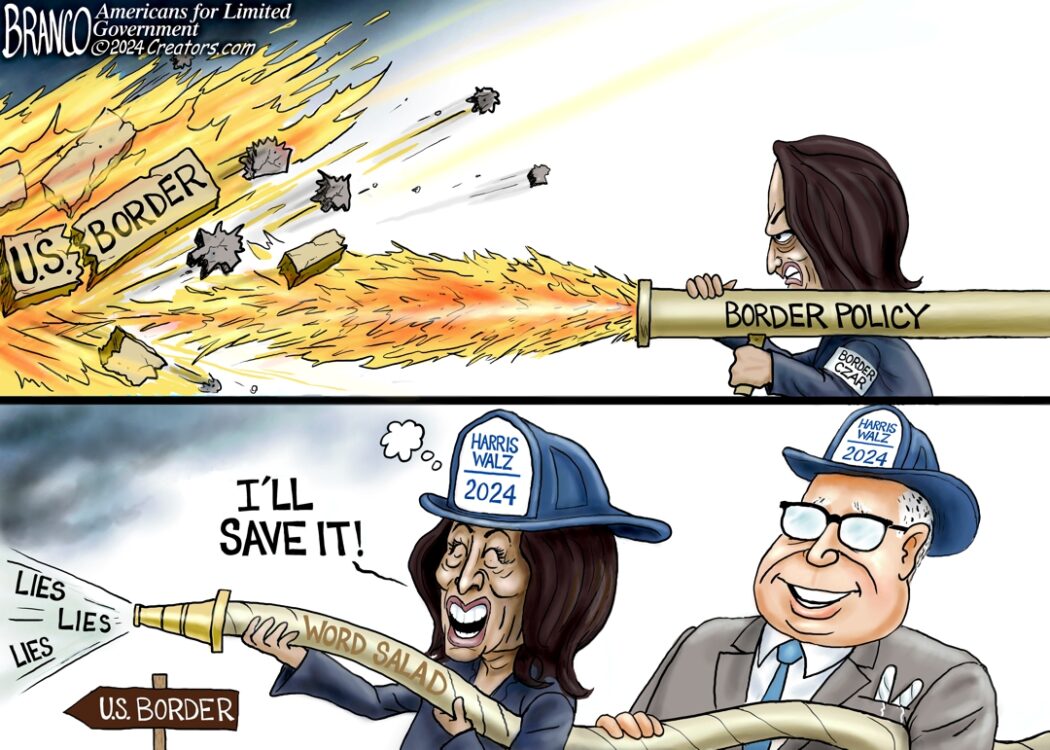


 What Did You Say?
“This is Not the Time for Balance”: LA Times Columnist Resigns in Protest . . . Over Balanced Commentary
By: Jonathan Turley | December 9, 2024
Read more at https://jonathanturley.org/2024/12/08/this-is-not-the-time-for-balance-la-times-columnist-resigns-in-protest-to-balanced-commentary/
When now President-Elect Donald Trump was convicted, the thrill-kill atmosphere around the courthouse and the country was explosive, but no one was more ecstatic than liberal columnist and former prosecutor Harry Litman. The then L.A. Times columnist told MSNBC’s Nicolle Wallace that it was a “majestic day” and “a day to celebrate.” A lawfare advocate, Litman excitedly laid out how Trump could be barred from office, declaring that the raid in Mar-a-Lago was the “whole enchilada” in ending Trump’s political career. Now, Litman has resigned from the L.A. Times because the owner wants more diversity of opinion in the newspaper. Litman went on MSNBC to declare that “this is not a time for balance.”
Those seven words sum up much of what has destroyed American media with millions turning away from the echo chamber created by the Washington Post, L.A. Times, and other publications. Litman is not alone. Many liberals are dispensing with the pretense of declaring opposing views “disinformation” and are now openly fighting to preserve ideological echo chambers and media silos.
In my new book, The Indispensable Right, I write about the decline of newspapers as part of the “advocacy journalism” movement. Opinion pages became little more than screeds for the left, including legal commentators who have been consistently wrong and misleading on merits of challenges or cases.
Last year, Washington Post publisher and CEO William Lewis delivered a truth bomb in the middle of the newsroom by telling the staff, “Let’s not sugarcoat it…We are losing large amounts of money. Your audience has halved in recent years. People are not reading your stuff. Right? I can’t sugarcoat it anymore.”
Litman has been one of the most unabashed lawfare warriors. Even when the Justice Department was seeking to dismiss the Flynn case, Lipman wrote an L.A. Times column advising Judge Emmet Sullivan how to “make trouble” for the administration. Litman admitted there is “very little leeway to reject the government’s decisions to dismiss charges” but encouraged Sullivan to “accomplish what Congress, multiple inspectors general, and a majority of the electorate have not been able to do — hold the president and his allies accountable for their contemptuous disregard for the rule of law.”
On MSNBC’s Deadline: White House, Litman declared to Nicolle Wallace that Trump’s victory is “an absolute five-alarm fire.” He called the effort to restore a diversity of viewpoints as little more than an attempt “to curry favor with Trump.” He then added:
It was a telling moment. Litman appeared on a network that has lost half of its viewership and is fighting for its existence in an effort by NBCUniversal to unload it. Readers are fleeing to new media after papers like the L.A. Times and the Washington Post literally wrote off half of the country. Yet, these figures would rather lose their jobs and media platforms than their bias.
Jonathan Turley is the Shapiro professor of public interest law at George Washington University and the author of “The Indispensable Right: Free Speech in an Age of Rage.”
Share this:
Category:
Political
Tagged with: