Let me tell you how my story ends: I become a tenured, award-winning professor of political science at an Ivy League university, and then at one of the leading universities in the South.
Now let me tell you how my story begins: I grow up in rural Virginia, literally dirt poor. I drop out of school in the eighth grade and have three children by the time I’m 20.
I consider myself to be a reasonably modest person, but even I have to admit that’s quite a journey.
How did I do it?
I worked hard. Not crazy, 24/7 hard—just hard. I made good decisions. Not brilliant, three-dimensional-chess decisions—just good ones. I met people along the way who helped me and sincerely wanted to see me succeed—not because they had something to gain, but because they were decent people. Almost all of these individuals, by the way, were white.
But mostly, I think I was blessed in one crucial way: I was born in America, a true land of opportunity for anyone of any color or background. In this country, where you start your life does not determine where you end up.
That works in both directions, by the way. You can start out with every advantage and waste them all. Or you can start out with nothing and become a success. It all depends on you. Your attitude is far more important than your race, gender, or social class in determining what you will accomplish in life.
When I hear young blacks—or anyone, for that matter—talk about systemic racism, I don’t know whether to laugh or cry. I want to laugh because it’s such nonsense. I want to cry because I know it’s pushing untold numbers of young blacks into a dead end of self-pity and despair. Instead of seizing the amazing opportunities America offers them, they seize an excuse to explain why they’re not succeeding.
I was born into a world where systemic racism was real—no-fooling, outright-bigotry, back-of-the-bus real. But here’s what you need to know: Yes, that racism shaped the black experience—but even then, it did not define it. Change was in the air. Call it systemic reform.
The modern Civil Rights Movement was in its infancy, and the leaders who fought for equal rights for blacks were men and women of all races. They believed in America and were determined to see it live up to its highest ideals—ideals manifest in the Declaration of Independence and the US Constitution.
Did I know, growing up, that George Washington and Thomas Jefferson owned slaves? I don’t think I ever thought about it. If I did, I’d like to think that I would have had enough common sense to know that we can’t judge men who lived 250 years ago by the moral standards of our own day.
But I know that Jefferson wrote the words in the Declaration of Independence that made slavery ultimately impossible: that all men are created equal. And I know that Washington, Hamilton, Franklin, Adams and the rest of the Founders risked everything to make my world, my America, possible. How could I not be grateful for that and for the sacrifices so many others have made to preserve it?
The truth is I cannot remember a time when I did not love America and feel pride in the belief that I live in the greatest country in the world. I knew if I diligently pursued my ambitions, I could leave the poverty of my early years, with all its abuse and depression, behind me.
I was fortunate in another way. I was spared the life-sapping, negative messages about America that are crippling a generation of young people. These ideas are poison:
☆ White privilege.
☆ Whiteness as a form of property.
☆ Unconscious racism.
☆ Reparations.
☆ Microaggressions.
☆ Police have it out for blacks.
☆ That the United States was created to protect and promote slavery.
These are the ideas young people are told they must accept. And then they’re told to reject the ideas that can save them—the antidote: the success principles that enabled me and millions of other Americans to escape lives of poverty.
These principles aren’t complicated: work hard, learn from your mistakes, take personal responsibility for your actions. When I made the decisions to get my high school equivalency, attend a community college, and then earn four additional college and university degrees, I believed that my education would open doors. And it did.
It was only when exposed to academic theories of oppression in graduate school that I was informed that because I was black, poor, and female, I could never do what I had already accomplished.
Thank God, it was too late for these toxic messages to stop me. Don’t let them stop you.
______________________________________________
Carol Swain is a professor of political science and law at Vanderbilt University.
Ty Smith — a black man who has two sons, 17 and 19 — absolutely annihilated critical race theory during his comments to an Illinois school board earlier this month, saying it will teach children of different races to “hate each other” and will reverse Dr. Martin Luther King Jr.’s dream that all people may be judged by the content of their character rather than by the color of their skin.
“You’re going to deliberately teach kids, ‘This white kid right here got it better than you because he white?'” Smith asked the board of Bloomington School District 87. “You’re going to purposely tell a white kid, ‘Oh, the black people are all down and suppressed.’ How do I have two medical degrees if I’m sitting here oppressed?”
Smith added that he grew up with no mother or father in the house and “worked my way through college, sat there and hustled my butt off to get through college. You’re going to tell me somebody look like all y’all white folks kept me from doing that? Are you serious? Not one white person ever came to me and said, ‘Well, son, you’re never gonna be able to get nowhere because, you know, the black people,’ but guess what? What’s sickening about this whole thing is what y’all doing right now is already something I do in my community right now, to speak out against [this stuff] because black folks are getting told by other black folks, ‘Oh, you know, you ain’t going to be able to do nothing out there in the world because them white folks ain’t going to let get no … the white man gonna keep you down.'”
Smith said he wasn’t buying critical race theory because how he chose to live his life proved to him that his skin color wasn’t a barrier.
“How did I get where I am right now if some white man kept me down? How am I now directing over folks that look just like you guys in this room right now? How? What kept me down? What oppressed me?” Smith asked what appeared to be a room full of mostly white listeners. “I worked for myself from off the streets to where I am right now, and you’re going to sit here and tell me this lie of critical race theory? … The reason why black folks can’t get ahead because of white folks? Are you kidding me? This is what we’ve come to? I can’t believe we even talking about this right now.”
He added that if critical race theory is allowed to be taught to children in the schools, it will reverse King’s dream of racial equality: “So, when February comes, don’t talk about Martin Luther King … if y’all going to sit there and just pretty much just pee on his grave with this nonsense. That’s exactly what’s about to happen.”
Smith concluded his remarks by saying critical race theory is “BS.”
Following his school board address, Smith spoke with Fox News’ Martha MacCallum about his concerns regarding critical race theory and his life experiences. Smith — who is host of “Cancel This with Ty Smith” on WRPW-FM — told MacCallum that despite the disadvantages he grew up with, he made decisions along the way to make his life better.
“I went beyond this stuff,” he said, which led to him “becoming successful.”
Indeed, Smith’s radio station bio notes that he “grew up in the tough neighborhoods of Decatur, and knows first hand the struggles people in poverty have. He will dive into why the media’s message to disadvantaged people is wrong, and what we should be telling those struggling.”
Smith also wasn’t buying leftist virtue-signaling — particularly those who march in the streets with “their fists up,” because he said “none of them” ever go to the communities he works with every day. He added to MacCallum that he also began asking questions like, “This systemic racism, where’s it at?” But in the end, despite trying to find it so he could figure out how to deal with it, no one could ever show Smith evidence of systemic racism.
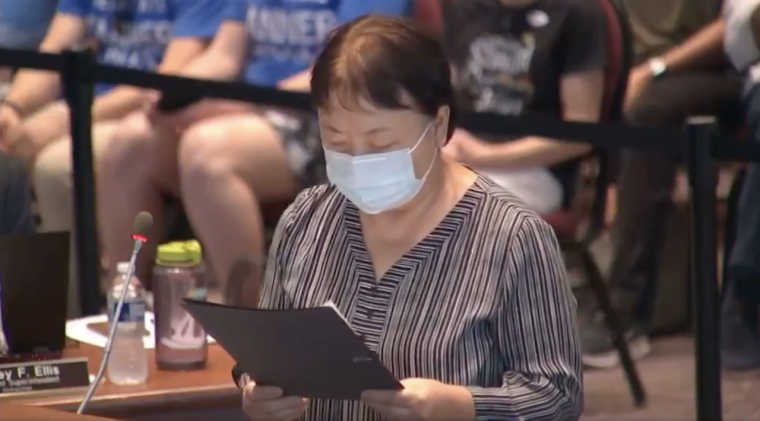
Xi Van Fleet, whose son graduated from Louden High School in Virginia, speaks about what she endured under Mao’s cultural revolution in China during a speech condemning critical race theory at a school board meeting on June 8, 2021. | | Screengrab: Twitter/The Virginia Project UAC
A woman who grew up in China during Mao Zedong’s Cultural Revolution condemned the teaching of critical race theory in U.S. schools, saying it’s “heartbreaking” for Chinese Americans to see the communism they escaped infiltrate the country.
“I have been very alarmed about what’s going on in our schools. You are now teaching, training our children to be social justice warriors and to loathe our country and our history,” said Xi Van Fleet in a statement at the Loudoun County School Board meeting on June 8 that was later shared by The Virginia Project, a political action committee working to combat what it deems as “un-American” ideologies, including CRT.
“Growing up in Mao’s China, all of this seems very familiar,” she continued. “The communist regime used the same critical theory to divide people. The only difference is they used class instead of race.”
Van Fleet, whose son graduated from Loudon High School in 2015, told Fox News Wednesday that she lived through the Mao’s Cultural Revolution until she immigrated to the United States. The Cultural Revolution was led by Mao, a brutal dictator who purged so-called “impure” elements of Chinese society. The Cultural Revolution lasted from 1966 to 1976, and resulted in the death of around 1.5 million people, while millions more were imprisoned, tortured or humiliated, according to History.com.
“To me, and to a lot of Chinese, it is heartbreaking that we escaped communism and now we experience communism here,” Van Fleet continued in her statement to the school board.
CRT, which is tied to Marxist critical theory, criticizes the U.S. and Western nations as being oppressive and promoting institutional “systemic racism” or “white supremacy.” It teaches that systemic racism is ingrained in every aspect of American life. Many opponents have noted that the ideology uses Marxist tactics of “class struggle” to divide people among race, gender and ethnicity. Critical theory, which first arose in academic journals three decades ago, is now being taught at public schools, government agencies and business training programs.
Van Fleet said CRT reminds her of growing up in Maoist China.
“They are a communist regime [that] uses the same critical theories to divide people,” she said. “The only difference is that they use class instead of race. During the cultural revolution, I witnessed students and teachers turn against each other, we changed school names to be politically correct, we were taught to denounce our heritage. The red guards destroyed everything that is not communist … statues, books and anything else.”
Evolutionary biologist Bret Weinstein, a former professor at Evergreen State, was among the first to warn the public that critical theory, now CRT, was not going to remain an issue on college campuses but would later affect all aspects of society.
“The critical race theory has its roots in cultural Marxism. It should have no place in our schools,” Van Fleet said as she concluded her remarks that were met with applause.
“I just want Americans to know that their privilege is to be here living in America, that is just the biggest privilege,” Van Fleet told Fox News. “I do not think a lot of people understand. They are thinking they are doing the right thing, ‘be against racism’ sounds really good. But they are basically breaking the system that is against racism.”
CRT has received pushback and condemned as “toxic” and divisive in nature. Former President Donald Trump banned critical race theory training in federal agencies, but President Joe Biden reversed it on his first day in office. When Biden reversed Trump’s ban, Christopher Rufo, a director at the Discovery Institute, announced a new coalition to stop critical race theory and “wage relentless legal warfare against race theory in America’s institutions.”
“Critical race theory is a grave threat to the American way of life. It divides Americans by race and traffics in the pernicious concepts of race essentialism, racial stereotyping, and race-based segregation—all under a false pursuit of ‘social justice,’” Rufo wrote at the time.
Florida’s Board of Education announced Thursday that it voted 8-0 to prohibit CRT from being taught in public schools in an effort to stop the “distort[ion] historical events,” according to The Washington Examiner.
“Some of this stuff is, I think, really toxic,” Florida Gov. Ron DeSantis said about CRT in a video.“I think it’s going to cause a lot of divisions. I think it’ll cause people to think of themselves more as a member of particular race based on skin color, rather than based on the content of their character and based on their hard work and what they’re trying to accomplish in life.”
“The woke class wants to teach kids to hate each other, rather than teaching them how to read, but we will not let them bring nonsense ideology into Florida’s schools,” DeSantis said in a statement.
Donations/Tips accepted and appreciated– $1.00 – $5.00 – $25.00 – $50.00 – $100 – it all helps to fund this website and keep the cartoons coming. Also Venmo @AFBranco – THANK YOU!
A.F. Branco has taken his two greatest passions, (art and politics) and translated them into the cartoons that have been popular all over the country, in various news outlets including “Fox News”, MSNBC, CBS, ABC, and “The Washington Post.” He has been recognized by such personalities as Dinesh D’Souza, James Woods, Sarah Palin, Larry Elder, Lars Larson, Rush Limbaugh, and shared by President Donald Trump.
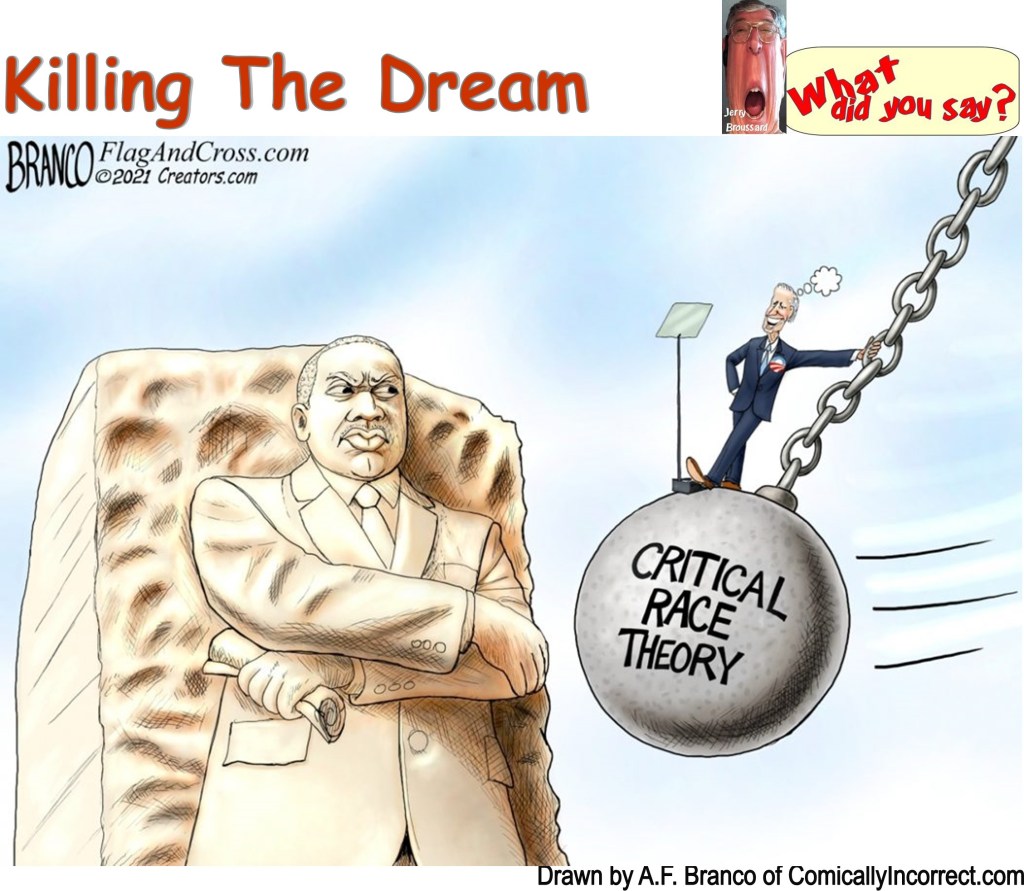
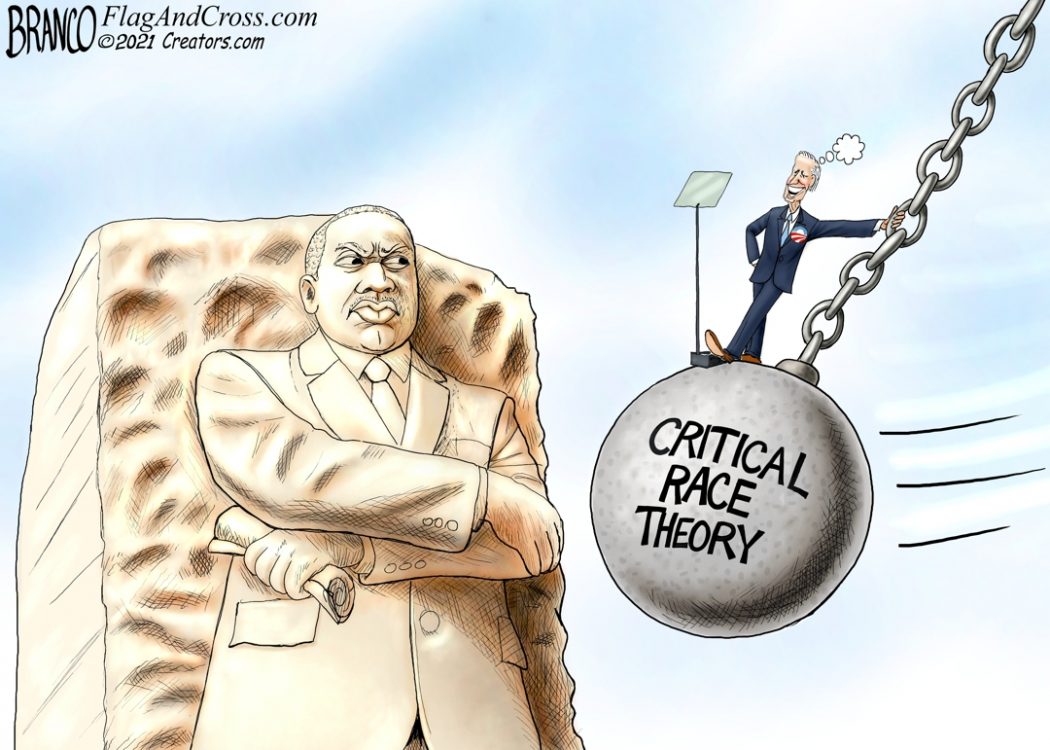
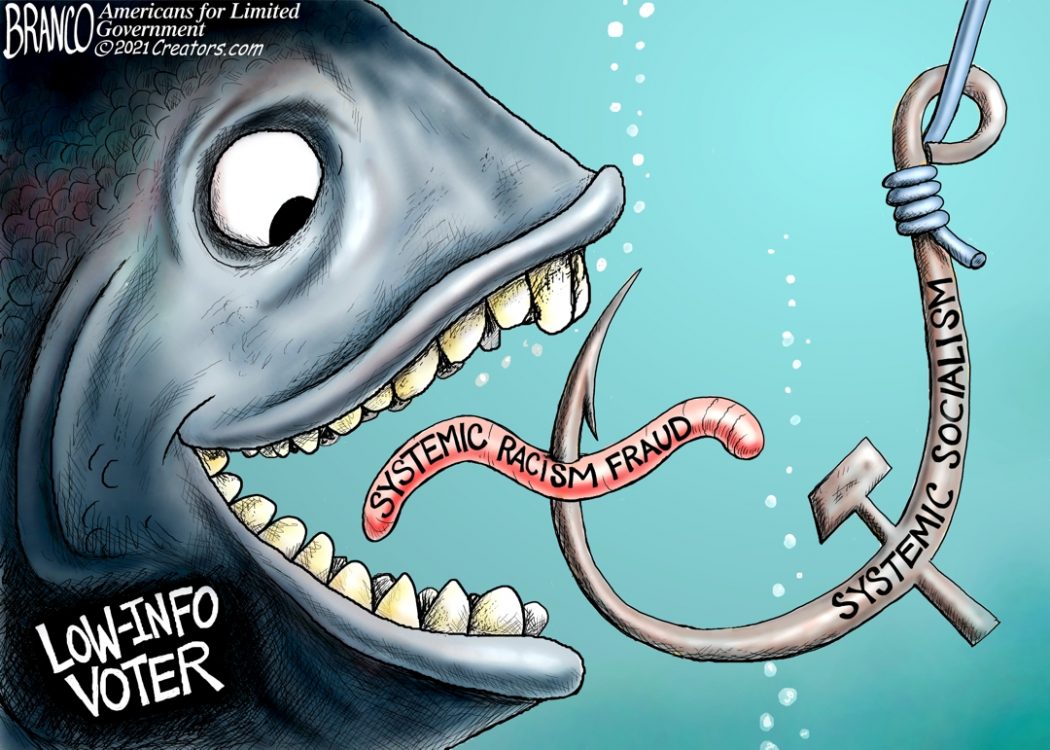
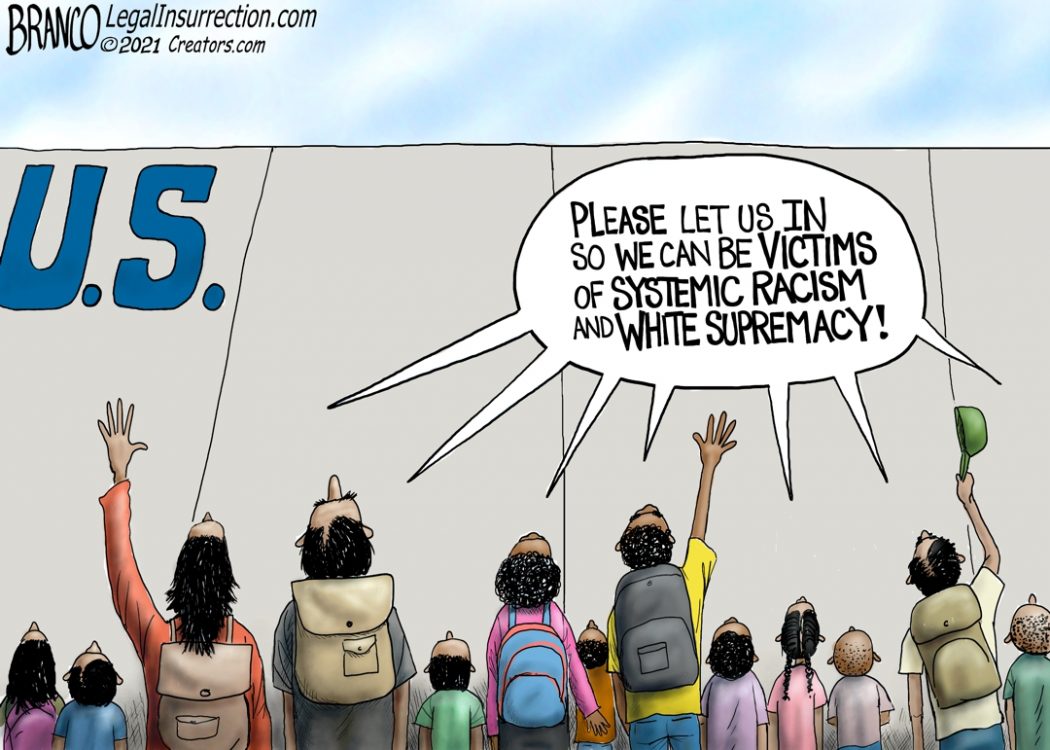
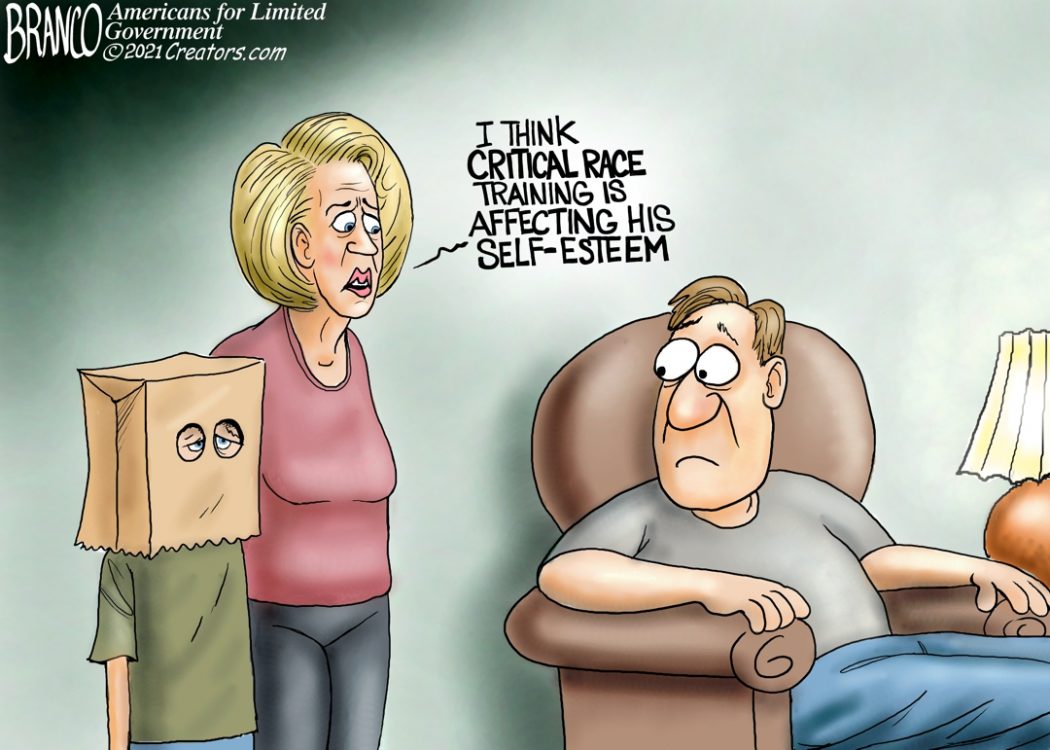
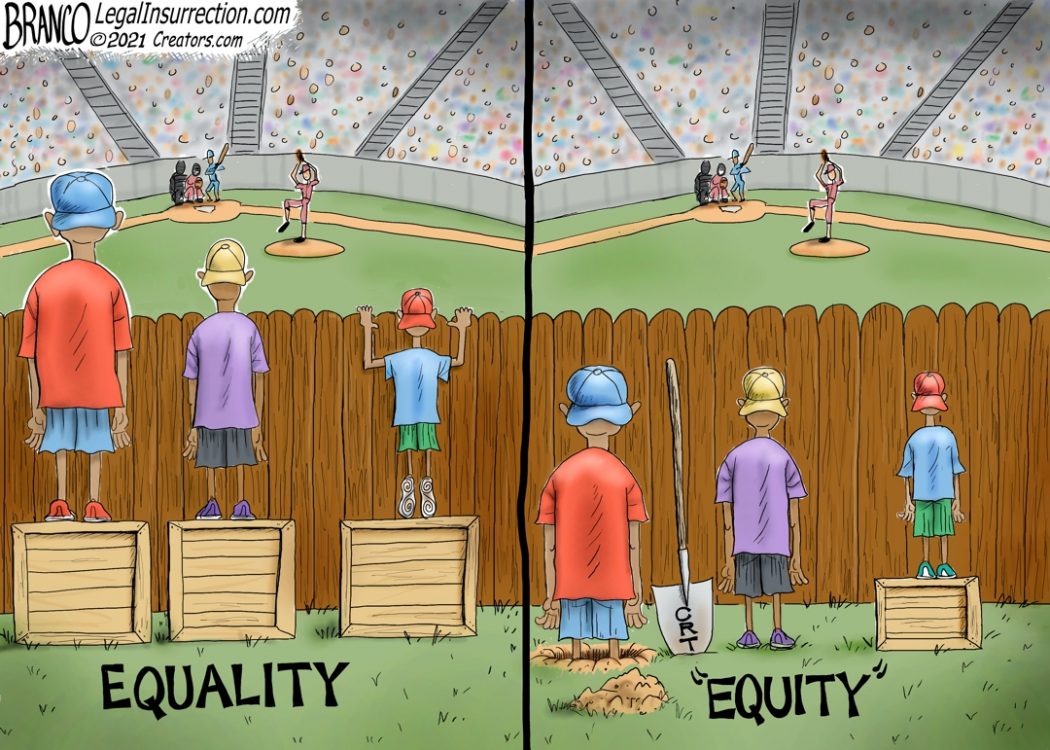
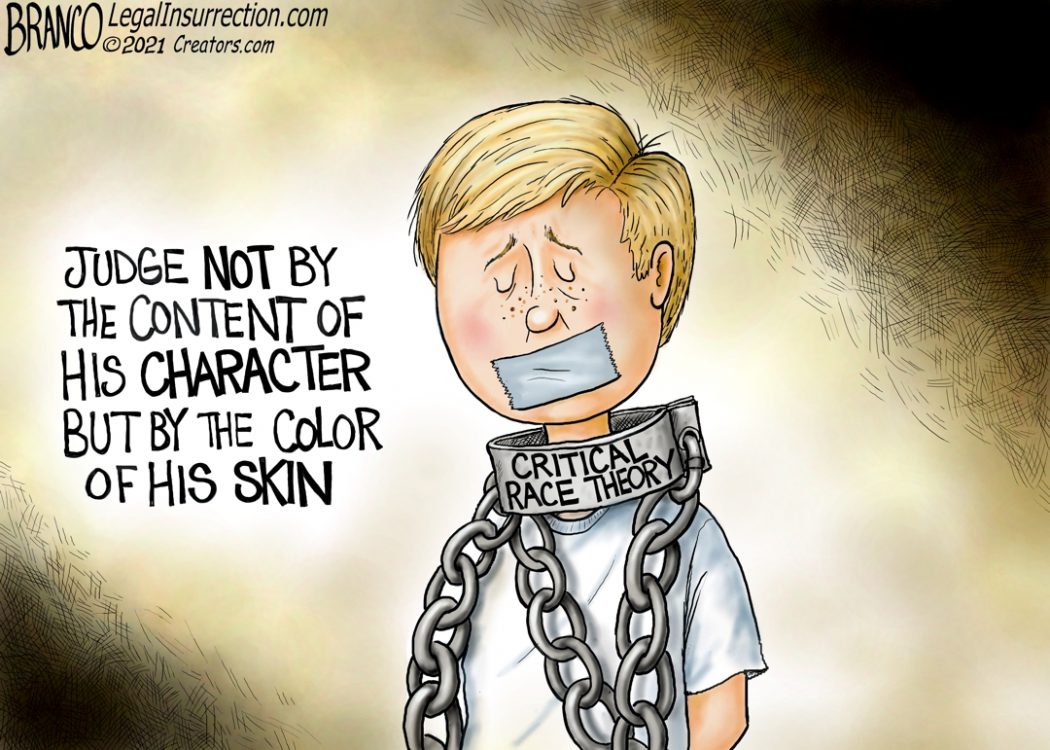
The Left is pushing Critical Race Theory the very opposite of MLK’s Dream of being judged not “by the color of our skin but the content of our Character”.
Donations/Tips accepted and appreciated– $1.00 – $5.00 – $25.00 – $50.00 – $100 – it all helps to fund this website and keep the cartoons coming. Also Venmo @AFBranco – THANK YOU!
A.F. Branco has taken his two greatest passions, (art and politics) and translated them into the cartoons that have been popular all over the country, in various news outlets including “Fox News”, MSNBC, CBS, ABC, and “The Washington Post.” He has been recognized by such personalities as Dinesh D’Souza, James Woods, Sarah Palin, Larry Elder, Lars Larson, Rush Limbaugh, and shared by President Donald Trump.
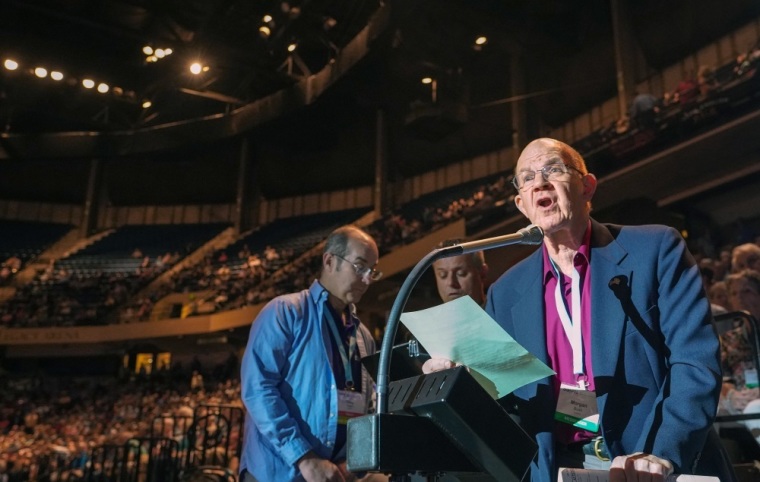
Morgan Bush, a messenger from Alabama, brings a motion during the 2019 Southern Baptist Convention Annual Meeting on June 11 at the Birmingham-Jefferson Convention Complex in Birmingham, Ala. | Matt Miller
In what is shaping up to be a historic annual meeting of the Southern Baptist Convention in Nashville, Tennessee, this month, the denomination’s Resolution 9 acknowledging critical race theory as a useful tool to explain how race has and continues to function in society is the target of multiple resolutions seeking to strip it of its power.
Denny Burk, professor of biblical studies at Boyce College, the undergraduate school of the Southern Baptist Theological Seminary in Louisville, Kentucky, revealed in a blog post Friday that he was aware of nearly 60 resolutions being submitted to the Resolutions Committee asking SBC messengers to condemn critical race theory.
“I am aware that a number of people have submitted resolutions relating to CRT. I know of at least three that are opposed to CRT (here, here, and here) and one that is in favor of CRT (here). As I write this, it looks like there are about 57 people submitting the exact same resolution as Mike Stone’s proposed resolution,” Burk wrote.
Mike Stone, the pastor of Emmanuel Baptist Church in Blackshear, Georgia, and one of three nominees vying to become the next president of the nation’s largest Protestant denomination, recently proposed a resolution asking the denomination to condemn the theory. The proposed resolution also seeks to affirm the controversial portion of the November 2020 statement from the Council of Seminary Presidents that states, “affirmation of Critical Race Theory, Intersectionality and any version of Critical Theory is incompatible with the Baptist Faith & Message.”
“And these are just the ones I know about because they’ve been publicized on the internet,” Burk added.
“I have heard through the grapevine that there are other proposals that haven’t been publicized and that we won’t know about until the Resolutions Committee reports on them at the convention. This means that the committee is not going to be able to please all sides and likely won’t try to. It also means that they have their work cut out for them.”
Regardless of what happens, Burk expressed confidence that SBC messengers “won’t leave Nashville without a strong resolution against critical race theory.”
“I have heard of at least one effort to rescind 2019’s Resolution 9. If that came to the floor of the convention, I would support it, but I’m not sure if it’s possible under the rules (someone else who knows more about Robert’s Rules can weigh-in),” he wrote.
“But I’m also not sure that it’s even necessary. If the convention passes a strong resolution against CRT, it would serve as a de facto rescinding of Resolution 9 (sort of like subsequent resolutions became a de facto repudiation of the SBC’s infamous pro-choice resolution of 1971). For me, the priority is getting a strong statement against CRT. That is the main thing.”
The professor expressed support for a resolution proposed by Stephen Feinstein, a pastor at Sovereign Way Christian Church in Hesperia, California, and a chaplain in the United States Army Reserve.
“What I like about this is that it defines ‘institutional racism’ not as CRT does, but in terms of willful discrimination,” Burk explained.
“In CRT, no human agency is required at all for racism to be present in a given institution or system (as I have written about here). CRT says that racism is everywhere all the time and that all white people are racists whether they choose to be or not. Any racially disparate outcome is racism even if no one willfully discriminated against anyone.”
Burk argues that such an argument is “completely incompatible with what scripture teaches about sin and judgment, but this resolution fixes that.”
“It recognizes that sinful partiality can affect institutions and systems while not alleging that all institutions and systems are racist by default (as in CRT),” he wrote.
Any member of a cooperating Southern Baptist church can propose a resolution for adoption by the SBC. However, the SBC Committee on Resolutions may decline to recommend properly submitted resolutions to the convention for adoption.
Prominent Southern Baptist Pastor Dwight McKissic, who founded and leads Cornerstone Baptist Church in Arlington, Texas, warned earlier this year that if Resolution 9 is rescinded, he would leave the SBC. His threat came after he quit the Southern Baptists of Texas Convention after leaders adopted a “strongly worded, anti-CRT policy that denounces all aspects of critical race theory.”
McKissic’s declaration also came amid an exodus of prominent black Southern Baptist pastors, such as Ralph West and Charlie Dates, over the Council of Seminary Presidents’ renouncing critical race theory and intersectionality.
The 2021 annual gathering of the Southern Baptist Convention is set to take place in Nashville, Tennessee, on June 15 and June 16. More than 13,000 messengers have pre-registered for the event, according to Ronnie Floyd, president of the SBC Executive Committee. Only four other conventions have attracted at least 10,000 messengers since 2000, he said.
“This could be one of our largest gatherings since 1995 in Atlanta, when we had 20,654 messengers,” he recently noted.
A video posted on social media by a black father and his young daughter dismissing critical race theory and encouraging others to respect one another regardless of their race has garnered more than 1 million views online. The viral video, first posted by Kory Yeshua on his TikTok channel, has drawn viral interest for its lighthearted yet pointed rebuke of critical race theory, an ideology which re-examines society through a racial lens and presumes that race is a constructed concept used primarily to exploit people of color. Proponents of the ideology largely espouse that America and its foundational institutions are inherently racist.
In the video, Yeshua is seen sitting with his daughter and telling her that she “can be anything in this world” that she wants to be.
“Yeah, and it doesn’t matter if you’re black or white or any color,” his daughter responds with a smile.
“How we treat people is based on who they are and not what color they are,” Yeshua goes on to say, his daughter adding, “and if they’re nice and smart.”
“My baby is going to know that no matter what she wants to be in life, all she has to do is work hard and she can become that,” he goes on to say.
His daughter then jumps in, exclaiming: “Work hard! Even if you don’t know anyone, you can make a friend.”
After smiling and laughing at his daughter’s comment, Yeshua adds, “Yeah, you can make friends no matter what color they are. So we need to stop CRT point-blank. Period. Children do not see skin color, man, they love everybody.”
One of the best videos opposing Critical Race Theory that you’ll ever see. 👏🏼🇺🇸 pic.twitter.com/cXOfheV0kJ
The video was posted on Yeshua’s TikTok account on May 19 and has garnered more than 20,000 views on the platform. Yeshua’s channel, which boasts over 270,000 followers, features hundreds of videos of the commentator promoting conservative values and criticizing leftist movements such as Black Lives Matter.
Then on Tuesday, conservative filmmaker Robby Starbuck posted the video on Twitter with the caption, “One of the best videos opposing Critical Race Theory that you’ll ever see.” The video caught fire shortly after Starbuck’s posting and is now rapidly circulating on the internet.
Critical race theory has become a hot-button political issue in America in recent months as school boards and educational institutions across the country have moved to implement the ideology into curricula. That movement has prompted dozens of Republican legislatures to advance measures banning critical race theory and other similar teachings from public school classrooms.
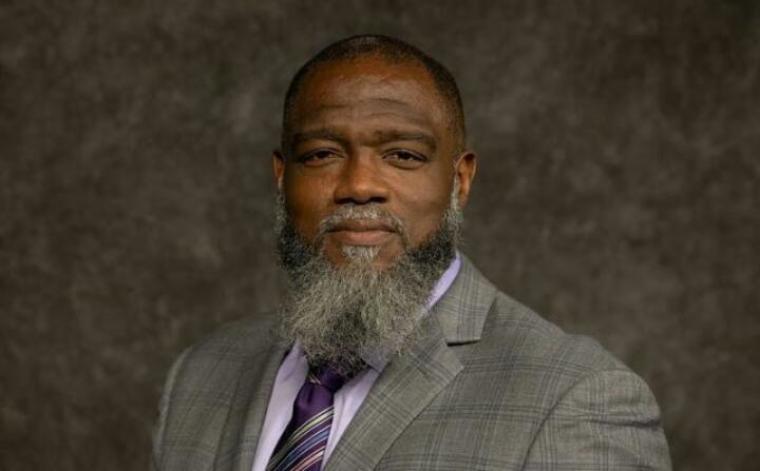
Prominent Southern Baptist preacher Voddie Baucham Jr. | Ema Capoccia
Although traditional Christian publishers turned their back on his latest book, Fault Lines: The Social Justice Movement and Evangelicalism’s Looming Catastrophe, denouncing critical race theory and the social justice movement, prominent Southern Baptist preacher Voddie Baucham Jr. found a home for it at Salem Books, and it is now one of the most talked-about works in evangelicalism.
It is currently the No. 1 book in several Christian categories on Amazon and is listed among the top 100 bestselling books on the e-commerce website, where 95% of those who have reviewed it gave it a five-star rating. On the Evangelical Christian Publishers Association’s bestsellers list for May, it sits at the No. 2 spot.
Data from Salem Books show that since its official release on April 6, nearly 50,000 hard copies of the book and just under 10,000 ebooks have been sold.
“This author has given us the definitive handbook for responding biblically to the critical theories assaulting evangelicalism. This is confessional polemics at its best. The author has carefully defined the terminology crafted, the truth compromised, and the trajectory considered — in the enemy’s battle against the sufficiency of the Scriptures,” gushed David Pitman, one of the many verified purchasers who gave Fault Lines a five-star review on Amazon.
“Though he has winsomely interwoven biographical and historical backgrounds, nevertheless, he never loses sight of the centrality of the cross of Christ. On page 233 he writes, ‘The Jew-Gentile divide was far more significant than the black-white one. If Christ took care of that on the cross, how much more did He take care of any man-made divisions we face today?’ I urge you to read this book carefully. The language, the logic, and the love in it — love for God and love for neighbor — are exactly the biblical message most needed in these tumultuous times,” Pitman wrote.
And these “tumultuous times” refer to the racial reckoning that has erupted in the evangelical church since the killing of George Floyd last May and the debate over whether issues like social justice and racial inequality should be explored through any other lens outside the Bible, such as critical race theory.
Critical race theory, as explained by Purdue University, “is a theoretical and interpretive mode that examines the appearance of race and racism across dominant cultural modes of expression. In adopting this approach, CRT scholars attempt to understand how victims of systemic racism are affected by cultural perceptions of race and how they are able to represent themselves to counter prejudice.”
In the summer of 2019, the Southern Baptist Convention passed Resolution 9“On Critical Race Theory and Intersectionality,” in which they defined CRT as “a set of analytical tools that explain how race has and continues to function in society. Intersectionality is the study of how different personal characteristics overlap to inform one’s experience.”
Kimberlé Crenshaw, the law professor at Columbia and UCLA who coined the term intersectionality more than three decades ago, said, according to Time magazine: “It’s basically a lens, a prism, for seeing the way in which various forms of inequality often operate together and exacerbate each other. We tend to talk about race inequality as separate from inequality based on gender, class, sexuality or immigrant status. What’s often missing is how some people are subject to all of these, and the experience is not just the sum of its parts.”
While acknowledging that “critical race theory and intersectionality alone are insufficient to diagnose and redress the root causes of the social ills that they identify, which result from sin,” SBC leaders accepted in Resolution 9 that “these analytical tools can aid in evaluating a variety of human experiences.”
Many prominent Southern Baptists like Baucham decried the SBC for adopting the resolution, and he believes it should be scrapped at the SBC’s annual meeting in Nashville, Tennessee, next month.
“In terms of the SBC, I think there needs to be something done on Resolution 9. I think Resolution 9 was unfortunate, and I think there are a lot of things that led to Resolution 9 being passed that had nothing to do with whether or not the SBC believes or agrees with CRT and intersectionality. So I’m hopeful there will be an appropriate response at the convention next month because this stuff is poison. This stuff is deadly. It corrodes and destroys everything that it touches,” Baucham, who is dean of theology at African Christian University in Zambia and a board member of Founders Ministries, told The Christian Post in a recent interview.
Baucham offers a primer of social justice terms in Fault Lines: The Social Justice Movement and Evangelicalism’s Looming Catastrophe, and makes a case for why the cult of antiracismshould be rejected. He doesn’t see anything redemptive in critical race theory and believes faithful Christians should not even consider it a useful analytical tool.
“[It is] absolutely not [a useful analytical tool]. CRT is built on premises that are anti-biblical. That would be akin to someone coming into your church and talking about Brahma, Vishnu and Shiva … and you coming and saying, ‘I understand these things come from Hinduism, but if we just look beyond the words and beyond the other religion, maybe there is something useful that we could use.’ That’s not what you do when somebody is coming with another gospel,” he said.
“The four main premises of critical race theory are things that we have to completely reject. The idea that racism is normal and unavoidable and ubiquitous in the United States and its history; the idea that white people are incapable of righteous actions on race unless their interests converge. You can’t get more anti-biblical than that,” Baucham explained. “…They reject objectivity and meritocracy, and their main idea is that we ascertain truth through narratives. Now, what part of that is a useful tool for Christians trying to understand racism? Absolutely none of it. So I think these people are completely wrong when they make this statement and they never get to specifics.‘
“They’ll say OK, CRT is a useful analytical tool, but they don’t say, here are the specific elements of CRT that are useful to us. And the other thing that they don’t do, is they don’t say here’s what CRT gives us that Bible and theology don’t give us. And that’s where this is hugely problematic because they’re essentially arguing that the Bible is not sufficient on issues of race, ethnicity, racism, et cetera., that CRT is needed to inform the Scriptures on these particular issues. So no, I couldn’t disagree more with people who try to take that third way or that middle ground,” he said. “There is no third way or middle ground with CRT and intersectionality.”
White privilege
In her groundbreaking essay, White Privilege: Unpacking the Invisible Knapsack, Peggy McIntosh describes the controversial concept as“an invisible package of unearned assets which I can count on cashing in each day.”
“I have come to see white privilege as an invisible package of unearned assets which I can count on cashing in each day, but about which I was ‘meant’ to remain oblivious. White privilege is like an invisible weightless knapsack of special provisions, maps, passports, codebooks, visas, clothes, tools and blank checks,”she wrote.
Baucham says he doesn’t believe in white privilege.
“I don’t agree with McIntosh and others on that concept or idea,” he said. “I don’t. I don’t believe that McIntosh was right. I don’t believe that that concept that comes from her is something that is real or is something that exists.”
When asked if he would agree that there is racial inequality, he said it would depend on how race is defined and noted that there is nowhere in the world where equality exists.
“It depends on what you mean by racial inequality. And it also depends on what you mean by race. I would need that term defined in terms of what is racial inequality. There is no place on Earth, nor has there ever been any place on Earth, where anything has been distributed equally among various people groups. No two groups of people are the same, which means that by definition, there is always going to be inequalities,” he said.
“And it goes both ways. I mean, in the NFL and the NBA, black people make up 75% and 80%, respectively, of those leagues. That’s racial inequality, right? Austrians, wherever you go in the world, are some of the best violin makers in whatever country they find themselves in. That would be racial inequality, but is that an evil? Is that a sin?‘
“So I think the problem is when people say racial inequality, what they are referring to is this idea that any disparate outcome equals injustice. And that is just completely unsupported by the facts,” he said.
And Baucham boldly tackles this issue in his book. In addressing the argument of disparity in policing, Baucham takes high-profile cases highlighted in mainstream media of black people killed by police such as Tamir Rice, Floyd, Breonna Taylor and Philando Castile, and compares them to similar cases where the victims are white but didn’t get much media attention.
“Have you heard of Tony Timpa? Like Floyd, ‘Timpa wailed and pleaded for help more than 30 times as officers pinned his shoulders, knees and neck to the ground,’ reported The Dallas Morning News in August 2016. Timpa, a 32-year-old schizophrenic, called the police himself, saying he was off his meds and needed help. When police arrived, Timpa had already been handcuffed by a security guard. Three Dallas Police Department officers restrained Timpa for nearly 14 minutes as he pleaded, ‘You’re gonna kill me! You’re gonna kill me! You’re gonna kill me!’ Eventually, Timpa went limp, at which time the officers mocked him and made jokes. In the end, when the paramedics finally came and put Timpa’s flaccid body on a stretcher, one officer said, ‘I hope we didn’t kill him.’ But they had,” Baucham noted.
“The George Floyd case was indeed tragic. However, it was not unique. Nor does it represent clear evidence of a particular pattern of police brutality regarding black men. No one took to Twitter demanding that Christian leaders prove their bona fides by speaking out on the Timpa case, and no one wrote articles in leading Christian publications about losing sleep over it. In fact, few—if any—of the people who mounted their moral high horses and took to the streets in protest over George Floyd even knew Tony Timpa’s name. Why? Because he was white, and his case did not advance the right narrative,” Baucham explained.
One Amazon critic who only discussed his assessment of the cases as Amazon Customer #1080, and only gave the book a one-star rating, called Baucham’s assessment “disturbing.”
“Case after case is made that gives comfort, justification, and sanctuary to the senseless killings of unarmed African American men, women, and children. In doing so however, the writer succeeds in making the case that America indeed has a serious policing problem. This was undoubtedly unintended,” the critic wrote. “This book is deceptive. The author regurgitates the echo chamber talk of his sect. Drawing from an amalgamation of dated propaganda, Cold War Era rhetoric, and exaggerated unpersuasive arguments of fear, the writer will no doubt stir both a bizarre joy and philosophical panic in the religious minds of those who already lean the direction of his views.”
When asked if his target audience for the book was an echo chamber of sorts based on his arguments, Baucham said he considered the question an “insult.”
“I didn’t sit down and try to figure out how to write a book for an echo chamber. My goal in writing the book is my love for the bride of Christ and my belief that there is a threat to her. That threat to her is this modern ideology of social justice, critical race theory, intersectionality, critical theory. These ideologies — that I’ve been watching and speaking on and writing about since the early 2000s, by the way — these ideologies come straight out of classical Marxism,” he insisted.
“And cultural Marxism, these ideologies that have taken root in academia and that now are being talked about in popular culture by people who have no idea where they come from and no idea what these things mean and no idea how antithetical they are to biblical Christianity. So this is a threat. This is a wolf. And my job as a shepherd is to fight off wolves. This has nothing to do with echo chambers or want to please certain kinds of people. If anything, this book is the opposite of that,” he said.
He further pointed out that despite being evangelical, his positions have made him an outsider in the evangelical community.
“Popular evangelicalism is woke, so most of the things that I’m pointing out put me on the outside of the echo chamber, not the inside. I mean, I’m not going to be invited to CRU or Intervarsity or the Gospel Coalition or I could run down the list. I’m not going to be invited by any of those things that are the premier places in evangelicalism,” he said.
“Forget the SBC, forget the PCA, a Southern Baptist seminary couldn’t hire me today because of all of these ideas. They would be completely pilloried if they hired me. So far from writing for an echo chamber, I’m actually speaking out and putting myself outside the echo chamber.”
Baucham, who was some six weeks into his recovery from coronary bypass surgery when he spoke with CP, said he believes his book is resonating with evangelicals because many people are still grappling with the social justice movement.
“I haven’t divided up the people in terms of how many black people or how many white people I’ve heard from, but I’ve heard from people across the spectrum. And regardless of people’s color, what I’ve heard from people is: ‘This is a real issue. This is a real problem, and I’ve wanted to be able to wrap my head around it, and you helped me to wrap my head around it,’” he said.
For black Christians who don’t agree with the narrative of the social justice movement, Baucham, who recently penned an op-ed for the New York Post titled, Why antiracism zealots are trying to silence black voices like mine, his voice on the issue has been a blessing.
“In terms of some black people, they’ve recognized if they speak out on this issue they get their head chopped off. They’re called sellouts, house ni**er, Uncle Tom … and so a lot of them are staying in the shadows because it’s just not safe to speak out on this issue,” he said.
“They’ve been very grateful to have another black Christian to speak out against this and somebody who has a platform, if you will. In terms of white Christians, you’ve been seeing similar things where they’re going, ‘I don’t agree with this narrative. And the minute I say I don’t agree with this narrative, I’m called racist. I’m called white supremacist,’ so on and so forth. So I think on all sides of this, because of the nature of what’s been going on over the last several months, a lot of people feel like this has given them a voice,” he added.
Like many evangelicals, Baucham sees the use of critical race theory by Christians as a threat to the Gospel, and he wasn’t afraid to highlight names of prominent evangelicals in his book, who he sees on both sides of the divide to which he currently sees no real solution.
“Why are people and groups like Thabiti Anyabwile, Tim Keller, Russell Moore, the Southern Baptist Convention, the Ethics and Religious Liberty Commission, 9Marks, the Gospel Coalition, and Together for the Gospel (T4G) being identified with Critical Social Justice on one side of the fault, and people like John MacArthur, Tom Ascol, Owen Strachan, Douglas Wilson, and the late R.C. Sproul being identified on the other?” he asks in the introduction of his 270-page book. “It is not a stretch to say we are seeing seismic shifts in the evangelical landscape. But is it an exaggeration to call this a coming catastrophe? I don’t think so,” he writes.
The divide is so strong, Baucham argues, that America is on the verge of a “race war.”
“I have pursued justice my entire Christian life. Yet I am about as ‘anti–social justice’ as they come—not because I have abandoned my obligation to ‘strive for peace with everyone, and for the holiness without which no one will see the Lord’ (Hebrews 12:14), but because I believe the current concept of social justice is incompatible with biblical Christianity,” he argues in the book.
“This is the main fault line at the root of the current debate—the epicenter of the Big One that, when it finally shifts with all its force, threatens to split evangelicalism right down the middle. Our problem is a lack of clarity and charity in our debate over the place, priority, practice, and definition of justice. The current cultural moment is precarious. The United States is on the verge of a race war, if not a complete cultural meltdown. And the rest of the Western world seems to be following suit. Tensions are rising in every place the African slave trade has left its indelible mark.”
Early this year, another prominent black Southern Baptist leader, Pastor Dwight McKissic, who founded and leads Cornerstone Baptist Church in Arlington, Texas, and where Baucham previously worked, according to his book, cut ties with the Southern Baptists of Texas Convention over its “strongly worded, anti-CRT policy that denounces all aspects of critical race theory” and warned that if leaders of the Southern Baptist Convention rescind Resolution 9 on critical race theory at their convention next month, he would cut ties with them too.
That announcement came amid an exodus of prominent black SBC pastors, such as Ralph West and Charlie Dates, over a decision by the denomination’s Council of Seminary Presidents to denounce critical race theory and intersectionality as incompatible with their beliefs at their 2020 annual session. The Council of Seminary Presidents, which is comprised of six seminaries, voted to reject CRT as incompatible with their faith while condemning “racism in any form.”
When asked what advice he had for the black pastors that left the denomination, Baucham said many of the ones who have left the nation’s largest Protestant denomination weren’t really that committed to the SBC.
“What’s interesting is most of the black pastors who have left weren’t very committed to the SBC in the first place. Many of them had recently come to the SBC and had been given platforms. They weren’t committed to the Baptist Faith and Message, they weren’t committed to the Southern Baptist doctrine, per se. Many of their churches weren’t contributing very much to the SBC. And so again, not in all cases, but in many cases, these people left because they were never really committed to the SBC in the first place,” he said.
When pressed further for what advice he would give them, he suggested they follow their conscience.
“I guess my message would be they need to go wherever their consciences dictate,” he said. “You don’t change the SBC by leaving. It’s one of the most diverse religious organizations in the world. And you don’t change it by leaving.”
For Christians who read his book, Baucham, who plans on heading back to Lusaka in mid-to-late June, wants them to get from his message that “the Gospel is under attack.”
“We are at war because this ideology is at war with the Gospel and is at war with Scripture. And so I wanted people to see that. I wanted people to see that this is about so much more than just black people see things one way, white people see things another way, Asians see things another way. It’s about so much more than that. And what’s ironic is that the rest of the culture is waking up to this,” he said.
“There are legislators now writing the law dealing with CRT because they see that it’s poison. And yet, Christians are still sitting around saying, well, useful analytical tool or third-way nuance … That’s why I chose the fault lines metaphor. That idea of an earthquake that’s coming that’s going to divide even more than it already has. On the one hand, I don’t want to see brothers and sisters divided. But on the other hand, I absolutely want to see a clear divide between the truth of the Gospel and the lie of CRT and anti-racism.”
Donations/Tips accepted and appreciated– $1.00 – $5.00 – $25.00 – $50.00 – $100 – it all helps to fund this website and keep the cartoons coming. Also Venmo @AFBranco – THANK YOU!
A.F. Branco has taken his two greatest passions, (art and politics) and translated them into the cartoons that have been popular all over the country, in various news outlets including “Fox News”, MSNBC, CBS, ABC, and “The Washington Post.” He has been recognized by such personalities as Dinesh D’Souza, James Woods, Sarah Palin, Larry Elder, Lars Larson, Rush Limbaugh, and shared by President Donald Trump.
Donations/Tips accepted and appreciated– $1.00 – $5.00 – $25.00 – $50.00 – $100 – it all helps to fund this website and keep the cartoons coming. Also Venmo @AFBranco – THANK YOU!
A.F. Branco has taken his two greatest passions, (art and politics) and translated them into the cartoons that have been popular all over the country, in various news outlets including “Fox News”, MSNBC, CBS, ABC, and “The Washington Post.” He has been recognized by such personalities as Dinesh D’Souza, James Woods, Sarah Palin, Larry Elder, Lars Larson, Rush Limbaugh, and shared by President Donald Trump.
Ryan Bomberger is the co-founder of The Radiance Foundation.
I’m half white and half black. My melanin doesn’t change my worth or my propensity to sin. Yet we live in a culture where we are told that our skin color confers upon us a status that is fixed, assigned by an elite class of humans who call themselves “scholars.” They want us to see everything through the broken lens of “race”—a human construct that has only served to dehumanize us throughout history. As a person with brown skin, I reject my assigned “status” and refuse to see everything through that distorted prism.
It leads to blindness.
Instead, I choose to see through the breakthrough filter of Scripture that opens our eyes to the truth of our identity, the perfect bond of love, our oneness through Christ, and the freedom of forgiveness. Our human condition, and the frailty that marks us, can never be illuminated by the darkness of tattered theories.
And that’s exactly what Critical Race Theory (CRT) is.
How can a theory derived from anti-Semites who were virulent racists hell-bent on abolishing the family and religion bring healing to the sin of racism? Karl Marx and Friedrich Engels saw Christianity as an impediment to their socialist ideology. How can a godless theory be used as an “analytical tool” to address issues needing a Godly solution?
I’m particularly irked by Christians who don’t want the struggle of wrestling with solutions but simply hop aboard the latest bandwagon sponsored by an insanely profitable victimhood industry. Racism is evil as is every other sin known to humankind. Sin diminishes and destroys us. It is a brokenness that cannot be remedied by more brokenness. But for many, the goal is not to offer a solution but a continual subscription.
Famed educator and leader Booker T. Washington, a former slave, explained this industry well on page 144 of his book “My Larger Education”: “There is another class of coloured people who make a business of keeping the troubles, the wrongs, and the hardships of the Negro race before the public. Having learned that they are able to make a living out of their troubles, they have grown into the settled habit of advertising their wrongs — partly because they want sympathy and partly because it pays. Some of these people do not want the Negro to lose his grievances, because they do not want to lose their jobs.”
Today, that class of people is of varying hues and NY Times bestsellers capitalize on a form of activism that seeks to divide us, erase equality, and offer forced redistribution in the form of “equity”. Dr. Carol Swain, the brilliant former (black) professor of political science and law at Vanderbilt University, offers a helpful definition of Critical Race Theory:
“Critical race theory is an analytical framework to analyze institutions and culture. Its purpose is to divide the world into white oppressors and non-white victims. Instead of traditional forms of knowledge, it holds up personal narratives of marginalized minority “victim” groups (blacks, Hispanics, Asians) as evidence (considered irrefutably by its nature) of the dishonesty of their mostly white heterosexual oppressors.”
As someone who is “biracial,” I’m both the “oppressed” and the “oppressor.” Through no fault of my own, since no one controls the circumstances of his or her conception, I’m foisted into perpetual perplexity simply based on the sins or the sufferings of my lineage. Just to further illustrate the absurdity of this deeply prejudiced CRT approach to classification, I can simply highlight my own origin story. I was conceived in rape. So, am I responsible for my (black) biological father’s heinous act? Of course not. Interestingly, my white father—who chose to adopt and love ten children (of varying beautiful hues) that other men abandoned—is branded as part of the “white supremacist patriarchy” that is guilty of every negative outcome of black Americans. My dad, Henry Bomberger, recently passed away. The only legacy he left behind was one of unconditional love and self-sacrifice. His devotion to us proved that it’s not color that binds us; it’s love.
Despite Scripture’s insistence on the unity of believers and how Christ makes us one (Galatians 3:28), CRT diabolically separates us using the deeply flawed human construct of race. Ironically, in a culture that rejects the science of binary gender the progressive priests of CRT demand we can only be the “oppressed” or the “oppressors”. How nihilistic. It also preaches perpetual “guilt” and undeserved “privilege” based solely on one’s skin color.
Fake guilt will never erase real problems.
As Christians, we are all privileged to know and worship a God who could’ve merely condemned us but chose to redeem and rescues us (John 3:16-17). We are privileged to no longer be slaves to sin (Romans 6:6). We are privileged, through Christ’s strength, to be more than conquerors (Romans 8:37).
The Bible tells us to no longer conform to the pattern of this world in Romans 12:2, yet this is exactly what we do when we embrace the warped worldliness of CRT. Blame, Deceive, Repeat. This destructive pattern is recognizable throughout Scripture. Satan is the accuser, and he constantly coaxes us to embrace the lie instead of the Light.
CRT is a debilitating disease. Its malignancy in the body of Christ is spread by pastors who don’t believe the Word is enough. Some of these leaders apparently think the World has the answers to the temporal and eternal devastation of sin.
Mainstream media gave voice to a handful of black pastors who support using CRT and several who left a major denomination over it. Pastor Charlie Dates, of the Progressive Baptist Church in Chicago, exited the Southern Baptist Convention over SBC Seminary presidents’ rejection of Critical Race Theory, despite their clear denouncements of the sin of racism. I thoroughly agree with their statement. I’m not a Southern Baptist, so I have no interest in defending a denomination but merely want to uphold the Truth. Pastor Dates, who embraces unbiblical Black Liberation Theology and the Black Lives Matter movement, issued a defiant (and historically challenged) OpEd sharply condemning those who oppose CRT. He claims the rejection of CRT is due to “fear of liberalism.” I don’t fear liberalism. I wholeheartedly disagree with it because of its dependence on deception and division. Dates strangely then attributed certain social movements to “liberalism” (aka the Democrat Party) such as abolition, women’s suffrage, and civil rights. On all three, Republicans led the fight. But CRT and its advocates value feelings far more than facts.
I don’t think there’s any more eloquent a pastor speaking about cultural issues and Biblical authority than Pastor Voddie Baucham. As a black adoptive father, he embodies what many Christians should aspire toward—Godly character and critical thinking. He exposes and denounces CRT—not with emotionalism (like Pastor Charlie Dates) but with factualism.
Dr. Kimberlé Crenshaw, credited as a co-founder of “Critical Race Theory” (of course, derived from Marxist Critical Theory) is a leading proponent of this poison. Never mind this accomplished black woman was the recipient of Ivy League education at Cornell and Harvard Law School. But, you know, systemic racism. She sees it in everything…well except the abortion industry which massively and disproportionately kills black lives. Crenshaw, who is radically pro-abortion, pro-LGBT, anti-nuclear family and denies the clearly evident consequences of fatherlessness, blames racism for everything that victimizes black people and other “marginalized” groups. Her organization, the African American Policy Council, is holding an event on April 29th featuring Crenshaw, Brad Sears (Executive Director of UCLA’s dubious and radically pro-LGBT The Williams Institute) and Planned Parenthood’s President, Alexis McGill Johnson, as keynote speakers.
But sure, let’s use Critical Race Theory—an ideology that is hostile to Christianity in countless ways—as a means by which Christians should see the world. CRT activists claim to fight for justice but regularly reject truth and morality. Psalm 89:14 says: “Righteousness and justice are the foundation of Your throne. Mercy and truth go before Your face.” You cannot have justice without mercy (the compassion or forgiveness toward an offender) and truth. To ignore this is to welcome a cancer instead of the cure.
ABOUT THE COMMENTATOR:
Ryan Bomberger is the Chief Creative Officer and co-founder of The Radiance Foundation. He is happily married to his best friend, Bethany, who is the Executive Director of Radiance. They are adoptive parents with four awesome kiddos. Ryan is an Emmy Award-winning creative professional, factivist, international public speaker and author of NOT EQUAL: CIVIL RIGHTS GONE WRONG. He loves illuminating that every human life has purpose.
Donations/Tips accepted and appreciated– $1.00 – $5.00 – $25.00 – $50.00 – $100 – it all helps to fund this website and keep the cartoons coming. Also Venmo @AFBranco – THANK YOU!
A.F. Branco has taken his two greatest passions, (art and politics) and translated them into the cartoons that have been popular all over the country, in various news outlets including “Fox News”, MSNBC, CBS, ABC, and “The Washington Post.” He has been recognized by such personalities as Dinesh D’Souza, James Woods, Sarah Palin, Larry Elder, Lars Larson, Rush Limbaugh, and shared by President Donald Trump.
Donations/Tips accepted and appreciated– $1.00 – $5.00 – $25.00 – $50.00 – $100 – it all helps to fund this website and keep the cartoons coming. Also Venmo @AFBranco – THANK YOU!
A.F. Branco has taken his two greatest passions, (art and politics) and translated them into the cartoons that have been popular all over the country, in various news outlets including “Fox News”, MSNBC, CBS, ABC, and “The Washington Post.” He has been recognized by such personalities as Dinesh D’Souza, James Woods, Sarah Palin, Larry Elder, Lars Larson, Rush Limbaugh, and shared by President Donald Trump.
Donations/Tips accepted and appreciated– $1.00 – $5.00 – $25.00 – $50.00 – $100 – it all helps to fund this website and keep the cartoons coming. Also Venmo @AFBranco – THANK YOU!
A.F. Branco has taken his two greatest passions, (art and politics) and translated them into the cartoons that have been popular all over the country, in various news outlets including “Fox News”, MSNBC, CBS, ABC, and “The Washington Post.” He has been recognized by such personalities as Dinesh D’Souza, James Woods, Sarah Palin, Larry Elder, Lars Larson, Rush Limbaugh, and shared by President Donald Trump.
Donations/Tips accepted and appreciated– $1.00 – $5.00 – $25.00 – $50.00 – $100 – it all helps to fund this website and keep the cartoons coming. Also Venmo @AFBranco – THANK YOU!
A.F. Branco has taken his two greatest passions, (art and politics) and translated them into the cartoons that have been popular all over the country, in various news outlets including “Fox News”, MSNBC, CBS, ABC, and “The Washington Post.” He has been recognized by such personalities as Dinesh D’Souza, James Woods, Sarah Palin, Larry Elder, Lars Larson, Rush Limbaugh, and shared by President Donald Trump.
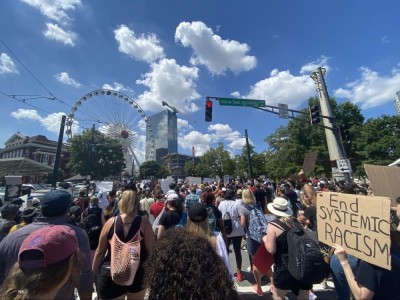
Thousands of people gathered in the heart of Atlanta to worship, pray, and repent for systemic racism in late June 2020 for an event hosted by OneRace Movement. | Courtesy of Adventures in Mission
Francis Schaeffer described how ideas escape the ivory towers of universities and think tanks eventually to shape how ordinary people think, speak, and view their world. In 2020, one idea made that journey in record time. Not that long ago, conversations involving Critical Race Theory were largely relegated to academic papers, classroom discussions, and scholarly journal articles. Today, dialogues about CRT can be found across social media, in corporate boardrooms, and even in the Church.
As a theory, CRT descends from European and North American philosophical traditions, particularly Marxism and Postmodernism. Like these worldviews of its intellectual ancestry, CRT sees the world in terms of power dynamics. In this way of thinking, social evils such as poverty, crime, or oppression result not from universal human frailties but from Euro-Americans intent on securing and increasing their economic and social power. Based on this metanarrative, equality and justice demand privileging the stories of those kept out of power. CRT sees members of the oppressed group as morally right, and members of the oppressor group as morally wrong.
CRT, like any worldview framework, should be evaluated. That, however, is easier said than done, even in the Church. Advocates often point to common ground between Critical Race Theory and the Christian worldview (for example, the commitment to justice and human dignity), and label any critiques of CRT as convenient ways to avoid confronting injustice and racism (which may not be true, but often is).
Many Christian critics, myself included, are specifically concerned with how CRT conflicts with a Christian worldview, particularly in areas of identity and morality. Not everyone agrees. Recently on Twitter, a defender of CRT boldly tweeted, “Whoever told you CRT is a worldview was either lying to you or didn’t know what they were talking about.” Of course, assuming malice or greed is a way of dodging the question rather than making an argument.
Another Twitterer offered a different response, “If CRT is bad because it’s a ‘secular worldview’ and we must only derive our worldviews ‘biblically’ then I better not see a TRACE of Aristotle or Plato in your worldview either, brother.”This one is a slightly more clever way of missing the point or, specifically misunderstanding what it means for a worldview to be “biblical.”To have a Christian worldview is to hold views that are consistent with the Bible, not to only have views that are in the Bible. The problem with Critical Race Theory is not that it isn’t found in the Bible; it’s that it offers a very different explanation of humanity, sin, and redemption than the Bible does.
Critical Race Theory has critical errors. By simplistically reducing evil to power dynamics and external social realities, CRT denies moral agency and the redemptive potential of entire groups of people because of their racial identity.
At the same time, those who oppose Critical Theory must do more than simply write off all its concerns. Like Marxism, Critical Theory is something of a Christian heresy,taking the Christian themes of human dignity and justice and a world remade, and re-orienting these causes under new management. Most pertinently, CRT is slipping into the space where the Church belongs but is too often absent.
If we don’t want unbiblical explanations of life and justice sweeping through the Church or culture, we’d better make sure we communicate and embrace the full ramifications of Christian truth for society, and then act justly and love mercy. If we rob our Faith of its social implications, we are no longer talking about Christianity. Such a personalized, privatized moral system may make us feel better, but it will never stand up to the rival worldviews of our day.
Over the next four Tuesday nights, The Colson Center is hosting an online course taught by Dr. Thaddeus Williams, on his book, Confronting Injustice without Compromising Truth. This is the book I’ve been waiting for, the book that carefully and biblically walks through a Christian view of justice. Dr. Williams carefully explains not only why theories like CRT aren’t true, but what the Bible asks of Christ’s followers when it comes to justice. Space is limited. Register today at breakpoint.org/Williams.
Because, the best antidote for the failings of Critical Theory and its inadequate worldview is for the Church to understand and live consistently with the Bible.
From BreakPoint. Reprinted with the permission of the Colson Center for Christian Worldview. All rights reserved. May not be reproduced or distributed without the express written permission the Colson Center for Christian Worldview. “BreakPoint®” and “The Colson Center for Christian Worldview®” are registered trademarks of The Colson Center for Christian Worldview.
ABOUT THE AUTHOR:
John Stonestreet is the President of the Chuck Colson Center for Christian Worldview, and co-host with Eric Metaxas of Breakpoint, the Christian worldview radio program founded by the late Chuck Colson. He is co-author of A Practical Guide to Culture, A Student’s Guide to Culture and Restoring All Things.
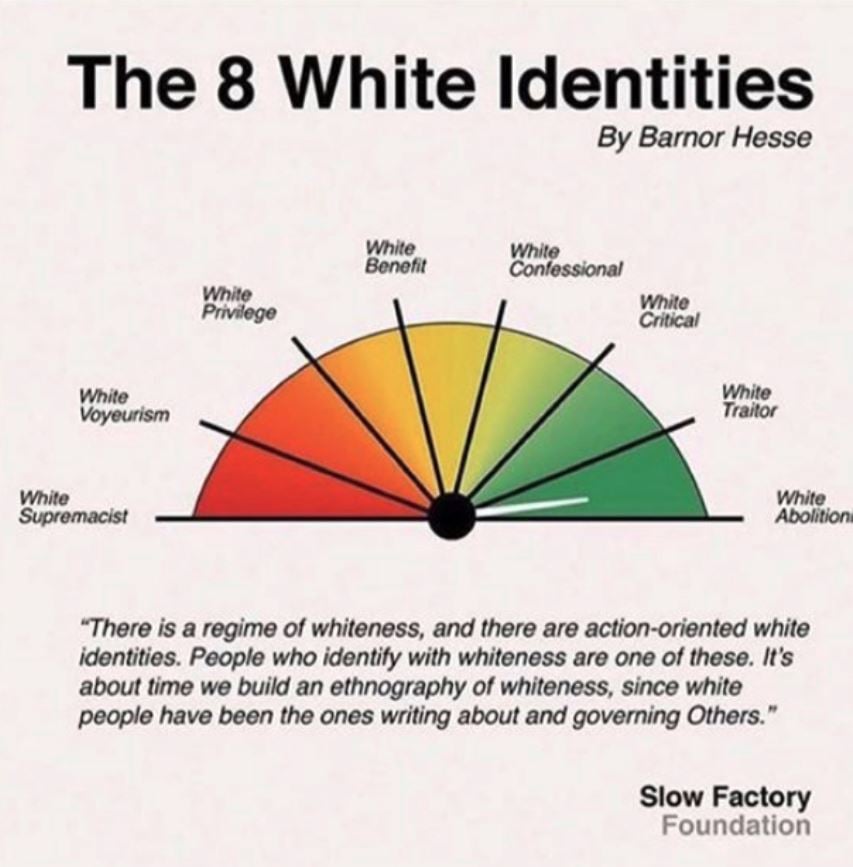
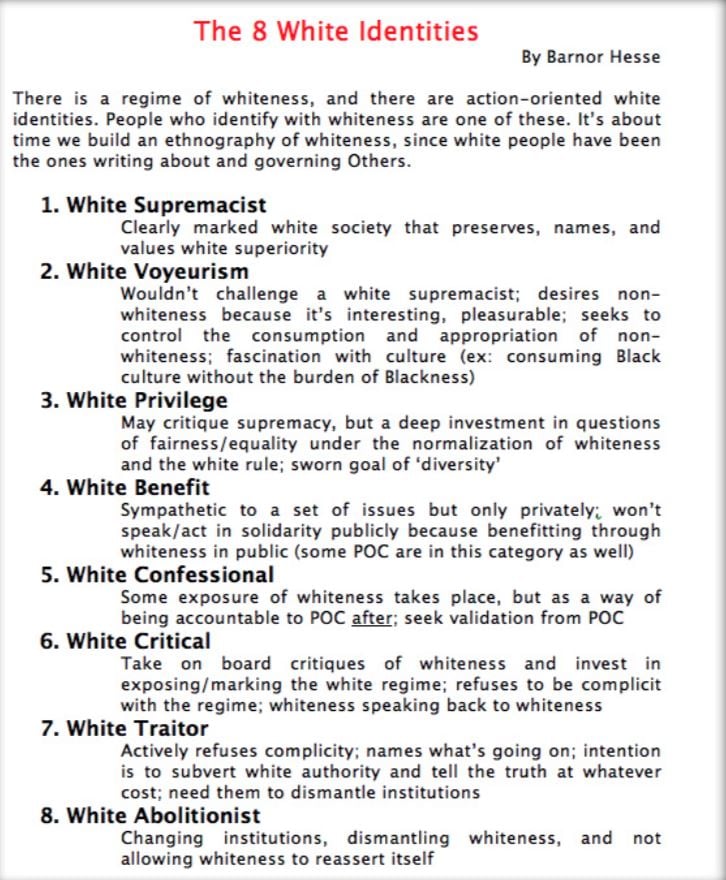
Critical race theory watchdog Christopher F. Rufo reported on Monday that the principal of a New York school sent a list of white identities to white parents so that they could try to convert themselves from white supremacists to white abolitionists.
The East Side Community School teacher even included a white supremacism spectrum for parents to self-identify.
Advertisement – story continues below
According to East Side Community School the goal is to become a white abolitionist. But these steps are subjective, not clearly defined and ALWAYS up for evaluation by your peers.
The modern-day left is determined to destroy our society with their hatred, ignorance and racism.
Advertisement – story continues below
Apparently this list of the eight “white identities” has been passed around on Facebook for a couple of years.
Hesse is an Associate Professor of African American Studies, Political Science, and Sociology
His research interests include post-structuralism and political theory, black political thought, modernity and coloniality, blackness and affect, race and governmentality, conceptual methodologies, postcolonial studies. His book, Un/settled Multiculturalisms: Diasporas, Entanglements, Transruptions, reconsiders the meanings of multiculturalism in the West. In introducing a new conceptual language, the volume stresses the importance of distinguishing between the multicultural as a signifier of the unsettled meanings of cultural differences, and multiculturalism as the signified of attempts to “fix” their meaning in national imaginaries. The book also casts the debates about multiculturalism in the contexts of globalization, post-colonialism, and what Barnor Hesse calls “multicultural transruptions”–which he sees as resurgent, irrepressible multicultural issues.
Jim Hoft is the founder and editor of The Gateway Pundit, one of the top conservative news outlets in America. Jim was awarded the Reed Irvine Accuracy in Media Award in 2013 and is the proud recipient of the Breitbart Award for Excellence in Online Journalism from the Americans for Prosperity Foundation in May 2016.
Critical race theory has infiltrated Christian private schools and parents aren’t speaking up because they’re afraid, said one education activist.
Elana Yaron Fishbein started an organization called “No Left Turn in Education” to help parents take the lead in the education of their children and to show people who oppose critical race theory that they have allies. Among its slogans is “education, not indoctrination.” In only a few months since its beginning in August 2020, her Facebook group grew dramatically. Today, her group has chapters in 18 states.
“Many parents say ‘how can you be against it (CRT)?’ until you open it and see what’s in it. It’s the exact opposite [of what it says,]” said Fishbein to The Christian Post.
Fishbein’s own courage in fighting critical race theory comes from her Jewish faith background, she said.
Originally from Israel, she noted, “It’s Jews, more than any other group in the history of the world, who have suffered from racism and the consequences of racism. Am I going to sit down and watch what they’re doing, turning this country into a racist country? Blaming all the whites for being racist and privileged? As an Israeli, I know if I don’t stand up and fight, we’ll be gone.”
She sounded the alarm that both public and private schools have begun teaching CRT as well as comprehensive sexual education, which instead of encouraging abstinence, focuses on normalizing sex outside of marriage and encourages confused kids to question whether they are male or female.
Critical race theory has varied definitions. Oxford Reference notes: “CRT regards the privileged position occupied by mostly White, middle-class academics as a major obstacle to a comprehensive exposure of the racism that is seen to permeate the law, its rules, concepts, and institutions.”
Conservative website Pulpit & Pen argues that CRT is dangerous in that it is “fundamentally opposed to the American Civil Rights Movement,” as it does not advocate for treating people equally but rather that “the law may actually need to [be] biased in favor of minority identity groups” to redistribute power. Race is the defining feature of human identity, Pulpit & Pen states, and every person is part of either an oppressor race that holds power, or an oppressed race that oppressors abuse.
Fishbein argued, “They attach to critical race theory a lot of beautiful names, but they mean the opposite. Of course, we are ‘anti-racist.’ Of course, we are ‘for diversity.’ But they mean the opposite.”
Churches and Christian schools are teaching children how to classify each other by race and see color instead of character, she said. It’s not only being taught in public schools but “it’s very, very pervasive in Catholic schools, Episcopalian schools, charter schools, we’re getting a lot of references from most private schools,” she maintained.
“The majority of private schools are in bed with all this too. It is very common even in religious schools and in a lot of churches. A lot of synagogues have gone totally woke.”
In Missouri, a student filed a lawsuit alleging that her Catholic school tried to force her to lie that she was racist. A Nevada charter school forced students to identify themselves as members of a race. A public school in California told children to rank themselves by “privilege” in the classroom. Some of the elements that defined privilege was whether someone was white and a Christian.
“More than 4,500 classrooms around the country have begun to incorporate the 1619 Project curricular materials into their content,” she said.
Burke and her colleagues specifically asked school board members and families across the country about the 1619 Project and 50% of all parents and 70% of school board members said that they do not want schools to use the instructional materials rooted in the idea that slavery is the center of the national narrative. Likewise, 70% of parents and 74% of school board members believe that slavery is a tragedy that harmed the nation but freedom and prosperity represent who Americans are.
Their data showed that only 25% of parents and 17% of school board members believe that students should be taught that the founding ideals of liberty and equality were false when they were written and that U.S. history must thus be reframed.
Fishbein believes that critical race theory often goes unopposed because its opponents feel too afraid to fight it. She often meets people who don’t tell even their close friends that they oppose the ideology.
One woman she met had a close friend who would host sleepovers with her children. For years, she felt too afraid to say she opposed CRT developments at the school their children attended. When she finally spoke up to her friend, her friend agreed with her and said that she also had felt too afraid to share her real beliefs.
When Fishbein first objected to CRT at her own school, parents weren’t willing to stand with her. Several people loudly condemned her, she said.
“The lynching was public, but the support was private,” she said. “I was really concerned about the people being afraid to talk. People say they are 100% with me and they agree, but they’re afraid to talk. It blew my mind. How in this country with First Amendment rights people are afraid to talk?”
Fishbein encouraged parents to run for school boards, form networks, and use resources on No Left Turn in Education’s website to fight back against the teaching of CRT.
“The school board dictates the curriculum,” she said. “Do you care about your kids, do you care about your family, do you care about your nation? You have to start getting involved.”
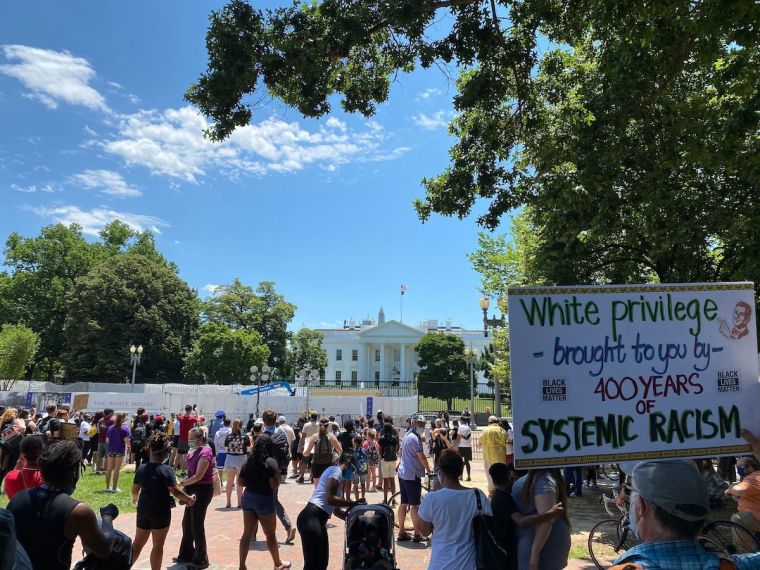
People gather near the White House during a peaceful protest against police brutality and racism, on June 13, 2020, in Washington, DC. | AFP via Getty Images/Daniel Slim
Scholars are warning about the influences of the neo-Marxist paradigm in many realms of culture, a theory they say undermines the foundations of a free society and harms the marginalized people it purports to help.
In a webinar hosted by The Heritage Foundation‘s Angela Sailor Monday, policy experts spoke at length about the ways in which critical race theory and the identity politics it underpins have sown hostile division into public life while claiming to combat racial injustice.
Broadly defined, critical race theory utilizes race as the lens through which every area of life is examined, categorizing everyone into oppressor and oppressed groups. The racial theory is the child of critical theory, the scholars explained, and most Americans do not agree with its ideological claims but it is being pushed strongly by elites and has entrenched special interests in many public institutions.
Lindsey Burke, director of the Center for Education Policy at The Heritage Foundation, noted in her remarks that among the most influential arenas where critical race theory is being furthered is through the approximately 14,000 public school boards across the country. Those boards indelibly shape the minds of schoolchildren and many are approving the use of the curriculum materials based on the 1619 Project, a series of New York Times reporting that frames the arrival of African slaves on the shores of the United States as the central feature of the American founding.This view stands in stark contrast to the the idea that nation was birthed at the signing of the Declaration of Independence on July 4, 1776.
“More than 4,500 classrooms around the country have begun to incorporate the 1619 Project curricular materials into their content,” she said.
Burke and her colleagues specifically asked school board members and families across the country about the 1619 Project and 50% of all parents and 70% of school board members said that they do not want schools to use the instructional materials rooted in the idea that slavery is the center of the national narrative. Likewise, 70% of parents and 74% of school board members believe that slavery is a tragedy that harmed the nation but freedom and prosperity represent who Americans are.
Their data showed that only 25% of parents and 17% of school board members believe that students should be taught that the founding ideals of liberty and equality were false when they were written and that U.S. history must thus be reframed.
Jonathan Butcher, a senior policy analyst at Heritage, explained that what the CRT worldview does is dismantle social and governmental norms and foments a new kind of intolerance.
“Critical theory is not a sympathetic perspective with policy goals that lead to racial reconciliation, freedom, and opportunity. That’s not what it is. It’s talking about subjugation and retribution,” he said, referencing a paper he co-authored with fellow panelist and author Mike Gonzalez.
One of the founders of CRT calls for “transformative resistance strategy” in response to the rule of law and the U.S. constitutional republic, he said. According to those who adhere to the theory, they are “highly suspicious of the liberal agenda” with liberal in this sense meaning classical liberal values from the Enlightenment, he noted.
Gonzalez, author of The Plot to Change America, offered during his remarks that it is important to realize that the far left feels emboldened to repress conservative ideas and are calling for vast institutional change, noting its grip on the government, culture-making institutions, Big Tech, and many Fortune 500 companies.
At base, CRT is “a tool for changing the country,” he said, a tool that undermines societal foundations and holds that the rule of law and jurisprudence is to preserve the privilege of those who write the laws.
Christopher Rufo, a journalist and visiting fellow at Heritage Foundation, has been examining how the theory has been operating within institutions, HR programs, and in federal government agencies.
At the National Nuclear Laboratories in New Mexico, CRT-based training sessions were held in which white male executives were taken to a resort and were forcedto undergo a series of exercises to deconstruct their white male identity, something that the trainers claimed was akin to the Ku Klux Klan, mass killings, and MAGA hats, he explained. The men were asked to condemn themselves and then write letters of apology to women and people of color and apologize for their whiteness. Similar training efforts and exercises were taking place across the federal bureaucracy but President Donald Trump canceled them with an executive order.
Rufo is now working on reporting that will show how this ideology is being inculcated into K-12 students. An upcoming story he will soon publish highlights how 3rd graders are being tasked with deconstructing their intersectional identities, which is “slicing and dicing their own internal self-image on the axes of race, gender, religion, sexual orientation, transgenderism … and then ranking themselves on a hierarchy of power and privilege.”
“They’re taking these tenets that were once limited to academia and now trying to basically inject them into the bloodstream of every institution from kindergarten to the federal government,” he said.
“They are now training elementary school students how to hold protests, how to disrupt the system, how to become revolutionaries.”
The theory, which promises a utopia of sorts and racial equality, is not aiming to build anything but rests in negation that relies upon the thrill of revenge yet offers nothing to the margins of society, Rufo argued.
He urged parents to find out what is in their children’s school curriculum, noting that much of it is not only indefensible but likely illegal and is only backed by a tiny group of activists in all but the most extreme school districts. It will take courage to resist but it is necessary and the more scrutiny it receives the more likely it is to be rejected, he said.
The Heritage Foundation discussion comes amid ongoing debate over CRT among evangelicals, with some influential leaders, including John Piper and Tim Keller, rejecting it.
A group of pastors, including SBC’s first and only black president, responded with a statement, lamenting that “the actions of some in the SBC appear to be more concerned with political maneuvering than working to present a vibrant, gospel-loving, racially and culturally diverse vision.”
“Many who recognize systemic injustices are labeled as ‘Marxists,’ ‘Liberals,’ and ‘Critical Race Theorists,’ even though they are theologically orthodox and believe in the total sufficiency of Scripture,” they said. “[W]e stand firmly in opposition to any movement in the SBC that seeks to distract from racial reconciliation through the gospel and that denies the reality of systemic injustice.”
American Family Association
American Family Association (AFA), a non-profit 501(c)(3) organization, was founded in 1977 by Donald E. Wildmon, who was the pastor of First United Methodist Church in Southaven, Mississippi, at the time. Since 1977, AFA has been on the frontlines of Ame
NEWSMAX
News, Opinion, Interviews, Research and discussion
Opinion
American Family Association
American Family Association (AFA), a non-profit 501(c)(3) organization, was founded in 1977 by Donald E. Wildmon, who was the pastor of First United Methodist Church in Southaven, Mississippi, at the time. Since 1977, AFA has been on the frontlines of Ame
American Family Association
American Family Association (AFA), a non-profit 501(c)(3) organization, was founded in 1977 by Donald E. Wildmon, who was the pastor of First United Methodist Church in Southaven, Mississippi, at the time. Since 1977, AFA has been on the frontlines of Ame
You Version
Bible Translations, Devotional Tools and Plans, BLOG, free mobile application; notes and more
Political
American Family Association
American Family Association (AFA), a non-profit 501(c)(3) organization, was founded in 1977 by Donald E. Wildmon, who was the pastor of First United Methodist Church in Southaven, Mississippi, at the time. Since 1977, AFA has been on the frontlines of Ame
NEWSMAX
News, Opinion, Interviews, Research and discussion
Spiritual
American Family Association
American Family Association (AFA), a non-profit 501(c)(3) organization, was founded in 1977 by Donald E. Wildmon, who was the pastor of First United Methodist Church in Southaven, Mississippi, at the time. Since 1977, AFA has been on the frontlines of Ame
Bible Gateway
The Bible Gateway is a tool for reading and researching scripture online — all in the language or translation of your choice! It provides advanced searching capabilities, which allow readers to find and compare particular passages in scripture based on












 What Did You Say?
You must be logged in to post a comment.