Perspectives; Thoughts; Comments; Opinions; Discussions

Archive for the ‘Free Speech’ Category

Tim Walz Endorsed Censorship In Front Of Millions Of Americans And No One Cares


By: Mark Hemingway | October 03, 2024

Read more at https://thefederalist.com/2024/10/03/tim-walz-endorsed-censorship-in-front-of-millions-of-americans-and-no-one-cares/
Author Mark Hemingway profile

Mark Hemingway

Visit on Twitter@heminator

More Articles

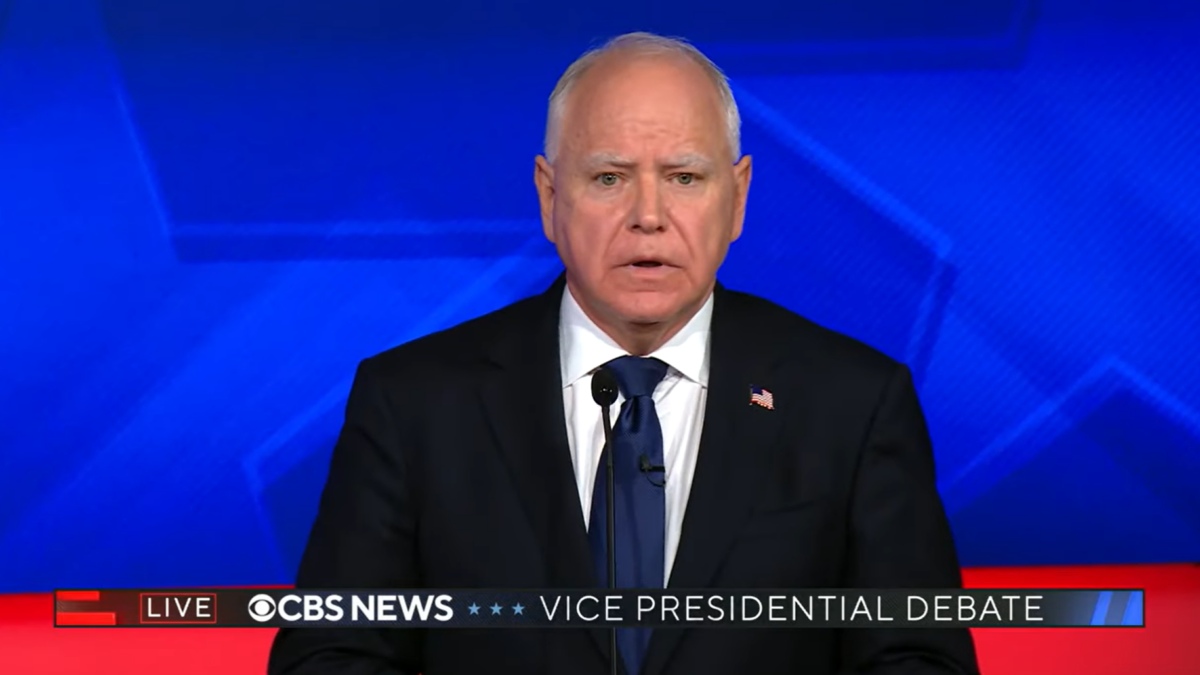
The most important exchange in Tuesday’s vice-presidential debate has been almost entirely ignored by the corporate media. Not surprisingly, that’s because it makes Walz look like an authoritarian and a fool in one fell swoop:

J.D. Vance: The most sacred right under the United States democracy is the First Amendment. You yourself have said there’s no First Amendment right to misinformation. Kamala Harris wants to use

Tim Walz: …[inaudible] threatening or hate speech …

J.D. Vance: … the power of government and Big Tech to silence people from speaking their minds. That is a threat to democracy that will long outlive this present political moment. I would like Democrats and Republicans to both reject censorship. Let’s persuade one another. Let’s argue about ideas, and then let’s come together afterwards.

Tim Walz: You can’t yell fire in a crowded theater. That’s the test. That’s the Supreme Court test.

J.D. Vance: Tim. Fire in a crowded theater? You guys wanted to kick people off of Facebook for saying that toddlers should not wear masks.

CBS News’ Norah O’Donnell: Senator, the governor does have the floor.

Tim Walz: Sorry.

Ok, let’s unpack what happened here. Walz challenged Vance on Trump’s questioning of the 2020 election results and Jan. 6, and Vance countered by saying that if Walz and his running mate, Kamala Harris, were so concerned about the fate of democracy they wouldn’t be so adamantly pro-censorship. Specifically, Walz has previously said, quite incorrectly from any legal or moral standpoint, that there’s no First Amendment right to “misinformation.”

Walz interjects to, near as I can tell, try and clarify that he was also talking about limiting “threatening” words or “hate speech.” Interestingly, I looked at multiple debate transcriptions, and none of them had this quite audible interjection included — though the first word or two is hard to discern, the part about “threatening or hate speech” is quite clear. In any event, to the extent that Walz is trying to defend himself he’s doing an awful job.

The legal standards for “threatening” speech or incitement might be clearer, but it’s still a fraught issue. As for “hate speech,” he has no idea what he’s talking about. You may not like it, but “hate speech” is absolutely protected speech. The First Amendment is absolutely a right to offend people without legal sanction, even gratuitously. Otherwise, policing speech is just a tool for government oppression. After all, who defines what constitutes “hate speech?” Walz seems to be suggesting he wants to throw people in jail for not using preferred pronouns and the like.
But the coup de grace for sinister ignorance is Walz saying, “You can’t yell fire in a crowded theater. That’s the test. That’s the Supreme Court test.” Now if you know anything about First Amendment issues, the “fire in a crowded theater” line makes civil libertarians break out in hives. Somewhat surprisingly, The Atlantic had a very good article a few years back about the origin of the phrase:

In reality, though, shouting “Fire” in a crowded theater is not a broad First Amendment loophole permitting the regulation of speech. The phrase originated in a case that did not involve yelling or fires or crowds or theaters. Charles T. Schenck, the general secretary of the U.S. Socialist Party, was convicted in a Philadelphia federal court for violating the Espionage Act by printing leaflets that criticized the military draft as unconstitutional.

In a six-paragraph opinion issued on March 3, 1919, Justice Holmes wrote for a unanimous Court that Schenck’s conviction was justified because the leaflets advocated for obstructing military recruiting and therefore constituted a “clear and present danger” during a time of war. “We admit that in many places and in ordinary times the defendants in saying all that was said in the circular would have been within their constitutional rights,” Holmes wrote. “But the character of every act depends upon the circumstances in which it is done. The most stringent protection of free speech would not protect a man in falsely shouting fire in a theatre and causing a panic.”

The rest of the article is worth reading for the full history, but in short, arresting people for handing out anti-war literature was justified by comparing it to shouting fire in a crowded theater. Which is unconscionable. Holmes himself later did an about-face on his own reasoning a year later, and the Supreme Court decision above was overturned by the court quite definitively by Brandenburg v. Ohio in 1969. “Fire in a crowded theater” was never a reliable “Supreme Court test” as Walz put it, and it’s been totally inoperable as a matter of law since Walz was in kindergarten.

This is not some small matter here. I have no interest in defending what happened on Jan. 6 (though I do think a great many people have been subject to grossly unfair legal penalties for their participation in the riot, and that this has been done out of partisan spite). But Vance is absolutely correct when he says the Democrat Party’s embrace of censorship is far more threatening than anything on Jan. 6.

How do I know this? Well, to start, unlike Jan. 6, censorship has affected far more people and is an ongoing concern. This publication is involved in a lawsuit with The Daily Wire and the state of Texas against the State Department for promoting Big Tech censorship tools. The State Department justifies what they’re doing as part of a frightening attempt to police “misinformation” — which is routinely defined as any news that liberal academics and federal bureaucrats don’t think is politically expedient.

Earlier this week, Rep. Adam Schiff, who knowingly spread lies about President Trump treasonously colluding with Russia to undermine a fairly elected president, sent a letter to tech companies telling them to censor “false, hateful, and violent content” because it is a “threat” to the upcoming election. But who decides what content is false, hateful, or violent here? Adam Schiff is an especially unworthy judge of these matters, but then again, there’s no elected official that should be deciding who gets to say what. And sending letters that attempt to intimidate private companies into preventing Americans from exercising their most fundamental constitutional right … well, perhaps we live in more civil times, but I have an idea of how the Sons of Liberty would have responded to such a politician.

And it’s not just politicians, the First Amendment is also being actively undermined by the people who, in theory, have the biggest stake in protecting it. Our corporate media’s silence is further proof they quietly agree that the censorship of unruly citizens is necessary. After all, if they continue to do things like refuse a vaccine that doesn’t actually prevent transmission of the disease, stubbornly point out the octogenarian the White House has dementia, and won’t vote for who they’re told to — how exactly do they expect journalism’s current business model to succeed?

The fact remains that fewer people are going to read this very article because it’s being actively suppressed by Big Tech right now. Even if I didn’t have the receipts to show that this publication was being intentionally and unconstitutionally singled out for suppression by the feds, just the fact I typed “vaccine” in the preceding paragraph was probably enough to alert The Algorithms such that this article will forever show up on page six of any relevant search results. The writer in me wants to note the twisted irony of an article warning about the obliteration of the First Amendment being actively censored; the citizen in me just understands this as simple tyranny.

Unlike so many of my peers — alas, I think my parents have taken to telling their friends I sell used cars to spare themselves the shame of admitting I’m a journalist — I’m not going to tell you how to vote. But it is entirely fair to say that Tim Walz and his ilk do not understand the First Amendment, and they sure as hell don’t respect it.

And when people like that get in power, we all lose.


Mark Hemingway is the Book Editor at The Federalist, and was formerly a senior writer at The Weekly Standard. Follow him on Twitter at @heminator

“Curbing” Free Speech: John Kerry Criticizes the First Amendment as “a Major Block” for Censorship


By: Jonathan Turley | October 3, 2024

Read more at https://jonathanturley.org/2024/10/03/curbing-free-speech-john-kerry-denounces-the-first-amendment-as-a-major-block-to-removing-disinformation/

Below is my column in the New York Post on the recent remarks of former Secretary of State John Kerry to the World Economic Forum, the latest in an array of powerful American politicians warning about the dangers of free speech and calling for government controls. He joins his fellow former Democratic Presidential Nominee Hillary Clinton in reaching out to the global elite for help in censoring their fellow Americans.

Here is the column:

If you want to know how hostile the global elite are to free speech, look no further than John Kerry’s recent speech to the World Economic Forum. Rather than extol the benefits of democratic liberty versus dictatorships and oligarchs, Kerry called the First Amendment a “major block” to keeping people from believing the “wrong” things.

The former secretary of state and aide to the Biden-Harris administration told the sympathetic audience:

“You know, there’s a lot of discussion now about how you curb those entities in order to guarantee that you’re going to have some accountability on facts, etc. But look, if people only go to one source, and the source they go to is sick, and, you know, has an agenda, and they’re putting out disinformation, our First Amendment stands as a major block to be able to just, you know, hammer it out of existence.

“So, what we need is to win the ground, win the right to govern, by hopefully winning enough votes that you’re free to be able to implement change.”

Free rein on social media

The “freedom” to be won in this election is to liberate officials who like himself can set about controlling what can be said, read or heard. Kerry insisted that the problem with social media is that no one is controlling what they can say or read. “The dislike of and anguish over social media is just growing and growing. It is part of our problem, particularly in democracies, in terms of building consensus around any issue,” he said.

“It’s really hard to govern today. The referees we used to have to determine what is a fact and what isn’t a fact have kind of been eviscerated, to a certain degree. And people go and self-select where they go for their news, for their information. And then you get into a vicious cycle.”

Kerry continued: “Democracies around the world now are struggling with the absence of a sort of truth arbiter, and there’s no one who defines what facts really are.”

It is not clear when in our history we allowed “referees” to “determine what is a fact.”

Since the First Amendment has been in place since 1791, it is hard to imagine when referees were used in conformity with our Constitution. The Founders would have been repulsed by the idea of a “truth arbiter.” Yet it was a pitch that clearly went over big with the crowd at the World Economic Forum.

Located in Geneva, Switzerland, it is funded by over 1,000 member companies around the world. It is the perfect body for the selection of our new governing “arbiters.” The greatest irony was that, after fearmongering about this supposed parade of horrible that comes from free speech, Kerry insisted, “If we could strip away some of the fearmongering that’s taking place and get down to the realities of what’s here for people, this is the biggest economic opportunity.”

It was like Ed Wood denouncing cheesy jump scares in horror movies. Kerry is only the latest Democratic leader or pundit to denounce the First Amendment.

In my book on free speech, I discuss the growing anti-free speech movement being led by law professors and supported by both politicians and journalists. They include Michigan law professor and MSNBC commentator Barbara McQuade, who has called free speech America’s “Achilles’ heel.”

Columbia law professor Tim Wu, a former Biden White House aide, wrote an op-ed declaring “The First Amendment Is Out of Control.” He explained that free speech “now mostly protects corporate interests” and threatens “essential jobs of the state, such as protecting national security and the safety and privacy of its citizens.”

George Washington University Law’s Mary Ann Franks complains that the First Amendment (and also the Second) is too “aggressively individualistic” and endangers “domestic tranquility” and “general welfare.”

‘Will we break the fever?’

Kerry hit all of the top talking points for the anti-free speech movement. He portrayed the First Amendment as hopelessly out of date and dangerous. He argued that citizens would be far better off if an elite could tell them what was information and what was disinformation.

Other political contemporaries are working on the same problem. Hillary Clinton has called upon Europeans to use the Digital Services Act to force the censoring of Americans. She has also suggested the arrest of Americans who she views as spreading disinformation.

Sen. Elizabeth Warren (D.-Mass.) has called for companies like Amazon to use enlightened algorithms to steer readers to “true” books on subjects like climate change to protect them from their own poor reading choices.

Kerry explained how the true heroes are those poor suffering government officials seeking to protect citizens from unbridled, unregulated thoughts:

“I think democracies are very challenged right now and have not proven they can move fast enough or big enough to deal with the challenges they are facing, and to me, that is part of what this election is all about. Will we break the fever in the United States?”

The “fever” of free speech is undeniably hard to break. You have to convince a free people to give up part of their freedom. To do so, they have to be very angry or very afraid. There is, of course, another possibility: that there is no existential danger of disinformation. Rather there are powerful figures who want to control speech in the world for their own purposes. These are the same rationales and the same voices that have been throughout our history for censorship.

Give me liberty

Each generation of government officials insists that they face some unprecedented threat, whether it was the printing press at the start of our republic or social media in this century. Only the solution remains the same: to hand over control of what we read or hear to a governing elite like Kerry.

In 1860, Frederick Douglass gave a “Plea for Free Speech in Boston,” and warned them that all of their struggles meant nothing if the “freedom of speech is struck down” because “Liberty is meaningless where the right to utter one’s thoughts and opinions has ceased to exist.” Douglass denounced those seeking to deny or limit free speech as making their “freedom a mockery.” Of course, Douglass knew nothing of social media, and he certainly never met the likes of John Kerry.

However, if we embrace our new arbiters of truth we deserve to be mocked as a people who held true freedom only to surrender it to a governing elite.

Jonathan Turley is the Shapiro Professor of Public Interest Law at George Washington University and the author of “The Indispensable Right: Free Speech in an Age of Rage.”

Federal Court Rules Against University of New Mexico in Free Speech Case


By: Jonathan Turley | October 1, 2024

Read more at https://jonathanturley.org/2024/10/01/federal-court-rules-against-university-of-new-mexico-in-free-speech-case/

We have been discussing how colleges and universities have been using security concerns as a way to bar conservative and libertarian speakers. Another barrier has been the imposition of prohibitive security fees as a condition for such speakers to appear on campus, fees generally not required for liberal speakers. Now, in a significant free speech victory, U.S. District Judge David Urias has enjoined the University of New Mexico from imposing a $5,400 security fee for former collegiate swimmer and activist Riley Gaines after speaking on campus. UNM has a history of cancellation campaigns against conservative and libertarian speakers, as previously discussed on this blog.

Gaines has become a national figure in her campaign against biologically male students competing in women’s sports. While it is a position that is supported by an overwhelming majority of Americans, faculty and students have repeatedly targeted Gaines with cancel campaigns and disruptive protests. In this case, UNM originally demanded over $10,000. The lawsuit brought by the Leadership Institute named UNM President Garnett Stokes and other UNM officials as defendants. Judge Urias was legitimately suspicious of the demand and found that it violated the First Amendment.

In his 16-page order in Leadership Institute v. Stokes (D.N.M.), Judge Urias noted that Gaines travels with her own security (itself a sad statement about this Age of Rage).  The court noted the rather fluid standard applied to Gaines:

[T]he quote of over $10,000 was for every officer UNM employed—thirty-three officers; nearly one for every three attendees the students expected. When TP-UNM asked why Defendant Stump intended to assign every officer to the Gaines event, and whether it was because of the speaker or the inviting organization, he responded that “it’s all based on individual assessments,” that they were looking at the “individual,” and that “there is not a criteria [sic].”

He also told the students that if an organization were to screen the Barbie movie in a venue on campus, he likely would not require even a single officer because the UNM police were “not worried about the Barbie movie.” He then said that security was “consistent” in how it assessed fees “to Turning Point” in the past. He described past TP-UNM events featuring other conservative speakers that generated protests at UNM. A few times during the meeting, he reiterated that UNM assesses security fees on a “case-by-case basis.”

Notably, the court detailed how fewer than 10 protesters actually showed up and demonstrated outside of the room. Nevertheless, UNM hit Turning Point with the fee for twenty-seven officers at the event who charged for a total of 95.25 hours.

The court applied the holding in Forsyth County v. Nationalist Movement (1992) in which the Supreme Court held that the government can impose extra security fees due to the controversial status of speakers or groups. In writing for a 5-4 majority, Justice Henry Blackmun held that “Nothing in the law or its application prevents the official from encouraging some views and discouraging others through the arbitrary application of fees. The First Amendment prohibits the vesting of such unbridled discretion in a government official.”

Judge Urias found precisely such a barrier imposed by the UNM:

When a policy allows “appraisal of facts, the exercise of judgment, and the formation of an opinion by the licensing authority, the danger of censorship and of abridgment of our precious First Amendment freedoms is too great to be permitted[.]” Forsyth County.… Although the question in this case is closer than that in Forsyth, the Court nonetheless finds that Plaintiffs have demonstrated the security fee policy in this case is similar enough to render it overly broad. Although the policy lists criteria for officials to consider when assessing event security, such as venue size and location, the list ultimately leaves the decision of how much to charge for security up to the whim of university officials. For example, the policy does not explain a method for determining how much more security is required for a small venue as compared to a large one, or for a daytime event as compared to a nighttime event.

Significantly, the policy states that the “basic cost of security … will be charged to all groups” based on a schedule of charges that the UNM Police Department has on its website, but despite this, the department does not actually delineate the amount of this “basic cost of security.” Though the security fee policy also states that the police department “regularly” updates the “schedule of charges based on the factors” and that “[t]he basic cost of security according to this schedule will be charged to all groups,” there is no schedule of charges.

Additionally, the preamble to the policy indicates that university officials “may” assess security fees but does not provide guidance for when they may or may not assess these fees, which contributes to the problem of allowing university officials overly broad discretion. In sum, Plaintiffs have shown a substantial likelihood of success on the merits of their overbreadth claim because the security fee policy does not contain limiting language that includes “narrowly drawn, reasonable and definite standards[,]” and it does not include anything to prevent UNM administrators from exercising their discretion in a content-based manner….

The ruling is a notable victory for free speech in creating additional precedent against the use of security fees as a deterrent to groups in inviting targeted speakers like Riley Gaines. Conservative groups have long complained that far left speakers are rarely targeted by cancel campaigns and even more rarely hit with these security fees.  In past cases, a security deposit is demanded upfront, creating a barrier for many groups.

Jonathan Turley is the Shapiro Professor of Public Interest Law at George Washington University and the author of “The Indispensable Right: Free Speech in an Age of Rage.”

“Hurtful to the Community”: Critics Force Removal of Republican Symbol from “Political Pattie’s”


By: Jonathan Turley | September 30, 2024

Read more at https://jonathanturley.org/2024/09/29/hurtful-to-the-community-critics-force-removal-of-republican-symbol-from-political-patties/

In a new sign of the intolerance of our Age of Rage, liberal activists in D.C. have forced a politics-themed bar in Washington, D.C., “Political Pattie’s,” to remove the GOP political symbol from its building. The GOP pachyderm will be packed away to protect the sensibilities of Democrats. The appearance of the elephant was too triggering for liberals and boycotts were being threatened.

According to The Washingtonian, “Political Pattie’s,” the red elephant was removed before the opening because it “was hurtful to the community.” No party symbols will be shown so that D.C. customers feel safe or at least satisfied in the space.

In a statement, owners Andrew Benbow and Sydney Bradford explained that “soon after our logo was painted on our building’s facade, we realized that the representation of the red elephant was hurtful to the community.” While both Benbow and Bradford support Vice President Kamala Harris in the 2024 election, they were hoping to encourage discourse and “promote unity,” according to Roll Call. Democrats would have none of it. They will also now repaint the word “Political” on the sign in blue to help maintain the apparent safe space for liberals.

The owners added “We view the online backlash that we’ve recently received to be mean spirited, especially considering our original and continued intent to be a space that is welcoming to ALL people, including members of the LGBTQ community.” Yet, they yielded to that threatened cancel campaign.

Roughly half of this country is Republican or conservative according to presidential voting patterns. Yet, many Democrats cannot tolerate even the inclusion of both symbols for the political parties. They will now be able to eat and drink in the same type of echo chamber where they receive news and discuss politics. The “hurt” will be gone with the reference to alternative viewpoints.

Airdnc? Trump Group Accuses Airbnb Host of Eviction on Political Grounds


By: Jonathan Turley | September 30, 2024

Read more at https://jonathanturley.org/2024/09/28/airdnc-trump-group-accuses-airbnb-host-of-eviction-on-political-grounds/

There is an interesting controversy growing over an alleged eviction by an Airbnb host in Philadelphia of Trump supporters. The conservative site Breitbart is reporting that “ballot chasers” for Trump were allegedly given an hour to clear out after the host learned that they were in Pennsylvania to get out the vote for Trump. If true, the incident raises a serious matter for Airbnb over hosts imposing political conditions for the use of their property.

Once again, we have not heard the other side to this controversy. However, if these allegations are established, it raises a variation of an issue that has been discussed for years on this blog: the role of private companies or businesses in censoring speech or blacklisting individuals.

First for the obvious threshold point. Private property owners have a right to exclude people from their property on any number of issues. This homeowner is likely to be lionized by many who agree with the decision. If an owner wants to run their home like an Airdnc, they have every right to do so. The question is whether they can do so as an Airbnb.

It is worth noting that many of the same individuals supporting this owner likely opposed the right of business owners in cases like Masterpiece Cake Shop and 303 Creative. In those cases, the owners refused to make products for celebrations that conflicted with their religious views.

I have previously written why businesses should have the right of such denial as a matter of free speech, including in my book “The Indispensable Right: Free Speech in an Age of Rage.” In this case, an owner is accused of refusing service or rentals based on political grounds. The question is not whether this owner has the right of exclusion in a home, but whether Airbnb is now allowing such threshold political tests to be applied by owners. It would create an uncertainty for guests who would not know if they may be tossed to the street if they reveal their political viewpoints or affiliations.

The incident could be a type of micro-cancel problem. We have seen universities and colleges cancel conservative and libertarian speakers under pressure from faculty and students who cannot tolerate opposing views from being spoken on campuses. Citizens Alliance’s PA CHASE says that it is still pursuing a requested $5,000 refund.

Airbnb notes in its contractual language that

“Guest identity verification, reservation screening and the 24-hour safety line are tools or features used by Airbnb to help verify guest identities, screen reservations for potential party and property damage risk, and provide access to Airbnb’s 24-hour safety line.”

There is no indication that the group was planning large gatherings at the location. However, it could be cited by the owner.

If the group is mistaken or misrepresenting the facts, Airbnb should make that clear. It should also make clear what its policy is on possible political conditions for Airbnb listings. One possibility is that the owner will argue that he or she did not want the property used for a high-traffic political effort operating out of the home. A homeowner could reasonably demand that the property not be used for large parties or high-traffic enterprises.

Conversely, Citizens Alliance is suggesting that they were simply planning to stay at the home. Moreover, other guests have likely held parties on rented premises without such alleged peremptory action. Notably, Airbnb promises homeowners up to $3 million in insurance for any damage to property. Airbnb has a strong anti-discrimination policy on race but is silent on political viewpoints.

If the host barred Trump supporters due simply to their political affiliations or the purpose of their visit, it would seem inimical to the business model of the company. However, there are difficult hypotheticals on the extremes. For example, what if an owner came to hand over the keys only to find guests wearing KKK or neo-Nazi outfits? What if a pro-life owner learned that the home would be used at the base camp for a pro-abortion campaign? Do they have the right to decline service like a cake shop or web designer?

The difference may be based on the use of the property. Airbnb operates like an aggregated hotel chain using private owners to supply the rooms. Just as Hyatt cannot impose political litmus tests, it is unworkable to allow such a test by individual owners and still maintain a viable national chain.

If this owner was in compliance with Airbnb contractual conditions, the site should make that clear to renters. At a minimum, Airbnb would have to require owners to state upfront any threshold political conditions. That would be a nightmare for the company since the site would turn into a patchwork of threshold exclusions. That would destroy the premise of the site which treats the room stock as uniformly available and only differentiated on physical layout and pricing.

Notably, in cases like Masterpiece Cake Shop, the owner insisted that he would sell pre-made cakes to anyone who wanted to buy them. He only objected to preparing special cakes for ceremonies that contradicted his religious views.

In the same way, Airbnb could make clear that, so long as the property itself will not be used for political or advocacy activities, owners are expected to adopt a non-discriminatory policy on political viewpoints. The cost of renting out your home to strangers is that you will likely disagree with the values of many of the renters.

Airbnb is reportedly still looking at the refund request.

Majority of Americans Admit to ‘Self-Silencing’ on Hot-Button Issues, Survey Finds


Dr: Rebeka Zeljko | September 25, 2024

Read more at https://www.dailysignal.com/2024/09/25/majority-americans-admit-self-silencing-hot-button-issue/

Most Americans, 58%, said they cannot express their private opinions publicly, and 61% admit to “self-silencing” their political views. (FL-photography/iStock/Getty Images)

Rebeka Zeljko

Rebeka Zeljko is a reporter who covers politics for the Daily Caller News Foundation.

Most Americans, 58%, said they cannot express their private opinions publicly, and 61% admit to “self-silencing” their political views, according to the survey. At the same time, Americans publicly claim to have higher trust in our institutions than they do in private.

Only 36% of Democrats publicly said that they trust the government to tell the truth, but only 5% agreed with the statement in private, according to the survey. Similarly, 42% of Democrats publicly report that they trust the media to tell the truth, while just 9% reiterated this belief in private.

Skepticism is even more apparent among Republicans, with 14% publicly saying they trust the government to tell the truth while just 2% hold this belief privately, according to the study. At the same time, just 16% of Republicans publicly trust the media to tell the truth, while just 3% agreed with the statement in private.

Social+Pressure+IndexDownload

Just 37% of Americans publicly believe that we live in a mostly fair society, while just 7% privately agree with the sentiment, according to the survey.

While polarization is at the forefront of many political conversations, the study reveals Americans privately agree on many issues.

The vast majority of Americans, 90%, are privately on the “same side” of roughly two-thirds of political issues ranging from abortion to school choice and legal immigration, according to the survey.

When it comes to defunding the police, 28% of Gen Z and 27% of Democrats publicly supported the movement, according to the survey. However, only 2% of Gen Z and 3% of Democrats privately support the same movement, which parallels the 1% support among Baby Boomers and Republicans.

The Populace Research/YouGov study surveyed 19,879 respondents from May 16 to June 24.

Originally published by the Daily Caller News Foundation

The Counter-Constitutional Movement: The Assault on America’s Defining Principles


By: Jonathan Turley | September 25, 2024

Read more at https://jonathanturley.org/2024/09/25/the-counter-constitutional-movement-the-assault-on-americas-defining-principles/

Below is my column in the Wall Street Journal on the growing counter-constitutional movement in the United States. This assault on the Constitution is being led by law professors who have lost their faith in the defining principles and institutions of our Republic.

Here is the column:

Kamala Harris declared in Tuesday’s debate that a vote for her is a vote “to end the approach that is about attacking the foundations of our democracy ’cause you don’t like the outcome.” She was alluding to the 2021 Capitol riot, but she and her party are also attacking the foundations of our democracy: the Supreme Court and the freedom of speech.

Several candidates for the 2020 presidential nomination, including Ms. Harris, said they were open to the idea of packing the court by expanding the number of seats. Mr. Biden opposed the idea, but a week after he exited the 2024 presidential race, he announced a “bold plan” to “reform” the high court. It would pack the court via term limits and also impose a “binding code of conduct,” aimed at conservative justices.

Ms. Harris quickly endorsed the proposal in a statement, citing a “clear crisis of confidence” in the court owing to “decision after decision overturning long-standing precedent.” She might as well have added “because you don’t like the outcome.” Sen. Sheldon Whitehouse (D., R.I.) has already introduced ethics and term-limits legislation and said Ms. Harris’s campaign has told him “That your bills are precisely aligned with what we are talking about.”

The attacks on the court are part of a growing counter constitutional movement that began in higher education and seems recently to have reached a critical mass in the media and politics. The past few months have seen an explosion of books and articles laying out a new vision of “democracy” unconstrained by constitutional limits on majority power.

Erwin Chemerinsky, dean of the UC Berkeley law school, is author of “No Democracy Lasts Forever: How the Constitution Threatens the United States,” published last month. In a 2021 Los Angeles Times op-ed, he described conservative justices as “partisan hacks.”

In the New York Times, book critic Jennifer Szalai scoffs at what she calls “Constitution worship.” She writes: “Americans have long assumed that the Constitution could save us; a growing chorus now wonders whether we need to be saved from it.” She frets that by limiting the power of the majority, the Constitution “can end up fostering the widespread cynicism that helps authoritarianism grow.”

In a 2022 New York Times op-ed, “The Constitution Is Broken and Should Not Be Reclaimed,” law professors Ryan D. Doerfler of Harvard and Samuel Moyn of Yale called for liberals to “reclaim America from constitutionalism.”

Others have railed against individual rights. In my new book on free speech, I discuss this movement against what many professors deride as “rights talk.” Barbara McQuade of the University of Michigan Law School has called free speech America’s “Achilles’ heel.”

In another Times op-ed, “The First Amendment Is Out of Control,” Columbia law professor Tim Wu, a former Biden White House aide, asserts that free speech “now mostly protects corporate interests” and threatens “essential jobs of the state, such as protecting national security and the safety and privacy of its citizens.”

George Washington University Law’s Mary Ann Franks complains that the First Amendment (and also the Second) is too “aggressively individualistic” and endangers “domestic tranquility” and “general welfare.”

Mainstream Democrats are listening to radical voices. “How much does the current structure benefit us?” Rep. Alexandria Ocasio-Cortez (D., N.Y.) said in 2021, explaining her support for a court-packing bill. “I don’t think it does.” Kelley Robinson, president of the Human Rights Campaign, said at the Democratic National Committee’s “LGBTQ+ Kickoff” that “we’ve got to reimagine” democracy “in a way that is more revolutionary than . . . that little piece of paper.” Both AOC and Ms. Robinson later spoke to the convention itself.

The Nation’s Elie Mystal calls the Constitution “trash” and urges the abolition of the U.S. Senate. Rosa Brooks of Georgetown Law School complains that Americans are “slaves” to the Constitution.

Without counter majoritarian protections and institutions, politics would be reduced to raw power. That’s what some have in mind. In an October 2020 interview, Harvard law professor Michael Klarman laid out a plan for Democrats should they win the White House and both congressional chambers. They would enact “democracy-entrenching legislation,” which would ensure that “the Republican Party will never win another election” unless it moved to the left. The problem: “The Supreme Court could strike down everything I just described, and that’s something the Democrats need to fix.”

Trashing the Constitution gives professors and pundits a license to violate norms. The Washington Monthly reports that at a Georgetown conference, Prof. Josh Chafetz suggested that Congress retaliate against conservative justices by refusing to fund law clerks or “cutting off the Supreme Court’s air conditioning budget.” When the audience laughed, Harvard’s Mr. Doerfler snapped back: “It should not be a laugh line. This is a political contest, these are the tools of retaliation available, and they should be completely normalized.”

The cry for radical constitutional change is shortsighted. The constitutional system was designed for bad times, not only good times. It seeks to protect individual rights, minority factions and smaller states from the tyranny of the majority. The result is a system that forces compromise. It doesn’t protect us from political divisions any more than good medical care protects us from cancer. Rather it allows the body politic to survive political afflictions by pushing factions toward negotiation and moderation.

When Benjamin Franklin said the framers had created “a republic, if you can keep it,” he meant that we needed to keep faith in the Constitution. Law professors mistook their own crisis of faith for a constitutional crisis. They have become a sort of priesthood of atheists, keeping their frocks while doffing their faith. The true danger to the American democratic system lies with politicians who would follow their lead and destroy our institutions in pursuit of political advantage.

Mr. Turley a law professor at George Washington University and author of “The Indispensable Right: Free Speech in an Age of Rage” 

California Sued Over New “Deepfake” Law


By: Jonathan Turley | September 24, 2024

Read more at https://jonathanturley.org/2024/09/22/california-sued-over-new-deepfake-law/

California has triggered the first lawsuit over its controversial new laws that require social media companies to censor fake images created by artificial intelligence, known as deepfakes as well as barring the posting of images. A video creator is suing the State of California after his use of a parody of Vice President Kamala Harris was banned. The law raises serious and novel constitutional questions under the First Amendment.

Gov. Gavin Newsom signed A.B. 2839, expanding the time period that bars the knowing posting of deceptive AI-generated or manipulated content about the election. He also signed A.B. 2655, requiring social media companies to remove or label deceptive or digitally altered AI-generated content within 72 hours of a complaint. A third bill, A.B. 2355, requires election advertisements to disclose whether they use AI-generated or manipulated content.

The American Civil Liberties Union of California, Foundation for Individual Rights and Expression (FIRE), the California News Publishers Association and the California Broadcasters Association opposed the legislation on first amendment grounds.

Elon Musk recently reposted the image of Christopher Kohls, who he defended as fighting for that “absolute Constitutional right to lampoon politicians he believes should not be elected.”

Kohls objected that the new law requires a new font size for the labeling that would fill up the entire screen of his video.

In the complaint below, Kohls noted “[w]hile the obviously far-fetched and over-the-top content of the video make its satirical nature clear, Plaintiff entitled the video ‘Kamala Harris Campaign Ad PARODY.’”

AB 2389 covers “deepfakes,” when “[a] candidate for any federal, state, or local elected office in California portrayed as doing or saying something that the candidate did not do or say if the content is reasonably likely to harm the reputation or electoral prospects of a candidate.”

The exceptions for satire, parody, and news reporting only apply when they are accompanied by a disclaimer. The law is vague and could be used to cover a wide array of political speech. It is not clear what defines satire or parody under the exception. Likewise, “materially deceptive content,” is defined as “audio or visual media that is digitally created or modified, and that includes, but is not limited to, deepfakes and the output of chatbots, such that it would falsely appear to a reasonable person to be an authentic record of the content depicted in the media.”

The Kohls complaint argues that the law flips the burden to creators to establish a defense.

One of the more interesting legal issues is how the law defines “malice.” The legislators lifted the definition from New York Times v. Sullivan on defamation to define the element as the statute requires “malice.” This term does not require any particular ill-intent, but instead applies a definition of “knowing the materially deceptive content was false or with a reckless disregard for the truth.”

That is the long-standing standard for public officials and public figures subject to the higher standard of defamation. However, it is not clear that it will suffice for a law with potential criminal liability  and a law with sweeping limits on political speech.

Opinion and satire are generally exempted from defamation actions. Satire can sometimes be litigated as a matter of “false light,” but the standard can become blurred. The intent is clearly to create a false impression of the speaker in making fun of a figure like Harris. Drawing lines between honest and malicious satire is often difficult. Under a false light claim, a person can sue when a publication or image implies something that is both highly offensive and untrue. Where defamation deals with false statements, false light deals with false implications.

For example, in Gill v. Curtis Publ’g Co., 239 P.2d 630 (Cal. 1952), the court considered a “Ladies Home Journal” article that was highly critical of couples who claimed to be cases of “love at first sight.” The article suggested that such impulses were more sexual than serious. The magazine included a photo of a couple, with the caption, “[p]ublicized as glamorous, desirable, ‘love at first sight’ is a bad risk.” The couple was unaware that the photo was used and never consented to its inclusion in the magazine. They prevailed in an action for false light given the suggestion that they were one of these sexualized, “wrong” attractions.

In 1967, the Supreme Court handed down Time, Inc. v. Hill, which held that a family suing Life Magazine for false light must shoulder the burden of the actual malice standard under New York Times v. Sullivan. Justice William Brennan wrote that the majority opinion held that states cannot judge in favor of plaintiffs “to redress false reports of matters of public interest in the absence of proof that the defendant published the report with knowledge of its falsity or reckless disregard of the truth.”

This line is equally difficult under the tort’s standard for the commercial appropriation of use or likeness.

Parody and satire can constitute appropriation of names or likenesses (called the right to publicity). The courts, including the Ninth Circuit, have made a distinctly unfunny mess of such cases. Past tort cases generally have favored celebrities and resulted in rulings like White v. Samsung, a perfectly ludicrous ruling in which Vanna White successfully sued over the use of a robot with a blonde wig turning cards as the appropriation of her name or likeness. It appears no blonde being — robotic or human — may turn cards on a fake game show.

There is also the interesting question of when disclaimers (which are often upheld) ruin the creative message. The complaint argues:

“Disclaimers tend to spoil the joke and initialize the audience. This is why Kohls chooses to announce his parody videos from the title, allowing the entire real estate of the video itself to resemble the sorts of political ads he lampoons. The humor comes from the juxtaposition of over-the-top statements by the AI generated ‘narrator,’ contrasted with the seemingly earnest style of the video as if it were a genuine campaign ad.”

The complaint below has eight counts from (facial and applied) challenges under the First Amendment to due process claims under the Fourteenth Amendment.

Here is the complaint: Kohls v. Bonta

Fall from Grace: Olympian Suspended for Making Sign of the Cross


By: Jonathan Turley | September 20, 2024

Read more at https://jonathanturley.org/2024/09/20/fall-from-grace-olympian-suspended-for-making-sign-of-the-cross/

International Judo Federation (IJF) has suspended a Serbian judo champion for five months from any international competitions for making the sign of the cross after his match in the Paris Olympic games this year. It is another bizarre controversy from the games, including France barring French Muslim athletes from wearing hijabs in competition.

Nemanja Majdov, 28, has been told that he was found guilty of “having shown a clear religious sign when entering the field of play.”

In a statement on Instagram, Majdov  added:

“In the defense letter of the disciplinary proceedings, I did not want to apologize… and of course, I did not, nor will I ever, although I did not even know what the punishment could be. The Lord has given me everything, both for me personally and for my career, and he is number 1 for me, and I am proud of that. And that will not change under any circumstances. Glory to Him, and thanks for everything. Nothing new for me personally, just a new page in my career and a new life experience. I’m sorry that such a beautiful and difficult sport like judo has fallen to such things. God gave me a great career, 7 European and three world medals. When I started, I dreamed of winning at least one big medal and thus succeeding in my life and the life of my family, who sacrificed everything for my career. He gave us a lot more and even borrowed too much so that I would bow my head in front of them when it came either-or.”

The athlete was previously warned not to make the sign of the cross. The IJF said that this is simply an effort to ensure its members “feel respected and accepted.”

I am not sure how that tracks. Athletes expressing their faith does not condone other faiths or belittle competitors. It shows that their accomplishments are not their own. They may want to embrace their friends, their country, or their faith.

The irony is crushing after the Olympics began with what many viewed as irreligious or disrespectful imagery for many religious people.

I fail to see how denying such gestures advances the game or its values. Part of these games is to respect our different values and cultures. While that justifiably means that the games do not officially endorse or demonstrate religious values, individual athletes should be able to acknowledge their faith in such small gestures. If we want to embrace the diversity of our world, the solution is not to bar expression of diverse values.

It appears that faith may move mountains, but not the Olympics.

THE LEFT’S PERSPECTIVE OF OUR FREE SPEECH


September 20, 2024

Bretxit: Notorious EU Anti-Free Speech Figure Thierry Breton Resigns in a Huff


By: Jonathan Turley | September 17, 2024

Read more at https://jonathanturley.org/2024/09/17/bretxit-notorious-anti-free-speech-figure-resigns-in-a-huff/

We have previously discussed Thierry Breton, the European Union commissioner who has been an unabashed leader of the anti-free speech movement in Europe.  Breton has threatened Elon Musk and others over the lack of censorship, including allowing candidates like former president Donald Trump to speak freely on his platform. For free speech advocates, Breton’s sudden and unexpected demise was reminiscent of the scene in the Wizard of Oz. Despite pledging to get Musk and his little platform too, Breton seemed to melt away faster than Margaret Hamilton after being hit with a bucket of water.

Call it Bretxit. The resignation of Breton came after reported tensions in the European Union and specifically with European Commission President Ursula von der Leyen. Breton lashed out at von der Leyen and all of the EU munchkins. “You asked France to withdraw my name – for personal reasons that in no instance you have discussed directly with me – and offered, as a political trade-off, an allegedly more influential portfolio for France in the future College.”

According to Deadline, his unilateral action against Musk may have been the final straw for Breton who fulfilled the worst image of an imperial, arrogant EU bureaucrat.

The departure of such an vehemently anti-free speech figure is obviously welcomed by many in the free speech community. However, we should not have any delusions. The EU remains committed to an anti-free speech agenda and using the Digital Services Act to force greater censorship around the world.

Ursula von der Leyen is no free speech advocate. Many of our own anti-free speech figures have found a willing partner in the EU.

Notably, after Musk purchased Twitter, Hillary Clinton called upon European officials to force him to censor American citizens under the infamous Digital Services Act (DSA). Recently, Democratic leaders like Minnesota Attorney General Keith Ellison praised Brazil for its action to prevent citizens from having access to unfettered news sources.

Bretxit will not end or even slow this movement. Breton’s public chest pounding was an embarrassment for the EU, but not because they disagreed with his censorship agenda. They simply disagreed with his drawing so much attention to their censorship efforts.

As for Musk’s defiance, Breton seemed surprised by his melting away and could almost be heard to say “You cursed brat! Look what you’ve done! I’m melting! Melting! Oh, what a world, what a world! Who would have thought a good little [CEO] like you could destroy my beautiful wickedness!”

Indeed, it is a better world.

Jonathan Turley is the Shapiro Professor of Public Interest Law at George Washington University. He is the author of “The Indispensable Right: Free Speech in an Age of Rage” (Simon & Schuster).

Summing up the Week of September 13, 2024, Politically INCORRECT Cartoons


“American Democracy Doesn’t Survive”: Brown Professor Warns of the “Dangers of the Constitution”


By: Jonathan Turley | September 13, 2024

Read more at https://jonathanturley.org/2024/09/11/the-moment-where-american-democracy-doesnt-survive-brown-university-professor-runs-movement-trashing-the-constitution/

We have been discussing a slew of books and interviews by academics denouncing the Constitution or individual rights as a threat to democracy. The latest is Brown University Political Science Professor Corey Brettschneider who is warning about the “dangers of the Constitution.” It is all part of a counter-constitutional movement challenging the very documents that have protected freedoms for centuries. It is hardly a perfect record, but it has served the country and its citizens well. Brettschneider explained to the Brown Daily Herald that the constitution is not only a danger to us all, but “the traditional checks and balances don’t work, and that impeachment and the Supreme Court have failed to check rogue presidents.” He warned that “it could be that we’re at the moment where American democracy doesn’t survive.” The reason appears in large part Trump. Like many, Brettschneider brushes over the fact that the system has worked as designed, including after the Jan. 6th riot. Notably, I agree with aspects of the book in highlighting the courageous struggle of dissenters in our history and the criticism of figures like John Adams, who is also criticized in my new book, The Indispensable Right: Free Speech in an Age of Rage.”

Moreover, he is correct that abusive presidents have avoided impeachment, and the Court has historically failed to protect individual rights. We both criticize those failures, particularly by the Court. Ultimately, however, the Court did embrace more robust views of individual rights and has repeatedly blocked the overreach of presidents.

Brettschneider describes what he calls “constitutional constituencies” in their struggle against such abuses.

“These constitutional constituencies, the citizens readers of the Constitution who played a critical role in defending and furthering our democracy, therefore disrupt a standard story told by constitutional law scholars and political scientists – experts who declare that checks on the president come mainly from Congress or the Supreme Court or locate the foundation of our democracy with the writers of the Constitution in 1787.”

He adds “If history is any guide, today’s crisis makes this a time ripe for constitutional recovery. In that sense, this book offers hope for current citizens seeking to restore democracy.”

While the book is about historical abuses by presidents and the struggle against them, the book’s pitch pushes all of the anxiety buttons: “Imagine an American president who imprisoned critics, promoted white supremacy, and sought to undermine the law to commit crimes without consequence.”  (The book addresses five prior presidents and the pitch does not make direct reference to Trump).

I have no objection to those who speak out against Trump or his conduct. That is part of a worthy national debate in this election year. However, more professors and pundits are suggesting that it is not just Trump but our Constitution that is threatening our democracy. While others have called the Constitution “trash” in their books, Brettschneider is a bit more circumspect in his interview and reportedly calls the Constitution a “dangerous document.”

The remarks of Professor Brettschneider is part of a growing library of books and interviews attacking the Constitution. As discussed earlier, law professors have led this effort. For example, in a New York Times column, “The Constitution Is Broken and Should Not Be Reclaimed,” law professors Ryan D. Doerfler of Harvard and Samuel Moyn of Yale called for the Constitution to be “radically altered” to “reclaim America from constitutionalism.”

Other professors have called for amending the First Amendment and have attacked free speech as a danger.

The United States Constitution is the oldest and most successful Constitution in history. It has survived crises that have destroyed other nations. Yet, we are a people who have not experienced true tyranny.  We can lose our appreciation for how fortunate we are to have this system and the stability that it has afforded this country.

In challenging constitutional values like the system of checks and balances, these academics are seeking to strip away the very elements that have forced compromise and moderation throughout our history. It is the very genius of James Madison that allowed the most pluralistic nation on Earth to govern as one.

The post-constitutional world that some professors describe is no doubt attractive to many. It promises more immediate gains from raw political power. However, it would endanger all rights by reducing the guardrails that have served us so well for centuries.

Jonathan Turley is the Shapiro Professor of Public Interest Law at George Washington University. He is the author of “The Indispensable Right: Free Speech in an Age of Rage” (Simon & Schuster).

Sixth Circuit Hands Down Major Free Speech Win for Professor Against the University of Louisville


By: Jonathan Turley | September 13, 2024

Read more at https://jonathanturley.org/2024/09/13/sixth-circuit-hands-down-major-free-speech-win-for-professor-against-the-university-of-louisville/

The United States Court of Appeals for the Sixth Circuit handed down a major victory for free speech this week in favor of a professor challenging his treatment by the University of Louisville. In Josephson v. Ganzel, a unanimous panel ruled for Dr. Allan Josephson who was subject to adverse actions after he publicly expressed skepticism over some treatments for youth diagnosed with gender dysphoria. The decision is important because it deals with qualified immunity and reaffirms liability for the denial of free speech protections.

Writing for the panel (including Senior Judge Ronald Lee Gilman and Judge Allen Griffin), Judge Andre Mathis found that university officials could not claim immunity in the denial of free speech protections for faculty.

We previously discussed this case. Josephson was a professor of psychiatry at the medical school and had success at the school after serving as the Division Chief of the Division of Child and Adolescent Psychiatry and Psychology at the University of Louisville for nearly 15 years. He has 35 years of experience in the field. His apparent good standing at the school changed dramatically when he participated in a discussion of the treatment of childhood gender dysphoria at an event in October 2017 sponsored by a conservative think tank, the Heritage Foundation.  He expressed his reservations with some treatments and his public comments were reported back to his colleagues.

Dr. Josephson argued that children are not mature enough to make such major, permanent decisions and that 80-95 percent of children claiming gender dysphoria eventually accept their biological sex over time without such treatment. Those views are widely shared by others and have been cited as the basis for states adopting bans on conversion treatments for young children.

His commentary triggered a backlash at the school, which led to a decision not to renew his contract. When sued, the school invoked the Eleventh Amendment and claimed qualified immunity. The district court correctly rejected that claim, and the Sixth Circuit just affirmed that denial.

The university was seeking protection that would have insulated anti-free speech practices from liability, a dangerous prospect that could have dramatically accelerated the growing intolerance on campuses. The University of Louisville was arguing that they could punish faculty for public statements without fear of liability as state officers.

Judge Mathis and his colleagues made fast work of this insidious and dangerous claim:

Defendants argue that they are entitled to qualified immunity for two main reasons. First, they argue it was not clearly established that each Defendant’s conduct, in isolation, was an adverse action sufficient to show retaliation against a professor because of his protected speech. Second, they argue it was not clearly established that the First Amendment protected statements like those Josephson made in October 2017.

Resolving Defendants’ first argument is not complicated. Defendants argue that Josephson’s rights were not clearly established because no court had specifically addressed whether isolated actions against a professor because of his speech were adverse actions. In other words, Defendants believe they can act as they choose until there is a case on all fours. We disagree. As we have explained, “we do not require an earlier decision that is ‘directly on point.’” McElhaney v. Williams, 81 F.4th 550, 556–57 (6th Cir. 2023) (quoting Mullenix v. Luna, 577 U.S. 7, 12 (2015)). At the same time, “‘existing precedent’ must place the contours of the right ‘beyond debate.’” Id. (quoting Mullenix, 577 U.S. at 12).

During the relevant period, it was beyond debate that “the First Amendment bar[red] retaliation for protected speech.” Crawford-El v. Britton, 523 U.S. 574, 592 (1998). By the fall of 2017, both the Supreme Court and this court had held that, absent a disruption of government operations, a public university may not retaliate against a professor for speaking on issues of social or political concern. Pickering, 391 U.S. at 574; Hardy v. Jefferson Cmty. Coll., 260 F.3d 671, 682 (6th Cir. 2001). And we had established that a retaliatory “adverse action” is one that “would deter a person of ordinary firmness from continuing to engage in that conduct.” Thaddeus-X, 175 F.3d at 394. We had further established that campaigns of harassment, when considered as a whole, may amount to adverse actions. See Fritz, 592 F.3d at 724; Thaddeus-X, 175 F.3d at 398; Bloch, 156 F.3d at 678. It was also established that legitimate threats “to the nature and existence of one’s ongoing employment is of a similar character to the other recognized forms of adverse action—termination, refusal to hire, etc.—even if perpetrated by a third party who is not the employer.” Fritz, 592 F.3d at 728. We have, moreover, “repeatedly held that ‘[a]n act taken in retaliation for the exercise of a constitutionally protected right is actionable under § 1983 even if the act, when taken for a different reason, would have been proper.’” Wenk v. O’Reilly, 783 F.3d 585, 595 (6th Cir. 2015) (alteration in original) (emphasis omitted) (quoting Bloch, 156 F.3d at 681–82). Thus, a reasonable university official during the relevant period would have understood that he could not lawfully terminate or threaten the economic livelihood of a professor because of his protected speech.

Defendants’ second argument does not fare much better. That is because the protected nature of Josephson’s speech was also clearly established. “To be clearly established, a legal principle must have a sufficiently clear foundation in then-existing precedent.” District of Columbia v. Wesby, 583 U.S. 48, 63 (2018). The principle “must be settled law.” Id. (internal quotation marks omitted). Settled law “means it is dictated by controlling authority or a robust consensus of cases of persuasive authority.” Id. (internal quotation marks omitted).

In the First Amendment retaliation context, “we ask whether any reasonable official would have understood that [Josephson’s] speech was protected, and thus that the official could not retaliate against him.” McElhaney, 81 F.4th at 557. The answer: It is, and has been, clearly established that public employees have a right to speak “on a matter of public concern regarding issues outside of one’s day-to-day job responsibilities, absent a showing that Pickering balancing favors the government’s particular interest in promoting efficiency or public safety.” Ashford, 89 F.4th at 975 (first citing Buddenberg v. Weisdack, 939 F.3d 732, 739–40 (6th Cir. 2019); then citing Westmoreland v. Sutherland, 662 F.3d 714, 718–19 (6th Cir. 2011)).

It can no doubt be difficult to determine if speech is public or private. See DeCrane, 12 F.4th at 599 (“[W]e have recognized that it can be ‘challenging’ to distinguish public from private speech.” (citation omitted)). Even so, by 2012, “[w]e had held that employees speak as private citizens (not public employees) at least when they speak on their own initiative to those outside their chains of command and when their speech was not part of their official or de facto duties.” Id. at 599–600 (citing Handy-Clay v. City of Memphis, 695 F.3d 531, 542–43 (6th Cir. 2012)). “Would this ‘firmly established’ rule have ‘immediately’ alerted a reasonable person No. 23-5293 Josephson v. Ganzel, et al. Page 22 that” Josephson spoke in his private capacity? See id. at 600 (quoting Wesby, 583 U.S. at 64). We think so.

Defendants also argue that Josephson’s Heritage Foundation panel remarks were a part of his official duties. Even if that were the case, it was clearly established that such speech is protected. See Meriwether, 992 F.3d at 505; Hardy, 260 F.3d at 680; Bonnell v. Lorenzo, 241 F.3d 800, 823 (6th Cir. 2001) (“[A] professor’s rights to academic freedom and freedom of expression are paramount in the academic setting.”).

After a recent blow to academic freedom and free speech by the United States Court of Appeals for the Fourth Circuit, this is a heartening opinion. It is particularly important because, as I have previously written in columns and my new book, public universities will be key to any effort to restore free speech values to higher education.

Higher education has already plunged in trust among citizens under the current administrators and faculty at our colleges and universities. They are destroying the very institutions that sustain them. Public universities can be a strong line of defense for free speech, offering students not just free speech environments but the direct protection of the First Amendment. Not surprisingly, the annual survey of free speech on campuses tends to have public universities at the top of the list of the most protective institutions with a few private standouts.

As shown by the University of Louisville’s medical faculty, administrators and faculty are not necessarily any more inclined to protect diversity of thought at public universities. However, the applicability of the First Amendment subjects them to greater accountability in the courts. In this case, the University of Louisville was seeking to reduce that accountability.

I have written about how taxpayers and legislators can exercise their own power to demand more diversified and tolerant environments at these schools. In the meantime, faculty and students can turn to state schools for greater protections for speech and more diverse environments. This case will help in that effort.

Here is the opinion: Josephson v. Ganzel

Jonathan Turley is the Shapiro Professor of Public Interest Law at George Washington University. He is the author of “The Indispensable Right: Free Speech in an Age of Rage” (Simon & Schuster).

“Perceived Criticism”: CEO Katherine Mayer Defends NPR’s Coverage and Culture


By: Jonathan Turley | September 10, 2024

Read more at https://jonathanturley.org/2024/09/10/npr/

National Public Radio has had a rough go in the last few years with declining audiences, financial shortfalls, and the recent exposure of its political bias by longtime editor Uri Berliner. However, if you tuned into the comments of NPR CEO Katherine Maher this week at the Texas Tribune Festival, you would think that the only challenging decision for NPR is picking the design of the next pledge drive tote bag. Despite comments that were repeatedly evasive and misleading, a room full of journalists seemed to just nod like William Safire’s “nattering nabobs.”

Mayer led with what many former employees like Berliner may have seen as a literal punchline: “I stand here to defend the integrity of the newsroom and to defend the integrity of the reporting and to say that every single day our folks get up, and they want to stand there and make sure that they are serving the American public in the best possible way from a nonpartisan perspective.”

NPR, however, has lost much of the public. Ironically, it is now more liberal and whiter than ever with relatively few minority, male, or conservative listeners. NPR’s audience has been declining for years. Indeed, that trend has been most pronounced since 2017 — the period when Berliner said the company began to openly pursue a political narrative and agenda to counter Donald Trump. The company has reported falling advertising revenue and, like many outlets, has made deep staff cuts to deal with budget shortfalls.

As she has in the past, Maher portrayed Berliner as pushing a false political agenda in claiming any bias at NPR. She denounced his criticism as an “affront to the individual journalists who work incredibly hard to report the news and report the news well and report the news with integrity … in a nonpartisan way.”

The portrayal of NPR as unbiased and balanced is laughingly absurd. Indeed, many of us objected to Maher’s selection after years of declining audiences and increasing criticism. Maher had a long record of far-left public statements against Republicans, Trump, and others.

As I have stated in the past, I am not suggesting that NPR does not have a right to slanted coverage. Many outlets today have such bias. However, they do not have a right to receive public subsidies. In a competitive media market, the government has elected to subsidize a selective media outlet. Moreover, this is not the media organization that many citizens would choose. While tacking aggressively to the left and openly supporting narratives (including some false stories) from Democratic sources, NPR and its allies still expect citizens to subsidize its work. That includes roughly half of the country with viewpoints now effectively banished from its airwaves.

While local PBS stations are supported “by listeners like you,” NPR itself continues to maintain that “federal funding is essential” to its work. If NPR is truly relying on federal funds for only 1 percent of its budget, why not make a clean break from the public dole? NPR would then have to compete with every other radio and media outlet on equal terms. And it would likely do well in such a competition, given its loyal base and excellent programming.

Maher and NPR want to continue to offer slanted coverage but require all Americans (including most who do not listen to NPR due to the bias) to pay for it.

Maher’s talk was a litany of faux expressions of concern with no indication of a willingness to change a thing at NPR. Maher expressed a heart-felt need to face “perceived criticism.” Putting aside that there is nothing “perceived” in the criticism, it is clear that she rejects the very premise of the obvious bias of the outlet.

When finally asked by Fox New Digital about voter registration records in 2021 showing an astonishing disparity between Democrats and Republicans in the NPR newsroom, Maher dismissed the data. Berliner found 87 registered Democrats and zero Republicans. However, Maher said that there were many employees not part of those stats. That is like dismissing a poll because not every American was contacted. There is no reason to expect that those self-reporting are hugely skewed toward Democrats without a single Republican participating.

She added that they are not allowed to hire employees based on political affiliation. It was again transparently evasive. No one is suggesting a political litmus test based on party registrations. The problem is the hiring of people who are uniformly left and Democratic in their outlooks and values.

Maher said that she believes that “it’s incredibly important for us to have people of diverse viewpoints in the newsroom, and the totality of the lived experience.” However, they clearly are not doing that in their hiring process. It is not an accident when you lack a single Republican in hiring.

We face the same rationalization in academia.

A survey conducted by the Harvard Crimson shows that more than three-quarters of Harvard Arts and Sciences and School of Engineering and Applied Sciences faculty respondents identified as “liberal” or “very liberal.” Only 2.5% identified as “conservative,” and only 0.4% as “very conservative.”

Likewise, a study by Georgetown University’s Kevin Tobia and MIT’s Eric Martinez found that only nine percent of law school professors identify as conservative at the top 50 law schools. Notably, a 2017 study found 15 percent of faculties were conservative. Another study found that 33 out of 65 departments lacked a single conservative faculty member.

When pressed, administrators and academics express the same befuddlement why their faculties are exclusively liberal. It is just a mystery. It cannot be due to their own bias in hiring people with clearly liberal or far left views.  

Maher was clearly singing to the choir in this event. She noted that some of her viewers want NPR to be harder on Trump. That is hardly surprising. While taking federal funds from the entire country, NPR currently has a shrinking audience of largely liberal, older, white, female Democrats. “Balance” is viewed by many as considering whether Trump is an existential threat to democracy or to humanity.

The falling audience and revenue shows that Maher and NPR are not appealing to a larger audience. Once again, they should not have to do so. If they want a smaller audience while maintaining the current one-sided coverage, that is entirely between them and their donors. What they do not have a right to is a public subsidy for that slanted coverage.

It is time for NPR to operate entirely in the free market like all of its competitors from CBS Radio to Fox Radio. If it is truly offering a broad and balanced news source, Maher will have little difficulty thriving without public funding.

Kamala Harris’ Banana Republic on Free Speech


By: David Harsanyi | September 09, 2024

Read more at https://www.dailysignal.com/2024/09/09/kamala-harris-banana-republic-on-free-speech/

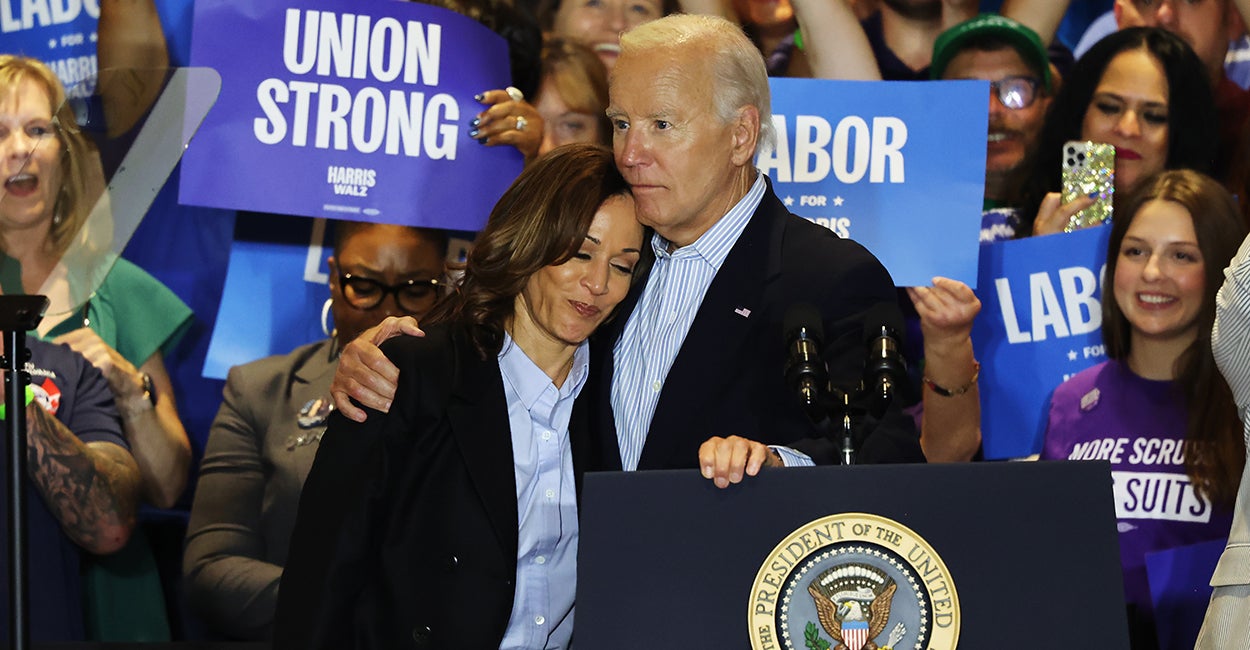
President Joe Biden hugs Vice President Kamala Harris during a campaign event Sept. 2 at IBEW Local No. 5 in Pittsburgh. (Michael M. Santiago/Getty Images)

David Harsanyi@davidharsanyi

David Harsanyi is a senior writer at National Review and the author of “Eurotrash: Why America Must Reject the Failed Ideas of a Dying Continent.”

In 2019, Vice President Kamala Harris told CNN’s Jake Tapper that social media companies “are directly speaking to millions and millions of people without any level of oversight or regulation and it has to stop.” 

Does it? 

Every two-bit authoritarian in history has justified censoring its citizens as a way of protecting them from the menace of disinformation. But social media sites, contra the reliably illiberal Harris, aren’t “directly speaking” to anyone. Millions of individuals are interacting and speaking to millions of other individuals. Really, that’s what grinds the modern Left’s gears: unsupervised conversations. 

Take the Brazilian Supreme Court panel that unanimously upheld the decision by one of its justices to shut down Elon Musk’s X over alleged “misinformation” fears. 

We must assume that the Democratic Party’s presidential nominee, who once promised to ban guns via an executive order, agrees with Justice Alexandre de Moraes’s decision to shut down a social media platform for refusing to bend to the state’s demands of censorship. 

The Associated Press reports that the Brazilian high court’s decision “undermines the effort by Musk and his supporters to cast Justice Alexandre de Moraes as an authoritarian renegade who is intent on censoring political speech in Brazil.” 

Really? Because it seems to me that the state shuttering one of the popular social media sites unmistakably qualifies as a ban on political speech, whether one person is responsible or an entire government. 

And make no mistake, it is politically motivated.

“Just because the guy has a lot of money doesn’t mean he can disrespect this [country],” Brazilian President Luiz Inacio Lula da Silva argued. Well, the South American nation’s constitution, like ours, apparently protects free expression—making no distinction between the poor and rich: “Any and all censorship of a political, ideological, and artistic nature is prohibited.”

You can tell Brazil is super serious about the matter because the bullet point appears in Chapter V, Article 220, or page 148 in my translated copy. 

Let’s concede, however, that de Moraes isn’t any kind of renegade, merely a conventional Brazilian autocrat. In the same way, Musk isn’t merely another billionaire but a tech CEO who generally views free expression as a neutral principle. I suppose the best evidence for this claim is the fact that even as Brazil bans Musk’s site, he allows the far-left Lula to have an account on X with 9 million followers. 

In Europe, free expression is also ostensibly protected by the constitution. Well, the right is contingent on “national security,” “territorial disorder,” “crime,” “health,” and other highly malleable issues that ultimately allow police officers in the United Kingdom and Germany to show up at your door and throw you in prison for offensive posts. 

As the now-deceased Supreme Court Justice Antonin Scalia once pointed out, “Every banana republic has a Bill of Rights.” The question is: How close are we to being one? 

Uncomfortably close is the answer. 

Meta CEO Mark Zuckerberg recently admitted that senior Biden-Harris administration officials “repeatedly pressured” Facebook to “censor” COVID-19 content, including “humor and satire,” during the pandemic. Zuckerberg vowed that he would never let his company be pushed around again. I’m sorry if we don’t take him at his word. 

Tech companies enjoy unencumbered free association rights and are free to keep or kick off anyone they desire from their platform, as they should. Before Musk’s purchase of Twitter, now known as X, contemporary left-wingers celebrated the independence of social media platforms. “If you don’t like it, build your own Twitter,” they would say. 

OK. But when corporations, which often spend tens of millions each year in Washington rent-seeking and lobbying for favorable regulations, take marching orders from state officials and giant federal bureaucracies on the contours of permissible speech, we have a big problem. 

If presidential candidates truly cared about “democracy,” they’d be advocating anti-cronyism laws and forbidding government officials from interfering with or pressuring private entities on speech. 

But, these days, many Americans no longer view free expression as a neutral, liberal virtue worth defending. Foremost among them, apparently, is the Democratic presidential ticket. 

COPYRIGHT 2024 CREATORS.COM 

The Blair Witch Project: Former Prime Minister Calls for Global Censorship


By: Jonathan Turley | September 9, 2024

Read more at https://jonathanturley.org/2024/09/08/the-blair-witch-project-former-prime-minister-calls-for-global-censorship-efforts/

In the 1999 cult classic The Blair Witch Project, one character tells his friends “I could help you, but I’d rather stand here and record.” For free speech advocates, we often feel that other citizens have become passive observers as an anti-free speech movement grows around us, threatening our “indispensable right.”

One of the most infamous figures in this movement has been former British Prime Minister Tony Blair, who has long been the smiling face of censorship. As the head of the Labour Party, Blair pushed through some of the early crackdowns on free speech in the United Kingdom. He is now calling for global censorship to expand these efforts.

In an interview on LBC Radio, Blair declared:

“The world is going to have to come together and agree on some rules around social media platforms. It’s not just how people can provoke hostility and hatred, but I think… the impact on young people particularly when they’ve got access to mobile phones very young, and they are reading a whole lot of stuff and receiving a whole lot of stuff that I think is really messing with their minds in a big way.”

We recently discussed how the UK is already using recent rioting to crackdown further on those with opposing or “toxic” views. For years, I have been writing about the decline of free speech in the United Kingdom and the steady stream of arrests.

A man was convicted for sending a tweet while drunk referring to dead soldiers. Another was arrested for an anti-police t-shirt. Another was arrested for calling the Irish boyfriend of his ex-girlfriend a “leprechaun.” Yet another was arrested for singing “Kung Fu Fighting.” A teenager was arrested for protesting outside of a Scientology center with a sign calling the religion a “cult.” Last year, Nicholas Brock, 52, was convicted of a thought crime in Maidenhead, Berkshire. The neo-Nazi was given a four-year sentence for what the court called his “toxic ideology” based on the contents of the home he shared with his mother in Maidenhead, Berkshire.

While most of us find Brock’s views repellent and hateful, they were confined to his head and his room. Yet, Judge Peter Lodder QC dismissed free speech or free thought concerns with a truly Orwellian statement: “I do not sentence you for your political views, but the extremity of those views informs the assessment of dangerousness.” Lodder lambasted Brock for holding Nazi and other hateful values:

“[i]t is clear that you are a right-wing extremist, your enthusiasm for this repulsive and toxic ideology is demonstrated by the graphic and racist iconography which you have studied and appeared to share with others…”

Even though Lodder agreed that the defendant was older, had limited mobility, and “there was no evidence of disseminating to others,” he still sent him to prison for holding extremist views. After the sentencing Detective Chief Superintendent Kath Barnes, Head of Counter Terrorism Policing Southeast (CTPSE), warned others that he was going to prison because he “showed a clear right-wing ideology with the evidence seized from his possessions during the investigation….We are committed to tackling all forms of toxic ideology which has the potential to threaten public safety and security.”

Blair’s views have been echoed by Speaker of the House Sir Lindsay Hoyle who declared:

“Misinformation is dangerous. Social media is good but it’s also bad when people are using it in a way that could cause a riot, threat, intimidation, suggesting that we should attack somebody, it’s not acceptable. What we’ve got to do is factually correct what’s up there, if not I think the government has to think long and hard about what they are going to do about social media and what are they going to put through parliament as a bill.’

“I believe it should be across, it doesn’t matter what country you are in, the fact is that misinformation is dangerous and no misinformation, or threats, or intimidation should be allowed to be carried out on social media platforms.”

As with the effort in Brazil to block X entirely for refusing to censor political opponents of the government, Blair’s call for global censorship is where the movement is going next.

Notably, after Musk purchased Twitter, Hillary Clinton called upon European officials to force him to censor American citizens under the infamous Digital Services Act (DSA). Recently, Democratic leaders like Minnesota Attorney General Keith Ellison praised Brazil for its action to prevent citizens from having access to unfettered news sources.

Interviews like the one with Tony Blair are not just jump scares meant to intimidate or scare others. They reflect a comprehensive campaign from our political elite to enforce censorship on a national and transnational scale. If you think that this latest Blair Witch Project is just another scary production, you have not been paying attention.

Jonathan Turley is the Shapiro Professor of Public Interest Law at George Washington University and the author of “The Indispensable Right: Free Speech in an Age of Rage.”

Get Musk: Leading Investor Calls for the Prosecution of Elon Musk for “Undermining” the Federal Government


By: Jonathan TYurley | September 9, 2024

Read more at https://jonathanturley.org/2024/09/09/get-musk-leading-investor-calls-for-the-prosecution-of-elon-musk-for-undermining-the-federal-government/

Silicon Valley investor Roger McNamee this weekend went on MSNBC’s “Last Word” and called for the arrest of Elon Musk for “undermining” the federal government by sharing his opinions on X.

McNamee is the latest denizen of the global elite to call for criminalizing speech to silence those with opposing views. McNamee is the founding partner of Elevation Partners and has a colorful history as a band member, a volunteer for Eugene McCarthy and a protester against Vietnam.

As discussed in my book The Indispensable Right: Free Speech in an Age of Rage, he is like many liberal baby boomers now joining the anti-free speech movement. They have decided that free speech, once the defining right for the left, is now an existential threat.

McNamee’s rationale for criminalizing speech is chillingly shallow and irrational. He declared that somehow Musk’s political views made him a danger as the head of companies of major importance to the United States. It does not bother him when CEOs adopt far left views, just Musk opposing some of those views:

“You have somebody who runs a really strategic defense and aerospace projects for the federal government who’s actively undermining the government that’s paying him. And somewhere in that is a legal case that needs to be prosecuted.”

Perish the thought that a CEO might undermine the government. McNamee is using the government contracts with SpaceX as a reason to censor Musk’s political and social views.

“The critical element in thinking about Elon Musk is that, like any American, he has a right to his own opinion, and he has a right to express his opinion. However, that right is not unlimited. He is under some special limitations that would not apply to normal people because his company, specifically Starlink and SpaceX are government contractors and, as such, he has obligations to the government that would, for any normal person, and should for him, require him to moderate his speech in the interest of national security.”

So, according to McNamee, if your company makes something that the government wants (including rescuing the currently stranded astronauts in space), he must give up his right to express political views, including against censorship.

McNamee embraces the power of the government to dictate viewpoints or at least silence certain views as a matter of national security. It is no accident that the overriding objective is to “get Musk.” Musk has proven the single greatest barrier to the global anti-free speech movement.

As with the effort in Brazil to block X entirely for refusing to censor political opponents of the government, McNamee’s call for state-driven censorship is where the movement is going next.

Notably, after Musk purchased Twitter, Hillary Clinton called upon European officials to force him to censor American citizens under the infamous Digital Services Act (DSA). Recently, Democratic leaders like Minnesota Attorney General Keith Ellison praised Brazil for its action to prevent citizens from having access to unfettered news sources.

What is most striking about these efforts is that they occurred after the failure of Plan A: to get Americans to embrace censorship.  Facebook even ran a creepy campaign to try to get young people to accept censorship, or “content moderation.” The commercials show people like “Joshan” who says that he “grew up with the internet.” Joshan mocks how much computers have changed and then objects how privacy and censorship have not evolved as much as our technology. As Joshan calls for “the blending of the real world and the internet world,” content moderation is presented as part of this not-so-brave new world. Joshan and his equally eager colleagues Chava and Adam were presented by Facebook as the shiny happy faces of young people longing to be content modified.  They were all born in 1996 — the sweet spot for censors who saw young people as allies to reduce free speech.

It did not work. Despite some erosion of free speech among young people, it takes a great deal to get a free people to give up their freedoms. Plan B is now to accomplish this objective of speech controls through national and global regulation. Figures like McNamee and Bill Gates are ready to support this brave new world of speech regulation by global censors.

While claiming unprecedented threats from “disinformation,” these are the same voices and rationales discussed in my book that have been used for centuries to limit the speech of others. They are selling the same defective product with the promise that less freedom will lead to a better life.

For global elites like McNamee, free speech is not just dispensable but distracting. Only fools would listen to these voices in trading away our indispensable right.

Jonathan Turley is the Shapiro Professor of Public Interest Law at George Washington University and the author of “The Indispensable Right: Free Speech in an Age of Rage.”

Summing Up the Week of September 6, 2024, Politically INCORRECT Cartoons and Memes


Harvard and Columbia Rank as Worst Colleges for Free Speech in Annual Survey


By: Jonathan Turley | September 5, 2024

Read more at https://jonathanturley.org/2024/09/05/harvard-and-columbia-rank-as-worst-colleges-for-free-speech-in-annual-survey/

For the second year in a row, Harvard University is ranked dead last among universities and colleges on the annual survey of free speech on campuses by the Foundation for Individual Rights and Expression (FIRE). Harvard shares a score of 0.00 with Columbia University. They are followed by New York University, University of Pennsylvania and Barnard College.

In my book “The Indispensable Right: Free Speech in an Age of Rage,” I discuss free speech on campuses and note that public universities could prove the last line of defense for this right. It is not that faculty members are necessarily any more protective of free speech or intellectual diversity at these schools. However, they are directly subject to the First Amendment as state schools and thus can be taken to court more readily for denials of the right.

Conversely, at schools like Harvard, Columbia, Penn, and NYU, the faculty appears unconcerned about their dismal records on free speech. There is still a growing anti-free speech movement on our campuses. It is notable that these schools also have largely purged conservative and Republican faculty from their ranks. A past survey found that over 75 percent of faculty identify as liberal or very liberal. Another survey found that many departments do not have a single Republican.

I was disappointed that my alma mater University of Chicago has fallen from number 1 to 44, though it still gets a shout out from FIRE as being a consistently strong free speech environment. The concerning fall has occurred under with the presidency of Armand Paul Alivisatos. He replaced one of the greatest advocates of free speech in academia, the late Robert Zimmer.

My proudest moment came when Zimmer sent a famous letter to the class of 2020. The letter warned students that they will not be shielded from views that upset them or given “safe spaces” on campus.

In the letter, the university declared that “our commitment to academic freedom means that we do not support so-called ‘trigger warnings,’ we do not cancel invited speakers because their topics might prove controversial, and we do not condone the creation of intellectual ‘safe spaces’ where individuals can retreat from ideas and perspectives at odds with their own.”

It was a moment of clarity that is missing in today’s environment of speech codes, microaggressions, and cancel campaigns. When Zimmer stepped down in 2021, there was a virtual panic in the free speech community. He was our champion and placed one of the premier academic institutions in the world on the side of free speech.

Notably, Barnard College (unlike the other schools at the bottom) has joined other schools in adopting the Chicago Principles. It released a statement committing itself to a new course. We will have to wait to see if faculty will honor such a commitment.

George Washington University, where I teach, is 161st out of 251 schools with a below average ranking. What was surprising this year were the schools receiving a “warning” about anti-free speech policies.  They include Pepperdine University, Hillsdale College, and Brigham Young University. FIRE found that all “have policies that clearly and consistently state” that they prioritize “other values over a commitment to freedom of speech.” The President of Hillsdale responded in this column.

If there will be substantial improvements in the anti-free speech environment in higher education in private colleges, they will only come from donors refusing to support these schools until they change their policies and culture. Administrators and faculty feel little pressure to reverse these trends. However, they will respond if their intolerance begins to threaten their own budgets and departments.

Higher education has already plunged in trust among citizens under the current administrators and faculty at our colleges and universities. They are destroying the very institutions that sustain them. In the meantime, public universities can be a strong line of defense for free speech, offering students not just free speech environments but the direct protection of the First Amendment. What is missing is greater diversity of viewpoints on faculties. I have written about how taxpayers and legislators can exercise their own power to demand more diversified and tolerant environments at these schools.

While some professors have argued that free speech and intellectual diversity are not essential to higher education, most of the public disagrees and has a right to expect a diverse and tolerant environment at state-supported schools.

In my book and past congressional testimony, I have also encouraged Congress to adopt ten basic prerequisites for federal funding for colleges and universities on free speech. If these schools want to continue to deny free speech to students and faculty, they should do so with their own funds and contributions from donors who share their anti-free speech agendas. Taxpayers should not be supporting schools which deny a right considered “indispensable” to our constitution and culture.
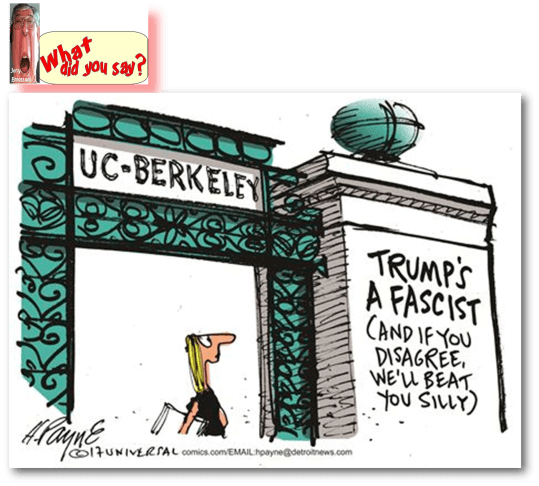
You can see the full rankings here.
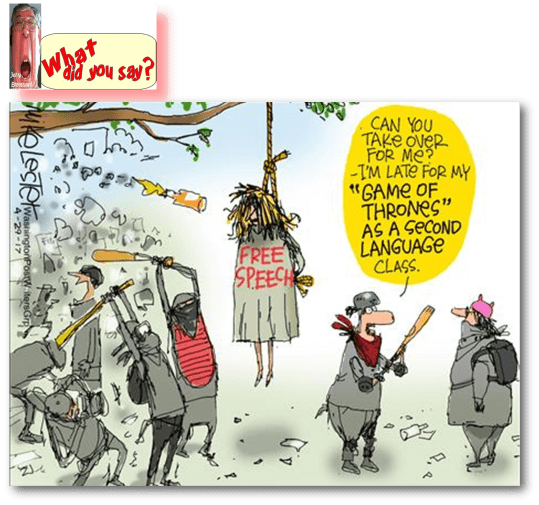
Jonathan Turley is the Shapiro Professor of Public Interest Law at George Washington University and the author of “The Indispensable Right: Free Speech in an Age of Rage.”

“That Has to Stop”: Harris Denounces Unfettered Free Speech in 2019 CNN Interview


By: Jonathan Turley | September 4, 2024

Read more at https://jonathanturley.org/2024/09/04/that-has-to-stop-harris-denounces-unfettered-free-speech-in-2019-cnn-interview/

previously wrote how a Harris-Walz Administration would be a nightmare for free speech. Both candidates have shown pronounced anti-free speech values. Now, X owner Elon Musk and former independent presidential candidate Robert F. Kennedy Jr. have posted a Harris interview to show the depths of the hostility of Harris to unfettered free speech. I have long argued that Trump and the third-party candidates should make free speech a central issue in this campaign. That has not happened. Kennedy was the only candidate who was substantially and regularly talking about free speech in this election. Yet, Musk and Kennedy are still trying to raise the chilling potential of a Harris-Walz Administration.

In my book “The Indispensable Right: Free Speech in an Age of Rage,” I discuss how the Biden-Harris Administration has proven to be the most anti-free speech administration since John Adams. That includes a massive censorship system described by one federal judge as perfectly “Orwellian.”

In the CNN interview, Harris displays many of the anti-free speech inclinations discussed earlier. She strongly suggests that X should be shut down if it does not yield to demands for speech regulation.

What is most chilling is how censorship and closure are Harris’s default positions when faced with unfettered speech. She declares to CNN that such unregulated free speech “has to stop” and that there is a danger to the country when people are allowed to “directly speak[] to millions and millions of people without any level of oversight and regulation.”

Harris discussed her view that then-President Trump’s Twitter account should be shut down because the public had to be protected from harmful viewpoints.

“And when you’re talking about Donald Trump, he has 65 million Twitter followers, he has proven himself to be willing to obstruct justice – just ask Bob Mueller. You can look at the manifesto from the shooter in El Paso to know that what Donald Trump says on Twitter impacts peoples’ perceptions about what they should and should not do.”

Harris demanded that Trump’s account “should be taken down” and that there be uniformity in the censorship of American citizens:

“And the bottom line is that you can’t say that you have one rule for Facebook and you have a different rule for Twitter. The same rule has to apply, which is that there has to be a responsibility that is placed on these social media sites to understand their power… They are speaking to millions of people without any level of oversight or regulation. And that has to stop.”

In other words, free speech should be set to the lowest common denominator of speech regulation to protect citizens from dangerous viewpoints. Harris’s views have been echoed by many Democratic leaders, including Hillary Clinton who (after Musk purchased Twitter) called upon European censors to force him to censor American citizens under the infamous Digital Services Act (DSA).

Other Democratic leaders have praised Brazil for banning X after Musk balked at censoring conservatives at the demand of the socialist government. Brazil is where this anti-free speech movement is clearly heading and could prove a critical testing ground for national bans on sites which refuse to engage in comprehensive censorship. As Harris clearly states in the CNN interview, there cannot be “one rule for Facebook and you have a different rule for Twitter.” Rather, everyone must censor or face imminent government shutdowns.

The “joy” being sold by Harris includes the promise of the removal of viewpoints that many on the left feel are intolerable or triggering on social media. Where Biden was viewed as an opportunist in embracing censorship, Harris is a true believer.  Like Walz, she has long espoused a shockingly narrow view of free speech that is reflective of the wider anti-free speech movement in higher education.

Harris often speaks of free speech as if it is a privilege bestowed by the government like a license and that you can be taken off the road if you are viewed as a reckless driver.

Trump and the third-party candidates are clearly not forcing Harris to address her record on free speech. Yet, polls show that the majority of Americans still oppose censorship and favor free speech.

In my book, I propose various steps to restore free speech in America, including a law that would bar federal funds for censorship, including grants and other funding that target individuals and sites over the content of their views. The government can still speak in its own voice, and it can still prosecute those who commit crimes on the Internet or engage in criminal conspiracies. Harris should be asked if she would oppose such legislation.

For free speech advocates, the 2024 election is looking strikingly similar to the election of 1800. One of the greatest villains in our history discussed in my book was President John Adams, who used the Alien and Sedition Acts to arrest his political opponents – including journalists, members of Congress and others. Many of those prosecuted by the Adams administration were Jeffersonians. In the election of 1800, Thomas Jefferson ran on the issue and defeated Adams.

It was the only presidential election in our history where free speech was a central issue for voters. It should be again. While democracy is really not on the ballot this election, free speech is.

Jonathan Turley is the Shapiro Professor of Public Interest Law at George Washington University and the author of “The Indispensable Right: Free Speech in an Age of Rage.”

Brazilians to be Fined $9000 a Day for Receiving News from X


By: Jonathan Turley | September 3, 2024

Read more at https://jonathanturley.org/2024/09/03/brazilians-to-be-fined-9000-a-day-for-receiving-news-from-x/

Brazil has not just banned X (formerly Twitter) from the entire country, but citizens will now be fined $9000 a day (more than the average salary in the country) for using VPNs to access the platform. X is the main source of news for Brazilians, who will now be left with government-approved sources or face financial ruin in seeking unfettered information.

The Guardian is reporting that the confiscatory fines are part of a comprehensive crackdown on efforts to get news through X, including ordering all Apple stores to remove X from new phones. The move puts Brazil with China in the effort to create a wall of censorship between citizens and unregulated information. For the anti-free speech movement, Brazil is a key testing ground for where the movement is heading next. European censors are arresting CEOs like Pavel Durov while threatening Elon Musk.

However, it is Brazil that foreshadows the brave new world of censorship where entire nations will block access to sites committed to free speech values or unfettered news. If successful, the Brazilian model is likely to be replicated by other countries.

The reason is that censorship is not working. As discussed in my book The Indispensable Right: Free Speech in an Age of Rage,” we have never seen the current alliance of government, corporate, academic, and media interest against free speech. Yet, citizens are not buying it. Despite unrelenting attacks and demonizing media coverage, citizens are still using X and resisting censorship. That was certainly the case in Brazil where citizens preferred X to regulated news sources. The solution is now to threaten citizens with utter ruin if they seek unfettered news.

The question is whether Brazil’s leftist government can get away with this. The conflict began with demands to censor supporters of the conservative former president Jair Bolsonaro. When X refused the sweeping demands for censorship, including the demand to name a legal representative who could be arrested for refusing to censor users, the courts moved toward this national ban.

The man behind the effort is Justice Alexandre de Moraes, who has aggressively used censorship to combat anything that he or the government deems “fake news” or disinformation. With Socialist President Luiz Inácio Lula da Silva, they are the dream team of the anti-free speech movement.

Justice Alexandre de Moraes

Minnesota Attorney General Keith Ellison responded to the ban with a posting declaring “Obrigado Brasil!” or “Thanks, Brazil!” Ironically, he did so on X.

Ellison previously praised the virulently anti-free speech group Antifa and promised that it would “strike fear in the heart” of Donald Trump. This was after Antifa had been involved in numerous acts of violence and its website was banned in Germany. It is at its base a movement at war with free speech, defining the right itself as a tool of oppression. That purpose is evident in what is called the “bible” of the Antifa movement: Rutgers Professor Mark Bray’s Antifa: The Anti-Fascist Handbook.

Bray emphasizes the struggle of the movement against free speech: “At the heart of the anti-fascist outlook is a rejection of the classical liberal phrase that says, ‘I disapprove of what you say but I will defend to the death your right to say it.’” Bray admits that “most Americans in Antifa have been anarchists or antiauthoritarian communists…  From that standpoint, ‘free speech’ as such is merely a bourgeois fantasy unworthy of consideration.”

The question is whether Brazil will become a nightmare for free speech around the world as other nations seek to force citizens to read and hear news from approved, state-monitored sites.

Jonathan Turley is the Shapiro Professor of Public Interest Law at George Washington University. He is the author of “The Indispensable Right: Free Speech in an Age of Rage” (Simon & Schuster).

Robert Reich Calls for the Arrest of Elon Musk for Resisting Censorship


By: Jonathan Turley | September 2, 2024

Read more at https://jonathanturley.org/2024/09/02/robert-reich-calls-for-the-arrest-of-elon-musk-for-resisting-censorship/

C-Span Screengrab

We have previously discussed the anti-free speech views of Clinton’s former Labor Secretary, Robert Reich, who has tried to sell citizens on the perfectly Orwellian view that more freedom means tyranny when it comes to the freedom of expression. He also demanded that former president Donald Trump be banned from ballots as a “traitor” — all in the name of protecting democracy from itself. Last week, Reich wrote a column declaring Elon Musk “out of control” in his refusal to censor citizens and appeared to call for his arrest.

Reich has long been a prominent voice in the anti-free speech movement discussed in my recent book, The Indispensable Right: Free Speech in an Age of Rage. Indeed, he has given a voice to the rage in calling for others to be silenced or arrested.

Elon Musk has long been the primary target of Reich and his allies after dismantling the censorship system at Twitter, now X. Reich called Musk’s purchase of Twitter with a pledge to reduce censorship to be “dangerous nonsense.”

Notably, Reich’s friend, Hillary Clinton, was one of the first to call for a crackdown on Musk after his purchase of Twitter.  Hillary Clinton and other Democratic figures turned to Europe and called upon them to use their Digital Services Act to force censorship against Americans.

Reich has always shown a chilling fluidity in how free speech is protected and argued that public interest should be able to trump the right of any citizens in espousing views that he believes are dangerous.

In denouncing Musk, Reich encouraged a campaign to counter his efforts to resist censorship. He wrote that Musk “may be the richest man in the world. He may own one of the world’s most influential social media platforms. But that doesn’t mean we’re powerless to stop him.”

Like Hillary Clinton, Reich is calling on foreign governments and censors to silence American citizens including Musk: “Regulators around the world should threaten Musk with arrest if he doesn’t stop disseminating lies and hate on X.”

He even appears willing to undermine national security programs to stop unfettered free speech. He called for the U.S. government to cut off contracts with his companies despite their critical role in various national security efforts, including the possible rescue of the stranded two astronauts currently in space. None of that matters to Reich who appears to view free speech as a greater threat to our nation: “Why is the US government allowing Musk’s satellites and rocket launchers to become crucial to the nation’s security when he’s shown utter disregard for the public interest? Why give Musk more economic power when he repeatedly abuses it and demonstrates contempt for the public good?”

Reich’s call to regulate speech in the public interest is the Siren’s Call of every authoritarian regime in history. He will presumably tell us what speech is no longer tolerable for public policy reasons. Our “Indispensable Right” will, according to Reich, be safely in the hands of the European censors who can protect us from errant and dangerous thoughts.

As he explained earlier, “the kinds of things that we do about this is, focus less on thinking about free speech, but thinking about how the times have changed.” In this way, speech regulations can keep us “moving towards how we recommend content and … how we direct people’s attention is leading to a healthy public conversation that is most participatory.”

The “healthy public conversation” with Robert Reich increasingly appears to be his talking and the rest of us listening.

Jonathan Turley is a Fox News Media contributor and the Shapiro Professor of Public Interest Law at George Washington University. He is the author of “The Indispensable Right: Free Speech in an Age of Rage” (Simon & Schuster, June 18, 2024).

How Democrats Make Republicans: RFK Should Be A Wake Up Call for the Party


By: Jonathan Turley | August 26, 2024

Read more at https://jonathanturley.org/2024/08/25/how-democrats-make-republicans-the-rfk-withdrawal-should-be-a-wake-up-call-for-the-party/

YouTube

Below is my column in the New York Post on the withdrawal of Robert Kennedy, Jr. from the presidential race and his endorsement of former President Donald Trump. Kennedy’s speech resonated with many long-time Democrats who have found themselves estranged from the party. While Kennedy remains an independent, it is a cautionary tale that is being missed in the “joy” theme of the Democratic National Convention. The fact is that new Republicans are often not the product of ideology and association but anxiety and exclusion. Democrats make Republicans.

Here is the column:

The withdrawal of Robert F. Kennedy Jr. from the presidential race and his endorsement of former President Donald Trump was yet another extraordinary moment in an election that has been anything but predictable. Only a year ago, it would have been unthinkable that a sitting president would be effectively forced off a ticket and replaced by a candidate who did not secure a single vote for president.

Now, the nephew of John F. Kennedy and son of the Robert F. Kennedy has not just withdrawn from the Democratic Party but endorsed the Republican nominee. Amidst all of the claimed “joy” of the Democratic National Convention, there is a sobering reality that is being ignored by the ecstatic press and pundits: this is how Democrats make Republicans.

There is an old expression that “a conservative is a liberal who has been mugged.”

Irving Kristol explained the neoconservative movement was built by Democrats “mugged by reality.”

Kennedy has not become a Republican but rather joined the roughly half of Americans now identifying as independents. While this country is solidly under the hold of a duopoly of power in the two main parties, only 25% of the country identify as Democrats, and 25% as Republicans.

Kennedy’s departure from the Democrats has been mocked in the press. However, when he spoke on his withdrawal, many of us who have been lifetime members of the party identified with his remarks.

I come from a politically active liberal Democratic family in Chicago. I spent much of my life working for liberals since I first came to Washington as a Democratic House page in the 1970s. I did stints on the Hill or on campaigns with Democrats ranging from Rep. Sid Yates (Ill.) to Sen. William Proxmire (Wis.) to Mo Udall (Arz.). I even worked on the campaign and ran for delegate for RFK Jr.’s uncle, Sen. Ted Kennedy.

Then the party changed. Where once they defended free speech, Democrats have rallied behind censorship and blacklisting of those with opposing views. They have sought to block dozens of Republicans from ballots, including former President Trump. To make matters worse, they have done so in the supposed name of democracy.

Those actions were raised by Kennedy in his powerful and poignant withdrawal speech. He detailed how the Democratic party moved to stop him from running against President Biden in the primary, including efforts to block him from ballots. It was an ironic moment. After harassing candidates like RFK and Minnesota Rep. Dean Phillips, the Democratic leadership then simply installed their choice at the convention in an unprecedented bait-and-switch.

There could have been a substantive primary that exposed the diminished mental state of Biden and allowed for a democratic choice on the best nominee. Instead, the Democrats prevented such choices from being made and selected a leader with all of the transparency and deliberation of a party Congress in China. Kennedy said that the Democratic Party has virtually shoved him and other voters into the arms of Donald Trump and the Republican Party.

Kennedy observed that “I began this journey as a Democrat, the party of my father, my uncle, the party which I pledged my own allegiance to long before I was old enough to vote.”

He said that his party was the one that championed free speech, government transparency, and opposed unjust wars. “True to its name, it was the party of democracy.”

He said that the party has turned its back on all of the values that once defined it. For former Democrats like Kennedy, running on “joy” is no substitute for these profound changes in the party.

Indeed, the DNC bordered on the creepy as speaker after speaker sold the idea that, if voters could just swallow the Harris candidacy, they would immediately experience joy like some political prozac commercial.

It is not clear whether the red pill/blue pill pitch will be enough, or whether Kennedy’s endorsement will turn the critical votes in swing states.

However, the DNC showed how Democrats make Republicans. The unrelenting identity politics and claims of defending democracy (while opposing democratic choice) only reaffirmed for many that there is no longer a big tent in the party of Roosevelt and Kennedy. There is a serious question whether John F. Kennedy would recognize or support the current Democratic Party. It now rejects many of his core, mainstream values. His nephew highlighted the irony of how the party not only worked to block the ability of opponents to challenge President Biden but worked to “conceal the cognitive decline of the sitting president.”

Even the Washington Post recently admitted that “the 81-year-old had shown signs of slipping for a long time, but his inner circle worked to conceal his decline.” However, the Post failed to note that Vice President Kamala Harris was part of that inner circle. Indeed, she has been touting her close work with Biden in her campaign.

There is little recognition that, if true, it means that Harris, the White House, and leading Democrats lied to the public about Biden’s mental decline for their own political interests.

For Kennedy, it was all too much “and, most sadly … in the name of saving Democracy, the Democratic Party set itself to dismantling it, lacking confidence in its candidate, that its candidate could win in a fair election at the voting booth.”

There is little “joy” in that.

Jonathan Turley is the Shapiro Professor of Public Interest Law at George Washington University. He is the author of “The Indispensable Right: Free Speech in an Age of Rage” (Simon & Schuster).

Tag Cloud