With the election of Donald Trump, the federal government and both local and educational authorities are on a collision course over immigration policies. Many states and cities have reaffirmed that they will oppose any deportation efforts, including another recent chest-pounding interview by Illinois Gov. J.B. Pritzker. It is likely that the federal government will squeeze federal funding for sanctuary states and cities, though such efforts can trigger “commandeering” and other legal challenges. Universities may be in a more precarious position, but some like the Los Rios Community College District in California are doubling down on plans to oppose any federal enforcement efforts.
Various university and college presidents have reaffirmed their support for undocumented students and staff, including most recently Fordham University President Tania Tetlow. However, the Los Rios Community College District seems to have laid out a more concrete plan to oppose federal enforcement, a plan that was referenced in a January 28 email. The district covers American River College, Cosumnes River College, Folsom Lake College, and Sacramento City College.
The email states that “[t]here have been reports all over the country of increased immigration raids in association with Executive Orders tied to immigration enforcement.” It seeks to address the “[f]ear … widespread throughout the undocumented and ally communities about their safety and the safety of their families and loved ones.”
Just after Trump’s election, Los Rios published a “Compact in Support of Undocumented and DACA Students and Employees,” including the possible concealment of immigration status.
Here are the eight commitments:
Los Rios will do everything in its power to fight for the rights of our immigrant and undocumented students and employees and will always do everything possible to uphold the values of our institutions.
Los Rios stands with state and local leaders who have pledged to do everything possible to defend the rights and protections of immigrant and undocumented Californians.
Los Rios commits to advocating for a permanent legislative solution to the Deferred Action for Childhood Arrivals (DACA) and a pathway to citizenship for our immigrant communities.
Los Rios will immediately provide additional resources to our Undocumented Resource Centers.
The Los Rios Police reaffirms its commitment to not participate in immigration-related activities, including arresting and/or detaining students, consistent with organizational values and state law.
Los Rios will protect students’ rights and confidentiality and will not share the immigration status of students or employees.
Los Rios, its colleges, and partners will do a full review of internal policies and regulations to ensure that we are doing everything possible to protect the rights of students and employees.
The Los Rios Colleges Foundation will create Dream Center Funds with resources for each college, administered by the Undocumented Resource Center on each campus. The Foundation will encourage other community members, employees, and private and corporate funders to give support to undocumented students to help remove critical barriers to their success, such as paying for DACA renewal fees, legal fees, purchasing laptops, and additional resources.
Number 6 is particularly interesting in promising an active role to conceal or withhold immigration status information.
We have been down this road before. Schools previously fought this battle over efforts to bar military recruiters. While I have been a vocal supporter of gay rights on many fronts, I was one of those who opposed the litigation that my law school joined. At the time, I stated that it was not only a clear loser on the law but also represented a type of hypocrisy: We insist that we cannot allow discrimination, but if money is at stake, we will allow it.
In Rumsfeld v. Forum for Academic and Institutional Rights, Inc., 547 U.S. 47 (2006), the Supreme Court unanimously ruled that the federal government, under the Solomon Amendment, could constitutionally withhold funding from universities if they barred military recruiters from interviewing students. The Solomon Amendment denied federal funding to an institution of higher education that “has a policy or practice … that either prohibits, or in effect prevents” the military “from gaining access to campuses, or access to students … on campuses, for purposes of military recruiting in a manner that is at least equal in quality and scope to the access to campuses and to students that is provided to any other employer.” 10 U. S. C. A. §983(b) (Supp. 2005).
It is easier to limit funds for universities, but it can still raise constitutional problems from free speech to associational rights.
In Rumsfeld v. FAIR, Chief Justice John Roberts noted that such laws could run afoul of the unconstitutional conditions doctrine “if Congress could not directly require universities to provide military recruiters equal access to their students.” He then added:
“This case does not require us to determine when a condition placed on university funding goes beyond the ‘reasonable’ choice offered in Grove City and becomes an unconstitutional condition. It is clear that a funding condition cannot be unconstitutional if it could be constitutionally imposed directly. See Speiser v. Randall, 357 U. S. 513, 526 (1958). Because the First Amendment would not prevent Congress from directly imposing the Solomon Amendment’s access requirement, the statute does not place an unconstitutional condition on the receipt of federal funds.
The Solomon Amendment neither limits what law schools may say nor requires them to say anything. Law schools remain free under the statute to express whatever views they may have on the military’s congressionally mandated employment policy, all the while retaining eligibility for federal funds. See Tr. of Oral Arg. 25 (Solicitor General acknowledging that law schools “could put signs on the bulletin board next to the door, they could engage in speech, they could help organize student protests”). As a general matter, the Solomon Amendment regulates conduct, not speech. It affects what law schools must do—afford equal access to military recruiters—not what they may or may not say.”
The coming challenges could raise the question left open in Rumsfeld v. FAIR. However, the question is whether universities, particularly state institutions, want to go down this road of confrontation rather than cooperation.
“Academic freedom” in American universities is nonexistent. There is zero freedom to be anything other than a leftist, which is why nonleftists are an endangered species in academia. Universities only use “academic freedom” to defend their left-wing fellow travelers from criticism and accountability.
There is zero desire for critical independent thought in modern American academia, because modern American academia is little more than a Marxist madrassa used to train and indoctrinate the next generation of left-wing shock troops. Academia uses “academic freedom” in the same way it uses “diversity” — as a way to exclude anyone who rejects left-wing identity ideology. Universities want ideological diversity in the same way bacteria crave bleach. They want actual academic freedom in the same way cockroaches want sunlight.
Never forget that to leftists, words have no fixed meaning. Words are weapons. Nothing more, and nothing less. “Diversity” means they get to hire left-wing, dead-eyed, purple-haired, barely literate white freaks who hate Jews, and black conservatives will just have to suck it. “Academic freedom” means they get to hire low-IQ, left-wing plagiarists whose entire livelihoods depend on the success of the left-wing machine, not brilliant analysts whose research rejects global warming or Covid alarmism nonsense.
Every single left-wing institution has the same rules and the same hiring practices.
At the Pentagon, delusional and drug-addled male perverts who think putting on a skirt and ladyface is the pinnacle of valor get promoted, while decorated combat veterans who reject heart attack juice in the guise of a fake vaccine get fired. On Wall Street, throwing other people’s money at failed global warming plays that will never be economically sustainable will get you promoted much faster than successfully investing in technologies viewed to be a threat by the regime. In Hollywood, a script trashing America as racist and evil will get greenlit faster than Alec Baldwin drawing down on a camera crew. But if you want to make a film praising the American founding? Good luck with that.
And in government, there’s no surer guarantee of lifelong employment for midwit morons than pledging allegiance to whatever delusion the regime is peddling on any given day, because the left-wing machine will defend anyone from anything, no matter how horrific, as long as that person marches to the beat of the regime’s drum.
This is the modern state of America, and it is true across every industry and major institution of power. One election will not fix it. One resignation will not fix it. Removing the rot that’s compromising the entire foundation of this country will require ruthlessly tearing down, fumigating, and rebuilding every single institution that has been infiltrated by the left.
This won’t be accomplished by politicians, or journalists, or celebrities, or hedge fund managers. It can only be accomplished by you demanding it and refusing to give in until the rot has been eliminated. Are you up for it? I hope so. Because if you’re not, this country doesn’t stand a chance.
Sean Davis is CEO and co-founder of The Federalist. He previously worked as an economic policy adviser to Gov. Rick Perry, as CFO of Daily Caller, and as chief investigator for Sen. Tom Coburn. He was named by The Hill as one of the top congressional staffers under the age of 35 for his role in spearheading the enactment of the law that created USASpending.gov. Sean received a BBA in finance from Texas Tech University and an MBA in finance and entrepreneurial management from the Wharton School. He can be reached via e-mail at sean@thefederalist.com.
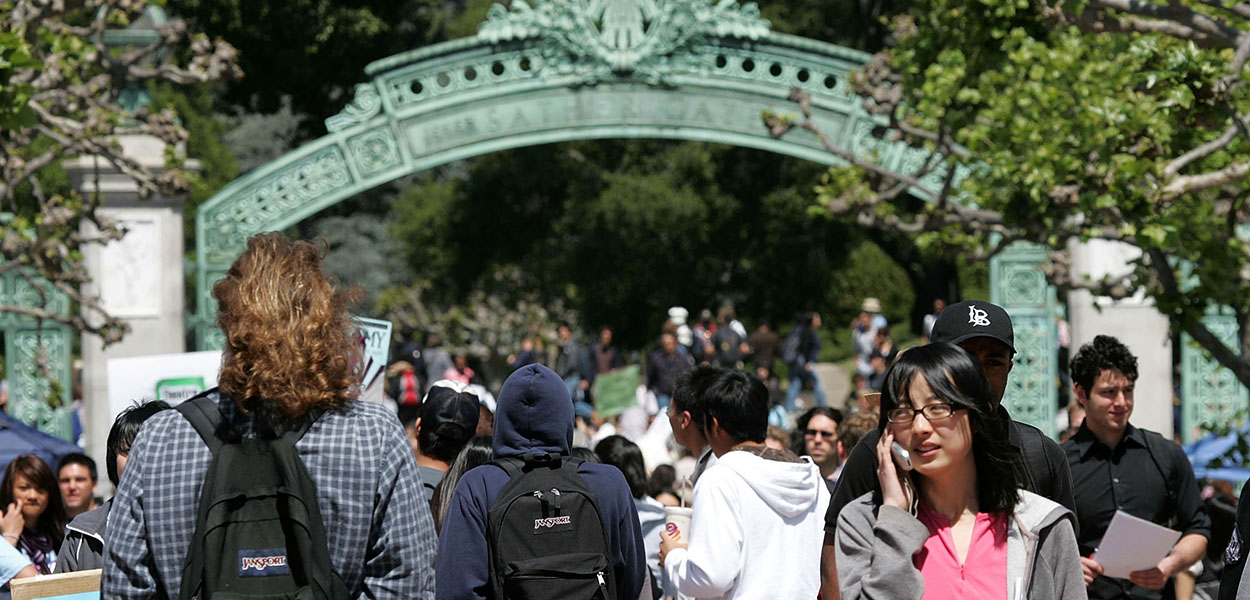
Fealty to DEI dogma has become practically mandatory at all levels of higher education, a report in The New York Times shows. Pictured: Students at UC Berkeley, whose DEI hiring requirements have been adopted by universities and colleges throughout the U.S., pass under Sather Gate on campus April 17, 2007. (Photo: Justin Sullivan/Getty Images)
College campuses have been dominated by the Left for generations. That’s hardly news to anyone. But a recent news report sheds light on how higher education has been transformed from a general haven of left-wing ideology into an engine of radicalism and revolution in the name of DEI: diversity, equity, and inclusion.
The lengthy report in The New York Times, of all places, highlights how the use of DEI statements essentially has allowed schools to create ideological loyalty oaths for new faculty. These tests aren’t being applied only in humanities departments, they’re the norm in science departments and all others too.
California—upholding its reputation for being at the cutting edge of anti-civilizational lunacy and tyranny—has predictably gone all in on the diversity, equity, and inclusion regime. Fealty to DEI dogma has become practically mandatory at all levels of higher education.
The Times notes that the faculty senate at the University of California, San Francisco urged professors to apply an “anti-oppression and anti-racism” lens to their coursework. On its website, UCLA’s public affairs school pledged to “decolonize the curriculum and pedagogy.” And the faculty senate of California Community Colleges instructed teachers on their duty to “lift the veil of white supremacy” and “colonialism.”
“Professions of fealty to DEI ideology are so ubiquitous as to be meaningless,” said Daniel Sargent, a professor of history and public policy at the University of California, Berkeley, told the Times. “We are institutionalizing a performative dishonesty.”
It’s not just that school administrators enforce a pervasive, left-wing culture on campus. That’s been happening for generations. These schools also are hiring with strict DEI-style parameters, to the near total exclusion of merit. In one study, according to the Times, researchers found that at Berkeley “a faculty committee rejected 75% of applicants in life sciences and environmental sciences and management purely on diversity statements.”
It seems this may have been a racial test too. From the Times’ report:
Latino candidates constituted 13% of applicants and 59% of finalists. Asian and Asian-American applicants constituted 26% of applicants and 19% of finalists. Fifty-four percent of applicants were white and 14% made it to the final stage. Black candidates made up 3% of applicants and 9% of finalists.
That makes sense, given what’s in the diversity statements. Many schools, including Berkeley, publicly post their standards online. Among the answers that will produce a low score is saying that you will “treat everyone the same.” To get the highest scores, you need to be explicitly racial in thinking and demonstrate that you’ve not only participated in or will participate in campus DEI programs but will be actively leading new initiatives.
What’s clear is that these schools aren’t focused simply on weeding out conservatives. People anywhere vaguely on the Right clearly don’t have a ghost of a chance of getting through the application process. No, these schools are about finding active, devoted leaders of social justice causes. If you aren’t a DEI revolutionary, schools don’t want you to teach about science or engineering or anything else at their institution.
Remember, when the Left says, “believe the science,” what it’s really saying is “believe the left-wing activist with institutional backing next to his/her/zir name.”
Unfortunately, what started in California didn’t stay in California, as many schools around the country copied the Golden State model. Among the methods schools use to promote DEI goals is what John Sailer, a fellow at the National Association of Scholars, called “cluster hiring.” Universities hire applicants in bulk, using DEI statements to weed out most unwanted applicants.
Sailer noted how in 2021, Vanderbilt University’s Department of Psychology undertook a cluster hire that “eliminated approximately 85% of its candidates based solely on diversity statements.”
The federal government exacerbates this problem.
“The National Institutes of Health (NIH) has allocated $241 million in grant money for cluster hires at universities around the country—with the condition that every search committee must require and heavily weigh diversity statements,” Sailer wrote.
The DEI racket is a national phenomenon, but this bleak environment includes signs that change may be coming.
It seems that some school systems are reconsidering their DEI litmus tests. For instance, Georgia’s public university system eliminated DEI requirements in July. It put out a statement saying that hiring decisions should be “free of ideological tests, affirmations, and oaths.”
I’d like to ascribe this change to a genuine change of heart, but it’s telling that this policy shift came right after the Supreme Court’s ruling that racial preferences in college admissions are unlawful. It goes to show how much of a game changer that decision is. Schools now have reason to be concerned about lawsuits from applicants claiming discrimination.
Creating ideological litmus tests that appear to discriminate and actually tell faculty that not discriminating is bad surely won’t help the cause of colleges and universities.
This small retreat won’t exactly fix what ails higher education in America, but it does represent an opening for a recalibration.
Larger change will happen when more schools return to a classical learning model and jettison the DEI regime altogether. That seems unlikely to happen without outside pressure.
But outside pressure is building as institutional trust declines. If more states reject the California model, a genuine new birth of freedom in education may not be so far-fetched as it seemed just a few years ago.
Little more than a decade ago, DEI was just another arcane acronym, a clustering of three ideas, each to be weighed and evaluated against other societal values. The terms diversity, equity, and inclusion weren’t yet being used in the singular, as one all-inclusive, non-negotiable moral imperative. Nor had they coalesced into a bureaucratic juggernaut running roughshod over every aspect of national life.
They are now.
Seemingly in unison, and with almost no debate, nearly every major American institution — including federal, state, and local governments, universities and public schools, hospitals, insurance, media and technology companies, and major retail brands — has agreed that the DEI infrastructure is essential to the nation’s proper functioning.
From Amazon to Walmart, most major corporations have created and staffed DEI offices within their human resources bureaucracy. So have sanitation departments, police departments, physics departments, and the departments of agriculture, commerce, defense, education, and energy. Organizations that once argued against DEI now feel compelled to institute DEI training and hire DEI officers. So have organizations that are already richly diverse, such as the National Basketball Association and the National Football League.
Many of these offices in turn work with a sprawling network of DEI consulting firms, training outfits, trade organizations, and accrediting associations that support their efforts.
“Five years ago, if you said ‘DEI,’ people would’ve thought you were talking about the Digital Education Initiative,” Robert Sellers, University of Michigan’s first chief diversity officer, said in 2020. “Five years ago, if you said DEI was a core value of this institution, you would have an argument.”
Diversity, equity, and inclusion is an intentionally vague term used to describe sanctioned favoritism in the name of social justice. Its Wikipedia entry indicates a lack of agreement on the definition, while Merriam-Webster.com and the Associated Press online style guide have no entry (the AP offers guidance on related terms). Yet however defined, it’s clear DEI is now much more than an academic craze or corporate affectation.
“It’s an industry in every sense of the word,” says Peter Schuck, professor emeritus of law at Yale. “My suspicion is that many of the offices don’t do what they say. But they’re hiring people, giving them titles and pretty good money. I don’t think they do nothing.”
It’s difficult to know how large the DEI Industrial Complex has become. The Bureau of Labor Statistics hasn’t assessed its size. Two decades ago, MIT professor Thomas Kochan estimated that diversity was already an $8 billion-a-year industry. Yet along with the addition of equity, inclusion, and like terms, the industry has surely grown an order of magnitude larger. Six years ago, McKinsey and Company estimated that American companies were spending $8 billion a year on diversity training alone. DEI hiring and training have only accelerated in the years since.
“In the scope and rapidity of institutional embrace,” writes Marti Gurri, a former CIA analyst who studies media and politics, “nothing like it has transpired since the conversion of Constantine.”
Yet in our time, no Roman Emperor has demanded a complete cultural transformation. No law was passed mandating DEI enactment. No federal court ruling has required its implementation. There was no clarion call on the order of President Dwight D. Eisenhower’s “military industrial complex” warning. No genuine public crisis matched the scale of the response.
The sources of this transformation are both deep and fairly recent. On one level, they can be traced back to the egalitarian movements that have long shaped American history — from the nation’s founding, through the Civil War and Reconstruction to the battles for women’s suffrage, the civil rights movement, and same-sex marriage. In other ways, the rapid transformation can seem no more explicable than an eccentric fashion trend, like men of the late 18th century wearing periwigs. However, a few pivot points of recent history bent its arc in DEI’s direction.
The push for affirmative action is the most obvious influence, a program first conceived during the Reconstruction era but then abandoned for nearly a century. Although triumphs for social justice, the Civil Rights Act and Voting Rights acts of the late 1950s and 1960s didn’t stop discrimination; the country would need to take more affirmative steps toward assisting minority groups and achieving more equitable outcomes, proponents argued. A controversial policy from the start (with the Supreme Court expected to curb its use in college admissions this term), affirmative action was further complicated by immigration reforms that allowed for more non-European immigrants, setting off a seismic demographic shift that continues to reverberate.
The diversity movement of the early 1990s was in part an attempt to capitalize on the new multicultural reality. Stressing individual and institutional benefits rather than moral failings, early corporate diversity training programs hewed to traditional values of equality and meritocracy. Creating a diverse workplace, R. Roosevelt Thomas wrote in the Harvard Business Review, in 1990, “should always be a question of pure competence and character unmuddied by birth.”
But in other ways, the recent explosion of DEI initiatives reflects shortcomings of earlier efforts, as suggested by the headline of a 2016 article in the Harvard Business Review, “Why Diversity Fails.” Even as high-achieving first- and second-generation immigrants have thrived in certain industries, particularly STEM fields, people of color remain scarce in senior institutional positions. There is also the deeper issue of what many in the post-George Floyd era have taken to calling systemic or structural racism, citing major disparities for black Americans in education, health care, homeownership, arrests, incarceration, and household wealth.
More recently, a spate of widely publicized police killings of unarmed African Americans has galvanized a growing belief, especially among progressives and especially since Donald Trump’s election, that America is an irredeemably racist nation. In 2020, in the wake of the Floyd murder and in advance of a fraught election, a moral panic set in. Having increased their ranks, social justice entrepreneurs and bureaucrats were poised to implement an ideological agenda and compound their institutional power.
Although no hard numbers exist on the exact size of the industry, the “DEIfication” of America is clear. From Rochester, New York, to San Diego, California, cash-strapped municipalities have found the funds to staff DEI offices. Startups and small companies that once relied on their own employees to promote an inclusive culture now feel compelled to hire diversity consultants and sensitivity trainers to set them straight.
At Ohio State University, for example, the average DEI staff salary is $78,000, according to public information gathered by economist Mark J. Perry of the American Enterprise Institute — about $103,000 with fringe benefits. Not to be outdone by its Big Ten conference rival, the University of Michigan pays its diversity officers $94,000 on average — about $124,000 with benefits. Until he retired from the position last summer, Michigan’s chief diversity officer, Robert Sellers, was paid over $431,000 a year. His wife, Tabbye Chavous, now has the job, at the vice provost rank and a salary of $380,000.
For smaller organizations that cannot afford a full-time equity officer, there are other options for shoring up social justice bona fides — namely, working with any of the hundreds of DEI consulting agencies that have risen like mushrooms after a night’s rain, most of them led by “BIPOC” millennials. With some firms, the social justice goals are unmistakable. The Racial Equity Institute is “committed to the work of anti-racist transformation” and challenging “patterns of power” on behalf of big-name clients like the Harvard Business School, Ben & Jerry’s, and the American Civil Liberties Union. With others, the appeal has less to do with social change than exploring marketing opportunities and creating a “with-it” company culture, where progressive politics complement the office foosball tables and kombucha on tap.
“Diversity wins!” declares the management consultancy McKinsey & Company. Certainly diversity officers have been winning, although opposition is building in Florida and elsewhere, where the wider woke agenda that includes DEI has advanced. Even minimally trained practitioners are in high demand, and signs of their influence abound.
Major tech companies like Google publicly chart the “Black+ and Latinx+” people they’ve hired and assure the public that Artificial Intelligence will prioritize the DEI political agenda. ChapGPT, an AI model that can generate remarkably cogent writing, has been designed with a liberal bias, summarily rejecting requests that don’t conform to the algorithm’s notions of “positivity, equality and inclusivity.”
In education, college students are required to take DEI-prescribed courses. Community college employees in California are evaluated on their DEI competencies. Loyalty oaths to the DEI dogma are demanded of professors. Applicants to tenure-track positions, including those in math and physics, are rejected out of hand if their mandatory DEI statements are found wanting. Increasingly, DEI administrators are involved in hiring, promotion, and course content decisions.
“Academic departments are always thinking, ‘We need to run this by Diversity,’” says Glenn Ricketts, public affairs officer for the National Association of Scholars.
The industry’s reach can also be seen in the many Orwellian examples of exclusion in the name of inclusion, of reprisals in the name of tolerance. Invariably, they feature an agitated clutch of activists browbeating administrators and executives into apologizing for an alleged trespass against an ostensibly vulnerable constituency. When that has been deemed insufficient or when senior executives have sensed a threat to their own legitimacy, they’ve offered up scapegoats on false or flimsy pretexts. That might be a decades-long New York Times reporter, a head curator at a major art museum, an adjunct art history professor, a second-year law student, or a janitor at a pricey New England college. (The list is long.)
Often enough, the inquisitions have turned into public relations debacles for major institutions. But despite the intense criticism and public chagrin, the movement marches on.
The expansion “happened gradually at first, and people didn’t recognize the tremendous growth,” Perry says. “But after George Floyd, it really accelerated. It became supercharged. And nobody wanted to criticize it because they would been seen as racists.”
Not playing along with the DEI protocols can end an academic career. For example, when Gordon Klein, a UCLA accounting lecturer, dismissed a request to grade black students more leniently in 2020, the school’s Equity, Diversity, and Inclusion office intervened to have him put on leave and banned from campus. A counter-protest soon reversed that. However, when Klein also declined to write a DEI statement explaining how his work helped “underrepresented and underserved populations,” he was denied a standard merit raise, despite excellent teaching evaluations. (He is suing for defamation and other alleged harms.)
Scores of professors and students have also been subject to capricious, secretive, and career-destroying investigations by Title IX officers, who work hand-in-glove with DEI administrators, focusing on gender discrimination and sexual harassment. As writer and former Northwestern University film professor Laura Kipnis recounts in “Unwanted Advances,” individuals can be brought up on charges without any semblance of due process, as she was, simply for “wrongthink” — that is, for having expressed thoughts that someone found objectionable.
With activist administrators assuming the role of grand inquisitors, “the traditional ideal of the university — as a refuge for complexity, a setting for free exchange of ideas — is getting buried under an avalanche of platitudes and fear,” she writes. And it would appear that students and professors would have it no other way. By and large, they want more bureaucratic intervention and regulations, not less.
As more institutions create DEI offices and hire ever more managers to run them, the enterprise inevitably becomes self-justifying. According to Parkinson’s Law, bureaucracy needs to create more work, however unnecessary or unproductive, to keep growing. Growth itself becomes the overriding imperative. The DEI movement needs the pretext of inequities, real or contrived, to maintain and expand its bureaucratic presence. As Malcolm Kyeyume, a Swedish commentator and self-described Marxist, writes: “Managerialism requires intermediation and intermediation requires a justifying ideology.”
Ten years ago, Johns Hopkins University political scientist Benjamin Ginsberg found that the ratio of administrators to students had doubled since 1975. With the expansion of DEI, there are more administrators than ever, most of whom have no academic background. On average, according to a Heritage Foundation study, major universities across the country currently employ 45 “diversicrats,” as Perry calls them. With few exceptions, they outnumber the faculty in history departments, often two or three to one.
At Michigan, Perry wasn’t able to find anyone with the words “diversity,” “equity,” or “inclusion” in his job title until 2004; and for the next decade, such positions generally remained centralized at the provost level, working for the university as a whole. But in 2016, Michigan president Mark Schlissel announced that the university would invest $85 million in DEI programs. Soon after, equity offices began to “metastasize like a cancer,” Perry says, across every college, department, and division, from the college of pharmacy to the school’s botanical garden and arboretum, where a full-time DEI manager is now “institutionalizing co-liberatory futures.” All the while, black enrollment at Michigan has dropped by nearly 50 percent since 1996.
Despite the titles and the handsome salaries, most DEI administrative positions are support staff jobs, not teaching or research positions. In contrast with the provisions of Title IX, DEI is not mandated by law; it is entirely optional. DEI officers nevertheless exert enormous influence, in part because so few people oppose them. The thinking seems to be that if you’re against the expanding and intrusive diversity, equity, and inclusion agenda, you must be for the opposite — discrimination, inequality, and exclusion.
“By telling themselves that they’re making the world a better place, they get to throw their weight around,” says Ricketts. “They have a lot of money, a lot of leverage, and a lot of people who just don’t want to butt heads with them — people who just want to go along to get along. People who are thinking, ‘If we embrace DEI, nobody can accuse us of being racist or whatever.’ They’re trying to cover their backsides.”
Some organizations, it seems, are merely trying to keep up with cultural trends.
Consider Tucson, Arizona, where diversity is not a buzzy talking point but an everyday reality. With a population that is 44 percent Hispanic, 43 percent white, and only 4.6 percent black, the city has had no major racial incidents in decades. Yet like hundreds of others communities, Tucson suddenly decided in direct response to the Floyd murder 1,600 miles away that it needed an office of equity.
To many observers, it seemed that the city was just “getting jiggy with it,” pretending to solve a problem that didn’t exist. After a two-year search, it hired Laurice Walker, the youngest chief equity officer in the country, at age 28, with a salary of $145,000 — nearly three and a half times what Tucson’s mayor, Regina Romero, earns.
Not that the mayor is complaining. “I think this position is about putting an equity lens into all that we do,” Romero said in May, by which she means — well, nobody is quite sure what “equity” means, particularly with respect to federal legislation clearly prohibiting positive and negative discrimination alike.
But trying to get out in front of the DEI train can also result in getting run over by it.
When the city council of Asheville, North Carolina, hired Kimberlee Archie as its first equity and inclusion manager, its members probably didn’t anticipate being accused of having a “white supremacy culture.” After all, city manager Debra Campbell is black, as are three of the seven women making up the city council. The council had cut police funding and unanimously approved a reparations resolution.
Archie nevertheless complained that her colleagues still weren’t doing enough to advance racial equity. “What I describe it as is kind of like the bobblehead effect,” she said in 2020. “We’d be in meetings … and people’s heads are nodding as if they are in agreement. However, their actions didn’t back that up.”
The drama in western North Carolina illustrates a dilemma that organizations face going forward. They can pursue an aggressive political agenda in which white supremacy is considered the country’s defining ethos (per The New York Times’ “1619 Project“) and present discrimination as the only remedy to past discrimination (see Ibram X. Kendi). Or they take the path of least resistance, paying rhetorical tribute to DEI enforcers as the “bobbleheads” that Archie disparages but doing little more than that. After all, they still have universities, businesses, and sanitation departments to run, alumni and investors to satisfy, students to teach, research to pursue, roads to be paved, sewage to be treated, costs to be minimized, and profits to be maximized.
Perhaps, too, senior administrators and executives are beginning to realize that, despite the moral panic of 2020, the most culturally diverse country in the world might not be irredeemably racist, even if it’s no longer acceptable to say so. The United States twice elected an African American man named Barack Hussein Obama as president. His first attorney general was a black man, who would be replaced by a black woman. His vice president would pick a woman of mixed race as his running mate. The mayors of 12 of the 20 largest U.S. cities are black, including the four largest cities.
Likewise, many of the people whom Americans most admire — artists, athletes, musicians, scientists, writers — are black. Lately, most winners of MacArthur Foundation “genius” grants are people of color. Gay marriage is legal, and enjoys wide public support, even among conservatives. The disabled, neurodivergent, and gender-divergent are applauded for their courage and resilience. And nonwhite groups, particularly Asians, Latinos, and African immigrants, have been remarkably upwardly mobile (often without official favoritism).
Clearly, troubling disparities persist for African Americans. What’s much less clear is that racism, systemic or not, remains the principal cause of these disparities or that a caste of equity commissars will reverse them. And now, it would seem that narrowing these disparities runs counter to their self-interest.
“I don’t want to deny that there’s genuine goodwill on the part of some of these programs,” says Prof. Schuck, stressing that he hasn’t examined their inner workings. “But some of these conflicts are not capable of being solved by these gestures. They have to justify their own jobs, their own budgets, however. And that creates the potential for a lot of mischief. They end up trafficking in controversy and righteousness, which produces the deformities we’ve been seeing in policies and conduct.”
Still, to hear DEI officers, it’s they who are beleaguered and overwhelmed. Yes, they have important-sounding jobs and rather vague responsibilities. They are accountable to nobody, really. Rather than fighting “the man,” they now are the man, or at least the gender-neutral term for man in this context. But this also means that they are starting to catch flak, particularly as the evidence mounts that the institutions they advise and admonish aren’t actually becoming more fair, open, and welcoming. They’re not even becoming more ethnically diverse.
Like other DEI advocates, the National Association of Diversity Officers in Higher Education has declined to answer questions for this article. Its officers are too busy traveling to conferences to do so, a spokeswoman said.
But at a recent association meeting, Anneliese Singh of Tulane University invoked Rosa Parks’ refusal to take a back seat to discrimination. Although Parks was a housekeeper and diversicrats have comfortable university sinecures, their struggles are analogously distressing, Singh suggested. The latter, too, are on the “front lines” in a harrowing war. However, she said, her colleagues needed to remember what mattered most: Looking out for themselves.
“It is not self-indulgence,” she said, now quoting the feminist and civil rights activist Audre Lord. “It is self-preservation. And that is an act of political warfare.”
For the moment, it’s a war Singh and her DEI colleagues are clearly winning.
This article was originally published by RealClearInvestigations.
“Marxism, Anarchism, and the Black Radical Tradition,” “Witchcraft and the Cultural Imagination,” “Trans-bodies in Horror Cinema,” “The Problem of Whiteness,” and “Transnational Queer Politics and Practices” are not course titles invented by “The Babylon Bee” to mock the state of America’s universities. Rather, they are real classes I came across this year while scrolling through the course listings for the University of Chicago’s winter quarter.
As a senior, I had flexibility in my schedule to take a class simply for the joy of learning, irrespective of whether it fulfilled a graduation requirement. This should have been an enjoyable experience. Instead, the process left me fearful of the close-minded young people being inculcated by my school and so many other academic institutions.
As a politically conservative student, I am accustomed to being in the classroom minority. To be clear, I was not looking for a course that would reinforce my conservative beliefs (even if I was, “conservative” classes simply do not exist). All I wanted was to take a class that was not explicitly partisan by its very title or course description. I desired to be in a class where I would actually learn,with the help of a fair and open-minded professor who is intellectually confident enough to include multiple perspectives in his assigned readings. Unfortunately, it was incredibly easy to find swaths of leftist courses but quite difficult to come across classes aimed at genuine intellectual exploration.
There is a reason explicitly leftist courses like “The Problem of Whiteness” are prevalent, but it is impossible to take “conservative” classes and hard to even find open-minded ones. In recent years, conservative or middle-of-the-road professors have been weeded out or forced into self-censorship by a rigid, punitive academic culture. If a professor does not agree with the majority of his colleagues or dares to depart from left-wing orthodoxy, he is threatened and punished by fellow educators and students (even in the STEM fields).
While it is demoralizing for conservative students to never have our views and ideas discussed, much less validated, we at least have the advantage of constantly being intellectually challenged. Sadly, I cannot say the same for my leftist peers, who can fill their entire course schedule with classes that reaffirm their preconceived worldviews.
Graduating after being virtually unchallenged for four years is not only a disservice to students; it’s dangerous for our country. A 2017 study by P. J. Henry and Jaime Napier showed that “education is related to greater ideological prejudice,” finding that the higher one’s education level, the stronger his political intolerance. This is the obvious byproduct of leftist thought saturating the academy—more time spent there necessarily fosters a one-sided sense of intellectual superiority. A more recent 2021 study done by the Foundation for Individual Rights in Education found that 66 percent of students said they supported shouting down speakers. Shockingly, 23 percent of student respondents support using violence to stop a speaker. Both numbers have spiked since 2020.
By indoctrinating and coddling young people, American universities are breeding intolerance. We are already seeing the effects of this indoctrination. Young leftists have disavowed our founding documents and fathers, and they censor, fire, harass, and publicly slander anyone who dares think differently from them.
Consider that our federal bureaucracies, the chambers of Congress, and the boardrooms of America’s most powerful corporations have only received the first wave of woke young people. Subsequent waves will be even more intolerant. Thanks to their immersion in the left-wing academic monoculture, the next generation will undoubtedly cement the downfall of the American mind and limit frighteningly more liberty in their wake.
Evita Duffy is a senior contributor to The Federalist, co-founder of the Chicago Thinker, and a senior at the University of Chicago, where she studies American History. She loves the Midwest, lumberjack sports, writing, & her family. Follow her on Twitter at @evitaduffy_1 or contact her at evitapduffy@uchicago.eduEVITA DUFFYVISIT ON TWITTER@EVITADUFFY_1MORE ARTICLES
Donations/Tips accepted and appreciated– $1.00 – $25.00 – $50.00 – $100 – it all helps to fund this website and keep the cartoons coming. Also Venmo @AFBranco – THANK YOU!
A.F. Branco has taken his two greatest passions, (art and politics) and translated them into the cartoons that have been popular all over the country, in various news outlets including “Fox News”, MSNBC, CBS, ABC and “The Washington Post.” He has been recognized by such personalities as Dinesh D’Souza, James Woods, Sarah Palin, Larry Elder, Lars Larson, Rush Limbaugh, and has had his toons tweeted by President Trump.
If you listen carefully to the Democrat leaders on Capitol Hill you can hear the whispers of fascism creeping in to their normal everyday conversation. The ease in which Democrats discuss the idea of restricting the First Amendment rights of their constituents should drive fear into the hearts of all Americans, but that simply doesn’t seem to be happening.
On Tuesday, the Senate held hearings on Free Speech and how the current campus climate is stifling the First Amendment rights of many students, teachers, and citizens. During the hearings the Senate heard from some prominent professors who argued that the attacks on free speech that we’re seeing across the country can have a deadly serious affect on other areas of civil life. Weakening one of our“God given”rights, could quickly lead to the erosion of other rights. The professors also admitted that every right has its limits, and speech is limited by the threat that could be posed by said speech. (Think of the old argument about shouting “fire” in a crowded theater.) However, they argued that this limit could not be imposed on speakers by others who disagreed with their speech (often called “the heckler’sveto”), because this was the very essence of the First Amendment. Sadly, Senator Dianne Feinstein (D-CA) and other Democrats (including Dick Durbin) did not seem to agree as they argued that threats posed by opponents of certain speech must also be taken into account when deciding whether or not speech was permissible.
After reading the First Amendment out loud, Feinstein said,
Legal expert, Professor Eugene Volokh disagreed arguing:
“There are of course times, as Senator Feinstein pointed out, that the University isn’t trying to suppress speech because it finds it offensive but because enough people who are willing to stoop to violence find it offensive that there is then the threat of a violent reaction to such speech. ButI tend to agree with Senator Cruz’s view that that kind of a heckler’s veto should not be allowed.
“The question was asked ‘When you have a set group of people who come to create a disturbance, what do you do?’ I think the answer is to make sure they don’t create a disturbance and to threaten them with punishment, meaningful punishment, if they do create a disturbance. And not to essentially let them have their way by suppressing the speech that they are trying to suppress.
“One of the basics of psychology that I think we’ve learned, and all of us who are parents I think have learned it very first hand, is behavior that is rewarded is repeated.When thugs learn that all they need to do in order to suppress speech is to threaten violence then there’ll be more such threats from all over the political spectrum. And I think the solution to that is to say that the speech will go on and if that means bringing in more law enforcement and making sure that those people who do act violently or otherwise physically disruptively that they be punished.”
While Volokh made stunningly simple and clear argument, Senators Durbin and Feinstein continued to push back, arguing that the threat of violence from protesters was enough to shut down speech on campus or anywhere else where violence was threatened.
Feinstein continued Durbin’s argument by saying that sometimes the danger posed is greater than the capability of the school or local authorities to handle. Volokh countered that when the police could no longer control threats of violence or lawbreakers our society would indeed be in a perilous place.Feinstein continued to press the Professors by wondering if they expected schools to always be prepared to deal with protests and threats? The professors argued that yes, schools should always accommodate speech, particularly when invited by students of that school and for credible reason. Can we also just add, that when a school schedules a speech that might be controversial, it’s really not that difficult for the school to coordinate with local authorities to provide for student and campus safety.
Sadly, Feinstein just never seemed to understand that if you allow the hecklers to shut down free speech… then free speech is functionally dead.
Professor Frederick Lawrence:I think the way to start with this is with a strong presumption in favor of the speech, particularly if it’s speech that’s coming from a student group who has invited somebody.
Feinstein: No matter how radical, offensive, biased, prejudiced, fascist the program is? You should find a way to accommodate it.
Professor Lawrence: If we’re talking about the substance of the program, not the danger and credible threats but the substance of the program, then yes.
Folks, if the Democrat leaders can’t seem to grasp the concept of free speech how are their followers ever going to get it? If this hearing is indicative of the Democrat Party today… our nation is in very big trouble.
Here’s the entire hearing – Volokh on free speech starts about 1:10:00 into the video and Feinstein jousts with Professor Lawrence at about 1:46:00.
Thankfully, not everyone in the room was a Democrat. Senator Ted Cruz (R-TX) delivered a short statement that cut to the heart of the matter explaining that free speech is important and that it must be defended at all cost.
“The Best Solution For Bad Ideas And Speech, Is Better Ideas And Speech.”
In his opening statement during a Senate Judiciary Committee hearing on “The Assault on the First Amendment on College Campuses,” Senator Ted Cruz, R-Texas, offered a robust defense of free speech, criticizing colleges and universities that have “quietly rolled over” to intolerant and bullying liberal student bodies.
“If universities become homogenizing institutions that are focused on inculcating and indoctrinating rather than challenging, we will lose what makes universities great,” Cruz said. “The First Amendment is about opinions that you passionately disagree with and the right of others to express them.”
“College administrators and faculties have become complicit in functioning essentially as speech police – deciding what speech is permissible and what speech isn’t,” Cruz said. “You see violent protests … enacting effectively a heckler’s veto where violent thugs come in and say ‘this particular speaker, I disagree with what he or she has to say. And therefore, I will threaten physical violence if the speech is allowed to happen.”…
“What an indictment of our university system,” Cruz declared. “If ideas are strong, if ideas are right, you don’t need to muzzle the opposition. You should welcome the opposition. When you see college faculties and administrators being complicit or active players in silencing those with opposing views, what they are saying is they are afraid.”
“They are afraid that their ideas cannot stand the dialectic, cannot stand opposition, cannot stand facts or reasoning, or anything on the other side. And it is only through force and power that their ideas can be accepted.”
ABOUT THE AUTHOR: Onan Coca
Onan is the Editor-in-Chief at Romulus Marketing. He’s also the managing editor at Eaglerising.com, Constitution.com and the managing partner at iPatriot.com. Onan is a graduate of Liberty University (2003) and earned his M.Ed. at Western Governors University in 2012. Onan lives in Atlanta with his wife and their three wonderful children. You can find his writing all over the web.
As the United States continues its descent into a wildly liberal hell in which the freedom of speech is being constantly eroded, Britain has taken a massive step in the right direction.
With the recent passage of the so-called “Brexit” bill, Britain is set to remove itself from the globalist-modeled European Union and the constraints of their oppressive regime. With that move, Britain can now focus on their sovereignty and their citizens’ rights…including free speech.
“In a move that could have wide-reaching implications on U.K. campuses, British universities will be instructed to uphold freedom of speech as a ‘legal duty.’
“Jo Johnson, British Minister of State for Universities and Science has written to universities informing them that they will be expected to uphold free speech for their students, faculty, and visiting guests. The move is being described as a response to the rise of ‘safe spaces’ and other forms of censorship in higher education.
“According to Johnson, this means that the use of universities facilities cannot be ‘denied to any individual or body on any grounds connected with their beliefs or views, policy or objective.’
“’As part of this, the government proposes to raise the issue of freedom of speech, with a view to ensuring that a principle underscoring the importance of free speech in higher education is given due consideration,’ Johnson wrote.”
Brexit has been a flashpoint for the history of the European Union, with referendums being introduced in several countries who could possibly be vying for their freedom in the next few years.
ABOUT THE AUTHOR: Andrew West
Andrew West is a Georgia-based political enthusiast and lover of liberty. When not writing, you can find Mr. West home brewing his own craft beer, perfecting his home-made hot sauce recipes, or playing guitar.
American Family Association
American Family Association (AFA), a non-profit 501(c)(3) organization, was founded in 1977 by Donald E. Wildmon, who was the pastor of First United Methodist Church in Southaven, Mississippi, at the time. Since 1977, AFA has been on the frontlines of Ame
NEWSMAX
News, Opinion, Interviews, Research and discussion
Opinion
American Family Association
American Family Association (AFA), a non-profit 501(c)(3) organization, was founded in 1977 by Donald E. Wildmon, who was the pastor of First United Methodist Church in Southaven, Mississippi, at the time. Since 1977, AFA has been on the frontlines of Ame
American Family Association
American Family Association (AFA), a non-profit 501(c)(3) organization, was founded in 1977 by Donald E. Wildmon, who was the pastor of First United Methodist Church in Southaven, Mississippi, at the time. Since 1977, AFA has been on the frontlines of Ame
You Version
Bible Translations, Devotional Tools and Plans, BLOG, free mobile application; notes and more
Political
American Family Association
American Family Association (AFA), a non-profit 501(c)(3) organization, was founded in 1977 by Donald E. Wildmon, who was the pastor of First United Methodist Church in Southaven, Mississippi, at the time. Since 1977, AFA has been on the frontlines of Ame
NEWSMAX
News, Opinion, Interviews, Research and discussion
Spiritual
American Family Association
American Family Association (AFA), a non-profit 501(c)(3) organization, was founded in 1977 by Donald E. Wildmon, who was the pastor of First United Methodist Church in Southaven, Mississippi, at the time. Since 1977, AFA has been on the frontlines of Ame
Bible Gateway
The Bible Gateway is a tool for reading and researching scripture online — all in the language or translation of your choice! It provides advanced searching capabilities, which allow readers to find and compare particular passages in scripture based on







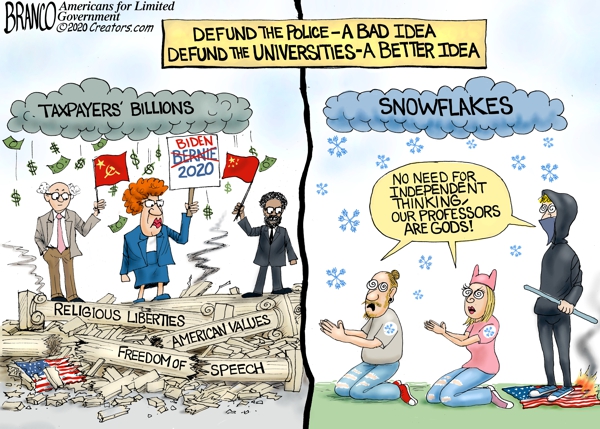 Political cartoon by A.F. Branco ©2020
 Political cartoon A.F. Branco ©2020.
 Reported By
  whispers of fascism creeping in to their normal everyday conversation. The ease in which Democrats discuss the idea of restricting the First Amendment rights of their constituents should drive fear into the hearts of all Americans, but that simply doesn’t seem to be happening.

 Feinstein continued Durbin’s argument by saying that sometimes the danger posed is greater than the capability of the school or local authorities to handle.
  schools to always be prepared to deal with protests and threats?
 that cut to the heart of the matter explaining that free speech is important and that it must be defended at all cost.





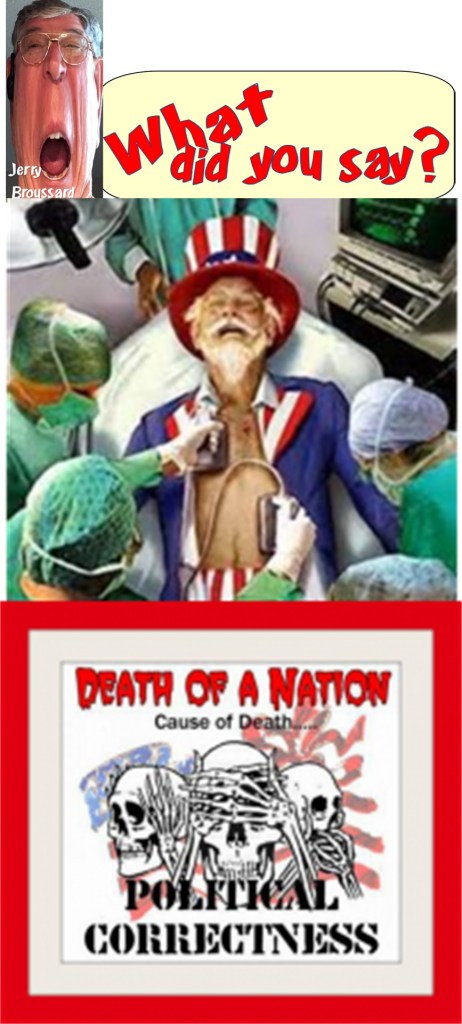
 What Did You Say?
You must be logged in to post a comment.