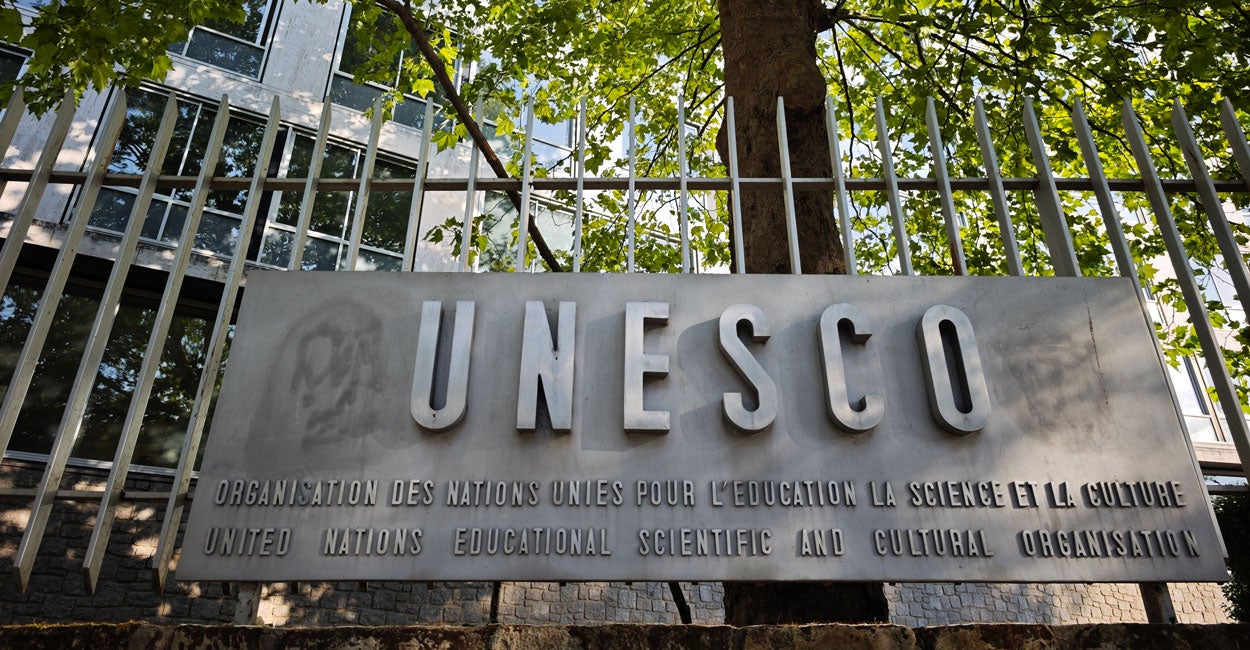
The United Nations Educational, Scientific, and Cultural Organization (UNESCO) headquarters in Paris. (Gao Chenxiang/VCG via Getty Images)
President Donald Trump is pulling the U.S. out of the United Nations Educational, Scientific and Cultural Organization in a move Rep. Randy Fine says he fully supports.
“This is an organization that has repeatedly pushed anti-Israel propaganda, from recognizing Palestinian statehood to denying the Jewish connection to holy sites,” Fine, R-Fla., who is Jewish, told The Daily Signal.
“It has allowed China to expand its influence and promoted woke DEI agendas that have no place in American foreign policy,” Fine said of UNESCO.
China and UNESCO have what UNESCO refers to as “a stable relationship that is conducive to world peace and prosperity.” In 2022, China became the largest financial backer of UNESCO, according to the Global Policy Journal.
“‘America First’ means we do not fund global institutions that undermine our values, rewrite history, or threaten the security of our allies,”according to Fine.
UNESCO is a United Nations organization established to promote education, science, culture, and communication in the name of furthering peace worldwide.
The Trump administration’s decision to leave UNESCO follows a 90-day review of the organization. The review uncovered, according to The New York Post, that UNESCO engages in diversity, equity, and inclusion practices and has a pro-China and pro-Palestinian bias.
“UNESCO works to advance divisive social and cultural causes and maintains an outsize focus on the UN’s Sustainable Development Goals, a globalist, ideological agenda for international development at odds with our ‘America First’ foreign policy,” Tammy Bruce, a State Department spokeswoman, said in a statement Tuesday.
Bruce called “UNESCO’s decision to admit the ‘state of Palestine’ as a member state” of the organization “highly problematic” and “contrary to U.S. policy,” adding the action “contributed to the proliferation of anti-Israel rhetoric within the organization.”
Moving forward, “U.S. participation in international organizations will focus on advancing American interests with clarity and conviction,” she said.
Audrey Azoulay, director general of UNESCO, said Tuesday that the U.S. withdrawal from UNESCO “contradicts the fundamental principles of multilateralism, and may affect first and foremost our many partners in the United States of America.” But Azoulay added that the group “has prepared” for the U.S. leaving the organization, since the move was anticipated.
The U.S. will officially withdraw from UNESCO at the end of 2026, but this won’t be the first time the U.S. has pulled out of the organization. President Ronald Reagan withdrew the U.S. from UNESCO in 1984 due to concerns over corruption within the organization. The U.S. rejoined under George W. Bush’s administration in 2003. America again pulled out of UNESCO during Trump’s first administration, but rejoined under President Joe Biden’s administration.
With this now being the third time the U.S. has pulled out of UNESCO, Eugene Kontorovich, a Heritage Foundation senior research fellow specializing in international law and issues related to Israel, says U.S. leaders need to “figure out a way to make this permanent.”
“Congress should repeal, formally, its 1946 authorization for U.S. membership [in UNESCO],” Kontorovich said, “so that a future Democratic president can’t just merry-go-round us back in.”
School districts around the world are racing to implement Social and Emotional Learning (SEL) programs in the name of improving their students’ social and emotional skills. In fact, according to the global purveyor of SEL standards, 27 states so far have adopted K-12 SEL competencies, and all 50 states have adopted SEL competencies for pre-K students. But where is this massive push for SEL coming from, and what are the motives behind it?
The answer to this question is becoming clear: The United Nations Educational, Scientific, and Cultural Organization (UNESCO) is a primary force behind the SEL movement worldwide. A major way UNESCO advocates for SEL is through UNESCO’S Mahatma Gandhi Institute of Education for Peace and Sustainable Development. The Gandhi Institute produces an online publication called The Blue Dot, which features articles from SEL experts and others around the globe that highlight “the relationship between education, peace, sustainable development and global citizenship.” Invoking Gandhi’s name in the title of this United Nations entity is meant to pull at the heartstrings of anyone who hears it. But should our heartstrings be pulled?
SEL Is Key to Achieving the UN’s Sustainable Development Goals
The title of a feature article in The Blue Dot co-written by a specialist from the Gandhi Institute reveals why UNESCO is hellbent on getting SEL into every school in America and across the world: “SEL for SDGs: Why Social and Emotional Learning (SEL) is Necessary to Achieve the Sustainable Development Goals.” The “sustainable development goals” (SDGs) are noble-sounding goals that would essentially require government management of energy sources worldwide and the large-scale redistribution of wealth in the name of saving the planet. In UNESCO’s view, the endgame of SEL is not to meet the social and emotional needs of each child, but to shape all children to meet the needs of a global society by adhering to the sustainable development goals.
The article explains that the UN’s sustainable development goals will create “dissonance” in people due to the conflicting nature of some of the goals. The goals will also create dissonance in people because of the monumental sacrifices that may be necessary to achieve them — giving up fossil fuels, family values, and control of one’s own property, to name a few.
Therefore, proponents say it is necessary to reduce children’s emotional resistance to the goals through systemic SEL in the classroom: “Since dissonance is an unpleasant emotive state, subjects of dissonance require emotion-regulatory capabilities (emotional resilience) to navigate the behaviors and prerequisite antecedents to attain [the] SDGs.” The article says, “Dissonance can be caused by beliefs, attitudes, values, and feelings,” and that “interventions to reduce dissonance are required to address … the intensity of emotional response.”
In short, they believe interventions by way of SEL programs are necessary to influence young people’s “beliefs, attitudes, values, and feelings” so they will more readily think like global citizens and cooperate with the goals UNESCO has set for the world.
Another article in The Blue Dot titled, “What is Systemic Social and Emotional Learning and Why Does it Matter?” and written by two officers from the Collaborative for Academic, Social and Emotional Learning (CASEL), says CASEL’s mission is to help make “SEL an essential part of the preschool to high school education.” CASEL has positioned itself as the world leader on SEL standards and has a cooperative relationship with UNESCO. These two entities are united in their zeal to weave SEL into all school subjects and to deliver it to all children everywhere.
Raising the Next Generation of ‘Global Citizens’
But why? What is it UNESCO wants to instill in children? UNESCO’s materials make it clear that SEL is intended to foster not only kindness between students, but cooperation with a global agenda rooted in the doctrine of collectivism. Nandini Chatterjee Singh, a program specialist for the Gandhi Institute, says“SEL skills are powerful competencies” that have been shown to “instill pluralistic thinking.” The institute’s website further says it is seeking to teach children to “exhibit prosocial behavior for … a peaceful and sustainable planet.”
In short, proponents of the sustainable development goals and SEL want to instill “pluralistic thinking” in your child in the name of global peace. They want children to be taught to value the “collective good” over individual liberties, rights, and property despite the fact that the freest, most prosperous nations in the world are founded on individual liberties, rights, and property.
Richard Davidson, a writer in The Blue Dot, says UNESCO’s Gandhi Institute is poised to disseminate SEL programs “that will have the potential to influence the development of the next generation of global citizens,” and he declares, “I believe that today we have a moral obligation to incorporate SEL into our educational systems at all levels.” Similarly, CASEL says, “SEL at the classroom level needs to be embedded in coordinated, systemic, whole-child, school-wide approaches.” (For more on whole-child, whole-school approaches to education, see here.)
In another SEL article in The Blue Dot, Mahima Bhalla, learning coordinator for the Gandhi Institute, says that “in order to contribute to the goal of peaceful and sustainable societies,” his organization “recognizes the need to move beyond only academic purposes of education” and instead focus on influencing the social and emotional state of students. This indicates a clear sea change in the purpose of education.
Systemic SEL Digital Curriculum
According to Davidson, the Gandhi Institute’s digital platforms “show great promise for massive scaling” and the director of the Gandhi Institute says it has already disseminated a suite of interactive digital SEL modules that address “contemporary issues such as migration, nationalism and violence.” The scope of these digital modules appears to go well beyond teaching Johnny and Billy to get along on the playground, which is how SEL is often sold to local educators.
The intended reach of the Gandhi Institute’s advocacy is made clear in its “Recommendations to Implementing SEL” section where it says the recommendations the institute gives are “prescribed as general guidelines for education decision makers at the national level right down to school boards and schools.” It’s also telling that it notes, “There needs to be an intentional focus (such as a campaign) organized by a coalition of partners led by UNESCO to communicate a common and unified message on the importance of SEL to parents and the public at large.”
By their own admission, UNESCO and its partners are eagerly trying to sell the idea of systemic SEL to the stakeholders known as parents. So are the parents of the world lining up to demand that schools add integrated SEL programs to their children’s school curricula? No. SEL is being peddled by UNESCO from the top down under the guise of local control.
Developing the attributes of compassion, kindness, and empathy in children is a noble goal, and some of that development can appropriately happen at school. But infusing digitally connected, UNESCO-endorsed, systemic SEL curriculum into the classrooms of the world to instill pluralistic thinking in children is not the answer. Local programs, local communities, and individual families are the best ways to instill social and emotional skills in children and to maintain free societies based on individual rights and responsibilities.
JERUSALEM — Three Palestinians were reported killed and over 200 were wounded in clashes with Israeli security forces in Jerusalem and the West Bank as Palestinian leaders urged a day of protest purportedly against Israel’s decision to put metal detectors at entrances to the Temple Mount.
Protest leaders, including top Palestinian officials, claim the metal detectors are part of an Israeli conspiracy to hamper Muslim worship at the Mount, the holiest site in Judaism and a site considered holy in Islam. The activists and Palestinian officials seemingly fail to note that Israel’s new security measures were put into place in direct response to the murderous Palestinian terrorist attack at the Mount last Friday in which three assailants somehow smuggled weapons onto the site. The metal detectors will protect all visitors to the Mount, including Muslim worshipers.
The activists protesting at the Temple Mount ignore that metal detectors have been in place for years for Jewish and Christian worshipers accessing the Western Wall. And Muslims on the Hajj pilgrimage pass through metal detectors at airports and border crossings.
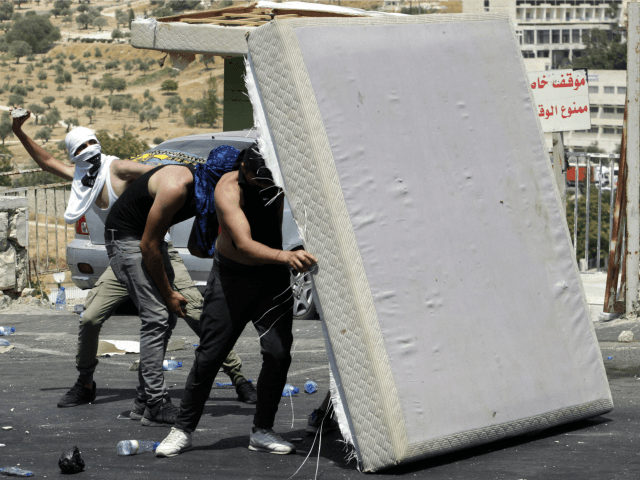
A Palestinian uses a slingshot against Israeli soldiers during violent clashes in the West Bank city of Bethlehem (AP/Nasser Shiyoukhi)
On Friday, Israeli Police cited information that “extremist elements” where planning to “to cause violent disruptions to the public order, and thereby to threaten the public peace, including the [safety] of those coming to pray at the holy sites and other residents of the area.”
As a result, Israeli security forces erected checkpoints at main entrances to Jerusalem and are blocking several roads leading to the Temple Mount area. Some 3,000 police forces were deployed to Jerusalem’s Old City in addition to five Israel Defense Forces battalions that have been put on standby.
The Times of Israelreported on Friday’s ensuing deadly clashes:
The Palestinian Authority’s official Wafa news agency said a 17-year-old was killed in Ras al-Amud outside the Old City after being shot by a “settler,” though no shooter was identified; the term is often used by Palestinians to refer to any Israeli out of uniform. The Palestinian Health Ministry identified the teen as Muhammad Mahmoud Sharaf from the East Jerusalem neighborhood of Silwan.
A second person was reportedly shot in the A-Tur area of east Jerusalem and died of his wounds at Makassed Hospital in East Jerusalem. The third death reportedly occurred in Abu Dis in the West Bank, near Jerusalem, according to the Palestinian Health Ministry.
Over 200 people were reported injured in the clashes across Jerusalem and the West Bank on Friday, the Palestinian Red Crescent said, adding that the injuries were incurred from live bullets, rubber-coated bullets, burning and tear gas inhalation.
There were reports of other clashes between Israeli forces and rioters across eastern sections of Jerusalem and in several West Bank locations, including checkpoints.
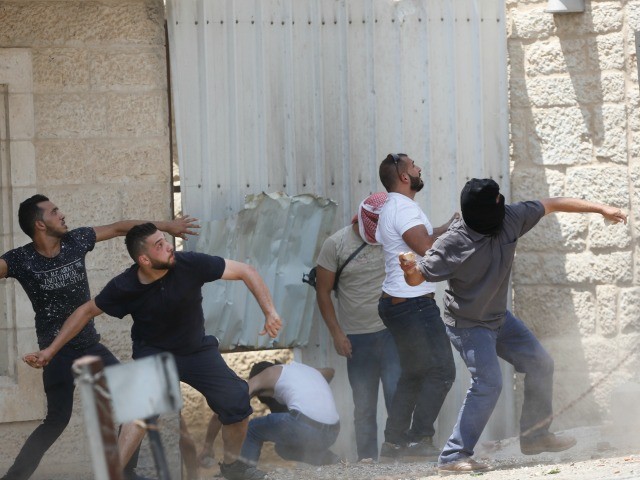
Palestinian youths hurl stones towards Israeli police officers during clashes in Jerusalem. (AP/Mahmoud Illean)
Some of those arrested included officials from Palestinian Authority President Mahmoud Abbas’s Fatah party.
According to Palestinian reports, 10 residents were arrested in east Jerusalem, among them were Fatah officials.
Some 400 Muslims attended the prayer next to the Gate of the Tribes (Bab al-Asbat), the place that sparked the violence earlier this week. Before the prayer, the leader called on the attendees to be patient, and said that “the Jews, that are occupying Palestine, are on their way to hell.”
The Palestinian Red Crescent says 41 Palestinians were taken to hospitals or clinics with injures from live fire, rubber bullets and beatings. About 150 Palestinians were treated for tear gas inhalation.
Four Israeli police officers have been reportedly injured in the clashes after being struck with stones and flares.
The Palestinian charge that Israel is hampering Muslim access to the Temple Mount is contradicted by facts on the ground. Israel allows the Jordanian-controlled Waqf to serve as custodians of the Mount and grants Muslim worshipers access to the site 24 hours per day, seven days a week with the exception of rare instances of security threats.
Jewish and Christian visitors, however, are restricted by the Waqf from visiting the Mount except on small tours for about two hours per day. The Waqf does not allow non-Muslims to pray on the Mount or bring holy objects to the site; whereas Muslim prayer is unrestricted. Waqf representatives closely monitor non-Muslim visitors to the site and are known to boot those engaging in prayer.
Palestinians throw stones against Israeli soldiers during clashes in the West Bank city of Bethlehem (AP/Nasser Shiyoukhi)
Israel on Thursday partially blamed the United Nations Educational, Scientific and Cultural Organization (UNESCO) for helping to fuel anti-Israel incitement regarding false threats to the Temple Mount.
“UNESCO is a full partner to the false incitement by Palestinians and radical Islam who claim that Al-Aksa [Temple Mount mosque] is in danger,”Israel’s ambassador to UNESCO in Paris Carmel Shama HaCohen said.
Last Friday’s Mount terrorist attack occurred less than two weeks after the United Nations Educational, Scientific and Cultural Organization (UNESCO) passed an anti-Israel resolution declaring Jerusalem’s Old City and its ancient walls to be “occupied” sites and listed the areas as Palestinian heritage sites in “danger.”
The Temple Mount is located in Jerusalem’s Old City, and last Friday’s attack occurred near the Lions Gate, part of Jerusalem’s ancient walls singled out by UNESCO.
And the terrorist attack took place one week after UNESCO passed another anti-Israel resolution regarding the Tomb of the Patriarchs in Hebron – considered the second holiest site in Judaism after the Temple Mount – claiming the tomb is a “Palestinian” world heritage site in danger.
Aaron Klein is Breitbart’s Jerusalem bureau chief and senior investigative reporter. He is a New York Times bestselling author and hosts the popular weekend talk radio program, “Aaron Klein Investigative Radio.” Follow him onTwitter @AaronKleinShow.Follow him onFacebook.
American Family Association
American Family Association (AFA), a non-profit 501(c)(3) organization, was founded in 1977 by Donald E. Wildmon, who was the pastor of First United Methodist Church in Southaven, Mississippi, at the time. Since 1977, AFA has been on the frontlines of Ame
NEWSMAX
News, Opinion, Interviews, Research and discussion
Opinion
American Family Association
American Family Association (AFA), a non-profit 501(c)(3) organization, was founded in 1977 by Donald E. Wildmon, who was the pastor of First United Methodist Church in Southaven, Mississippi, at the time. Since 1977, AFA has been on the frontlines of Ame
American Family Association
American Family Association (AFA), a non-profit 501(c)(3) organization, was founded in 1977 by Donald E. Wildmon, who was the pastor of First United Methodist Church in Southaven, Mississippi, at the time. Since 1977, AFA has been on the frontlines of Ame
You Version
Bible Translations, Devotional Tools and Plans, BLOG, free mobile application; notes and more
Political
American Family Association
American Family Association (AFA), a non-profit 501(c)(3) organization, was founded in 1977 by Donald E. Wildmon, who was the pastor of First United Methodist Church in Southaven, Mississippi, at the time. Since 1977, AFA has been on the frontlines of Ame
NEWSMAX
News, Opinion, Interviews, Research and discussion
Spiritual
American Family Association
American Family Association (AFA), a non-profit 501(c)(3) organization, was founded in 1977 by Donald E. Wildmon, who was the pastor of First United Methodist Church in Southaven, Mississippi, at the time. Since 1977, AFA has been on the frontlines of Ame
Bible Gateway
The Bible Gateway is a tool for reading and researching scripture online — all in the language or translation of your choice! It provides advanced searching capabilities, which allow readers to find and compare particular passages in scripture based on





 Reported






 What Did You Say?
You must be logged in to post a comment.