Today’s Politically INCORRECT Cartoon
What-cha-ma-call-it
URL of the original posting site: http://comicallyincorrect.com/2017/03/20/whatchamacallit/
What-cha-ma-call-itURL of the original posting site: http://comicallyincorrect.com/2017/03/20/whatchamacallit/
Repair and Extend (Ryancare)URL of the original posting site: http://comicallyincorrect.com/2017/03/13/repair-extend-ryancare/
The Fix Is InURL of the original posting site: http://comicallyincorrect.com/2017/03/10/the-fix-is-in/

Commentary by URL of the original posting site: http://humanevents.com/2017/03/01/how-to-provide-universal-health-care-using-this-one-easy-trick/
Right there, I’ve solved the health insurance crisis for 90 percent of Americans. Unfortunately, no one can imagine what a free market in health care looks like because we haven’t had one for nearly a century.
On NBC’s “Meet the Press” this weekend, for example, Chuck Todd told Sen. Tom Cotton that his proposal to create affordable health care that would be widely available, “sounds good,” but “do you understand why some people think that’s an impossible promise to keep?”
Todd continued: “To make it affordable, making it wider, I mean, that just seems like — you know, it seems like you’re selling something that can’t be done realistically.”
It turns out that, outside of a communist dictatorship, all sorts of products are affordable AND widely available! We don’t need Congress to “provide” us with health care any more than we need them to “provide” us with bread. What we need is for health insurance to be available on the free market.
With lots of companies competing for your business, basic health insurance would cost about $50 a month. We know the cost because Christian groups got a waiver from Obamacare, and that’s how much their insurance costs right now. (Under the law, it can’t be called “insurance,” but that’s what it is.)
Even young, healthy people would buy insurance at that price, expanding the “risk-sharing pools” and probably bringing the cost down to $20 or $30 a month.
In a free market, there would be an endless variety of consumer-driven plans, from catastrophic care for the risk-oblivious to extravagant plans for the risk-averse. You know — just like every other product in America.
You should visit America sometime, Chuck! The orange juice aisle in a Texas grocery store knocked the socks off Russian president Boris Yeltsin. (Imagine how cheap a double screwdriver must be in America!)
Just as there are rows of different types of orange juice in the grocery store –- and loads of grocery stores — there will be loads of health insurance plans and insurance companies offering them.
Americans would finally be able to buy whatever insurance plans they liked, as easily as they currently buy flat-screen TVs, cellphones and — what’s that product with the cute gecko in its commercials? I remember now! CAR INSURANCE!
Evidently, insurance is not impervious to the iron law of economics that every product sold on the free market gets better and cheaper over time. The only complicated part of fixing health care is figuring out how to take care of the other 10 percent of Americans — the poor, the irresponsible and the unlucky. And the only reason that is complicated is because of fraud.
Needless to say, the modern nanny state already guarantees that no one will die on the street in America. The taxpayer spends more than a trillion dollars every year on Medicare, Medicaid and Social Security disability insurance so that everyone’s health is taken care of, from cradle to grave. Unfortunately, probably at least half of that sum is fraud.
Policing fraud is difficult because:
Consequently, after the first sentence establishing a free market in health insurance, the entire rest of the bill should be nothing but fraud prevention measures to ensure that only the truly deserving — and the truly American — are accessing taxpayer-supported health care programs.
I’d recommend sending as much as possible back to the states, and also paying bounties to anyone who exposes a fraud against Medicare, Medicaid or Social Security. Anyone caught committing health care fraud should get 10 years. Not in prison, in a Medicaid doctor’s waiting room.
But I’m sure you guys in Congress have come up with lots of great ideas for policing fraud in the SEVEN YEARS you’ve had to think about it. (Hello? Is he breathing? Dammit, I’m not getting a pulse!!) Then, Congress can start removing all the bad stuff from the U.S. Code, such as:
The goal of “universal health care” is very simple to achieve, just as the goal of “universal wearing of clothing” seems to have been taken care of. The government can provide for those who can’t provide for themselves, but the rest of us need to be allowed to buy health insurance on the free market — an innovation that has made America the richest, most consumer-friendly country in the world.
It’s taken 50 years, but, thanks to Hillary’s losing the election, we finally have liberals on the record opposing the Soviet Union. Can’t all of Washington come together and end our soviet health care system?
A Perspective by
Daniel Horowitz | March 01, 2017URL of the original posting site: https://www.conservativereview.com/commentary/2017/03/trump-scored-big-using-a-conventional-speech-to-kick-off-an-unconventional-presidency

Donald Trump in Mesa, AZ / Gage Skidmore | Flickr
In many ways this was the best speech he has given to date. In fact, it was a perfect presentation of his agenda. To be clear, not all of his agenda is conservative, but that is already baked into the cake. Amidst a month of endless muddled messaging, ramblings about the media, Republican infighting, and competing factions within his own administration, last night was his only opportunity to take his message directly to the American people. It was also a time to move beyond campaign rhetoric and embrace the reality of his party controlling all of government and the need for a forward-looking message.
Here are my quick observations on the policy aspects of the speech, divided into what conservatives should consider good and bad..
Coming into the speech, rumors were swirling in the media that Trump would embrace some sort of amnesty. Not only did that not occur, but Trump reclaimed the term “immigration reform” and used it to describe what the word truly means: finally restoring our immigration system to its historical values before Ted Kennedy destroyed it. That means only admitting immigrants who love our values, do not become a public charge, and do not threaten our way of life. It also means implementing a sane legal immigration system that is not based on chain migration. He put Democrats on defense so that they will have to explain why they oppose merit-based immigration.. For those of us who’ve worked on this issue for years, this speech was just what the doctor ordered.
Trump spoke to the morality, not just the legality, of his immigration moratorium, which we called on him to do earlier this week. As Trump said,
“It is not compassionate, but reckless, to allow uncontrolled entry from places where proper vetting cannot occur. Those given the high honor of admission to the United States should support this country and love its people and its values.” He also charted a completely new path on the entire premise and goal of refugee policy: “The only long-term solution for these humanitarian disasters is to create the conditions where displaced persons can safely return home and begin the long process of rebuilding.”
Earlier today, I laid down the gauntlet for Trump to finally speak directly to the problems of Obamacare. I argued he needed to call for full repeal and hold Democrats accountable for creating this disaster but then blocking its solution. Trump did not disappoint in the macro-messaging. The guiding principles he laid out on health care were sound. He actually touched on the central point missed by GOP congressional leadership — that we should focus on lowering costs rather than expanding coverage as an end to itself, saying: “The way to make health insurance available to everyone is to lower the cost of health insurance, and that is what we will do.” Unfortunately, he contradicted that messaging by hinting at a pre-existing condition mandate and refundable tax credits — two elements of the establishment plan that will actually keep prices high. Nonetheless, the overall plan was as good as we can hope for from any Republican at this moment and needs to be bolstered by allies in the administration.
Although the details were a little sparse for a speech this long, he made it clear that the era of nation building is over. “My job is not to represent the world. My job is to represent the United States of America,” said Trump in a very effective punchline. At the same time, President Trump spoke to defending American security without apologizing and waging an unflinching war against radical Islamic terror. And thank God, as this is the first time in years a president has mentioned our alliance with Israel without pushing the odious “two state solution.”
Although crime is a policy mainly dealt with on a state level, I’m glad Trump used his “job” as ‘citizen in chief’ to address rising crime rates. This is one area of Trumpism that is actually more in line with traditional conservatism, even though it deviates from the current dogma among “right-leaning” policy elites. The same is true for the drug epidemic. He let the liberal open borders crowd own the disaster that is taking place in our communities thanks to drugs pouring over the border.
While we’ve come to expect social conservatism to take a back seat, it’s a shame that these issues didn’t even receive the traditional obligatory mention, especially given the persecution that is taking place at the hands of the sexual identity lobby and the courts. He could have easily woven in respect for the conscience and private property decisions of others into this unifying speech and would have been a good ambassador for the cause. He won with overwhelming support from evangelicals and other faith-based groups in this country. It’s a shame they were left out tonight. Then again, the rest of the party is just as bad on this issue, so it’s not as if Trump is changing the party’s true position. Nonetheless, conservatives need to fight harder to address fundamental rights and judicial reform.
Let our policies stand on their own merits and the media’s desire to destroy them will be that much harder.
As always, there was no mention of balancing the budget, the threat of debt, or the need to cut spending. In addition, President Trump promoted “Ivankacare” and the full blown $1 trillion porkulous he calls an infrastructure rebuilding package. Conservatives should not back down in their opposition to these bad ideas. We don’t need another massive entitlement; we need to repeal Obamacare so that mothers don’t have to work more to pay for a second mortgage. Likewise, the talk of “crumbling infrastructure” is a dubious left-wing talking point. And to the extent there are problems with our infrastructure it’s because of the inefficient, failed federal monopoly on highway spending. Trump said, “the time has come for a new program of national rebuilding.” He is right, it’s time to devolve transportation and education spending to the states in order to improve those important functions.
Moreover, Trump must remember that we cannot have economic growth with such long-term debt. Also, the trade deficit he speaks of is only a problem because of our fiscal deficit and the misallocation of investments pouring into this country.
Nothing new here, but still very problematic. Much of the appeal of “buy America” and “stopping companies from going overseas” stems from the general feeling that we have lost our economy and sovereignty. But were Trump to really propose a solid agenda ending venture socialism — taxation, regulation, and subsidization — along with his virtuous immigration ideas, those problems would go away over time and trade won’t have to be the bogeyman. Furthermore, enactment of true free market policies is the best way to keep companies in America.
Overall, there was really nothing new regarding Trump’s non-conservative views, and I believe they were overshadowed by the solid parts of his speech on immigration and Obamacare. It’s something we must continue to work on as we fight to defend his good policies.
President Trump must now harness the energy from this successful speech and deliver specific policies to Congress on taxes, immigration, and health care. He must whip GOP leaders into shape, get everyone in his administration on the same page, stay on message, and let his policies speak above the rancor of the media. Trump should focus relentlessly on his policies (hopefully the more conservative ones) and back them up with a series of policy speeches while simply ignoring the media. Yes, the media is the enemy, but we must not be our own worst enemy. Let our policies stand on their own merits and the media’s desire to destroy them will be that much harder.
Authored 
Death of the GOP

Trump was made president of the United States on several fronts. He was against illegal aliens infesting the U.S.A. and for building a wall on the southern border, he was in favor of lowering taxes and re-building the economy, he was pro-U.S.A. (i.e. “make America great again”), and he was going to end Obamacare.
On the latter issue, the Republican Party stood fully behind Trump and have for several years now said they, too,
want to put an end to one of the worst, most destructive laws ever to ooze out of D.C. But, now, only a month into the era of Trump, now that they are fully in charge and have a president ready to join the effort to quash the socialist take over of one sixth of the nation’s economy, we have already seen they are losing their spine on the matter.
Despite so many who are crowing that the Democrat Party is dead — and, yes, they are in the worst shape they’ve ever been in — and despite those who assume Democrats are now in the permanent wilderness, it is idiotic to assume the Dems are down and out. The fact is, right this minute the GOP has more power than it has had in generations and now is the time to act on Obamacare. We can’t expect the GOP to ever be in a better place to put an end to President Obama’s signature nightmare.
To their credit — and just, at that — many Republicans do understand that ObamaCare needs to be eliminated. Remember, many Republicans were heard claiming that repealing Obamacare would be a “day one” task. And on that subject, Trump did, indeed, make a “day one” move to begin the rollback of Obama’s law. Hours after taking office, Trump signed an Executive Order instructing federal agencies to grant relief to Americans negatively affected by the Affordable Care Act (ACA).
For instance, last year, when Speaker of the House Paul Ryan was not able to muster enough votes to override Obama’s veto of a bill designed to begin dismantling Obamacare, Ryan insisted that if a Republican were to win the White House, they would still do it.
“We have now forged a path — that is a clear path — to repealing Obamacare without 60 votes in the Senate. So what we are proving today is if we have a Republican president next year, we will repeal Obamacare. And we will replace Obamacare,” Ryan said at a press conference in February of last year after the vote to override Obama’s veto failed.
Just before Donald Trump was inaugurated as our 45th president, Senate Majority Leader Mitch McConnell also ripped into Obamacare, said it has failed America, and promised to dump it.
“The Senate is currently working to pass the legislative tools to bring relief to the middle class by repealing this partisan law,” McConnell said of Obamacare in an op-ed January 9.
“We’re acting quickly because ObamaCare is collapsing under its own weight, and things will continue to get worse otherwise. That doesn’t mean the law will end overnight. There will be a stable transition period, and once repeal is passed we will turn to replacement policies that cost less and work better than what we have now,” McConnell promised.

Indeed, there are hints all over the media that the Republican Party is backing down from concrete action as fast as they rush to microphones to claim otherwise. For instance, only about a week before his inauguration, Trump was listening to Kentucky Republican, Senator Rand Paul, who was already cautioning that the party should slow down of the repealing of Obamacre until there was a “replacement” ready for introduction.
Now, before I go on, if you don’t believe that the GOP has several replacement bills already written, then you are a fool. Rand Paul has probably even been part of the drafting of at least one of them. So, there is no reason to wait for some mythical bill to be “written.” There are several to choose from already. Just frikkin pick one and go!
Even conservative Senator Tom Cotton (R-Ark) has been blathering about waiting until a “replacement” is ready.
“I think when we repeal Obamacare we need to have the solution in place moving forward,” Cotton said on MSNBC show in January. “Again, the solution may be implemented in a deliberate fashion, but I don’t think we can repeal Obamacare and say we’ll get the answer two years from now.”
And orange-faced former House Speaker John Boehner is even back in the media insisting that the GOP will never repeal Obamacare. Just last week Boehner claimed “it is not going to happen.”
Notice what all this means? It means that Republicans are looking for a reason to tell voters that they aren’t ready to fight to repeal Obamacare.
This “let’s wait and see” attitude is a common refrain in Washington belched out by Republicans who are looking for ways to avoid doing what they promised or were elected to do. They’ve been throwing this line of nonsense around for decades. The GOP said they couldn’t reign in government, lower taxes, or fight Obama because they didn’t have the House of Representatives. Then they got the House. After that they said now wasn’t the time to fight for anything because the GOP didn’t control the Senate. Then they got the Senate. Then they said they couldn’t forge ahead because Obama was president and they needed a Republican in the White House. Then Trump won. Today they have no excuse not to plow ahead… but what are they saying? They are saying now is not the time to fight. Now is the time to cool our jets and slow things down.
This never, ever happens when Democrats are in power. When Democrats are in power they launch into their agenda with full steam ahead quite regardless of whether or not they have an electoral “mandate.” Sadly, the Republican Party hasn’t had the spine to lead since it finally lost its post civil war lock on power when the socialist FDR era finally sent them packing.
Like I said, the GOP should assume that it will never have this much power again and at light speed they should sweep the Democrats and their legacy into the wastebasket of history with all haste. Not only is it what the Democrats would do — and have done decade after decade — but it is exactly what Republicans were sent to Washington to do.
Right now the Republican Party has a very weak coalition despite the cliff the Democrats fell off of. The GOP is at an uneasy crossroads between its weakling, past self, and its possible new, stronger self led by Trump. But right now it does not have a successful identity and if it slows Trump down and refuses to repeal Obamacare, refuses to lower taxes and improve our economy, won’t vote to build the wall, or won’t work to pass any of Trump’s main agenda, then it will not succeed. It will instead give the undeserving, un-American Democrats an easy path right back to power.
Warner Todd Huston is a Chicago-based freelance writer, has been writing opinion editorials and social criticism since early 2001 and is featured on many websites such as Andrew Breitbart’s BigGovernment.com and BigJournalsim.com along with all Breitbart News sites, RightWingNews.com, CanadaFreePress.com, and many, many others. He has been a frequent guest on talk-radio programs across the country to discuss his news stories and current events and has appeared on TV networks such as CNN, Fox News, Fox Business Network, and various Chicago-based news programs. He has also written for several history magazines and appears in the book “Americans on Politics, Policy and Pop Culture” which can be purchased on amazon.com. He is the owner and operator of PubliusForum.com. Follow Warner Todd Huston on Twitter @warnerthuston or email the author at igcolonel@hotmail.com.
Authored by Melissa Quinn / @MelissaQuinn97 / February 23, 2017
Conservatives speaking at the Conservative Political Action Conference said they want to see Congress repeal and replace Obamacare. (Photo: Mike Theiler/Reuters/Newscom)
During a panel at the Conservative Political Action Conference, or CPAC, on Thursday, Grace-Marie Turner, president of the Galen Institute, told attendees to think of Obamacare’s repeal as a “down payment” that will allow Republicans to implement their own health care reforms in the future.
But first, Turner said Republicans need to take action to repeal the law using a fast-track budget tool called reconciliation.
“We have to do this,” she said. “We have to be get this out of here to be able to deliver on the repeal-and-replace pledge to the American people, and then to begin the process of truly returning to a health sector that can be America’s greatest health sector again.”
Rep. Michael Burgess, R-Texas, Scott Flanders of eHealth, and Dale Bellis of Liberty HealthShare joined Turner on the health care panel at the annual event.
While Republicans campaigned since 2010 on repealing Obamacare, efforts to advance the legislation dismantling the law have slowed over the last few weeks. The GOP-led Congress passed a bill using reconciliation to undo major provisions of the health care law in 2015. But President Barack Obama ultimately vetoed that legislation. Now, conservatives in Congress are calling on their leaders to bring that same bill before members for another vote.
“It’s going to happen,” Burgess said of Obamacare’s repeal. “What [the 2015 bill] demonstrated to me was that if you got the right president in the White House, you could send that bill back down to the other end of Pennsylvania Avenue, and you could repeal large pieces of the Affordable Care Act.”
The 2015 reconciliation bill repealed Obamacare’s individual and employer mandates, Medicaid expansion, and subsidies. It also stripped the federal government of the authority to run the exchanges, and eliminated federal funding for Planned Parenthood. Though that legislation passed both chambers of Congress, tensions have emerged among GOP lawmakers over which parts of the health care law to unwind.
Republicans are split over whether to leave the Medicaid expansion in place, while GOP leaders want to include parts of a replacement plan in the same legislation that will repeal the law—a strategy that some conservatives have derided. But Burgess, who serves on the House Energy and Commerce Committee, said the 2015 reconciliation bill will serve as a “starting point” for Congress this year, with Republicans understanding that the repeal bill will be at least the same as that passed in 2015.
In addition to disagreement over whether to include parts of Obamacare’s replacement in the repeal bill, Republicans also split on whether to provide tax credits or tax deductions to consumers. But Turner stressed that the process for replacing the law—what she said will become a “once-in-a-generation reform”—will be a lengthy one that requires thought, particularly since Republicans are starting not from a blank slate, but with an already changed health insurance market.
“It’s really what would we want if we were starting from the right kind of policy for the health sector? We are not starting there. We’re starting with Obamacare,” she said. “We’re starting with some number of millions of people … relying on Obamacare. You have to create a lifeboat for them, and structures that provide the kind of resources people need who don’t have means to purchase health insurance on their own so they can continue coverage.”
Like Republicans in Congress, President Donald Trump campaigned on repealing Obamacare. During his first day in office, Trump signed an executive order addressing Obamacare and giving his federal agencies the discretion to no longer enforce the individual mandate. And he’s repeatedly said that his new Health and Human Services secretary, Tom Price, will present a replacement plan before Congress.
Trump will address a joint session of Congress next week, and Burgess had his own wishes for what he hopes the president will tell Republicans and Democrats in Congress.
“I would like for him to say very directly to us, to my leadership in the House, Republicans and Democrats, that ‘this is your job,’” Burgess said. “‘I want you to get it done.’ Simple as that.”
CPAC, the largest annual national gathering of conservative activists, runs from Wednesday to Saturday at the Gaylord National Resort and Convention Center in National Harbor, Maryland, just outside Washington.
Commentary by URL of the original posting site: http://humanevents.com/2017/02/15/the-silence-of-the-lambs-congress/
In the past three weeks, Trump has: staffed the White House, sent a dozen Cabinet nominees to the Senate, browbeat Boeing into cutting its price on a government contract, harangued American CEOs into keeping their plants in the United States, imposed a terrorist travel ban, met with foreign leaders and nominated a Supreme Court justice, among many other things.
(And still our hero finds time to torment the media with his tweets.)
What have congressional Republicans been doing? Scrapbooking?
More than 90 percent of congressional Republicans kept their jobs after the 2016 election, so you can cross “staffing an entire branch of government” off the list. Only the Senate confirms nominees, which they’ve been doing at a snail’s pace, so they’ve got loads of free time — and the House has no excuse at all.
The House passed six Obamacare repeals when Obama was president and there was no chance of them being signed into law. Back then, Republicans were full of vim and vigor! But the moment Trump became president, the repeals came to a screeching halt. After the inauguration (gigantic!), House Speaker Paul Ryan and Senate Majority Leader Mitch McConnell put out a plan for repealing Obamacare … in 200 days. They actually gave their legislative agenda this inspiring title: “The Two Hundred Day Plan.”

What was in the last six Obamacare repeals? If we looked, would we find “All work and no play makes Jack a dull boy” carefully typed out 1 million times? Seriously, what does Paul Ryan’s day look like?
This is the Silence of the Lambs Congress. They’re utterly silent, emerging from the House gym or their three-hour lunches only to scream to the press about Trump.
To the delight of the media, these frightened little lambs are appalled by nearly everything Trump does. They’ve been especially throaty about Trump’s temporary travel ban from seven terrorist nations — as designated by the Obama administration (and by everybody else who hasn’t been in a deep freeze in a Finnish crevasse for the past decade).
Just like the six Obamacare repeals, a refugee ban was already written and passed by one house of Congress. Then suddenly: the Silence of the Lambs. McConnell and Ryan are hiding under their desks, as Trump is being attacked from every side.
Way, way back, 15 long months ago, congressional Republicans didn’t have a problem with a total ban on Syrian and Iraqi refugees. Not for a mere three months like Trump’s order — but permanently, unless the director of the FBI, the secretary of the Department of Homeland Security and the director of national intelligence personally certified that a particular refugee posed no danger to the U.S.
That bill passed the House with an overwhelming, veto-proof majority, including 47 Democrats. Then it went to the Senate to die.
A little more than a year ago, Rep. Michael McCaul, R-Texas, bragged in a press release that he had introduced the House’s refugee ban, calling it a bill that would “protect Americans from ISIS.” But when it came to Trump’s three-month pause, McCaul told the Post that Trump’s order “went too far.” I guess that ISIS problem just sort of faded away. (Or maybe we should check with Mrs. McCaul, inasmuch as it’s her family money that makes Rep. McCaul one of the richest members of Congress.)
Rep. Charlie Dent, R-Pa., who voted for the House’s permanent refugee ban, demanded that Trump immediately rescind his travel ban, babbling on about the “many, many nuances of immigration policy” — which he must have learned about on one of his congressional jaunts to a Las Vegas casino.
Rep. Justin Amash, R-Mich., said that Trump’s order “overreaches and undermines our constitutional system.” Evidently, he was suddenly struck by the realization that it’s “not lawful to ban immigrants on the basis of nationality,” despite having voted to ban refugees on the basis of nationality just 15 months earlier. (I’m OK with this, provided the Syrians, Somalis and Yemenis are sent to live on Justin’s street after being told about his support for gay marriage.)
Sens. Jeff Flake, R-Ariz., and Ben Sasse, R-Neb., both rushed to The Washington Post with this refreshingly original point: NOT ALL MUSLIMS ARE TERRORISTS! Why, thank you, senators! Where would the GOP be without you?
The Post also quoted spokesmen — spokesmen! — for Republican Sens. Mike Lee of Utah, Rob Portman of Ohio and Lindsey Graham of South Carolina complaining about not having been briefed on Trump’s order. The senators themselves were far too busy to talk to the press because they were — wait, what were they doing again? Words With Friends? Decoupage?
Since the election, Sen. Bob Corker, R-Tenn., has been mostly occupied polishing his anti-Trump quotations to get a pat on the head from an admiring media. He complained about Trump’s order, saying it was “poorly implemented” and that he had to find out about it from reporters. (I wonder why.)
This is the moment we’ve been waiting for our entire lives, but Republicans in Congress refuse to do the people’s will. Their sole, driving obsession is to see Trump fail.
Authored By: Daniel Horowitz
| February 15, 2017
Clown judge / Ken Cook | Shutterstock
That is why it is at least as an important to fill the federal circuits with originalist’ as it is for the Supreme Court. However, if Trump is going to leave his mark on the judiciary, that would require taking bold measures to overturn established traditions so that each appeals court nominee would be more in the mold of Clarence Thomas than even a Neil Gorsuch, much less a John Roberts or Anthony Kennedy.
For those paying attention to how a mere district judge in one bad circuit can violate the national sovereignty, you need no tutorial on the importance of the lower courts.
In 2015, 54,244 cases were filed in the 12 regional courts of appeals (not including the specialized appeals court for the Federal Circuit) out of a total of 361,689 that began at the district level. At the same time, only about 80 cases were granted full review by the Supreme Court. In other words, the federal courts of appeals are ostensibly the court of last resort for most federal cases. And given that the Left has successfully redefined the Constitution, almost every political issue has become a federal case.
Even though many of the major cases broadly affecting public policy are granted review by the high court, many languish in the lower courts for years and never make it to the Supreme Court. Moreover, the Supreme Court is clearly influenced by the jurisprudential momentum of the lower courts. Given that most of the circuits are full of post-constitutionalists who make Anthony Kennedy look like James Madison, it creates a peer pressure in the legal community to move away from the Constitution as written.
Keep in mind that most of the major cases of consequence pending before the Supreme Court have been appealed by conservatives because of bad lower court decisions.
Remember, gay marriage didn’t happen in a vacuum with the Obergefell case. Almost every district court and all but one of the circuits redefined marriage in one of the most anti-constitutional opinions of all time. We are witnessing a similar trend with lower courts chipping away at the “plenary power doctrine” on immigration in recent years.
Furthermore, justices will rarely take up a case expeditiously when there is no split decision among at least two circuit courts. Given that the lower courts are in such bad shape — with such a dearth of originalist — conservatives can rarely win in even one circuit on such bedrock issues as voter ID, religious conscience, and an array of immigration issues. The lower courts tee up the contours and the dynamics of the cases that reach the high court. Therefore, if we fail to change the personnel and the procedures of the lower courts, another two solid originalist on the Supreme Court (assuming one of the liberals dies or resigns from office) would have only a limited effect.
Keep in mind that most of the major cases of consequence pending before the Supreme Court have been appealed by conservatives because of bad lower court decisions. The tyranny begins and usually ends in the circuits. Given that Republicans have control of the federal government and most state governments, we will only be playing defense in the lower courts because that is where the Left will plant their flag, even more so than during the Obama era.
It’s not just the 9th Circus.
You could probably count on your fingers the number of true originalist (à la Clarence Thomas) on the circuit courts. While it’s arduous to game out the “ideology” of each judge and circuit, here is my preliminary attempt at an overview of the circuits.
First, we will begin with this infographic detailing the number of Republican appointees and Democrat appointees by circuit among active judges (not including semi-retired “senior judges”). The graphic also shows the strong influence of Obama’s eight years on the appeals courts and the immediate vacancies that can be filled by Trump.
A few observations stand out.
1. Among active judges, Democrats now have an outright majority on nine of the 13 circuits.
And as we will explain in a moment, the courts are in worse shape than this topline number would suggest because almost every Democrat-appointee is a post-constitutionalist while only half the GOP-appointees are conservatives and only relatively small number are true originalist. Just consider how two GOP-appointed judges were already involved in the immigration ruling, one of the most radical and harmful decisions of all-time.
2. There are 20 vacancies that Trump can and should fill immediately.
But Obama’s presidency was so strategic that it will take a long time to swing back a single circuit. Only 10 of those 20 are Democrat vacancies that would tilt the balance of a seat and most are not in circuits that will fundamentally alter the balance of most three-judge panels.
3. The all-important D.C. Circuit is now 7-4 majority Democrat appointees, with four judges appointed by Obama alone.
The D.C. Circuit is the second most influential court in the land on constitutional issues. Worse, while there are some solid senior judges, Janice Rogers Brown is the only real originalist left among the active judges, with Brett Kavanaugh a mostly reliable conservative. The D.C. Circuit is going to be a dumpster fire for the indefinite future. Moreover, if you drill down into the district level, the District Court for the District of Columbia has an 11-0 Democrat majority among active judges!
By the middle of the year, when all the current vacancies take effect, there will be 90 Democrat appointees, 69 GOP appointees, and 20 vacancies among active seats on the appeals courts. However, the circuit courts are really in much worse shape than even the top line numbers would suggest.
Remember, almost all of the cases in the appeals courts are decided by a randomly selected three-judge panel, which also includes the senior judges (although their caseload is reduced in varying degrees). While it is possible to request a full en banc review of a case by the full circuit, those reviews are relatively rare in most circuits. Due to the clear Democrat majority on nine of the circuits and the lack of originalist on most of those panels, the legal Left is almost always assured a favorable panel for whatever they are looking to do: redefine marriage, infringe upon religious liberty, throw out abortion regulations, block photo ID, etc.
On the other hand, we’d be lucky to find 15 originalist on the appeals courts who are every bit as conservative as the 90 Democrat appointees — and a number of Republican appointees — are liberal.
Now let’s take a look at the four circuits where there is a supposed GOP majority:
This is the easiest one to game out. The 6-3 GOP majority is extremely deceiving. This circuit is home to the infamous Richard Posner, a Reagan appointee who quite literally believes that the Constitution as adopted is outdated and should be disregarded. He wrote the 7th Circuit’s tyrannical gay marriage opinion, among many other bad decisions.
Only two of the nine active judges can be considered reliable originalist across the board: Michael Kanne and Dianne Sykes. While many conservative legal theorists have respected Frank Easterbrook for many years, he has shown that he doesn’t believe in an individual right to bear arms. The rest of the Republican appointees range from progressive to unreliable. Thus liberals can pretty much rely on a favorable three-judge panel for almost anything they want.
The 9-5 majority of GOP appointees is very misleading if one thinks this is an originalist-dominated circuit.
First, Judge Helene White, although appointed by Bush, is really a liberal Democrat who was selected by Michigan’s two Democrat senators as part of a deal. Jeffrey Sutton, another W appointee, wrote the court’s opinion upholding Obamacare. Out of the seven remaining GOP appointees, only Alice Batchelder could be counted among the most reliable originalist with a few others leaning conservative, such as Raymond Kethledge. Another conservative, Danny Boggs, just retired, so at best his vacancy will be a wash.
Thus, between the liberal active judges and a number of other liberal senior judges in this circuit, it’s hit or miss for conservatives in terms of getting a reliable three-judge panel. In fact, the far Left recently got a three-judge panel to say that transgenderism is settled law and helped promote Jill Stein’s crazy recount in Michigan!
The only two circuits that could remotely be considered conservative are the 5th and 8th circuits. However, even the fifth is not as good as its numbers would suggest. The panel certainly has its share of solid judges, with Edith Jones, Priscilla Owen, Jennifer Elrod, and Jerry Smith. But last year, conservatives couldn’t even get voter ID past the full panel because a few GOP appointees joined with the Left.
The 8th Circuit is probably the best panel in the country. However, that makes the three vacancies on the court somewhat moot because they’d be better served on other courts.
As you can see, although there is much hype surrounding the more than 100 vacancies on the court, they will not swing the balance in terms of the circuits. Only 20 of the vacancies are on appeals courts, of which only 10 are Democrat seats, and many of them are on circuits that are irremediably broken or on the 8th Circuit, which is already good.
Moreover, the prognosis for the future is grim. Many Democrat judges will view Trump as anathema that they will not retire under his watch. A quick glance at the vacancy list shows that all five of the circuit court judges who retired since Trump won the election were Republican, as were most of the district court retirees. Thus the trend is not indicative of a host of opportunities to flip the balance of the circuits. Which is one more reason why we need wholesale judicial reform in addition to filling vacancies.
Nonetheless, it is important that Trump not wait the traditional six months or so to start the process of filling lower court vacancies. While I don’t believe it will fundamentally alter the balance of the courts, the better judges who are in the circuits make it more likely we will get lucky and have a decent three-judge panel for random, important cases.
However, if Trump is to make his appointments meaningful, he would have to depart from longstanding tradition that gives home state senators major input on nominees and allows them to potentially scuttle the nomination.
One of the reasons why we have many liberal judges from Republican presidents — such as Judge Robart, a W appointee — is because Democrat senators can “blue slip” any nominee from their state they dislike. Under Senate tradition, the Judiciary Committee will refuse to hold a hearing on any nominee that is officially opposed by the home state senators. This is why it’s so hard to get even a marginally conservative judge approved from blue states, much less someone in the mold of Clarence Thomas.
Even in red states with two GOP senators, the judicial nominees often reflect a legal mirror image of their political views, which are moderate at best. And in states with senators from opposing parties, Republicans have often cut deals to approve only those nominees who are acceptable to their home state Democrat senator.
The problem of home state RINOS and Democrats is further exacerbated by the fact that tradition tends to
bind the president to maintaining state continuity in seats within a circuit court. According to CRS, just 13 percent of circuit court appointments since the Kennedy administration have changed state representation from the vacant seat. And it is downright mandated by law that every state has at least one judge on the given circuit court and that every nominee must at least reside within the circuit at the time of the appointment.
Trump would have to expend as much political capital trying to ‘appoint better judges’ in a meaningful way as he would by pursuing judicial reform.
Consequently, if a president wants to fill a vacant seat from a state with a Democrat senator, he would be constrained by tradition from filling it with someone from a state with two Republicans, thereby avoiding a blue slip problem.
To begin with, it’s so hard to find Clarence Thomases in this profession. The limitation of state allocation rules and blue slip obstruction are killers. This is why despite swearing every time we will do a better job “appointing better judges,” we wind up with more Kennedys and Roberts on the lower courts. It’s also why outside of the geographical areas of the fifth and eighth circuits, it’s hard to appoint a string of reliable conservatives. There are three vacancies from the 3rd Circuit, for example, but it will be very hard to fill them with originalist given the geographical problem.
As such, Trump would have to expend as much political capital trying to “appoint better judges” in a meaningful way as he would by pursuing judicial reform. Yet the latter would actually solve the problem in the long run.
Authored By: Jen Kuznicki | February 14, 2017
New York protestors under the nationwide Refuse Fascism movement. / Michael Nigro | AP Photo
I’m sure any day now John McCain, R-Ariz. (F, 32%) will blast the resistance movement in similar fashion, right?
Don’t count on it. What McCain misunderstood back in 2010 was that the hobbits were the good guys. It is more likely McCain and his ilk will see the current resistance movement as good, right, and pure because what they want is what any big government politician wants: more government.
Yet the resistance movement is improperly named, just like the “Affordable” Care Act. The people blasting Republican members of Congress at town hall meetings aren’t resisting government, they are demanding more. They should be treated as what they are: a mob of Orcs, a group of destroyers of the Constitution and American Exceptionalism.
The Tea Party went to Republican town halls and said, “we want government out of our lives,” and “we want you to adhere to the Constitution.” They said, “we want less government, limited government, so we can have freedom and liberty.” The destroyers, however, are saying to the Republican politicians, “your job is to control the people, don’t stop doing your job.” They say, “give us more government, more handouts, more welfare, more taxes, more regulation,” anything less makes them scream, “you suck!”
The destroyers are resisting the Constitution, using it and the Declaration of Independence as toilet paper. Any similarities drawn between the two uprisings is the difference between constitutionalism and anarchy, between capitalism and communism, as my friend Mark Levin would say: between liberty and tyranny.
The destroyers claim that they are, “We the People.” But they are not the people the Constitution was formed to govern. We are witnessing the destroyers demand anarchy and lawlessness. When Ben Franklin said, “a republic, if you can keep it,” he was talking about right now.
As former Tea Party members sit back and think their work is done by electing Trump who promised, “only I can fix,” conservatives are rightly frustrated. Complacency and reports of “fake news” has put up walls between Tea Party activists who believed saving the country was a sprint instead of a marathon, and dogged conservatives who rightly reject nationalism yet see a desperate need for coalition.
Yet people on the side of right wonder, “what is it the resistance movement is protesting?” The marches included a thousand different issues, the uncoordinated mobs had every cause represented from transgender rights to population control and climate hoax extremists. They are protesting America as founded. They are protesting biological truth. They are protesting God. They are protesting individuality. They are protesting private property. They are protesting capitalism. They are arguing for Fascism and Socialism and Communism.
Fascism is government control of private enterprise; they are arguing for that, not against it. The Tea Party argued against it, causing headaches for Republican members who believed the Left’s big lie that government can and should control the markets. The Tea Party mobilized in every state to stop crony capitalism, stop government from picking private business winners and losers, and stop government from playing favorites with “public-private” partnerships. Many Tea Partyers lost their way when Trump ran for president, because he too agreed with the left-winger belief that government should pick the winners and losers. Those Tea Partyers must come back and face the fact that there must be a stark difference between us and the destroyers of truth, so that spineless Republicans won’t cause more damage to the republic.
Socialism and its logical conclusion — Communism — is represented by Bernie Sanders, I-Vt. (F, 17%) and Elizabeth Warren, D-Mass. (F, 18%) and is now mainstream in the Democrat Party. What has socialism gotten us? Social Security is bankrupt, as it the entire federal government, yet they want more. We had to put up massive resistance as Tea Partyers to stop Republicans from expanding Medicaid, yet several states ran by Republicans did it anyway. Doing so probably cemented Obamacare forever. Tea Partyers rightly said, “stop giving more, stop spending, you are breaking our backs!” You will never hear a destroyer say that, ever.

Jen Kuznicki is a contributor to Conservative Review, blue collar, wife, mom, political writer, humorist, conservative activist, a seamstress by trade, and compelled to write. Follow her on Twitter @JenKuznicki.
Authored 
Rep. Tom McClintock (R-CA) was reelected with 63% of the vote in his district, but you never would have guessed it if you would have been at a recent town hall where police had to escort him from the premises.
Rep. Justin Amash (R-MI) was reelected with 60% of the vote in his district, but at a recent town hall in Grand Rapids, Michigan you would have thought that no one in his community had voted for him.
There are many other examples of the ridiculous rise of liberal complainers. Folks who are so incensed at losing (even when the winner got more than 60% of the vote) that they simply have to complain about everything, but I’ll just share one more…
In Florida, Rep. Gus Bilirakis (R-FL) won his district with 69% of the vote. 69%! And yet, when he held a town hall in New Port Richey, Florida you would have though that the man would soon be looking for other work. The venue was filled with liberal Democrats screaming and complaining about the GOP majority doing things that Republicans elected them to do. The insanity was epic, stirred by one man’s demand that Obamacare be “ripped to shreds,” but it was an elderly gentleman in a trademark “Make America Great Again” hat that made the crowd apoplectic.
The man asked three simple questions, and had the Democrat crowd cheering him on… but when he answered his own questions it was as if he’d just poured hot coals over their liberal heads.
“Every American should have health care coverage—would
you agree,” he asked. The crowd cheered their approval. “That pre-existing conditions should be covered—would you say,” the man continued. Again the crowd cheered the man on. “If you are 26 years old, or at least up to that, you should be able to be covered by your parents’ insurance—would you agree,” he asked one last time to raucous applause. But there would be no cheering from the liberals after his final statement… “OK, Mr. Price, the cabinet member, has said he’s committed to those three things. Yes, yes, yes! So you need to find out the facts before you start complaining.”
Ouch.
Watch the epic dress down for yourself:
The Independent Journal Review proves the man right, and lays out Dr. Tom Price’s (the new Secretary of Health and Human Services) position on healthcare.
On the issue of health care for all, Health and Human Services Secretary Tom Price said:
“I think it’s absolutely imperative that we have a system in place that has patients at the center and allows for every single American to have the opportunity to gain access to the kind of coverage they want.”
Price also recently vowed, “we will not abandon individuals with pre-existing illness or disease.”
Finally, even President Donald Trump said he wants to keep the Obamacare provision allowing people up to 26 years old to be covered by their parents’ insurance plans.
Onan is the Editor-in-Chief at Liberty Alliance media group. He’s also the managing editor at Eaglerising.com, Constitution.com and the managing partner at iPatriot.com. Onan is a graduate of Liberty University (2003) and earned his M.Ed. at Western Governors University in 2012. Onan lives in Atlanta with his wife and their three wonderful children. You can find his writing all over the web.
Authored
By: Daniel Horowitz | February 03, 2017URL of the original posting site: https://www.conservativereview.com/commentary/2017/02/they-lied-all-along-republicans-plan-to-repair-not-repeal-obamacare
First they promised to repeal Obamacare “root and branch.” Then they promised to “repeal and replace” without explaining its meaning — other than to legitimize the premise of Obamacare as a partial force for good. Now, they are on to “repair.”
The Hill has the relevant quotes from two of the most important committee chairmen (Senator Walden, R-Ore. (F, 36%) and Senator Alexander, R-Tenn. (F, 15%)) drafting the repeal bill … which will not repeal Obamacare:
“I’m trying to be accurate on this that there are some of these provisions in the law that probably will stay, or we may modify them, but we’re going to fix things, we’re going to repair things,” House Energy and Commerce Committee Chairman Greg Walden (R-Ore.), a key player on healthcare, told reporters Tuesday.
“There are things we can build on and repair, there are things we can completely repeal,” he said.
Senate Health Committee Chairman Lamar Alexander (R-Tenn.) is sounding a similar note. […]
“I think it is more accurate to say repair ObamaCare because, for example, in the reconciliation procedure that we have in the Senate, we can’t repeal all of ObamaCare,” Alexander said. “ObamaCare wasn’t passed by reconciliation, it can’t be repealed by reconciliation. So we can repair the individual market, which is a good place to start.”
As we noted before, every word of this premise is false because the price-hiking coverage regulations are inextricably linked to the subsidies, as noted by the courts and CBO. Therefore, the regulations can be repealed through budget reconciliation. Moreover, the Senate parliamentarian doesn’t have the final say on addressing Senate precedent.
However, there is a more important point to bring out from this story. These people lied to all of us. They told a bald-faced lie. Absolutely nothing changed structurally about Obamacare from the time they made these promises during the past three elections until now. If anything, premiums went up even more than expected and there are even fewer insurers than previously predicted, making the case for repeal an easier political sell.
Likewise, nothing changed procedurally from the time they promised to use budget reconciliation to repeal at least most of the main elements of the law. Republicans always knew that they would need to get rid of the actuarially crippling regulations, which would then unfreeze the insurance market, lower costs, bring back choice and competition, and engender much less of a need for subsidies. All the while, everyone always planned to maintain the subsidies and Medicaid expansion for a one to two-year transition period while other free market health care and health insurance reforms were put in place.
Yet, Republicans, particularly those in the Senate, never had any intention of repealing it because they don’t believe or understand free markets, are owned by the big pharma/big government complex, and have no desire or ability to articulate a winning issue to the public without shooting themselves in the foot.
In 2012 and 2014, conservatives worked against Mitch McConnell, R-Ky. (F, 40%) and his sitting RINO Senators (such as Thad Cochran, R-Miss. (F, 22%), Pat Roberts, R-Kan. (F, 51%) Lisa Murkowski, R-Ala. (F, 20%) and Lamar Alexander, R-Tenn. (F, 15%)) and his chosen challengers in open seats (such as Sens. Tillis, R-N.C. (F, 35%) and Cassidy, R-La. (F, 47%)). Voters were warned that they had no intention of repealing Obamacare. Conservatives cautioned that if Ted Cruz’s, R-Texas (A, 97%) plan to defund Obamacare at its inception was not followed, the law would never be repealed. That if we failed to build a Senate majority upon a solid foundation and stronger leadership, Obamacare would never be repealed even if we were so fortunate to control all three branches. [See my op-ed at Fox News Opinion on October 25, 2013, “Building a GOP Majority on Quicksand”]
Groups like Senate Conservatives Fund were maligned as pursuing “purity for profit” and undermining the creation of a GOP majority that would truly repeal Obamacare. Establishment voices accused the grassroots activists of needlessly creating a civil war over disagreements on strategy. Yet, we knew all along it was a disagreement over beliefs and courage, not strategy. Unfortunately, the establishment used their superior funding (from groups like the Chamber of Commerce that wanted to keep Obamacare all along) to run on repealing the law “root and branch,” as McConnell famously said. Now, some of these very senators are leading the charge to repair the law, which is not feasible.
Trump should dispatch Vice President Pence to work with the House Freedom Caucus as well as Speaker Paul Ryan, R-Wisc. (F, 52%) and ensure that the House passes the full repeal bill — along with the regulations. They should make it clear that there are no excuses for the Senate to not overrule the parliamentarian, but at the same time they should not wait around for the lords of the Senate to do the right thing. The reconciliation bill should be structured as follows:
At that point, Trump should relentlessly use his bully pulpit to name and shame the Senate into fulfilling their promise. It can be done if we actually got the momentum rolling in the House. As Reps. Mark Meadows, R-N.C. (A 94%) and Jim Jordan, R-Ohio (A, 96%) said in a statement today, “We committed to the American people to repeal every tax, every mandate, the regulations, and to defund Planned Parenthood. That’s what the American people expect us to do — and they expect us to do it quickly.”
In the meantime, conservatives should put the pressure on the Senate by launching a new round of primaries. Members like Jeff Flake, R-Ariz. (F, 50%), Bob Corker, R-Tenn. (F, 45%), Roger Wicker, R-Miss. (F, 28%), and Orrin Hatch, R-Utah (F, 33%) could be prime targets in states won by Trump.
As Bobby Jindal said, “Republicans who want to retreat from repeal to repair should be replaced.”
Commentary by
Ann Coulter | URL of the original posting site: http://humanevents.com/2017/01/25/can-i-be-the-poster-child-against-obamacare/
Just yesterday, for example, in addition to working, I had to spend an hour — on top of days and days last month — figuring out which few remaining clinics provide mammograms under my brand-new, now third Obamacare insurance plan. My original plan was made “illegal” by Obamacare, and the next two plans — fully approved under Obamacare — went bankrupt and were shut down by state and federal regulators.
Now I just have to pray I don’t get cancer or break a bone before Obamacare is repealed because, even at $700 a month with a gigantic deductible, there is NO PLAN on the individual market accepted by the two premier hospitals in my area for cancer or broken bones.
Those $700 premiums go to pay for the pregnancies and dental care for welfare recipients and immigrants, not cancer treatment for Ann.
Democrats love to get on their high horses about the wonderful things Obamacare has done for the uninsured. They should be asked why they refuse to live under it. After they spend 800 hours changing insurance plans every year, ending up with increasingly expensive and increasingly useless plans — all so that their premiums can pay for the poor — I’ll be fascinated to hear about their love for the downtrodden.
Same with Republicans who are, once again, being bamboozled by lobbyists, to the detriment of their taxpaying constituents who don’t have time or money to fly to Washington and tell them our hard-luck stories. Insurance lobbyists have somehow convinced politicians, who have very little experience in the private sector, that health insurance is wildly different from every other product — even car insurance and homeowner’s insurance — because of its need for a large pool of enrollees. Everyone talks about the enrollment problem as if this is a bug unique to the health insurance industry. What product, do they imagine, does not need lots of customers?
How could restaurants afford those chefs, fresh flowers, industrial kitchens, one hundred sets of plates, napkins and silverware and a staff of waiters — without customers? AHHHH! THEY’LL GO OUT OF BUSINESS!!! THE MODEL DOESN’T WORK WITHOUT LOTS OF PARTICIPANTS! CONGRESS MUST GET INVOLVED.
Publishers couldn’t have editors, proofreaders, lawyers, paper plants and marketing departments — unless there’s a large pool of book buyers. Pipe manufacturers couldn’t have hundreds of employees, huge machines and factories unless — you get the idea.
Why is “having customers” treated like some freakish need of this one industry? People are a lot less interested in buying hotel rooms, restaurant meals and pipes than they are in buying health insurance. Everyone knows someone who has died of cancer or had some other major medical problem, and most people are not insane.
Even with the hell of Obamacare, requiring hundreds of hours of work — to research, sign up for, be thrown off of, then sign up for a different, ever-more-expensive plan, year after year — the long-suffering taxpayer is doing all that in order to maintain some form of health insurance. So apparently, no matter how awful you make it, this is a product Americans are desperate to buy!
Republicans all say they want to save the so-called “good parts” of Obamacare. Because who knows better what the American consumer wants than a member of Congress!
I keep imagining Congress designing a “comprehensive hotel reform bill,” promising to save the popular parts: “BUT PEOPLE LIKE HAVING TV’S IN THEIR HOTEL ROOMS!” How could we ever get TVs in hotel rooms without Congress writing a law?
It turns out, people running a business have an uncanny ability to figure out what’s popular with their customers. Any “popular” features of Obamacare obviously, manifestly, inevitably will be preserved by the free market. If parents like keeping their useless millennial kids on their plans, guess what? Any insurance company forced to compete with other insurance companies WILL OFFER THAT.
As for covering people with “pre-existing conditions” — there are pre-existing conditions and pre-existing conditions. Does this mean the unfortunate few with some exorbitantly expensive medical problem? Or does it mean people who have a “pre-existing condition” because they waited to be diagnosed with cancer before buying insurance?
The first category of people was dealt a bad hand. Eventually, they will be taken care of by the market when excess coverage policies are common and reinsurance companies pop up to cover the primary insurance companies. Until then, a separate program can pay for the unlucky. That’s not a reason to wreck the health insurance market for everyone else. There aren’t 22 million people with horrifyingly expensive medical conditions. They’re being used as the baby seals to sell subsidized health care for the irresponsible.
The second category is a lot less sympathetic, which is precisely why the two cases are always conflated. You can’t buy flood insurance after your house has already floated away.
But we won’t let people die in the streets, so — as Trump said at the very first GOP debate — they will be dealt with “through a different system.” They probably can’t go to Sloan Kettering, but then again, neither can I. Right now, my $700 a month pays for them to go to Sloan Kettering.
Both cases are of zero practical importance to the vast majority of people who just want to buy health insurance on the free market, rather than what we’re doing now, which is giving shiftless layabouts and irresponsible screw-offs an unlimited health care credit card — paid for through our insurance premiums.
We’d come to Washington and tell you that, but we’re working to pay for the pediatric dental care of illegal aliens.
Authored by Melissa Quinn / @MelissaQuinn97 / January 23, 2017
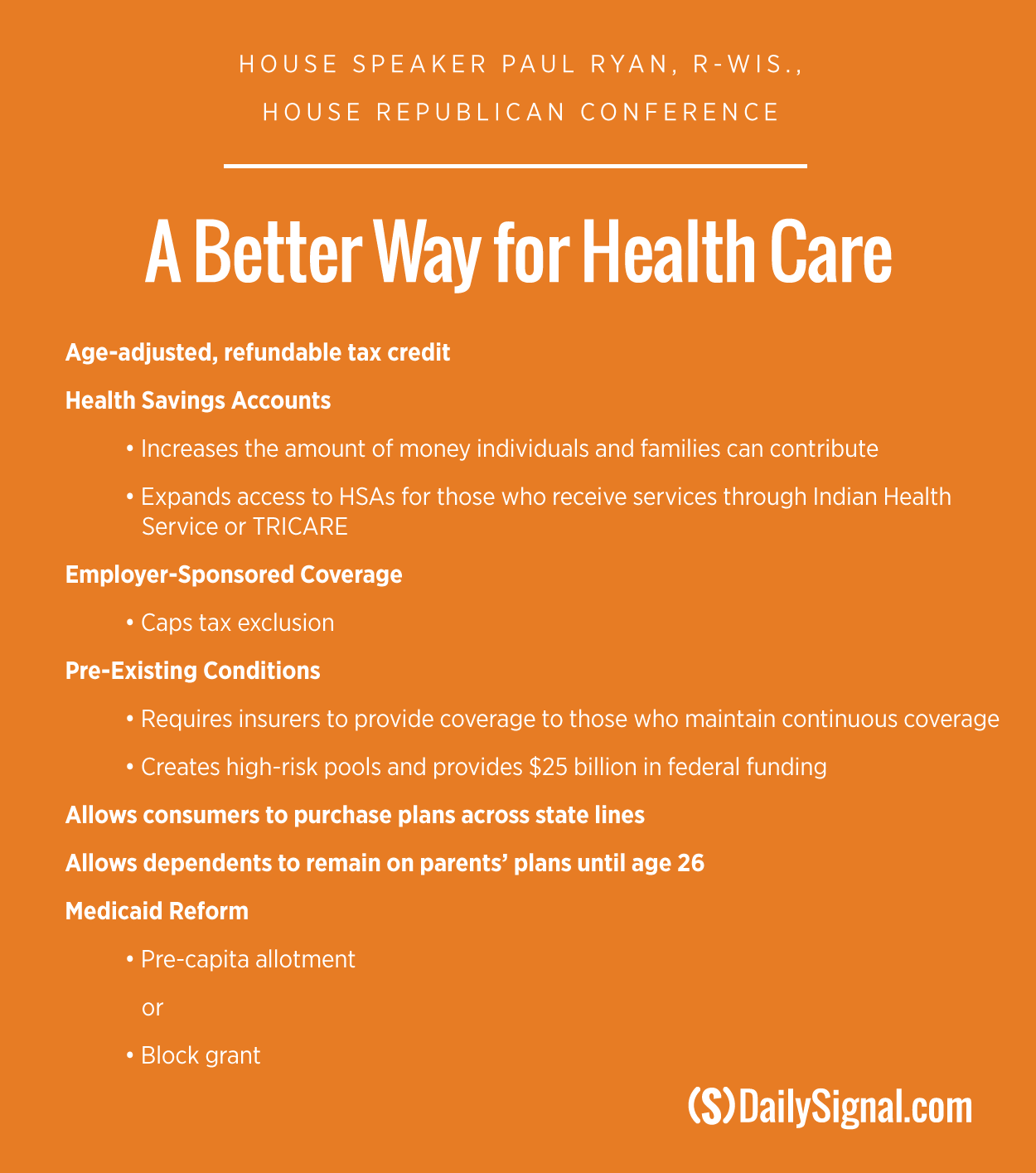
During the 114th Congress, Republicans introduced at least 400 bills changing the health care system and crafted several Obamacare replacement plans, including “A Better Way,” which was released by House Speaker Paul Ryan and the Republican conference last year. (Photo: Ron Sachs/CNP/AdMedia/Newscom)
<!– United States House Speaker Paul Ryan (Republican of Wisconsin) speaks to reporters after meeting with US Vice President-elect Mike Pence on their plans to repeal the Affordable Care Act (ACA) in the US Capitol in Washington, DC on Wednesday, January 4, 2017. Photo Credit: Ron Sachs/CNP/AdMedia –>
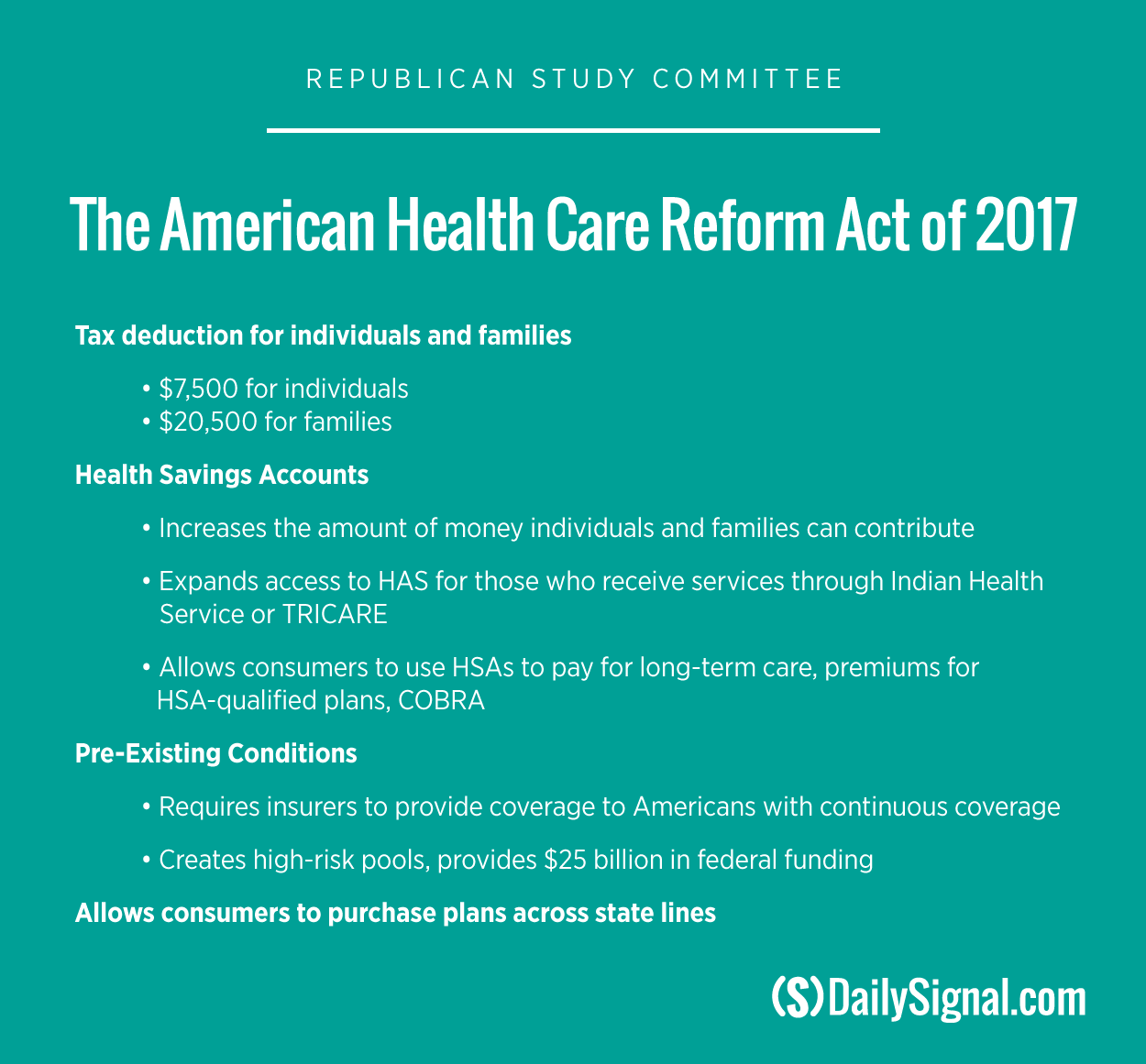
Most of the major plans share some key provisions: they offer tax credits to consumers; expand the use of health savings accounts, or medical savings accounts; and reform Medicaid. But differences emerge in the nitty gritty details of each proposal, including whether tax credits are based on age or income, where to cap the tax exclusion on employer-sponsored coverage, and whether to turn Medicaid into a block grant program or per capita allotment.
House and Senate Republicans, along with President Donald Trump, are meeting in Philadelphia, Pennsylvania, on Thursday and Friday for their annual retreat, where House Speaker Paul Ryan, R-Wis., said earlier this month lawmakers will have a “full, exhausting” conversation on their plan for repealing and replacing Obamacare.
Already, there are at least four plans crafted to replace the law. On Monday, Republican Sens. Bill Cassidy of Louisiana and Susan Collins of Maine introduced another proposal ahead of this week’s GOP gathering.
While the other major Republican proposals repeal all of Obamacare, the Cassidy-Collins plan repeals only the health care law’s mandates, like the individual and employer mandates; maintains its subsidies and taxes; and allows states that like Obamacare to keep Obamacare.
In addition to the Cassidy-Collins plan, The Daily Signal examined proposals offered by Ryan and the Republican conference; Rep. Tom Price, R-Ga., who Trump nominated for secretary of health and human services; the Republican Study Committee; and Sen. Richard Burr of North Carolina, Sen. Orrin Hatch of Utah, and Rep. Fred Upton of Michigan.
See how these Obamacare replacement plans stack up.
Authored By Tom Howell Jr. – The Washington Times – Saturday, January 21, 2017URL of the original posting site: http://www.washingtontimes.com/news/2017/jan/21/president-trumps-aca-order-appears-target-mandate/
Published January 16, 2017 / FoxNews.comURL of the original posting site: http://www.foxnews.com/politics/2017/01/16/paul-previews-obamacare-replacement-plan-focusing-on-lower-cost-policies.html
Paul, a physician, has emerged in recent weeks as a leader in the repeal-replace effort, amid Republican concerns that fulfilling campaign vows to dismantle ObamaCare at the start of the 115th Congress could leave tens of millions of Americans uninsured. Incoming Republican President Donald Trump has expressed similar concerns, despite campaigning on a winning repeal-replace agenda.
Paul tweeted on Jan. 6: “I just spoke to (Trump) and he fully supports my plan to replace ObamaCare the same day we repeal it. The time to act is now.”
The Republican-led Congress has already taken votes toward repealing ObamaCare under a process known as budget reconciliation, which effectively keeps Democrats from blocking the effort and requires only a simple majority for passage. Among the other Senate Republicans trying slow the repeal process, to synch with a replacement plan, are Susan Collins, Maine; Bob Corker, Tennessee; Rob Portman, Ohio; and Lisa Murkowski of Alaska.
Paul suggested Sunday that the replacement plan will include more low-cost insurance plans
“One of the key reforms that we will do is, we’re going to legalize the sale of inexpensive insurance,” he told CNN’s “State of the Union.” “That means getting rid of the ObamaCare mandates on what you can buy.”
Paul last week announced some of the early details of the plan on Fox News’ “Special Report” with Bret Baier. Paul said his plan borrows from previous GOP replacement plans and appears to have consensus among congressional Republicans.
“The ideas that we’ve taken for the replacement bill come from other Republicans’ bills,” he told Fox.
Paul said Sunday the plan also will include health saving accounts and tax credits to help customers save money. He also suggested the plan will allow people and small businesses to create their own markets.
“There’s no reason why (a business owner) with four employees shouldn’t be able to join with hundreds and hundreds of other businesses that are small to become a large entity to get leverage to bring your prices down,” Paul said.
However, he acknowledged rolling back Medicaid expansion as part of the ObamaCare repeal remains a “big question.” Many Americans got coverage under Medicare expansion in states.
On the issue of Rex Tillerson’s effort to become the next secretary of state, Paul said he’ll support the former ExxonMobil CEO’s bid.
“Yes, I will vote for Rex Tillerson,” said Paul, a member of the Senate Foreign Relations Committee holding the confirmation hearings. “I was very impressed.”
http://video.foxnews.com/v/embed.js?id=5277414285001&w=466&h=263<noscript>Watch the latest video at <a href="http://video.foxnews.com">video.foxnews.com</a></noscript>”>
Obamacare Doesn’t Care
Posted on January 5, 2017URL of the original posting site: http://girlsjustwannahaveguns.com/trump-replies-back-to-obamas-war-cry-on-republicans-will-have-you-screaming-like-an-eagle/
President-elect Donald Trump lashed out at congressional Democrats on Thursday – including ‘head clown’ Chuck Schumer, the Senate minority leader – saying they should work with Republicans to find a workable replacement for the Obamacare medical insurance overhaul plan.
‘The Democrats, lead [sic] by head clown Chuck Schumer, know how bad ObamaCare is and what a mess they are in. Instead of working to fix it, they do the typical political thing and BLAME,’ Trump wrote in a series of morning tweets.
‘The fact is ObamaCare was a lie from the beginning. ”Keep you [sic] doctor, keep your plan!” It is time for Republicans & Democrats to get together and come up with a healthcare plan that really works – much less expensive & FAR BETTER!’
A day earlier, the president-elect urged Republicans to blame Democrats for the ‘mess’ of Obamacare, while outgoing president Barack Obama counseled Democrats not to bail Republicans out by signing on to replacement efforts once the GOP goes through with its plan to repeal Obama’s signature legislative proposal.
The counter-charges in the rekindled Obamacare wars came as Republicans are planning an immediate attack on the law thorough executive actions and an early legislative push.
Obama went to the Capitol to meet with Congressional Democrats to plot strategy in an effort to prevent his achievement from getting dismantled – a victory Democrats won only at great cost, including with the loss of their congressional majorities.
The president told Democrats not to ‘rescue’ Republicans by joining their effort to passing replacement measures, amid GOP efforts to court some conservative Democrats.
He pointed to the post-Obamacare Tea Party revolution, and even urged his party to try to brand Republican-backed changes as ‘Trumpcare’ as a rhetorical way to saddle the opposition party with responsibility for what ensues, CNN reported.
Asked by reporters what he said on his way out of the closed door meeting, Obama said only, ‘Look out for the American people.’
White House press secretary Josh Earnest said Obama said he felt ‘envy’ for those who have the opportunity to ‘keep up the fight’ as he prepares to decamp the White House for a rented home in Northwest Washington.
Published on November 29, 2016URL of the original posting site: http://clashdaily.com/2016/11/adios-obamacare-trump-picks-tom-price-health-human-services-secretary-boom/
Price — a former orthopedic surgeon — has been one of the strongest opponents to the Affordable Care Act and currently serves as chairman of the House Budget Committee. In a statement, Trump said Price has “earned a reputation for being a tireless problem solver and the go-to expert on healthcare policy, making him the ideal choice to serve in this capacity.”
“He is exceptionally qualified to shepherd our commitment to repeal and replace Obamacare and bring affordable and accessible healthcare to every American,” the president-elect continued. “I am proud to nominate him as Secretary of Health and Human Services.”
Read more: The Daily Caller
Tom Price: Conservative and full of ideas:
Mr. Price, a 62-year-old former orthopedic surgeon, is one of several GOP physicians who sought to carve out a leading role in shaping the party’s health policy and, in particular, the party’s alternative vision to Democrats’ Affordable Care Act.
Much of his criticism of the law has centered on the authority it gives to the federal government, and to the agency that he may now head.
“We think it’s important that Washington not be in charge of health care,” the six-term congressman said in an interview this summer. “The problem that I have with Obamacare is that its premise is that Washington knows best.”
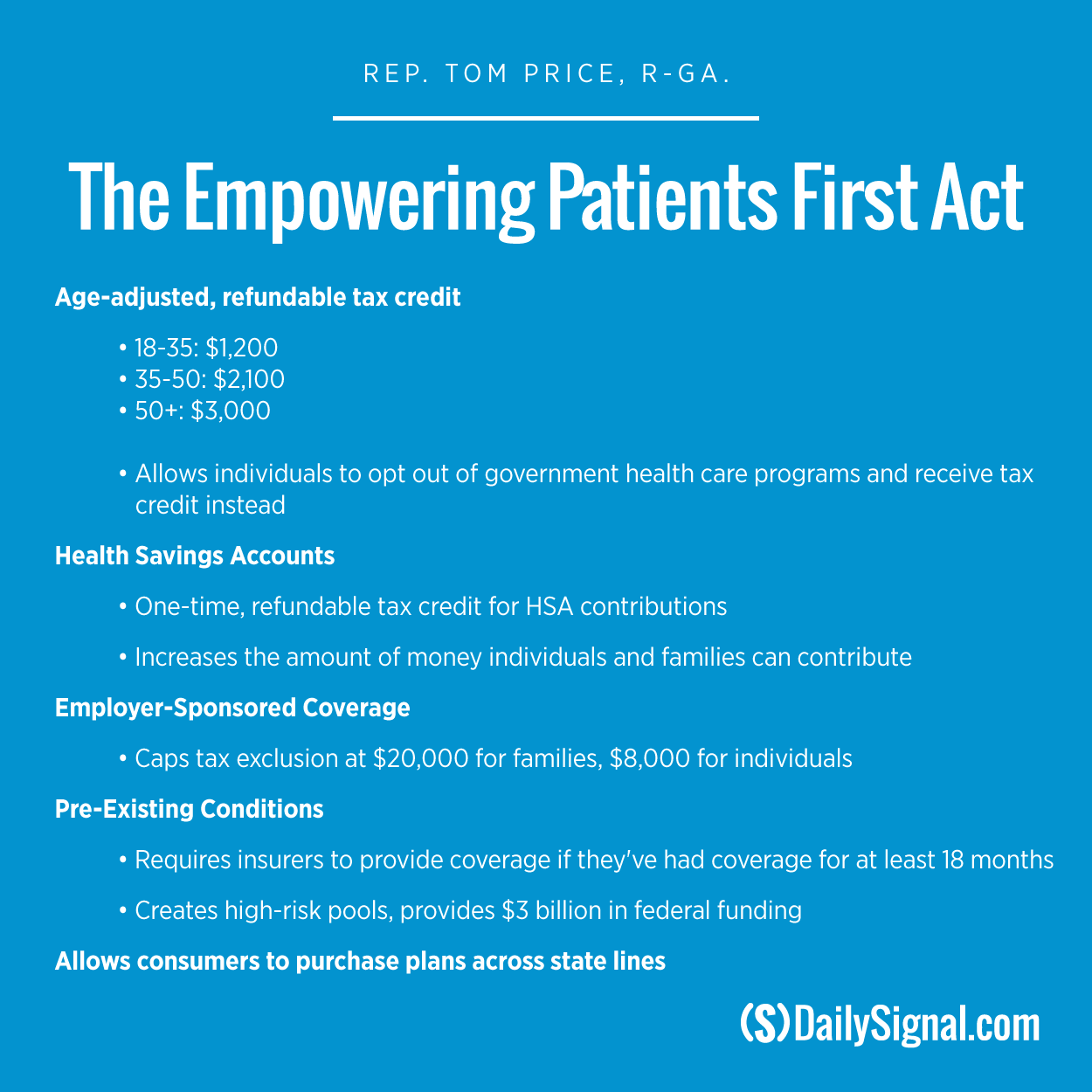
Mr. Price has championed his own legislation, the Empowering Patients First Act, since 2009, taking a position on a number of hot-button issues for conservative health policy thinkers. In its latest iteration, the proposal includes refundable, age-adjusted tax credits for people to buy insurance if they don’t have access to coverage through an employer or government program. People in a government program, such as Medicare, Medicaid or Tricare, would also be allowed to opt out of it and get tax credits toward the cost of private coverage instead.
Mr. Price had previously included tax deductions in his plans, a tool typically favored by harder-line conservative health-policy thinkers, but said he had “moved towards credits because we felt it was cleaner.”
The plan offers a one-time credit aimed at boosting health-savings accounts, long described by supporters as a way of bringing down medical spending, and derives part of its funding from capping how much employers can spend on providing employee health care before being taxed. The plan seeks to make health insurance available to individuals with pre-existing medical conditions by helping states set up new “high-risk” pools or other programs for such enrollees, and sets new rules allowing insurers to sell policies across state lines.
Read more: Wall Street Journal
Authored by Melissa Quinn / @MelissaQuinn97 / October 17, 2016URL of the original posting site: http://dailysignal.com/2016/10/17/in-3-years-his-insurance-premiums-double-as-options-decline-under-obamacare/

Warren Jones, a veterinarian from Kansas City, Missouri, will see his monthly health insurance premiums top $716 next year. Many consumers are facing double-digit rate hikes and a decline in the options available both on and off the exchanges. (Photo: Jonathan Alcorn /Reuters/Newscom)
For the past 15 years, Warren Jones has had the same health insurance plan with Blue Cross and Blue Shield of Kansas City. But over the years, Jones, of Kansas City, Missouri, has watched the coverage offered in his policy “erode” over time. First, the company got rid of the dental and vision coverage he had. Then, Jones’ deductible increased—to $2,500—for his plan alone. But perhaps the most significant change for Jones, a veterinarian, has been the rising cost of his monthly premiums.
In 2014, the year Obamacare took effect, Jones paid $318 in monthly premiums. In 2015, the price went up to $394 per month, then to $491 for 2016. For 2017, Blue Cross and Blue Shield of Kansas estimates that Jones will pay $716 each month for his premiums—a 45.8 percent increase—according to a letter the insurer sent him.
“You can’t keep doing this because people’s wages don’t increase by that amount,” Jones told The Daily Signal. “Nobody’s wages are increasing, so it’s taking a bigger chunk of the budget.”
“That’s the scariest part,” he continued. “It takes a bigger chunk of the budget, and there’s no relief in sight.”
Like millions of other Americans nationwide, Jones, 55, doesn’t buy his insurance on Obamacare’s state and federal exchanges. And even if he did, he wouldn’t qualify for the subsidies that lessened the cost of health insurance for 7.3 million Americans who received the tax credits last year, according to regulatory filings.
Instead, the veterinarian falls into an overlooked subset of consumers who pay full price for their health insurance in a time of skyrocketing premiums and deductibles. They don’t qualify for the tax credits offered under the health care law, and they don’t receive their coverage from employers, since many are self-employed.
“I have seen so many people, self-employed people, many started their own little business
and make whatever they do, they have a small business, and they buy their individual policy or buy for their family, and what are their options?” said Beverly Gossage, a broker who has worked in the Kansas City area for 14 years.
“Do they no longer be self-employed? Maneuver taxes to make less than the income threshold to get subsidies?” Gossage continued. “They don’t want to do that, but they’re being pushed to do that. I get this question every day—‘What am I supposed to do?’”
Gossage ran as a Republican for Kansas insurance commissioner in 2014.
Over the past few months, insurers have been submitting rates to state regulators for the 2017 benefit year. In most states, companies are requesting double-digit rate hikes for those selecting plans sold in the individual market both on and off the Obamacare exchanges. Experts say insurers are playing catch-up after setting rates too low in the early years of the health care law and enrolling a sicker—and costlier—population than anticipated.
“A lot of insurers didn’t understand that the market was going to be skewed in terms of income and health status as severely as it was,” Ed Haislmaier, a senior research fellow in health policy studies at The Heritage Foundation, told The Daily Signal. “Generally, the pool was much worse than anybody expected because of things the administration did that made it worse.”
In response to questions about the growing cost of health insurance for consumers who buy plans sold in the individual market, the Obama administration has said that many Americans are shielded from premium hikes since they buy coverage on the exchanges and receive a subsidy from the government.
Many of the exchange enrollees who qualify for a subsidy may end up paying as little as $75 per month in premiums, Health and Human Services Secretary Sylvia Mathews Burwell said earlier this month.
But that’s not the case for people like Jones and the 10 million others paying full price for their coverage.
“The traditional individual market, which consisted largely of middle-class people who are self-employed, those people are hooked onto this,” Haislmaier said. “It’s kind of a situation where you have an anchor that’s too big, and it’s pulling the boat under.”
Jones is considering selecting a new health insurance plan altogether, but because Missouri hasn’t yet approved rates for 2017, he’s unsure if he’ll even be able to find a cheaper alternative.
“The big thing is the unknown still,” Jones said. “But we know we’re getting inundated with increases in premiums.”
The Missouri man said he is familiar with Blue Cross and Blue Shield of Kansas City, and switching to another carrier may leave him with even less coverage.
“You get a comfort level, and at least you know what you’re getting,” Jones said. “If I had to change insurance, you miss the changes that occur. You don’t know what you’re signing up for.”
While Missouri residents like Jones are confronting a spike in rates, consumers across the state’s western border also are facing fewer insurers to choose from. Among the insurers that will continue to sell coverage in Kansas, the number of plans they’re offering both on and off the Obamacare exchange is decreasing. Many insurers, large and small, have decided to leave the exchanges after losing millions of dollars last year; they either withdrew from states altogether or decreased the number of policies offered.
According to an August study from the Kaiser Family Foundation, six in 10 counties may have a maximum of two insurers on the exchanges next year. Additionally, five states will have one insurer selling coverage on an exchange. In Kansas, 17 carriers sold policies in the state before Obamacare’s implementation, Gossage said. This year, the majority of consumers in Kansas will have only two insurers to choose from on the exchange, according to the Kansas Department of Insurance. Those buying plans sold in the individual market off the exchange have five insurers, according to the state.
It’s a similar landscape in Missouri, where four insurance companies are selling coverage on the exchange, according to regulatory filings. Off the exchange, consumers can choose from at least seven different companies. Gossage said that over the last few years, she has seen insurers significantly lessen the number of policies they’re offering.
“What we did is we went from a very vibrant, competitive marketplace with extremely low rates and lots of different plans to pick from to over-overregulation with the type of plan you have and to mandates placed on insurance companies which led to high premiums and fewer carriers in the marketplace,” Gossage said.
While much of the focus has been on the declining number of choices for consumers selecting coverage on Obamacare’s exchanges, those with plans sold in the individual market off the exchanges are hurting, too.
Rochelle Bird, who is self-employed and lives in Overland Park, Kansas, has had a policy through Coventry, a subsidiary of Aetna, for two years. In that time, her monthly premiums have risen from $335 to $487, and her deductible went from $1,200 to $6,200.
“We may still offer coverage in your area, but most of the options available today will not be available for 2017,” the letter stated.
Bird said she wasn’t surprised to learn her policy was being canceled. Rather, she expected it.
“I know that this act has created chaos,” she said of Obamacare, formally the Affordable Care Act. “When I get a thing [in the mail] saying that my rate has changed, I know it’s 50-50 when I open it. It’s either a letter saying this is what you’re going to pay starting Jan. 1, or we’re no longer offering that plan anymore. It wasn’t a total shock to me.”
Bird said she has started researching other policies with different insurance companies, but because officials in Kansas only recently finalized rates, she hasn’t yet made a final decision on her coverage for next year. She has, however, set expectations for the terms of her next plan.
“I am now faced with the fact that unless something changes, there will be one health care provider presumably with two different health plans that I will have a choice of [while] living in the state of Kansas,” Bird said. “That’s absurd. How is that helpful?”
“I’m expecting (a) I’ll pay more, (b) I’ll have less, and (c) I may or may not have the same doctors,” she said. “Those are always the moving parts.”
Bird herself didn’t purchase her plan on the Obamacare exchange, and she wouldn’t qualify for a subsidy if she did. While going without insurance and paying the fine—$695 per adult or 2.5 percent of household income for 2016—isn’t an option for her, it is for other Kansas and Missouri residents.
Jessica Huayaban of Olathe, Kansas, and her husband, Joel, each purchased plans in the individual market off the exchange in 2014. Jessica, 36, bought a plan through Humana, and her husband, 35, through Coventry. The couple, who own a painting and remodeling company, previously were uninsured and saving money each month to pay for a costly knee surgery Joe needed. Jessica and Joel had insurance before, but when the recession hit in 2009, coverage was too expensive so they decided to go without.
“It was way cheaper to cash pay,” she said of the years they needed medical services but didn’t have insurance.
In 2014, when Obamacare was implemented, the couple purchased their own coverage, but only because the law required it.
“I wasn’t getting [insurance] for even the coverage part,” Jessica told The Daily Signal. “I was getting it for the compliance.”
Over the past two years, the monthly premiums Jessica pays for her Humana plan have gone up minimally, but her plan has a high deductible.
Then, last month, the 36-year-old mother received a letter from her insurer notifying her they’re canceling her policy.
“This is just something that continues to happen, and I don’t have a choice in it,” Jessica said.
She said she isn’t sure whether she and her husband will purchase plans on Obamacare’s exchange when the open enrollment period opens in November.
And although she may qualify for a subsidy, the young mother fears she’ll be stuck with an expensive tax bill when she files with the IRS for 2017, since her income—she is self-employed—fluctuates drastically from month to month.
“All of it is so backward,” she said of the health insurance system.
Commentary by
Michelle Malkin | URL of the original posting site: http://humanevents.com/2016/10/12/obama-lied-my-third-health-plan-just-died/
Once was a shock. Twice was an outrage. Thrice is a nightmare that won’t end.Over the past three years, my family’s private, individual health insurance plan — a high-deductible Preferred Provider
Organization — has been canceled three times. Our first death notice, from Anthem Blue Cross Blue Shield, arrived in the fall of 2013. Our second, from Rocky Mountain Health Plans, came last August. Three weeks ago, we received another ominous “notice of plan discontinuation” from Anthem informing us that the insurer “will no longer offer your current health plan in the State of Colorado.”
Every time we receive a cancellation letter, I recall President Obama’s big lie: “If you like your doctor, you will be able to keep your doctor. Period. If you like your health care plan, you will be able to keep your health care plan. Period. No one will take it away. No matter what.”
Then I imagine Vincent Price’s evil “Thriller” laugh reverberating at the end of that cruel punchline: Mwahahahahahaha! (Actually, you can play a real-life horror soundtrack by watching Obama’s jerk speechwriters Jon Lovett, David Litt and Jon Favreau cackle with liberal PBS host Charlie Rose earlier this year about authoring Obamacare’s big lie. Google it, but take your blood pressure medication first.)
Like an estimated 22 million other Americans, I am a self-employed small-business owner who buys health insurance for my family directly on the individual market (as opposed to group insurance through a company or third party). Our most recent plan features a $6,000 deductible with a $1,000 monthly premium. It’s nosebleed expensive, but provides us access to specialists not curtailed by bureaucratic gatekeepers. This has been important for us because several members of my family have required specialized care for chronic illnesses.
Once again, however, I’ll soon be talking about our plan in the past tense. Choices for families like mine have evaporated in the era of Obamacare. In Colorado, UnitedHealthCare and Humana will cease selling individual plans next year. Rocky Mountain Health Plans is pulling out of the individual market in all but one county. Nearly 100,000 of my fellow Coloradans will be forced to find new insurance alternatives as open enrollment approaches on Nov. 1, according to the Denver Business Journal. As Anthem abandons PPOs, the cost of remaining individual market plans will soar an average of 20 percent.
It’s a nationwide implosion.
government-run exchanges are flailing. And the vaunted nonprofit Obamacare co-ops that were supposed to dramatically lower costs have bombed despite billions in taxpayer subsidies.I believe this insurance market meltdown — which many of us predicted from the get-go — is not by accident, but by design. Or as Oklahoma Insurance Commissioner John D. Doak put it: “This system has been doomed from the beginning.”
Smug propagandists for Obamacare, such as liberal magazine Mother Jones, continue to dismiss the plight of millions of families like mine and accuse us of concocting a “phony” crisis. But it’s the architects of Obamacare who prevaricated all along. Remember: Obamacare godfather and MIT professor Jonathan Gruber bragged that “lack of transparency” was a “huge political advantage,” along with what he derided as “the stupidity of the American voter.”
This wealth redistribution Trojan horse was sold to gullible Americans as a vehicle for expanding “affordable” access to health insurance for all. Now, millions of us are paying the price: crappier plans, fewer choices, shrinking access to specialists, skyrocketing price tags — and no end in sight to the death spiral.
Mission accomplished.

Drawn by Lisa Benson – Tuesday, October 4, 2016URL of the original posting site: http://townhall.com/political-cartoons/lisabenson


Saturday, 01 Oct 2016 10:13 AMURL of the original posting site: http://www.newsmax.com/Newsfront/collapse-minnesota-obamacare/2016/10/01/id/751177/#ixzz4LsHQ3xhR
Image: Near ‘Collapse,’ Minnesota to Raise Obamacare Rates by Half (AP)

The increases range from 50 percent to 67 percent, Commissioner Mike Rothman’s office said in a statement. Rothman, who regulates the state’s insurers, is an appointee under Governor Mark Dayton, a Democrat. The rate hike follows increases for this year of 14 percent to 49 percent.“It’s in an emergency situation — we worked hard and avoided a collapse.” Rothman said in a telephone interview. “It’s a stopgap for 2017.”
On average, rates in the state will rise by about 60 percent, said Shane Delaney, a spokesman for MNSure, the
state’s marketplace for Obamacare plans. About 250,000 people, or 5 percent of the state’s population, were covered under plans bought on the individual market, including plans bought on the Affordable Care Act markets as well as outside it.
Many people in the exchanges are eligible for tax credits to help reduce the cost of the premiums, Rothman’s office said, though those subsidies cut off once a family of four has an income of $97,200 or more. The law requires all Americans to buy insurance or pay a penalty. In Minnesota, a low-cost plan for a single person last year had annual premiums of about $2,800, before any tax credits, according to the Kaiser Family Foundation.
Most of the insurers in Minnesota’s individual market also plan to limit enrollment, to avoid taking on too many
customers from Blue Cross and Blue Shield of Minnesota, which is leaving the exchanges after financial losses, the state said. Taking on too many new customers could harm insurers’ finances or overwhelm the doctors and hospitals that they contract with.
Jonathan Gold, a spokesman for the U.S. Department of Health and Human Services, said Minnesotans would still have affordable options for coverage next year. “Headline rate changes do not reflect what these consumers actually pay because tax credits reduce the cost of coverage below the sticker price,” Gold said in a statement.
Of the about 70,000 people who had insurance on the Obamacare markets this year, 63 percent got subsidies last year, according to the commissioner’s office.
Minnesota State House Speaker Kurt Daudt, a Republican, said the rate increases, along with allowing some insurers to limit enrollment, were creating a crisis.
“The unhealthy combination of massive cost increases and enrollment caps is creating a health care crisis for thousands of Minnesota families,” Daudt said in a statement.

Commissioner Rothman called for changes to the individual marketplace.
“Last year at this time when rates were announced, I said there was a serious need for reform in Minnesota’s individual market,” he said. “This year the need for reform is now without any doubt even more serious and urgent.” He called the rising rates “unsustainable and unfair” and said that people were being “crushed by the heavy burden of these costs.”
© Copyright 2016 Bloomberg News. All rights reserved.
Obamacare Transparency

Authored by Melissa Quinn / @MelissaQuinn97 / September 12, 2016
Since Obamacare’s first open enrollment period in October 2013, enrollment in health care ministries has skyrocketed. (Photo: Jeff Malet Photography/Newscom)
<!– Demonstrators at the U.S. Supreme Court say “Don’t Take My Care”. In a 6-3 decision, the Supreme Court ruled to to uphold the availability of tax subsidies related to President Barack Obama’s signature healthcare law, the 2010 Affordable Care Act better known as Obamacare on Thursday in Washington D.C., June 25, 2015. (Photo by Jeff Malet) –>
That’s because Folley and her family of four are members of Samaritan Ministries, a health care sharing ministry with members who “share” in the cost of one another’s medical expenses.
Folley, who lives in New Hampshire, is one of the more than 200,000 members of Samaritan Ministries, a Christian-based organization that is one of the three major health care sharing ministries. Nationwide, membership in health care sharing organizations tops 600,000 people, according to the Alliance of Health Care Sharing Ministries.
Folley, who has blogged about her experiences with Samaritan Ministries, first joined the health care sharing organization in April 2014. Folley’s family was previously insured through her husband’s employer, but after the couple decided her husband would go back to school, they knew they would have to explore other health care options.
“In our situation, leaving a job, going into being a student and a homemaker and not having any type of benefits, either you’re going to be left out in the cold or you’re going to be doing something like this,” she told The Daily Signal. “Of course, now it’s illegal to be out in the cold, and we knew we weren’t interested in Obamacare.”
A friend of Folley’s husband originally told them about Samaritan Ministries, and when they began to research the organization, the couple was pleased with what they found. Health care sharing ministries facilitate the sharing of medical costs between members, all of whom have shared beliefs. The ministries don’t serve as insurance, but rather when a member has a medical “need,” other members “share” that person’s medical costs. In some ministries, like Samaritan, members are encouraged to negotiate prices directly with providers to bring down the cost of their medical bills, like Folley did, and they pay in cash before being reimbursed by members of the health care sharing ministry.
For Folley, one of the most attractive parts of the health care sharing ministry was the fact that the organizations are exempt from Obamacare’s individual mandate, so members aren’t subject to the annual fine for going uninsured. Folley said she and her husband are opposed to socialized medicine and didn’t have confidence in the government’s ability to manage their health care. But most importantly, because health care sharing organizations are exempt from the requirements the Affordable Care Act places on insurance policies, Folley said it protected her and her husband, who are devout Catholics, from crossing any ethical boundaries.
“We didn’t want to buy into a plan where we were most likely going to be paying for abortions or not knowing whether or not we were paying for abortions,” she said, continuing:
“With Samaritan, we know we don’t pay for anyone’s abortions, we don’t pay for contraception, we don’t pay for sex changes or counseling for things we would object to. We know that our money isn’t taking part in anything that we have a moral objection to.”
Health care sharing organizations have existed for more than 20 years, but membership has grown substantially since Obamacare’s first open enrollment period launched in October 2013. Samaritan Ministries, of which Folley is a member, has seen its enrollment nearly triple in that time. In January 2013, the organization had 64,721 members. By September 2016, its membership had grown to more than 207,000 members, according to the organization.
Christ Medicus Foundation’s CURO, a Catholic health care sharing ministry that partners with Samaritan, launched in 2014 and has grown to have 900 member households, comprised of more than 2,500 individual members, the organization estimates. Similarly, enrollment in Medi-Share, another health care sharing ministry, more than tripled. Medi-Share had 59,855 members in June 2013, according to the organization. By June 2016, the health care sharing ministry boasted 200,333 members. Anthony Hopp, vice president of external relations for Samaritan Ministries, said 2013—when Obamacare’s exchanges launched—was a “pivotal year” for membership growth.
“The Affordable Care Act increased awareness of health care sharing ministries in general,” Hopp told The Daily Signal. “We pretty much collectively, all of the health care sharing organizations, were off the radar for the most part. Then, with the insertion of the exemption, a lot of news outlets picked this up, and whether we wanted to be or not, we were kind of thrust into everybody’s minds.”
The ministries are expecting to see their enrollment continue to grow, particularly as issues continue to arise with the Affordable Care Act.
“It’s lower cost. It’s personal accountability. It lets you see everything you’re doing and the decisions you’re making,” Twila Brase, president of the Citizens’ Council for Health Freedom, told The Daily Signal of the organizations.
Health care sharing ministries are adamant in that their organizations are not insurance, but rather serve as an alternative to the Affordable Care Act.
“The Affordable Care Act provided a lot of different ways for people to meet their health care needs. We view ourselves as just one option—we’re an alternative to health insurance,” Michael Gardner, director of communications at Medi-Share, told The Daily Signal.
“People value the community. That’s one of the key things,” he continued. “It’s a community of like-minded people who come together based on a set of beliefs to share each other’s medical burdens.”
Louis Brown, director of CMF CURO, said the health care sharing ministry started as the “Catholic response to the needs and suffering of today within American health care.” Like Gardner, Brown said the first thing his organization tells prospective members is that they are not offering insurance, but rather a way for people of the same faith to come together to take care of one another.
“We believe as Catholics that problems are best solved closest to the problem, and here, we are able to solve this problem of medical costs and medical needs and health care needs, this issue of healing, and we’re able to do that as a community of faith coming together across the country,” Brown told The Daily Signal. “It works, and it’s less expensive, and it’s consistent with your faith.”
Prospective members must adhere to a series of guidelines to join health care sharing organizations, which are traditionally in keeping with biblical teachings. Guidelines differ among health care sharing ministries, but many require members to remain drug-free, drink only in moderation, attend church on Sundays, and abstain from sexual activity outside of marriage.
Each month, members “share” in the cost of medical bills through a set monthly payment, and the organizations place restrictions on which sorts of medical costs constitute “needs.” For example, medical services for pre-existing conditions are often excluded, as are routine physicals and preventive care.
Folley and her family pay $495 per month as members of Samaritan. The family receives the name of another member to send their “share” to, and Folley typically includes notes of encouragement to the member, and includes him or her in the family’s prayers.
“It is really good to know you’re part of a body of people who are on the same page,” Folley said. “We have received very kind and sweet notes from other people when we’ve been receiving and definitely had a strong sense of them praying for us and knowing they care even though they don’t know us at all.”
Folley and her family have had to submit a “need” four times since joining Samaritan, including one for the birth of her son and another for her daughter’s broken leg. Each time, the family received “shares” from other Samaritan members, along with notes of encouragement.
“The philosophy at Samaritan is very much promoting independence and taking care of yourself, but also subsidiarity and taking care of your Christian brothers and sisters and relying on the church rather than the state,” Folley said.
Though health care sharing ministries have been functioning for more than 20 years, critics warn that there is no guarantee that medical bills will be paid for. The National Association of Insurance Commissioners has previously warned that health care sharing ministries are not insurance and therefore don’t have the protections of insurance. But the health care sharing organizations don’t shy away from admitting that those critics are right.
“When they’re digging at, ‘well there’s no guarantee, there’s no guarantee,’ we don’t argue that. There isn’t,” Hopp, of Samaritan Ministries, told The Daily Signal. “But Samaritan, our core principle is that Jesus Christ is the provider of all our needs. Our mindset is not that Samaritan is a panacea for any and every medical need. That’s not the purpose. This is simply one way that God has used to meet the needs of his people.”
In the past, there have been issues surrounding unpaid medical claims and lawsuits filed by members. In 2000, Christian Healthcare Ministries, then known as the Christian Brotherhood Newsletter, was found liable for $14 million in damages by an Ohio jury for diverting money from the organization and an affiliated mission. Before the jury ruled, members of the newsletter had amassed $34 million in unpaid medical claims.
Additionally, Medi-Share members in Montana, Oklahoma, and Nevada sued the health care sharing ministry in the last 10 years over refusal to pay medical bills they argued should’ve been covered.
Gardner, of Medi-Share, said prospective members need to be sure to fully understand which medical services are eligible for sharing and stressed that there is no guarantee of payment because the organizations are not insurance.
“That’s one thing people should be sure to ask about if they’re considering a ministry,” he said.
At Samaritan, members vote on which medical services can be shared, Hopp said. If an individual disagrees with Samaritan’s guidelines on which medical services can be shared, the decision can be appealed to a 13-member panel of randomly selected members for arbitration. Since the ministry was founded in 1994, Hopp said the arbitration process has only been used four times.
“I’m not aware of any insurance company that has that consumer protection,” he said.
Folley, the Samaritan member, said that the idea of membership in a health care sharing ministry may not cross people’s minds until they are left without benefits, as her family was after her husband decided to return to school.
“Once you’re out of that paradigm and you look into it, you realize what a great option it is, and it’s even better than most really good insurance plans,” she said. “I know we spend less money … Even compared to a good insurance plan, it’s better.”
Since joining Samaritan, Folley said she’s found herself immune from some of the complaints consumers with insurance have had in the wake of Obamacare’s implementation: rising premiums and deductibles, narrowing networks, and the inability to keep a prior doctor.
“I get to sidestep all of that,” she said. “It’s incredibly liberating. I think, ‘poor them.’ I don’t deal with any of that.”
Hopp said Samaritan typically raises its monthly “shares” once every two to two and a half years through a vote its members take, with the most recent increase to $495 a boost from $405. Folley has had the freedom to choose which doctors she wants to use, she said, which is beneficial for Folley since she has self-described “alternative views” on health care. And the monthly “share” she does make to fellow Samaritan members doesn’t feel like a bill to her.
“Because you send your money directly to someone who needs it to pay back their medical bills, it doesn’t feel like paying a bill. It feels like charity,” Folley said. “It feels like OK, this person needs this $400 from me. I have to do that, because I know they would do that for me.”
This article has been updated to include recent enrollment figures from Samaritan Ministries.

Together, Yes They Can

Reported by Juliegrace Brufke 05/27/2016
A man looks over the Affordable Care Act (commonly known as Obamacare) signup page on the HealthCare.gov website in New York in this October 2, 2013 photo illustration. REUTERS/Mike Segar

“Our examination of the company’s financials made it clear that the company’s losses would prevent it from paying future claims should its operations continue,” Lt. Gov. Mary Taylor said in a statement provided to The Hill.
Centers for Medicare and Medicaid Services spokesman Aaron Albright assured they are working to make certain everyone stays covered.

By Sarah Ferris – 05/16/16
final chance to work out a compromise with religious groups opposed to the birth control mandate under the Affordable Care Act. In an opinion released Monday, the high court vacated the judgments of the high-profile case, Zubik v. Burwell, and sent it back to lower courts.It also doesn’t decide whether the federal government “has a compelling interest” to enforce the mandate.
Instead, the justices unanimously instructed both parties to find a tweak to the contraceptive mandate to eliminate any faith-based concerns “while still ensuring that the affected women receive contraceptive coverage seamlessly.”
“Given the gravity of the dispute and the substantial clarification and refinement in the
positions of the parties, the parties on remand should be afforded an opportunity to arrive at an approach going forward that accommodates petitioners’ religious exercise while at the same time ensuring that women covered by petitioners’ health plans ‘receive full and equal health coverage, including contraceptive coverage,’” the justices wrote in the decision.
The Becket Fund for Religious Liberty, which filed the lawsuit on behalf of Little Sisters of the Poor, called the ruling an “important win”
“The Court has recognized that the government changed its position,” said Mark Rienzi, the lead attorney for the Little Sisters of the Poor. “There is still work to be done, but today’s decision indicates that we will ultimately prevail in court.”
The Supreme Court had hinted at a way to resolve the dispute without a new ruling.
Shortly after the 90-minute oral arguments on March 23, the justices took the surprising step of asking for an additional briefing. During that time, both the government and the petitioners told the justices they believed they could reach a compromise.
The compromise ultimately reached by the Little Sisters of the Poor and the Obama administration will have a ripple effect across other religious charities, hospitals and institutions that have taken issue with the mandate.
This year’s case on the contraception mandate comes two years after the Supreme Court’s major ruling in Burwell v. Hobby Lobby Stores, which restricted the federal government’s power to require birth control coverage in healthcare plans run by religiously affiliated companies.

BY: May 13, 2016URL of the original posting site: http://freebeacon.com/issues/obamacare-pressures-insurers-sex-change/
The final rule comes the same day the Obama administration ordered schools to let children use whatever bathroom or locker room matches “their chosen gender identity,” or risk losing federal funding.
The agency released its final “Nondiscrimination in Health Programs and Activities” rule, which enforces Section 1557 of the Affordable Care Act.
The regulation “prohibits discrimination based on race, color, national origin, sex, age, or disability; enhances language assistance for individuals with limited English proficiency; and protects individuals with disabilities,” the agency said in a release.
Doctors and health insurers also cannot deny “health care or health coverage based on an individual’s sex, including discrimination based on pregnancy, gender identity, and sex stereotyping.”
In a fact sheet on the portion of the rule regarding sex discrimination, the government explains that health care providers cannot refuse to cover all services related to a sex change—such as hormone therapy, breast implants, and the surgery itself—as a matter of policy.
“Categorical coverage exclusions or limitations for all health care services related to gender transition are discriminatory,” the agency said.
The rule also includes a bathroom provision, stating that “individuals must be treated consistent with their gender identity, including in access to facilities.”
Additionally, health care providers “may not deny or limit treatment for any health services that are ordinarily or exclusively available to individuals of one gender based on the fact that a person seeking such services identifies as belonging to another gender.”
The regulation will apply to virtually all hospitals, health care providers, and insurance companies.
“The Section 1557 final rule applies to any health program or activity, any part of which receives funding from the Department of Health and Human Services (HHS), such as hospitals that accept Medicare or doctors who receive Medicaid payments; the Health Insurance Marketplaces and issuers that participate in those Marketplaces; and any health program that HHS itself administers,” the agency said.
The Obama administration praised the rule as a win for “civil rights.”
The regulation is the “first federal civil rights law to broadly prohibit discrimination on the basis of sex in federally funded health programs,” the agency said.
“A central goal of the Affordable Care Act is to help all Americans access quality, affordable health care,” said Health and Human Services Secretary Sylvia M. Burwell. “Today’s announcement is a key step toward realizing equity within our health care system and reaffirms this administration’s commitment to giving every American access to the health care they deserve.”
The agency told the Washington Free Beacon that the rule does not force health insurance companies to cover sex reassignment surgeries, but companies cannot deny treatments related to a gender transition outright.
“The final rule does not require covered entities to cover any particular procedure or treatment for transition-related care, including gender reassignment surgery. However, it does bar a covered entity from categorically excluding from coverage or limiting coverage for all gender transition-related services,” an agency spokesperson said.
The rule itself could open the door for lawsuits by transgender individuals, who could claim that being denied a service related to a sex-change violates their civil rights because it is now illegal to deny care on the basis of gender identity.
Several states already had policies in place that ban private insurance companies and Medicaid providers from excluding services for a gender transition. California, Oregon, Washington, Colorado, Illinois, New York, Vermont, Rhode Island, Connecticut, Massachusetts, and the District of Columbia all have “explicitly prohibited private health insurance plans sold in the state from having exclusions for transition-related care,” according to the National Center for Transgender Equality. The final rule now essentially makes those laws national.
The Obama administration removed a ban from Medicare covering gender reassignment surgeries in 2014.
The average surgery cost for a man to become a woman is $23,000.
Elizabeth Harrington is a staff writer for the Washington Free Beacon. Elizabeth graduated from Temple University in 2010. Prior to joining the Free Beacon, she worked as a staff writer for CNSNews.com. Her email address is elizabeth@freebeacon.com. Her Twitter handle is @LizWFB.
Reported By Tom Howell Jr. – The Washington Times – Thursday, May 12, 2016URL of the original posting site: http://www.washingtontimes.com/news/2016/may/12/judge-rules-favor-house-gop-obamacare-lawsuit/
According to an online survey produced by LevelFunded Health, (LFH) a national health insurance agency “with a hyper-focus on Affordable Care Act ‘alternative’ employee benefit programs for the small employer market segment,” 87 percent of small businesses that offer “group health care” suffered from a 25 percent increase in health insurance premium costs since 2014. It reports that 12 percent of small businesses experienced increases of 50 percent or more to their premium costs.
Small businesses are at a significant disadvantage because they will unlikely be able to absorb higher health insurance costs, which is why many have canceled their health insurance benefits completely. Larger companies can more easily absorb increased costs. But they are not immune from the tragedy of Obamacare. UnitedHealth Group, for example, the nation’s largest health insurer, recently announced it’s expecting more than $500 million in losses on 2016 Obamacare plans alone.
These increased costs affect more than financial outcomes. They affect being able to employ workers, and more importantly, quality workers. The LFH survey reports that health insurance costs affect the quality and skill-level of employees who are drawn to particular businesses because of the benefits they offer. Small businesses are more likely to lose quality job applicants to large corporations that can offer better benefits.
The LFH survey found that 56 percent of the 2,500 small businesses it polled reported that they are losing quality employees and candidates because of how expensive employer-provided health care plans are under Obamacare, compared to significantly lower costs and more options prior to Obamacare.
Included as part of the ACA is the Small Business Health Options Program (SHOP) marketplace, allegedly designed to aid small businesses. Kaiser Health News reported in 2015 that, “Employers with fewer than 50 full-time workers are eligible to buy coverage on SHOP. The federal government even offers businesses an incentive, a tax credit worth up to half of an employer’s share of their workers’ premiums. Among the conditions: The firm must employ fewer than 25 workers and their average salary cannot exceed $50,000.”
But, in 2015, only 85,000 people out of 11,000 small businesses received coverage through SHOP– a number significantly less than the 1 million people Obama and the Congressional Budget Office expected.
And increased costs affect more than losing quality workers. The ACA and SHOP’s failure to aid small businesses has forced them to decide more than choosing between letting go their employees and providing health insurance to their employees, to now raising prices for their customers.
The real burden that few discussed regarding Obamacare was the hidden fines, fees, and taxes that the 2,000+ law created, which began to go into effect in 2016 and 2017.
Already, the small businesses that have 50 or more full-time employees and don’t provide health insurance must pay an “Employer Shared Responsibility” fine. 
According to HealthCare.gov: “Some employers with 50 or more [full-time] employees who don’t offer insurance, or whose offer of coverage is not affordable or doesn’t meet certain minimum standards, are subject to Employer Shared Responsibility provisions. They may owe a payment if at least one of their full-time employees enrolls in a plan through the Health Insurance Marketplace and receives a premium tax credit.”
As a result, to avoid Obamacare penalties and fines associated with the 50-employee rule, small businesses are outsourcing jobs to online freelancers and not hiring more staff.
Six years of Obamacare has resulted in more regulations as well, which means increased audits, and more paperwork and headaches for small business owners. Many experts anticipate that Department of Labor audits will also increase, which piles on even more costs for small businesses.
What small business can continue to exist in the nightmare that Obama and every Democrat who voted for it, created? How will they survive more regulations, additional costs associated with fines, fees, and increased taxes, not to mention the likelihood of being audited for failing to comply with these increased number of regulations. But their ability to compete with larger companies for quality employees will be even more difficult than it already is. Finding and keeping quality employees is essential to small business owners. But Obamacare has made this necessity nearly impossible in 2016 and beyond, as more people continue to lose their jobs and their health insurance, both of which they had prior to Obamacare.

URL of the original posting site: http://www.washingtontimes.com/news/2016/mar/8/hr-block-customers-pay-twice-much-obamacare-fee

Your ObamaCare plan will be forced to pay for it, whether you want it or not, thanks to the federal government’s commandeering of the health-insurance industry under the so-called Affordable Care Act. And eventually, younger and younger children will be in Big Brother’s crosshairs for mental and behavioral health “services,” whether parents want it or not. School teachers, social workers, and more are all already being enlisted in the federal government’s search for supposed “mental and behavioral health” issues — a list that is perpetually expanding as psychiatrists invent new “illnesses.” The outcry against the federal government’s obsession with your mind and the minds of America’s children, though, is growing louder, as critics call the agenda “depressing” and worry whether it is another scheme to disarm more Americans. 
The controversial “recommendations” include screening all Americans between the ages of 12 and 18 for depression. A separate but related recommendation seeks to have all U.S. adults checked for “mental illness,” too. And consider that the list of “illnesses” is subjective (homosexuality was a mental disorder a few decades ago) and is constantly expanding as psychiatrists vote to create new ones, literally, as part of the Diagnostic and Statistical Manual — the “Bible” of psychiatry that has been widely criticized, even by leading psychiatrists.
The latest demands come from the United States Preventive Services Task Force, or USPSTF. The influential outfit, appointed by the Obama administration’s increasingly radical Department of Health and Human Services (HHS), recommends various unconstitutional federal health policies for Big Brother to decree into pseudo-law via regulation.
Its latest recommendations for children and adolescents 12 and older were published earlier this month in the Annals of Internal Medicine. “The USPSTF recommends screening for major depressive disorder (MDD) in adolescents aged 12 to 18 years,” the HHS task force said in the summary of its position. “Screening should be implemented with adequate systems in place to ensure accurate diagnosis, effective treatment, and appropriate follow-up.” Why the federal government believes it has any business coming between patients and doctors — or where it believes the constitutional authority for such meddling is found — was not immediately clear.
The outfit also left the door open for recommending such “screening” for children under 12, too. “The USPSTF concludes that the current evidence is insufficient to assess the balance of benefits and harms of screening for MDD in children aged 11 years and younger,” the Obama HHS panel wrote. The recommendations also call for using controversial medications such as Prozac to drug children between 12 and 17, while advocating powerful psychotropic substances such as Lexapro for children as young as eight.
Already, about one in 10 American school-aged boys has been labeled and drugged under the guise of “Attention Deficit Disorder” (ADD) and “Attention Deficit Hyperactivity Disorder” (ADHD). However, even the late Dr. Leon Eisenberg, often described as the “father” or “inventor” of the diagnosis, said before his death in an interview with German magazine Der Spiegel that the alleged disease was “a prime example of a fabricated disorder.” With the list of “disorders” expanding rapidly, and with that list labeling more and more normal behaviors as symptoms of alleged illness, critics have warned that the trend is deeply troubling.
When it comes to adults, the advisory panel, which purports to be independent, wants to cast an even broader net. “The USPSTF recommends screening for depression in the general adult population, including pregnant and postpartum women,” said the outfit, which adds that its views should not be construed as the official position of the “Agency for Healthcare Research and Quality” or Obama’s HHS. “Screening should be implemented with adequate systems in place to ensure accurate diagnosis, effective treatment, and appropriate follow-up.”
In its “rationale” for recommending that all U.S. adults be screened for depression, the panel claims that the “illness” is “common in patients seeking care in the primary care setting.” It also cites “adequate evidence” allegedly showing some “improvements” if its advice is followed.
Then, unsurprisingly, the outfit downplays the very serious risks documented by The New American magazine and many other sources — including government and Big Pharma itself. For instance, the panel admits that antidepressants are “associated” with harms, including an increase in suicidal behavior, an increased risk of gastrointestinal bleeding, fetal harm, and more. But despite that, the task force “concludes with at least moderate certainty that there is a moderate net benefit” to screening all American adults. And by all, the task force means all: “The USPSTF recommends screening in all adults regardless of risk factors,” it said.
Big Pharma and Big Government were no doubt pleased with the conclusion. But not everyone was. Among those expressing concerns was Dr. Ron Paul, the liberty-minded former congressman from Texas and GOP presidential contender, who called the proposed mandatory screenings a “depressing thought” in his weekly column. “Basic economics, as well as the Obamacare disaster, should have shown this task force that government health insurance mandates harm Americans,” wrote Paul, a medical doctor. He warned that, among other problems, the scheme would raise insurance costs. Even more troubling is that it would likely result in new federal databases containing the results of the screenings, which would be used to deny even more Americans their right to keep and bear arms. 
“Today, some mental health professionals think that those who believe in limited government, free-market economics, or traditional values suffer from mental disorders,” Paul explained, echoing growing concerns among watchdogs monitoring the psychiatric industry. “If mandatory depression screening becomes a reality, it is likely this mental health screening will be expanded to cover screening for other mental illnesses. This could result in anyone with an unpopular political belief or lifestyle choice being labeled as ‘mentally ill.’”
Other commentators also directly suggested that the new demands for more “mental health” screening may be related to Obama’s agenda to infringe on gun rights. “With executive actions aimed at getting guns out of the hands of the mentally ill, the timing of this report’s release is rather curious,” wrote Trey Sanchez with Truth Revolt, a conservative-leaning outlet. “It seems reasonable to assume that mass screenings will produce more diagnoses of depression, even for those patients who showed up a little blue that day. But maybe that’s the point: the more people there are that can be labeled ‘mentally ill’ (indeed a disservice to those suffering from actual mental illnesses), the less gun permits approved.”
It is hardly the first time in recent memory that Obama’s HHS has demanded extreme and anti-constitutional intrusions under the guise of “health.” Indeed, the HHS has become increasingly bold in its demands for totalitarianism. Last year, for example, it unveiled a push to target American adults with vaccine mandates. In collaboration with Big Business and special interests, bureaucrats outlined the “National Adult Immunization Plan” (NAIP) to track Americans’ vaccination records, wage a massive propaganda campaign to “encourage” more inoculations, and foist more controversial vaccines on adults against their will. Critics noted that the agenda includes eventually imposing vaccines at gunpoint.
More recently, HHS, in partnership with the increasingly radical U.S. Department of Education, unveiled a draft policy statement in which families are referred to as Big Brother’s “equal partners” in child rearing. As if that was not enough, the document called for expanding “home visitation” programs. “Home visits by a nurse, social worker, or early childhood educator during pregnancy and in the first years of life can make a tremendous difference in the lives of many children and their families,” argued Obama’s HHS Secretary Sylvia Burwell last year in announcing more “grants” to send government workers to family homes.
Alex Newman is a correspondent for The New American, covering economics, education, politics, and more. Follow him on Twitter @ALEXNEWMAN_JOU. He can be reached at: anewman@thenewamerican.com .

“Dhimmitude”Dhimmitude — I had never heard the word until now. I typed it into Google and started reading. Pretty interesting. It’s on page 107 of the healthcare bill. I looked this up on Google and yep, it exists. It is a REAL word.
Dhimmitude is the Muslim system of controlling non-Muslim populations conquered through jihad (Holy War). Specifically, it is the TAXING of non-Muslims in exchange for tolerating their presence AND as a coercive means of converting conquered remnants to Islam. Obama Care allows the establishment of Dhimmitude and Sharia Muslim diktat in the United States.
Muslims are specifically exempted from the government mandate to purchase insurance, and also from the penalty tax for being uninsured. Islam considers insurance to be “gambling”, “risk-taking”, and “usury” and is thus banned. Muslims are specifically granted exemption based on this. How convenient. So I, as a Christian, will have crippling IRS liens placed against all of my assets, including real estate, cattle, and even accounts receivable, and will face hard prison time because I refuse to buy insurance or pay the penalty tax.
Meanwhile, Louis Farrakhan (the Muslim) will have no such penalty and will have 100% of his health insurance needs paid for by the de facto government insurance. Non-Muslims will be paying a tax to subsidize Muslims. This is Dhimmitude.
<><><><><><><><><><> NEXT EMAIL FROM MY INBOX <><><><><><><><><><>
The shoe is on the other foot and the Mexicans from the State of Sonora, Mexico do not like it. Can you believe the nerve of these people? It’s almost funny. The State of Sonora is angry at the influx of Mexicans into Mexico! 
The state legislators from the Mexican State of Sonora traveled to Tucson to complain about Arizona’s new employer crackdown on illegals from Mexico. It seems that many Mexican illegals are returning to their hometowns and the officials in the Sonora state government are ticked off. A delegation of nine state legislators from Sonora was in Tucson on Tuesday to state that Arizona’s new ‘Employer Sanctions Law’ will have a devastating effect on the Mexican state. At a news conference, the legislators said that Sonora (Arizona’s southern neighbor) made up of mostly of small towns – cannot handle the demand for housing, jobs and schools that it will face as Mexican workers return to their hometowns from the USA without jobs or money. 

‘How can Arizona pass a law like this?’ asked Mexican Rep Leticia Amparano-Gamez, who represents Nogales . ‘There is not one person living in Sonora who does not have a friend or relative working in Arizona ,’ she said, speaking in Spanish. ‘Mexico is not prepared for this, for the tremendous problems it will face as more and more Mexicans working in Arizona and who were sending money to their families return to their hometowns in Sonora without jobs,’ she said ‘We are one family, socially and economically,’ she said of the people of Sonora and Arizona.

Too bad that other states within the USA don’t pass a law just like that passed by Arizona. Maybe that’s the answer, since our own Congress will do nothing.
Be sure to read to the bottom or you will miss the message…
Too strict?
<><><><><><><><><><> NEXT EMAIL FROM MY INBOX <><><><><><><><><><>
WHY is the USA BANKRUPT? We have been hammered with the propaganda that it was the Iraq war and the war on terror that is bankrupting us. I hope the following 14 answers that question for the last time. Included are the URL’s for verification of all the following facts.

If this doesn’t bother you, then just ignor the message. If, on the other hand, it does raise the hair on the back of your neck, I hope you share it with every Legal Resident in the United States!!!
<><><><><><><><><><> NEXT EMAIL FROM MY INBOX <><><><><><><><><><>

Obamacare Job Killer | Political Cartoon | A.F.Branco

January 28,2016

URL of the original posting site: http://dailysignal.com/2015/11/25/how-obamacare-could-limit-insurance-options-for-americans-in-these-34-states/?utm_source=heritagefoundation&utm_medium=email&utm_campaign=morningbell&mkt_tok=3RkMMJWWfF9wsRovu67OZKXonjHpfsX74%2BokW6S2hYkz2EFye%2BLIHETpodcMTcFkPb7YDBceEJhqyQJxPr3NLtQN191pRhLiDA%3D%3D

UnitedHealthcare, the nation’s largest health insurer, announced last week it may not sell insurance on Obamacare’s exchanges in 2017. (Photo: Kris Tripplaar/Sipa USA/Newscom)
<!– A logo sign outside of the headquarters of UnitedHealthcare in Minnetonka, Minnesota on October 25, 2015. Photo by Kristoffer Tripplaar *** Please Use Credit from Credit Field *** –>

Last week, UnitedHealthcare, the largest insurer in the U.S., told shareholders it was considering pulling out of the state- and federally run exchanges in 2017, with a decision likely to come in early 2016, the company said.
UnitedHealthcare announced it will evaluate whether the plans it offers on the exchanges can remain viable, according to a press release from its parent company, UnitedHealth Group. However, the possibility of the insurance giant leaving Obamacare’s health insurance exchanges could have a significant impact on consumers purchasing insurance in the 34 states where UnitedHealth sells plans.
“In recent weeks, growth expectations for individual exchange participation have tempered industry wide, co-operatives have failed, and market data has signaled higher risks and more difficulties while our own claims experience has deteriorated, so we are taking this proactive step,” Stephen Hemsley, chief executive officer of UnitedHealth Group, said in a statement Friday.
According to enrollment data, more than 500,000 Americans using the exchanges purchased plans from UnitedHealthcare. Those consumers will have to purchase new plans in 2017 should the insurance company leave the exchanges, Ed Haislmaier, a health policy expert at The Heritage Foundation, told The Daily Signal.
“What we’re seeing is that insurers are re-evaluating whether this is a good market to go into,” he said. “Some are expanding; others are having problems, and they pulled back. Over time, what you’ll probably see is fewer insurers offering coverage in the exchanges. We’re already seeing that, even though United expanded in 2015 and 2016, insurers offering coverage is down. It’s going to take a few years to play out.”
Compared to its competitors, UnitedHealthcare was slow to offer products on the exchange when Obamacare first went into effect in October 2013 and sold plans in just four states—Colorado, Maryland, Nevada, and New York—in 2014, according to the state-run exchanges and federal exchange, HealthCare.gov.
However, the insurer expanded its exchange coverage substantially in 2015 and 2016, selling plans in 22 states during the 2015 open enrollment period and 34 states during this year’s open enrollment period. Competitors Aetna and Humana, by comparison, are offering coverage on the exchanges in 15 states.
Haislmaier said that insurers like UnitedHealthcare may not have prepared for how much plans sold on the exchanges would cost them.
“What you’re seeing is the market itself, and this is attributable to Obamacare, is turning out to be a market that’s predominately low-income individuals between 100 to 200 percent of the poverty line,” Haislmaier said. “They’re buying coverage, getting a substantial subsidy, but gravitating toward the low cost-sharing plans where they get extra subsidies. The enrollees have more of an incentive to use more health care, and that makes those plans more expensive [for the insurer].”
For insurers to profit from the coverage offered on the exchanges, Haislmaier said, they must narrow networks or raise prices, both of which impact consumers.
“The ones who have not narrowed the networks or have been behind the curve on pricing are having losses and reevaluating participation,” he said.
In addition to serving more than 500,000 consumers who purchased plans on the exchange, UnitedHealthcare is selling one of the cheapest plans available to consumers in the marketplace. Larry Levitt, senior vice president of the Kaiser Family Foundation, told USA Today that of the two cheapest silver plans available on the federal exchange, UnitedHealthcare is selling one. That plan, he said, is available to more than 40 percent of the counties in the 38 states using HealthCare.gov.
In a statement to The Daily Signal, Aaron Albright, spokesman for the Centers for Medicare and Medicaid Services, said insurance companies like Aetna, Anthem, Kaiser Permanente, and Molina have indicated that they are committed to participating in the marketplace.
“This is further indication that statements from one issuer are not reflective of the marketplace’s overall strength going forward,” he said. “The future of the marketplace is strong. It continues to grow, giving more Americans access to quality, affordable health care, and consumers are benefiting from increased choice and competition.”
The news from UnitedHealthcare regarding its future on Obamacare’s exchanges delivers another blow for consumers, some of whom face dwindling options for coverage. Over the last 10 months, 12 consumer-operated and oriented plans, or co-ops, announced they are no longer selling insurance in 2016 and are closing their doors.
Many cited an inability to perform because of market conditions, in addition to lower payments from Obamacare’s risk corridor program, as reasons for the co-ops’ collapse. Because the dozen co-ops failed, more than 1 million consumers had to purchase coverage from a different insurer during this opening enrollment period.

Posted by According to a New York Post report, hundreds of cancer patients with the Memorial Sloan Kettering Cancer Center in Manhattan face the prospect of losing their insurance this week thanks to the collapse of Health Republic, the nation’s largest, and New York’s only Obamacare co-op.
Approximately 250 cancer patients will need to find new insurance that Sloan Kettering accepts by November 15th, or face the prospect of paying for their care out-of-pocket.
Via the New York Post:
Some 250 patients receiving treatment at Memorial Sloan
Kettering Cancer Center are facing a crisis because they signed up with the only ObamaCare insurer in New York that provides coverage at the world-renowned hospital — and the insurer is going bust.
Now the patients either have to find new insurers and doctors or pay higher out-of-pocket costs for extended care at Sloan.
State regulators are removing Health Republic Insurance of New York from the ObamaCare exchange as of Nov. 30 because the company is gushing red ink — losing more than $130 million in 18 months.
The state Department of Financial Services is advising customers to shop for new policies by Nov. 15, to ensure coverage for the rest of this year as well as next.
State law will allow the cancer patients to get coverage for 60 days after their plan expires on the 15th, but Sloan Kettering is requesting that the state extend that to a full year.
meaning there simply aren’t any options out there for these hundreds of cancer patients.In all, the shuttering of Health Republic has left 215,000 Obamacare customers in New York scrambling to find new, and likely less affordable plans.
This disaster has been on the horizon for some time, as Health Republic consistently operated in the red despite receiving $355 million in taxpayer funded low-cost loans. They lost at least $80 million this past year despite those loans.
As Betsy McCaughey explained after word of Health Republic’s demise came to light, this is a nationwide problem:
Congress loaned a whopping $2.5 billion of taxpayers’ money to Health Republic of New York and 22 other boondoggle insurance co-ops, even after being warned by its own budget experts that many co-ops would fail and not repay the loans. How carelessly politicians spend other people’s money.
Congressman Chris Gibson has called for an investigation into what happened with Health Republic and the state’s role in failing to properly oversee the disaster. Gibson told Time Warner Cable News that the co-op’s failure could be the start of a trend that leads to the collapse of the insurance market.
“This failure represents about 20 percent of the individuals
in New York state that went to the market for insurance,” Gibson said. “If this trend continues it’s going to be destabilizing for market.”
“We need to know what happened.”
Governor Cuomo has pointed the finger at the Obama administration instead, saying they’ve been working closely with the Centers for Medicare and Medicaid Services.

URL of the original posting site: http://dailysignal.com/2015/11/05/top-officials-with-failed-obamacare-co-ops-made-an-average-of-245000/?utm_source=heritagefoundation&utm_medium=email&utm_campaign=morningbell&mkt_tok=3RkMMJWWfF9wsRouvarPZKXonjHpfsX74%2BokW6S2hYkz2EFye%2BLIHETpodcMTcFjMbrYDBceEJhqyQJxPr3NLtQN191pRhLiDA%3D%3D

Photo: Kevin Lamarque/Reuters/Newscom
According to 2013 tax filings accessed through Guidestar.org, the top executives at the 11 co-ops that have announced they will be winding down operations made an average of $245,203 annually. Tax filings for 2014 are not yet publicly available.
The Affordable Care Act placed a $500,000 salary cap on co-op employees, and executives running the nonprofit insurers earned a high of $490,125—paid to Jerry Burgess, chief executive of Consumers’ Choice Health Insurance Cooperative in South Carolina—and a low of $46,524—paid to Joanne Hill of Colorado HealthOP in Colorado.
Aaron Albright, spokesman for the Centers for Medicare and Medicaid Services, told The Daily Signal the co-op loans cannot be used to provide “excessive compensation.” Additionally, Albright said the Obama administration reviews top co-op officials’ employment agreements to ensure the nonprofit insurers are complying with the terms of their loans.
Hill founded Colorado’s nonprofit insurer but left last month after Colorado HealthOP elected new members to its board. Of the executives identified in relevant tax filings, four moved on to other jobs. One of those four, Tom Zumtobel, who previously served as Nevada Health Cooperative’s chief executive officer, left and became the head of Arizona’s co-op.
Congress created the co-ops to inject competition into areas where few insurance providers offered plans. The federal government awarded $2.4 billion in startup and solvency loans to 23 co-ops that were approved by the Centers for Medicare and Medicaid Services.
Since Obamacare went into effect in 2013, 11 co-ops have announced they’re winding down operations and no longer offering insurance on the state-run and federal exchanges in 2016. Those 11 co-ops are located in Arizona, Colorado, Iowa, Kentucky, Louisiana, Nevada, New York, Oregon, South Carolina, Tennessee, and Utah.
The failed co-ops received more than $1.1 billion in total and enrolled more than 690,000 Americans in plans, according to the Centers for Medicare and Medicaid Services and state regulatory filings.
The Daily Signal reached out to all 11 co-ops for comment. Nine of the nonprofit insurers did not return requests for comment. Kentucky Health Cooperative directed questions to the state Department of Insurance, and the Louisiana Health Cooperative did not have a comment.
The Centers for Medicare and Medicaid Services also did not return a request for comment.
Joshua Gill contributed to this article.

Posted by Richard Pollock, Reporter; 11/01/2015
U.S. President Barack Obama listens as he is introduced to speak at the White House Summit on Worker Voice in Washington October 7, 2015. (REUTERS/Kevin Lamarque)
Obamacare premium costs will soar 20.3 percent on average in 2016 instead of the 7.5 percent increase claimed by federal officials, according to an analysis by The Daily Caller News Foundation. The discrepancy is because the government excluded price data for three of the four Obamacare health insurance plans when the officials issued their recent forecast claiming enrollees would face only a 7.5 percent average rate increase in 2016.When data for all four plans are included, premium costs will actually rise on average 20.3 percent next year. The 2015 Obamacare price hike was 20.3 percent.
The Obamacare program’s federal exchange operates in 37 states where officials declined to set up state-run exchanges. Officials in the U.S. Department of Health and Human Services Center for Medicare Services, which manages Obamacare, only calculated price changes for the health insurance program’s Silver plan, thus ignoring data for the Bronze, Gold and Platinum plans.
The CMS officials said they did so because the IRS uses the Silver plan as a “benchmark” for tax purposes. That approach, however, gave consumers an incomplete picture of what is happening in the health insurance marketplace through the Obamacare program.
The DCNF analysis reviewed price data for all four plans obtained from CMS, insurance companies, state insurance regulators and the nonpartisan National Conference of State Legislatures.
Wayne Winegarden, a senior fellow in business and economics at the Pacific Research Institute, told The DCNF that CMS 7.5 percent forecast number is “misleading and a meaningless statistic” that “isn’t actually relevant to any individual in any state. If you go across the four different metals, what happened in the Gold plan, what happened in the Platinum plan, what happened to the Bronze plan?” 
Charles Gaba, a data analyst who tracks Obamacare trends and is an Obamacare supporter, reported earlier this year that Obamacare consumers in all 50 states will experience an average 14.4 percent increase. His analysis can be found on his web site, acasignups.net. “I was hoping they would include all of the rates,” Gaba told The DCNF. “I would love it ideally if they had all the medal levels.”
Gaba called the CMS price analysis, “fairly representative, but there’s the Gold, the Platinum, the Bronze, the catastrophic plan even, and there’s also a variety of Silver plans. So there are a bunch of different ones in addition to the benchmarks which they did not include.”
The difference between premium cost projections based only on the Silver plan and those that result from using all four plans can be dramatic. Silver enrollees in Pennsylvania, for example, will experience a 10.6 percent increase. Using all four plans, the average price hike for Obamacare enrollees is 20.3. Time Insurance Co. pulled out of Obamacare after state officials rejected its 61 percent increase request.
South Dakotans using Silver will pay 24.7 percent more this year. But among all exchange users in the state, the average increase will be 39 percent. Dakota Care hiked its Obamacare exchange prices 63 percent for 2016, while Blue Cross Blue Shield raised its rates by 43 percent.
In South Carolina, the Silver increase will be 10.8 percent, compared to 23.4 percent when all four plans are considering.
Some worrisome trends appear when specific Silver plan offerings are measured against other medal levels. The National Conference of State Legislators has begun tracking Obamacare price hikes by levels.
The mainstream media was quick to embrace the 7.5 percent number, claiming it reflected the real- world experience of most Obamacare customers. The Washington Post’s Amy Goldstein reported in a story filed last Saturday that “the [CMS] analysis includes all plans being sold in the 37 states that will continue to rely on the federal exchange next year.”
In fact, Platinum, Gold and Bronze price changes were excluded from the federal analysis.
Thomas Miller a resident fellow at the American Enterprise Institute, told The DCNF that CMS is “always trying to put the best face on things going forward.” But, he said, “you got your initial press release. Only a few people catch up with what might be the final results.”
Emma Colton contributed to this story.
Published October 23, 2015, FoxNews.com
Though Republicans have gone after the Affordable Care Act before, as well as Planned Parenthood, this bill is unique in that it uses a parliamentary tactic to make it easier to pass the Senate. Republicans wrapped the bill in a procedure that would shield it from a Senate filibuster — meaning it will need only 51 votes to pass that chamber, as opposed to 60.
But it’s no guarantee that the 54 Senate Republicans would back it, as it faces potential opposition from moderate Republicans concerned it goes too far and GOP senators running for president saying it doesn’t go far enough. A pair of presidential contenders — Sens. Ted Cruz, R-Texas, and Marco Rubio, R-Fla. — along with Sen. Mike Lee, R-Utah, sent a letter this week to House Republicans urging opposition to the bill, saying “This simply isn’t good enough.”
Still, House Republicans cast the bill as a way to would help them sharpen political differences with Democrats for next year’s elections. “This is our best opportunity to date to put the bill on the president’s desk and show the American people where his priorities lie,” said Rep. Diane Black, R-Tenn.
The legislation would eliminate the health law’s requirements that most people who don’t have employer-provided health coverage buy individual policies, and that most companies provide medical insurance. It would also eliminate the statute’s taxes on medical devices and high-priced insurance policies.
It also prevents Planned Parenthood from getting federal money for a year — the GOP reaction to secretly recorded tapes that showed the group’s officials describing how they sometimes provide researchers with tissue from aborted fetuses.
Democrats called the debate a political charade and a waste of time, saying the House has voted 61 times to repeal all or part of Obama’s prized health overhaul since the GOP took control of the chamber in 2011. “This is a hyper-partisan document that is just talking points for extremists,” said Rep. Ted Lieu, D-Calif. In a statement promising Obama’s veto, the White House said the GOP measure “would take away critical benefits and health care coverage from hard-working middle-class families.” 
The Associated Press contributed to this report.
Posted by Paul Winfree / @paulwinfree / October 23, 2015
Lawmakers actually managed to prevent a bailout this time. (Photo: franckreporter/iStock)
Earlier this month, the Obama administration announced that insurers who lost money selling Obamacare would not get a $2.5-billion bailout. It was great news for taxpayers, but it didn’t happen by chance.

Obamacare must’ve hit one of those bumps in the road. Or in the case of my cartoon, gone off of the rails employer mandate delayed until 2015 to give Democrats breathing room until after 2014 midterm elections
The House of Representatives today approved a bill that will use the reconciliation process to approve legislation to de-fund the Planned Parenthood abortion business, which has been caught selling aborted babies and their body parts. The House passed the Planned Parenthood de-funding bill on a 240-189 vote margin with all but seven Republicans voting for the bill and only one Democrat willing to vote to de-fund Planned Parenthood after it kills unborn babies in abortions and sells their body parts for profit. (Scroll down to bottom to see how your member voted.)“Fighting for families hurt by the President’s health care law and for women and children harmed by abortion providers has consistently been a priority of mine,” said Representative Randy Hultgren of Illinois.
He applauded the bill for prohibiting all federal mandatory funding for one year to abortion providers while the House continues its investigation into Planned Parenthood’s activities. He said by redirecting $235 million in federal funds to community health centers for the next two years. Community health centers are widely available and provide a full range of health services for women. There are 670 community health care centers in his home state of Illinois vs. only 18 Planned Parenthood centers and there is a similar breakdown in states across the country.
Today’s vote comes just one day after hackers posted online new footage of shocking Planned Parenthood videos that the Center for Medical Progress has not had a chance to release to the public but that have been provided to a Congressional committee investigating Planned Parenthood.
SIGN THE PETITION! Congress Must De-Fund Planned Parenthood Immediately
After the House approved a previous de-funding measure, Senate Democrats defeated a bill to fund the federal government that included language de-funding Planned Parenthood for one year while the Congressional investigation continues into how it allegedly violated multiple laws to sell aborted babies and their body parts.
The legislation the House approved today would hopefully be able to overcome the Democrats’ filibuster and be approved on a majority vote in the Senate. H.R. 3762 is a special once-a-year measure called the “reconciliation bill.” Unlike almost every other kind of bill, the “reconciliation bill” cannot be filibustered in the U.S. Senate — so it can pass with only 51 votes, rather than 60 (of 100 senators). Republicans currently hold a narrow majority in the U.S. Senate, 54-46.
The bill would block, for one year, most federal payments to Planned Parenthood. At least 89% of federal funding of Planned Parenthood would be blocked by this bill. The bill would repeal a number of major components of the Obamacare health law, including two of the major provisions that will lead to rationing of lifesaving care — the “Independent Payment Advisory Board” and the “excess benefits tax.”
Dozens of leading pro-life groups have already indicated their support for the bill, including the National Right to Life Committee. In a letter to members of Congress that NRLC provided to LifeNews.com, the group indicated it strongly supports the bill to de-fund Planned Parenthood.
“NRLC strongly supports the language in the bill that would block, for one year, most federal payments to affiliates of the Planned Parenthood Federation of America (PPFA). It would close the largest pipeline for federal funding of Planned Parenthood, Medicaid, and apply as well to the CHIP and the Title V and Title XX block grant programs, thus covering roughly 89% of all federal funds to Planned Parenthood. The amounts denied to Planned Parenthood in effect are reallocated to community health centers,” the pro-life group explained.
“Over one-third of all abortions in the U.S. are performed at PPFA-affiliated facilities. Longstanding objections to the massive federal funding of PPFA have been reinforced by recent widely publicized undercover videos, which illuminate the callous brutality that occurs daily in these abortion mills,” NRLC added.
The reconciliation bill also repeals portions of Obamacare,including its rationing components. With regard to the rationing aspects of Obamacare, NRLC strongly supports a repeal.
“In addition, NRLC has always opposed the Obamacare law and advocated its repeal. With respect to H.R. 3762, we particularly endorse the components that would repeal the Independent Payment Advisory Board (IPAB) and the “excess benefits tax” (“Cadillac Tax”), both dangerous mechanisms that would ultimately contribute to the rationing of lifesaving care,” the right to life group said.
Leading pro-life groups that also support the reconciliation bill to de-fund Planned Parenthood include Susan B. Anthony List, National Right to Life, Family Research Council, March for Life, Concerned Women for America, Students for Life, Priests for Life, Operation Rescue, and American Life League, among others.
While the reconciliation process would result in getting a bill to de-fund Planned Parenthood to pro-abortion President Barack Obama’s desk, Obama has already promised repeatedly to veto any bill that revokes taxpayer funding for the abortion company. The Senate does not have enough votes to overcome such a veto, leading some pro-life groups to point out that there is little hope of de-funding Planned Parenthood until the election of a pro-life president next year.
“The Administration strongly opposes Senate passage of the Senate amendment to H.J.Res. 61, making continuing appropriations for fiscal year (FY) 2016, and for other purposes, which contains highly objectionable provisions that advance a narrow ideological agenda,” the Office of Management and Budget (OMB) said before the vote. Eliminating federal funding to Planned Parenthood would “limit access” to healthcare for women, men, families and “disproportionately” affect low-income people, the OMB said.
Weeks ago, a previous Senate vote on de-funding Planned Parenthood saw Senate Democrats filibuster and block legislation to revoke $550 million in taxpayer funding.
The 10th video by The Center for Medical Progress features several top-level Planned Parenthood executives discussing the organization’s secretive practices around aborted fetal parts harvesting. The video includes comments from Deborah VanDerhei, the National Director of the organization’s Consortium of Abortion Providers, describing the harvesting of fetal body parts as “donation for remuneration.”
The expose’ videos catching Planned Parenthood officials selling the body parts of aborted babies have shocked the nation. Here is a list of all ten:
SIGN THE PETITION! Congress Must Investigate Planned Parenthood for Selling Aborted Baby Parts

The federal law that technically prohibits the sale of aborted babies and their body parts was written by a pro-abortion Congressman decades ago and essentially spells out a process by which sellers of aborted baby body parts can meet certain criteria that allows the sales to be legal. That’s why a Colorado congressman has introduced legislation to totally ban the sales of aborted baby body parts.
ROLL CALL OF VOTE TO DE-FUND PLANNED PARENTHOOD:
A yea vote is a vote to de-fund Planned Parenthood. A no vote is a vote in opposition of de-funding.
—- AYES 240 —
| Abraham Aderholt Allen Amash Amodei Babin Barletta Barr Barton Benishek Bilirakis Bishop (MI) Bishop (UT) Black Blackburn Blum Bost Boustany Brady (TX) Brat Bridenstine Brooks (AL) Brooks (IN) Buchanan Bucshon Burgess Byrne Calvert Carter (GA) Carter (TX) Chabot Chaffetz Clawson (FL) Coffman Cole Collins (GA) Collins (NY) Comstock Conaway Cook Costello (PA) Cramer Crawford Crenshaw Culberson Curbelo (FL) Davis, Rodney Denham Dent DeSantis DesJarlais Diaz-Balart Donovan Duffy Duncan (SC) Duncan (TN) Ellmers (NC) Emmer (MN) Farenthold Fincher Fitzpatrick Fleischmann Fleming Flores Forbes Fortenberry Foxx Franks (AZ) Frelinghuysen Garrett Gibbs Gibson Gohmert Goodlatte Gosar Gowdy Granger Graves (GA) Graves (LA) Graves (MO) |
Griffith Grothman Guinta Guthrie Hardy Harper Harris Hartzler Heck (NV) Hensarling Herrera Beutler Hice, Jody B. Hill Holding Hudson Huelskamp Huizenga (MI) Hultgren Hunter Hurd (TX) Hurt (VA) Issa Jenkins (KS) Jenkins (WV) Johnson (OH) Johnson, Sam Jolly Jordan Joyce Katko Kelly (MS) Kelly (PA) King (IA) King (NY) Kinzinger (IL) Kline Knight Labrador LaHood LaMalfa Lamborn Lance Latta LoBiondo Long Loudermilk Love Lucas Luetkemeyer Lummis MacArthur Marchant Marino Massie McCarthy McCaul McClintock McHenry McKinley McMorris Rodgers McSally Meehan Messer Mica Miller (FL) Miller (MI) Moolenaar Mooney (WV) Mullin Mulvaney Murphy (PA) Neugebauer Newhouse Noem Nugent Nunes Olson Palazzo Palmer Paulsen |
Pearce Perry Peterson Pittenger Pitts Poe (TX) Poliquin Pompeo Posey Price, Tom Ratcliffe Reed Reichert Renacci Ribble Rice (SC) Rigell Roby Roe (TN) Rogers (AL) Rogers (KY) Rohrabacher Rokita Rooney (FL) Ros-Lehtinen Roskam Ross Rothfus Rouzer Royce Russell Ryan (WI) Sanford Scalise Schweikert Scott, Austin Sensenbrenner Sessions Shimkus Shuster Simpson Smith (MO) Smith (NE) Smith (NJ) Smith (TX) Stefanik Stewart Stivers Stutzman Thompson (PA) Thornberry Tiberi Tipton Trott Turner Upton Valadao Wagner Walberg Walden Walorski Walters, Mimi Weber (TX) Webster (FL) Wenstrup Westerman Westmoreland Whitfield Williams Wilson (SC) Wittman Womack Woodall Yoder Yoho Young (AK) Young (IA) Young (IN) Zeldin Zinke |
—- NOES 189 —
| Adams Aguilar Ashford Bass Beatty Becerra Bera Beyer Bishop (GA) Blumenauer Bonamici Boyle, Brendan F. Brady (PA) Brown (FL) Brownley (CA) Buck Bustos Butterfield Capps Capuano Cárdenas Carney Carson (IN) Cartwright Castro (TX) Chu, Judy Cicilline Clark (MA) Clarke (NY) Clay Cleaver Clyburn Cohen Connolly Conyers Cooper Costa Courtney Crowley Cuellar Cummings Davis (CA) Davis, Danny DeFazio DeGette Delaney DeLauro DelBene DeSaulnier Dingell Doggett Dold Doyle, Michael F. Duckworth Edwards Ellison Engel Eshoo Esty Farr Fattah Foster Frankel (FL) |
Fudge Gabbard Gallego Garamendi Graham Grayson Green, Al Green, Gene Grijalva Gutiérrez Hahn Hanna Hastings Heck (WA) Higgins Himes Hinojosa Honda Hoyer Huffman Israel Jackson Lee Jeffries Johnson (GA) Johnson, E. B. Jones Kaptur Keating Kennedy Kildee Kilmer Kind Kirkpatrick Kuster Langevin Larsen (WA) Larson (CT) Lawrence Lee Levin Lewis Lieu, Ted Lipinski Loebsack Lofgren Lowenthal Lowey Lujan Grisham (NM) Luján, Ben Ray (NM) Lynch Maloney, Carolyn Maloney, Sean Matsui McCollum McDermott McGovern Meadows Meeks Meng Moore Moulton Murphy (FL) Nadler |
Napolitano Neal Nolan Norcross O’Rourke Pallone Pascrell Pelosi Perlmutter Peters Pingree Pocan Polis Price (NC) Quigley Rangel Rice (NY) Richmond Roybal-Allard Ruiz Ruppersberger Rush Ryan (OH) Salmon Sánchez, Linda T. Sanchez, Loretta Sarbanes Schakowsky Schiff Schrader Scott (VA) Scott, David Serrano Sewell (AL) Sherman Sinema Sires Slaughter Smith (WA) Speier Swalwell (CA) Takai Takano Thompson (CA) Thompson (MS) Titus Tonko Torres Tsongas Van Hollen Vargas Veasey Vela Velázquez Visclosky Walker Walz Wasserman Schultz Waters, Maxine Watson Coleman Welch Wilson (FL) Yarmuth |
—- NOT VOTING 5 —
| Castor (FL) Deutch |
Kelly (IL) McNerney |
Payne
|
Posted by Natalie Johnson / @nataliejohnsonn / October 16, 2015
An Indiana man’s IRS bill went viral after he posted a photograph to his Facebook page of a $2,344 fine he claimed was from the federal government for not purchasing health insurance under the Affordable Care Act.Benjamin Miller said his insurance skyrocketed after President Barack Obama’s health care law took effect so he decided to forgo enrollment, provoking the claimed hefty fine from the IRS for violating the law’s individual mandate.
In the Facebook post, withheld because it contains personal information, Miller said the plan for him and his family cost $398 a month prior to Obamacare’s implementation. In 2014, after the law took effect, his insurance soared to $1,400 a month.“So I chose not to pay $1,400 a month so [I] got a nice little fine,” Miller wrote in the Facebook post. “Thanks Obama for the fine for not having insurance … Thanks for the Affordable Care Act. Thanks for making it so affordable!”
The bill shows Miller was penalized under Obamacare’s individual mandate, now termed a “shared responsibility payment,” which requires individuals to purchase health coverage or pay a fine.
Ed Haislmaier, a senior research fellow in health policy at The Heritage Foundation, said one of the main criticisms of the mandate since its introduction is that the fine is initially set so low that it is cheaper for people with middle or lower-middle incomes—particularly those who are young, healthy and without dependents—to pay the fine than to buy the health coverage. Last year, roughly 7.5 million Americans opted to pay the fine rather than purchase coverage under the Affordable Care Act, according to the IRS.
Haislmaier said the mandate remains “extremely unpopular” among Americans, with bipartisan opposition spanning across ideologies. “A lot of the people who are on the more conservative end of the political spectrum view this as an infringement on their personal liberty,” Haislmaier said. “Whereas people, even on the very left end of the political spectrum, have a dislike of private insurance and really resent the government forcing them to buy private coverage when they would much rather have a government, single-payer program.”
He said this opposition is likely to continue, particularly because these penalties are scheduled to increase.
Ubon Mendie, a spokesman for the IRS, said he could not confirm the authenticity of Miller’s photograph.
“Federal law would prohibit any federal employee from actually speaking about that,” Mendie said.
Posted by Melissa Quinn / @MelissaQuinn97 / October 15, 2015A government watchdog overseeing the Department of Health and Human Services delivered the grim financial state of nearly all of the co-ops—that collectively received $2.4 billion—created under Obamacare several months ago.
Now, following the collapse of six of the 23 that launched in 2013, the co-ops, or consumer oriented and operated plans, face an uphill battle to solidify themselves as competitors in the health insurance market.
To assist the co-ops in getting off the ground, the Centers for Medicare and Medicaid Services disbursed $2.4 billion in start-up and solvency loans to the 23 co-ops created under Obamacare.

Additionally, an analysis conducted by The Daily Signal in February, along with a July report from the Department of Health and Human Services Office of the Inspector General, found that 22 of the 23 co-ops lost money in 2014.
Thirteen of the 23, meanwhile, enrolled far fewer consumers than projected.
Industry experts predicted that some of the co-ops would struggle to survive, as the nonprofit insurers lacked the financial flexibility and deep pockets of their larger, more established competitors. The collapse of the two biggest co-ops, Kentucky and New York, as well as the most recent closure‚ Tennessee, has brought into the question the viability of the remaining 17. “If you can make it through for long enough, and if this market continues to grow, you can see a world where some [co-ops] become viable and profitable in future years,” Chris Sloan, a manager at Avalere Health, told The Daily Signal. “But they have to make it through now, the lack of risk corridors payment, a slower enrollment than expected. These are brand new companies, and it’s a brand new market, so you have to make it through the initial early years.”
“There’s been a lot of factors that have happened that have really blown the winds back at [the co-ops] that no one really expected.”
In a statement to The Daily Signal, Aaron Albright, spokesman for the Centers for Medicare and Medicaid Services, said the agency recognizes that not all of the co-ops will succeed. However, he said they have increased competition in the health insurance market. “As co-ops across the country continuously review their financial and operational positions heading into the next open enrollment period, we will work closely with state departments of insurance and co-ops to provide the best possible outcome for the consumer,” Albright said. “If a co-op has solvency issues, and we cannot rule out that others may this year, we will work with the states so that consumers have affordable options on the marketplace.” (This statement was added after publication)
Co-ops, or nonprofit insurance companies, were created during the Obamacare debate in 2009 as a compromise between Republicans and Democrats, who wanted the health care law to include a public option, or a federal health insurance plan.
The Obama administration originally requested $6 billion from Congress to fund start-up and solvency loans for the co-ops, but lawmakers cut the funding to $3.8 billion in 2011 after members on both sides of the aisle raised concerns about the requested amount. Then, Congress further lowered the funding for the co-ops to roughly $2.4 billion, the majority of which has been allocated to the 23 co-ops. In addition to receiving federal dollars to launch, six co-ops requested and received additional money through solvency loans, which assisted the nonprofit insurers in meeting state solvency and reserve requirements.
The co-ops were designed to inject competition into areas where few companies provided coverage, and in their first year participating in the market, some saw higher than expected enrollment as they offered the cheapest plans available to consumers. For example, CoOportunity, a co-op that received $145 million in loans from the government, expected to enroll just 12,000 consumers in Iowa and Nebraska during its first year on the exchange. By the end of the first open enrollment period in 2013, the co-op ended up enrolling 120,000—far exceeding its projections.

At the time the co-op announced its liquidation, it was not yet known if CoOportunity would be able to repay the $145 million it received in start-up and solvency loans.
Louisiana Health Cooperative received $65.8 million in loans, Health Republic Insurance of New York got $265.1 million, and Nevada Health Cooperative earned $65.9 million in loans. Louisiana Insurance Commissioner Jim Donelon said in July that Obamacare’s “onerous burdens” have made it difficult for start-ups in the insurance market, such as the Louisiana Health Cooperative, to succeed. Similarly, Stacey Hatfield, a member of Nevada Health Co-Op’s board, said in August the co-op was “winding down” operations because of “challenging market conditions.”
“We talk about the co-ops as an overall program,” Hatfield said. “They are, in fact, 17 different health plans. They’re co-ops because they were seeded with the co-op loans from the ACA, but they are, in fact, plans run by different people and different orgs and things like that. And there’s pretty big diversity in terms of who is running the co-ops. Part of it comes down to if they were able to make decisions, and pricing decisions, that were viable for the market.”
In addition to adjusting to new market conditions, Obamacare’s co-ops may face additional financial uncertainty due to payments expected under the health care law’s risk corridor program. Earlier this month, the Obama administration announced that insurance companies would receive a significant amount less than expected through the program.
The risk corridor program, which is in place until 2017, was implemented to provide stability in the market. Under the initiative, companies that profited above a specified threshold shared a portion of the profit with the federal government. Those that lost more than a specified threshold, meanwhile, received assistance from the Department of Health and Human Services.
However, insurance companies that lost money—and thus expected to receive assistance from the government—learned earlier this month that they would receive just 12.6 percent of their requested risk-corridor payments. “A lot were counting on that money,” Sloan said.
In the wake of the announcement, two co-ops—Tennessee Community Health Alliance and Kentucky Health Cooperative—announced they would be winding down operations and no longer offering plans in 2016. Kentucky Health Cooperative received $146.4 million in loans, and Tennessee Community Health Alliance received $73.3 million. “In plainest language,” Kentucky Health Cooperative interim Chief Executive Officer Glenn Jennings said, “things have come up short of where they need to be.” Jennings said that the change to its risk-corridor payment led to “an unavoidable outcome.”
Kentucky’s co-op requested $77 million from the Department of Health and Human Services but will receive just $9.7 million.
Similarly, Jerry Burgess, president of Community Health Alliance, pointed to the lower than expected risk corridor reimbursement in a release notifying consumers that the co-op would no longer offer plans. “Last week’s announcement of a risk corridor reimbursement of just 12.6 percent cast doubt on the collectability of over $17 million of CHA’s risk corridor receivable and led to an unavoidable outcome,” Burgess said.
Tennessee’s Community Health Alliance froze enrollment in January. The co-op planned to offer insurance on the federal exchange in 2016, but the Obama administration’s guidance about the risk corridor program “raised concerns” about Community Health Alliance’s future.
Sloan, the manager for Avalere Health, told The Daily Signal the reduced payments “dealt a pretty big blow” to the co-ops. “I don’t think anyone expected that every single one of them was going to be successful. Obviously, the risk corridor payment was going to be the biggest thing you could change that could’ve led to improved viability for them,” he said. “If these organizations got their full risk corridor payments, that would’ve made a lot of their balance sheets look a lot better for this year.”
Sloan warned that the co-ops could be in for a similar surprise next year, as the program must be revenue-neutral, and payments could differ from their expectations next year, too.
In discussing the challenges the co-ops face, Sloan also pointed to the Department of Health and Human Services’ enrollment projections for 2016, which were announced today. The agency said it expects to enroll 10 million Americans in health insurance through Obamacare next year—far less than the 21 million projected by the Congressional Budget Office in March. “Co-ops, for the most part, they’re all only in exchanges,” Sloan said. “They’re designed for that market. That was the idea of the co-ops. … When you’ve got a market of that size—and 10 million isn’t that big for an insurance market—there’s inherently more risk, inherently more volatility in a small market.”
“It’s the only market they’re in, and it’s not a market that’s expected to grow significantly next year,” he continued. “Those are the two main things: one, the risk corridors may face a similar situation next year, and two, it doesn’t look like there are going to be significant enrollment changes next year. Put those two things together, and those are some forces working against the co-ops.”
Posted by Jack Davis September 10, 2015URL of the original posting site: http://www.westernjournalism.com/federal-judge-hands-republicans-historic-unexpected-win-over-obama/?utm_source=Email&utm_medium=TeaPartyNewsletter&utm_campaign=PM2&utm_content=2015-09-10

That was the score Wednesday as a federal judge gave House Republicans the go-ahead to proceed with their lawsuit to block President Obama’s budget-busting healthcare law. “This suit remains a plain dispute over a constitutional command, of which the Judiciary has long been the ultimate interpreter,” wrote U.S. District Court Judge Rosemary M. Collyer, who said that House Republicans have legal standing to sue.
The Constitution, Collyer wrote, “could not be more clear: ‘No Money shall be drawn from the Treasury but in consequence of Appropriations made by Law.’ Neither the president nor his officers can authorize appropriations; the assent of the House of Representatives is required before any public monies are spent.”
Republicans had argued the Obama administration violated the Constitution by spending money on Obamacare without Congressional approval. House Democrats had called the Republicans’ suit “a political stunt.” The suit focuses on the $175 billion Obama wants to spend as part of a cost-sharing program with health insurance companies.
“The United States House of Representatives now will be heard on an issue that drives to the very heart of our constitutional system: the control of the legislative branch over the power of the purse,” said Jonathan Turley, the attorney for House Republicans.
“The president’s unilateral change to Obamacare was unprecedented and outside the powers granted to his office under our Constitution,” said House Speaker John Boehner, R-Ohio, in a statement. “I am grateful to the court for ruling that this historic overreach can be challenged by the coequal branch of government with the sole power to create or change the law. The House will continue our effort to ensure the separation of powers in our democratic system remains clear, as the Framers intended.”
Arguments on the merits of the suit are scheduled to be heard in the fall, although the White House said Wednesday it will appeal Collyer’s decision.
URL of the original posting site:
http://freedomoutpost.com/2015/09/while-kim-davis-was-illegally-put-in-jail-obama-did-this/#PlhU4bqhzWEILszD.99
The Obama administration follows the Rahm Emanuel sentiments at every turn in taking advantage of a crisis. The illegal jailing of Kim Davis for following the law and ignoring an unlawful order from Bush appointed pro-sodomite Judge David Bunning was used as cover for the Obama administration to illegally plan regulation, which is imposing law (something the Executive Branch has not been given authority in the Constitution to do), to pay for mutilation surgeries for mentally ill men and women who think they are the opposite gender.
The Daily Caller reports:
The Department of Health and Human Services (HHS) announced a planned new regulation Thursday that will require health insurers participating in Obamacare to cover more health procedures sought by the transgendered.
The new rule applies to every health insurer offering plans through Healthcare.gov or any of the state-run Obamacare insurance exchanges. It declares that insurers are prohibited from engaging in discrimination not only on the basis of sex, but also on the basis of gender identity.
In the past, several health insurance plans have categorically excluded health care related to transitioning between genders, often on the grounds that such procedures are often cosmetic, not medically necessary, and elective in nature. Now, such categorical bans will be disallowed, and insurers will have to cover many of the procedures.
HHS says the new rule won’t require insurers to cover all hormone treatments or sex reassignment surgeries, but it will almost certainly require them to cover a large number of them.
First, let’s put in place that the Executive Branch is acting unconstitutionally. Article 1, Section 1 of the US Constitution reads:
All legislative powers herein granted shall be vested in a Congress of the United States, which shall consist of a Senate and House of Representatives.
How much power for legislation is left for the Executive Branch? How about for the federal courts? None, zero, zip, nada. The Congress has not passed any legislation that requires paying for mutilation surgeries or hormone treatments for mentally ill people under the judgment of God (Romans 1:18ff). Therefore, the Executive Branch has no authority to issue such a rule against health insurers. They are usurping it.
Why don’t the insurance companies band together and tell the feds to go pound sand?
“We are not requiring coverage for gender transition surgery,” said Jocelyn Samuels, director of the Office for Civil Rights at HHS, who makes me wonder for the appearance if she is not some sort of transgendered person. “We are simply saying that insurers must apply nondiscriminatory treatment … if they all exclude all gender identity treatment that will be a violation of the law.”
Well, Samuels can say that all she likes, but the reality is that the federal government, under the Constitution, has no authority to tell anyone who they may or may not discriminate. We discriminate all the time. It’s protected in the First Amendment under the idea of peaceably assembling. We assemble with those of like mind and discriminate from assembling with those we are against ideologically.
How is Samuels attempting to justify her claims?
CNBC reports, “As an example, Samuels said the department would question a decision by an insurer to deny coverage to a person for a hysterectomy—the removal of ones’ uterus—if it were recommended by their doctor as part of a gender dysphoria diagnosis, and if that insurer covered hysterectomies for other diagnosed reasons.”
Wait, so a hysterectomy is equivalent to a man who thinks he is a woman and wants to cut his privates off and have breast augmentation? Seriously? See what a reprobate mind does people? See why those who encourage reprobate minds are also worthy of the same punishment as the reprobates? This is insanity!
And at the end of the day, who will pay for all of this? That’s right, you Mr. and Mrs. America, because it will be money that will be added to your premiums and, of course, with the people in the illegal Obamacare program, there is no doubt that taxpayers will be on the hook for some of the costs as well.
So, the criminals continue to run the show while the rightful governors, the people, stand back and allow it. I’m wondering just how long it’s going to take the people to pull out the pitchforks, torches, tar and feathers and, of course, exercise their rights under the Second Amendment to “secure a free state.”
Both chambers of Congress worked very hard to make those savings possible. And lawmakers will have to continue working hard to keep bailouts like this from happening in the future.
Here’s how Congress did it this time. But first, some background.
Obamacare used generosity to overcome insurance companies’ objections to its excessive regulation. For starters, the law mandated that everyone buy their product. It created new subsidies to help people make those purchases. And it massively expanded Medicaid, which is largely administered by insurers.
The second bailout provision was a “risk corridor” program designed to collect payments from insurers who made excess profits—as determined by the federal government—and make payments to insurers with excess losses. If the government didn’t collect enough from profitable insurers to cover the compensatory payments, taxpayers would be stuck with covering the “shortfall.”
The design amounted to a double bailout, with taxpayers on the hook for subsidizing insurance company losses on the back end as well as for the front-end subsidies and mandates that benefited insurers.
The Democratic leadership was able to bulldoze Obamacare through Congress. But many lawmakers felt that this sweetheart deal for insurers was a raw deal for taxpayers. In 2014, they decided to look into it.
The House Committee on Oversight and Government Reform scheduled a Feb. 5 hearing entitled “Obamacare: Why the Need for an Insurance Company Bailout?” The day before that hearing, the Congressional Budget Office released a study estimating that risk corridors would make the government $8 billion. Democrats gleefully trumpeted the projection at the hearing, with the Committee’s ranking member claiming that “billions of dollars in savings would simply disappear” if the risk corridors were eliminated.
The Committee released its preliminary findings at a June hearing. During that meeting, Jeff Sessions, R-Ala., then the ranking member of the Senate Budget Committee, raised a new issue: the questionable legality of the administration’s plan to transfer taxpayer funds to insurers
through the risk corridor program.
In January, Sessions’ committee and the House Energy and Commerce Committee had identified that the Department of Health and Human Services (HHS) lacked an appropriation for bailing out insurance companies through the risk corridors. They asked the Government Accountability Office to look into the matter. That September, the GAO issued its legal opinion: the administration would need an appropriation from Congress to make outgoing payments.
Of course, once insurers realized that the risk corridor payments might be limited to whatever was collected from companies offering profitable plans, their lobbyists descended in droves, arguing that premiums would skyrocket unless lawmakers propped up insurers by letting taxpayer dollars flow through the risk corridors.
Fortunately, Congress rejected this bullying and decided that taxpayers should not be forced to bail out insurers that lost money on Obamacare plans. On Dec. 2, 2014, the Senate Republican Policy Committee issued a paper entitled “Ending Obamacare’s Insurance Company Bailout.” Shortly thereafter, Congress made the
risk corridor program budget-neutral for fiscal year 2015.
Now we know exactly how much that decision saved taxpayers this year: $2.5 billion. But what about FY 2016 and beyond? Congress will need to buckle down again—and either repeal the risk corridors entirely or maintain budget neutrality until the program ends.
Originally published in The National Interest.