We have been discussing media rating systems being used to target advertisers and revenue sources for certain cites and companies. NewsGuard and the Global Alliance for Responsible Media (GARM) have been criticized as the most sophisticated components of a modern blacklisting system targeting conservative or dissenting voices. I recently had a series of exchanges with NewsGuard after a critical column. Now, the House Judiciary Committee under Chairman Rep. Jim Jordan (R-Ohio) is moving forward in demanding documents and records from leading companies utilizing the GARM system, a company that I have previously criticized. It is a welcomed effort for anyone who is concerned over the use of these blacklisting systems to curtail free speech. However, time is of the essence.
The demand to preserve evidence went to various companies, including Adidas, American Express, Bayer, BP, Carhartt, Chanel, CVS and General Motors.
In my new book, I discuss the rating systems as a new and insidious form of blacklisting. Notably, Elon Musk has now filed a lawsuit against GARM and may be able to get more evidence out in discovery on the operations of this outfit.
It is an effort to strangle the financial life out of sites by targeting their donors and advertisers. This is where the left has excelled beyond anything that has come before in speech crackdowns.
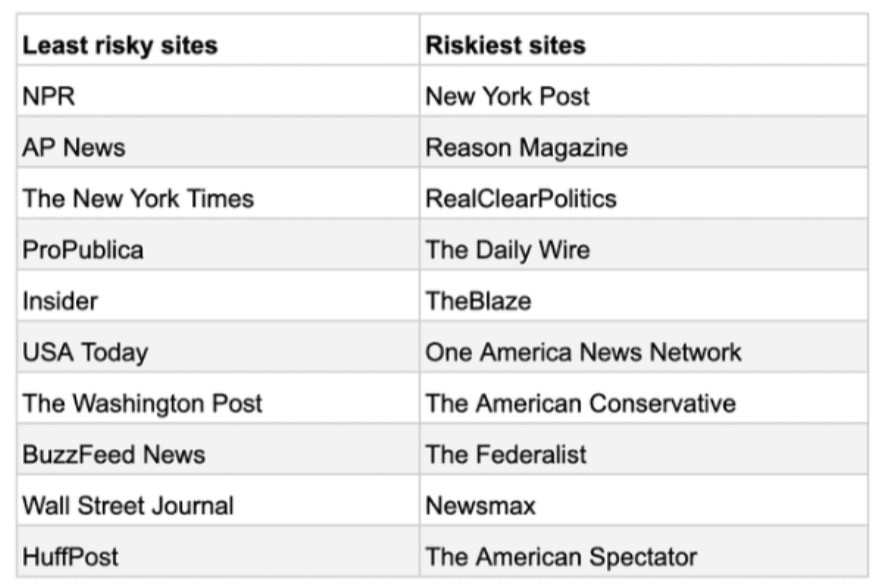
Years ago, I wrote about the Biden administration supporting efforts like the Global Disinformation Index (GDI) to discourage advertisers from supporting certain sites. All of the 10 riskiest sites targeted by the index were popular with conservatives, libertarians and independents. That included Reason.org and a group of libertarian and conservative law professors who simply write about cases and legal controversies. GDI warned advertisers against “financially supporting disinformation online.” At the same time, HuffPost, a far-left media outlet, was included among the 10 sites at lowest risk of spreading disinformation.
Once GDI’s work and bias was disclosed, government officials quickly disavowed the funding. It was a familiar pattern. Within a few years, we found that the work had been shifted instead to groups like the GARM, which is the same thing on steroids. It is the creation of a powerful and largely unknown group called the World Federation of Advertisers (WFA), which has huge sway over the advertising industry and was quickly used by liberal activists to silence opposing views and sites by cutting off their revenue streams.
Notably, Rob Rakowitz, head of GARM, pushed GDI and embraced its work. In an email to GARM members obtained by the committee last month, Rakowitz wrote that he wanted to “ensure you’re working with an inclusion and exclusion list that is informed by trusted partners such as NewsGuard and GDI — both partners to GARM and many of our members.”
GARM is being used by WFA to achieve what GDI failed to accomplish. The WFA site refers to Rakowitz as “a career change agent” who will “remove harmful content from ad-supported digital media.”
Rakowitz’s views on free speech are chilling and his work shows how these systems can be used to conceal bias in targeting the revenue of sites with opposing views.
Rakowitz has denounced the “extreme global interpretation of the US Constitution” and how civil libertarians cite “‘principles for governance’ and applying them as literal law from 230 years ago (made by white men exclusively).”
He appears to be referring to free speech. If so, it is deeply troubling. Some of us believe that free speech is a human right, not just an American right. Those “white men” include philosophers from the Enlightenment whose ideas were incorporated in the Framer’s view of inalienable rights like free speech.
The threat against free speech today is being led by private groups seeking to exercise an unprecedented level of control over what people can read and discuss.
Pundits and politicians, including President Joe Biden and former President Barack Obama, have justified their calls for censorship (or “content moderation” for polite company) by stressing that the First Amendment only applies to the government, not private companies. That distinction allows Obama to declare himself to be “pretty close to a First Amendment absolutist.” He did not call himself a “free speech absolutist” because he favors censorship for views that he considers to be “lies,” “disinformation,” or “quackery.”
The distinction has always been a disingenuous evasion. The First Amendment is not the sole or exclusive definition of free speech. Censorship on social media is equally, if not more, damaging for free speech. Those who value free speech should oppose blacklisting systems, as was the case during the McCarthy period. Now that conservatives and libertarians are being blacklisted, it is suddenly less troubling for many on the left.
Rakowitz now wields massive influence over public discourse in this collaboration with corporations and groups like GDI. As was done to the left during the McCarthy period, blacklisting systems are now being used to control public access to information by choking off the revenue of sites.
The current anti-free speech movement is the most dangerous in history due precisely to this sophistication and the unprecedented alliance of corporate, media, academic, and government interests.
GARM and other media rating systems have been embraced by many who would prefer to silence opposing voices than respond to them. Rakowitz was wildly popular at Davos in calling for a “safer” Internet that would target dangerous sites much like GDI: “GARM has been officially recognized as a key project for 2020 within the WEF’s platform on Shaping the Future of Media Entertainment and Culture.”
The House committees are pushing forward with a sense of urgency. It is clear that the investigations in government-supported censorship and these blacklisting operations will end if the Democrats retake the house. It is expected that these companies will seek to delay any disclosures in the hope that the House will change hands and this system will again be allowed to recede back into the darkness.
I hope that our readers have read the response of NewsGuard’s Gordon Crovitz to my recent criticism of the company’s rating system for news sites. He makes important points, including the fact that the company has given high ratings to conservative sites and low ratings to some liberal sites. I have mutual friends of both Gordon and his co-founder Steve Brill, who have always sworn by their integrity and motivations. I do not question Gordon’s account of past ratings for sites.
However, I also welcome the opportunity to further this discussion over media rating systems and to explain why I remain unconvinced by his defense. It is a long overdue debate on the use and potential misuse of such systems.
As a threshold matter, I want to note that I am aware of conservative sites reviewed by NewsGuard that have been given favorable ratings. That is a valid distinction from past rating sites like the Global Disinformation Index (GDI).
Moreover, while I noted that NewsGuard has been accused of bias by conservatives and is being investigated in Congress, my primary objections are to rating systems as a concept for media sites. Before addressing that opposition, I should note that I still have concerns over bias from the email that was sent me, particularly just after a column criticizing the company.
Now to the main concern.
A Shield or a Sword?
In his response to me, Gordon argues that “I would have thought, including based on your recent book, that you’d especially welcome an accountable market alternative to censorship.”
I disagree with Gordon’s suggested dichotomy. As I argue in the column, rating systems are arguably the most effective means to silence opposing voices or sites. These systems are used to target revenue sources and have been weaponized by the current anti-free speech movement. They are used more as a sword than a shield by those who want to marginalize or demonetize a site.
We have seen such campaigns targeting various sites and individuals, led by political groups opposed to their viewpoints, including figures such as Joe Rogan. This includes Elon Musk and X after the reduction of censorship systems and the release of the “Twitter Files.” After being targeted by these campaigns for years, rating systems have been denounced by Musk as part of an “online censorship racket.”
Moreover, the use of private entities like NewsGuard is precisely what makes the current movement so insidious and dangerous. Whether by design or by default, rating systems are effective components of what I have described as a system of “censorship by surrogate.”
What NewsGuard is attempting is potentially far more impactful for the funding and viability of websites. Rather than an alternative, it can be an avenue for censorship.
I have also written about my concerns with the Global Alliance for Responsible Media and its use of rating systems to deter advertisers for targeted sites. The group states that it “unites marketers, media agencies, media platforms, industry associations, and advertising technology solutions providers to safeguard the potential of digital media by reducing the availability and monetization of harmful content online.”
As the column discusses, NewsGuard seeks to position itself as a type of Standard & Poor’s rating system for media. The role would give the company unprecedented influence over the journalistic and political speech in America. The rating can be used to discourage advertisers and revenue sources for targeted sites. Just as S&P scores can kill a business, a media rating could kill a blog or website.
That is an enormous amount of power to be wielded by any organization, let alone a for-profit enterprise started by two self-appointed monitors of media. That is not meant to disparage Gordon and Steve, but to acknowledge that this is not just a hugely profitable but a hugely powerful enterprise.
It is also not a criticism of the founding principles. We have seen many organizations that began as faithful to principles of neutrality only to see those principles corrupted with time. Indeed, as we have previously discussed, the very principles of objectivity and neutrality are now rejected in many journalism schools.
The Criteria
While NewsGuard insists that its criteria is completely objective and neutral, that does not appear to be the case. The site’s standards include key determinations on whether some sites run statements that NewsGuard considers “clearly and significantly false or egregiously misleading.” (That appears part of the most heavily weighted criteria for credibility at 22 points).
The staff will determine if it believes that a site shows a tendency to “egregiously distort or misrepresent information.”
The staff decides if information is false and, if it is considered false by NewsGuard, whether the site “identifies errors and publishes clarifications and corrections, transparently acknowledges errors, and does not regularly leave significant false content uncorrected.” Thus, if you disagree with the claims of falsity or view the statement as opinion, the failure to correct the statement will result in additional penalties.
The site will also determine if it finds the sources used by a site to be “credible” and whether “they … egregiously distort or misrepresent information to make an argument or report on a subject.”
If the site decides that there are errors, it will lower ratings if the site does not “transparently acknowledges errors, and does not regularly leave significant false content uncorrected.”
The company pledges to combat “misinformation” and “false narratives.”
We have seen mainstream media use these very terms to engage in highly biased coverages, including labeling true stories or viewpoints “disinformation.”
Given these terms and the history of their use in the media, NewsGuards assurances boil down to “trust us we’re NewsGuard.” GDI made the same assurances.
This is not to say that some of these criteria cannot be helpful for sites. However, the overall rating of media sites is different from Standard & Poor’s. Financial ratings are based on hard figures of assets, earnings, and liabilities. “Liquidity” is far more concrete and objective than “credibility.” What NewsGuard does is fraught with subjectivity regardless of the motivations or intentions of individual raters.
The Res Ipsa Review
The inquiry sent to this blog reflects those concerns. The timing of the inquiry was itself chilling. I had just criticized NewsGuard roughly a week earlier. It is not known if this played any role in the sudden notice of a review of Res Ipsa.
One inquiry particularly stood out for me. The reviewer informed me:
“I cannot find any information on the site that would signal to readers that the site’s content reflects a conservative or libertarian perspective, as is evident in your articles. Why is this perspective not disclosed to give readers a sense of the site’s point of view?”
The effort of NewsGuard to label sites can have an impact on its ratings on credibility and transparency. Yet, sites may disagree with the conclusions of NewsGuard on their view of the content. What may seem conservative to a NewsGuard reviewer may be less clearly ideological to the host or blog.
Moreover, despite noting that it asked MSNBC to state its liberal bias, it is not clear if the company has suggested such a notice from many other sites from NPR to the New Republic. For example, is Above the Law supposed to warn readers that it takes a liberal perspective and regularly attacks conservatives? What about other academic blogs like Balkinization?
The point is not to say that they should be required to label their own views (though some sites choose to do so) but to ask whether all sites are asked to do so. If not, when is this demand made for sites? For some reviewers, a liberal perspective may simply seem like stating the obvious or unassailable truth.
Labeling
In fairness to NewsGuard, we all often engage in labeling as part of our discussions — both labeling ourselves and others. For example, I often acknowledge that I hold many libertarian views. However, I continue to write columns that run across the ideological spectrum and I continue to be attacked from both the right and the left for those columns.
Identifying yourself as a libertarian does not convey much information for readers. Many readers have erroneous views of libertarians as a monolithic group. (The public high school teacher of one of my kids told the class that libertarians were just conservatives who did not want to call themselves Republicans). In actuality, it is a group that runs from liberal to conservative figures who maximize individual rights. Labeling your site as libertarian is about as helpful as saying that it is utilitarian.
The suggestion in the email is that readers should be informed that anything they read is coming from a libertarian or conservative on the site. Yet, most law professor blogs are very liberal, but do not make the same type of warning.
We often discuss these labels in judging the diversity of faculties. Yet, that is based largely on surveys of professors self-identifying or the political registration of academics. It is admittedly a blunt tool, but there is little debate that faculties around the country are overwhelmingly liberal. Indeed, even sites like Above the Law have strived to defend “predominantly liberal faculties” as just reflecting the fact that most conservatives are simply wrong on the law.
There is always an overgeneralization in the use of such labels, but we try to take that into consideration in discussing the overall lack of diversity of viewpoints on campuses today.
Conclusion
Rating media sites is vastly different. You are often relying on the views of the reviewers that may be challenged by the site. Postings that challenge popular narratives are often denounced as false or disinformation by critics.
I am particularly concerned over the reported government contracts given to NewsGuard by the Biden Administration as well as agreements with teacher unions to help filter or rate sites. The Twitter Files have shown an extensive system of funding and coordination between agencies and these companies. The funding of such private rating or targeting operations is precisely what I have warned about in congressional testimony as a type of “censorship by surrogate.” The government has been attempting to achieve forms of censorship indirectly that it is barred from achieving directly under the First Amendment.
Consider those bloggers and scientists who were censored and denounced for voicing support for the lab theory on Covid 19 and other subjects from the efficacy of masks to the need to shutdown schools. They spent years having mainstream media figures denouncing them for refusing to admit that they were spreading disinformation or conforming to general views on these issues.
Political and legal commentary are rife with contested opinion over the facts and their implications. Having a company sit in judgment on what is fact and what is opinion is a troubling role, particularly when the rating is used to influence advertisers and financial supporters.
Once again, there are many people on the other side of this debate who have good-faith reasons for wanting a standardized set of criteria for news sources and commentary sites. I simply believe that this is a degree of influence that is dangerously concentrated in a small number of groups like NewsGuard.
N.B.: After this response ran, NewsGuard wrote me that Above The Law actually was marked down for failing to clearly delineate between news and opinion. It further said that the New Republic acknowledges its liberal take, so there is no issue on labeling. What is not clear is whether every site, including academic blogs, are asked to label themselves and who makes that decision on what label should apply.
Below is my column in The Hill on the recent notice that this blog is now being formally “reviewed” by NewsGuard, a company that I just criticized in a prior Hill column as a threat to free speech. The questions from NewsGuard were revealing and concerning. Today, I have posted the response of NewsGuard’s co-founder Gordon Crovitz as well as my response to his arguments.
Here are is the column:
Recently, I wrote a Hill column criticizing NewsGuard, a rating operation being used to warn users, advertisers, educators and funders away from media outlets based on how it views the outlets’ “credibility and transparency.” Roughly a week later, NewsGuard came knocking at my door. My blog, Res Ipsa (jonathanturley.org), is now being reviewed and the questions sent by NewsGuard were alarming, but not surprising.
I do not know whether the sudden interest in my site was prompted by my column. I have previously criticized NewsGuard as one of the most sophisticated operations being used to “white list” and “black list” sites. My new book, “The Indispensable Right: Free Speech in an Age of Rage,” details how such sites fit into a massive censorship system that one federal court called “Orwellian.”
For any site criticizing the media or the Biden administration, the most chilling words today are “I’m from NewsGuard and I am here to rate you.”
Conservatives have long accused the company of targeting conservative and libertarian sites and carrying out the agenda of its co-founder Steven Brill. Conversely, many media outlets have heralded his efforts to identify disinformation sites for advertisers and agencies.
Brill and his co-founder, L. Gordon Crovitz, want their company to be the media version of the Standard & Poor’s rating for financial institutions. However, unlike the S&P, which looks at financial reports, NewsGuard rates highly subjective judgments like “credibility” based on whether they publish “clearly and significantly false or egregiously misleading” information. They even offer a “Nutrition Label” for consumers of information.
Of course, what Brill considers nutritious may not be the preferred diet of many in the country. But they might not get a choice since the goal is to allow other companies and carriers to use the ratings to disfavor or censor non-nutritious sites.
The rating of sites is arguably the most effective way of silencing or marginalizing opposing views. I previously wrote about other sites supported by the Biden administration that performed a similar function, including the Global Disinformation Index (GDI). GDI then released a list of the 10 most dangerous sites, all of which are popular with conservatives, libertarians and independents. GDI warned advertisers that they were accepting “reputational and brand risk” by “financially supporting disinformation online.” The blacklisted sites included Reason, a respected libertarian-oriented source of news and commentary about the government. However, HuffPost, a far left media outlet, was included among the 10 sites at lowest risk of spreading disinformation.
When NewsGuard came looking for Res Ipsa, the questions sounded like they came directly from CGI. I was first asked for information on the financial or revenue sources used to support my blog, on which I republish my opinion pieces from various newspapers and publish original blog columns.
Given NewsGuard’s reputation, the email would ordinarily trigger panic on many sites. But I pay not to have advertising, and the closest I come to financial support would be my wife, since we live in a community property state. If NewsGuard wants to blacklist me with my wife, it is a bit late. Trust me, she knows.
NewsGuard also claimed that it could not find a single correction on my site. In fact, there is a location for readers marked “corrections” to register objections and corrections to postings on the site. I also occasionally post corrections,changes and clarifications.
NewsGuard also made bizarre inquiries, including about why I called my blog “Res Ipsa Liquitur [sic] – the thing itself speaks. Could you explain the reason to this non-lawyer?” Res ipsa loquitur is defined in the header as “The thing itself speaks,” which I think speaks for itself.
But one concern was particularly illuminating:
“I cannot find any information on the site that would signal to readers that the site’s content reflects a conservative or libertarian perspective, as is evident in your articles. Why is this perspective not disclosed to give readers a sense of the site’s point of view?”
I have historically been criticized as a liberal, conservative or a libertarian depending on the particular op-eds. I certainly admit to libertarian viewpoints, though I hold many traditional liberal views. For example, I have been outspoken for decades in favor same-sex marriage, environmental protection, free speech and other individual rights. I am a registered Democrat who has defended reporters, activists and academics on the left for years in both courts and columns.
The blog has thousands of postings that cut across the ideological spectrum. What I have not done is suspend my legal judgment when cases touch on the interests of conservatives or Donald Trump. While I have criticized Trump in the past, I have also objected to some of the efforts to impeach or convict him on dubious legal theories.
Yet, NewsGuard appears to believe that I should label myself as conservative or libertarian as a warning or notice to any innocent strays who may wander on to my blog. It does not appear that NewsGuard makes the same objection to HuffPost or the New Republic, which run overwhelmingly liberal posts. Yet, alleged conservative or libertarian sites are expected to post a warning as if they were porn sites.
NewsGuard is not alone in employing this technique. Mainstream media outlets often label me as a “conservative professor” in reporting my viewpoints. They do not ordinarily label professors with pronounced liberal views or anti-Trump writings as “liberal.”
Studies show that the vast majority of law professors run from the left to the far left. A study found that only 9 percent of law school professors at the top 50 law schools identify as conservative. A 2017 study found only 15 percent of faculties overall were conservative.
It is rare for the media to identify those professors as “liberal,” including many professors on the far left who regularly denounce conservatives or Republicans. It is simply treated as not worth mentioning. Yet, anyone libertarian or right of center gets the moniker as a warning that their viewpoint should considered in weighing their conclusions. Yet, NewsGuard is in the business of labeling people . . . and warning advertisers. It considers my writings to be conservative or libertarian and wants to know “Why is this perspective not disclosed to give readers a sense of the site’s point of view?”
It does not matter that my views cut across the ideological spectrum or that I do not agree with NewsGuard’s label. Indeed, while I clearly hold libertarian views, libertarians run a spectrum from liberal to conservative. The common article of faith is the maximization of individual rights, while there is considerable disagreement on many policies. Steven Brill is considered a diehard liberal. Would it be fair to add a notice or qualifier of “liberal” to any of his columns or opinions?
It does not matter. Apparently from where NewsGuard reviewers sit, I am a de facto conservative or libertarian who needs to wear a digital bell to warn others.
It is a system that includes what Elon Musk correctly called “the advertising boycott racket.” Musk was responding to another such group pushing a rating system as an euphemism for blacklisting. For targeted sites, NewsGuard is now the leading racketeer in that system. It makes millions of dollars by rating sites — a new and profitable enterprise with dozens of other academic and for-profit groups. They have commoditized free speech in blacklisting and potentially silencing others. If you are the Standard & Poor’s of political discourse, you can rate sites out of existence by making them a type of junk bond blog.
Yet, the fact that I have no advertisers or sponsors to scare off does not mean that NewsGuard cannot undermine the site. The company has reportedly received federal contracts, which some in Congress have sought to block. It is also allied with organizations like Turnitin to control what teachers and students will read or use in schools. The powerful American Federation of Teachers, which has been criticized for its far left political alliances with Democratic candidates, has also pushed NewsGuard for schools.
This is why my book calls for a number of reforms, including barring federal funds for groups engaged in censoring, rating or blacklisting sites. NewsGuard shows that such legislation cannot come soon enough.
N.B.: The original version of this column included MSNBC as an example of liberal sites that do not post their own ideological bent or label. I later heard from NewsGuard that they did indeed mark down MSNBC for failing to make such a disclosure, so I removed it from this blog column. I posted a response today on why I continue to oppose rating systems such as NewsGuard.
On the weekend, I ran a column critical of NewsGuard and its recent notification of this blog that it was being “rated.” NewsGuard co-founder Gordon Crovitz responded to that column the next day. We have previously exchanged emails on my concerns over rating systems generally, including the Global Disinformation Index (which is not related to NewsGuard). I noted the concerns over bias from conservatives and members of Congress, but my primary concern remains with the concept of a rating system for media sites and blogs. While NewsGuard has given high ratings to some conservative sites, I generally oppose media rating systems due to free speech concerns and the use of these systems by the current anti-free speech movement.
I have always found Gordon to be open and frank about these subjects and I wanted readers on the blog to hear the opposing view from him directly. He was kind enough to consent to my posting the following. I will be posting a response to Gordon separately in the hopes that we can use this controversy as a foundation for a much needed discussion of rating systems and their impact on free speech.
Here is his response:
Jonathan:
We welcome the publicity, but your complaints in your July 27 commentary in the Hill about NewsGuard seem based on some misunderstandings.
First, we launched NewsGuard in 2018 as an alternative either to the Silicon Valley platforms secretly putting their thumbs on the scale for news and information sites or for calls to have the government censor social media and other online speech. Digital platforms were (and are) secretly rating news and information websites, with no disclosure about their criteria and no way for the people running the websites even to find out how they were rated. The only other entity rating news and information sites at the time we launched was GDI, which as you have written is a left-wing advocacy group–which like the digital platforms does not disclose its criteria or let publishers know how they are rated (except when information escapes such as the top 10 list of “risky” sites, which as you noted are all conservative or libertarian sites).
As I have written as a (libertarian-leaning) conservative former publisher, including in this recent Washington Examiner article https://www.washingtonexaminer.com/opinion/3091369/advertisers-fear-supporting-journalism-heres-how-to-fix-that/, I wouldn’t trust the platforms or a left-wing advocacy group either. We launched NewsGuard as the transparent and apolitical alternative, with the goal of giving news consumers basic information about websites they encounter online.
We reach out to the people running news and information websites for several purposes. We want to be sure we correctly assess sites based on our nine criteria. We’re a journalistic enterprise, so would always reach out for comment before concluding a site fails any of our criteria. We often quote the people running websites to provide more context about their site, whether they fail any criteria or not. More than a quarter of the websites we’ve rated have taken steps, usually relating to greater transparency, to get higher ratings.
In your column, you asserted that NewsGuard treats liberal sites preferentially compared with how we treat conservative or libertarian sites. This is false, as the many high scores for conservative and libertarian sites–and low scores for liberal sites–makes clear. You’ll see examples in the Washington Examiner article I linked to above. (There are right-wing sites like OAN that get low ratings such as for its Dominion Voting Systems claims, and there are left-wing sites that get low ratings for false claims such as about Donald Trump.)
In your Hill article, you claimed that “it does not appear” that we expect left-wing sites to disclose their point of view to readers. You gave the example of MSNBC. I am attaching our publicly available rating for this website. You will see it fails our criterion relating to news/opinion for failing to disclose its orientation. The MSNBC website scores lower than Fox News using our criteria because MSNBC fails to disclose its orientation whereas the website for Fox News does disclose its. (MSNBC also fails our criterion for gathering and presenting responsibly due to claims it made about Trump, Ron DeSantis, Steve Bannon and others.)
We also anticipated even back when we launched that there would be calls for government censorship if secret and partisan ratings were the only ones available in the market. I would have thought, including based on your recent book, that you’d especially welcome an accountable market alternative to censorship.
Finally, I appreciated your obituary for Bob Zimmer and your calls for the Chicago Principles to be widely adopted. (Whether our UChicago fully lives up to them is a topic for another day–I prefer the more energetic approach of Ed Levi to today’s more appeasing practices.) More information about websites is an exercise of free speech, and when done with transparent apolitical criteria equally applied seems to me a market solution you should support, not criticize or fear.
The U.S. Department of State reportedly hired German censors to train American teachers on how to facilitate so-called anti-disinformation efforts in the classroom.
Documents obtained through the Freedom of Information Act (FOIA) by the Media Research Center (MRC) and shared exclusively with The Daily Wire reveal that the State Department paid for trainings for hundreds of teachers “created mostly by German ‘disinformation’ activists.” The “Medialogues on Propaganda,” which featured 11 online training meetings between June 2021 and April 2022 and was attended by some 700 teachers, was funded by a grant from the U.S. Embassy in Berlin.
“The intent was to train teachers to ‘inoculate’ students against disinformation that train them in ‘media literacy,’” The Daily Wire reported. “The State Department sessions were used by its activist organizers to promote products from their for-profit ‘partner,’ Ad Fontes, as well as NewsGuard.”
Ad Fontes is a for-profit firm founded in 2018 that advises advertisers, online platforms, and educators about which websites to either boycott or censor. While the company claims to be impartial, its recommendations show otherwiseby disproportionately targeting conservative media as outlets for clients to avoid.
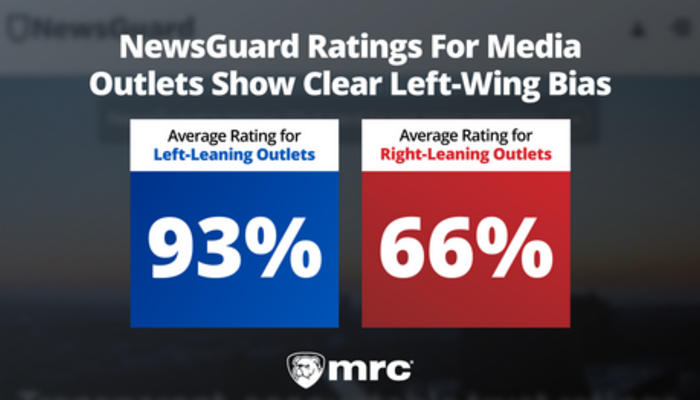
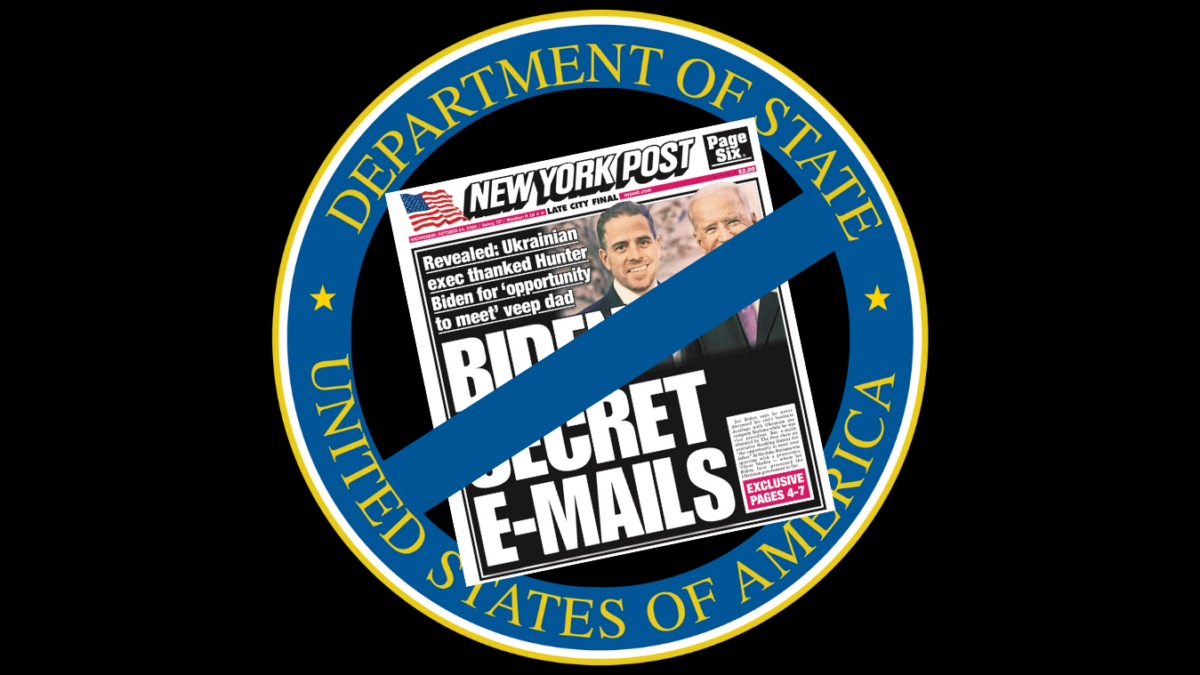
NewsGuard is a similar “disinformation” group backed by federal grant money. It operates as a browser extension that rates the credibility of news organizations and has been deployed in classrooms. A study published last month by the Media Research Center shows NewsGuard’s credibility ratings “overwhelmingly favored left-leaning outlets over right-leaning ones.” Prominent examples of NewsGuard’s biased ratings include perfect grades for legacy outlets that botched the Hunter Biden laptop story while giving failing grades to conservative websites that got it right.
The federal government’s use of taxpayer funds to back NewsGuard is the subject of a lawsuit from The Federalist, The Daily Wire, and the state of Texas, which are collectively suing the State Department to stop “one of the most audacious, manipulative, secretive, and gravest abuses of power and infringements of First Amendment rights by the federal government in American history.” The case exposes federal censorship efforts beyond the dramatic discoveries in the pending Supreme Court case of Murthy v. Missouri (also known as Missouri v. Biden).
The State Department did not respond to The Federalist’s repeated inquiries about why the agency did not shut down the propagandist trainings by German censors.
The government trainings were reportedly run by Germany’s University of Würzburg’s Media Education & Educational Technology Lab and the University of Rhode Island’s Media Education Lab with Media Literacy Now (MLN), a non-profit group.
“MLN lobbies for mandatory training in schools to fight ‘misinformation’ and ‘online radicalization,’ boasting that it has helped convince 18 states to make laws on media literacy training,” the Daily Wire reported. “And while the Rhode Island Lab wrote an entire report on the importance of ‘media literacy’ without ever defining it, MLN had spoken more clearly, calling it a ‘tool to create the society we all deserve: one that nurtures racial equity, social justice, and true democracy. Media literacy equals cultural change.’”
University of Rhode Island Communications Professor Renee Hobbs is an MLN advisory board member and the founder of the Rhode Island Lab. According to the Daily Wire, Hobbs previously pressed for $60 million in subsidies for “anti-disinformation work like hers — legislation whose momentum rested on the idea that Russians caused Trump to win in 2016, itself a conspiracy.”
Hobbs played host to the state-sponsored “disinformation” seminars while also serving as chair of a National Council of Teachers of English (NCTE) group encouraging teachers to shift their focus to “consumerism and economic injustice.” Hobbs’ Rhode Island Lab also once used a fake, satirical Lego set to encourage teachers to hold student discussions about the Jan. 6, 2021 Capitol riot.
“When asked why the State Department would fund a propaganda seminar aimed at Americans,” the Wire reported, “the State Department told The Daily Wire that with its $30,000 grant to Media Literacy Now, ‘the U.S. Embassy in Germany supported the participation of German participants in the media literacy program you are inquiring about.’”
The current U.S. ambassador to Germany, Amy Gutmann, was sworn in back in April 2022, just as the State Department trainings were purportedly ending. Before becoming Biden’s ambassador in Berlin, however, Gutmann was president of the University of Pennsylvania since 2004. The Penn Biden Center for Diplomacy and Global Engagement was established under Gutmann’s tenure, where about ten classified documents were discovered from Biden’s time as vice president that included “top-secret material.” Biden was paid a nearly seven-figure salary from the Ivy League university despite rare school appearances.
Tristan Justice is the western correspondent for The Federalist and the author of Social Justice Redux, a conservative newsletter on culture, health, and wellness. He has also written for The Washington Examiner and The Daily Signal. His work has also been featured in Real Clear Politics and Fox News. Tristan graduated from George Washington University where he majored in political science and minored in journalism. Follow him on Twitter at @JusticeTristan or contact him at Tristan@thefederalist.com. Sign up for Tristan’s email newsletter here.
The U.S. State Department is violating the U.S. Constitution by funding technology to silence Americans who question government claims, says a lawsuit filed Tuesday by The Federalist, The Daily Wire, and the state of Texas.
The three are suing to stop “one of the most audacious, manipulative, secretive, and gravest abuses of power and infringements of First Amendment rights by the federal government in American history,” says the lawsuit. It exposes federal censorship activities even beyond the dramatic discoveries in a pending U.S. Supreme Court case, Murthy v. Missouri (also known as Missouri v. Biden).
This lawsuit alleges the State Department is illegally using a counterterrorism center intended to fight foreign “disinformation” instead to stop American citizens from speaking and listening to information government officials dislike. Other recent investigations have also found government counterterrorism resources and tactics being used to shape American public opinion and policy.
Through grants and product development assistance to private entities including the Global Disinformation Index (GDI) and NewsGuard, the lawsuit alleges, the State Department “is actively intervening in the news-media market to render disfavored press outlets unprofitable by funding the infrastructure, development, and marketing and promotion of censorship technology and private censorship enterprises to covertly suppress speech of a segment of the American press.”
This is just the latest in a series of major investigations and court cases in the last year to uncover multiple federal censorship efforts laundered through private cutouts. The “Twitter Files,” a series of investigative journalist reports, uncovered that dozens of federal agencies pressured virtually all social media monopolies to hide and punish tens of millions of posts and users.
Missouri v. Bidenfound this federal censorship complex has included government officials changing the content moderation and user policies of social media monopolies through threats to destroy their business models. House of Representatives investigations have uncovered U.S. national security and spy agencies creating “private” organizations to circumvent the Constitution’s prohibition on federal officials abridging Americans’ speech. These false-front organizations deliberately avoid creating records subject to transparency laws and congressional oversight, public records show.
Congressional investigations in November revealed that federal officials have specifically targeted The Federalist’s reporting for internet censorship.
In which Sean Davis was censored for saying the best evidence against the integrity of the election was the fact that Democrats/media/Big Tech were censoring anyone who observed their censorship efforts related to the election. pic.twitter.com/r6NdbnSx1f
‘Coordinating the Government’s Efforts to Silence Speech’
The Fifth Circuit refrained from stopping the State Department’s participation in the “vast censorship enterprise” that Murthy v. Missouri uncovered because, the court said, it hadn’t seen enough evidence of that agency’s involvement. This new lawsuit from Texas, The Federalist, and The Daily Wire provides such evidence.
Even though Congress and the Constitution have banned the federal government from silencing Americans, the State Department’s Global Engagement Center (GEC) has morphed into “the lead in coordinating the government’s efforts to silence speech,” the lawsuit says. The lawsuit names as defendants the U.S. State Department, GEC, and multiple department officials including Secretary of State Antony Blinken. GEC originated as a counterterrorism agency created by an executive order from President Obama.
Through GEC, the State Department evaluated more than 365 different tools for scrubbing the internet of disfavored information, the lawsuit says. The department also pays millions to develop multiple internet disinformation “tools.” It also runs tests on censorship technologies and awards government prize money to those most effective at controlling what Americans say and hear online, the lawsuit says.
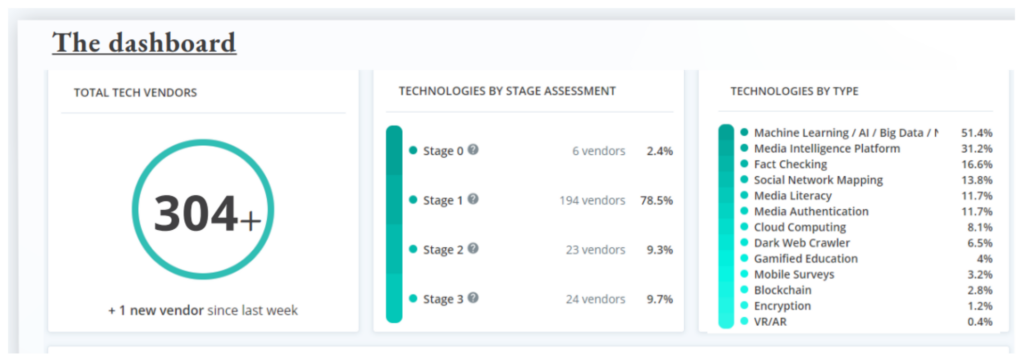
State then shares these censorship technologies with companies, favored media outlets, academics, and government agencies. It markets these government-funded censorship technologies to Silicon Valley companies including Facebook, X, and LinkedIn. The tools included “supposed fact-checking technologies, media literacy tools, media intelligence platforms, social network mapping, and machine learning/artificial intelligence technology,” the lawsuit says.
At least two of the censorship tools the State Department has funded, developed, and awarded have targeted The Federalist and The Daily Wire, the lawsuit says. NewsGuard and GDI wield these tools developed with government assistance to deprive government-criticizing news outlets, including The Federalist and The Daily Wire, of operating funds.
They do this by rating conservative outlets poorly, falsely claiming these outlets purvey “disinformation” and are “unreliable.” That deprives leftists’ media competitors of high-value ad dollars from the big companies that use these rating systems. Such companies include YouTube, Facebook, Snapchat, Best Buy, Exxon Mobil, Kellogg, MasterCard, and Verizon.
“Advertising companies that subscribe to GDI’s blacklist refuse to place ads with disfavored news sources, cutting off revenue streams and leaving the blacklisted outlets unable to compete with the approved ‘low risk’ media outlets — often legacy news,” the lawsuit says.
Boosting Disinformation While Claiming the Opposite
Ratings companies like NewsGuard and GDI base their low ratings of outlets like The Federalist at least in part on politically charged “fact checks” of a tiny percentage of the outlets’ articles. While these companies’ full ratings criteria are secret, in December 2022 GDI published a top 10 list of its most favored and most disfavored news outlets. The Federalist and Daily Wire appear on GDI’s 10 “riskiest” list.
All of the outlets on GDI’s “least risky” list have helped spread some of the government’s biggest disinformation operations in the last decade. Those include the Russia-collusion hoax and Hunter Biden laptop stories, which influenced national elections in favor of Democrats. The 10 “least risky” outlets have also widely published notable misinformation such as claims that Covid vaccines prevent disease transmission, the Covington student insult hoax, and evidence-free claims that Supreme Court Justice Brett Kavanaugh is a serial gang rapist.
This federal censorship-industrial complex’s numerous disinformation operations include the Hamilton 68 effort. In contrast, The Federalist not only reported all these stories accurately from the beginning but for most led the reporting pack that proved it. GDI rated The Daily Wire’s “risk level” as “high” and The Federalist’s “risk level” as “maximum.”
While technologies and enterprises the State Department promotes push corporate media’s biggest purveyors of propaganda, they also “blacklist” The Federalist and Daily Wire, the lawsuit says, “negatively impacting Media Plaintiffs’ ability to circulate and distribute their publications to both current and potential audiences, and intentionally destroying the Media Plaintiffs’ ability to obtain advertisers.” Microsoft, for example, uses NewsGuard technology “to train Bing Chat.”
The lawsuit is filed in the U.S. federal court for the Eastern District of Texas. It seeks a court declaration that the State Department’s funding, testing, pressuring, and promoting of internet censorship tools is unconstitutional and an order that it end.
Joy Pullmann is executive editor of The Federalist, a happy wife, and the mother of six children. Her ebooks include “The Read-Aloud Advent Calendar,” “The Advent Prepbook,” and “101 Strategies For Living Well Amid Inflation.” An 18-year education and politics reporter, Joy has testified before nearly two dozen legislatures on education policy and appeared on major media from Fox News to Ben Shapiro to Dennis Prager. Joy is a grateful graduate of the Hillsdale College honors and journalism programs who identifies as native American and gender natural. Her traditionally published books include “The Education Invasion: How Common Core Fights Parents for Control of American Kids,” from Encounter Books.
In May 2021, L. Gordon Crovitz, a media executive turned start-up investor, pitched Twitter executives on a powerful censorship tool.
In an exchange that came to light in the “Twitter Files” revelations about media censorship, Crovitz, former publisher of the Wall Street Journal, touted his product, NewsGuard, as a “Vaccine Against Misinformation.” His written pitch highlighted a “separate product” — beyond an extension already on the Microsoft Edge browser — “for internal use by content-moderation teams.” Crovitz promised an out-of-the-box tool that would use artificial intelligence powered by NewsGuard algorithms to rapidly screen content based on hashtags and search terms the company associated with dangerous content.
How would the company determine the truth? For issues such as Covid-19, NewsGuard would steer readers to official government sources only, like the federal Centers for Disease Control. Other content-moderation allies, Crovitz’s pitch noted, include “intelligence and national security officials,” “reputation management providers,” and “government agencies,” which contract with the firm to identify misinformation trends. Instead of only fact-checking individual forms of incorrect information, NewsGuard, in its proposal, touted the ability to rate the “overall reliability of websites” and “’prebunk’ COVID-19 misinformation from hundreds of popular websites.”
NewsGuard’s ultimately unsuccessful pitch sheds light on one aspect of a growing effort by governments around the world to police speech ranging from genuine disinformation to dissent from officially sanctioned narratives. In the United States, as the “Twitter Files” revealed, the effort often takes the form of direct government appeals to social media platforms and news outlets. More commonly the government works through seemingly benign non-governmental organizations — such as the Stanford Internet Observatory — to quell speech it disapproves of.
Or it pays to coerce speech through government contracts with outfits such as NewsGuard, a for-profit company of especially wide influence. Founded in 2018 by Crovitz and his co-CEO Steven Brill, a lawyer, journalist, and entrepreneur, NewsGuard seeks to monetize the work of reshaping the internet. The potential market for such speech policing, NewsGuard’s pitch to Twitter noted, was $1.74 billion, an industry it hoped to capture.
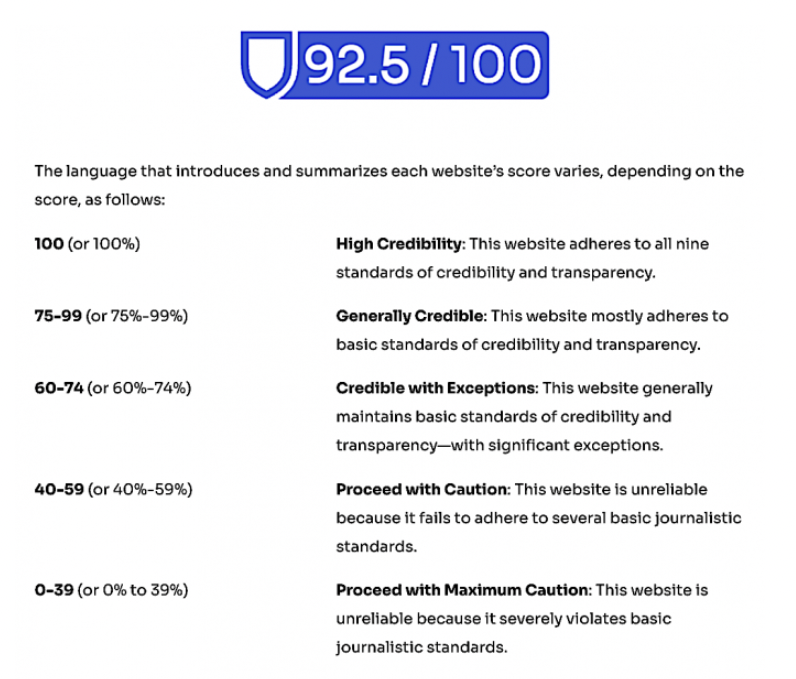
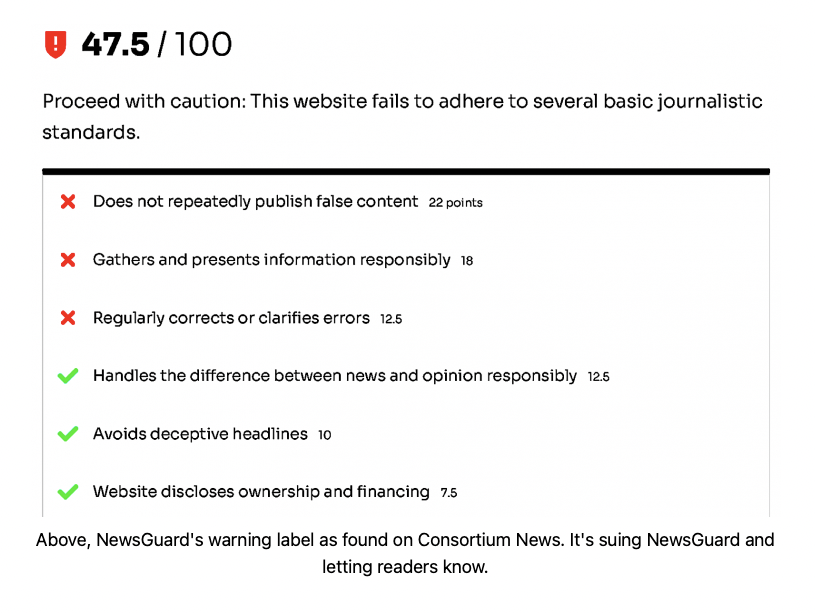
Instead of merely suggesting rebuttals to untrustworthy information, as many other existing anti-misinformation groups provide, NewsGuard has built a business model out of broad labels that classify entire news sites as safe or untrustworthy, using an individual grading system producing what it calls “nutrition labels.” The ratings — which appear next to a website’s name on the Microsoft Edge browser and other systems that deploy the plug-in — use a scale of zero to 100 based on what NewsGuard calls “nine apolitical criteria,” including “gathers and presents information responsibly” (worth 18 points), “avoids deceptive headlines” (10 points), and “does not repeatedly publish false or egregiously misleading content” (22 points), etc.
IMAGE CREDITNEWSGUARD
Critics note that such ratings are entirely subjective — The New York Times, for example, which repeatedly carried false and partisan information from anonymous sources during the Russiagate hoax, gets a 100 percent rating. RealClearInvestigations, which took heat in 2019 for unmasking the “whistleblower” of the first Trump impeachment (while many other outlets including the Times still have not), has an 80 percent rating. (Verbatim: the NewsGuard-RCI exchange over the whistleblower.) Independent news outlets with an anti-establishment bent receive particularly low ratings from NewsGuard, such as the libertarian news site Antiwar.com, with a 49.5 percent rating, and conservative site The Federalist, with a 12.5 percent rating.
As it stakes a claim to being the internet’s arbiter of trust, the company’s site says it has conducted reviews of some 95 percent of news sources across the English, French, German, and Italian web. It has also published reports about disinformation involving China and the Ukraine-Russia and Israel-Hamas wars. The model has received glowing profiles in CNN and The New York Times, among other outlets, as a viable solution for fighting fake news.
IMAGE CREDITNEWSGUARD
NewsGuard is pushing to apply its browser screening process to libraries, academic centers, news aggregation portals, and internet service providers. Its reach, however, is far greater because of other products it aims to sell to social media and other content moderation firms and advertisers. “An advertiser’s worst nightmare is having an ad placement damage even one customer’s trust in a brand,” said Crovitz in a press release touting NewsGuard’s “BrandGuard” service for advertisers. “We’re asking them to pay a fraction of what they pay their P.R. people and their lobbyists to talk about the problem,” Crovitz told reporters.
How NewsGuard Starves Disfavored Sites Of Ad Clients
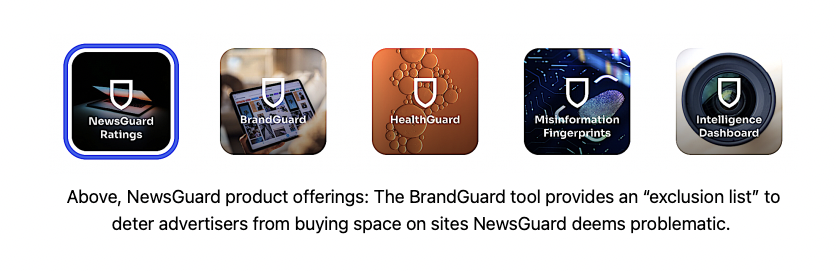
NewsGuard’s BrandGuard tool provides an “exclusion list” that deters advertisers from buying space on sites NewsGuard deems problematic. But that warning service creates inherent conflicts of interest with NewsGuard’s financial model: The buyers of the service can be problematic entities too, with an interest in protecting and buffing their image.
A case in point: Publicis Groupe, NewsGuard’s largest investor and the biggest conglomerate of marketing agencies in the world, which has integrated NewsGuard’s technology into its fleet of subsidiaries that place online advertising. The question of conflicts arises because Publicis represents a range of corporate and government clients, including Pfizer — whose Covid vaccine has been questioned by some news outlets that have received low scores. Other investors include Bruce Mehlman, a D.C. lobbyist with a lengthy list of clients, including United Airlines and ByteDance, the parent company of much-criticized Chinese-owned social media platform TikTok.
NewsGuard has faced mounting criticism that rather than serving as a neutral public service against online propaganda, it instead acts as an opaque proxy for its government and corporate clients to stifle views that simply run counter to their own interests. The criticism finds support in internal documents, such as the NewsGuard proposal to Twitter, which this reporter obtained during “Twitter Files” reporting last year, as well as in government records and discussions with independent media sites targeted by the startup.
Beginning last year, users scanning the headlines on certain browsers that include NewsGuard were warned against visiting Consortium News. A scarlet-red NewsGuard warning pop-up said, “Proceed With Caution” and claimed that the investigative news site “has published false claims about the Ukraine-Russia war.” The warning also notifies a network of advertisers, news aggregation portals, and social media platforms that Consortium News cannot be trusted.
But Consortium News, founded by late Pulitzer Prize-winning investigative journalist Robert Parry and known for its strident criticism of U.S. foreign policy, is far from a fake news publisher. And NewsGuard, the entity attempting to suppress it, Consortium claims, is hardly a disinterested fact-checker because of federal influence over it. NewsGuard attached the label after pressing Consortium for retractions or corrections to six articles published on the site. Those news articles dealt with widely reported claims about neo-Nazi elements in the Ukrainian military and U.S. influence over the country — issues substantiated by other credible media outlets. After Consortium editors refused to remove the reporting and offered a detailed rebuttal, the entire site received a misinformation label, encompassing over 20,000 articles and videos published by the outlet since it was founded in 1995.
The left-wing news site believes the label was part of a pay-for-censorship scheme. It notes that Consortium News was targeted after NewsGuard received a $749,387 Defense Department contract in 2021 to identify “false narratives” relating to the war between Ukraine and Russia, as well as other forms of foreign influence.
Bruce Afran, an attorney for Consortium News, disagrees. “What’s really happening here is that NewsGuard is trying to target those who take a different view from the government line,” said Afran. He filed an amended complaint last month claiming that NewsGuard not only defamed his client, but also acts as a front for the military to suppress critical reporting.
“There’s a great danger in being maligned this way,” Afran continued. “The government cannot evade the Constitution by hiring a private party.”
Joe Lauria, the editor-in-chief of Consortium News, observed that in previous years, anonymous social media accounts had also targeted his site, falsely claiming a connection to the Russian government in a bid to discredit his outlet.
“NewsGuard has got to be the worst,” said Lauria. “They’re labeling us in a way that stays with us. Every news article we publish is defamed with that label of misinformation.”
Both Lauria and Afran said that they worry that NewsGuard is continuing to collaborate with the government or with intelligence services. In previous years, NewsGuard had worked with the State Department’s Global Engagement Center. It’s not clear to what extent NewsGuard is still working with the Pentagon. But earlier this year, Crovitz wrote an email to journalist Matt Taibbi, defending its work with the government, describing it in the present tense, suggesting that it is ongoing:
For example, as is public, our work for the Pentagon’s Cyber Command is focused on the identification and analysis of information operations targeting the U.S. and its allies conducted by hostile governments, including Russia and China. Our analysts alert officials in the U.S. and in other democracies, including Ukraine, about new false narratives targeting America and its allies, and we provide an understanding of how this disinformation spreads online. We are proud of our work countering Russian and Chinese disinformation on behalf of Western democracies.
The company has not yet responded to the Consortium News lawsuit, filed in the New York federal court. In May of this year, the Air Force Research Lab responded to a records request from journalist Erin Marie Miller about the NewsGuard contract. The contents of the work proposal were entirely redacted.
Asked about the company’s continued work with the intelligence sector, Skibinski replied, “We license our data about false claims made by state media sources and state-sponsored disinformation efforts from China, Russia and Iran to the defense and intelligence sector, as we describe on our website.”
Punishing An Outlet That Criticized A NewsGuard Backer’s Pharma Clients
Other websites that have sought to challenge their NewsGuard rating say it has shown little interest in a back-and-forth exchange regarding unsettled matters. Take the case of The Daily Sceptic, a small publication founded and edited by conservative English commentator Toby Young. As a forum for journalists and academics to challenge a variety of strongly held public-policy orthodoxies, even those on Covid-19 vaccines and climate change, The Daily Sceptic is a genuine dissenter. Last year, Young reached out to NewsGuard, hoping to improve his site’s 74.5 rating.
In a series of emails from 2022 and 2023 that were later forwarded to RealClearInvestigations, NewsGuard responded to Young by listing articles that it claimed represent forms of misinformation, such as reports that Pfizer’s vaccine carried potential side effects. The site, notably, has been a strident critic of Covid-19 policies, such as coercive mandates. Anicka Slachta, an analyst with NewsGuard, highlighted articles that questioned the efficacy of the vaccines and lockdowns. The Daily Sceptic, for example, reported a piece casting Covid-19 lockdowns as “unnecessary, ineffective and harmful,” citing academic literature from Johns Hopkins University.
Rather than refute this claim, Slachta simply offered an opposing view from another academic, who criticized the arguments put forth by lockdown critics. And the Hopkins study, Slachta noted, was not peer-reviewed. The topic is still, of course, under serious debate. Sweden rejected the draconian lockdowns on schools and businesses implemented by most countries in North American and Europe, yet had one of the lowest “all-cause excess mortality” rates in either region.
Young and others said that the issue highlighted by NewsGuard is not an instance of misinformation, but rather an ongoing debate, with scientists and public health experts continuing to explore the moral, economic, and health-related questions raised by such policies. In its response to NewsGuard’s questions about the lockdown piece, Young further added that his site made no claim that the Hopkins paper was peer-reviewed and added that its findings had been backed up by a paper from the National Bureau of Economic Research.
Yet to NewsGuard, Young’s site evidently posed a misinformation danger by simply reporting on the subject and refusing to back down. Emails between NewsGuard and the Daily Sceptic show Young patiently responding to the company’s questions; he also added postscripts to the articles flagged by NewsGuard with a link to the fact checks of them and rebuttals of those fact checks. Young also took the extra step of adding updates to other articles challenged by fact-checking non-governmental organizations. “I have also added postscripts to other articles not flagged by you but which have been fact checked by other organisations, such as Full Fact and Reuters,” Young wrote to Slachta.
That wasn’t enough. After a series of back-and-forth emails, NewsGuard said it would be satisfied only with a retraction of the articles, many of which, like the lockdown piece, contained no falsehoods. After the interaction, NewsGuard lowered The Daily Sceptic’s rating to 37.5/100.
“I’m afraid you left me no choice but to conclude that NewsGuard is a partisan site that is trying to demonetise news publishing sites whose politics it disapproves of under the guise of supposedly protecting potential advertisers from being associated with ‘mis-’ and ‘disinformation,’” wrote Young in response. “Why bother to keep up the pretence of fair-mindedness John? Just half my rating again, which you’re going to do whatever I say.”
NewsGuard’s Skibinski, in a response to a query about The Daily Sceptic’s downgrade, denied that his company makes any “demands” of publishers. “We simply call them for comment and ask questions about their editorial practices,” he wrote. “This is known as journalism.”
The experience mirrored that of Consortium. Afran, the attorney for the site, noted that NewsGuard uses an arbitrary process to punish opponents, citing the recent study from the company on misinformation on the Israel-Hamas war. “They cherry-picked 250 posts among tweets they knew were incorrect, and they attempt to create the impression that all of X is unreliable,” the lawyer noted. “And so, what they’re doing, and this is picked up by mainstream media, that’s actually causing X, formerly Twitter, to now lose ad revenue, based literally on 250 posts out of the billions of posts on Twitter.”
The push to demonize and delist The Daily Sceptic, a journalist critic of pharmaceutical products and policies, reflects an inherent conflict with the biggest backer of NewsGuard: Publicis Groupe.
Publicis client Pfizer awarded Publicis a major deal to help manage its global media and advertising operations, a small reflection of which is the $2.3 billion the pharmaceutical giant spent on advertising last year.
The NewsGuard-Publicis relationship extends to the Paris-based marketing conglomerate’s full client list, including LVHM, PepsiCo, Glaxo Smith Kline, Burger King, ConAgra, Kellogg Company, General Mills, and McDonalds. “NewsGuard will be able to publish and license ‘white lists’ of news sites our clients can use to support legitimate publishers while still protecting their brand reputations,” said Maurice Lévy, chairman of the Publicis Groupe, upon its launch of NewsGuard.
Put another way, when corporate watchdogs like The Daily Sceptic or Consortium News are penalized by NewsGuard, the ranking system amounts to a blacklist to guide advertisers where not to spend their money.
“NewsGuard is clearly in the business of censoring the truth,” noted Dr. Joseph Mercola, a gadfly voice whose website was ranked as misinformation by NewsGuard after it published reports about Covid-19’s potential origin from a lab in Wuhan, China.
“Seeing how Publicis represents most of the major pharmaceutical companies in the world and funded the creation of NewsGuard, it’s not far-fetched to assume Publicis might influence NewsGuard’s ratings of drug industry competitors,” Mercola added, in a statement online.
This article was originally published by RealClearInvestigations.
Lee Fang is an investigative reporter. Find his Substack here.
The federal government peddled technology to Big Tech companies to assist them in censoring Americans’ speech on social media in the run-up to the 2020 election, according to emails Missouri and Louisiana uncovered in their First Amendment lawsuit against the Biden administration. Specifically, the State Department marketed this censorship technology through its Global Engagement Center. In other words, our tax dollars not only funded the development of tools to silence speech that dissented from the regime’s narrative. They also paid for government employees to act as sales reps pitching the censorship products to Big Tech.
I’ve been “tasked with building relationships with technology companies,” Samaruddin Stewart, then a senior adviser for the State Department’s Global Engagement Center or “GEC,” wrote in an early-February 2020 introductory email to LinkedIn, allegedly requesting a meeting. According to the lawsuit, his email also suggested he would be reaching out to other social media companies interested in “countering disinformation.”
On March 9, 2020, Stewart again contacted LinkedIn, referencing an earlier verbal discussion and writing:
I’ll send information [to LinkedIn representatives] about gaining access to Disinfo Cloud — which is a GEC funded platform that offers stakeholders an opportunity to discover companies, technology, and tools that can assist with identifying, understanding, and addressing disinformation.
These two emails are explosive. Yet because they were revealed in two passing paragraphs of the 164-page complaint filed by Missouri, Louisiana, and a handful of other plaintiffs against the Biden administration, they — and their enormous significance — have been overlooked.
‘Cold-Calling’ Big Tech
The Stewart emails establish that in 2020, federal government actors contacted social media giants to promote GEC’s Disinfo Cloud. GEC represented that this government platform provided “companies, technology, and tools” to “assist with identifying, understanding, and addressing disinformation.” Then it gave private tech companies access to Disinfo Cloud.
Almost identical to how GEC described Disinfo Cloud in congressional testimony, the State Department’s webpage marketed it as a “one-stop shop” to “identify and then test tools that counter propaganda and disinformation.” “Fact checking” and “media authentication” are just a couple of the types of technologies available through the dashboard.
GEC didn’t just promote Disinfo Cloud or give Big Tech access to what GEC called“the U.S. government’s online repository.” Government employees at GEC also offered to help private companies identify tools to suit their specific needs. Just “write” to the GEC’s Technology Engagement Division about “what your office needs to counter propaganda and disinformation,” the State Department instructed on its webpage, and the government will “assist” in finding “a technological solution.”
‘Testbed’
Access to Disinfo Cloud, according to the State Department’s webpage, also provides “a gateway” to the GEC’s Technology Engagement Division’s “Testbed,” allowing users to review and test the technology against their unique needs.
While Stewart’s emails don’t expressly mention the “Testbed” feature, the State Department boasts that the “private sector” uses both Disinfo Cloud and Testbed. The GEC’s webpage also invites Disinfo Cloud users to ask “for assistance in identifying a technological solution or draft a test proposal for a tool.” If Disinfo Cloud users can’t find a tool that works for them, the GEC Technology Engagement team stresses it “is open to insights and is here to help implement ideas to move the counter propaganda and disinformation mission forward.”
Infomercials
Deposition testimony by FBI Agent Elvis Chan suggests GEC’s marketing of the censorship tools went beyond making cold calls (or emails) to LinkedIn and other Big Tech companies. It also seemingly went further than providing product advice and samples on Disinfo Cloud: The GEC’s Technology Engagement Division apparently hosted infomercials to help the private vendors market their censorship software.
Chan, the assistant special agent in charge of the cyber branch at the FBI’s San Francisco field office, was “one of the primary people” communicating with social media companies about supposed “disinformation,” and thus is one of the named defendants in Missouri v. Biden. As part of that litigation, the plaintiffs deposed Chan. During questioning, Chan testified that ahead of the 2020 election, he periodically spoke with Stewart, who would meet with the social media companies separately from Chan.
According to Chan, Stewart met with policy individuals with the various social media companies about “different initiatives.” Those initiatives included various kinds of vendor-made software “that they would pilot to see if they could detect malign foreign influence on social media platforms.”
Chan further testified that Stewart and GEC “would provide webinars” from these vendors. As Chan explained, “[T]he State Department was just providing a venue where different vendors could show off their products.” The presentations were open to the general public, said Chan, but the GEC “would invite all sorts of audiences, to include researchers, employees from State Department counterparts, so typically Ministry of Foreign Affairs.” The intended audience, according to Chan, was “State Department-equivalent personnel, social media companies, and researchers.”
Chan said he attended only a couple of the webinars because the companies took only a “surface-level” look at the content, and thus he didn’t consider the technology useful to the FBI. But apparently, it was fine for the State Department to market the same tools to social media companies.
From Chan’s deposition testimony, it appears Stewart, the GEC’s then-senior adviser, made the equivalent of sales calls and hosted infomercials, all for the purpose of pushing various censorship services to social media companies.
It is unclear whether these webinars were in addition to the GEC’s “Tech Demo Series” — at which private vendors showcased their knack for fighting so-called disinformation for “U.S. government counterparts and foreign partners” — or whether, after the GEC sent a full-time representative to Silicon Valley in December of 2019 (presumably Stewart), the Tech Demo Series was opened to the public. However, given that the official Disinfo Cloud Twitter account promoted the Tech Demo Series, it seems likely that GEC expanded its target audience for the series to include the private sector and other Disinfo Cloud users.
Either way, Chan’s deposition testimony reveals our government marketed censorship technology to social media companies through “webinars.” And while Chan claimed he didn’t think GEC endorsed the products, the government expressly represented the Disinfo Cloud technology as tools to “assist” with attacking so-called disinformation.
The Tools
So what exactly were those tools?
From open-source material, it is difficult, if not impossible, to identify the entire dataset of tech companies featured on Disinfo Cloud or participating in the Tech Demo Series. That’s because Disinfo Cloud has “been retired as [a] GEC-sponsored effort,” according to the State Department. The DisinfoCloud.com webpage has also been shuttered.
But because GEC ran various “tech challenges,” giving winners State Department “sponsorship” on the government’s Disinfo Cloud Testbed — advertised as worth $25,000 — among other things, several censorship companies involved can be identified, including NewsGuard, PeakMetrics, and Omelas.
NewsGuard’s censorship technology includes “its unreliable reliability ratings database of thousands of news and information websites and a second database of purported hoaxes,” as I detailed in March. NewsGuard’s winning tech-challenge entry built upon those databases and used“AI and social listening tools to identify the initial source of the hoax,” and to find instances of the hoax being “repeated or amplified” online.
The second winner, PeakMetrics, offered a dashboard for tracking mentions of a topic across multiple media channels with social listening technology. The third winner, Omelas, developed tools to visually map online information.
The government gave these winners the ability to pilot their technology on Disinfo Cloud’s Testbed. Then it promoted Disinfo Cloud to social media giants as offering “access to companies, technology, and tools that can assist with identifying, understanding, and addressing disinformation.”
So were NewsGuard, PeakMetrics, and Omelas among the companies GEC marketed to Big Tech? Did they participate in the government-run Tech Demos and present infomercials to the private sector? Did GEC help these vendors test their products for private companies on the Testbed?
In Practice
Consider the implications, using NewsGuard to illustrate.
NewsGuard rates various media outlets on a 100-point scale and provides a red “unreliable” rating if its “experts” score the news source below 60. The company rates The Federalist “red” and claims it is one of the top-10 “most influential misinformers.” Conversely, some of the outlets that botched the biggest political stories of the century maintain a 100 percent reliability score.
The government awarded NewsGuard a $25,000 prize to develop new technology on Disinfo Cloud, using, in part, that ratings system as a backbone. NewsGuard would later receive an additional $750,000 from the government to advance the development of its censorship technology. PeakMetrics and Omelas also both scored additional government funding of $1.5 and $1 million respectively.
But think about the government’s other behind-the-scenes censorship entanglements. The government, via your tax dollars, funded both Disinfo Cloud, which provided the technology necessary to pilot the program, and the outside contractor, Park Advisors, that managed it.
The State Department’s GEC promoted the companies and technology featured on Disinfo Cloud, and a government liaison working for GEC personally contacted social media companies to encourage them to use the platform. The government also hosted Tech Demo Series for the vendors to market their products to the private sector.
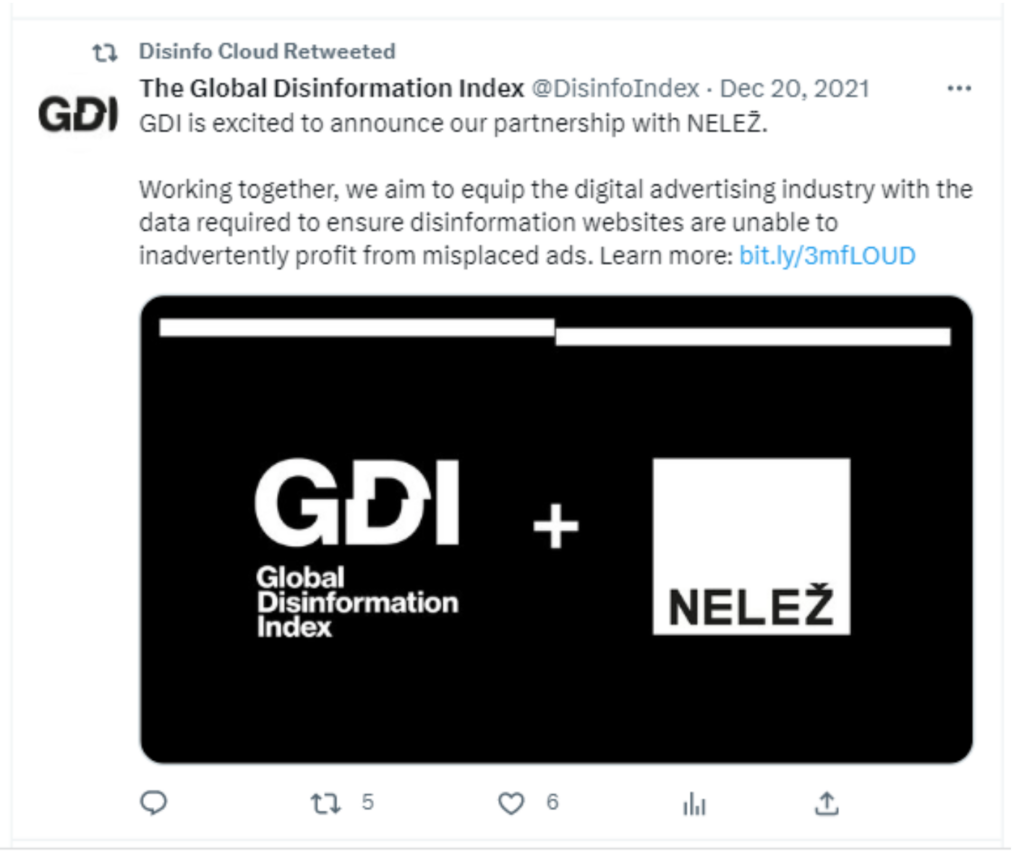
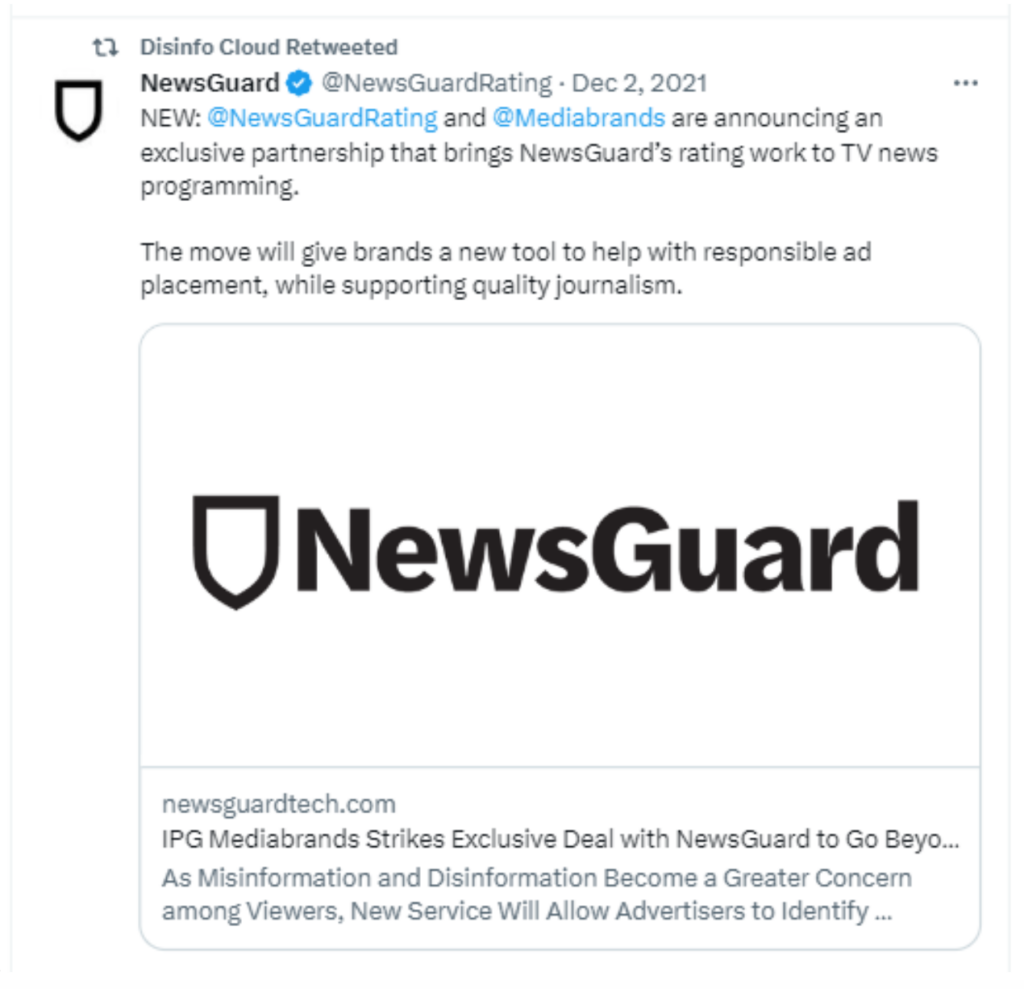
Disinfo Cloud regularly promoted private censorship technology on its official Twitter account and retweeted NewsGuard’s announcement of its partnership with Mediabrands to “bring NewsGaurd’s rating work to TV news programming.
Then beyond promoting the censorship tools, government employees working with GEC helped social media and private-sector businesses identify, test, and tweak the most “appropriate” technology for their “needs.”
And what are those “needs?” Censoring the speech of you and your fellow Americans.
A Scandal Like No Other
This scandal far surpasses the one that formerly ensnared GEC, when it was revealed the State Department awarded the Global Disinformation Index (GDI) — another “ratings” company that blacklists conservative outlets — $100,000 as part of the U.S.-Paris Tech Challenge. GDI also reportedly received money from other government-funded organizations. Those taxpayer funds helped finance GDI’s blacklist of conservative media outlets, which advertisers relied upon to defund dissenters.
But what Stewart’s emails now reveal is that the government is not merely funding censorship research. It is acting as a sales rep to market censorship technology to private companies.
The State Department isn’t skirting the First Amendment. It is driving a stake through its heart.
Margot Cleveland is The Federalist’s senior legal correspondent. She is also a contributor to National Review Online, the Washington Examiner, Aleteia, and Townhall.com, and has been published in the Wall Street Journal and USA Today. Cleveland is a lawyer and a graduate of the Notre Dame Law School, where she earned the Hoynes Prize—the law school’s highest honor. She later served for nearly 25 years as a permanent law clerk for a federal appellate judge on the Seventh Circuit Court of Appeals. Cleveland is a former full-time university faculty member and now teaches as an adjunct from time to time. As a stay-at-home homeschooling mom of a young son with cystic fibrosis, Cleveland frequently writes on cultural issues related to parenting and special-needs children. Cleveland is on Twitter at @ProfMJCleveland. The views expressed here are those of Cleveland in her private capacity.
American Family Association
American Family Association (AFA), a non-profit 501(c)(3) organization, was founded in 1977 by Donald E. Wildmon, who was the pastor of First United Methodist Church in Southaven, Mississippi, at the time. Since 1977, AFA has been on the frontlines of Ame
NEWSMAX
News, Opinion, Interviews, Research and discussion
Opinion
American Family Association
American Family Association (AFA), a non-profit 501(c)(3) organization, was founded in 1977 by Donald E. Wildmon, who was the pastor of First United Methodist Church in Southaven, Mississippi, at the time. Since 1977, AFA has been on the frontlines of Ame
American Family Association
American Family Association (AFA), a non-profit 501(c)(3) organization, was founded in 1977 by Donald E. Wildmon, who was the pastor of First United Methodist Church in Southaven, Mississippi, at the time. Since 1977, AFA has been on the frontlines of Ame
You Version
Bible Translations, Devotional Tools and Plans, BLOG, free mobile application; notes and more
Political
American Family Association
American Family Association (AFA), a non-profit 501(c)(3) organization, was founded in 1977 by Donald E. Wildmon, who was the pastor of First United Methodist Church in Southaven, Mississippi, at the time. Since 1977, AFA has been on the frontlines of Ame
NEWSMAX
News, Opinion, Interviews, Research and discussion
Spiritual
American Family Association
American Family Association (AFA), a non-profit 501(c)(3) organization, was founded in 1977 by Donald E. Wildmon, who was the pastor of First United Methodist Church in Southaven, Mississippi, at the time. Since 1977, AFA has been on the frontlines of Ame
Bible Gateway
The Bible Gateway is a tool for reading and researching scripture online — all in the language or translation of your choice! It provides advanced searching capabilities, which allow readers to find and compare particular passages in scripture based on













 What Did You Say?
You must be logged in to post a comment.