Perspectives; Thoughts; Comments; Opinions; Discussions

Posts tagged ‘GEN Z’

Covid Taught Americans to Stop Trusting a Government That Puts Them Last


By: Elle Purnell | March 12, 2025

Read more at https://thefederalist.com/2025/03/12/covid-taught-americans-to-stop-trusting-a-government-that-puts-them-last/


grayscale photo of people walking street in masks
The reaction to Covid showed Americans the system wasn’t going to save them. They were going to have to do it themselves.

Author Elle Purnell profile

Elle Purnell

Visit on Twitter@_ellepurnell

More Articles

When Donald Trump first sailed into the Oval Office, his detractors shrieked that his blunt rhetoric was dividing the country. His supporters pointed out that Trump wasn’t so much creating division as he was revealing divisions that had been growing in America for a long time. 

The reaction to the novel Wuhan coronavirus did the country a similar service, by revealing a new fault line: two sets of rules, which were applied differently to Americans depending on their membership in certain political cliques. For the average American who assumed his political leaders still shared the belief that all men are created equal, it was a cruel betrayal.

Coronavirus lockdowns alerted Americans to an uncomfortable reality: the institutions to which they’d entrusted their liberties were no longer trustworthy. If the 2024 election is any indication, they got the message.

In the Covid times, hardworking people were deemed “nonessential” and lost their jobs while watching Tony Fauci’s net worth climb. They were banished from church while thousands gathered in the street to worship George Floyd. They watched their kids fall behind in school while Nancy Pelosi and Lori Lightfoot broke the rules to get their split ends trimmed. Their dying loved ones left this world alone, while Obama danced with Hollywood stars at his 60th birthday bash. To add further insult, those loved ones were denied proper funerals, while 10,000 people gathered to eulogize a drug-addicted criminal in a gold casket on television. Only some Americans were authorized to print their opinions online, while others were punished and censored.

The delusion that we were “all in this together” didn’t survive for long. A certain set of rules applied to the BLM protesters, the Democrat politicians, and the Hollywood elites, and another set of rules applied to everyone else. Americans started to realize they were being had.

When Covid vaccine mandates rolled out, the dichotomy was even clearer. For the vaccinated class, there were jobs, service academy appointments, college acceptances, and social acceptance. For the unvaccinated, there was talk of denying them entry to airplanes, restaurants, and stores, or even putting them into camps.

Once the double standard was exposed, it became visible everywhere. The Bidens got away with selling White House access because of their last name, while Trump was relentlessly prosecuted for made-up crimes because of his. Peaceful pro-life protesters were dragged to prison while abortion supporters got away with firebombing pregnancy clinics. Ukrainian oligarchs got billions while we watched the buying power of each paycheck shrink. Our government seemed more interested in caring for citizens of other countries who broke our laws than in looking after its own. Our president was more interested in apologizing for using the term “illegal” to describe Laken Riley’s murderer than he was in apologizing to Riley’s family for inviting her killer across the border. Our speech was muzzled as a “threat to democracy” while partisans gleefully dismantled our republic.

Nearly 8 in 10 Americans told Trafalgar Group pollsters in 2022 that they felt they were living under a two-tiered justice system.

If Covid brought the double standard into focus, the racial turmoil of 2020 confirmed leftists’ belief that it was a good thing. Americans were given different rules to live by, depending on the color of their skin. White Americans were expected to engage in public spectacles of guilt and self-hatred for their own inherent racism, examine their white fragility, pay “reparations” to their black friends, and accept fault for all of society’s ills. Black Americans were encouraged to celebrate their “black pride” and demand preferential treatment. The Smithsonian released an infographic saying traits like being “polite” or on time were hallmarks of “whiteness,” with the overly racist implication that black Americans should not be expected to do either. Hiring quotas were installed to reflect the principle that black and white people should be treated differently.

The ideology represented by the shorthand “DEI” turned this discrimination into a $9 billion industry. DEI didn’t just institutionalize racial discrimination, it also implemented discrimination based on sexual preferences. While white guys got blamed for society’s faults, white guys who dressed up as women got special victim status and Bud Light brand deals!

Americans who still believed God created each man and woman with equally valuable souls were offended at the creation of artificial hierarchies that turned true equality on its head, doling out special privileges based on a person’s race, politics, or sexuality. As institutions — from media to academia to government — led the way in imposing those hierarchies, Americans stopped trusting them.

Like Trump’s uncovering of deep-rooted political divisions in 2016, that loss of trust was as necessary as it was uncomfortable. It almost certainly played a role in Gen Z’s rightward swing. It was a huge step in shrinking the power of the leftist-dominated corporate press, which beclowned itself by uncritically repeating the government’s talking points about masks, vaccines, lockdowns, and Covid’s origins. And it laid the foundations for Americans, after four years of the Biden regime, to embrace Trump’s swamp-draining attitude more enthusiastically than ever.

The years of Covid paranoia and power-grabbing were an experiment in trusting The System, and whether Americans accepted or rejected it revealed as much about them as the 2016 election did. But it also revealed a lot about The System — and all the institutions of power that comprise it — to Americans.

They realized the system wasn’t going to save them. They were going to have to do it themselves.


Elle Purnell is the elections editor at The Federalist. Her work has been featured by Fox Business, RealClearPolitics, the Tampa Bay Times, and the Independent Women’s Forum. She received her B.A. in government from Patrick Henry College with a minor in journalism. Follow her on Twitter @_ellepurnell.
‘Gender-Fluid’ Is The Poisonous Fruit Of The ‘Keep Your Options Open’ Gospel


BY: ELLE PURNELL | APRIL 18, 2023

Read more at https://thefederalist.com/2023/04/18/gender-fluid-is-the-poisonous-fruit-of-the-keep-your-options-open-gospel/

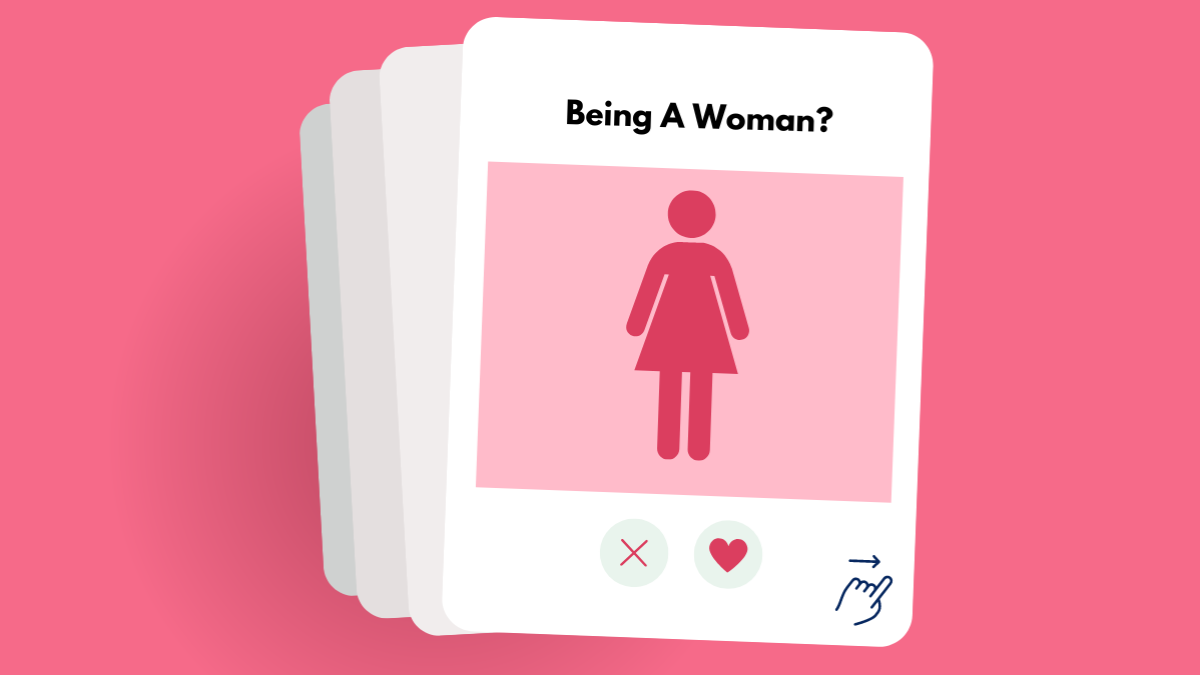
Graphic of swiping right on being a woman
Of course kids think their sex is reversible. Society teaches that everything else is.

Author Elle Purnell profile

ELLE PURNELL

VISIT ON TWITTER@_ETREYNOLDS

MORE ARTICLES

Netflix subscriptions. Marriage. Terms of service agreements. Text messages. Social media posts. Pregnancy. Amazon purchases. Aging.

According to our consumerist social catechism, each of these actions is reversible. Click “cancel.” Get a divorce. Dig through your privacy settings and revoke permissions (even though you know you’re never going to). Unsend. Delete. Get an abortion. Return for free with a preprinted label. Get plastic surgery.

For young people raised in this “Ctrl-Z” world, unfamiliarity with the irreversible breeds suspicion, which translates to avoiding commitments. It’s no surprise few of my generational peers are getting married and having kids — although the culture tells us those commitments are still changeable, they’re actually messy to get out of and necessarily close other doors.

We are taught to believe limitations are inherently oppressive and therefore bad. Keeping your options open, on the other hand, is liberating and therefore desirable.

Some limitations, like those of becoming a parent, we choose to enter into and therefore can choose to avoid — which young people increasingly do. Other limitations are innate and unalterable. But to the restriction-averse, that inescapable nature makes those even more threatening. One of those fearsomely unchangeable limits is our biology: We are afraid to be limited by our natural sex.

Here’s how Amelia Blackney, a 13-year-old girl who decided to start going by the plural pronouns “they/them” and identifying as “non-binary,” explained her decision to CNN:

That way it’s like I’m not a part of any gender or I can be both genders at the same time. My pronouns now put me at a place where I can decide between different genders. That feels right.

If limitations are to be avoided — or overthrown — why would you tie yourself down to being either a girl or a boy? Why limit your prospects to growing up to be either a man or a woman? If you could be gender-fluid, all doors remain open to you. You don’t have to choose to be a she or a he, you can be they! Your options become unlimited. Subscription to being a woman, canceled.

Another child, 14-year-old Sylvia Chesak, described how she was “uncomfortable” thinking of herself as “just” a “she,” and chose to use “any pronouns” as a result.

These children, or the adults who egg them on, revolt against the sex they say was “assigned” in infancy. The nonsense language of “assigned at birth” doesn’t only make the wrong assumption that sex is nonexistent until it’s decreed by a doctor. It also makes the subtle implication that by doing the “assigning,” a doctor is imposing a category — a limit — on an infant that is inherently restrictive and must be abolished. Physical limitations like a man’s inability to get pregnant don’t matter, just like the physical limitations of a kid with Coke-bottle glasses who wants to become a pilot don’t matter to the adults telling him he can “be whatever he wants to be.”

One mother wrote in Time magazine about choosing not to call her child, named Zoomer, either a boy or a girl because she didn’t want to impose the “chains” and “restrictions of the gender binary.” Even after her child expressed a desire to be treated as a particular sex, the woman insisted on calling her child “they” in the article.

Elsewhere, she says, “The aim isn’t to create a genderless world; it’s to contribute to a genderfull one.” In other words, rejecting the sex binary isn’t about erasing sexuality, but removing all of its categorical limits.

A Swedish mother similarly explained that she refused to acknowledge her child’s sex “just as I don’t want to decide what they grow up to do…”

Telling children they can be and do “anything” helped create a generation petrified of narrowing their own options. They date around indefinitely to keep options open in case something better comes along. In the same way, kids learn to keep open the “option” of being a boy or a girl or a xe. Your natural sex is bad because it limits your possibilities.

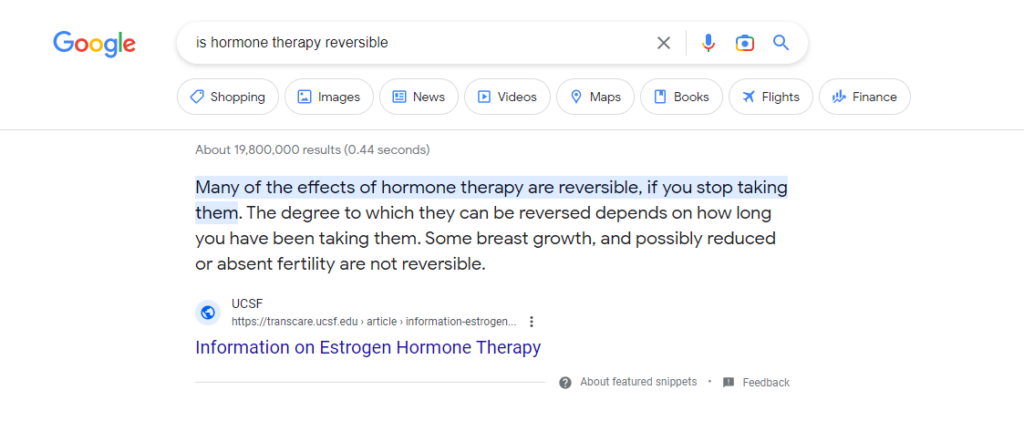
Of course, your possibilities become far more limited when a doctor chops off your breasts or genitals or pumps you with hormones that may permanently alter your voice and body and keep you from ever having children. But just examine the messaging those hormones are marketed by: They’re reversible. You can just stop taking them. Here’s what Google would tell a curious teen, though the fine print is far more complicated than the highlighted answer suggests:

The messaging for puberty blockers is even more overt. Delay puberty, St. Louis Children’s Hospital tells kids, if you want “more time to explore [your] options.” What teen wouldn’t want that?

The reality is, of course, that some limits are outside our control. As for the limits we choose by the commitments we make, it’s far more paralyzing to artificially keep every option open than to choose wisely and live within the natural limitations of an ordered life. For kids getting transed into oblivion, that paralysis may be literal. But for all of us, refusing to commit to decisions worthy of our commitment will leave us lonely, exhausted, and bitter. Eventually, people who don’t want to limit their “options” by getting married usually realize one day that they don’t like any of the options left. Those who never put down roots typically end up adrift.

Thankfully, accepting our finitude is liberating. By recognizing the divine order that confines us, we are freed from struggling against it, and freed to do well in the things that are within our power.

In that latter realm, we have the gift of making choices and commitments, not so that we will avoid ever making them, but so that we may choose what is good. From choosing to work hard, to be loyal friends, to profess our faith, to raise children, to be faithful to our spouses, good choices place obligations on us, many of which are permanent. The fulfillment of those obligations enriches our lives, offering a depth of meaning and satisfaction that “keeping our options open” can never provide.


Elle Purnell is an assistant editor at The Federalist, and received her B.A. in government from Patrick Henry College with a minor in journalism. Follow her work on Twitter @_etreynolds.

Too Dead to Live and Too Alive to Die, Gen Z is Generation Zombie


BY: FORREST ROBINSON | APRIL 13, 2023

Read more at https://thefederalist.com/2023/04/13/too-dead-to-live-and-too-alive-to-die-gen-z-is-generation-zombie/

zombie crew walking toward the camera
An undead generation has emerged — a horde of Gen Z zombies mindlessly marching, ready to mobilize but not thrive.

Author Forrest Robinson profile

FORREST ROBINSON

VISIT ON TWITTER@FOZ89107323

MORE ARTICLES

Does Generation Z take anything seriously? Earnestness is “cringe,” being in love makes one a “simp,” and ambition makes one a “try-hard.”

There is a “deeper ideology lurking in the minds of younger millennials & Gen Z,” as Esmé Partridge writes, “the rejection of idealism in all its forms.” Disenchanted with the world, plagued by hopelessness and nihilism, we have become a generation of zombies — a group of youth that is too dead to live and too alive to die. 

No Purpose or Place

In the 1920s, famed novelist F. Scott Fitzgerald described his lost generation as one that had “grown up to find all gods dead, all wars fought, and all faith in man shaken.” 

A century later, Gen Z finds itself in a similar position. The past haunts us, and a stormy future looms over the horizon. Even in our happiest moments, we’ve come to expect something bad just around the corner. Anxiousness afflicts many Zoomers — more than half of us already think humanity is doomed.

Though we share similarities with past generations, Gen Z is unique. Some argue Zoomers will eventually outgrow their crazy beliefs in the same way hippies eventually got jobs and created families. Millennials, however, are only getting more liberal as they age, breaking one of the oldest rules in politics. According to a recent Gallup poll, roughly 1 in 5 Gen Z adults says he or she is LGBTQ.

First and foremost, Gen Z craves distinction. They want to differentiate themselves from the masses by changing the world through fighting climate change, institutional racism, capitalism — you name it. This might explain why 1 in 4 people aged 16-25 wants to become an influencer when he or she grows up.

Why the thirst for power and status? Humans need goals that require effort to attain. We are like archers who need a clear and higher target. The popularity of figures such as Jordan Peterson shows that, especially for young men, it is no longer clear what that target is.

A Developmental Crisis

In the book “iGen,” Jean Twenge observes that more than previous generations, Zoomers aren’t growing up. We don’t have a meaningful target anymore. Gen Z is dating less, quitting jobsnot attending church, and spending half its waking time online. If Zoomers need attention, they use Instagram. Bored? Netflix or Youtube. Horny? Pornhub. Hungry? UberEats.

It’s not surprising that pundits like Jesse Singal and Jonathan Haidt blame social media for Gen Z’s stunted growth. Apps such as TikTok and Instagram have no doubt profoundly affected us, but blaming social media for Gen Z’s mental health epidemic is only half-correct.

Before we had Instagram, we had liberalism. As Patrick Deneen once wrote, “It is less a matter of our technology ‘making us’ than of our deeper political commitments shaping our technology.”

Jaded and Conformist

Inauthenticity has reached its peak with Gen Z. To be part of the in-group, a Zoomer must adopt a live-and-let-live attitude and remain blasé at all times, unattached to all people and things. Like Gen X, they avoid sincerity, choosing instead to be ironic, humorous, or just plain passionless.

For Zoomers, being serious is “cringe.” They dislike partisan politics because it’s rooted in taking differences seriously. Gen Z is disproportionately liberal not because they are passionate card-carrying Democrats — although some of them are — but because they are apathetic. They just want to be left alone by what the media portray as Bible thumpers, old white politicians, and conservatives. 

It is revealing that the only time Gen Z ever seems mobilized to take things seriously is when a police officer kills a black man or abortion is restricted. Gen Z is so well catechized into its political religion that within minutes, like a flock of sheep, millions of Zoomers suddenly start sharing infographics, donation pages, and memes all over social media. Gen Z only cares about a particular issue when a so-called victim group is allegedly oppressed, or there’s a threat to its autonomy. As soon as the latest political trend goes away, Zoomers stop caring.

A Generation Without Love

The sexual revolution of the ’60s didn’t bring about communism, as Wilhelm Reich hoped, but capitalism in the sexual market. Now driven by a desire for recognition, Zoomers want sexual empowerment above all else.

To that end, Zoomers avoid caring about finding relationships. As one study found, “only one in 10 Gen Z members say they are ‘committed to being committed,’” preferring solitude (or situationships) to real relationships. 

Since seeking commitment is now perceived as exerting pressure, young people must put up a facade of unseriousness and just look for green flags so as not to alienate the person they desire.

Even in a relationship, the psychoanalyzing doesn’t cease. Zoomers analyze texts, obsess over appearance, and worry that their romantic interests are dating other people from Tinder. This perpetual state of uncertainty is so exhausting that many are choosing to either throw out sexual rules completely or abstain from relationships altogether.

Repressed and Insecure

With religious values and sexual norms no longer fixed, many Zoomers struggle to nail down a sense of worth and are thus insecure. Not expressing their real personalities or feelings, these Zoomers live in a perpetual state of “LARPing” and suffer from main character syndrome.

Given their repression of “cringe” thoughts and feelings the in-group might not like, Gen Z’s higher likelihood of engaging in self-harm is unsurprising. To escape the torturous emptiness so many Zoomers find themselves in today, many reach for a razor blade or a smartphone. Either Zoomers gobble down drugs for mental illness, harm themselves, or vainly attempt to produce a sense of self with endless selfies and videos for their followers.

The Zoomers’ obsession with “mental health” and “normalizing” certain behaviors is a byproduct of their unstable self-image. Without knowing how to make sense of their emotions, they outsource the task of understanding themselves to therapists. 

Godless and Selfish

More than anything, Gen Z wants to feel alive. They turned out in droves to support BLM in 2020 because it enabled them to experience the emotional highs and lows of religion without the responsibilities. As Twitter user Zero HP Lovecraft wrote, “Christians are persecuted by bureaucrats, tamely and passively,” while black people “are persecuted by cops with guns and gas grenades. … Only one of these is exciting.” In other words, one belief system feels boring and uninteresting, the other eventful and real — hence why many gravitate toward the latter.

Even many modern so-called Christians, as Rod Dreher observed, use religion as “a psychological adjunct to life, a buffer to the harshness of the materialistic, individualistic lives they actually want to lead.” In the context of Zoomers, that makes religion — and its secular woke derivatives — a supposed stimulant for attaining health and well-being. Since Gen Z now worships the “God within,” there has been a rise in gnostic beliefsself-improvement and wellness cults, astrology and tarot, and, of course, LGBT orthodoxy.

In our post-religious society, life has been reduced to a biological process that must be optimized for the sake of social approval. Instead of prayer, we use painkillers. Instead of aspiring toward good works that glorify God, we engage in meaningless activities that glorify ourselves. And out of that reality has emerged the next undead generation. The horde of Gen Z zombies is mindlessly marching, ready to mobilize but not thrive.


Forrest Robinson is a student at Gordon College in Wenham, Ma. He frequently posts threads on his Twitter @Foz89107323.

As Moral Relativism Replaces Christian Values, Americans Will Suffer More Mass Shootings


BY: KATHLEEN BUSTAMANTE | APRIL 03, 2023

Read more at https://thefederalist.com/2023/04/03/as-moral-relativism-replaces-christian-values-americans-will-suffer-more-mass-shootings/

angry protesters march with signs
The devolution of American society began when moral relativism supplanted biblical truth in education, government, and eventually the family.

Author Kathleen Bustamante profile

KATHLEEN BUSTAMANTE

MORE ARTICLES

The devolution of American society began when moral relativism supplanted biblical truth in education, government, and the family. Beginning in the late 1940s with the Supreme Court’s Everson v. Board of Education ruling and onward, our government and educational system have turned their backs on absolute truth to embrace Marxism, which aims to remove Christianity from all spheres of society.

The moral erosion proves obvious in a recent Barna poll that found, “Millennials are significantly less likely to believe in the existence of absolute moral truth or that God is the basis of all truth.”

The study also noted that “Millennials have less respect for life, in general,” and that “they are less than half as likely as other adults to say that life is sacred. They are twice as likely to diminish the value of human life by describing human beings as either ‘material substance only’ or their very existence as ‘an illusion.’”

Millennials’ disregard for life or morality should not come as a surprise. The decreasing number of young Americans who attend church regularly hear from pastors who may not preach biblical truth. A study by the Cultural Research Center at Arizona Christian University found that only 51 percent of America’s evangelical church pastors hold a biblical worldview. 

Armed with this data, I am thankful that recent shootings like those at The Covenant School in Nashville and the school shooting in Uvalde do not occur more frequently.

Gun-control advocates, the media, politicians, and my friends on social media urge increased gun restrictions as the solution to the problem, pointing to Europe and Australia as the golden standard for gun control. Yet, a 2018 New Zealand Herald article showed that despite tighter gun restrictions in these countries, shootings have occurred more frequently than Americans realize.

In 2022, for example, a gunman killed two and wounded seven people in Denmark, a country with some of the strictest gun laws in Europe, before authorities apprehended him and held him for psychological testing. The article, along with anti-firearm advocates, suggests increased psychological testing as the next solution now that radical gun-control policies have failed.

Not many in Western society honestly address the origin behind increased psychological problems. Western countries increasingly lean on modern mental health mantras rather than dealing with the heart of the matter.

For centuries, firearms have been a standard tool for hunting and home defense in America and Europe. So why the escalation of gun-related massacres throughout the United States and the West over recent decades? Again, I pose the heart of the issue: Moral relativism has replaced the truth of God’s Word.

As a college writing professor, I read and hear the anti-American and anti-Christian propaganda to which my students have been exposed their entire lives. Basic biblical truths such as “treat others how you wish to be treated” and “love your neighbor” have been replaced with mantras like “treat others with kindness unless they offend you” and “love yourself.”

How can a society that raises children devoid of the Christ-centered teachings of Christianity expect anything besides massacres at the hands of miserable, self-centered, and horribly confused individuals like the Uvalde and Highland Park shooters?

Gun Control to Mask Moral Decline

Seven years ago, I attended an active-shooter training hosted by the campus safety department at the community college where I taught in Portland, Oregon. I will never forget the cautionary advice shared by one of the presenters.

“In the event of an active shooter situation, don’t bother calling campus police. Instead, call 911,” he advised. “Campus police at this college are unarmed, so we won’t be able to ensure your safety. Although it will take the local police department much longer to respond to a campus shooting, they will eventually be able to take down a shooter if the need arises.”

Baffled, I asked why campus police are expected to perform their duties unarmed. He explained that several years prior, a college board member felt distressed about campus police carrying firearms. After a swift vote by the board, my safety as well as the safety of my students and colleagues would be jeopardized henceforth.

After the training, I stayed behind to ask the officer his opinion regarding faculty arming themselves on campus. He encouraged me — off the record, of course — to carry concealed for my own safety and for the safety of my students. That college, like most academic institutions across the country, proclaims itself to be a gun-free zone.

A 2019 CNN article documented 10 years of school shootings, and the majority occurred in gun-free zones. A 2019 study conducted by the Crime Prevention Research Center found that in schools across the U.S. that reportedly allow teachers to carry guns on campus, no deaths occurred as a result of shootings between 2000 and 2018.

Neither the problem nor the solution to school shootings has any correlation with guns or mental health problems that can be treated with medication and therapy, as many scholars and pundits contend. Rather, the problem stems from our nation’s replacement of biblical truth with moral relativism.

A Symptom, Not the Cause

As a writing instructor for 16 years, I examined thousands of essays, gaining an unusual window into the lives and experiences of my Millennial and Gen Z students. Like an airline passenger who shares intimate details with a stranger, knowing he will never see that passenger again, many of my students confide personal musings and revelations in their writing.

A surprising number of essays I read unwrap students’ deep suffering related to childhood sexual, physical, or emotional abuse. Some of my students suffer the scars of drug- or alcohol-addicted, neglectful parents. Some students are only a few months clean and sober themselves. Several are homeless. And over the past decade, they write increasingly about gender confusion.

I have detected a common theme throughout their stories. Each of these unique souls is in search of something specific, a need inherent in every human. The agonizing part is that an ancient moral and religious tradition understands their needs, but they do not.

Instead of the moral relativism they have been fed from kindergarten through college, they need to hear truth. Not the “find your own truth” nonsense propagated by educators, Hollywood, and hosts on “The View,” but rather the age-old truth found solely in the Word of God.

The solution is clear: Churches must put away social justice-centered and seeker-friendly sermons and return to expository teaching. Parents must roll up their sleeves and remove the responsibility of parenting from educators and the media by doing the hard work themselves. And voters must stop expecting the government to fix a problem created by sinful humanity.

Instead, we must repent and ask God to point our nation to truth.


Kathleen Bustamante is a freelance writer and former college writing instructor. Her writing has appeared in the American Spectator, the American Conservative, the American Thinker, Real Clear Religion, and James G. Martin Center for Academic Renewal.

Why Did Gen Z Turn Out to Vote for Democrats and Against Their Own Interests?


BY: AUGUSTE MEYRAT | NOVEMBER 16, 2022

Read more at https://thefederalist.com/2022/11/16/why-did-gen-z-turn-out-to-vote-for-democrats-and-against-their-own-interests/

girl in red sweater holding her phone sitting next to a girl friend
No one challenges the kids, so they grow up soft and slow, making them the perfect sheep to be manipulated en masse.

Author Auguste Meyrat profile

AUGUSTE MEYRAT

VISIT ON TWITTER@MEYRATAUGUSTE

MORE ARTICLES

There’s plenty of blame to go around for the disappointing results of the last week’s election: the current post-Covid rules (or lack thereof) for voting, mismanaged ballot collection and counting, Republican leadership, and American voters. Naturally, all of these factors played a role in helping a party that has failed on multiple fronts to stay securely in power.

However, one major reason for Democrats winning was Gen Z voters coming out in large numbers to vote for them — though this was not quite as big a reason as Democrats believe. This cohort was responsible for electing cognitively impaired man-child John Fetterman and incompetent shrew Kathy Hochul as well as reelecting Covid tyrant Gretchen Whitmer. Less unsurprisingly, they’re also responsible for supporting the legalization of marijuana and expanding abortion.

Why did these young people feel motivated enough to go and vote against their interests and keep the country on a downward trajectory? Do they like rising crime, high inflation, mass illegal immigration, homeless encampments, high gas prices, and a shrinking economy? Did they really think Biden would pay off their student loans? Are they just brainwashed zombies who comply with the narratives of TikTok?

Based on my extensive experience as an English teacher, I would say that yes, the average Gen Z American is largely indifferent to important issues that affect the country, even ones that affect their general quality of life. Every day, I witness their lack of reasoning skills and personal drive. This in turn causes them to be disturbingly introverted and handle most of their interactions with people through social media. Many have no real community or deep-seated beliefs and act more on feelings than principle.

Instead, they spend most of their waking life on the internet, consuming mindless content and dreaming up fake personas for themselves. And as a result, they are largely immaturelonely, and neurotic.

This much is argued by writer and former English professor Mark Bauerlein, who writes that Gen Z, “will be the most conformist cohort in American history, already favoring cancellation more than any other age group, and politics will be a primary mode of grouping.” This generation is told what to think by various online influencers, and they passively comply. Because of screen addiction, they will never learn to think or act for themselves, nor will they ever really want to.

The propagandizing effect of heavy social media usage cannot be overstated. For young people, nearly every narrative and social phenomenon now originate from the internet. This means that it’s the dumb and disturbed “influencers” online, not parents or teachers, informing this next generation about politics, economics, and culture. And the algorithms of popular social media sites are designed to curate and amplify this same defective messaging a million times over. The subversive effect on people with still-developing frontal cortexes is not all that different from the “Ludivico technique” in “A Clockwork Orange” in which criminals are forcibly bombarded with images and music in order to condition them against misconduct.

Why is Gen Z so glued to their screens? Two friends and fellow teacher-writers Jeremy Adams and Shane Trotter have examined this question in depth. In his book “Hollowed Out,” Adams argues how the breakdown of family, schools, and the culture at large has left today’s young people morally and intellectually adrift: Not working? Not supporting oneself? Playing video games all day on somebody else’s dime? Not feeling a crumb of shame about it — even describing such a state as happy? That is hollowness.

The many norms and standards (these things that would “fill in” a person) that used to be reinforced by their parents, pastors, teachers, politicians, entertainers, and artists simply aren’t anymore. Should it surprise people that the kids carelessly withdraw from the world and play on their phones?

In Trotter’s book “Setting the Bar,” he attributes the failures of Gen Z to low standards and a permissive parenting culture that coddles kids:

The typical modern youth experience — from the school environment, to the parenting norms, to the broader cultural value structure — is ingraining limiting beliefs and destructive habits that leave our kids ill-equipped for the challenges that lie ahead of them.

No one challenges the kids, so they grow up soft and slow, making them the perfect sheep to be manipulated en masse.

Adams and Trotter demonstrate how circumstances have turned many Zoomers into sad, confused individuals doomed to have an impoverished adulthood. Instead of receiving lessons on independence, critical thinking, and disciplined living, too many of them are protected from all forms of adversity and given an iPad to keep them pacified. This treatment insulates them so much from reality that they never come to know themselves and are bored to the point of despair.

Ironically, understanding this dark reality may be the key to generational reform. True, it might be easy to agree with Bauerlein that Gen Z is hopeless and will probably bring the rest of the nation down with them, but this theory assumes that the Gen Z lifestyle is actually sustainable. The students in my classes all share a natural desire to be better people. I do what I can to offer them a way out; that is, I talk to them and push them to do more. At first, they resist and resort to their phone for comfort but this attitude changes when they feel the profound joy of actually learning and accomplishing something. 

Conservatives can shake their heads at today’s young adults refusing to grow up, or they can actually try to reach these kids. It’s not like they want to be lonely, ignorant, or “neurodivergent.” And most, if they’re being honest, don’t want to be slaves to their smartphones. Rather, like everyone else, they want goodness, beauty, and truth. They want loving relationships, authentic experiences, and some degree of mastery over their emotions and impulses. Above all, they want meaning.

If they have those things, then they will stop voting for corrupt mediocrities and suicidal social policies. More importantly, they will stop wasting away their lives on frivolity and enjoy a fruitful and fulfilling adulthood. Although election results are technically a political matter, what they reveal about voters is a cultural and moral one. We should treat this midterm as the Gen Z cry for help. It’s time for us to go out and save them.


Auguste Meyrat is an English teacher in the Dallas area. He holds an MA in humanities and an MEd in educational leadership. He is the senior editor of The Everyman and has written essays for The Federalist, The American Conservative, and The Imaginative Conservative, as well as the Dallas Institute of Humanities and Culture. Follow him on Twitter.

Watching Phones Instead of Reading Good Books Is Starving Kids’ Souls


BY: KATIE SCHUERMANN | OCTOBER 11, 2022

Read more at https://thefederalist.com/2022/10/11/watching-phones-instead-of-reading-good-books-is-starving-kids-souls/

young man on his phone

Author Katie Schuermann profile

KATIE SCHUERMANN

MORE ARTICLES

Consortium for Classical Lutheran Education 2022 conference. It is excerpted here with CCLE permission.

My husband pastors a campus church at a Big Ten university, and we live amongst college students. It is a blessed life, one in which our evenings are longer and our mornings shorter, all because we have the privilege of fostering 50-plus Gen Z-ers in the faith.

What passion and curiosity reside in the hearts and heads of our young people! But do you know what else resides there? Fear and distrust of most everything coming out of the mouth of anyone older than them.

For so many of these students grew up reading, hearing, watching, and absorbing stories that assert that they are omniscient, that no outside source is as trustworthy as their own feelings. They are certain they know what is best for themselves, and anyone who asserts otherwise is an indoctrinated false prophet of the dead past who simply refuses to sing along with Elsa, “Let it go.”

How did these young people come to trust their own corrupted gut more than the wisdom of their parents? I suspect it has something to do with Cinderella, Ariel, Elsa, and Anna; as well as Monica, Ross, Rachel, Phoebe, Joey, and Chandler; and “Modern Family,” “Sex and the City,” “Parks and Recreation,” Marvel movies, and even “Veggie Tales,” for many of our present college students were raised in homes dominated by screens.

Much of their free time was spent absorbing serial television, and while not every televised program, movie, and YouTube channel necessarily tells false stories, much of modern programming follows a storytelling formula that ensures the pet social agendas of screenwriters are always being covered in the plot and in ways that narrate lies surrounding sexual identity, the sanctity of life, the good order of creation and marriage, the strength of men, and the reality of absolutes.

Stories have always been a part of how we pass down what is good and beautiful and true to our children, but depending on the storyteller, this practice can corrupt as easily as benefit. As more and more families turn over the care of their children to institutions, programs, clubs, teams, and devices, parents are no longer controlling the narrative of the stories being passed down to their children.

The loudest, most powerful propagandist holds the bullhorn, and he makes sure the story’s plot fits his personal agenda, no matter if it is evil and ugly and false. This proves especially dangerous in the classroom, where most children spend the greater part of everyday away from their parents.

We now have generations of children raised by bullhorns, and it is commonplace for a child to be occupied by some sort of program every moment of every day, whether it is a daycare program, school program, televised program, sports program, or an arts program — you name it. Many of today’s college students have had few opportunities in life to grow bored, to daydream, and to experience what happens to their bodies and minds and emotions when not occupied. They seem to have missed out on what used to be standard human experiences such as unregulated play, relating to peers of all shapes, sizes, and maturity levels, and making messy, wonderful, formative relationships with imperfect people.

I have observed that when young people are denied the opportunity to share experiences with other real people, they bond with the fake experiences and fake people they see on a screen instead. It is not uncommon for conversations amongst college students to be centered around Disney or “Game of Thrones” or the show “Friends” or countless other streamed programs. Sadly, those Hollywood-scripted shows are the memories peers share, and those designed-to-disorder plots are the common experiences with which they relate to each other.

So, what do we do about it? How do we reclaim the hearts and minds — the attention — of our children? We have to turn off the television, certainly, and power down our devices and pick out the books to be read before bedtime as well as model chastity and charity and temperance and kindness and patience in our own lives.

As Rod Dreher suggests in “The Benedict Option,” “Christians are going to have to become better tellers of our own story,” for the screenwriters are already pitching a relentless campaign for that position, programming our children into an understanding of humanity and of God that is false, an understanding that fools’ men, born free, into living as slaves to bullhorns.

Bo Giertz, the most celebrated storyteller in my own tradition of Lutheranism, writes: “People often think they are free when they put themselves above God’s commands and don’t do what He wants. Actually, they only stop serving one power and begin serving another. Jesus tells us there is only one way to find true freedom: to remain in His Word, listening, receiving, and understanding. Then we perceive truth, and the truth sets us free, truly free.” (“Wednesday after the Third Sunday in Lent,” To Live with Christ, Bo Giertz, 224.)

We need more of this truth that “sets us free” in the stories our children are consuming. We need to read and discuss books with them that teach toward virtue and away from vice, so our youth can recognize tyranny and slavery to sin when they see it.

And they need to know they are not alone. When the time of persecution inevitably comes — when their character and endurance are put to the ultimate test — it is helpful for them to know that they are in good company. They stand with Jesus and the Apostle Paul and Samwise Gamgee and Josip Lasta and Charles Wallace and Katniss and the Rev. John Ames and Robbie Jones and saints and angels and hundreds of years of fictional heroes who have been tested and tried and even triumphed.

Think of it this way. A child is born having no formative memories of virtues and vices. At least, we hope he doesn’t, for firsthand knowledge of tyranny and sloth and intemperance would suggest that the child has been abandoned or deceived by a parent or abused by an adult or has endured some unthinkable suffering.

But a child can still know that patience is a virtue, that joy accompanies charity, that self-sacrifice has its rewards, and that chastity is a beautiful, worthy aspiration, because he has heard the story of Joseph in Egypt and Isaac on the altar and Stephen in Jerusalem and Frodo in Mordor and Bigwig in “Watership Down” and Anne in Avonlea. These characters and stories — fiction or nonfiction — give children memories of virtues before they experience them themselves. These stories teach children into a thought pattern and into a mindset and behavior that is virtuous, that is free.

As Wendell Berry writes in his essay “A Native Hill”: “It is not from ourselves that we learn to be better than we are.” Our children need us to keep telling them good, true stories — especially the true story of their forefathers, both in the family and in the faith — so they can learn to be better than they are. For we have already seen that, if left to the world and its false stories, our children will learn to be worse than they are.


Katie Schuermann is a full-time homemaker, a part-time musician, and a seasonal writer. Find her books and more at katieschuermann.com.

Tag Cloud