Yesterday, the Supreme Court held the long-awaited argument in Louisiana v. Callais, considering an appeal of Louisiana’s congressional map. The two majority-black districts are being challenged under the 15th Amendment and the Equal Protection Clause of the 14th Amendment as unconstitutionally gerrymandered on the basis of race. The case could result in a rejection of race-based congressional districting under Section 2 of the Voting Rights Act.
Notably, the Louisiana case was previously argued, but on the last day before the summer recess, the court issued an order setting the case for a second oral argument in the 2025-26 term. It later directed the litigants to file briefs addressing:
“whether the State’s intentional creation of a second majority-minority district violates either the 14th Amendment or the 15th Amendment, which bars the government from denying or restricting voting rights based on race.”
On Wednesday, I was addressing the annual conference of chief judges, speaking on the Supreme Court. I discussed some of the current cases, including Louisiana v. Callais. I noted that there may now be a majority in favor of a significant change on Section 2, but that some of us would be listening for Justices Brett Kavanaugh and Amy Coney Barrett as indicators of the Court balance.
We did hear from Kavanaugh and Barrett and the challengers could take heart in the skepticism that they expressed over the indefinite use of race in such districting.
The oral argument took an interesting turn when Justice Ketanji Brown Jackson sought to push back on the need to show a discriminatory intent. She interjected:
“I guess I’m thinking of it, of the fact that remedial action, absent discriminatory intent, is really not a new idea in the civil rights laws. And my kind of paradigmatic example of this is something like the ADA. Congress passed the Americans with Disabilities Act against the backdrop of a world that was generally not accessible to people with disabilities.‘
“And so, it was discriminatory in effect because these folks were not able to access these buildings. And it didn’t matter whether the person who built the building or the person who owned the building intended for them to be exclusionary. That’s irrelevant.‘
“Congress said the facilities have to be made equally open to people with disabilities if readily possible. I guess I don’t understand why that’s not what’s happening here. The idea in Section 2 is that we are responding to current-day manifestations of past and present decisions that disadvantage minorities and make it so that they don’t have equal access to the voting system.’
“They’re disabled. In fact, we use the word disabled in Milligan. We say that’s a way in which you see that these processes are not equally open.”
Justice Jackson appears to be referring to this paragraph in Allen v. Milligan:
“Individuals thus lack an equal opportunity to participate in the political process when a State’s electoral structure operates in a manner that “minimize[s] or cancel[s] out the[ir] voting strength.” Id., at 47. That occurs where an individual is disabled from “enter[ing] into the political process in a reliable and meaningful manner” “in the light of past and present reality, political and otherwise.” White, 412 U. S., at 767, 770. A district is not equally open, in other words, when minority voters face—unlike their majority peers—bloc voting along racial lines, arising against the backdrop of substantial racial discrimination within the State, that renders a minority vote unequal to a vote by a nonminority voter.” (emphasis added)
The court was not making an analogy to the ADA (though, in fairness to Justice Jackson, she was not suggesting that it made that point). It is also worth noting that Chief Justice John Roberts wrote:
“We have understood the language of §2 against the background of the hard-fought compromise that Congress struck. To that end, we have reiterated that §2 turns on the presence of discriminatory effects, not discriminatory intent.”
Milligan was deeply fractured and the question is whether five justices would now elect to set aside or reframe some of these former rulings.
During the oral argument, Roberts seemed to do precisely that in the use of Milligan, remarking “That case took the existing precedent as a given, it was a case in which we were considering Alabama’s particular challenge based on … what turned out to be an improper evidentiary showing.”
Moreover, Justice Kavanaugh (who was one of the concurrences in Milligan) suggested that we might have reached “the end point” on such race-based districting: “[T]his Court’s cases in a variety of contexts have said that race-based remedies are permissible for a period of time, sometimes for a long period of time, decades in some cases, but … they should not be indefinite and should have a[n] end point.”
Now, back to the ADA analogy.
The disabled face permanent and ongoing physical disabilities in accessing buildings and spaces. While Jackson was stressing that intent does not matter when it comes to discrimination against the disabled, the question of the other justices is whether the use of race-based districts will continue indefinitely. The ADA is permanent because the disabilities are permanent. The analogy plays into the very point of justices like Kavanaugh on whether race-based districting would continue ad infinitum.
If the oral argument is a reflection of the eventual votes of the justices, there now seems to be a working majority of justices willing to bring “an end point” to race-based districting. The result would have tremendous legal and political impact.
Legally, one of the most litigated areas of elections would be largely curtailed. The Voting Rights Act would still be used to prevent measures to inhibit voting and to protect the right to vote for every citizen. However, the constant districting controversies over guaranteeing majority black districts would come to an end.
The move would also be a major additional move of the Roberts court to eliminate the use of race-based classifications in society from college admissions to election districting. In a 2007 case, Chief Justice John Roberts stated that position most succinctly by declaring that the “way to stop discriminating on the basis of race is to stop discriminating on the basis of race.”
Politically, any loss of such gerrymandering on the basis of race could impact the Democrats who hold the vast majority of these districts.
Of course, the Court could again fracture as it did in Milligan on the rationale for any opinion. What was notable about the oral argument is that there appeared to be at least five justices considering a threshold rejection of race-based districting under Section 2 of the Voting Rights Act.
There is a major ruling, Mead v. Rockford Public School Dist., a potentially precedent-setting case on parental rights in our public schools. Judge Paul Maloney (W.D. Mich.) ruled that Plaintiffs Dan and Jennifer Mead could move forward with their claims that the Rockford Public School district concealed changes to the gender identification of their biological daughter, identified as G.M. As I have previously written, parental rights are shaping up as a major battleground for the Supreme Court after years of decisions in the lower court undermining parental controls and disclosures.
A recent legal decision captured this growing divide. The U.S. Court of Appeals for the 1st Circuit ruled last month that parents had no protected right to be informed when their children change their gender identity in public school.
In Foote v. Feliciano, Marissa Silvestri and Stephen Foote sued Baird Middle School in Ludlow, Massachusetts, after they learned that school administrators did not inform them that their 11-year-old child had self-declared as “genderqueer” and that teachers and staff were using a new name and new pronouns for the student.
The parents later learned that the school’s staff had continued to meet with their child without their knowledge, implemented the change in gender identity and took active measures not to reveal the change to them (including using the student’s birth name in communications with the parents). The school, without the parents’ knowledge, arranged for changes in everything from the use of male bathrooms to the exclusive use of the child’s new name in class.
The district court in Massachusetts denied the parents’ request for a trial and granted a summary dismissal in favor of the schools.
A century ago, the nation’s highest court ruled in Pierce v. Society of Sisters that “the child is not the mere creature of the State; those who nurture him and direct his destiny have the right, coupled with the high duty, to recognize and prepare him for additional obligations.”
There is no greater natural right than the right to control the upbringing of our children. This right was not granted to us by the grace of the state. It rests with us as human beings. It is part of a panoply of natural rights embraced by the framers − a commitment made nearly 250 years ago in our Declaration of Independence.
The right prevailed in Michigan in this critical threshold ruling. While denying a free exercise claim, the court agreed that there was a viable Fourteenth Amendment claim:
The right of parents to direct their children’s upbringing originated from three Supreme Court cases: Meyer v. Nebraska (1923), Pierce v. Society of Sisters (1925), and Farrington v. Tokushige (1927)…. The Court affirmed the life of this right in Troxel v. Granville (2000). There, the Court held that “the interest of parents in the care, custody, and control of their children [] is perhaps the oldest of the fundamental liberty interest recognized by this Court.” … In addition, parents have a fundamental right to control their child’s health. See Parham v. J.R. (1979). “The law’s concept of the family rests on a presumption that parents possess what a child lacks in maturity, experience, and capacity for judgment required for making life’s difficult decisions.” So “[s]urely, [a parent’s right] includes a ‘high duty’ to recognize symptoms of illness and to seek and follow medical advice.” …
The court noted that the parents were alleging a key element in the case that the district intentionally deceived them and found that these “allegations show some amount of coercion or interference from the district, which implicates Plaintiffs’ right to make fundamental decisions for G.M.”
Below is my column that ran earlier on Fox.com on the calls for the termination of academics and others who have criticized Charlie Kirk or expressed satisfaction with his murder. Unfortunately, such hateful remarks are nothing new in academia. However, this is not about them. It is about us, and more importantly, it is about Charlie and what he fought for his entire life. We cannot allow our anger or sorrow to lead us into becoming the very people that Charlie denounced in his life. If you “Stand with Charlie,” you stand with free speech.
Here is the column:
“Stand with Charlie!” That message spontaneously appeared throughout the world after the unspeakable violent attack by an extremist. No, it was not the response to the murder of Charlie Kirk this week. It was ten years ago with the killing of staff at the satirical magazine Charlie Hebdo. World leaders, including the French, German, and Turkish presidents, joined a march for free speech despite their own speech crackdowns, including prior targeting of the magazine and the victims.
The chief editor, Stéphane Charbonnier, had refused to be silenced by the French government and declared, “I would rather die standing than live on my knees.” He was the first person the gunmen asked for in their attack on the office, and he was one of the first to be killed.
At the time, I wrote about the breathtaking hypocrisy and noted that one of the few surviving editors of the magazine refused to join the march with those who relentlessly pursued them with criminal investigation. After the march, France, Germany, and other Western governments expanded their censorship laws and the prosecution of viewpoints deemed inflammatory or hateful.
In the ultimate dishonoring of the memory of the Charlie Hebdo staff, the French officials then proceeded to use their own murders to justify increasing prosecution of speech
The killing of Charlie Kirk in the United States ten years later is clearly different in one critical respect. There will be no “I am Charlie” campaign on the left. Some on the left have celebrated the killing while others, mouthing regret, attacked Kirk and suggested that he brought this upon himself.
That is hardly a surprise. Kirk spent his tragically short life exposing the hypocrisy and intolerance of the left, particularly in higher education. They hated him for it. Universities and colleges have long been bastions of the left with the purging of most conservative or Republican faculty from most departments and the maintenance of an academic echo chamber in classrooms.
Kirk challenged all that. He drove many mad by inviting them to debate issues. The response was often violence, including the trashing of tables of his group, Turning Point USA. Ultimately, he was killed for insisting on being heard.
However, we are facing the same danger of self-consuming hypocrisy — ten years after that other Charlie shooting. Some on the right are calling for people who denounce Kirk or celebrate his death to be fired. That ranges from professors to public employees.
I knew Charlie. While I cannot call myself a close friend, we spoke about the lack of free speech on our campuses and the efforts to cancel or fire those with opposing views. More than anyone today, Kirk brilliantly exposed that hypocrisy by putting himself and his group in harm’s way.
The way to honor Charlie Kirk’s life and legacy is not with hypocrisy and intolerance. That is what he died fighting against.
To fire people on campuses for speaking out against Charlie Kirk would make an utter mockery of his work and his death. It would be like banning LGBTQ groups in response to the assassination of Harvey Milk in 1978.
Charlie Kirk wanted unfettered debate. He wanted people to be able to express themselves regardless of how the majority felt about their views. He was the victim, not the advocate, of cancel campaigns.
There are instances where hateful views may raise grounds for termination. A secret service agent is under investigation after dismissing the assassination. Given the need to protect conservative as well as liberal figures (including those in the current administration), the bias in the postings can raise legitimate grounds for inquiry.
Likewise, those who use their official, academic, or corporate positions to espouse hateful messages risk termination.
However, many of these individuals were speaking as individuals outside of their positions, and their hateful commentary is not necessarily compromising or conflicting with their positions.
Hate speech in the United States is protected speech. The crackdown on speech deemed hateful, inflammatory, or intolerant has been the signature of the left, the very thing that Charlie campaigned against.
It is never easy to show restraint when you are angry or grieving. After all, many of those objecting to these cases today were silent or supported crackdowns on conservatives for years on and off campuses. They lack any self-awareness or shame in demanding protections that they rarely extend to others with opposing views. That is the value of an age of rage. It gives you license to silence and attack others for their views while insisting that you are the real victim.
However, we cannot become those we have long fought against in the free speech community. More importantly, we cannot become those whom Charlie fought against up to the very moment of his murder. We honor his legacy by protecting the thing that Charlie cherished the most. We need to “Stand with Charlie” and support free speech.
Below is my column in The Hill on the controversial remarks of Sen. Tim Kaine (D. Va.) denouncing a nominee who believed in natural law and the concept of God-given rights. By the end of the hearing, Kaine effectively lumped Alexander Hamilton with Ayatollah Khomeini in his statement at the committee hearing.
Here is the column:
Sen. Tim Kaine (D-Va.) this week warned the American people that a Trump nominee for a State Department position was an extremist, cut from the same cloth as the Iranian mullahs and religious extremists.
Riley Barnes, nominated to serve as assistant secretary of State for democracy, human rights and labor, revealed his dangerous proclivities to Kaine in his opening statement when he said that “all men are created equal because our rights come from God, our creator; not from our laws, not from our governments.”
It was a line that should be familiar to any citizen — virtually ripped from the Declaration of Independence, our founding document that is about to celebrate its 250th anniversary. Yet Kaine offered a very surprising response in the Senate Foreign Relations Committee hearing.
“The notion that rights don’t come from laws and don’t come from the government but come from the Creator — that’s what the Iranian government believes,” he said. “It’s a theocratic regime that bases its rule on Shia (sic) law and targets Sunnis, Bahá’ís, Jews, Christians, and other religious minorities. They do it because they believe that they understand what natural rights are from their Creator. So, the statement that our rights do not come from our laws or our governments is extremely troubling.”
The idea that laws “come from the government” is the basis of what is called “legal positivism,” which holds that the legitimacy and authority of laws are not based on God or natural law but rather legislation and court decisions.
In my forthcoming book celebrating the 250th anniversary, Rage and the Republic: The Unfinished Story of the American Revolution, I detail how the Declaration of Independence (and our nation as a whole) was founded on a deep belief in natural laws coming from our Creator, not government. That view is captured in the Declaration, which states, “We hold these truths to be self-evident, that all men are created equal, that they are endowed by their Creator with certain unalienable Rights, that among these are Life, Liberty and the pursuit of Happiness.”
Kaine represents Virginia, the state that played such a critical role in those very principles that he now associates with religious fanatics and terrorists. In fact, Kaine’s view did exist at the founding — and it was rejected. Alexander Hamilton wrote that “The sacred rights of mankind are not to be rummaged for among old parchments or musty records. They are written, as with a sunbeam, in the whole volume of human nature, by the hand of the Divinity itself, and can never be erased or obscured by mortal power.”
Although the Framers were clear, Kaine seemed hopelessly confused. He later insisted that “I’m a strong believer in natural rights, but I have a feeling if we were to have a debate about natural rights in the room and put people around the table with different religious traditions, there would be some significant differences in the definitions of those natural rights.”
This country was founded on core, shared principles of natural law, including a deep commitment to individual rights against the government. The government was not the source but the scourge of individual rights. This belief in preexisting rights was based on such Enlightenment philosophers as John Locke who believed that, even at the beginning when no society existed, there was law, “The state of nature has a law of nature to govern it, which obliges everyone,” he wrote. “And reason, which is that law, teaches all mankind.”
Note that a natural law can also be based on a view of the inherent rights of human beings — a view of those rights needed to be fully human. Like divinely ordained rights, these are rights (such as free speech) that belong to all humans, regardless of the whim or want of a given government. They are still not “rights [that] come from our laws or our governments.”
The danger of legal positivism is that what government giveth, government can take away. Our prized unalienable rights become entirely alienable if they are merely the product of legislatures and courts.
It also means that constitutional protections or even the constitutional system itself is discardable, like out-of-fashion tricorn hats. As discussed in the book, a new generation of Jacobins is rising on the American left, challenging our constitutional traditions. Commentator Jennifer Szalai has denounced what she called “Constitution worship” and argued that “Americans have long assumed that the Constitution could save us. A growing chorus now wonders whether we need to be saved from it.”
That chorus includes establishment figures such as Erwin Chemerinsky, dean of the Berkeley Law School and author of “No Democracy Lasts Forever: How the Constitution Threatens the United States.”
Other law professors, such as Ryan D. Doerfler of Harvard and Samuel Moyn of Yale, have called for the nation to “reclaim America from constitutionalism.”
That “reclamation” is easier if our rights are based not in natural law, but rather in the evolving priorities of lawmakers like Kaine. Protections then become not the manifestations of human rights, but of rights invented by humans. Kaine’s view — that advocates of natural law are no different from mullahs applying Sharia law — is not just ill-informed but would have been considered by the founders as constitutionally blasphemous.
He is, regrettably, the embodiment of a new crisis of faith in the foundations of our republic on the very eve of its 250th anniversary. This is a crisis of faith not just in our Constitution, but in each other as human beings “endowed by their Creator with certain unalienable Rights.”
When President James Buchanan declared that the United States Senate is the “world’s greatest deliberative body,” he clearly had not envisioned Sen. Cory Booker (D., N.J.). In yet another tirade on the floor, Sen. Booker attacked not just President Donald Trump but his Democratic colleagues for voting for a bipartisan bill on law enforcement. Behind the “I am Spartacus” theatrics is a more troubling trend in the United States Senate as it devolves into a more populist, impulsive institution.
In 1872, Moncure Daniel Conway published an account of a meeting between Thomas Jefferson and George Washington. Jefferson questioned Washington’s support for the creation of a second or upper house in the form of the Senate. Washington asked:
“Why…did you just now pour that coffee into your saucer, before drinking?”
“To cool it,” answered Jefferson, “my throat is not made of brass.”
“Even so,” rejoined Washington, “we pour our legislation into the senatorial saucer to cool it.”
These days, it seems like legislation goes to the Senate to heat up. The Senate is losing its constitutional and cultural moorings as the cooling saucer for our heated politics. Instead, it is becoming more like . . . well . . . the house.
The role of the Senate is key to the Madisonian design in forcing compromise and deliberation. Senators were given longer, six-year terms to insulate them from the immediate political demands that often motivate the House.
That has changed with the 24-hour media-saturated political environment. It has changed in this age of rage. Cue Corey Booker:
Putting the claims of “secret police” and, once again, the imminent collapse of democracy, Booker was immediately set upon by his colleagues after he moved to block the bipartisan bill by fellow Democratic Sens. Catherine Cortez Masto (Nev.) and Amy Klobuchar (Minn.). Klobuchar effectively accused Booker of grandstanding and hypocrisy:
“I will note that Sen. Booker objected to my police reauthorization bill, the cops funding, the Clinton cops funding, long before Donald Trump came into office. So, this is not just about this. This is a long dispute over this type of funding.”
She also snapped back at Booker saying that he could not make a key hearing on the drafting of the bill because of a conflict, noting “I can’t help it if someone couldn’t change their schedule to be there.”
Cortez Masto struck back at the notion that Democrats should simply refuse to cooperate with the Administration or that working with Republicans is what Booker calls “complicity.”
Booker is clearly maneuvering for a possible presidential run and seeking to tap into the rage growing on the far left. He is also the inevitable result of the rising rhetoric of figures like Senate Minority Leader Chuck Schumer in pandering to the far left of his party. Democratic senators are now being denounced as “establishment” as Booker and others tack to the left to lead “the resistance.”
Booker just raised the anger ante for Democrats. They must either join the resistance and the rage or face the ire of their party. In the interim, the constitutional system will suffer. We need the House of Representatives as the “people’s house.” We do not need two Houses of Representatives. The Senate ideally moderates, not magnifies, the pressures and passions in the political system.
Booker’s tirades clearly resonate with some on the far left, but it is likely to come at a cost for the institution itself. As tensions build on the Democratic side, Teddy Roosevelt’s quip seems to be coming true in voting for bipartisan legislation: “When they call the roll in the Senate, the Senators do not know whether to answer ‘Present’ or ‘Not guilty.””
On Tuesday the Justice Department petitioned for a writ of Quo Warranto against three individuals having served as board members of the Corporation for Public Broadcasting who were fired by President Trump yet allegedly continued to hold and exercise their office.
The complaint states “[s]ince April 28, 2025, Defendants Laura G. Ross, Thomas E. Rothman, and Diane Kaplan have been usurping and purporting to exercise unlawfully the office of board member of the Corporation for Public Broadcasting (the “CPB”)… President Donald J. Trump lawfully removed each Defendant from office on April 28, 2025. As recent Supreme Court orders have recognized, the President cannot meaningfully exercise his executive power under Article II of the Constitution without the power to select—and, when necessary, remove—those who hold federal office. Personnel is policy, after all.”
According to Defendants, they “received an email from Trent Morse, the Deputy Director of Presidential Personnel for the Executive Office of the President, purporting to notify the board members that their positions on the Board of Directors for CPB were terminated… The Correspondence stated, in full:
‘On behalf of President Donald J. Trump, I am writing to inform you that your position on the Corporation for Public Broadcasting is terminated effective immediately. Thank you for your service.’”
Immediately after President Trump’s effort to remove the board members from their positions, the three “immediately sought a preliminary injunction against the president and other officials, seeking to enjoin the government from completing their firing. See Corp. for Pub. Broad. v. Trump, Civ. A. No. 25-1305 (RDM) (D.D.C. Apr. 29, 2025). Their effort was unsuccessful as the court held that their claim the president lacked authority to remove them from office was unlikely to succeed.’
“The Justice Department’s complaint accused the three defendants of continuing to usurp the office of Board Member of the CPB by “participating in board meetings, voting on resolutions and other business that comes before the board, and presenting themselves to the public as board members. All of this [was] manifestly unlawful.”
The board members’ original complaint, argued that the CPB was created by Congress to be “a private corporation [to] be created to facilitate the development of public telecommunications and to afford maximum protection from extraneous interference and control.” They specifically argued the following:
CPB is not a federal agency subject to the President’s authority, but rather a private corporation. See Id. at § 396(b) (“[CPB] will not be an agency or establishment of the United States Government. The Corporation shall be subject to the provisions of this section, and, to the extent consistent with this section, to the District of Columbia Nonprofit Corporation Act.”);
CPB’s Board members are not officers of the United States, and thus are not within the removal provisions of Article II of the Constitution. See Id. at § 396(d)(2) (“The members of the [CPB] Board shall not, by reason of such membership, be deemed to be officers or employees of the United States.”);
CPB Board members cannot be affected, controlled, or disturbed by the actions of the government. See Id. at § 398(c) (forbidding “any department, agency, officer, or employee of the United States to exercise any direction, supervision, or control over educational television or radio broadcasting, or over [CPB] …”);
CPB Board members forfeit their membership in only one scenario, not present here. See Id. at § 396(e)(7) (“Members of the Board shall attend not less than 50 percent of all duly convened meetings of the Board in any calendar year. A member who fails to meet the requirement … shall forfeit membership.”);
The Act omits the typical statutory provision when creating a federal agency that the Board members serve at the pleasure of the President.
The board members sought in their complaint declaratory relief, and alleging “Violation of the Administrative Procedure Act Not in Accordance with Law/In Excess of Statutory Authority, Violation of Separation of Powers/Ultra Vires Presidential Action, Violation of the Presentment, Appropriations, and Take Care Clauses.” They also sought relief in having the court declare the e-mail terminating their position to have no legal effect and a temporary restraining order “prohibiting the Defendants from taking any action which gives effect to the Correspondence or otherwise seeks to interfere with or control the governance and operations of CPB” along with legal fees and any other relief the court might grant.
In its quo warranto filing, the Justice Department countered, “Although the Public Broadcasting Act provides that “[t]he members of the Board shall not, by reason of such membership, be deemed to be officers or employees of the United States,” 47 U.S.C. § 396(d)(2), and that the CPB “will not be an agency or establishment of the United States Government,” id. § 396(b), the Act and other statutes provide many levers of government control and influence over the CPB:
[in partial list for brevity]
As noted above, all CPB board members are appointed by the President and confirmed by the Senate. Id. § 396(c)(1).
Congress set forth specific qualifications for board members, including that no more than 5 members will be of the same political party, that board members must be “eminent in” relevant fields, and that the Board contain members who represent licensees and permittees of public television stations and public radio stations. Id. § 396(c)(1)-(3).
Congress restricted the compensation of CPB officers and employees based on a federal employee pay scale. Id. § 396(e)(1).
Congress authorized the CPB to take various actions “[i]n order to achieve the objectives and to carry out the purposes of” the Act. Id. § 396(g); see also id. § 396(a) (listing those objectives and purposes). The CPB funds “public telecommunications . . . programs,” assists “in the development . . . of interconnection systems” and “public telecommunication entities.” 47 U.S.C. § 396(g)(1). And the CPB is empowered to make grants, hire staff, make payments, and to “take any other actions” necessary to support its congressional purposes. Id. § 396(g)(2). Congress also “prohibited” the CPB from owning or operating broadcast stations or producing its own programming. Id. § 396(g)(3). The CPB is primarily funded through annual Congressional appropriations. Id. § 396(k)(1). For example, in 2024, Congress appropriated $535 million to the CPB for fiscal year 2026. See Further Consolidated Appropriations Act of 2024, Pub. L. No. 118-47, 138 Stat. 460, 696, § 407.
[…]
Congress imposed various requirements on recipients of grants from the CPB, including that they hold open meetings, that public broadcast station grant recipients establish a community advisory board, and that employees of the Public Broadcasting System and National Public Radio cannot “be compensated in excess of reasonable compensation” while those organizations receive grants. Id. § 396(k)(4), (8), (9).
[…]
The CPB is a “designated Federal entity” under the Inspector General Act, 5 U.S.C. § 415(a)(1)(A), which means it has an Inspector General who conducts investigations and audits of CPB operations and issues reports to Congress, the CPB Board and management, and the public, see Office of the Inspector General, Corporation for Public Broadcasting, https://perma.cc/AAD4-G5DL (the CPB’s Office of the Inspector General “conduct[s] independent audits, evaluations, and investigations” and “report[s] to Congress and the public about our activities”).
Congress holds oversight hearings regarding the CPB. See, e.g., House Committee on Energy & Commerce, Oversight and Investigations Subcommittee Hearing: “Examining Accusations of Ideological Bias at NPR, a Taxpayer Funded News Entity,” https://perma.cc/W284-W8GW (May 8, 2024).
Specific allegations against the board members, state the three held board meetings on May 2nd, 13th and June 10th and 11th where they voted in their official capacity, adopted resolutions, and acted as if the preliminary injunction they sought had been held in their favor. Also, the President under his Article II powers has:
“[a]mple authority, both longstanding and recent, [to] establish that the power to appoint someone to a position presumptively carries with it the incident power of removal, absent a clear restriction on that removal authority. “ citing also Lebron v. National Railroad Passenger Corp., 513 U.S. 374 (1995). The Supreme Court held that the National Railroad Passenger Corporation (commonly known as Amtrak) was “an agency or instrumentality of the United States for the purpose of individual rights guaranteed against the Government by the Constitution,” even though the federal statute creating Amtrak structured it as a corporation and provided that Amtrak would not be a government agency. The Supreme Court held “that where, as here, the Government creates a corporation by special law, for the furtherance of governmental objectives, and retains for itself permanent authority to appoint a majority of the directors of that corporation, the corporation is part of the Government for purposes of the First Amendment. Lebron involved a First Amendment claim, but the Supreme Court later applied similar analysis to hold that Amtrak is also “a governmental entity for purposes of the Constitution’s separation of powers provisions.” Dep’t of Transp. v. Ass’n of Am. R.Rs., 575 U.S.43, 53-54 (2015).”
The government requested the court “enter judgment that Defendants “be ousted and excluded” from the office of board member of the CPB. The Court should also grant appropriate ancillary relief, including return of any salary or payment Defendants have unlawfully taken by virtue of their usurpation of office” and that any official actions taken by the Defendants since their termination be nullified
Judge Randolph Moss of the US District Court for the District of Columbia, who presides over both the Board Member’s and the Justice Department’s complaints found it “difficult to fathom that Congress intended to provide the members of the Corporation’s Board with essentially irrevocable tenure.”
By Darren Smith
The views expressed in this posting are the author’s alone and not those of the blog, the host, or other weekend bloggers. As an open forum, weekend bloggers post independently without pre-approval or review. Content and any displays or art are solely their decision and responsibility. – JonathanTurley.org
The Trump administration notched another victory this week when U.S. District Judge Amit Mehta in Washington granted a motion to dismiss a case brought by five organizations to stop the cancellation of more than 360 grant awards by the Justice Department. However, in reaching this relatively straightforward conclusion, Judge Mehta opted to follow a pattern set by other judges in adding his own personal commentary on the wisdom of the policy change. Judge Mehta easily found that he lacked jurisdiction over such questions. However, he then vented his own personal views on the policy:
“Defendants’ rescinding of these awards is shameful. It is likely to harm communities and individuals vulnerable to crime and violence. But displeasure and sympathy are not enough in a court of law.”
Actually, neither the court’s displeasure nor sympathy should be part of the decision of a court of law. With all due respect to Judge Mehta, some of us find it shameful that judges are using these opinions to express their political viewpoints. I previously wrote about this pattern of extrajudicial commentary, particularly among the judges of the U.S. District Court for the District of Columbia.
District Court Judge Tanya Chutkan, an Obama appointee who previously presided over Trump’s election interference case, was criticized for failing to recuse herself from that case after she made highly controversial statements about Trump from the bench. In a sentencing hearing of a Jan. 6 rioter in 2022, Chutkan said that the rioters “were there in fealty, in loyalty, to one man — not to the Constitution.” She added then, “[i]t’s a blind loyalty to one person who, by the way, remains free to this day.” That “one person” was still under investigation at the time and, when Trump was charged, Chutkan refused to let the case go.
Later, Chutkan decided to use the bench to amplify her own views of the pardons and Jan. 6. Like Judge Mehta, she conceded that she could not block the pardons but used the cases to express her personal disagreements with President Trump and his policies. She proclaimed that the pardons could not change the “tragic truth” and “cannot whitewash the blood, feces and terror that the mob left in its wake. And it cannot repair the jagged breach in America’s sacred tradition of peacefully transitioning power.”
I fail to see how being assigned this case gives a judge license to hold forth on their own views of the merits of these grants or the implications of their suspension. He is tasked with deciding the legal questions in the case, which he did so correctly.
The warning was stark. At issue was a privileged class that has long dictated policy despite countervailing public opinion. At issue, the luminary warned, is nothing short of democracy itself. No, it was not the continued rallies of Sen. Bernie Sanders (I., VT) to “fight oligarchy.” It was Justice Clarence Thomas rallying his colleagues to fight technocracy, or government by experts. He warned against allowing “elite sentiment” to “distort and stifle democratic debate.” Yet, the story is even more profound of an elite class which succumbed to the Icarian gene and fell to Earth due to hubris and excess.
In his concurrence in United States v. Skrmetti, a case upholding Tennessee’s ban on adolescent transgender treatments, Thomas called for his colleagues to stand against an “expert class” that has dictated both policy and legal conclusions in the United States. The reference to “experts” is often used to insulate an opinion as self-evidently true on a given question when they speak as a group. It distinguishes the informed from the casual; the certifiably authoritative from the merely interested. Yet, what constitutes an “expert” can be little more than an advanced degree, and the “overwhelming opinion of experts” can be little more than groupthink.
Thomas warned his colleagues that “[t]here are particularly good reasons to question the expert class here, as recent revelations suggest that leading voices in this area have relied on questionable evidence and have allowed ideology to influence their medical guidance.”
Indeed, those “good reasons” have become increasingly obvious to those outside of the Beltway. The public saw experts line up during the pandemic to support mandatory uses of surgical masks, shutting down schools, and requiring the ruinous six-foot rule of separation. Many of these rules were later found lacking in scientific support. At the same time, dissenting experts, including the signatories of the Great Barrington Declaration, were blacklisted, censored, or fired for challenging these views.
We have seen the same orthodoxy on issues ranging from gender dysphoria to COVID measures.
In his concurrence, Thomas lashed out at the virtual mantra in court papers and the media of an “overwhelming medical consensus” in favor of transitioning children. This is often cited as the conclusive judgment of experts as opposed to citizens who overwhelmingly oppose treatments for children, including castration or surgical removal of genitalia. Thomas insisted that “so-called experts have no license to countermand the ‘wisdom, fairness, or logic of legislative choices.’”
For decades, citizens largely identified the government with bringing modern approaches to programs eliminating long-standing social ills from poverty to illiteracy to inequality. Roughly 100 years ago, the New Deal of Franklin Delano Roosevelt transformed the government’s role in American life. A generation of experts brought new ideas of electrification, education, and economics to the country.
This veneration was furthered by Kennedy’s assemblage of “the best and the brightest” and Johnson’s “Great Society” reformers.
The courts later followed with greater and greater deference afforded to these experts, including the establishment of the “Chevron doctrine” insulating agency decisions from substantial judicial review. The Supreme Court ruled that courts were poorly equipped to second-guess the expertise of agency experts.
The Reagan Revolution challenged those assumptions. Reagan famously told voters that “the nine most terrifying words in the English language are: I’m from the Government, and I’m here to help.”
Over the years, the mystique took on a more menacing aspect for many in the country as they watched academic and scientific groups become more advocates than experts. There seemed to be a shift from making for a better life to making us better people through progressive social agendas.
The result has been a dramatic change in trust for higher education and, by extension, the supremacy of the expert class. According to Gallup, only a third of Americans today have great confidence in higher education and roughly the same number have little or no confidence. That is a drop of over twenty percent in the last ten years.
Other polling shows drops in the trust for state and local public health officials as well as the U.S. Centers for Disease Control and Prevention (CDC).
The decline of the expert class can be traced to the changes in higher education over the last couple of decades. As I discuss in my book The Indispensable Right, an orthodoxy has taken hold of most universities with a purging of conservative, libertarian, and dissenting faculty. Within these ideological echo chambers, appointments, publications, and grants often seem to turn on conclusions that favor political agendas.
Over the years, dissenting faculty members have been forced out of scientific and academic organizations for challenging preferred conclusions on subjects ranging from transgender transitions to COVID-19 protections to climate change. Some were barred from speaking at universities or blacklisted for their opposing views.
As shown during COVID, many of the exiled experts were ultimately proven correct in challenging the efficacy of surgical masks or the need to shut down our schools and businesses. Scientists moved like a herd of lemmings on the origin of the virus, crushing those who suggested that the most likely explanation is a lab leak (a position that federal agencies would later embrace).
Scientists have worked with the government in suppressing dissenting views. At the end of last year, The Wall Street. Journal released a report on how the Biden administration suppressed dissenting views supporting the lab leak theory, as dissenting scientists were blacklisted and targeted. When experts within the Biden Administration found that the lab theory was the most likely explanation for COVID-19, they were told not to share their data publicly and were warned about being “off the reservation.”
British pediatrician Hilary Cass published a review for NHS England that cast doubt on gender-identity treatments for children and young people. The research reportedly led to an aggressive campaign by the World Professional Association for Transgender Health (WPATH) to suppress the results.
The gravitational pull of social agendas has overwhelmed not just scientific judgment but common sense. For example, there has been a push to treat gender as a socially constructed myth. A University of Pittsburgh anthropology professor declared that you cannot tell the gender of an individual from their bones – a widely ridiculed assertion.
The editor-in-chief of Scientific American Laura Helmuth made her own contribution to gender ideology by tweeting out a statement with a 2017 article in Audubon Notebook stating “White-throated sparrows have four chromosomally distinct sexes that pair up in fascinating ways. P.S. Nature is amazing[.] P.P.S. Sex is not binary.”
Various experts cried fowl and noted that her point was ideologically driven and scientifically absurd. (Helmuth later resigned after posting a profanity-laden attack on social media calling Trump voters “fascists” and bigots).
In many cases, dissenting views on social or political issues are treated as disqualifying for any research. At Cornell, professors signed a letter denouncing“informed commentary” critical of violent protests as racist.
In 2020, Harald Uhlig, the senior editor of the prestigious Journal of Political Economy and the Bruce Allen and Barbara Ritzenthaler Professor in Economics at the University of Chicago, criticized Black Lives Matter and the movement to defund the police. The response was a campaign to remove Uhlig from the Journal. Writers like economist Paul Krugman insisted that he was now “yet another privileged white man” attacking the “less fortunate.”
The University of Pittsburgh Medical Center removed Associate Professor of Medicine Norman Wang from his position as Program Director of the Electrophysiology Fellowship after he wrote an article in a peer-reviewed journal questioning the use of affirmative action in medical schools admissions. (Later, the Supreme Court would declare such use of race as unconstitutional race discrimination).
Another controversy arose in 2024 just before the Supreme Court considered access to mifepristone, one of two drugs used for abortions by mail. District Judge Matthew Kacsmaryk relied on two studies that showed harm from the use of the pill.
The Sage journal Health Services Research and Managerial Epidemiology was widely criticized by abortion advocates for publishing the studies. One month before the oral argument, the studies were conveniently retracted and a review published that found the conclusions “invalidated in whole or in part.”
Justices and judges will often take favorable studies as gospel in supporting their legal conclusions. In her dissent in the University of North Carolina affirmative action case, Justice Ketanji Brown Jackson triggered a controversy in citing a 2020 study from a friend-of-the-court brief by the Association of American Medical Colleges. Jackson claimed that race-based admissions “saves lives” because having a Black physician more than doubles the likelihood of the survival of high-risk Black babies. The claim of the brief and the flawed methodology of the study was shredded by critics.
The fact is that it is easy to produce near uniformity of experts since most universities now run from the left to the far left. The combination of biased hiring practices has left most departments with few or no conservative faculty members. As a result, the media can report that liberal positions are supported overwhelmingly by “experts.”
For example, it is now common for the media to report signed letters or petitions of law professors denouncing conservative positions or rulings. It rarely mentions that most law schools have only a couple of conservative faculty members. It is like getting a pro-papal petition from the College of Cardinals. Nevertheless, the coverage leaves the impression that opposing views on transgenderism, gun rights, or other subjects are absurd and rejected by virtually all “experts.”
Both the courts and the public, however, appear to be losing their awe for the expert class. The Supreme Court recently tossed the Chevron Doctrine and called for courts to resume their prior scrutiny of agency decisions.
None of this means that courts or the public should disregard science or experts. Indeed, many experts still follow core principles of unbiased inquiry and discourse. However, good science requires open inquiry and a diversity of viewpoints. Citizens are rejecting science by plebiscite, the self-authenticating petitions where academics purported to speak for an expert class.
The expert class lost the public when they replaced objectivity with orthodoxy. No matter how many experts claim that gender is a social myth, the public is not likely to dispense with reality. The rise and fall of the expert class is a story of the costs of arrogance and excess. Higher education has created a privileged class of social warriors who abandoned core principles of neutrality and objectivity in research. It is an Icarian generation of scholars who flew too close to the sun and fell to Earth in the eyes of the public.
Yesterday, I wrote a column in the Hill discussing how Trump is unlikely to go to Congress in launching an attack on Iran and how he has history on his side in acting unilaterally. The column noted that many Democratic politicians and pundits who were supportive of such unilateral actions by Democratic presidents such as Bill Clinton and Barack Obama are suddenly opposed to Trump using the same power. It is the Claude Rains School of Constitutional Law where politicians are “shocked, shocked” that Trump is using the authority that they accepted in Democratic predecessors.
Democratic members are calling for impeachment, while others are declaring the attacks unconstitutional. Senate Minority Leader Chuck Schumer is particularly shocked that Trump took the action and is calling for a vote under the War Powers Act.
Schumer insisted that “no president should be allowed to unilaterally march this nation into something as consequential as war with erratic threats and no strategy.” House Minority Leader Hakeem Jeffries has issued a similar statement.
Schumer is the same politician who was silent or supportive in earlier unilateral attacks by Democratic presidents. In 2011, Obama approved a massive military campaign against Libya. I represented a bipartisan group of members of Congress challenging that action. We were unsuccessful, as were such prior challenges.
I have long criticized the abandonment of the clear language of the Constitution on the declaration of wars. Only eleven such declarations have been made in our history. That has not happened since World War II in 1942. Over 125 military campaigns have spanned from Korea to Vietnam, Afghanistan, and Iraq. It is not a rule honored solely in the breach.
Democrats were supportive when Clinton launched cruise missile attacks under Operation Infinite Reach on two continents on August 20, 1998. He ordered attacks in locations in Khartoum, Sudan, and Khost Province, Afghanistan.
The War Powers Act has always been controversial and largely ineffectual. Presidents have long asserted the inherent powers to conduct such attacks under their Article II authority as the designated Commander-in-Chief of the Armed Forces. The WPA requires the President to inform Congress within 48 hours in a written notice to the Speaker of the House of Representatives and the President pro tempore of the Senate of the action.
The WPA further bars the use of armed forces in such a conflict for more than 60 days without congressional authorization for use of military force (AUMF) or a declaration of war by the United States. There is a further 30-day withdrawal period.
President Trump reportedly did immediately notify Congress after the attack under the WPA .
Presidents have routinely ignored the WPA when it limited their ability to conduct foreign military operations. In 1999, Clinton ignored the 60-day deadline and continued to bomb forces in Kosovo. His actions were also challenged, but the court in Campbell v. Clinton just shrugged off the violation and said it was a non-justiciable political question.
In responding to the current demands, Trump could look to a curious ally: Hillary Clinton.
Secretary of State Hillary Clinton pushed for unilateral attacks during the Obama Administration. She dismissed the need to consult, let alone secure authorization, from Congress. In March 2011, Clinton testified that there was no need for such consultation and declared that the Administration would ignore a 60-day limit on unauthorized military actions.
Obama also defied the War Powers resolution on Syria. He actually did ask for congressional authorization to take military action in that country in 2013, but Congress refused to approve it. He did it anyway. Despite Congress expressly denying, ” authorization for the introduction of United States Armed Forces,” both Obama and Trump did precisely that.
Trump was wise to notify Congress. However, what occurs after that is anyone’s guess. The WPA and the AUMF have been paper tigers for decades and most in Congress wanted it that way. Politicians long ago abandoned their responsibilities to declare war. What remains has been little more than political theater.
Even under the WPA, Trump would have 60 days to prosecute this war and another 30 days to draw down forces without congressional approval. The court, in Campbell v. Clinton, noted that even if Clinton violated the WPA by continuing operations after the 60-day period, he was technically in compliance by withdrawing forces before the end of the 90-day period.
Trump could likely prosecute this campaign in 90 days. Indeed, if it goes beyond 90 days, we will likely be facing a potential global war with retaliatory strikes on both sides. In such an environment, it is very unlikely that Congress would withhold support for our ongoing operations.
In the meantime, the calls for impeachment are absurd given the prior actions of presidents in using this very authority. Once again, some Democrats appear intent on applying a different set of rules for impeaching Trump than any of his predecessors. Trump can cite both history and case law in allowing presidents to take such actions. At most, the line over war powers is murky. The Framers wanted impeachments to be based on bright-line rules in establishing high crimes and misdemeanors.
This is all part of the Claude Rains School of Constitutional Law. Members will once again express their shock and disgust in the use of the same authority that they once accepted in prior presidents. Trump has a great number of risks in this action from global military and economic consequences. The War Powers Act is not one of them if history is any measure.
Jonathan Turley is the Shapiro Professor of Public Interest Law at George Washington University and has both testified and litigated in the area of war powers, including the prior representation of members of Congress. He also testified in both the Clinton and Trump impeachment hearings.
N.B.: A slightly different version of this column ran on Fox.com
Rep. Thomas Massie (R-Ky.) announced this morning that he would oppose the introduction of his war powers resolution on Iran if the ceasefire held. He described the resolution as a moot point if peace is restored. That is clearly not going to satisfy colleagues like Rep. Alexandria Ocasio-Cortez (D-N.Y.) who is struggling to maintain her call for impeachment.
Rep. Ocasio-Cortez seemed a tad adrift when asked about the ceasefire, offering a rambling explanation on why it does not change a thing in terms of impeachable conduct:
“I think that the president of the United States, admitting that he unilaterally brought the United States into a war without congressional approval, is a very grave public admission. It is illegal. It is unconstitutional…And, and so for me, while the president is posting something about a ceasefire, I think what he also posted was an official acknowledgement that this was war. And I think that is something that should be taken into very serious consideration.”
It was an obvious blow to many democrats. You get all dressed up for an impeachment and then peace suddenly breaks out.
If it is any solace, there was never a plausible impeachment in the making. If so, you could have impeached presidents going back to Thomas Jefferson. Barack Obama dropped over 26,000 bombs in 2016 alone from Syria to Libya to Somalia to Pakistan to Afghanistan to Iraq. Democrats did not rise up and demand impeachment after Obama was hitting targets around the world.
Nevertheless, you could also taste the palpable disappointment for many.
Below is my column in the Hill on resumption of the claims that “democracy is dying” as part of the “No Kings” protests. When this column posted, I was inundated with the usual threats and profanity. However, the emails and messages were particularly vehement this week. (One on Father’s Day explained that when a bullet is put in my head, my children would celebrate). For self-professed champions of democracy, there is nothing more deflating and demoralizing than being told that democracy is not dying. “No Kings” is the ultimate virtue signal, but it requires a monarch to make the self-image complete. There are obviously important issues to debate and to protest. However, we can have that debate without the absurd claims that our constitutional system is failing, as claimed by many politicians and pundits.
Here is the column:
Across the nation today, thousands of protests are being organized by left-wing groups, unions, and other organizations, with chants of “No Kings, No Kings, No Kings.” The mantra is a calculated campaign to cement the notion that Donald Trump has assumed dictatorial powers. It is a curious campaign, since every indication is that our constitutional system is operating precisely as designed.
Courts have ruled both in favor of and against the Trump administration. Congress has held hearings and passed legislation on various issues. We have the oldest and most stable constitutional system in the history of the world. The Constitution is not only designed for times like these — it was written in a time like this.
The superficial appeal of such campaigns is evident in the triggering event that sparked the protests. The Trump administration is holding a parade to celebrate the 250th anniversary of the United States Army — the kind of celebration that is common among our closest allies, from France to Great Britain.
Since this anniversary coincides with Trump’s birthday, it is claimed that it is nothing more than a royal birthday bash, even though Trump has been calling for such military parades since his first term.
The well-funded protests are being fueled by Democratic leaders, who are resuming their claims that citizens must either protest this weekend or accept tyranny in the United States. Rep. Eric Swalwell (D., Calif.) went so far as to declare, “If we don’t show up, Democracy dies.”
The Democrats seem to believe that the “death of democracy” theme that failed spectacularly in the last election can now rescue their party from record-low polling. In Chicago, Mayor Brandon Johnson (who is at 6 percent popularity with his constituents) announced, “I am counting on all of Chicago to resist in this moment.”
Even some judges appear to have picked up on the mantra. Before issuing his order to stop Trump’s use of the National Guard in Los Angeles this week, District Court Judge Charles Breyer declared in open court that Trump was another “King George.” He then wrote an opinion that included in it many Democratic talking points — suggesting, for example, that Trump was creating disorder by calling out the National Guard to deal with disorder. Breyer further indicated that the violence in Los Angeles was relatively minor, despite potentially deadly attacks on law enforcement, arson, and looting.
Many of us have noted that there are good-faith arguments on both sides of this issue. However, since the Madison Administration, the Supreme Court has warned lower courts not to second-guess the basis for deployments. Rather than confine himself to the relative authority of the federal and state governments on ordering deployments, Judge Breyer eagerly entered the political fray on these collateral issues. The impression is that Gov. Gavin Newsom (D) had Breyer at hello.
The “No Kings” mantra is meant to implant this image in the public psyche, despite the lack of evidence that democracy is in any real danger. It is called the illusory truth effect, whereby the repetition of a false claim can create an impression of truth. Ironically, it is a technique denounced by some of these very same critics as a common means of disinformation. They cite the effect as a justification for censorship of opposing views.
Yet, what is disinformation to some is information to others. “Democracy is dying” may be an absurdity, but it is also their advocacy — and it is protected speech, no matter how disinformative.
The danger is that these Democratic politicians are fueling the most radical and violent elements in our country with their “rage rhetoric.” The images reinforce the “no holds barred” message.
People watch unhinged members such as Rep. LeMonica McIver (D.-N.J.) hitting federal officers and forcing her way into federal facilities and the lessons are not lost on them. They see Rep. Maxine Waters (R-Calif.), who has fueled the anger in prior riots, accusing California Guardsmen of coming to shoot people in Los Angeles and telling them, “You better shoot straight.”
Many are fueling the rage as a license to oppose Trump by any means. What they will not admit is that they need the rage. They like it.
That was evident in the disruption of a press conference by Sen. Alex Padilla (D-Calif.) who not only yelled at Homeland Security Secretary Kristi Noem, but resisted efforts of security to move him into the hall. He then claimed to be a victim of authoritarianism.
The right to disrupt has never been a basis for democracy, but it is a basis for anarchy. The Democratic Party has finally embraced the philosophy of former Rep. Jamaal Bowman (D-N.Y.), who famously pulled the fire alarm in order to prevent a vote from happening on the House floor.
Before he was voted out of office, Bowman was shown on videotape screaming about gun control in the Capitol as his colleagues left the floor following a vote. Various Democratic members, including former House Majority Whip Steny Hoyer (D-Md.), tried to calm Bowman. However, when Rep. Thomas Massie (R-Ky.) asked Bowman to stop yelling, Bowman shouted back: “I was screaming before you interrupted me.”
These politicians and pundits will not tolerate such interruptions this weekend. Whatever unfolds, it’s Trump’s fault. There is a national rave planned, and the republic be damned.
Today, the United States Court of Appeals for the Second Circuit will hear oral arguments on a threshold issue in the criminal case against President Donald Trump in New York. The case is still pending in the New York court system after his sentencing, but President Trump wants the case removed to federal court. He is relying on last year’s presidential immunity decision and arguing that Manhattan District Attorney Alvin Bragg tripped a wire by calling former White House aides as witnesses.
Last year, the Supreme Court issued a historic decision in Trump v. United States defining the scope of presidential immunity.
The Court found that there was absolute immunity for actions that fall within their “exclusive sphere of constitutional authority,” while they enjoy presumptive immunity for other official acts. They do not enjoy immunity for unofficial, or private, actions.
The Court has often adopted tiered approaches in balancing the powers of the branches. For example, in his famous concurrence to Youngstown Sheet & Tube Co. v. Sawyer, 343 U.S. 579 (1952), Justice Robert Jackson broke down the line of authority between Congress and the White House into three groups where the President is acting with express or implied authority from Congress; where Congress is silent (“the zone of twilight” area); and where the President is acting in defiance of Congress.
Here, the Court separated cases into actions taken in core areas of executive authority, official actions taken outside those core areas, and unofficial actions. Actions deemed personal or unofficial are not protected under this ruling.
Trump is arguing that he is protected by presidential immunity and that this matter should be heard in federal court. He is citing Bragg’s calling of former White House Communications Director Hope Hicks and former executive assistant Madeleine Westerhout as witnesses to discuss matters occurring in the White House and during Trump’s first term.
Bragg is arguing that it is too late for such removal. Trump’s prior efforts at removal have failed.
The argument will be heard before Judges Raymond J. Lohier, Susan L. Carney, and Myrna Perez.
This is a difficult case to make at this stage of the case. If Trump loses, the criminal case will continue through the state system and may eventually find its way to the Supreme Court.
I have long been a critic of the case and there are strong grounds to appeal.
For example, Judge Juan Merchan effectively guaranteed a conviction by telling jurors that they did not have to agree with specificity on what had occurred in the case to convict Trump. The only way to get beyond the passage of the statute of limitations on the dead misdemeanor for falsifying business records had been to allege that the bookkeeping violation in question occurred to conceal another crime. Bragg did not bother to state clearly what that crime was, originally alluding to four different crimes.
It was not until the end of the case that Merchan would lay out three possible crimes for the jury. All the way up to the final instructions in the case, legal analysts on CNN and other outlets expressed doubt about what the actual theory of the criminal conduct was in the case.
Despite spending little time on these secondary crimes at trial, Merchan told the jury that they could convict if they believed that invoices and other documents had been falsified to hide federal election violations, other falsification violations or a tax violation.
Those are very different theories of a criminal conspiracy. Under one theory, Trump was hiding an affair with a porn actress with the payment of hush money before the election. Under another theory, he was trying to reduce a tax burden for someone else (that part was left hazy). As a third alternative, he might have falsified the documents to hide the falsification of other documents, a perfectly spellbinding circular theory.
If those sound like they could be three different cases, then you are right. Yet Merchan told the jurors that they did not have to agree on which fact-pattern or conspiracy had occurred. They could split 4-4-4 on the secondary crime motivating the misdemeanors and just declare that some secondary crime was involved.
Many of us are eager to see the New York system move this case, as well as the equally grotesque case brought by New York Attorney General Letitia James. The cases, however, continue to move forward at a glacial pace in the notoriously slow New York legal system.
Yesterday, the Supreme Court handed down three major cases with unanimous decisions. One, Ames v. Ohio Department of Youth Services, raises additional questions over diversity, equity, and inclusion (DEI) programs that have been widely used in higher education and businesses. There is no reason to believe that DEI measures are DOA, but the decision is likely to accelerate challenges based on reverse discrimination after the Court rejected the imposition of an added burden for members of any “majority group” including straight, white males.
The immediate question before the Court was a circuit split over the standard that applies to a member of a “majority” group who claims that he or she was treated unfairly based on majority characteristics. The Sixth Circuit, along with four other circuits, held that such litigants must shoulder additional pleading burdens under Title VII of the Civil Rights Act.
Many of us have long argued that this long-standing rule was itself discriminatory and at odds with both constitutional and statutory authority. It was a bizarre interpretation of a law that barred employees from discriminating based on “race, color, religion, sex, and national origin.” That would ordinarily require a plaintiff to support a claim of disparate treatment by showing that she applied for a position for which she was qualified but was rejected under circumstances giving rise to an inference of unlawful discrimination. However, judges began to add their own burden of white, male or straight litigants in requiring them to show additional “background circumstances” that show the defendant is an “unusual employer” that discriminates against majority groups.
In this case, Marlean Ames, a heterosexual woman, claimed that she was demoted at the Ohio Department of Youth Services after Ginine Trim, a gay woman, replaced her supervisor. Trim hired a younger gay man allegedly based on sexual orientation. Both the district court and the Sixth Circuit dismissed the complaint because Ames failed to identify any other “background circumstances” that demonstrated her employer discriminated against heterosexual women. Justice Ketanji Brown Jackson wrote for a unanimous Supreme Court that reversed the Sixth Circuit and rejected the “additional circumstances” test as at odds with the plain text of Title VII.
“As a textual matter, Title VII’s disparate-treatment provision draws no distinctions between majority-group plaintiffs and minority-group plaintiffs. Rather, the provision makes it unlawful “to fail or refuse to hire or to discharge any individual, or otherwise to discriminate against any individual with respect to his compensation, terms, conditions, or privileges of employment, because of such individual’s race, color, religion, sex, or national origin.” The “law’s focus on individuals rather than groups [is] anything but academic.” Bostock v. Clayton County (2020). By establishing the same protections for every “individual”—without regard to that individual’s membership in a minority or majority group—Congress left no room for courts to impose special requirements on majority-group plaintiffs alone.”
Justice Thomas, joined by Justice Gorsuch, filed a concurrence that chastised lower courts and “judges creating a textual legal rules and frameworks.”
The opinion has broader implications for businesses and higher education where DEI has been used to brush aside such reverse discrimination claims. Often such claims are mocked as suggesting that members of a majority group are “victims.” While not imposing this specific “add-on,” these controversies involve much of the same bias against reverse discrimination claims. Litigants complain that they often face greater demand and resistance to their claims as opposed to employees who are part of minority groups.
Various legal groups insisted that the Sixth Circuit was correct and that majority-group litigants should shoulder an added burden, including the NAACP Legal Defense and Educational Fund, National Women’s Law Center, Latino Justice, National Employment Law Project and Asian American Legal Defense and Education Fund. The views of these groups could not garner a single vote on the Court.
The Ames decision is a welcome development in bringing greater uniformity in the treatment of discrimination claims. It is also a shot across the bow of businesses and universities that have used DEI to dismiss the countervailing interests and claims of majority-group employees.
Across the country, a new defense is being heard in state and federal courtrooms. From Democratic members of Congress to judges to city council members, officials claim that their official duties include obstructing the official functions of the federal government. It is a type of liberal license that excuses most any crime in the name of combating what Minn. Gov. Tim Walz called the “modern-day Gestapo” of the Immigration and Customs Enforcement (ICE).
The latest claimant of this license is Rep. LaMonica McIver (D-NJ), who was charged with assaulting, resisting, and impeding law enforcement officers during a protest at Delaney Hall ICE detention facility in Newark, New Jersey. McIver is shown on video forcing her way into an ICE facility and striking and shoving agents in her path.
This was not a major incursion, but these state and federal officials joined a mob in briefly overwhelming security and breaching the fence barrier after a bus was allowed through the entrance. Federal officials were able to quickly force back the incursion.
McIver and House Democrats insisted that McIver’s forcing her way into the facility might be trespass and assault for other citizens, but she was merely exercising “legislative oversight.” Rep. Alexandria Ocacio-Cortez (D., N.Y.) declared“You lay a finger on someone – on Bonnie Watson Coleman or any of the representatives that were there – you lay a finger on them, we’re going to have a problem.”
Rep. Eric Swallwell (D., Cal.) promised more such actions: “I promise you there’s gonna be more un-noticed visits by my colleagues where they show up and they better be let in.”
Minority Leader Hakeem Jeffries (D., N.Y.) even ominously warned the federal government that Democrats would bring down the house if it tried to charge McIver: “It’s a red line. They know better than to go down that road.”
Well, the red line was crossed in a big way after Acting U.S. Attorney for the District of New Jersey Alina Habba charged McIver with a felony under Title 18, United States Code, Section 111(a)(1). The ACLU called the charge “authoritarianism” and insisted that these state and federal politicians “have every right to exercise their legally authorized oversight responsibilities for expanded immigration detention in New Jersey.”
The problem with the oversight claim is that McIver’s status as a member of Congress does not allow her access into closed federal facilities. Congress can subpoena the Executive Branch or secure court orders for access. However, members do not have immunity from criminal laws in unilaterally forcing their way into any federal office or agency. If that were the case, Rep. Alexandria Ocacio-Cortez would not have posted images of herself crying at the fence of an immigrant facility, she could have climbed over the fence in the name of oversight.
Conversely, Republicans in the Biden Administration could have simply pushed their way into the Justice Department to seek the files on the influence-peddling scandal.
Yet, the point of the claim is less of a real criminal defense and more of a political excuse.
It is the same claim being heard this week from Worcester City Councilor Etel Haxhiaj who was shown in a video shoving and obstructing ICE officers attempting to arrest a woman on immigration charges. Two other individuals (including a Democratic candidate for a school board) were arrested, but not Haxhiaj who claimed that she was merely protecting “a constituent.” After the melee, the city manager issued an order preventing city police from assisting in any way in the carrying out of such civil immigration enforcement efforts by the federal government.
Even judges are claiming the same license. In Wisconsin, Judge Hannah Dugan has been charged with obstructing a federal arrest of an illegal immigrant who appeared in her courtroom. Dugan heard about agents waiting outside in the hallway to arrest the man and went outside to confront the agents. She told them to speak to the Chief Judge and that they needed a different warrant. The agents complied and the Chief Judge confirmed that they could conduct the arrest. In the interim, however, Dugan led the man out a non-public door and facilitated his escape (he was arrested after a chase down a public street).
Judge Duggan also claimed that she was carrying out her duties even though her hearing was over, the charges were not part of state matter, and the arrest was being carried out outside of her courtroom. She was declared “a hero” by Democratic politicians and pundits.
As Democratic leaders like Walz engage in rage rhetoric and paint Republicans (and federal law enforcement) as Nazis, political violence is on the rise across the country. Many of the people burning Teslas and engaging in such crimes claim the same type of license that the ends justify the means. That includes affluent professionals who are now shoplifting from Whole Foods as a “protest” against Jeff Bezos meeting with Trump.
When the Administration sought to investigate those burning Teslas and dealerships, Rep. Dan Goldman (D., N.Y.) denounced it as a “political weaponization” of the legal system. The comments suggest that such arson is somehow a form of political expression on the left.
House Minority Leader Jeffries was correct that a “red line” was crossed but not the one that he was thinking of in threatening consequences for any charges. The red line is the one separating political expression and criminal conduct.
Border Czar stressed repeatedly to political leaders that they can protest and refuse to help but “you can‘t cross the line” into obstruction and interference with their operations.
If oversight means that members can force their way into any federal facilities, we would have 535 roaming inspectors general who could wander at will through the executive branch.
Rep. McIver would be better to claim a different type of oversight, in allowing her passion to briefly overwhelm her judgment in rushing into the facility.
In the end, however, McIver and Duggan may have a license of a different kind.
Both have the advantage of being charged in liberal districts where they would appear before sympathetic jurors. They need to just convince a single jury to engage in “jury nullification,” to vote based on the cause, not the crime, in the case.
Today, the United States Supreme Court will hear three consolidated cases in Trump v. CASA on the growing use of national or universal injunctions. This is a matter submitted on the “shadow docket” and the underlying cases concern the controversy over “birthright citizenship.” However, the merits of those claims are not at issue. Instead, the Trump Administration has made a “modest request” for the Court to limit the scope of lower-court injunctions to their immediate districts and parties, challenging the right of such courts to bind an Administration across the nation.
The case is the consolidation of three matters: Trump v. CASA out of Maryland; Trump v. Washington out of Washington State, and Trump v. New Jersey, out of Massachusetts. These cases also present standing issues since the Administration challenges the argument that there is a cognizable “injury” to individuals who may travel to the states bringing the actions.
However, the main question is the scope of injunctions.
As I have previously written, district court judges have issued a record number of injunctions in the first 100 days of the Trump Administration. Under President George W. Bush, there were only six such injunctions, which increased to 12 under Obama. However, when Trump came to office, he faced 64 such orders in his first term.
When Biden and the Democrats returned to office, it fell back to 14. That was not due to more modest measures. Biden did precisely what Trump did in seeking to negate virtually all of his predecessors’ orders and then seek sweeping new legal reforms. He was repeatedly found to have violated the Constitution, but there was no torrent of preliminary injunctions at the start of his term.
Yet, when Trump returned to office, the number of national injunctions soared again in the first 100 days and surpassed the number for the entirety of Biden’s term.
This is a rare argument. First, it is a shadow docket filing that usually results in summary decisions without oral argument. Moreover, this matter came after what is commonly viewed as the final day for oral arguments. The Court granted a rare late oral argument, reflecting that multiple justices view this matter sufficiently serious to warrant a break from standard operating procedures.
Rather than arguing a “question presented” on birthright citizenship, the Administration is solely looking for limits on the district courts as appeals continue on the “important constitutional questions” raised by birthright citizenship.
The Administration argues that the Constitution does not give judges the power to issue universal injunctions and that courts are limited to addressing the cases before them in a given district. The Administration acknowledges that class actions can create the basis for universal injunctions, offering a moderate resolution to the Court. In such cases, if the parties can meet the standard for a national class, they can seek a national or universal injunction.
In today’s arguments (which I will be covering for Fox and on X), we can expect to hear from justices who have previously been critical of universal injunctions, including Justice Clarence Thomas, who, in his concurring opinion in Trump v. Hawaii, called them “legally and historically dubious.”
Likewise, Justices Gorsuch and Alito have criticized such injunctions. In a prior dissent to an emergency filing in Department of State v. AIDS Vaccine Advocacy Coalition, Alito was joined by Thomas, Gorsuch, and Kavanaugh in stating that the government “has a strong argument that the District Court’s order violates the principle that a federal court may not issue an equitable remedy that is ‘more burdensome than necessary to’ redress the plaintiff’s injuries.”
Many of us will be watching three members the most closely: Chief Justice John Roberts and Associate Justices Elena Kagan and Amy Coney Barrett. Roberts is the ultimate institutionalist, and we should see in his argument how he views the impact of such injunctions on the court system as a whole. He is very protective of the courts’ inherent authority but may also have misgivings about the scope of these orders.
During the Biden Administration, Justice Kagan has previously criticized universal injunctions. In an interview at Northwestern University Law School, Kagan flagged the “forum shopping” by litigants in filing cases before favorable courts:
“You look at something like that and you think, that can’t be right. In the Trump years, people used to go to the Northern District of California, and in the Biden years, they go to Texas. It just can’t be right that one district judge can stop a nationwide policy in its tracks and leave it stopped for the years that it takes to go through the normal process.”
Justice Barrett previously joined with Kavanaugh in stating that the power of district courts to enter a universal injunction “is an important question that could warrant our review in the future.”
U.S. Solicitor General D. John Sauer will argue the government’s case.
Jeremy Feigenbaum, New Jersey’s solicitor general, will argue for the state and local governments and Kelsi Corkran, the Supreme Court director at Georgetown’s Institute for Constitutional Advocacy and Protection, will argue for the private individuals and groups.
Jonathan Turley is the Shapiro Professor of Public Interest Law at George Washington University where he teaches a course on the Supreme Court and the Constitution.
The intense struggle between the Trump Administration and federal judges continued this week with another court ordering a halt to a nationwide program. In Massachusetts, District Judge Indira Talwani is preventing President Donald Trump from canceling a Biden program granting parole and the right to work to immigrants from Cuba, Haiti, Nicaragua, and Venezuela (CHNV). Judge Talwani’s order would require individual hearings for the half of a million individuals allowed into the country under this program by President Joe Biden.
Under the announcement published in the Federal Register, the Department of Homeland Security officially moved to terminate the CHNV Program. The announcement followed an Executive Order, signed on Trump’s first day in office, entitled “Securing Our Borders,” directing the DHS to end the CHNV program. Under the notice, DHS said that the parole status would expire in 30 days “unless the Secretary makes an individual determination to the contrary.” It further mandated that parolees who had not obtained a legal basis to be in the United States, such as a green card or other visa, must depart the United States before their parole expires.
In the prior hearing, Judge Talwani indicated that she would not allow that to happen, stating that the Administration’s interpretation of the law was “incorrect” and that “[t]he nub of the problem here is that [Homeland Security Secretary Krisit Noem], in cutting short the parole period afforded to these individuals, has to have a reasoned decision.”
In her opinion, Judge Talwani wrote:
“If their parole status is allowed to lapse, plaintiffs will be faced with two unfavorable options: continue following the law and leave the country on their own, or await removal proceedings. If plaintiffs leave the country on their own, they will face dangers in their native countries, as set forth in their affidavits.”
The court also noted that leaving would cause family separation and jeopardize their ability to seek a remedy based on the Administrative Procedure Act.
The Administration argued that it did have a “reasoned decision” to end the CHNV program and weighed the cost to the parolees. It noted that the parolees were always going to face family separation and costs since this was just a temporary, two-year program. It asserted that it did weigh alternative periods for winding down the program. While the court may disagree with its conclusions, it asserts that it has the same discretion used by President Biden in creating the program.
There was another pressing reason for the change. If the parolees were allowed to run the course of the full period, those who did not obtain legal status could force formal removal proceedings rather than the expedited removal under the program.
The Justice Department maintained:
“DHS’s decision to terminate the CHNV program and existing grants of parole under that program is within this statutory authority and comports with the notice requirements of the statute and regulations,” they wrote. “Additionally, given the temporary nature of CHNV parole and CHNV parolees’ pre-existing inability to seek re-parole under the program, their harms are outweighed by the harms to the public if the Secretary is not permitted to discontinue a program, she has determined does not serve the public interest.”
All of this presents another novel legal question. Parole is not a legal status under immigration laws. It is a status created by executive action and is now being curtailed under that same authority. However, these individuals came to the country under the promise of a two-year period. The question is whether a temporary program created by executive fiat can be treated as creating a type of vested right.
If Judge Talwani prevails, individual determinations of half a million cases would be an overwhelming burden on the Administration and easily run out the time granted under the program for these individuals. Indeed, for many of the individuals, the appellate process could exceed that period.
The court is not weighing the harshness of the decision but the president’s discretion in making such a decision. Judge Talwani suggests that, once created by President Biden, the program cannot be curtailed or shortened by President Trump. That question could very well find itself on the Supreme Court’s ever-lengthening docket.
Parental rights are emerging as one of the major civil liberties movements of this generation — and one of the greatest conflicts between the right and the left in this country. For example, the United States Court of Appeals for the First Circuit ruled schools can hide a change of gender in young children from their parents. Now, Colorado is poised to pass a law that would threaten the custody rights of parents who “deadname” or “misgender” their own children. If a parent does not adopt a child’s new pronouns or name, they could be found to have exercised “coercive control” and lose custody in divorce proceedings in favor of a more enlightened parent.
As someone who grew up in an Italian family, I must confess that I thought “coercive control” of a parent was called . . . well . . . parenting. I can still remember my Sicilian mother brandishing a broom in front of our door to prevent one of my sisters from going out with a boy that she did not like. She simply declared “I gave you life, I can take it away” and my sister went back upstairs.
I admit the Italian parental style can be a bit shocking for outsiders and misunderstood by many. (My Irish father would sit bemused in the kitchen). In reality, it was all drama, but you knew that it conveyed not anger but love.
Under the new proposal, House Bill 25-1312, Colorado would use the “Kelly Loving Act” to make “deadnaming” and “misgendering” children a factor in child custody disputes. Referring to your child’s biological gender or given name or pronoun would now be considered harmful and abusive, inviting a court to take your child away from you as a coercive parent.
“Section 2 provides that, when making child custody decisions and determining the best interests of a child for purposes of parenting time, a court shall consider deadnaming, misgendering, or threatening to publish material related to an individual’s gender-affirming health-care services as types of coercive control. A court shall consider reports of coercive control when determining the allocation of parental responsibilities in accordance with the best interests of the child.”
So, the state will require parents to adopt a gender, name, and pronoun that they believe are harmful for their children. Many such parents may believe that a young child should proceed slowly and not make such changes as they consider the implications of such decisions.
One question is whether this would be limited to custody proceedings or eventually expand to families generally. If this is deemed abusive or harmful during custody battles, it would also be presumably abusive or harmful outside of such proceedings. The fear is that the underlying conclusions could support a view of a household being abusive and not being in the best interests of the child.
Notably, the Supreme Court will now be considering a Colorado case involving a ban on counselors offering “conversion therapy” for children. Under the state rule, a counselor can lose her license if she agrees to such counseling at the request of her parents. The U.S. Court of Appeals for the 10th Circuit tossed the challenge, ruling that conversion therapy is harmful and the rule is part of an effort to regulate the healthcare profession.
“This bill is the bare minimum of what we can do as a state, and the fact that we have to legislate for people to not bully and misgender and deadname people because of whatever insecurities they might have is sad to me. Why can’t we just respect one another? Why can’t we just understand that someone else’s identity has nothing to do with me or you?”
The bill passed the committee on a straight party vote with Republicans in opposition. I believe that the Democrats are not just ignoring parental rights but political realities. They will find that this is not a partisan issue. It is a primal issue. For parents, Democratic politicians like Garcia fail to “understand” that it has a lot “to do with them.” They are the parents of these children. If Democrats do not “understand” that, they are likely soon to find that out.
Below is my column in The Hill on the President stating that he is not joking about pursuing a third term. The statement lit up the media. However, it works better as a jump scare for liberals than a credible claim for the courts.
Here is the column:
The late Justice Antonin Scalia famously said that Congress does not “hide elephants in mouseholes.” His point was that courts are skeptical of using minor provisions in a statute to achieve sweeping new legal changes.
The challenge of stuffing an elephant into a mousehole came to mind this week after President Donald Trump said that he is “not joking” about considering a third term and that experts told him it is possible under the Constitution.
One often has to take such moments with a heavy dose of skepticism from a president who clearly relished handing snake-in-a-can soundbites to the media just to watch the resulting screams. If so, he was not disappointed. The media went into renewed vapors as commentators pronounced, yet again, the death of democracy.
However, given the president’s statement, it is important to be clear about the basis for this theory, which has long been something of a parlor game for law professors on how a president might be able to circumvent the two-term limitation imposed by the 22nd Amendment.
Let’s start with the language. Ratified in 1951, the amendment was passed ironically by Republicans who were reacting to Franklin Delano Roosevelt’s decision to break from the tradition of two-term presidencies by seeking a third term. The intent was clear. They believed that serving more than two terms exposed the country to the danger of a politician occupying the office for life or prolonged periods. To prevent that, the amendment states:
“No person shall be elected to the office of the president more than twice, and no person who has held the office of president, or acted as president, for more than two years of a term to which some other person was elected president shall be elected to the office of the president more than once.”
Notably, the language includes those who were not necessarily elected to the office but “held” the office for more than two years (presumably through succession to the office due to a vacancy).
Few seriously doubt the intent of the amendment to prevent any person serving a third term to force a change of leadership in the nation. That is when the mousehole comes in. The amendment refers to a person being “elected.” Thus, some advocates claim that the amendment does not prevent a president from “serving” a third term — only being “elected” to such a term.
This strained interpretation would mean that the drafters were solely aggrieved by the thought of someone running for the office and not serving in the office. There is no compelling historical support for that interpretation.
Under this interpretation, a two-term president could engineer a third term by running for vice president and having the elected president then resign after the inauguration. The problem with this tactic is another amendment. The 12th amendment states that “no person constitutionally ineligible to the office of President shall be eligible to that of Vice-President of the United States.”
Trump could not run for vice president because he is ineligible to be president. Accordingly, he would likely be barred from many state ballots from running for vice president.
Yet, there is an even smaller mousehole. Trump could have two people run for president and vice president as stand-in officeholders while he could engineer his election as Speaker of the House of Representatives. After the election, they could both resign, and Trump would be third in the line of succession. Putting aside the considerable level of faith in both the president and vice president resigning, the maneuver would make a mockery of the constitutional design behind the amendments.
It would also make leading Republican candidate’s mockeries as types of “mini-mes” for Trump. Even the debate of such a maneuver before the election would demean figures like Vice President J.D. Vance as mere cutouts in a Constitutional sleight-of-hand.
The fueling of this talk also works in favor of those politicians and commentators who continue to claim that Trump is an autocrat committed to the destruction of the American democracy. It suggests that Trump is open to trashing constitutional traditions or language to achieve prolonged power. In fairness to those advocating this theory, this is not an assault on democracy or a call for tyranny. It is an effort to use clever interpretations of the Constitution to allow for a third term. Voters would be aware of this maneuver when going to the polls (which is doubtful), and courts would have to uphold the interpretation (which is even more doubtful).
In the end, the powder is not worth the prize in raising this prospect. President Trump has carried off the political comeback of the century. His administration is set to make history with sweeping changes that continue to garner considerable support among the public. This claim will only undermine that legacy, and the support needed to achieve it.
Jonathan Turley is a Fox News Media contributor and the Shapiro Professor of Public Interest Law at George Washington University. He is the author of “The Indispensable Right: Free Speech in an Age of Rage” (Simon & Schuster, June 18, 2024).
Below is my column in the New York Post on the increasing political violence on the left, particularly targeting Elon Musk, his companies, and his clients. There have been more arrests of people engaging in property destruction. What is most striking, however, is how Democrats have torched their core beliefs to pursue a scorched Earth campaign against Musk.
Here is the column:
In this “Age of Rage, it is common for people to become the very thing that they despise in others, jettisoning their most cherished values to strike out at those they hate. Since the election, Democrats have shown that very self-destructive quality of rage in adopting anti-immigrant, anti-free speech, anti-labor, and even anti-environmental positions to get at Donald Trump or his supporters. It consumes every part of a person. It is addictive, and it is contagious. What these rage addicts will not admit, however, is that they like it; they need it.
This time, they are targeting Elon Musk, whose dealerships, charging stations, and customers have been hit by political violence from the left. While other billionaires from George Soros to Mark Zuckerberg have spent big on elections for the left, Musk is somehow uniquely evil because he gives money to Republicans and supports the Trump Administration.
This scorched Earth campaign was evident this week in New York, where democratic legislators are again moving to weaponize state laws for political purposes — just like they did with Trump. New York state Sen. Pat Fahy (D-Albany) is pledging to bar Musk from direct sales in the state.
Notably, Fahy has been a longtime advocate of electric vehicles. The move will make it more difficult not just for Musk but other EV dealers to survive, but climate change policies be damned. Fahy and her colleagues want to get at Musk in any way they can.
Fahy explained, “No matter what we do, we’ve got to take this from Elon Musk. He’s part of an effort to go backwards.”
The move is not unique:
* The left decries political violence like January 6th but is largely silent as Teslas are set on fire and Cybertrucks are covered with graffiti. It promotes boycotts and rallies with a wink at the vandals. As the violence increases around the country, the left has held protests featuring signs like “Burn a Tesla, Save Democracy.”
* Democrats have made the defense of immigration a core issue and have objected even to the use of the term “illegal” or “unlawful” to refer to those crossing the Southern border. Yet, they have attacked Musk due to his status as a naturalized citizen. He is denounced as a “foreigner” “meddling” in our government. Some questioned Musk’s loyalty because he is a naturalized American.
* Those who insist that they believe in free speech are supporting censorship and opposing Musk for restoring free speech protections on X.
* In California, labor advocates oppose expanded operations from SpaceX that would benefit workers in the state. California Coastal Commissioner Gretchen Newsom tried to block increased SpaceX launches despite their benefit for both the California economy and national security. Because he “aggressively injected himself into the presidential race,” it does not matter that this would cost money and labor opportunities. Retaliation for “hopping about the country, spewing and tweeting political falsehoods” was more important.
Still, the greatest hypocrisy may be found in the Democrats’ willingness to abandon environmental priorities for political revenge. It is a contest of virtue-signaling. Fighting for Mother Earth is fine on most days, but nothing compares to destroying Elon Musk.
Lawmakers and advocates are also pressuring pension funds to divest from Tesla while trying to force Tesla showrooms to close — at the cost of New York jobs.
Tesla is an American company making and selling cars in this country. It sells more electric vehicles in the US and New York than any other manufacturer. Yet it must now be destroyed because, unlike a Soros or a Zuckerberg, Musk’s political views are not acceptable to the left.
Tesla was allowed to operate five locations to directly sell to consumers under a 2014 deal because it was viewed as good for New York jobs, the New York economy, and, most importantly, the environment.
None of that matters now.
Fahy explained, “The bottom line is, Tesla has lost their right to promote these when they’re part of an administration that wants to go backwards. Elon Musk was handed a privilege here.”
It also does not matter that companies like Rivian and Lucid (and their employees) will be caught in the crossfire. Nothing matters but revenge.
Many Democrats seem to have lost a capacity for shame. They are disgusted only by the refusal of others to yield to their demands, not the use of any means to achieve political ends. The question is, what do Democrats like Fahy now stand for when everything they are is now defined by those they hate?
Below is my column in the Hill on the recent World Forum where leaders gathered to declare “A New World Order with European Values.” Globalists gathered in Berlin to seek a new era based on European values that not only involve the expansion of transnational systems but the contraction of free speech rights.
Here is the column:
“A New World Order with European Values.” Emblazoned across banners and signs, those words met the participants at this week’s meeting of the World Forum in Berlin. Each year, leaders, executives, journalists and academics gather to address the greatest threats facing humanity. This year, there was little doubt about what they view as the current threat: the resurgence of populism and free speech.
In fairness to the Forum, “a New World Order” likely sounds more ominous for some civil libertarians than intended. While the European Union is a transnational government stretching across 27 nations, the organizers were referring to a shift of values away from the United States to Europe.
As one of the few speakers at the forum who was calling for greater protections for free speech, I found it an unnerving message. Even putting aside, the implications of the New World Order, the idea of building a world on today’s European values is alarming for free speech.
Free speech is in a free fall in Europe, with ever-expanding speech regulations and criminal prosecutions — including for having “toxic ideologies.”
The World Forum has a powerful sense of fraternity, even an intimacy, among leaders who see each other as a global elite — a cadre of enlightened minds protecting citizens from their own poor choices and habits. There has long been a push for transnational governing systems, and European figures see an opportunity created by the conflict with President Trump. The European Union is the model for such a Pax Europaea or “European peace.”
The problem is that this vision for a new Holy Roman Empire lacks a Charlamagne. More importantly, it lacks public support.
The very notion of a “New World Order” is chilling to many who oppose the rise of a globalist class with the rise of transnational governance in the European Union and beyond.
This year, there is a sense of panic among Europe’s elite over the victory of Trump and the Republicans in the U.S., as well as nationalist and populist European movements. For globalists, the late Tip O’Neill’s rule that “all politics is local” is anathema. The European Union is intended to transcend national identities and priorities in favor of an inspired transnational government managed by an expert elite.
The message was clear. The new world order would be based on European, not American, values. To rally the faithful to the cause, the organizers called upon two of the patron saints of the global elite: Bill and Hillary Clinton. President Clinton was even given an award as “leader of the century.” The Clintons were clearly in their element. Speaker after speaker denounced Trump and the rise of what they called “autocrats” and “oligarchs.” The irony was crushing. The European Union is based on the oligarchy of a ruling elite. The World Forum even took time to celebrate billionaires from Bill Gates to George Soros for funding “open societies” and greater transnational powers.
The discussions focused on blunting the rise of far-right parties and stemming the flow of “disinformation” that fosters such dissent. Outside of this rarefied environment, the Orwellian language would border on the humorous: protecting democracy from itself and limiting free speech to foster free speech.
Yet, one aspect of the forum was striking and refreshingly open. This year it became clear why transnational governance gravitates toward greater limits on free speech. Of course, all of this must be done in the name of democracy and free speech.
There is a coded language that is now in vogue with the anti-free speech community. They never say the word “censorship.” They prefer “content moderation.” They do not call for limiting speech. Instead, they call for limiting “false,” “hateful” or “inciteful” speech.
As for the rise of opposing parties and figures, they are referred to as movements by “low-information voters” misled by disinformation. Of course, it is the government that will decide what are acceptable and unacceptable viewpoints.
That code was broken recently by Vice President JD Vance, who confronted our European allies in Munich to restore free speech. He stripped away the pretense and called out the censorship.
With the rise of populist groups, anti-immigration movements and critics of European governance, there is a palpable challenge to EU authority. In that environment, free speech can be viewed as destabilizing because it spreads dissent and falsehoods about these figures and their agenda. Thus far, “European peace” has come at the price of silencing many of those voices, achieving the pretense of consensus through coerced silence.
Transnational governance requires consent over a wide swath of territory. The means that the control or cooperation of media and social media is essential to maintaining the consent of the governed. That is why free speech is in a tailspin in Europe, with ever-expanding speech regulations and criminal prosecutions.
Yet, it is difficult to get a free people to give up freedom. They have to be very afraid or very angry. One of the speakers was Maria A. Ressa, a journalist and Nobel laureate. I admire Ressa’s courage as a journalist but previously criticized her anti-free speech positions. Ressa has struck out against critics who have denounced her for allegedly antisemitic views. She has warned that the right is using free speech and declaring “I will say it now: ‘The fascists are coming.’”
At the forum, Ressa again called for the audience of “powerful leaders” to prevent lies and dangerous disinformation from spreading worldwide.
But the free speech movement has shown a surprising resilience in the last few years. First, Elon Musk bought Twitter and dismantled its censorship apparatus, restoring free speech to the social media platform. More recently, Mark Zuckerburg announced that Meta would also restore free speech protections on Facebook and other platforms.
In a shock to many, young Irish voters have been credited with killing a move to further expand the criminalization of speech to include “xenophobia” and the “public dissemination or distribution of tracts, pictures or other material” from viewpoints barred under the law.
Anti-free speech forces are gathering to push back on such trends. Indeed, Hillary Clinton has hardly been subtle about the dangers of free speech to the new world order. After Musk bought Twitter with the intention of restoring free speech protections, Clinton called upon the European Union to use its infamous Digital Services Act to make Musk censor her fellow Americans. She has also suggested arresting those spreading disinformation.
The European Union did precisely that by threatening Musk with confiscatory fines and even arrest unless he censored users. When Musk decided to interview Trump in this election, EU censors warned him that they would be watching for any disinformation.
For many citizens, European governance does not exactly look like a triumph over “oligarchs” and “autocrats.” Indeed, the EU looks pretty oligarchic with its massive bureaucracy guided by a global elite and “good” billionaires like Soros and Gates.
Citizens would be wise to look beyond the catchy themes and consider what Pax Europaea would truly mean to them. We have many shared values with our European allies. However, given the current laws limiting political speech, a “New World Order Based on European Values” is hardly an inviting prospect for those who believe in robust democratic and free speech values.
This week, the Ninth Circuit delivered a significant victory for free speech after Professor Lars Jensen won a critical reversal against Truckee Meadows Community College in Reno. Jensen had criticized the school’s lower standards. Jensen objected in 2020 and 2021 to proposed curriculum changes that he argued would have allowed remedial math classes to count for college credit. He distributed a flyer at an event detailing his concerns and warning that a student would be allowed to graduate from college while only being “ready for middle school math.”
TMCC Dean Julie Ellsworth told Jensen not to circulate his fliers during the break at the event, but he refused to relent. Ellsworth warned him that there would be consequences for his “disobeying” her.
In the two performance reviews following the confrontation, Jensen’s department chair suggested he receive an “excellent” rating, but Ellsworth gave him “unsatisfactory” ratings for “insubordination.” That designation required Jensen to undergo review for possible termination.
District Court Judge Larry Hicks dismissed the case in 2023. Now the Ninth Circuit has reversed Judge Hicks and found that Jensen is entitled to his day in court. Moreover, the panel found that Judge Hicks erred in refusing to allow Jensen to amend his complaint.
The panel applied the Pickering standard that we have previously discussed. The Court has held that, when a public employer retaliates against an employee for workplace-related speech, the First Amendment requires “balanc[ing] . . . the interests of the [public employee], as a citizen, in commenting upon matters of public concern and the interest of the State, as an employer, in promoting the efficiency of the public services it performs through its employees.” Pickering v. Bd. of Educ., 391 U.S. 563, 568 (1968).
That standard, in turn, triggers a five-part inquiry:
“(1) whether the plaintiff spoke on a matter of public concern; (2) whether the plaintiff spoke as a private citizen or public employee; (3) whether the plaintiff’s protected speech was a substantial or motivating factor in the adverse employment action; (4) whether the state had an adequate justification for treating the employee differently from other members of the general public; and (5) whether the state would have taken the adverse employment action even absent the protected speech.” Eng v. Cooley, 552 F.3d 1062, 1070 (9th Cir. 2009).
The Ninth Circuit ruled that:
“Jensen’s criticism of the changes in TMCC’s mathematics curriculum addressed a matter of public concern. “[T]he preferable manner of operating [a] school system . . . clearly concerns an issue of general public interest.” Pickering, 391 U.S. at 571. The handout Jensen distributed at the Math Summit spoke to the preferable manner of operating TMCC, specifically its math department. Jensen described how the math department’s lowered standards would impact almost a third of TMCC’s degree and certificate programs and how graduates would consequently have inadequate math and technical skills when entering the job market. Jensen also grounded his criticism in the effect these lower standards would have on the community, noting that employers in the surrounding area subsidize TMCC through their taxes and expect competent graduates in return. The decline of TMCC’s educational standards and the resulting impact on the community is a matter of public concern.”
The ruling remands the case back to the District Court of Nevada, where Jensen’s First Amendment claims can proceed. He may also choose to amend his other claims as necessary to proceed alongside them. Jensen is also represented by Nevada attorney John Nolan, who brought the lawsuit and wrote the briefs filed with the Ninth Circuit.
Today, the U.S. Supreme Court will hear a case with potentially sweeping implications for discrimination cases. Ames v. Ohio Department of Youth Service involves an Ohio woman, Marlean Ames, who claims she was discriminated against for being straight as less-qualified LGBT colleagues in Ohio’s youth corrections system were promoted. Ames alleged that she was treated differently due to her heterosexuality at the Ohio Department of Youth Services, resulting in not just a demotion but a pay cut in violation of Title VII of the Civil Rights Act of 1964.
Ames started working at the Ohio Department of Youth Services in 2004 as an executive secretary and was promoted several times, ultimately reaching program administrator. In 2017, Ames was given a new supervisor, Ginine Trim, who is openly gay. She alleges that she met or exceeded performance review standards but was discriminated against due to being straight. Her case was dismissed by the lower courts using a three-step process for handling discrimination cases based on indirect evidence under McDonnell Douglas Corp. v. Green (1973).
Under that test, plaintiffs must first present sufficient evidence of discrimination but also requires an added burden for those individuals who are part of a majority group. The test requires plaintiffs like Ames to provide additional “background circumstances” to “support the suspicion that the defendant is that unusual employer who discriminates against the majority.”
She is arguing that all parties should bear the same burden. In her filing, she calls for the Court to reject the precedent:
“Judges must actually treat plaintiffs differently, by first separating them into majority and minority groups, and then imposing a ‘background circumstances’ requirement on the former but not the latter. In other words, to enforce Title VII’s broad rule of workplace equality, courts must apply the law unequally.”
In reviewing her claim, the U.S. Court of Appeals for the 6th Circuit called the matter an “easy” call at the preliminary stage. It noted that Ames could not show that a member of a minority group made the allegedly discriminatory decision, or with evidence demonstrating a pattern of discrimination against members of the majority group.
Judge Raymond Kethledge criticized the court’s requirement that Ames show special “background circumstances” because she is straight. Such a rule, he argued, “discriminates” “on the very grounds that the statute forbids.”
Ames argues that the test’s “background circumstances” component conflicts with the text of Title VII of the Civil Rights Act, which prohibits discrimination “against any individual with respect to the terms of conditions of employment because of that individual’s sex” or other protected characteristic. She argues “that the law as applied demands something more of her than the law as written.”
The Court could break from McDonnell Douglas Corp. v. Green and continue the push of Chief Justice John Roberts in Students for Fair Admissions v. Harvard College to make the Constitution’s guarantee of equal treatment “universal in its application.”
On Friday, the Supreme Court agreed to review a potentially blockbuster religion clause case in Oklahoma Charter School Board v. Drummond. However, there is a catch. While the lawyers representing St. Isidore of Seville Catholic Virtual School may need every vote they can get in this heavily contested area; they may have to prevail without Justice Amy Coney Barrett who recused herself for an unstated reason.
The case could bring clarity to an area long mired in 5-4 decisions. The question presented is “whether a state violates the First Amendment’s free exercise clause by excluding privately run religious schools from the state’s charter-school program solely because the schools are religious.”
The basis for the recusal is a mystery. Barrett was on the faculty at Notre Dame University and has close ties to the institution. Notre Dame Law Professor Nicole Garnett has been involved in the case and the Notre Dame Religious Liberty Clinic is on the brief for St. Isidore.
St. Isidore of Seville Catholic Virtual School is a Roman Catholic institution focused on digital learning.
The lower court ruled that such funding of a religious school is unconstitutional. Before the Oklahoma Supreme Court, Oklahoma Attorney General, Gentner Drummond, prevailed in arguing that the charter school board violated state law, the Oklahoma Constitution, and the U.S. Constitution. He insisted that the board should not have chartered the school because “St. Isidore’s educational philosophy is to establish and operate the school as a Catholic school.” He also opposed review by the Supreme Court, warning that the school intends to “serve the evangelizing mission of the church.”
The case could produce one of the most consequential decisions on the separation of Church and State in decades. Given her past interest and writing in the area, it would be ironic for Barrett to miss this ruling.
It is reminiscent of Justice Ketanji Brown Jackson’s recusal in the Harvard affirmative action case due to her close ties to that institution. However, for Jackson, it was immaterial since she was allowed to vote in the sister case involving the University of North Carolina.
The New Hampshire Supreme Court just handed down a victory for free speech in Attorney General v. Hood.As is often the case, defending free speech means supporting viewpoints that most of us find grotesque and hateful. However, the justices rejected the position of the Portsmouth Police Department that it could force the removal of a racist banner from an overpass. Such signs and flags are commonly allowed, but the police and prosecutors insisted that racist messages “interfered with the rights” of other citizens. The controversy began on July 30, 2022, when a group of roughly ten people with NSC-131, a “pro-white, street-oriented fraternity dedicated to raising authentic resistance to the enemies of [its] people in the New England area,” hung banners from the overpass, including one reading “KEEP NEW ENGLAND WHITE.”
The police informed the leader, Christopher Hood, that they were violating a Portsmouth municipal ordinance that prohibited hanging banners from the overpass without a permit. While the group removed the banners, it later posted statements on the incident. The state responded by filing complaints against the defendants seeking civil penalties and injunctive relief for their alleged violation of RSA 354-B:1.
Notably, the state did not deny that groups routinely hang flags and signs from overpasses. However, it claimed that hanging banners reading “Keep New England White” was “motivated by race and interfered with the lawful activities of 2 others.”
N.H. Stats. 354-B:1 provides,
All persons have the right to engage in lawful activities and to exercise and enjoy the rights secured by the [constitutions and laws] without being subject to actual or threatened physical force or violence against them or any other person or by actual or threatened damage to or trespass on property when such actual or threatened conduct is motivated by race, color, religion, national origin, ancestry, sexual orientation, sex, gender identity, or disability….
It shall be unlawful for any person to interfere or attempt to interfere with the rights secured by this chapter.
The justices held that the enforcement in this case violated the New Hampshire Constitution’s free speech provision:
[T]he State alleged that the defendants “trespassed upon the property of the State of New Hampshire and the City of Portsmouth when [they and other individuals] displayed banners reading ‘Keep New England White’ from the overpass without a permit.” In objecting to Hood’s motion to dismiss, the State argued that “[t]he defendant displayed a banner upon the fencing—causing a thing to enter upon land in possession of another, without any prior authorization from city or state authorities.” Because the State alleged that the defendants intentionally invaded the property of another, and because “[t]he State, no less than a private owner of property, has power to preserve the property under its control for the use to which it is lawfully dedicated,” we conclude that the State’s complaints sufficiently alleged a civil trespass.
Nonetheless, we must next determine whether the State’s proposed construction of the Act, applying the aforementioned definition of trespass, violates the defendants’ constitutional rights to free speech…
Government property generally falls into three categories — traditional public forums, designated public forums, and limited public forums. Here, the trial court correctly reasoned that because “application of the Civil Rights Act requires no consideration of the relevant forum or the nature of the underlying regulations as to that forum,” it applies “with equal force in traditional public fora as it does in limited or nonpublic fora.” We agree with the trial court’s assessment and proceed to the regulation at issue.
Government regulation of speech is content-based if a law applies to a particular type of speech because of the topic discussed or the idea or message expressed. The State argues that the Act “does not become a content or viewpoint-based action because the State relies upon a defendant’s speech.” Rather, it maintains that “[c]onsidering an actor’s motivation to assess whether that remedy may be warranted has no impact on the person’s right to freedom of speech, even when proof of motivation relies upon evidence of the person’s speech, because a person’s motivation has always been a proper consideration.” We disagree.
The Act prohibits threatened and actual conduct only when “motivated by race, color, national origin, ancestry, sexual orientation, sex, gender identity, or disability.” Thus, we agree with the trial court’s assessment that “[b]ecause the Civil Rights Act’s additional sanctions apply only where a speaker is ‘motivated by race’ or another protected characteristic, it is ‘content-based’ in that it ‘applies to … particular speech because of the topic discussed or the idea or message expressed.’”
Content-based restrictions must be narrowly tailored to serve a compelling government interest. The State asserts that the requirement that a trespass be unprivileged or otherwise unlawful functions as a limitation sufficient to prevent its construction of the Act from being unconstitutionally overbroad. We are not persuaded. The trial court determined, and we agree, that although “prohibiting or discouraging interference with the lawful rights of others by way of bias-motivated conduct (including actual trespass) is a compelling government interest,” the State’s construction of the Act “is overly broad and not narrowly tailored to that end because, so construed, the Civil Rights Act applies in numerous circumstances which have no relation to this interest.”
The ruling is notable in part because of the position of various Democratic leaders that hate speech is not protected under the First Amendment. I have spent years contesting that false claim, including in my recent book “The Indispensable Right: Free Speech in an Age of Rage.”
Ironically, this false claim, repeated by many Democrats, constitutes one of the most dangerous forms of disinformation. It is being used to convince a free people to give up some of their freedom with a “nothing to see here” pitch.
In prior testimony before Congress on the censorship system under the Biden administration, I was taken aback when the committee’s ranking Democrat, Del. Stacey Plaskett (D-Virgin Islands), declared, “I hope that [all members] recognize that there is speech that is not constitutionally protected,” and then referenced hate speech as an example.
That false claim has been echoed by others such as Sen. Ben Cardin (D-Md.), who is a lawyer. “If you espouse hate,” he said, “…you’re not protected under the First Amendment.” Former Democratic presidential candidate Howard Dean declared the identical position: “Hate speech is not protected by the First Amendment.”
Even some dictionaries now espouse this false premise, defining “hate speech” as “Speech not protected by the First Amendment, because it is intended to foster hatred against individuals or groups based on race, religion, gender, sexual preference, place of national origin, or other improper classification.”
The Supreme Court has consistently rejected Gov. Walz’s claim. For example, in the 2016 Matal v. Tam decision, the court stressed that this precise position “strikes at the heart of the First Amendment. Speech that demeans on the basis of race, ethnicity, gender, religion, age, disability, or any other similar ground is hateful; but the proudest boast of our free speech jurisprudence is that we protect the freedom to express ‘the thought that we hate.’”
After a presidential campaign where both President Joe Biden and Vice President Kamala Harris pushed back on claims that they were trying to shut down much of the fossil fuel industry, Biden waited until the final days of his administration to ban oil and gas drilling over 670 million acres of America’s coastline. President-elect Donald Trump responded that“It’s ridiculous. I’ll un-ban it immediately. I have the right to un-ban it immediately.” It will likely be more difficult than a simple “un-ban” order. Environmental groups will likely push a “sue, baby, sue” campaign to counter Trump’s “drill, baby, drill.”
In his statement, Biden justified the move to counter the “climate crisis.” A White House announcement stated that “President Biden has determined that the environmental and economic risks and harms that would result from drilling in these areas outweigh their limited fossil fuel resource potential.”
The question is whether the order can handcuff Trump in pursuing one of the main parts of his campaign platform to unleash America’s fossil fuel resources.
This is all familiar ground.
Biden acted under Section 12(a) of the 1953 Outer Continental Shelf Lands Act (OCSLA), which states that the president “may, from time to time, withdraw from disposition any of the unleased lands of the Outer Continental Shelf.”
As noted in a Congressional Research Service report there is an ongoing debate over whether presidents can reverse the withdrawals of prior presidents. Trump faced that question in 2017 when he sought to overturn a ban by President Barack Obama in order to open up Alaska’s Beaufort and Chukchi seas and some parts of the Atlantic to oil and gas exploration. Two years later, a judge on the U.S. District Court for the District of Alaska struck down Trump’s order. While acknowledging that the law is ambiguous, it did not find express authority for such reversals. Litigation ran out the clock and Biden later overturned Trump’s executive order.
So, there are grounds to assert this authority of reversal, but it will take years in court. The alternative and preferred route would be Congress. This is an issue that should ultimately rest with Congress. This ambiguous law is unfortunately common in poorly crafted provisions giving presidents sweeping authority. Sen. Mike Lee (R., Utah), chair of the Senate Energy and Natural Resources Committee, has already pledged to “push back using every tool at our disposal.”
Below is my column in the Hill on the sentencing this week of President-Elect Donald Trump in Manhattan. Judge Juan Merchan waited to schedule the hearing for just ten days before the inauguration, limiting the time available to appeal. His order suggests that, if there is any interruption or delay in his sentencing, he might follow the advice of Manhattan District Attorney Alvin Bragg and suspend sentencing for four years, a terrible option that we previously discussed. One could call that passively aggressive, but it seems quite actively aggressive.
Here is the column:
At 9:30 a.m. on Jan. 10, 2025, the curtain will fall on the longest performance of “Hamlet” in history. Acting Justice Juan Merchan will finally decide whether “to be or not to be” the judge to sentence Trump to jail. (Spoiler alert: He appears set to avoid a jail sentence and likely reversal.)
Since Trump’s conviction in May 2024, Merchan has contemplated his sentencing options. This was to be the orange-jump-suit moment many longed for over years of unrequited lawfare. They will likely be disappointed. As some of us noted after the verdict, this type of case would often result in an unconditional discharge or a sentence without jail time. That prediction became more likely after Trump was reelected in November. Limits on Trump’s freedom or liberty would likely result in a fast reversal, and Merchan knew it.
While various pundits predicted that Trump “will go to jail” after the trial, more realistic lawfare warriors had other ideas. The next best thing was to suspend proceedings and leave Trump in a type of legal suspended animation. Merchan would hold a leash on the president as a criminal defendant awaiting punishment. But the whole point of a trophy-kill case is the trophy itself. Merchan will not disappoint. While indicating that he is inclined to a sentence without jail or probation, he will finalize the conviction of Trump just 10 days before his inauguration. In so doing, he will formally label the president-elect a convicted felon.
It will be punishment by soundbite. Trump will become the first convicted felon to be sworn into office, a historical footnote that will be repeated mantra-like in the media. Merchan seems at points to be writing the actual talking points for the talking heads. In his order, he states grandly that the jurors found that this “was the premediated and continuous deception by the leader of the free world.” He then adds that he could not vacate the conviction because it would … constitute a disproportionate result and cause immeasurable damage to the citizenry’s confidence in the Rule of Law.”
Of course, this did not work out as many hoped. That apparently includes President Biden. Last week, the Washington Post reported that Biden was irate over the Justice Department’s failure to prosecute Trump more quickly to secure a conviction before the election. He also reportedly regretted his appointment of Attorney General Merrick Garland as insufficiently aggressive in pursuing Trump. It appears Garland was not sufficiently Bragg-like for Biden’s lawfare tastes.
The sentencing, however, will have another impact. Trump will finally be able to appeal this horrendous case. It has always been a target-rich opportunity for appeal, but Trump could not launch a comprehensive appeal until after he was sentenced.
Those appellate issues include charges based on a novel criminal theory through which…..
“This body and this nation has [sic] a territories and a colonies problem.” Those words from Del. Stacey Plaskett echoed in the House chamber this week as the delegate interrupted the election of the House speaker to demand a vote for herself and the representatives of other non-states. The problem, however, is not with the House but with Plaskett and other members in demanding the violation of Article I of the Constitution.
After her election in 2015, Plaskett has often shown a certain disregard for constitutional principles and protections. Despite being a lawyer, Plaskett has insisted in Congress that hate speech is not constitutionally protected, a demonstrably false assertion. Where there is overwhelming evidence of a censorship system that a court called “Orwellian,” Plaskett has repeatedly denied the evidence presented before her committee. When a journalist testified on the evidence of that censorship system, Plaskett suggested his possible arrest. (Plaskett suggested that respected journalist Matt Taibbi had committed perjury due to an error that he made, not in testimony but in a tweet that he later corrected).
However, ignoring the free speech or free press values pales in comparison to what Plaskett was suggesting this week in nullifying critical language in Article I.
Article I, Section 2, states:
“The House of Representatives shall be composed of Members chosen every second Year by the People of the several States, and the Electors in each State shall have the Qualifications requisite for Electors of the most numerous Branch in the States Legislature.”
The ability to vote in the House is expressly limited to the elected representatives of “the several states.” Nevertheless, as the vote was being taken on the eventual election of Speaker Mike Johnson (R., La.), Plaskett rose to demand recognition and to know why she was not allowed to vote:
“I note that the names of representatives from American Samoa, Guam, Northern Mariana, Puerto Rico, the Virgin Islands, and the District of Columbia were not called, representing, collectively, 4 million Americans. Mr. Speaker, collectively, the largest per capita of veterans in this country.”
The presiding member asked a rather poignant question in response: “Does the gentlelady have a problem?”
The answer was decidedly “yes.”
Plaskett responded, “I asked why they were not called. I asked why they were not called from the parliamentarian, please.”
The response was obvious:
“Delegates-elect and the resident commissioner-elect are not qualified to vote/ Representatives-elect are the only individuals qualified to vote in the election of the speaker. As provided in Section 36 of the House rules and manual, the speaker is elected by a majority of the members-elect voting by surname.”
Plaskett then declared “This body and this nation has a territory and a colonies problem. What was supposed to be temporary has now, effectively, become permanent. We must do something about this.”
As Plaskett’s mike was cut off, she objected “But I have a voice!” as Democrats gave her a standing ovation………
MSNBC host Lawrence O’Donnell is under fire this week for using the terrorist attack on Bourbon Street in New Orleans to attack the United States Army as a greater threat than those crossing our Southern border. The statement is a vintage example of why many are turning away from legacy or mainstream media, including MSNBC (which has lost nearly half its audience since the election).
O’Donnell has long maintained his show as something of a safe space for the left, including declaring that no Trump supporter would be allowed to speak on his show because they are all “liars,” a label that now applies to a majority of American voters in the last election.
Yet, this statement stands out for many in its unhinged effort to spin the tragedy into a more favorable liberal talking point.
O’Donnell declared:
“The simple fact is, this country has suffered more deadly terrorism at the hands of American-born citizens who are veterans of the United States military than people who have crossed into this country at the southern border. It is very clear from the evidence that if you want to worry about terrorism in this country, the United States Army is a much bigger problem than the southern border.”
There are two curious elements to O’Donnell’s comment. The first is that Army training somehow makes veterans greater threats of terrorism. The military also tends to instill patriotism and public service in its members. Moreover, O’Donnell was referencing the fact that Shamsud-Din Jabbar served in the Army, even though he was largely trained as a human resources and information technology expert. His attack was not a McVeigh-like truck bomb, but the use of the truck itself — an unfortunately common terrorist method that hardly speaks to any Army training.
Second, O’Donnell makes reference to those crossing the Southern Border as opposed to others who have either crossed any border or have entered this country legally. Again, the suggestion is that there is something about military training worthy of special concern. Khalid Sheikh Mohammed, Tamerlan Tsarnaev, Dzhokhar Tsarnaev, Zacarias Moussaoui, Richard Colvin Reid, James T. Hodgkinson, Thomas Matthew Crooks, Darrell Edward Brooks Jr., and others may beg to differ.
O’Donnell made specific reference to Timothy McVeigh, the domestic terrorist behind the Oklahoma City bombing in 1995:
“Timothy McVeigh parked a truck outside that building loaded with explosives in an act of homegrown American terrorism. Timothy McVeigh’s hatred of the American government was not tamed in any way by his service in the American military. So, too, with America’s latest terrorist attack in New Orleans on New Year’s Eve, with an American military veteran driving a pickup truck through a crowd to murder 14 people.”
Ok, McVeigh and Jabbar became extremists after they served in the military. However, all terrorists make such ………
In an explosive exposé, the Wall Street Journal has revealed how the mental decline of President Joe Biden was pronounced from the start of his term. However, cabinet members and other Democrats lied to the public about his declining levels of acuity and engagement. That effort succeeded largely with the help of an alliance with the media, which showed little interest in whether the President was actually running the government.
After President Joe Biden’s disastrous debate performance, the solid wall of media and staff shielding his declining mental state collapsed. Even after Special Counsel Robert Hur declined criminal charges against Biden due to his diminished state, Democratic pundits and the press covered for him, claiming that he was sharp and effective. With the debate, the public was able to see what many in the media and the White House had been hiding for years.
After interviewing roughly 50 insiders, the Journal found evidence of a knowing effort to hide Biden’s mental state. For many, Biden’s refusal to leave his home for much of the 2020 campaign was evidence of the insecurity of staff about his ability to engage with reporters. It only got worse during the term as staff virtually tackled anyone trying to ask him a question. Biden was routinely shuffled off stage after reading briefly from a teleprompter.
Behind the scenes, cabinet members reportedly stopped asking for meetings with Biden after staff conveyed that such requests were not welcomed. He held far fewer cabinet meetings and was often considered “down” for any discussions. That included a period during the calamity of the Afghan withdrawal.
One official is quoted as admitting on one occasion in 2021 that Biden “has good days and bad days and today was a bad day so we’re going to address this tomorrow.” That was just after he was elected. Yet, Biden was kept within the protective cocoon of media that did not press the issue and was infamous for ignoring scandals while asking Biden about his choice of ice cream on a given day.
Now, some media outlets are re-positioning on the issue as they prepare to resume hard questioning and investigations in the new Trump Administration . . . after a four-year hiatus. Suddenly, everyone is shocked to learn that Biden was mentally diminished and blaming nameless staff for misleading them.
One exception this week was Chris Cillizza, who served as CNN’s editor-at-large before leaving the network in 2022. On YouTube, Cillizza stated, “As a reporter, I have a confession to make” and admitted “I should have pushed harder earlier for more information about Joe Biden’s mental and physical well-being and any signs of decline.”
Now, everyone likes a redemptive sinner, and I give Cillizza credit for admitting his own failure to pursue the story despite many critics objecting for years over the lack of such inquiries. However, Cillizza only confessed to failing to pursue the story due to a fear of being accused of “age shaming” Biden. The suggestion is that identity politics chilled journalism, not the overwhelming media support for the President and countervailing opposition to Trump.
The “age shaming” excuse is difficult to square with the failure to pursue an array of other scandals during the term from influence peddling to policy debacles. Nevertheless, Cillizza was remarkably frank that he was only able to push on the story after leaving CNN:
“I didn’t really push on it, if I’m being honest. Now, once I left CNN and once it became a little bit clearer to me about Biden’s age, I think I did write pretty regularly and talk pretty regularly about how I wasn’t sure that this guy was up to it. And then obviously, after the June 27 debate, everybody, including me, was writing and talking about it.”
Putting Cillizza’s statement aside, there is a notable effort by some in the media to retroactively resume journalism after years of docile coverage on issues such as Biden’s incapacity.
The belated interest in the story reflects not only the limits of modern journalism but the limits of the 25th Amendment. From the outset, there was concern over Biden’s acuity and stamina within the White House. It was hidden from the public. His cabinet members like DHS Secretary Alejandro Mayorkas, Secretary of Commerce Gina Raimondo, and others quashed claims of any diminishment with first-hand testimonials about how sharp and impressive the President was in meetings. Vice President Kamala Harris echoed those claims.
The Vice President and the cabinet are essential to the removal process under the 25th Amendment. Section 4 allows the removal of a president. One option is what I have called the “mutiny option.” It requires a vice president and a majority of the Cabinet to declare that the president is “unable to discharge the powers and duties of his office,” and notify Congress that the vice president intends to take over. If Vice President Kamala Harris could get eight Cabinet officers to go along with a letter to Congress, her status as the “Acting President” would likely be short-lived. Joe Biden would only have to declare to Congress that “no inability exists.” Biden would then resume his powers. That would then trigger a congressional fight.
In reality, the Biden term shows how they can often be part of the cover-up.
The 25th Amendment also does not define incapacity and having “good days and bad days” is unlikely to suffice. As I previously discussed, the issue of “disability” of a president was briefly raised in the Constitutional Convention in 1787. It was a delegate from Biden’s home state of Delaware who asked how they would respond to a disability, “and who is to be the judge of it?” John Dickinson’s question was left unanswered in the final version of the Constitution.
What followed were persistent controversies over succession. This issue came to a head after President Dwight D. Eisenhower suffered a stroke. After the assassination of President John F. Kennedy, Congress finally addressed the issue in the 25th Amendment. The amendment addresses the orderly succession of power as well as temporary disabilities when presidents must undergo medical treatment or surgeries. This process is even more unlikely to occur when the media has formed a protective line around a president.
The problem was never “age shaming,” it was a shameless effort to shield this president from tough questions and public exposure.
As an academic and a legal commentator, I have sometimes disagreed with the United States Supreme Court, but I often stress the good-faith differences in how certain rights or protections are interpreted. One case, however, has long stood out for me as wildly off base and wrongly decided: Kelo v. New London. The case allowed the government to seize property from one private party and then give it to another private party. There is now a petition before the Supreme Court that would allow it to reconsider this pernicious precedent. The Court should grant review in Bowers v. Oneida County Industrial Development Agency precisely for that purpose.
Many of us expressed outrage at the actions of the city leaders of New London, Connecticut, when they used eminent domain to seize the property of citizens against their will to give it to the Pfizer corporation. This anger grew with the inexplicable decision of the Supreme Court in Kelo v. City of New London to uphold the abusive action. After all the pain that the city caused its own residents and the $80 million it spent to buy and bulldoze the property, it came to nothing. Pfizer later announced that it was closing the facility — leaving the city worse off than when it began.
I will not repeat my fundamental disagreement with the interpretation of the eminent domain power. For my prior testimony on the Kelo decision, click here.
The Bowers case involves New York developer Bryan Bowers who challenged the decision of a county redevelopment agency to condemn his property and then give it to another developer to use as a private parking lot. Most states prohibit this abusive practice but not New York.
Justice Chase (not long after the Bill of Rights was written) rejected this type of abuse:
“An act of the Legislature (for I cannot call it a law) contrary to the great first principles of the social compact, cannot be considered a rightful exercise of legislative authority … . A few instances will suffice to explain what I mean… . [A] law that takes property from A. and gives it to B: It is against all reason and justice, for a people to entrust a Legislature with such powers; and, therefore, it cannot be presumed that they have done it.” Calder v. Bull, 3 Dall. 386, 388 (1798) (emphasis deleted).
Much has changed on the Court since 2005. It is possible that the new majority could finally correct the mistake made in Kelo. While most states have barred this abusive practice, states like New York still leave property owners at the mercy of local officials who use eminent domain to transfer property between citizens.
For Susette Kelo, she had little chance to fight a major pharmaceutical company for her home. The Supreme Court just looked on passively after local officials seized her home because she was not nearly as valuable to them as Pfizer. This abusive use of eminent domain is not just an invitation for corrupt dealings but a denial of the core protections of individual citizens under our Constitution.
It is time for Kelo to be set aside. The Court has that opportunity with Bowers.
Below is my column in the New York Post on the news reports that President Joe Biden is seriously considering preemptive pardons for political allies. In granting what I have called “White Knight pardons,” Biden would achieve more of a political than legal purpose. Democrats are worried about the collapsing narrative that President-elect Donald Trump will destroy democracy, end future elections, and conduct sweeping arrests of everyone from journalists to homosexuals. That narrative, of course, ignores that we have a constitutional system of overlapping protections that has blocked such abuses for over two centuries. Ironically, preemptive pardons would do precisely what Biden suggests that he is deterring: create a dangerous immunity for presidents and their allies in committing criminal abuses.
Here is the column:
There are growing indications that President Joe Biden is about to fundamentally change the use of presidential pardons by granting “prospective” or “preemptive” pardons to political allies. Despite repeated denials of President-elect Donald Trump that he is seeking retaliation against opponents and his statements that he wants “success [to be] my revenge,” Democratic politicians and pundits have called for up to thousands of such pardons.
While there is little threat of any viable prosecution of figures like the members of the January 6th Committee, the use of “White Knight pardons” offers obvious political benefits. After many liberals predicted the imminent collapse of democracy and that opponents would be rounded up in mass by the Trump Administration, they are now contemplating the nightmare that democracy might survive and that there will be no mass arrests.
The next best thing to a convenient collapse of democracy is a claim that Biden’s series of preemptive pardons averted it. It is enough to preserve the narrative in the face of a stable constitutional system . Indeed, Biden’s pardon list has replaced the usual Inauguration Ball lists as the “must-have” item this year. Pardon envy is sweeping over the Beltway as politicians and pundits push to be included on the list of presumptive Trump enemies.
The political stunt will come at a cost. Preemptive pardons could become the norm as presidents pardon whole categories of allies and even themselves to foreclose federal prosecutions. It can quickly become the norm in what I recently wrote about as our “age of rage.”
It will give presidents cover to wipe away any threat of prosecution for friends, donors, and associates. This can include self-pardons issued as implied condemnations of their political opponents. It could easily become the final act of every president to pardon himself and all of the members of his Administration. We would then have an effective immunity rule for outgoing parties in American politics.
Ironically, there is even less need for such preemptive pardons after the Supreme Court recognized that presidents are immune for many decisions made during their presidencies. Likewise, members have robust constitutional protections for their work under Article I, as do journalists and pundits under the Constitution’s First Amendment.
We have gone over two centuries without such blanket immunity. In my book The Indispensable Right, I discuss our periods of violent political strife and widespread arrests. Thomas Jefferson referred to John Adams’s Federalist government as “the reign of the witches.” Yet even presidents in those poisonous times did not do what Joe Biden is now contemplating.
Moreover, presidential pardons have a checkered history, including presidents pardoning family members or political donors. Bill Clinton did both. Not surprisingly, Clinton last week attempted to add his own wife’s name to the sought-after Biden pardon list. He added, however, “I don’t think I should be giving public advice on the pardon power…It’s a very personal thing.”
That is precisely the point. The power was not created to be used for “very personal things,” like pardoning your half-brother and a fugitive Democratic donor on your last day in office. Yet, despite that history, no president has seen fit to go as far as where Biden appears to be heading.
We have a constitutional system that allows for overlapping protections of individuals from abusive prosecutions and convictions. It does not always work as fast as we would want, but it has sustained the oldest and most stable constitutional system in history. These figures would prefer to fundamentally change the use of the pardon power to maintain an apocalyptic narrative that was clearly rejected by the public in this election. If you cannot prove the existence of the widely touted Trump enemies list, a Biden pardon list is the next best thing.
After years of lying to the American people about the influence-peddling scandal and promising not to consider a pardon for his son, Biden would end his legacy with the ultimate dishonesty: converting pardons into virtual party favors.
In doing so, he has ironically lowered the standard and expectations for his successors. Joe Biden has become the president that Richard Nixon only imagined. He would establish with utter clarity that this power is not presidential, but personal and political . . . and many in the Beltway are waiting to give him a standing ovation.
The shooting at the Abundant Life Christian School in Madison, Wisconsin, immediately prompted renewed calls for gun control from President Joe Biden and others. As I have previously written, these calls often appear entirely disconnected from the actual crime or the constitutional protections afforded gun owners, including President Biden demanding a ban on assault weapons after a shooting with a handgun.
President Biden’s call for greater background checks and enforcement was a bit incongruous after he pardoned his own son on gun charges. More importantly, the Wisconsin case only highlighted why these standard demands for gun control would not have impacted that case.
This was a juvenile who is believed to have used a 9mm handgun in the attack. Natalie Rupnow, 15, was not supposed to have a gun and would not have gone through background checks. While both Biden and Kamala Harris have raised limiting or banning the popular 9mm, Harris admits that she is one of millions with the weapon and it would not be subject to any of these proposals.
The president once again denounced the availability of what he collectively calls “assault weapons,” a common reference to such popular models as the AR-15. Efforts to ban this model have already failed in the courts on constitutional grounds, though litigation is continuing on that issue.
In 2008, the Supreme Court handed down a landmark ruling in District of Columbia v. Heller, recognizing the Second Amendment as encompassing an individual right to bear arms. The Supreme Court further strengthened the right in New York State Rifle & Pistol Association Inc. v. Bruen.
That is why laws to ban or curtail sales of the AR-15 run into constitutional barriers. Even the U.S. Court of Appeals for the Ninth Circuit struck down a California ban on adults under 21 purchasing semi-automatic weapons like the AR-15.
These calls for greater gun controls remain either factually ambiguous or legally dubious. For example, former FBI Deputy Director Andrew McCabe declared after the Wisconsin shooting that it is time to “change the context of gun ownership.” While admitting that he did not know all of the facts, McCabe said:
We’re [going] nowhere because it keeps happening. We know it’s going to happen again. It’s happening today. It’s going to happen again in the near future. I can guarantee you that and every time it happens, we do just about nothing. That doesn’t mean there aren’t things we can’t do. We could do things. We could — we could support and enact legislation that changes the — the — the context of gun ownership in this country and emphasizes gun safety and responsibility with the firearms that you own and keeping them out of the hands of children and doing — and really vigorous, consistent background checks across the country. We could stop selling people — stop — you — eliminate the ability to purchase guns without a background check.
It is unclear what “changing the context” means, particularly when the context is first and foremost constitutional.
Likewise, Rep. Mark Pocan (D-WI) called for his House colleagues to “stand up to gun manufacturers” but stopped short of explaining what that would actually mean:
Thoughts and prayers without action means more school shootings, more dead kids.
More ACTION is needed by our elected officials.
And more BACKBONE to stand up to gun manufacturers.
This is uniquely a United States problem that doesn't have to happen.
Pocan has previously called for “common sense” laws without tackling the more difficult question of how to produce the sweeping changes given the narrow scope of constitutional limits for an individual right.
Wisconsin has robust gun control laws that did not prevent this shooting because Rupnow was not subject to the background checks and other regulations. She was not supposed to have the weapon and 9mm is not one of the guns that Democrats are calling to ban.
None of this means that people of good faith should not work on new initiatives and measures to combat gun violence. However, politicians like President Biden have misled the public for years about the narrow range of constitutional options for gun control legislation. The suggestion is that “this did not have to happen” despite the fact that none of these proposals would have stopped this from happening.
In a tragedy of this magnitude, our leaders have a duty, first and foremost, of honesty in speaking with the public.
Below is my column in The Hill on the calls for “blanket pardons” for hundreds and even thousands of people. Despite Trump’s ill-considered statement about how the J6 Committee members should go to jail for what they did on NBC this weekend, Trump has also insisted that he wants “success” to be his revenge. Many in the media are also omitting that Trump immediately said “no” to whether he would direct either the Attorney General or the FBI director to indict or investigate. While I have been a vocal critic of the J6 Committee, I know of no crime that could be credibly pursued against the members, as I have written. More importantly, presidents do not just send people to jail. There will be no round-up of opponents and democracy will survive. We have an entire constitutional system designed to prevent arbitrary prosecutions or authoritarian measures. These White Knight pardons are meant to preserve a collapsing narrative of how Trump wants to round up his enemies and end democracy. It has resulted in a strange and uniquely Washington phenomenon: pardon envy.
Here is the column:
Liberal pundits and press in Washington are facing a growing nightmare in Washington. No, it is not the victory of President-elect Donald Trump or the Democrats’ loss of both houses of Congress and the popular vote in this election. It is the possibility that democracy may not collapse as predicted, and Trump might not even round up his opponents en masse.
For months, liberals have been telling voters that this will likely be their last election and that democracy is about to end in the U.S. ABC host Whoopi Goldberg declared on “The View” that Trump will immediately become a dictator who will “put you people away … take all the journalists … take all the gay folks … move you all around and disappear you.”
Many predicted they would be on the top of the enemies list and the first to be rounded up.
Now, the moment is nearly here, and pundits are dreading that the public may notice there is no line of democracy champions being frog-marched down Pennsylvania Avenue. Faced with such a scenario and a further loss of credibility, many are coming up with the next best thing — pretending they stopped the roundup by having Biden pardon everyone. The spin will be that Trump would have gone after rivals but was prevented from doing so by Biden.
The idea is to portray yourself as a white knight, riding down to protect the vulnerable and timid from the coming hoard.
Even if democracy inconveniently survives, Biden can preserve the narrative with sweeping pardons. The White House is reportedly exploring giving preemptive pardons to figures ranging from Dr. Anthony Fauci, Sen.-elect Adam Schiff (D-Calif.) and former Rep. Liz Cheney (R-Wyo.).
Cheney previously declared that this “may well be the last real vote you ever get to cast.” A pardon would preserve her persona as a modern-day Joan of Arc who avoided being burnt at the stake only by the grace of a Biden pardon. Others seem to be panicking that there may be a list of pardoned people, but they will be left off. Call it “Pardon Envy.” The only thing worse than not being on a Trump enemies list is not being on a Biden pardon list.
Before the election, MSNBC host Al Sharpton and regular Donny Deutsch warned viewers that they would likely be added to an “enemies list.” MSNBC host Rachel Maddow ominously told her viewers that, “Yes, I’m worried about me — but only as much as I’m worried about all of us.”
Washington Post columnist Jennifer Rubin seemed apoplectic that she and others might be omitted from both lists. One has to be somewhat sympathetic to Rubin. To be left both unpardoned and unarrested is to lose all standing among the “save democracy” social set.
Rubin, once dubbed the Post’s Republican columnist, has called for the Republican Party to be burned down and recently advised people how to keep panic alive despite the election: “You can’t talk broad themes. You have to boil it down to nuts and bolts, and you have to be pithy. What do I mean by pithy? How about this: Republicans want to kill your kids. It’s true.”
In a podcast, Rubin explained that Biden should pardon “thousands” to blunt Trump’s “initial round of revenge” from journalists to the “little guy and gal” counting votes. She advised that he should pardon whole “categories” of people to pardon anyone Trump may have “identified by name or type” to offer “protection from a maniac.”
In her most recent column, Rubin repeated the call for Biden to pardon “scores of Americans” due to a “reasonable fear that a weaponized FBI directed by a vengeful president will carry out threats to pursue his enemies.”
The key is to issue broad pardons to suggest that, absent such extraordinary action, “this maniac” would have purged whole areas of blue states. It is like telling everyone that you are wearing a tin-foil hat to prevent aliens from snatching you. When someone points out that they have not seen any aliens, you can respond, “See, it worked!”
The Biden White House is considering the use of such white-knight pardons to claim that the president did not protect just his son (and himself) with the pardon power but many others. Biden wants to remove the stain of his abuse of the pardon power to benefit his own family by turning it into a literal party favor for other Democrats and Trump critics. Even though Trump has denied any interest in retribution, saying that “my revenge will be a success,” preemptive pardons leave the impression that they did in fact preempt something that would have occurred.
A white-knight pardon can also work when you are protecting someone who does not want to be saved. That is the case with a Trump pardon. Such a pardon is absolutely not needed and would constitute the most hostile pardon in history. The federal cases against Trump are effectively dead. Even though they were dismissed without prejudice, it is extremely unlikely they would be resumed. Moreover, the cases brought by Special Counsel Jack Smith were riddled with constitutional problems and unlikely to be sustained even with a conviction.
The only ongoing legal threat to Trump is from Democratic prosecutors on the state level, such as Manhattan District Attorney Alvin Bragg and Fulton County District Attorney Fani Willis. A pardon would not apply to such cases anyway.
Yet, to pardon Trump for nonexistent federal cases would be to suggest that Biden saved him from prosecution. This is the same president who did nothing for years until the cases collapsed. He would now claim that he worked to bring the nation together after calling Trump a virtual Nazi and his supporters “garbage.”
Trump may be the only one who is not interested in a trophy pardon. What is the value of being part of the resistance if you are not being pursued, persecuted or pardoned?
It seems like some of the same people who had hoped to be on the list for the Biden Inaugural balls are now making calls to make the Biden pardon list. If Biden were to yield to calls for hundreds or even thousands of pardons, the loss of political standing for those not making the list could become intolerable. For any self-respecting armchair resistance fighter in 2025, a Biden pardon could become the latest status symbol.
Supreme Court Justice Sonia Sotomayor is under fire today for seemingly dismissing medical concerns over the risks of puberty blockers and gender surgeries for minors with a comparison to taking Aspirin. In the oral arguments in United States v. Skrmetti, Sotomayor pointed out that there are risks to any medical procedure or drug. However, the analogy belittled the concerns of many parents and groups over the research on the dangers of these treatments. It also highlighted how the Biden Administration and liberal justices were discarding countervailing research inconveniently at odds with their preferred legal conclusion.
The Biden administration is challenging Tennessee’s law banning gender-changing drugs and procedures for minors. That state cites studies that indicate serious complications or risks associated with the treatments for children.
While the conservative justices acknowledged studies on both sides of the debate over risks, the liberal justices seemed to dismiss studies that were inconsistent with striking down the law as a violation of the Equal Protection Clause of the 14th Amendment. That issue produced a difficult moment for Solicitor General Elizabeth Prelogar when Supreme Court Justice Samuel Alito confronted her about statements made in her filing with the Court.
Alito quoted Prelogar’s petition to the Court that claimed that there was “overwhelming evidence” supporting the use of puberty blockers and hormone treatments as safe with positive results for children. Justice Alito, however, cited extensive countervailing research from European countries showing significant risks and potential harm. The World Health Organization has recognized these risks and lack of evidence supporting these procedures and researchers in Finland recently published a study showing that suicides among kids with gender dysphoria are extremely rare in contradiction to one of the common arguments made for adolescent treatment.
Alito also cited the United Kingdom’s Cass Review, released shortly after her filing. The Cass study found scant evidence that the benefits of transgender treatment are greater than the risks. He then delivered the haymaker: “I wonder if you would like to stand by the statement in your position or if you think it would now be appropriate to modify that and withdraw your statement.”
🔥🔥🔥Supreme Court Justice Samuel Alito presses Elizabeth Prelogar on the experimental nature of "gender-affirming care."
American Civil Liberties Union attorney Chase Strangio (who has previously argued that children as young as two years old can identify themselves as transgender) seemed to later acknowledge that very few gender-dysphoric children actually go through with suicide but insisted that the procedures reduce suicidal inclinations.
Justice Sotomayor seemed intent on defusing the problem with the opposing scientific research in her exchange with Tennessee Solicitor General Matthew Rice. In his argument, Rice stated that “they cannot eliminate the risk of detransitioners, so it becomes a pure exercise of weighing benefits versus risk. And the question of how many minors have to have their bodies irreparably harmed for unproven benefits is one that is best left to the legislature.”
That is when Sotomayor interjected: “I’m sorry, counselor. Every medical treatment has a risk — even taking Aspirin. There is always going to be a percentage of the population under any medical treatment that is going to suffer a harm.”
According to studies, aspirin can have potential side effects that are largely quite mild. The studies cited by the state are raising far more serious risks and medical changes, including irreversible double mastectomies, genital surgeries, sterilization and infertility. There can also be long-term effects in bone growth, bone density, and other developmental areas. Those risks have led European countries to change their policies on the treatments pending further study.
Rice: "How many minors have to have their bodies irreparably harmed for unproven benefits?"
The point is not that the justices should resolve this medical debate, but that it is properly resolved elsewhere, including in the state legislative process.
Sotomayor’s aspirin analogy seemed gratuitously dismissive for many and reminiscent of the response to scientists who questioned Covid protocols and policies from the six-foot rule to mask efficacy.
Stanford Professor Dr. Jay Bhattacharya (who is now nominated to lead the National Institutes of Health) and others were vilified by the media over their dissenting views on the pandemic and efforts to show countervailing research. He and others signed the 2020 Great Barrington Declaration that called on government officials and public health authorities to rethink the mandatory lockdowns and other extreme measures in light of past pandemics.
All the signatories became targets of an orthodoxy enforced by an alliance of political, corporate, media, and academic groups. Most were blocked on social media despite being accomplished scientists with expertise in this area.
Some scientists argued that there was no need to shut down schools, which has led to a crisis in mental illness among the young and the loss of critical years of education. Others argued that the virus’s origin was likely the Chinese research lab in Wuhan. That position was denounced by the Washington Post as a “debunked” coronavirus “conspiracy theory.” The New York Times Science and Health reporter Apoorva Mandavilli called any mention of the lab theory “racist.”
Federal agencies now support the lab theory as the most likely based on the scientific evidence.
Likewise, many questioned the efficacy of those blue surgical masks and supported natural immunity to the virus — both positions were later recognized by the government.
Others questioned the six-foot rule used to shut down many businesses as unsupported by science. In congressional testimony, Dr. Anthony Fauci recently admitted that the 6-foot rule “sort of just appeared” and “wasn’t based on data.” Yet not only did the rule result in heavily enforced rules (and meltdowns) in public areas, the media further ostracized dissenting critics.
Again, Fauci and other scientists did little to stand up for these scientists or call for free speech to be protected. As I discuss in my new book, “The Indispensable Right,” the result is that we never really had a national debate on many of these issues and the result of massive social and economic costs.
For scientists attacked and deplatformed for years, Sotomayor’s statements were painfully familiar. They also cited European and countervailing studies that the media dismissed as fringe views or conspiratorial viewpoints. In the same way, Justice Sotomayor’s analogy seemed to treat those raising these concerns (including parents) as akin to questioning the risks of aspirin. The import seemed to be that stopping taking aspirin based on minor concerns would be ridiculous and so too are objections to gender changing treatments and procedures.
The fact is some analogies are poorly chosen or misunderstood. However, the thrust of the comments from the justice were dismissive of the science supporting Tennessee and the 23 states with similar laws. That is roughly half of the states which want to adopt a more cautious approach. No one was arguing against adults being able to opt for such treatment, but these states do not want children to be subject to the treatments in light of this ongoing debate.
According to Gallup’s latest polling, support for a handgun ban has fallen to just 20 percent and support for an “assault weapons” ban has cratered to just 52 percent. Gun bans were a constant call from both President Joe Biden and Vice President Kamala Harris over the last four years. President Biden often combined the call with dubious factual, legal, and historical arguments.
I previously wrote about the failure of politicians to acknowledge the limits posed by the Second Amendment and controlling case law. While there are good-faith objections to how the Second Amendment has been interpreted, the current case law makes such bans very difficult to defend.
In 2008, the Supreme Court handed down a landmark ruling in District of Columbia v. Heller, recognizing the Second Amendment as encompassing an individual right to bear arms. Yet, the 2024 campaign showed a belated recognition that the Administration has failed to galvanize public opinion in support of gun limits and bans. Harris came under fire during the campaign when she suddenly seemed to embrace one of the very guns that she previously vilified as it became clear that she was too far left from much of the country.
Years ago, I wrote that the rise in gun ownership in the United States, including among minority gun owners, was strikingly out of sync with the Democratic talking point. In 2019, support for an assault weapons ban stood at 61%. It is now barely at a majority.
The drop in support for a handgun ban is notable in that only 33 percent of Democrats support such a ban. The rise in gun ownership and the drop in polling raise another issue where Democratic candidates seem to be speaking to an increasingly empty room. The gun ownership rates are a problem for the party because most political issues do not involve a large personal investment by citizens. When someone becomes a gun owner, they spend hundreds of dollars on the weapon, ammunition, and other costs. The ban campaigns become more of a personal and financial issue for them.
Harris’s attempt to appeal to gun owners fell flat after years of calling for limits and bans. The question is whether the party is ready to pivot on this and other issues — and whether it can give its political base. That 33 percent is the core voting bloc in primaries even as the rest of the country moves toward the center of the political spectrum.
Below is my column in the New York Post on the growing hysteria among press and pundits proclaiming the imminent end of democracy if Kamala Harris is not elected. The predictions of mass roundups, disappearances, and tyranny ignore a constitutional system that has survived for over two centuries as the oldest and most stable democracy in the world. More importantly, the public appears to agree that democracy is under threat but appear to hold a very different notion of where that threat is coming from.
Here is the column:
“Democracy dies in darkness” is the Washington Post’s slogan, but can it handle the light?
The Post has been doggedly portraying the election between former President Donald Trump and Vice President Kamala Harris as a choice between tyranny (Trump) and democracy (Harris). Yet when it commissioned a poll on threats to democracy shortly before the election, it did not quite work out.
Voters in swing states believe that Trump is more likely to protect democracy than Kamala Harris, who is running on a “save democracy” platform. The poll sampled 5,016 registered voters in Arizona, Georgia, Michigan, Nevada, North Carolina, Pennsylvania and Wisconsin. When asked whether Trump or Harris “would do a better job” of “defending against threats to democracy,” 43% picked Trump while 40% picked Harris.
Notably, this was the same result when President Biden was the nominee. While over half said that threats to democracy were important to them, the voters trusted Trump (44%) more than Biden (33%) in protecting democracy.
Even with the slight improvement for Harris, the result was crushing for not just many in the Harris campaign but the press and pundits who have been unrelenting in announcing the end of democracy if Harris is not elected.
I have long criticized the apocalyptic, democracy-ending predictions of Biden, Harris and others as ignoring the safeguards in our system against authoritarian power. Nevertheless, Harris supporters have ratcheted up the rhetoric to a level of pure hysteria. Recently, Michael Cohen, a convicted felon and Trump’s disbarred former lawyer, told MSNBC that if Trump wins the election, he will “get rid of the judiciary and get rid of the Congress.”
Recently, MSNBC host Al Sharpton and regular Donny Deutsch warned viewers that they will likely be added to an enemies “list” for some type of roundup after a Trump election. MSNBC host Rachel Maddow also joined in the theme of a final stand before the gulag: “For that matter, what convinces you that these massive camps he’s planning are only for migrants? So, yes, I’m worried about me — but only as much as I’m worried about all of us.” Rep. Alexandria Ocasio-Cortez (D-NY) was quick to add her own name to a list that seems to be constantly updated by the media. She told podcast host Kara Swisher, “I mean, it sounds nuts, but I wouldn’t be surprised if this guy threw me in jail.”
On ABC’s “The View,” the hosts are becoming indistinguishable from tinfoil-hatted subway prophets. Whoopi Goldberg even explained how Trump is already committed to being a dictator who will “put you people away … take all the journalists … take all the gay folks … move you all around and disappear you.”
Of course, assuming that Cohen is wrong that there will be no courts after a Trump victory, this would require federal judges to sign off on the rounding up of MSNBC personalities, all gay people, all reporters, and, of course, Whoopi Goldberg. All that is required is for over two centuries of constitutional order to fail suddenly, and for virtually every constitutional actor in our system to suddenly embrace tyranny.
Those pushing this hysteria often curiously cite the January 6 riot as proof that the end is near. Yet that horrible day was the vindication, not the expiration, of our constitutional system. The system worked. The riot was put down. Congress, including Republicans, reassembled and certified Biden as the next president. In the courts, many Trump-appointed judges ruled against challenges to the election. Our system was put through a Cat 5 stress test and did not even sway for a moment. Nevertheless, the same voices are being heard on the same media outlets with doomsday scenarios.
Former Acting US Solicitor General Neal Katyal told MSNBC’s “Morning Joe” ominously, “We are looking at a very possible constitutional crisis and one that’s going to make January 6, 2021, look like a dress rehearsal. And this year, the rogues have had four years to go pro and perfect the big lie.”
In other words: Be afraid, very afraid.
Then, in a New York Times column, Katyal lays out scenarios premised on a complete breakdown of the oldest and most stable democratic system in history. It is like telling passengers on an ocean liner that we will all drown and then whispering that this is “assuming the crew intentionally scuttles the ship, all bulkheads and sealed departments fail, and every lifeboat and life preserver is discarded.”
But then we are all going to die.The only way to avoid that watery grave (with the death of democracy itself)? Vote Democratic.
There is, however, some good news in all of this: Despite years of alarmist predictions from Biden, Harris, the press, and pundits, the public is not buying it. It is not because they particularly like Trump. Many of his supporters seem poised to vote for him despite viewing him as polarizing and, at times, obnoxious.
No, it is because the American voter has a certain innate resistance to being played as a chump. Many of the same figures claiming that democracy is at stake supported ballot cleansing to remove Trump and others from the ballots. They supported the weaponization of the legal process in New York against Trump. Likewise, as Harris insists that she is the only hope for fundamental rights, many cannot fail to notice that she is supporting an unprecedented system of censorship that one court called “Orwellian.”
None of this means that the choice between Trump and Harris is easy. However, Harris’ claim to be the only hope for democracy is proving as tin eared as running on pure “joy.”
Voters are clearly demanding more than a political pitch of abject fear mixed with illusive joy.
With the end of the Biden Administration in sight, liberal pundits seem to be striving to prove that the only difference between a lawbreaker and a law-abiding citizen is the ability to get away with the crime. Popular figures on the left from Michael Moore to Keith Olbermann are calling on President Joe Biden to commit overtly unlawful acts in his final 100 days in office, including targeting his political opponents. In one of the few statements of Moore with which I agree, he stated that this is “no joke.” It certainly is not.
It is the same logic used by looters that they have a license for illegality. However, this constitutional looting would endanger not just the Constitution but the country as a whole if Biden were to heed this advice.
In a posting on Substack, Moore told Biden that it was time to yield to temptation and check off a liberal 13-item “bucket list” of demands, tossing aside questions of legality or constitutionality in the process.
“You’re not done. You’ve still got 100 days left in office! And the Supreme Court has just granted you superpowers — AND immunity! You don’t answer to anyone. For the first time in over 50 years, you don’t have to campaign for anything…“You have full immunity! No kidding! No joke! That’s not hyperbole! You can get away with anything! And what if anything means everything to the people?”
The list includes emptying death row, canceling all student and medical debt, halting weapons shipments to Israel, ending the death penalty, declaring the Equal Rights Amendment a constitutional amendment, and granting clemency to nonviolent drug offenders. Other pundits have pushed Biden and Democrats to take some of the actions on Moore’s list before the end of the administration.
Many of these items could only be fulfilled by knowingly gutting the Constitution and assuming the powers of a monarch. That includes just canceling all student and medical debt in defiance of both the courts and Congress.
As discussed in my most recent column, others have added to that bucket list. Take Olbermann who, while insisting that he is fighting to “save democracy,” has called upon Biden to target political opponents like Elon Musk with deportation: “If we can’t do that by conventional means, President Biden, you have presidential immunity. Get Elon Musk the F out of our country and do it now.”
These calls come in the midst of a counter-constitutional movement led by law professors. Moreover, the disregard for such legal authority has been voiced by liberal academics like Harvard Professor Lawrence Tribe. Indeed, his past “just do it” approach was not dissimilar in advice to Biden.
For example, the Biden administration was found to have violated the Constitution in its imposition of a nationwide eviction moratorium through the Centers for Disease Control and Prevention (CDC). Biden admitted that his White House counsel and most legal experts told him the move was unconstitutional. But he ignored their advice and went with that of Harvard University Professor Laurence Tribe, the one person who would tell him what he wanted to hear. It was, of course, then quickly found to be unconstitutional.
The false premise of the recent calls is that the Court removed all limits on the presidency in its recent ruling on presidential immunity. The fact that law professors are repeating this clearly erroneous claim is a measure of the triumph of rage over reason today.
As I have previously written, I am not someone who has favored expansive presidential powers. As a Madisonian scholar, I favor Congress in most disputes with presidents. However, I saw good-faith arguments on both sides of this case and the Court adopted a middle road on immunity — rejecting the extreme positions of both the Trump team and the lower court.
As I previously wrote, the Court followed a familiar approach:
The Court found that there was absolute immunity for actions that fall within their “exclusive sphere of constitutional authority” while they enjoy presumptive immunity for other official acts. They do not enjoy immunity for unofficial, or private, actions.
The Court has often adopted tiered approaches in balancing the powers of the branches. For example, in his famous concurrence to Youngstown Sheet & Tube Co. v. Sawyer, 343 U.S. 579 (1952), Justice Robert Jackson broke down the line of authority between Congress and the White House into three groups where the President is acting with express or implied authority from Congress; where Congress is silent (“the zone of twilight” area); and where the President is acting in defiance of Congress.
The Court separated cases into actions taken in core areas of executive authority, official actions taken outside those core areas, and unofficial actions. Actions deemed personal or unofficial are not protected under this ruling. It is certainly true that the case affords considerable immunity, including for conversations with subordinates. However, as Chief Justice John Roberts lays out in the majority opinion, there has long been robust protections afforded to presidents.
There are also a host of checks and balances on executive authority in our constitutional system. This includes judicial intervention to prevent violations of the law as well as impeachment for high crimes and misdemeanors. What is interesting is not just what is stated but implied. Courts would quickly enjoin such efforts, but figures like Moore suggest that it would not matter. If so, Biden would not only flagrantly violate the Constitution, but then defy the authority of the federal courts. That includes unilaterally declaring an unratified amendment as ratified based on a meritless claim by the far left.
So, President Biden would violate the Constitution, refuse to yield to the courts, and pursue his “bucket list” of priorities without any legal restraints. All would be done in defense of democracy. It shows how the line between tyranny and democracy can be lost in an age of rage.
The reinvention of Vice President Kamala Harris in this election has been a thing to behold. In politics, candidates often reconstruct their records to secure votes, but Harris appears to have constructed an entirely mythical being. Once ranked to the left of socialist Sen. Bernie Sanders and viewed as among the most liberal members of the Senate, Harris has sought to convince the public that she is actually a frack-loving, gun-toting, border-defending moderate. This last week, Harris sounded like she has hired Neo as her new campaign manager from the Matrix. When asked “what do you need, besides a miracle?” Neo replied “Guns. Lots of Guns.”
When CBS’s Bill Whitaker expressed shock at her gun-toting persona on the campaign trail, he asked if she actually fired it. Harris then did her best Rooster Cogburn, who noted “Well a gun that ain’t loaded, ain’t much good for nuthin.” Harris said that she has of course fired the gun in her trips to the firing range.
While she was referring to defending her home, Harris’s pledge to gun down intruders stands in stark contrast to her opposition to stand your ground laws. When she was the San Fransisco District Attorney, Kamala Harris was one of the signatories on the District Attorneys’ amicus brief in District of Columbia v. Heller — in support the handgun ban. The Court rejected the position of Harris and her fellow Democratic DAs and held that there is an individual right to bear arms under the Second Amendment.
Harris’ true grit has delighted activists who are trying to lure male voters back to the Democratic Party. It may not be as thrilling to some in the Biden-Harris Administration including President Joe Biden.
As we have previously discussed, Biden and other Democrats have repeatedly denounced semiautomatics and some have suggested that, with a change in the Supreme Court, they might be banned. While the Administration has repeatedly called for a ban on AR-15s, the most popular weapon in America, President Biden has suggested in the past that he might seek to ban 9mm weapons.
In reference to guns that use 9mm ammunition, Biden declared “there’s simply no rational basis for it in terms of thinking about self-protection.”
It is a call that has been echoed in Canada where Prime Minister Justin Trudeau announced that his government is introducing legislation to “implement a national freeze on handgun ownership.” He said Canadians would no longer be able “to buy, sell, transfer or import handguns anywhere in Canada,” adding that “there is no reason anyone in Canada should need guns in their everyday lives.”
While the White House subsequently tried to walk back his comments, Biden saying there’s “no rational basis” to own 9mms makes the new Harris look . . . well . . . irrational. Both Biden and Harris have made sweeping, unsupportable statements about guns and constitutional protections. For example, despite being repeatedly corrected, President Biden continues to repeat the same false statements about bans on weapons when the Second Amendment was ratified.
Likewise, in support of the ban on AR-15s, Harris declared: “Do you know what an assault weapon is? It was designed for a specific purpose, to kill a lot of human beings quickly. An assault weapon is a weapon of war, with no place, no place in a civil society.”
Yet, courts likely would press a Harris administration on why it is seeking to ban this model when other higher-caliber weapons are sold. AR-15s can handle a variety of calibers. However, they are no more powerful than other semi-automatic rifles of the same caliber and actually have a lower caliber than some commonly sold weapons which use .30-06, .308 and .300 ammunition; many of these guns fire at the same — or near the same rate — as the AR-15. None of these weapons are classified as actual military “assault weapons,” and most civilians cannot own an automatic weapon.
As discussed earlier, President Biden showed the same disconnect as Harris between the factual and the rhetorical basis for some gun-control measures. He condemned “high-caliber weapons” like 9mm handguns and said “a .22-caliber bullet will lodge in the lung, and we can probably get it out — may be able to get it and save the life. A 9mm bullet blows the lung out of the body.”
Biden has not made any comment on Harris promising to blow away anyone coming into her house with her own Glock.
Yet, before condemning Harris for her implied threat to “blow lungs out of bodies,” Biden should again check both the constitutional and practical statements about handguns.
Gun experts mocked the notion that 9mm rounds blow organs out of bodies, but 9mm ammunition is the most popular handgun caliber in the U.S., with more than half of all handguns produced in 2019 using that round, according to Shooting Industry magazine. If Biden pushed a ban, he would target more than 40 percent of all pistols produced in the U.S., including many Glocks.
Again, in fairness to Harris, she is not the first politician to reinvent herself on the campaign trail. For now, Harris wants to be clear that “I have a Glock, and I’ve had it for quite some time.” For critics, the reload is a bit much given her record. Yet, in a close election, many activists want voters in states like Pennsylvania to know that Harris is the virtual Jed Clampett of the Beverly Hills set. Indeed, you get the impression that she would use her Glock to frack, if only she could.
While 9mm’s have been vilified by the Biden-Harris Administration, it just happens to be one of the most popular guns in the United States . . . and Harris wants people to know that she has one and knows how to use it.
As a politician reinventing herself in a higher-caliber image, she chose wisely. Indeed, other politicians may want to take heed and listen to Deputy Marshall Sam Gerard in U.S. Marshalls: “Get yourself a Glock and get rid of the nickel-plated sissy-pistol.”
The Largest-Ever Survey of American Gun Owners Finds That Defensive Use of Firearms Is Common
The results also confirm that “assault weapons” and “large capacity” magazines are widely used for lawful purposes.
The largest and most comprehensive survey of American gun owners ever conducted suggests that they use firearms in self-defense about 1.7 million times a year. It also confirms that AR-15-style rifles and magazines that hold more than 10 rounds, frequent targets of gun control legislation, are in common use for lawful purposes, which the Supreme Court has said is the test for arms covered by the Second Amendment.
The online survey, which was conducted by Centiment in February and March of 2021, was based on a representative sample of about 54,000 adults, 16,708 of whom were gun owners. Georgetown University political economist William English, who commissioned the survey as part of a book project, presents its major findings in a recent paper available on the Social Science Research Network.
The overall adult gun ownership rate estimated by the survey, 32 percent, is consistent with recent research by Gallup and the Pew Research Center. So is the finding that the rate varies across racial and ethnic groups: It was about 25 percent among African Americans, 28 percent among Hispanics, 19 percent among Asians, and 34 percent among whites. Men accounted for about 58 percent of gun owners.
Because of the unusually large sample, the survey was able to produce state-specific estimates that are apt to be more reliable than previous estimates. Gun ownership rates ranged from about 16 percent in Massachusetts and Hawaii to more than 50 percent in Idaho and West Virginia.
The survey results indicate that Americans own some 415 million firearms, including 171 million handguns, 146 million rifles, and 98 million shotguns. About 30 percent of respondents reported that they had ever owned AR-15s or similar rifles, which are classified as “assault weapons” under several state laws and a proposed federal ban. Such legislation also commonly imposes a limit on magazine capacity, typically 10 rounds. Nearly half of the respondents (48 percent) said they had ever owned magazines that can hold more than 10 rounds.
Those results underline the practical challenges that legislators face when they try to eliminate “assault weapons” or “large capacity” magazines. The survey suggests that up to 44 million AR-15-style rifles and up to 542 million magazines with capacities exceeding 10 rounds are already in circulation.
Those are upper-bound estimates, since people who reported that they ever owned such rifles or magazines may have subsequently sold them. But even allowing for some double counting, these numbers suggest how unrealistic it is to suppose that bans will have a significant impact on criminal use of the targeted products. At the same time, widespread ownership of those products by law-abiding Americans makes the bans vulnerable to constitutional challenges.
Two-thirds of the respondents who reported owning AR-15-style rifles said they used them for recreational target shooting, while half mentioned hunting and a third mentioned competitive shooting. Sixty-two percent said they used such rifles for home defense, and 35 percent cited defense outside the home. Yet politicians who want to ban these rifles insist they are good for nothing but mass murder.
Owners of “large capacity” magazines likewise cited a variety of lawful uses. Recreational target shooting (64 percent) was the most common, followed by home defense (62 percent), hunting (47 percent), defense outside the home (42 percent), and competitive shooting (27 percent).
Politicians who favor a 10-round limit argue that no one except for criminals and police officers really needs a larger magazine. Yet respondents described various situations, based on their personal experiences, where “it would have been useful for defensive purposes to have a firearm with a magazine capacity in excess of 10 rounds.” These ranged from muggings and home invasions by multiple attackers to encounters with wild animals.
Maybe these gun owners were wrong to think the ability to fire more than 10 rounds without reloading was important in those situations. But judging from the responses that English quotes, they had cogent reasons for believing that. Bans on “large capacity” magazines routinely exempt current and retired police officers, on the theory that they are especially likely to face threats (such as multiple assailants) that may require more than 10 rounds. It strains credulity to suggest that ordinary citizens never face such threats, and this survey provides further reason to doubt that assumption.
Thirty-one percent of the gun owners said they had used a firearm to defend themselves or their property, often on multiple occasions. As in previous research, the vast majority of such incidents (82 percent) did not involve firing a gun, let alone injuring or killing an attacker. In more than four-fifths of the cases, respondents reported that brandishing or mentioning a firearm was enough to eliminate the threat.
That reality helps explain the wide divergence in estimates of defensive gun uses. The self-reports of gun owners may not be entirely reliable, since they could be exaggerated, mistaken, or dishonest. But limiting the analysis to cases in which an attacker was wounded or killed, or to incidents that were covered by newspapers or reported to the police, is bound to overlook much more common encounters with less dramatic outcomes.
About half of the defensive gun uses identified by the survey involved more than one assailant. Four-fifths occurred inside the gun owner’s home or on his property, while 9 percent happened in a public place and 3 percent happened at work. The most commonly used firearms were handguns (66 percent), followed by shotguns (21 percent) and rifles (13 percent).
Based on the number of incidents that gun owners reported, English estimates that “guns are used defensively by firearms owners in approximately 1.67 million incidents per year.” That number does not include cases where people defended themselves with guns owned by others, which could help explain why English’s figure is lower than a previous estimate by Florida State University criminologists Gary Kleck and Marc Gertz. Based on a 1993 telephone survey with a substantially smaller sample, Kleck and Gertz put the annual number at more than 2 million.
Although less than one in 10 of the defensive gun uses identified by English’s survey happened in public places, most of the respondents (56 percent) said they had carried handguns for self-defense. More than a third (35 percent) said they did so “sometimes,” “often,” or “always or almost always.” About the same percentage reported that they had wanted to carry handguns in circumstances where local rules prohibited it.
At the time of the survey, the ability to legally carry handguns in public varied widely across jurisdictions. Some states had highly restrictive laws that gave local officials wide discretion to reject carry permit applications, a policy that the Supreme Court recently deemed unconstitutional. Even after that ruling, some states plan to enforce licensing requirements and/or location restrictions that make it difficult for residents to carry handguns for self-defense. Depending on your perspective, the results of this survey demonstrate either the wisdom or the injustice of that strategy.
English’s survey also asked about incidents in which respondents believed that the visible presence of a gun had neutralized a potentially violent threat. He says that category would include, for example, “a situation in which a combative customer calmed down after noticing that shop owner had a handgun on his or her hip, or a situation in which a trespasser cooperatively left a property when questioned by a landowner who had a rifle slung over his or her shoulder, or a situation in which a friend showed up with a firearm to help [defuse] a dangerous situation.”
Nearly a third of gun owners reported such incidents, and some said they had witnessed them more than once. English says the results imply “approximately 1.5 million incidents per year [in] which the presence of a firearm deterred crime.” That estimate, of course, depends on the respondents’ subjective impressions, so it is probably less reliable than the estimate of explicit defensive uses, which itself is open to the usual questions about the accuracy of respondents’ interpretations and recollections. But even taken with the appropriate measure of salt, the results suggest that competing studies may grossly underestimate the defensive value of guns.
Below is my column in USA Today on the most chilling moment from the Vance-Walz debate when the Democratic nominee showed why he is part of the dream ticket for the anti-free speech movement.
Here is the column:
In the vice-presidential debate Tuesday, Minnesota Gov. Tim Walz pulled the fire alarm. His opponent, Sen. JD Vance, R-Ohio, cited the massive system of censorship supported by Vice President Kamala Harris and her running mate. Walz proceeded to quote the line from a 1919 case in which Supreme Court Justice Oliver Wendell Holmes said you do not have the right to falsely yell fire in a crowded theater. It is the favorite mantra of the anti-free speech movement. It also is fundamentally wrong.
‘Fire in a theater’ case supported government censorship
As I discuss in the book, the line was largely lifted from a brief in an earlier free speech case. It has since become the rationale for politicians and pundits seeking to curtail free speech in America.
For example, when I testified last year before Congress against a censorship system that has been described by one federal court as “similar to an Orwellian ‘Ministry of Truth,’” Rep. Dan Goldman, D-N.Y., interjected with the fire-in-a-theater question to say such censorship is needed and constitutional. In other words, the internet is now a huge, crowded theater and those with opposing views are shouting fire.
Goldman and Walz both cited a case in which socialists Charles Schenck and Elizabeth Baer were arrested and convicted of violating the Espionage Act of 1917. Their “crime” was to pass out flyers in opposition to the military draft during World War I. Schenck and Baer called on their fellow citizens not to “submit to intimidation” and to “assert your rights.” They argued, “If you do not assert and support your rights, you are helping to deny or disparage rights which it is the solemn duty of all citizens and residents of the United States to retain.” They also described the military draft as “involuntary servitude.”
In the vice-presidential debate, Walz showed that he and other Democratic leaders most certainly do need a class in First Amendment law. As I have said, the Biden-Harris administration has proved to be the most anti-free speech administration in two centuries. You have to go back to John Adams’ administration to find the equal of this administration.
Harris has been an outspoken champion of censorship in an administration that supports targeting disinformation, misinformation and “malinformation.” That last category was defined by the Biden administration as information “based on fact, but used out of context to mislead, harm, or manipulate.”
In the debate, Walz also returned to his favorite dismissal of censorship objections by saying that it is all just inflammatory rhetoric. Recently, Walz went on MSNBC to support censoring disinformation and declared, “There’s no guarantee to free speech on misinformation or hate speech, and especially around our democracy.” That is entirely untrue and shows a fundamental misunderstanding of the right called “indispensable” by the Supreme Court. Even after some of us condemned his claim as ironically dangerous disinformation, Walz continues to repeat it.
Free speech advocates view Harris as a threat
This is why, for the free speech community, the prospect of a Harris-Walz administration is chilling. Where President Joe Biden was viewed as supporting censorship out of political opportunism, Harris and Walz are viewed as true believers.
We are living through the most dangerous anti-free speech movement in American history. We have never before faced the current alliance of government, corporate, academic and media forces aligned against free speech. A Harris-Walz administration with a supportive Congress could make this right entirely dispensable.
Others are laying the groundwork for precisely that moment. University of Michigan Law School professor and MSNBC legal analyst Barbara McQuade has said that free speech “can also be our Achilles’ heel.”
Columbia law professor Tim Wu, a former Biden White House aide, wrote a New York Times op-ed with the headline, “The First Amendment Is Out of Control.” He told readers that free speech “now mostly protects corporate interests” and threatens “essential jobs of the state, such as protecting national security and the safety and privacy of its citizens.”
Walz said in the debate that Vice President Harris is promoting the “politics of joy.” Indeed, the wrong people are perfectly ecstatic. Harris and Walz are the dream team for the anti-free speech movement.
Below is my column in the Wall Street Journal on the growing counter-constitutional movement in the United States. This assault on the Constitution is being led by law professors who have lost their faith in the defining principles and institutions of our Republic.
Here is the column:
Kamala Harris declared in Tuesday’s debate that a vote for her is a vote “to end the approach that is about attacking the foundations of our democracy ’cause you don’t like the outcome.” She was alluding to the 2021 Capitol riot, but she and her party are also attacking the foundations of our democracy: the Supreme Court and the freedom of speech.
Several candidates for the 2020 presidential nomination, including Ms. Harris, said they were open to the idea of packing the court by expanding the number of seats. Mr. Biden opposed the idea, but a week after he exited the 2024 presidential race, he announced a “bold plan” to “reform” the high court. It would pack the court via term limits and also impose a “binding code of conduct,” aimed at conservative justices.
Ms. Harris quickly endorsed the proposal in a statement, citing a “clear crisis of confidence” in the court owing to “decision after decision overturning long-standing precedent.” She might as well have added “because you don’t like the outcome.” Sen. Sheldon Whitehouse (D., R.I.) has already introduced ethics and term-limits legislation and said Ms. Harris’s campaign has told him “That your bills are precisely aligned with what we are talking about.”
The attacks on the court are part of a growing counter constitutional movement that began in higher education and seems recently to have reached a critical mass in the media and politics. The past few months have seen an explosion of books and articles laying out a new vision of “democracy” unconstrained by constitutional limits on majority power.
Erwin Chemerinsky, dean of the UC Berkeley law school, is author of “No Democracy Lasts Forever: How the Constitution Threatens the United States,” published last month. In a 2021 Los Angeles Times op-ed, he described conservative justices as “partisan hacks.”
In the New York Times, book critic Jennifer Szalai scoffs at what she calls “Constitution worship.” She writes: “Americans have long assumed that the Constitution could save us; a growing chorus now wonders whether we need to be saved from it.” She frets that by limiting the power of the majority, the Constitution “can end up fostering the widespread cynicism that helps authoritarianism grow.”
In a 2022 New York Times op-ed, “The Constitution Is Broken and Should Not Be Reclaimed,” law professors Ryan D. Doerfler of Harvard and Samuel Moyn of Yale called for liberals to “reclaim America from constitutionalism.”
Others have railed against individual rights. In my new book on free speech, I discuss this movement against what many professors deride as “rights talk.” Barbara McQuade of the University of Michigan Law School has called free speech America’s “Achilles’ heel.”
In another Times op-ed, “The First Amendment Is Out of Control,” Columbia law professor Tim Wu, a former Biden White House aide, asserts that free speech “now mostly protects corporate interests” and threatens “essential jobs of the state, such as protecting national security and the safety and privacy of its citizens.”
George Washington University Law’s Mary Ann Franks complains that the First Amendment (and also the Second) is too “aggressively individualistic” and endangers “domestic tranquility” and “general welfare.”
Mainstream Democrats are listening to radical voices. “How much does the current structure benefit us?” Rep. Alexandria Ocasio-Cortez (D., N.Y.) said in 2021, explaining her support for a court-packing bill. “I don’t think it does.” Kelley Robinson, president of the Human Rights Campaign, said at the Democratic National Committee’s “LGBTQ+ Kickoff” that “we’ve got to reimagine” democracy “in a way that is more revolutionary than . . . that little piece of paper.” Both AOC and Ms. Robinson later spoke to the convention itself.
The Nation’s Elie Mystal calls the Constitution “trash” and urges the abolition of the U.S. Senate. Rosa Brooks of Georgetown Law School complains that Americans are “slaves” to the Constitution.
Without counter majoritarian protections and institutions, politics would be reduced to raw power. That’s what some have in mind. In an October 2020 interview, Harvard law professor Michael Klarman laid out a plan for Democrats should they win the White House and both congressional chambers. They would enact “democracy-entrenching legislation,” which would ensure that “the Republican Party will never win another election” unless it moved to the left. The problem: “The Supreme Court could strike down everything I just described, and that’s something the Democrats need to fix.”
Trashing the Constitution gives professors and pundits a license to violate norms. The Washington Monthly reports that at a Georgetown conference, Prof. Josh Chafetz suggested that Congress retaliate against conservative justices by refusing to fund law clerks or “cutting off the Supreme Court’s air conditioning budget.” When the audience laughed, Harvard’s Mr. Doerfler snapped back: “It should not be a laugh line. This is a political contest, these are the tools of retaliation available, and they should be completely normalized.”
The cry for radical constitutional change is shortsighted. The constitutional system was designed for bad times, not only good times. It seeks to protect individual rights, minority factions and smaller states from the tyranny of the majority. The result is a system that forces compromise. It doesn’t protect us from political divisions any more than good medical care protects us from cancer. Rather it allows the body politic to survive political afflictions by pushing factions toward negotiation and moderation.
When Benjamin Franklin said the framers had created “a republic, if you can keep it,” he meant that we needed to keep faith in the Constitution. Law professors mistook their own crisis of faith for a constitutional crisis. They have become a sort of priesthood of atheists, keeping their frocks while doffing their faith. The true danger to the American democratic system lies with politicians who would follow their lead and destroy our institutions in pursuit of political advantage.
California has triggered the first lawsuit over its controversial new laws that require social media companies to censor fake images created by artificial intelligence, known as deepfakes as well as barring the posting of images. A video creator is suing the State of California after his use of a parody of Vice President Kamala Harris was banned. The law raises serious and novel constitutional questions under the First Amendment.
Gov. Gavin Newsom signed A.B. 2839, expanding the time period that bars the knowing posting of deceptive AI-generated or manipulated content about the election. He also signed A.B. 2655, requiring social media companies to remove or label deceptive or digitally altered AI-generated content within 72 hours of a complaint. A third bill, A.B. 2355, requires election advertisements to disclose whether they use AI-generated or manipulated content.
The American Civil Liberties Union of California, Foundation for Individual Rights and Expression (FIRE), the California News Publishers Association and the California Broadcasters Association opposed the legislation on first amendment grounds.
Elon Musk recently reposted the image of Christopher Kohls, who he defended as fighting for that “absolute Constitutional right to lampoon politicians he believes should not be elected.”
Kohls objected that the new law requires a new font size for the labeling that would fill up the entire screen of his video.
In the complaint below, Kohls noted “[w]hile the obviously far-fetched and over-the-top content of the video make its satirical nature clear, Plaintiff entitled the video ‘Kamala Harris Campaign Ad PARODY.’”
AB 2389 covers “deepfakes,” when “[a] candidate for any federal, state, or local elected office in California portrayed as doing or saying something that the candidate did not do or say if the content is reasonably likely to harm the reputation or electoral prospects of a candidate.”
The exceptions for satire, parody, and news reporting only apply when they are accompanied by a disclaimer. The law is vague and could be used to cover a wide array of political speech. It is not clear what defines satire or parody under the exception. Likewise, “materially deceptive content,” is defined as “audio or visual media that is digitally created or modified, and that includes, but is not limited to, deepfakes and the output of chatbots, such that it would falsely appear to a reasonable person to be an authentic record of the content depicted in the media.”
The Kohls complaint argues that the law flips the burden to creators to establish a defense.
One of the more interesting legal issues is how the law defines “malice.” The legislators lifted the definition from New York Times v. Sullivan on defamation to define the element as the statute requires “malice.” This term does not require any particular ill-intent, but instead applies a definition of “knowing the materially deceptive content was false or with a reckless disregard for the truth.”
That is the long-standing standard for public officials and public figures subject to the higher standard of defamation. However, it is not clear that it will suffice for a law with potential criminal liability and a law with sweeping limits on political speech.
Opinion and satire are generally exempted from defamation actions. Satire can sometimes be litigated as a matter of “false light,” but the standard can become blurred. The intent is clearly to create a false impression of the speaker in making fun of a figure like Harris. Drawing lines between honest and malicious satire is often difficult. Under a false light claim, a person can sue when a publication or image implies something that is both highly offensive and untrue. Where defamation deals with false statements, false light deals with false implications.
For example, in Gill v. Curtis Publ’g Co., 239 P.2d 630 (Cal. 1952), the court considered a “Ladies Home Journal” article that was highly critical of couples who claimed to be cases of “love at first sight.” The article suggested that such impulses were more sexual than serious. The magazine included a photo of a couple, with the caption, “[p]ublicized as glamorous, desirable, ‘love at first sight’ is a bad risk.” The couple was unaware that the photo was used and never consented to its inclusion in the magazine. They prevailed in an action for false light given the suggestion that they were one of these sexualized, “wrong” attractions.
In 1967, the Supreme Court handed down Time, Inc. v. Hill, which held that a family suing Life Magazine for false light must shoulder the burden of the actual malice standard under New York Times v. Sullivan. Justice William Brennan wrote that the majority opinion held that states cannot judge in favor of plaintiffs “to redress false reports of matters of public interest in the absence of proof that the defendant published the report with knowledge of its falsity or reckless disregard of the truth.”
This line is equally difficult under the tort’s standard for the commercial appropriation of use or likeness.
Parody and satire can constitute appropriation of names or likenesses (called the right to publicity). The courts, including the Ninth Circuit, have made a distinctly unfunny mess of such cases. Past tort cases generally have favored celebrities and resulted in rulings like White v. Samsung, a perfectly ludicrous ruling in which Vanna White successfully sued over the use of a robot with a blonde wig turning cards as the appropriation of her name or likeness. It appears no blonde being — robotic or human — may turn cards on a fake game show.
There is also the interesting question of when disclaimers (which are often upheld) ruin the creative message. The complaint argues:
“Disclaimers tend to spoil the joke and initialize the audience. This is why Kohls chooses to announce his parody videos from the title, allowing the entire real estate of the video itself to resemble the sorts of political ads he lampoons. The humor comes from the juxtaposition of over-the-top statements by the AI generated ‘narrator,’ contrasted with the seemingly earnest style of the video as if it were a genuine campaign ad.”
The complaint below has eight counts from (facial and applied) challenges under the First Amendment to due process claims under the Fourteenth Amendment.
We have been discussing a slew of books and interviews by academics denouncing the Constitution or individual rights as a threat to democracy. The latest is Brown University Political Science Professor Corey Brettschneider who is warning about the “dangers of the Constitution.” It is all part of a counter-constitutional movement challenging the very documents that have protected freedoms for centuries. It is hardly a perfect record, but it has served the country and its citizens well. Brettschneider explained to the Brown Daily Herald that the constitution is not only a danger to us all, but “the traditional checks and balances don’t work, and that impeachment and the Supreme Court have failed to check rogue presidents.” He warned that “it could be that we’re at the moment where American democracy doesn’t survive.” The reason appears in large part Trump. Like many, Brettschneider brushes over the fact that the system has worked as designed, including after the Jan. 6th riot. Notably, I agree with aspects of the book in highlighting the courageous struggle of dissenters in our history and the criticism of figures like John Adams, who is also criticized in my new book, “The Indispensable Right: Free Speech in an Age of Rage.”
Moreover, he is correct that abusive presidents have avoided impeachment, and the Court has historically failed to protect individual rights. We both criticize those failures, particularly by the Court. Ultimately, however, the Court did embrace more robust views of individual rights and has repeatedly blocked the overreach of presidents.
Brettschneider describes what he calls “constitutional constituencies” in their struggle against such abuses.
“These constitutional constituencies, the citizens readers of the Constitution who played a critical role in defending and furthering our democracy, therefore disrupt a standard story told by constitutional law scholars and political scientists – experts who declare that checks on the president come mainly from Congress or the Supreme Court or locate the foundation of our democracy with the writers of the Constitution in 1787.”
He adds “If history is any guide, today’s crisis makes this a time ripe for constitutional recovery. In that sense, this book offers hope for current citizens seeking to restore democracy.”
While the book is about historical abuses by presidents and the struggle against them, the book’s pitch pushes all of the anxiety buttons: “Imagine an American president who imprisoned critics, promoted white supremacy, and sought to undermine the law to commit crimes without consequence.” (The book addresses five prior presidents and the pitch does not make direct reference to Trump).
I have no objection to those who speak out against Trump or his conduct. That is part of a worthy national debate in this election year. However, more professors and pundits are suggesting that it is not just Trump but our Constitution that is threatening our democracy. While others have called the Constitution “trash” in their books, Brettschneider is a bit more circumspect in his interview and reportedly calls the Constitution a “dangerous document.”
The remarks of Professor Brettschneider is part of a growing library of books and interviews attacking the Constitution. As discussed earlier, law professors have led this effort. For example, in a New York Times column, “The Constitution Is Broken and Should Not Be Reclaimed,” law professors Ryan D. Doerfler of Harvard and Samuel Moyn of Yale called for the Constitution to be “radically altered” to “reclaim America from constitutionalism.”
Other professors have called for amending the First Amendment and have attacked free speech as a danger.
The United States Constitution is the oldest and most successful Constitution in history. It has survived crises that have destroyed other nations. Yet, we are a people who have not experienced true tyranny. We can lose our appreciation for how fortunate we are to have this system and the stability that it has afforded this country.
In challenging constitutional values like the system of checks and balances, these academics are seeking to strip away the very elements that have forced compromise and moderation throughout our history. It is the very genius of James Madison that allowed the most pluralistic nation on Earth to govern as one.
The post-constitutional world that some professors describe is no doubt attractive to many. It promises more immediate gains from raw political power. However, it would endanger all rights by reducing the guardrails that have served us so well for centuries.
The United States Court of Appeals for the Sixth Circuit handed down a major victory for free speech this week in favor of a professor challenging his treatment by the University of Louisville. In Josephson v. Ganzel, a unanimous panel ruled for Dr. Allan Josephson who was subject to adverse actions after he publicly expressed skepticism over some treatments for youth diagnosed with gender dysphoria. The decision is important because it deals with qualified immunity and reaffirms liability for the denial of free speech protections.
Writing for the panel (including Senior Judge Ronald Lee Gilman and Judge Allen Griffin), Judge Andre Mathis found that university officials could not claim immunity in the denial of free speech protections for faculty.
We previously discussed this case. Josephson was a professor of psychiatry at the medical school and had success at the school after serving as the Division Chief of the Division of Child and Adolescent Psychiatry and Psychology at the University of Louisville for nearly 15 years. He has 35 years of experience in the field. His apparent good standing at the school changed dramatically when he participated in a discussion of the treatment of childhood gender dysphoria at an event in October 2017 sponsored by a conservative think tank, the Heritage Foundation. He expressed his reservations with some treatments and his public comments were reported back to his colleagues.
Dr. Josephson argued that children are not mature enough to make such major, permanent decisions and that 80-95 percent of children claiming gender dysphoria eventually accept their biological sex over time without such treatment. Those views are widely shared by others and have been cited as the basis for states adopting bans on conversion treatments for young children.
His commentary triggered a backlash at the school, which led to a decision not to renew his contract. When sued, the school invoked the Eleventh Amendment and claimed qualified immunity. The district court correctly rejected that claim, and the Sixth Circuit just affirmed that denial.
The university was seeking protection that would have insulated anti-free speech practices from liability, a dangerous prospect that could have dramatically accelerated the growing intolerance on campuses. The University of Louisville was arguing that they could punish faculty for public statements without fear of liability as state officers.
Judge Mathis and his colleagues made fast work of this insidious and dangerous claim:
Defendants argue that they are entitled to qualified immunity for two main reasons. First, they argue it was not clearly established that each Defendant’s conduct, in isolation, was an adverse action sufficient to show retaliation against a professor because of his protected speech. Second, they argue it was not clearly established that the First Amendment protected statements like those Josephson made in October 2017.
Resolving Defendants’ first argument is not complicated. Defendants argue that Josephson’s rights were not clearly established because no court had specifically addressed whether isolated actions against a professor because of his speech were adverse actions. In other words, Defendants believe they can act as they choose until there is a case on all fours. We disagree. As we have explained, “we do not require an earlier decision that is ‘directly on point.’” McElhaney v. Williams, 81 F.4th 550, 556–57 (6th Cir. 2023) (quoting Mullenix v. Luna, 577 U.S. 7, 12 (2015)). At the same time, “‘existing precedent’ must place the contours of the right ‘beyond debate.’” Id. (quoting Mullenix, 577 U.S. at 12).
During the relevant period, it was beyond debate that “the First Amendment bar[red] retaliation for protected speech.” Crawford-El v. Britton, 523 U.S. 574, 592 (1998). By the fall of 2017, both the Supreme Court and this court had held that, absent a disruption of government operations, a public university may not retaliate against a professor for speaking on issues of social or political concern. Pickering, 391 U.S. at 574; Hardy v. Jefferson Cmty. Coll., 260 F.3d 671, 682 (6th Cir. 2001). And we had established that a retaliatory “adverse action” is one that “would deter a person of ordinary firmness from continuing to engage in that conduct.” Thaddeus-X, 175 F.3d at 394. We had further established that campaigns of harassment, when considered as a whole, may amount to adverse actions. See Fritz, 592 F.3d at 724; Thaddeus-X, 175 F.3d at 398; Bloch, 156 F.3d at 678. It was also established that legitimate threats “to the nature and existence of one’s ongoing employment is of a similar character to the other recognized forms of adverse action—termination, refusal to hire, etc.—even if perpetrated by a third party who is not the employer.” Fritz, 592 F.3d at 728. We have, moreover, “repeatedly held that ‘[a]n act taken in retaliation for the exercise of a constitutionally protected right is actionable under § 1983 even if the act, when taken for a different reason, would have been proper.’” Wenk v. O’Reilly, 783 F.3d 585, 595 (6th Cir. 2015) (alteration in original) (emphasis omitted) (quoting Bloch, 156 F.3d at 681–82). Thus, a reasonable university official during the relevant period would have understood that he could not lawfully terminate or threaten the economic livelihood of a professor because of his protected speech.
Defendants’ second argument does not fare much better. That is because the protected nature of Josephson’s speech was also clearly established. “To be clearly established, a legal principle must have a sufficiently clear foundation in then-existing precedent.” District of Columbia v. Wesby, 583 U.S. 48, 63 (2018). The principle “must be settled law.” Id. (internal quotation marks omitted). Settled law “means it is dictated by controlling authority or a robust consensus of cases of persuasive authority.” Id. (internal quotation marks omitted).
In the First Amendment retaliation context, “we ask whether any reasonable official would have understood that [Josephson’s] speech was protected, and thus that the official could not retaliate against him.” McElhaney, 81 F.4th at 557. The answer: It is, and has been, clearly established that public employees have a right to speak “on a matter of public concern regarding issues outside of one’s day-to-day job responsibilities, absent a showing that Pickering balancing favors the government’s particular interest in promoting efficiency or public safety.” Ashford, 89 F.4th at 975 (first citing Buddenberg v. Weisdack, 939 F.3d 732, 739–40 (6th Cir. 2019); then citing Westmoreland v. Sutherland, 662 F.3d 714, 718–19 (6th Cir. 2011)).
It can no doubt be difficult to determine if speech is public or private. See DeCrane, 12 F.4th at 599 (“[W]e have recognized that it can be ‘challenging’ to distinguish public from private speech.” (citation omitted)). Even so, by 2012, “[w]e had held that employees speak as private citizens (not public employees) at least when they speak on their own initiative to those outside their chains of command and when their speech was not part of their official or de facto duties.” Id. at 599–600 (citing Handy-Clay v. City of Memphis, 695 F.3d 531, 542–43 (6th Cir. 2012)). “Would this ‘firmly established’ rule have ‘immediately’ alerted a reasonable person No. 23-5293 Josephson v. Ganzel, et al. Page 22 that” Josephson spoke in his private capacity? See id. at 600 (quoting Wesby, 583 U.S. at 64). We think so.
Defendants also argue that Josephson’s Heritage Foundation panel remarks were a part of his official duties. Even if that were the case, it was clearly established that such speech is protected. See Meriwether, 992 F.3d at 505; Hardy, 260 F.3d at 680; Bonnell v. Lorenzo, 241 F.3d 800, 823 (6th Cir. 2001) (“[A] professor’s rights to academic freedom and freedom of expression are paramount in the academic setting.”).
After a recent blow to academic freedom and free speech by the United States Court of Appeals for the Fourth Circuit, this is a heartening opinion. It is particularly important because, as I have previously written in columns and my new book, public universities will be key to any effort to restore free speech values to higher education.
Higher education has already plunged in trust among citizens under the current administrators and faculty at our colleges and universities. They are destroying the very institutions that sustain them. Public universities can be a strong line of defense for free speech, offering students not just free speech environments but the direct protection of the First Amendment. Not surprisingly, the annual survey of free speech on campuses tends to have public universities at the top of the list of the most protective institutions with a few private standouts.
As shown by the University of Louisville’s medical faculty, administrators and faculty are not necessarily any more inclined to protect diversity of thought at public universities. However, the applicability of the First Amendment subjects them to greater accountability in the courts. In this case, the University of Louisville was seeking to reduce that accountability.
I have written about how taxpayers and legislators can exercise their own power to demand more diversified and tolerant environments at these schools. In the meantime, faculty and students can turn to state schools for greater protections for speech and more diverse environments. This case will help in that effort.
We have previously discussed (here and here and here and here) the push for reparations in California that has been touted by California Gov. Gavin Newsom and Democrats for years. After the Democrats campaigned on the issue in past elections, I wrote a column about how this bill had come due after years of delay for study and recommendations. The legislature, however, just stamped the bill “return to sender” and shelved the two reparations bills with the reported support of Newsom. The reaction is not surprising that there has been a bait-and-switch by Democrats on the issue.
Last week, the California legislature did approve proposals allowing for the return of land or compensation to families whose property was unjustly seized by the government and issuing a formal apology for laws and practices that have harmed Black people. However, the two bills to establish a fund for reparation payments – Senate Bills 1403 and 1331 – were tabled. State Sen. Steven Bradford blamed Democratic California Gov. Gavin Newsom for the result, stating that the governor made clear that he would veto them.
Newsom signed a $297.9 billion budget in June that included up to $12 million for reparations legislation. However, that is a drop in the bucket given the billions demanded and it is not clear how the money will be spent. Adding to the anger is the fact that the legislature approved a bill to allow undocumented persons to receive no-interest loans of up to $150,000 to cover down payments on new homes.
It is now unclear what will happen next, though sponsors are saying that they will continue to push for legislation green lighting reparation payments. Some congressional Democrats have pushed for similar federal reparations and passed a bill out of the House Judiciary Committee in 2021 that failed to receive a floor vote. BET founder Robert Johnson has called for $14 trillion in federal reparations.
As discussed earlier, there are a host of legal and practical questions over the reparation payments that will have to be resolved. Even with passage, the bills would likely face constitutional challenges.
We have been discussing Democratic leaders and activists who have been calling for revolutionary change and a rejection of the foundation of the American constitutional system. The latest is Human Rights Campaign president Kelley Robinson, who spoke at the National Democratic Convention. In an earlier speech, Robinson rejected what she referred to as the Founders’ “little piece of paper” and called for the reimagining of our constitutional system.
The voices calling for radical change have been growing for years, including among law professors and legal commentators. Viewers now get a steady diet of figures like MSNBC commentator Elie Mystal who called the U.S. Constitution “trash” and argued that we should simply just dump it.
I was recently called for a response to Robinson’s call. Yet, it is not clear if Robinson is speaking about the Declaration of Independence or the Constitution as that “little piece of paper.” However, she insists that “[i]n this moment, we’ve got to reimagine it with people that look and love like us at the center.”
Robinson added:
“And I think for us right now is about reimagining freedom and this American story in a way that is more revolutionary than what our Founders actually put down on that little piece of paper, but instead is the type of democracy that is by and for all of the people in this country. That’s the opportunity that we have.”
Her comments did include positive views of the progress made under the current system:
“The story of America is the story of progress towards freedom. In just a few generations, my family went from being enslaved in Mississippi to the first free Black family in Muscatine, Iowa, to preparing to elect President Kamala Harris. Progress is happening my friends!”
As someone who has supported LGBT rights for over four decades, I have nothing but admiration for those who fight for equal rights for everyone to be able to live their lives according to their own values and associations. However, a radical “reimagining” of our constitutional system is a popular and growing call on the left. It is often left vague in terms of what such a reimagination would entail, but suggests structural, not just policy, changes.
It is that “little piece of paper” that has secured the equal rights for members of this community.
Assuming that the “little piece of paper” is a reference to the Madisonian constitution, it is a “type of democracy” that has proven the oldest and most successful constitutional system in the history of the world. It has survived precisely because it was designed for the most pluralistic nation in the world. It allows for tremendous social and political changes but does so within a framework that protects individual rights.
Before we start “reimagining” our way out of the most stable constitutional system in history, we may want to consider how the alternatives have been faring around the world.
It is that “little piece of paper” that introduced a revolutionary concept of governance that permits a nation of rivaling factions and values to govern as one. That does not mean that we do not have deep and at times bitter divisions. However, we are joined in a common article of faith in the Constitution.
While he spoke more about democracy in general, Churchill’s famous comment could as easily refer to the Madisonian system: it may be “the worst form of Government except for all those other forms that have been tried from time to time.”
Communist Goals from “The Naked Communist” was read on the floor of the House of Representatives on January 10th, 1963 by U.S. Congressman Albert S. Herlong, Jr. of Florida.
The Naked Communist was written by ex-FBI agent Cleon Skousen in 1953. He describes the Marxist strategy during the Cold War.
Maybe we need someone to read these communist goals again. Send this article to your Senators and Congressmen and ask them to read this on the floor of both houses.
1. U.S. acceptance of coexistence as the only alternative to atomic war. 2. U.S. willingness to capitulate in preference to engaging in atomic war. 3. Develop the illusion that total disarmament [by] the United States would be a demonstration of moral strength. 4. Permit free trade between all nations regardless of Communist affiliation and regardless of whether or not items could be used for war. 5. Extension of long-term loans to Russia and Soviet satellites. 6. Provide American aid to all nations regardless of Communist domination. 7. Grant recognition of Red China. Admission of Red China to the U.N. 8. Set up East and West Germany as separate states in spite of Khrushchev’s promise in 1955 to settle the German question by free elections under supervision of the U.N. 9. Prolong the conferences to ban atomic tests because the United States has agreed to suspend tests as long as negotiations are in progress. 10. Allow all Soviet satellites individual representation in the U.N. 11. Promote the U.N. as the only hope for mankind. If its charter is rewritten, demand that it be set up as a one-world government with its own independent armed forces. (Some Communist leaders believe the world can be taken over as easily by the U.N. as by Moscow. Sometimes these two centers compete with each other as they are now doing in the Congo.) 12. Resist any attempt to outlaw the Communist Party. 13. Do away with all loyalty oaths. 14. Continue giving Russia access to the U.S. Patent Office. 15. Capture one or both of the political parties in the United States. 16. Use technical decisions of the courts to weaken basic American institutions by claiming their activities violate civil rights.
17. Get control of the schools. Use them as transmission belts for socialism and current Communist propaganda. Soften the curriculum. Get control of teachers’ associations. Put the party line in textbooks. 18. Gain control of all student newspapers. 19. Use student riots to foment public protests against programs or organizations which are under Communist attack. 20. Infiltrate the press. Get control of book-review assignments, editorial writing, policy-making positions. 21. Gain control of key positions in radio, TV, and motion pictures. 22. Continue discrediting American culture by degrading all forms of artistic expression. An American Communist cell was told to “eliminate all good sculpture from parks and buildings, substitute shapeless, awkward and meaningless forms.” 23. Control art critics and directors of art museums. “Our plan is to promote ugliness, repulsive, meaningless art.” 24. Eliminate all laws governing obscenity by calling them “censorship” and a violation of free speech and free press. 25. Break down cultural standards of morality by promoting pornography and obscenity in books, magazines, motion pictures, radio, and TV. 26. Present homosexuality, degeneracy and promiscuity as “normal, natural, healthy.” 27. Infiltrate the churches and replace revealed religion with “social” religion. Discredit the Bible and emphasize the need for intellectual maturity, which does not need a “religious crutch.” 28. Eliminate prayer or any phase of religious expression in the schools on the ground that it violates the principle of “separation of church and state.”
29. Discredit the American Constitution by calling it inadequate, old-fashioned, out of step with modern needs, a hindrance to cooperation between nations on a worldwide basis. 30. Discredit the American Founding Fathers. Present them as selfish aristocrats who had no concern for the “common man.” 31. Belittle all forms of American culture and discourage the teaching of American history on the ground that it was only a minor part of the “big picture.” Give more emphasis to Russian history since the Communists took over. 32. Support any socialist movement to give centralized control over any part of the culture–education, social agencies, welfare programs, mental health clinics, etc. 33. Eliminate all laws or procedures which interfere with the operation of the Communist apparatus. 34. Eliminate the House Committee on Un-American Activities.
35. Discredit and eventually dismantle the FBI. 36. Infiltrate and gain control of more unions. 37. Infiltrate and gain control of big business. 38. Transfer some of the powers of arrest from the police to social agencies. Treat all behavioral problems as psychiatric disorders which no one but psychiatrists can understand [or treat]. 39. Dominate the psychiatric profession and use mental health laws as a means of gaining coercive control over those who oppose Communist goals. 40. Discredit the family as an institution. Encourage promiscuity and easy divorce.
41. Emphasize the need to raise children away from the negative influence of parents. Attribute prejudices, mental blocks and retarding of children to suppressive influence of parents. 42. Create the impression that violence and insurrection are legitimate aspects of the American tradition; that students and special-interest groups should rise up and use [“]united force[“] to solve economic, political or social problems. 43. Overthrow all colonial governments before native populations are ready for self-government. 44. Internationalize the Panama Canal. 45. Repeal the Connally reservation so the United States cannot prevent the World Court from seizing jurisdiction [over domestic problems. Give the World Court jurisdiction] over nations and individuals alike.
The Naked Communist was written by ex-FBI agent Cleon Skousen in 1953. He describes the Marxist strategy during the Cold War.
President Ronald Reagan said of the book: “No one is better qualified to discuss the threat to this nation from communism. You will be alarmed, you will be informed and you’ll be glad you heard him.”
Marxist Strategy & Communist Goals
Completed to Date
01
U.S. acceptance of coexistence as the only alternative to atomic war.
DONE
02
U.S. willingness to capitulate in preference to engaging in atomic war.
DONE
03
Develop the illusion that total disarmament [by] the United States would be a demonstration of moral strength.
Working under Obama
04
Permit free trade between all nations regardless of Communist affiliation and regardless of whether or not items could be used for war.
DONE
05
Extension of long-term loans to Russia and Soviet satellites.
06
Provide American aid to all nations regardless of Communist domination.
DONE
07
Grant recognition of Red China. Admission of Red China to the U.N.
DONE
08
Set up East and West Germany as separate states in spite of Khrushchev’s promise in 1955 to settle the German question by free elections under supervision of the U.N.
DONE
09
Prolong the conferences to ban atomic tests because the United States has agreed to suspend tests as long as negotiations are in progress.
10
Allow all Soviet satellites individual representation in the U.N.
11
Promote the U.N. as the only hope for mankind. If its charter is rewritten, demand that it be set up as a one-world government with its own independent armed forces. (Some Communist leaders believe the world can be taken over as easily by the U.N. as by Moscow. Sometimes these two centers compete with each other as they are now doing in the Congo.)
12
Resist any attempt to outlaw the Communist Party.
DONE
13
Do away with all loyalty oaths.
DONE
14
Continue giving Russia access to the U.S. Patent Office.
15
Capture one or both of the political parties in the United States.
DONE
16
Use technical decisions of the courts to weaken basic American institutions by claiming their activities violate civil rights.
DONE
17
Get control of the schools. Use them as transmission belts for socialism and current Communist propaganda. Soften the curriculum. Get control of teachers’ associations. Put the party line in textbooks.
DONE
18
Gain control of all student newspapers.
WORKING
19
Use student riots to foment public protests against programs or organizations which are under Communist attack.
DONE
20
Infiltrate the press. Get control of book-review assignments, editorial writing, policy-making positions.
DONE
21
Gain control of key positions in radio, TV, and motion pictures.
DONE
22
Continue discrediting American culture by degrading all forms of artistic expression. An American Communist cell was told to “eliminate all good sculpture from parks and buildings, substitute shapeless, awkward and meaningless forms.”
DONE
23
Control art critics and directors of art museums. “Our plan is to promote ugliness, repulsive, meaningless art.”
DONE
24
Eliminate all laws governing obscenity by calling them “censorship” and a violation of free speech and free press.
WORKING
25
Break down cultural standards of morality by promoting pornography and obscenity in books, magazines, motion pictures, radio, and TV.
DONE and getting worse
26
Present homosexuality, degeneracy and promiscuity as “normal, natural, healthy.”
DONE
27
Infiltrate the churches and replace revealed religion with “social” religion. Discredit the Bible and emphasize the need for intellectual maturity, which does not need a “religious crutch.”
WORKING
28
Eliminate prayer or any phase of religious expression in the schools on the ground that it violates the principle of “separation of church and state.”
DONE
29
Discredit the American Constitution by calling it inadequate, old-fashioned, out of step with modern needs, a hindrance to cooperation between nations on a worldwide basis.
DONE and GROWING
30
Discredit the American Founding Fathers. Present them as selfish aristocrats who had no concern for the “common man.”
DONE and GROWING
31
Belittle all forms of American culture and discourage the teaching of American history on the ground that it was only a minor part of the “big picture.” Give more emphasis to Russian history since the Communists took over.
DONE and GROWING
32
Support any socialist movement to give centralized control over any part of the culture–education, social agencies, welfare programs, mental health clinics, etc.
WORKING
33
Eliminate all laws or procedures, which interfere with the operation of the Communist apparatus.
WORKING
34
Eliminate the House Committee on Un-American Activities.
????
35
Discredit and eventually dismantle the FBI.
WORKING
36
Infiltrate and gain control of more unions.
DONE and GROWING
37
Infiltrate and gain control of big business.
WORKING
38
Transfer some of the powers of arrest from the police to social agencies. Treat all behavioral problems as psychiatric disorders which no one but psychiatrists can understand [or treat].
WORKING
39
Dominate the psychiatric profession and use mental health laws as a means of gaining coercive control over those who oppose Communist goals.
WORKING
40
Discredit the family as an institution. Encourage promiscuity and easy divorce.
DONE and GROWING
41
Emphasize the need to raise children away from the negative influence of parents.
WORKING
42
Create the impression that violence and insurrection are legitimate aspects of the American tradition; that students and special-interest groups should rise up and use [“]united force[“] to solve economic, political or social problems.
DONE and GROWING
43
Overthrow all colonial governments before native populations are ready for self-government.
WORKING
44
Internationalize the Panama Canal. (Thank you President Jimmy Carter)
DONE
45
Repeal the Connally reservation so the United States cannot prevent the World Court from seizing jurisdiction [over domestic problems. Give the World Court jurisdiction] over nations and individuals alike.
Below is my column in The Hill on the move of the European Union to force Elon Musk to censor X users, including political speech leading up to the 2024 election. The column discusses this Rockwell painting, which we often use in discussing free speech controversies.
Here is the column:
Eighty years ago, the U.S. government launched a war bond campaign featuring a painting by artist Norman Rockwell in the struggle against the authoritarian threat from Europe. The picture they chose was Rockwell’s Freedom of Speech depicting a man rising to speak his mind at a local council meeting in Vermont. The image rallied the nation around what Louis Brandeis called our “indispensable right.”
Now, that very right is again under attack from another European government, which is claiming the right to censor what Americans are allowed to say about politics, science and other subjects. Indeed, the threat from the European Union may succeed in curtailing American freedom to an extent that the Axis powers could not have imagined. They may win, and our leaders have not said a thing yet about it.
In my book “The Indispensable Right: Free Speech in an Age of Rage,” I discuss the inspiration for Rockwell’s painting: a young selectman in Vermont named James “Buddy” Edgerton. The descendent of a Revolutionary War hero, Edgerton stood up as the lone dissenter to a plan to build a new schoolhouse over the lack of funding for such construction.
For Rockwell, the scene was a riveting example of how one man in this country can stand alone and be heard despite overwhelming opposition to his views. It was, for Rockwell (and for many of us), the quintessential American moment. In the 1940s, people like Edgerton had to travel to small board meetings or public spaces to speak their mind. Today, the vast majority of political speech occurs over the Internet and specifically social media. That is why the internet is the single greatest advancement for free speech since the printing press. It is also the reason governments have spent decades seeking to control speech over the internet, to regulate what people can say or read.
One of the greatest threats to free speech today is the European Digital Services Act. The act bars speech that is viewed as “disinformation” or “incitement.” European Commission Executive Vice President Margrethe Vestager celebrated its passage by declaring that it is “not a slogan anymore, that what is illegal offline should also be seen and dealt with as illegal online. Now it is a real thing. Democracy’s back.”
In Europe, free speech is in free fall. Germany, France, the United Kingdom and other countries have eviscerated free speech by criminalizing speech deemed inciteful or degrading to individuals or groups. The result had made little difference to the neo-Nazi movement in countries like Germany, which is reaching record numbers. It has, however, silenced the rest of society. According to polling, only 18 percent of Germans feel free to express their opinions in public. Fifty-nine percent of Germans do not even feel free expressing themselves in private among friends. Only 17 percent feel free to express themselves on the internet. They have silenced the wrong people, but there is now a massive censorship bureaucracy in Europe and the desire to silence opposing voices has become insatiable.
Some in this country have the same taste for speech-regulation. After Elon Musk bought Twitter and dismantled most of the company’s censorship program, many on the left went bonkers. That fury only increased when Musk released the “Twitter files,” confirming the long-denied coordination and support by the government in targeting and suppressing speech.
In response, Hillary Clinton and other Democratic figures turned to Europe and called upon them to use their Digital Services Act to force censorship against Americans. The EU immediately responded by threatening Musk with confiscatory penalties against not just his company but himself. He would have to resume massive censorship or else face ruin.
It was a case of the irresistible force meeting the immovable object. The anti-free speech movement had finally found the one man who could not be bullied, coerced or threatened into submission. Musk’s defiance has only magnified the unrelenting attacks against him in the media, academia and government. If Musk can be broken, these figures will once again exercise effective control over a large swath of speech globally.
This campaign recently came to a head when Musk had the audacity to interview former president Donald Trump. In anticipation of the interview, one of the most notorious anti-free speech figures in the world went ballistic. European Commissioner for Internal Markets and Services Thierry Breton issued a threatening message to Musk, “We are monitoring the potential risks in the EU associated with the dissemination of content that may incite violence, hate and racism in conjunction with major political — or societal — events around the world, including debates and interviews in the context of elections.”
While offering a passing nod to the freedom of speech, he warned Musk that “all proportionate and effective mitigation measures are put in place regarding the amplification of harmful content in connection with relevant events.” In other words, be afraid, be very afraid. Musk responded with “Bonjour!” and then suggested that Breton perform a physically challenging sexual act.
To recap, the EU is now moving to force censorship upon American citizens to meet its own demands of what is false, demeaning or inciting. And that includes censorship even of our leading political candidates for the presidency. The response from the Biden administration was not a presidential statement warning any foreign government from seeking to limit our rights or even Secretary of State Antony Blinken calling the EU ambassador to his office for an expression of displeasure.
That’s because Biden and Harris are not displeased with but supportive of letting the EU do what they are barred from doing under our Constitution. This administration is arguably the most anti-free speech government since John Adams signed the Sedition Act. They have supported a massive system of censorship, blacklisting and targeting of opposing voices. Democratic members have given full-throated support for censorship, including pushing social media companies to expand in areas ranging from climate control to gender identity.
So, after only 80 years, our leaders are silent as a European government threatens to reduce our political speech to the lowest common denominator, which they will set according to their own values. Not a shot will be fired as Biden and Harris simply yield our rights to a global governing system.
But we do not have to go quietly into this night. Free speech remains a human right that is part of our DNA as Americans. We can fight back and protect millions of Edgertons who want to express their views regardless of the judgment of the majority.
I previously called for legislation to get the U.S. government out of the censorship business domestically. We also need new legislation to keep other countries from regulating the speech of our own citizens and companies. While this country has long threatened retaliation in combatting market barriers in other countries, we need to do the same thing for free speech. We need a federal law that opposes the intrusion of the Digital Services Act into the U.S. If free speech is truly the “indispensable right” of all Americans, we need to treat this threat as an attack on our very existence. It is not only the rawest form of foreign intervention into an election, but a foreign attack on our very freedoms. This is why we must pass a Digital Freedom Act.
Below is my column in The Hill on my call for a bill that would bar federal funding of any program and grant to censor, blacklist, or target individuals or sites based on their content. It is time to get the U.S. government out of the censorship business. The column discusses the proposal in my new book, “The Indispensable Right: Free Speech in an Age of Rage” to block any further funding for the current system of corporate, academic, and government programs targeting opposing or dissenting views.
Here is the column:
It is time to get the United States out of the censorship business for good. In the last three years, the House of Representatives has disclosed a massive censorship system run in part with federal funding and with coordination with federal officials. A federal court described this system as truly “Orwellian.”
The Biden Administration has made speech regulation a priority in targeting disinformation, misinformation or malinformation. President Joe Biden even said that companies refusing to censor citizens were “killing people.” His administration has now created an anti-free speech record that is only rivaled by the Adams Administration, which used the Alien and Sedition Acts to arrest political opponents.
Jen Easterly, who heads the Cybersecurity and Infrastructure Security Agency, is an example of how speech controls and censorship have become mainstream. Her agency was created to work on our critical infrastructure, but Easterly declared that the mandate would now include policing “our cognitive infrastructure.” That includes combating “malinformation,” or information “based on fact, but used out of context to mislead, harm, or manipulate.”
I have testified for years about the censorship system. For much of that time, Democrats insisted that there was no proof of any coordination or funding from the government. Such evidence did indeed exist, but Democrats worked to block any investigation to confirm what we already knew about government officials targeting individuals and groups for throttling, bans, and blacklisting.
Then Elon Musk bought Twitter. The release of the Twitter Files destroyed any plausible deniability of the government’s role in this censorship system. Various agencies had employees working with social media companies to target those with opposing or disfavored views. At the same time, we learned of grants from the federal government supporting blacklisting and targeting operations.
That includes efforts to quietly choke off the revenue of disfavored sites by pressuring advertisers and donors.
While companies like Facebook have continued to fight to conceal their coordination with the government, the Twitter Files pulled back the curtain to expose the system. Indeed, Democrats largely abandoned their denials and turned to full-throated defenses of censorship, even calling free speech advocates “Putin-lovers” and “insurrectionist sympathizers.”
In 1800, Thomas Jefferson defeated John Adams in the only election where free speech was a primary issue for voters. It should be again. Vice President Kamala Harris is known as a supporter for these censorship and blacklisting operations. She can now defend that record and convince Americans that they need to have less free speech. This debate should ideally focus on one simple legislative proposal. In my new book, I suggest various measures that can regain the ground that we have lost on free speech. One such measure is a federal law that would ban any federal funding of any offices or programs (government, academic, or corporate) that rate, target, censor, throttle, or seek to take adverse action against individuals or groups based on their viewpoints in public forums or social media.
There can be easy exceptions to this ban for individuals or groups engaging in criminal conduct or unlawful foreign interference with elections. Threatening individuals or trafficking in child pornography constitute conduct, not speech. They are criminal acts under the federal code. Nothing in this law would prevent the government from speaking in its own voice. If Secretary of Homeland Security Alejandro Mayorkas wants to challenge claims made about him or his agency, he can do so on the agency website or make his case to the media. That is the essence of free speech. What he cannot do is create a Disinformation Governance Board to regulate the speech of citizens or groups.
In my prior testimony to Congress, I warned about the use of what I called “censorship by surrogate” through which agencies did indirectly what they are barred from doing directly under the First Amendment.
This new law will not put an end to the burgeoning anti-free speech movement. It will not end the new market for groups making millions in seeking to silence or strangle sites with opposing views. However, it will create a wall of separation of the government from censorship systems.
It would also offer a simple and clear line for the 2024 election. Candidates will have to take sides on free speech. If candidates like Harris want to continue to support the government in blacklisting or censoring citizens, they should own it. We spent years of politicians engaging in cynical denials of the government’s role in censorship. If these politicians are “all in” with censorship, then they should be honest about it and let voters make the same choice that was made in 1800.
With billions to play with and enabling allies in Congress to conceal federal operations, speech regulation is an irresistible temptation for the government. We have seen how this temptation quickly becomes an insatiable appetite for government officials seeking to silence rather than answer critics.
Let’s get our government out of the business of rating, throttling blacklisting, and censoring citizens. It is time to pass a free speech protection act.
Below is my column in The Hill on why a Harris-Walz Administration would be a nightmare for free speech. A long-standing advocate for censorship and other speech controls, Vice President Kamala Harris just added an equally menacing candidate to her ticket for 2024.
Here is the column:
The selection of Minnesota Gov. Tim Walz (D) as the running mate for Vice President Kamala Harris has led to intense debates over crime policy, war claims, gender identity policies and other issues. Some attacks have, in my view, been inaccurate or overwrought. However, the greatest danger from this ticket is neither speculative nor sensational. A Harris-Walz administration would be a nightmare for free speech.
For over three years, the Biden-Harris administration has sustained an unrelenting attack on the freedom of speech, from supporting a massive censorship system (described by a federal court as an “Orwellian Ministry of Truth“) to funding blacklisting operations targeting groups and individuals with opposing views.
President Biden made censorship a central part of his legacy, even accusing social media companies of “killing people” for failing to increase levels of censorship. Democrats in Congress pushed that agenda by demanding censorship on subjects ranging from climate change to gender identity — even to banking policy — in the name of combatting “disinformation.”
The administration also created offices like the Disinformation Governance Board before it was shut down after public outcry. But it quickly shifted this censorship work to other offices and groups.
As vice president, Harris has long supported these anti-free speech policies. The addition of Walz completes a perfect nightmare for free speech advocates. Walz has shown not only a shocking disregard for free speech values but an equally shocking lack of understanding of the First Amendment.
Walz went on MSNBC to support censoring disinformation and declared, “There’s no guarantee to free speech on misinformation or hate speech, and especially around our democracy.” Ironically, this false claim, repeated by many Democrats, constitutes one of the most dangerous forms of disinformation. It is being used to convince a free people to give up some of their freedom with a “nothing to see here” pitch.
In prior testimony before Congress on the censorship system under the Biden administration, I was taken aback when the committee’s ranking Democrat, Del. Stacey Plaskett (D-Virgin Islands), declared, “I hope that [all members] recognize that there is speech that is not constitutionally protected,” and then referenced hate speech as an example.
That false claim has been echoed by others such as Sen. Ben Cardin (D-Md.), who is a lawyer. “If you espouse hate,” he said, “…you’re not protected under the First Amendment.” Former Democratic presidential candidate Howard Dean declared the identical position: “Hate speech is not protected by the First Amendment.”
Even some dictionaries now espouse this false premise, defining “hate speech” as “Speech not protected by the First Amendment, because it is intended to foster hatred against individuals or groups based on race, religion, gender, sexual preference, place of national origin, or other improper classification.”
The Supreme Court has consistently rejected the claim of Gov. Walz. For example, in the 2016 Matal v. Tam decision, the court stressed that this precise position “strikes at the heart of the First Amendment. Speech that demeans on the basis of race, ethnicity, gender, religion, age, disability, or any other similar ground is hateful; but the proudest boast of our free speech jurisprudence is that we protect the freedom to express ‘the thought that we hate.’”
As the new Democratic vice-presidential candidate, Walz is running alongside one of the most enthusiastic supporters of censorship and blacklisting systems. In her failed 2020 presidential bid, Harris ran on censorship and pledged that her administration “will hold social media platforms accountable for the hate infiltrating their platforms, because they have a responsibility to help fight against this threat to our democracy.”
In October 2019, Harris dramatically spoke directly to Facebook’s Mark Zuckerberg, insisting“This is not a matter of free speech….This is a matter of holding corporate America and these Big Tech companies responsible and accountable for what they are facilitating.” She asked voters to join her in the effort.
They didn’t, but Harris ultimately succeeded in the Biden-Harris administration to an unprecedented degree with a comprehensive federal effort to target and silence individuals and groups on social media.
In my new book, “The Indispensable Right: Free Speech in an Age of Rage,”I detailed how President Biden is the most anti-free speech president since John Adams. Unlike Adams, I have never viewed Biden as the driving force behind the massive censorship and blacklisting operations supported by his subordinates, including Harris. That is not to say that Biden does not share the shame in these measures. He was willing to sacrifice not only free speech but also institutions like the Supreme Court in a desperate effort to rescue his failing nomination.
The substitution of Harris for Biden makes this the second election in which free speech is the key issue for voters. In 1800, Thomas Jefferson defeated Adams, in large part based on his pledge to reverse the anti-free speech policies of the prior administration, including the use of the Alien and Sedition Acts to arrest his opponents.
With the addition of Walz, Democrats now have arguably the most anti-free speech ticket of a major party in more than two centuries. Both candidates are committed to using disinformation, misinformation and malinformation as justifications for speech controls. The third category has been emphasized by the Biden-Harris administration, which explained that it is information “based on fact, but used out of context to mislead, harm, or manipulate.”
Walz has the advantage in joining this anti-free speech ticket without the burden of knowledge of what is protected under the First Amendment.
With the Harris-Walz ticket, we have come full circle to the very debate at the start of this republic. The warnings of the Founders to reject the siren’s call of censorship remain tragically relevant today. Free speech was and remains our “indispensable right.”
As Benjamin Franklin warned, “In those wretched countries where a man cannot call his tongue his own, he can scarce call anything his own. Whoever would overthrow the liberty of a nation must begin by subduing the freeness of speech….Without freedom of thought there can be no such thing as wisdom, and no such thing as public liberty without freedom of speech, which is the right of every man.”
With her selection of Walz, Harris has decided to put free speech on the ballot in this election. It is a debate that our nation should welcome, as it did in 1800. The Biden-Harris administration has notably toned down its anti-free speech efforts as the election approaches. Leading censorship advocates have also gone mostly silent. If successful, a Harris-Walz administration is expected to bring back those policies and personalities with a vengeance. That could be radically enhanced if the Democrats take both houses of Congress and once again block investigations into their censorship programs.
The media has worked very hard to present Harris and Walz as the “happy warriors.” Indeed, they may be that and much more. The question is what they are happy about in their war against free speech.
For over a year, Special Counsel Jack Smith has made one element the overriding priority in his prosecution of former president Donald Trump: speed. Smith repeatedly moved to curtail Trump’s appellate rights and demand expedited appeals to try to secure a conviction before the election. In that effort, he found an equally motivated judge in U.S. District Judge Tanya S. Chutkan, who virtually turned her court into a rocket docket to try Trump. Now, in a neck-breaking change of direction, Smith is trying to slow down Chutkan who appears again ready to pull out the stops in this case.
After the mandate in the case was returned to her, Judge Chutkan immediately resumed her high-speed scheduling to look at the pre-trial issues after the Court reversed her earlier rulings on the basis of presidential immunity.
The past problem with a court making speed the priority is that it does not allow much time to create a record. The remand will now require Judge Chutkan to do so on the question of what charges and evidence may be barred under the ruling in Trump v. United States.
As it has in the past, the c=Court adopted a three-tiered approach to presidential powers based on the source of a presidential action. Chief Justice John Roberts cited Youngstown Sheet and Tube Co. v. Sawyer, in which the court ruled against President Harry Truman’s takeover of steel mills.
In his famous concurrence to Youngstown, Justice Robert Jackson broke down the balance of executive and legislative authority between three types of actions. In the first, a president acts with express or implied authority from Congress. In the second, he acts where Congress is silent (“the zone of twilight” area). In the third, the president acts in defiance of Congress.
In this decision, the Court adopted a similar sliding scale. It held that presidents enjoy absolute immunity for actions that fall within their “exclusive sphere of constitutional authority” while they enjoy presumptive immunity for other official acts. They do not enjoy immunity for unofficial or private actions.
Only hours after receiving the mandate, Judge Chutkin scheduled an Aug. 16 conference to lay out the schedule and issues going forward. The former version of Jack Smith would have been delighted. He did not even see the need for the right for an en banc appeal in previously pushing for a pre-election trial.
Now, however, Smith is telling Judge Chutkin to slow down already.
Smith told the court that “The Government continues to assess the new precedent set forth last month in the Supreme Court’s decision in Trump v. United States. Although those consultations are well underway, the Government has not finalized its position on the most appropriate schedule for the parties to brief issues related to the decision.”
He has asked for a three-week delay to further consider what he wants to do. It is not clear if the press and pundits will now charge Smith with “slow walking” the case.
The question is whether Smith is considering a drastic move in light of the calendar and the ruling. There is, of course, always the possibility that he either throws in the towel or opts for a post-election trial. That would certainly go against the grain of Smith, who has always pushed both the law and the calendar to the breaking point. However, as some of us have been arguing for months, he may no longer view a trial as a plausible objective.
There is also the possibility that Smith will do something that some of us have discussed over the last year: pare down his case. Smith has always been undone by his appetite. As shown in his 8-0 reversal in his conviction of former Virginia Governor Bob McDonnell, Smith has rarely shown moderation as a prosecutor.
His overloaded criminal complaints created this disaster for his team. In Florida, Smith unwisely loaded up the prosecution with controversial charges on the retention of classified material. It not only triggered difficult challenges but slowed the case to a crawl as the parties dealt with classification laws. Had he proceeded solely on obstruction charges, he might have secured his trial before the election (and before the recent ruling on immunity). Even if the reduced case was heard by the Court on immunity, an obstruction case would have been far stronger for Smith.
The same is true with the D.C. case. Smith loaded up the case to raise the January 6th speech and other issues. Most were unnecessary, but Smith used his press conference to denounce the January 6th riot.
A three-week delay will give Smith ample time (in addition to the weeks following the Supreme Court decision) to deliberate. However, it will take roughly a month off the calendar for just internal debate with the election only three months away.
So, even with a judge who appears chomping at the bit to resume the fast track to trial, Smith now wants more time. Even before this request, it was hard to see how a trial could be held before the election. Now it seems a virtual certainty that any trial will have to await the results of the election. As I wrote in 2023, the odds were against a federal trial before the election, which would convert the voters into the largest jury in history.
Senate Majority Leader Chuck Schumer (D., N.Y.) has introduced the “No Kings Act” with great fanfare and the support of most of his Democratic colleagues. Liberal groups have heralded the measure to legislatively reverse the ruling in Trump v. United States. It is obviously popular with the press and pundits. It is also entirely unconstitutional in my view. The “No Kings Act” is not just a cynical abdication of responsibility by Democrats but would constitute the virtual decapitation of the Constitution.
I have previously written about the false claims made about the Supreme Court’s decision by President Joe Biden, Vice President Kamala Harris and other leading democrats. The press and pundits have reached a new level of sensationalism and hysteria in the coverage with MSNBC’s Rachel Maddow even claiming that it was a “death squad ruling.”
The Trump Decision
The Court actually rejected the most extreme positions of both the Trump team and the lower courts.
As it has in the past, the Court adopted a three-tiered approach to presidential powers based on the source of a presidential action. Chief Justice John Roberts cited Youngstown Sheet and Tube Co. v. Sawyer, in which the court ruled against President Harry Truman’s takeover of steel mills.
In his famous concurrence to Youngstown, Justice Robert Jackson broke down the balance of executive and legislative authority between three types of actions. In the first, a president acts with express or implied authority from Congress. In the second, he acts where Congress is silent (“the zone of twilight” area). In the third, the president acts in defiance of Congress.
In this decision, the court adopted a similar sliding scale. It held that presidents enjoy absolute immunity for actions that fall within their “exclusive sphere of constitutional authority” while they enjoy presumptive immunity for other official acts. They do not enjoy immunity for unofficial or private actions.
Where the coverage has been wildly inaccurate, the No Kings Act is cynically dishonest.
To his credit, President Joe Biden was at least honest in proposing a constitutional amendment to overturn the decision in Trump. However, that was dead on arrival in Congress since under Article V it would require a two-thirds majority vote in both houses and then ratification by three-fourths of the states.
The Democrats are seeking to circumvent that process with simple majority votes with the No Kings Act. The bill is being presented as a jurisdiction-stripping measure, not an effort to dictate outcomes.
Congress does have authority to change the jurisdiction of the federal courts. That authority was recognized by the Court itself in Ex parte McCardle (1869). Chief Justice Salmon Chase ruled that it did have the authority “to make exceptions to the appellate jurisdiction of this court.” However, Chase also emphasized that the law did “not affect the jurisdiction which was previously exercised” so that prior decisions would remain fully enforceable.
Moreover, shortly after McCardle, the Court ruled in United States v. Klein (1871), that Congress may not use its authority of court jurisdiction to lay out a “rule of decision” for the Supreme Court, or effectively dictate results in court cases.
The No Kings Act
The No Kings Act does more than just strip jurisdiction and makes no secret of its purpose in dictating the outcome of future cases.
It purports in Section 2 to “clarify that a President or Vice President is not entitled to any form of immunity from criminal prosecution for violations of the criminal laws of the United States unless specified by Congress.”
That is a rather Orwellian view of “clarification” since it directly contradicts the opinion in declaring in the very next section that “[a] President, former President, Vice President, or former Vice President shall not be entitled to any form of immunity (whether absolute, presumptive, or otherwise) from criminal laws of the United States unless specified by Congress.”
Schumer and most of the Democratic senators actually believe that they can simply instruct lower courts to ignore a Supreme Court ruling on the meaning of the Constitution. It would undermine the basis of Marbury v. Madison after 221 years.
To be sure, it is stated in strictly jurisdictional terms. Yet, it crafts the jurisdictional changes to mirror the decision and future immunity claims.
The bill declares that federal courts “may not consider whether an alleged violation of any criminal laws of the United States committed by a President or Vice President was within the conclusive or preclusive constitutional authority of a President or Vice President or was related to the official duties of a President or Vice President unless directed by Congress.”
But the Democrats are not done yet. Section 4 actually removes the Supreme Court from such questions and makes appellate courts the effective highest courts of the land when it comes to presidential immunity:
“The Supreme Court of the United States shall have no appellate jurisdiction, on the basis that an alleged criminal act was within the conclusive or preclusive constitutional authority of a President or Vice President or on the basis that an alleged criminal act was related to the official duties of a President or Vice President.”
Notably, this is one of the wacky ideas put forward by the President’s Supreme Court Commission. After all, why pack the Court if you can just gut it?
Of course, some sponsors like Elizabeth Warren (D., Mass.) want to both pack the Court and strip it of authority. Presumably, once packed, the authority to act as a court would be at least restored with the liberal majority.
By making the D.C. Circuit (where most of these cases are likely to be litigated) the highest court of the land on the question, the Democrats are engaging in the rawest form of forum shopping. The D.C. Circuit is expected to remain in the control of Democratic appointees for years. (The Act expressly makes the D.C. courts the only place to bring a civil action in this area and states that “a decision of the United States Court of Appeals for the District of Columbia Circuit shall be final and not appealable to the Supreme Court of the United States.”)
The Supreme Court of the United States shall have no appellate jurisdiction to declare any provision of this Act (including this section) unconstitutional or to bar or restrain the enforcement or application of any provision of this Act (including this section) on the ground of its unconstitutionality.
But wait there is more.
The No Kings Act reads like a fairy tale read by Democratic senators to their grandchildren at night. Not only would the evil conservative justices be vanquished by a lower court controlled by Democratic appointees, but the bill is filled with other wish list items from the far left. It would strip the Court of the ability to take other cases, to dismiss a criminal proceeding, to suppress evidence, and to grant a writ of habeas corpus, or “the Great Writ” that is the foundation of Anglo-American law for centuries.
The Democrats even legislatively dictate that any review of the law must meet a standard of its choosing. They dictate that “[a] court of the United States shall presume that a provision of this Act (including this section) or the enforcement or application of any such provision is constitutional unless it is demonstrated by clear and convincing evidence that such provision or its enforcement or application is unconstitutional.” Thus, even the clear and convincing provision of the Act must be subject to a clear and convincing evidence review.
The Death of Marbury?
Again, Democrats are insisting that they are merely changing the jurisdiction of the Court and not ordering outcomes. However, the sponsors make clear that this is meant to “reaffirm that the President is not immune to legal accountability.” Sponsors like Sen. Sheldon Whitehouse (D., R.I.) declared that “Congress has the power to undo the damage of this decision” by a “captured Court.”
The greatest irony is that the Democrats are practically reverting to the position of critics of Marbury v. Madison, who argued that the Framers never intended the Supreme Court to be the final arbiter of what the law means. That principle has been the touchstone of American law since 1803, but the Democrats would now effectively revert to the English approach under the guise of jurisdiction stripping legislation. Before the Revolution, the Parliament could dictate what the law meant on such cases, overriding the courts. On a practical level, the Democrats would regress to that pre-Marbury approach.
Marbury introduced a critical stabilizing element in our system that contributed greatly to the oldest and most successful constitutional system in history. Democrats would now toss much of that aside in a spasm of partisan anger. Calling the No Kings Act a jurisdiction stripping bill does not conceal its intent or its implications for our system.
It is all a rather curious position for the party that claims to be defending the rule of law. The No Kings Act would constitute a radical change in our constitutional system to allow popular justice to be meted out through legislative fiat.
Sponsors like Sen. Jeanne Shaheen, D-N.H., previously promised a “revolution” if the conservatives did not rule as the Democrats demanded. They have now fulfilled those threats, though few expected that they would undo the work following our own Revolution.
Just to be sure that the sponsorship of this infamous legislation is not soon forgotten, here are the senators willing to adopt this Constitution-destroying measure:
Chuck Schumer (D-NY), Mazie Hirono (D-HI), Brian Schatz (D-HI), Ben Ray Luján (D-NM), Jack Reed (D-RI), Richard Blumenthal (D-CT), Tom Carper (D-DE), Peter Welch (D-VT), John Hickenlooper (D-CO), Bob Casey (D-PA), Chris Coons (D-DE), Jeanne Shaheen (D-NH), Tammy Baldwin (D-WI), Jeff Merkley (D-OR), Ben Cardin (D-MD), Dick Durbin (D-IL), Elizabeth Warren (D-MA), Patty Murray (D-WA), Chris Van Hollen (D-MD), Ed Markey (D-MA), Tammy Duckworth (D-IL), Amy Klobuchar (D-MN), Laphonza Butler (D-CA), Sheldon Whitehouse (D-RI), Bernie Sanders (I-VT), Cory Booker (D-NJ), Kirsten Gillibrand (D-NY), Ron Wyden (D-OR), Angus King (I-ME), Martin Heinrich (D-NM), Debbie Stabenow (D-MI), Alex Padilla (D-CA), Gary Peters (D-MI), and Raphael Warnock (D-GA).
In my new book, The Indispensable Right: Free Speech in an Age of Rage,” I write about a global anti-free speech movement that is now sweeping over the United States. While not the first, it is in my view the most dangerous movement in our history due to an unprecedented alliance of government, corporate, academic, and media forces. That fear was amplified this week with polling showing that years of attacking free speech as harmful has begun to change the views of citizens.
As discussed in the book, our own anti-free speech movement began in higher education where it continues to rage. It then metastasized throughout our politics and media. It is, therefore, not surprising to see the new Knight Foundation-Ipsos study revealing a further a decline in students’ views concerning the state of free speech on college campuses.
The study shows that 70 percent of students “believe that speech can be as damaging as physical violence.” It also shows the impact of speech codes and regulations with two out of three students reporting that they “self-censor” during classroom discussions.
Not surprisingly, Republican students are the most likely to self-censor given the purging of conservative faculty and the viewpoint intolerance shown on most campuses. Some 49 percent of Republican students report self-censoring on three or more topics. Independents are the second most likely at 40 percent. Some 38 percent of Democrats admit to self-censuring.
Sixty percent of college students strongly or somewhat agree that “[t]he climate at my school or on my campus prevents some people from saying things they believe, because others might find it offensive.”
The most alarming finding may be that only 54 percent of students believe that colleges should “allow students to be exposed to all types of speech even if they may find it offensive or biased.” That figure stood at 78 percent in 2016.
The poll follows similar results in a new poll by the Foundation for Individual Rights and Expression (FIRE) of the population as a whole. It found that 53% of Americans believe that the First Amendment goes too far in protecting rights. So there is now a majority who believe that the First Amendment, including their own rights, should be curtailed.
The most supportive of limiting free speech are Democrats at a shocking 61%. However, a majority (52%) of Republicans also agreed.
Roughly 40% now trust the government to censor speech, agreeing that they trust the government “somewhat,” “very much,” or “completely” to make fair decisions about what speech should be disallowed.
It is no small feat to convince a free people to give up their freedoms. They have to be afraid or angry. These polls suggest that they appear both very afraid and very angry.
It is the result of years of indoctrinating students and citizens that free speech is harmful and dangerous. We have created a generation of speech phobics who are willing to turn their backs on centuries of struggle against censorship and speech codes.
Anti-free speech books have been heralded in the media. University of Michigan Law Professor and MSNBC legal analyst Barbara McQuade has written how dangerous free speech is for the nation. Her book, “Attack from Within,” describes how free speech is what she calls the “Achilles Heel” of America, portraying this right not as the value that defines this nation but the threat that lurks within it.
McQuade and many on the left are working to convince people that “disinformation” is a threat to them and that free speech is the vehicle that makes them vulnerable.
This view has been pushed by President Joe Biden who claims that companies refusing to censor citizens are “killing people.” The Biden administration has sought to use disinformation to justify an unprecedented system of censorship.
Recently, the New York Times ran a column by former Biden official and Columbia University law professor Tim Wu describing how the First Amendment was “out of control” in protecting too much speech.
Wu insists that the First Amendment is now “beginning to threaten many of the essential jobs of the state, such as protecting national security and the safety and privacy of its citizens.” He claims that the First Amendment “now mostly protects corporate interests.”
There is even a movement afoot to rewrite the First Amendment through an amendment. George Washington University Law School Professor Mary Anne Franks believes that the First Amendment is “aggressively individualistic” and needs to be rewritten to “redo” the work of the Framers.
Her new amendment suggestion replaces the clear statement in favor of a convoluted, ambiguous statement of free speech that will be “subject to responsibility for abuses.” It then adds that “all conflicts of such rights shall be resolved in accordance with the principle of equality and dignity of all persons.”
Franks has also dismissed objections to the censorship on social media and insisted that “the Internet model of free speech is little more than cacophony, where the loudest, most provocative, or most unlikeable voice dominates . . . If we want to protect free speech, we should not only resist the attempt to remake college campuses in the image of the Internet but consider the benefits of remaking the Internet in the image of the university.”
Franks is certainly correct that those “unlikeable voices” are less likely to be heard in academia today. As discussed in my book, faculties have largely cleansed with the ranks of conservative, Republican, libertarian, and dissenting professors through hiring bias and attrition. In self-identifying surveys, some faculties show no or just a handful of conservative or Republican members.
One of the most dangerous and successful groups in this anti-free speech movement has been Antifa. I testified in the Senate on Antifa and the growing anti-free speech movement in the United States. I specifically disagreed with the statement of House Judiciary Committee Chairman Jerry Nadler that Antifa (and its involvement in violent protests) is a “myth.”
Antifa is at its base a movement at war with free speech, defining the right itself as a tool of oppression. It is laid out in Rutgers Professor Mark Bray’s “Antifa: The Anti-Fascist Handbook” in which he emphasizes the struggle of the movement against free speech: “At the heart of the anti-fascist outlook is a rejection of the classical liberal phrase that says, ‘I disapprove of what you say but I will defend to the death your right to say it.’”
Bray quotes one Antifa member as summing up their approach to free speech as a “nonargument . . . you have the right to speak but you also have the right to be shut up.”
However, the most chilling statement may have come from arrested Antifa member Jason Charter after an attack on historic statues in Washington, D.C. After his arrest, Charter declared “The Movement is winning.” As these polls show, he is right.
Texas won a big victory in the United States Court of Appeals in the long struggle over floating buoy barriers in the Rio Grande River to help block unlawful migration. In United States v. Abbott, the court ruled 11-7 in an en banc decision against the Biden Administration over the barrier. It is an interesting decision that included a sharp disagreement over the claim that the large numbers of migrants across the border constitute an “invasion” under Article I, Section 10, Clause 3 (“[n]o state shall, without the Consent of Congress, . . . engage in war, unless actually invaded, or in such imminent Danger as will not admit of delay”).
In its challenge, the Biden Administration claimed the placement of the buoys violated the Rivers and Harbors Act of 1899. The appellate panel and trial court previously ruled in favor of the federal government. However, both were overturned. The majority found that the specific stretch of the Rio Grande that was chosen by the state is not covered by the Rivers and Harbors Act because it is not “navigable.” The definition of navigable waters has long been a matter of dispute in the courts.
Yet, it was the invasion issue that had many of us watching for this decision. I have previously expressed doubts over this theory. I agree with Texas on its criticism of the Biden Administration’s disastrous handling of the border. The impact on Texas is devastating. However, I do not believe that it qualifies as an invasion under Article I.
The opinions deal with this issue in dicta rather than the central holding. Some judges felt that the court should have addressed the issue.
What is interesting is the concurring opinion of Judge James Ho that the meaning of “invasion” is a “political question.” As such, he believes that courts must defer to the Texas governor’s assertion that there is an invasion, at least so long as the governor is acting in “good faith.”
In his concurring opinion, Judge Andrew Oldham maintains that Ho is wrong about the necessity of the court in taking up the issue.
In her dissenting opinion, Judge Dana Douglas objects that this approach would have sweeping and destabilizing effects and “would enable Governor Abbott to engage in acts of war in perpetuity.”
American Family Association
American Family Association (AFA), a non-profit 501(c)(3) organization, was founded in 1977 by Donald E. Wildmon, who was the pastor of First United Methodist Church in Southaven, Mississippi, at the time. Since 1977, AFA has been on the frontlines of Ame
NEWSMAX
News, Opinion, Interviews, Research and discussion
Opinion
American Family Association
American Family Association (AFA), a non-profit 501(c)(3) organization, was founded in 1977 by Donald E. Wildmon, who was the pastor of First United Methodist Church in Southaven, Mississippi, at the time. Since 1977, AFA has been on the frontlines of Ame
American Family Association
American Family Association (AFA), a non-profit 501(c)(3) organization, was founded in 1977 by Donald E. Wildmon, who was the pastor of First United Methodist Church in Southaven, Mississippi, at the time. Since 1977, AFA has been on the frontlines of Ame
You Version
Bible Translations, Devotional Tools and Plans, BLOG, free mobile application; notes and more
Political
American Family Association
American Family Association (AFA), a non-profit 501(c)(3) organization, was founded in 1977 by Donald E. Wildmon, who was the pastor of First United Methodist Church in Southaven, Mississippi, at the time. Since 1977, AFA has been on the frontlines of Ame
NEWSMAX
News, Opinion, Interviews, Research and discussion
Spiritual
American Family Association
American Family Association (AFA), a non-profit 501(c)(3) organization, was founded in 1977 by Donald E. Wildmon, who was the pastor of First United Methodist Church in Southaven, Mississippi, at the time. Since 1977, AFA has been on the frontlines of Ame
Bible Gateway
The Bible Gateway is a tool for reading and researching scripture online — all in the language or translation of your choice! It provides advanced searching capabilities, which allow readers to find and compare particular passages in scripture based on


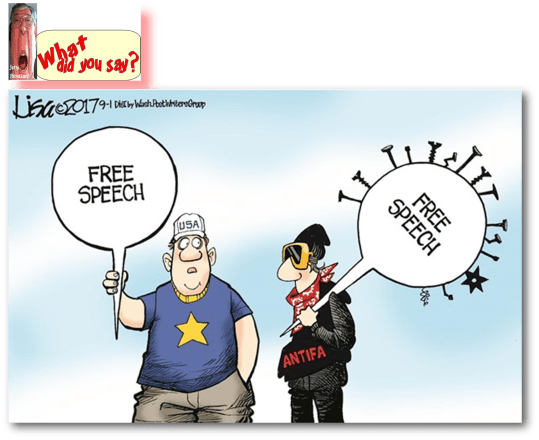






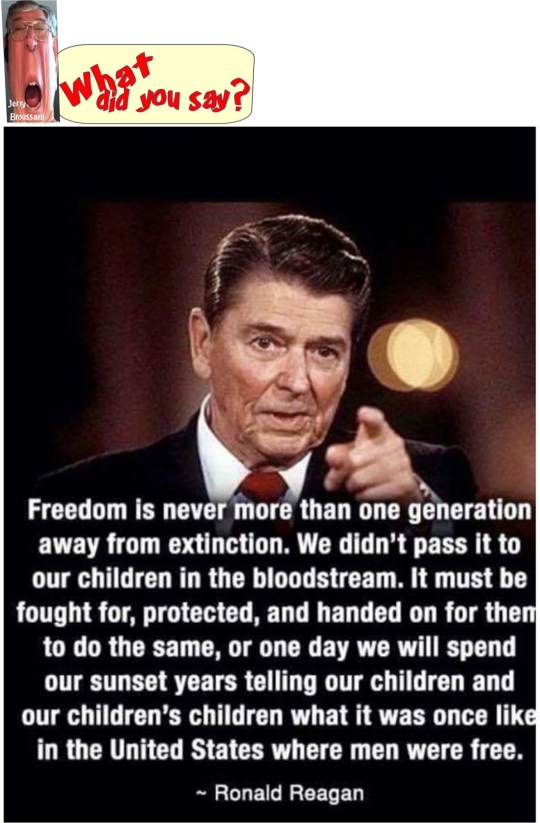
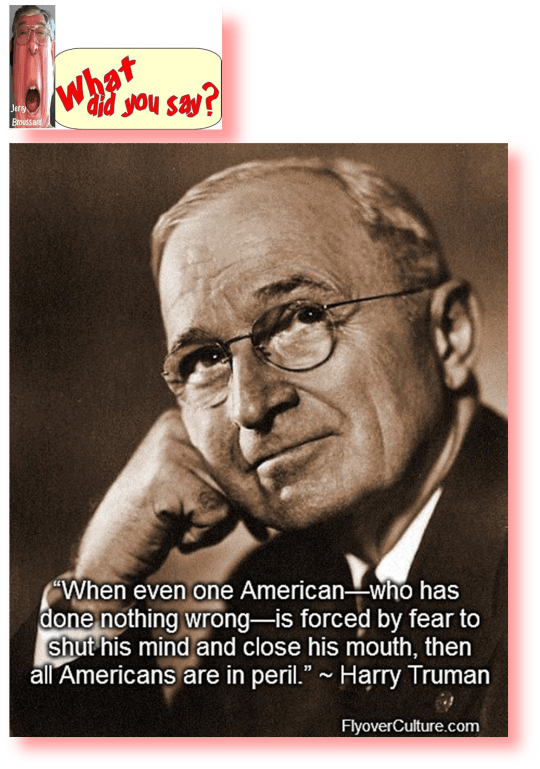


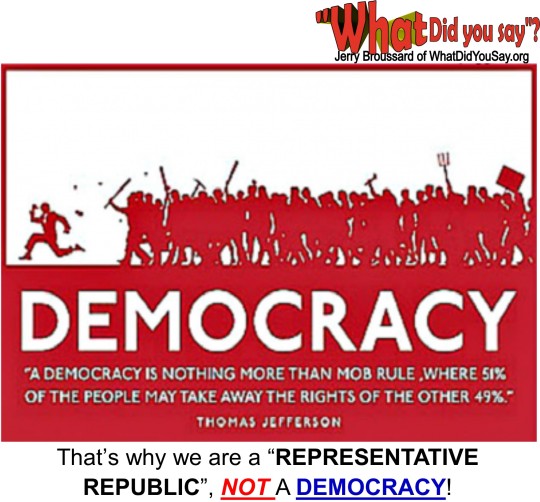


 What Did You Say?

You must be logged in to post a comment.