The Biden administration attempted to distract the Supreme Court from the voluminous evidence of federal abuse of Americans’ speech rights during oral arguments in Murthy v. Missouri Monday. It sounded like several justices followed the feds’ waving red flag.
“The government may not use coercive threats to suppress speech, but it is entitled to speak for itself by informing, persuading, or criticizing private speakers,”said Biden administration lawyer Brian Fletcher in his opening remarks. He and several justices asserted government speech prerogatives that would flip the Constitution upside down.
The government doesn’t have constitutional rights. Constitutional rights belong to the people and restrain the government. The people’s right to speak may not be abridged. Government officials’ speaking, in their official capacities, may certainly be abridged. Indeed, it often must be, precisely to restrict officials from abusing the state’s monopoly on violence to bully citizens into serfdom.
It is obviously un-American and unconstitutional for the government to develop a “hit list” of citizens to mute in the public square through secret pressure on communications monopolies beholden to the government for their monopoly powers. There is simply no way it’s “protected speech” for the feds to use intermediaries to silence anyone who disagrees with them on internet forums where the majority of the nation’s political organizing and information dissemination occurs.
NEITHER THE TIMES NOR ANY OTHER MAJOR NEWS OUTLET HAS EVER ACKNOWLEDGED THE WHITE HOUSE SOUGHT TO CENSOR ME AND MAKE TWITTER BAN ME AT A SECRET MEETING IN APRIL 2021.
What’s happening is not government expressing its views to media, or “encouraging press to suppress their own speech,” as Justice Elena Kagan put it. This is government bullying third parties to suppress Americans’ speech that officials dislike.
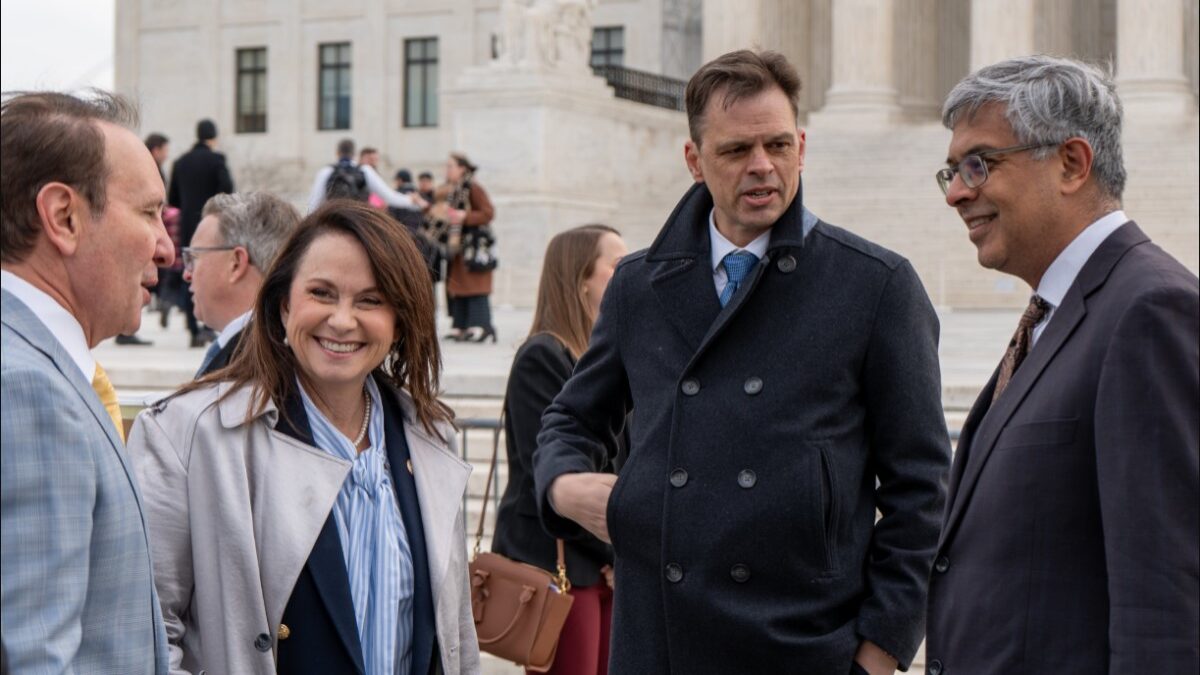
In the newspaper analogy, it would be like government threatening an IRS audit or Equal Employment Opportunity Commission (EEOC) investigation, or pulling the business license of The Washington Post if the Post published an op-ed from Jay Bhattacharya. As Norwood v. Harrison established in 1973, that’s blatantly unconstitutional. Government cannot “induce, encourage or promote private persons to accomplish what it is constitutionally forbidden to accomplish.”
Yet, notes Matt Taibbi, some justices and Fletcher “re-framed the outing of extravagantly funded, ongoing content-flagging programs, designed by veterans of foreign counterterrorism operations and targeting the domestic population, as a debate about what Fletcher called ‘classic bully pulpit exhortations.’”
Every Fake Excuse for Censorship Is Already Illegal
We have laws against all the harms the government and several justices put forth as excuses for government censorship. Terrorism is illegal. Promoting terrorism is illegal, as an incitement to treason and violence. Inciting children to injure or murder themselves by jumping out windows — a “hypothetical” brought up by Justice Ketanji Brown Jackson and discussed at length in oral arguments — is illegal.
If someone is spreading terrorist incitements to violence on Facebook, law enforcement needs to go after the terrorist plotters, not Facebook. Just like it’s unjust to punish gun, knife, and tire iron manufacturers for the people who use their products to murder, it’s unjust and unconstitutional for government to effectively commandeer Facebook under the pretext of all the evils people use it to spread. If they have a problem with those evils, they should address those evils directly, not pressure Facebook to do what they can’t get through Congress like it’s some kind of substitute legislature.
It’s also ridiculous to, as Jackson and Fletcher did in oral argument, assume that the government is the only possible solution to every social ill. Do these hypothetically window-jumping children not have parents? Teachers? Older siblings? Neighbors? Would the social media companies not have an interest in preventing their products from being used to promote death, and wouldn’t that be an easy thing to explain publicly? Apparently, Jackson couldn’t conceive of any other solution to problems like these than government censorship, when our society has handled far bigger problems like war, pandemics, and foreign invasion without government censorship for 250 years!
Voters Auditing Government Is Exactly How Our System Should Work
Fletcher described it as a “problem” that in this case, “two states and five individuals are trying to use the Article III courts to audit all of the executive branch’s communications with and about social media platforms.” That’s called transparency, and it’s only a problem if the government is trying to escape accountability to voters for its actions. The people have a fundamental right to audit what their government is doing with public positions, institutions, and funds! How do we have government by consent of the governed if the people can have no idea what their government is doing?
Under federal laws, all communications like those this lawsuit uncovered are public records. Yet these public records are really hard to get. The executive branch has been effectively nullifying open records laws by absurdly lengthening disclosure times — to as long as 636 days — increasingly forcing citizens to wage expensive lawsuits to get federal agencies to cough up records years beyond the legal deadline.
Congress should pass a law forcing the automatic disclosure of all government communications with tech monopolies that don’t concern actual classified information and “national security” designations, which the government expands unlawfully to avoid transparency. No justice should support government secrecy about its speech pressure efforts outside of legitimate national security actions.
Government Is So Big, It’s Always Coercive
Fletcher’s argument also claimed to draw a line between government persuasion and government coercion. The size and minute harassment powers of our government long ago obliterated any such line, if it ever existed. Federal agencies now have the power to try citizens in non-Article III courts, outside constitutional protections for due process. Citizens can be bankrupted long before they finally get to appeal to a real court. That’s why most of them just do whatever the agencies say, even when it’s clearly unlawful.
Federal agencies demand power over almost every facet of life, from puddles in people’s backyards to the temperature of cheese served in a tiny restaurant. If they put a target on any normal citizen’s back, he goes bankrupt after regulatory torture.
As Franklin Roosevelt’s “brain trust” planned, government is now the “senior partner” of every business, giving every “request” from government officials automatic coercion power. Federal agencies have six ways from Sunday of getting back at a noncompliant company, from the EEOC to the Occupational Safety and Health Administration to the Environmental Protection Agency to Health and Human Services to Securities and Exchange Commission investigations and more. Use an accurate pronoun? Investigation. Hire “one too many” white guys? Investigation.
TikTok legislation going through Congress right now would codify federal power to seize social media companies accused of being owned by foreign interests. Shortly after he acquired X, Elon Musk faced a regulatory shakedown costing him tens of millions, and more on the way. He has money like that, but the rest of us don’t.
Speech from a private citizen does not have the threat of violence behind it. Speech from a government official, on the other hand, absolutely does and always has. Government officials have powers that other people don’t, and those powers are easily abused, which is exactly why we have a Constitution. SCOTUS needs to take this crucial context into account, making constitutional protections stronger because the government is far, far outside its constitutional bounds.
Big tech companies’ very business model depends on government regulators and can be destroyed — or kneecapped — at the stroke of an activist president’s pen. Or, at least, that’s what the president said when Facebook and Twitter didn’t do what he wanted: Section 230 should “immediately be revoked.” This is a president who claims the executive power to unilaterally rewrite laws, ignore laws, and ignore Supreme Court decisions. It’s a president who issues orders as press releases so they go into effect months before they can even begin to be challenged in court.
Constitutionally Protected Speech Isn’t Terrorism
If justices buy the administration’s nice-guy pretenses of “concern about terrorism,” and “once in a lifetime pandemic measures,” they didn’t read the briefs in this case and see that is simply a cover for the U.S. government turning counterterrorism tools on its own citizens in an attempt to control election outcomes. This is precisely what the First Amendment was designed to check, and we Americans need our Supreme Court to understand that and act to protect us. Elections mean nothing when the government is secretly keeping voters from talking to each other.
The Supreme Court may not be able to return the country to full constitutional government by eradicating the almost entirely unconstitutional administrative state. But it should enforce as many constitutional boundaries as possible on such agencies. That clearly includes prohibiting all of government from outsourcing to allegedly “private” organizations actions that would be illegal for the government to take.
That includes not just coercive instructions to social media companies, but also developing social media censorship tools and organizations as cutouts for the rogue security state that is targeting peaceful citizens instead of actual terrorists. Even false speech is not domestic terrorism, and no clearheaded Supreme Court justice looking at the evidence could let the Biden administration weaponize antiterrorism measures to strip law-abiding Americans of our fundamental human rights.
Joy Pullmann is executive editor of The Federalist, a happy wife, and the mother of six children. Her ebooks include “Classic Books For Young Children,” and “101 Strategies For Living Well Amid Inflation.” An 18-year education and politics reporter, Joy has testified before nearly two dozen legislatures on education policy and appeared on major media from Fox News to Ben Shapiro to Dennis Prager. Joy is a grateful graduate of the Hillsdale College honors and journalism programs who identifies as native American and gender natural. Her traditionally published books include “The Education Invasion: How Common Core Fights Parents for Control of American Kids,” from Encounter Books.
On Friday, the House Judiciary Committee subpoenaed Elvis Chan, the lead FBI agent involved in mass social media censorship, to appear for a September 21, 2023 deposition. Last week’s subpoena followed Chan’s failure to appear for a scheduled voluntary interview to face questioning about the federal government’s role in burying the Hunter Biden laptop story in the month before the 2020 election.
While that scandal is much bigger than Chan, he is first in line to untangling the truth about how the government interfered in the 2020 election by running an info op to convince voters the Hunter Biden’s laptop was Russian disinformation. Given Chan’s testimony in the civil lawsuit brought by Missouri and Louisiana and several individual plaintiffs in Missouri v. Biden, as well as since-uncovered documents from Facebook, the importance of questioning Chan cannot be overstated.
What Chan Said
In Missouri v. Biden, the plaintiffs sued the Biden administration and numerous agencies and government officials, including the FBI and Chan. They alleged the federal defendants violated the First Amendment by, among other things, coercing and significantly encouraging “social-media platforms to censor disfavored [speech].” After filing suit, the plaintiffs filed a motion for a preliminary injunction and then obtained an order allowing for expedited discovery.
Since then, the district court has entered a preliminary injunction barring several federal agencies from coercing tech giants into censoring speech. The Fifth Circuit Court of Appeals narrowed the injunction but upheld many of the lower court’s legal conclusions. The Supreme Court is currently considering the Biden administration’s motion for a stay of the injunction.
What matters to the House’s subpoena of Chan is what the expedited discovery in Missouri v. Biden uncovered. It included the plaintiffs’ deposition of Chan. In his deposition, Chan testified he was one of the “primary” FBI agents who communicated with social media companies about so-called “disinformation.”
Specifically, “During the 2020 election cycle, Chan coordinated meetings between the FBI’s Foreign Influence Task Force (FITF) and at least seven of the major tech giants, including Meta/Facebook, Twitter, Google/YouTube, Yahoo!/Verizon Media, and Microsoft/LinkedIn,” with meetings occurring weekly as the election neared.
In questioning Chan, the plaintiffs’ attorneys pushed him on several points related to the censorship of the Hunter Biden laptop, forcing Chan to acknowledge the FBI regularly raised the possibility of “hack and dump” operations with senior officials at the various tech companies. Those discussions included the FBI warning of a potential hack-and-leak occurring in advance of the 2020 election, much like the Democratic National Committee (DNC) hack and WikiLeaks release of internal emails.
Attorneys for the plaintiffs also quizzed Chan on the identity of the government officials who discussed “hack-and-dump Russian operations” with the tech giants. Chan identified Section Chief Laura Dehmlow, along with four FBI officials who attended Department of Homeland Security Cybersecurity and Infrastructure Security Agency (CISA) meetings. Chan named Brady Olson, William Cone, Judy Chock, and Luke Giannini as some of the individuals who had discussed the supposedly impending hack-and-leak operation. Chan claimed not to recall, though, whether anyone within the FBI suggested he raise the possibility of Russian hack-and-dump operations with the tech giants.
That Chan and others warned big tech of the potential for a pre-election hack-and-dump operation is huge. As Chan also testified, the government had no specific intelligence suggesting there were plans for such an operation. Nonetheless, the warnings prompted Twitter and Facebook to censor the Hunter Biden laptop story following The New York Post’s story breaking.
FBI Played Social Media Companies
While the government had no reason to believe a hack-and-leak operation was in the works, several of the FBI agents involved in warning the social media companies knew Hunter Biden had abandoned his laptop at a computer repair store and that the material on the laptop was genuine. That includes Chan, Demhlow, and at least three other individuals connected to the FBI’s FITF.
Chan did not reveal these details in his Missouri v. Biden deposition. Instead, Dehmlow informed the House of these facts during her deposition. Among other things, Dehmlow testified that soon after The New York Post broke the Biden laptop story, somebody from Twitter asked the FBI whether the laptop was real. An analyst in the FBI’s Criminal Investigative Division confirmed, “Yes, it was.’” An FBI lawyer on the call then immediately interjected, “No further comment.”
Dehmlow further testified that several individuals on the FBI’s FITF knew the laptop was real, including then-FITF Section Chief Brad Benavides and the unit chief. Dehmlow then confirmed that after the call with Twitter, the FBI had internal deliberations about the laptop and that later when Facebook asked about the authenticity of the laptop, Dehmlow responded, “No comment.”
During his deposition in the Missouri v. Biden case, Chan confirmed Dehmlow’s representation that in response to the Facebook inquiry, she had replied, “No comment.” Chan, however, then claimed he was not aware of any other inquiries from social media companies concerning the Hunter Biden laptop.
Was Chan Telling the Truth?
Last month, House Judiciary Chair Jim Jordan revealed his committee had obtained internal documents from Facebook that call into question Chan’s testimony. “I spoke with SSA Elvis Chan (FBI San Francisco) on 15 October 2020, as a follow up to the call with the Foreign Influence Task Force on 14 October,” one Facebook document read, contradicting Chan’s claim that he knew of no other inquiries from social media companies.
“I asked SSA Chan whether there was any update or change. . . as to whether the FBI saw any evidence suggesting foreign sponsorship or direction of the leak of information related to Hunter Biden as published in the New York Post story,” Facebook’s memorandum continued. According to Facebook’s internal document, Chan stated “that he was up to speed on the current state of the matter within the FBI and that there was no current evidence to suggest any foreign connection or direction of the leak.” Chan further assured Facebook “that the FBI would be in contact if any additional information on this was developed through further investigation.”
Chan’s claim to Facebook that he was “up to speed on the current state of the matter” also seemingly conflicted with Chan’s testimony in the Missouri v. Biden case that he had “no internal knowledge of that investigation,” and “that it was brought up after the news story had broke.” It is also difficult to reconcile Chan’s claim — that the laptop was only brought up after the Post ran the story — with Dehmlow’s testimony that several individuals on the FITF knew the laptop was real, including an FBI analyst.
What the House Should Ask Chan
The House should explore these inconsistencies with Chan and further quiz him on both Dehmlow’s testimony and the Facebook documents. Chan should also be quizzed on with whom else he discussed the potential for a hack-and-leak operation.
We know from Chan’s Missouri v. Biden deposition that he had served as the supervisor for the Russia-adept cyber squad that investigated the DNC server hack before the San Francisco office handed it to FBI headquarters. Chan testified in that deposition that he would have discussed national security cyber-investigations involving Russian matters with Sean Newell, a deputy chief at the DOJ National Security Division who had also worked on the DNC hack. Chan should be pushed further on whether Newell or anyone else who worked on the DNC hack had raised the issue of a 2020 hack-and-release repeat.
If so, the question then becomes whether they knew of the existence and authenticity of the Biden laptop. That question proves significant because it appears the hack-and-leak narrative was peddled to the social media companies to prime them to censor the laptop story. So, knowing who knew the laptop story was accurate but still fed the hack-and-leak hysteria will point to the players responsible for interfering in the 2020 election by silencing the truthful reporting of the Hunter Biden laptop story.
Chan may refuse to testify, however, even pursuant to a subpoena, or the Department of Justice may direct Chan not to submit to congressional questioning, forcing Republicans to enforce the subpoena in court. We’ll know tomorrow if either scenario plays out or if Chan comes clean with what he knows.
Margot Cleveland is an investigative journalist and legal analyst and serves as The Federalist’s senior legal correspondent. Margot’s work has been published at The Wall Street Journal, The American Spectator, the New Criterion (forthcoming), National Review Online, Townhall.com, the Daily Signal, USA Today, and the Detroit Free Press. She is also a regular guest on nationally syndicated radio programs and on Fox News, Fox Business, and Newsmax. Cleveland is a lawyer and a graduate of the Notre Dame Law School, where she earned the Hoynes Prive—the law school’s highest honor. She later served for nearly 25 years as a permanent law clerk for a federal appellate judge on the Seventh Circuit Court of Appeals. Cleveland is a former full-time university faculty member and now teaches as an adjunct from time to time. Cleveland is also of counsel for the New Civil Liberties Alliance. Cleveland is on Twitter at @ProfMJCleveland where you can read more about her greatest accomplishments—her dear husband and dear son. The views expressed here are those of Cleveland in her private capacity.
On Thursday afternoon, three Fifth Circuit Court of Appeals judges heard Biden administration arguments to let government keep pressuring social media monopolies to ban ideas they don’t like from the internet. On July 4, a lower court had ordered the Biden administration to cease what it called “arguably … the most massive attack against free speech in United States’ history.” The Fifth Circuit paused that injunction on July 14 and heard oral arguments against it on Aug. 10 in Missouri v. Biden.
In this major case likely to hit the U.S. Supreme Court, the Biden administration is fighting to stop American citizens from sharing messages government officials don’t like. This case uncovered reams of White House and other high-level officials threatening internet monopolies with the end of their entire business model if they didn’t ban speech by Democrats’ political opponents.
“It’s far beyond the scope of what people realize,” says a lawyer for the plaintiffs, Zhonette Brown, of the public interest firm New Civil Liberties Alliance (NCLA).
Internal documents Twitter divulged under new owner Elon Musk provided more proof that social media monopolies are silencing Americans from Tucker Carlson and Robert F. Kennedy Jr. to millions of non-famous citizens at the behest of government pressure. Here are some key takeaways from Thursday’s oral arguments and earlier revelations from this massive First Amendment case.
1. By the Government’s Own Definition, It’s Censoring
Key to Thursday’s arguments was the question of coercion: Did government demands of internet monopolies equal coercion, or were those merely officials advocating for their views?
“If the government was doing something like that in a coercive manner, then that could be the subject of a proper injunction,” Department of Justice lawyer Daniel Bentele Hahs Tenny told the court in his opening remarks. “The problem is that what you would have to do is say, ‘Here is what the government is doing that’s coercive, and I’m enjoining that.’”
Judge Don Willett responded: “How do you define coercive?”
Tenny: “I don’t think there’s too much disagreement on this point. Coercive is where a reasonable person would construe it to be backed by a threat of government action against a party if it didn’t comply.”
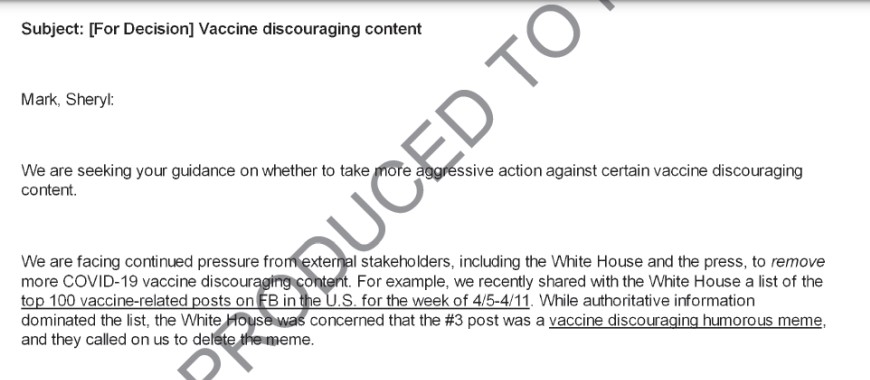
That’s exactly what the government did, the voluminous documents already discovered in this case show. In just one of the examples, Meta executive Nick Clegg, a former high-ranking U.K. official, told his bosses Mark Zuckerberg and Sheryl Sandberg: “We are facing continued pressure from external stakeholders, including the White House and the press, to remove more COVID-19 vaccine discouraging content” (emphasis original).
Clegg also characterized to colleagues an interaction with Andy Slavitt, a White House Covid adviser, this way: “[H]e was outraged – not too strong a word to describe his reaction – that we did not remove this post” of a meme about trial lawyers getting 10 years of vaccine-injured clients from government mandates.
2. Government Officials Treated Internet Monopolies Like Their Subordinates
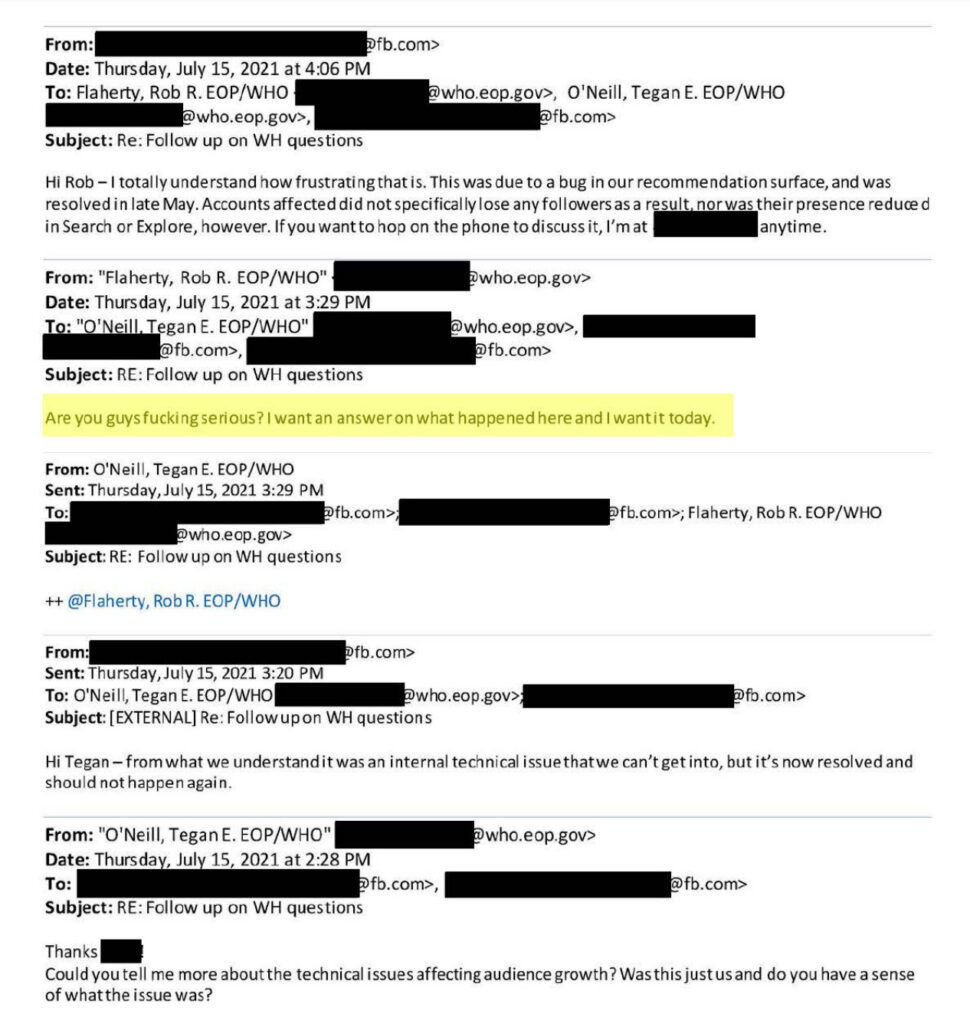
The Fifth Circuit panel demonstrated familiarity with the numerous examples of this kind of government behavior, such as this email exchange between White House digital director Rob Flaherty and Facebook, in which Flaherty swears at Facebook engineers, “Are you guys f-cking serious? I want an answer on what happened here and I want it today.”
“What appears to be in the record are these irate messages from time to time from high-ranking government officials that say, “You didn’t do this yet,’” Judge Jennifer Walker Elrod told Tenny. “And that’s my toning down the language. … So it’s like, ‘Jump!’ and, ‘How high?’”
The judges also noted the White House publicly threatened the business model of all online communications monopolies through potentially revoking Section 230 and launching antitrust lawsuits. The lawsuit documentation shows leading Democrats making the same public threats, including House Speaker Nancy Pelosi and multiple U.S. senators.
Joe Biden even threatenedto hold Zuckerberg criminally liable for not running Facebook the way Biden wanted. In office, Biden also famously accused Facebook of “killing people” by not doing enough to spread the administration’s message and suppress opposing messages. FBI agent Elvis Chan‘s deposition in this case noted federal officials showed adverse legislation to social media monopolies’ leaders as examples of what the government would do to them if they didn’t ban Americans’ speech.
“It’s not like, ‘We think this would be a good public policy and we want to explain to you why that would be a good policy,” Elrod said. “There seems to be some very close relationship that they’re having these — ‘This isn’t being done fast enough’ you know, like it’s a supervisor complaining about a worker.”
3. Judges Likened Government Behavior to Mobsters
Tenny claimed there was no “or else” explaining what the government “would do” if the internet monopolies didn’t obey, so there was no government coercion present.
“This is an analogy, probably an inapt analogy, so if you’ll excuse me — like if somebody is in these movies we see with the mob or something. They don’t spell out things but they have these ongoing relationships and they never actually say, ‘Go do this or else you’re going to have this consequence,’ but everybody just knows,” Elrod replied. “And I’m certainly not equating the federal government with anybody in illegal organized crime, but there are certain relationships that people know things without always saying the ‘Or else.’”
Willett followed that up by commenting the case documentation makes it look like the government is “relying on a fairly unsubtle kind of strong-arming and veiled or not so veiled threats. ‘That’s a really nice social media platform you got there, it’d be a shame if something happened to it.’”
4. Censorship Is Election Interference
The lead attorney for the plaintiffs, John Sauer, initiated this case as Louisiana’s solicitor general. In representing state government interests to the judges, he noted that elected officials have to pay attention to what their constituents are saying online, or they won’t have a good read on what voters what them to do in office.
“We’ve gotta be able to craft messages and know what policies we’re adopting to be responsive to our citizens,” he summarized from statements submitted to the court from multiple state officials. “…Going back to 1863, as everyone knows, going back to the Federalist number 56 where [Bill of Rights author James] Madison said it, everyone knows state legislators have a sovereign interest in knowing what their constituents think and feel, and that’s directly impacted.”
When the federal government silences some Americans’ views online, Sauer said, it makes it harder for elected representatives to actually represent them. Two of the state injuries the plaintiffs assert against the federal government’s censorship are “Interference with our ability to hear our constituents’ voices on social media” and “interference with our ability to have a fair and unbiased process for our people to organize and petition the government for grievances.”
Court documents also revealed the Cybersecurity and Infrastructure Security Agency, a federal agency, set up a private entity to ban and throttle election-related online speech Democrats dislike. Much of the information choked by this algorithmic censorship operation is true, such as the legitimacy of Hunter Biden’s laptop, investigations and members of Congress have noted.
“They invented a whole new word, ‘mal-information,’ to justify going after the censorship of true speech and ideas,” Sauer said last month in a public discussion of the case that YouTube banned.
5. Democrats Want Free Speech for Themselves While Banning It for Their Enemies
The oral arguments also got into the FBI’s 2020 election interference in telling online monopolies that The New York Post’s reporting on Hunter Biden’s laptop was foreign disinformation. Tenny claimed the FBI refused to comment on the laptop because it was a pending investigation.
Yet the FBI and other federal intelligence agencies actually did comment on the laptop by calling it “foreign disinformation,” both privately to the internet monopolies and publicly. This was false, and the FBI knew it. The lower court ruled this deception constituted coercion because it caused people to act on false information.
As Ben Weingarten notes, these lies and FBI-demanded online content bans to protect them benefitted Joe Biden in the 2020 election:
According to Elvis Chan (pdf), an FBI official leading engagement with the social media platforms, while the bureau didn’t explicitly ask the companies to change their hacked material policies, it did frequently follow up to ask whether they had changed said policies, as the FBI wanted to know how they would treat such materials.
The judges almost broached an important question: If the First Amendment protects the FBI’s lies that Hunter Biden’s laptop was disinformation, for which not one federal employee has been disciplined, how can it allow for criminalizing the same behavior by average Americans by labeling their views “disinformation” and “mal-information”?
6. Today’s Internet Is Still Massively Rigged
Taibbi also noted that court documents show the Biden administration got mad enough to fire the F-bomb at social media companies when the algorithmic censorship they demand affected Biden’s Instagram account. Instagram instantly fixed the issue for the White House, but not for non-powerful Americans.
It’s clear from the case documents and other disclosures such as the “Twitter Files” and “Facebook Files” that the algorithms controlling what Americans see online are now deeply, massively rigged. That rigging is multilayered. It includes all this government coercion of entities including Apple, Google, LinkedIn, Meta, Snapchat, Tiktok, and Twitter going back to at least 2017, as well as pressure operations from corporate media and internal employee groups.
Beyond algorithm changes, social media monopolies have also changed their terms of service in response to government demands, the NCLA attorneys noted last month. So government control of public discourse will continue even if the Fifth Circuit reinstates the injunction.
Tenny told the Fifth Circuit the Covid-era censorship that ignited this case is over because the government currently deems Covid not an emergency. In court, Sauer cited YouTube banning two weeks ago a video of attorneys discussing this case as more proof this massive censorship persists. He also cited court documents showing Americans still can’t post social media messages about censored topics.
“Attorneys present gave estimates ranging from a few weeks to two months for the panel to rule” on whether to reinstate an injunction against more of this government behavior, reported Taibbi, who attended the oral arguments in New Orleans, Louisiana. The previous injunction includes exceptions for crimes such as sex trafficking.
“The government wants to be doing something that it shouldn’t be doing, and they really, really want to be doing it,” said NCLA attorney John Vecchione in the discussion YouTube banned.
Joy Pullmann is executive editor of The Federalist, a happy wife, and the mother of six children. Her latest ebook is “101 Strategies For Living Well Amid Inflation.” Her bestselling ebook is “Classic Books for Young Children.” An 18-year education and politics reporter, Joy has testified before nearly two dozen legislatures on education policy and appeared on major media from Fox News to Ben Shapiro to Dennis Prager. Joy is a grateful graduate of the Hillsdale College honors and journalism programs who identifies as native American and gender natural. Her several books include “The Education Invasion: How Common Core Fights Parents for Control of American Kids,” from Encounter Books.
The First Amendment’s mandate that “Congress shall make no law . . . abridging the freedom of speech” is a guarantee that, no matter how inconvenient to those temporarily holding high office, the people have an absolute right to express their thoughts and opinions. Despite this constitutional requirement, over 200 years ago, President John Adams and the Federalists in Congress used the threat of war with France as a pretext to enact into law the Sedition Act of 1798, which made it a crime for Americans to “print, utter, or publish . . . any false, scandalous, and malicious writing” about the government.
The debate surrounding the Sedition Act was about the nature of freedom of speech. One supporter of the law, Alexander Addison, believed that some opinions were so dangerous that it was in the public interest to suppress them, stating, “Truth has but one side: and listening to error and falsehood is indeed a strange way to discover truth.”
An opponent, Thomas Cooper, presciently argued that the purpose of the Sedition Act was to empower one party to “suppress the opinions of those who differ from them.” Unsurprisingly, all the defendants prosecuted under the Sedition Act would be Republicans.
Sound familiar?
On Independence Day this year, a federal judge issued a preliminary injunction restricting the Biden Administration from collaborating with social media companies to censor and suppress constitutionally protected speech. In his opinion, Judge Terry Doughty stated that the Biden Administration’s efforts to suppress opinions it opposes “arguably involves the most massive attack against free speech in the United States’ history.” It is difficult to disagree with Judge Doughty’s description.
For years, the Biden Administration demanded social media suppress and censor conservatives who dared question the origins of Covid, the effectiveness of masks and lockdowns, and election integrity, among other issues. The Biden Administration was so zealous in its enforcement of censorship, even parody content did not escape its anti-free speech campaign.
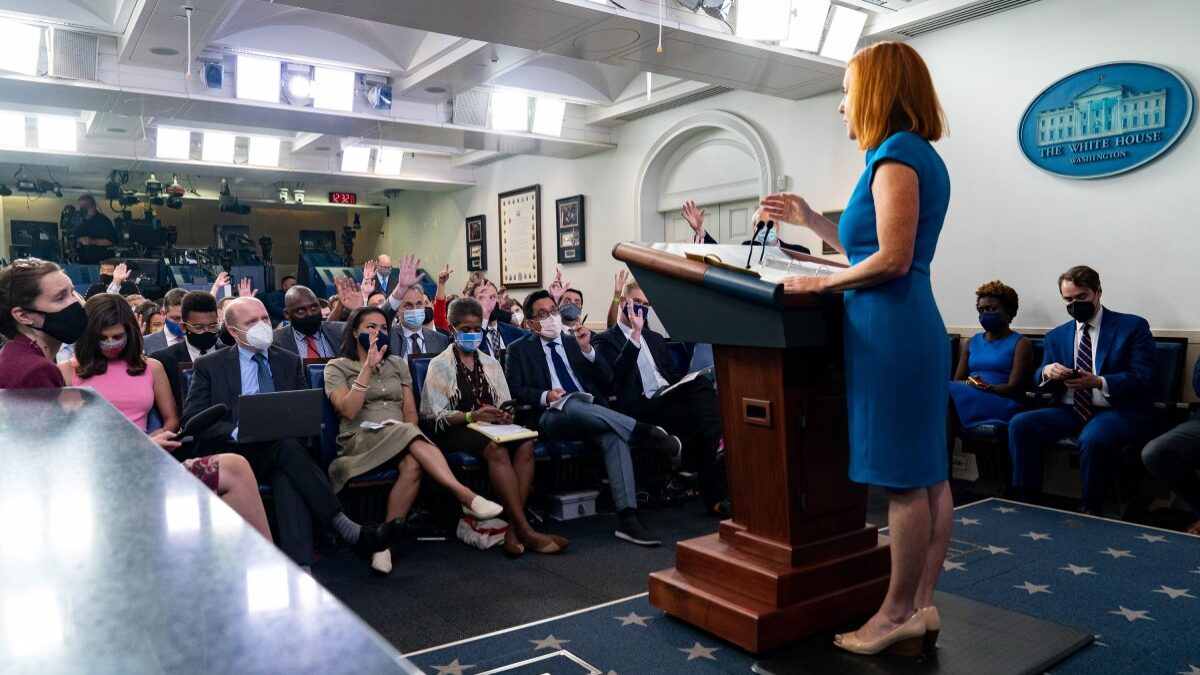
And the Biden administration didn’t ask nicely. When then-White House Press Secretary Jen Psaki publicly called on social media companies to censor speech relating to Covid, she mentioned Biden’s support for a “robust anti-trust program,” all but threatening to break up tech giants if they failed to adopt the administration’s censorship policies. Later, the White House announced that it was reviewing policies relating to whether social media should be held legally liable for spreading so-called misinformation. In other words, the Biden administration effectively told social media “Do our bidding, or else.”
The White House was so aggressive that a Twitter representative stated the site was “bombarded” with censorship requests from the executive branch. But that bombardment was not really directed at Twitter — it was a monstrous attack on the free speech rights guaranteed to every American by the First Amendment.
In addition to countless numbers of Americans, I was targeted by the censorship regime. When I posted a video on YouTube to educate the public on the potentially harmful consequences of relying on ineffective cloth masks to prevent transmission of Covid, YouTube took my video down and suspended me for a week.
Americans are a free people and we do not take infringements upon our liberties lightly. The time has come for resistance and to reclaim our God-given right to free expression. Permit me, as a member of the resistance, to present a solution that that restores and protects the First Amendment.
I introduced legislation called the Free Speech Protection Act, which will prohibit federal employees and contractors from using their positions to censor and otherwise attack speech protected by the First Amendment. My legislation will impose penalties for those that violate this rule, as well as empower private citizens to sue the government and executive branch officials for violating their First Amendment rights. Additionally, the bill will mandate frequent publicly accessible reports detailing the communications between an executive branch agency and media organizations, ensure that federal grant money is not used to label media organizations as sources of misinformation or disinformation, and terminates authorities that threaten free speech.
Under my Free Speech Protection Act, the government will no longer be able to cloak itself in secrecy to undermine the First Amendment rights of conservatives, libertarians, liberals, socialists, and all others who wish to exercise their right to free speech and engage in public discourse.
My legislation will make it difficult to hide efforts to censor constitutionally protected speech. Those officials who censor Americans are on notice: if you infringe upon First Amendment rights, under my bill, you will face severe penalties, such as potential debarment from employment by the United States, a civil penalty of no less than $10,000, and revocation of a security clearance. Any administration employee who prizes his livelihood would not dare threaten free speech after my bill becomes law.
Looking back upon his defeat of John Adams for the presidency, Thomas Jefferson wrote, the “revolution of 1800 . . . was a real revolution in the principles of our government as that of [17]76.” Jefferson’s victory was a vindication of the First Amendment as he allowed the Sedition Act to expire and pardoned those convicted for expressing their views.
Once again, the American people are called upon to defend the founding principles over which our forebears fought a revolution. To protect free speech, Congress must prohibit the government’s collusion with Big Tech and other media organizations. Congress must pass the Free Speech Protection Act.
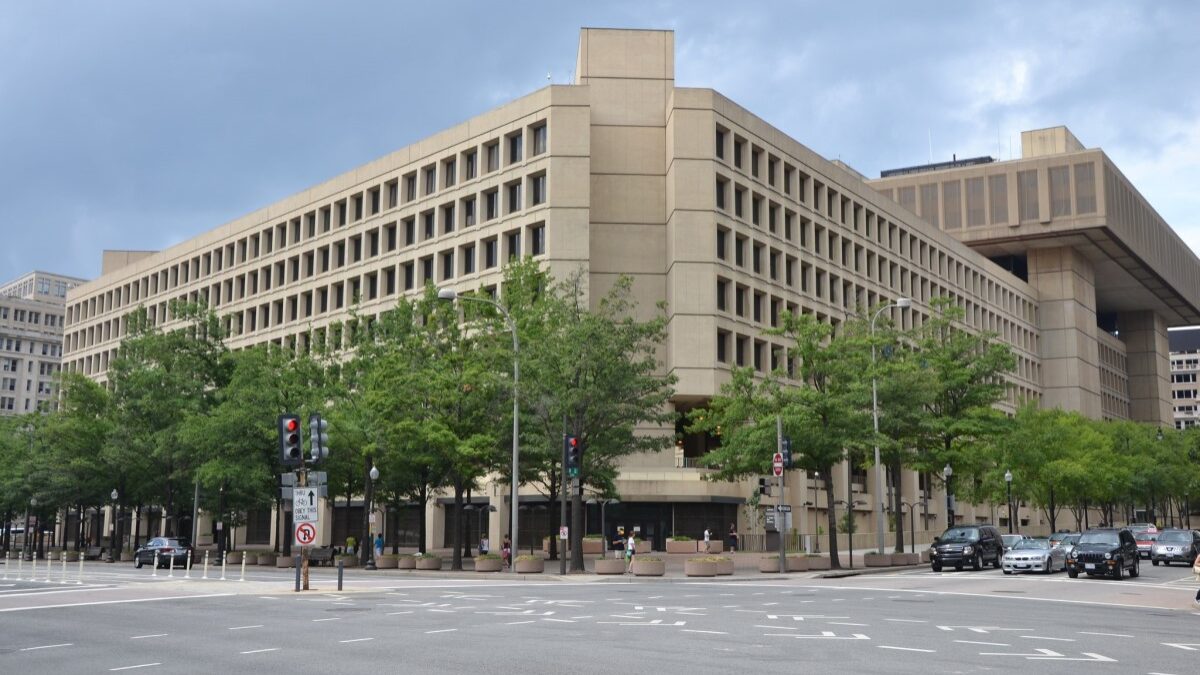
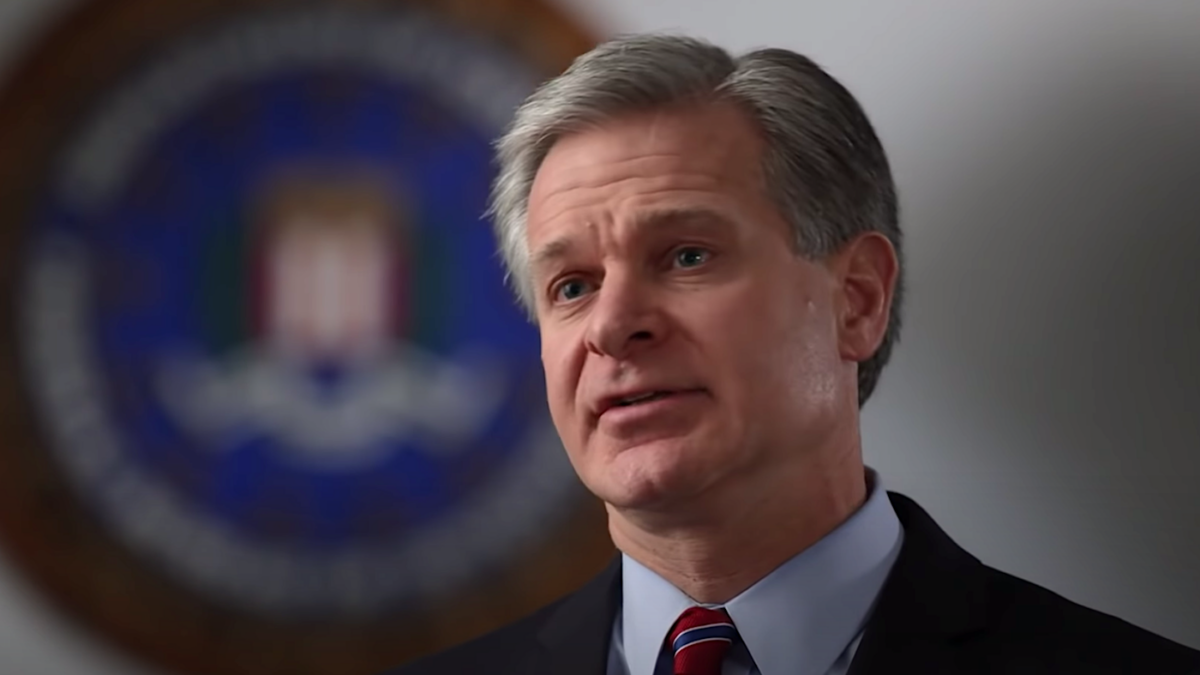
FBI Director Christopher Wray sat for nearly four hours of questioning on Wednesday before the House Judiciary Committee. Here are the top takeaways from the hearing.
1. Wray Indicates Foreign Intel Agencies Worked with Big Tech to Silence Speech
The FBI director faced fierce questioning from Republican committee members on the FBI’s efforts to induce Big Tech to censor American speech. Several representatives specifically challenged Wray to justify the FBI passing along requests from the Ukrainian intelligence agency, SBU, to social media companies. The FBI’s role as a conduit for SBU was just revealed on Monday in a report from the House Select Subcommittee on the Weaponization of the Federal Government.
That report revealed that following Russia’s invasion of Ukraine, the SBU enlisted the FBI to forward to American social media companies lists of accounts that allegedly “spread Russian disinformation.” The FBI obliged, sending a flurry of requests for accounts to be removed, including many American accounts, to multiple social media platforms. In fact, the House report highlighted the inclusion of the official, verified, Russian-language account of the U.S. State Department. The House Judiciary Committee queried Wray on how this could happen, while also inquiring why the FBI would assist the SBU in this endeavor, especially in light of Russia’s known infiltration of SBU.
In explaining the FBI’s involvement, Wray stressed that Russia’s invasion of Ukraine in February 2022 had cut off Ukraine’s communications, causing SBU to ask the FBI to contact U.S. companies on their behalf with the list of accounts supposedly spreading Russian disinformation. But as Republicans on the committee highlighted, the account lists in question included American accounts. Thus, the FBI’s involvement triggered the same First Amendment problems as those litigated in Missouri v. Biden.
This testimony also raised a second area of concern, namely the apparent coordination between U.S. social media companies and foreign governments. Wray said he served as an intermediary because Ukraine’s communications system was down. But in that case, it appears SBU would have contacted the American companies on its own behalf, seeking the silencing of Americans’ speech.
So the question for American social media companies is this: Do they accept requests to remove accounts or posts from foreign countries? And do they censor Americans’ speech based on foreign claims of disinformation?
2. Private Corporations Present a Bigger Concern Than Wray
Social media companies are not the only ones who have some explaining to do following Wray’s testimony. Americans should also demand answers from private businesses with access to consumer information, especially those in the financial sector.
This concern flows from Wray’s response to questioning about Bank of America handing the FBI financial records of customers who had purchased firearms within the six months before the Jan. 6, 2021, Capitol riot. Wray defended the FBI’s receipt of this information by noting that “a number of business community partners, all the time, including financial institutions, share information with us about possible criminal activity.” Such activity is entirely lawful, the FBI director maintained, although he added that the FBI opted not to use the Bank of America data to avoid concerns over the bureau obtaining that data.
That the FBI decided not to use the data, however, provides no comfort because Bank of America obviously had no qualms about sharing the information. Further, Wray framed Bank of America’s data sharing as consistent with “business partners” who “all the time” share information about possible criminal activity.
But financial data showing a customer had previously purchased a gun does not represent evidence of “possible criminal activity.” Yet that didn’t stop Bank of America from giving the information to the FBI. So what other financial information is Bank of America providing? And what about other “business partners”?
3. Wray Needs to Read the Court’s Opinion in Missouri v. Biden
The partnership that took main billing during Wednesday’s hearing was that forged between the FBI and social media companies, and Republicans drilled Wray on the coordinated efforts to censor American speech. Throughout the entire hearing, though, Wray unwaveringly maintained the bureau was not responsible for the censorship because the FBI was merely making suggestions that posts involving foreign malign influence be removed.
No one who read the district court’s opinion in Missouri v. Biden could reasonably reach that conclusion. And since the FBI played such a heavy role in the censorship enterprise summarized in that case, the FBI director owes it to the public to actually study that opinion.
DOJ lawyers may be telling Wray the FBI is in the clear, but a federal judge disagreed,
and since the court has ordered the FBI to abandon its unconstitutional conduct, Wray needs to understand precisely what that means. Reading the court’s unfiltered opinion is the only way to see the many ways the FBI violated the First Amendment.
4. So Much Ignorance, So Little Time
Wray was not only ignorant of the facts underlying Missouri v. Biden, but he also revealed several other blind spots. For instance, during the hearing, Wray acknowledged he had previously testified that the FBI had not used Section 702 of the Foreign Intelligence Surveillance Act, which allows the federal government to collect communications of foreign individuals, in its investigation of the Jan. 6 Capitol riot. That ended up not being accurate, however, but Wray was “blissfully ignorant” of that fact when he testified to the contrary to Congress.
Democrat Rep. Eric Swalwell also put on a display of ignorance Wednesday, although in his case it was a feigned ignorance, with the California congressman framing the Hunter Biden laptop as concerning the nudes of a private citizen. While Swalwell may still be fixated on the nudes on the laptop, Republicans’ concern has always been of the evidence of a pay-to-play scandal implicating now-President Biden.
Then there’s Rep. Zoe Lofgren who claimed the GOP majority was engaging in “conspiracy theories” to discredit “one of the premier law enforcement agencies in the United States,” and “without any evidence” trying to “make the case that the FBI is somehow opposed to conservative views.”These20 examples tell a different story.
5. Why Was Auten Anywhere Near Biden Evidence?
Wray and the Democrats weren’t the only ignorant ones, however. Republicans were clueless when it came to understanding why FBI analyst Brian Auten was anywhere near evidence implicating Hunter Biden. After all, Auten had been under internal investigation since 2019 for his role in Crossfire Hurricane. Given the partisan witch hunt that investigation proved to be, why would the bureau allow Auten to play a part in the highly political investigation of Hunter Biden?
Yet it apparently did. A whistleblower has told Sen. Chuck Grassley, R-Iowa, that Auten opened an assessment in August 2020 and that assessment provided other FBI agents the ability to falsely brand derogatory information about Hunter Biden as disinformation.
Wednesday’s testimony by the FBI director shed no light on the question of Auten’s involvement.
6. AG Garland’s the Real Hack Targeting Parents
While Wray was unable to explain Auten’s involvement in the Hunter Biden investigation, he made clear that when it came to the parents-are-terrorists memorandum, that was all Attorney General Merrick Garland’s doing. That testimony proved enlightening by showing that for all of the FBI’s deficiencies, even its director sees the attorney general as more of a hack for targeting parents at school board meetings.
7. Orange Man Bad, FBI Good
Also enlightening were the Democrats’ main lines of questioning. Here, there were two. The leftist lawmakers spent most of their time rehabilitating the FBI, reciting the many important bureau missions, showcasing hero agents, highlighting horrible attacks on FBI offices, and rejoicing in the FBI’s family days. Then the far-left faction merely attacked Donald Trump and MAGA Republicans.
Together these lines of questioning exposed the Democrats as unconcerned by the many abuses Americans have witnessed over the last half-dozen years. And what was unserious appeared downright absurd when Democrat Pramila Jayapal used her allotted time to challenge the FBI director over the bureau’s purchase of citizens’ data, including location data, from various data brokers. Pre-Trump, every Democrat would have been drilling Wray on such abuses of civil liberties, but this week it was only Jayapal.
8. The Speech or Debate Clause Does Some Heavy Lifting
In addition to the Democrats’ two main lines of questioning, a sub-theme of many of the comments concerned the whistleblowers, with Democrats attempting to discredit their testimony. One way they sought to do that was by presenting the whistleblowers as hired tongues. But beginning with Rep. Jerry Nadler, D-N.Y., and continuing through Rep. Sheila Jackson Lee, D-Texas, they made this point by slandering the whistleblowers, falsely stating they had been paid for their testimony.
Of course, the speech or debate clause prevents the whistleblowers from suing the committee members who lied about them, which is precisely why they had no qualms about doing so.
REMEMBER WHAT THE DEMS WERE SAYING ABOUT THE SO-CALLED WHISTLEBLOWER THAT CAME OUT ABOUT PRESIDENT TRUMP? I guess it’s the accused that makes their speech different.
9. Schiff Can’t Stop Lying
Rep. Adam Schiff, D-Calif., is proof of this point because he can’t stop lying. He lied about the Carter Page FISA warrants. And on Wednesday, he lied again about President Donald Trump’s telephone call with the Georgia secretary of state following the November 2020 election.
Unfortunately, “as I’ve been forced to detail time and again because the corrupt media continue to lie about the conversation, the transcript of the call established that Trump did not request that Raffensperger ‘find 11,780 votes.’” As I wrote in February, “It never happened.” Instead, during that “telephone conversation between Trump’s legal team and the secretary of state’s office, Trump’s lawyer explained to Raffensperger that ‘the court is not acting on our petition. They haven’t even assigned a judge.’” Thus the legal team wanted the secretary of state’s office to investigate the violations of Georgia election law because the court refused to do its duty.
Schiff knows this, but he also knows there are no consequences for lying. On the contrary, he might just convince Californians to send him to the Senate so he can follow in Harry “He Didn’t Win, Did He?” Reid’s footsteps.
10. A Mixed Bag on the Pro-Life Question
The final takeaway topic from Wray’s testimony concerned the pro-life question, and Wray presented a mixed bag. On the one hand, he outrageously refused to condemn the FBI agents who decided to use a SWAT-like display of force to arrest a pro-life sidewalk counselor at his family home when the man’s attorney had agreed to arrange for his client to voluntarily appear to face the charges — of which he was later acquitted.
On the other hand, when Rep. Deborah Ross, D-N.C., attempted to frame abortionists and abortion facilities as being increasingly targeted in the wake of Dobbs, Wray corrected the narrative, noting that the uptick in violence has been to pro-life centers, with 70 percent of the cases involving such organizations.
Margot Cleveland is The Federalist’s senior legal correspondent. She is also a contributor to National Review Online, the Washington Examiner, Aleteia, and Townhall.com, and has been published in the Wall Street Journal and USA Today. Cleveland is a lawyer and a graduate of the Notre Dame Law School, where she earned the Hoynes Prize—the law school’s highest honor. She later served for nearly 25 years as a permanent law clerk for a federal appellate judge on the Seventh Circuit Court of Appeals. Cleveland is a former full-time university faculty member and now teaches as an adjunct from time to time. As a stay-at-home homeschooling mom of a young son with cystic fibrosis, Cleveland frequently writes on cultural issues related to parenting and special-needs children. Cleveland is on Twitter at @ProfMJCleveland. The views expressed here are those of Cleveland in her private capacity.
In a preliminary injunction issued against the White House and federal agencies on Tuesday in Missouri v. Biden, Judge Terry Doughty eviscerated government actors for colluding with social media companies to censor users’ protected speech in the name of eliminating “misinformation.”
Doughty, as others have done, compares the government censorship to Orwell’s hypothetical “Ministry of Truth.” But Orwell’s satirical title gives the speech police too much credit: It assumes “truth” is still a functional part of their vocabulary. No, our censors speak in terms of “misinformation.”
The perversion of truth is falsehood; misinformation is just the perversion of information. Truth has a moral component; information doesn’t. Years of moral relativism have eroded our cultural understanding of “truth” as a knowable, agreed-upon concept — and in our modern world, all we’re left with is an infinite supply of information.
Truth, Discerned in Nature by Reason
For most of Western history, philosophers and laymen alike have agreed upon the existence of “truth,” as a factual concept but also as a moral one. Plato said the “true philosophers” were those “who are lovers of the vision of truth,” which he described in terms of an ideal reality that transcended the imperfect reflections of truth, goodness, and beauty in the natural world. Similarly, Cicero believed in the existence of a natural law that could be understood via man’s reason.
Christianity describes the law being written on the hearts of men in similar terms, and presents the good, true, and beautiful as originating from and perfectly fulfilled in the triune God. The Bible refers to Christ as the Logos, the Word of God — a term closely associated with wisdom, reason, and truth. Elsewhere, Christ describes himself as “the way, and the truth, and the life.”
As Christianity and Greek thought spread throughout the West, an emphasis on the comprehension of truth via reason took root. Presuppositions about rational thought and laws of nature spawned mathematic, scientific, and artistic advancements, most famously during the Renaissance. A few centuries later, Enlightenment thinkers began to break away from the theistic grounding of the Western pursuit of truth, elevating reason alone as a sufficient basis for a functioning society. Modernism rejected the Enlightenment obsession with reason, as the booming industrial world sought to overcome nature and its laws and limits. As religious foundations continued to crumble, relativism emerged and completely unmoored itself from traditional assumptions about objective and knowable truth.
Today, we see factual relativism as well as moral. Not only does our prevailing social ethic tolerate individuals’ self-determination of “what’s right for me,” we’ve gone so far as to nod along when a man says he is actually a woman, lacking the philosophical footing to explain why that simply can’t be true.
To “speak your truth,” as distinct from the truth, is a moral victory to be praised according to our prevalent irrational dogma. Our cultural rejection of reason is evident in every field: Look at the deconstructionist sculptures and poetry that pass for art, or the assault on the fixed, rational rules of mathematics.
In this cultural condition, people are no longer equipped to speak in terms of truth, grounded in the divinely appointed laws of nature, discernible by human reason. Those concepts aren’t in our contemporary vocabulary.
“What’s right for me.” “Speak your truth.” These are samples of a culture that rejects all authority except their own. Self-centered, selfish, insecure, afraid of normal society, and moral laws they create their own world with cliches, beliefs, and a language that supports their self-created world. They are a spiritual, and natural law unto themselves.
Rather than blind themselves into society, their self-centered egos demand sociaity change just for them, adapt their language and definition to theirs, and respect their decisions or else they’ll shame you, or bully you (riots and violent demonstrations) into submission.
This is what happened with the homosexual lobby in the beginning of all this mess going back to the 60’s, 70’s, 80’s and 90’s. The bully has made a lot of progress. Now they are so bold that they don’t care we know what they are doing in indoctrinating our children recruiting them into homosexuality. With the help of Margrett Sangers disciples of birth control, they are sterilizing our children through this trans garbage getting children to sterilize themselves through sex change surgeries. Welcome to 2023 Liberalism Psychotics.
Truth Isn’t Fragile, But Regime-Approved Narratives Are
In granting the preliminary injunction, Judge Doughty explains: “It is the purpose of the Free Speech Clause of the First Amendment to preserve an uninhibited marketplace of ideas in which truth will ultimately prevail, rather than to countenance monopolization of the market, whether it be by government itself or private licensee.”
The essential context and goal of meaningful free speech — a world in which ideas are debated openly so that truth may triumph — is no longer feasible when ideas cease to be judged on their merits and are instead judged by the intensity with which a person feels them to be true.
When there is no longer an agreed-upon concept of “truth,” ideas are reduced to those with which you agree and those you don’t. When you can’t rely on your ideas to endure simply because they’re true, contradictory perspectives and ideas become more of a threat.
Enter the pervasive concept of “misinformation.” It’s not a new term — Noah Webster defined it in 1828 as “false account or intelligence received.” The very idea of “misinformation” as it was understood in Webster’s time was basically a photonegative of truth: One could be misinformed, but the “false account” could be understood to be false precisely because it contradicted something true.
But in a post-rational world, “misinformation” means something else. One of the government bureaucrats accused in Missouri v. Biden of working to censor Americans admitted as much, in a very un-self-aware statement: “CISA Director Easterly stated: ‘We live in a world where people talk about alternative facts, post-truth, which I think is really, really dangerous if people get to pick their own facts,’” according to Doughty.
Of course, if everyone is picking his own facts, the government doing so is no different. As Doughty concluded, “The Free Speech Clause was enacted to prohibit just what Director Easterly is wanting to do: allow the government to pick what is true and what is false.” If there is no ultimate truth, then all that’s left is the prevailing narrative and information that challenges that narrative: misinformation. Government censors can make an appeal to reported facts or scientific studies, but man is ultimately fallible and those conclusions have no grounding if they are rooted in no higher law than the men who derive them.
That’s because truth is inseparable from goodness. It’s more than sterile informational accuracy — to be true is to reflect the created order that is ultimately good because its Creator is goodness Himself.
Man possesses the knowledge of good and evil, and it cost him dearly. Until we admit the language of goodness — and its opposite — back into our cultural vocabulary, we’ll be vainly squabbling over “misinformation,” and the most powerful actors will get to define it.
Elle Purnell is an assistant editor at The Federalist, and received her B.A. in government from Patrick Henry College with a minor in journalism. Follow her work on Twitter @_etreynolds.
Corporate media mocked widespread conservative outrage over online censorship as a “baseless” and misdirected ploy to gin up controversy and votes, but Missouri v. Biden proves Big Tech and the federal government colluded to suppress “millions of protected free speech postings by American citizens.”
There is hardly a lack of proof that Americans were the subject of years of government-led partisan purges on Twitter, Facebook, and other social media platforms.
Emails, documents, files, and statements show that it was often at the prompting of federal agencies such as the Department of Health and Human Services, the National Institute of Allergy and Infectious Diseases, the Centers for Disease Control and Prevention, the Census Bureau, the Department of Homeland Security, the Department of State, the FBI, and the Department of Justice, as well as the White House, that Big Tech effectively silenced the voices of countless Americans on Covid-19, elections, and criticism of the Biden regime.
In his 155-page memorandum ruling handed down on July 4, Judge Terry Doughty, chief judge of the U.S. District Court for the Western District of Louisiana, asserted that the attorneys general who brought the case will likely see victory in court with their claim that “the United States Government, through the White House and numerous federal agencies, pressured and encouraged social-media companies to suppress free speech.”
“Defendants used meetings and communications with social-media companies to pressure those companies to take down, reduce, and suppress the free speech of American citizens. They flagged posts and provided information on the type of posts they wanted suppressed. They also followed up with directives to the social-media companies to provide them with information as to action the company had taken with regard to the flagged post,” Doughty confirmed.
Even before lockdowns, BLM riots, and the 2020 election, corporate media outlets were smearing conservative claims of Big Tech censorship.
“Google and Facebook aren’t infringing on the right’s freedom of expression, but insisting otherwise is politically convenient,” the Atlantic asserted in 2019.
One year after the Atlantic claimed “there is no evidence” that Americans were suffering suppression of online speech, Pew Research found that “most Americans think social media sites censor political viewpoints.”
American suspicions that the government was involved in the censorship industrial complex only grew and were later confirmed by the “Twitter Files.” When corporate media weren’t ignoring the “Twitter Files” completely, outlets “repeatedly rolled eyes, dismissed, and mocked [the revelations of censorship] as a nothingburger.”
Meanwhile, the Biden administration feigned innocence about its role in limiting Americans’ speech at the same time it was expanding its efforts to muzzle citizens. Corporate media proudly participated in blackouts on information like the Hunter Biden laptop, and other Democrats also joined in the smear campaign.
“It may be possible — if we can take off the tinfoil hat — that there is not a vast conspiracy,” Democrat Rep. Colin Allred of Texas said after the release of the “Twitter Files.”
Missouri v. Biden didn’t uncover a couple of instances of accidental deplatforming, as Big Tech, corporate media, and the Biden White House so often like to claim. Doughty confirmed that attorneys general provided “substantial evidence in support of their claims that they were the victims of a far-reaching and widespread censorship campaign.”
Not only that, but Doughty agreed that Big Tech’s decision to take down:
“Opposition to COVID-19 vaccines;
opposition to COVID-19 masking and lockdowns;
opposition to the lab-leak theory of COVID-19;
opposition to the validity of the 2020 election;
opposition to President Biden’s policies;
statements that the Hunter Biden laptop story was true;
and opposition to policies of the government officials in power” at the behest of the government appears blatantly partisan.
“It is quite telling that each example or category of suppressed speech was conservative in nature. This targeted suppression of conservative ideas is a perfect example of viewpoint discrimination of political speech,” Doughty wrote. “American citizens have the right to engage in free debate about the significant issues affecting the country.”
The First Amendment, Doughty wrote, was designed to protect an “uninhibited marketplace of ideas in which truth will ultimately prevail.” Yet, for years now, the federal government and Big Tech, with cover from corporate media, have repeatedly violated Americans’ right to that “uninhibited marketplace.”
Jordan Boyd is a staff writer at The Federalist and co-producer of The Federalist Radio Hour. Her work has also been featured in The Daily Wire, Fox News, and RealClearPolitics. Jordan graduated from Baylor University where she majored in political science and minored in journalism. Follow her on Twitter @jordanboydtx.
Evidence is mounting that both the Biden campaign and the federal governmentinterfered in the 2020 election by running an info op to convince voters the Hunter Biden laptop was Russian disinformation. Missouri and Louisiana have unearthed some of the most damning evidence in their First Amendment lawsuit against the Biden administration, but a close analysis of the court filings suggests the FBI is not being forthright in identifying the players involved.
As part of the lawsuit Missouri and Louisiana’s attorneys general initiated, the states obtained limited initial discovery. Among other things, the plaintiffs obtained a list of government officials who communicated with Twitter about so-called content moderation and the deposition testimony of Elvis Chan, the assistant special agent in charge of the FBI’s San Francisco Cyber Branch.
In his deposition, Chan testified that he is one of the “primary” FBI agents who communicates with social media companies about so-called disinformation. During the 2020 election cycle, Chan coordinated meetings between the FBI’s Foreign Influence Task Force (FITF) and at least seven of the major tech giants, including Meta/Facebook, Twitter, Google/YouTube, Yahoo!/Verizon Media, and Microsoft/LinkedIn. Those meetings occurred at first quarterly and then monthly and weekly as the election neared.
In questioning Chan, attorneys representing Missouri and Louisiana pushed him on several points related to the censorship of the Hunter Biden laptop. The lawyers succeeded in eliciting testimony from Chan that the FBI regularly raised the possibility of “hack and dump” operations with senior officials at the various tech companies. Those discussions included the FBI warning the companies of a potential hack-and-leak occurring shortly before the 2020 election, like the Democratic National Committee hack and WikiLeaks that occurred in 2016.
The plaintiffs also quizzed Chan on the names of any government officials who discussed “hack-and-dump Russian operations” with the tech giants. Chan mentioned Section Chief Laura Dehmlow, “among others.” But Chan then danced around who those others were, saying he couldn’t recollect. Chan eventually identified four FBI officials that attended Department of Homeland Security Cybersecurity and Infrastructure Security Agency (CISA) meetings at which the FBI discussed the risk of hack-and-leak operations. These officials were Brady Olson, William Cone, Judy Chock, and Luke Giannini.
Regarding whether anyone within the FBI suggested Chan should raise the possibility of Russian hack-and-dump operations with the tech giants in 2020, Chan repeatedly said he could “not recall,” but at one point acknowledged, “They may have, but I don’t recollect at this time.”
The plaintiffs in Missouri v. Biden claim Chan’s “I do not recall,” is not credible. They say it is “facially implausible that Chan does not recall whether other federal officials discussed warning platforms about ‘hack-and-leak’ operations during 2020, especially after the fiasco of censorship of the Hunter Biden laptop story.” Furthermore, the plaintiffs added, “the only aspect of [Chan’s] internal discussions with the FBI about hack-and-leak operations that he does not recall is whether someone from the FBI suggested or directed him to raise the issue with social-media platforms.”
Uncovering whether someone — and if so, who — directed Chan or other FBI agents to warn tech companies about a potential hack-and-leak operation is necessary to unravel the extent of the government’s info ops. Did FBI agents with knowledge of either the Hunter Biden laptop or the existence of damaging communications possessed by other governments, such as Ukraine or China, prompt Chan and others to warn of an impending hack-and-leak to protect the Biden family from any fallout?
Chan also appeared less than forthcoming when questioned about whether he had discussed the 2020 election with any of the people involved in the DNC hack. Here, an unnoticed tidbit from Chan’s deposition proves interesting: Chan testified that he served as the supervisor for the Russian cyber squad that investigated the DNC server before the San Francisco office handed it off to FBI headquarters.
When asked whether “subsequent to the 2016 investigation of the hack of the DNC server,” he had “any communications with anyone involved in that investigation about the possibility that a hack-and-leak operation” could happen prior to the 2020 election, Chan initially provided a misleading response, saying he did “not remember discussing the potential for a 2020 election with any of the FBI personnel because they had moved on to different roles.”
Catching Chan’s narrowing of the question from “anyone” to “FBI personnel,” the plaintiffs’ attorney quickly queried, “and people outside the FBI?” Chan then noted he would have discussed national security cyber investigations involving Russian matters with Sean Newell, a deputy chief at the DOJ National Security Division who also worked on the DNC hack. But Chan refused to say whether Newell or anyone else who worked on the DNC hack had raised the issue of a 2020 hack-and-release repeat.
Chan’s reticence raises red flags. But piecing together two exhibits filed in the Missouri v. Biden case reveals a thread to pull to start getting some answers.
Exhibit 23 used during Chan’s deposition includes a series of emails related to the DNC hack that were filed in the special counsel’s criminal prosecution of former Clinton campaign attorney Michael Sussmann. In addition to Chan and Newell, the emails include names of about another dozen government agents.
When those names are cross-checked against the names of the federal officials with whom Twitter “had meetings or discussions” about so-called content moderation issues — a list Twitter provided the plaintiffs in Missouri v. Biden in response to a third-party subpoena — two names overlap: Chan and Jonathan Sills.
Sills, an attorney with the FBI’s Office of General Counsel, appeared in several emails in which Sussmann and the FBI discussed logistical details for conveying a copy of the DNC server data to the FBI. Given Sills was only added to the email threads when they discussed whether the FBI would pay CrowdStrike to make a copy of the data, it seems unlikely Sills had a broader involvement in the DNC hack-and-release investigation.
But why then was Sills communicating with Twitter about so-called content moderation issues? Was it about payments to Twitter? Or something else?
Recall we still don’t know the identities of the “folks in the Baltimore field office and at HQ that are just doing keyword searches for violations,” as then-Twitter legal executive Stacia Cardille complained in a Nov. 3, 2020, email to Jim Baker, the then-deputy general counsel for Twitter. “This is probably the 10th request I have dealt with in the last 5 days,” Cardille noted.
Remember also that the FBI’s Baltimore field office provided coverage to the Delaware U.S. attorney’s office out of which the Hunter Biden investigation was being run — to the extent FBI headquarters allowed.
When reached by phone in his D.C. office, Sills told The Federalist he was not authorized to comment on the matter, which is unfortunate because the people who can comment seem not to recollect the most pertinent points. A follow-up email to Sills went unanswered.
Eventually, though, these threads will all be pulled when discovery occurs in Missouri v. Biden. While some will lead nowhere, as the initial discovery proves, there is much to learn about the government’s involvement in the Hunter Biden info ops and its role in censoring speech on social media.
Margot Cleveland is The Federalist’s senior legal correspondent. She is also a contributor to National Review Online, the Washington Examiner, Aleteia, and Townhall.com, and has been published in the Wall Street Journal and USA Today. Cleveland is a lawyer and a graduate of the Notre Dame Law School, where she earned the Hoynes Prize—the law school’s highest honor. She later served for nearly 25 years as a permanent law clerk for a federal appellate judge on the Seventh Circuit Court of Appeals. Cleveland is a former full-time university faculty member and now teaches as an adjunct from time to time. As a stay-at-home homeschooling mom of a young son with cystic fibrosis, Cleveland frequently writes on cultural issues related to parenting and special-needs children. Cleveland is on Twitter at @ProfMJCleveland. The views expressed here are those of Cleveland in her private capacity.
American Family Association
American Family Association (AFA), a non-profit 501(c)(3) organization, was founded in 1977 by Donald E. Wildmon, who was the pastor of First United Methodist Church in Southaven, Mississippi, at the time. Since 1977, AFA has been on the frontlines of Ame
NEWSMAX
News, Opinion, Interviews, Research and discussion
Opinion
American Family Association
American Family Association (AFA), a non-profit 501(c)(3) organization, was founded in 1977 by Donald E. Wildmon, who was the pastor of First United Methodist Church in Southaven, Mississippi, at the time. Since 1977, AFA has been on the frontlines of Ame
American Family Association
American Family Association (AFA), a non-profit 501(c)(3) organization, was founded in 1977 by Donald E. Wildmon, who was the pastor of First United Methodist Church in Southaven, Mississippi, at the time. Since 1977, AFA has been on the frontlines of Ame
You Version
Bible Translations, Devotional Tools and Plans, BLOG, free mobile application; notes and more
Political
American Family Association
American Family Association (AFA), a non-profit 501(c)(3) organization, was founded in 1977 by Donald E. Wildmon, who was the pastor of First United Methodist Church in Southaven, Mississippi, at the time. Since 1977, AFA has been on the frontlines of Ame
NEWSMAX
News, Opinion, Interviews, Research and discussion
Spiritual
American Family Association
American Family Association (AFA), a non-profit 501(c)(3) organization, was founded in 1977 by Donald E. Wildmon, who was the pastor of First United Methodist Church in Southaven, Mississippi, at the time. Since 1977, AFA has been on the frontlines of Ame
Bible Gateway
The Bible Gateway is a tool for reading and researching scripture online — all in the language or translation of your choice! It provides advanced searching capabilities, which allow readers to find and compare particular passages in scripture based on










 What Did You Say?
You must be logged in to post a comment.