Perspectives; Thoughts; Comments; Opinions; Discussions

Posts tagged ‘MAIL-IN BALLOTING’

Poll: Election-Shifting Percentage of Voters Admit to Illegal Voting In 2020


BY: JUSTIN HASKINS | APRIL 30, 2024

Read more at https://thefederalist.com/2024/04/30/poll-election-shifting-percentage-of-voters-admit-to-illegal-voting-in-2020/
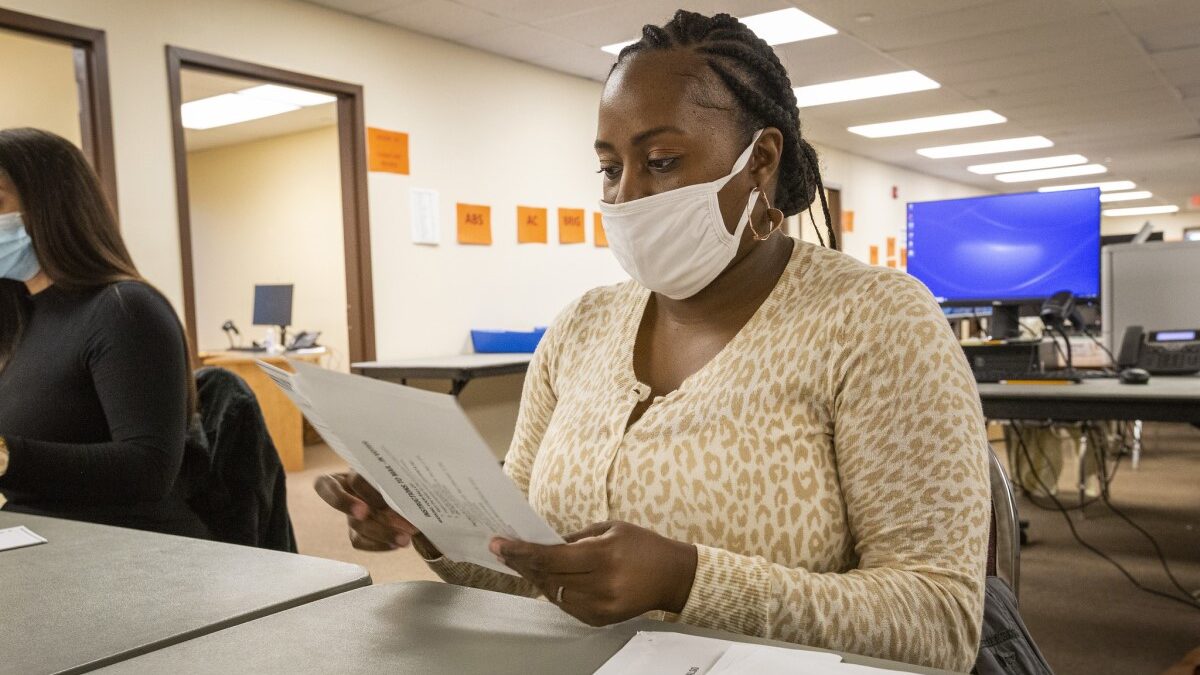

mail-in voting

Author Justin Haskins profile

JUSTIN HASKINS

MORE ARTICLES

For the past three years, the corporate press and numerous officials in the Biden White House have asserted there is no evidence widespread voter fraud occurred during the 2020 presidential election. Some have even gone so far as to call it the “most secure” election in U.S. history.

However, a poll conducted by Rasmussen Reports — a survey I wrote with a team of experts at the Heartland Institute and discussed last week on Tucker Carlson’s show — not only calls into question that often-repeated claim, it shows the opposite could have been true. According to its findings, voter fraud, especially fraud related to mail-in ballots, may have been common in the 2020 election. This conclusion isn’t based on questionable allegations but on voters’ own responses to the poll questions.

The Heartland Institute/Rasmussen survey, which was conducted from Nov. 30 to Dec. 6, asked likely voters who cast ballots in 2020 questions about fraudulent activities, without telling them such actions were a form of voter fraud. The results were stunning. One in five people who voted by mail admitted to engaging in at least one kind of potential voter fraud, seriously calling into question the security of widespread mail-in balloting.

For example, one question asked, “During the 2020 election, did you cast a mail-in ballot in a state where you were no longer a permanent resident?” Such an action nearly always constitutes fraud. Incredibly, 17 percent of voters said “yes.”

Another question asked if “a friend or family member” filled out a respondent’s ballot, “in part or in full,” on behalf of the respondent, which is illegal in some states. Nineteen percent of mail-in voters who responded to the survey answered “yes.”

Even more remarkably, 21 percent of respondents admitted to filling out a ballot for someone they know, such as a spouse or child, and 17 percent confessed to signing a ballot or ballot envelope “on behalf of a friend or family member, with or without his or her permission” — both potential forms of illegal voting.

Taken together, these results strongly indicate fraud and illegal voting heavily affected mail-in balloting in the 2020 election. Even if a fraction of the people admitting wrongdoing here are actually guilty, that would still equal the electoral margin for 2020.

It’s an incredibly important finding since that contest involved more mail-in ballots than any other election in U.S. history. Election officials report that of 159 million ballots cast in 2020, more than 68 million were submitted by mail, about 43 percent of the total. In addition, as the MIT Election Data and Science Lab noted, “the dramatic increase in the raw number of absentee ballots cast was accompanied by a significant decrease in the overall absentee rejection rate for the country: from 0.96 percent in 2016 to 0.79 percent in 2020.”

If the recent Heartland Institute/Rasmussen survey is accurate and one in five ballots were, in fact, fraudulent, that would suggest greater than 13 million ballots should not have been counted nationwide in 2020. That’s far more than the margin of victory for President Biden in the popular vote, about 7 million.

As troubling as these findings are, however, additional questions in the Heartland Institute/Rasmussen survey suggest voter fraud and illegal voting may have been even worse than the one-in-five figure suggests. For instance, 8 percent of all respondents — not just those who voted by mail — said they were offered “pay” or “reward” in return for voting.

Equally disturbing, 10 percent of voters said, “a friend, family member, co-worker, or other acquaintance” admitted to them that he or she “cast a mail-in ballot in 2020 in a state other than his or her state of permanent residence.” Eleven percent said that “a friend, family member, co-worker, or other acquaintance” admitted to filling out someone else’s ballot.

These questions could indicate far more fraud occurred than anyone previously thought.

It’s also worth remembering that presidents are not elected by a national popular vote but through the Electoral College. The three states in which Trump and Biden were closest — Arizona, Georgia, and Wisconsin — were all decided by fewer than 21,000 votes.

Biden narrowly won each of those contests, but if he had lost those three states, he wouldn’t have reached the 270 electoral vote thresholds needed to win the presidency. Instead, the Electoral College vote would have been a tie, pushing the decision to the Republican-controlled House of Representatives. With such razor-thin margins and the results of the recent Heartland/Rasmussen voter fraud survey in mind, it’s hard not to wonder how big of an effect fraud truly had on the outcome of the 2020 presidential election.

But regardless of how much fraud occurred, one thing is absolutely certain: States must take appropriate legislative action to protect the integrity of the next presidential election so that all Americans can be confident that the winner of the 2024 campaign will capture the White House fair and square.

There is already substantial evidence that voter fraud could play a significant role in 2024. Another survey conducted in March and April by the Heartland Institute and Rasmussen shows that 28 percent of likely voters now say they would commit at least one form of illegal voting during the 2024 election, “if given the opportunity.” Interestingly, respondents’ willingness to commit fraud was similar among Republicans, Democrats, and independents.

There is some good news, however. The threat of voter fraud can be limited dramatically by changing mail-in ballot rules. Voters who are physically able to cast their ballots in person should be required to do so, or they should be mandated to have their ballot signature notarized, significantly reducing opportunities for fraud. Lawmakers could fund public programs to increase access to free notaries for those who need them.

According to the National Conference of State Legislatures, just three states require notaries for mail-in ballots — Mississippi, Missouri, and Oklahoma. Only nine additional states mandate that a voter obtain one or more non-notary witness signatures when casting a ballot by mail. Most states require neither a witness nor a notary to verify signatures.

Lawmakers must ensure widespread voter fraud does not happen in future elections. That can only occur if mail-in voting systems are radically improved. Time is running out for legislators to fix these major threats to American self-government.


Justin Haskins (Jhaskins@heartland.org) is the director of the Socialism Research Center at The Heartland Institute and a New York Times bestselling author.

California Democrat Arrested, Charged With Mail-In Ballot Fraud


BY: VICTORIA MARSHALL | FEBRUARY 20, 2023

Read more at https://thefederalist.com/2023/02/20/california-democrat-arrested-charged-with-mail-in-ballot-fraud/

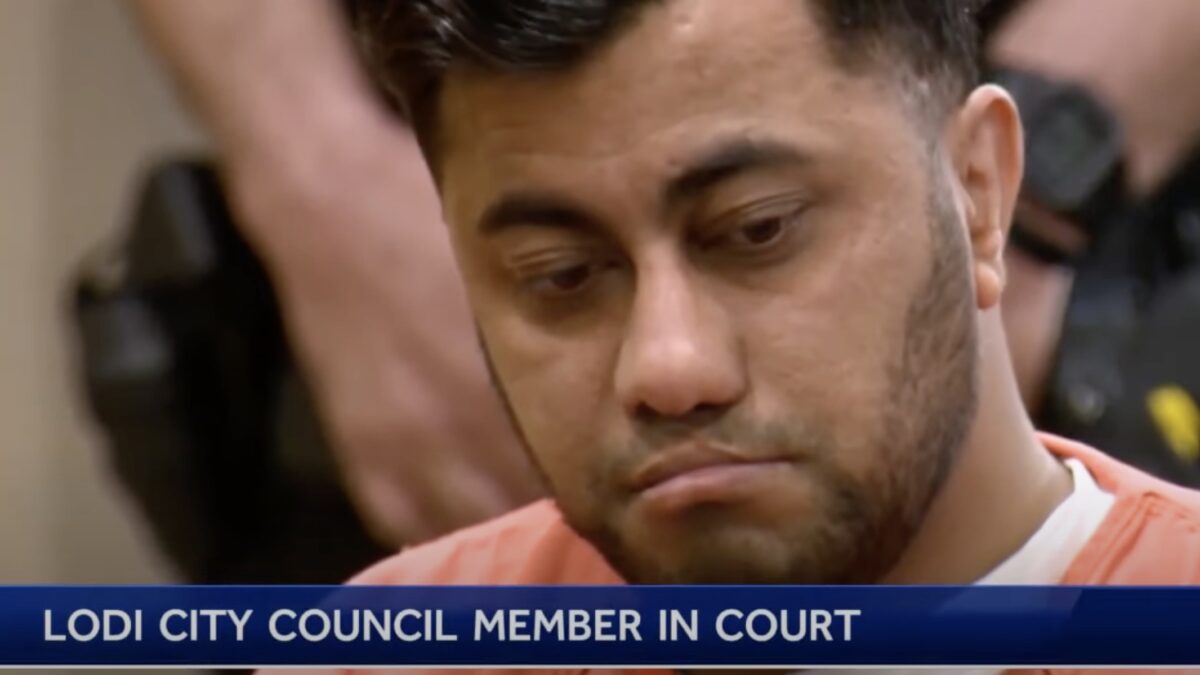
Shakir Khan

A California city council member was arrested for allegedly committing election fraud.

Lodi City Council member Shakir Khan, a Democrat, was arrested on Thursday for multiple election fraud charges, including allegedly stashing 41 mail-in ballots at his home, falsifying voter registration documents, and pressuring residents to vote for him. Investigators claim, based partially on body cam footage of police interviews, that Khan registered 23 people to vote at his home address and used his phone number to register 47 people to vote.

These charges stem from the 2020 election, when Khan was elected to the District 4 seat for the Lodi City Council.

Khan also faces charges in a separate criminal case with his brother that include illegal gambling, money laundering, tax evasion, and unemployment fraud. He’s due in court for another arraignment on that case on Feb. 21. Related to the election fraud charges, Khan was released from jail on Friday but must wear a tracking device and stay within California.

Local news reports it’s unclear whether Khan has resigned from the city council over the allegations. Still, the charges he faces related to election fraud are serious. That investigators allegedly found 41 sealed and completed mail-in ballots when searching Khan’s home proves how easy it is for nefarious actors to fix elections when unsupervised mail-in balloting is legal.

As previously reported, mail-in ballots pose a huge risk for election fraud. According to data from the federal Election Assistance Commission, 28.3 million mail-in ballots are still missing across the country from elections conducted between 2012 and 2018. Because there is no way to track these ballots, there is no way of knowing whether they were used fraudulently.

federal Election Assistance Commission, 28.3 million mail-in ballots are still missing“..

Third-party partisan organizers can also take advantage of such a lax system by harvesting ballots (coaxing voters to fill out ballots on behalf of Democratic candidates, taking their ballots, and dropping them off at election offices), and they do. In fact, Khan allegedly engaged in ballot harvesting by pressuring District 4 residents to vote for him and filling out their ballots.

Requiring all voters who are able to cast their ballots in person would remedy many of the security weaknesses of mail-in balloting. If that were law in Khan’s case, he wouldn’t have been allegedly able to fill out 41 fraudulent mail-in ballots using fake names and addresses and deliver them to be counted. There would have to be actual people showing up at the polls, identifying themselves, and filling out each of their ballots.

Despite the obvious liabilities of switching to all-mail elections, California just became the eighth state to approve all-mail voting for its elections moving forward. As a result of such a disastrous change, expect more cases like Khan’s to spring up.


Victoria Marshall is a staff writer at The Federalist. Her writing has been featured in the New York Post, National Review, and Townhall. She graduated from Hillsdale College in May 2021 with a major in politics and a minor in journalism. Follow her on Twitter @vemrshll.

Author Victoria Marshall profile

VICTORIA MARSHALL

VISIT ON TWITTER@VEMRSHLL

MORE ARTICLES

After Approving Mass Mail-In Balloting, California Loses 10 Million Ballots In November Midterms


BY: VICTORIA MARSHALL | JANUARY 18, 2023

Read more at https://thefederalist.com/2023/01/18/after-approving-mass-mail-in-balloting-california-loses-10-million-ballots-in-november-midterms/

mail in ballot

The 2022 midterms were the first major elections to occur in California after the Golden State approved all-mail voting in September 2021. Under the new system, all registered voters in the state are automatically mailed a ballot for each election cycle (Californians can still opt to vote in person if they wish). But during California’s first foray into mass mail-in balloting for the 2022 midterms, 226,250 mail ballots were rejected and more than 10 million remain unaccounted for, according to a new report by the Public Interest Legal Foundation.

Per the report, the most common reason for rejection of mail ballots in the 2022 cycle was late arrival (48 percent of rejects). Under California law, mail ballots must be postmarked no later than Election Day and arrive at the tabulation center within seven days. For the state’s 2022 general elections, more than 57,000 ballots arrived after Nov. 15 (the seven-day mark). Largely as a result of the switch to mail-in balloting, more than 57,000 Californians were disenfranchised. Such voter disenfranchisement is sure to continue as long as the state keeps its vote-by-mail system. 

“Mail ballots disenfranchise,” PILF President J. Christian Adams said in a statement. “There are many reasons mail ballots fail ultimately to count. No one casting a ballot at home can correct an error before it’s too late. California’s vote-by-mail demonstration should serve as a warning to state legislators elsewhere.”

Another concerning figure coming from California’s midterm election cycle is that 10 million ballots still remain unaccounted for, after processing all polling place votes and rejected ballots. The assumption by election officials is that the majority of these ballots were ignored or thrown out by recipients. But such an information gap increases the risk of fraud. As the report notes, “The public cannot know how many ballots were disregarded, delivered to wrong mailboxes, or even withheld from the proper recipient by someone at the same address.”

Unaccounted mail-in ballots are a serious liability for states with all-mail voting. According to data from the federal Election Assistance Commission, 28.3 million mail-in ballots are still missing from elections conducted between 2012 and 2018. While there is no way of knowing whether these missing mail-in ballots were used fraudulently, they still pose a risk to election integrity.

Take ballot harvesting — the practice of third-party organizers collecting ballots from voters and returning them to election offices — for example. States that approve all-mail voting greatly incentivize ballot harvesting, since Democrat doorknockers can coax potential voters to fill out their ballots and hand them over to their newfound Democrat friends on the spot, rather than having to convince voters to do the legwork themselves. Partisan activists may take advantage of such a lax system. And they already do.

All-mail voting also creates more opportunities for chaos, which in turn undermines voters’ confidence. Under a traditional system where voters cast ballots in person, poll workers must account for all election materials and have a log of the number of ballots cast. When problems occur, such as ballots disappearing, the issue is resolved quickly due to the data trail. Not so with all-mail elections.

During the Covid-19 pandemic, multiple states switched to mail-in balloting under the guise of protecting public health. These voting systems were put in place with hardly any safeguards or scrutiny of the risks posed by all-mail elections. Currently, there are eight states — California, Colorado, Hawaii, Nevada, Oregon, Utah, Vermont, and Washington — that primarily conduct their elections by mail.


Victoria Marshall is a staff writer at The Federalist. Her writing has been featured in the New York Post, National Review, and Townhall. She graduated from Hillsdale College in May 2021 with a major in politics and a minor in journalism. Follow her on Twitter @vemrshll.

Author Victoria Marshall profile

VICTORIA MARSHALL

VISIT ON TWITTER@VEMRSHLL

MORE ARTICLES

PA Supreme Court Deals Huge Election Victory: Undated Mail-In Ballots Cannot Be Counted


BY: VICTORIA MARSHALL | NOVEMBER 02, 2022

Read more at https://thefederalist.com/2022/11/02/pa-supreme-court-deals-huge-election-victory-undated-mail-in-ballots-cannot-be-counted/

mail in ballot

The Pennsylvania Supreme Court ruled on Tuesday that undated mail-in and absentee ballots cannot be counted — a major win for election integrity just a week before Election Day of the 2022 midterms.

The ruling directs Pennsylvania county boards of elections to “segregate and preserve any ballots contained in undated or incorrectly dated outer envelopes” for the Nov. 8 general election but to refrain from counting them. This decision directly contradicts the Keystone State’s Democrat acting secretary of the commonwealth, Leigh Chapman, who told counties to ignore a previous U.S. Supreme Court ruling that effectively said undated mail-in ballots should not be counted. The Republican National Committee and the Pennsylvania GOP immediately announced a lawsuit in response.

The RNC and the state GOP argued that Chapman’s directive violated state law, as Pennsylvania requires voters to properly date their ballots. In fact, mail-in ballots for this election cycle even contain wording that reads “today’s date required” and clear instructions for voters to “sign and date” their ballots. Under Chapman’s instructions, some of Pennsylvania’s 67 counties would have followed her lead while others would have followed state law and clear ballot instructions, tainting the election with inconsistencies and chaos. The RNC asked the Pennsylvania Supreme Court at least to order counties to segregate undated or incorrectly dated ballots.

“Following an RNC, NRCC, and PAGOP lawsuit, Pennsylvania’s Supreme Court has made clear that incorrectly dated and undated mail ballots can not be counted,” RNC Chairwoman Ronna McDaniel said. “Republicans went to court, and now Democrats and all counties have to follow the law: this is a milestone in Republicans’ ongoing efforts to make it easier to vote and harder to cheat in Pennsylvania and nationwide.”

This legal victory by the RNC follows two other recent wins: one against Michigan’s Secretary of State Jocelyn Benson for restricting the rights of poll challengers and another against the North Carolina State Board of Elections for restricting poll watchers.

“Election integrity begins by following the law, and this decision is a big win for Pennsylvanians,” Jason Snead, the executive director of the Honest Elections Project, said in a statement. “Pennsylvania law clearly requires that every mail ballot be dated and signed. That simple, straightforward rule helps to stop late and illegal voting without burdening anyone’s right to vote.”


Victoria Marshall is a staff writer at The Federalist. Her writing has been featured in the New York Post, National Review, and Townhall. She graduated from Hillsdale College in May 2021 with a major in politics and a minor in journalism. Follow her on Twitter @vemrshll.

Author Victoria Marshall profile

VICTORIA MARSHALL

VISIT ON TWITTER@VEMRSHLL

MORE ARTICLES

How No-Excuse Absentee Voting Allows Special Interests To Manipulate Voters


REPORTED BY: WILLIAM DOYLE | FEBRUARY 15, 2022

Read more at https://thefederalist.com/2022/02/15/how-no-excuse-absentee-voting-allows-special-interests-to-manipulate-voters/

ballots

Signs outside every physical polling place forbid electioneering. Each state has some form of restriction on political activities near polling locations when voting is taking place. These restrictions are usually on the display of signs, handing out campaign literature, attempting to influence voters, or soliciting votes within a predetermined distance (typically 50 to 200 feet) of a polling place. A list of the specific electioneering prohibitions adopted by each state can be found here.

Opposition to electioneering is the main reason election integrity advocates oppose allowing political activists to provide food and water to voters waiting in line at polling places. What has been portrayed as a measure to starve and dehydrate suffering voters is really a commonsense prohibition against electioneering. Allowing such practices would allow anybody with a few water bottles or a bag of sandwiches an opportunity to harangue, harass, or otherwise intimidate voters who are waiting in line to cast their ballots.

But nobody has yet come to terms with a new type of electioneering that goes hand in hand with universal absentee voting. We call it “remote electioneering” and define it as an attempt to influence or solicit votes among absentee voters between the time they receive their absentee ballot and the time they submit it to their election office. Obviously, the opportunities for what in normal circumstances would qualify as illegal electioneering multiply considerably with absentee voting, since there is no way of knowing the extent to which partisan activists attempt to influence the behavior of absentee voters.

CTCL’s Goal Was to Influence Absentee Voters

But we have a glimpse of the attitudes of Democrat election activists toward electioneering with absentee ballots through Center for Technology and Civic Life (CTCL) documents, which outline the actions that the major recipients of their Covid-19 Response Grant Program would have to fulfill as conditions of keeping their grant money. By the admission of the activist election officials in Wisconsin who were funded by CTCL in 2020, absentee ballot electioneering was one of their major goals. Grant recipients were required to “Encourage and Increase Absentee Voting (By Mail and Early, In-Person),” mainly through providing “assistance” in their completion and the installation of ballot drop boxes. They were also to “dramatically expand strategic voter education & outreach efforts, particularly to historically disenfranchised residents” in states such as Georgia, Pennsylvania, and Wisconsin, which in 2020 were flooded with no-excuse absentee ballots for the first time ever.

We know that absentee ballot electioneering occurred in areas in these states where CTCL had a substantial presence because it was part and parcel of CTCL’s requirement that absentee voting be promoted, assisted, and increased. Ongoing contact between activist election officials and millions of new absentee voters was not only encouraged in areas that received big CTCL money, it was required.

Wisconsin Illustrates Extravagant Plans

The Wisconsin Safe Voting Plan, which served as the basic template for CTCL’s nationwide efforts during the 2020 election, provides documentation of their extravagant plans to use key election offices to electioneer the absentee vote that they were so intent on promoting.

Election officials in Wisconsin who were “on the street” had enough contact with voters to bemoan the fact that “countless [individuals]” in their municipalities attempted to submit cell phone “selfies” as valid photo ID. Explaining to them that this was not a valid form of photo ID and instructing them on how to properly submit valid ID reportedly “took considerable staff time and resources.”

If election officials had such knowledge, they must have had extensive contact with such low-information absentee voters while they were in the process of completing and submitting their ballots. If this were at the polling booth, it would qualify as illegal electioneering because election officials had “extensive contact” with in-person voters who were completing and submitting their ballots.

A great deal of concern was expressed about “Voters who, understandably, were completely confused about the timeline and rules for voting in the midst of a pandemic and required considerable public outreach and individual hand-holding to ensure their right to vote.” Figuratively “holding someone’s hand” as they cast a vote — whether absentee or in person — seems to be the very definition of electioneering.

The city of Green Bay planned to spend $45,000 to employ bilingual “voter navigators” to help residents properly upload valid photo ID, complete their ballots, comply with certification requirements, and offer witness signatures.  But it would be illegal for poll workers to help voters complete their ballots when voting in person. Why should it not be illegal for partisan activists to help people complete their absentee ballots?

The city of Racine wished to create a corps of “vote ambassadors.” Racine officials said they would recruit, train, and employ such paid ambassadors to set up at the city’s community centers to assist voters with all aspects of absentee ballot requests. But how do we know that the diplomatic efforts of such “ambassadors” would not be exercised exclusively on behalf of their own partisan interests when “assisting” in the completion of absentee ballots?

Violating Voting Booth’s Sanctity

The sanctity of the voting booth used to be considered one of the sacred traditions of American democracy, as it protects the right of individuals to determine who will represent them in government. But the kind of Democracy™ that involves the indiscriminate mass mailing of no-excuse absentee ballots is a top-down endeavor, where most of the power, initiative, and agency is on the side of Democrat politicians and leftist election activists rather than voters.

Their plan is to influence, cajole, and incentivize the least civically engaged, least informed, most apathetic individuals within their jurisdictions to fill out absentee ballots in a way that validates the consolidation of Democratic Party power. Absentee ballot electioneering is the key to a more modern way of “stuffing the ballot box” in an era where activists have convinced a significant number of people that their voting rights have been fatally compromised if they are not permitted to cast a ballot in whatever way is most effortless for them.

The fact that opportunities for electioneering are so few at the polling place, and so plentiful during the time that elapses between the receipt of absentee ballots and their submission, suggests another reason those who wish to find new ways to interfere in legitimate elections are the most strident advocates of universal mail-in voting. It also provides yet another reason why people who believe in free and fair elections should spare no effort to resolutely oppose no-excuse absentee voting in 2022.


William Doyle, Ph.D., is principal researcher at Caesar Rodney Election Research Institute in Irving, Texas. He specializes in economic history and the private funding of American elections. Previously, he was associate professor and chair in the Department of Economics at the University of Dallas. He can be contacted at doyle@rodneyinstitute.org.

ZuckBucks-Connected Private Organization Taught Election Officials To ‘Control the Narrative’ About Mail-In Voting


REPORTED BY: LOGAN WASHBURN | JANUARY 26, 2022

Read more at https://thefederalist.com/2022/01/26/zuckbucks-connected-private-organization-taught-election-officials-to-control-the-narrative-about-mail-in-voting/

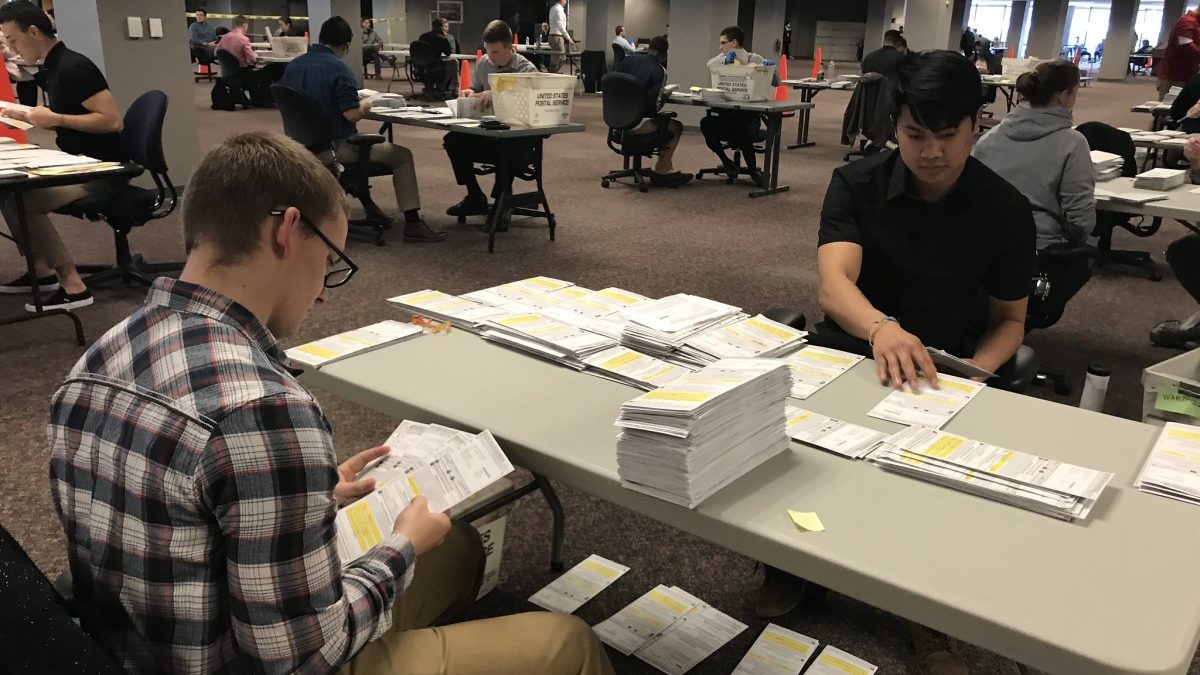
Wisconsin election volunteers

A left-leaning nonprofit instructed public officials how to “control the narrative” about mail-in ballots in the 2020 election. The National Vote at Home Institute (NVAHI) guided officials to sway public opinion in favor of mail-in voting with their 2020 Election Official Communications Toolkit.” The group shared this document with public officials in Wisconsin while working with the Center for Tech and Civic Life (CTCL) to influence the 2020 election.

CTCL used nearly half a billion dollars from Facebook tycoon Mark Zuckerberg to fund private action within government election offices. They spent most of the money in Democrat-saturated districts, which boosted Joe Biden’s narrow presidential win in 2020. As a partner for the “Zuckbucks” recipient, NVAHI gave public officials advice on how to “control the narrative” about mail-in ballots.

“Do not repeat myths as a way to refute them,” the document says. “Instead, control the narrative by presenting information that affirms the safety, security, and reliability of mail balloting.”

Mail-in voting is not only proven to be more susceptible to voter fraud and errors than in-person voting, it is well known to favor Democrats over Republicans. It essentially functions as a get-out-the-vote operation on behalf of Democrats, whose voters are less motivated to show up at the polls on election day. Republican voters far prefer to vote in person, accurately believing it is more secure.

The group also told election officials to push mail-in voting by placing articles in media outlets: “Reporters will likely already be writing up voter information guides as well as shaping their articles around how well or poorly the election is running. A proactive op-ed strategy is helpful here,” the document says.

NVAHI explained that officials should target free, popular local news publications: “For all these types of outlets, approach them about whether they would run an article on your behalf about the upcoming election,” the document says.

The organization recommended officials use public information strategies such as “playing up the security” of mail-in voting. NVAHI told election officials to dissuade concerns about mail-in ballots by claiming that they contain “over a dozen security features.”

“Voters may be reluctant to fill out a mail ballot because of concerns they’ve heard about stolen or lost ballots. Assuage those concerns without leaning into them,” the document says.

The guide also tells public officials to “instill a sense of urgency” about mail-in voting, recommending an appeal to popularity: “Voters may be unsure whether voting by mail is right for them. Social proof (showing how many people are taking up a behavior) is a powerful way of making mail-in ballots a compelling option.”

The document also recommended that government election offices use particular slogans for public information campaigns, such as “Voting by mail is easy and secure,” and “Let’s all vote safely. Choose to vote by mail.”

NVAHI partnered with the organization Ideas42 to create this toolkit. According to its website, the group is “a non-profit that uses insights from behavioral science to improve lives, build better systems and policies, and drive social change.” Ideas42 works with CTCL partner Center for Civic Design, along with several offices of government secretaries of state.

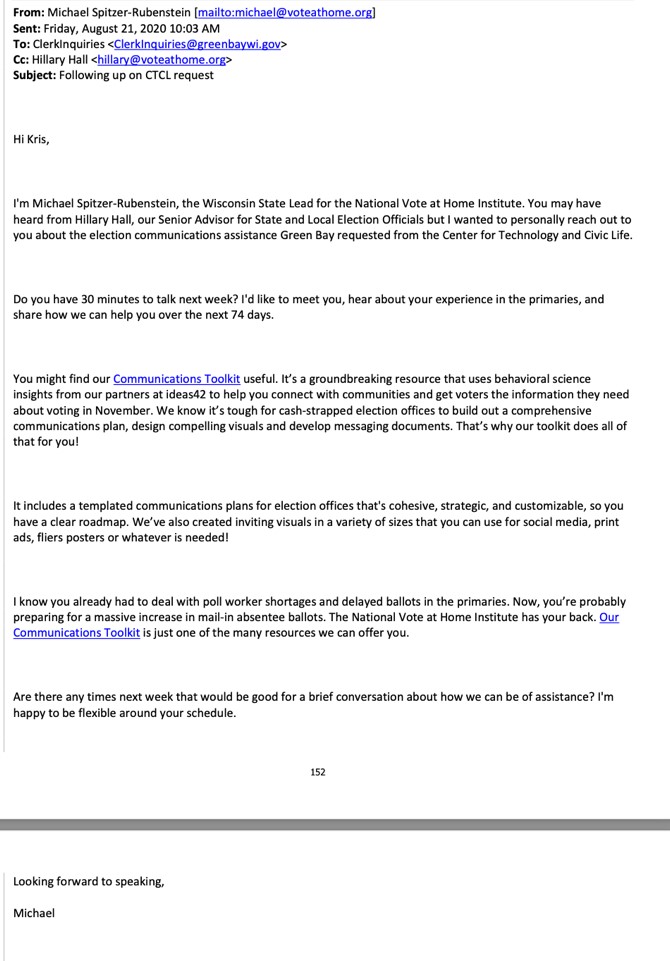
After CTCL gave a grant of $1.6 million to the Wisconsin city of Green Bay in 2020, NVAHI gained access to absentee ballots and influence over election preparations in the area. NVAHI Wisconsin State Lead Michael Spitzer-Rubenstein emailed the elections guide to former Green Bay City Clerk Kris Teske in August 2020.

When reaching out to Teske, Spitzer-Rubenstein described the toolkit as “a groundbreaking resource that uses behavioral science insights from our partners at Ideas42 to help you connect with communities and get voters the information they need.”

Spitzer-Rubenstein, who worked for Democrat political campaigns in the past, emailed Teske to ask if his group could “cure” absentee ballots. This means altering absentee ballots after they are filed to allegedly fix errors, rather than counting improperly marked ballots as invalid. When Teske turned down the offer, Spitzer-Rubenstein emailed former Green Bay Mayor’s Office Chief of Staff Celestine Jeffreys, who ordered Teske to open the city elections’ ballot-curing process to NVAHI, a private special interest group.

A 2021 audit of Wisconsin elections found the state had counted enough illegal ballots in 2020 to potentially switch its Electoral College votes from Biden to Donald Trump. Vote curing in the election could have contributed to the state counting illegal votes, the audit found.

Also in 2021, a judge ruled that the state’s 2020 use of ballot drop boxes and ballot harvesting, both of which are only possible with mail-in ballots, was illegal. The majority of mail-in ballots in Wisconsin were votes for Biden, who won the state by a margin of 0.63 percent, or approximately 20,600 votes.

Before election day, Green Bay elections officials gave Spitzer-Rubenstein four out of five keys to the room in which the absentee ballots were stored, former Brown County Clerk Sandy Juno told Wisconsin Spotlight.

After the election, Juno expressed concerns that the Central Count location was “tainted by the influence of a person working for an outside organization influencing the election,” according to Wisconsin Spotlight. Teske said she felt that third-party groups such as CTCL and NVAHI excluded the clerk’s office from the election process.

“As you know, I am very frustrated, along with the Clerk’s Office. I don’t know what to do anymore,” she emailed a colleague. “I don’t understand how people who don’t have knowledge of the process can tell us how to manage the election.”


Logan Washburn is studying politics and journalism at Hillsdale College. He is a correspondent for Campus Reform and an outreach assistant for the Freedom Foundation.

Tag Cloud