Welcome to 2025, where we are still uncovering election fraud from the 2020 and 2022 elections. Texas Attorney General Ken Paxton is investigating more than 100 possible noncitizens who may have voted in both the 2020 and 2022 elections, casting more than 200 ballots. In this case, most of the suspected illegal ballots were cast in Harris County. Paxton is also investigating in Guadalupe, Cameron, and Eastland counties, based on information from the Texas Secretary of State.
Add the possible 100 fraudulent voters announced this week to the 33 potential noncitizens who may have voted illegally in 2024. Paxton started investigating those 33 voters in June after the Texas secretary of state made a referral, based on information found in the U.S. Citizenship and Immigration Service’s (USCIS) SAVE database, showing they voted in the 2024 general election.
Some 1,200 federal agencies use SAVE to verify U.S. citizenship or determine current immigration. For example, when an applicant applies for a Social Security Number, a drivers license, or for public housing assistance, the agency will check SAVE to see if they are a citizen. Legally, noncitizens are not allowed to vote in U.S. elections.
“Illegal aliens and foreign nationals must not be allowed to influence Texas elections by casting illegal ballots with impunity. I will not allow it to continue,” Paxton said in a statement. “Thanks to President Trump’s decisive action to help states safeguard the ballot box, this investigation will help Texas hold noncitizens accountable for unlawfully voting in American elections. If you’re a noncitizen who illegally cast a ballot, you will face the full force of the law.”
No one can realistically say fraudulent, noncitizen voting doesn’t happen. There are too many examples to ignore. Sometimes it is a single incident with one voter, like the Chinese student living in Michigan who was improperly registered to vote and is charged with voting the November election. Other times, it is a group of voters, like when Michigan Secretary of State Jocelyn Benson found 15 likely noncitizens across the state voted in November’s election, but she said illegal activity is “very rare.”
So rare, that an audits of voter registration rolls in Iowa found 277 noncitizens registered to vote or actually voted in the 2024 election. In Oregon, the elections director quit after officials discovered more than 300 noncitizens had been registered to vote, and the state’s Department of Motor Vehicles processed more than 54,600 voter registrations, 2021-2024, with an unknown citizenship.
Just last month, the Senate Judiciary Committee announced it is investigating newly declassified FBI documents alleging that in 2020 the Chinese Communist Party was making thousands of fake U.S. driver’s licenses to use to validate fake mail-in ballots. The investigation is ongoing, but we can already see it is a huge scandal. And the list goes on, and on, and on. Not rare.
The remedy is so simple. Mandatory voter identification at voter registration and when voting. The Safeguard American Voter Eligibility (SAVE) Act would keep noncitizens from voting by requiring proof of citizenship when registering to vote. It passed in the House in April and still has not moved in the Senate. It should be a bipartisan issue, but Democrats have claimed that providing identification is a burden that disenfranchises voters.
It is good officials are still digging into how the 2020 election went off the rails, so we understand the weak spots. But it is past time to shore up the election process with simple fixes like the SAVE Act, so in 2030 we are not still trying to figure out what happened in 2028.
Beth Brelje is an elections correspondent for The Federalist. She is an award-winning investigative journalist with decades of media experience.
Texas Attorney General Ken Paxton is investigating reports of nonprofits illegally registering noncitizens to vote.
“Nonprofit organizations have been located outside Texas Department of Public Safety Driver License offices, operating booths offering to assist in voter registration for persons doing business,” reads an Aug. 21 press release from Paxton’s office.
Investigators with Paxton’s Election Integrity Unit recently performed “undercover operations” in “major metropolitan areas” regarding possible registration of noncitizens to vote, according to the release. Investigators have “already confirmed” nonprofit registration efforts outside Texas DPS offices.
“If eligible citizens can legally register to vote when conducting their business at a DPS office, why would they need a second opportunity to register with a booth outside?” Paxton said in the release. “The Biden-Harris Administration has intentionally flooded our country with illegal aliens, and without proper safeguards, foreign nationals can illegally influence elections at the local, state, and national level.”
The attorney general’s office is continuing an “ongoing investigation,” Paxton said in a statement to The Federalist.
“We cannot provide more information at this time,” Paxton said. “It is encouraging that these booths are now prohibited from operating on DPS property.”
The DPS had allegedly been tacitly allowing these efforts near driver’s license offices, according to Texas Scorecard. But due to Paxton’s investigation, the department “temporarily prohibited” voter registration groups from operating on its property.
“It is a crime to vote — or to register to vote — if you are not a United States Citizen,” Paxton said in the release. “Any wrongdoing will be punished to the fullest extent of the law.”
It is a “crime in Texas to lie about one’s citizenship” or to help another person do so when registering to vote, according to the release. The crime brings a punishment of up to two years in a state jail and a $10,000 fine. It is also illegal in Texas for noncitizens to vote or help someone else do so. Violations bring a punishment of up to 20 years in prison and a $10,000 fine.
“Texans are deeply troubled by the possibility that organizations purporting to assist with voter registration are illegally registering noncitizens to vote in our elections,” the release said.
Republican Gov. Greg Abbott echoed a similar sentiment on X, referring to Paxton’s investigation.
“Illegally registering non-citizens to vote won’t be tolerated in Texas. It’s a crime,” Abbott said. “We won’t let cheaters influence elections in Texas.”
Illegally registering non-citizens to vote won't be tolerated in Texas.
It's a crime.
Attorney General @KenPaxtonTX is thoroughly investigating it.
Logan Washburn is a staff writer covering election integrity. He graduated from Hillsdale College, served as Christopher Rufo’s editorial assistant, and has bylines in The Wall Street Journal, The Tennessean, and The Daily Caller. Logan is originally from Central Oregon but now lives in rural Michigan.
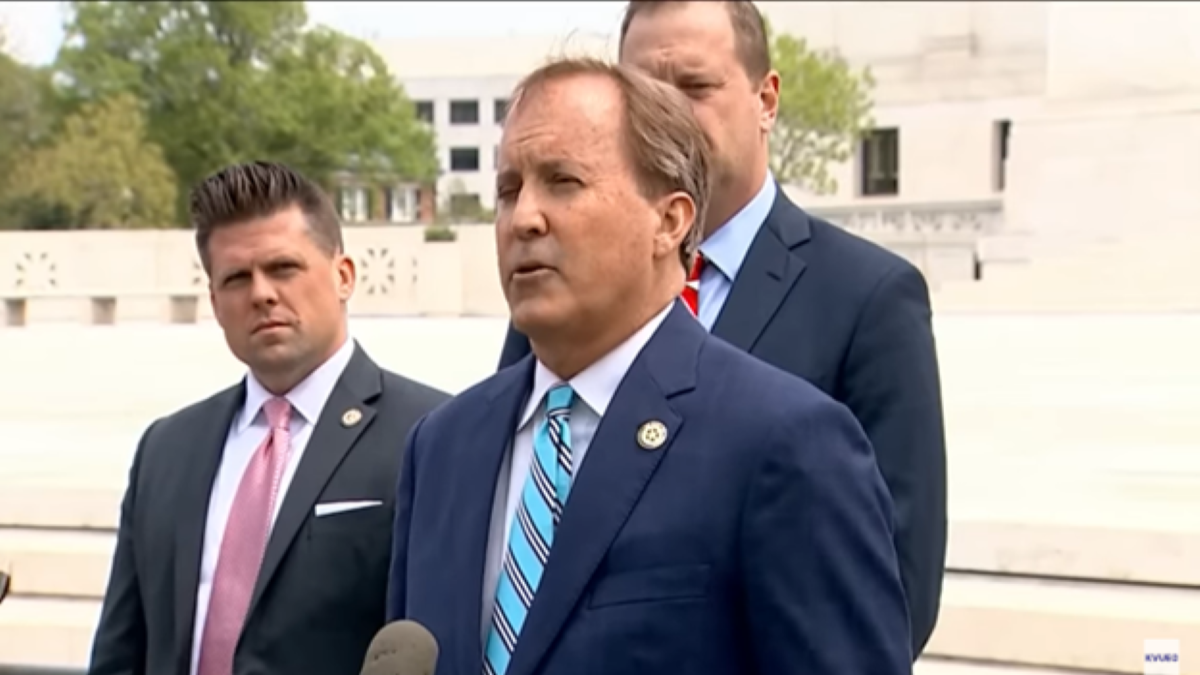
Texas Attorney General Ken Paxton told Newsmax on Tuesday that the Border Patrol agents in Texas who are taking down the razor wire that the state put up to keep out illegal migrants “do not like” what the Biden administration is ordering them to do.
“I don’t think there’s tension between the actual people on the ground,” Paxton said on Newsmax’s “National Report.” “The Border Patrol do not like what they’re being forced to do. They do it because they’re forced by [President] Joe Biden and his administration. On day one of his administration, he said that he was not going to deport people anymore and ever since then, we’ve been in litigation with them over immigration, and he’s continued to let people in. But that’s not what law enforcement wants. I can tell you nobody wants what he wants.‘
“Basically, he’s decided, to the detriment of the American public, that he’s going to bring these people in, work with the cartels every day, because the cartels make money off every person coming through and he’s making it easier for them because they don’t have to hide anymore. They just turn themselves in. It also allows the cartels to import more drugs, so it’s been very profitable and good for the cartels. It has not been good for Americans because of the increased crime, the risk of terrorism and the cost that every state is going to bear as a result of this.”
Texas has continued to install razor wire at the U.S.-Mexico border, even as federal agents were given the go-ahead by the Supreme Court last week to cut it down. Texas Gov. Greg Abbott called the razor wire an “effective deterrent against the illegal border crossings” and vowed to “continue to deploy this razor wire to repel illegal immigration.”
Paxton on Tuesday also commented on the state’s fight with the federal government over Shelby Park in Eagle Pass, which the Biden administration has sought unsuccessfully to enter since Texas cordoned it off.
“This is property owned by the government in Texas,” Paxton said. “The federal government has no right to come and take over that property — which is used for recreational purposes, that’s being funded by tax dollars in Texas — and use it as a way to increase the number of people crossing the border and potentially, as we know, increasing crime in the area, and so, absolutely we’re going to keep them out. They have no right to take it over.
“It’s only a 2.5-mile area. It’s interesting to me that there’s 1,260 something miles of border and they’re mad about 2.5 miles when they’re letting people in all over the place. So, it’s an interesting fight that doesn’t seem, in my opinion, to have a lot of purpose for them. It has a lot of purpose for us because this is a park that residents use for recreational purposes.”
Nicole Wells, a Newsmax general assignment reporter covers news, politics, and culture. She is a National Newspaper Association award-winning journalist.
The U.S. State Department is violating the U.S. Constitution by funding technology to silence Americans who question government claims, says a lawsuit filed Tuesday by The Federalist, The Daily Wire, and the state of Texas.
The three are suing to stop “one of the most audacious, manipulative, secretive, and gravest abuses of power and infringements of First Amendment rights by the federal government in American history,” says the lawsuit. It exposes federal censorship activities even beyond the dramatic discoveries in a pending U.S. Supreme Court case, Murthy v. Missouri (also known as Missouri v. Biden).
This lawsuit alleges the State Department is illegally using a counterterrorism center intended to fight foreign “disinformation” instead to stop American citizens from speaking and listening to information government officials dislike. Other recent investigations have also found government counterterrorism resources and tactics being used to shape American public opinion and policy.
Through grants and product development assistance to private entities including the Global Disinformation Index (GDI) and NewsGuard, the lawsuit alleges, the State Department “is actively intervening in the news-media market to render disfavored press outlets unprofitable by funding the infrastructure, development, and marketing and promotion of censorship technology and private censorship enterprises to covertly suppress speech of a segment of the American press.”
This is just the latest in a series of major investigations and court cases in the last year to uncover multiple federal censorship efforts laundered through private cutouts. The “Twitter Files,” a series of investigative journalist reports, uncovered that dozens of federal agencies pressured virtually all social media monopolies to hide and punish tens of millions of posts and users.
Missouri v. Bidenfound this federal censorship complex has included government officials changing the content moderation and user policies of social media monopolies through threats to destroy their business models. House of Representatives investigations have uncovered U.S. national security and spy agencies creating “private” organizations to circumvent the Constitution’s prohibition on federal officials abridging Americans’ speech. These false-front organizations deliberately avoid creating records subject to transparency laws and congressional oversight, public records show.
Congressional investigations in November revealed that federal officials have specifically targeted The Federalist’s reporting for internet censorship.
In which Sean Davis was censored for saying the best evidence against the integrity of the election was the fact that Democrats/media/Big Tech were censoring anyone who observed their censorship efforts related to the election. pic.twitter.com/r6NdbnSx1f
‘Coordinating the Government’s Efforts to Silence Speech’
The Fifth Circuit refrained from stopping the State Department’s participation in the “vast censorship enterprise” that Murthy v. Missouri uncovered because, the court said, it hadn’t seen enough evidence of that agency’s involvement. This new lawsuit from Texas, The Federalist, and The Daily Wire provides such evidence.
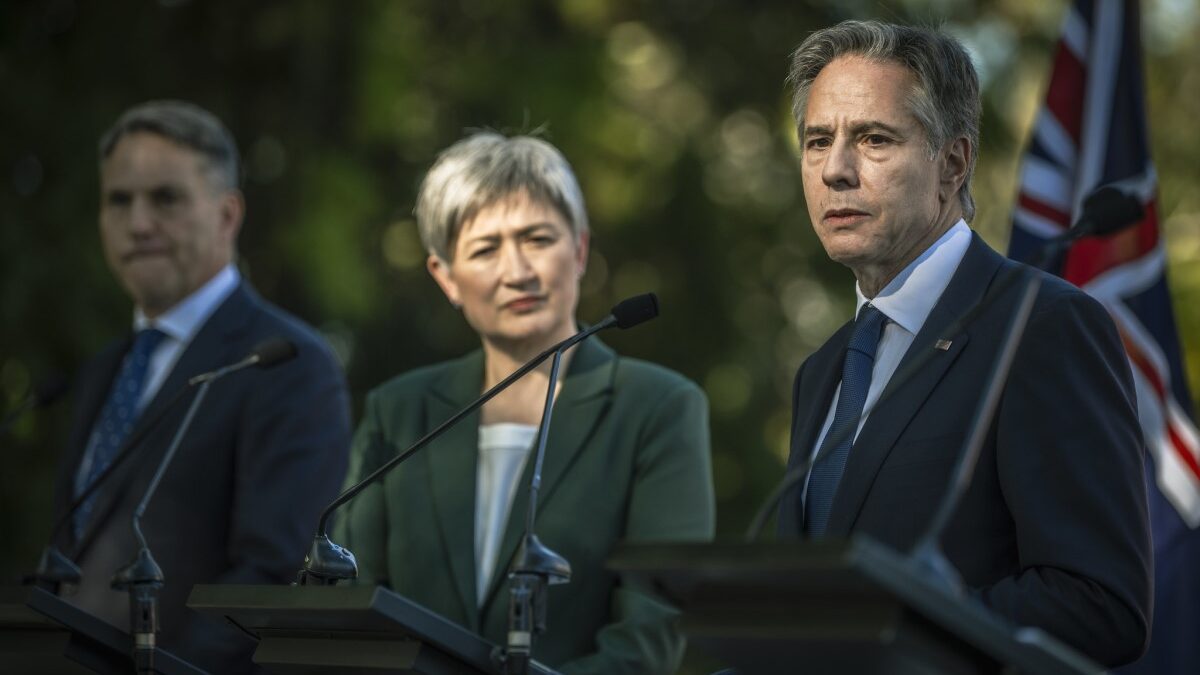
Even though Congress and the Constitution have banned the federal government from silencing Americans, the State Department’s Global Engagement Center (GEC) has morphed into “the lead in coordinating the government’s efforts to silence speech,” the lawsuit says. The lawsuit names as defendants the U.S. State Department, GEC, and multiple department officials including Secretary of State Antony Blinken. GEC originated as a counterterrorism agency created by an executive order from President Obama.
Through GEC, the State Department evaluated more than 365 different tools for scrubbing the internet of disfavored information, the lawsuit says. The department also pays millions to develop multiple internet disinformation “tools.” It also runs tests on censorship technologies and awards government prize money to those most effective at controlling what Americans say and hear online, the lawsuit says.
State then shares these censorship technologies with companies, favored media outlets, academics, and government agencies. It markets these government-funded censorship technologies to Silicon Valley companies including Facebook, X, and LinkedIn. The tools included “supposed fact-checking technologies, media literacy tools, media intelligence platforms, social network mapping, and machine learning/artificial intelligence technology,” the lawsuit says.
At least two of the censorship tools the State Department has funded, developed, and awarded have targeted The Federalist and The Daily Wire, the lawsuit says. NewsGuard and GDI wield these tools developed with government assistance to deprive government-criticizing news outlets, including The Federalist and The Daily Wire, of operating funds.
They do this by rating conservative outlets poorly, falsely claiming these outlets purvey “disinformation” and are “unreliable.” That deprives leftists’ media competitors of high-value ad dollars from the big companies that use these rating systems. Such companies include YouTube, Facebook, Snapchat, Best Buy, Exxon Mobil, Kellogg, MasterCard, and Verizon.
“Advertising companies that subscribe to GDI’s blacklist refuse to place ads with disfavored news sources, cutting off revenue streams and leaving the blacklisted outlets unable to compete with the approved ‘low risk’ media outlets — often legacy news,” the lawsuit says.
Boosting Disinformation While Claiming the Opposite
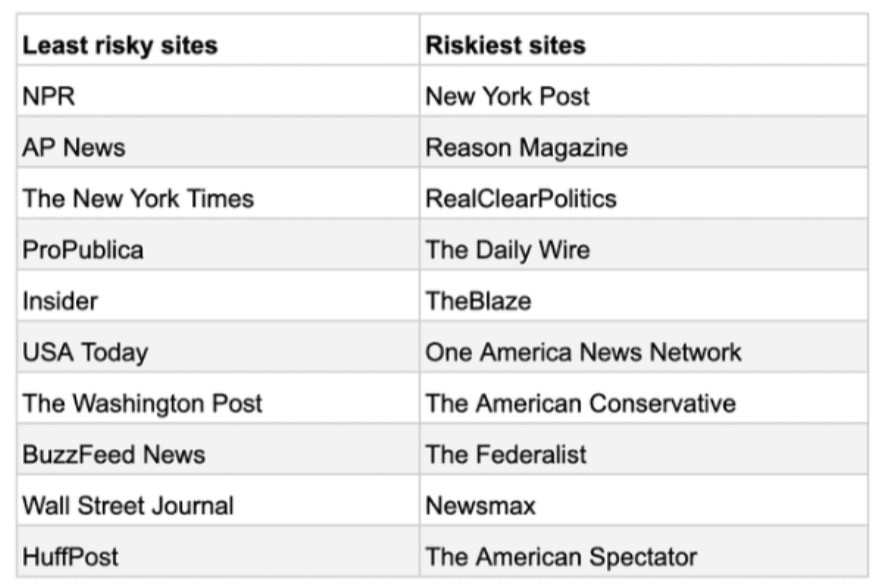
Ratings companies like NewsGuard and GDI base their low ratings of outlets like The Federalist at least in part on politically charged “fact checks” of a tiny percentage of the outlets’ articles. While these companies’ full ratings criteria are secret, in December 2022 GDI published a top 10 list of its most favored and most disfavored news outlets. The Federalist and Daily Wire appear on GDI’s 10 “riskiest” list.
All of the outlets on GDI’s “least risky” list have helped spread some of the government’s biggest disinformation operations in the last decade. Those include the Russia-collusion hoax and Hunter Biden laptop stories, which influenced national elections in favor of Democrats. The 10 “least risky” outlets have also widely published notable misinformation such as claims that Covid vaccines prevent disease transmission, the Covington student insult hoax, and evidence-free claims that Supreme Court Justice Brett Kavanaugh is a serial gang rapist.
This federal censorship-industrial complex’s numerous disinformation operations include the Hamilton 68 effort. In contrast, The Federalist not only reported all these stories accurately from the beginning but for most led the reporting pack that proved it. GDI rated The Daily Wire’s “risk level” as “high” and The Federalist’s “risk level” as “maximum.”
While technologies and enterprises the State Department promotes push corporate media’s biggest purveyors of propaganda, they also “blacklist” The Federalist and Daily Wire, the lawsuit says, “negatively impacting Media Plaintiffs’ ability to circulate and distribute their publications to both current and potential audiences, and intentionally destroying the Media Plaintiffs’ ability to obtain advertisers.” Microsoft, for example, uses NewsGuard technology “to train Bing Chat.”
The lawsuit is filed in the U.S. federal court for the Eastern District of Texas. It seeks a court declaration that the State Department’s funding, testing, pressuring, and promoting of internet censorship tools is unconstitutional and an order that it end.
Joy Pullmann is executive editor of The Federalist, a happy wife, and the mother of six children. Her ebooks include “The Read-Aloud Advent Calendar,” “The Advent Prepbook,” and “101 Strategies For Living Well Amid Inflation.” An 18-year education and politics reporter, Joy has testified before nearly two dozen legislatures on education policy and appeared on major media from Fox News to Ben Shapiro to Dennis Prager. Joy is a grateful graduate of the Hillsdale College honors and journalism programs who identifies as native American and gender natural. Her traditionally published books include “The Education Invasion: How Common Core Fights Parents for Control of American Kids,” from Encounter Books.
Democrats are working overtime to make it so painful for attorneys to represent Republicans in election cases that the next candidate will be unable to find lawyers willing to battle on their behalf.
A state court judge refused to halt the Texas Bar’s assault on Attorney General Ken Paxton for his decision to challenge several swing states’ execution of the 2020 election in Texas v. Pennsylvania, a little-noticed perfunctory order published in late January revealed.
While the partisan targeting of Paxton represents but one of the many attempts by Democrats to weaponize state bars to dissuade attorneys from representing Republicans, court documents obtained by The Federalist reveal that in the case of the Texas attorney general, the bar went nuclear.
In March of 2022, as Paxton prepared to face Land Commissioner George P. Bush in the May 2022 GOP runoff for attorney general, news leaked that the State Bar of Texas intended to advance an ethics complaint against the Republican attorney general. Then, soon after Paxton prevailed in the primary, on May 25, 2022, the Commission for Lawyer Discipline, which is a standing committee of the State Bar of Texas, filed a disciplinary complaint against Paxton in the Collin County, Texas district court.
While the Texas Bar’s disciplinary complaint represents an outrageous and unconstitutional attack on the attorney general, as will be detailed shortly, the backstory is nearly as troubling — both the machinations underlying the charge against Paxton and, more broadly, the barrage of politicized bar complaints pursued against Republican lawyers who provided legal advice or litigated various issues in the aftermath of the November 2020 general election.
Bars Gone Rogue
The D.C. Bar’s investigation into former Trump administration Assistant Attorney General Jeff Clark based on a complaint from Sen. Dick Durbin, D-Ill., exemplifies the partisan co-opting of the various professional responsibility boards charged with overseeing attorneys’ conduct.
In Clark’s case, the ethics charge was both “demonstrably false and premised on the fraudulent narratives pushed by the partisan politicians running the Jan. 6 show trial and their partners in the press.” Yet Clark has been forced to fight for his livelihood because the D.C. Bar allowed Democrats to convert a disagreement over Clark’s legal opinion into a question of professional ethics. Clark has attempted to put a halt to the proceedings by moving to remove the case to the federal district court, but Clark’s motion has been stalled there for several months.
More recently, the California State Bar joined in the political witch hunt when it filed a 35-page, 11-count disciplinary complaint against attorney and former law professor John Eastman. The California State Bar’s complaint alleged Eastman’s engagement “in a course of conduct to plan, promote, and assist then-President Trump in executing a strategy, unsupported by facts or law, to overturn the legitimate results of the 2020 presidential election by obstructing the count of electoral votes of certain states.” As I wrote at the time:
The 11 charges against Eastman prove troubling throughout, with the State Bar of California proposing to discipline Eastman for presenting legal analyses to his client, Trump, and for speaking publicly on his views about the election, with the bar even attempting to hold Eastman responsible for any violence that occurred on Jan. 6. The disciplinary complaint also misrepresents numerous arguments Eastman and others made concerning the 2020 election, falsely equating claims of violations of election law with fraud.
Eastman’s long and costly battle against the California Bar is only beginning. And that is precisely the point of involving state bars: to make it so painful for attorneys to represent Republicans in election cases that the next presidential candidate — or senatorial or congressional candidate — will be unable to find lawyers willing to battle on their behalf.
A Broader Campaign
These efforts are well-coordinated and well-funded, with the group 65 Project launching in March of 2022 ethics complaints against 10 lawyers who worked on election lawsuits following the 2020 presidential election. According to Influence Watch, “65 Project was ‘devised’ by Democratic consultant and former Clinton administration official Melissa Moss,” and is managed by attorney Michael Teter, a former litigation associate with the DNC-connected law firm Perkins Coie. David Brock, of Media Matters fame, advises the group, and the advisory board includes, among others, the former U.S. Senate Majority Leader Tom Daschle, D-S.D.
The 65 Project reportedly “seeks to disbar 111 lawyers from 26 states in total,” but is “not targeting any Democratic-aligned attorneys who have challenged election laws or results in the past.” Rather, the project’s sole aim is Republican lawyers, such as Eastman, with the group pushing for Eastman’s disbarment from the Supreme Court Bar.
It is not merely private attorneys the Democrat project targets, however. In September, the 65 Project filed complaints against the attorneys general of 15 states, including Alabama, Arkansas, Florida, Indiana, Kansas, Louisiana, Mississippi, Missouri, Montana, Nebraska, Oklahoma, South Carolina, Tennessee, Utah, and West Virginia, advocating the bars in those states take disciplinary action against the attorneys general for conduct related to the 2020 election.
Texas AG Paxton didn’t make the list, though, because local Democrats had already taken up the charge. And here, the backstory reveals the troubling politicization of state bars is not limited to Democratic-connected groups like the 65 Project or to the bars in leftist locales such as D.C. and California.
Anti-Paxton Crusade
In Paxton’s case, the state bar received at least 85 complaints about Paxton related to Texas v. Pennsylvania. The Office of Chief Disciplinary Counsel reviewed the complaints and dismissed them, finding “the information alleged did not demonstrate Professional Misconduct.” But then four attorneys appealed the dismissal, including one who, according to court filings, was the president of the Galveston Island Democrats and a friend of a Democrat seeking to run against Paxton for attorney general in the then-upcoming 2022 election.
An appeals body within the Texas State Board reversed the dismissal of the complaints, and later a fifth complaint was added to the charges against Paxton. Paxton was then forced to respond to the allegations, which itself proved difficult because they consisted of vague rhetoric, such as claims that Paxton “violated his duty and obligations as a Texas attorney” and “filed an utterly frivolous lawsuit,” bringing “shame and disrespect to the State of Texas and the legal community of Texas.”
Nonetheless, Paxton filed a detailed response, expanded on the theories Texas asserted in the Texas v. Pennsylvania case, and provided the bar with an extensive discussion of the factual and legal basis underpinning the court filings. The Texas Bar then handed the complaints over to what Paxton described as “an investigatory panel comprised of six unelected lawyers and activists from Travis County.”
As Paxton’s later court filings would stress, “as a group, the panel donated thousands of dollars to federal, state, and local candidates and causes opposed to Attorney General Paxton.” “What’s more,” Paxton argued in opposing the bar’s case against him, “members of the panel voted consistently in Democratic primaries for over a decade. Several have maintained highly partisan social media accounts hostile to Paxton.”
Unsurprisingly, the partisan panel found “just cause” existed to believe that Paxton had violated a catch-all provision of the Rules of Professional Conduct, namely the canon prohibiting attorneys from engaging “in conduct involving dishonesty, fraud, deceit, or misrepresentation.”
But in making this finding and filing a disciplinary petition in the state court, the Texas Bar wholely ignored the fundamental flaw in its crusade against Paxton — and one of constitutional dimension: The state bar, as a bureaucratic arm of the judicial branch, violates the Texas Constitution’s guarantee of separation of powers by challenging Paxton’s execution of his duties as attorney general.
Separation of Powers
Paxton concisely exposed this reality in his briefing, first quoting Texas precedent that teaches: “The Texas Separation of Powers provision is violated … when one branch unduly interferes with another branch so that the other branch cannot effectively exercise its constitutionally assigned powers.” “The Commission’s suit against the Attorney General violates the Separation-of-Powers doctrine,” Paxton continued, because the “decision to file Texas v. Pennsylvania is committed entirely to the Attorney General’s discretion. No quasi-judicial body like the Commission can police the decisions of a duly elected, statewide constitutional officer of the executive branch.”
In seeking the dismissal of the state bar complaint against him based on separation-of-powers principles, Paxton’s argument shows the politicization process becomes nuclear when the target is the state’s attorney general, writing: “Unelected administrarors from the judicial branch attempting to stand in judgment of the elected attorney general who is the sole executive officers with the authority to represent the State of Texas in the Supreme Court of the United States.”
While it is bad enough that the state bar has been used as a sword to attack political enemies, such as Eastman in California and Clark in D.C., to deter attorneys in the future from representing unpopular cases or parties, the weaponization of the state bar against a state’s attorney general is not a difference in degree, but a difference in kind. As Paxton wrote:
No other attorney in Texas, no one else on the planet can bring a lawsuit on behalf of the State … but we’ve got an administrative arm of the judicial branch, unelected state bureaucrats telling the chief legal officer of the State of Texas how he can exercise his sole prerogative and his exclusive authority to bring a civil lawsuit on behalf of the State of Texas.
Yet unelected bureaucrats — many of whom are political enemies of Paxton — have put the attorney general literally on trial for exercising the executive function with which he was constitutionally charged. And while Paxton fully briefed his position — that as a matter of constitutional law and the doctrine of separation of powers, the court lacked jurisdiction to proceed on the bar’s complaint against him — the trial judge summarily rejected Paxton’s motion, merely stating the motion was “denied.”
Paxton has yet to state publicly whether he plans to appeal the denial of his motion to dismiss to the Texas Court of Appeals. But as a matter of principle he should; this case represents not merely an attack on him personally, but on the position of attorney general.
The Federalist obtained copies of the relevant court filings and they are available here, here, here, here, here, and here.
Margot Cleveland is The Federalist’s senior legal correspondent. She is also a contributor to National Review Online, the Washington Examiner, Aleteia, and Townhall.com, and has been published in the Wall Street Journal and USA Today. Cleveland is a lawyer and a graduate of the Notre Dame Law School, where she earned the Hoynes Prize—the law school’s highest honor. She later served for nearly 25 years as a permanent law clerk for a federal appellate judge on the Seventh Circuit Court of Appeals. Cleveland is a former full-time university faculty member and now teaches as an adjunct from time to time. As a stay-at-home homeschooling mom of a young son with cystic fibrosis, Cleveland frequently writes on cultural issues related to parenting and special-needs children. Cleveland is on Twitter at @ProfMJCleveland. The views expressed here are those of Cleveland in her private capacity.
Sen. Ted Cruz, Texas Attorney General Ken Paxton, and the attorneys general from 17 additional states should all be disbarred, according to the reasoning of the disciplinary complaint the State Bar of California filed Thursday against former Trump campaign attorney John Eastman. That detail is one of many buried in the 35-page, 11-count disciplinary complaint made public yesterday in the latest lawfare attack on attorneys who deigned to represent Donald Trump.
State Bar of California’s Chief Trial Counsel George Cardona announced on Thursday the filing of disciplinary charges against Eastman, allegedly arising from Eastman’s engagement “in a course of conduct to plan, promote, and assist then-President Trump in executing a strategy, unsupported by facts or law, to overturn the legitimate results of the 2020 presidential election by obstructing the count of electoral votes of certain states.” The press release announcing the disciplinary charges further claimed that Eastman “made false and misleading statements regarding purported election fraud,” that provoked a crowd into assaulting and breaching the Capitol on Jan. 6, 2021.
The 11 charges against Eastman prove troubling throughout, with the State Bar of California proposing to discipline Eastman for presenting legal analyses to his client, Trump, and for speaking publicly on his views about the election, with the bar even attempting to hold Eastman responsible any violence that occurred on Jan. 6. The disciplinary complaint also misrepresents numerous arguments Eastman and others made concerning the 2020 election, falsely equating claims of violations of election law with fraud.
But it is count two of the disciplinary complaint, charging Eastman with “seeking to mislead a court,” that exposes the California State Bar as a kangaroo court.
“On or about December 7, 2020, the State of Texas filed a Motion for Leave to File Bill of Complaint in the United States Supreme Court, initiating the lawsuit Texas v. Pennsylvania,” begins count two of the complaint against Eastman. The complaint then explains that in that lawsuit, Texas argued the defendant states of Pennsylvania, Georgia, Michigan, and Wisconsin “usurp[ed] their legislatures’ authority and unconstitutionally revised their States’ election statutes.” As a remedy, Texas sought an order from the Supreme Court to “enjoin the use of unlawful election results without review and ratification by the Defendant States’ legislatures and remand to the Defendant States’ respective legislatures to appoint Presidential Electors in a manner consistent with the Electors Clause.”
Eastman, on behalf of then-President Trump, sought to intervene in the Texas v. Pennsylvania case, and in that motion, Eastman “expressly adopted the allegations contained in the Motion for Leave to File Bill of Complaint filed by Texas.” In adopting the allegations Texas made, Eastman, according to the California State Bar, “misl[ed] the Supreme Court by an artifice or false statement of fact or law,” in violation of California’s “Business and Professions Code” that governs attorneys’ conduct in the Golden State.
Under the California State Bar’s reasoning, then, Texas’ attorney general who filed the motion likewise “misled” the U.S. Supreme Court, as did the attorneys general of the 17 other states that supported Texas’ motion for leave to file a bill of complaint. So too would have Sen. Ted Cruz, had the Supreme Court agreed to hear the motion, as he had agreed to argue the case on Trump’s behalf in that circumstance.
While count two represents but one of the 11 distinct charges levied against Eastman, it most clearly exposes the logical conclusion reached when state bars use disciplinary proceedings to conduct lawfare against political opponents.
To date, the bars have limited themselves to targeting just a few attorneys working for Trump, with the D.C. Bar pursuing Rudy Giuliani and Jeff Clark, in addition to the California State Bar’s attack on Eastman. But there is no limiting principle to prevent the bars in other states from pursuing any politician with a law license who happens to represent the wrong person.
That is an extremely dangerous precedent, which is why tomorrow at a press conference called by Eastman’s legal team, some big legal names will condemn the move. The hastily called conference is expected to bring together former U.S. Attorney General Edwin Meese III and John Yoo, a current professor of law at the University of California-Berkley, former general counsel to the U.S. Senate Judiciary Committee, and former deputy assistant attorney general. Former Wisconsin Supreme Court Justice Michael Gableman and former California Supreme Court Justice Janice Rogers Brown, among others, are also expected at the conference.
Whether the legacy media will cover Eastman’s detailed response to the State Bar of California’s disciplinary complaint or bother to report on his press conference remains to be seen. But if Cruz and the attorneys general impugned by the California State Bar speak out, the corrupt press may not have any choice but to report on the ridiculous theories underlying the disciplinary attacks on Eastman.
Margot Cleveland is The Federalist’s senior legal correspondent. She is also a contributor to National Review Online, the Washington Examiner, Aleteia, and Townhall.com, and has been published in the Wall Street Journal and USA Today. Cleveland is a lawyer and a graduate of the Notre Dame Law School, where she earned the Hoynes Prize—the law school’s highest honor. She later served for nearly 25 years as a permanent law clerk for a federal appellate judge on the Seventh Circuit Court of Appeals. Cleveland is a former full-time university faculty member and now teaches as an adjunct from time to time. As a stay-at-home homeschooling mom of a young son with cystic fibrosis, Cleveland frequently writes on cultural issues related to parenting and special-needs children. Cleveland is on Twitter at @ProfMJCleveland. The views expressed here are those of Cleveland in her private capacity.
Four Republican Texas state representatives asked Texas Attorney General Ken Paxton on Monday to review new transgender student policies for public schools. State Representatives Bryan Slaton, Brian Harrison, Tony Tinderholt, and Mark Dorazio signed a letter calling on Paxton to examine the Texas Association of School Boards’ (TASB) 2023 “radically pro-transgender” guidance, according to a copy of the letter tweeted by Slaton.
The representatives accuse TASB of disseminating legal advice that seems to discourage schools from reporting child abuse, denies parental rights, and claims female students don’t have legal protection to a private restroom or locker room, the letter stated.
“This radically pro-transgender legal advisory appears to encourage school districts to refrain from reporting child abuse and obscure information regarding children exhibiting gender dysphoria from their parents,” the four congressmen stated. “This document also makes a bold declaration that says young girls would have no law protecting them from having a school district permit a biological male to enter their restroom or locker room.
The TASB legal advice is “highly concerning” as it “may be effectively creating state policy,” they said.
The school board association said that having a transgender child use separate gender-neutral facilities could make some students “feel that such an arrangement negatively singles them out and isolates them from their peers,” according to the document.
“Consequently, the transgender student may request to use communal sex-specific facilities that match the student’s gender identity. There is no law that prohibits a district from granting the transgender student’s request to use these facilities,” TASB advised. “If other students or their parents object to the use of a sex-specific facility by a transgender student, a school district may be able to amicably address the competing interests by making individual-user facilities and private areas available for all students.”
The decision on whether students should play on sex-specific sports teams is in murky waters, according to the TASB letter. Despite Texas law requiring students to play on teams separated by their biological birth, TASB advises school districts to “assess each request individually and determine the best course of action based on a thorough evaluation of all of the issues and potential risks, and in consultation with the district’s attorney.”
TASB also counseled schools on the legality behind preventing unsupportive parents from knowing about their child’s gender dysphoria and choosing a different name or pronoun.
“Texas educators typically work with parents to decide on appropriate accommodations for transgender students. Nonetheless, it is important to keep in mind that transgender students are at particular risk of harm, including self-harm, when a parent disagrees with the student’s gender identity,” the document stated.
“As such, a student may request that a district employee not tell his or her parent about the student’s gender identity. School officials should proceed with caution in this case, in accordance with district policy regarding student counseling, crisis intervention, and child abuse,” TASB added.
Gov. Greg Abbott signs SB #2065 into law on June 11, 2015 joined by Attorney General Ken Paxton, Lt. Gov. Dan Patrick and authors of the bill Sen. Craig Estes R-Wichita Falls and Rep. Scott Sanford R-McKinney photo by: Marjorie Kamys Cotera
Gov. Greg Abbott signs SB #2065 into law on June 11, 2015 joined by Attorney General Ken Paxton, Lt. Gov. Dan Patrick and authors of the bill Sen. Craig Estes R-Wichita Falls and Rep. Scott Sanford R-McKinney
Gov. Greg Abbott, who signed a bill Thursday that allows clergy members to refuse to conduct marriages that violate their beliefs, said that “pastors now have the freedom to exercise their First Amendment rights.”
The signing ceremony for the so-called Pastor Protection Act, which goes into effect Sept. 1, was held outside the Governor’s Mansion. Abbott was surrounded by about two dozen clergy members at a news conference discussing the law. Others attending the signing ceremony included Lt. Gov. Dan Patrick, Attorney General Ken Paxton and Sen. Craig Estes, R-Wichita Falls, who authored the bill.
“Freedom of religion is the most sacred of our rights and our freedom to worship is secured by the Constitution,”Abbott said. “Religious leaders in the state of Texas must be absolutely secure in the knowledge that religious freedom is beyond the reach of government or coercion by the courts.”
With the signing of the bill,“Texas took a small but important step to further protect the religious freedom of clergy in the face of increasing hostility toward people of faith in all walks of life,”Paxton said in a statement. “No Pastor, Priest, Rabbi or other religious leader should be forced to perform or recognize a marriage that contradicts his or her sincere religious belief.”
Estes has said the bill is about protecting pastors “who have a strong religious belief “ against same-sex marriage.
State Rep. Celia Israel, D-Austin, said in a statement released Thursday that she believes it’s possible to support both equality and religious liberty. “Texans are ready for equality, and if this measure gives pastors a peace of mind, I welcome it becoming law,”Israel said.
Critics had argued that Senate Bill 2065 attempts to make it difficult for same-sex couples to marry in Texas, in case the U.S. Supreme Court legalizes gay marriages.
American Family Association
American Family Association (AFA), a non-profit 501(c)(3) organization, was founded in 1977 by Donald E. Wildmon, who was the pastor of First United Methodist Church in Southaven, Mississippi, at the time. Since 1977, AFA has been on the frontlines of Ame
NEWSMAX
News, Opinion, Interviews, Research and discussion
Opinion
American Family Association
American Family Association (AFA), a non-profit 501(c)(3) organization, was founded in 1977 by Donald E. Wildmon, who was the pastor of First United Methodist Church in Southaven, Mississippi, at the time. Since 1977, AFA has been on the frontlines of Ame
American Family Association
American Family Association (AFA), a non-profit 501(c)(3) organization, was founded in 1977 by Donald E. Wildmon, who was the pastor of First United Methodist Church in Southaven, Mississippi, at the time. Since 1977, AFA has been on the frontlines of Ame
You Version
Bible Translations, Devotional Tools and Plans, BLOG, free mobile application; notes and more
Political
American Family Association
American Family Association (AFA), a non-profit 501(c)(3) organization, was founded in 1977 by Donald E. Wildmon, who was the pastor of First United Methodist Church in Southaven, Mississippi, at the time. Since 1977, AFA has been on the frontlines of Ame
NEWSMAX
News, Opinion, Interviews, Research and discussion
Spiritual
American Family Association
American Family Association (AFA), a non-profit 501(c)(3) organization, was founded in 1977 by Donald E. Wildmon, who was the pastor of First United Methodist Church in Southaven, Mississippi, at the time. Since 1977, AFA has been on the frontlines of Ame
Bible Gateway
The Bible Gateway is a tool for reading and researching scripture online — all in the language or translation of your choice! It provides advanced searching capabilities, which allow readers to find and compare particular passages in scripture based on









 What Did You Say?
You must be logged in to post a comment.