Perspectives; Thoughts; Comments; Opinions; Discussions

Posts tagged ‘FULTON COUNTY’

Joe Biden’s Fingerprints Are All Over the Criminal Prosecutions of Donald Trump


BY: MARGOT CLEVELAND | JUNE 03, 2024

Read more at https://thefederalist.com/2024/06/03/joe-bidens-fingerprints-are-all-over-the-criminal-prosecutions-of-trump/
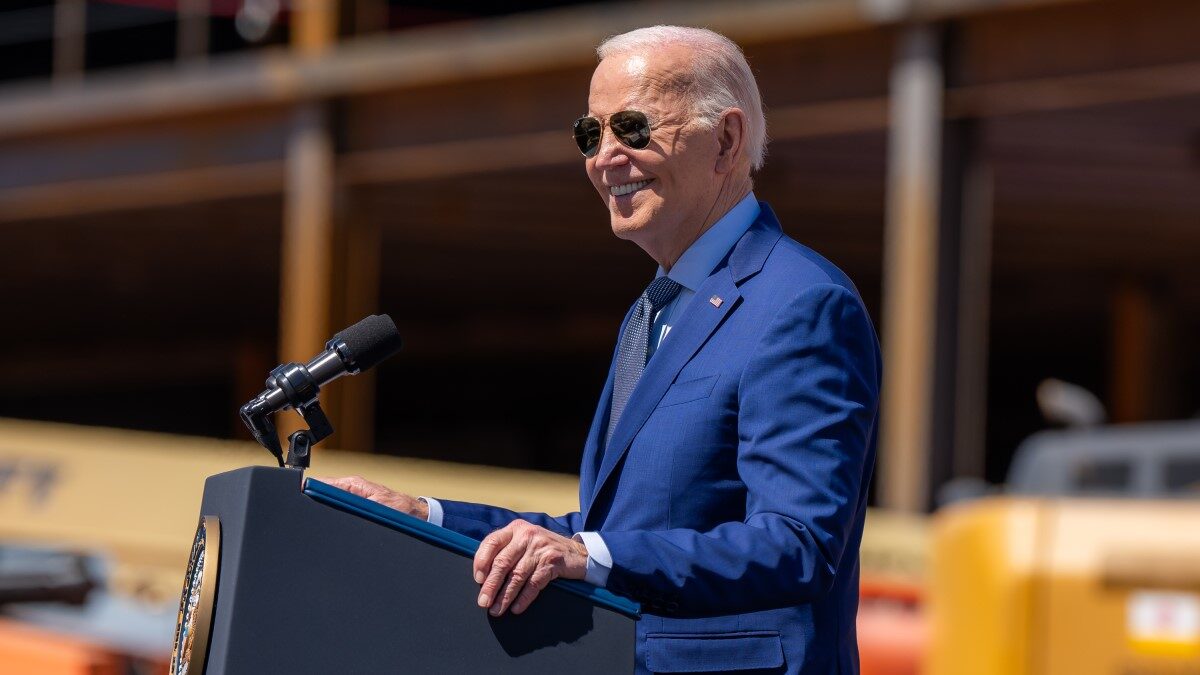

Joe Biden

Author Margot Cleveland profile

MARGOT CLEVELAND

VISIT ON TWITTER@PROFMJCLEVELAND

MORE ARTICLES

In response to Americans’ outcry over the political prosecutions of Donald Trump and a Manhattan jury convicting the former president on 34 felony counts, President Joe Biden declared, “It’s irresponsible for anyone to say this was rigged, just because they don’t like the verdict.” Coming from the Commander-in-Rigging, this proclamation means nothing.

Biden and those seeking to ensure his re-election have their hands all over Manhattan District Attorney Alvin Bragg’s prosecution of the former president. A lead prosecutor for Bragg during the trial was Matthew Colangelo. In December 2022, Colangelo left the Biden Department of Justice to “jump start” the criminal case against Trump. Biden had previously named Colangelo his acting associate attorney general—the third highest-ranking official in the DOJ.

There’s Plenty More Where That Came From

Colangelo’s role in prosecuting his former boss’s political opponent provides the most obvious evidence of the Biden administration’s involvement in the Manhattan D.A.’s criminal targeting of Trump, but the rigging started much earlier. As I previously reported, the incestuous relationship between the Manhattan D.A.’s office and Team Biden began as early as mid-February 2021. Then, “Bragg’s predecessor, District Attorney Cyrus Vance, arranged for private criminal defense attorney and former federal prosecutor Mark Pomerantz to be a special assistant district attorney for the Manhattan D.A.’s office.”

As The New York Times reported at the time, Pomerantz was to work “solely on the Trump investigation” during a temporary leave of absence from his law firm, Paul, Weiss, Rifkind, Wharton, and Garrison. “But even before being sworn in as a special assistant to the Manhattan D.A., Pomerantz had reportedly ‘been helping with the case informally for months.’” Even Democrats’ most reliable Old Grey Lady (of the evening) acknowledged, “the hiring of an outsider is a highly unusual move for a prosecutor’s office.”

Soon after the Manhattan D.A. hired Pomerantz, two of his colleagues, Elyssa Abuhoff and Caroline Williamson, also took leaves of absence from Paul, Weiss to serve as special assistant district attorneys on the Trump investigation. “For a law firm to lend not one but three lawyers to the Manhattan D.A.’s office seems rather magnanimous, until you consider Paul, Weiss’s previous generosity to Joe Biden.”

As I previously reported, during Biden’s first run for the White House, “the law firm hosted a $2,800-per-plate fundraiser for about 100 guests.” Brad Karp, the chair of Paul, Weiss, also topped the list of Biden fundraisers, bundling at least $100,000 for the then-candidate. At the time, Karp wrote in an email: “As someone who cares passionately about preserving the rule of law, safeguarding our democracy and protecting fundamental liberties, I’ve been delighted to do everything I possibly can to support the Joe Biden/Kamala Harris ticket.”

Biden’s relationship with Karp continued after his election, with the president including Karp and his wife at a state dinner with the Australian prime minister. Karp and his fellow Paul, Weiss lawyers continue to fund Biden’s re-election campaign. In fact, Biden’s connection to the firm is so strong Bloomberg branded Paul, Weiss the “Biden-Era N.Y. Power Center.”

But for Paul, Weiss lending Pomerantz to the Manhattan D.A.’s office to control the Trump investigation, the former president likely never would have been charged. According to Pomerantz, Bragg had decided “not to go forward with the grand jury presentation and not to seek criminal charges,” indefinitely suspending the investigation.

Pomerantz made those claims in the resignation letter he tendered to Bragg in early 2022, which was deliberately leaked to The New York Times. “Pomerantz’s letter and his claims that Bragg had suspended the Trump probe triggered a political firestorm, which the Manhattan D.A. sought to quell by telling the public the investigation was ongoing.” Soon after, Bragg capitulated, hiring Biden’s high-ranking DOJ lawyer, Colangelo, who proceeded to indict and convict Trump.

In contrast to the Biden-connected attorneys who secured Trump’s indictment and conviction, in late 2021, at least three career prosecutors in the Manhattan D.A.’s office asked to be removed from the investigation of Trump, reportedly “concerned that the investigation was moving too quickly, without clear evidence to support possible charges.”

Not Just Manhattan

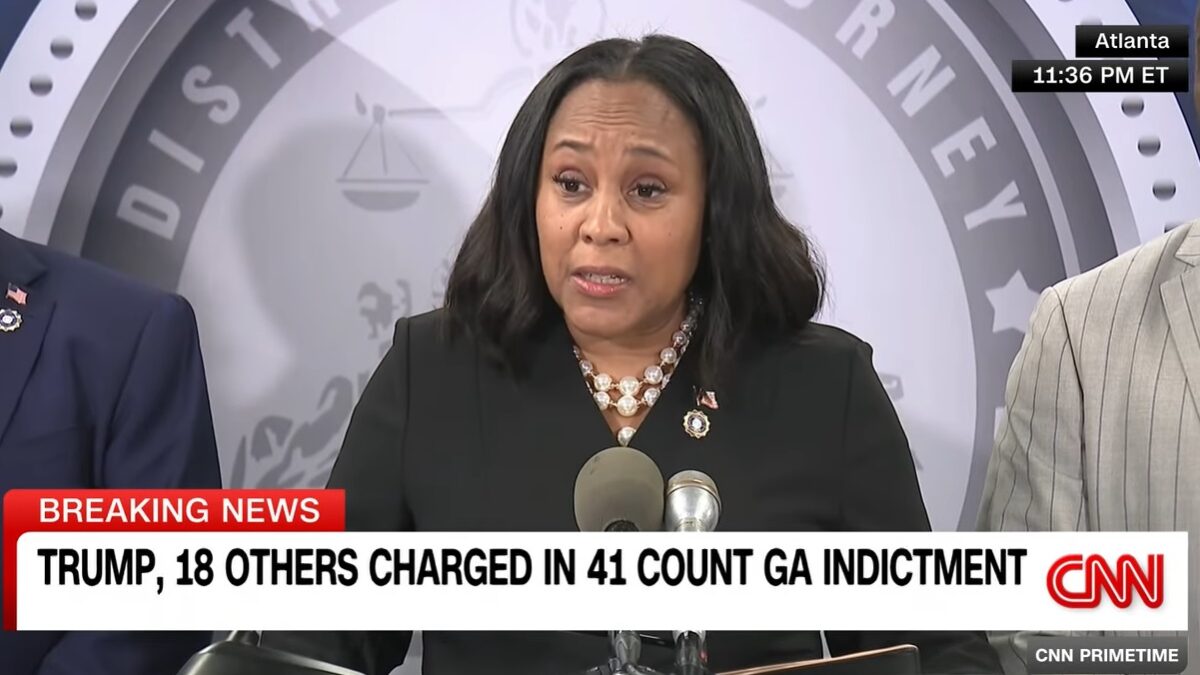
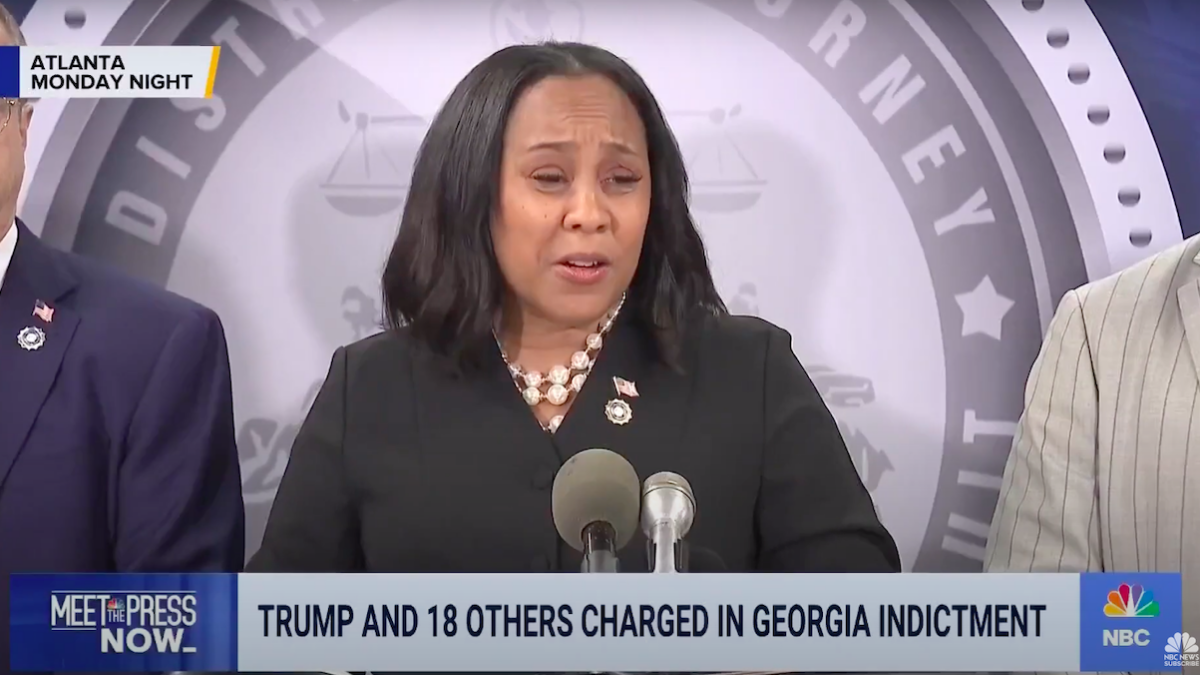
The Biden connection to the political targeting of Trump is not limited to the Manhattan D.A.’s office. In August 2023, Fulton County, Georgia District Attorney Fani Willis charged Trump and 18 other Republicans in a sprawling 98-page criminal indictment.

Earlier this year, court filings and testimony in the case related to motions to disqualify Willis and her former lover, Nathan Wade, revealed the Fulton County D.A.’s office had met with White House counsel in May 2022. Then, just three days after Trump announced his 2024 candidacy for president, Wade traveled to D.C. for an interview with the “White House,” according to Fulton County records. The Biden administration’s White House counsel’s office also dispatched two letters to Willis, according to one of her prosecutors.

Biden and his Democrat-run administration also have their fingers all over the remaining two criminal cases targeting Trump, both brought by Special Counsel Jack Smith. President Biden, according to an April 2, 2022, New York Times report, “As recently as late last year… confided to his inner circle that he believed former President Donald J. Trump was a threat to democracy and should be prosecuted.”

The Times claimed Biden had expressed frustration with Garland’s “deliberative approach” and that the president believed Trump should be prosecuted. The president “has said privately that he wanted Mr. Garland to act less like a ponderous judge and more like a prosecutor who is willing to take decisive action over the events of Jan. 6.,” the legacy outlet reported.

Biden’s attorney general would eventually appoint Smith special counsel. Smith would later charge Trump in two separate indictments—one in Florida concerning documents the former president retained, and one in D.C. with various conspiracy to defraud and obstruction charges related to Trump’s challenging the outcome of the 2020 election.

Stretching the Law Past Its Breaking Point

With the D.C. indictment, the special counsel delivered to Biden just what he wanted—a prosecution of Trump “for his role in the events of Jan. 6.” To deliver for Biden, though, required Smith to stretch the federal criminal code to the point of breaking. In the case of two of the crimes charged, in the context of Jan. 6, 2021, defendants, the Supreme Court seems poised to limit the reach of the relevant statutes—a holding that could mean that Smith charged Trump with two non-crimes.

The final criminal case pending against Trump, Smith’s documents case, also connects back to the Biden administration. That case began when the DOJ launched an investigation prompted by a referral from the national archivist related to a dispute over presidential records—even though the same archivist declined to refer Hillary Clinton to the DOJ for mishandling classified documents. Later, a top aide to Smith, Jay Bratt, would meet with “White House officials multiple times, just weeks before Mr. Smith indicted former President Donald Trump.”

That case has been delayed after it was revealed the FBI agents who executed a search warrant obtained by the Biden administration had failed to keep the documents seized from Mar-a-Lago in the same condition they were found, with the order of the materials mixed up. At the same time, it was revealed that the “classified cover sheets” depicted in the photographs of the evidence seized during the August 2022 search of Trump had been placed there by federal agents. The leak of those photographs falsely portrayed the former president as in possession of documents bearing classified cover sheets.

Biden can continue to deny his responsibility for the criminal targeting of his political opponent all he wants, but the facts tell a different story. So did the president’s malevolent smile on Friday when he was asked to respond to Trump calling himself a political prisoner and blaming the president directly.
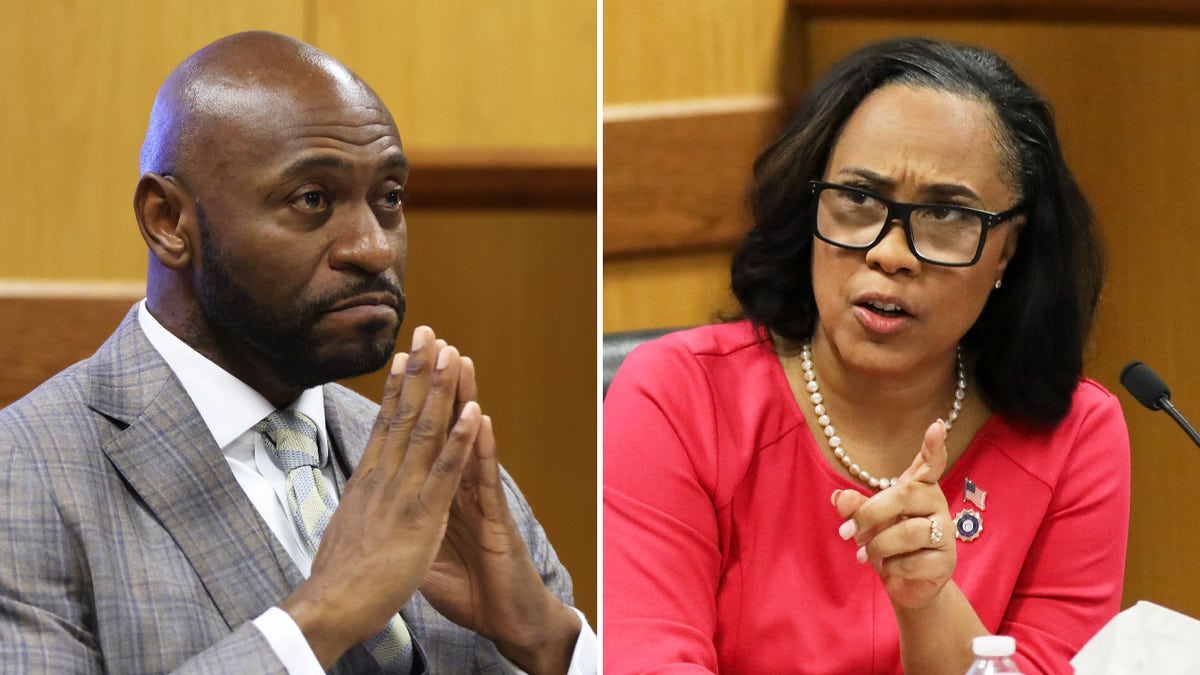
Margot Cleveland is an investigative journalist and legal analyst and serves as The Federalist’s senior legal correspondent. Margot’s work has been published at The Wall Street Journal, The American Spectator, the New Criterion, National Review Online, Townhall.com, the Daily Signal, USA Today, and the Detroit Free Press. She is also a regular guest on nationally syndicated radio programs and on Fox News, Fox Business, and Newsmax. Cleveland is a lawyer and a graduate of the Notre Dame Law School, where she earned the Hoynes Prize—the law school’s highest honor. She later served for nearly 25 years as a permanent law clerk for a federal appellate judge on the Seventh Circuit Court of Appeals. Cleveland is a former full-time university faculty member and now teaches as an adjunct from time to time. Cleveland is also of counsel for the New Civil Liberties Alliance. Cleveland is on Twitter at @ProfMJCleveland where you can read more about her greatest accomplishments—her dear husband and dear son. The views expressed here are those of Cleveland in her private capacity.

Key witness in Fani Willis case testifies he may have lied in texts about friends’ affair


By Brianna Herlihy Fox News | Published February 27, 2024 6:19pm EST | Updated February 28, 2024 10:45am EST

Read more at https://www.foxnews.com/politics/key-witness-in-fani-wilis-case-testifies-he-may-have-lied-in-texts-about-friends-affair

Former law firm partner and divorce attorney Terrance Bradley on Tuesday testified under oath regarding what he knew about Fulton County, Georgia, District Attorney Fani Willis and special prosector Nathan Wade’s personal relationship. Bradley took the stand after Judge Scott McAfee determined Bradley couldn’t claim attorney-client privilege.

Bradley, when pressed under oath, said he couldn’t recall several details and timelines about conversations he had with former client Wade about Wade’s romantic relationship with Willis. Defense attorney Ashleigh Merchant at one point referenced text messages between her and Bradley in which she had asked Bradley if he thought the relationship started before Willis hired Wade in 2021. Bradley responded “absolutely” in the text exchange.

When confronted with a record of those texts in court Tuesday, Bradley appeared to mutter “dang.” But then he said he was “speculating” in those comments. 

FANI WILLIS’ TESTIMONY WAS ‘BELLIGERENT’ AND COULD DAMAGE HER CREDIBILITY, FORMER PROSECUTOR SAYS

Fani Willis, Nathan Wade
Fani Willis, the district attorney for Fulton County, Georgia, is accused of having an “improper” romantic relationship with special prosecutor Nathan Wade. (Getty Images)

Attorney Richard Rice later asked Bradley if he makes a habit of passing on “lies about your friends.” 

“Do you tell lies about your friends? About a case of national importance?” Rice asked. 

“I could have had, I don’t know,” Bradley responded. 

Bradely said he couldn’t recall key details or specific information more than two dozen times in the roughly two-hour testimony in Fulton County Superior Court on Tuesday. He also said he had only ever discussed Wade’s relationship with Willis once with Wade.

FULTON COUNTY DA FANI WILLIS ACCUSED OF LYING ABOUT TIMING OF AFFAIR WITH TRUMP PROSECUTOR

Bradley this month avoided answering certain questions, citing attorney-client privilege. McAfee said he would hold an “in-camera” meeting with Bradley to determine if his privilege assertions are accurate. He said it appeared that Bradley may have been misusing his attorney-client privilege.

Bradley is the former law firm partner of Wade, who is accused of having an affair that financially benefited Willis after she hired him to help prosecute the election interference case against former President Donald Trump.

On Tuesday, Bradley said he hadn’t spoken to Wade in two years after having been friends for more than 10 years.

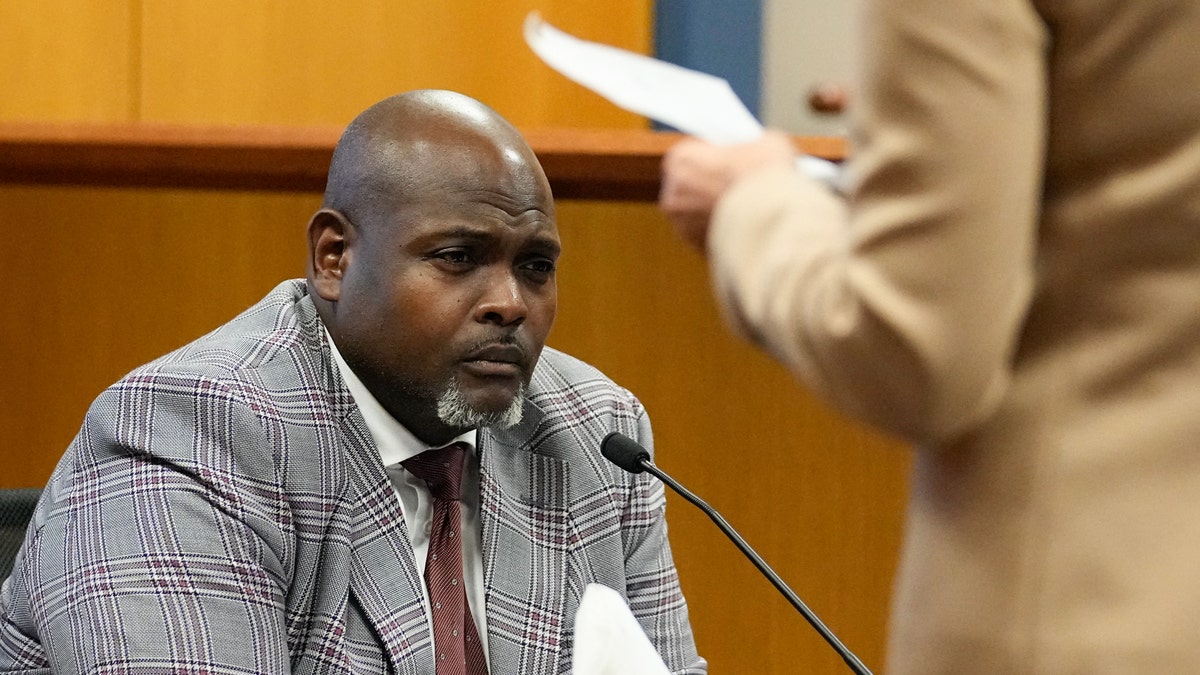
Terrance Bradley testifies
Terrence Bradley, divorce lawyer and former law partner of Nathan Wade, testifies during a hearing into misconduct allegations against Fulton County District Attorney Fani Willis at the Fulton County Courthouse in Atlanta on Tuesday. (Brynn Anderson/Pool/AFP via Getty Images)

Bradley had refused to answer some of the questions asked by defense counsel about what he knew about Wade and Willis’ relationship and when he knew, citing attorney-client privilege. Bradley, for a brief time, was Wade’s lawyer during Wade’s divorce.

McAfee determined after the in-camera meeting that Bradley’s testimony was not covered by privilege, leading to Tuesday’s testimony, which is likely the last installment of evidentiary hearings before both sides present final arguments Friday.

Lawyers for Trump and his co-defendants who are accusing Willis of having had an “improper” affair with Wade will try to connect evidence that Willis and Wade lied about when their relationship began and should therefore be disqualified from the case. 

Earlier this month, Willis’ father, John C. Floyd III, took the stand and confirmed what Willis testified to — that her father taught her to keep large amounts of cash on hand at all times. She said it was from these funds that she reimbursed Wade for luxury trips, which is why she had no record of the payments.

Floyd also said he did not meet Wade until 2023 and that he was unaware his daughter had a romantic relationship with Wade until about seven weeks ago, when allegations of Willis’ impropriety were first made in court filings.

Video

During their romantic relationship, which ended last summer, Wade and Willis vacationed in wine country in California, the Caribbean and other destinations. 

Michael Roman, a GOP political operative and co-defendant in the Trump case, first alleged that Willis had a conflict of interest in the case because she benefited financially from hiring her lover. Four co-defendants have made similar accusations.

The crux of the defense’s case is whether it can prove with a money trail that Willis has a conflict of interest in the case against Trump and should thus be disqualified.

GEORGIA DA FANI WILLIS WILL NOT TESTIFY FOR SECOND DAY ON ‘IMPROPER’ AFFAIR WITH NATHAN WADE

Willis testified that she reimbursed Wade for her share of vacation expenses in cash, but she and Wade testified there were no receipts for those transactions.

The defense, led by Merchant, is also trying to prove Willis and Wade were romantically involved prior to Wade’s employment in the DA’s office.

Both Willis and Wade insisted that their relationship started in 2022, after Wade was hired. But they contradicted testimony from Robin Yeartie, a former “good friend” of Willis and past employee at the DA’s office.

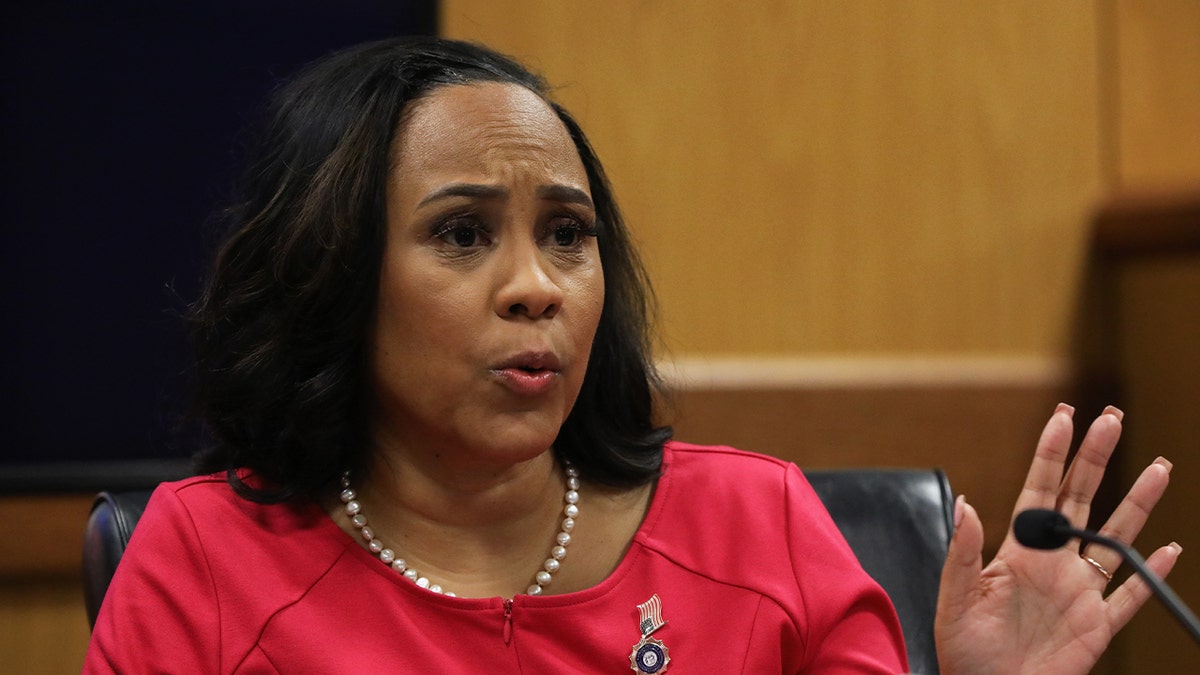
Fani Willis
Fulton County District Attorney Fani Willis testifies during a hearing in the case of the State of Georgia v. Donald John Trump at the Fulton County Courthouse  in Atlanta on Feb. 15 (Alyssa Pointer)

Yeartie said she had “no doubt” Willis and Wade’s relationship started in 2019, after the two met at a conference. 

She testified to observing Willis and Wade “hugging” and “kissing” and showing “affection” prior to November 2021 and that she had no doubt that the two were in a “romantic” relationship starting in 2019 and lasting until she and Willis last spoke in 2022.

Willis dismissed Yeartie’s testimony and said she no longer considers Yeartie a friend.

The highlight of the two-day proceeding was Willis’ own — and unexpected — testimony, which was described by one expert as “belligerent.”

She verbally sparred with lawyers for hours, at one point prompting the judge to threaten to strike her testimony. She also raised eyebrows by appearing to wear her dress backward. She did not return to the witness stand the following day. 

McAfee said at the start of the proceedings this month that it’s “clear that disqualification can occur if evidence is produced demonstrating an actual conflict or the appearance of one.”

Fox News Digital’s Chris Pandolfo contributed to this report.

Brianna Herlihy is a politics writer for Fox News Digital.

HUMOR OP-ED: The Best Trump Mugshot Memes Mocking Democrats’ Indictment Frenzy as the Joke It Is


BY: JORDAN BOYD | AUGUST 25, 2023

Read more at https://thefederalist.com/2023/08/25/the-best-trump-mugshot-memes-mocking-democrats-indictment-frenzy-as-the-joke-it-is/

Donald Trump mugshot

Author Jordan Boyd profile

JORDAN BOYD

VISIT ON TWITTER@JORDANBOYDTX

MORE ARTICLES

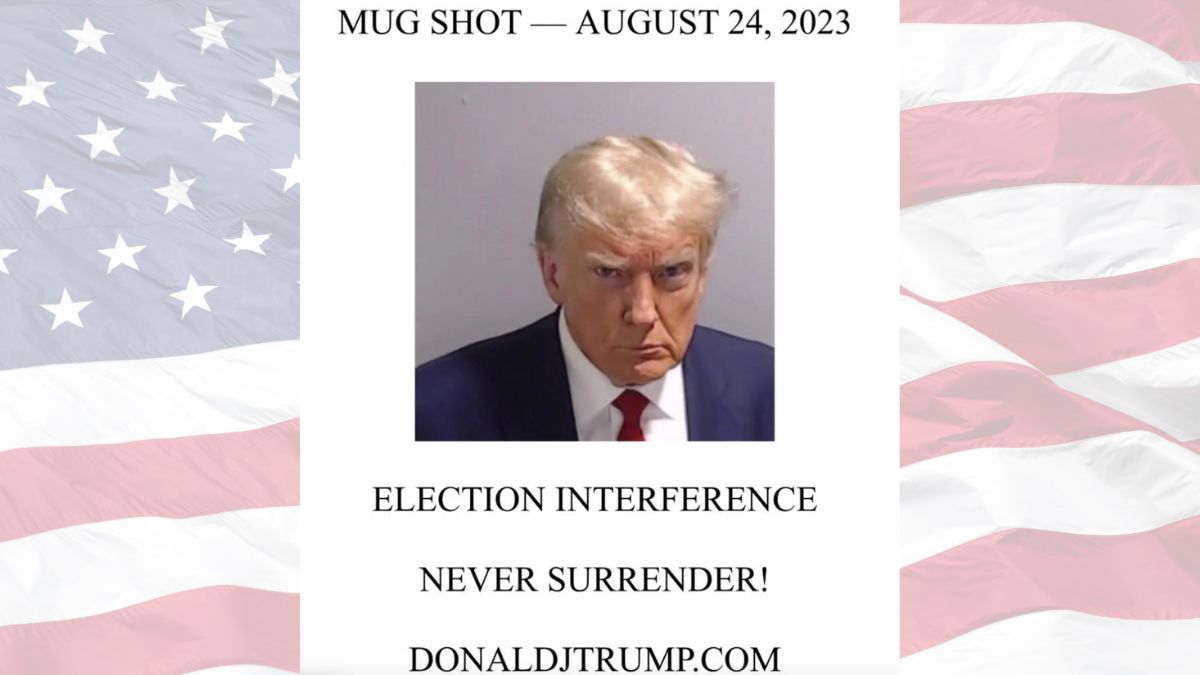
Former President Donald Trump turned himself into the Fulton County jail for booking on Thursday night in what Democrats and corporate media desperately tried to paint as a somber “surrender.” It didn’t take long, however, for his mugshot to steal the spotlight.

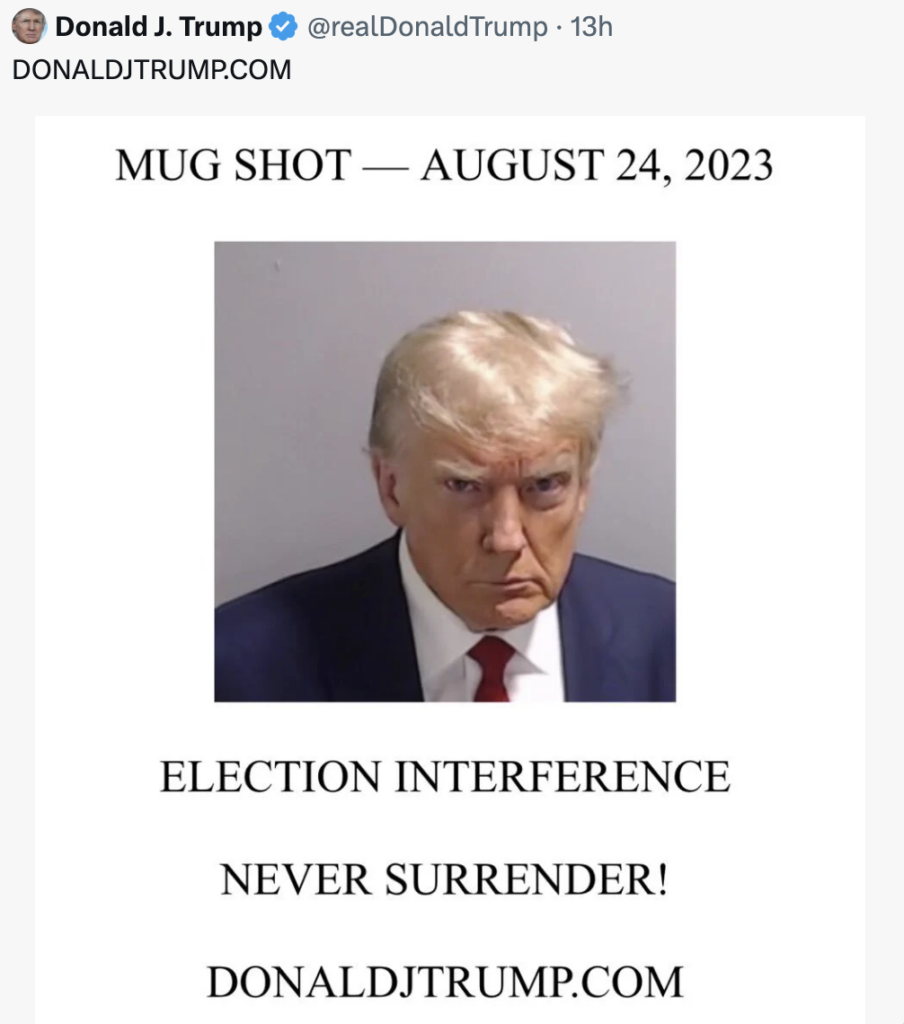
Trump immediately posted the photo featuring his instantly iconic glare to X, formerly known as Twitter, and began fundraising off of it. The post, which had raked in more than 1.2 million likes by Friday morning, was the first time Trump used the social media site since the platform banned him in January 2021 and Elon Musk unbanned him in November 2022.

“ELECTION INTERFERENCE,” the accompanying text reads. “NEVER SURRENDER!”

Trump’s return to X certainly made waves but he wasn’t the only one breaking the internet on Thursday night. Democrats and their propaganda press pawns no doubt intended for Trump’s booking photo to publicly humiliate him. The hordes of Photoshop fiends online, however, were only emboldened. Dozens of memes poking fun at the deep state’s latest election interference plot are circulating on Twitter, Instagram, and Facebook. Here are the best Trump mugshot memes that prove just how silly Democrats’ indictment frenzy really is.

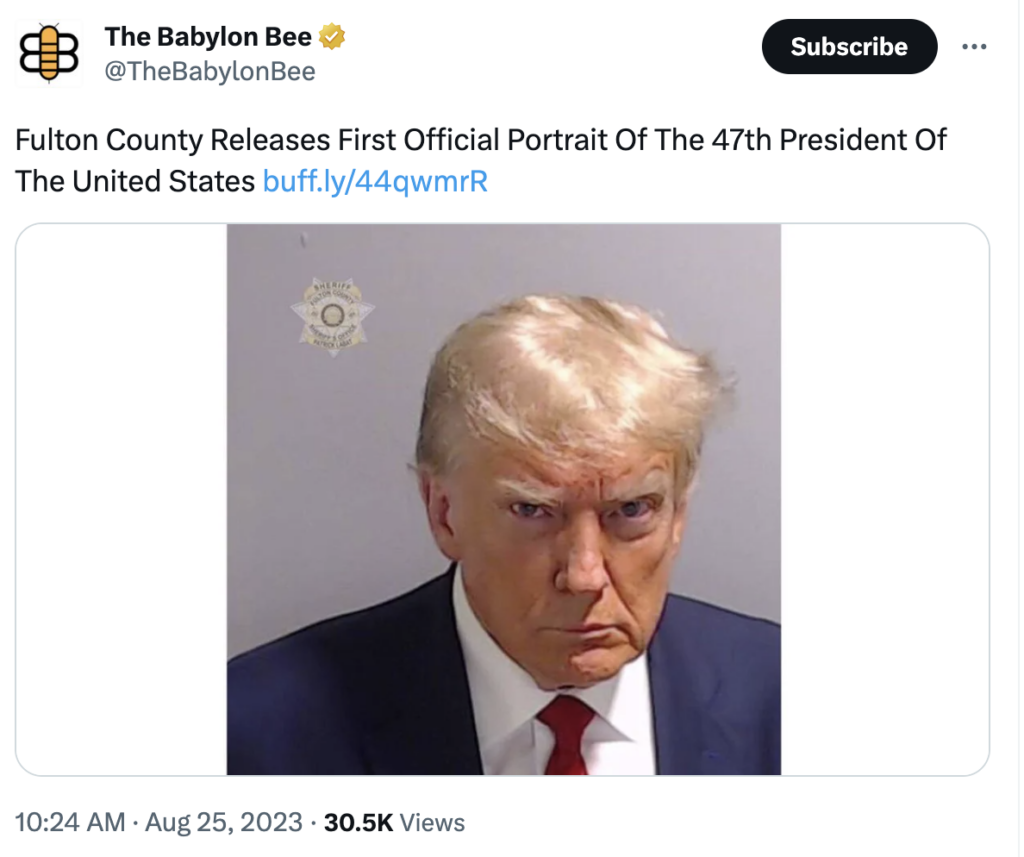
“Fulton County Releases First Official Portrait Of The 47th President Of The United States,” The Babylon Bee’s latest mugshot headline states.

“Me when I pull up to a Chik Fil-A on a Sunday,” Federalist Legal Correspondent Margot Cleveland quipped.

Another X user said Trump’s unimpressed scowl is the same look you give “when you get home and see that they didn’t give you any extra sauce.”

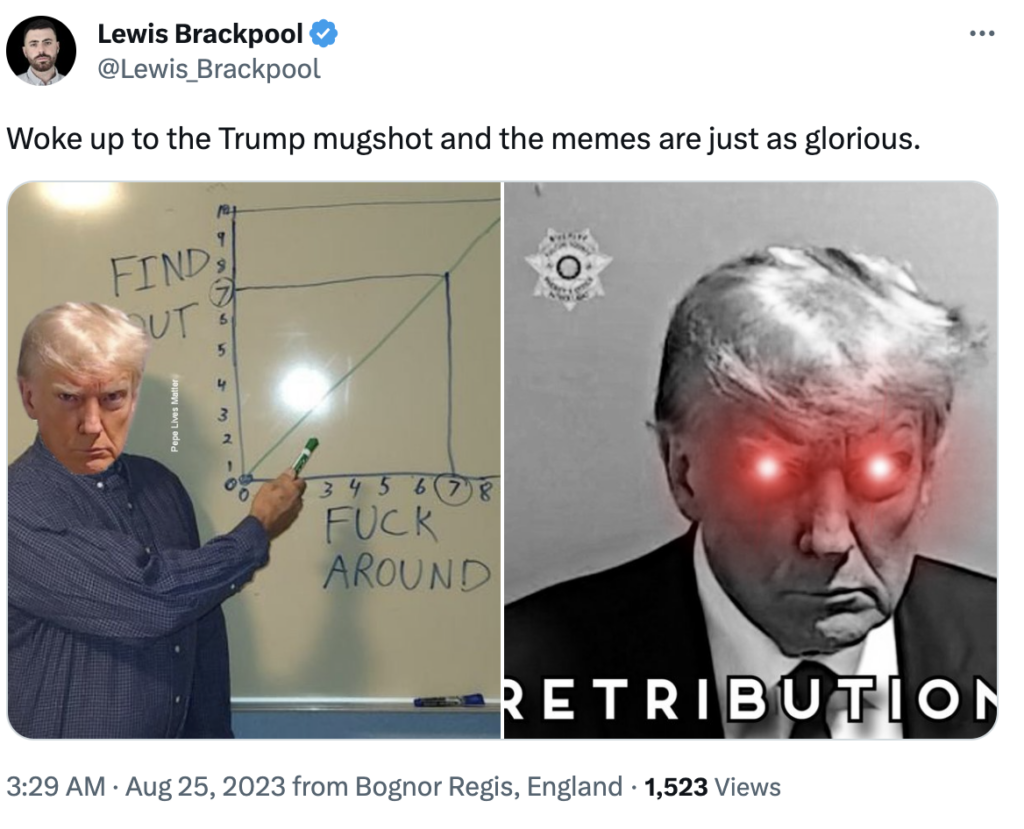
One meme masterpiece shows Trump in black and white with laser eyes. The text on the photo reads “retribution.”

The sister edit in that post, which features Trump’s mugshot in front of the infamous “f-ck around and find out graph,” is especially hilarious since Rolling Stone tried — and failed — to use the same format to mock Trump’s fourth indictment.

Several users likened Trump’s booking photo to other iconic mugshots. One meme compared Trump’s photo to that of Martin Luther King Jr.

Another X user remarked, referring to Trump’s cameo in the classic Christmas movie sequel, that his “Home Alone 2 mugshot collection is slowly expanding.”

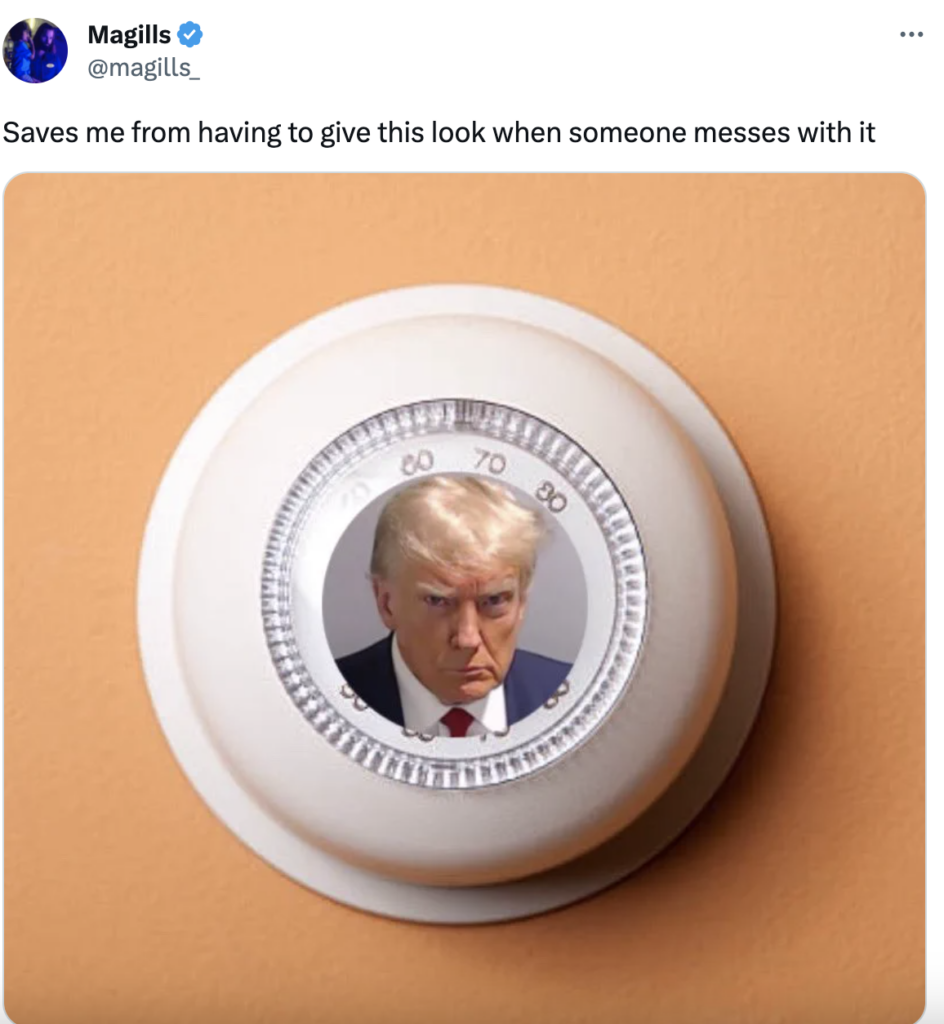
Someone else threatened to turn Trump’s stern stare into a thermostat tinkering deterrent.

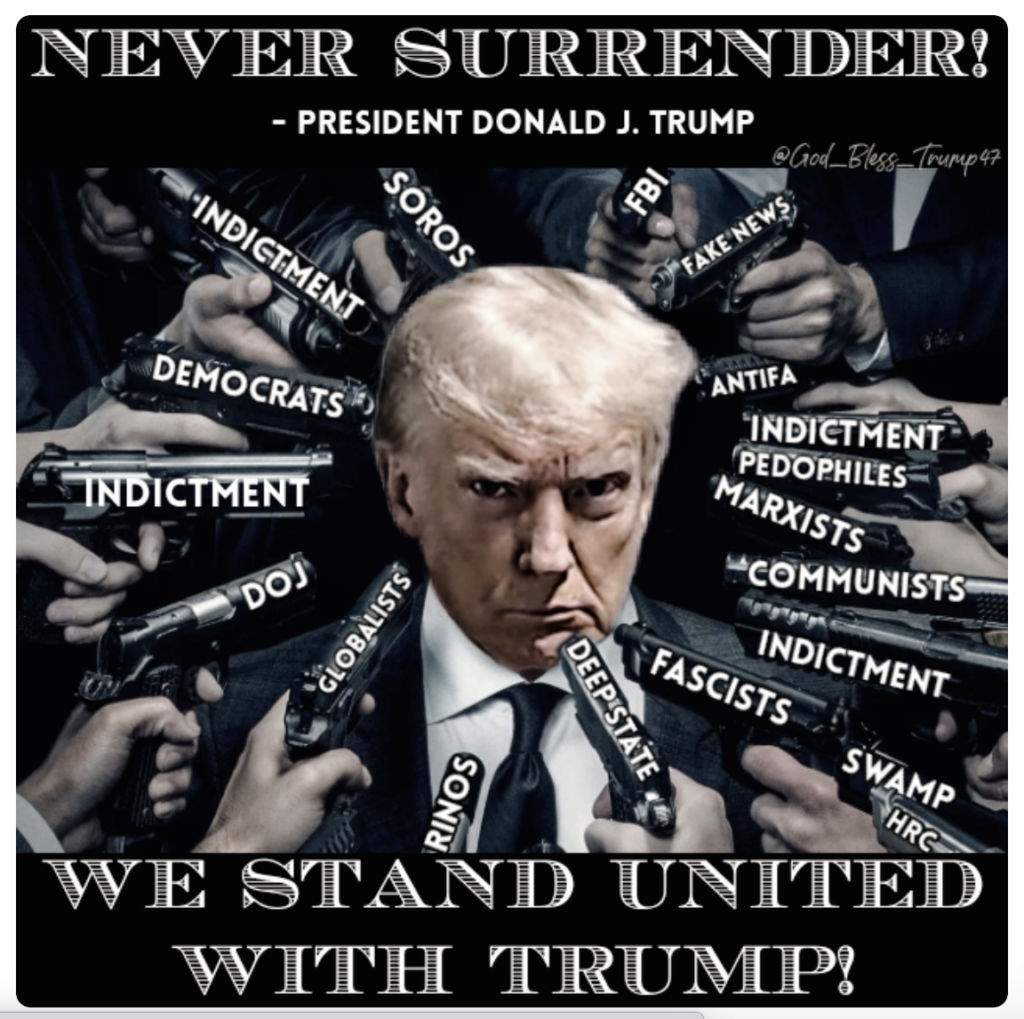
Trump even joined in the fun by reposting a more serious doctored photo of his mugshot surrounded by guns. Among those targeting Trump in the photo are the “fake news,” the “swamp,” the “deep state,” “RINOs,” and “Democrats.”

For a different kind of mugshot content, consider spicing up your playlists with this spin on Kanye West’s hit song “Gold Digger,” which takes aim at Fulton County District Attorney Fani Willis for her political hackery.


Jordan Boyd is a staff writer at The Federalist and co-producer of The Federalist Radio Hour. Her work has also been featured in The Daily Wire, Fox News, and RealClearPolitics. Jordan graduated from Baylor University where she majored in political science and minored in journalism. Follow her on Twitter @jordanboydtx.

House Republicans Launch Probe Into Fulton County’s ‘Politically Motivated’ Trump Indictments


BY: SHAWN FLEETWOOD | AUGUST 24, 2023

Read more at https://thefederalist.com/2023/08/24/house-republicans-launch-probe-into-fulton-countys-politically-motivated-trump-indictments/

Willis Indictment

Republicans on the House Judiciary Committee sent a letter to Fulton County District Attorney Fani Willis on Thursday demanding the Democrat prosecutor provide answers over her indictment of former President Donald Trump and his associates.

“Your indictment and prosecution implicate substantial federal interests, and the circumstances surrounding your actions raise serious concerns about whether they are politically motivated,” the letter reads.

Last week, Willis announced her office would be charging Trump and 18 of his associates for what she claims was an attempt to “conspire[] and endeavor[] to conduct and participate in criminal enterprise” to overturn the results of the 2020 election. Included in the bogus 98-page indictment are several acts Willis contends contributed to the “furtherance” of the so-called conspiracy, such as tweets issued by Trump encouraging people to watch Georgia legislative oversight hearings on TV and a text message asking for phone numbers sent by former White House Chief of Staff Mark Meadows.

In their letter to Willis, Republicans on the House Judiciary Committee questioned the Fulton County DA’s rationale for charging Trump and his associates and raised several examples indicating her prosecution of the former president is “politically motivated.” Among those cited is Willis’ purported launch of a new campaign fundraising site “that highlighted [her] investigation into President Trump” several days before her office indicted the former commander-in-chief.

Also referenced are public remarks by Emily Kohrs, the forewoman of the special grand jury convened by Willis, who openly bragged during interviews with regime-approved media “about her excitement at the prospect of subpoenaing President Trump and getting to swear him in.” The letter also invoked the decision by Fulton County’s superior court clerk to prematurely release “a list of criminal charges against President Trump reportedly hours before the vote of the grand jury.”

While a statement issued by the court clerk’s office originally claimed the document showing the charges against Trump was “fictitious,” the clerk later asserted it was a “mishap” and that “when [she] hit save, it went to the press queue.”

In explaining their rationale for federal oversight of the Georgia-based indictments, House Republicans referenced Willis’ alleged attempt to “use state criminal law to regulate the conduct of federal officers acting in their official capacities,” such as that of Trump and Meadows. The letter additionally raised questions about the involvement of Department of Justice Special Counsel Jack Smith and whether Willis’ office “coordinated” with Smith “during the course of [her] investigation.”

“News outlets have reported that your office and Mr. Smith ‘interviewed many of the same witnesses and reviewed much of the same evidence’ in reaching your decision to indict President Trump,” the letter reads. “The House Committee on the Judiciary (Committee) thus may investigate whether federal law enforcement agencies or officials were involved in your investigation or indictment.”

As such, House Republicans are demanding Willis turn over any and all documents related to her office’s “receipt and use of federal funds,” communications with the Smith and the DOJ, and communications between her office and any federal agency regarding her investigation into Trump and his associates by Sept. 7.


Shawn Fleetwood is a staff writer for The Federalist and a graduate of the University of Mary Washington. He previously served as a state content writer for Convention of States Action and his work has been featured in numerous outlets, including RealClearPolitics, RealClearHealth, and Conservative Review. Follow him on Twitter @ShawnFleetwood

Author Shawn Fleetwood profile

SHAWN FLEETWOOD

VISIT ON TWITTER@SHAWNFLEETWOOD

MORE ARTICLES

To Understand the Latest Crazy Trump Indictment, Check Out The 6 Types of Charges


BY: MARGOT CLEVELAND | AUGUST 16, 2023

Read more at https://thefederalist.com/2023/08/16/to-understand-the-latest-crazy-trump-indictment-check-out-the-6-types-of-charges/

Donald Trump

Author Margot Cleveland profile MARGOT CLEVELAND

VISIT ON TWITTER@PROFMJCLEVELAND

MORE ARTICLES

Late Monday, Fulton County District Attorney Fani Willis charged former President Donald Trump and 18 other defendants in a 98-page indictment that included a total of 41 different counts.

The defendants are already fighting back, with Trump’s former chief of staff, Mark Meadows, seeking to remove the case to federal court based on a statute that protects federal officials from state court prosecution for official conduct. More counteroffensives will likely follow, with other former federal officials, including Trump, presumably also seeking removal to federal court, while the remaining defendants will probably expeditiously move to dismiss the indictment on a variety of grounds. 

To get a handle on the indictment and to stay current with the various developments, it is helpful to put the charges into one of six buckets, starting with the biggest one: the alleged RICO conspiracy. 

Bucket 1: RICO 

The Racketeer Influenced and Corrupt Organizations Act (RICO) count runs some 70 pages and says all 19 defendants, “while associated with an enterprise, unlawfully conspired and endeavored to conduct and participate in, directly and indirectly, such enterprise through a pattern of racketeering activity.” The indictment next defines the “enterprise” as “a group of individuals associated in fact,” who “had connections and relationships with one another” and “functioned as a continuing unit for a common purpose of achieving the objectives of the enterprise,” which Willis maintains was “to unlawfully change the outcome of the election in favor of Trump.”

There are several problems with the RICO count, most fundamentally, as Andrew McCarthy explained in an enlightening article, RICO requires an “enterprise,” which, while not necessarily a formal entity, needs to be an identifiable group. The RICO crime, then, is “being a member of the enterprise that commits crimes, not the commission of any particular crime.”

But there must be some sort of “enterprise,” and here Willis conflates the objective — keeping Trump in power — with “the enterprise.” “It was that objective, and not the sustaining of any group, that brought them together; and once that objective was attained or conclusively defeated, the group — to the dubious extent it really was an identifiable group — would (and did) melt away,” McCarthy wrote. It’s a “good sign that you’re not dealing with a RICO enterprise,” the former federal prosecutor explained.

Without an “enterprise,” there can be no RICO crime, and the facts alleged in the indictment are such that the defendants will likely soon seek dismissal of that count. Now, Georgia law differs from federal law on RICO, and there is no saying how the state court will interpret its own RICO statute, but from a legal perspective, the claim is exceedingly weak.

The second fundamental problem with the RICO count is factual: Willis portrays the defendants as trying to unlawfully change the election in Trump’s favor, but the many actions Trump and others took involved legal proceedings and efforts to convince the legislative bodies to use their authority to address what the defendants saw as a fatally flawed election. A court is unlikely to toss the complaint on this ground, however, with factual disputes ones only a jury can resolve. 

However, if the court holds, as it appears it should, that the RICO count fails as a matter of law because there was no “enterprise,” then that factual dispute is irrelevant. Likewise, the 160-some “acts” Willis included in the indictment — everything from Trump declaring victory on Nov. 4 to tweeting that followers should watch a television newscast — allegedly in furtherance of the “RICO” conspiracy become irrelevant. 

Bucket 2: Alternate Electors

The second-biggest bucket concerns the counts related to the naming of alternative Trump electors. The crimes alleged here range from soliciting individuals to violate their oaths of office, to conspiring to file false statements or documents, to forgery. Counts 2, 6, 8-19, 23, and 37 alleged these and other crimes against various defendants all arising out of Republicans appointing an alternative slate of Trump electors who would vote for Trump in the event he prevailed in his then-pending Georgia lawsuit.

While the legacy media continue to frame these individuals as “fake electors,” as I’ve previously detailed, that is fake news. Rather, legal precedent indicates that alternative electors should be named to protect a candidate challenging the outcome of an election, as Trump was in Georgia and elsewhere. That is precisely what Democrats did in Hawaii in 1960 when Richard Nixon had been declared the victor in the state, but John F. Kennedy’s court contest remained viable. 

As a matter of law, these counts should all be dismissed because Republicans naming alternate electors was not a crime — no matter how much the press wants you to believe otherwise.

Bucket 3: Petitioning the Government for Redress

The crimes charged in Counts 5, 28, 38, and 39 fit into a third bucket that consists of efforts by Trump and others to petition the government for redress. Here, the crimes charged include solicitation of violations of oath by public officers and the making of false statements during those efforts, but the common theme is that the defendants sought to have Secretary of State Brad Raffensperger or the Georgia legislature address Trump’s allegations of voting irregularities or fraud. 

There is nothing criminal, however, in asking the secretary of state to use his authority to investigate and respond to voting irregularities or to ask the legislature to call a special session to name Trump electors. On the contrary, those activities would seemingly be protected by the constitutional guarantee of the right to petition the government for redress.

Bucket 4: False Statements

The fourth bucket holds numerous counts against a variety of defendants with the common theme being false statements charges. Count 27 alleged false statements were included in one of Trump’s election lawsuits, but lawyers are entitled to rely on information provided for others, making this count weak. Counts 7, 24, 25, and 26 all charged individual defendants with making false statements to Georgia House or Senate committees. The main issue here will be whether the defendants made the statements knowing they were false. 

Count 22 charges an attempt to make a false statement and concerns a letter DOJ lawyer Jeff Clark drafted and recommended be sent to the Georgia legislature. As I previously detailed, however, there was no impropriety in Clark’s drafting of that letter. Clark will also likely succeed in having the case against him removed to federal court and then dismissed. 

Counts 40 and 41 both involve charges of lying as well, with Count 40 alleging one defendant lied to Fulton County investigators and Count 41 alleging perjury before a grand jury. Given the target on these defendants’ backs, it’s difficult to believe they knowingly lied, but that question may end up being left to a jury to decide.

Bucket 5: Communications Related to Ruby Freeman

Counts 20, 21, 30, and 31 all involve charges concerning efforts to supposedly influence the testimony of Ruby Freeman, who was an election worker at the State Farm Arena. Here, the theory seems to be that some of the defendants attempted to pressure Freeman to lie about what happened during the vote counting. Again, it may be left to a jury to decide this issue.

Bucket 6: Accessing Voting Machines and Election Data

The final category of charges involves efforts by Sidney Powell and others to allegedly illegally access voting machines and election results. Counts 32-36 allege various crimes related to those efforts, including conspiracy to commit election fraud by tampering with machines. Once the defendants charged in those counts respond, it will be easier to assess the criminal theories proffered and any weakness in the claims.

For now, though, watch for the federal court’s holding on whether Meadows, Clark, Trump, and potentially others have the right to remove the case to federal court. Simultaneously, expect the other defendants to seek dismissal of all or part of the indictment, likely narrowing this criminal case down substantially.


Margot Cleveland is The Federalist’s senior legal correspondent. She is also a contributor to National Review Online, the Washington Examiner, Aleteia, and Townhall.com, and has been published in the Wall Street Journal and USA Today. Cleveland is a lawyer and a graduate of the Notre Dame Law School, where she earned the Hoynes Prize—the law school’s highest honor. She later served for nearly 25 years as a permanent law clerk for a federal appellate judge on the Seventh Circuit Court of Appeals. Cleveland is a former full-time university faculty member and now teaches as an adjunct from time to time. As a stay-at-home homeschooling mom of a young son with cystic fibrosis, Cleveland frequently writes on cultural issues related to parenting and special-needs children. Cleveland is on Twitter at @ProfMJCleveland. The views expressed here are those of Cleveland in her private capacity.

The Purpose of the Trump Indictments is to Demonstrate the Left’s Power


BY: JOHN DANIEL DAVIDSON | AUGUST 16, 2023

Read more at https://thefederalist.com/2023/08/16/the-purpose-of-the-trump-indictments-is-to-demonstrate-the-lefts-power/

Fani Willis talking about Trump indictments

Author John Daniel Davidson profile JOHN DANIEL DAVIDSON

VISIT ON TWITTER@JOHNDDAVIDSON

MORE ARTICLES

The latest indictment of former President Donald Trump is even more outlandish than Jack Smith’s blatant attempt to criminalize free speech. The indictment Monday out of Fulton County, Georgia, criminalizes mundane activities like asking for a phone number, texting, encouraging people to watch a televised hearing, and reserving a room at the Georgia capitol. 

These activities, according to Georgia prosecutor Fani Willis, run afoul of the state’s Racketeer Influenced and Corrupt Organizations (RICO) statute. As far as Willis is concerned, Trump’s legal efforts to challenge the election results in Georgia amounted to a criminal conspiracy, with Trump as the criminal mastermind. What that means, outlandishly, is that every phone call or tweet related to those legal efforts, every step Trump and his team took to press their legal case, counts as “an overt act in furtherance of the conspiracy.”

This is of course crazy. As more than a few people have noted since the charges dropped, according to Willis’ standard every major Democrat should be in prison on racketeering charges — including Hillary Clinton but especially Stacey Abrams, who has made a career out of denying that she lost the 2018 Georgia gubernatorial election. 

So yes, the hypocrisy is stupendous and blatant. But let me suggest that decrying the hypocrisy here is a loser’s game. What you see in these anti-Trump indictments is not hypocrisy, it’s hierarchy. We all became familiar with this concept during the Covid pandemic. Gathering for church, even outside, was against the law, but mass rioting in the streets was OK — so long as you were rioting for racial justice. Ordinary people had to let their elderly loved ones die alone and were not even allowed to bury them, yet thousands attended the funeral and memorial services for secular saint George Floyd.

Perhaps nothing better captured the hierarchy-not-hypocrisy concept than a photo of Democrat Rep. Alexandria Ocasio-Cortez at the annual Met Gala in September 2021 wearing a white gown with “tax the rich” scrawled on its backside. Set aside the idiocy of the stunt itself. In the photo, AOC isn’t wearing a face mask, but the woman helping her with her gown is. What AOC was displaying for the public was hierarchy.

As my colleague Eddie Scarry wrote at the time, “This is simply another example of those in power, those running our most influential cultural and political institutions, sending a message: There’s a new social hierarchy in America. And this one isn’t about what you can afford to do, it’s about what you’re allowed to do.”

The same analysis applies to the raft of indictments against Trump, whose post-2020 denunciations of the election are no different than those of Clinton in 2016 or most Democrats in 2000 and 2004. Democrats are allowed to question the results of an election, Republicans are not. That’s not hypocrisy, it’s hierarchy. 

Once you understand this, you begin to recognize it everywhere. Antifa thugs and BLM rioters were allowed to trash entire city blocks, torch police stations, take over neighborhoods, besiege federal courthouses — and do so with the blessing and encouragement, at times even with the complicity, of elected Democrat Party leaders. But every granny that set foot within a mile of the U.S. Capitol on Jan. 6 had better brace for a federal indictment if they haven’t already been charged.

The same goes for teachers who push transgender ideology and critical race theory on students versus the parents who object to these things being taught behind their backs. The former are courageous leaders, the latter are potential domestic terrorists, at least according to the Biden Justice Department. Ditto for the media’s treatment of the Trump family business versus the Biden family business. None of this is hypocrisy, it’s hierarchy. The left is trying to tell you something, which is that they have all the power and you have none.

The essayist N.S. Lyons (a pseudonym) put it well in a piece last August, describing the futile efforts of Team B to call out the hypocrisy of Team A:

You see, it’s possible you are under the misapprehension that you are not supposed to notice what you described as the “double-standard” in acceptable behavior between Team A and Team B. And that you think if you point out this double-standard, you are foiling the other team’s plot and holding them accountable. This might be because, in your mind, you are still in high school debate club, where if you finger your opponent for having violated the evenly-applied rules a neutral arbiter of acceptable behavior will recognize this unfairness and penalize them with demerits.

Except in reality you are not holding Team A accountable, and in fact are notably never able to hold them accountable for anything at all. Even though Team A gets to hold you accountable for everything and anything whenever they want. This is because unfortunately there is no neutral arbiter listening to your whining. In fact, currently the only arbiter is Team A, because Team A has consolidated all the power to decide the rules, and to enforce or not enforce those rules as they see fit.

With each new Trump indictment, the left’s strategy becomes increasingly clear. It isn’t to bring real criminal charges based on actual violations of the law, or to see justice applied equally and fairly even to a powerful person like Trump. The strategy is to demonstrate power and thereby humiliate and discourage Trump supporters by showing them how powerless they are.

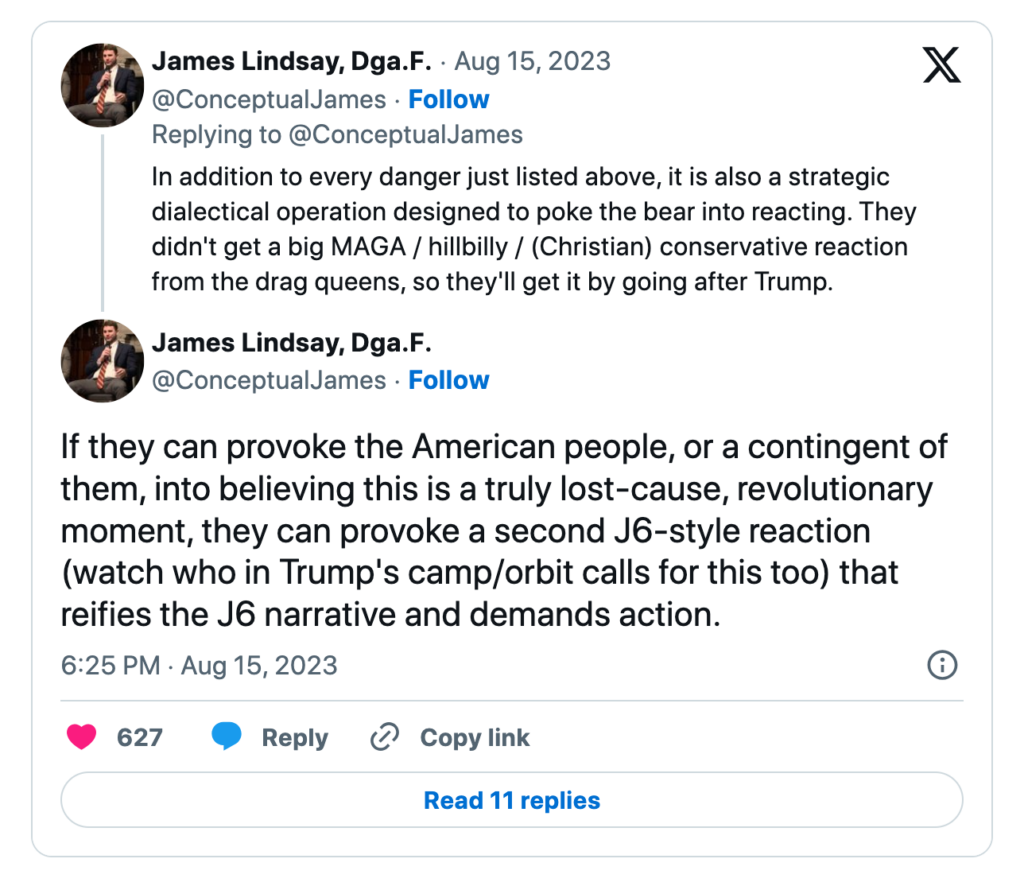
Another aspect of this strategy, as James Lindsay explained in a Twitter thread Tuesday, is to provoke the right into reacting. This is what Lindsay calls “leftist dialectical political warfare,” or, in Trump’s case, “Operation Poke the Bear.” The purpose of such warfare, says Lindsay, is to provoke a reaction that would justify the further consolidation of power on the left.

So expect to see more “hypocrisy” — even lazy and objectively embarrassing hypocrisy of the kind we saw this week in the Georgia indictment. It doesn’t matter how laughable or outlandish the charges against Trump are, because prosecuting actual crimes and upholding the law have nothing to do with any of this.

This is about power — who has it, and who doesn’t. The people at the top are trying to tell you, the masses under them, that they can do whatever they want to you, at any time, and there’s nothing you can do to fight back. Just look what they’re doing to Trump, a former president. If they can do that to him, imagine what they can do to you.


John Daniel Davidson is a senior editor at The Federalist. His writing has appeared in the Wall Street Journal, the Claremont Review of Books, The New York Post, and elsewhere. Follow him on Twitter, @johnddavidson.

Defense Attorneys Allege Massive Misconduct in Georgia’s Crumbling Get-Trump Crusade


BY: MARGOT CLEVELAND | MAY 08, 2023

Read more at https://thefederalist.com/2023/05/08/defense-attorneys-allege-massive-misconduct-in-georgias-crumbling-get-trump-crusade/

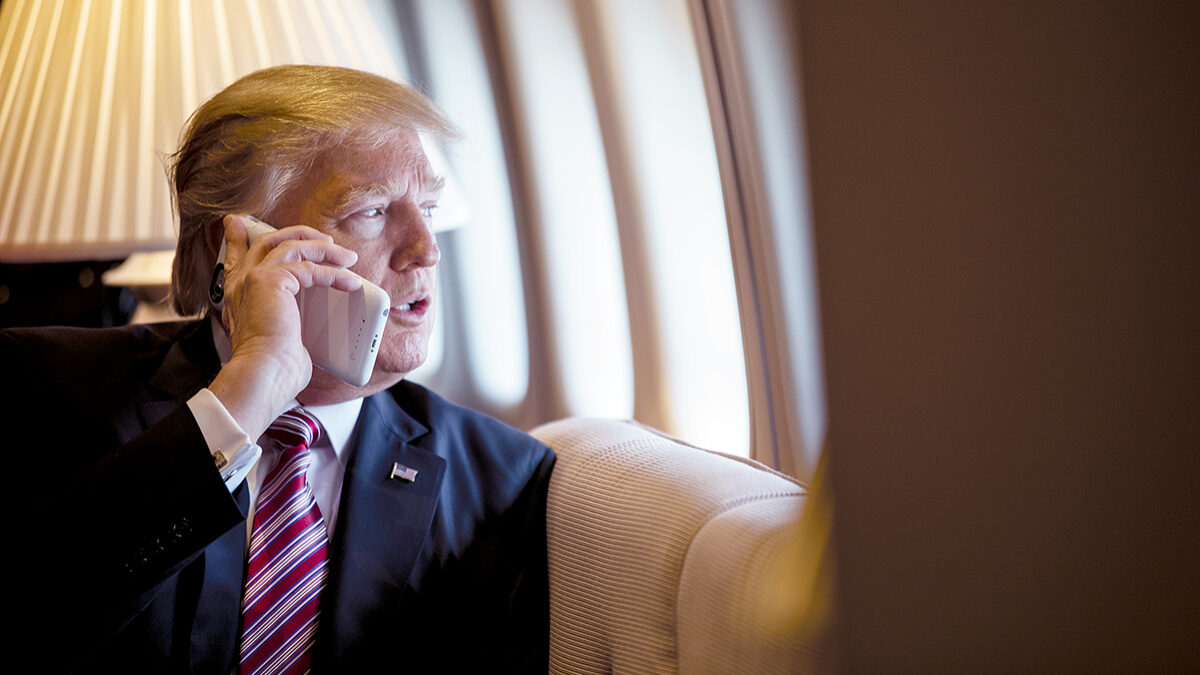
Trump talking on cell phone
Contrary to misleading headlines, none of the eight electors granted immunity in Fulton County’s anti-Trump war ‘said anything … incriminating to themselves or anyone else.’

Author Margot Cleveland profile

MARGOT CLEVELAND

VISIT ON TWITTER@PROFMJCLEVELAND

MORE ARTICLES

“At Least Eight Trump Electors Have Accepted Immunity in Georgia Investigation,” headlines uniformly blared on Friday. The legacy outlets echoing that narrative, however, buried the lead, which is that Fulton County’s get-Trump district attorney can’t even find incriminating evidence against the former president when she grants immunity to targets of her criminal investigation. A strong secondary story, also ignored or downplayed by the left-wing media, reveals multiple incidents of alleged misconduct by the D.A.’s office. 

The attorney representing eight Republicans targeted by the Fulton County D.A. filed a scathing response on Friday to the D.A. office’s motion to disqualify her from continued representation of her clients. Kimberly Debrow’s 28-page response detailed several previously unknown instances of questionable conduct by prosecutors targeting Donald Trump, his lawyers, and several high-profile Georgia Republicans. And contrary to the misleading headlines of the last several days, Debrow revealed that none of the eight individuals granted immunity “said anything in any of their interviews that was incriminating to themselves or anyone else.” 

How We Got Here

Debrow’s response began by providing an important backdrop to Fulton County D.A. Fani Willis’ motion to disqualify Debrow from the still-ongoing probe into supposed “coordinated attempts to unlawfully alter the outcome of the 2020 elections in this state.” Willis’ probe began in earnest in January of 2022, when she obtained permission from the chief judge of Fulton County to impanel a “special grand jury.” While the “special grand jury” lacked the authority to indict anyone, it had subpoena power and was also charged with issuing a report making “recommendations concerning criminal prosecution.” 

The special purpose grand jury issued its report earlier this year. Although much of the report remains under seal, in February a state court judge authorized the release of limited excerpts, including the grand jury’s conclusion “that perjury may have been committed by one or more witnesses testifying before it.” However, as I detailed when the story broke, that conclusion is meaningless without context, and the context makes clear that Willis misrepresented to the grand jury — and the American public — the substance of then-President Trump’s telephone call to Georgia Secretary of State Brad Raffensperger on Jan. 2, 2021.

Specifically, Willis falsely portrayed Trump as asking Raffensperger to “‘find 11,780 votes’ in the former President’s favor.” As the transcript of Trump’s conversation with Raffensperger established, however, the then-president did nothing of the sort. Instead, during the call, Trump’s lawyer explained to Raffensperger that “the court is not acting on our petition,” and sought an investigation into several categories of votes that appeared cast in violation of Georgia law.

While Willis branded Trump’s call to Raffensperger a “central focus” of her investigation, as Friday’s court filing reveals, the Fulton County D.A. also targeted Republicans named as “Trump electors” from the 2020 presidential election. Initially, the D.A.’s office told those electors, all 11 of whom were jointly represented by Debrow and fellow attorney Holly Pierson, they were “solely witnesses in the investigation.” Under those circumstances, they voluntarily agreed to be interviewed by Willis’ team. In late April 2022, Nathan Wade, a “private attorney” Willis hired to be special prosecutor, interviewed two electors and then canceled a third interview before unexpectedly subpoenaing the Republicans to testify before the grand jury.

A legal dispute between Wade and the defense attorneys ensued over the extent to which the Fifth Amendment’s right against self-incrimination protected the electors from being forced to respond to questions before the grand jury. Before the court had a chance to rule on the matter, however, Wade informed the court that the D.A.’s office intended to offer immunity to one or more of the electors. 

Immunity Talk

While not identifying which of the 11 electors the D.A. would offer immunity to, Wade represented that the D.A. was prepared to offer “full immunity from prosecution for any acts taken related to the December 14, 2020, meeting at the Georgia State Capitol to execute purported electoral college votes in favor of former President Donald J. Trump and former Vice President Michael R. Pence.” 

In response, Pierson and Debrow wrote to each of their clients, explained the existence and implications of the potential immunity offers, and noted whether a conflict of interest existed because the lawyers represented all 11 electors, but the D.A. would only be offering some of them immunity. The defense attorneys gave their clients a follow-up 13-page, single-spaced memo that comprehensively detailed the issues and then spoke with each client individually. All 11 electors opted to continue with joint representation and rejected the D.A.’s suggestion of immunity. 

At the time, the defense attorneys informed both the court and the D.A.’s office of their clients’ decision, noting first their fundamental distrust of “the motives and intentions of the DA and the investigative team in this case,” and “their perception that this investigation into their lawful conduct is not based on (or even interested in) the facts or the law but instead is politically motivated.” 

The defense counsel further noted their clients had “grave concerns” that if they testified truthfully “that neither they nor the other electors committed any illegal act or engaged in any sort of conspiracy with regard to the 2020 election the DA and your team would not accept that truth…” The electors thus feared prosecutors would “charge them with perjury or false statements to law enforcement officials or similar after their truthful, immunized testimony merely because the immunized witness is not in a position to tell the DA’s Office or the grand jury the story they want to hear.”

After the electors rejected the prosecutors’ overtures, the D.A.’s office responded by filing a motion to disqualify Pierson and Debrow, which would force the electors to hire new attorneys. In late November 2022, the court held that joint representation was permissible for 10 of the electors but that a conflict of interest required Chairman David Shafer to be separately represented. The electors and their attorneys then decided Pierson would represent Shafer and Debrow would represent the 10 remaining electors, and the court ruled such representation was permissible, over the D.A.’s objections.

Soon after, Debrow emailed the D.A.’s team to discuss a potential immunity deal, but it was not until April 4, 2023, that prosecutors responded. On April 7, 2023, Wade, the attorney Willis hired to be special prosecutor, provided draft immunity agreements for eight of the 10 electors. The two not offered immunity opted to obtain new legal representation, and Debrow’s remaining eight clients then accepted the revised immunity offers. Thereafter, seven of the eight electors sat for recorded interviews with Wade questioning them on behalf of the D.A.’s office and with Debrow representing them. The final elector was out of the country and thus has not yet been interviewed. 

Manipulation and Intimidation

During Wade’s questioning, Debrow claims he attempted to mislead and confuse her clients by suggesting the D.A.’s office had previously made an actual offer of immunity in late 2022, as opposed to merely floating the potential for an immunity deal. In one case, Debrow detailed how, when she attempted to clarify for her client Wade’s misleading questions, the prosecutor threatened to leave, rip up the immunity agreement, and indict the elector. 

The D.A.’s office then filed a second motion to disqualify Debrow, falsely representing to the court that “some of the electors represented by Ms. Debrow told members of the investigation team that no potential offer of immunity was ever brought to them in 2022.” The Fulton County D.A. knew that representation was false, Debrow stressed in her response, highlighting the evidence previously presented to both the court and prosecutors that detailed the extensive discussions Debrow had with her clients about the initial immunity outreach.

Willis also sought to force Debrow off the case by arguing some of her clients “stated that another elector represented by Ms. Debrow committed acts that are violations of Georgia law.” 

“This statement is categorically false, and provably so,” Debrow countered. Here, Debrow first detailed her extensive legal experience, including her service as an assistant district attorney in three Georgia counties, before stressing she was present for every interview and would have recognized any such incriminating testimony. “Nothing even similar to any such statements were made by any of the interviewed electors,” Debrow said, adding that the transcripts confirmed her representation.

Significantly, Debrow told the court that “none of the interviewed electors said anything in any of their interviews that was incriminating to themselves or anyone else,” meaning they also had not implicated Trump, his lawyers, or any of the other potential targets of Willis’ criminal investigation. That fact was lost on the reporters, however, who since Friday have focused instead on the mere fact that the eight electors had accepted immunity agreements — implying that meant they had dirt to dish.

Ignoring the Real Story

The corporate media were likewise content to ignore the allegations of serious misconduct. Those included Willis’ misrepresentation to the court about whether the electors’ attorney had informed them of the prior immunity discussion and Wade’s alleged attempt to mislead and intimidate one of the witnesses by threatening to indict him. 

Wade’s involvement here is particularly ironic given that a Fulton County judge held the special prosecution team could no longer investigate one of the electors, then-state Sen. Burt Jones, because Willis had hosted and headlined a fundraiser for Charlie Bailey — a Democrat seeking to challenge Jones in the general election for lieutenant governor. Wade, like Willis, had donated to Bailey’s campaign.

Noteworthy too is Wade’s work with Willis, as Wade was a private attorney whom Willis specifically hired to work on 2020 election investigation. Willis bringing on a pit bull to further her get-Trump efforts smells disgustingly similar to Manhattan D.A. Alvin Bragg’s use of outside “special assistant district attorneys,” including three from a high-powered, Democrat-connected law firm, to help find a way to indict Trump.

Also appalling is the attempt by Willis’ office to force Debrow off the case — a tactic sadly seen sometimes when a prosecutor proves unable to manipulate a witness into saying what the government wants. 

The trial court has yet to rule on the Fulton County D.A.’s motion to disqualify Debrow, and maybe there will be something more of concern that the prosecutor omitted from the motion. But the detailed excerpts included in Debrow’s response brief appear to doom Willis’ attempt to force the electors to hire new attorneys. And if, as Debrow’s represented, the electors said nothing “incriminating to themselves or anyone else,” much more of the Fulton County D.A.’s case is likely doomed too.


Margot Cleveland is The Federalist’s senior legal correspondent. She is also a contributor to National Review Online, the Washington Examiner, Aleteia, and Townhall.com, and has been published in the Wall Street Journal and USA Today. Cleveland is a lawyer and a graduate of the Notre Dame Law School, where she earned the Hoynes Prize—the law school’s highest honor. She later served for nearly 25 years as a permanent law clerk for a federal appellate judge on the Seventh Circuit Court of Appeals. Cleveland is a former full-time university faculty member and now teaches as an adjunct from time to time. As a stay-at-home homeschooling mom of a young son with cystic fibrosis, Cleveland frequently writes on cultural issues related to parenting and special-needs children. Cleveland is on Twitter at @ProfMJCleveland. The views expressed here are those of Cleveland in her private capacity.

Tag Cloud