
Perspectives; Thoughts; Comments; Opinions; Discussions

Posts tagged ‘coal’

California’s Income-Based Electric Bills Show It Cares More About Control Than Climate


BY: CHUCK DEVORE | APRIL 20, 2023
Read more at https://thefederalist.com/2023/04/20/californias-income-based-electric-bills-show-it-cares-more-about-control-than-climate/

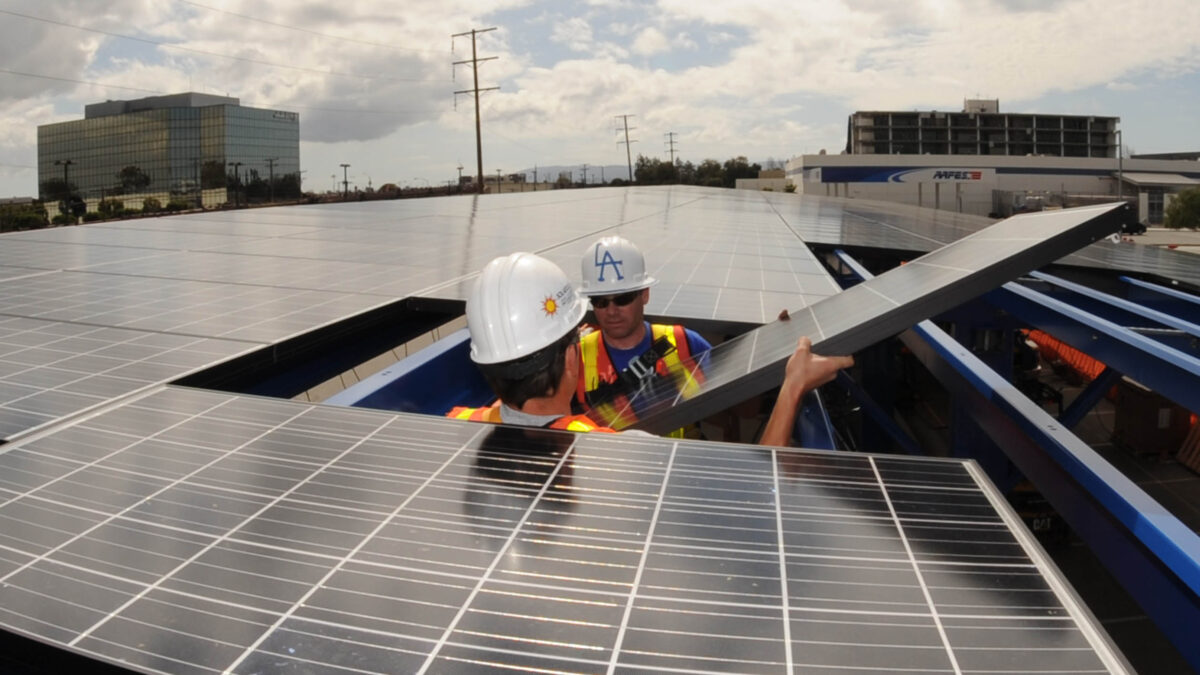
solar panels generate energy in California
The electrical pricing scheme may work as income redistribution social policy, but it fails the test of reducing energy consumption.

Author Chuck DeVore profile

CHUCK DEVORE

VISIT ON TWITTER@CHUCKDEVORE

MORE ARTICLES

What’s behind California’s shift to paying for electricity based on income? In a few words, it’s the consequence of California’s futile fight against climate change.

California’s quixotic pursuit to save the planet by reducing greenhouse emissions has had three broad and irrefutable consequences. It has made energy more expensive; costlier energy has accelerated the deindustrialization of the state; and, the best irony of all, the offshored manufacturing has increased greenhouse gas emissions by pushing production to dirty, coal-fired China, with goods then shipped back to California for consumption.

The latest twist in California’s arrogant tale of energy virtue signaling is playing out with a major restructuring in how Californians are charged for their electricity. For decades, consumers paid for electricity — as well as other utilities such as water and natural gas — with a tiered system that charged more for resources used above a baseline amount. For electricity, the baseline was determined by three things: the consumer’s use of electricity, the region, and the season.

This system meant consumers who used a lot of electricity would pay far more for each kilowatt hour of that additional electricity than they would for their baseline allocation.

This tended to hit lower-income consumers who ran their air conditioning too much, though the Golden State also has a separate program to reduce costs for low-income residents known as California Alternate Rates for Energy (CARE).

But with California’s electric prices pushing from where they’ve traditionally been — about sixth-highest among the contiguous 48 states, behind New York and New England — to the second-highest in the nation after Hawaii last year, costs on the working poor were rising too much. To paraphrase a colorful politician, “The electric bill is too damn high.”

Thus, the California legislature last year passed Assembly Bill 205, which mandated an end to the tiered system of electric rates and instituted in its place a system where each would pay according to his ability to help those in need. (Of course, it sounds better in the original German, “Jeder nach seinen Fähigkeiten, jedem nach seinen Bedürfnissen.”) The bill goes into effect no later than July 1, 2024, with the stated aim that “low-income ratepayers in each baseline territory would realize a lower average monthly bill without making any changes in usage.”

One unintended consequence of ditching the old baseline allocation scheme is all ratepayers, regardless of income, will now have far less incentive to conserve electricity, since each additional unit of electricity used will be priced the same, with overall prices reduced.

Higher Income Will Pay More

In preparation for the rollout of the new electric charges, California’s big, regulated utilities have proposed their new rate plans to the California Public Utilities Commission (CPUC). Depending on the provider, ratepayers would pay a fixed fee based on three household income tiers, plus charges for electricity use. Household income would be validated by a third party, likely the agency that collects the state income tax, the California Franchise Tax BoardThe three proposed household income tiers and their fixed rates are: $28,000 to $69,000 — $20 to $34 a month, depending on the provider; $69,000 to $180,000 — $51 to $73 a month; and more than $180,000 — $85 to $128 a month.

Median household income in California in the years 2017-2021 was $84,097, meaning that an average California family could, under the proposed rate structure, pay a flat fee of $876 per year for their electricity while charges for kilowatt hours used would decline by 33-42 percent depending on the provider. The net effect would be an increase of about $90 a year for the average household and up to $750 more annually for higher-income households. Ironically, households living in homes with rooftop solar would see some of the highest increases in electrical costs under the new rate structure. Lower-income households are expected to see savings of up to $300 per year.

Increasing Fees Rather Than Taxes

One big advantage to California policymakers of heavily regulating public utilities is the ability to use these energy and water corporations as de facto arms of the welfare state.

California’s Constitution requires a two-thirds majority to increase taxes, but a simple majority to increase fees. The CPUC’s total control over California’s utilities means state lawmakers can direct the CPUC to change its rate structures to take more from those earning more and give to those earning less — all without a penny flowing into or out of the state treasury — something that’s particularly attractive today in a state that went from an almost $100 billion surplus last year to an expected $30 billion deficit this year.

And in that, the CPUC commissioners, appointed by Gov. Gavin Newsom, are willing accomplices in the class struggle for fair electricity bills and energy justice. Of the five commissioners, four are attorneys, with backgrounds in “environmental justice,” air quality, low-income assistance, and climate change — electricity generation, not so much. Though the CPUC’s mission is to ensure “that consumers have safe, reliable utility service at reasonable rates, protecting against fraud, and promoting the health of California’s economy,” it’s clear now that all that really matters is figuring out how to shield low-income voters from the costly consequences of California’s green energy crusade.

Moreover, while the electrical pricing scheme may work as income redistribution social policy, it fails the test of reducing energy consumption — laying bare the fact that California policymakers care more about control than they do the climate.
Chuck DeVore is chief national initiatives officer at the Texas Public Policy Foundation, vice chairman of the Golden State Policy Council, a former California legislator, and a retired U.S. Army lieutenant colonel. He’s the author of “The Crisis of the House Never United—A Novel of Early America.”

As America Self-Destructs With Green Energy, China Preps For War With Coal


BY: CHUCK DEVORE | SEPTEMBER 02, 2022

Read more at https://thefederalist.com/2022/09/02/as-america-self-destructs-with-green-energy-china-preps-for-war-with-coal/

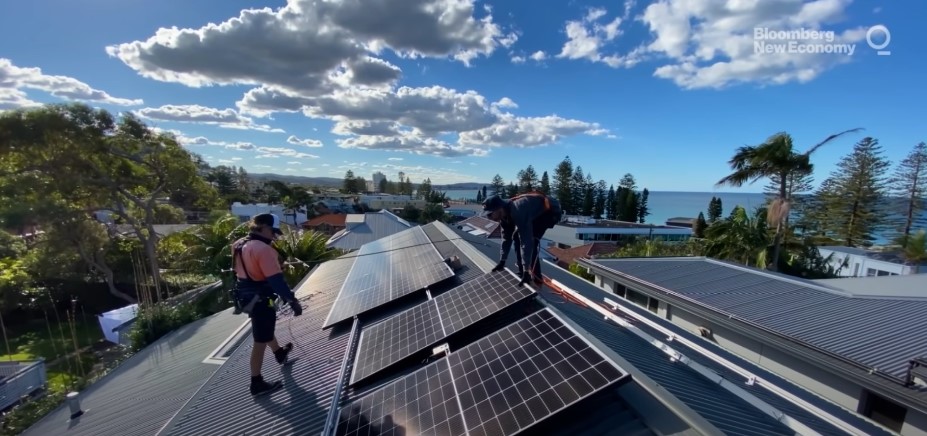
Chinese workers installing solar panels

Author Chuck DeVore profile

CHUCK DEVORE

VISIT ON TWITTER@CHUCKDEVORE

MORE ARTICLES

On Aug. 25, the California Air Resources Board, the state’s air quality regulator, announced a ban on the sales of new gasoline- and diesel-powered vehicles by 2035. Less than a week later, a heat wave threatened California with seven days of power shortages. So, the state’s grid operator asked electric vehicle owners not to recharge when they come home from work. This is all a painful part of the energy transition, we are told — needed to save the planet. 

In its effort to wean itself off fossil fuels, California has found a willing and enthusiastic partner in the People’s Republic of China. Most batteries, solar panels, and wind turbines that make California’s green dreams possible are made in China. California leaders — from former Republican Gov. Arnold Schwarzenegger to former Democratic Gov. Jerry Brown, and current Democratic Gov. Gavin Newsom — have traveled to China to tout their green cooperation with Red China. 

The push for electric vehicles (EVs) by California and China raises an intriguing question: Are both sides really weaning themselves off fossil fuels to save the planet and reduce pollution, or might there be an entirely different intention — at least for China?

U.S. climate czar John Kerry, a former senator, former secretary of state, and the Democratic nominee for president in 2004, epitomized American elite opinion when he said on Aug. 30 that China has “generally speaking, outperformed its (climate) commitments” and that the U.S. and China can make a difference for the world by “working together.”

When policymakers and strategists erroneously ascribe to others the same motives that they have themselves, it is called the Mirror-Image Fallacy. Opponents in warfare seek to deceive — the best deception plans are those that show the enemy what the enemy wants to believe. Mirror-Image Fallacy and deception plans can work hand-in-glove. 

If China was truly going all-in on EVs to reduce pollution and curb its greenhouse gas emissions, one would expect to see that in its energy consumption profile. Instead, we see something different. Yes, China has been adding wind, solar, and nuclear power, but coal use is also increasing. 

From 2010 to 2020, the amount of electricity produced by coal in China rose by 57 percent to 4,775 terawatt hours. From 2010 to 2021 — the latest year available and 2020 having been depressed by the response to Covid-19 — American coal use to generate electricity declined by 52 percent to 899 terawatt hours. U.S. coal power peaked in 2007. China surpassed U.S. coal use in 2006 and never looked back. Today, China generates more than five times the electricity from coal than the U.S., with construction underway or planned in China to build the equivalent of more than the entire operating U.S. coal fleet. By this one action alone, China will wipe out all projected U.S. reductions in greenhouse gas emissions — and then some. 

Last year, China consumed 54 percent of the world’s coal. This is the main reason that China emits more greenhouse gasses than all the world’s developed nations combined — which shouldn’t be a shock given that America, Western Europe, and Japan outsourced much of their manufacturing to China over the past 20 years. 

Apologists for China’s one-party communist government often cite the fact that China is still a developing nation, with about 200 million Chinese living on $5.50 a day as recently as 2018. It takes energy to be prosperous and prosperous people use energy — lots of it — for cars, air conditioning, heat, air travel, and the internet. Prosperous people, and those who expect to be, don’t typically try to overthrow their governments, either. For the Chinese Communist Party, this is key. 

While the Western elite vanguard of the war against climate change sees greenhouse gas emissions as the singular existential threat, the Chinese Communist Party sees greenhouse gas emissions as the necessary byproduct of wealth, power, military might — and compliant subjects. 

Were China’s leaders interested in growing their economy while improving air quality and holding the line on carbon dioxide emissions, they’d turn from coal to natural gas. If China expected to be an honest participant in the post-World War II liberal order, then it would have no qualms about increasing its dependence on natural gas. 

But China has scant natural gas reserves, and the nearest large exporter, Russia, has built most of its pipeline capacity to serve Europe — which it is now cutting off, showing the danger of relying on foreign suppliers. Other major exporters in the Pacific include the U.S., Australia, and Indonesia, but China’s aggressive foreign policies have alienated these nations. Qatar has significantly increased its liquified natural gas exports to China, but these shipments are vulnerable to interdiction in the event of a conflict — it’s doubtful that much in the way of Chinese imports would make it past the Straits of Malacca.

This last point leads to a final, stunning, and very troubling conclusion. For years, strategists have assumed that China would never start a conflict that would deliberately involve America as an enemy because China importsome 72 percent of its oil, with about 85 percent of that imported oil transiting the Straits of Malacca.

But what if our policy experts have gotten China’s energy strategy all wrong? What if their efforts to reduce their reliance on oil had nothing to do with the environment and everything to do with energy security — with being able to fight a war indefinitely while being blockaded?

In 2019, 45 percent of the oil used in the U.S. was refined into gasoline for cars. Another 29 percent was made into diesel and jet fuel — applications less immediately replaceable by batteries since hydrocarbon fuels have about 100 times the energy density of lithium-ion batteries — one of the reasons why long-haul trucking and commercial jets aren’t likely to be electric anytime soon. 

China is well into a program to go electric with respect to passenger vehicles. In China, this practically means that EVs are mostly coal-powered. That still leaves more oil demand than China’s modest domestic oil production can handle, risking the depletion of China’s reputed billion-barrel strategic petroleum reserve in 200 days or so. 

Of course, with the onset of Covid-19, China perfected complete control of its population, shutting down travel at will and confining people to their homes. But a war can’t be won on lockdown, and people get restless. Here’s where China’s hidden ace in the hole comes in: coal gasification.

With a technology that matured in the 1920s, Germany under Hitler invested heavily in coal gasification to make gasoline and other fuels — Germany has a lot of coal and very little oil. On the eve of war in 1938, Germany produced just under 10 percent of its oil needs from domestic crude while importing 60 percent from overseas and about 8 percent from overland routes within Europe. The remaining 20 percent of Germany’s need was answered by converting coal to liquid fuels. By 1943, German synthetic fuel production had more than tripled to 42 million barrels annually. 

In the 1940s, German synthetic oil was up to 20 times more costly than abundant American crude oil. But wartime necessities required its production. Today, deriving synthetic fuel from coal is about half of the cost of oil at $90 a barrel — but the process to manufacture it produces about double the greenhouse gas emissions by simply refining crude oil into fuels. Simply put, it’s cost-effective but bad for the climate — and China is investing heavily in it to reduce its reliance on imported oil. 

A holistic look at China’s energy sector indicates a nation concerned only with energy security and not at all concerned with climate change. That has grave consequences for America’s ability to deter China from an ambitious campaign of military aggression.


Chuck DeVore is Chief National Initiatives Officer at the Texas Public Policy Foundation, a former California legislator, special assistant for foreign affairs in the Reagan-era Pentagon, and a lieutenant colonel in the U.S. Army (retired) Reserve. He’s the author of two books, “The Texas Model: Prosperity in the Lone Star State and Lessons for America,” and “China Attacks,” a novel.

    Today’s Politically INCORRECT Cartoon by A.F. Branco


    A.F. Branco Cartoon – Mad Science

    A.F. BRANCO | on August 6, 2022 | https://comicallyincorrect.com/a-f-branco-cartoon-mad-science-2/

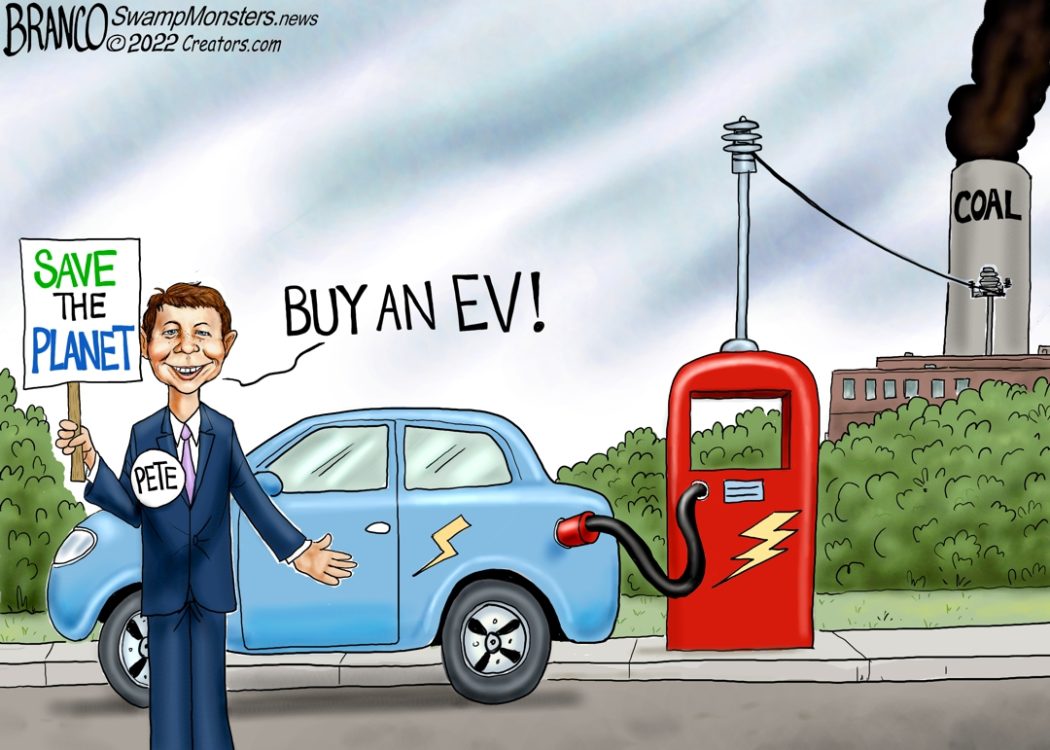
    Pete Buttigieg’s answer to saving the planet is to buy expensive Electric Vehicles charged by Coal Plants.

    Pete Buttigieg Electric Vehicles
    Political cartoon by A.F. Branco ©2022

    DONATE to A.F.Branco Cartoons – Tips accepted and appreciated – $1.00 – $5.00 – $25.00 – $50.00 – $100 – it all helps to fund this website and keep the cartoons coming. Also Venmo @AFBranco – THANK YOU!

    A.F. Branco has taken his two greatest passions, (art and politics) and translated them into cartoons that have been popular all over the country, in various news outlets including “Fox News”, MSNBC, CBS, ABC, and “The Washington Post.” He has been recognized by such personalities as Dinesh D’Souza, James Woods, Sarah Palin, Larry Elder, Lars Larson, Rush Limbaugh, and President Donald Trump.

    Trump EPA finalizes rule to gut Obama coal plant regulations


    Written by Josh Siegel | June 19, 2019 12:00 AM | Updated Jun 19, 2019, 10:23 AM

    The Trump administration finalized Wednesday its much-anticipated rule gutting President Barack Obama’s signature plan for reducing carbon emissions from coal plants to combat climate change. The Environmental Protection Agency released its replacement of Obama’s Clean Power Plan with a modest rule intended to encourage efficiency upgrades at coal plants to help them exist longer and emit less pollution.

    “ACE will continue our nation’s environmental progress and will do so legally and with respect for the states,” EPA Administrator Andrew Wheeler said at a press conference Wednesday, where he was joined by White House Chief of Staff Mick Mulvaney, other administration officials, and Republican members of Congress from coal states. “The ACE rule will incentivize new technologies so coal plants can be part of our energy future.”

    The Trump administration plan, known as the Affordable Clean Energy or ACE rule, encourages states to allow utilities to make heat rate improvements in power plants, enabling them to run more efficiently by burning less coal to produce the same amount of electricity. Under current rules, power plants must undergo new pollution reviews when they upgrade facilities, making it prohibitively expensive.

    The rule is not projected to meaningfully reduce emissions, and is expected to have little effect on the actions of electric utilities that are already switching away from expensive coal to cheaper natural gas and renewables without a federal regulation.

    The focus on regulating power plants individually is a rejection of the Clean Power Plan, which allowed for efficiency upgrades, but also sought to push the overall power sector to switch away from coal to natural gas and renewables.

    The Clean Power Plan required states to reduce carbon dioxide emissions 32% below 2005 levels by 2030.

    The Trump administration rule, unlike the Clean Power Plan, does not set a specific target for the power sector to reduce carbon emissions, giving states the authority to write their own plans for reducing pollution at individual plants.

    In choosing to replace the Clean Power Plan, rather than repeal it outright, the EPA is acknowledging the federal government is legally obligated to regulate carbon emissions that cause climate change. Environmentalists and Democratic states, however, plan to sue the Trump administration, arguing the rule does not meaningfully fulfill the bare-bones requirement of the Clean Air Act since it would not significantly cut carbon emissions by keeping alive coal plants with efficiency improvements that would otherwise retire.

    Carbon emissions rose in 2018 for the first time in eight years.

    “What a responsible administration would do is strengthen the Clean Power Plan, not kill it,” said David Doniger, senior strategic director of the Climate and Clean Energy Program at the Natural Resources Defense Council, which will be among the groups suing the EPA. “We will attack this because it attempts to cripple the Clean Air Act as a tool to tackle climate change.”

    Courts never ruled on the legality of the Obama administration’s Clean Power Plan — even though the Supreme Court stayed the rule.

    Trump’s EPA, and conservative state attorneys general who filed suit, argued that Obama’s approach was expansive and illegal.

    The relevant section of the Clean Air Act, section 111(D), says carbon pollution regulations must reflect “the best system of emission reduction” — without defining what that means. The Trump administration, critics say, is seeking to have the federal courts enshrine its narrow view of law.

    “They are looking to define the limits of EPA’s regulatory authority,” said Jeff Holmstead, a former deputy administrator of the EPA in the George W. Bush administration and energy industry attorney who agrees with the Trump administration’s approach. “The ACE rule can establish what EPA can do when it comes to regulating emissions from the power sector.”

    EPA says the new rule will reduce carbon emissions by as much as 35% below 2005 levels in 2030 — similar to projections for the Clean Power Plan — but most of that would occur from market forces absent any regulation. EPA, in a fact sheet accompanying the rule, projects ACE will cut carbon emissions 11 million tons by 2030, but that’s only about a 0.84% reduction compared to what would occur with no regulation.

    A senior EPA official, briefing reporters Wednesday, acknowledged some coal plants will increase emissions over their lifetime if they apply efficiency improvements and operate longer, rather than retire.

    “It will yield virtually no reductions in C02 emissions,” said Joseph Goffman, an environmental law professor at Harvard University who was a chief architect of the Clean Power Plan, speaking on a phone call with reporters. The EPA is looking to “simply be a grudging cheerleader for what the utility sector is doing anyway, not for climate change reasons, but simply for business reasons,” he added.

    Large utilities that are transitioning off coal have said EPA’s effort to encourage efficiency upgrades at coal plants will not inspire them to alter plans to switch to cleaner energy.

    “We are on our path. We are going to stay on our path,” Dominion CEO Thomas Farrell told the Washington Examiner this month at a utility industry conference.

    Coal has fallen from 55% of power produced by Dominion to 11%, he said, helping the company stay on track for its goal of reducing emissions 50% by 2030 and 80% by 2050.

    Ohio-based American Electric Power, one of the nation’s largest utilities, has similar views on the Trump pitch, even though it opposed the Clean Power Plan. It aims to reduce coal use from nearly half its electricity mix to 27% by 2030, while cutting its carbon emissions 80% by 2050.

    “AEP’s long-term strategy remains focused on modernizing the power grid, expanding renewable energy resources and delivering cost-effective, reliable energy to our customers,” Tammy Ridout, an AEP spokeswoman, told the Washington Examiner.

    Indeed, many coal plants across the industry are too old to make upgrades worth investing in. Others have already done the efficiency work EPA outlines in its proposal, utility industry analysts say.

    Trump EPA’s coal plan could be most beneficial for smaller utilities, like co-ops that provide energy to rural consumers. These utilities aim to keep rates as low as possible because many of their users are low-income, and it would cost less to upgrade an existing coal plant than to invest in a new facility.

    “The final ACE rule gives electric cooperatives the ability to adopt evolving technology and respond to market and consumer demands while continuing to serve as engines of economic development for one in eight Americans,” said Jim Matheson, CEO of the National Rural Electric Cooperative, a trade group representing more than 900 co-ops in 47 states.

    More Poiltically INCORRECT Cartoons


    More Politically INCORRECT Cartoons for Friday August 18, 2017


    HTTP://Townhall.com

    Tag Cloud