Conservatives Won the Word ‘Woke.’ Now It’s Time to Reclaim Accurate Language Everywhere
BY: ELLE PURNELL | MAY 05, 2023

ELLE PURNELL
VISIT ON TWITTER@_ETREYNOLDS
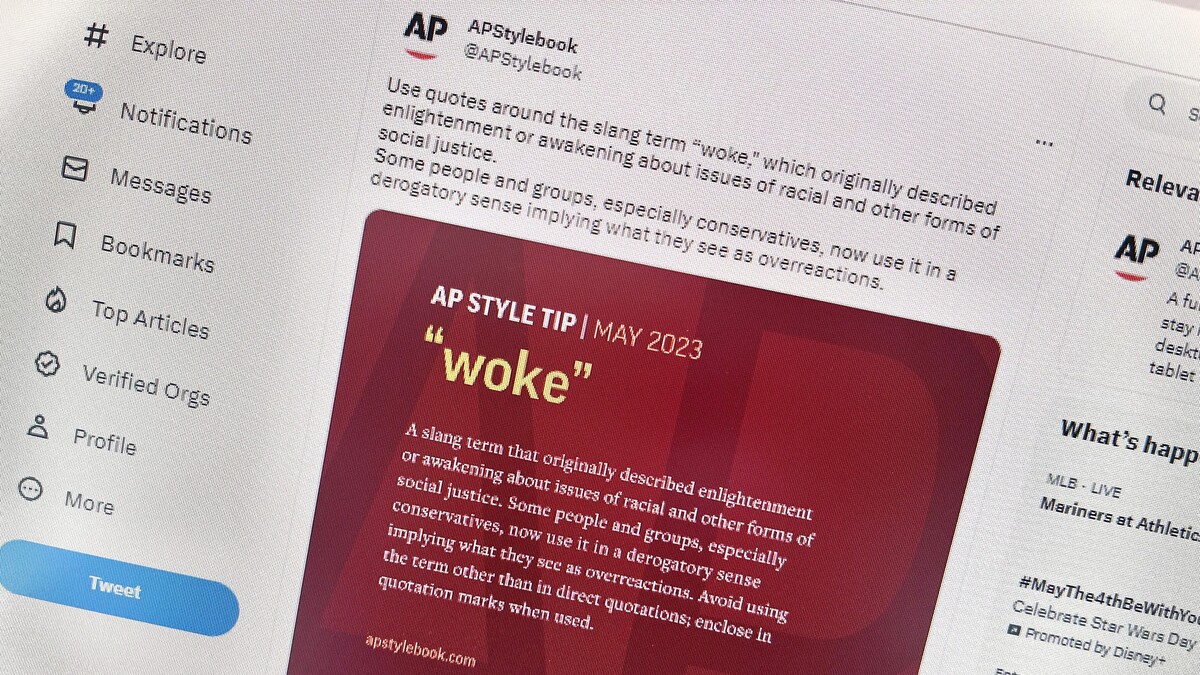
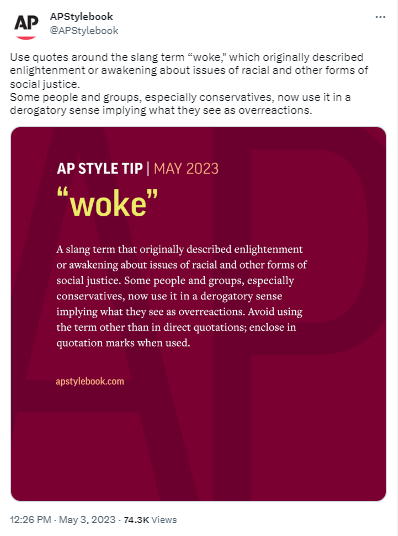
The Associated Press Stylebook, a once-respected linguistic guide for journalists, conceded the definition of the word “woke” to conservatives on Thursday, in an update instructing writers to “use quotes around the slang term.”
“Woke” was originally popularized by left-wing proponents of identity politics to flatteringly refer to their own “enlightenment or awakening about issues of racial and other forms of social justice,” as the AP explains. Conservatives have used it to describe those same people and their ideas.
Those ideas more often than not, demand revolutionary social changes that prejudge people based on their secondary physical characteristics. If, like the vast majority of America until about five seconds ago, you think such identarian prejudices are a bad thing, you might use the word “woke” in a less than fawning manner. Apparently, the AP’s staff can’t handle that.
AP’s concession of the word is hilariously thin-skinned, but it’s also a rare win for conservatives in the war of words. Just by describing woke behavior as such, we’ve held a bit of ground against the unhinged language police who are mad that the right is using their terminology against them. Unintentionally, it seems we’ve ended up with command of the word altogether, if left-wing outlets like the AP are henceforth refusing to use it.
While there are times individual ideologies require a more specific description — queer theory, or socialism, for example — “woke” is a completely fair and often helpful term to use when speaking generally about the coalition of people on the left who want to see meritocracy replaced by identity politics. As my colleague Samuel Mangold-Lenett noted recently in these pages, “what other slogany-sounding word really works as a catch-all for what leftism has become?”
“They lost complete control of the English language,” he added, “and the word they used to indicate their radicalism to one another is being used to expose that radicalism to the rest of the world.”
The apparatus of left-wing media outlets, cultural celebrities, and tech platforms that drives our modern discourse has a majority share in defining the language we use. From headlines to search engines to literal dictionaries, activists manipulate the tools of debate. In any debate, the first step is defining your terms — if your definitions are off, you’ve already lost.
That’s why it’s incumbent upon conservatives to be intentional, honest, and straightforward with the words we use. That includes defending the legitimacy of disfavored-but-accurate terms (like “woke,” or “woman”) and refusing to use inaccurate language.
Take the nonsense phrase “gender-affirming care,” for example. The diction dictators have effectively standardized the term, to the point where even people who disapprove of such procedures will glibly repeat it. But nothing about the phrase is tethered to reality.
The whole idea that people have “genders” beyond their natural sex is pseudo-science crafted to further an ideology. Procedures that attempt to inhibit or reverse the physical realities of a person’s sex are not “affirming” that sex, but actively rejecting it. And deformative surgeries that involve amputating healthy body parts and creating Frankenstein-esque “penises” and “vaginas” with scraps of carved-up skin are certainly not “care.”
To use the phrase “gender-affirming care” is to give up the entire argument before it’s even begun. Or, as George Orwell put it, such nonsense terms “construct your thoughts for you,” and “perform the important service of partially concealing your meaning even from yourself.”
The same goes for using improper pronouns to describe sexually confused people: calling a man “she” or a woman “he.” Doing so indulges a delusion. Having physical reality on your side does little good if you concede it away by the very words you use.
The list of nonsense words that woke ideologues are injecting into common parlance is long. For starters, here’s a list of “10 Politically Correct But Factually False Words And Phrases To Stop Using Immediately,” and a follow-up list of eight more.
Concurrent with the effort to mainstream invented euphemisms such as “gender-affirming care” is an effort to cannibalize established English vocabulary. Other victims of the AP Stylebook’s recent crusades include “riot,” “mistress,” “crazy,” and “pro-life.” Proper grammar is also a victim, with the redefinition of the plural pronoun “they” to refer to individuals who are in denial of their natural sex.
Tech monopolies such as Google instruct their employees to avoid terms like “man hours” and “blacklist.” The Centers for Disease Control and Prevention has nixed “criminal” and “foreigner.” From journalism to medicine, terms such as “mother” and “woman” are replaced by dehumanizing lingo like “birthing parent” and “person who menstruates.” Merriam-Webster has redefined “anti-vaxxer,” “sexual preference,” and “assault rifle” to further the editors’ ideological ends.
By describing woke ideologies and their fruits at face value, conservatives felled the left’s self-conferred monopoly on how, when, and where the term could be used. But the same people policing the word “woke” are appointing themselves the arbiters of the rest of the English language, too.
For those of us who prefer our words to reflect reality, there is nothing to be gained by good-naturedly going along with linguistic charades. On the other hand, there is the entire discourse to be lost.
“The worst thing one can do with words is to surrender them,” George Orwell wrote in his 1946 essay, “Politics and the English Language.” Orwell protested not just sloppy use of language, but intentional misuse of language for political purposes.
“Political language is designed to make lies sound truthful and murder respectable,” he said. “Thus political language has to consist largely of euphemism, question-begging and sheer cloudy vagueness.”
Politicians and dishonest media propagandists today use inaccurate language to frame narratives and foster a leftist perspective. Inadvertently, even well-meaning audiences sometimes internalize this language and end up propagating the very ideas and framing they fundamentally reject. Don’t let that be you.
In every debate, it’s vital to start by defining your terms. If conservatives want to counter the radical left’s agenda, we have to begin by using words that accurately reflect what we mean — not words that actively mean the opposite. Here are just 10.
1. ‘Mainstream Media’
The public communication cartel headed by The New York Times, The Washington Post, CNN, CBS, and MSNBC does not represent mainstream Americans. Earlier this year, Axios (another culprit of heavy-handed political spin) reported that 56 percent of Americans believe “Journalists and reporters are purposely trying to mislead people by saying things they know are false or gross exaggerations.”
Big Media has engaged in deception through false and misleading “reporting” on Georgia’s election laws, the trespass and unrest at the U.S. Capitol on January 6, and more. Embracing “Russiagate” and the allegations of the Steele dossier against President Trump was one indicator of crumbling credibility. The cover-up of the Hunter Biden laptop story just before the 2020 presidential election was another.
Even more recently, CBS’s “60 Minutes” invented a scandal about Florida Republican Gov. Ron DeSantis, while giving minuscule coverage to New York Democrat Gov. Andrew Cuomo’s cover-up of COVID-19 nursing home deaths his policies caused.
Leftist propaganda outlets who are running cover for Democrats and spreading inaccurate opposition research on conservatives don’t deserve to be called mainstream. Instead, use “Big Media,” “corporate media,” or — as DeSantis says — “smear merchants.”
2. ‘Gender,’ When You Mean ‘Sex’
Words have gender; people are one sex or another. For Latin and in many of the languages that have grown out of it, gender is a linguistic term indicating which word endings a term should possess. Gender is either feminine, masculine, or neuter. The phrase “la boulangerie,” for example, is French for “the bakery,” and its gender is feminine.
Male and female, on the other hand, refer to sex. Sex is a biological category that reflects a person’s physical characteristics and reproductive systems, and also manifests in certain broad behavioral differences that distinguish men and women.
3. ‘Sex-Reassignment Surgery’
Further, sex is not assigned, at birth or ever. If it is not “assigned,” it cannot be reassigned. Surgical procedures that remove or conceal the outward appearance of a woman or man’s reproductive organs, are most accurately described as genital mutilation or amputation.
4. ‘Democracy,’ When You Mean ‘Republic’
A democracy is direct rule by the supreme will of the people: the highest law is that of the loudest mob. Derived from the Greek “demos” (people) and “kratia” (power), democracy involves no higher law than popular consensus, and subjects the majority will to no checks and balances but itself.
In Book VIII of “The Republic,” Plato lists democracy as the social structure directly followed by tyranny. Democracy, Plato theorized, “comes into being when the poor, winning the victory, put to death some of the other party, drive out others, and grant the rest of the citizens an equal share in both citizenship and offices.” He continued, “that is the constitution of democracy alike whether it is established by force of arms or by terrorism.”
The American system was established as a constitutional republic. The highest law of the land is the U.S. Constitution, to which all public servants are (or should be) accountable. Additional laws are made by elected representatives of the people. Further, the American system is a federal republic, meaning power is divided between federal, state, and local governments, all of whom serve as the guarantors of the people’s sovereignty and rights.
5. ‘Abortion Doctors’ and ‘Abortion Clinics’
Doctors protect life; they don’t willfully take it. The Hippocratic Oath, written by the ancient Greek physician Hippocrates and long respected as a noble description of a doctor’s vocation, includes a commitment to “not give to a woman an abortive remedy.” Doctors are also obligated to, as far as it is in their power, “do no harm.” (This phrase is commonly attributed to the Hippocratic Oath, but actually comes from another work of Hippocrates, his book, “Of the Epidemics.”)
Similarly, clinics are medical facilities where people receive help and care. We do not call the room in which a prisoner on death row is executed a “clinic,” and neither should we use the term to describe the place where preborn babies are killed and dismembered. Call abortionists and abortion facilities what they are.
6. ‘Antidiscrimination’
Often, “antidiscrimination” policies actually refer to legal preferences based on sex, race, socioeconomic status, or some other category. The Brigham and Women’s Hospital in Boston, for example, released an “Antiracist Agenda For Medicine” earlier this month that would provide “preferential care based on race” for black and Latino patients.
In another example of discrimination under the name of its opposite, Yale University unlawfully discriminated against white and Asian students, according to a two-year Department of Justice investigation. Instead of using the leftist buzzword “antidiscrimination” to describe these policies, call them legalized preferences, or simply the discrimination they are.
7. ‘Undocumented Immigrant’
“Undocumented” is the term used by people who don’t want to call breaking immigration laws “illegal.” However, most illegal immigrants have identification documents from their home governments. Further, 16 states — California, Colorado, Connecticut, Delaware, Hawaii, Illinois, Maryland, Nevada, New Jersey, New Mexico, New York, Oregon, Utah, Vermont, Virginia and Washington — as well as Washington, D.C., issue drivers licenses to illegal aliens, giving them U.S. documents as well.
8. ‘Equity’ Or ‘Equality,’ When You Mean The Other
Equity and equality sound similar, but have widely different implications today. Noah Webster’s 1828 dictionary defines “equality” as “The same degree of dignity or claims; as the equality of men in the scale of being … an equality of rights.” The Declaration of Independence’s assertion that “all men are created equal” recognizes this equal value and dignity in personhood of each human being.
Equity has traditionally been a common legal term, referring to civil remedies; it can also mean the “impartial distribution of justice.” But in the jargon of identity politics, equity describes a policy that “recognizes that each person has different circumstances and allocates the exact resources and opportunities needed to reach an equal outcome.” See the above entry for “antidiscrimination” for an example of how equity-driven policies usually work.
9. ‘Cisgender’
Cisgender is an unnecessary word and assumes that sex is a result of human choice. A cisgender man is a man; a cisgender woman is a woman. Only added to the Oxford English Dictionary in 2015, “cisgender” was invented to represent the opposite of “transgender” in the 1990s.
10. ‘Pro-Choice’
“Pro-choice” is a euphemism to get around having to call yourself pro-abortion. But just as we don’t use “pro-choice” to describe supporting a person’s decision to murder another, we shouldn’t use it here. Abortion denies giving the unborn baby the choice to live; in that sense, it is violently anti-choice.
“This invasion of one’s mind by ready-made phrases,” Orwell continued, “can only be prevented if one is constantly on guard against them.” Sloppy, inaccurate phrases will “construct your thoughts for you,” he says, and “perform the important service of partially concealing your meaning even from yourself.”
Don’t let corrupt media and politicians design your words and supplant your meaning. To win the culture debate, you better first define your terms.


 What Did You Say?
You must be logged in to post a comment.