The past nine months have seen more than a quarter-million Americans die from the coronavirus. Each and every death represents a tragedy — a life cut short, an empty place at the family table this holiday season, children mourning their parents, even parents mourning their children.
But a separate and ongoing tragedy has also struck at countless more than another quarter-million Americans: Children who have disappeared from school following last spring’s COVID-19 closures.A survey conducted by CBS’s “60 Minutes” found that among 78 of the largest school districts in the country, at least 240,000 students remained unaccounted for when school resumed, in many cases virtually, this fall. This number doesn’t, of course, include the many other children schools have lost in other districts.
Each and every one of those cases also represents a tragedy. Indeed, it’s a slow-moving crisis. Every child who doesn’t return to school to complete his or her education represents dreams unfulfilled. It means diminished career prospects, lower earnings, an increased risk of trouble with law enforcement or substance misuse, more expense to society through the criminal justice and welfare systems, and on, and on, and on.
Just as these students have fallen through the proverbial cracks, however, policymakers do not seem to be doing nearly enough to solve the problem.
Obstacles to Online Learning
In their reporting on these missing children, “60 Minutes” spoke with one of them, a high school senior in Tampa, Fla. named Kiara. Kiara said she had moved around town eight or nine times since elementary school; her stepfather lost her job when the pandemic hit, and she was currently living in a motel.
A school district administrator said Kiara had been a good student before the pandemic but started failing classes when learning went virtual. Listening to her describe her situation, it’s not hard to figure out why her performance suffered:
Not having that teacher to really talk to was kinda difficult and just me not having a laptop at the time was difficult doing it on my phone. Just such a small screen. …
[Doing virtual learning via her phone] was very difficult because my phone is really skinny. At the time, I didn’t have glasses so I’d have to, like, slide to the left and slide to the right and slide up. So it was just really iffy. …
Definitely, I definitely come outside [to escape her crowded motel room]. I’ll sit here and study. But sometimes, you know, the mosquitoes are coming, you know. It’s hard.
At times, Kiara would walk a mile to a nearby park to get some peace and quiet to complete her work — but the park didn’t have WiFi or an electrical outlet. She said she would “try to make it work as best I could,” but it doesn’t take a doctorate in education to realize why any student’s performance would suffer in that environment.
In some respects, Kiara represents one of the luckier victims of the school shutdowns. She has big dreams — she wants to become a dental hygienist, and eventually a dentist — and fought through the obstacles the COVID-19 closures put in her path. But it’s sadly understandable to see how some families and some children would just give up.
Enrollment Down, and It’s Not All Homeschooling
Across the country, public school enrollment has declined for the current academic year. Outside D.C., Montgomery County, Maryland’s public school enrollment declined by 3,300, or about 2 percent, this fall; on the other side of the Potomac River, Fairfax County, Virginia’s enrollment declined by nearly 5 percent. In Missouri, public school enrollment dropped 3.2 percent statewide, with a 31 percent drop in preschool enrollment and a nearly 10 percent decline in kindergarten enrollment.
These changes represent two distinct trends — both ends of the proverbial barbell. In Montgomery County, Fairfax County, and other wealthy enclaves, the enrollment declines come from affluent families enrolling their children in private schools to escape another year of virtual or hybrid learning in public education. At the other end of the spectrum, children like Kiara in families facing financial and other logistical difficulties dropped out of virtual learning entirely.
Open the Schools
The chaos children like Kiara continue to face with virtual learning — a national scandal if there ever was one — argues for a major expansion of school choice, so that no child faces these kinds of obstacles again. Thankfully, Ohio just enacted a major expansion of school choice, giving students an early Christmas present; other states should follow suit (in the interests of full disclosure, I have worked on a variety of projects advocating for school choice; however, no clients had input into this article).
Until every parent has access to school choice, school districts should start taking steps to reopen their classrooms to in-person instruction. There are fine and valid disagreements to be had over the necessity of business closures during the pandemic, but the idea that bars should remain open yet schools remain closed runs counter to any sense of logic, not to mention good public policy.
The future of hundreds of thousands of children lies in the hands of policymakers and school officials coming up with a plan to open their doors as soon as possible, and keep them open. Kiara and students like her deserve far better than what they have received during the past nine months — and they deserve it now.
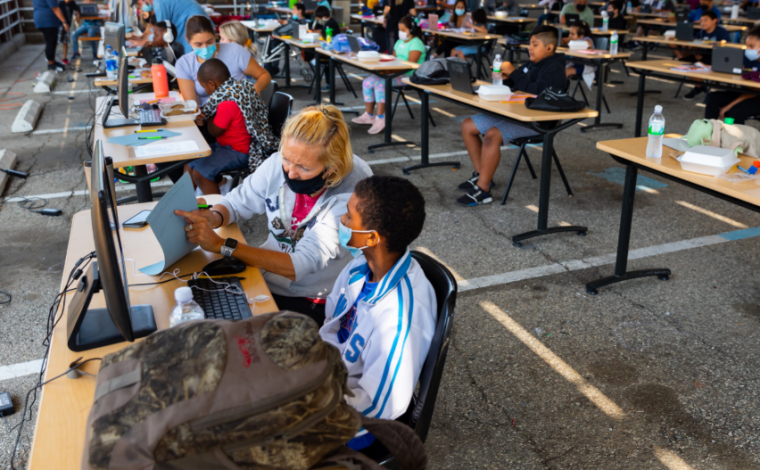
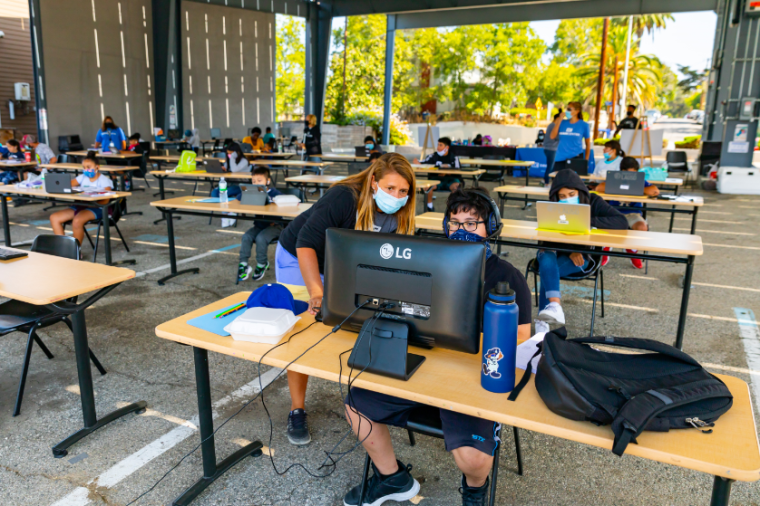
Tutors assist students with schoolwork at the Restart Learning Center, a distance learning center set up by the Los Angeles Dream Center, a faith-based nonprofit organization based in the Echo Park neighborhood of Los Angeles, 2020. | Los Angeles Dream Center
As the pandemic has forced many of America’s public schools to begin the school year with remote learning, several churches and faith-based groups nationwide have opened their doors to students who don’t have internet access at home or whose parents can’t stay home with them. Among those institutions are 14 Houston-based churches belonging to the Texas Annual Conference of the United Methodist Church that partnered with the Houston Independent School District to serve as distance learning centers.
The distance-learning centers were attended by hundreds of children before the school district’s return to in-person learning in late October. The eighth-largest school district in the United States, with the help of the UMC conference, birthed the “Sanctuaries of Learning” program to aid approximately 500 students in pre-kindergarten through fifth grade. The program helped the students navigate the waters of virtual learning, a new experience for most K-12 students in the U.S.
“They lived in the neighborhood, they registered through the school, they called the school to save a place, … [and] their parents were notified about it,” said Rev. Jill Daniel, an elder in the Texas Annual Conference of the United Methodist Church.
Although the program concluded in mid-October when the school district resumed in-person learning, the program’s impact can be felt nationwide as some school districts have not yet returned to in-person classes.
In an interview with The Christian Post, Shannon Martin, director of communications for the Texas Annual Conference, explained that their regional church body “birthed this program.”
“But then as people started hearing about it … it started catching on across the country. So there are people all over the country doing this,” she said. “Other people have adopted the same name, Sanctuaries of Learning. We certainly did not copyright it. We wanted people to use it and certainly utilize the same model of working with school districts. Once there’s a good model, we want other churches and other people to be able to follow along with … the same model because it’s worked.”
Daniel said the conference started receiving calls from all over the U.S., specifically recalling phone calls from New York City, California, Colorado, Oklahoma, the Carolinas and elsewhere in Texas. They asked: “What can we do to make this happen?”
“We probably had … well over 120 or so Zoom meetings with people all over the United States and we walked a little closer with some of them,” she explained. “And it’s been amazing to just watch God doing this very new thing and blessing it so mightily.”
The pastor predicted that the establishment of the Sanctuaries of Learning program would lead to a “rebirth” of neighborhood churches because “during quarantine, we had all this time where … our churches have been that mission depot in the neighborhood, where we’ve had food distributed and people have done dinners for their neighbors and checked on one another.”
While schools in Houston have returned to in-person learning, schools in California’s Los Angeles Unified School District are not likely to return to in-person learning before January. This week, the district released data based on 10-week interim assessments showing that poor grades surged in the district’s lower-income communities.
In addition to churches, faith-based organizations have also worked to set up distance learning centers.
The faith-based nonprofit Los Angeles Dream Center established the Restart Learning Center, a “safe, socially distanced outdoor learning environment” in the parking lot of its Echo Park campus. The parking lot contains a solar panel shed that shields against heat and precipitation.
Like the Sanctuaries of Learning in Texas, the Restart Learning Center draws in students residing within walking distance of the surrounding neighborhood. Participants include attendees of both public and private schools. The Restart Learning Center operates five days a week from 9 a.m. to 2 p.m. The center is free of charge.
“This will all be executed in an effort to support parents, work schedules and schooling, to cheerlead kids and to provide them a safe place and motivation center,” Matthew Barnett, pastor of the Los Angeles Dream Center, told CP.
Barnett explained that about 80 children each day attend the learning center along with a “rotating group” of students that come and go. According to Barnett, the lockdowns in Los Angeles have had an adverse impact on “the poorest of the poor.”
“I don’t think maybe people understand how much of a gap has been left between those that are in need and those who have,” he surmised.
“We had to supply more than half of the 80 kids learning tablets with our own money,” he continued. “I would say 75% of the kids get them from us.” The remainder of students use school-issued computers, he added.
How Sanctuaries of Learning came to be
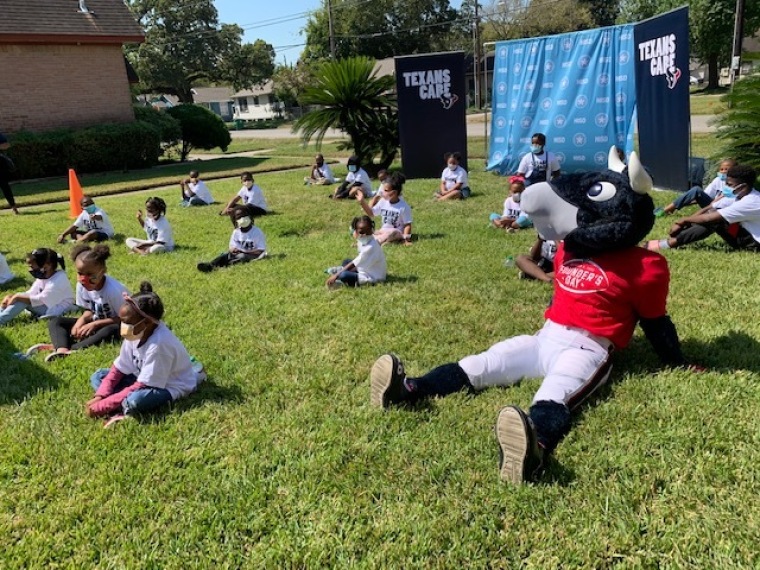
Students gather outside as members of the Houston Texans visit a Sanctuaries of Learning campus in Houston, Texas on Houston Texans’ Founder’s Day. The Sanctuaries of Learning were distance learning centers set up by the Texas Annual Conference of the United Methodist Church for children in Houston, Texas, 2020. | Jill Daniel
Daniel, who serves as director of a Texas Annual Conference initiative called “We Love All God’s Children,” explained how the Sanctuaries of Learning program came about. The initiative aims to “change the trajectory of the lives of children from birth through the end of elementary school.” It also aims to help families in underserved areas through a holistic approach that includes discipleship and early education.
“We work with all 683 United Methodist Churches in the Texas Annual Conference,” she said.
“We Love All God’s Children” has worked to set up UMC Children Centers, which the elder described as “state-of-the-art early childhood centers.” Several United Methodist Children Centers were planned to open in 2020. But because of the coronavirus pandemic, they couldn’t open this year.
“We immediately shifted from doing what we had been doing to [figuring out] how can we help our churches … in this new crazy time,” she said.
“And so one of the things I tried to keep in mind was that … my ministry area focuses on underserved children. And so it would be the children who I focus on who were not going to have access to technology, who didn’t have Wi-Fi in their house.”
Over the summer, the pastor said she began praying and trying to figure out how churches could join together to help the public school systems since it was looking very likely schools would return for the 2020-2021 school year virtually.
“And so I worked on a proposal. I went to one of our district superintendents, who’s the district superintendent over the … Central South District — that’s all the United Methodist churches within Beltway 8 in Houston,” she said. “And I pitched that idea to him. And he said, ‘I’ll tell you what … let my churches be the guinea pigs.’”
After the bishop approved her idea in early June, Daniel reached out to Dr. Grenita Lathan, the interim superintendent of the Houston Independent School District. However, she did not hear back from her right away. At the end of July, Daniel received an e-mail from Lathan, who said that she would announce the district’s plans for reopening later that week and asked if she wanted to meet with her.
“I know now that the reason she never responded was because she had no idea what Houston ISD was going to do,” Daniel explained.
“She kind of took the reins on our Zoom meeting. She wanted to join with us. She wanted to make use of all the United Methodist churches that she could that are near a neighborhood elementary school.”
District sent support staff to churches
According to Daniel, the churches needed people to oversee the safety of the students while teachers taught live from their classrooms.
“We just needed people to oversee the safety of the kids, to help if one of them has trouble logging on or that sort of thing,” the UMC elder explained.
Daniel said that the school district sent support staff to assist students at all distance-learning campuses.
“Those were people they were paying already, like cafeteria workers or bus drivers,” the reverend explained. “They were paying them but they didn’t have any work to do.”
In addition to deploying support staff, the school district also provided breakfast, lunch and an afternoon snack to all of the children participating in the program. The school district also provided personal protective equipment and a “cleaning crew that came in every afternoon” to clean the churches.
“They even came before we ever started and did a deep clean to start with. And then they also came every night and did it,” she recalled.
Daniel was amazed at what the school district provided.
“We never dreamed of that or imagined that,” she said. “If we didn’t have enough bandwidth, they brought boosters over so that everything would be good for the kids. They also sent their safety team and their property management teams around all of our churches.”
Also, the Houston Independent School District even added the churches to its liability insurance.
The Sanctuaries of Learning program was paid for in part by coronavirus relief that the Texas Annual Conference of the United Methodist Church received. Each church that participated in the Sanctuaries of Learning program received a $1,000 check.
“We were so thankful to be able to provide a safe, healthy, affirming Christian environment, positive environment for those kids to be in,” Daniel said.
Every Friday was “fun Friday” for students participating in the Sanctuaries of Learning program. Daniel told CP that on Houston Texans’ Founder’s Day, Oct. 6, the football team came out to some of the churches. Daniel recalled one cheerleader reading a book to all the kids in that school. All the children received a free T-shirt.
“One fun Friday, we had ice cream sundaes and we gave … each child a whole library from the Barbara Bush Literacy Foundation,” Daniel stated. “Each child had 25 books on their reading label to save and to take home.”
The Sanctuaries of Learning program did not come without challenges.
On the second day of school, a student at one of the campuses tested positive for coronavirus. This forced the campus to close down and anyone who worked closely with the infected student had to quarantine. For the remainder of the program, no one at any of the Sanctuaries of Learning campuses tested positive for coronavirus, however.
Daniel described the Sanctuaries of Learning program as a “game-changer for our children.”
“It’s a game-changer for mama or for daddy or for whoever is raising that child who doesn’t have to be worried every day about whether they’re safe and how and whether they’re going to get … what they need at school,” she said.
While in-person schooling has resumed in the Houston Independent School District and other large school districts nationwide, the Sanctuaries of Learning program is ready to restart should the district decide to move to online learning again.
No end to remote learning in sight for Los Angeles
A tutor assists a student at the Restart Learning Center, a distance learning center set up at the Los Angeles Dream Center, a faith-based nonprofit based in the Echo Park Neighborhood of Los Angeles, 2020. | Los Angeles Dream Center
Barnett explained that the Los Angeles Dream Center has the resources to continue operating the Restart Learning Center for the remainder of the semester. But he is “terrified of the fact that [remote learning] could go on for a whole year.”
“With the teachers afraid to go back and the union battles that are going on, this thing, I fear it will be the whole year long,” he said. “So that’s going to really test our ability to keep it going. But we’re going to give it a try.”
The Restart Learning Center program provides one tutor for every three students.
“The best thing about it is that they have somebody who’s a cheerleader next to them, pulling for them to succeed and celebrating their accomplishment,” Barnett stated. “So I think that’s the … most important thing.”
He assured that tutors are there “every step of the way” to help students with whatever questions they may have.
Barnett estimated the cost of running the center is about $300 per month per student. It costs about “$20,000 a month to operate all these stations and school.”
“We’ve invested a lot of money that we really expect not to get back,” the pastor explained. “We just did it in a labor of love. … If people want to support, they can. … It’s been a kind of a missions work for us and it’s almost like we just started helping people and we’re trying to catch up.”
American Family Association
American Family Association (AFA), a non-profit 501(c)(3) organization, was founded in 1977 by Donald E. Wildmon, who was the pastor of First United Methodist Church in Southaven, Mississippi, at the time. Since 1977, AFA has been on the frontlines of Ame
NEWSMAX
News, Opinion, Interviews, Research and discussion
Opinion
American Family Association
American Family Association (AFA), a non-profit 501(c)(3) organization, was founded in 1977 by Donald E. Wildmon, who was the pastor of First United Methodist Church in Southaven, Mississippi, at the time. Since 1977, AFA has been on the frontlines of Ame
American Family Association
American Family Association (AFA), a non-profit 501(c)(3) organization, was founded in 1977 by Donald E. Wildmon, who was the pastor of First United Methodist Church in Southaven, Mississippi, at the time. Since 1977, AFA has been on the frontlines of Ame
You Version
Bible Translations, Devotional Tools and Plans, BLOG, free mobile application; notes and more
Political
American Family Association
American Family Association (AFA), a non-profit 501(c)(3) organization, was founded in 1977 by Donald E. Wildmon, who was the pastor of First United Methodist Church in Southaven, Mississippi, at the time. Since 1977, AFA has been on the frontlines of Ame
NEWSMAX
News, Opinion, Interviews, Research and discussion
Spiritual
American Family Association
American Family Association (AFA), a non-profit 501(c)(3) organization, was founded in 1977 by Donald E. Wildmon, who was the pastor of First United Methodist Church in Southaven, Mississippi, at the time. Since 1977, AFA has been on the frontlines of Ame
Bible Gateway
The Bible Gateway is a tool for reading and researching scripture online — all in the language or translation of your choice! It provides advanced searching capabilities, which allow readers to find and compare particular passages in scripture based on

 Christopher Jacobs | DECEMBER 8, 2020

 What Did You Say?