
Perspectives; Thoughts; Comments; Opinions; Discussions

Posts tagged ‘UK’

UK’s ‘Rwanda Plan’ for Illegal Immigration an Effective Model for US: The BorderLine


By: Simon Hankinson / April 25, 2024

Read more at https://www.dailysignal.com/2024/04/25/uks-rwanda-plan-illegal-immigration-effective-model-borderline/
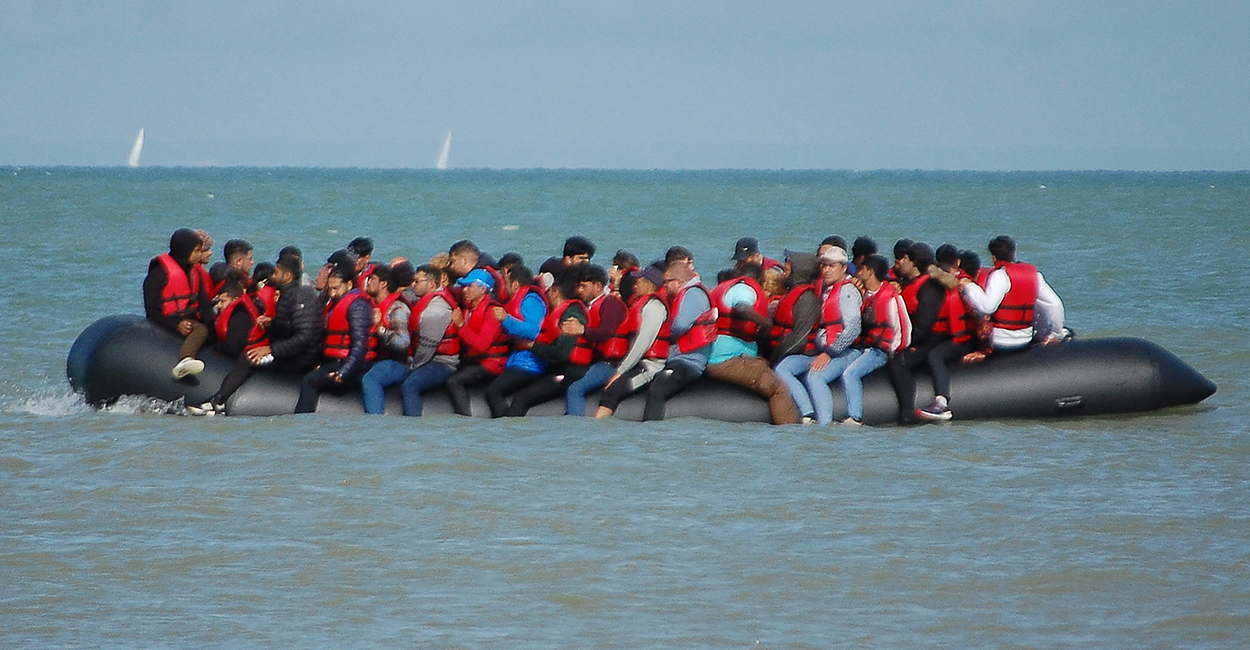
Dozens of migrants with lifejackets overflow an inflatable raft in the English Channel
The U.K.’s ‘Rwanda Plan’ could serve as a model for the U.S. as both countries struggle to stem illegal immigration. Immigrants should be deported or sent to a safe third country to await the processing of their asylum claims. Pictured: Illegal immigrants sit on an inflatable raft before attempting to illegally cross the English Channel to reach Britain, off the coast of Sangatte, France, on July 18, 2023. (Photo: BERNARD BARRON, AFP/Getty Images)

After nearly two years of legal and political challenges, Britain’s parliament has finally passed a law confirming that Rwanda is a safe place to send people who arrive in the U.K. illegally by sea. This is a major policy win for the Conservative government of Prime Minister Rishi Sunak and a victory for common sense. Britain, like the U.S. and Europe, is experiencing mass illegal migration in the guise of asylum claims. The British devised the Rwanda plan in response, but the U.S. already has successful equivalents that can be resurrected when there is a will to once again control America’s borders.

Like those coming to the U.S. by land, most people illegally arriving in Britain by boat are economic migrants. Britain’s asylum system has been swamped by growing demand, and backlogs for processing cases stretch into years.

In 2018, only 300 people arrived illegally in the U.K. by small boat from France across the English Channel. In 2022, it was more than 45,000. And in August 2023, the U.K. received its 100,000th illegal boat-borne immigrant, one of 700 who arrived each day. Nearly all of the 100,000 are still in Britain, joined by ever-increasing numbers.

From Jan. 1 to April 21 this year, 6,265 small boats arrived in the U.K. carrying illegal immigrants, with the largest numbers being from Afghanistan and Vietnam.

Having left the European Union, the British are unable to return asylum-seekers to the first safe country in the EU under what are called the Dublin Regulations. By mid-2023, 96% of asylum-seekers who arrived in 2021 had not received final decisions in their cases, and around 50,000 were being housed in hotels, costing the United Kingdom the equivalent of more than $8.8 million U.S. a day. The limitless liability of illegal immigration to the U.K. is an important electoral issue for Conservative Party voters. 

Sound familiar?

In August 2023, Sunak’s government passed an Illegal Migration Act that barred people who entered illegally by sea from applying for asylum. The act requires British officials to return inadmissible aliens—without appeal—back to their birth country, if possible, or if not, to a safe third country.

To implement the act, Britain needed a safe third country to house putative asylum-seekers pending case processing. Britain does not have any developing-country neighbors, so they struck a deal with Rwanda in 2022 in which that Central African country would be compensated to take up to 1,000 putative asylum applicants over five years.

Anyone sent to Rwanda could opt at any time to return to their home country or to be resettled in Rwanda as refugees, but they could not return to Britain. The British government fought a series of legal challenges to its policy, but passage of the new law should clear the way for removal flights to Rwanda within weeks from now.

Sunak says he means business. “The only way to stop the boats is to eliminate the incentive to come, by making it clear that if you are here illegally, you will not be able to stay,” he said at a press conference. “We are ready. The plans are in place.”

The government has also set aside judges and courts on standby to handle the inevitable legal challenges.

The Rwanda plan is Britain’s attempt to regain control over its borders and national sovereignty. The goal is to cut off the possibility of asylum from boat arrivals, thus both destroying the business model of maritime smugglers and saving lives. This past week, five people died when over 100 illegal migrants attempted to cross the English Channel in an overcrowded boat.

The Rwanda plan has many opponents. The United Nations High Commission for Refugees argues that if the U.K. is successful, it will set a “worrying precedent for dismantling asylum-related obligations that other countries, including in Europe, may be tempted to follow …” Perhaps so, but the alternative is to cede control over immigration to foreign actors in perpetuity.

The British hope to emulate the success of Australia, which in 2001, started turning back boats carrying illegal migrants. The idea was to give “no advantage” to asylum applicants arriving illegally by boat over those arriving by air.

Australia set up detention and asylum processing centers on the island nation of Nauru, and on Manus Island in Papua New Guinea. Eventually, Australia adopted a strict rule that no asylum-seeker arriving by boat and processed offshore would ever be resettled in Australia. The policy faced considerable political opposition but was highly effective in reducing demand.

The message was quickly understood by would-be boat migrants and migrant traffickers across Southeast Asia. “Arrival numbers went off a cliff once the Australians started to deport … because ‘news spreads like wildfire among refugees,’” wrote Matthew Paris in the Spectator.

When a later Australian government closed the Manus and Nauru centers, illegal migration soared again. In 2012, more than 600 people drowned when boats carrying illegal migrants capsized. In response, Australia reopened the offshore centers and resumed sending back all illegal aliens who arrived or attempted to arrive in Australia by sea.

As before, the putative asylum applicants remained in the offshore centers for the entire time, pending the adjudication of their cases. The offshoring policy and an unbending Australian government destroyed the market for maritime migrant smugglers. For example, in 2014, only a single boat carrying migrants made it to Australia.

At its peak in 2014, Nauru’s camp had 1,233 asylum applicants living there. By June 2023, only three remained. Though the boat-borne illegal migration virtually stopped, a credible ability to restart offshore processing is vital to Australia maintaining its current control over seaborne illegal immigration. Therefore, Australia is paying the equivalent of $288,000 U.S. a year to Nauru to keep the detention/processing option open in reserve.

The U.S. does not have the advantage of being an island. But as recently as the Trump administration, we had Safe Third Country agreements in place with Central American countries and the Migrant Protection Protocols with Mexico. Under these agreements, any asylum applicant coming to the U.S. and first passing through a third safe country to get here would be sent back to that country if he or she had not applied for asylum in that country. For example, all those who crossed illegally into the U.S. from Mexico were returned there pending their case adjudication.

The U.S. needs to use all the economic and diplomatic leverage at our disposal to revive those agreements. Meanwhile, similar to the U.K. and Australia, we should prohibit asylum applications from those illegally crossing between ports of entry to discourage frivolous and fraudulent asylum claims.

The BorderLine is a weekly Daily Signal feature examining everything from the unprecedented illegal immigration crisis at the border to immigration’s impact on cities and states throughout the land. We will also shed light on other critical border-related issues like human trafficking, drug smuggling, terrorism, and more.

Read Other BorderLine Columns:

Biden’s Precarious Parole Programs for Illegal Immigrants

My Look Inside Biden’s Illegal Immigrant Catch-and-Release Craziness

What I Saw on My Latest Visit to the Border

You Can’t Fool All of the People All of the Time About Immigration

Haiti: Here We Go Again

UK’s Onshore Wind Scheme Could Backfire, With Far More Potent Greenhouse Gas Emissions


By: Miles Pollard / September 12, 2023

Read more at https://www.dailysignal.com/2023/09/12/uks-onshore-wind-scheme-might-not-lower-emissions-could-raise-energy-prices/

As it relates to wind power in the United Kingdom, not everything is coming up daisies, much less roses, despite what advocates for renewable power would have Britons believe. (Photo: Studio-fi/iStock/Getty Images)

Shortly after naming Claire Coutinho as secretary of state for energy security and net zero on Aug. 31, British Prime Minister Rishi Sunak announced a plan to accelerate the approval process for onshore wind projects. Previously, a 2015 ruling allowed a single complaint within a community to halt an onshore wind program and fully stopped subsidies for such projects. Under the new rule, communities can speed up the process for allocating sites through local development orders or community right-to-build orders.

However, wind farms can drastically raise the cost of electricity when the wind doesn’t blow and could leak a chemical that is exponentially more harmful to the environment than carbon dioxide (CO2).

Perhaps Coutinho isn’t aware of the influential 2019 BBC article that uncovered how the U.K.’s offshore wind turbine gearboxes are utilizing the world’s most potent greenhouse gas, sulfur hexafluoride, and that these gearboxes are leaking 15% of the gas over their lifecycle.

Sulfur hexafluoride (SF6) is 23,500 times more potent than carbon dioxide (CO2). For reference, methane (CH4) and nitrous oxide (N0) are roughly 25 and 298 times more potent than carbon dioxide, respectively. Additionally, these estimates are only over a 100-year perspective, and SFcould exist up to 3,200 years in the atmosphere. Consequently, a single pound of released SFis the equivalent of 11 tons of CO2 in the atmosphere. 

No energy source, not even wind, can be fully without externalities, even with the most advanced recycling techniques. That’s not to mention the hydrocarbons needed to fabricate the nylon and fiberglass for blades and to create the steel and concrete for towers.

Speaking of externalities, Coutinho should also acknowledge the potential of 100,000 birds killed every year by wind turbines in the U.K. However, losses could be minimized by adopting the Norwegian practice of painting one rotor blade black to reduce those deaths by an estimated 70%.  

Despite the calls for expansion of energy generation, one of the largest hurdles is the time it takes to link to the grid, with more than 1,100 projects currently waiting to connect. With such a backlog of projects and the lack of transmission infrastructure, the U.K. government should contemplate allowing these projects to compete in an unsubsidized market to weed out economically unviable projects and restore reliability and adaptability to the grid.

Furthermore, the U.K. should also be wary of greenlighting or expanding every wind project without completing the due diligence to investigate local environmental harm and to acknowledge the wishes of local constituents. Abandoning reliable generation capacity for intermittent wind power without first investing in viable storage capacity is a recipe for disaster. For example, scalable gas-fired power stations saved the U.K. last winter by providing 60% of the needed electricity while wind turbines contributed a paltry 3%.

In order to end the economic malaise caused by ever-increasing energy prices and a culture of strangling economic freedom into stagnation, the U.K. needs to adopt an energy policy that will lower prices of electricity, rather than adopting the German model of closing reliable nuclear power stations and massively expanding intermittent solar and wind. Instead, the U.K. should adopt the Trump-era all-of-the-above strategy for energy security. 

Similarly, the U.K. should roll back pre-Brexit European laws and rebuff current proposed measures that seek to control people’s everyday lives, such as mandating that properties meet net zero targets or pay £15,000 (about $18,750).

In an economic climate of spiraling inflation, the U.K. government should look to all avenues, including retaining its coal power until viable base-load generation alternatives can be secured.

The U.K.’s remaining nuclear reactors should be left online or expanded, and small modular nuclear reactors should be explored. Rather than solely expanding wind turbines that could leak a greenhouse gas 23,500 times more potent than CO2, the U.K. should explore scalable alternatives, such as the zero-emission natural gas plant that is being brought online in 2025.  

With continuing inflationconnected insiders colluding with unelected bureaucrats, and a worldwide populace increasingly leery of increasing government censorship, the U.K. needs to abandon anti-energy policies and acknowledge that economic growth will always require more energy and more ingenuity. Lifting restrictions on wind power and other sources is but the first step to allowing the U.K. to become energy secure.

Intermittent sources alone cannot ensure energy security, as they are only as good as their storage capacity. Wind power must also be upfront about its tangible greenhouse gas emissions.

The U.K. needs stable and scalable energy sources to alleviate its energy woes. Only by lowering high energy bills and lowering the cost of living can the U.K. reignite the boundless energy of human potential.

COMMENTARY BY

Miles Pollard

Miles Pollard is an economic policy analyst with the Center for Energy, Climate, and Environment at The Heritage Foundation.

Here’s Why the Media Don’t Want You to Know About the Massive Protests Going on Around the Globe


REPORTED BY: BETH WHITEHEAD | JULY 15, 2022

Read more at https://thefederalist.com/2022/07/15/heres-why-the-media-dont-want-you-to-know-about-the-massive-protests-going-on-around-the-globe/

Mass protests in Buenos Aires amid Argentina inflation crisis

Discontent with left-wing policy failures is triggering massive protests all over the world. Just don’t expect to read all about it in the New York Times.

Author Beth Whitehead profile

BETH WHITEHEAD

MORE ARTICLES

If you skim the front pages of major corporate news outlets, you’ll find no mention of the economic protests raging in Spain, Morocco, Greece, and the United Kingdom.

On The Washington Post homepage these days, you’ll find headlines such as, “How To Deal With A Chatty Coworker Who Won’t Get Out Of Your Office,” but you won’t find mention of the more than 100,000 people protesting in Madrid. You’ll find the story of a gay union entitled, “What’s Two ‘Yentas’ Plus One Senator? A Lifetime Together” at The New York Times, but you won’t see a single heading on the more than 10,000 protesters in Athens. Corporate media has largely glossed over the tens of thousands of farmers in the Netherlands who clogged up roadways and distributions centers by holding Canadian-trucker-convoy-style demonstrations to protest radical climate policies.

According to the Carnegie Endowment for International Peace, which records protests worldwide, 11 countries are currently seeing protests of more than 1,000 people in response to the rising cost of living and other economic woes in 2022. As of July 5, Carnegie had recorded protests of more than 120,000 people in France, 100,000 in Spain, 10,000 in Greece, 10,000 in Kazakhstan, 10,000 in Sri Lanka, 10,000 in India, 5,000 in Iran, 5,000 in Peru, 1,000 people in Argentina, 1,000 in Morocco, and 1,000 in the U.K.

Many of the French protesters took to the streets on May Day for salary increases and against President Emmanuel Macron’s increase of the retirement age. Fifty-four people were reportedly arrested in Paris after some demonstrations turned violent. France’s economy, Europe’s third-largest, shrank in the first quarter of 2022, and in June, inflation shot up 5.8 percent compared to last year. Protesters also held demonstrations in March, with some complaining they had lost 15 to 20 percent of their purchasing power. Meanwhile, France’s answer to inflation? Keep spending; the country is throwing $20.4 billion at the problem.

In Spain, with gas subsidies, direct grants, and an increase in the minimum wage, the socialist-leaning government has seen only rising inflation rates (10.2 percent), and the accompanying price hikes are driving thousands of people onto the streets to protest. The country is finding out the hard way what a 40 percent reliance on renewable energy will do to the labor market. With its high unemployment rate at 13.65 percent as of the first quarter of 2022, labor shortages are raising prices on staple grocery items to an almost 30-year high. Thousands of demonstrators protested in March for relief in the form of tax cuts.

Meanwhile, it’s no surprise that any supply issues, aggravated or initiated by the Russia-Ukraine war, would burden Greece’s weakened economy that only just emerged from a decade-long crisis in 2018 to be sent right back by Covid shutdowns in 2020. In April, thousands gathered at a labor union-organized rally outside parliament in protest of inflation, which followed a February demonstration where about 10,000 people showed up to protest electricity prices that had leaped 56 percent, fuel prices that had jumped 21.6 percent, and natural gas prices that had skyrocketed 156 percent in January.

In India, a country locked in a vicious cycle of going into debt to pay off interest of former debts, the increasing cost of living is racking the country. In March, an estimated 50 million workers participated in a two-day strike to protest the loss of jobs and income, with communist groups organizing rallies in May decrying the high rate of inflation.

The socialist government in Argentina that led the country to default seven times and produced the largest decline in the relative standard of living in the world since 1900 is trying to do something new. On Monday, Argentina’s new economy minister Silvina Batakis announced her plan to cut the fiscal deficit — a proposal more than a thousand Argentines are protesting.

Decades of government spending and faulty economic policies have led to Argentina’s inflation rate growing to 58 percent. Prices are liquid and through the roof, with iPhones costing six months’ rent and a two-hour plane ticket equaling the cost of a month’s college tuition. Batakis plans to hold Argentina to the terms of a $44 billion debt deal it made earlier this year with the International Monetary Fund. Thousands of Argentines meanwhile flocked to protest against the economic hardships felt by the country upon cutting spending and took up banners crying for Argentina’s separation from the IMF.

The United Kingdom is suffering from a high 9.1 percent inflation rate as of May, and many are tired of the government’s response. Brits flocked out in February to protest rising costs of living, with demonstrations held in at least 25 towns and cities and signs reading, “tax the rich” and “freeze prices not the poor.” The U.K.’s inflation rate was already at 5.4 percent in January of this year due in part to the 2020 Covid shutdowns, but it has since almost doubled, largely due to the EU’s sanctions on Russian oil. In June, thousands marched down central London in protest, wanting the government to boost its welfare response.

Still reeling from the worst drought it has had in 40 years, Morocco is seeing price spikes on even the most basic goods. Thousands of Moroccans joined protests in February to decry the increasing cost of living, with unions staging more demonstrations in April. The country has high unemployment rates and large public debt, along with a heavy reliance on imports.

Aside from a scant headline here and there, America’s most popular news providers, The Washington Post, New York Times, CNN, and NBC, did not cover these protests, despite the French and Spanish protests being 10 to 100 times larger than the protests these corporate media giants did report.

None of these four major outlets wrote a single line on the protests of more than 100,000 demonstrators in Spain, more than 10,000 in Greece, more than 1,000 in Morocco, and more than 1,000 in the U.K. The New York Times published one lone article on the strike in India, where an estimated 50 million people walked off the job. The Washington Post has two small articles on the Argentinian protests of more than 1,000 as inflation appears set to hit 70 percent, and it has reported once on the May Day protests in France where more than 120,000 people protested government pension reforms. NBC mentioned the May Day protests once in a world report. This is the entire 2022 coverage by these media giants of these countries’ protests over economic turmoil.

Of these 11 countries, only four made any major headlines. The corporate press oftentimes only highlights these economic protests when they get so loud they can no longer be ignored, as we saw with Kazakhstan’s kill order to quell protests and the Sri Lankans’ attack on their president’s home. Over the weekend, the biased media finally began covering the Sri Lanka protests that are over 10,000 people strong — but only because footage of demonstrators swarming the president’s residence by the thousands on Saturday went viral.

Corporate media won’t talk about the rest of these protests because the countries are struggling from economically disastrous policies akin to President Joe Biden’s. Any show of economic turmoil in EU member states could be traced back to EU sanctions on Russia or green energy failures, which would fly in the face of the corporate media’s agenda. Many of these countries have inflationary monetary policies.

The leftist media will tell you about Sri Lanka, Kazakhstan, Iran, and Peru, however, but only to bolster its pro-Ukraine/anti-Russia narrative that denies the realities of war to promote Biden’s efforts to empty our pockets and replenish Ukraine’s.

In its treatment of the Kazakhstan protests, The Washington Post made sure to mention the country’s relationship with Russia. The Times’ articles on the Sri Lanka protests framed the economic downturns in terms of problems stemming from Russia’s invasion and ignored Sri Lanka’s Green Deal ban on chemical fertilizer that ultimately crashed its economy. Both CNN’s coverage of protests in Iran and NBC’s reports of those in Peru likewise stressed the Russia-Ukraine war as the cause for economic turmoil.

The media only highlight these world protests when they grow too big to ignore or when the facts can be skewed toward their preferring narratives. Cherry-picking which protests to highlight gives media cover to paint them as isolated incidents in non-Western countries instead of a worldwide trend showing the consequences of embracing left-wing policies. After all, Biden is making the same blunders in the United States, and corporate media can’t have Americans connecting those dots.

The U.S. labor market is in shambles. Inflation has skyrocketed to a 40-year high at 9.1 percent. The Biden administration is drawing down our emergency oil reserves, shipping it overseas to nations that can’t function on their “Green Energy” policies any more than we can. Irony alert: The oil will go through a European pipeline despite Biden citing climate conservation to shut down our own Keystone pipeline.

Discontent with these policy failures is triggering massive protests all over the world. Just don’t expect to read all about it in the New York Times.


Beth Whitehead is an intern at The Federalist and a journalism major at Patrick Henry College where she fondly excuses the excess amount of coffee she drinks as an occupational hazard.

Welcome to Jihadi Britain


Reported By Clarion Project Tuesday, October 10, 2017

URL of the original posting site: https://clarionproject.org/welcome-jihadi-britain/ 

POP QUIZ: Which Religion Is SPIKING In Britain And Which One Is PLUMMETING?


waving flagPublished on December 26, 2016

URL of the original posting site: http://clashdaily.com/2016/12/pop-quiz-religion-spiking-britain-one-plummeting/

The percentage spike is SHOCKING… and so is the percentage drop-off. What will this mean for Britain?

A Government report released stunning numbers relating to religion. The changes in numbers of Christians and Muslims in the country was staggering. The Casey Report states:

Christians remain a majority, while a quarter of the population holds no religion. But the proportion of Christians fell from 70 per cent to 59 per cent…

Among faith groups the number of people identifying themselves as Muslim grew most significantly, by 1.2m people.

This 72 per cent increase is higher than for any other religious group and Muslims make up the largest non-Christian religious population in the UK at 2.8m in total, compared with 0.8m Hindus, 0.4m Sikhs, 0.3m Jews and 0.3m Buddhists.
Read more: Express UK

America are you paying attention

Europe is changing. England isn’t as Christian as it used to be.

The Brierley Consultancy conducted a separate study and says that Church membership in the UK has declined significantly. In 1930, membership levels were at 10.6 million which has dwindled to 5.5 million in 2010.

The Casey Report says that of those that those who identify as Christians has plummeted from 40.2 million to 36.1 million with further losses projected. We are facing an increase in a religious ideology that has a branch that stands against Western values of freedom, tolerance, integration and equality.

The Left will tout this as ‘Progressive’ and ‘inclusive’, failing to see the irony of their position.

Are you surprised at the findings of the report?

What do YOU think this means for Europe?

America are you paying attention

Hillary Clinton: Nationwide Gun Ban, Repeal of Second Amendment “Worth Considering”


waving flagPosted By Kit Daniels | Infowars.com On October 16, 2015

Article printed from Infowars: http://www.infowars.com

URL to article: http://www.infowars.com/hillary-clinton-nationwide-gun-ban-repeal-of-second-amendment-worth-considering

Hillary Clinton: Nationwide Gun Ban, Repeal of Second Amendment "Worth Considering"

Hillary Clinton said it’s “worth considering” a nationwide gun ban and a “buyback” program to eradicate private gun ownership.

The presidential candidate attacked the Second Amendment during an Oct. 16 town hall meeting in which she was asked if it were feasible for the U.S. to confiscate millions of firearms in a year.Armed

Hillary said:

“You know, Australia’s a good example, Canada’s a good example, the UK’s a good example. Why? Because each of them had mass killings, Australia had a huge mass killing about 20 or 25 years ago. Canada did as well, so did the UK. In reaction, they passed much stricter gun laws.’

“In the Australian example, as I recall, that was a buyback program. The Australian government as part of trying to clamp down on the availability of … weapons offered a good price for buying hundreds of thousands of guns and basically clamped down going forward, in terms of having more of a background check approach, more of a permitting approach.’

“But they believed, and I think the evidence supports them, that by offering to buy back those guns, they were able to, you know, curtail the supply and set a different standard for gun purchases in the future. “Delusional Mental Illness Gibberish

Clinton also mentioned that several U.S. cities have done gun buyback programs and it would be “worth considering on a national level.”Hey Leftist

But she failed to mention that she supported shipping guns to Syrian rebels, the majority of whom are either ISIS militants or affiliated with the Islamic State.

“In fact she was the biggest cheerleader for redistributing these arms to Syrian rebels,” presidential candidate Rand Paul told Fox News in July. “The reason this is an important issue is many of these people who received the arms are not friends of America.”

Many of them are linked to al Qaeda and al-Nusra and some of these weapons may well have ended up in the hands of people who became ISIS.”Symbolism over substance

Virtually all of the rebels in Syria have pledged allegiance to the Islamic State.

“The Free Syrian Army and the Syrian National Council, the vaunted bulwarks of the moderate opposition, only really exist in hotel lobbies and the minds of Western diplomats,” journalist Ben Reynolds wrote in November. “There is simply no real separation between ‘moderate’ rebel groups and hardline Salafists allied with al-Qaeda.”Islam is NOT

The New York Times made a similar statement.

“Nowhere in rebel-controlled Syria is there a secular fighting force to speak of,” the newspaper reported in 2013.Disarmed Citizenry


In God We Trust freedom combo 2

Tag Cloud