
Perspectives; Thoughts; Comments; Opinions; Discussions

Posts tagged ‘TOXIC MASCULINITY’

How Rejecting Biblical Masculinity Turns Men From Protectors To Predators


BY: NANCY PEARCEY | APRIL 12, 2023

Read more at https://thefederalist.com/2023/04/12/how-rejecting-biblical-masculinity-turns-men-from-protectors-to-predators/


woman holding toxic masculinity sign at gun protest
Men everywhere seem to experience tension between what they themselves define as good men and the way the surrounding culture pressures them to be real men.

Author Nancy Pearcey profile

NANCY PEARCEY

MORE ARTICLES

The following is an excerpt from Nancy Pearcey’s upcoming book, “The Toxic War on Masculinity: How Christianity Reconciles the Sexes.” 

The report of a mass shooting in a bar in Thousand Oaks, California, in 2018 was more than a news account of a crime. It was also a story about two young men. 

The killer was 28-year-old Ian David Long, a college dropout, divorced former Marine who was unemployed and living with his mother. 

He knew the Borderline Bar and Grill held a weekly college night when it would be crowded with young people. He entered the bar dressed in black, a hood pulled over his head. Tossing smoke grenades into the crowd to create confusion, he drew out a pistol with a laser sight and started shooting. A sergeant from the sheriff’s office rushed over to help, but the shooter was waiting for him. After killing the sergeant and 12 other people, Long shot himself. 

In the crowd that night was another young man, 20-year-old Matt Wennerstrom, who emerged as the hero of the hour. Sporting a backward baseball cap and a scruffy beard, Matt looked like a typical college student. But what he did was not at all typical. 

As soon as shots began booming through the bar, he and about seven other young men grabbed as many people as they could and pushed them under a pool table for cover. Then they piled their own bodies over them to protect them from the hail of gunfire. 

One woman, who was celebrating her 21st birthday at the bar that night, told reporters afterward, “There were multiple men who got on their knees and pretty much blocked all of us with their back toward the shooter, ready to take a bullet for any single one of us.” 

When the shooter paused to reload, Matt and his friends threw bar stools through a back window and began shepherding people outside. Repeatedly, the young men rushed back into the bar to steer more people to safety. 

How did Matt have the presence of mind to respond so quickly to danger?  

When a reporter at the scene of the crime asked that question, the young man replied, “My life is taken care of. I know where I’m going if I die, so I was not worried to sacrifice.” 

Two young men. One used his masculine strength to take lives. The other used his masculine strength to save lives. 

‘Toxic Masculinity’

When the American Psychological Association (APA) issued its first-ever guidelines for counseling men and boys in 2018, it denounced “traditional masculinity ideology” as “psychologically harmful.” Groups like the APA have injected the phrase “toxic masculinity” into the bloodstream of America’s public discourse. The phrase has become a catchall explanation for male sexism, dominance, aggression, and violence. 

Few people are claiming all masculinity is toxic. Yet the message men often hear is that there is something inherently defective in the male character. Many men today feel discouraged, devalued, and demoralized.  

When I told my class at Houston Baptist University that I was writing a book on masculinity, a male student shot back, “What masculinity? It’s been beaten out of us.” When masculinity itself is portrayed as a problem, the implication is that the solution is emasculation. 

“Are men being held hostage by culture war labels and stereotypes that blame them rather than help them?” asks the Christian Science Monitor. In a culture that increasingly blames men, it’s time to find ways to help them instead. 

Because of testosterone, men are typically larger, stronger, and faster than women. In general, they are also more physical, more competitive, and more risk-taking. We need to affirm these God-given traits as good when used to honor and serve others. 

The APA guidelines make a point of noting that most mass shooters are male, but they overlook the controlled power and aggression used by the heroic men who have stopped mass shooters.  

Masculine traits are not intrinsically toxic; they are good when directed to virtuous ends. In a fallen world, the lawful application of coercive force is sometimes necessary to defend the innocent. 

Yet we all know that the male strength that makes a man a protector can be distorted and turn him into a predator. The drive to achieve can become egoism and self-seeking. The leadership impulse can be twisted into an impulse for domination and control. 

In “Play the Man,” Washington, D.C., pastor Mark Batterson says, “The image of God is our original software, sin is the virus.” The challenge is to sort out which definitions of manhood are part of the original software and which are the virus. Which belong to God’s original design and which are products of sin? 

Masculinity: God’s Software or a Sinful Virus? 

We might say there are two competing scripts for what it means to be a man. Sociologist Michael Kimmel highlighted the contrast with an ingenious experiment. He started by asking cadets at West Point what it means to be a good man. If someone delivers a eulogy and says, “He was a good man,” what does that mean?  

The cadets had no trouble answering: “Honor, duty, integrity, sacrifice, do the right thing, stand up for the little guy, be a provider, be a protector.” Be responsible, be generous, and give to others. 

“Where did you learn that?” Kimmel asked. The cadets answered, “It’s everywhere. It’s our culture … it’s the Judeo-Christian heritage. It’s the air we breathe.” Men seem to be innately aware of the software God has coded into the male character. 

Kimmel then asked a follow-up question: “What does it mean if I tell you, ‘Man the f-ck up! Be a real man.’” 

The cadets shouted, “Oh no, that’s completely different.” To be a real man means to be “tough, strong, never show weakness, win at all costs, suck it up, play through pain, be competitive, get rich, get laid.” 

Kimmel has posed the same two questions to thousands of boys and young men in countries across the globe — from single-sex schools in Australia to a police academy in Sweden to former soccer stars at FIFA — and he virtually always gets the same answer.  

Men everywhere seem to experience tension between what they themselves define as the good man and the way the surrounding culture pressures them to be real men. They sense the contradiction between the software and the virus. 

The Good Man vs. the ‘Real’ Man

Borrowing from Kimmel’s experiment, let’s give them labels: the Good Man versus the “Real” Man. 

It’s not that every trait listed as the “Real” Man is necessarily bad. In a crisis, for example, we need men (and women) who can stand tough and not collapse in tears. But that is meant to be a short-term strategy, not a way of life.  

The problem with the stereotype of the “Real” Man is that it is one-sided. When separated from a moral vision of the Good Man, it can easily degenerate into sexism, dominance, entitlement, and contempt for those perceived as weak — traits we can all agree are toxic. 

Of course, men do not respond well to being accused of being toxic — who would? A better course is to ask, “How can we support men in aspiring to live out the ideal of the Good Man?” 

Because men are made in God’s image, even those who are not Christian seem to understand that their unique masculine strengths are not intended to enable them to get whatever they want but to protect those they love — to provide, sacrifice, and, if necessary, fight for them. 

As a result, when Christians promote a biblical moral vision — the Good Man — they are not imposing an alien standard on men. They are encouraging them to follow their own conscience, to be uncompromising in doing what they instinctively know is right.  

As Paul writes in his letter to the Romans, people everywhere “show that the requirements of the law are written on their hearts, their consciences also bearing witness, and their thoughts sometimes accusing them and at other times even defending them” (Romans 2:15). 

Our goal should be to support men in living out their innate sense of the biblical software — God’s original design for manhood.  

In “The War Against Boys,” feminist philosopher Christina Hoff Sommers writes, “History teaches us that masculinity without morality is lethal. But masculinity constrained by morality is powerful and constructive, and a gift to women.” 

But how did there come to be two competing scripts in the first place? Over the course of Western history, society has grown more secular, and so has its concept of masculinity. As a result, men increasingly feel pressure to live by the secular script of the “Real” Man. The most important conversation is not the one between men and women but the one carried out within men’s own heads between these two competing versions of manhood. Ideally, the Good Man should also be the “Real” Man. But in today’s secular culture, the two have become decoupled.  

My goal is to ask how the two scripts were split apart. We will be effective in countering the secular script for men only if we understand where it came from and how it developed. By recognizing that there are two competing scripts, we can cut through many of today’s contentious debates over masculinity. The word “masculinity” has become a trigger word that sets people off in all directions, making it difficult even to discuss the topic objectively.  

But a Christian worldview gives us the means to think critically about cultural trends. It provides a perspective that is “in the world but not of it” (John 17:14–19). 

A transcendent perspective empowers us to rise above the polarization — to push back against both extremes and consider a dispassionate account of the issues facing men today. 

Nancy Pearcey is a professor and scholar in residence at Houston Christian University. She has written several bestselling books, which have been translated into 19 languages. The story of Brandon is adapted from her book “Love Thy Body: Answering Hard Questions about Live and Sexuality.”

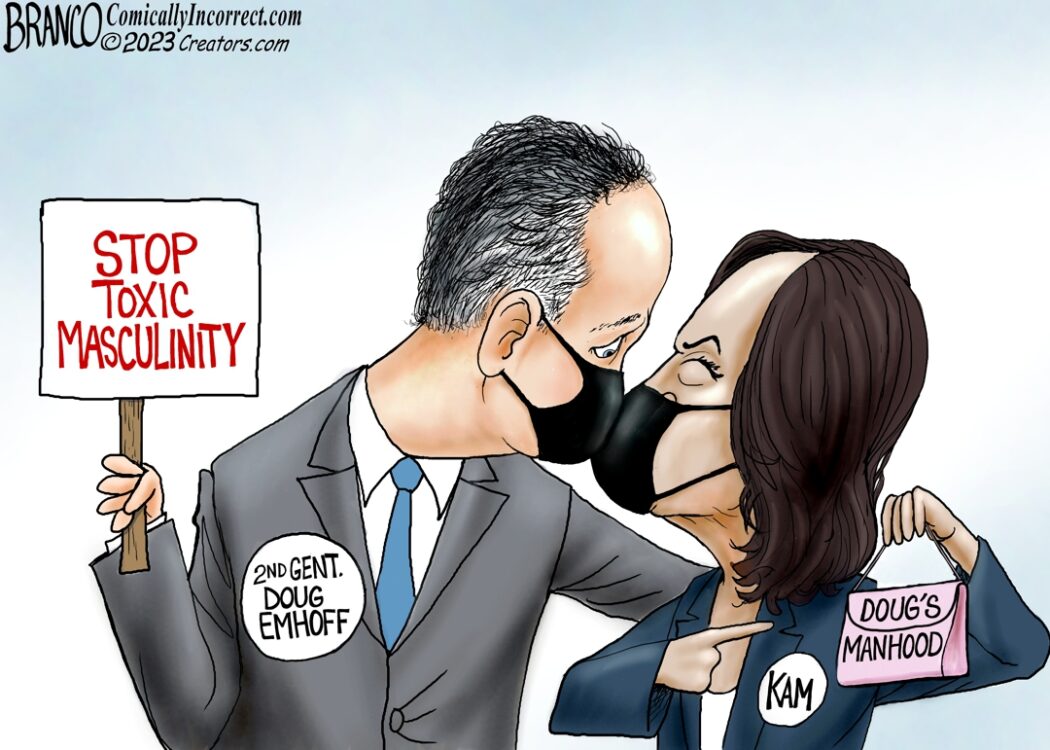
Today’s Politically INCORRECT Cartoon by A.F. Branco


A.F. Branco Cartoon – Sad Sack

A.F. BRANCO | on March 3, 2023 | https://comicallyincorrect.com/a-f-branaco-cartoon-sad-sack/

2nd Gentlemen, Doug Emhoff, has picked up the cause of ridding the world of toxic masculinity.

Emhoff Toxic Masculinity
Political cartoon by A.F. Branco ©2023.

DONATE to A.F.Branco Cartoons – Tips accepted and appreciated – $1.00 – $5.00 – $25.00 – $50.00 – $100 – it all helps to fund this website and keep the cartoons coming. Also Venmo @AFBranco – THANK YOU!

A.F. Branco has taken his two greatest passions, (art and politics) and translated them into cartoons that have been popular all over the country, in various news outlets including NewsMax, Fox News, MSNBC, CBS, ABC, and “The Washington Post.” He has been recognized by such personalities as Rep. Devin Nunes, Dinesh D’Souza, James Woods, Chris Salcedo, Sarah Palin, Larry Elder, Lars Larson, Rush Limbaugh, and President Donald Trump.

Mark Warren Op-ed: Only Spiritual Brotherhood Can Save Men in the Job Crisis


BY: MARK WARREN | DECEMBER 29, 2022

Read more at https://thefederalist.com/2022/12/29/only-spiritual-brotherhood-can-save-men-in-the-job-crisis/

An article on the job crisis has a picture of a young man playing video games on a computer.
America’s young men are in crisis, and the answer to this problem is spiritual, not economic or political.

Author Mark Warren profile

MARK WARREN

MORE ARTICLES

There’s a strange thing happening in the American economy right now — what we read in the newspaper or see on TV doesn’t match what we’re witnessing with our own eyes. Job numbers reported in the media seem wonderful. Amazingly low unemployment that hasn’t been witnessed in 50 years! Hundreds of thousands of new jobs created monthly. Yet for all these rosy numbers, when we look at the real world, we see critically understaffed businesses, long waits for repairs, and customer service in the gutter.

America’s young men are in crisis, and the answer to this problem is spiritual, not economic or political. While the media continues to trumpet good news about the economy, the reason your real-life experiences don’t match such optimism is because these reports typically only give you part of the picture. What corporate media doesn’t tell you is that about 11 million jobs remain unfilled right now.

That’s why service is lousy everywhere and you can’t get a plumber. Those jobs go unfilled because millions of young American men between the ages of 25 and 54 aren’t working. At all. As Bloomberg reports, they’ve been left behind, with a lower percentage of men between those ages working than in 1970 — a statistic that emerged before the economic disaster brought by coronavirus lockdowns.

Millions of Young Men Doing Nothing All Day

So, how can millions of men be out of work when unemployment is extremely low? Easy, if you don’t count them.

Yes, the unemployment rate hovers at a record low figure, but this number doesn’t count all unemployed people. It only includes those who don’t have a job and are actively seeking one. This cheery (and erroneous) unemployment rate doesn’t count the millions of young men who aren’t looking for a job. Young males fitting this description are often referred to as “NEETs,” an acronym originating in the U.K. that stands for “Not in Employment, Education or Training.” These fellows aren’t working and, worse, aren’t interested in work.

Of course, this was already a growing problem in the last decade. But unemployment went full supernova during the coronavirus lockdown — and finally smart people are paying attention to it. Mike Rowe of “Dirty Jobs” fame recently hosted a podcast discussion on the crisis of young men not working.

To further understand the problem’s depth, Rowe interviewed economist Nicholas Eberstadt, who wrote “Men Without Work.” It explains the seriousness of this issue, documenting how the unemployment crisis goes far beyond simply not having a job. Too many men in their prime have fallen into a hollow existence. And their parents — and our tax dollars — subsidize such incredible waste.

What do such men do with their copious amounts of leisure? According to Eberstadt, they aren’t only not working. They aren’t going to church. They typically aren’t dating. They aren’t engaging in charity work or civic activities either, or even helping with housework.

Instead, they play video games, binge watch TV and movies, and, perhaps most concerningly, abuse drugs. So many young men are not only lost to our economy but lost to their families as well. They are at risk of becoming another gloomy statistic in the opioid epidemic.

Social and Spiritual Solutions

So, what is the answer? Unsurprisingly, it depends on who you ask. Eberstadt, the expert on young men dropping out of the economy, believes in secular and market-driven solutions to this crisis. He explains to Rowe on the podcast that we could use shame as a powerful motivator, much like our nation has shamed smokers to give up the habit.

But a campaign to shame men is already widespread in America — and not particularly helpful. In recent years, so many expressions of traditional male values have been labeled “toxic masculinity.” Combine this message with readily available drugs ranging from prescription opioids and fentanyl to legal marijuana in many states, and it almost feels like society is encouraging young men to disconnect from the real world and play “Call of Duty” all day.

We therefore believe the real solution to this crisis is spiritual. And we don’t mean just dragging young men away from the TV and into church. When Eberstadt’s book was first published in 2016, The New York Times highlighted it with an op-ed that made an eye-opening point about the root cause of the problem.

In the article, the journalist explored the issue via an interview with a young man who lost his job in the oil industry. He told the interviewer he feels as if America doesn’t care about him. He says he feels as if he’s “considered nothing.” This is a tragedy that likely resonates with millions of other young men not working. No shaming campaign will solve this. It will only worsen things.

Instead, these men would do well to unite. We suggest they form small groups with other men to help each other and provide non-judgmental spaces to work through life’s problems.

Form a Small Band of Brothers

I did this with several brothers a couple of decades ago — and continue to do to this day. Recently, I recounted what drove me to create such fellowship and how it’s transformed my life and so many others in the new book “Power of 4: How Christian Men Create Purposeful Lives By Not Going It Alone.”

If young men feel isolated and valueless, the answer is to bring them together in brotherhood to help them understand their worth. “Power of 4” emphasizes how much more powerful men can be when they don’t try to go it alone. When a man has three brothers to meet with regularly to work through life’s challenges, he is much better off than trying to handle his problems on his own.

Consider a hypothetical Power of 4 group comprised of men not in the workforce. They could work together to build each other up, for instance, by engaging in charity work while also collaborating on resumes and professional networking. (Simply having regular face-to-face contact with other men who are not keen on blaming themselves for their station in life will do worlds of good for young men in crisis).

An even more powerful approach to a Power of 4 group might be to mix together men with established careers with those not in the workforce. Young men who feel lost and without purpose could get unimaginable benefits from spending time with men who are on solid footing in their profession. Such successful men might even assist their Power of 4 brother by arranging an internship or introductory position.

What’s more, men currently working know just how nearly every employer is screaming out for quality employees now. That means a resume with some gaps in it won’t necessarily hold back a man who wants to better his situation. Undoubtedly, our young men in crisis can transform their lives once they realize they do have value — and even the potential for greatness. All it takes is a determination to relinquish those behaviors holding them back — whether it be drugs and alcohol or Netflix and PlayStation (or all of the above!).

Ultimately, we are deeply concerned by the crisis of young men dropping out of society. Despite so much bad news, we see many positives in the future. If men come together to support each other, this problem can and will correct itself.

With the right support system, young men can achieve tremendous personal growth. Every human has value, a fact lost on so many men for far too long. With the help of three brothers, our blueprint for the Power of 4, and our Lord and Savior Jesus Christ, American men will return to a society that so desperately needs them.


Mark Warren is the coauthor of “Power of 4: How Christian Men Create Purposeful Lives By Not Going It Alone.”

Tag Cloud