Perspectives; Thoughts; Comments; Opinions; Discussions

Posts tagged ‘TAIWAN’

Beyond Taiwan: Decoding China’s Unprecedented Military Posturing


By: Brent Sadler | Ruben Frivold | July 30, 2024

Read more at https://www.dailysignal.com/2024/07/30/beyond-taiwan-decoding-chinas-unprecedented-military-posturing/

Chinese sailors and naval officers stand April 23 at the end of an open house celebrating the Chinese navy’s 75th anniversary in Qingdao, China. (Kevin Frayer/Getty Images)

As Americans focus on the presidential election campaign and domestic political uncertainty, China’s large-scale military exercises loom on the horizon after an unusually provocative summer of such activity. Tensions across the Taiwan Strait simmer and a standoff with the Philippines persists in the South China Sea, and China is becoming more direct with America and its allies, indicating its approach is evolving quickly.

First, activity over the Taiwan Strait by China’s air force (the People’s Liberation Army Air Force) has remained at elevated levels since 2021, but recently set new records.  

On July 11, for example, 66 Chinese aircraft were detected over the Taiwan Strait, the highest single-day activity this year. Even more concerning, 56 of the aircraft crossed over Taiwan’s side of the strait, constituting the highest single-day crossing of the median line since recordkeeping began in 2020.

China’s increased military activity also led to the highest recorded 10-day average median line crossing: 23.4 aircraft. Such crossings are highly provocative. That said, activity over the past few months continues an upward trend.
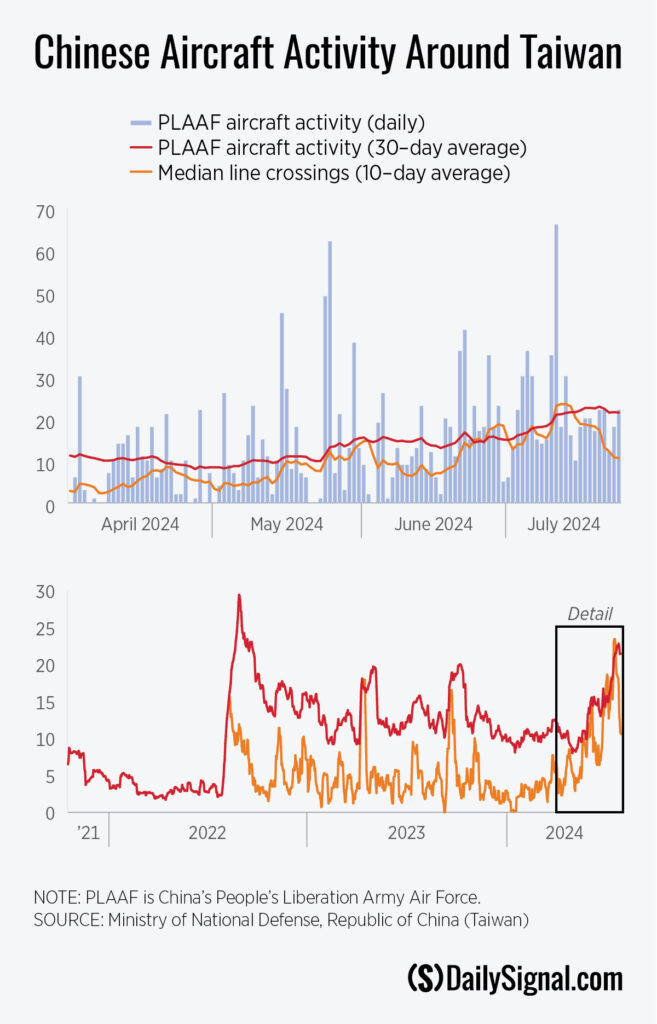
The recent wave of intimidation by the Chinese air force, known as PLAAF, began soon after a July 10 meeting between the top U.S. envoy to Taiwan, Raymond Greene, and Taiwan President Lai Ching-te. Greene pledged increased measures to defend Taiwan, and his visit remains the most plausible reason for China’s response, given historical precedent.

But it’s worth noting that the Chinese escalation also coincided with NATO’s 75th-anniversary summit in Washington, which ran from July 9 through 11, where China was mentioned on multiple occasions. With surprisingly stern language, the NATO summit’s communique warns that “the stated ambitions and coercive policies [of the Chinese Communist Party] continue to challenge [NATO’s] interests, security and values.” The alliance’s communique reiterates that China cannot enable the largest war in Europe in recent history without this negatively impacting its interests and reputation.”

In all, China is mentioned 14 times in the document, demonstrating NATO’s first clear acknowledgment that transatlantic security is now deeply intertwined with issues emanating from the Indo-Pacific.

Participation by South Korea, Japan, Australia, and New Zealand in the NATO summit further signals the alliance’s deepening concern for the region and how a war there would affect European security.

In response to NATO’s statements, China’s Ministry of Defense offered stern words of its own on the same day as the communist regime’s record aircraft activity over Taiwan. China insisted NATO’s statements constitute belligerent rhetoric,” making clear that China “will firmly uphold its own sovereignty, security and development interest.” China’s dissatisfaction with the U.S.-led world order and its reach in the Indo-Pacific is well known, and that animosity is being played out increasingly in military shows of force.

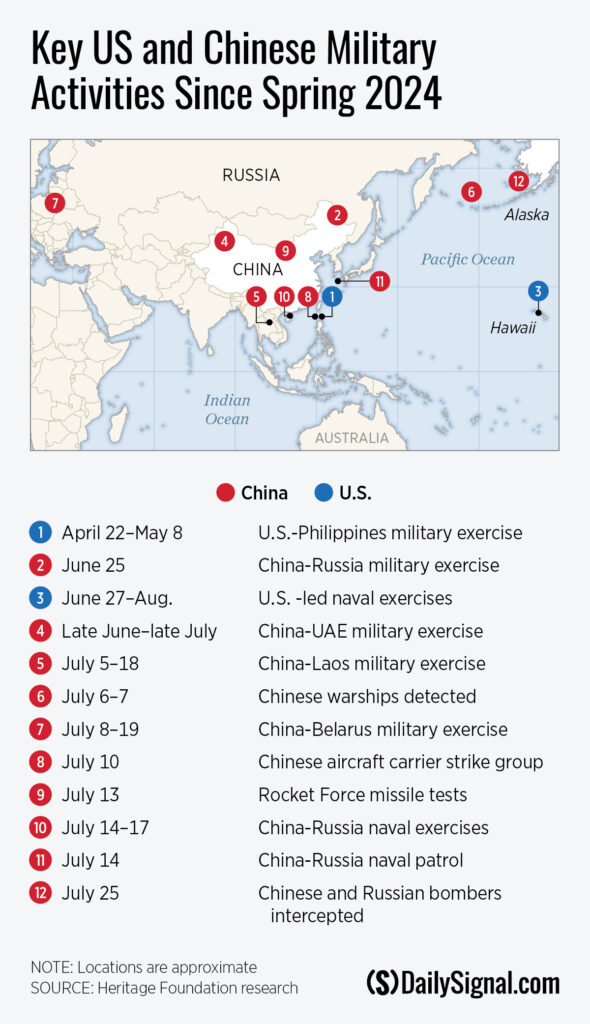
Chinese and Russian forces also gathered June 25 near the Blagoveshchensk–Heihe Bridge, which connects Russia and northeast China. According to China Military, a publication funded by the People’s Liberation Army, priorities included encirclement and capture operations” within the domains of “aerial reconnaissance, surface interception, and ambushes on the shore.”

China said the motivation for the military exercise was to combat separatism—a justification especially significant considering that China quickly labeled Lai, Taiwan’s president, a “separatist” after his May 20 inauguration.

China’s summer activity is expanding to include a variety of other military exercises. On July 13, China carried out multiple waves of missile tests in Inner Mongolia. China’s Rocket Force, responsible for the tests, likely will play a critical role in the regime’s military operations in a war over Taiwan’s future. As such, these tests also serve as preparation for a potential Taiwan war scenario and for more provocative exercises with the Chinese navy and air force during exercises expected soon in the South China Sea. If these missile tests are deemed successful by Chinese leader Xi Jinping, he may decide to execute a more complex and provocative challenge in the region.

NATO’s concern is reinforced by China’s increasingly apparent support of Russia in the ongoing Russia-Ukraine war. More directly, China and Belarus began joint exercises July 8 dubbed Eagle Assault 2024. This coincided with a visit to Warsaw by Ukrainian President Volodymyr Zelenskyy, during which Ukraine and Poland signed a security agreement. The China-Belarus military exercise took place just 17 miles from the Ukraine border and 2 miles from Poland.

Like Russia, Belarus is a member of the Shanghai Cooperation Organization, a Eurasian economic and security coalition. This partnership provides China with an impetus for a greater military presence in Europe, but how it serves China’s strategic interests is less clear. However, this military exercise, planned well in advance and coinciding with the NATO summit in Washington, certainly underscores China’s dismay with Europe’s demurring on Chinese trade and increasing realization of it as a threat.

Earlier this month, China also deepened military cooperation with the United Arab Emirates and Laos, respectively, through two exercises: Falcon Shield 2024 and Friendship Shield 2024. While noteworthy, neither exercise raised a red flag militarily. But the exercises did demonstrate China’s continued willingness to engage favorably with partners who are amenable to accepting its position on Taiwan.

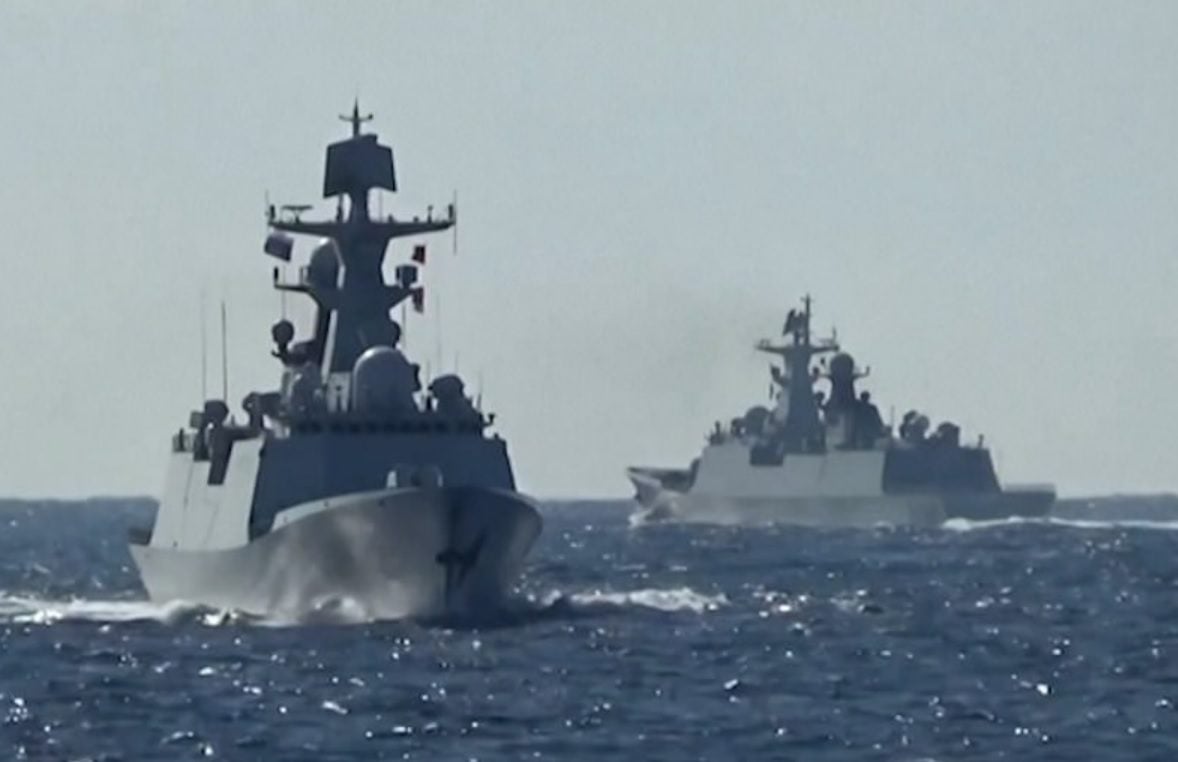
In the South China Sea, a familiar hotspot, China and Russia are increasing joint military engagement, as they are elsewhere. On July 14, Joint Sea 2024 began at a naval port in Zhanjiang, southern China, headquarters for China’s South Sea fleet. Both countries conducted a variety of anti-submarine and air defense exercises.

At the same time, a separate Chinese-Russian naval patrol entered the South China Sea, passing close to Japanese islands, in what the two nations described as a routine operations unrelated to the geopolitical climate. The joint forces simulated missile firing and cross-deck landing operations and carried out gun drills. Military exercises are routinely scheduled during the summer months. But the recent activity amid regional and global tensions demonstrates an unusual increase in Beijing’s risk-taking not seen in previous years.

China also is finding ways to test the United States more directly.

Case in point: Chinese and Russian bomber aircraft were detected July 25 and intercepted by NORAD as they flew into the Alaska Air Defense Identification Zone off the coast of Alaska. This is the latest example of China and Russia’s deepening defense ties and marks the first time two U.S. adversaries deployed strategic bombers together near the United States. The Chinese aircraft in question was the H-6 bomber, capable of carrying nuclear weapons and sometimes active over the Taiwan Strait.

This latest Alaska incident came just weeks after Chinese warships were detected July 6 and 7 near Alaska’s Aleutian Islands. While steering clear of territorial waters, the Chinese vessels passed into the exclusive U.S. economic zone. This marks the fourth consecutive year that China’s naval assets have been detected near Alaska—another component of China’s upward-trending assertiveness in the Pacific.

Only days after that, the Chinese aircraft carrier Shandong, along with two missile destroyers and a frigate, made headlines as they passed close to the Philippines on the way to the Western Pacific to carry out another set of drills.

In a departure from the norm, the carrier group didn’t pass through the Bashi Channel separating Taiwan and the Philippines, but instead went through the Balintang Channel, which runs between two groupings of some of the Philippines’ northernmost islands. This diversion, while subtle, signals continued aggression toward the Philippines, where U.S. Marines recently held joint exercises.
Vietnam also has seen tension before with China in the South China Sea, but unlike the Philippines, Hanoi’s most recent Chinese-style artificial island expansion hasn’t drawn noticeable displeasure from Beijing. Since its positive diplomatic developments with both the U.S. and China last September ­and December, Vietnam has rapidly pursued island reclamation in the South China Sea. Discovery Great Reef, South Reef, Namyit Island, and Pearson Reef all received dozens of acres of land expansion since November, according to the Asia Maritime Transparency Initiative.

Barque Canada Reef continues to be Vietnam’s largest outpost and recipient of recent efforts, gaining 174 acres of land over the past six months. In all, 692 acres have been added since November. This is up from 404 acres the prior year and represents a 100% increase in land reclamation since 2022.

Manila’s seemingly minor actions prompted violent responses from Beijing and Western states’ diplomatic activities triggered military posturing, but China hasn’t condemned Vietnam’s sweeping reclamation campaign.

Why is China choosing not to back down over the Philippines while simultaneously turning a blind eye to Vietnam’s recent surge of island-building in the same region?

China’s selective enforcement of its own standards points to the likelihood that its reactions are reserved for the U.S. or actions that Beijing perceives to be prompted by or indirectly benefit the U.S.

As tensions over Taiwan and features in the South China Sea reach a boiling point, efforts to understand Beijing’s thinking are paramount and could offer ways to better address and mitigate its escalations. America’s lack of strategic direction is commensurate with China’s recent threatening actions. Beijing’s timing, location, and choice of willing partners lessen the probability that its activities happen at the same time by coincidence and hold no greater meaning.

Washington must be alert in the coming months, particularly around Thursday, Aug. 1, the anniversary of the founding of the People’s Liberation Army—a symbolic date that China often uses for strategic messaging. The United States has been in China’s crosshairs for years. But given its recent conduct, Beijing is more likely than ever to double down on its posturing and take on added risks with Washington and allies such as the Philippines.


Biden and Xi Have First Talk Since November Summit


Tuesday, 02 April 2024 02:00 PM EDT

Read more at https://www.newsmax.com/politics/biden-xi-china-yellen-ai-taiwan-fentanyl/2024/04/02/id/1159508/

President Joe Biden and Chinese President Xi Jinping discussed Taiwan, artificial intelligence and security issues Tuesday in a call meant to demonstrate a return to regular leader-to-leader dialogue between the two powers. The call, described by the White House as “candid and constructive,” was the leaders’ first conversation since their November summit in California produced renewed ties between the two nations’ militaries and a promise of enhanced cooperation on stemming the flow of deadly fentanyl and its precursors from China.

Xi told Biden that the two countries should adhere to the bottom line of “no clash, no confrontation” as one of the principles for this year.

“We should prioritize stability, not provoke troubles, not cross lines but maintain the overall stability of China-U.S. relations,” Xi said, according to China Central Television, the state broadcaster.

The call kicks off several weeks of high-level engagements between the two countries, with Treasury Secretary Janet Yellen set to travel to China on Thursday and Secretary of State Antony Blinken to follow in the weeks ahead.

Biden has pressed for sustained interactions at all levels of government, believing it is key to keeping competition between the two massive economies and nuclear-armed powers from escalating to direct conflict. While in-person summits take place perhaps once a year, officials said, both Washington and Beijing recognize the value of more frequent engagements between the leaders.

The two leaders discussed Taiwan ahead of next month’s inauguration of Lai Ching-te, the island’s president-elect, who has vowed to safeguard its de-facto independence from China and further align it with other democracies. Biden reaffirmed the United States’ longstanding “One China” policy and reiterated that the U.S. opposes any coercive means to bring Taiwan under Beijing’s control. China considers Taiwan a domestic matter and has vigorously protested U.S. support for the island.

Taiwan remains the “first red line not to be crossed,” Xi told Biden, and emphasized that Beijing will not tolerate separatist activities by Taiwan’s independence forces as well as “exterior indulgence and support,” which alluded to Washington’s support for the island.

Biden also raised concerns about China’s operations in the South China Sea, including efforts last month to impede the Philippines, which the U.S. is treaty-obligated to defend, from resupplying its forces on the disputed Second Thomas Shoal.

Next week, Biden will host Philippines President Ferdinand Marcos Jr. and Japanese Prime Minister Fumio Kishida at the White House for a joint summit where China’s influence in the region was set to be top of the agenda.

Biden, in the call with Xi, pressed China to do more to meet its commitments to halt the flow of illegal narcotics and to schedule additional precursor chemicals to prevent their export. The pledge was made at the leaders’ summit held in Woodside, California, last year on the margins of the Asia-Pacific Economic Cooperation meeting.

At the November summit, Biden and Xi also agreed that their governments would hold formal talks on the promises and risks of advanced artificial intelligence, which are set to take place in the coming weeks. The pair touched on the issue on Tuesday just two weeks after China and the U.S. joined more than 120 other nations in backing a resolution at the United Nations calling for global safeguards around the emerging technology.

Biden, in the call, reinforced warnings to Xi against interfering in the 2024 elections in the U.S. as well as against continued malicious cyberattacks against critical American infrastructure, according to a senior U.S. administration official who previewed the call on the condition of anonymity.

He also raised concerns about human rights in China, including Hong Kong’s new restrictive national security law and its treatment of minority groups, and he raised the plight of Americans detained in or barred from leaving China.

The Democrat president also pressed China over its defense relationship with Russia, which is seeking to rebuild its industrial base as it presses forward with its invasion of Ukraine. And he called on Beijing to wield its influence over North Korea to rein in the isolated and erratic nuclear power.

As the leaders of the world’s two largest economies, Biden also raised concerns with Xi over China’s “unfair economic practices,” the official said, and reasserted that the U.S. would take steps to preserve its security and economic interests, including by continuing to limit the transfer of some advanced technology to China.

Xi complained that the U.S. has taken more measures to suppress China’s economy, trade and technology in the past several months and that the list of sanctioned Chinese companies has become ever longer, which is “not de-risking but creating risks,” according to the broadcaster.

Yun Sun, director of the China program at Stimson Center, said the call “does reflect the mutual desire to keep the relationship stable” while the men reiterated their longstanding positions on issues of concern.

The call came ahead of Yellen’s visit to Guangzhou and Beijing for a week of bilateral meetings on the subject with finance leaders from the world’s second largest economy — including Vice Premier He Lifeng, Chinese Central Bank Gov. Pan Gongsheng, former Vice Premier Liu He, American businesses and local leaders.

An advisory for the upcoming trip states that Yellen “will advocate for American workers and businesses to ensure they are treated fairly, including by pressing Chinese counterparts on unfair trade practices.”

It follows Xi’s meeting in Beijing with U.S. business leaders last week, when he emphasized the mutually beneficial economic ties between the two countries and urged people-to-people exchange to maintain the relationship.

Xi told the Americans that the two countries have stayed communicative and “made progress” on issues such as trade, anti-narcotics and climate change since he met with Biden in November. Last week’s high-profile meeting was seen as Beijing’s effort to stabilize bilateral relations.

Ahead of her trip to China, Yellen last week said that Beijing is flooding the market with green energy that “distorts global prices.” She said she intends to share her beliefs with her counterparts that Beijing’s increased production of solar energy, electric vehicles and lithium-ion batteries poses risks to productivity and growth to the global economy.

U.S. lawmakers’ renewed angst over Chinese ownership of the popular social media app TikTok has generated new legislation that would ban TikTok if its China-based owner ByteDance doesn’t sell its stakes in the platform within six months of the bill’s enactment.

As chair of the Committee on Foreign Investment in the U.S., which reviews foreign ownership of firms in the U.S., Yellen has ample leeway to determine how the company could remain operating in the U.S.

Meanwhile, China’s leaders have set a goal of 5% economic growth this year despite a slowdown exacerbated by troubles in the property sector and the lingering effects of strict anti-virus measures during the COVID-19 pandemic that disrupted travel, logistics, manufacturing and other industries.

China is the dominant player in batteries for electric vehicles and has a rapidly expanding auto industry that could challenge the world’s established carmakers as it goes global.

The U.S. last year outlined plans to limit EV buyers from claiming tax credits if they purchase cars containing battery materials from China and other countries that are considered hostile to the United States. Separately, the Department of Commerce launched an investigation into the potential national security risks posed by Chinese car exports to the U.S.

Copyright 2024 The Associated Press. All rights reserved. This material may not be published, broadcast, rewritten or redistributed without permission.

McCarthy Strengthens U.S.-Taiwan Relations While Biden Allows Red China to Rise


BY: SHAWN FLEETWOOD | APRIL 06, 2023

Read more at https://thefederalist.com/2023/04/06/mccarthy-strengthens-u-s-taiwan-relations-while-biden-allows-red-china-to-rise/

Kevin McCarthy meets Taiwan President Tsai at the Reagan Library
House Speaker Kevin McCarthy met with Taiwanese President Tsai Ing-Wen on Wednesday in an aim to strengthen U.S.-Taiwan relations.

Author Shawn Fleetwood profile

SHAWN FLEETWOOD

VISIT ON TWITTER@SHAWNFLEETWOOD

MORE ARTICLES

On Wednesday, Speaker McCarthy and a bipartisan group of lawmakers met with Taiwanese President Tsai Ing-wen at the Ronald Reagan Library in California. The meeting made McCarthy the most senior U.S. official to meet with the leader of Taiwan on U.S. soil in decades, according to Newsweek.

During the historic summit, McCarthy reaffirmed Congress’s commitment to strengthening relations with the island nation and support for Taiwan’s aim to remain democratic in the wake of increasing Chinese aggression.

“I felt our meeting today provided a greater peace and stability for the world. America’s support for the people of Taiwan will remain resolute, unwavering and bipartisan,” McCarthy said. Tsai echoed similar sentiments, saying, “To preserve peace, we must be strong” and “we are stronger when we are together.”

The Chinese Communist Party (CCP) — which claims Taiwan is Chinese territory — issued remarks on Thursday threatening to “take resolute measures” in response to Tsai and McCarthy’s alleged promotion of Taiwanese independence. Taiwan News reported the island’s national defense ministry tracked a People’s Liberation Army helicopter and two naval vessels in the waters surrounding Taiwan on Wednesday and Thursday.

Most egregiously, however, is the CCP’s attempt to “inspect” ships traveling through the Taiwan Strait. According to Reuters, “China’s Fujian maritime safety administration launched a three-day special joint patrol and inspection operation in the central and northern parts of the Taiwan Strait” on Wednesday that includes “moves to board ships.” Fujian is a southeastern Chinese province bordering the Taiwan Strait.

“The maritime safety authority in the southeastern Chinese province said … the operation included ‘on-site inspections’ on direct cargo ships and construction vessels on both sides of the Taiwan Strait ‘to ensure the safety of vessel navigation and ensure the safe and orderly operation of key projects on water,’” the report reads. Taiwan indicated it would not cooperate with the inspections.

Biden Helps China by Undercutting America

In the background of McCarthy’s bid to reaffirm U.S. support for Taiwanese sovereignty is the flailing presidency of Joe Biden, whose administration’s seemingly intentional bid to cripple America’s national security and economic stability is giving China leeway to expand its influence across the globe.

On Monday, NBC News reported the infamous Chinese spy balloon the Biden administration let drift across the continental United States earlier this year “was able to gather intelligence from several sensitive American military sites.” Among the intelligence transmitted back to the CCP was “mostly from electronic signals, which can be picked up from weapons systems or include communications from base personnel.”

On the economic front, Biden’s monetary policy — which includes spending trillions of taxpayer dollars on useless Democrat pet projects — has resulted in decades-high inflation, causing everyday Americans to struggle to afford basic necessities such as gas and groceries. The administration’s ongoing war against the U.S. fossil fuel industry has only exacerbated the country’s economic pains.

Under Biden, the hegemony of the U.S. dollar is also in jeopardy. Countries such as Brazil and Malaysia have announced within the past week plans to work with China to reduce dependence on the U.S. dollar when conducting trade with Beijing. Most recently, the Chinese yuan surpassed the U.S. dollar as the most traded currency in Russia, signifying growing ties between Beijing and Moscow.

As noted by The Daily Caller, “[i]f foreigners no longer want [U.S. dollars] for trade, central bank reserves, private wealth funds, and the official currency of about a dozen countries, all those dollars have nowhere to go but back to us in a flood like our country has never seen.” Such a scenario would likely lead to hyperinflation and further suffering among the American people.

The U.S. is haunted by self-inflicted domestic problems, so the CCP likely sees an opportunity not just to take control of Taiwan but to recalibrate the politics of the Indo-Pacific in its favor. The longer Biden cripples the U.S., the closer China gets to creating a new world order devoid of U.S. influence.


Shawn Fleetwood is a Staff Writer for The Federalist and a graduate of the University of Mary Washington. He also serves as a state content writer for Convention of States Action and his work has been featured in numerous outlets, including RealClearPolitics, RealClearHealth, and Conservative Review. Follow him on Twitter @ShawnFleetwood

WARNING: China Poised to Invade Taiwan’s Offshore Islands


By Joe Hoft | Published August 2, 2022

Read more at https://www.thegatewaypundit.com/2022/08/warning-china-poised-invade-taiwans-offshore-islands/

Quemoy and Matsu, officially known as the Kinmen and Lienchiang Counties respectively, are groups of islands located directly off the coast of mainland Communist China but are under the administration of the Republic of China, Taiwan.

Quemoy and Matsu are not fortified, making their capture by the People’s Liberation Army an easy, but highly symbolic victory.

In the Second Taiwan Strait Crisis, also called the 1958 Taiwan Strait Crisis, the People’s Republic of China shelled the islands of Quemoy and Matsu Islands in part to probe the extent of the United States’ defense of Taiwan’s territory. During the 1960 Presidential campaign between Democrat John F. Kennedy and Republican Richard M. Nixon, the defense of Taiwan, as represented by Quemoy and Matsu, became a major issue during three of their debates.

According to recent reports, footage uploaded by civilians in China shows large military movements of troops and equipment as Speaker of the House Nancy Pelosi is expected to arrive in Taiwan.

The large military movements have occurred on major highways and railways throughout the Chinese province of Fujian, directly adjacent to Quemoy and Matsu.

In the last 24 hours, commercial flights have been abruptly canceled from airports in several cities in Fujian province. These airports include Xiamen, Fuzhou and Quanzhou. Xiamen Airlines put out a statement saying that the flight cancelations were due to “regional traffic control” and did not elaborate further.

This could be considered an invasion warning, the military occupation of the Quemoy and Matsu Islands as the first step by Communist China to subjugate Taiwan and eliminate U.S. influence in the Western Pacific.

Lawrence Sellin, Ph.D. is retired U.S. Army Reserve colonel and a veteran of Afghanistan and Iraq. He had a civilian career in international business and medical research. Dr. Sellin is the author of Restoring the Republic: Arguments for a Second American Revolution. His email address is lawrence.sellin@gmail.com.

Joe Hoft

Joe Hoft is the twin brother of TGP’s founder, Jim Hoft, and a contributing editor at TGP. Joe’s reporting is often months ahead of the Mainstream media as was observed in his reporting on the Mueller sham investigation, the origins of the China coronavirus, and 2020 Election fraud. Joe was a corporate executive in Hong Kong for a decade and has years of experience in finance, IT, operations and auditing around the world. The knowledge gained in his career provide him with a unique perspective of current events in the US and globally. Joe’s weekday radio show at Realtalk933.com has received rave reviews. He has ten degrees or designations and is the author of four books. His new book: ‘The Steal – Volume One: Setting the Stage’ is out now. It addresses the stolen 2020 Election and those activities that led up to November 3, 2020 – please take a look and buy a copy.

 @joehoft

Chinese officials scramble to find ways to insulate China’s economy from Western sanctions as tensions with Taiwan grow


Reported by SAMUEL MANGOLD-LENETT | May 02, 2022

Read more at https://www.theblaze.com/news/china-taiwan-usa-sanctions/

Stoking fears that China is preparing for an invasion of Taiwan, Chinese officials are looking for ways to defend their country from economic isolation should Western nations opt to sanction China in a similar fashion to how they sanctioned Russia after it invaded Ukraine.

The Daily Mail reported that China’s economic regulators held emergency meetings in late April with officials from the Chinese central bank, the finance ministry, domestic banks operating in China, and international leaders in the financial sectors like HSBC.

In the wake of Russian President Vladimir Putin’s invasion of Ukraine, Western nations locked arms and issued thorough sanctions on the Russian economy. These sanctions caused the Russian economy to plummet and prompted drastic retaliatory threats from the Russian government.

These Western sanctions greatly restricted Russia’s ability to conduct business with other nations by limiting its use of the SWIFT telecommunications network and making it virtually impossible for it to conduct business with the global reserve currency – the U.S. dollar.

The crippling effect these sanctions have had on the Russian economy prompted the emergency meeting between Chinese officials and financial executives. Chinese President Xi Jinping has been startled by the dollar freeze and is concerned about a similar policy being leveraged against China.

Reportedly, the U.S. is considering implementing similar packages of sanctions against China in the event that it moves forward with an invasion of Taiwan. Recent and repeated rhetoric from Chinese leadership indicates that it is not a matter of “if” but a matter of “when” China launches an invasion of Taiwan.

A source close to the Chinese officials who met said, “No one site could think of a good solution to the problem. China’s banking system isn’t prepared for a freeze of its dollar assets or exclusion from the Swift messaging system as the US has done to Russia.”

Reportedly, one idea proposed in the meeting was to force Chinese businesses that export to other nations to part ways with their holdings in U.S. dollars in exchange for Chinese renminbi.

Other proposed solutions such as swamping U.S. dollar holdings to favor the Euro were not thought to be practical.

Some of the Chinese leaders present doubted whether the U.S. even has the capacity to issue such sanctions on China’s economy.

Andrew Collier, managing director of Orient Capital Research in Hong Kong, said, “It is difficult for the U.S. to impose massive sanctions against China. It is like mutually assured destruction in a nuclear war.”

Why Taiwan Is The Lynchpin Of China’s Quest For Global Dominance


DECEMBER 13, 2021 By Dean Cheng

In recent months, concern has been growing about the potential for conflict in the Taiwan Straits. American defense officials have publicly expressed worry about the ability of the United States to successfully deter the People’s Republic of China (PRC) should Beijing decide to use force against the island of Taiwan. The steady increase in size and frequency of Chinese aerial intrusions into Taiwan’s air defense identification zone has exacerbated these concerns.

Are such concerns justified? Yes. To what extent does the fate of Taiwan affect the United States? A lot.

To begin with, there is the geographic importance of Taiwan. Taiwan is part of the so-called “first island chain,” stretching from Japan through Okinawa and Taiwan to the Philippines and the Straits of Malacca. This chain, if in hostile hands, is a barrier to both Chinese military and commercial access to the seas. As important, since China’s economic center of gravity is on the coast from Tianjin to Shanghai to Shenzhen, it is vulnerable to attacks from the sea — or from that same island chain.

Conversely, in Chinese hands, Taiwan and the broader first island chain will serve as a shield for China. Taiwan, in the center of that chain, would be a key factor determining whether China’s military must operate defensively or could operate offensively.

Ownership of Taiwan would provide Beijing other, greater advantages. If China were able to deploy surface-to-air missiles, radars, and airborne early-warning aircraft to Taiwan, Beijing’s warning time of any attack would be substantially increased. Long-range strike forces deployed on the island would provide the PLA Air Force and PLA Navy an unfettered ability to range deep into the central Pacific to attack oncoming forces, while also interdicting supply routes to Japan and South Korea.

This geographic importance is not solely a wartime concern. The PRC is unique. It is a land power that depends on the seas. China needs the oceans to import key resources, the most important of which is food. China is a net importer of food, including staple grains; without such imports, the Chinese population would experience skyrocketing food prices, which in turn could threaten the rule of the Chinese Communist Party (CCP).

In addition, the PRC must import energy, including oil, as well as raw materials. The PRC converts said raw materials into a range of products, from steel I-beams to T-shirts to computers, and exports them around the world. All of this is by way container ships, of which China is now one of the largest producers.

Without easy access to the sea, the CCP would have trouble feeding its people, maintaining its factories, and earning income. Even with the Belt and Road Initiative and other infrastructure investments, for the moment China cannot replace its dependence upon the seas.

There is also the reality that Taiwan is a key link in the global supply chain supporting information and communications technologies. Taiwanese firms, along with South Korean and some other companies, are the key producers of microchips, the silicon-based components that effectively animate the world’s electronics. The current shortage of chips has had downstream effects across industrial sectors, extending beyond information and communications technologies to include automobiles.

Taiwanese firms have more than 60 percent of the global market share of chip production. Were China to somehow jeopardize that capacity, Beijing would have the ability to influence other countries to an overwhelming degree. This would affect not only the United States but such key allies as Japan and Germany.

It is not for the United States to determine the ultimate fate of Taiwan, or dictate the relationship between Beijing and Taipei. But it is in America’s interest to ensure that this sensitive region, with its enormous impact on global economic security, does not see the outbreak of conflict. American efforts to support a peaceful resolution of the Taiwan Straits issue, including deterring a Chinese use of force against the island of Taiwan, are an integral part of sustaining global peace and stability.

Dean Cheng is a senior research fellow at The Heritage Foundation.

Today’s Politically INCORRECT Cartoon by A.F. Branco


A.F. Branco Cartoon – Art of Diplomacy

A.F. BRANCO on October 8, 2021 | https://comicallyincorrect.com/a-f-branco-cartoon-art-of-diplomacy/

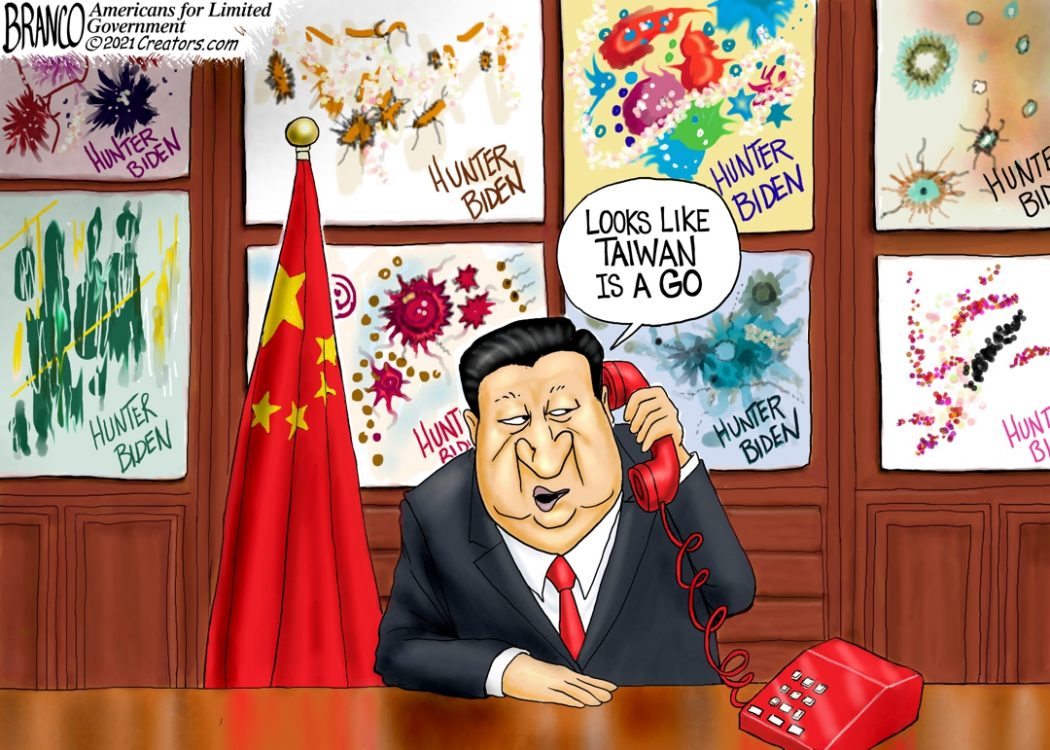
What do Countries like China expect in return for coughing up $500,000 for a hunter Biden painting?

Hunter Biden Paintings
Cartoon by A.F. Branco ©2021

Donations/Tips accepted and appreciated – $1.00 – $5.00 – $25.00 – $50.00 – $100 – it all helps to fund this website and keep the cartoons coming. Also Venmo @AFBranco – THANK YOU!

A.F. Branco has taken his two greatest passions, (art and politics) and translated them into the cartoons that have been popular all over the country, in various news outlets including “Fox News”, MSNBC, CBS, ABC, and “The Washington Post.” He has been recognized by such personalities as Dinesh D’Souza, James Woods, Sarah Palin, Larry Elder, Lars Larson, Rush Limbaugh, and shared by President Donald Trump.

Tag Cloud