Maricopa County Recorder Steven Richer turned to the left-leaning States United Democracy Center and an overseas group bankrolled by the State Department to help his office target election speech that’s disapproved of by the government, according to emails obtained by The Federalist.
Richer thanked States United for offering to let his office “piggyback” on the group’s anti-speech operations, which he described as “deep scanning” the internet for “disinformation,” a term often invoked to censor speech the government disagrees with. States United is a left-wing election law group that consistently opposes Republican election integrity legislation like voter ID laws and supports Democrat attempts to diminish election security, according to InfluenceWatch. The group has praised the weaponization of the justice system against Trump, and was described by The New York Times as part of a “coalition” preparing to “push back” against a potential Trump victory with “extraordinary pre-emptive actions.”
According to email records, States United set up a call with Richer’s staff and the global censorship group, Institute for Strategic Dialogue (ISD). ISD is a London group that has been accused of wrongly labeling “mainstream views” as “misinformation” and subsequently censoring conservative opinions online, according to InfluenceWatch. The group was the recipient of a 2021 grant sponsored by the State Department’s Global Engagement Center, which “fund[s] the development of censorship tools,” as The Federalist’s Margot Cleveland has reported. The ISD works with governments, leftist 501(c)(3) groups, and Big Tech companies as well as some of the left’sbiggestfinancialbackers.
Richer later suggested Arizona State University officials should fire Faculty Associate Aaron Ludwig for retweeting election concerns, apparently looping States United in on the process.
Briefings by Professional Censorship Gurus
“Thanks very much to States United for the kind offer to let us piggyback on some of the deep scanning you’re contracting for election threats and disinformation,” Richer emailed then-States United Senior Counsel Bo Dul on June 17, 2022. Richer indicated his office and “some … partners at the county” do some of this work already, but that he would “love to fill any holes” with the offer from States United.
A few minutes later, Dul told Richer that the States United senior adviser “leading our disinfo work,”Caroline Chambers, would be “circl[ing] up with our partners at ISD and your team to set up a call soon.” Before working for States United, Dul was the senior elections policy adviser and general counsel in the Arizona secretary of state’s office under Democrat Katie Hobbs. Now she’s again working as general counsel for Hobbs, who became governor of Arizona last year.
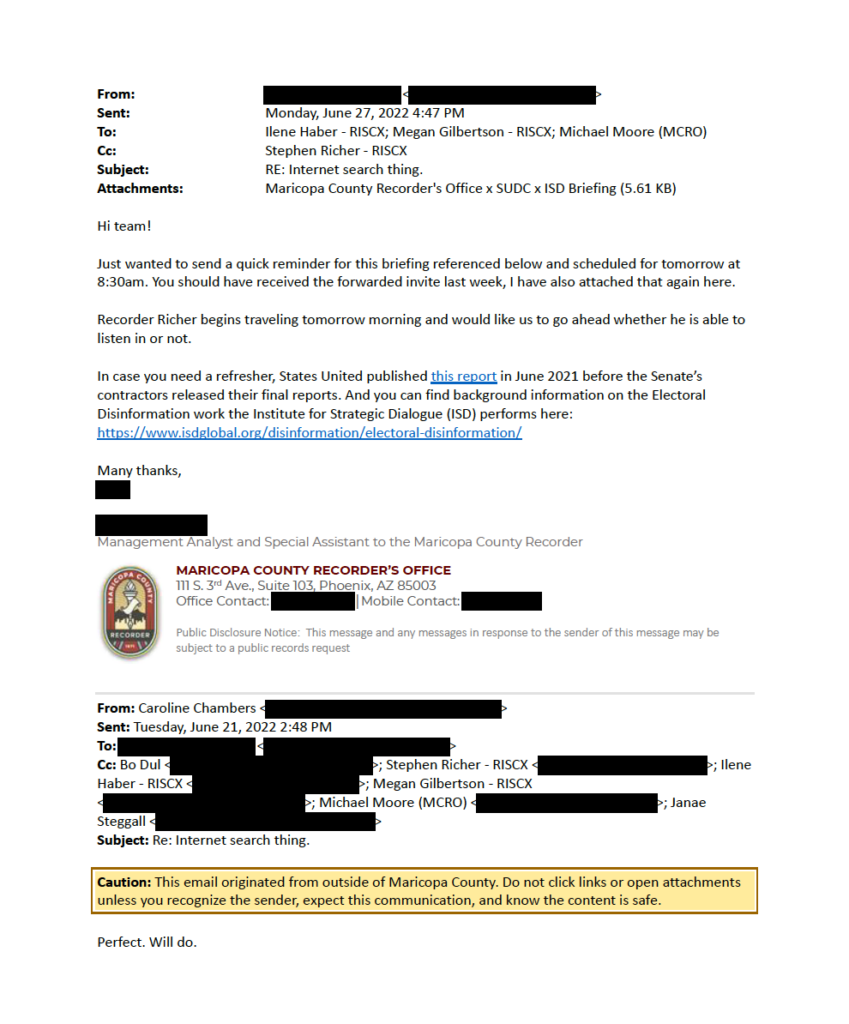
Chambers sent an email to Dul on June 21 and copied Richer, indicating she wanted to “set up a briefing.” On June 23, a States United staffer emailed Chambers, Dul, and other recipients a link to a Zoom meeting with the subject line “Maricopa County Recorder’s Office x SUDC x ISD Briefing.” The meeting was scheduled for June 28.
A “management analyst and special assistant to the Maricopa County Recorder” emailed staff on June 27, reminding them about the briefing the next morning.
The assistant pointed recipients to “background information on the Electoral Disinformation work the Institute for Strategic Dialogue (ISD) performs,” linking to an ISD webpage on “electoral disinformation.” The page boasts about ISD working with States United ahead of the 2022 midterms to “detect, analyze and escalate threats” like “election denialist activity,” and links to news clips of ISD representatives celebrating efforts to pressure Big Tech into censoring more speech.
The June 27, 2022, email from the “special assistant” indicated Richer was traveling at the time of the briefing and may or may not have attended the call but wanted his staff to “go ahead” and attend either way. Asked how long the Maricopa County Recorder’s Office has collaborated with States United and ISD and whether they are currently working with those groups, a representative from Richer’s office told The Federalist the recorder has “worked with numerous entities” over “the last several years.”
“We have received information from States United Democracy Center regarding election worker safety and, as we do with all new information, taken it into consideration,” the representative said, before listing ways the office has made itself “widely available to the public.”
Attempt to Cancel a Professor for Retweeting Election Post
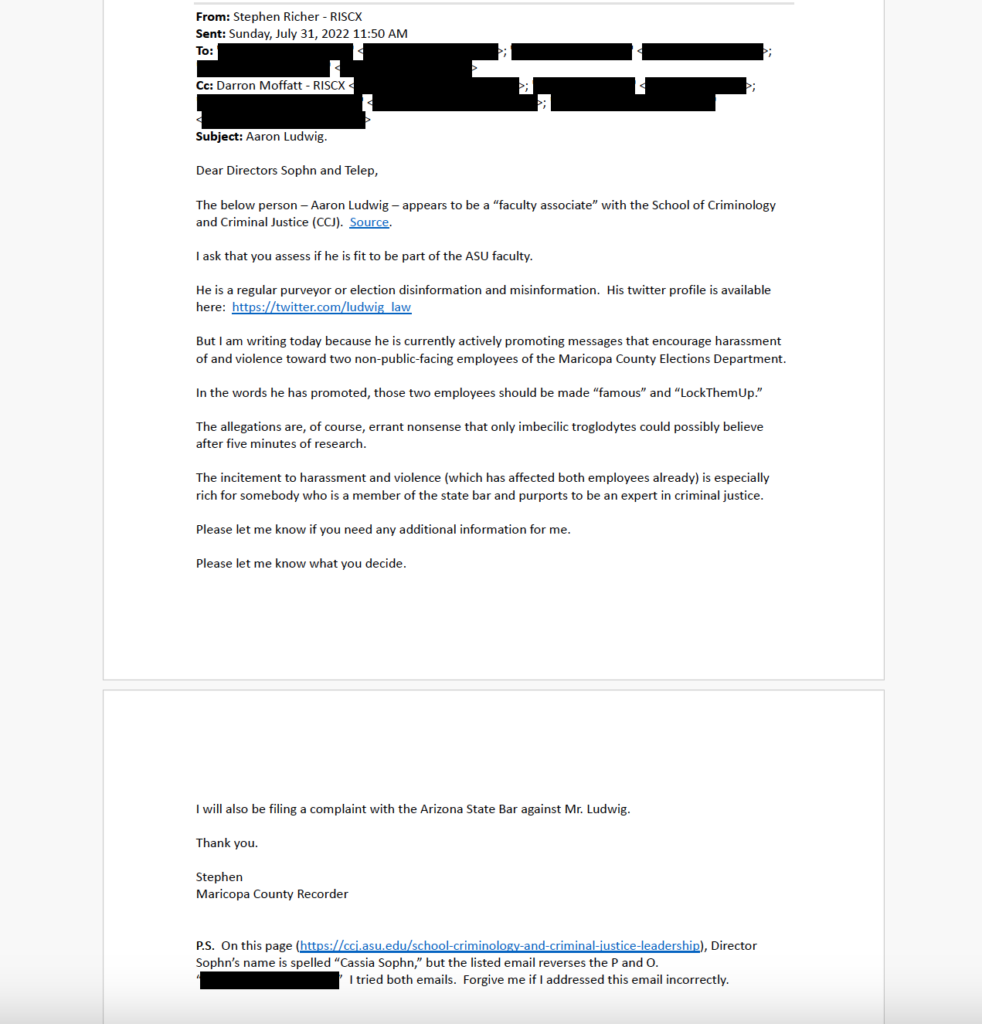
Just the next month, Richer emailed Arizona State University officials to suggest they fire Criminology and Criminal Justice Faculty Associate Aaron Ludwig for his online speech. Richer was upset because Ludwig had retweeted election concerns.
“He is a regular purveyor of election disinformation and misinformation,” Richer wrote on July 31, linking to Ludwig’s account on Twitter (now X). “I ask that you assess if he is fit to be part of the ASU faculty.”
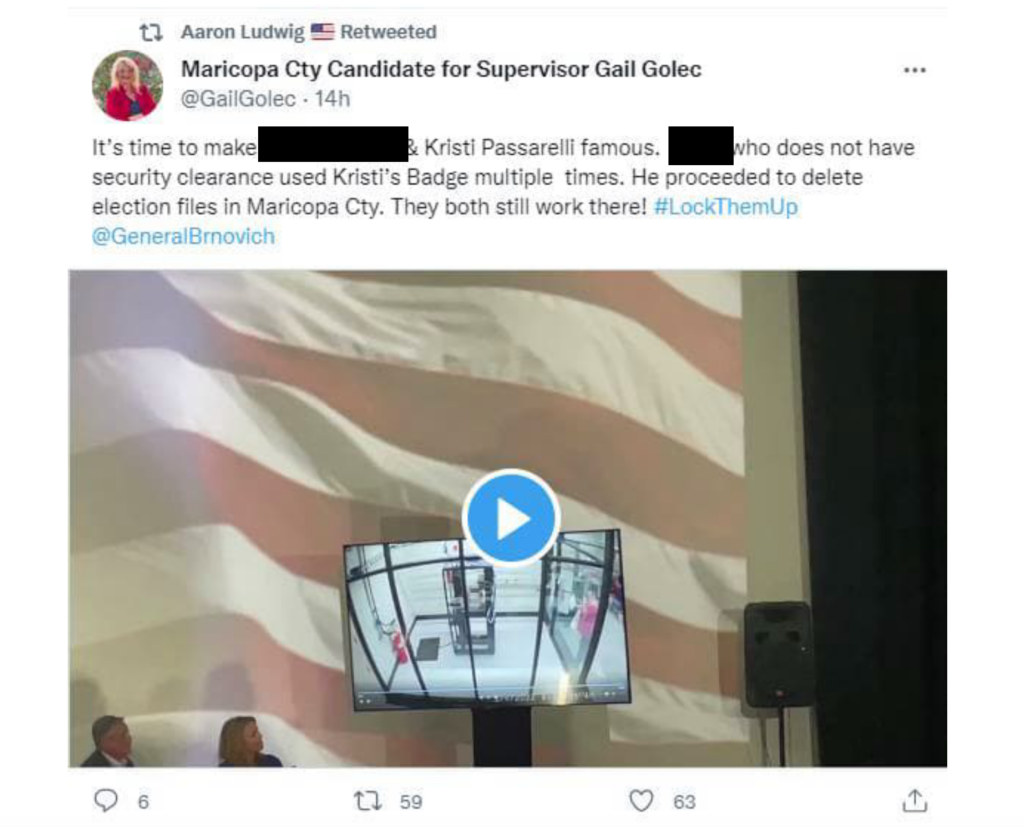
Richer claimed Ludwig was “promoting messages that encourage harassment of and violence toward” two Maricopa County Elections Department employees. The recorder included several screenshots of tweets Ludwig reposted, including one that accused the employees of improperly using a security badge and deleting election files and another that was critical of Richer himself.
“The allegations are, of course, errant nonsense that only imbecilic troglodytes could possibly believe after five minutes of research,” Richer spewed in the email, referencing the retweet.
An ASU dean, Cynthia Lietz, sent an email to Richer the same day with the subject line “RE: Aaron Ludwig.”
“Thank you for this important information, we will look into this,” she wrote.
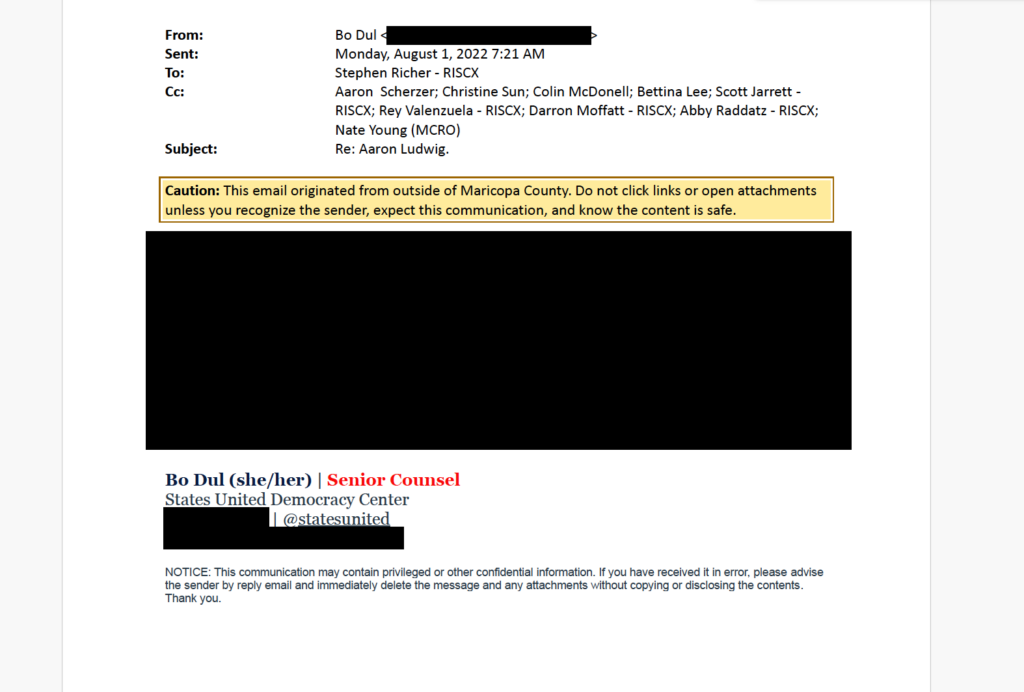
Dul, the States United operative, also emailed Richer and his staff the next day with the subject line “Re: Aaron Ludwig.” The entire body of the email was redacted when released to The Federalist.
Months passed, but Richer wouldn’t let Ludwig’s speech go. He followed up with Lietz on Feb. 6, 2023, in the same email thread.
“Did anything ever come of this?” he asked.
“Yes, we did address this,” Lietz wrote in an email the next day.
Ludwig told The Federalist his supervisors never discussed the matter with him, but he first heard about the situation in April when acquaintances found the interchange in a public records request. He said he thinks Richer’s actions violate the First Amendment.
“The government should not be allowed, and I believe, is not allowed pursuant to the First Amendment, to censor free speech unless it is those few things that can” constitutionally be regulated, he said.
Ludwig was chief of the racketeering and asset forfeiture section at the Arizona Attorney General’s Office from 2011 to 2014, and a special prosecutor for the office until 2015, according to his LinkedIn.
“I led Arizona’s charge against organized crime and the southern border, the transnational criminal organizations including all the drug cartels,” he told The Federalist. “For somebody to attack my background and credentials and professionalism and integrity, and accuse me of being some filthy liar or anything is so offensive. It’s destructive to my reputation. I believe it’s defamatory per se.”
Called Free Speech a ‘Thorn in the Side of My Office’
Richer recently lost the Republican primary for county recorder. He initially campaigned on election integrity, but once in office, he used “his perch as an opportunity to regularly defend the Democrat-run 2020 election in Maricopa County, write op-eds at CNN against the type of election audits he conducted to gain power, draft lengthy screeds lambasting Republican leaders and voters for their election integrity concerns, and push ranked-choice voting and other efforts critics say are disastrous for voter confidence in elections,” as the Federalist’s Editor-in-Chief Mollie Hemingway previously reported.
“The Constitution today is in some ways a thorn in the side of my office. Specifically the First Amendment,” the recorder allegedly wrote in a draft speech, according to Just the News. The outlet also obtained a document with instructions on “banning a user on social media,” which the county reportedly told Just the News was “a draft document of ideas that were brought up in a meeting but never implemented.” Richer has also worked with the Cybersecurity and Infrastructure Security Agency — the federal government’s censorship“nerve center” — in his war on unapproved speech.
Richer, who has become a corporate mediadarling for criticizing the election integrity concerns of his former supporters, has also attracted the attention of Democrat megadonor Reid Hoffman. During Richer’s unsuccessful primary bid, Hoffman helped fund mailers backing the recorder, as The Federalist previously reported.
Logan Washburn is a staff writer covering election integrity. He graduated from Hillsdale College, served as Christopher Rufo’s editorial assistant, and has bylines in The Wall Street Journal, The Tennessean, and The Daily Caller. Logan is originally from Central Oregon but now lives in rural Michigan.
While the GOP and conservative media have largely moved on from Arizona gubernatorial candidate Kari Lake and the systemic failures that occurred in Maricopa County on Nov. 8, court testimony and eyewitness reports from the Lake trial include allegations that Arizona’s largest county violated state law by failing to implement chain-of-custody documentation for Election Day ballots, resulting in a mysterious 25,000 extra votes added to Maricopa County’s official tally within a 24-hour period — more than the margin of victory between Lake and gubernatorial victor Katie Hobbs.
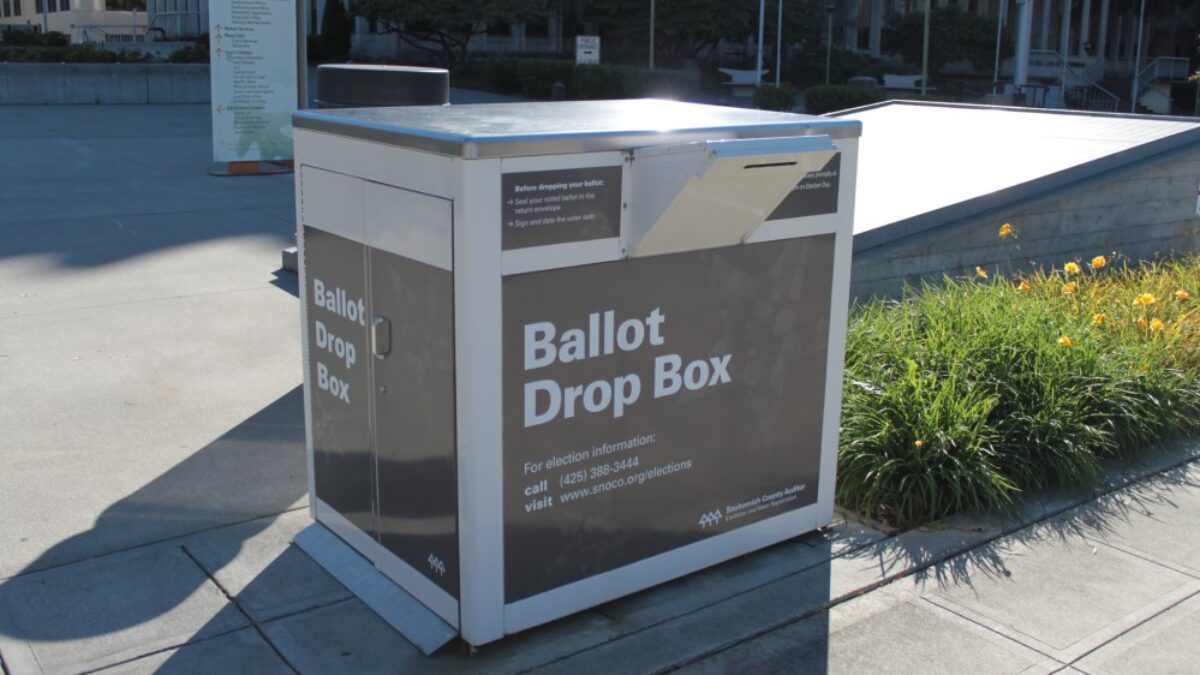
It was about 10:00 on election night when Maricopa County’s ballot tabulation vendor, Runbeck Election Services, received its first truckload of Election Day drop box ballots. While Runbeck received seven truckloads total (the last was completed about 5 a.m. the following morning), Runbeck staff thought it odd the deliveries did not come earlier throughout the day. But that wasn’t the only glitch. There were no chain-of-custody forms delivered with the ballots, a stark departure from typical procedure.
According to Runbeck employee Denise Marie, prior to Nov. 8, drop box ballots were “delivered in red bins with a chain of custody form” from the Maricopa County Tabulation and Election Center (MCTEC), which listed how many ballots were delivered.
But on election night, “instead of receiving the ballots in red bins, the ballots from the drop boxes had been placed in mail trays and loaded onto mail cages. MCTEC did not include the Maricopa County Delivery Receipt forms with any of the Election Day drop box ballot deliveries. There were no chain of custody forms with the ballots and no count of the number of ballots that were delivered,” Marie wrote in a sworn affidavit.
Maricopa County Co-Director of Elections Reynaldo Valenzuela even testified that while the county’s election workers count drop box ballots and record the counts on documents as required by law prior to Election Day, they did not count the ballots retrieved from drop boxes on Election Day itself. During the Lake trial, Valenzuela was asked whether Maricopa County election officials know the precise number of drop box ballots on Election Day, and he told the court, “On Election Day, no, because we’re not doing drop box courier process at that time. It’s a different process for Election Day.”
According to Lake attorney Kurt Olsen, this is in direct violation of Arizona state statute, which requires the county recorder to maintain records that log the chain of custody for ballots “during early voting through the completion of provisional voting tabulation.”
Per Arizona’s Election Procedures Manual, when ballots are taken from drop boxes, they must either be counted at the local vote center or be placed in secure ballot transport containers to be taken back to the county for tabulation. When the county recorder or elections official opens the container, he or she must count the number of ballots inside and note it on a retrieval form.
Because Maricopa County tabulators received more Election Day drop box ballots than they had ever received before, as County Recorder Stephen Richer testified, they removed the ballots from the ballot transport containers without counting or recording the number on a retrieval form for each drop box, as witnessed by Republican poll watcher Leslie White. This is a violation of the chain-of-custody requirements the county recorder is tasked with implementing.
The ballots were then put in mail trays and loaded onto mail cages, which were then put on trucks and delivered to Runbeck to be scanned and counted, according to supply-chain auditor and Lake trial witness Heather Honey. And notably, according to Marie’s sworn affidavit, this loading of ballots into the trucks also occurred without any documentation or record of the number of ballots on each.
Since Maricopa County failed to create its own chain-of-custody documents for the Election Day drop box ballots, Runbeck made its own (called “MC Inbound Receipt of Delivery Forms“), which logged the seven truckloads of drop box ballots on election night. On the delivery forms, Runbeck estimated the total number of Election Day drop box ballots to be 263,379 by multiplying the maximum number of ballots a mail tray can hold by the number of trays received, as Honey explained to The Federalist.
Runbeck CEO Jeff Ellington gave his staff a similar estimate of the number of ballots received via an email on Nov. 9, saying, “we started getting mail packets dropped off from Maricopa around 10pm last night and received mail packets about every hour through sunrise this morning. Likely between 250 and 275K packets were dropped off at the polls yesterday.”
At a press conference that evening, Richer affirmed Runbeck’s estimate by saying the county had received an unprecedented 275,000 drop-off ballots on Election Day. That same day, Maricopa County reported the total number of ballots cast in the 2022 general election to the Arizona Department of State: 1,136,849 ballots, with 407,664 ballots left to count — 1,544,513 ballots total.
However, on that same day, around 5:30 p.m., Maricopa County asked Runbeck to calculate the total number of Election Day drop-off ballots received, according to Marie, who was tasked with running the tabulation herself. Marie found that Runbeck’s records showed 298,942 drop box ballots had been received and scanned on Election Day.
As a result of such a discrepancy between the estimate and the official tally, Maricopa County sent a new vote tally to the Arizona secretary of state’s office on Nov. 10 (earlier that day, Richer had sent an email to the Maricopa County Board of Supervisors admitting he could not reconcile the differences between the county’s numbers and the secretary of state’s listing, demonstrating that even the supposed expert official in charge of the counting process couldn’t figure out where the extra ballots came from). Instead of the original 1,544,513 total ballots reported for the 2022 general election in Maricopa County, the secretary of state’s website now listed 1,569,603, a more than 25,000-vote discrepancy with no explanation. That same day, Maricopa County gave another press conference, stating it had received 292,000 Election Day drop box ballots without batting an eye.
What This Means
Arizona law requires the county recorder to show the origins and chain-of-custody documents for every drop box ballot obtained. According to Runbeck employee Denise Marie and Maricopa County Co-Director of Elections Reynaldo Valenzuela, Maricopa County violated state law by failing to create any chain-of-custody documentation for the drop box ballots received on Election Day. Because of this failure, no records exist to dispute or reconcile the discrepancy between the number of ballots Runbeck first reported (263,379) and its final tally (298,942), a more than 35,000-vote change. As Olsen remarked in his closing argument for the Lake trail, “If you don’t have a count from MCTEC when those ballots are being transported to Runbeck, how do you know whether that count is secure?”
Nor do there appear to be chain-of-custody documents, a violation of Arizona law, showing how Maricopa County was able to add more than 25,000 ballots to its final tally. That addition is more than Hobbs’ margin of victory, which was about 17,000 votes.
“On November 9th, the reported count is 25,000 ballots less, which is beyond the margin here, than on November 10th,” Olsen said. “So the day after the election, they put out what the count is and then magically 25,000 ballots appear on November 10th, and well, hey, that’s the race.”
While part of the argument Lake’s attorneys used in their lawsuit seeking to challenge Arizona’s gubernatorial election was that Maricopa County violated its own Election Procedural Manual by failing to implement chain-of-custody documentation, Arizona Superior Court Judge Peter Thompson rejected the claim due to the county’s assertion that such chain-of-custody documents exist, even though it failed to produce them. At the time of the trial, Maricopa County hadn’t fulfilled a public records request for the documents.
But while such documents do exist for drop box ballots counted prior to Election Day, no such chain-of-custody paperwork exists for the Election Day drop box ballots themselves, Honey reiterated to The Federalist. The judge did not consider this alleged violation of state law and ruled against Lake’s challenge, saying she failed to present clear and convincing evidence of widespread misconduct.
Arizona has an impossibly high bar for overturning elections on the grounds of misconduct, as the judge himself noted. Lake not only had to allege misconduct but intentional misconduct, such to affect the outcome of the election. Lake has since filed two appeals — one with an appeals court, the other with the Arizona Supreme Court. The appeals court agreed to expedite her case.
When asked about its alleged failure to implement chain-of-custody documentation for the Nov. 8 election, Communications Manager for the Maricopa County Elections Department Matthew Roberts told The Federalist: “There are robust tracking and security procedures in place to document and ensure proper chain-of-custody of early ballots on Election Day. These policies and procedures were followed on Election Day, as well as throughout the early voting period. At no point during the process were chain of custody policies broken or procedures not followed and documented.”
The Maricopa County Elections Department did not respond to The Federalist’s request for documentation of the chain-of-custody process for the Election Day drop box ballots.
Victoria Marshall is a staff writer at The Federalist. Her writing has been featured in the New York Post, National Review, and Townhall. She graduated from Hillsdale College in May 2021 with a major in politics and a minor in journalism. Follow her on Twitter @vemrshll.
American Family Association
American Family Association (AFA), a non-profit 501(c)(3) organization, was founded in 1977 by Donald E. Wildmon, who was the pastor of First United Methodist Church in Southaven, Mississippi, at the time. Since 1977, AFA has been on the frontlines of Ame
NEWSMAX
News, Opinion, Interviews, Research and discussion
Opinion
American Family Association
American Family Association (AFA), a non-profit 501(c)(3) organization, was founded in 1977 by Donald E. Wildmon, who was the pastor of First United Methodist Church in Southaven, Mississippi, at the time. Since 1977, AFA has been on the frontlines of Ame
American Family Association
American Family Association (AFA), a non-profit 501(c)(3) organization, was founded in 1977 by Donald E. Wildmon, who was the pastor of First United Methodist Church in Southaven, Mississippi, at the time. Since 1977, AFA has been on the frontlines of Ame
You Version
Bible Translations, Devotional Tools and Plans, BLOG, free mobile application; notes and more
Political
American Family Association
American Family Association (AFA), a non-profit 501(c)(3) organization, was founded in 1977 by Donald E. Wildmon, who was the pastor of First United Methodist Church in Southaven, Mississippi, at the time. Since 1977, AFA has been on the frontlines of Ame
NEWSMAX
News, Opinion, Interviews, Research and discussion
Spiritual
American Family Association
American Family Association (AFA), a non-profit 501(c)(3) organization, was founded in 1977 by Donald E. Wildmon, who was the pastor of First United Methodist Church in Southaven, Mississippi, at the time. Since 1977, AFA has been on the frontlines of Ame
Bible Gateway
The Bible Gateway is a tool for reading and researching scripture online — all in the language or translation of your choice! It provides advanced searching capabilities, which allow readers to find and compare particular passages in scripture based on

.jpg)



 What Did You Say?
You must be logged in to post a comment.