
Perspectives; Thoughts; Comments; Opinions; Discussions

Posts tagged ‘oil prices’

Jen Psaki Is a Lying Liar Who Lies: Insane Gas Prices Edition


REPORTED BY: TRISTAN JUSTICE | MARCH 07, 2022

Read more at https://www.conservativereview.com/jen-psaki-is-a-lying-liar-who-lies-insane-gas-prices-edition-2656864250.html/
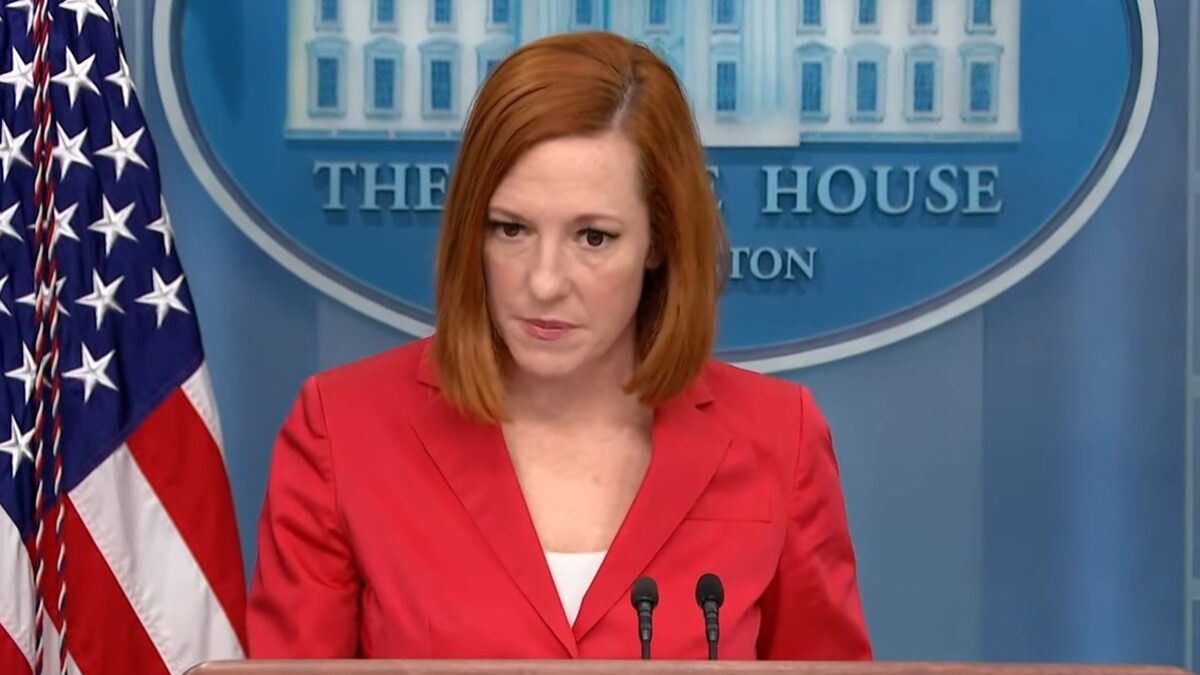
Jen Psaki

President Joe Biden’s Press Secretary Jen Psaki tried to evade White House responsibility for soaring gas prices Monday, casting blame solely on overseas turmoil in Ukraine. Gas prices hit a national average of $4.06 a gallon, according to AAA, this week reaching a new high not seen since 2008 when prices reached their all-time peak at $4.11.

“The increase,” Psaki said, “is a direct result of the invasion of Ukraine,” adding “there was an anticipation” of rising prices.

In anticipation, however, the White House has only exacerbated a self-inflicted crisis by doubling down on the administration’s war on domestic energy production in the name of climate change and environmental justice. As the impending invasion of Ukraine foreshadowed turbulence in global energy markets, President Biden’s Department of Justice reinstated the administration’s suspension of new oil and gas leases on federal lands through a legal filing in Louisiana.

Despite Psaki’s blame on Russian aggression for the spike in energy costs, gas prices began to soar upon Biden’s first days in office after the president’s inaugural orders shut down the Keystone XL pipeline and unilaterally suspended new oil and gas leases on public land.

According to the Energy Information Administration (EIA), American gas prices eclipsed an average of $3 per gallon by May as President Biden unleashed a cascade of taxes and regulation on the industry while moving to lock down lucrative reserves. In other words, gas prices have been rising since Biden took office, not since Russia launched its invasion of neighboring Ukraine.

Biden’s suspension of new drilling on federal lands, while temporarily overturned by a federal judge in the U.S. District Court for the Western District of Louisiana mid-summer, killed incentives in the capital- and labor-intensive industry for operations to keep up with demand, suppressing production. Producers require long-term planning and assurance their operations will remain in place before they pledge billions in new capital to drill in a particular area. That means new leases must always be on the horizon.

Cancellation of the Keystone XL pipeline alone axed some 830,000 barrels of Canadian crude flowing to Gulf refineries while the U.S. simultaneously doubled imports of Russian oil. Last year, the U.S. welcomed an average of more than 600,000 barrels of Russian crude and related petroleum products daily, financing the Kremlin war machine. As the world’s third-largest oil producer providing more than 10 percent of global supply, Russia raked in $119 billion in resource revenues.

Biden is reluctant to sanction President Vladimir Putin’s energy sector, with the White House claiming the solution to rising prices is to pivot in favor of cleaner energy sources that are often unreliable and more expensive. Russian gas operations, meanwhile, produce 30 percent more methane than American operators. Iran, where the administration is hoping to lift sanctions and welcome its oil, hosts operations with 85 percent more intense methane emissions than their U.S. counterparts.

Biden could have brought down energy prices at any point in his presidency but instead has continued to escalate the administration’s animosity towards domestic production and the American worker. An enhanced regulatory regime combined with Wall Street pressure to restrict investment in the capital-intense industry has limited diplomatic options to counter Russian aggression by limiting domestic capacity to supplement supply shocks.

In Alaska for example, Democrats have sought to lock down decades worth of oil and gas reserves stored under a fraction of the Arctic National Wildlife Refuge (ANWR) with reinstated environmental protections poised to become permanent.

Instead of unleashing American energy potential to reclaim the independence once briefly achieved under the Trump administration, Biden officials are now pleading with authoritarian adversaries in Venezuela and Saudi Arabia to ramp up production abroad.


Tristan Justice is the western correspondent for The Federalist. He has also written for The Washington Examiner and The Daily Signal. His work has also been featured in Real Clear Politics and Fox News. Tristan graduated from George Washington University where he majored in political science and minored in journalism. Follow him on Twitter at @JusticeTristan or contact him at Tristan@thefederalist.com.

Obama: Iranian oil, good. Canadian oil, bad. American oil, bad.


waving flagBy Marita Noon

URL of the original posting site: http://netrightdaily.com/2015/08/obama-iranian-oil-good-canadian-oil-bad-american-oil-bad/#ixzz3iA1wNK3s

off limitsPresident Obama’s confusing approach to energy encourages our enemies who shout “death to America,” while penalizing our closest allies and even our own job creators.

Iran’s participation in the nuclear negotiations that have slogged on for months, have now, ultimately, netted a deal that will allow Iran to export its oil — which is the only reason they came to the table (they surely are not interested in burnishing Obama’s legacy). International sanctions have, since 2011, cut Iran’s oil exports in half and severely damaged its economy. Iran, it is estimated, currently has more than 50 million barrels of oil in storage on 28 tankers at sea — part of a months’ long build up.

It is widely reported that, due to aging infrastructure and saturated storage, it will take Iran months to bring its production back up to pre-sanction levels. The millions of barrels of oil parked offshore are indicative of their eagerness to increase exports. Once the sanctions are lifted — if Congress approves the terms of the deal, Iran wants to be ready to move its oil. In fact, even before the sanctions have been lifted, Iran is already moving some of its “floating storage.”

On July 17, the Financial Times  reported, “The departure of a giant Iranian supertanker from the flotilla of vessels storing oil off the country’s coast has triggered speculation Tehran is moving to ramp up its crude exports.” The Starla, “a 2 million barrel vessel,” set sail — moving the oil closer to customers in Asia. In April, another tanker, Happiness, sailed from Iran to China, where, since June, it has parked off the port City of Dalian.

Starla is the first vessel storing crude offshore to sail after the nuclear deal was reached — which is, according to the Financial Times, “signaling its looming return to the oil market.” Reuters calls its departure “a milestone following a months-long build-up of idling crude tankers.” Analysts at Macquarie Capital apparently think the oil on Starla will not be parked, waiting for sanctions to be lifted. A research note, states that Iran is “likely assuming that either a small increase in exports will not undermine the historic accord reached or that no one will notice.” We noticed.

Already, before sanctions are lifted, global oil prices are feeling the pressure of Iran’s increased exports. Since the deal’s been announced, crude prices have lost almost all of their recent gains.

While the Obama Administration’s actions are allowing Iran, which hates America, to boost its economy by increasing its oil exports, they are hurting our closest ally by continuing to delay the Keystone pipeline — which would help Canada export its oil.Indenification of Obama

After six-and-a-half years of kicking the can down the road, and despite widespread support and positive reports, the Keystone pipeline is no closer to construction than it was on the day the application was submitted. It is obvious President Obama doesn’t like the project, which will create tens of thousands of jobs, according to his own State Department. Back in February, he vetoed the bill Congress sent him that would have authorized construction, saying that it circumvented “longstanding and proven processes for determining whether or not building and operating a cross-border pipeline serves the national interest.” At the time, Senate Majority Leader Mitch McConnell (R-Ky.) said, “Congress won’t stop pursuing good ideas, including this one.” But he was not able to gather enough votes to override the veto, and, since then, we’ve heard nothing about the Keystone pipeline. In Washington, DC, silence on an important issue like Keystone isn’t always golden.

There is no pending legislation on Keystone, but the permit application has still not been approved or rejected. I had hoped that the unions, who want the jobs Keystone would provide, would be able to pressure enough Democrats to support the project, to push a bill over the veto-proof line. But that didn’t happen. For months, Keystone has been silently dangling. But that may be about to change.insane

Reliable sources tell me that Obama is prepared to, finally, announce his decision on Keystone. According to the well-sourced rumor, he is going to say, “No” — probably just before or after the Labor Day holiday. He’ll conclude that it is not in the “national interest.” So helping our ally grow its economy and export its oil is not in our national interest but helping our sworn enemy do the same, is? It’s like the “Channeling Jeff Foxworthy” parody states, we just “might live in a country founded by geniuses and run by idiots.”

Speaking of economic growth and oil exports, what about here at home, in the good old U.S. of A.? Senator Lisa Murkowski (R-Alaska) questions the deal that allows Iran to export its oil, while we cannot. “As Congress begins its 60-day review of President Obama’s nuclear deal with Iran, there are plenty of reasons to be skeptical about whether it is in our nation’s — and the world’s — best interests. Not least among them are the underexplored, but potentially significant, consequences the deal will hold for American energy producers.”

Most people don’t realize that the U.S. is, as Murkowski says in her op-ed, “the only advanced nation that generally prohibits oil exports.” Due to decades-old policy, born in a different energy era, American oil producers are prohibited from exporting crude oil because it was perceived to be in “short supply.” (Note that refined petroleum product, such as gasoline and diesel, can be exported and is our number one export. We are also about ready to ship our first major tanker full of natural gas to Europe.) Today, when it comes to crude oil, our cup runneth over. The U.S. is now the world’s largest producer of oil and gas. Rather than short supply, we have an oversupply — so much so that American crude oil (WTI) is sold at a discount over the global market (Brent). This disadvantages U.S. producers but doesn’t benefit consumers because gasoline is sold based on the higher-priced Brent.

hypocrite in chiefMurkowski argues that it is time to lift the 40-year-old oil export ban. She’s introduced bipartisan legislation that would do just that, but, if he were so inclined, President Obama could reverse the policy himself — if he found it to be in the national interest. And how could it not be?

Allowing U.S. crude oil onto the world market enhances global energy security, as it would be less impacted by tensions in the Middle East. Our allies in Europe and Asia would have access to supply from a friendly and reliable source — remember the Arab Oil Embargo crippled Japan’s economy because it had no domestic supply and was overly reliant on Arab sources. Lifting the oil export ban would allow U.S. crude to be sold at the true market price, not the discounted rate, which would help stem the job losses currently being felt throughout the oil patch due to the low price of oil and exacerbated by the drop in the price of crude triggered by the Iran deal.

So, the Obama Administration is lobbying Congress to lift the sanctions on Iran, a country that views America as The Great Satan. Lifting sanctions would allow Iran to resume full oil export capabilities and boost its economy — while refusing to give our allies and our own country the same benefit. Iranian oil will enter the world market, while Canadian and American oil is constrained. How is that in the “national interest?”

It appears we might just be living in a country founded by geniuses and run by idiots.Never Argue Delusional

The author of Energy Freedom, Marita Noon serves as the executive director for Energy Makes America Great Inc. and the companion educational organization, the Citizens’ Alliance for Responsible Energy (CARE). She hosts a weekly radio program, “America’s Voice for Energy,” which expands on the content of her weekly column.

burke freedom combo 2

How low can it go? Oil, gas prices in freefall as OPEC reels from US fracking


FoxNews.com, Published November 29, 2014

URL of the Original Posting Site: http://www.foxnews.com/world/2014/11/29/opec-keeps-oil-output-steady-despite-falling-prices/

Mideast Bahrain Oil Prices-1.jpg

A row of oil pumps work in the desert oil fields of Sakhir, Bahrain. OPEC nations have agreed to keep supply steady, putting new pressure on US producers. (The Associated Press)

Drivers paying less at the pump due to free-falling oil prices can thank the U.S. energy boom for generating shale oil – and weakening OPEC’s ability to keep the cost of a gallon of gas high.

In just a matter of months, the price of a barrel of oil has dropped from more than $100 to about $70, and gas is now cheaper than it has been in years. But a recent report conducted for the American Petroleum Institute claimed oil would cost twice as much as it does now if it weren’t for America’s fracking boom, which wrings oil and natural gas out of shale miles underground.

But the next question could be whether the fracking industry can survive the low prices it brought.

“The shale boom is on a par with the dot-com boom,” Russian oil baron Leonid Fedun of OAO Lukoil told Bloomberg. “The strong players will remain, the weak ones will vanish.”

OPEC, the cartel of oil-producing nations that has historically been able to calibrate the price of oil – and ultimately gasoline – by increasing or decreasing supply, announced Thursday that it won’t fight the price skid by cutting production this time. That likely means prices will continue to fall, and the more costly production technique of fracking could become cost-prohibitive, say experts.

Drivers have benefited in recent months from the falling prices, the API study found.

“This reduction in petroleum product prices have saved U.S. consumers an estimated $63 to $248 billion in 2013 and estimated cumulative savings of between $165 and $624 billion from 2008 to 2013,” stated the report.

OPEC decision to maintain a production target of 30 million barrels a day was seen as a reflection of its members view that the short term pain was necessary to pressure rival producers in the U.S., who need moderate oil prices to break even. Saudi Arabia, the leader of OPEC, appears to be hoping to drive prices below the level at which shale oil production is economical. Experts say shale oil production turns too costly at the $60 a barrel level.

But other OPEC countries may not be able to withstand the steady production and the falling prices it brings. OPEC members like Venezuela and Nigeria need levels close to $100 or above to fund national budgets. Saudi rival Iran is suffering, too, with the price drop adding to huge revenue losses due to sanctions on its crude sales imposed over its nuclear program.

And Russia’s economy is in trouble, making falling oil revenues a problem there, as well.

“I think you’re going to see additional tension between the OPEC ranks,” said Jamie Webster, senior director of crude oil markets at IHS consultants.

In the U.S., gasoline prices are averaging $2.82 per gallon, the lowest price this time of year since 2009, according to the U.S. Energy Information Administration, which says the average U.S. retail regular-grade gasoline price has fallen 88 cents/gal since the start of July.

But in the U.S., consumers’ joy at pump prices falling toward $2 a gallon will be tempered by fears the burgeoning economy in places like the Dakotas, Texas and Oklahoma could be hurt by the lower cost. The industry is credited with creating nearly 2 million jobs, a number projected to double by 2035.

“If prices don’t recover soon this could be the beginning of the end of the Great American oil fracking boom,” Forbes’ Christopher Helman recently wrote. BIgger energy companies with money of their own to invest might be able to ride out the dip, but smaller, highly-leveraged oil and gas companies will have problems, he said.

By WhatDidYouSay.org

By WhatDidYouSay.org

Iraq violence slingshots Brent, WTI to highest levels of 2014


|

Thursday, 12 Jun 2014 | 2:39 PM ET

iraq

Sectarian violence in Iraq sent the price of oil skyrocketing on Thursday, propelling both Brent and West Texas Intermediate up more than two percent to their highest levels of the year amid growing concerns about a threat to global supply.

After a delayed reaction to turmoil raging in the country, oil prices soared as open warfare between rebel forces—threatening a reconquest of Iraq barely a few years after U.S. forces departed—and the government spilled on to the world stage. Iraq is a member of OPEC, second only to Saudi Arabia as one of the world’s largest producers of crude.

Read More: Iraq burns again: What has sparked the fire?

With violence threatening Iraq’s civilian population and overwhelming the country’s security forces, a shadowy group known as the Islamic State in Iraq and Sham (ISIS) has managed to seize control of key cities including Mosul, the country’s second-largest, Ramadi, Falluja and Tikrit. Fears about global supply mounted, as reports surfaced that Russian tanks had moved into beleaguered Ukraine, sending crude on a tear and overwhelming the impact of lackluster U.S. economic data.

“That’s the big story: what will happen if…the (insurgents) don’t get what they want? Oil prices will go significantly higher,” said Richard Hastings, macro strategist at Global Hunter Securities. “It’s history in the making.”

As the flames of instability rage in Syria and Libya, another major oil producer, “the map of the Middle East is being rebuilt,” he added.

Until recently, Iraq’s oil production had recovered to levels seen prior to the 2003 war that destabilized the country. The country pumped 3.6 million barrels of crude a day in February, an annual output record that exceeded 1979’s water mark.

Analysts say that although the U.S. energy renaissance has helped to contain the threat of an oil shock, risks to the stability of global oil supply have heightened considerably.

Damaged vehicles belonging to Iraqi security forces are seen during clashes between Iraqi security forces and al Qaeda-linked Islamic State in Iraq and the Levant (ISIL) in the northern Iraq city of Mosul, June 10, 2014.

Reuters Damaged vehicles belonging to Iraqi security forces are seen during clashes between Iraqi security forces and al Qaeda-linked Islamic State in Iraq and the Levant (ISIL) in the northern Iraq city of Mosul, June 10, 2014.

Read MoreOil will stay above $100, say big energy investors

“Prices would be significantly higher by about 10—12 percent if it were not for U.S. shale oil,” said Hastings. He added that ISIS insurgents could easily throw the country into more chaos by disrupting the flow of both electricity and crude.

The surge in crude helped yank major U.S. stocks sharply lower. Brent climbed by nearly $3 to over $113 a barrel for the first time in 2014, and its highest since September 10. U.S. crude soared by $2.13 to settle at $106.53 a barrel, its highest since mid-September 2013.

Natural gas prices have risen even more dramatically than oil in the wake of the violence, up 23 cents per mmBtu to $4.74, a hike of 5.19 percent.

17The United States said on Wednesday it is working with Iraq’s leaders on a coordinated response to regain lost territory and would provide additional assistance to Baghdad. Iraq’s southern oilfield export facilities, which ship about 2.6 million barrels per day (bpd), were “very, very safe”, the country’s oil minister Abdul Kareem Luaibi said on Wednesday.

“With this administration, what they “SAY” and what they will do are typically very different things.” JB

Still, early predictions that Iraq could pump record barrels per oil this year are looking optimistic at best. Economists at Capital Economics note that with Libya’s output looking increasingly tenuous, “Iraq’s aim of increasing output to 4 million bpd this year looks ambitious and hopes that the easing of sanctions on Iran would lead to a surge in production have been disappointed.”

The Saudis, however, may be able to offset a shortage of Iraqi crude. “The country currently has as much as 2.5m bpd of spare capacity which it could use to meet any increase in demand or if output from other OPEC members falls short. This should ensure that oil supply from OPEC should, at least, remain stable,” the firm wrote in a research note this week.

oil

Oil prices were also supported by last week’s 2.6 million bpd drop in crude inventories, which came just as the summer driving season gets underway.

The tumult in the Middle East, combined with falling gasoline stockpiles domestically, all but certain to renew upward pressure on domestic retail gasoline prices. Nationally, gas is flirting near $4 per gallon, frustrating cash-strapped drivers who have yet to feel the benefits of the U.S. energy boom.

Read MoreWall Street, Big Oil and your pain at the gas pump

“Oil acts as a tax on consumers,” explained Joel Guth, CEO of Gryphon Financial Partners, a member of the Hightower network. “We’re moving into the summer driving season, and if they spend more on energy consumption, it takes more money away from discretionary spending. Certainly all signs point to more volatility in oil producing countries, not less.”

–By CNBC’s Javier E. David

Cloward PivenProblem where he lives nowArticle collective closing


Tag Cloud