
Perspectives; Thoughts; Comments; Opinions; Discussions

Posts tagged ‘NEOCONS’

Despite Growing Opposition And Serious Problems At Home, Democrats Make Ukraine Funding Their Top Priority


BY: MOLLIE HEMINGWAY | OCTOBER 02, 2023
Read more at https://thefederalist.com/2023/10/02/despite-growing-opposition-and-serious-problems-at-home-democrats-make-ukraine-funding-their-top-priority/

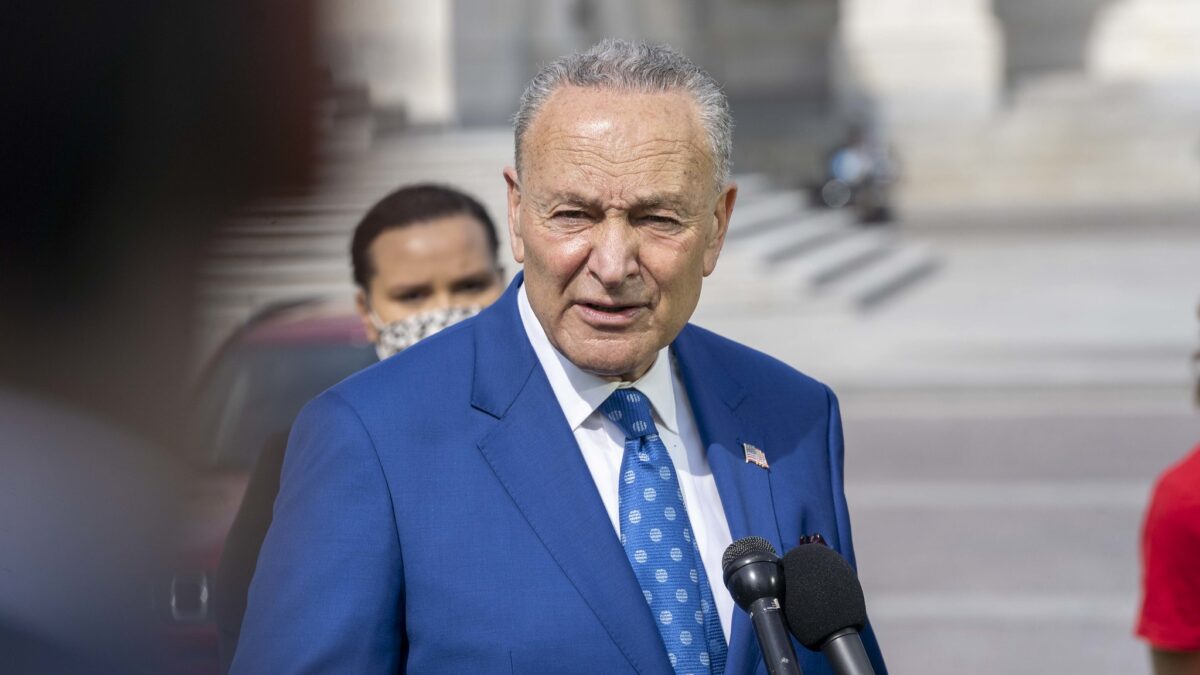
Chuck Schumer

Author Mollie Hemingway profile

MOLLIE HEMINGWAY

VISIT ON TWITTER@MZHEMINGWAY

MORE ARTICLES

Congress averted a government shutdown this weekend, agreeing to 45 days of funding to give members time to pass appropriations bills for the full year. Incredibly, Democrats seemed prepared to shut down the government over their desire for increases in Ukraine war funding. Republicans, by contrast, bucked Senate leader Mitch McConnell to keep the government open without such funding.

While shutdown battles have become common, this one had absurd moments. Democrats tried to delay votes with everything from “magic minutes,” which allow party leaders to speak at length, to Democrat Rep. Jamaal Bowman pulling a fire alarm in the middle of a vote, forcing the evacuation of a House office building.

With hundreds of Jan. 6 protesters facing excessive sentences, which Department of Justice prosecutors say is because they attempted to delay or obstruct an official congressional proceeding, some Americans began demanding the elected member of Congress be held to the same excruciating standard. Bowman, a former school principal, later claimed he didn’t understand how fire alarms work.

Even after the House passed the bill, Democrat Sen. Michael Bennet of Colorado further delayed the eventual passage by placing a hold on the bill. The procedural delays were partly a result of efforts to force a shutdown that could be blamed on Republicans. Conventional wisdom in Washington is that Republicans get blamed for government shutdowns regardless of who is responsible.

Democrats Willing to Shut Down over Ukraine

However, Democrats’ delays were also about a demand for additional Ukraine funding. Some Republicans, such as Senate Minority Leader Mitch McConnell, also want U.S. taxpayers to finance even more of the war against Russia, which has descended into an expensive quagmire.

“Despite nine months of bloody fighting, less than 500 square miles of territory have changed hands since the start of the year. A prolonged stalemate could weaken Western support for Ukraine,” reported The New York Times last week.

That’s exactly what has happened. Congress has approved around $113 billion in four rounds of funding. Many polls show significantly weakening support for additional funding. In fact, some 55 percent of Americans oppose additional funding, according to a poll from the left-wing media outlet CNN. That percentage goes up to 71 percent for Republicans. Additional funding for Ukraine is supported by 62 percent of Democrats, according to the poll. Incidentally, CNN joined other corporate media in suppressing discussion of these numbers during the weekend shutdown battle, which hinged on Ukraine funding.

“The press never even mentions that Ukraine war funding has become incredibly unpopular with actual Republican voters and an increasing number of independents,” one social media analyst noted. “It’s always framed on every network like some fringe position when it’s actually the majority of Americans.”

Democrats are enthusiastically adopting the Bush-era foreign policy of supporting lengthy U.S.-led wars with a tenuous or even deleterious effect on national security. These wars tend to have very little strategy other than avoiding quick resolution. Such long wars enable years or even decades of financing of the defense industry, which some Ukraine war supporters point to as a benefit for Americans. Democrats are even adopting the Bush-era claim that such wars need to be fought to advance “democracy.”

Partisan Divide On The Issue Rears Head

On Friday night, the lack of additional funding for Ukraine caused Senate Appropriations Committee Chairwoman Patty Murray, D-Wash., to object to Sen. Ron Johnson’s, R-Wis., request on the Senate floor to pass a clean two-week funding extension.

“The Dems are about to shut down the government over Ukraine. I actually can’t believe it, but here we are,” Sen. J.D. Vance, R-Ohio, said in a social media post.

The Senate then pushed a bill that would give an additional $6 billion to fund the proxy war against Russia in Ukraine. Speaker of the House Kevin McCarthy dismissed it out of hand and said the House would propose something instead. A few days prior, House Republicans were able to strip $300 million in Ukraine funding from a bill that was being debated.

Back in the Senate, McConnell failed to get fellow Republicans to sign onto his plan to force Ukraine funding instead of allowing House Republicans to work on a funding bill without it. Punchbowl’s John Bresnahan and Andrew Desiderio had perhaps the most intriguing reporting of the weekend with this vignette:
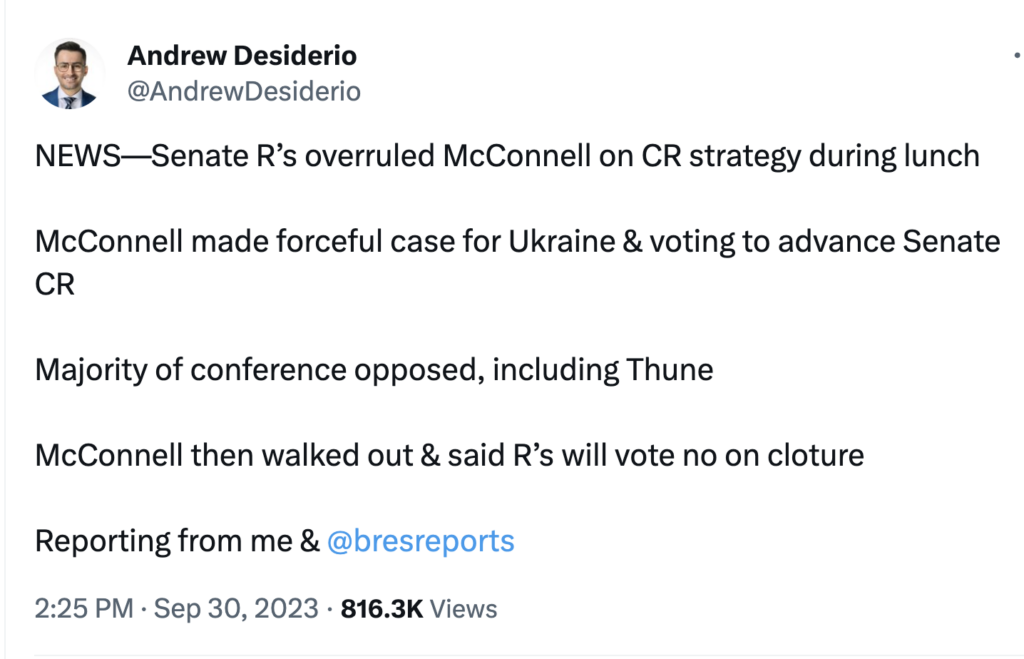
Senate sources said it was the first time they could remember that Republican senators didn’t seem to fear repercussions for disagreeing with McConnell, particularly on a prominent issue on which he’d staked out a clear position. It was unclear whether senators overruled McConnell because his mental and physical weakness has left him vulnerable or simply because they recognize how strongly Republican voters feel about funding an expensive war without a clear strategy for success.

House Democrats dug in, passing around a one-page sheet lambasting McCarthy for his continuing resolution, almost all of which focused on Democrats’ desire for U.S. taxpayers to finance the Ukraine war.

The Senate prepared to hotline, or fast track, their vote on the House bill that did not include war funding. That’s when Bennett held it up over the Ukraine issue.

The pressure for funding could not have been more intense. “Senior administration officials” pressured McConnell, saying that Ukraine could not be sustained without funding in this weekend’s bill.

“It’s rumored that Pentagon officials are on their way over to the Capitol to lobby for Schumer-McConnell. The Military Industrial Complex™️ doesn’t like to lose,” wrote Sen. Mike Lee, R-Utah, on Saturday.

Russia-collusion hoaxer Michael McFaul trotted out the same type of argument that has been used to bully Americans to stay in drawn-out wars for decades. “If the US pulls back on our support from Ukraine now, we radically diminish our credibility to deter a Chinese invasion of Taiwan,” he said.

Ukraine War Enthusiasts Pressure McCarthy

The Ukraine war enthusiasts only allowed the stopgap funding measure to proceed on the grounds they’d soon get a vote on whether to send another major aid package to Ukraine.

“We will not stop fighting for more economic and security assistance for Ukraine,” Schumer said.

“We cannot under any circumstances allow American support for Ukraine to be interrupted. I fully expect the Speaker will keep his commitment to the people of Ukraine and secure passage of the support needed to help Ukraine at this critical moment,” President Biden said in his announcement on the funding measure. He said he’d made a deal with McCarthy to vote on additional funding.

House Democrats said, “When the House returns, we expect Speaker McCarthy to advance a bill to the House Floor for an up-or-down vote that supports Ukraine, consistent with his commitment to making sure that Vladimir Putin, Russia and authoritarianism are defeated. We must stand with the Ukrainian people until victory is won.”

Nearly every Democrat and a fair number of Republicans want to continue funding the Ukraine war, despite the results of previous rounds of funding. They’ll likely succeed, but the vote will be harder.

Conservative Republicans such as Sen. Rand Paul, R-Ky., will be on guard. “When I said I’d do everything I could to stop the US government from being held hostage to Ukraine, I meant it. We cannot continue to put the needs of other countries above our own. We cannot save Ukraine by dooming the U.S. economy. I’m grateful to all Members of Congress who stood with me, but the battle to fund our government isn’t over yet — the forever-war crowd will return,” he wrote.

Democrats’ campaign strategy of emphasizing Ukraine war funding at a time of economic distress for many Americans will be interesting to watch.

Mollie Ziegler Hemingway is the Editor-in-Chief of The Federalist. She is Senior Journalism Fellow at Hillsdale College and a Fox News contributor. She is the co-author of Justice on Trial: The Kavanaugh Confirmation and the Future of the Supreme Court. She is the author of “Rigged: How the Media, Big Tech, and the Democrats Seized Our Elections.” Reach her at mzhemingway@thefederalist.com

Today’s TWO Politically INCORRECT Cartoons by A.F. Branco


A.F. Branco Cartoon – A Sight To See

A.F. BRANCO | on June 18, 2023 | https://comicallyincorrect.com/a-f-branco-cartoon-a-sight-to-see/

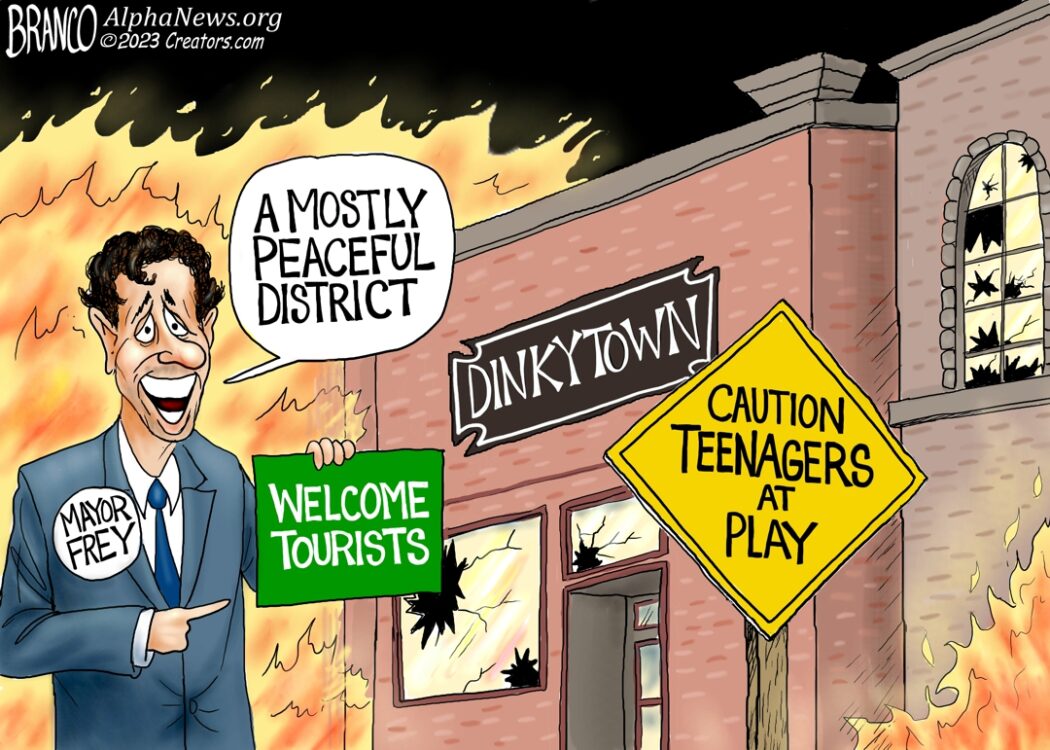
Teenage rage in Dinkytown but it’s mostly peaceful destruction and Mayor Frey won’t do a thing.

Dinkytown
Cartoon by A.F. Branco ©2023.

A.F. Branco Cartoon – Blood Money

A.F. BRANCO | on June 19, 2023 | https://comicallyincorrect.com/a-f-branco-cartoon-blood-money-2/

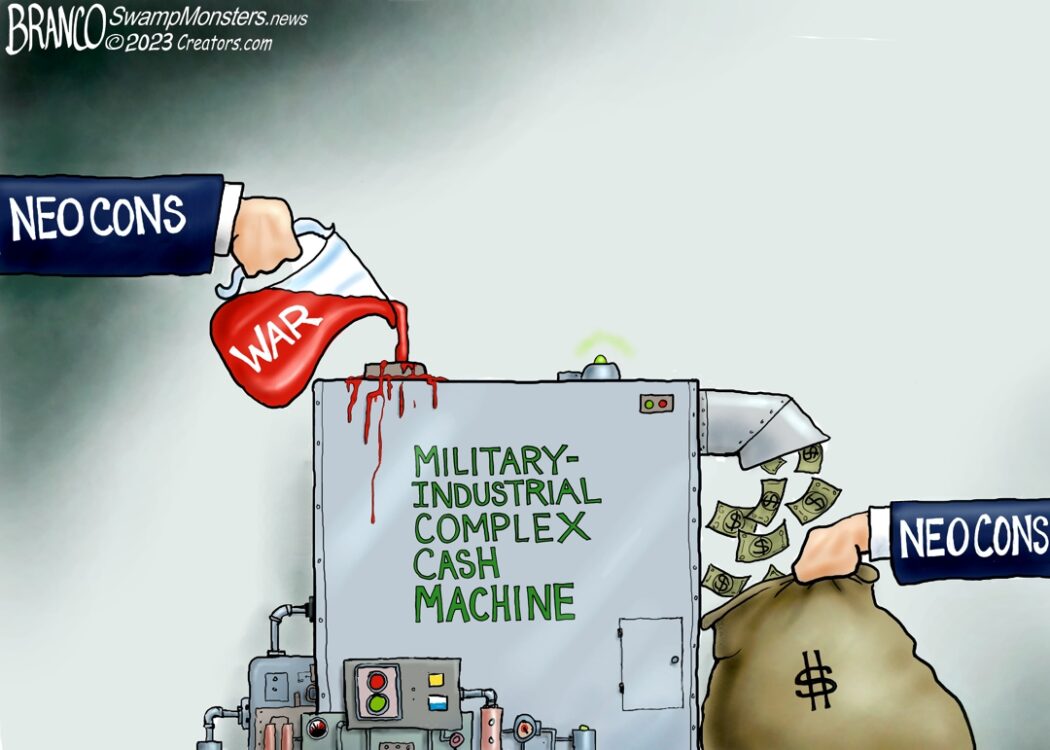
Warmonger NeoCons fuel the Military-Industrial Complex cash machine with endless wars.

Neocons Money Machine
Cartoon by A.F. Branco ©2023.

DONATE to A.F.Branco Cartoons – Tips accepted and appreciated – $1.00 – $5.00 – $25.00 – $50.00 – $100 – it all helps to fund this website and keep the cartoons coming. Also Venmo @AFBranco – THANK YOU!

A.F. Branco has taken his two greatest passions, (art and politics) and translated them into cartoons that have been popular all over the country, in various news outlets including NewsMax, Fox News, MSNBC, CBS, ABC, and “The Washington Post.” He has been recognized by such personalities as Rep. Devin Nunes, Dinesh D’Souza, James Woods, Chris Salcedo, Sarah Palin, Larry Elder, Lars Larson, Rush Limbaugh, and President Trump

JOHN DANIEL DAVIDSON Op-ed: The Culture War Isn’t The Most Important Issue Of 2024, It’s The Only Issue


JOHN DANIEL DAVIDSON | MAY 09, 2023

Read more at https://thefederalist.com/2023/05/09/the-culture-war-isnt-the-most-important-issue-of-2024-its-the-only-issue/

Trans protest

Author John Daniel Davidson profile

JOHN DANIEL DAVIDSON

VISIT ON TWITTER@JOHNDDAVIDSON

MORE ARTICLES

The more obvious it becomes that our domestic political struggles are actually part of a much larger spiritual war over the fate of western civilization, that we are today engaged not so much in a political fight as a religious battle between good and evil, the stronger the urge seems to be among Republican politicians to deny this reality and take refuge in the comforting political narratives of the past.

A perfect case in point was a tweet last week from Kari Lake’s permanent campaign, which managed in one fell swoop to channel the deeply misguided political analysis of the entire neocon Washington establishment: “No one is saying not to fight the culture war. But it’s simply not the most critical issue heading into 2024.”

“The GOP must show the country how it plans to turn the economy around & prevent World War 3,” she added. “We need to take this country back from @JoeBiden before we can take our culture back from his friends.”

Ah, yes. The comforting fiction that if we can just show voters how we plan to turn the economy around, surely then we’ll regain power, surely then we’ll have a mandate from the people — and then (and only then) we can “take our culture back.”

With apologies to Lake, who before the midterms seemed to have a bright political future in the emerging populist GOP, this is absolute nonsense. On the one hand, it’s a desperate cope, the embodiment of the stale, low-energy politics that have kept conservatives out of power in Washington for most of the last three decades. On the other, it’s a textbook neocon talking point, pretending the culture war is a distraction when in fact it’s the only war whose outcome really will decide the fate of our country.

Ironically, it’s also an example of the kind of politics that Lake herself purported to defy. She made a name for herself during the midterm cycle by taking on the political establishment and attacking the corporate media’s false narratives about 2020 and much else. Lake isn’t the politician you’d think would fall into this trap, yet she did. Why?

The best explanation has nothing to do with Lake in particular but with the tendency of all politicians to want to explain the problems we face and offer practical solutions. The economy is bad, here’s how we fix it. The cities are filled with dangerous lunatics, here’s how we make our streets safe again. The border is overrun with illegal immigration, here’s how we crack down and secure it.

Republicans are more naturally susceptible to this way of thinking because, unlike Democrats, they tend to be less rabidly ideological and less committed to fundamentally altering America and bringing about political and social revolution. But this way of thinking — that our most pressing problems just need common-sense policy fixes that normal people support! — is woefully inadequate for our current moment. 

Put simply, the big mistake in thinking the culture war isn’t the most critical issue heading into 2024 is that all of American politics is now one big culture war. The culture war is the only issue because the cultural war is everything now. When one side stakes its claim to political power on offering abortion up until birth and transgender operations for 8-year-olds, and holds out these policies as proof of its moral authority, we’re way past arguing over how to get the economy back on track. There’s no going back to that kind of politics.

Tucker Carlson hit on this at the end of his big speech at Heritage recently. He compared the values of the political left to the values of the Aztecs, who sacrificed children to their bloodthirsty gods — and he wasn’t wrong. Our politics, he argued, have shifted profoundly in a relatively short period of time. Instead of arguing over the best means to bring about an agreed-upon common good, we no longer agree about what the common good is. Forget about whether Republicans or Democrats are right about the ideal marginal tax rate. We can’t even agree on whether men and women exist as meaningful categories. And if we don’t get that question right, you can forget about economic prosperity, much less anything like a republic or a constitutional system of government. 

What the neocons and establishment politicians don’t seem to understand is that the culture war has become a grinding war of attrition that will end with the complete destruction of one side. There is no way to reconcile the vision of the common good espoused by the transgender movement, on the one hand, and orthodox Christians, on the other.

The culture war in America is not some luxury good that Republican politicians can sample now and then. It has consumed our politics by revealing deep, uncrossable chasms in our national life. So, we now find ourselves in a different kind of struggle. Call it a culture war, a religious war, a battle between good and evil, or all of the above. It’s a war for survival between two competing and irreconcilable visions of what America should be.

Any politician on the right that doesn’t understand that, who thinks we just need to show voters our plan for getting the economy back on track, needs to step aside and make room for leaders who know what time it is, that the hour is late, the day now far spent, and the time for fighting has come. The culture war is now the big tent. Those who embrace it, who delve into the fray without apology, will be the next crop of leaders on both the right and the left.

Keep this in mind as we march toward the 2024 election cycle. The cast of buffoons and egomaniacs on the Republican side will feature mostly candidates who don’t understand or don’t want to admit what’s happening. They will say things like, “No one is saying not to fight the culture war. But it’s simply not the most critical issue heading into 2024.” And when they say that, they’ll be doing you a favor. You can then safely ignore whatever else they say because you’ll know at that point they’re either a fool or a coward, and all they have to offer is defeat. 


John Daniel Davidson is a senior editor at The Federalist. His writing has appeared in the Wall Street Journal, the Claremont Review of Books, The New York Post, and elsewhere. Follow him on Twitter, @johnddavidson.

Washington Is Ramping Up Its Campaign to Draw NATO Into War With Russia


REPORTED BY: JOHN DANIEL DAVIDSON | MARCH 16, 2022

Read more at https://thefederalist.com/2022/03/16/washington-is-ramping-up-its-campaign-to-draw-nato-into-war-with-russia/

S300 missile system

By now it should be obvious that a concerted and bipartisan effort is underway in Washington to escalate U.S. involvement in the Ukraine war. This effort has been ongoing since the war began three weeks ago, but now it’s entering a new and dangerous phase. In a letter sent Tuesday to Secretary of Defense Lloyd Austin and Secretary of State Anthony Blinken, a half-dozen top Republican lawmakers called for the Biden administration to provide Ukraine with “Soviet- or Russian-made strategic and tactical air defense systems and associated radars to Ukraine.”

That means long-range surface-to-air missiles, like the Soviet-made S-300 system, which is designed to shoot down enemy aircraft and intercept ballistic missiles. Ukrainian President Volodymyr Zelenskyy has urged the United States to help Ukraine acquire S-300 air defense systems from countries that have them, like North Atlantic Treaty Organization (NATO) members Bulgaria, Greece, and Slovakia, and he might do so again on Wednesday when he addresses Congress.

In action, S-300 air defense systems look something like this:

The provision of such heavy weaponry to Ukraine, whether by the United States or our NATO allies, would represent an unprecedented level of direct military support for Ukraine that would undoubtedly — and rightly — be interpreted by Moscow as a sharp escalation by the West. 

Top Republican lawmakers, though, are undeterred by such concerns. The letter, signed by GOP Sens. James Inhofe, Marco Rubio, James Risch, and Reps. Mike Rogers, Michael Turner, and Michael McCaul, also calls for an array of other weapons to be sent immediately to Ukraine, including more Javelin antitank and Stinger antiaircraft missiles, which the United States has been providing to Ukraine in large quantities, as well as myriad small arms, ammunition, and other supplies.  It also calls for the delivery to Ukraine of Polish MiG-29 fighter jets “in the near term,” and for the United States to “re-engage Warsaw” on ways to backfill those aircraft. The Republican signatories then declare: “We encourage the department to re-evaluate the flawed conclusion that the transfer of these fighter jets to Ukraine would be ‘escalatory’ in comparison to the weapons systems that have already been delivered to Ukraine by the U.S. and our allies and partners.”

On the contrary, it would indeed be escalatory simply because the weapons that have already been delivered to Ukraine are nothing compared to, say, dozens of advanced fighter jets. Poland certainly considers such a course of action “escalatory.”

After all, the entire fighter jet transfer scheme was abandoned last week when Poland, responding to some loose talk from Blinken about giving a “green light” to the transfer, offered to deploy its MiG-29s to Ramstein Air Base in Germany and place them at the disposal of the United States. Poland was essentially asking the United States to bear the risks of sending fighter jets into Ukraine, which Moscow would almost certainly consider an act of war. The Biden administration, recognizing these risks, declined Poland’s offer.

None of this seems to daunt these Republican lawmakers, though. They seem to think we should press ahead and arm the Ukrainians with everything short of NATO soldiers and nuclear weapons. The idea of sending long-range surface-to-air missiles to Ukraine is essentially identical to the MiG-29 transfer idea: funnel advanced weapons systems to Ukraine but somehow maintain the fiction that the United States and NATO are non-belligerents. At some point, we will cross the line of belligerence, and whether and when we cross that line isn’t something we alone get to decide.

It’s not enough, as these GOP lawmakers are doing, to wave away the risks that such policies carry. Moscow clearly views this war as existential, and it will not simply allow NATO to funnel increasingly more powerful weapons into Ukraine. As I argued last week, this isn’t Afghanistan or Syria. Controlling Ukraine is central to Moscow’s conception of its national security, and it won’t simply walk away from this war without widening it first.

Lawmakers in Washington aren’t the only ones who refuse to see this. Open the editorial pages of the Wall Street Journal these days and you’ll see the same kind of hand-waving over the risks of escalation. On Tuesday, the Journal published an op-ed by Douglas Feith and John Hannah (along with a supporting editorial) that argued for a “humanitarian airlift” for Ukraine without acknowledging the risks involved.

What, exactly, would that look like? An international airlift, openly organized and funded by the United States, would “provide food, medicine and other nonmilitary supplies for days, weeks and maybe longer,” write Feith and Hannah, who both served as national-security officials in the George W. Bush administration. “Countries viewed as not hostile to Russia — perhaps Brazil, Egypt, India and the United Arab Emirates — could take the lead in flying planes into Ukraine.”

But since NATO and the United States aren’t willing to impose a no-fly zone (yet) it’s hard to imagine pilots from those non-NATO countries will be lining up to volunteer for the mission. What happens if they get shot down?

Feith and Hannah don’t say. Russian President Vladimir Putin, they argue, “would either consent and facilitate distribution of supplies or provoke more denunciations of Russia for its inhumanity.” Or he might shoot down a supply plane, launch a missile attack on the NATO airbase where the airlift is based, or do any number of things to widen the war in response.

Feith and Hannah, along with the Journal’s editorial board, make no serious attempt to grapple with the risks involved in such an operation, let alone the potential for rapid escalation once things go sideways. Like the aforementioned Republican lawmakers, they refuse to engage in even the most rudimentary risk analysis.

Why? One possible explanation is that perhaps the people making these arguments want the United States to get involved as a belligerent, and don’t really believe their hand-waving about the risks associated with their schemes. Feith and Hannah, for example, laughably assert that there is “little to no downside” to their proposal, which they also note “doesn’t preclude efforts to arm the Ukrainians better, or eventually to establish a no-fly zone, but because the airlift is far less risky it should be more readily doable.”

Well, yes, a humanitarian airlift into an active warzone is certainly less risky than a no-fly zone, which is indistinguishable from going to war with Russia, but that doesn’t mean it’s risk-free, much less prudent. But maybe that’s the point: dial up the risk and see what happens.

As the war in Ukraine stretches into its third week, with heavy Russian bombardment of Ukrainian cities intensifying and civilian causalities mounting, we’re going to hear more and more arguments out of Washington that the United States and NATO need to do more, that we can’t stand aside and let Putin do as he pleases in Ukraine. The people making these arguments will deny that their proposals for aiding Ukraine, however unprecedented, could risk escalation with or retaliation from Moscow. They will not even engage that question in good faith.

Instead, they will insist, with the force of what they believe is moral authority, that we keep plunging down a slippery slope that eventually leads to war between NATO and Russia — and that we do so without even acknowledging what we’re doing.


John Daniel Davidson is a senior editor at The Federalist. His writing has appeared in the Wall Street Journal, the Claremont Review of Books, The New York Post, and elsewhere. Follow him on Twitter, @johnddavidson.

Tag Cloud