Perspectives; Thoughts; Comments; Opinions; Discussions

Posts tagged ‘LONELINESS’

Casey Chalk Op-ed: A Church Without God Is Dead On Arrival


BY: CASEY CHALK | SEPTEMBER 15, 2023

Read more at https://thefederalist.com/2023/09/15/a-church-without-god-is-dead-on-arrival/

Unitarian Universalists

Author Casey Chalk profile

CASEY CHALK

MORE ARTICLES

We need a church for the nones, or Americans who say they don’t belong to a particular religion. That’s what The Washington Post’s Perry Bacon calls for in a much-ballyhooed column last month. “Start the service with songs with positive messages. … Reserve time when church members can tell the congregation about their highs and lows from the previous week. Listen as the pastor gives a sermon on tolerance or some other universal value, while briefly touching on whatever issues are in the news,” Bacon suggests. Sunday services would be supplemented by volunteer, community-service activities, he adds.

Bacon, who grew up evangelical, communicates a yearning felt by many Americans in this atomized age. Surgeon General Vivek H. Murthy, in a recent advisory titled “Our Epidemic of Loneliness and Isolation,” asserted: “Religious or faith-based groups can be a source for regular social contact, serve as a community of support, provide meaning and purpose, create a sense of belonging around shared values and beliefs, and are associated with reduced risk-taking behaviors.” Church, even our post-Christian culture can admit, is healthy for us. Sen. Chris Murphy, D-Conn., argued much the same in a June speech, citing the values of churches to address our “epidemic of loneliness” by giving us “connection” and “meaning.”

A church without God, prayer, or the Bible; a church for fellowship not faith, service not sacraments: that’s supposedly what lonely Americans need. Yet can such a civically focused ecclesial institution, or set of institutions, replace our increasingly empty (or repurposed) churches? In fact, they already exist, and have proved just as incapable of replacing the role vacated by that “old time religion.”

Mainline Protestantism Has Already Failed at Church Without God

Some have recommended Unitarian Universalism, which welcomes a wide diversity of religious (or areligious) beliefs as long as their adherents accept various mantras associated with the political left (e.g. “justice, equity and compassion in human relations”). Yet Bacon doesn’t like the fact that the Unitarian Universalist church remains predominantly white and elderly, and lacks activities for children. He also cites a 10-year-old organization called Sunday Assembly that has attempted to establish “nonreligious congregations” around the world, though the group, which promotes “wonder and good” and “celebrat[ing] life,” is attracting few followers.

But let’s be frank. We don’t need to look to secular simulacrums of Christianity to identify craven appeasements to the gods of progressivism. Liberal Protestants long ago capitulated to the gods of the left and are little more than mouthpieces for the Democrat Party. Sure, the “Seven Sisters of American Protestantism” — American Baptist Churches USA, Christian Church (Disciples of Christ), the Episcopal Church, Evangelical Lutheran Church in America, Presbyterian Church (USA), United Church of Christ, United Methodist Church — still profess to uphold biblical doctrines. But would any of these mainline Protestant churches really discipline a member (or even a clergyman) who confessed they didn’t believe in various creedal documents or, for that matter, even Scripture?

Mainline Protestant denominations — or what’s left of them — are swimming with those whose membership is often attributed to the very same things endorsed by Bacon, Murthy, and Murphy. According to Pew, only a little over half said religion was important to their life, about 20 percent prayed little to never, more than half barely ever read the Bible, and 20 percent didn’t believe or didn’t know if heaven existed. And yet, these “tolerant” and “diverse” denominations are hemorrhaging even their like-minded attendees, some losing almost half of their total membership in little more than a decade.

America’s Abandonment of Religion Is About Apathy and Addiction

And it’s not as if the nones are champing at the bit to join secular civic organizations that, denuded of any deity, prayer, or Scripture, still offer camaraderie and community service. Between 2019 and 2021, formal volunteer participation in America fell 7 percent — the largest drop that the U.S. Census survey recorded since it began tracking it in 2002. Covid didn’t help any, but this is not a new trend: Volunteerism has been declining for decades.

No, Americans are not just abandoning God, but each other, escaping into their smartphones and streaming entertainment. “Americans spend an average of 13 hours and 11 minutes a day using digital media,” Forbes reported earlier this year. It’s not only unbelief with whom churches must compete, but Apple, Amazon, and Netflix. Loving your neighbor or the Lord your God doesn’t offer the same dopamine rush as Facebook, Twitter, or Instagram, I’m sorry to say.

This is why a church for the nones is dead on arrival. The nones don’t want it, as even Bacon must admit. “But I’ve not followed through on any of these options,” he writes of trying to find a new “ecclesial” home. “With all my reservations, I don’t really want to join an existing church. And I don’t think I am going to have much luck getting my fellow nones to join something I start. My sense is that … those who aren’t at church are fine spending their Sunday mornings eating brunch, doing yoga or watching Netflix.” Americans are too disenchanted with an “intolerant” and “illogical” religion and too addicted to its chemical proxies to think an areligious alternative will satisfy the longings in their soul. Choosing church for its social utility, liberal pundit E.J. Dionne acknowledges in a recent WaPo column, is not a particularly strong draw.

Only God Can Save Us from Ourselves

More than 16 centuries ago, a North African intellectual and private tutor heard a child playing a game and, curiously, felt compelled to pick up a book of the writings of St. Paul the Apostle. Less than a year later, he was baptized a Christian in Milan, Italy. By the time of his death in A.D. 430, he was already recognized as a man of unparalleled intellectual and moral acuity, as he still is today, even by non-Christians. “You have made us for yourself, O Lord, and our hearts are restless until they rest in you,” St. Augustine wrote in his Confessions, one of the earliest (and greatest) spiritual autobiographies ever composed.

Only when Americans relearn that we are, above all else, made for God, will our personal health improve and our communities once more move with brilliant energy and excitement, unanticipated byproducts of passionately orienting our hearts and minds to the transcendent and its transformative demands. Until then, expect little from ham-handed attempts to fashion church (and spirituality) to our personal preferences and peccadilloes. As a young Augustine himself learned, all that resides in such vain efforts is vapid self-worship.


Casey Chalk is a senior contributor at The Federalist and an editor and columnist at The New Oxford Review. He has a bachelor’s in history and master’s in teaching from the University of Virginia and a master’s in theology from Christendom College. He is the author of The Persecuted: True Stories of Courageous Christians Living Their Faith in Muslim Lands.

Benevolent Tyranny: US Senator Announces New Epidemic, Nanny State Solution


By Norman Leahy | July 26, 2023

Read more at https://americanliberty.news/commentary/benevolent-tyranny-us-senator-announces-new-epidemic-nanny-state-solution/nleahy/2023/07/

The federal government has a long, expensive habit of trying to be our national nanny.  From dictates on how much water flows through our showers, toilets and dishwashers, to how much meat we should eat and steps we should take, there are few areas of life where government doesn’t butt-in to make matters worse for everyone.

Which brings us to Connecticut Sen. Chris Murphy‘s proposal to do something about the “loneliness epidemic.”

Yes, the government believes loneliness is a public health crisis in need of attention. But at least the Surgeon General’s office doesn’t call for legislation and spending to addressing the problem. Instead, it suggests a series of cost-free (to taxpayers)  options for individuals:

  • Make time to share a meal. Listen without the distraction of your phone. Perform an act of service. Express yourself authentically.

Setting aside what, exactly, that last item means, Sen. Murphy is determined to side steps the warm fuzzies, and make this a government matter:

  • The National Strategy for Social Connection Act would create an Office of Social Connection Policy within the White House to work across federal agencies to develop effective strategies for improved social infrastructure and issue national guidelines for social connection similar to existing guidelines on sleep, nutrition, and physical activity. It would also provide funding for the Centers for Disease Control and Prevention (CDC) to better understand the epidemic of social isolation and loneliness.

Considering government’s track record for making sure we all eat, sleep and exercise right, the only possible outcome of a loneliness czar will be…a loneliness plague.

Underlying Murphy’s thesis for state action, however, is a disturbing embrace of collectivism over individual achievement. As Murphy and Harvard’s Richard Weissbourd wrote in Time Magazine, the big bad behind the loneliness epidemic is…too much individualism:

  • Much has been written about why we tipped toward ourselves over the last several decades. The villains in this story include declines in religious participation and social outings and clubs, fueled in part by television, which keeps us at home. Workplaces also became more focused on profit than on employee well-being and solidarity, and we started lionizing those who stepped over others to get ahead. While those people always existed in society, they were usually identified and treated as outliers that needed to be constrained, not as examples of American greatness.

“Outliers that needed to be constrained…” Sorry, Og: this so-called “wheel” you’ve invented is just too dangerous to the health and well-being of our cozy cave dwelling community. Into the pit with you…

And as for what government power can do to reknit the fabric of American life, Murphy and Weissbourd wrote that the state should, once it’s finished roughing-up the social media companies, dragoon the young into service:

  • Expand..national service programs…bringing young people together from various backgrounds to work on common causes, creating ties across the usual divides and strengthening young people’s commitment to their country.

In other words, bring back a version of the old military draft. Because noting says “togetherness” like sacrificing your time and talent to government. On pain of fines and imprisonment for not cheerfully agreeing to do so.

I would suggest Murphy and his fellow nannies stick to their knitting: addressing the federal budget, finding ways to deal with the debt and deficit, and keeping a close eye on world events.  And leave the rest of us alone to sort out friendship, family and community on our own terms.

ABOUT THE AUTHOR Norman Leahy

Norman Leahy has written about national and Virginia politics for more than 30 years with outlets ranging from The Washington Post to BearingDrift.com. A consulting writer, editor, recovering think tank executive and campaign operative, Norman lives in Virginia.

To Address the Loneliness Epidemic, the Feds Want to Control Your Town and Friends


BY: STELLA MORABITO | MAY 30, 2023

Read more at https://thefederalist.com/2023/05/30/to-address-the-loneliness-epidemic-the-feds-want-to-control-your-town-and-friends/

person walking in park, lonely

Author Stella Morabito profile

STELLA MORABITO

VISIT ON TWITTER@STELLA_MORABITO

MORE ARTICLES

U.S. Surgeon General Vivek Murthy recently released an advisory titled “Our Epidemic of Loneliness and Isolation.” It warns that social isolation is a major public health problem. The 81-page document presents six government-directed “pillars” of action to address the health hazards of social isolation.

On the surface, these six directives may look innocuous, but they present a clear and present danger to the autonomy of our private lives and relationships. The project is potentially so massive in scope that it’s not an overstatement to say it threatens to regulate our freedom of association in ways we never could have imagined.

Let’s look in greater depth at those pillars and the risks they pose.

‘Building a Social Infrastructure’

The first stated goal is to “strengthen social infrastructure in local communities.” It defines “social infrastructure” as the regular events and institutions that make up community life, and says the federal government should both fund local organizations and direct how they’re structured, including their locations. This can only mean that all local communities must answer to the federal bureaucracy in the quest to strengthen social connections among people.

Social infrastructure, the report says, includes physical parts of a community, such as housing, libraries, parks and recreation spaces, transport systems, and so forth. The report expresses concern that some people have better access to such locations than other people, and recommends federal interventions.

Those are likely to be used to promote densified housing along the lines of the “15-minute city” (more accurately termed 15-minute ghettoes), as well as the eventual dismantling of single-family housing. The goal of replacing private vehicles with public transportation fits easily into this scheme too.

I don’t presume that this plan will, by itself, drive wholesale changes in our physical infrastructure. But it would certainly provide authority and justification for changes supported by radical environmentalists, all of which diminish our freedoms.

The advisory warns that participation is mandatory if the plan is to work: “It will take all of us — individuals, families, schools, and workplaces, health care and public health systems, technology companies, governments, faith organizations, and communities — working together…”

The report’s proposed infrastructure to solve the problem of social isolation seems designed to lock everybody into compliance with and dependence upon federal mandates. Local control is then lost.

We end up with a massive federal infrastructure that can monitor the levels of social connection and disconnection in every nook and cranny of society. As described in the report, this would mean every institution, every governmental department, every volunteer association, every locality, every church, every faith community, every organization, every club, every service club, every sports league, and so on, would likely be assessed and “strengthened” to promote social connection.

‘Enact Pro-Connection Public Policies Everywhere’

According to the second pillar, “Government has a responsibility to use its authority to monitor and mitigate the public health harm caused by policies, products, and services that drive social disconnection.” How will these be tracked and mitigated? It “requires establishing cross-departmental leadership to develop and oversee an overarching social connection strategy. Diversity, equity, inclusion, [DEI] and accessibility are critical components of any such strategy.”

In other words, some people are more socially connected than others, and that’s not fair. They enjoy benefits — as in “unearned privileges” — that put others at a disadvantage. So, the government needs to intervene for the sake of equity to “spread the wealth” of social connections.

DEI is a creature of identity politics, which serves to erase human individuality and replace it with demographic identity markers that label people as either oppressors or victims, thus cultivating more resentments and hostilities in society. By injecting the codes of DEI into all social relationships, we’re bound to become even more divided, alienated, and lonely. And the federal government is bound to become even more authoritarian and meddlesome in our personal relationships and social interactions.

‘Mobilize the Health Sector’

Another threat to the private sphere of life comes under the directive to “mobilize the health sector” by expanding “public health surveillance and interventions.” This sounds very much like tracking your social connections and intervening when the bureaucracy deems it necessary. Big Brother sitting in on your doctor visits and therapy sessions?

The report indicates that health care workers will be trained to track cases of what the government views as social connection and disconnection. As they obediently report to the federal bureaucracy, most individual and local control will be lost. Medicine is bound to become more federalized and less private than ever when answering to these mandates.

Consider also that mental health practitioners are already suggesting that signs of racial or cultural bias should be classified as a mental illness.

Consider also that mental health practitioners are already suggesting that signs of racial or cultural bias should be classified as a mental illness. “

Of course, to the promoters of DEI, all white people are inherently racially biased, simply because of their skin color. This brings to mind the disturbing practice in the Soviet Union of consigning political dissenters to psychiatric treatment. The official line was that you must be mentally ill if you disagree with communism.

‘Reform Digital Environments’

The advisory recognizes that overuse of the internet and social media can drive people deeper into social isolation. But it also promotes centralized government control over technology development, especially in human interactions: “We must learn more by requiring data transparency from technology companies,” it says. So, government would decide how to design and use such technologies. It would very likely compel technology companies to provide data to the government on Americans’ social connections.

The advisory also backs the “development of pro-connection technologieswith the goal of creating “safe” environments and “safeguarding the well-being of users.” Such phrasing has been used in recent years to justify censorship under the guise of protecting certain demographics.

In light of the importance of DEI to the overall strategy, this sounds ominously like a call for further “protection,” i.e., government control of the private sphere. Again, the primary director of all these remedies is the federal bureaucracy, not a trusted family member, friend, pastor, or neighbor.

‘Deepening Our Knowledge’

The fifth pillar of the advisory pushes a “research agenda” that enlists all “stakeholders” — that means every level of government, every organization, every corporation, every school, every family, every individual — to deepen their knowledge about social connection and disconnection. Of course, the advisory has already predetermined the outcome of much of this research, and we can be reasonably confident this research will reflect the outlook offered by the advisory. After all, that’s how researchers get grants and research contracts.

I imagine institutions will publicize their “studies” through a media monopoly that promotes the preferred narrative on what kinds of relationships we should have, what we can and can’t talk about. Essentially, we’ll get a flood of government propaganda about their preferences for human relationships.

In the context of today’s censorship regime, this means promoting a single narrative that will drown any competing views offered by critics and the public with the favored views of government and corporate interests, parroted endlessly by Big Media.

‘Cultivate a Culture of Social Connection’

Finally, the advisory advocates for cultivating “a culture of connection,” one based on “kindness, respect, service, and commitment to one another.” This sounds lovely, doesn’t it? Unfortunately, our government’s relentless push for woke policies tells us that we cannot expect to understand those terms as traditional virtues.

Rather, such terms will likely be used in woke Orwellian fashion, to direct our social interactions and behaviors. For example, not dating a transgender person is now labeled unkind and “transphobic.” “Gender affirming care” — i.e., castration and mutilation of children — is the only “respectful” way of treating gender dysphoria. Your “responsibility” is to comply without question.

The advisory also calls for the media and the arts to promote stories that encourage “connection,” most likely in the Orwellian sense that wokeness demands. Further, the report cautions that certain kinds of social connection are harmful for individuals and society. It warns that too much like-mindedness can lead to extremism and violence.

We should be very skeptical of the federal government’s role in deciding which groups it deems acceptable, given its growing politicization of law enforcement, its attempts to silence concerned parents at school board meetings by labeling them “domestic terrorists,” and its overall undermining of due process and the Bill of Rights.

The Historical Pattern of Big Government Is Atomization, Not Social Connection

Ironies abound in this advisory. The pretext for government injecting itself into our personal lives is to rescue us from the misery of our loneliness epidemic. Never mind that government policies are largely to blame for family breakdown, welfare dependency, urban blight, attacks on free speech, attacks on privacy, and countless other developments that result in an acute sense of isolation and polarization.

Never mind that the proven prescription for loneliness is the opposite: a private sphere of life where intact families raise their children with a sense of virtue; where institutions of faith give people a sense of order and purpose in life; and where friends can confide in one another without meddlers eavesdropping on their conversations. This sphere of life — the private sphere — is the fount of freedom, love, and trust that nurtures social connections. It can only thrive in privacy.

But this private sphere seems to be in the crosshairs of Murthy’s massive government project to “fix” the social connections of all Americans. The government will doubtless enlist a media monopoly and Big Tech for support in monitoring those connections.

Given the current direction of this administration’s policies, it will also deploy heavy-handed political censorship — of which Murthy already proved a huge fan during Covid — to enforce compliance and punish dissent. Such censorship heightens the fear of speaking openly, which only builds more walls between people. Ironically, we would end up more atomized than ever.

The Tentacles of Bureaucracy

This may sound over the top to a general reader who may find the advisory benign and even welcoming, and perhaps just a narrowly focused plan to address a recognized health issue.

I am very skeptical about that for two reasons. The first is the natural inclinations of bureaucracies populated by “experts.” Bureaucracies never shrink. They continuously bloat. That’s the nature of the beast. Their protectors keep pushing their relevance on some issue or problem. Their experts — who will always “know better” than anyone else — will present solutions to be deployed by the bureaucracy. Compliance will then be demanded. And the bureaucracy will continue to bloat until its tentacles strangle every area of life.

The second reason for skepticism is history, which is filled with examples of governments invading the private sphere of life, specifically the institutions of family, faith, and community. That private sphere is still the most decentralized area of life, the one in which individuals are most able to think and speak freely, unless the government invades. Communist China, the Soviet Union, and Nazi Germany are prime examples in the 20th century of government invading the private sphere.

Eminent sociologist Robert Nisbet wrote about the deep-seated tendency of governments to hijack the functions of the mediating institutions of family, faith, and community. When the government takes over those functions, we lose those institutions as buffer zones between the isolated individual and the all-powerful state. We become powerless in the resulting isolation.

Nisbet posed this rhetorical question: “What remains then, but to rescue the masses from their loneliness, their hopelessness, and despair, by leading them into the promised land of the absolute, redemptive State?”

I believe the surgeon general’s advisory vindicates Nisbet’s point. Indeed, the state creates the malady and then offers its authority as the only cure as it rushes into the vacuum. The strategy for doing so seems evident in the report’s “six pillars.”

Where Does It All End?

No one can say for sure where this “Ministry of Loneliness” proposal will end up. History — particularly recent history — has warned us about such projects. The goals of this advisory may seem unobjectionable, but the concern is about who decides how we connect socially.

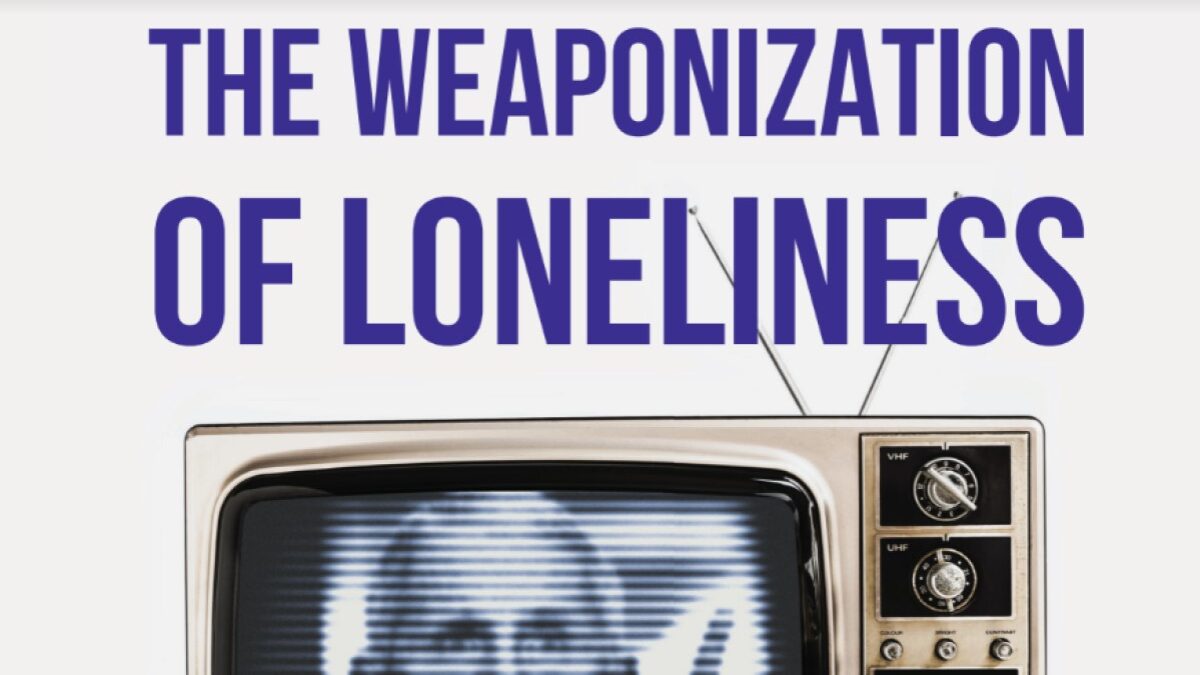
When the “who” is the federal government, we should remember that the pattern of the mass state is always to induce loyalty to the mass state. That pattern always comes with a push to surrender our loyalty to one another as individual human beings capable of real kindness and real love. That amounts to something I call the weaponization of loneliness.

We must insist on making our own decisions to live as free individuals. That means pushing back in any way possible against potential intrusions in the private sphere of life. It means rejecting the pseudo-intimacy and pseudo-connection that our federal government seems intent on foisting upon us in exchange for control of our private lives and relationships. Otherwise, we end up in much worse isolation that renders us powerless and unfree.


Stella Morabito is a senior contributor at The Federalist. She is author of “The Weaponization of Loneliness: How Tyrants Stoke Our Fear of Isolation to Silence, Divide, and Conquer.” Her essays have appeared in various publications, including the Washington Examiner, American Greatness, Townhall, Public Discourse, and The Human Life Review. In her previous work as an intelligence analyst, Morabito focused on various aspects of Russian and Soviet politics, including communist media and propaganda. Follow Stella on Twitter.

To Stop Totalitarianism, We Must Understand How It Weaponizes Loneliness


BY: STELLA MORABITO | OCTOBER 12, 2022

Read more at https://thefederalist.com/2022/10/12/to-stop-totalitarianism-we-must-understand-how-it-weaponizes-loneliness/

Weaponization of Loneliness
Victory in the war against tyranny depends more than anything else on understanding how imposed loneliness works on our psyches.

Author Stella Morabito profile

STELLA MORABITO

VISIT ON TWITTER@STELLA_MORABITO

MORE ARTICLES

The following is an excerpt from the author’s new book, “The Weaponization of Loneliness: How Tyrants Stoke Our Terror of Isolation to Silence, Divide, and Conquer.” (Bombardier Books, Post Hill Press.)

Revolutionary elites who push utopias are always a small minority. In order to get all of society on board, they must enlist mobs to promote the illusion of compliance with their visions. Mobs enforce the narrative, often through violence. They help censor any competing views through intimidation and various forms of book burning.

We ought to study how radical utopian revolutions got a foothold in the past in order to better understand the 21st-century incarnation. Mob action was a major catalyst for the French Revolution, accelerating Maximilien Robespierre’s brutal dechristianization campaign and Jacobin revisions of history. Private life came under direct attack after Russia’s Bolshevik Revolution. Those attacks reached terrifying new heights during Stalin’s Reign of Terror.

Identity politics and pseudoscience played out to a gruesome degree during Adolf Hitler’s Third Reich, causing intense hostilities in the society. And American immigrants from communist China can recall the cruel legacy of mob-led struggle sessions during Chairman Mao Zedong’s Cultural Revolution. Some have publicly expressed alarm at seeing similar dynamics develop in their adopted homeland.

But many who sense the brewing of a totalitarian revolution in the 21st century are puzzled because it doesn’t appear to have a central operator. Yes, there remain many dictators on the world stage, as always. But there is no single figure like Hitler, Lenin, Mao, Robespierre, or even Oliver Cromwell, who has been at the center driving all the changes. There has been no single nation-state leading the charge. No specific revolutionary party. No one corporation giving directives to all.

Rather, it all seems more hydra-headed, coming from all directions and from many different sources with seemingly different interests. Indeed, Big Tech selectively bans political speech on social media platforms like Facebook. Twitter even suspended the account of a sitting U.S. president. Big Media is a mammoth propaganda operation with little actual news reported. Financial institutions became more apt to regulate the donations of their customers, some eager to freeze bank accounts of citizens they deem politically incorrect.

Then there’s the World Economic Forum, whose founder Klaus Schwab has incessantly spoken and written about a “Great Reset,” which would lead to a more centrally controlled social order of the entire world. Over the years Schwab groomed a coterie of young leaders, including Prime Minister of Canada Justin Trudeau and Prime Minister of France Emanuel Macron, who cooperate to establish such an order.

The 2020s also opened with more federal judges blatantly legislating from the bench, more military officers requiring recruits to be indoctrinated in woke ideologies, medical organizations promoting vaccine mandates, and more pediatricians endorsing hormone regimens and genital surgeries on children without parental consent. Meanwhile, academia continued its war on freedom of expression, and K–12 educrats grew increasingly hostile to the parents of the children they supposedly teach.

People felt gut-punched by so many unexpected invasions of privacy and attacks against free speech in a nation trusted to protect it. How did so much sudden disregard for due process arise, so little regard for reason and reality? And from so many different places?

It’s All Tied Together by the Machinery of Loneliness

Although all these developments have come at us from different directions, they have a machinery in common. The common denominator of such revolutions past, present, and future is the weaponization of loneliness. All its features pit people against one another. All were at work in various ways in past revolutions of modern history. And all result in our further atomization, our further separation from one another.

The most critical features are the forces of identity politics, political correctness, and mobs. Identity politics is clearly meant to divide us into hostile groups, such as oppressor and victim, based on race or sex or any other demographic grouping. Political correctness induces us to self-censor, which means we drive ourselves into further isolation by limiting our exchanges with others to avoid the risk of social rejection. Mobs then serve as agitation forces that push propaganda into action. They intimidate others into silence and compliance and finally can cause any agenda—no matter how fringy—to become policy.

Another way to think about the machinery is as a combustion engine that can’t operate without ignited fuel. The fuel is our conformity impulse, and the spark is our fear. Without them, the machinery of loneliness simply can’t operate. So if we cannot shake off our conformity impulse and fear of isolation, we will remain self-silenced, isolated, and obedient to the mob. We will end up lonelier, more exhausted, and conditioned to repeat the cycle.

There Is Hope

The good news is that there is a wealth of neglected research on these matters of social psychology. We need to make that research common knowledge by discussing it often. In the 1950s, psychologist Solomon Asch conducted experiments on the conformity impulse. Later, Asch’s student Stanley Milgram studied the pattern of obedience to malevolent authorities.

In 1960, acclaimed Nobel laureate Elias Canetti produced his classic study on the behavior of mobs, “Crowds and Power.” In 1957, Vance Packard published his explosive bestseller “The Hidden Persuaders,” which explored the uses of depth psychology by advertisers to manipulate people’s desires and fears.

Eminent psychiatrists like Margaret Thaler Singer and Robert Jay Lifton investigated the practice of coercive thought reform. Singer analyzed cult dynamics that led nearly a thousand people in Jonestown, Guyana, to commit “revolutionary suicide” at the order of Jim Jones in 1978. The term “Stockholm syndrome” had already come into circulation to describe the phenomenon of captives bonding with their captors.

Even earlier, however, scholars were reflecting on the dynamics of mobs, including Gustave LeBon, who in 1895 published “The Crowd: A Study of the Popular Mind.” And early in the 20th century, Italian Marxist Antonio Gramsci theorized that the power of culture, especially as expressed through modern communications, shaped social attitudes far more effectively than any appeal to economic interests.

In the 1930s, the neo-Marxists of the Frankfurt School accepted and applied Gramsci’s theory. We can see it in today’s aggressive media campaigns, the shift to “social justice” action in academia, and Big Tech’s censorship of dissenting views.

The key ingredient of groupthink has always been the fear of social isolation, which leads us to be swept up by propaganda. It’s a fear so pervasive that—like fish in water—we are rarely aware of the effect it has on us.

We can see how this phenomenon worked in totalitarian societies like Stalin’s Soviet Union or Nazi Germany, where people betrayed neighbors and even family members to avoid becoming “nonpersons” in society. The great irony here is that by breaking bonds of family and friendship, people only dig themselves in deeper. They cement their dependency on the state while also helping the state destroy the private sphere of life, which is their only path to escape and resistance.

Hence, totalitarians have always targeted the private sphere of life for destruction. The rallying cry “Abolish the family!” comes straight from “The Communist Manifesto.” Nothing could be more alienating to a human being than to be deprived of healthy familial bonds. The ramifications are vast because strong communities depend upon strong families.

Tyrannical systems also seek to abolish traditional religions and the fellowship of the faithful. Opportunities for such societal breakdown today have accelerated as never before. In the extremist reaction against the Dobbs decision, we saw how state and corporate actors supported by media propaganda can promote an antifamily ethos that produces atomization.

How Tech Tears Us Apart

The machinery of loneliness is running in high gear due to the revolution in communications technologies. This revolution handed us each a “device” that draws us into the web of the internet, often in literally hypnotic fashion. The seduction is so powerful that one can reasonably ask if the endgame is a vast hive mind.

The technological media constantly distract us, prod us, probe us, and flood us with suggestions. We each end up knowing a whole lot less about a whole lot more. At the same time, we become increasingly disconnected from real life among our flesh-and-blood brethren.

Communications professor Marshall McLuhan famously warned in 1964 that electronic media acts within each of us as an extension of our central nervous system. We may think we are gleaning the medium for content, but any content is incidental to the real message. The real message, he insisted, is in the medium itself, which rewires us neurologically. As we allow our devices to pull us into the cyberworld, we become isolated by detaching ourselves from the real world.

When we delve into the internet or connect to our devices, we are not consumers. Rather, we are products—raw material for advertisers— as we let the whole world know what we like and what we don’t like, who we know, where we are located, our habits, our dreams, our desires.

We may offer such data in a quest to be connected with others. But we don’t realize how that information is also pure gold for developers of artificial intelligence who can use it to develop algorithms that predict and modify our behaviors, and even program behaviors into us that actually isolate us further. No medieval wizard or alchemist could have imagined such a boon for his designs or such an infrastructure to empower him.

People are now more easily separated through social pressures that involve shunning and vilification, often magnified through propaganda that is exponentially amplified through Big Tech and Big Media. In the meantime, all these drivers of social decay result in institutional decay, which further contributes to a dangerous state of atomization. The subversion of education is key because education is upstream from all the other institutions, including our legislatures, courts, media, the arts, the corporate world, finance, medicine, and even the military.

Once that “march through the institutions” is complete, then the primordial institutions that shelter our private lives—family, faith, and community—are set to come under direct attack. So if our isolation continues unchecked, it easily becomes a tool to dismantle freedom, no matter the intentions of those who act to dismantle it. Nothing is left but the vast mass state directing the lives of individuals, all virtually separated from one another.

Victory in the war against tyranny depends more than anything else on understanding how imposed loneliness works on our psyches and how it is an indispensable tool of totalitarianism. Once comprehended, we can begin to neutralize its effects and defend ourselves against its inherent machinery.


Stella Morabito is a senior contributor at The Federalist. She is author of “The Weaponization of Loneliness: How Tyrants Stoke Our Fear of Isolation to Silence, Divide, and Conquer.” Her essays have appeared in various publications, including the Washington Examiner, American Greatness, Townhall, Public Discourse, and The Human Life Review. In her previous work as an intelligence analyst, Morabito focused on various aspects of Russian and Soviet politics, including communist media and propaganda. Follow Stella on Twitter.

The Only Way to Fight Disinformation Is to Fight Political Censorship


REPORTED BY: STELLA MORABITO | APRIL 18, 2022

Read more at https://thefederalist.com/2022/04/18/the-only-way-to-fight-disinformation-is-to-fight-political-censorship/

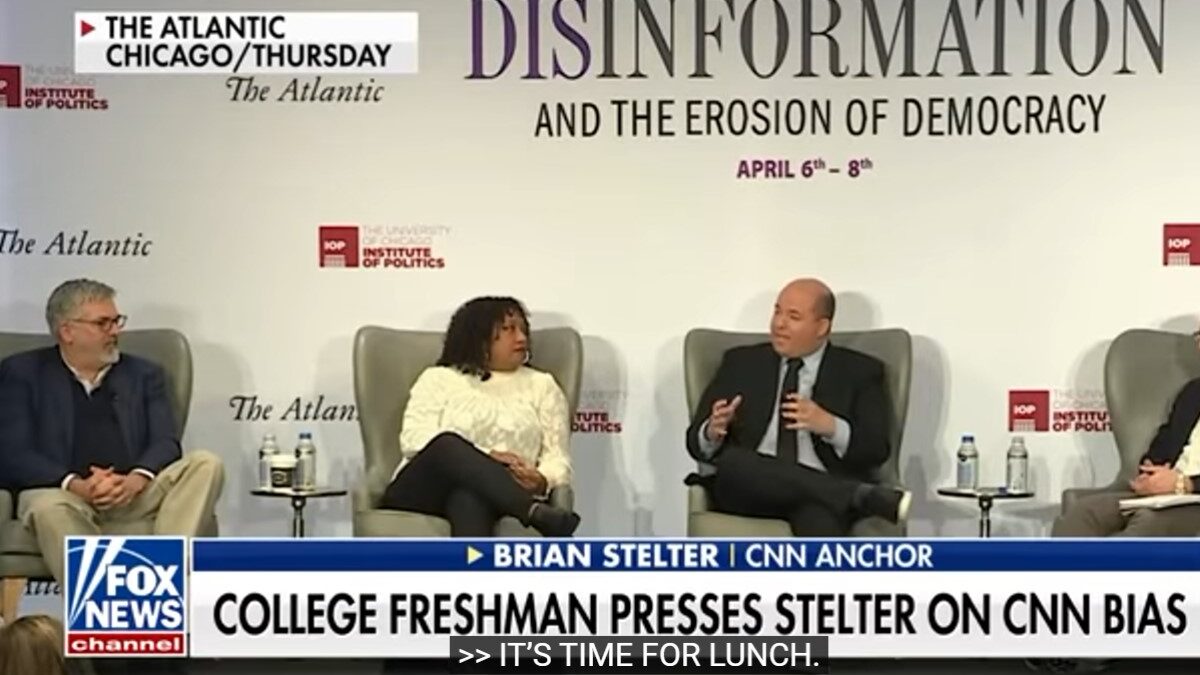
Chicago Disinformation Conference

The surest way to kill a democracy is to practice political censorship under the guise of protecting society from disinformation.

Author Stella Morabito profile

STELLA MORABITO

VISIT ON TWITTER@STELLA_MORABITO

MORE ARTICLES

If outfits like the Aspen Institute’s Commission on Information Disorder,” along with Big Tech’s faceless “fact-checkers,” ever get a total monopoly on dictating reality, the result will be a 24/7 mix of falsehoods with the occasional limited hangout to cover up their lies. The icing on this fake cake is the use of conferences about disinformation, such as the recent stunt at the University of Chicago that served as cover for justifying political censorship. There former President Obama presented the perfect picture of psychological projection: a panel of propagandists accusing others of wrongthink.

The Atlantic’s Anne Applebaum, for example, sought to censor the reality of the Hunter Biden laptop scandal by announcing she didn’t find it “interesting.” See how that works? Truth depends upon how our elites personally feel about what should be true. But it gets much worse, because political censorship creates deep dysfunction in society. In fact, the surest way to kill a democracy is to practice political censorship under the guise of protecting society from disinformation.

Censorship causes disinformation. It’s the grandaddy of disinformation, not a solution to it. The sooner everyone recognizes this obvious fact, the better off we’ll be. Whenever a self-anointed elite sets up a Ministry of Truth, the link between censorship and disinformation becomes clear. Before long, they invent reality and punish anyone who expresses a different viewpoint.

So, it’s no small irony that those who claim to be protecting “democracy” from disinformation are the biggest promoters of disinformation and greatest destroyers of real democracy. Their dependence on censorship obstructs the circulation of facts. It prevents any worthwhile exchange of ideas.

Unchecked Censorship Isolates People

Consider what happens if a society is only permitted one propagandistic narrative while all other ideas and information are silenced. People start self-censoring to avoid social rejection. The result is a form of imposed mental isolation. Severely isolated people tend to lose touch with reality. The resulting conformity also perpetuates the censorship. This is unnatural and dangerous because human beings depend on others to verify what’s real. People weren’t able to verify reality in Nazi Germany, during Joseph Stalin’s Reign of Terror, or during Mao Zedong’s brutal Cultural Revolution. All were societies in the grip of mass hysteria because of ruthless censorship to protect a narrative.

As psychiatrist Joost Meerloo noted in his book “The Rape of the Mind,” no matter how well-meaning political censorship might be, it creates dangerous conformity of thought: “the presence of minority ideas, acceptable or not, is one of the ways in which we protect ourselves against the creeping growth of conformist majority thinking.”

The only way we can strengthen ourselves against such contagion is through real freedom of speech that allows fully open discussion and debate. However, if we’re confined by Big Tech to a relentless echo chamber and punished for expressing different thoughts, we’ll just keep getting more and more disinformation. In fact, we are now drowning in the distortions produced by “fact-checkers.” Take, for example, narratives that promote the gender confusion and sexualization of children. Public school teachers routinely post TikTok videos of themselves spewing forth their gender confusion. And if someone calls out Disney for its open grooming of children, Twitter suspends them.

If we never push back against such absurdities, we ultimately end up in a state of mass delusion, each of us a cell in a deluded hive mind, obedient to commands about what to say, how to act, and what to think. To get an idea of what that looks like in a population, check out this clip from North Korea:

Censorship-Invoked Social Contagion Is Real

One of the most telling incidents of censorship over the past year was YouTube and Twitter’s take-down of virologist and vaccine inventor Dr. Robert Malone, claiming he was “spreading misinformation”—i.e., spreading a second opinion—about Covid vaccines and treatments. But big tech saw an even bigger threat in Malone’s discussion of Mattias Desmet’s study of Mass Formation Psychosis (MFP) on Joe Rogan’s popular podcast. This is a big reason Spotify was under pressure to de-platform Rogan entirely. Open discussion of such things would erode the illusions big media and big tech so doggedly prop up.

Malone explained how a propaganda-saturated population can end up in a state of mass hypnosis that renders people incapable of seeing reality. He described Desmet’s theory about how social isolation, a high level of discontent, and a strong sense of free-floating anxiety are keys to the development of this psychosis.

The anxiety is so painful that it causes people to cling, trancelike, to any narrative that seems to offer stability. Once all other views are censored, people become so invested in the narrative that they cannot consider any alternative views. They will even mob anyone who endangers the narrative. This phenomenon was prevalent in the German population under Nazism. Their obedience to the propaganda rendered them incapable of understanding any opposing narrative.

Mass psychosis should not sound farfetched. There’s nothing new about it. Hundreds of instances of mass hysteria are documented. In the 19th century, Scottish journalist Charles MacKay wrote up a whole catalog of them. In 2015 medical sociologist Robert Bartholomew co-authored a compendium of popular delusions or “mass sociogenic illness.”

Most past incidents of mass hysteria have been confined to geographic regions, such as the witch trials in 17th century Salem, Massachusetts. But with the internet accessible and addictive in the 2020s, the possibility of mass delusion on a global scale is upon us. Censorship—in the name of protecting “democracy” from disinformation—is the key to creating it.

Propagandists Guard Their Illusions Like Magicians

By definition, propaganda aims to psychologically affect people and change their attitudes. So, our social survival depends upon becoming aware of such phenomena. Building self-awareness about our vulnerability to crowd psychology would serve as a sort of psychological vaccine. Of course, elites do not want us even entertaining the possibility that we can be manipulated or vulnerable to social and psychological pressures. Propagandists are illusionists by nature. If their illusion falls apart, then the game is over for them. This is why they depend so heavily on the slur “conspiracy theorist” to distract us from the truth and from their use of censorship to cut us off from other ideas.

The late Nobel laureate Doris Lessing spoke against the dangers of social conformity and censorship in 1986. She noted there was a great body of knowledge that was continuing to be built about the laws of crowd psychology and social contagion. It was odd that we weren’t applying this knowledge to improve our lives. Lessing concluded that no government in the world would willingly help its citizens resist group pressures and learn to think independently. We have to do it ourselves. Fast forward to the twenty-first century, and it sure looks like the keepers of this secret knowledge use it as a means of social control.

No sane person would want to live inside the boxes that the censors who claim to be fighting disinformation are building around us. If we want to escape this Twilight Zone existence, we must destroy that canard and insist on real freedom of speech everywhere.


Stella Morabito is a senior contributor at The Federalist. Her essays have also appeared in the Washington Examiner, American Thinker, Public Discourse, Human Life Review, New Oxford Review. In her previous work as an intelligence analyst, she focused on various aspects of Russian and Soviet politics, including communist media and propaganda. She has also raised three children, served as a public school substitute teacher, and homeschooled for several years as well. She has a B.A. in journalism and international relations from the University of Southern California and a Master’s degree in Russian and Soviet history, also from USC. Follow Stella on Twitter.

Tag Cloud