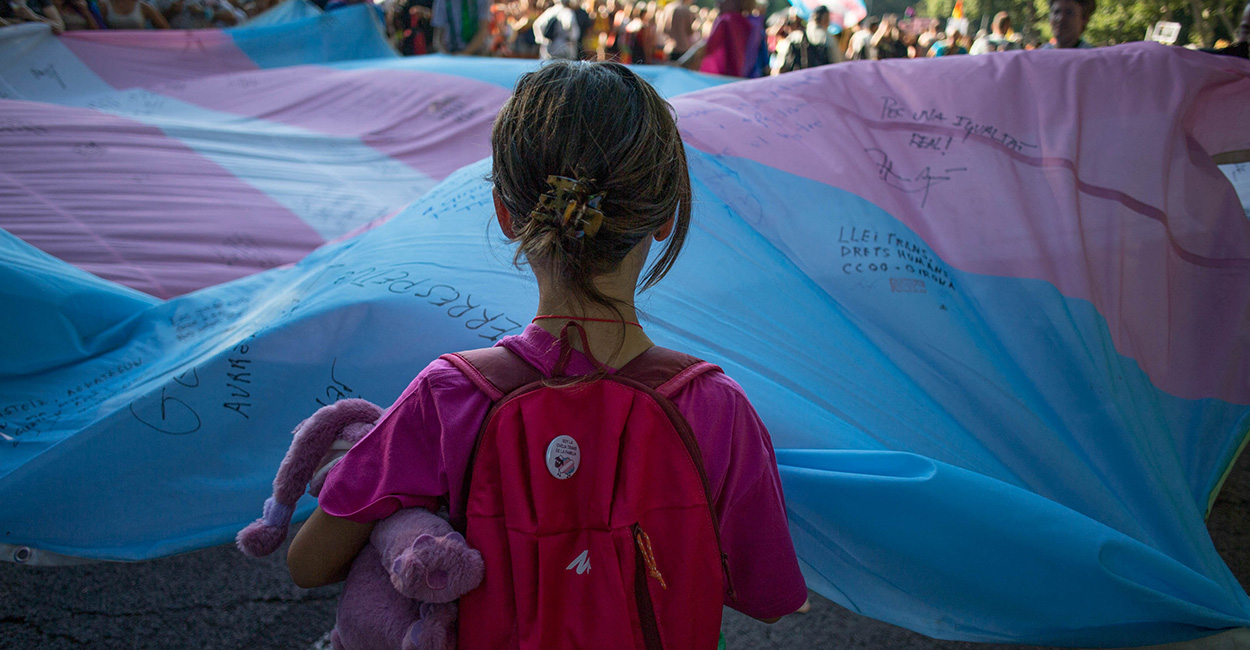
Kathy Grace Duncan lived as a man for 11 years before she decided to detransition. She joins “The Daily Signal Podcast” to share her story. Pictured: A girl holds the Transgender Pride flag during the pride march in Madrid, Spain on July 9, 2022. (Photo: Luis Soto/SOPA Images/LightRocket/Getty Images)
As a little girl, Kathy Grace Duncan watched her father abuse her mother and vowed she would never be victimized like her mom.
Duncan realized she would grow up to be a woman and did not want to be “weak,” so she says she “made a vow at a very early age, ‘I’m going to be the man my dad is not.’”
For Duncan, it was a five year journey to go through the “detransitioning process, and that was undoing the thinking that being a woman is bad, that I’m not safe, that I’ll be hated, that I’m vulnerable,” she says.
Virginia Allen: I am so pleased to have with me in studio today two amazing women from the CHANGED Movement, Kathy Grace Duncan and back with us is Elizabeth Woning. Thank you both so much for being here today.
Elizabeth Woning: It’s a privilege to be here.
Allen: I want to take a moment just to talk a little bit about what CHANGED Movement is. For those that haven’t heard our previous conversations, that aren’t familiar with the amazing work you-all do, just give us, in a nutshell, your heart, what your mission is.
Woning: Well, CHANGED came together in 2018 out of some bad legislation in California that would have limited resources for people who are questioning their sexuality.
And so the other co-founder, Ken Williams, and I, we were doing ministry. We’re both pastors in Northern California. We thought, “This is a bad idea,” since both of us have come out of LGBT ourselves, to limit the kind of resources that are available for people, particularly if they’re leaving LGBT culture and want to follow Christ.
So we started speaking up and out of that. Then this strange new organic grassroots movement started to form. We met hundreds at that point of people who had left LGBT just like we had.
Ken and I both are married to opposite-sex spouses. We no longer identify as gay. We’ve experienced really dramatic transformation in our lives. Ken has four kids. He and his wife Tiffany have four kids. And so with that, we see that, I would say, justice for the LGBT community, in our opinion, is restoration. True justice is restoration. And so we do what we can now.
So out of that legislation, this movement formed that we called CHANGED, because as we were in committee hearings and sharing how the Lord had changed and impacted our lives, as you can imagine, the legislators in California kind of looked at us like we had three heads. And so we thought, “What can we do?” And at one point we’re driving back to Northern California out of Sacramento and Ken said, “We need a book.”
And so we formed this book of testimonies. This would’ve been the kind of resource banned by this legislation. We provocatively called it “CHANGED” because we really wanted to bring the point forward that people leave LGBT all the time, and you just never hear about those people. So we created this book, and that kind of became a sensation and it formed this movement that we now call CHANGED.
We have a ministry side that helps equip pastors and leaders to better address the needs of those who are following Christ away from LGBT culture, but then also continue in the advocacy space. Because increasingly, avenues away from LGBT culture are closing. I mean, I could go so far as to say it’s becoming illegal to get help, to get support, even to hear the Gospel if you identify as LGBT.
And so we want to be in that advocacy space, protecting free speech and First Amendment rights, freedoms of conscience, freedom to pursue professional therapy even. That’s who we are at CHANGED. That’s what we’re doing.
Allen: Well, it’s a powerful space to be in. Kathy Grace, you have such a profound story that has impacted so many lives, both through CHANGED and through sharing your story on so many platforms. Let’s go all the way back to the beginning and walk through your story. What was your childhood like? When did you begin to start questioning your own sexuality and questioning your own identity?
Kathy Grace Duncan: Sure. It was like before I went to kindergarten. So ages 3 and 4, I already felt that I was born into the wrong body, that I should have been born a boy. So that was kind of my start in life, if you will.
My childhood, the house I grew up in, it was pretty dysfunctional. My dad was emotionally and verbally abusive to my mom, and my mom was the victim.
Now, at that age, I didn’t have the tools to realize that my dad was abusive, my mom’s a victim. So my takeaway from that was that women were weak, women were vulnerable, and women were hated. And realizing I’m a girl, I’m going to grow up to be a woman, I don’t want to do that. But yet I don’t want to be that man my dad is, so I made a vow at a very early age I’m going to be the man my dad is not.
So that’s how I saw life through that: If I grow up, I’m going to be this, so I’d rather be a man instead. I didn’t become a man because I wanted to date women or anything like that. It was, I was running from pain. I didn’t want to be hated, vulnerable, or weak from those lies.
Allen: How old were you when you started telling people, “I’m a man,” and living essentially as a man, dressing like a man?
Duncan: When I was 19, I became desperate. Throughout my whole childhood, that was my secret. I didn’t tell anybody. And then at the age of 19, I was desperate. So I moved out of the house, changed my name, started hormones, and started living as a man.
Allen: What was the response of people around you? Also, set the context of, around what year was this?
Duncan: Sure. So, it was early ’80s, so it was definitely frowned upon and very unknown. You were basically looked at as being really weird. My whole goal was to have a normal life. And to me, that was normal.
I didn’t tell anybody when I changed. I moved in with a single-parent woman and I didn’t tell her anything. I presented already as a man on hormones, and then I told them that the hormones was to help me because I had a pituitary issue. So I told a lot of white lies to cover up what I was doing. But again, it was out of desperation.
Allen: And how long did you live as a man?
Duncan: I lived as a man for 11 years.
Allen: When did you start thinking, “OK, this isn’t ‘fixing it’”? Or when did you kind of begin to feel just like, “Wait a second, I’m not sure that this was what I wanted or that this is the answer”?
Duncan: I actually didn’t ever question. I think that’s because my mind was so set at a very early age. I thought, “This was it. This was the goal.” But it was probably about four years before I came out of the lifestyle I started opening my heart and my life everywhere to the Lord. He had called to me and said, “Will you now?” And I said, “Yes,” because there wasn’t any reason why I couldn’t.
And so I started following him and looking for him, and I was going to be everywhere where he was. And at the end of that four-year period, I’m still serving in the church as a man.
Allen: And your community sees you completely as a man?
Duncan: Correct. And at the end of that, I was confronted by the church. They said, “Hey, we’re hearing some rumors about you. We just want to know who are you? Who are you really?” And it was at that point I confessed, “I’m a woman living as a man.” Which I didn’t believe that before, so it was the four years of the Lord working in my heart where I came to that place. When I confessed that, I encountered the Lord. He blew into me and I realized then I have to go back to being the woman he created me to be.
Allen: That’s a huge “yes” after 11 years. The Lord takes you on this four-year journey. What was that process then of detransitioning and saying again, “I’m a woman and I’m going to live and present as a woman”?
Duncan: Sure. So, there was five years that I went through the detransitioning process, and that was undoing the thinking that being a woman is bad, that I’m not safe, that I’ll be hated, that I’m vulnerable. So it’s undoing those things and embracing being a woman is good, and I was created on purpose for a purpose, and we have an intentional God.
And so, again, just embracing those things, figuring out that I’m safe, I’m OK, and figuring out how do I embrace being a woman and how do I cast off being a man? It’s like taking off the old, putting on the new.
I have to say, the first time I ever wore a dress, I was paralyzed. I felt like I was supposed to, but I went into the women’s bathroom and I couldn’t come back out. I’m like, “They’re going to think I’m weird.”
I was a fundraiser for this ministry I was a part of. And the executive director’s wife come in and she’s like, “So what are you doing here?” Because I’m just sitting there. She’s like, “What are you doing in here?” And I’m like, “I’m terrified. I can’t go out there.” She goes, “Come on and I’ll go with you.” And then it was, after that, I was like, “OK, this isn’t quite as bad as what I first feared.”
Allen: When you think back to yourself as a young child, that 3-, that 4-year-old who was in that place of struggle, you were watching what was happening to your mom and thinking, “I don’t want to be victimized,” what were the resources that now as an adult you can think back and say, “This is what I needed. This is what little Kathy Grace needed. And for any child who’s experiencing gender dysphoria, this is what they need”?
Duncan: Well, I think, first of all, to have intentional parents. To look at, “We’ve got this little girl who’s struggling.” And even though I may not have been showing it, I still needed to be loved. I still had needs that were going unmet. My mom wasn’t very nurturing. And so it’s looking for my parents to go, “You love me,” and to nurture me up as a little girl. For my dad to say, “You’re my beautiful little girl.”
So for parents to begin to instill that in their kids at a very early age because they’re making up their mind about who they are, even at 3 and 4.
And other resources than that, maybe teachers. Teachers looking at that, going, “You know, this little girl, she’s quite a tomboy. I’m just going to kind of watch her.” But as far as other resources like that, I didn’t have any.
Allen: For both of you, please feel free to jump in on this, what are the psychological resources that today are available, specifically for young people who are struggling with their gender identity? What is out there that they can access and what are the major holes that you-all still see in this realm?
Woning: There’s so many. There’s so many. One of the things that is true today is, Kathy Grace has reflected for years on her childhood. Like, “How did this happen?” But even so, even what she knows about her childhood and even what that can tell us about children today who are experiencing dysphoria, the phenomenon that we’re seeing today is new of young children, especially young girls, believing that they’re boys and moving in the trajectory of transitioning into what they perceive to be masculinity or manhood in droves, seeking mastectomies and hysterectomies to transition. This is a new phenomenon that has never happened before.
Now, the tomboy phenomenon has been around, I think, probably forever—not just because girls might have some kind of emotional distress, but because of developmental factors in their bodies. Actually, young girls who might be 5, 6, 7 have a lot of testosterone in their bodies at that time. And so their developing body can influence that.
But so the phenomenon we’re seeing today is so new. It’s very poorly studied. There’s very little expertise speaking to gender dysphoria generally. If you look across the LGBTQ world, the transgender population is very small in percentage comparison to the population of the LGB population. It is very small. It’s kind of a very unique population, maybe even much more marginalized than the LGB population historically. And so there’s just not as much known about that experience.
So then fast forward to today where we’ve got conversion therapy bans, therapy bans that basically say, “No one can change. Your sexuality is determinative.” Based on those perspectives, the belief that the dysphoria, like, for example, you could be born a female with a male brain, those kinds of perspectives, which are completely untrue, are being considered as possible.
And so we’re in this interesting time where something new is happening. The psychological world, particularly the American Psychological Association and the American Psychiatric Association, largely only affirms LGBT identity. They don’t favor moving backward. There are a lot of reasons for that, in part because the experience is itself so distressing. But then on top of that, because of activism.
So young children today, the resources available are very limited. I can say that there is a very, very great need for American culture to step back and say, “What are the ethics of affirming LGBT identity in a prepubescent child?”
And then understanding that sexual behavior for a prepubescent child, whether you perceive it to be same-sex sexuality like a gay behavior, or whether it’s cross-gender behaviors, is signaling something that’s going wrong. It’s signaling a misperception about yourself, or a trauma response to some pressure that’s happening. And instead of resolving the trauma, we’re medicalizing the trauma for what we perceive to be a trans-identifying child and never treating the psychological distress.
And so like Kathy Grace said, coming into this meeting, what we’re facing isn’t the development of a transgender movement as much as it is a mental health crisis that we’re witnessing and we’re completely ill-equipped to address because of our affinity for LGBT activism, just with the psychological world, our agreements in that realm, lack of understanding of the whole LGBT experience, and then lack of understanding of childhood development.
Duncan: I would just add to that by saying, coming out of that, when I was detransitioning, I didn’t look at that I lived as a man or now that I need to live as a woman. It’s why I lived as a man that helped me to deconstruct that, if you will, and move forward into living as a woman. And realizing that it’s not a sexual issue, it’s relational issues. All the things that I worked back through was rejection, abandonment, and abuse, which are all relational issues—you know, broken relationships. And there was unmet needs that I was trying to get met by living as a man as well.
Allen: As you worked through that, the care that you were receiving, the counseling, would some of that now be illegal today in certain states like California?
Duncan: Yeah, it would be.
Allen: Kathy Grace, it’s been about 25 years, right? Since you detransitioned?
Duncan: Thirty.
Allen: Thirty, OK. So as you work with detransitioners and folks who are wanting to come out of that lifestyle, what are some of the most common reasons that you hear from people as to why they’re making that choice of, “Now I want to live according to my biological sex”?
Duncan: Well, there’s a few. I work with a lot of Christians, and they come out because they’ve encountered the Lord. They’ve asked the Lord, or they’ve began to question, and so they take it to the Lord, “I am not sure this is right,” and the Lord affirms that.
I even had one detransitioner tell me, she was talking to the Lord saying, “I’m not sure. Do you want me to go back to being a woman? Should I still live as a man?” And the Lord said to her, “Well, what name do you want me to call you?” And I was like, “Oh, that’s kind of powerful and convicting.”
And then there’s been those who I’ve talked to who do not know the Lord and they’ve come out because they have gone off of social media. They’ve stopped TikTok, Reddit, Facebook. They’ve stopped listening to the narrative. Once they’ve cleared their mind, they’re like, “No, I want to be a woman. I want to go back.”
Allen: That’s powerful.
Duncan: Yeah, I was amazed by that. The thing that’s amazing to me too is when they get away from that narrative, they go back to how God designed them to be, whether they know it or not.
Allen: I want to encourage all of our listeners to visit your website, which is CHANGEDmovement.com. You can find the book there, so many powerful stories of lives that have been transformed, and learn more about the advocacy work that you-all are doing. So again, the website is CHANGEDmovement.com. But Kathy Grace, Elizabeth, thank you both so much for your time today.
Woning: Thank you very much.
Duncan: You’re very welcome.






 What Did You Say?
You must be logged in to post a comment.