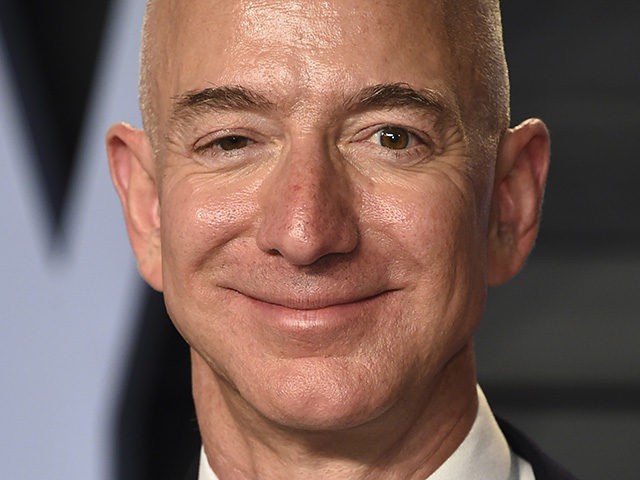
Bravo, Mr. Bezos: Post Owner Calls for Newspaper to Champion Individual Freedom and Free Markets
By: Jonathan Turley | February 27, 2025

There was another meltdown at the Washington Post after owner Jeff Bezos moved again to moderate the newspaper’s message, which has plummeted in readership. Bezos told the editors that he wanted the newspaper to advocate for individual liberties and the free market. The message sent the left into vapors and led to the resignation of Washington Post opinion editor David Shipley. Outside the paper, another round of calls for boycotts and subscription cancellations followed.
In the announcement below, Bezos declared, “I’m confident that free markets and personal liberties are right for America. I also believe these viewpoints are underserved in the current market of ideas and news opinion. I’m excited for us together to fill that void.”
He added that a newspaper should be a voice for freedom — “is ethical — it minimizes coercion — and practical — it drives creativity, invention, and prosperity.” He noted that:
“There was a time when a newspaper, especially one that was a local monopoly, might have seen it as a service to bring to the reader’s doorstep every morning a broad-based opinion section that sought to cover all views. Today, the internet does that job.”
For those of us in the free speech community, the return of the Post as a champion of free speech and other individual rights would be a welcomed change. Notably, staff did not object when prior owners aligned with their views on editorial priorities. Obviously, we will need to see how this new directive is carried out. I would be equally opposed to the Post purging liberal views in the way it moved against conservative and libertarian views for the last decade. I do not see such a directive in this announcement. Bezos wants his newspaper to be a voice for individual freedom and free market principles. That should not mean that the newspaper will not run any dissenting views on policies and programs. It does mean that the newspaper will continue to be an outlet for voicing extreme views calling for the curtailment of free speech and other individual rights.
What is striking is that many on the left expect Bezos to run the newspaper like a vanity project, losing millions of dollars to bankroll a far-left agenda. This is an announcement that goes to the position of the newspaper, not any intrusion into reporting. It also does not bar a diversity of opinion on the op-ed pages which still have a vast majority of liberal writers.
The thought that the Post would now focus on advocating for individual rights and the free market led Jeffrey Evan Gold, who posts as a legal analyst for CNN and other networks, to declare that it was the “last straw” and post his cancellation.
Jeff Stein, the publisher’s chief economics reporter, denounced Bezos as carrying out a “massive encroachment” that makes it clear “dissenting views will not be published or tolerated there.” For many moderates and conservatives, it was a crushingly ironic objection given the virtual purging of conservative and libertarian voices at the newspaper.
Amanda Katz, who resigned from the Post’s opinion team at the end of 2024, offered a vivid example of the culture that Bezos is trying to change at the Post. Katz said the change was “an absolute abandonment of the principles of accountability of the powerful, justice, democracy, human rights, and accurate information that previously animated the section in favor of a white male billionaire’s self-interested agenda.”
Just as a reminder, Bezos simply stated that the newspaper would advocate for freedom and free markets. However, the most telling condemnation came from Post columnist Philip Bump, who wrote “what the actual f**k.” Not surprisingly, Bump wrote the condemnation on Bluesky, a site that promises a type of safe space for liberals who do not want to be triggered by opposing views.

Bump previously had a meltdown in an interview when confronted about past false claims. After I wrote a column about the litany of such false claims, the Post surprised many of us by issuing a statement that it stood by all of Bump’s reporting, including false columns on the Lafayette Park protests, Hunter Biden’s laptop, and other stories. That was long after other media debunked the claims, but the Post stood by the false reporting.
We have previously discussed the sharp change in culture at the Post, which became an outlet that pushed anti-free speech views and embraced advocacy journalism. The result was that many moderates and conservatives stopped reading the newspaper.
In my book on free speech, I discuss at length how the Post and the mainstream media has joined an alliance with the government and corporations in favor of censorship and blacklisting. I once regularly wrote for the Post and personally witnessed the sharp change in editorial priorities as editors delayed or killed columns with conservative or moderate viewpoints.
Last year, that culture was vividly on display when the newspaper offered no objection or even qualification after its reporter, Cleve Wootson Jr., appeared to call upon the White House to censor the interview of Elon Musk with former President Donald Trump. Under the guise of a question, Wootson told White House Press Secretary Karine Jean-Pierre that censoring its leading political opponent is “an America issue.”
During a press briefing, the Washington Post’s Cleve Wootson Jr. flagged the interview and said, “I think that misinformation on Twitter is not just a campaign issue…it’s an America issue.”
There was a time when a reporter calling for censorship of a political opponent would have been a matter for immediate termination in the media. Instead, the newspaper that prides itself on the slogan “Democracy dies in Darkness,” was entirely silent. No correction. No qualification.
The call for censorship for disinformation is ironic given the Post’s publication of a series of false stories and conspiracy theories. When confronted about the columnist’s demonstrably false statements, the Post simply shrugged.
The Wootson controversy was consistent with the embrace of advocacy journalism at the Post. We previously discussed the release of the results of interviews with over 75 media leaders by former executive editor for The Washington Post Leonard Downie Jr. and former CBS News President Andrew Heyward. They concluded that objectivity is now considered reactionary and even harmful. Emilio Garcia-Ruiz, editor-in-chief at the San Francisco Chronicle said it plainly: “Objectivity has got to go.”
The former Post editor, Downie, recounted how news leaders:
“believe that pursuing objectivity can lead to false balance or misleading “bothsidesism” in covering stories about race, the treatment of women, LGBTQ+ rights, income inequality, climate change and many other subjects. And, in today’s diversifying newsrooms, they feel it negates many of their own identities, life experiences and cultural contexts, keeping them from pursuing truth in their work.”
The decline of the Post has followed a familiar pattern. The editors and reporters simply wrote off half of their audience and became a publication for largely liberal and Democratic readers. In these difficult economic times with limited revenue sources, it is a lethal decision.
Robert Lewis, a British media executive who joined the Post earlier this year, reportedly got into a “heated exchange” with a staffer. Lewis explained that, while reporters were protesting measures to expand readership, the very survival of the paper was now at stake:
“We are going to turn this thing around, but let’s not sugarcoat it. It needs turning around,” Lewis said. “We are losing large amounts of money. Your audience has halved in recent years. People are not reading your stuff. Right. I can’t sugarcoat it anymore.”
Other staffers could not get past the gender and race of those who would oversee them. One staffer complained, “We now have four White men running three newsrooms.” The Post has been buying out staff to avoid mass layoffs, but reporters are up in arms over the effort to turn the newspaper around.
So, let’s recap: The Washington Post’s owner has been pushing the newspaper to shift back toward the middle and restore greater balance on its pages. He is unwilling to bankroll a far-left echo chamber of advocacy journalism. Washington Post opinion editor David Shipley resigned in protest rather than agree to emphasize individual rights and free markets in editorials that speak for the newspaper.
Shipley previously fought to reverse Bezos’s decision not to endorse presidential candidates in 2024 or later elections. Some of us have long argued that newspapers should end such endorsements as inimical to journalistic neutrality and objectivity. The editors reportedly encouraged Bezos that, if he wanted to end such endorsements, he should wait until after endorsing Harris in this election cycle — a remarkable position devoid of any cognizable or controlling principle.
There was a time when advocating for editorials to champion freedom would not have been controversial. The staff’s hyperventilation only reinforces the need for such an intervention. These same voices supported the Post adopting “Democracy dies in Darkness” to oppose what they viewed as an attack on democracy from Trump or the right. However, advocating for freedom in editorials is simply unacceptable.
Perish the thought that a newspaper would commit itself to advocating for individual rights and the free market. (Warning foul language below)
Perhaps the Post could adopt a new slogan: “Freedom dies in Silence.”
Here is the announcement from Jeff Bezos:
I shared this note with the Washington Post team this morning: I’m writing to let you know about a change coming to our opinion pages.
We are going to be writing every day in support and defense of two pillars: personal liberties and free markets. We’ll cover other topics too of course, but viewpoints opposing those pillars will be left to be published by others.
There was a time when a newspaper, especially one that was a local monopoly, might have seen it as a service to bring to the reader’s doorstep every morning a broad-based opinion section that sought to cover all views. Today, the internet does that job.
I am of America and for America, and proud to be so. Our country did not get here by being typical. And a big part of America’s success has been freedom in the economic realm and everywhere else. Freedom is ethical — it minimizes coercion — and practical — it drives creativity, invention, and prosperity.
I offered David Shipley, whom I greatly admire, the opportunity to lead this new chapter. I suggested to him that if the answer wasn’t “hell yes,” then it had to be “no.” After careful consideration, David decided to step away. This is a significant shift, it won’t be easy, and it will require 100% commitment — I respect his decision.
We’ll be searching for a new Opinion Editor to own this new direction. I’m confident that free markets and personal liberties are right for America. I also believe these viewpoints are underserved in the current market of ideas and news opinion. I’m excited for us together to fill that void.
Jeff
Jonathan Turley is the Shapiro professor of public interest law at George Washington University and the author of “The Indispensable Right: Free Speech in an Age of Rage.”





 What Did You Say?
You must be logged in to post a comment.