As the House voted Thursday to bar foreign nationals from voting in local Washington, D.C. elections, Democrats and their public-relations team in the corporate media have rolled out the big guns in attacking such election integrity efforts. They’re painting the legislation that ensures noncitizens cannot vote in elections as the next so-called “Big Lie,” sticking to their well-worn narrative that noncitizens already are prohibited from voting in U.S. elections and that such violations “don’t exist.”
But one of the fiercest opponents of the election integrity legislation has said the quiet part out loud, as Democrats are wont to do.
‘Alien Suffrage’
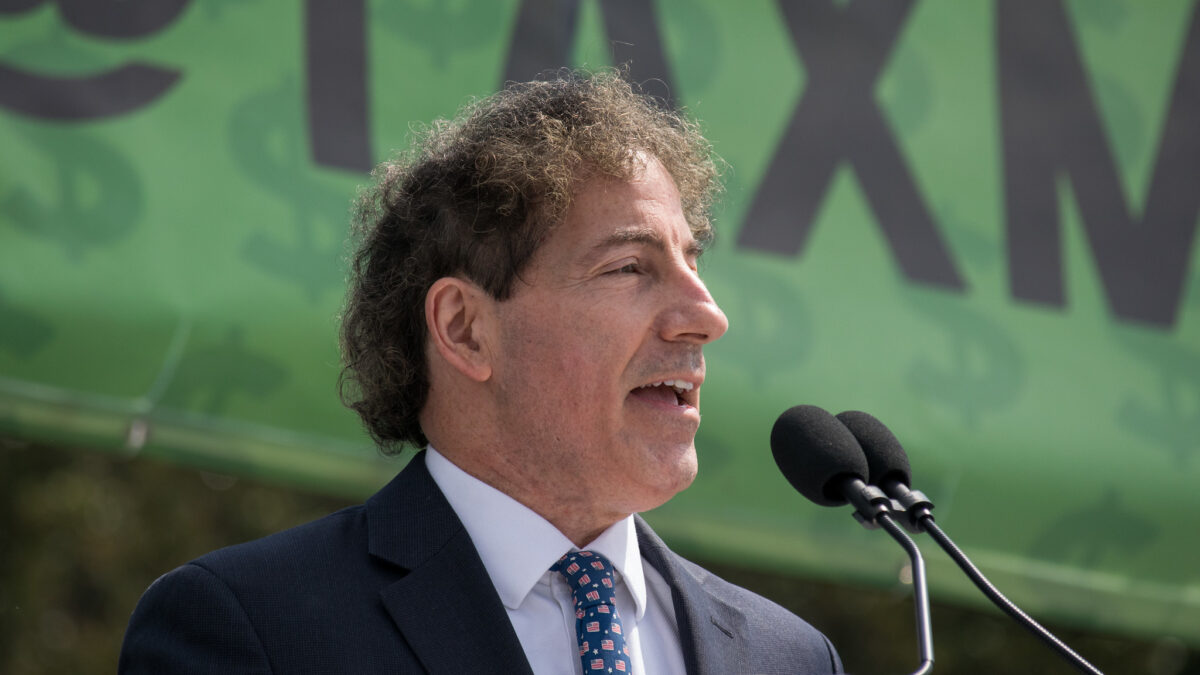
As Fox News reported, U.S. Rep. Jamie Raskin, D-Md., wrote a full-throated defense of “Alien Suffrage” in a 1993 paper for the American University Washington College of Law, where he serves as Professor of Law Emeritus. Raskin is ranking member of the House’s Oversight Committee, which, among other things, has constitutional oversight of the District of Columbia.
“In this Article, I will argue that the current blanket exclusion of noncitizens from the ballot is neither constitutionally required nor historically normal,” Raskin wrote. “Moreover, the disenfranchisement of aliens at the local level is vulnerable to deep theoretical objections since resident aliens — who are governed, taxed, and often drafted just like citizens — have a strong democratic claim to being considered members, indeed citizens, of their local communities.”
A top Democrat leader unveils liberal plans to give illegal immigrants right to vote in local, state, and federal elections.
Writes that illegals “have a strong democratic claim to being considered members, indeed citizens”. https://t.co/k3u4bVlyb9
Not surprisingly, Raskin was among 143 Democrats voting against the Republican-led bill blocking illegal immigrants and other foreign nationals from voting in elections in the district, over which Congress has ultimate authority. Interestingly, 52 Democrats joined Republicans in passing the measure — because the vast majority of Americans believe only U.S. citizens should be allowed to vote in local and U.S. elections. Taking the opposing view is not a smart reelection strategy for politically vulnerable liberals.
Several cities in Raskin’s home state have allowed foreign nationals to vote in local elections for years. Takoma Park, Maryland in November celebrated its 30th anniversary “of the first non-US. Residents” voting in the Washington, D.C. suburb.
“Even if it’s only a handful voting in elections—and it’s more than that—it’s a huge step forward for democracy,” said Seth Grimes, a leftist community organizer, in an official city press release. “Non-citizens have a stake in civic affairs, and everyone should have a voice in who governs them.”
Polling shows an overwhelming number of Americans don’t share Grimes’ point of view, or the one expressed in Raskin’s law school report. A national poll conducted last year for Americans for Citizen Voting by RMG Research, Inc., found 75 percent of respondents were opposed to allowing foreign nationals to vote in their local elections.
In his 1993 paper, Raskin argued that the “emergence of a global market and the corresponding dilution of national boundaries, would invite us to treat local governments as ‘polities of presence’ in which all community inhabitants, not just those who are citizens of the superordinate nation-state, form the electorate.”
“Alien suffrage would thus become part of a basic human right to democracy,” the now-congressman wrote.
Does Raskin still feel that way? His office did not return The Federalist’s request for comment.
Media: Alien Voting Doesn’t Happen and It’s Fine When It Does
After Thursday’s vote, it’s not a leap to suspect many of Raskin’s fellow Democrats support foreign nationals voting in local elections. If they were against it, they would have voted for the D.C. election integrity measure.
Corporate media, of course, have been running interference for Democrats in the weeks since former President Donald Trump, the GOP’s presumed presidential nominee, and Speaker Mike Johnson announced the rollout of the Safeguard American Voter Eligibility Act. The SAVE Act is aimed at shoring up glaring holes in the 30-year-old National Voter Registration Act (NVRA) passed during a simpler time, when politicians believed in borders. The bill would amend the 1993 “Motor Voter” law to require individuals to provide proof of citizenship before they are automatically registered to vote at state departments of motor vehicles and other agencies. It also requires states to remove foreign nationals from their voting rolls, something too many state election officials have been loath to do. The NVRA does not require direct proof of citizenship for voter registration.
Republicans say the legislation is crucial in the wake of the millions of illegal immigrants that have poured through the U.S. southwest border since Joe Biden took the presidential oath of office in January 2021.
“There is currently an unprecedented and a clear and present danger to the integrity of our election system, and that is the threat of noncitizens and illegal aliens voting in our elections,” Johnson said at a Capitol press conference earlier this month announcing the bill.
But the accomplice media, while conceding foreign nationals have been caught voting in federal elections, assert the act is extremely rare. Besides, the left’s messengers contend, what illegal alien in his right mind would risk committing a felony just to vote in a federal election? The New York Times accused Republicans of “Sowing [a] False Narrative.” The Associated Press asserts“Noncitizen voting isn’t an issue in federal elections,” while it acknowledges that it does happen.
“To be clear, there have been cases of noncitizens casting ballots, but they are extremely rare. Those who have looked into these cases say they often involve legal immigrants who mistakenly believe they have the right to vote,”AP admits.
So much for the idea that any illegal vote dilutes the validity of an election. Again, the corporate media like to put qualifiers on fraud, forced by the facts to acknowledge its existence but insisting it isn’t “widespread.”
“They’ve used ‘widespread’ for years as a way of downplaying any concern about it,” said Hans von Spakovsky, a former member of the Federal Election Commission and Senior Legal Fellow in the Heritage Foundation’s Edwin Meese III Center for Legal and Judicial Studies. “We don’t have ‘widespread’ bank robberies but we have enough of them that we take very detailed security precautions to prevent them. Election fraud is exactly the same.”
Hans Von Spakovsky points out: “We don’t have ‘widespread’ bank robberies, but we have enough of them that we take very detailed security precautions to prevent them. Election fraud is exactly the same.”https://t.co/xKMn3uRBxFpic.twitter.com/erB4hxK2cQ
Raskin isn’t the only Democrat who has defended foreign nationals voting in elections. House Minority Leader Hakeem Jeffries, a Brooklyn Democrat, has been very vocal in his support for aliens voting in New York local elections. His New York congressional colleague, leftist Rep. Alexandria Ocasio-Cortez, has suggested the Republican-controlled House’s bill to bar foreign nationals from voting in D.C. is reminiscent of the days of slavery.
“They’re singling out the residents of the District of Columbia and expanding in the history of disenfranchisement that goes all the way back to the legacy of slavery,”she said last year.
James Comer, chairman of the House Committee on Oversight and Accountability, said the bill aims to rectify the D.C. City Council’s decision to “recklessly allowed non-citizens to participate in elections in our nation’s capital.”
“This move by the Council was irresponsible and subverts the voices of American citizens,” Comer said in a statement. “Today, Congress took action and I applaud the passage of legislation that will now prohibit non-citizens from voting in District of Columbia elections.”
The House bill pertaining to D.C. elections and the SAVE Act aren’t going anywhere this year with a Democrat-controlled Senate and a president who appears to be running a Democrat Party future recruitment drive. But Americans, many of whom don’t support illegal aliens and other foreign nationals voting in U.S. elections, know where the party stands heading into the November election.
“Rep. Raskin is okay with the ‘dilution of national boundaries.’ I am not. And neither are the majority of United States citizens,” said Jack Tomczak, national field director for Americans for Citizen Voting, which is leading a growing national effort to amend state constitutions to include citizen-only voting language.
Matt Kittle is a senior elections correspondent for The Federalist. An award-winning investigative reporter and 30-year veteran of print, broadcast, and online journalism, Kittle previously served as the executive director of Empower Wisconsin.
House Speaker Mike Johnson was “very optimistic” after Tuesday’s meeting with President Joe Biden and the other three top Congressional leaders that a government shutdown will be averted before Friday’s deadline.
“We have been working in good faith around the clock every single day for months and weeks and over the last several days, quite literally around the clock to get that job done. We’re very optimistic,” Republican Johnson told reporters after the meeting with President Joe Biden, Vice President Kamala Harris, Senate Majority Leader Chuck Schumer, Minority Leader Mitch McConnell, and House Minority Leader Hakeem Jeffries.
“We believe that we can get to agreement on these issues and prevent a government shutdown, and that’s our first responsibility,” Johnson added.
In the meeting, Biden warned the leaders of the consequences of failing to move quickly to pass funding to avoid a looming partial government shutdown and send weapons to Ukraine, or face dire consequences.
“We’ve got a lot of work to do,” Biden said in the Oval Office, with Vice President Kamala Harris at his side and the four leaders sitting on couches nearby.
The meeting left the president optimistic of avoiding a shutdown, Jeffries said, according to Politico.
Senate Minority Leader Mitch McConnell told reporters at the Capitol that the meeting focused mainly on keeping the government open, “which I think we all can agree on.”
The White House meeting came almost two months after Johnson and Schumer agreed on a $1.59 trillion discretionary spending level for the fiscal year that began on Oct. 1. Despite that deal, Congress has failed to pass spending bills to fund the government, largely due to in-fighting by Republicans who control the House of Representatives by a thin majority.
Biden said he believed a solution could be reached on funding the government by a Friday deadline to avoid a partial government shutdown, which he said would be damaging to the U.S. economy.Ukraine funding becomes more urgent every day, Biden said.
“I think the consequences of inaction are dire,” he said of Ukraine.
The spending bill is being held up by demands from ultra-conservative Republicans in the House who want to see spending cuts and policy positions injected into how dollars are spent. A group of hard-right Republicans has brought the government to the brink of a shutdown or a partial shutdown three times in the past six months.
Schumer and Johnson traded accusations in recent days over who was to blame for the stalemate. On Monday, Schumer told reporters that “Democrats are doing everything we can to avoid a shutdown.”
The first batch of government funding, which includes money for agencies that oversee agriculture and transportation, will run out on Friday at midnight, while funding for some agencies including the Pentagon and the State Department will expire on March 8. The government spending package is separate from the national security aid bill that includes Ukraine and Israel funding.
The House is under pressure to pass the $95 billion national security package that bolsters aid for Ukraine, Israel as well as the Indo-Pacific. That legislation cleared the Senate on a 70-29 vote earlier this month, but Johnson has resisted putting up the aid bill for a vote in the House.
The White House has ramped up public pressure on Johnson in recent weeks as Ukraine marked the second anniversary of the Russian invasion.
“What the president wants to see is we want to make sure that the national security interests of the American people gets put first and is not used as a political football,” Jean-Pierre said. “We want to make sure that gets done.”
Congress averted a government shutdown this weekend, agreeing to 45 days of funding to give members time to pass appropriations bills for the full year. Incredibly, Democrats seemed prepared to shut down the government over their desire for increases in Ukraine war funding. Republicans, by contrast, bucked Senate leader Mitch McConnell to keep the government open without such funding.
While shutdown battles have become common, this one had absurd moments. Democrats tried to delay votes with everything from “magic minutes,” which allow party leaders to speak at length, to Democrat Rep. Jamaal Bowman pulling a fire alarm in the middle of a vote, forcing the evacuation of a House office building.
With hundreds of Jan. 6 protesters facing excessive sentences, which Department of Justice prosecutors say is because they attempted to delay or obstruct an official congressional proceeding, some Americans began demanding the elected member of Congress be held to the same excruciating standard. Bowman, a former school principal, later claimed he didn’t understand how fire alarms work.
Even after the House passed the bill, Democrat Sen. Michael Bennet of Colorado further delayed the eventual passage by placing a hold on the bill. The procedural delays were partly a result of efforts to force a shutdown that could be blamed on Republicans. Conventional wisdom in Washington is that Republicans get blamed for government shutdowns regardless of who is responsible.
Democrats Willing to Shut Down over Ukraine
However, Democrats’ delays were also about a demand for additional Ukraine funding. Some Republicans, such as Senate Minority Leader Mitch McConnell, also want U.S. taxpayers to finance even more of the war against Russia, which has descended into an expensive quagmire.
“Despite nine months of bloody fighting, less than 500 square miles of territory have changed hands since the start of the year. A prolonged stalemate could weaken Western support for Ukraine,” reported The New York Times last week.
“The press never even mentions that Ukraine war funding has become incredibly unpopular with actual Republican voters and an increasing number of independents,” one social media analyst noted. “It’s always framed on every network like some fringe position when it’s actually the majority of Americans.”
Democrats are enthusiastically adopting the Bush-era foreign policy of supporting lengthy U.S.-led wars with a tenuous or even deleterious effect on national security. These wars tend to have very little strategy other than avoiding quick resolution. Such long wars enable years or even decades of financing of the defense industry, which some Ukraine war supporters point to as a benefit for Americans. Democrats are even adopting the Bush-era claim that such wars need to be fought to advance “democracy.”
Partisan Divide On The Issue Rears Head
On Friday night, the lack of additional funding for Ukraine caused Senate Appropriations Committee Chairwoman Patty Murray, D-Wash., to object to Sen. Ron Johnson’s, R-Wis., request on the Senate floor to pass a clean two-week funding extension.
“The Dems are about to shut down the government over Ukraine. I actually can’t believe it, but here we are,” Sen. J.D. Vance, R-Ohio, said in a social media post.
The Senate then pushed a bill that would give an additional $6 billion to fund the proxy war against Russia in Ukraine. Speaker of the House Kevin McCarthy dismissed it out of hand and said the House would propose something instead. A few days prior, House Republicans were able to strip $300 million in Ukraine funding from a bill that was being debated.
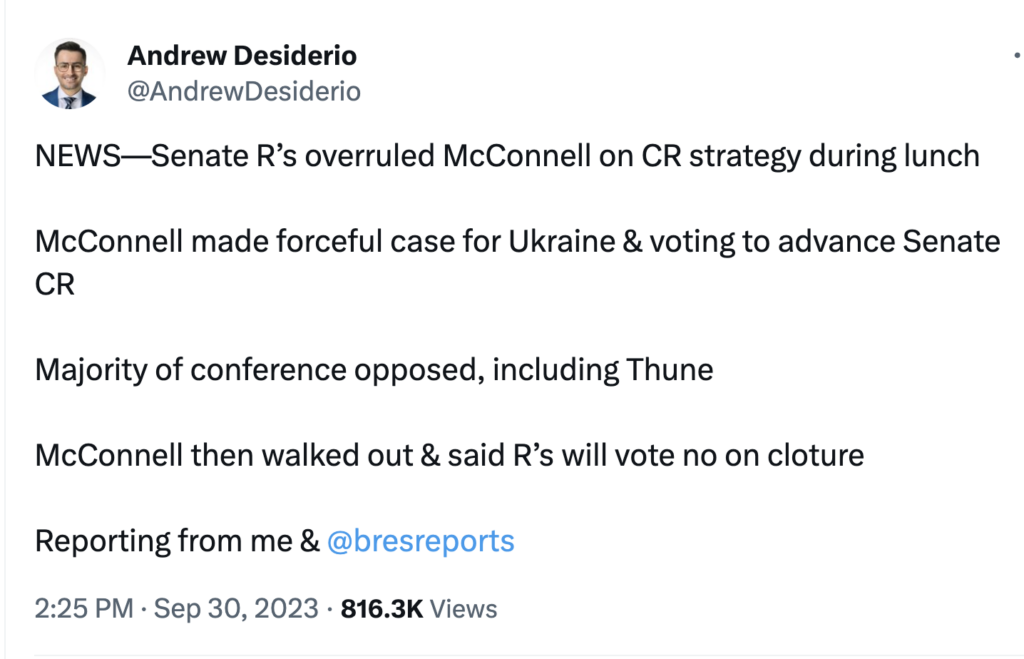
Back in the Senate, McConnell failed to get fellow Republicans to sign onto his plan to force Ukraine funding instead of allowing House Republicans to work on a funding bill without it. Punchbowl’s John Bresnahan and Andrew Desiderio had perhaps the most intriguing reporting of the weekend with this vignette:
Senate sources said it was the first time they could remember that Republican senators didn’t seem to fear repercussions for disagreeing with McConnell, particularly on a prominent issue on which he’d staked out a clear position. It was unclear whether senators overruled McConnell because his mental and physical weakness has left him vulnerable or simply because they recognize how strongly Republican voters feel about funding an expensive war without a clear strategy for success.
House Democrats dug in, passing around a one-page sheet lambasting McCarthy for his continuing resolution, almost all of which focused on Democrats’ desire for U.S. taxpayers to finance the Ukraine war.
The Senate prepared to hotline, or fast track, their vote on the House bill that did not include war funding. That’s when Bennett held it up over the Ukraine issue.
The pressure for funding could not have been more intense. “Senior administration officials” pressured McConnell, saying that Ukraine could not be sustained without funding in this weekend’s bill.
“It’s rumored that Pentagon officials are on their way over to the Capitol to lobby for Schumer-McConnell. The Military Industrial Complex™️ doesn’t like to lose,” wrote Sen. Mike Lee, R-Utah, on Saturday.
Russia-collusion hoaxer Michael McFaul trotted out the same type of argument that has been used to bully Americans to stay in drawn-out wars for decades. “If the US pulls back on our support from Ukraine now, we radically diminish our credibility to deter a Chinese invasion of Taiwan,” he said.
Ukraine War Enthusiasts Pressure McCarthy
The Ukraine war enthusiasts only allowed the stopgap funding measure to proceed on the grounds they’d soon get a vote on whether to send another major aid package to Ukraine.
“We will not stop fighting for more economic and security assistance for Ukraine,”Schumer said.
“We cannot under any circumstances allow American support for Ukraine to be interrupted. I fully expect the Speaker will keep his commitment to the people of Ukraine and secure passage of the support needed to help Ukraine at this critical moment,”President Biden said in his announcement on the funding measure. He said he’d made a deal with McCarthy to vote on additional funding.
House Democrats said, “When the House returns, we expect Speaker McCarthy to advance a bill to the House Floor for an up-or-down vote that supports Ukraine, consistent with his commitment to making sure that Vladimir Putin, Russia and authoritarianism are defeated. We must stand with the Ukrainian people until victory is won.”
Nearly every Democrat and a fair number of Republicans want to continue funding the Ukraine war, despite the results of previous rounds of funding. They’ll likely succeed, but the vote will be harder.
Conservative Republicans such as Sen. Rand Paul, R-Ky., will be on guard. “When I said I’d do everything I could to stop the US government from being held hostage to Ukraine, I meant it. We cannot continue to put the needs of other countries above our own. We cannot save Ukraine by dooming the U.S. economy. I’m grateful to all Members of Congress who stood with me, but the battle to fund our government isn’t over yet — the forever-war crowd will return,” he wrote.
Democrats’ campaign strategy of emphasizing Ukraine war funding at a time of economic distress for many Americans will be interesting to watch.
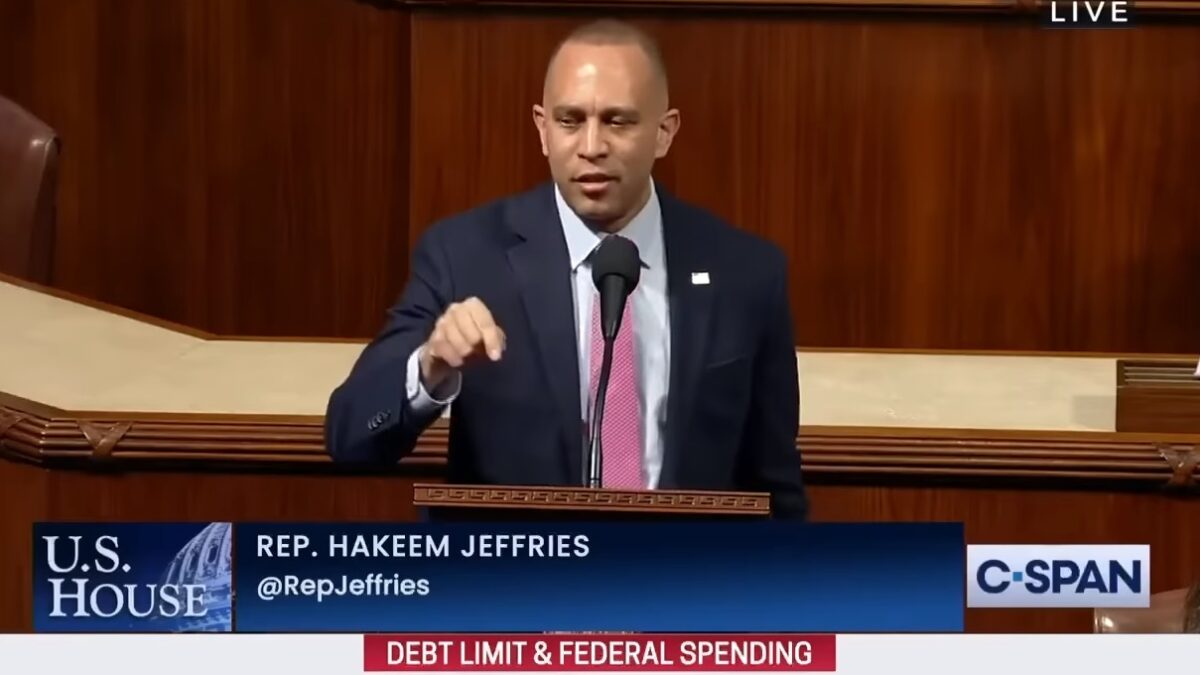
The top two Democrats in the House of Representatives quietly voted last week against defending the right of Congress to pass laws. The sanctity of democracy and Congress itself has been a major political talking point for Democrat leaders in recent years. But the vote showed the difficulty Democrat Minority Leader Hakeem Jeffries and other top Democrats have standing up to the intense pressure they face from left-wing billionaires and the environmental activist groups they run.
The vote dealt with litigation from left-wing environmental groups trying to stop provisions in the recently passed Fiscal Responsibility Act (FRA), which raised the debt limit. That bill, signed into law on June 5, 2023, contained provisions to ensure the completion of a 303-mile pipeline from natural gas fields in West Virginia to an existing pipeline in Southwest Virginia. Left-wing environmental groups funded by major Democrat donors and a foreign oligarch who finances much of the left’s “dark money” behemoth have fought the completion of the Mountain Valley Pipeline for years. While most of the pipeline has been constructed, the FRA directed expedited approval of the remaining permits, removal from any court the jurisdiction to review agency actions, and directing the D.C. Circuit Court of Appeals to oversee any claims challenging the pipeline.
Both Jeffries and Democrat Whip Katherine Clark voted for the legislation. Jeffries publicly stated he did so “without hesitation, reservation, or trepidation.” President Biden, the top Democrat in the country, signed it into law. His Department of Justice began implementing the law. But when the time came to defend both that legislation and the very right of Congress to pass laws, Jeffries and Clark refused.
The Bipartisan Legal Advisory Group (BLAG), comprising the Speaker of the House and the leader and whip of each party, “speaks for, and articulates the institutional position of, the House in all litigation matters,” according to House rules. While it has at times been used in a partisan matter, most notably and aggressively under former Speaker of the House Nancy Pelosi, it also routinely sees unanimous votes on key issues about the rights and powers of Congress.
Earlier this year, for example, all five members voted to intervene in an ongoing legal battle between the Department of Justice and Rep. Scott Perry, R-Penn., over the department’s aggressive efforts to access the conservative member’s phone.
The vote last week was divided on party lines, even though it dealt with an issue that the BLAG had previously worked on twice before and involved a law that both Democrat members had voted for only weeks prior.
Back Story
Blocking an energy pipeline in the region has been a top priority of left-wing activist groups for years. They had successfully asked the Fourth Circuit Court of Appeals to block and delay permits and approvals for the pipeline.
Once the debt limit bill passed, the Department of Justice moved to dismiss those cases. It argued that the bill had mooted the controversy by explicitly ratifying and approving all necessary permits and by changing the law governing the pipeline in such a way that it rendered meritless the claims put forth by the environmentalist groups.
The Wilderness Society and an array of other left-wing environmentalist groups opposed what the DOJ was doing and asked the Fourth Circuit to issue a stay. Left-wing Swiss billionaire Hansjörg Wyss “has been a leading source of difficult-to-trace money to groups associated with Democrats,” according to an analysis from The New York Times. He serves on the board of governors of the Wilderness Society. That group argued the bill violated the separation of powers and that the Fourth Circuit remained the right court to hear their objections to the previous legislation. Without explaining its reasoning, a trio of judges on the Fourth Circuit that had previously ruled in favor of the environmental groups’ petitions issued a stay.
The pipeline company filed an emergency application at the Supreme Court to vacate the stays and have the Fourth Circuit dismiss the claims so the pipeline could be completed as directed by June’s legislation.
That’s why the Bipartisan Legal Advisory Group voted on an amicus brief backing Congress’ own legislation and the right of Congress to pass legislation.
The amicus brief argues that the Fourth Circuit stays are at odds with Congress’s declaration that “the timely completion” of the pipeline “is required in the national interest.” It also notes that the House has twiceprior defended the power of Congress to enact changes in law that affect the outcome of pending court cases, and the court upheld the constitutionality of doing so both times. Finally, it argues that the stays are erroneous; that nothing precludes Congress from changing laws simply because they end legal challenges to agency actions.
“The jobs at stake are the exact type of jobs – blue collar jobs for skilled workers that provide good wages, health coverage, retirement security, and funding for training of current workers and new entrants to the industry – that are so badly needed in today’s economy,” the union wrote in its brief.
When Clark whipped for the bill she now refuses to defend, she praised Biden for “standing with our veterans, seniors, and working families” during the negotiations.
Neither Jeffries nor Clark responded to The Federalist’s request for comment.
The top two Democrats in the House of Representatives quietly voted last week against defending the right of Congress to pass laws. The sanctity of democracy and Congress itself has been a major political talking point for Democrat leaders in recent years. But the vote showed the difficulty Democrat Minority Leader Hakeem Jeffries and other top Democrats have standing up to the intense pressure they face from left-wing billionaires and the environmental activist groups they run.
The vote dealt with litigation from left-wing environmental groups trying to stop provisions in the recently passed Fiscal Responsibility Act (FRA), which raised the debt limit. That bill, signed into law on June 5, 2023, contained provisions to ensure the completion of a 303-mile pipeline from natural gas fields in West Virginia to an existing pipeline in Southwest Virginia. Left-wing environmental groups funded by major Democrat donors and a foreign oligarch who finances much of the left’s “dark money” behemoth have fought the completion of the Mountain Valley Pipeline for years. While most of the pipeline has been constructed, the FRA directed expedited approval of the remaining permits, removal from any court the jurisdiction to review agency actions, and directing the D.C. Circuit Court of Appeals to oversee any claims challenging the pipeline.
Both Jeffries and Democrat Whip Katherine Clark voted for the legislation. Jeffries publicly stated he did so “without hesitation, reservation, or trepidation.” President Biden, the top Democrat in the country, signed it into law. His Department of Justice began implementing the law. But when the time came to defend both that legislation and the very right of Congress to pass laws, Jeffries and Clark refused.
The Bipartisan Legal Advisory Group (BLAG), comprising the Speaker of the House and the leader and whip of each party, “speaks for, and articulates the institutional position of, the House in all litigation matters,” according to House rules. While it has at times been used in a partisan matter, most notably and aggressively under former Speaker of the House Nancy Pelosi, it also routinely sees unanimous votes on key issues about the rights and powers of Congress.
Earlier this year, for example, all five members voted to intervene in an ongoing legal battle between the Department of Justice and Rep. Scott Perry, R-Penn., over the department’s aggressive efforts to access the conservative member’s phone.
The vote last week was divided on party lines, even though it dealt with an issue that the BLAG had previously worked on twice before and involved a law that both Democrat members had voted for only weeks prior.
Back Story
Blocking an energy pipeline in the region has been a top priority of left-wing activist groups for years. They had successfully asked the Fourth Circuit Court of Appeals to block and delay permits and approvals for the pipeline.
Once the debt limit bill passed, the Department of Justice moved to dismiss those cases. It argued that the bill had mooted the controversy by explicitly ratifying and approving all necessary permits and by changing the law governing the pipeline in such a way that it rendered meritless the claims put forth by the environmentalist groups.
The Wilderness Society and an array of other left-wing environmentalist groups opposed what the DOJ was doing and asked the Fourth Circuit to issue a stay. Left-wing Swiss billionaire Hansjörg Wyss “has been a leading source of difficult-to-trace money to groups associated with Democrats,” according to an analysis from The New York Times. He serves on the board of governors of the Wilderness Society. That group argued the bill violated the separation of powers and that the Fourth Circuit remained the right court to hear their objections to the previous legislation. Without explaining its reasoning, a trio of judges on the Fourth Circuit that had previously ruled in favor of the environmental groups’ petitions issued a stay.
The pipeline company filed an emergency application at the Supreme Court to vacate the stays and have the Fourth Circuit dismiss the claims so the pipeline could be completed as directed by June’s legislation.
That’s why the Bipartisan Legal Advisory Group voted on an amicus brief backing Congress’ own legislation and the right of Congress to pass legislation.
The amicus brief argues that the Fourth Circuit stays are at odds with Congress’s declaration that “the timely completion” of the pipeline “is required in the national interest.” It also notes that the House has twiceprior defended the power of Congress to enact changes in law that affect the outcome of pending court cases, and the court upheld the constitutionality of doing so both times. Finally, it argues that the stays are erroneous; that nothing precludes Congress from changing laws simply because they end legal challenges to agency actions.
“The jobs at stake are the exact type of jobs – blue collar jobs for skilled workers that provide good wages, health coverage, retirement security, and funding for training of current workers and new entrants to the industry – that are so badly needed in today’s economy,” the union wrote in its brief.
When Clark whipped for the bill she now refuses to defend, she praised Biden for “standing with our veterans, seniors, and working families” during the negotiations.
Neither Jeffries nor Clark responded to The Federalist’s request for comment.
Adam Schiff and a group of Democrats introduced a proposed constitutional amendment to overturn the Citizens United decision, one of the greatest free-speech victories in history.
It’s just a political stunt, of course, as Schiff doesn’t have the votes. But it does reflect the authoritarian outlook of the contemporary left on free expression. From the day the decision came down, 13 years ago this week, Citizens United was a rallying cry for those threatened by unregulated discourse. President Barack Obama infamously, and inaccurately, rebuked the justices during his State of the Union for upholding the First Amendment. Since then, Democrats have regularly blamed the decision for the alleged corrosion of “democracy.”
Recall, however, that Citizens United decision revolved around the federal government’s banning of a documentary critical of 2008 presidential candidate Hillary Clinton before the Democratic primary elections. At the time, McCain-Feingold made it illegal for corporations (groups of freely associating citizens) and unions (ditto) to engage in “electioneering” a month before a primary or two months before a general election. It was outright censorship. In oral arguments, then-Solicitor General of the United States, now-Supreme Court Justice Elena Kagan initially contended that the federal government had the right to censor books that “express advocacy.”
Also recall that “campaign finance” laws — speech codes, in reality — were written by politicians and defended by a media encumbered by any limitations on their own free expression. These detestable laws prohibited groups of citizens from assembling and pooling their resources to engage more effectively in what is the most important kind of political expression at the most vital time, right before an election.
Schiff’s amendment would overturn Citizens United, and thus the First Amendment, and empower state and federal governments to enact “reasonable, viewpoint-neutral” limitations on speech that “influences” elections.
For one thing, even a wholly neutral restrictions on political speech were possible, they would still be restrictions on expression. It doesn’t matter one whit if you find those restrictions “reasonable” or “neutral.” The right of free speech isn’t contingent on fairness or outcomes or your good faith limitations. It is a free-standing, inherent right protected by the Constitution, not prescribed to us by the state in portions. It’s amazing that this has to be said.
Moreover, do Democrats trust Kevin McCarthy’s conception of “reasonable”? Because I don’t. Nor do I trust Hakeem Jeffries or that weasel Schiff, who has already personally engaged in censoring dissent. As Lois Lerner could tell you, any law empowering bureaucrats to define political speech will be arbitrarily enforced and, inevitably, abused. The only “viewpoint-neutral” position on speech is that it’s none of the state’s business.
Then again, not even the amendment is neutral. Section 4 of Schiff’s proposal offers an exemption to the “press.” Who is the press? Bureaucrats, no doubt, will make that determination. Schiff knows that most large communication companies already work for Democrats. The big studios produce movies and documentaries with one ideological viewpoint; and major news outlets give one side billions in in-kind contributions. The amendment would strip one group of its power to compete in the marketplace of ideas. “By taking the right to speak from some and giving it to others,” Justice Anthony Kennedy wrote for the majority in Citizens United, “the Government deprives the disadvantaged person or class of the right to use speech to strive to establish worth, standing, and respect for the speaker’s voice.”
Schiff’s amendment could also be used to strip people of anonymity. “Dark money” has been a bogeyman of the left for years, treated as one of the most corrosive elements in contemporary politics — even though leftists are more reliant on anonymous big-dollar money than conservatives. Of course, the expectation that private citizens have any responsibility to publicly attach their names to political speech — as Publius might tell you — is destructive nonsense.
“Anonymity is a shield from the tyranny of the majority,” the 1995 Supreme Court ruling in McIntyre v. Ohio Elections Commission famously noted. It “exemplifies the purpose behind the Bill of Rights and of the First Amendment in particular: to protect unpopular individuals from retaliation … at the hand of an intolerant society.” There are entire genres of mainstream “reporting” that exist to dox heretics and punish dissent and engage in struggle sessions. Leftists want to create as many Brendan Eichs as possible to chill speech.
Schiff claims he wants to “return power to people” by allowing the state to prescribe the way they can participate in political debate. Schiff’s amendment includes restricting corporations from spending “unlimited amounts of money to influence elections.” Corporations have been banned from donating directly to candidates since 1907. But why shouldn’t private entities, groups of people, be allowed to “influence” politics? Anyway, you can already imagine the malleability of the word “influence.” Will California ban corporations from influencing green policy? Or only from influencing cultural policy? Boy, I wonder.
A decade ago, politicians would give us some perfunctory words about the importance of free expression. Those days are gone. The bogus panic over “disinformation” — without free will, you guys are far too susceptible to bad ideas — has given them the excuse to wring their hands over the dangerous excesses of the First Amendment.
These days a person can contribute as much money as they please to any independent group that shares their values. The notion that there should be restrictions stopping you from airing those views, whether you’re a billionaire or a poor student, is fundamentally un-American and authoritarian.
David Harsanyi is a senior editor at The Federalist, a nationally syndicated columnist, a Happy Warrior columnist at National Review, and author of five books—the most recent, Eurotrash: Why America Must Reject the Failed Ideas of a Dying Continent. He has appeared on Fox News, C-SPAN, CNN, MSNBC, NPR, ABC World News Tonight, NBC Nightly News and radio talk shows across the country. Follow him on Twitter, @davidharsanyi.
American Family Association
American Family Association (AFA), a non-profit 501(c)(3) organization, was founded in 1977 by Donald E. Wildmon, who was the pastor of First United Methodist Church in Southaven, Mississippi, at the time. Since 1977, AFA has been on the frontlines of Ame
NEWSMAX
News, Opinion, Interviews, Research and discussion
Opinion
American Family Association
American Family Association (AFA), a non-profit 501(c)(3) organization, was founded in 1977 by Donald E. Wildmon, who was the pastor of First United Methodist Church in Southaven, Mississippi, at the time. Since 1977, AFA has been on the frontlines of Ame
American Family Association
American Family Association (AFA), a non-profit 501(c)(3) organization, was founded in 1977 by Donald E. Wildmon, who was the pastor of First United Methodist Church in Southaven, Mississippi, at the time. Since 1977, AFA has been on the frontlines of Ame
You Version
Bible Translations, Devotional Tools and Plans, BLOG, free mobile application; notes and more
Political
American Family Association
American Family Association (AFA), a non-profit 501(c)(3) organization, was founded in 1977 by Donald E. Wildmon, who was the pastor of First United Methodist Church in Southaven, Mississippi, at the time. Since 1977, AFA has been on the frontlines of Ame
NEWSMAX
News, Opinion, Interviews, Research and discussion
Spiritual
American Family Association
American Family Association (AFA), a non-profit 501(c)(3) organization, was founded in 1977 by Donald E. Wildmon, who was the pastor of First United Methodist Church in Southaven, Mississippi, at the time. Since 1977, AFA has been on the frontlines of Ame
Bible Gateway
The Bible Gateway is a tool for reading and researching scripture online — all in the language or translation of your choice! It provides advanced searching capabilities, which allow readers to find and compare particular passages in scripture based on







 What Did You Say?
You must be logged in to post a comment.