Perspectives; Thoughts; Comments; Opinions; Discussions

Posts tagged ‘George Washington’

America’s Founders Didn’t Support Open Borders, And Neither Should We


BY: HELEN RALEIGH | MAY 10, 2023

Read more at https://thefederalist.com/2023/05/10/americas-founders-didnt-support-open-borders-and-neither-should-we/
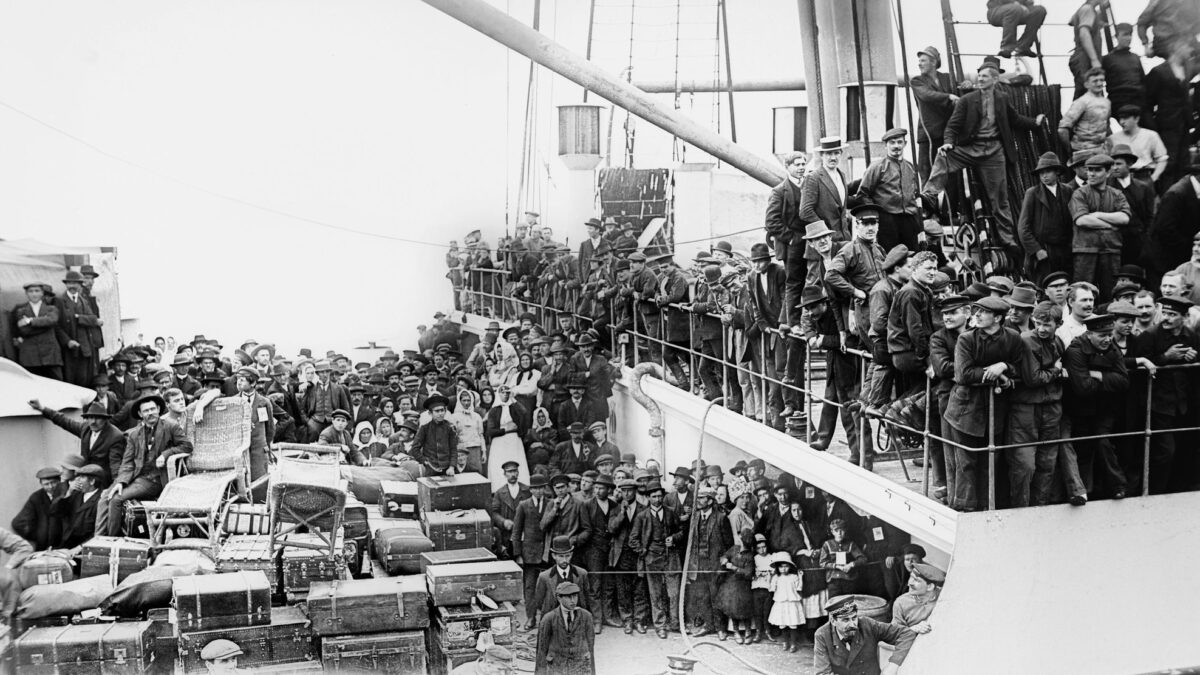

european immigrants at Ellis Island

Author Helen Raleigh profile

HELEN RALEIGH

VISIT ON TWITTER@HRALEIGHSPEAKS

MORE ARTICLES

There is little evidence that the founders advocated for a free-for-all, open-door immigration policy.  

From the very beginning, even in the absence of immigration law, the founders knew America had to set boundaries. Their top three concerns were the qualifications, assimilation, and allegiance of newcomers. The founders emphasized the moral character and contributions newcomers would bring. 

Not only should new migrants have good moral character, but they should also place “high importance to the respectability and character of the American name” and do their best to “preserve its good fame from injury,” as Rep. James Jackson, a Democratic-Republican from Georgia, said in 1790. The founding generation didn’t want convicts and criminals as new immigrants.  

George Washington preferred skilled new immigrants, such as “useful mechanics and some particular descriptions of men or professions.” James Madison wanted the “worthy part of mankind to come and settle amongst us,” so they can “increase the wealth and strength of the community; and those who acquire the rights of citizenship, without adding to the strength or wealth of the community are not the people we are in want of.”  

How can a new immigrant increase the wealth and strength of a community? Rep. John Laurance clarified:  

Every person who comes among us must do one or the other; if he brings money, or other property with him, he evidently increases the general mass of wealth, and if he brings an able body, his labor will be productive of national wealth, and an addition to our domestic strength. Consequently, every person, rich or poor, must add to our wealth and strength, in a greater or less degree. 

Assimilation Strengthens and Protects  

The United States was founded upon specific ideas and moral principles, as expressed by the eloquent words of the Declaration of Independence. Thomas Jefferson believed that “it is for the happiness of those united in society to harmonize as much as possible in matters which they must of necessity transact together.”  

He feared that if new immigrants believed different ideas, then “with their language, they will transmit [them] to their children. In proportion to their numbers, they will share with us the legislation. They will infuse into it their spirit, warp and bias its direction, and render it a heterogeneous, incoherent, distracted mass.”  

Benjamin Franklin shared Jefferson’s concerns. Some people today accuse Benjamin Franklin of being anti-immigration because of the disparaging words he said about German immigrants. In fact, Franklin was anything but opposed to immigration. He published the first German newspaper in America, the Philadelphische Zeitung, in 1732Franklin was not against immigration; he was concerned that a lack of assimilation would be harmful to immigrants’ happiness and damning to the unity and longevity of the republic.  

George Washington expressed a similar concern: that immigration does not benefit America when immigrants congregate and “retain their language, habits and principles (good or bad) which they bring with them.”  

Instead, he firmly believed that new immigrants or their descendants should, “by an intermixture with our people … get assimilated to our customs, measures and laws: in a word, soon become one people.”  

Immigrants Must Pledge Allegiance 

No matter what drives them to America, some immigrants retain residual loyalty to their countries and cultures of birth. To become Americans, the founders believed immigrants needed to give up prior allegiances and pledge an oath of fidelity to the U.S. In Alexander Hamilton’s words:  

The safety of a republic depends essentially on the energy of a common national sentiment; on a uniformity of principles and habits; on the exemption of citizens from foreign bias and prejudice; and on the love of country which will almost invariably be found to be closely connected with birth, education, and family.  

John Quincy Adams, in an 1819 letter to Moritz von Furstenwarther, a German citizen who was considering moving to the U.S. and had asked Adams for a job, stated that the U.S. is a land “not of privileges, but of equal rights.” Thus, Adams warned Furstenwarther that new immigrants like him:

Must cast off the European skin, never to resume it. They must look forward to their posterity, rather than backward to their ancestors; they must be sure that whatever their own feelings may be, those of their children will cling to the prejudices of this country, and will partake of that proud spirit. 

Citizenship Isn’t Cheap

While some founders believed an oath of allegiance and a declaration to stay in America were sufficient for citizenship, others did not want to give out citizenship too cheaply.  

They pointed out that some foreign sailors had voted in Philadelphia’s assembly elections after taking oaths of allegiance and then left America, having never intended to stay. This kind of practice not only results in election fraud but also threatens the “safety of a republic” because a foreigner who rejects American principles and ideas would vote against them. 

Therefore, some founders thought “some security for their [immigrants’] fidelity and allegiance was requisite besides the bare oath.” The additional security the founders sought was property ownership or residency.  

Property ownership has been used to distinguish citizens from aliens since the Roman Empire. Some founders wanted to “see the title of a citizen of America as highly venerated and respected as was that of a citizen of old Rome.”  

During the House of Representatives debate on immigration law in Philadelphia in 1790, the majority of the founders regarded it as essential that an individual have a period of residency in the U.S. prior to gaining citizenship. Residency achieved two purposes, according to Rep. Michael Stone: 

First, that he should have an opportunity of knowing the circumstances of our Government, and in consequence thereof, shall have admitted the truth of the principles we hold. Second, that he shall have acquired a taste for this kind of Government. And in order that both these things may take place, in such a full manner as to make him worthy of admission into our society.

Founders extensively debated how long residency should be. Some suggested two years, while others suggested five years or even longer. But all agreed the residency requirement should be long enough to “give a man an opportunity of esteeming the Government from knowing its intrinsic value,” which “was essentially necessary to assure us of a man’s becoming a good citizen.”  

Hamilton, the most famous immigrant to America, opposed limiting any congressional office to either native-born Americans or immigrants who met the residency requirement. People suspected later that he was trying to make himself eligible for the U.S. presidency.  

Hamilton’s actual argument at the Constitutional Convention showed he was more concerned about ordinary immigrants. He pointed out, “Persons in Europe of moderate fortunes will be fond of coming here, where they will be on a level with the first citizens. I move that the section be so altered as to require merely citizenship and inhabitancy.”

The majority overruled Hamilton’s proposal by requiring future U.S. House Representatives to meet a seven-year residency requirement, U.S. senators a nine-year residency, and presidents a 14-year residency.  

Helen Raleigh, CFA, is an American entrepreneur, writer, and speaker. She’s a senior contributor at The Federalist. Her writings appear in other national media, including The Wall Street Journal and Fox News. Helen is the author of several books, including “Confucius Never Said” and “Backlash: How Communist China’s Aggression Has Backfired.” Her latest book is the 2nd edition of “The Broken Welcome Mat: America’s UnAmerican immigration policy, and how we should fix it.” Follow her on Parler and Twitter: @HRaleighspeaks.

How The Declaration of Independence Inspired George Washington’s Underdog Army to Win


REPORTED BY: SCOTT POWELL | JULY 04, 2022

Read more at https://thefederalist.com/2022/07/04/how-the-declaration-of-independence-inspired-george-washingtons-underdog-army-to-win/

Declaration of Independence

Deeply moved by the power of the Declaration’s words, George Washington ordered copies sent to all generals in the Continental Army.

Author Scott Powell profile

SCOTT POWELL

MORE ARTICLES

Most Americans celebrating the July 4 holiday today don’t fully realize that the power of ideas in the Declaration of Independence was the critical enabling factor for the Americans to win the War of Independence. Compared to the British professional military, the American colonial army was simply no match—it was undermanned, underfunded, underequipped, inexperienced, and undertrained. At the outset of the war, the British Royal Navy had 270 warships deployed in American waters, while the Continental Navy had seven ships.

On July 4, 1776, in what is now Manhattan, New York, Gen. George Washington was preparing for battle. He had no idea that a Declaration of Independence was being released in Philadelphia that day, as he pondered the sobering stream of British ships coming through the Narrows and anchoring off Staten Island in New York Harbor.

A month before, Washington had written a letter to his brother, saying: “We expect a very bloody summer of it in New York… If our cause is just, as I do most religiously believe it to be, the same Providence which in many instances appeared for us, will still go on to afford its aid.”

On July 4, 1776, in Philadelphia, it was also a somber day when those 56 members of the Continental Congress committed to signing the Declaration of Independence. Each knew that becoming a signatory put a death warrant on their heads for being a traitor to Great Britain.

Thus, the first Declaration of Independence that was signed on July 4 did not have signatures identifying the committed delegates. Rather, there were two signatures on that first document: John Hancock, president of the Continental Congress, and Charles Thomson, secretary of the Continental Congress.

It took more than two weeks for the Declaration to be “engrossed”—that is, written on parchment in a clear hand. Many of the 56 delegates to the Continental Congress who had agreed to sign the document did so on August 2, but new delegates replaced some six of the original delegates and an additional seven delegates could not sign until many weeks later. Recognizing the long odds against the small and underequipped American colonial army defeating the British army and navy—the most formidable military force in the world—the Continental Congress decided to hold the 56-signatory Declaration for release at a later time.

Washington’s First Read of the Declaration

Washington was in New York preparing its defense when on July 6, 1776, a courier arrived to deliver a copy of the two-signature Declaration of Independence that had been released in Philadelphia several days before. Deeply moved by the power of the Declaration’s words, Washington ordered copies sent to all generals in the Continental Army and that chaplains be hired for every regiment to assure that, “every officer and man, will endeavor so to live and act, as becomes a Christian Soldier, defending the dearest Rights and Liberties of his country.” 

Like the Mayflower Compact, the Declaration was a true covenant with God of absolute commitment, with its last sentence invoking: “with a firm reliance on the Protection of Divine Providence, we mutually pledge to each other our Lives, our Fortunes, and our sacred Honor.”

Washington read the Declaration repeatedly and became so moved that, on July 9, he called a halt to his troops’ battle preparations and announced a respite and gathering to read the Declaration to his soldiers and the townspeople. The crowd hustled down to lower Manhattan, where they gazed out at a forest of masts of the British ships at anchor in New York harbor. After the reading, when a few of the rowdies in the group spotted a statue of King George III, they pulled it down, to others’ tumultuous cheers.

By August, about 35,000 professionally trained and well-equipped British and Hessian mercenary soldiers had arrived on some 400 British ships. The number of soldiers under Washington’s command had some turnover since leaving Boston, but had grown slightly to about 18-19,000, with recent enlistees—primarily farmers, fishermen, and artisans—having no training.

When engagement with the British finally commenced on Long Island on August 27, the colonial army was quickly overwhelmed, with more than 1,000 taken prisoners. Washington decided to retreat from Long Island back to Manhattan to regroup in hope of fighting more successfully another day.

Constant Defeats, and Only a Few Key Victories

It was not to be over the next two months, as Washington’s troops faced two more devastating routs in New York—with six times more casualties than the British suffered and several thousand taken as prisoners. Washington was forced to leave New York in total and abject defeat.

It had been decided to place half the remaining American troops active in the New York campaigns under generals Lee and Gates. Washington would lead the rest and make their way south through New Jersey to Philadelphia. But for a gallant few among some 3,500 marching with Washington, nearly all thought the War for Independence was lost. Washington’s greatest challenge then was maintaining the morale, confidence, and loyalty of his diminished and discouraged troops.

Crossing over into Pennsylvania in early December, Washington’s army encamped on the banks of the Delaware River. Washington’s faith in God’s providence and his belief in the cause of independence sustained him, but he knew at this point only a decisive victory could bring about a reversal of fortune.

Just days later, intelligence from a spy revealed that a large contingent of German Hessians under British command was occupying Trenton, only nine miles away. Washington immediately began planning what would become the legendary crossing of the Delaware on Christmas night to march and strike at Trenton.

The surprise attack that ensued early the morning of December 26 was a resounding victory. A few days later, another intelligence tip was delivered, and Washington decided to make a second surprise attack on British regulars encamped in nearby Princeton.

Leading from the front, Washington displayed such courage, “with a thousand deaths flying around him,” that his men fought with greater vigor than ever and inspired the local townspeople to grab their arms and join in the fight. In short order there were many more British than American casualties, resulting in defeat with the surrender of some 300 Redcoats.

Victory Inspired by the Declaration’s Ideas

Perceiving this dual miracle as a harbinger of more victories to come, and perhaps with many recognizing the power of providence and the vital importance in the ideas manifest in the Declaration, the Continental Congress ordered the reprinting and dissemination to all the colonies of the now-famous 56-signature Declaration of Independence on January 18, 1777—more than six months after the original document had been drafted and approved.  

The Revolutionary War would grind on for nearly four more years. In the end, although Washington’s continental army lost six major battles and won only three, Washington’s courage, sacrifice, and persistence inspired and sustained everyone around him.

Of the 56 signers of the Declaration, nine fought and died from wounds or hardships of the Revolutionary War. Two had sons serving in the Continental Army who died, and another five signers were captured and tortured as traitors, and later died. Twelve of the 56 Declaration signers had their homes looted and destroyed.

A Willingness to Sacrifice All, If Necessary

The Americans’ willingness to sacrifice was on display during the battle of Yorktown from September 28 to October 19, 1781—the decisive and final battle in the war for independence. Thomas Nelson, Jr. a signer of the Declaration of Independence, who succeeded Thomas Jefferson as governor of Virginia, was a native of Yorktown.

When Nelson learned that his Yorktown home had been taken over and occupied as the military headquarters for British Gen. Charles Cornwallis, he urged Washington to aim his cannons and open fire on his own home. Nelson’s home was destroyed and a few weeks later Cornwallis surrendered and acknowledged the American final victory for its complete independence.

In the minds of many, Washington remains the greatest Founding Father because of his fearless courage in battle, his incredible perseverance against unfathomable odds, and his faith in Providence that provided protection and empowered him to achieve the impossible.

As we reflect on the meaning of July 4 this year, we should celebrate and take heart that the same good ideas and principles—natural God-given rights—expressed in the Declaration of Independence that inspired Washington—are as today as they were then. With renewed courage, those who believe in these ideas will be empowered to make good triumph over evil.


Scott S. Powell is senior fellow at Discovery Institute. This article is a vignette adapted from his acclaimed book, “Rediscovering America,” now Amazon’s No. 1 new release in the history genre. Reach him at scottp@discovery.org

Here is an EXCELLENT Comment I received Yesterday.


waving flag david andre davison said:

Regarding Academic: Constitution Is ‘Confederate Symbol,’ Censor ItNew WhatDidYouSay Logo

As a student of History, I get enjoyment out of modern society trying to rewrite the past to suit their views. History is what really happened, not a revision that suits our present philosophy.

George Washington and Thomas Jefferson were slave owners. Abraham Lincoln wanted to send slaves back to Africa. Many southerners didn’t even own slaves. The Civil War was fought over tariffs and states rights, not only slavery…

What does the future hold for History? Will we re-write Pearl Harbor as not to offend our Japanese friends and population? Will we erase all evidence of the unfair encroachment of Native American villages and lands, along with broken peace treaties? What about the way we “Stole” Florida from Spain and the Seminoles, or the southwest from Mexico?

Re-writing history and removing monuments and symbols only destines us to repeat our mistakes through ignorance.

Just my two-cents!


I would like to hear from more of you. This was an excellent comment, based on obvious study of history.

Thank You Again, david andre davison

Jerry Broussard of WhatDidYouSay.org

freedom combo 2

Delegates begin planning for changes to U.S. Constitution


http://minutemennews.com/2014/06/delegates-begin-planning-changes-u-s-constitution/

INDIANAPOLIS | Representatives and senators from 29 states met Thursday in the Indiana Statehouse to begin planning for the first state-led revisions to the U.S. Constitution since the nation’s fundamental governing document was enacted in 1789.

The significance of the work undertaken by The Mount Vernon Assembly to prepare for a future Convention of the States was not lost on the 94 official and participating delegates, mostly Republicans, who filled the House chamber.

“Nothing like this has occurred in over two centuries, though certainly the founders of this nation assumed it would have happened long ago,” said Indiana Senate President David Long, R-Fort Wayne, an organizer of the meeting.

Article V of the U.S. Constitution requires Congress call a Convention of the States for proposing constitutional amendments if legislatures in two-thirds of the states (34 states) request one. If the convention approves an amendment, it then can be ratified by three-fourths of the states (38 states) and added to the Constitution without additional congressional approval.

However, because an Article V convention never has been called, there are no clear procedures on how it would begin, what rules the convention would follow or whether it could be limited in scope.

The Mount Vernon Assembly, which organized last December at George Washington’s Virginia estate and is planning to change its name to the Assembly of State Legislatures, has taken it upon itself to start answering those questions to ensure a future Convention of the States gets off on the right foot.

“It has been a failure on the part of state legislatures for not stepping up for the past 200 years and saying, here’s how we’re going to do it, so that’s what we’re doing,” said state Rep. Chris Kapenga, a Wisconsin Republican.

“It’s time we accept the responsibility given us because there’s little debate in state legislatures, or in the public, that something’s not right in Washington.”

Throughout the morning, delegates discussed their organizing principles and whether they were being too deliberate in their planning.

Kapenga pushed back on the few lawmakers who wanted to jump ahead to debating amendment proposals that someday could be considered by a Convention of the States.

“This is the Constitution of the United States — we have to be very cautious and go through this process where we make sure anything that we put down is debated and discussed, and debated and discussed, and the final product is solid,” Kapenga said.

In the afternoon, delegates organized into four committees to begin tackling detailed planning questions for a Convention of the States, including how many delegates each state should have, whether states must send Congress an identical request and whether past state calls for Article V conventions, such as those submitted by Indiana in 1861 and 1979, are still valid.

State Sen. Jim Arnold, D-LaPorte, was appointed co-chairman of the Judiciary Committee. He will help shape answers to those questions and others ahead of the assembly’s December meeting, where its proposed rules for a Convention of the States will be approved.

Ultimately, the Convention of the States, if one ever is called, must decide whether to accept the rules and procedures proposed by the Assembly of State Legislatures.

Long said regardless of that decision, the work of planning and preparing for a convention has reminded states of their rights under America’s federalist system of government and their role in the constitutional amendment process.

“States’ rights has never been, nor should it ever be, a partisan issue,” Long said. “It is instead a constitutionally based concept that has made us the great country that we are today — 50 independent states, governed separately but united together.”

Copyright 2014 nwitimes.com. All rights reserved. This material may not be published, broadcast, rewritten or redistributed.

<!– AP Usage Tag

–>


Executive Orders: Carving a Path to Dictatorship


http://freedomoutpost.com/2014/02/executive-orders-carving-path-dictatorship/#rusrVpLY02pqejd7.99

Posted by

Executive Orders, issued by the current sitting US President at the time, are nothing new to America.  In fact, our first President, George Washington, issued 8 of them during his presidency.  From my research, it is generally understood that Executive Orders stem from two areas of the US Constitution, and both references that substantiate Executive Orders are fairly weak.  As one website explains:

Presidents have been issuing executive orders since 1789 even though the Constitution does not explicitly give them the right to do so. However, vague wording in Article II Section 1 and Article II Section 2 gives the president this privilege. Executive orders also include National Security directives and Homeland Security Presidential Directives.

A well-referenced Wikipedia entry further illustrates the point:

Although there is no constitutional provision nor statute that explicitly permits executive orders, there is a vague grant of “executive power” given in Article II, Section 1, Clause 1 of the Constitution, and furthered by the declaration “take Care that the Laws be faithfully executed” made in Article II, Section 3, Clause 5. Most executive orders use these Constitutional reasonings as the authorization allowing for their issuance to be justified as part of the President’s sworn duties, the intent being to help direct officers of the U.S. Executive carry out their delegated duties as well as the normal operations of the federal government: the consequence of failing to comply possibly being the removal from office

Throughout history, Executive Orders have been responsible, at times, for drastically altering the lives of the American populace.  Perhaps the most heinous example being EO 9066, issued by Franklin D. Roosevelt, which was ultimately responsible for the internment of more than 60,000 American citizens of Japanese descent, and over 10,000 of German and Italian ancestry. That seems like a lot of power in the hands of one man and his administration.  Unfortunately, it seems that the use of Executive Orders is set to increase, further eroding the Constitutional principles that this nation was founded upon.

In a recent article published by the Daily Caller, Democratic Rep. Sheila Jackson Lee has promised to give Obama a number of Executive Orders to sign; in fact, stating that Executive Orders should be number one on the agenda for her newly formed Full Employment Caucus.

To give you an example of how Obama has used this extraordinary power in the past, one only needs to look here.  In this case, Obama exercised Executive Privilege, but it really amounts to a de facto Executive Order.  The abuse of EO’s, by this administration, is particularly alarming when one discovers Obama’s history of deceit.

Are Executive Orders leading our nation into bondage?  I suppose that if for each one of us to decide.  I do know, however, whenever a president of any nation can rule by fiat, that their actions are protected by the very office that they serve, that nation is on a slippery slope to dictatorship.  Allow me to leave you with the words of one of our greatest Founding Fathers:

“Single acts of tyranny may be ascribed to the accidental opinion of a day. But a series of oppressions, begun at a distinguished period, and pursued unalterably through every change of ministers (administrations), too plainly proves a deliberate systematic plan of reducing us to slavery.” – Thomas Jefferson  

About Jim White

Jim is the owner and editor of Northwest Liberty News.  He is a patriot who could no longer ignore the Founding Fathers whispering in his ear to take action and his goal is to inspire you to take action.

George Washington Gives Model of Presidential Leadership


– The Foundry: Conservative Policy News Blog from The Heritage Foundation – http://blog.heritage.org

George Washington Gives Model of Presidential Leadership

Posted By Rich Tucker On September 6, 2012 @ 10:48 am In First Principles |

The old joke about baseball in the District of Columbia was that Washington is “first in war, first in peace, and last in the league.” This slyly played off the age-old description of George Washington himself: “First in war, first in peace, first in the hearts of his countrymen.”

This year’s Nationals are running away with their division, so the joke finally feels dated. But George Washington himself remains a timeless hero who still deserves the full devotion of the American people.

First in war? “Through force of character and brilliant political leadership,” writes Heritage’s Matthew Spalding, “Washington transformed an underfunded militia into a capable force that, although never able to take the British army head-on, outwitted and defeated the mightiest military power in the world.” Spalding’s essay about Washington [2] has just been reissued as part of The Heritage Foundation’s series on people who’ve shaped American political thought [3].

First in peace? “As our first President, Washington set the precedents that define what it means to be a constitutional executive. He was a strong, energetic President but always aware of the limits on his office; he deferred to authority when appropriate but aggressively defended his prerogatives when necessary.”

First in the hearts of his countrymen? True then: “The vast powers of the presidency, as one delegate to the Constitutional Convention wrote, would not have been made as great ‘had not many of the members cast their eyes towards General Washington as president; and shaped their ideas of the powers to be given to a president, by their opinions of his virtue.’”

True now, as another presidential election approaches: “We take for granted the peaceful transferal of power from one President to another, but it was Washington’s relinquishing of power in favor of the rule of law—a first in the annals of modern history—that made those transitions possible.”

George Washington twice voluntarily surrendered power to return to a peaceful life on his Mount Vernon estate. The ruler he helped vanquish, King George III, called him “the greatest character of the age.” The capital city he gave his name to is renowned as the defender of freedom and opportunity.

As John Adams put it, Washington’s example “will teach wisdom and virtue to magistrates, citizens, and men, not only in the present age, but in future generations, as long as our history shall be read.”

More than a century after Washington died, Woodrow Wilson [4] attempted to refound the United States on progressive principles. His experiment is still going on today. That explains why Washington remains so crucial: His guiding principles came from the written Constitution and Declaration of Independence, not some unwritten, “living” constitution.

Let us learn the first President’s lessons and move toward a more Washingtonian governance.


Article printed from The Foundry: Conservative Policy News Blog from The Heritage Foundation: http://blog.heritage.org

URL to article: http://blog.heritage.org/2012/09/06/george-washington-gives-model-of-presidential-leadership/

URLs in this post:

[1] Image: http://blog.heritage.org/wp-content/uploads/rotunda-capitol-7-1-11.jpg

[2] Spalding’s essay about Washington: http://www.heritage.org/research/reports/2012/09/american-statesman-the-enduring-relevance-of-george-washington

[3] American political thought: http://www.heritage.org/issues/political-thought

[4] Woodrow Wilson: http://www.heritage.org/research/reports/2012/07/woodrow-wilson

Copyright © 2011 The Heritage Foundation. All rights reserved.


Tag Cloud