The National Science Foundation’s Directorate for Technology, Innovation, and Partnerships (TIP) is helping tech developers build artificial intelligence programs that suppress digital speech by starving online companies of ad revenue and isolating them from the financial system.
As part of the Small Business Innovation Research (SBIR) program’s second phase, the Massachusetts-based Automated Controversy Detection, Inc. (AuCoDe) received just over $940,000 for a project titled “A Controversy Detection Signal for Finance.” The company received $225,000 during the first phase of the program for the same project, for a total just under $1.2 million. AuCoDe received this money over a span of four years, from 2018 to 2022.
According to LinkedIn, AuCoDe is an “NSF backed company that aims to make online communication more productive and less dangerous.” Its now-defunct website states that AuCoDe “use[d] state-of-the-art machine learning algorithms to stop the spread of misinformation online.”
Let’s all say it together. “Who is responsible to determining what is, and is not, misinformation, or disinformation?” The wrong answer is Socialism.
The company developed artificial intelligence programs to identify “opposing sentiment,” “misinformation and disinformation,” “fairness and bias issues,” and “bot activity and its correlation with disinformation campaigns.” It used similar methods to “gain insight into sentiment and beliefs.”
Along these lines, the NSF-funded project’s goal was to develop technology that can “automatically detect controversy and disinformation, providing a means for financial institutions to reduce risk exposure” amid the increase of “public attention and political concern” being paid to disinformation.
Second phase SBIR grant money funded the “development of novel algorithms that automatically detect controversy in social media, news, and other outlets.” AuCoDe’s used this money to attempt the creation of “artificial intelligence and machine learning” programs that combat “the growing noise of controversy, mis- and dis-information, and toxic speech.”
According to the grant’s project outcomes report, AuCoDe developed several such “technologies.” The company created the “Squint,” controversy detection dashboard, and “Squabble, a proprietary controversy detection model.”
Squint and Squabble, “enable users to learn the controversy and toxicity levels of social media content, together with the stance score of an individual or company.” AuCoDe also created a free Chrome extension called “DETOXIFY” that enables users to blacklist and blur topics from their social media feeds.
Squint and Squabble are unavailable for public use.
AuCoDe also used this grant money to launch a YouTube channel where company members discuss “current controversies.” The channel boasts three total subscribers, and the most recent of its nine videos was uploaded eight months ago.
A paper, co-authored by AuCoDe staff members Shiri Dori-Hacohen, Keen Sung, Jengyu Chou, and Julian Lustig-Gonzalez, produced as a result of this grant detailed how “detecting information disorders and deploying novel, real-world content moderation tools is crucial in promoting empathy in social networks” like Parler and Reddit.
A supplemental video provided by the authors discussed the “cost of disinformation” both before and after Covid — partially AI-generated results “conservatively” estimated to be upward of $230 billion — and relied upon a report from the Global Disinformation Index to substantiate that brands like Amazon, Petco, and UPS “inadvertently funded disinformation stories leading up to the 2020 election.”
Below is a teacher (yes, a schoolteacher, teaching children as we speak). It is safe to assume that a person this him would be used to determine what is, and is not, misinformation, disinformation, et., al.
Ontario parents, this man says you’re a snowflake if you don’t want him teaching Marxism, queer theory, intersectionality, anti-racism, etc.
He says it’s all curriculum-related and he can teach whatever he wants.
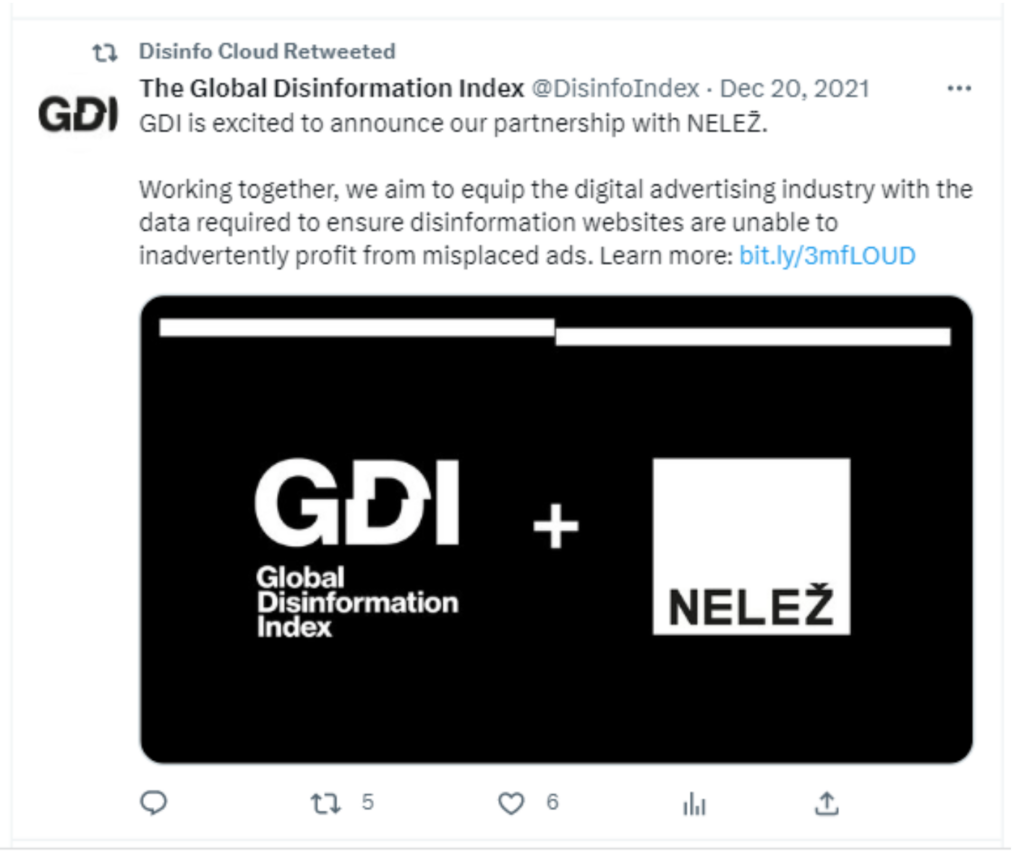
The Global Disinformation Index, of course, is a formerly State Department-backed British organization that provided advertising companies with blacklists to starve companies accused that were accused spreading disinformation of revenue. AuCoDe’s research was aimed at helping the federal government further this goal through the algorithmic curation of digital speech.
In January 2021, using research gathered from these grants, the company published a piece titled “Misinformation drives calls for action on Parler: preliminary insights into 672k comments from 291k Parler users.” The company said it was “investigating the nature of accounts on alt-tech networks, with an eye toward who is spreading misinformation” and suggested that the platform’s very nature enabled users to circulate and engage with “mis- and dis-information.”
“In conclusion, our first look at our collection of Parler data finds a plethora of misinformation driving a desire for action,” the company wrote. “We also discovered that in addition to highly permissive content moderation, there is a lack of moderation around bots, leaving enormous potential for disinformation campaigns to be carried out on these networks — something we will be keenly exploring in the coming weeks.”
The reality is that AuCoDe interfered with Americans’ right to free speech because it didn’t align with the left-wing consensus and used federal tax dollars to run cover for Big Tech oligarchs. If the company was actually dogmatically concerned with “misinformation,” it would have gone after Facebook, which played a much larger role in hosting Jan. 6 discourse.
A source close to the company told The Federalist that AuCoDe closed in May 2023. More than $1 million in taxpayer money went to a government-backed start-up specifically focused on attacking the First Amendment rights of Americans and sabotaging businesses that deviate from left-wing orthodoxy.
Samuel Mangold-Lenett is a staff editor at The Federalist. His writing has been featured in the Daily Wire, Townhall, The American Spectator, and other outlets. He is a 2022 Claremont Institute Publius Fellow. Follow him on Twitter @smlenett.
The federal government peddled technology to Big Tech companies to assist them in censoring Americans’ speech on social media in the run-up to the 2020 election, according to emails Missouri and Louisiana uncovered in their First Amendment lawsuit against the Biden administration. Specifically, the State Department marketed this censorship technology through its Global Engagement Center. In other words, our tax dollars not only funded the development of tools to silence speech that dissented from the regime’s narrative. They also paid for government employees to act as sales reps pitching the censorship products to Big Tech.
I’ve been “tasked with building relationships with technology companies,” Samaruddin Stewart, then a senior adviser for the State Department’s Global Engagement Center or “GEC,” wrote in an early-February 2020 introductory email to LinkedIn, allegedly requesting a meeting. According to the lawsuit, his email also suggested he would be reaching out to other social media companies interested in “countering disinformation.”
On March 9, 2020, Stewart again contacted LinkedIn, referencing an earlier verbal discussion and writing:
I’ll send information [to LinkedIn representatives] about gaining access to Disinfo Cloud — which is a GEC funded platform that offers stakeholders an opportunity to discover companies, technology, and tools that can assist with identifying, understanding, and addressing disinformation.
These two emails are explosive. Yet because they were revealed in two passing paragraphs of the 164-page complaint filed by Missouri, Louisiana, and a handful of other plaintiffs against the Biden administration, they — and their enormous significance — have been overlooked.
‘Cold-Calling’ Big Tech
The Stewart emails establish that in 2020, federal government actors contacted social media giants to promote GEC’s Disinfo Cloud. GEC represented that this government platform provided “companies, technology, and tools” to “assist with identifying, understanding, and addressing disinformation.” Then it gave private tech companies access to Disinfo Cloud.
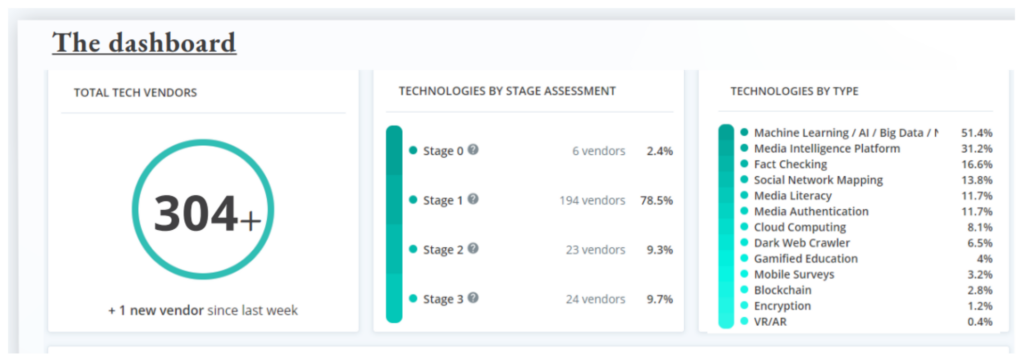
Almost identical to how GEC described Disinfo Cloud in congressional testimony, the State Department’s webpage marketed it as a “one-stop shop” to “identify and then test tools that counter propaganda and disinformation.” “Fact checking” and “media authentication” are just a couple of the types of technologies available through the dashboard.
GEC didn’t just promote Disinfo Cloud or give Big Tech access to what GEC called“the U.S. government’s online repository.” Government employees at GEC also offered to help private companies identify tools to suit their specific needs. Just “write” to the GEC’s Technology Engagement Division about “what your office needs to counter propaganda and disinformation,” the State Department instructed on its webpage, and the government will “assist” in finding “a technological solution.”
‘Testbed’
Access to Disinfo Cloud, according to the State Department’s webpage, also provides “a gateway” to the GEC’s Technology Engagement Division’s “Testbed,” allowing users to review and test the technology against their unique needs.
While Stewart’s emails don’t expressly mention the “Testbed” feature, the State Department boasts that the “private sector” uses both Disinfo Cloud and Testbed. The GEC’s webpage also invites Disinfo Cloud users to ask “for assistance in identifying a technological solution or draft a test proposal for a tool.” If Disinfo Cloud users can’t find a tool that works for them, the GEC Technology Engagement team stresses it “is open to insights and is here to help implement ideas to move the counter propaganda and disinformation mission forward.”
Infomercials
Deposition testimony by FBI Agent Elvis Chan suggests GEC’s marketing of the censorship tools went beyond making cold calls (or emails) to LinkedIn and other Big Tech companies. It also seemingly went further than providing product advice and samples on Disinfo Cloud: The GEC’s Technology Engagement Division apparently hosted infomercials to help the private vendors market their censorship software.
Chan, the assistant special agent in charge of the cyber branch at the FBI’s San Francisco field office, was “one of the primary people” communicating with social media companies about supposed “disinformation,” and thus is one of the named defendants in Missouri v. Biden. As part of that litigation, the plaintiffs deposed Chan. During questioning, Chan testified that ahead of the 2020 election, he periodically spoke with Stewart, who would meet with the social media companies separately from Chan.
According to Chan, Stewart met with policy individuals with the various social media companies about “different initiatives.” Those initiatives included various kinds of vendor-made software “that they would pilot to see if they could detect malign foreign influence on social media platforms.”
Chan further testified that Stewart and GEC “would provide webinars” from these vendors. As Chan explained, “[T]he State Department was just providing a venue where different vendors could show off their products.” The presentations were open to the general public, said Chan, but the GEC “would invite all sorts of audiences, to include researchers, employees from State Department counterparts, so typically Ministry of Foreign Affairs.” The intended audience, according to Chan, was “State Department-equivalent personnel, social media companies, and researchers.”
Chan said he attended only a couple of the webinars because the companies took only a “surface-level” look at the content, and thus he didn’t consider the technology useful to the FBI. But apparently, it was fine for the State Department to market the same tools to social media companies.
From Chan’s deposition testimony, it appears Stewart, the GEC’s then-senior adviser, made the equivalent of sales calls and hosted infomercials, all for the purpose of pushing various censorship services to social media companies.
It is unclear whether these webinars were in addition to the GEC’s “Tech Demo Series” — at which private vendors showcased their knack for fighting so-called disinformation for “U.S. government counterparts and foreign partners” — or whether, after the GEC sent a full-time representative to Silicon Valley in December of 2019 (presumably Stewart), the Tech Demo Series was opened to the public. However, given that the official Disinfo Cloud Twitter account promoted the Tech Demo Series, it seems likely that GEC expanded its target audience for the series to include the private sector and other Disinfo Cloud users.
Either way, Chan’s deposition testimony reveals our government marketed censorship technology to social media companies through “webinars.” And while Chan claimed he didn’t think GEC endorsed the products, the government expressly represented the Disinfo Cloud technology as tools to “assist” with attacking so-called disinformation.
The Tools
So what exactly were those tools?
From open-source material, it is difficult, if not impossible, to identify the entire dataset of tech companies featured on Disinfo Cloud or participating in the Tech Demo Series. That’s because Disinfo Cloud has “been retired as [a] GEC-sponsored effort,” according to the State Department. The DisinfoCloud.com webpage has also been shuttered.
But because GEC ran various “tech challenges,” giving winners State Department “sponsorship” on the government’s Disinfo Cloud Testbed — advertised as worth $25,000 — among other things, several censorship companies involved can be identified, including NewsGuard, PeakMetrics, and Omelas.
NewsGuard’s censorship technology includes “its unreliable reliability ratings database of thousands of news and information websites and a second database of purported hoaxes,” as I detailed in March. NewsGuard’s winning tech-challenge entry built upon those databases and used“AI and social listening tools to identify the initial source of the hoax,” and to find instances of the hoax being “repeated or amplified” online.
The second winner, PeakMetrics, offered a dashboard for tracking mentions of a topic across multiple media channels with social listening technology. The third winner, Omelas, developed tools to visually map online information.
The government gave these winners the ability to pilot their technology on Disinfo Cloud’s Testbed. Then it promoted Disinfo Cloud to social media giants as offering “access to companies, technology, and tools that can assist with identifying, understanding, and addressing disinformation.”
So were NewsGuard, PeakMetrics, and Omelas among the companies GEC marketed to Big Tech? Did they participate in the government-run Tech Demos and present infomercials to the private sector? Did GEC help these vendors test their products for private companies on the Testbed?
In Practice
Consider the implications, using NewsGuard to illustrate.
NewsGuard rates various media outlets on a 100-point scale and provides a red “unreliable” rating if its “experts” score the news source below 60. The company rates The Federalist “red” and claims it is one of the top-10 “most influential misinformers.” Conversely, some of the outlets that botched the biggest political stories of the century maintain a 100 percent reliability score.
The government awarded NewsGuard a $25,000 prize to develop new technology on Disinfo Cloud, using, in part, that ratings system as a backbone. NewsGuard would later receive an additional $750,000 from the government to advance the development of its censorship technology. PeakMetrics and Omelas also both scored additional government funding of $1.5 and $1 million respectively.
But think about the government’s other behind-the-scenes censorship entanglements. The government, via your tax dollars, funded both Disinfo Cloud, which provided the technology necessary to pilot the program, and the outside contractor, Park Advisors, that managed it.
The State Department’s GEC promoted the companies and technology featured on Disinfo Cloud, and a government liaison working for GEC personally contacted social media companies to encourage them to use the platform. The government also hosted Tech Demo Series for the vendors to market their products to the private sector.
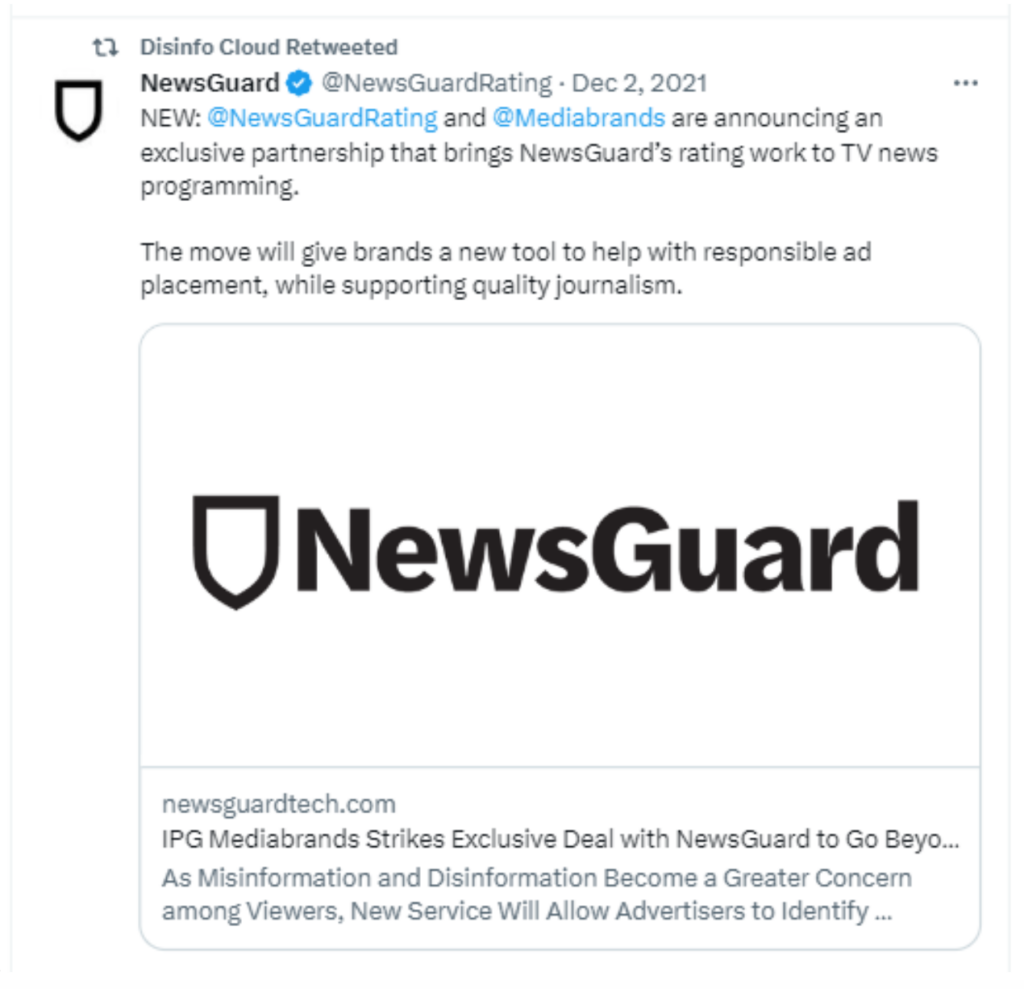
Disinfo Cloud regularly promoted private censorship technology on its official Twitter account and retweeted NewsGuard’s announcement of its partnership with Mediabrands to “bring NewsGaurd’s rating work to TV news programming.
Then beyond promoting the censorship tools, government employees working with GEC helped social media and private-sector businesses identify, test, and tweak the most “appropriate” technology for their “needs.”
And what are those “needs?” Censoring the speech of you and your fellow Americans.
A Scandal Like No Other
This scandal far surpasses the one that formerly ensnared GEC, when it was revealed the State Department awarded the Global Disinformation Index (GDI) — another “ratings” company that blacklists conservative outlets — $100,000 as part of the U.S.-Paris Tech Challenge. GDI also reportedly received money from other government-funded organizations. Those taxpayer funds helped finance GDI’s blacklist of conservative media outlets, which advertisers relied upon to defund dissenters.
But what Stewart’s emails now reveal is that the government is not merely funding censorship research. It is acting as a sales rep to market censorship technology to private companies.
The State Department isn’t skirting the First Amendment. It is driving a stake through its heart.
Margot Cleveland is The Federalist’s senior legal correspondent. She is also a contributor to National Review Online, the Washington Examiner, Aleteia, and Townhall.com, and has been published in the Wall Street Journal and USA Today. Cleveland is a lawyer and a graduate of the Notre Dame Law School, where she earned the Hoynes Prize—the law school’s highest honor. She later served for nearly 25 years as a permanent law clerk for a federal appellate judge on the Seventh Circuit Court of Appeals. Cleveland is a former full-time university faculty member and now teaches as an adjunct from time to time. As a stay-at-home homeschooling mom of a young son with cystic fibrosis, Cleveland frequently writes on cultural issues related to parenting and special-needs children. Cleveland is on Twitter at @ProfMJCleveland. The views expressed here are those of Cleveland in her private capacity.
American Family Association
American Family Association (AFA), a non-profit 501(c)(3) organization, was founded in 1977 by Donald E. Wildmon, who was the pastor of First United Methodist Church in Southaven, Mississippi, at the time. Since 1977, AFA has been on the frontlines of Ame
NEWSMAX
News, Opinion, Interviews, Research and discussion
Opinion
American Family Association
American Family Association (AFA), a non-profit 501(c)(3) organization, was founded in 1977 by Donald E. Wildmon, who was the pastor of First United Methodist Church in Southaven, Mississippi, at the time. Since 1977, AFA has been on the frontlines of Ame
American Family Association
American Family Association (AFA), a non-profit 501(c)(3) organization, was founded in 1977 by Donald E. Wildmon, who was the pastor of First United Methodist Church in Southaven, Mississippi, at the time. Since 1977, AFA has been on the frontlines of Ame
You Version
Bible Translations, Devotional Tools and Plans, BLOG, free mobile application; notes and more
Political
American Family Association
American Family Association (AFA), a non-profit 501(c)(3) organization, was founded in 1977 by Donald E. Wildmon, who was the pastor of First United Methodist Church in Southaven, Mississippi, at the time. Since 1977, AFA has been on the frontlines of Ame
NEWSMAX
News, Opinion, Interviews, Research and discussion
Spiritual
American Family Association
American Family Association (AFA), a non-profit 501(c)(3) organization, was founded in 1977 by Donald E. Wildmon, who was the pastor of First United Methodist Church in Southaven, Mississippi, at the time. Since 1977, AFA has been on the frontlines of Ame
Bible Gateway
The Bible Gateway is a tool for reading and researching scripture online — all in the language or translation of your choice! It provides advanced searching capabilities, which allow readers to find and compare particular passages in scripture based on






 What Did You Say?
You must be logged in to post a comment.