Perspectives; Thoughts; Comments; Opinions; Discussions

Posts tagged ‘FCC’

The FCC’s Political Attack on Elon Musk Has Put American Lives in Danger


By: Mollie Hemingway | October 01, 2024

Read more at https://thefederalist.com/2024/10/01/the-fccs-political-attack-on-elon-musk-has-put-american-lives-in-danger/


Elon Musk

Author Mollie Hemingway profile

Mollie Hemingway

Visit on Twitter@mzhemingway

More Articles

Disrupting communications is a military strategy that has been deployed during wars throughout history. It’s also what the federal government has done to rural Americans as part of its war on Elon Musk, a tech billionaire whose support of free speech has put him at odds with the Biden administration and other powerful Democrats. The decision to cut rural Americans off from broadband communications had already been strongly criticized as harmful, politically motivated, and completely without merit even before Category 4 Hurricane Helene wrought destruction last week in some of the most remote areas of Georgia, Tennessee, and North Carolina.

Now the FCC’s war on Musk may have turned deadly. The death toll is already at 138 Americans across six states, with many hundreds still missing. Among the serious problems facing rural victims is an inability to communicate with potential rescuers as roads are washed out, telecommunications are down, electricity is out, and people are facing fatal flooding.

It didn’t have to be this way.

In 2020, the Federal Communications Commission awarded Musk’s Starlink an $885.5 million award to help get broadband access to 642,000 rural homes and businesses in 35 states. A subsidiary of SpaceX, Starlink is a satellite internet system delivering high-speed internet to anyone on the planet. The plan would work out to less than $1,400 per linkup, same-day delivery of the necessary hardware, and only a few hours to get up and running.

Some 19,552 households and businesses in North Carolina would have had access to Starlink if they desired. Of the 21 worst-hit counties in North Carolina, the FCC-funded Starlink program would have served all or part of 17 of them, according to multiple officials. The FCC suddenly canceled that grant in 2022, a few months before Joe Biden suggested that the federal government find ways to go after Musk, a former Democrat who began criticizing some of the Democrat Party’s support of censorship of and lawfare against political opponents. After a challenge from SpaceX, the FCC reaffirmed its decision to cancel the award in 2023.

Democrat FCC Chairwoman Jessica Rosenworcel implausibly claimed to believe that Starlink couldn’t provide the service it had promised, a claim that didn’t pass the smell test for many industry observers at the time it was made. Starlink and its military counterpart were in wide use by other government programs. What’s more, at this moment Donald Trump and Elon Musk are rushing Starlink kits to remote North Carolina on their own. So are other Americans doing relief operations. And the White House is claiming it is also going to send Starlink kits to the area.

“The @FCC would rather Americans die, than approve a very inexpensive way to connect people in disaster areas. They should be ashamed,” Maye Musk, the mother of Elon Musk, said on X. “Biden, Harris and the FCC are also punishing people in disaster areas and rural areas. Shame on them,” she added.

Other agencies also joined Democrats’ anti-Musk efforts. As The Wall Street Journal reported, the Department of Justice pursued multiple attacks on Musk and his companies. The Federal Trade Commission began harassing X by making myriad questionable document demands, including requests for information on the journalists who worked on the project exposing how previous leaders of Twitter had colluded with the federal government to censor American speech and debate. The National Labor Relations Board went after Tesla over its dress code. The Securities and Exchange Commission and the U.S. Fish and Wildlife Service are also investigating Musk and his companies.

The FCC’s politically motivated cancellation of the contract in 2022 left rural Americans with no options.

The cancellation “is without legal justification,” FCC Commissioner Brendan Carr, who voted against canceling the award, said at the time. “[I]t will leave rural Americans waiting on the wrong side of the digital divide.”

The FCC’s political action against Musk isn’t the only Biden administration action harming Americans who were ravaged by Helene. Joe Biden named Kamala Harris the Broadband Czar in April 2021 and placed her in charge of a $100 billion slush fund for broadband projects. At the Commerce Department, a $42.5 billion subset of that program was launched in 2021, with guidance written to limit the ability of Starlink to compete for contracts. The Broadband Equity, Access, and Deployment (BEAD) Program was supposed to fund programs in all 50 states. It has been a complete failure.

More than three years later, not a single rural American family or business has been connected to broadband through the program. At best the groundwork will begin four years after the launch and won’t finish until 2030 at the earliest. For that much taxpayer money, Starlink could be provided to 140 million people, and without the wait, observers noted.

The FCC’s anti-Musk efforts come at the same time that the Democrat-run agency fast-tracked a shocking application by a group backed by the Democrat Soros family to purchase more than 200 radio stations across the country. Federal law requires applicants with significant foreign ownership, as the Soros group has, to go through significant paperwork and security reviews prior to receiving licenses for radio stations. They didn’t follow the law and yet the FCC fast-tracked the approval for the first time in its history.

“Your last name should not determine how the government treats you, and very clearly that’s what is happening here,” said Carr of the FCC’s politicized actions on behalf of the Soros group and against the Musk group.
Mollie Ziegler Hemingway is the Editor-in-Chief of The Federalist. She is Senior Journalism Fellow at Hillsdale College and a Fox News contributor. She is the co-author of Justice on Trial: The Kavanaugh Confirmation and the Future of the Supreme Court. She is the author of “Rigged: How the Media, Big Tech, and the Democrats Seized Our Elections.” Reach her at mzhemingway@thefederalist.com

House Republicans to file resolution disapproving of Biden admin’s ‘totalitarian’ digital equity rules


By Jessica Chasmar Fox News | Published January 30, 2024 9:00am EST

Read more at https://www.foxnews.com/politics/house-republicans-file-resolution-disapproving-biden-admins-totalitarian-digital-equity-rules

FIRST ON FOX: House Republicans are introducing a joint resolution disapproving of the Biden administration’s new “digital discrimination” rules package, which they describe as a power grab by the federal government over the internet.

The Congressional Review Act (CRA) resolution of disapproval, which is led by Republican Reps. Andrew Clyde and Buddy Carter of Georgia and co-sponsored by 65 House Republicans, aims to nullify the Federal Communications Commission’s (FCC) new digital equity rules package that went into effect this month as part of President Biden’s Infrastructure Investment and Jobs Act.

“Under the guise of ‘equity,’ the Biden Administration is attempting to radically expand the federal government’s control of all internet services and infrastructure,” Clyde said in a statement to Fox News Digital. “The FCC’s so-called ‘digital discrimination’ rule hands bureaucrats unmitigated regulatory authority that will undoubtedly impede innovation, burden consumers, and generate censorship concerns. Given the Biden Administration’s long history of weaponizing agencies against the American people, Congress should not let this unconstitutional power grab go unchecked.”

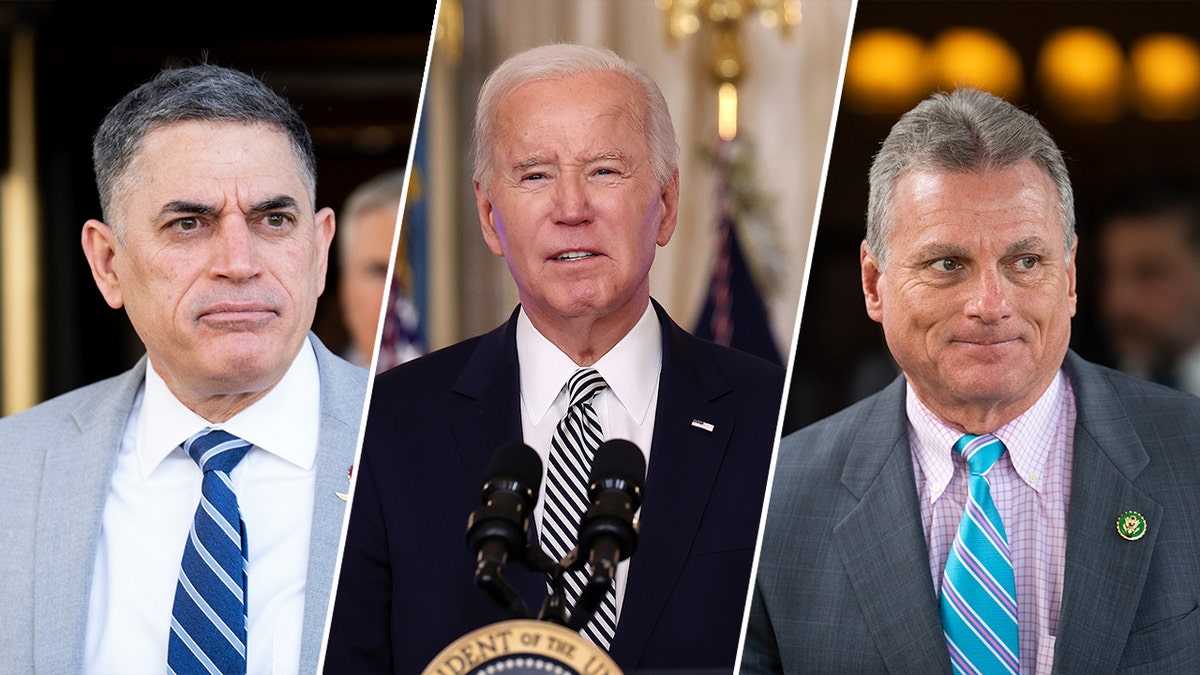
Clyde, Biden and Carter split image
Rep. Andrew Clyde, left, President Biden and Rep. Buddy Carter (Getty Images)

A resolution of disapproval under the CRA allows lawmakers to object to rules being put forward by the administration. The FCC rules package the Republicans are targeting, which was ratified by the commission on Nov. 15 and went into effect Jan. 15, implements a section of Biden’s 2021 infrastructure bill that aims to prevent digital discrimination of access to broadband services based on income level, race, ethnicity, color, religion or national origin.

FCC COMMISSIONER BLASTS BIDEN’S ‘DIGITAL EQUITY’ PLAN AS ‘UNLAWFUL POWER GRAB’

“These rules will protect civil rights, lower costs, and increase Internet access for Americans across the country,” Vice President Harris said in a Nov. 15 statement.

According to the FCC, the new rules allow it to “protect consumers by directly addressing companies’ policies and practices if they differentially impact consumers’ access to broadband internet access service or are intended to do so” and to apply those protections “to ensure communities see equitable broadband deployment, network upgrades, and maintenance.”

U.S. Federal Communications Commission (FCC) seal
The Federal Communications Commission seal (Pavlo Gonchar/SOPA Images/LightRocket via Getty Images)

However, critics of the package argue it could have the opposite effect by widening the so-called “digital divide,” which refers to unequal access to digital technology.

“Yet again, the Biden administration is attempting to push its ideology through heavy-handed government controls,” Carter, who is co-leading the resolution, told Fox News Digital in a statement. “This time, the Federal Communications Commission (FCC) plans to enact widespread regulations on every aspect of our internet’s functionality. This FCC ‘Digital Discrimination’ rule will undoubtedly widen the digital divide by stifling future investment in broadband deployments. Not only is it unconstitutional, but it goes against the very core of free market capitalism. Congress must block the FCC’s totalitarian overreach.”

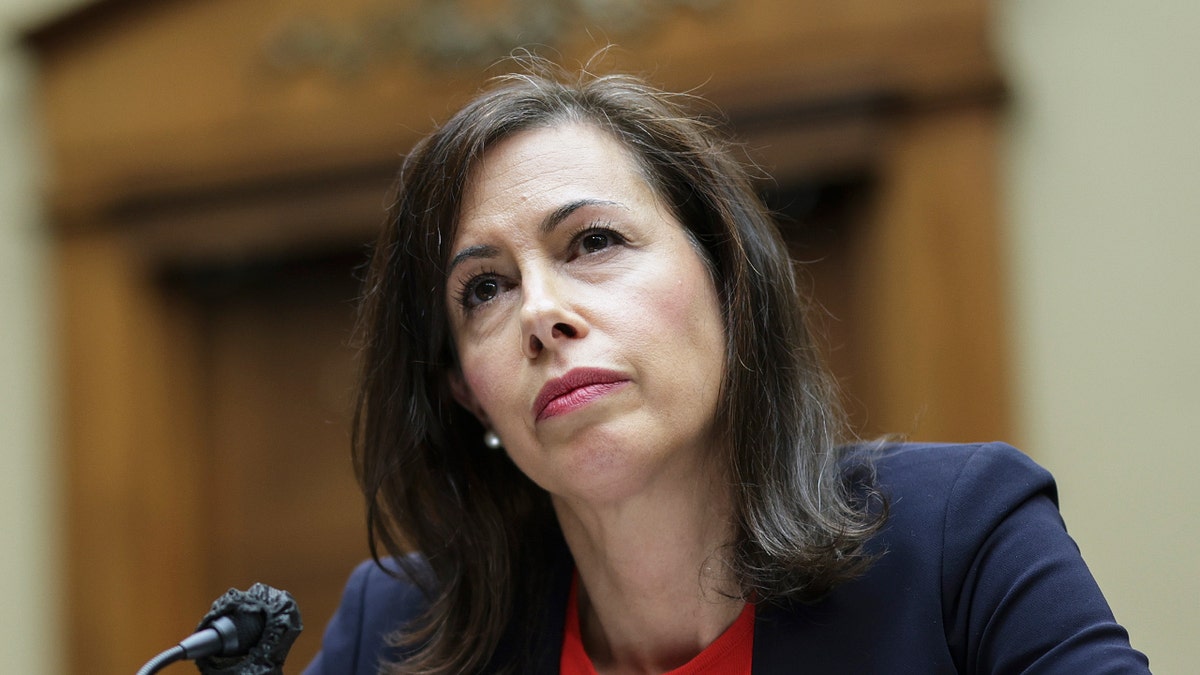
Jessica Rosenworcel
FCC Chair Jessica Rosenworcel (Kevin Dietsch)

Multiple outside groups have also endorsed the GOP resolution, including Heritage Action for America, Americans for Tax Reform, Taxpayers Protection Alliance (TPA) and Americans for Prosperity, among others.

“TPA is happy to support Rep. Carter’s CRA of the FCC’s order on digital discrimination. The order represents a massive extension of government power into broadband networks and is a solution in search of a problem,” TPA President David Williams said in a statement provided to Fox News Digital. “Notably, embracing a disparate impact standard, which ignores a vast number of economic factors that shape market decisions, will inevitably result in regulators telling companies to alter their policies based on the race of their customers. We encourage all members to support Rep. Carter’s CRA and hold the FCC accountable for this unnecessary proposal.”

Biden speaks after drone attack
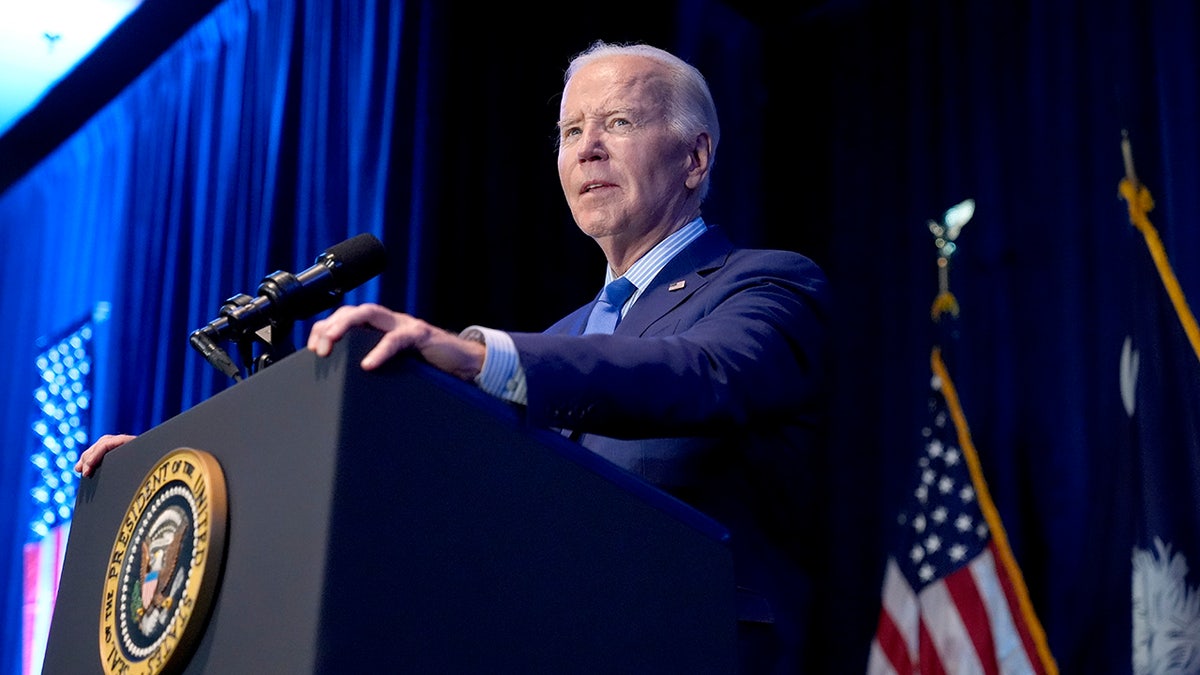
President Biden (AP Photo/Jacquelyn Martin)

Brendan Carr, one of the FCC’s commissioners, previously blasted the digital discrimination rules as a “breathtaking” government power grab.

Carr said in November, prior to their ratification, that the rules give the “Administrative State effective control of all Internet services and infrastructure.”

“President Biden has called on the FCC to adopt new rules of breathtaking scope,” Carr said. “Those rules would give the federal government a roving mandate to micromanage nearly every aspect of how the Internet functions — from how ISPs allocate capital and where they build, to the services that consumers can purchase; from the profits that ISPs can realize and how they market and advertise services, to the discounts and promotions that consumers can receive.”

“Talk about central planning,” he added. “I oppose President Biden’s plan.”

White House spokesperson Robyn Patterson previously defended the president’s plan in a statement to Fox News Digital when asked about Carr’s comments in November.

“President Biden believes no parent should have to drive to a McDonald’s parking lot so their kid can do their homework online,” Patterson wrote. “That’s why he worked with Democrats and Republicans alike to pass the Bipartisan Infrastructure Law to ensure every American has access to affordable, reliable high-speed internet.”

The House Republicans’ CRA resolution, which is expected to be filed Tuesday, would have to pass the House and Democrat-controlled Senate before making it to Biden’s desk.

Fox News Digital reached out to the White House for comment.

The FCC declined to comment on the resolution but pointed Fox News Digital to a Nov. 15 statement by FCC Chair Jessica Rosenworcel, who said, “The language is broad. But Congress was explicit —these rules have to ‘facilitate equal access to broadband.’ As part of this goal, Congress also told us we need to prevent and eliminate digital discrimination of access. That means our rules would miss the mark if they cover just discriminatory intent because we would fall short of meeting our statutory obligation to ‘facilitate equal access’ to broadband. As a result, we define digital discrimination to include disparate treatment and disparate impact. I believe this approach puts us both on the right side of history and the right side of the law.”

Jessica Chasmar is an editor on the politics team for Fox News and Fox Business. Story tips can be sent to Jessica.Chasmar@fox.com.

The FCC is voting to seize American internet infrastructure in the name of ‘equity’


By: PETER GIETL | NOVEMBER 15, 2023

Read more at https://www.theblaze.com/return/the-fcc-is-voting-to-seize-american-internet-infrastructure-in-the-name-of-equity/

When regimes capture power, it’s often not in the dramatic fashion of the storming of the Bastille. Instead, it’s a bureaucratic takeover, hidden in jargon and filled with clichés, for the greater good. The Federal Communications Commission is poised to vote today on a sweeping set of new rules called the “Preventing Digital Discrimination Order.”

The 200-page report recommends implementing an exhaustive array of new restrictions that will alter the internet forever. It springs from section 60506 of the Infrastructure Investment and Jobs Act 2021. This legislation was meant to infuse some federal dollars into America’s sagging internet infrastructure. Unfortunately, this vote will grant the FCC the power to control nearly every aspect of internet infrastructure in the name of our secular gods of diversity, equity, and inclusion.

The TL;DR of the obtuse rules is the ability to censor, control, and regulate internet service providers based on vague laws around equity. Most disturbing is that it doesn’t have to be “discrimination” as it’s generally understood but rather “disparate outcomes,” meaning all internet infrastructure must produce perfect equity or face the wrath of the United States government.

The agency’s unelected officials will convene to deliberate on regulations to integrate the latest progressive ideals regarding race and identity into the internet landscape. It’s expected to pass 3-2. It will stifle innovation and impede internet access opportunities, all in pursuit of achieving equity.

If approved, this would mark the first time the FCC would gain the authority to oversee various aspects of every ISP’s service termination policies, including customer credit usage, account history, credit checks, and account termination, among other related matters.

Experts have been sounding the alarm about what this could mean for internet freedom.

Even FCC Commissioner Brendan Carr has blasted the power-grab, calling it a free pass giving the “administrative state effective control of all internet services and infrastructure.”

“President Biden has called on the FCC to adopt new rules of breathtaking scope,” Carr noted on X, formerly Twitter. “Those rules would give the federal government a roving mandate to micromanage nearly every aspect of how the Internet functions — from how ISPs allocate capital and where they build, to the services that consumers can purchase; from the profits that ISPs can realize and how they market and advertise services to the discounts and promotions that consumers can receive.”

“The FCC reserves the right under this plan to regulate both ‘actions and omissions, whether recurring or a single instance.’ In other words, if you take any action, you may be liable, and if you do nothing, you may be liable. There is no path to complying with this standardless regime. It reads like a planning document drawn up in the faculty lounge of a university’s Soviet Studies Department.”

These regulators have established a framework that could penalize any organization seeking to enhance internet accessibility or provide internet services if the agency determines that it did so in a manner that facilitates discrimination. Whatever the regulators decide that means.

Congressional pushback

Ranking Member Ted Cruz (R-Texas) of the U.S. Senate Commerce Committee, along with 27 fellow senators, is urging the Federal Communications Commission to withdraw its preliminary proposal regarding “Digital Discrimination.” This proposal would grant the federal government significant influence over virtually every facet of the internet, potentially subjecting broadband providers to extensive, vague, and detrimental liability under a “disparate impact” standard.

In a letter to FCC Chairwoman Rosenworcel, the senators wrote:

Your Draft Order, which largely follows a Biden administration diktat, will create crippling uncertainty for the U.S. broadband industry, chill broadband investment, and undermine Congress’s objective of promoting broadband access for all Americans. We urge you to adhere to the will of Congress and conform to the plain meaning of [the bipartisan infrastructure bill] to avoid causing serious damage to the competitive and innovative U.S. broadband industry.”

Net neutrality back door

This power-grab is also a de facto attempt to bring back net neutrality. Net neutrality, with its burdensome and intrusive regulations, hinders the internet’s natural evolution. The internet has thrived remarkably well without the heavy hand of net neutrality oversight. Moreover, these regulations prevent internet service providers from rightfully charging substantial fees to content giants like video streaming platforms, which are voraciously consuming bandwidth. By prohibiting these fees, net neutrality shifts the responsibility of expanding network capacity entirely onto individuals and away from giant tech platforms.

This, in turn, is expected to result in higher costs for consumers, as they will be forced to bear the burden of more expensive internet packages, even if they don’t use these data-intensive streaming services. As it stands, net neutrality stifles innovation, undermines market forces, and ultimately harms consumers and the internet ecosystem. The idea that they would resurrect these onerous rules through the back door is no less worrying just because it isn’t surprising.

The one silver lining to this is that the disparate impact rules they cite to justify the power-grab have been struck down by the Supreme Court. There will no doubt be immediate lawsuits to try to fight these rules. Across varying industries and government entities, a concerted effort exists to curtail your freedom. From COVID lockdowns to tech censorship, expansive regulations, gun laws, and the jailing of political dissidents, the underlying result is curtailing your freedoms. The regime knows a free internet is one of the last tools the American people have left, which is why it tries to control it at every turn.

FCC shoots down petitions to delay open internet rules


 URL of the Original Posting Site: http://www.engadget.com/2015/05/10/fcc-cant-stop-wont-stop/ 

Remember when a wolfpack of cable companies and telecoms — including AT&T, CenturyLink, the American Cable Association, USTelecom and more — filed motions to delay the FCC from enacting parts of its open internet order? Well, the Commission was having none of that. Late in the day this past Friday, Wireless Competition Bureau chief Julie Veach and Wireless Telecommunications Bureau chief Roger Sherman handed down an order dismissing those petitions, pointing out that additional protection for the internet as we know it is crucial and that the petitioners’ cases aren’t as strong as they think.Tyranney Alert

Most of those groups had their sights set on one crucial proviso: the FCC’s new rules would classify internet service providers as “common carriers,” which they believed would bring not only the industry but the infrastructure that powers the internet under tighter, heavier government control. Despite the fact that companies that would now fall under that umbrella wouldn’t be subject to the full scope of regulatory oversight per the Telecommunications Act, they’re still fighting back in the name of the internet’s future growth. To hear dissenting FCC commissioner Ajit Pai tell it, the FCC would have the “the power to micromanage virtually every aspect of how the Internet works.” The petition filed by USTelecom, the CTIA, AT&T and CenturyLink spelled gloom and doom for the web as we know if the FCC gets its way:

“From day one, the Commission’s assertion of comprehensive control over the Internet will subject broadband Internet access providers – especially, small providers – to enormous unrecoverable costs and reduce their ability and incentive to invest in broadband infrastructure.”burke

To be clear, AT&T and company did not petition against the three “bright light” rules – no blocking legal content, no throttling and no paid prioritization – contained in the FCC’s Open Internet Order. While we guess it’s good everyone involved can agree on at least that much, it doesn’t change the fact that courts still have to rule on the lawsuits challenging the validity of the FCC’s plan. Tom Wheeler might be convinced of his eventual victory, but you can bet no one’s going to leave the ring until one set of ideals has been laid out on the ground.

OARLogo Picture6

FCC to cripple the Internet


http://www.foxnews.com/tech/2014/05/14/fcc-to-cripple-internet/?intcmp=latestnews

The Federal Communications Commission thinks the Internet in the United States can be run at two speeds. Backtracking from an earlier proposal, the FCC now believes it will be just fine to let Internet service providers (ISPs) control what you access online, with a few exceptions that the FCC would police.

While this new proposal might not kill the Internet, as it exists now, it would certainly cripple it – at least for American consumers and businesses.

Multiple leaks about FCC chairman Tom Wheeler’s proposal to the commission, which will be presented on Thursday, indicate that the agency would not allow ISPs to give preferential treatment – faster Internet access – to their own subsidiaries. But it would allow other companies to pay for faster, more reliable access. (No matter that such a similar restriction has already failed in the case of Comcast giving preferential treatment to its own Golf Channel.)

If the Internet does not maintain net neutrality, wherein all digital data is treated the same, countless businesses will suffer.

Tyrannical Censorship Alert

Unfortunately, there is no halfway approach to how data should flow over the Internet. It’s a binary proposition: Either access to the Internet is equal, no matter the type or size of the business, or it is not. Letting Amazon have better access because it can pay and because it is not owned by AT&T will not make the situation more equal.

If the Internet does not maintain net neutrality, wherein all digital data is treated the same, countless businesses – tech companies in Silicon Valley, auto companies in Detroit, health care providers in Houston, startups in New York – will suffer. And, of course, you and I will pay for diminishing service and be denied the option of choosing what we want to read, view and listen to at faster speeds.

Representatives of the country’s largest ISPs are claiming that the one solution to preserving net neutrality in the U.S. – legally classifying broadband Internet utilities as utilities – “would threaten new investment in broadband infrastructure and jeopardize the spread of broadband technology across America, holding back Internet speeds and ultimately deepening the digital divide.” That’s according to a press release attached to a letter signed by Verizon CEO Lowell McAdam, AT&T CEO Randall Stephenson, Time Warner Cable CEO Robert Marcus and Comcast CEO Brian Roberts.

Nothing could be further from the truth.

In the first place, those companies are proposing to introduce their own digital divide, in which consumers would have no choice. Faster, more reliable Internet access would be granted only to those companies that would pay AT&T, Time Warner, et al. Want better access to your child’s school website? Too bad, Verizon will say no – unless the school can fork over the kind of fees that an Amazon or Facebook would pay. Thus, the digital divide would grow exponentially if these CEOs have their way. 

Secondly, there is no “threat to new investment in broadband.” Indeed, the situation is quite the opposite. There is constant improvement in optical switches, which increase speeds. And there is plenty of motivation for ISPs to upgrade: It’s called competition (can you say Google Fiber?). You and I pay dearly for these services every month, but if it’s not enough to run their businesses properly, then AT&T, Time Warner and Verizon should start charging subscribers more up front and providing better service. Crippling the Internet for their own profit, with no promise of improvement, is not a solution. It’s a disincentive for ISPs to upgrade.

Moreover, access to and the flexibility of the Internet have done nothing but improve under the de facto standard of net neutrality since the early ’90s. Suddenly handing over control of how reliably and how fast certain content gets sent to a few companies would kneecap the U.S. economy.

It would stall such initiatives such as autonomous cars, which will save lives by preventing deaths on American highways but which require high-speed Internet connections. Allowing ISPs to charge more for that access would stymie such innovation and, to put it bluntly, ultimately cost lives. The idea that Comcast or Time Warner might give YouTube better online access than a doctor sending critical diagnostic information to a hospital is frightening.

Failure to support net neutrality and to reclassify broadband Internet service as a utility will also handcuff American businesses that have to compete on a global stage. Companies in other countries would have a marked advantage with full and equal Web access. Consider how many startups would move just a few miles from Seattle to Vancouver to get a Canadian Internet advantage. Meanwhile, the burgeoning startup scene in cities such as London and Berlin would also be given a boost.

The big ISPs like Verizon and Comcast are right about one thing: The FCC cannot micromanage how every content provider gets information onto the Web. Provisions established when Comcast purchased NBC Universal have already failed. And even if such restrictions could withstand legal challenges, enforcement would take years in each case, by which time businesses would be shut and innovation squelched.

When President Obama was running for office, he said on multiple occasions: “I will take a back seat to no one in my commitment to network neutrality.” This week, it’s time the president got into the front seat.

So what can you do? Email your members of Congress, email the White House … and email the FCC – if, that is, you can get through.

John R. Quain is a personal tech columnist for FoxNews.com. Follow him on Twitter @jqontech or find more tech coverage at J-Q.com.

VOTE 02

Obama Administration to Monitor Newsrooms to Control Content


http://lastresistance.com/4825/obama-administration-monitor-newsrooms-control-content/#3mhXpVe27sR2BtBM.99

Posted By on Feb 21, 2014


obama glares

  • What is the news philosophy of the station?
  • How do you define critical information that the community needs?
  • Who decides which stories are covered?
  • Have you ever suggested coverage of what you consider a story with critical information for your customers (viewers, listeners, readers) that was rejected by management?

From Fox News:

The purpose of the proposed Federal Communications Commission study is to “identify and understand the critical information needs of the American public, with special emphasis on vulnerable-disadvantaged populations,” according to the agency.

However, one agency commissioner, Ajit Pai, said in a Wall Street Journal op-ed piece Wednesday that the May 2013 proposal would allow researchers to “grill reporters, editors and station owners about how they decide which stories to run.”

He also said he feared the study might stifle the freedom of the press.

“The American people, for their part, disagree about what they want to watch,” wrote Pai, appointed to the FCC’s five-member commission in May 2012 by President Obama. “But everyone should agree on this: The government has no place pressuring media organizations into covering certain stories.”

We all know that news media are all biased, no matter which network. But anyone who thinks that having government monitors “make sure” that media networks are “telling the whole story” is going to make things better is fooling himself. All this will do is force media networks to become the White House’s mouthpiece (even more than they are now). All information will be filtered by the White House so that the American audience will only hear what they’re supposed to hear.

Oh, and this FCC study is “voluntary.” But if a newsroom refuses to answer any of the questions, they could lose their license.

SEE THE REPORT HERE. Click on image to view video:

FOX


Read more at

Tag Cloud