Explosive Pennsylvania Testimony Explains How Leftist Money Infiltrated Election Offices In 2020
REPORTED BY: MARGOT CLEVELAND | APRIL 08, 2022
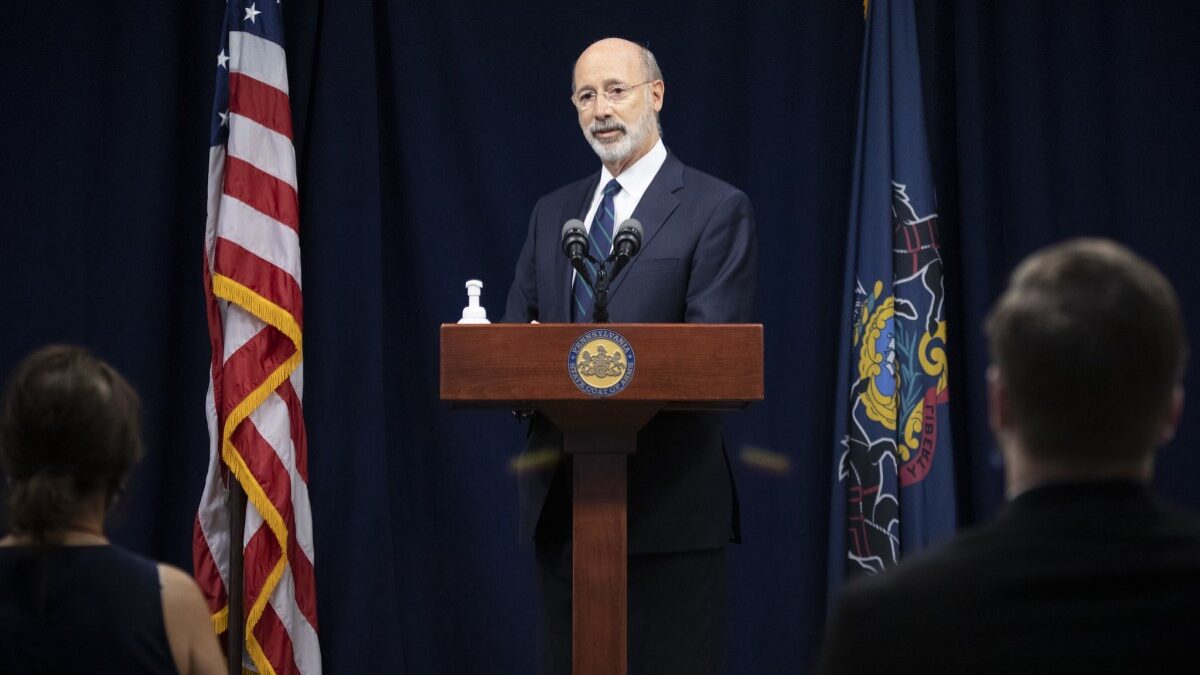
This evidence should be enough for the Pennsylvania legislature to recognize there is a real problem when private money and private actors collaborate with election officials.

MARGOT CLEVELAND
VISIT ON TWITTER@PROFMJCLEVELAND
The Democrat governor’s office in Pennsylvania colluded with left-wing activists to secure millions of dollars in private money to run get-out-the-vote efforts in blue counties in the swing state in 2020, new, explosive testimony revealed. The Pennsylvania legislature heard this testimony, backed up by email evidence, on Tuesday during the first public hearing on two new bills seeking to block private grants.
Tuesday’s public hearing began with statements by the respective primary sponsors of the bills that seek to ban dark money from elections, with Sen. Lisa Baker speaking in support of Senate Bill 982 and Rep. Eric Nelson encouraging passage of House Bill 2044. Pennsylvania investigative journalist Todd Shepherd then testified at length on the results of his extensive probe into the insertion of private funds into the 2020 election.
With a series of PowerPoint slides, Shepherd revealed to lawmakers that beginning in July 2020, consultants working for leftist organizations coordinated with local election officials and Democrat Gov. Tom Wolf’s office to lobby five blue counties to apply for these private grants. While the grants originated with the nominally non-partisan Center for Tech and Civic Life—an organization that Mark Zuckerberg and Priscilla Chan’s private foundation later infused with some $350 million in cash—emails reveal that a main consultant involved in targeting select counties, Marc Solomon, worked for the Center for Secure and Modern Elections, or the CSME.
“What’s important to know about CSME is that it is not a 501(c)3, but rather it is a fiscally sponsored project of the New Venture Fund,” Shepherd told the Pennsylvania lawmakers. In turn, “the New Venture Fund is managed by Arabella Advisors,” Shepherd continued, noting that “the ‘parent’ group of Arabella, New Venture Fund — they are part of what the Atlantic Magazine identified as ‘The Massive Progressive Dark-Money Group You’ve Never Heard Of.’” In fact, in January, The New York Times called out the New Venture Fund in its article headlined, “Democrats Decried Dark Money. Then they Won with it in 2020,” Shepherd added.
The CSME was not the only left-wing organization involved in lobbying blue counties to obtain grants. The emails also indicate that The Voter Project played a prominent role in this targeted cash giveaway: Following the 2020 election, the lead strategist in Pennsylvania for The Voter Project would brag that The Voter Project “was instrumental in signing up over 3.2 million people to vote by mail and leading the soft-side effort to win the swing state in 2020.”
How the Left Opened This Battlefront
A July 2020 email exposes the beginning of these efforts, with The Voter Project’s Gwen Camp introducing Delaware County’s Christine Reuther to CSME’s Solomon, saying they had “both been hearing about the other’s operations” and “want[ed] to get everyone together to talk about the potential for an official partnership.” According to the testimony, Camp copied Jessica Walls-Lavelle, a special advisor to the chief of staff on election reform in Wolf’s office, on that email, along with The Voters Project lead Pennsylvania strategist Kevin Mack.
In August, other emails show the governor’s staffer, Walls-Lavelle, reaching out to additional blue counties. Solomon passed the good news to his Delaware County contact, Reuther, telling her, “We’ve invited Chester, Montco, and Bucks to apply! They’re on it!”
Another email from August shows Camp, a consultant for The Voters Project, contacting a representative in Lackawanna County, telling the recipient that Camp is working with Jessica Walls-Lavelle, who is “with the Governor’s Office.”
Activists Push for Ballot Trafficking Dropboxes
All five counties lobbied by the left-wing activists, with an assist from Wolf’s office, ended up breaking heavily for Joe Biden, which likely explains why, when Solomon saw in August 2020 that Montgomery County had applied for a $1.2 million grant, he exclaimed, “the third largest county in the state, Philly suburbs!” Solomon then asked his colleagues whether they should turn this “into more of a plan.”
In an email response, Solomon’s cohort noted that the application “raised polling place consolidation as a possibility.” “We should ask what resources they need to make that not happen,” the email continued, suggesting: “Could we push them to use more than 5 drop boxes with more money? Maybe pointing out that Delaware County is using 10 times as many?”
While the right-to-know requests revealed the targeted lobbying of blue counties, there were no emails showing any outreach to core Republican counties until after September 1, 2020. That proves significant, according to Shepherd’s testimony, because when the summer-time targeting of Democratic strongholds took place, the Zuckbucks cash infusion to the CTCL had not yet been announced. Without that cash, there may never have been a chance for the red counties to obtain any funds. (Shepherd also questioned where the earlier CTCL funding came from—something apparently still unknown.)
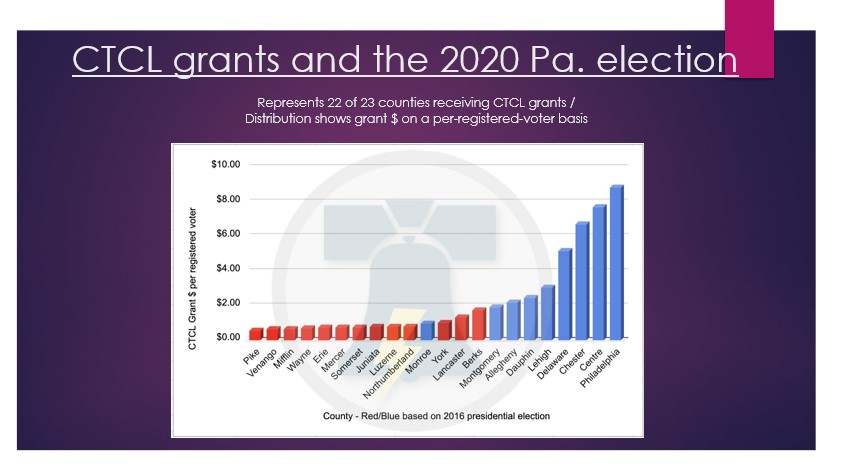
But even after the new funds came in, the Democrat counties still received a substantially higher cut of the $22.5 million in grants spread across 23 counties, as Shepherd illustrated with powerful graphics, testifying, “Philadelphia had $8.83 cents that could be spent on each ‘Joe Citizen’ registered to vote there, while in Luzerne or Erie County, those counties had about 75 cents to spend on ‘Joe Citizen’ registered voter in those counties.”
Equal Protection Problems
Far from being an outlier, Pennsylvania’s experience matches the growing evidence seen in other states that the Zuckbucks and other leftist money funded state-run get-out-the-vote efforts for Biden. What makes Pennsylvania different, however, is that the emails connect the grant process to government actors and show the state’s collaboration with left-wing political activists to lobby Democrat-only counties. This evidence raises constitutional concerns under the Equal Protection Clause of the U.S. Constitution.
The Supreme Court made clear in Bush v. Gore that “the right to vote is protected in more than the initial allocation of the franchise.” The Equal Protection clause requires both that the right to vote be granted on equal terms, but also that the state “not, by later arbitrary and disparate treatment, value one person’s vote over that of any.” The emails highlighted in Tuesday’s hearing suggest that such “arbitrary and disparate treatment” occurred in 2020, with the governor’s office and select counties as willful participants.
Individuals representing the secretary of state’s office and Philadelphia County also testified at Tuesday’s hearing and attempted to downplay the disparity by stressing that large counties had different needs. Delaware County spent some $600,000 on “Bluecrest mail sorting equipment” one witness stressed, while an election official from Philadelphia county noted it expended huge sums of grant money to purchase modern machines to “open, sort, and tabulate” votes in that county.
But rather than support their “nothing to see here” response, Delaware and Philadelphia County’s purchase of the high-tech Bluecrest mail-sorting equipment highlights a second Equal Protection problem seen in the 2020 election.
As I reported shortly after the election, evidence shows that Philadelphia and other Democrat strongholds illegally engaged in pre-canvasing activities by inspecting mail-in ballots before election day. They did this by weighing the ballots on the Bluecrest sorting equipment to determine if the voter had enclosed the ballot in a “sleeve” as required by state law. Election workers in Philadelphia and other select counties then provided campaign workers the list of allegedly defective ballots—ones without a sleeve—allowing activists to contact the voters, telling them to cast a new vote.
While the Bluecrest sorting equipment used in Philadelphia and Delaware County can detect which ballots are defective based on their thickness or weight, smaller counties without that sophisticated equipment could not conduct such pre-canvas inspections, which in any event violate the state’s election code.
Other Evidence of Vote Mismanagement
Referencing Delaware County’s expenditures proves ironic for a second reason: Whistleblower videos have exposed extensive evidence of systemic problems with the 2020 election in the large Pennsylvania county, including violations of election law and potentially corruption and fraud. Of course, mail-in voting itself is ripe for election fraud, and as the emails show Delaware County had 10 times the number of drop boxes planned over the even larger Montgomery County.
The whistleblower videos in Delaware County also captured election workers discussing the fact that some of the voting machines were missing V-drives, or the removable memory drive that records the vote tallies, and conversing on how to recreate the missing data, which a later video confirmed the county did. Yet, even with this video evidence, Delaware County council member Christine Reuther declared at a recent public meeting, “There were no missing drives. It’s been debunked. It’s been before the board of elections. It’s been addressed in court. There’s been testimony about it. There were no missing drives.”
Reuther is the same council member involved in the early lobbying for Delaware County to apply for private grants.
This evidence should be enough for the Pennsylvania legislature to recognize there is a real problem when private money and private actors collaborate with election officials, especially when they target select counties. But Tuesday’s hearing suggests Democrats don’t care, with one witness opposing the new legislation by framing the bills as part of “the big lie” that Trump won the election.
Without Democrats on board, the bill will be doomed even if it passes the legislature, as last year Wolf vetoed a similar ban on outside money. And we may now know why.


 What Did You Say?

You must be logged in to post a comment.