
After Media Try To Provoke Trump-Rubio Rift, Sec. Of State Nominee Pledges Loyalty To America First
By: Jordan Boyd | January 15, 2025

Jordan Boyd
Visit on Twitter@jordanboydtx
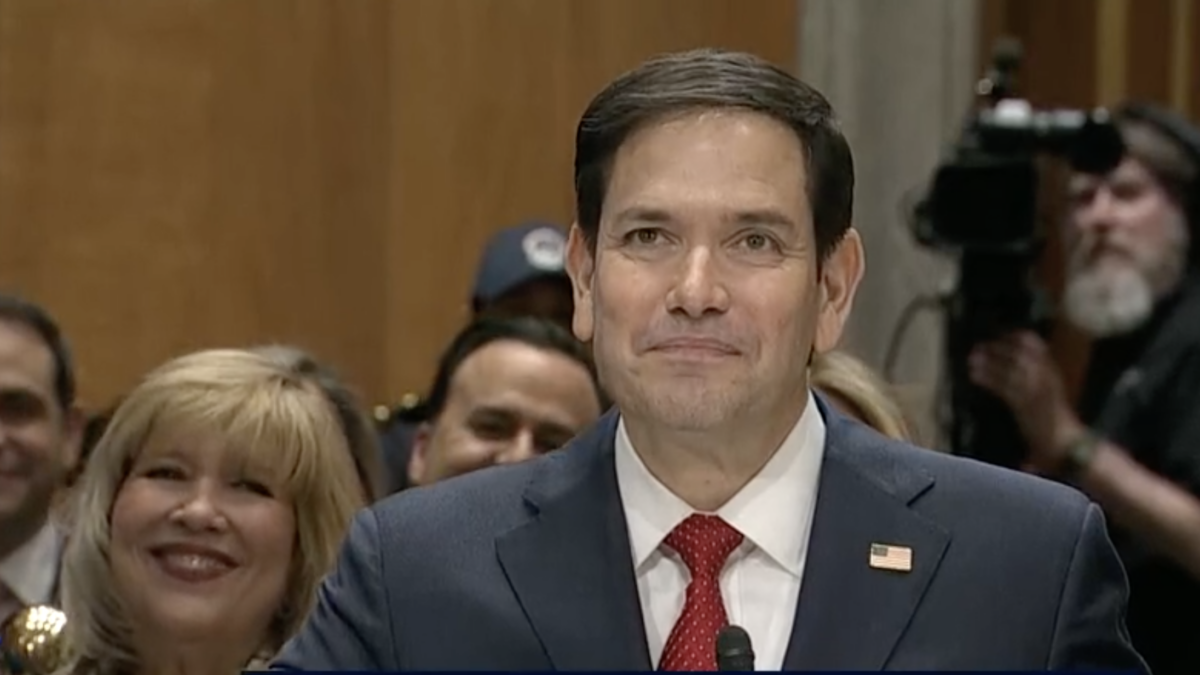
President Donald Trump’s pick for Secretary of State Sen. Marco Rubio doubled down on his commitment to the America First foreign policy agenda during his confirmation hearing on Wednesday, despite a corporate media effort to cause a rift between him and the incoming president.
Politico published a piece one day before the hearing attempting to kiss Rubio’s role as Secretary of State goodbye before it even begins. In the gossip column masquerading as an article, Politico’s Senior Foreign Affairs Correspondent Nahal Toosi uses the alleged analysis of a dozen unnamed “current and former U.S. and foreign officials” to claim that Rubio won’t last as Trump’s Secretary of State because “the odds are high that the two will differ on policy.” Toosi also invokes Trump and Rubio’s history as presidential primary rivals in 2016 as a potential problem for the pair’s ability to strategize effectively.
The only way Rubio will survive leading the State Department, the author insists, “may be to take the punches from his internal rivals, suffer through whatever insults Trump lobs at him, stick to the lanes that are open, and simply let the State Department fade into irrelevance.”
While it’s true that Rubio and Trump ran against each other and that the former used to take more of an interventionist and neocon approach to foreign policy than he does now, a lot has changed politically and globally in the last decade. The ongoing transformation of the Republican party from an arm of the establishment to a party of and for the people, paired with the rapid rise of China’s hegemony, has pushed Trump and Rubio’s visions for the globe much closer together than they were nearly 10 years ago. Both care deeply about projecting U.S. strength to the world while keeping American tax dollars from funding endless wars.
Rubio spokesman Dan Holler told Politico that Rubio is far more focused on executing Trump’s “ambitious foreign policy agenda that will put Americans first and correct the failures of the past four years” than devoting time to corporate media’s “silly games or gossip.” Rubio confirmed to the Senate Foreign Relations Committee on Wednesday that his new job will center on putting America first.
“Under President Trump, the top priority of the United States Department of State will be the United States,” Rubio said in his opening statement. “The direction he has given for the conduct of our foreign policy is clear. Every dollar we spend, every program we fund, every policy we pursue, must be justified by the answer to one of three questions: Does it make America safer? Does it make America stronger? Or does it make America more prosperous?”
On Rubio’s agenda is executing Trump’s vision to curb China’s global influence, end the Russia-Ukraine and Israel-Hamas wars, and address the vast problems exacerbating the U.S. border invasion.
“In our very own hemisphere, narcoterrorists and dictators, and despots take advantage of open borders to drive mass migration, to traffic in women and children, and to flood our communities with deadly fentanyl and violent criminals,” Rubio said.
The biggest foreign threat facing the U.S. today, he told senators, is the Communist Party of China, “the most potent and dangerous, near-peer adversary this nation has ever confronted.”
“We welcomed the Chinese Communist Party into the global order, and they took advantage of all of its benefits. And they ignored all of its obligations and responsibilities. Instead, they have repressed, and lied, and cheated, and hacked, and stolen their way into global superpower status. And they have done so at our expense and at the expense of the people of their own country,” Rubio said.
When it comes to Eastern Europe, Rubio says he echoes Trump’s desire for “people to stop dying” and for the U.S. to stop funding a conflict with no end in sight — especially when its own border is compromised.
“I think it should be the official position of the United States that this war should be brought to an end,” Rubio said. “My differences with the Biden administration throughout this process, is that they never clearly delineated what the end goal of the conflict was — what exactly were we funding? What exactly were we putting money towards? On many occasions, it sounded like however much it takes, for however long it takes — that is not a realistic or prudent position.”
Corporate media outlets, anonymous foreign policy officials, and America’s adversaries alike are trying to drive a stake between Rubio and the man who named him to be the face of the nation’s foreign relations with hopes of hampering their effectiveness. Yet, Politico’s own pages admit that Trump and Rubio have successfully worked together to secure their foreign policy goals before.
Rubio’s public commitment to following through on Trump’s promises to secure the homeland and restabilize the globe suggests that, if he is confirmed, productivity is the priority, not pretend personal strife.
 Authored by Eric Lieberman, Reporter / 10/06/2016


 After more than two years, the Republicans on the House Benghazi committee on Tuesday
  Democrats — in defending former Secretary of State Hillary Clinton — have opposed the committee since before it was formed. Still, Minority Leader Nancy Pelosi appointed Democrats to the committee. On Monday, the Democrats on the committee released their own report, which they used to call the probe a waste of time.


 What Did You Say?
I’ve said several times on the Senate floor, over the last two weeks, that the Zika virus is a serious threat and should be dealt with responsibly by funding immediate vaccine research and aggressive mosquito population control.
The threat to adults from Zika is relatively small, but the threat to pre-born children is very high. Our national priority rightly focuses on protecting the life of these young children in the womb, since each child has value, no matter their age or size.
But an international medical emergency has now become a U.S. budget emergency, a major debt crisis that will impact our children as well.
If there was a way to both respond to Zika and prevent new debt spending, wouldn’t it be reasonable to do that? The Department of Health and Human Services, Department of State, and International Assistance Programs currently have about $80 billion in unobligated funds. A small fraction of this could be reprogrammed and redirected to respond to the Zika emergency and not add any additional debt to our nation’s children. This is exactly the type of authority the Obama administration asked for in 2009 during the height of the H1N1 virus scare.
This is not a partisan idea, it is a reasonable one in light of the medical emergency and the financial reality of our nation.
In a floor speech last week, I also shed light on the fact that Congress last December provided the Obama administration with authority to pull money from bilateral economic assistance to foreign countries. They can use those funds to combat infectious diseases, if the administration believed there is an infectious disease emergency. In the middle of the Zika epidemic, the administration did use their authority to pull money from foreign aid and spend it, but they didn’t use it for Zika.
You might ask—so what did the administration spend the infectious disease money on earlier this year?
You guessed it… climate change.
In March, President Obama gave the United Nations $500 million out of an account under bilateral economic assistance to fund the U.N.’s Green Climate Fund.
Congress refused to allocate funding for the U.N. Climate Change Fund last year, so the president used this account designated for international infectious diseases to pay for his priority.
While I understand that intelligent people can disagree on the human effects on the global climate, it is hard to imagine a reason why the administration would prioritize the U.N. Green Climate Fund over protecting the American people, especially pregnant women, from the Zika virus.
Unfortunately, it gets worse.
The U.N. Green Climate Fund is connected to the U.N. Framework Convention on Climate Change (UNFCCC), an affiliated organization of the United Nations. The UNFCCC recently accepted the “State of Palestine” as a signatory, which should trigger a U.S. funding prohibition. U.S. law forbids any taxpayer dollars to fund international organizations that recognize “Palestine” as a sovereign state.
So, the administration found a way to offend our ally Israel, delay the Zika response and, if Congress allows him, add another billion dollars to our national debt. That is a busy month.
The White House should not throw money at the U.N. while a vaccine for a virus known to cause severe, debilitating neurological birth defects is put on the back burner. Zika is an important international crisis, but every crisis does not demand new “emergency funding” that is all debt. If there is a way to avoid more debt, we should take that option, it is what every family and every business does every day.