The Senate on Friday voted 62-38 to end debate on a continuing resolution to fund the government through September, all but guaranteeing final passage of a GOP-crafted bill that would avoid a partial federal shutdown. 9 Democrats and one independent who caucuses with them helped push the Republican-backed bill over the finish line.
The continuing resolution bill arose out of political necessity after Congress was unable to pass individual spending bills for the current year.
“The budget from last YEAR is still not done. We are working very hard with the House and Senate to pass a clean, temporary government funding Bill (‘CR’) to the end of September. Let’s get it done!” he wrote on Truth Social on Feb. 27.
Trump’s call for a stopgap measure to provide funding to the government came as the narrow Republican majorities in Congress faced the difficult task of agreeing on a budget resolution. The effort to pass a CR through Sept. 30, the end of fiscal 2025, was complicated by Democrat demands that Republicans promise Trump would cease his cost-cutting actions.
Sen. Patty Murray, D-Wash., the ranking member on the Senate Appropriations Committee, said that she and her fellow Democrats would support the CR if guarantees were provided that Trump would not impound funding and would back off of Elon Musk’s anti-bureaucracy efforts.
Ultimately, the bill passed in the House along mostly partisan lines, with only one Democrat, Rep. Jared Golden, D-Maine, voting for it.
From the outset, the situation in the Senate appeared to be much the same. Sen. John Hickenlooper, D-Colo., who was once thought to be open to the CR, took to X and said he wouldn’t vote for it because of Trump’s frontal attack on the bureaucracy.
“This bill would wipe out congressional oversight, letting Trump cut and redirect funding however he wants,” said Hickenlooper.
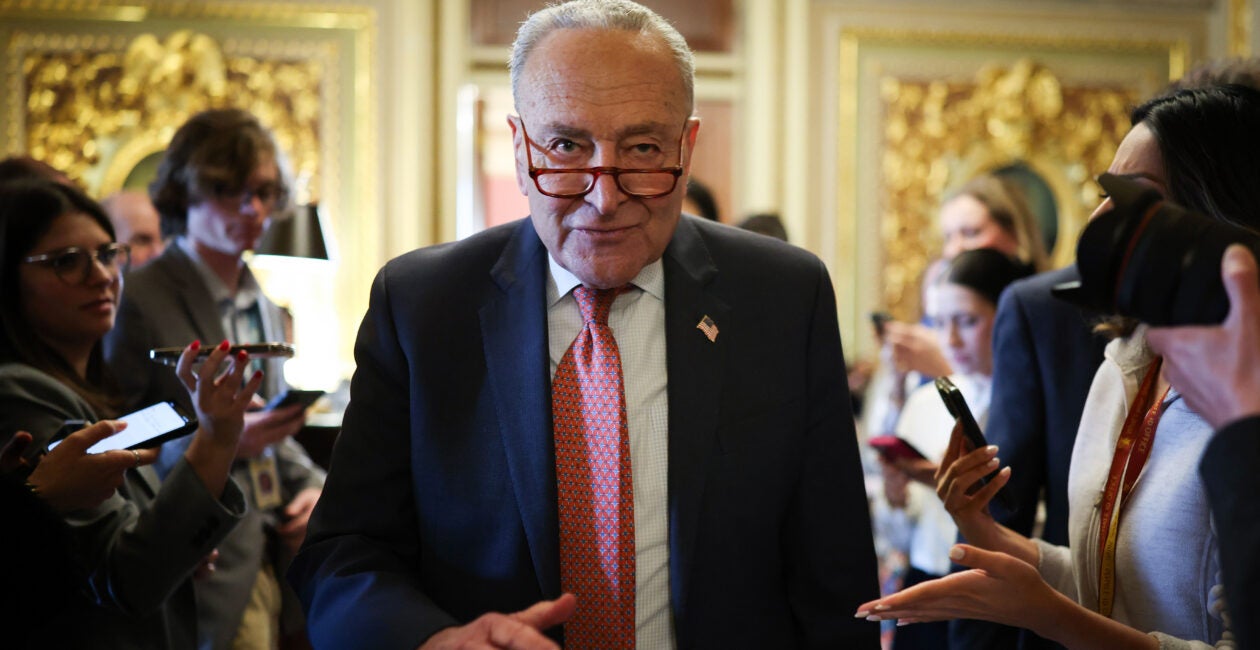
But some Democrats, facing the harsh reality of the fact that their opposition could trigger a government shutdown, decided to support the CR. Senate Minority Leader Chuck Schumer, D-N.Y., who had previously said he would urge his members to vote against it, said in a speech Thursday that he would not block the CR.
“While the CR bill is very bad, the potential for a shutdown has consequences for America that are much, much worse,” said Schumer.
Sen. Tommy Tuberville, R-Ala., asked shortly before the cloture vote why Schumer backed down, said, “It would be to commit suicide” if the Democrats triggered a shutdown. Sen. John Fetterman, D-Penn., went a step further than Schumer, deciding to support the bill to avoid a shutdown, writing on X, “I disagree with many points in the CR, but I will never vote to shut our government down.”
Sen. Cynthia Lummis, R-Wyo., told The Daily Signal shortly before the cloture vote that she was confident Democrats would moderate their opposition to Trump in the future.
“I actually have great optimism the Democrats will get their land legs back under them. They always have. Right at the moment, they’re flailing a bit. But that won’t last,” said Lummis.
“They’ll pull it together, and they’ll either find ways to work with Republicans to get some of their policy priorities included, and if they don’t, this flailing with opposition instead of legislating will hurt them in the 2026 election cycle.“
In March the Republican-led House passed H.R. 3391, which would continue funding research of pediatric diseases like childhood cancer. The legislation never went anywhere in the Senate under the leadership of Democrat Majority Leader Chuck Schumer. But now Democrats are trying to use sick kids with cancer as leverage to pass 1,500-plus pages of pork.
On Wednesday Speaker Mike Johnson unveiled a 1,500-page so-called “continuing resolution” that was really nothing more than a stuffed omnibus bill that included money for censorship, sweetheart deals for Congress, and other unnecessary expenditures. Almost immediately the pork-stuffed “continuing resolution” was rebuked by millions of Americans, including President-elect Donald Trump and incoming co-director of the Department of Government Efficient (DOGE) Elon Musk.
Following public pressure, the House released a trimmed-down version (116 pages) on Thursday. That measure funds the government through March 14. The new version keeps the $110 billion in disaster relief and farmer assistance from the original bill and suspends the debt ceiling for two years. The new version also removed the funding for childhood cancer.
And suddenly — after H.R. 3391 has collected dust in the Senate under the leadership of Schumer for months –Democrats are outraged about funding for pediatric cancer research.
The Bulwark’s Sam Stein wrote that after “pediatric cancer research advocates spent years” working to get funding, “Elon began tweeting.” Elon “killed the budget deal,” according to Stein, and with it funding for childhood cancer research.
Hawaii Democrat Sen. Brian Schatz posted on X: “F-ck cancer. Especially pediatric cancer. These people want to punish these precious little kids to pay for tax cuts for the wealthiest corporations in human history.”
Pod Save America host Jon Favreau blamed Musk: “Congrats to Elon Musk for giving the people what they want: less funding for child cancer research.”
But where was the condemnation from Favreau or Schatz or Stein when Schumer sat on H.R. 3391? Why haven’t they begun pressuring Schumer to do something with the legislation he already has?
If the only time you come out swinging in defense of funding for childhood cancer research is when you can use it to smear your political opponents and push through pork spending, but you stay silent when your own party sits on the legislation (after Republicans passed it), you’re not the good guy. You’re a hypocrite using sick children as leverage to further your pet projects.
Brianna Lyman is an elections correspondent at The Federalist. Brianna graduated from Fordham University with a degree in International Political Economy. Her work has been featured on Newsmax, Fox News, Fox Business and RealClearPolitics. Follow Brianna on X: @briannalyman2
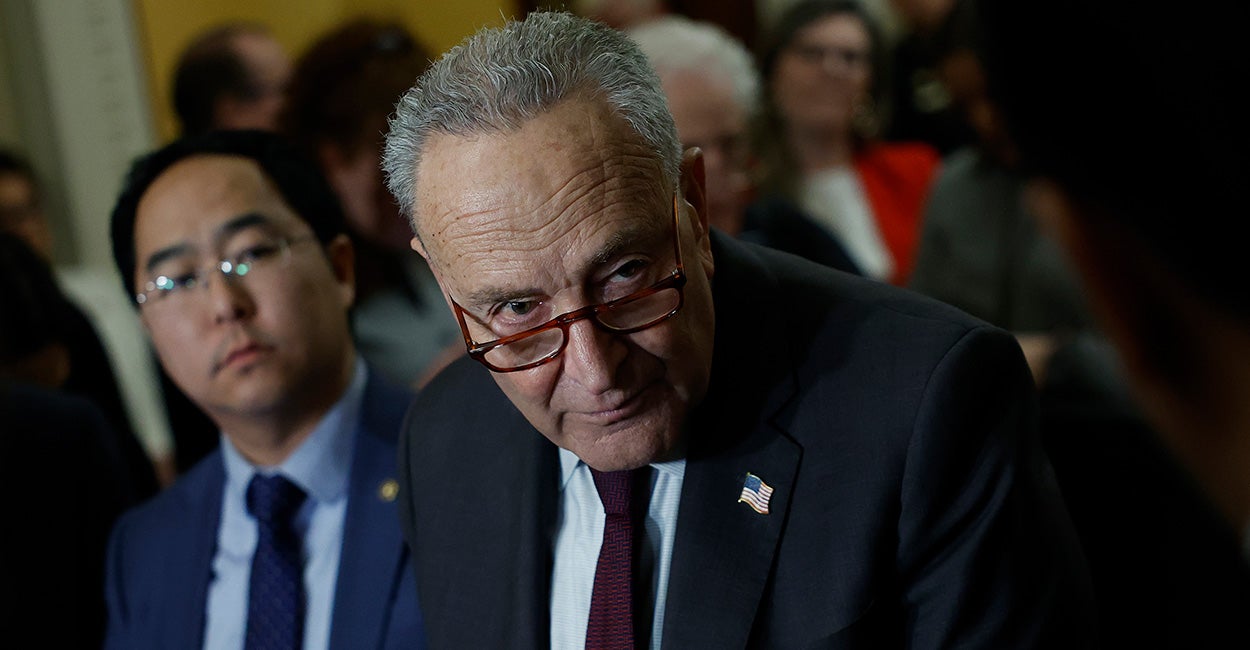
U.S. Senate Majority Leader Chuck Schumer speaks during a news conference on Dec. 10, 2024, in Washington, D.C. (Kevin Dietsch via Getty Images)
The current battle in Congress over the continuing resolution to fund the government is a fight worth having to stop the bloated spending of the federal government—spending that increases our unsustainable, monumental debt; funds dangerous and unnecessary government programs; and keeps unaccountable bureaucrats in office whose goal in life is to control our lives from birth to death. This article, originally published in 2013 during a previous budget fight, illustrates that the government never really shuts down. Crucial services for national security and law enforcement will continue even if no continuing resolution is approved, as will payments for Social Security and veterans’ benefits. The rallying cry for concerned members of Congress trying to stop the federal government’s runaway spending should be the famous words of Captain John Paul Jones: “I have not yet begun to fight!”
Here is the article—and the lesson—from 2013:
If President Barack Obama “shuts down” the government by vetoing a continuing resolution, or CR, that funds all government operations with the exception of Obamacare, or the Senate fails to pass such a CR, crucial services will continue without interruption. That includes all services essential for national security and public safety—such as the military and law enforcement—as well as mandatory government payments such as Social Security and veterans’ benefits.
The key fact, as the U.S. Department of Justice itself has said, is that when there is a short-term lapse in appropriations, “the federal government will not be truly ‘shut down’ … because Congress has itself provided that some activities of government should continue.” In fact, any claims that not passing a CR will result in a “shutting down” of the government “is an entirely inaccurate description,” according to the DOJ.
Such a lapse in funding would be neither catastrophic nor unprecedented, but it would pare down government services to those most essential for “the safety of human life or the protection of property.” That would not include the hundreds of billions of dollars in the federal budget that are constantly squandered and wasted on frivolous, unnecessary, and unneeded programs.
What the Law Says
The effect of a veto of appropriated funding by the White House or the failure of the Senate to pass a CR is governed by the Constitution, federal law, DOJ legal opinions, and planning memoranda issued by the White House Office of Management and Budget.
Under Article I of the Constitution, “No money shall be drawn from the Treasury, but in consequence of appropriations made by law.” This constitutional limitation is implemented by the federal Antideficiency Act, which makes it illegal for federal officials to spend money in excess of appropriations or to obligate the government to enter into contracts before an appropriation has been passed to pay for such a commitment. The Antideficiency Act also prohibits the federal government from accepting voluntary services, which is why federal employees (except those deemed “essential”) have to be furloughed—they cannot volunteer their services during a shutdown even if they want to. The act contains a very expansive exception, however, “for emergencies involving the safety of human life or the protection of property.”
Although that exception has been broadly interpreted by the Office of Management and Budget and the DOJ to give executive agencies wide discretion over how to spend their remaining funds, the statute was amended by Congress in 1990 in response to a 1981 opinion issued by Attorney General Benjamin R. Civiletti to make it clear that the term emergenciesdoes “not include ongoing, regular functions of government, the suspension of which would not imminently threaten the safety of human life or the protection of property.”
A 1995 opinion by the DOJ’s Office of Legal Counsel over that amendment confirmed the earlier DOJ opinions, although it slightly narrowed the interpretation of “the safety of human life or the protection of property” to mean that they must be “compromised in some significant degree” by the lack of funding.
A 2011 Office of Management and Budget memorandum also confirmed that the executive branch still views those DOJ opinions as establishing the guidelines for the continued operation of the government during a lapse in funding. The Office of Management and Budget refers to those government functions that can continue to operate because they meet the emergency definition as “excepted” functions. Federal employees who “are needed for the performance of those ‘excepted’ functions” can continue to be employed even in the absence of a CR or an appropriations bill. In fact, the Office of Management and Budget says that federal employees can continue to work who are necessary not just to protect life and property but to perform activities “expressly authorized by law” or “necessarily implied by law,” an extremely broad standard.
Many ‘Essential’ Functions
As a recent report by the Congressional Research Service points out, an Office of Management and Budget memorandum from 1981 lays out examples of the many government functions of federal agencies that may continue during a funding lapse:
National security, including the conduct of foreign relations essential to the national security or the safety of life and property.
Benefit payments and the performance of contact obligations under no-year or multi-year appropriations or other funds remaining available for those purposes.
Medical care of inpatients and emergency outpatient care and activities essential for the safe use of food, drugs, and hazardous materials.
Air traffic control and other transportation safety functions.
Border and coastal protection and surveillance.
Protection of federal lands, buildings, waterways, and other property of the U.S.
Care of prisoners and others in federal custody.
Law enforcement and criminal investigations.
Emergency and disaster assistance.
Activities essential to the preservation of the money and banking system of the U.S., including borrowing and tax collection.
Production of power and maintenance of the power distribution system.
Protection of research property.
In its 2011 memorandum, the Office of Management and Budget also provided other instances of “excepted” situations where federal agencies would continue to function. For example, operations where a “statute or other legal requirement expressly authorizes an agency to obligate funds in advance of appropriations” such as a Civil War-era law that “provides authority to the Defense Department to contract for necessary clothing, subsistence, forage, fuel, quarters, transportation, or medical and hospital supplies” or another federal law authorizing the Bureau of Indian Affairs to continue to contract for goods and supplies.
The DOJ’s 1995 opinion again confirmed that essential government benefit payments continue because they operate “under indefinite appropriations provisions that do not require passage of annual appropriations legislation.” It pointed out that “Social Securityis a prominent example of a program that operates under an indefinite appropriation. In such cases, benefit checks continue to be honored by the Treasury, because there is no lapse in the relevant appropriation.”
And all government employees necessary to continue to make those benefit payments will continue to be employed to do so even though their salaries would normally be paid through the CR because they are “necessary to disburse the Social Security benefits that operate under indefinite appropriations.” This same rule would obviously apply to other such government benefits such as Medicare and for military veterans, as well as “the performance of emergency services that continue under that separate exception.”
The 2011 Office of Management and Budget memorandum confirmed that there would be no cessation in any government functions necessary for Obama to carry out his “constitutional duties and powers (e.g., commander in chief or conducting foreign relations).” So, for example, the president would be able to continue his very extensive (and very expensive) foreign travels in the interests of “conducting foreign relations,” even if he decides to cause a lapse in government funding with a veto of a CR.
Regarding the president’s duty as commander in chief, the Department of Defense has issued guidance outlining that “the legal authority for critical military operations to continue” is clear. Among the units and activities exempt from a funding lapse are “forward-based combat, combat support, and combat service support units.”
So, “operations such as those in Iraq and Afghanistan would continue, units preparing for deployment would carry on their training and other deployment preparations, and activities needed to support operations and training would continue.” There would also be no suspension or furlough of “units identified for deployment in plans for major regional contingencies” as well as “units assigned to carry out strategic nuclear operations.”
Recent History
There have been 17 funding gaps since 1977, ranging in duration from one to 21 days. In November 1995, when President Bill Clinton vetoed a CR and there was a funding gap for five days, only about 800,000 out of a total of 4.475 million federal employees were furloughed.
Only about 280,000 federal employees were furloughed during the December 1995 to January 1996 funding gap. During this time, the Social Security Administration initially retained about 5,000 employees and then called back an additional 50,000 employees within three days to continue paying benefits and processing new claims, keeping over 80% of the total employees of the agency employed despite the lack of a CR.
Not Much Shut Down
Based on past experience, one may safely conclude that a very large number of federal employees would continue to provide services during any government “shut down,” and essential services necessary to safeguard the country will continue, as will the crucial benefit payments on which many Americans depend.
But this would still not allow the full, continued implementation of Obamacare. As outlined in a prior Heritage Foundation issue brief, “Even if a government shutdown occurs without a defunding bill, while the administration may have some funding available from other sources to continue to implement parts of Obamacare that fall within exceptions to the ADA [Antideficiency Act], it would not be able to legally implement all of the many different parts of the law, and it is doubtful it would have the funds to implement all of the law.”
There are many parts of the law that could not be deemed “emergencies,” even under the broad reading given that term by the executive branch. And the more parts of the law that are stopped, the better off the American people will be.
House Speaker Mike Johnson, R-La., is taking flak from his own conference over his 11th-hour rush to secure another continuing resolution to fund the government, according to multiple reports. With the deadline of midnight Friday to pass a CR to keep the government open through March 14 and Johnson’s commitment to a 72-hour rule for lawmakers to review the legislation, one lawmaker called it a “dumpster fire” while another called it having to eat a “crap sandwich,” The Hill reported.
Worse for conservative lawmakers, included in the CR is $100.4 billion in disaster aid and another $10 billion in economic assistance for farmers, turning the short-term funding bill into an omnibus, according to sources.
“It’s a total dumpster fire. I think it’s garbage,” Rep. Eric Burlison, R-Mo., told reporters. “This is what Washington, D.C., has done. This is why I ran for Congress, to try to stop this. And sadly, this is happening again.”
Added Rep. Chip Roy, R-Texas: “We get this negotiated crap, and we’re forced to eat this crap sandwich. Why? Because freaking Christmas is right around the corner. It’s the same dang thing every year. Legislate by crisis, legislate by calendar. Not legislate because it’s the right thing to do.”
Johnson defended the add-ons at a Tuesday press conference.
“This is a small CR that we had to add things to that were out of our control. We’ve got man-made disasters,” Johnson said. “I wish it weren’t necessary. I wish we hadn’t had record hurricanes in the fall. And I wish our farmers were not in a bind so much that creditors are not able to lend to them.”
Adding to the angst is that as of Tuesday morning, text of the CR hadn’t been published, pushing the 72-hour window well into Friday. Many lawmakers were planning to leave Washington, D.C., on Thursday for Christmas recess.
“Same crap we already knew,” one House Republican told the Washington Examiner. “No text. No timeline.”
Another Republican, who was in Johnson’s closed-door conference meeting Tuesday morning, told the Examiner that despite Johnson’s pledge to give lawmakers the full 72-hour window for review, he “clearly is OK if we don’t.”
“I think that he can do better,” Burlison said of Johnson, according to The Hill. “He can communicate better. The fact that we haven’t seen the language today and we’re supposed to vote on it this week is unacceptable.”
186 House Democrats voted against keeping the Children’s Health Insurance Program (CHIP) funded for the next six years as they opposed a stopgap spending measure in the House of Representatives Thursday that would keep the government open for the next four weeks.
Senate Democrats were likewise poised to vote against CHIP, as they declared earlier in the day that they had the votes to filibuster the spending bill and shut down the government. (Republicans have taken to calling the impending shutdown the “Schumer shutdown,” for Minority Leader Charles Schumer (D-NY), in response.)
CHIP provides funds for health insurance for children from low-income families who are not poor enough to be eligible for Medicaid. CHIP funding is the number one issue for American voters overall, according to a recent poll by Politico and the Harvard University School of Public Health.
When he won Alabama’s special election for the U.S. Senate last month, Doug Jones called on both parties to put politics aside and vote to fund the CHIP program:
“Take this election,” Jones said, “take this election where the people of Alabama said we want to get something done, we want you to find common ground, we want you to talk. Take this opportunity in light of this election and go ahead and fund that CHIP program before I get up there. Put it aside and let’s do it for those million kids and 150,000 here in Birmingham, Alabama.”
Congress did not do so, but Jones proposed a bill last week that would extend CHIP funding for five years — one year shorter than the stopgap spending bill Democrats are rejecting.
CNN political analyst Gloria Borger offered her version of Democrats’ argument Thursday: “If this is so important to you Republicans, why didn’t you take it up earlier this year when you could have, when the Democrats wanted to deal with it? I mean, children’s health insurance is something that you can bring up on the floor any time and renew it, and they’ve been screaming about it — the Democrats have been screaming about it for quite some time.”
Voters in contested House and Senate districts this year can expect to see Republican advertisements noting that Democratic incumbents voted against funding CHIP. Only six House Democrats broke ranks to vote with the GOP.
Joel B. Pollak is Senior Editor-at-Large at Breitbart News. He was named to Forward’s 50 “most influential” Jews in 2017. He is the co-author of How Trump Won: The Inside Story of a Revolution, is available from Regnery. Follow him on Twitter at @joelpollak
American Family Association
American Family Association (AFA), a non-profit 501(c)(3) organization, was founded in 1977 by Donald E. Wildmon, who was the pastor of First United Methodist Church in Southaven, Mississippi, at the time. Since 1977, AFA has been on the frontlines of Ame
NEWSMAX
News, Opinion, Interviews, Research and discussion
Opinion
American Family Association
American Family Association (AFA), a non-profit 501(c)(3) organization, was founded in 1977 by Donald E. Wildmon, who was the pastor of First United Methodist Church in Southaven, Mississippi, at the time. Since 1977, AFA has been on the frontlines of Ame
American Family Association
American Family Association (AFA), a non-profit 501(c)(3) organization, was founded in 1977 by Donald E. Wildmon, who was the pastor of First United Methodist Church in Southaven, Mississippi, at the time. Since 1977, AFA has been on the frontlines of Ame
You Version
Bible Translations, Devotional Tools and Plans, BLOG, free mobile application; notes and more
Political
American Family Association
American Family Association (AFA), a non-profit 501(c)(3) organization, was founded in 1977 by Donald E. Wildmon, who was the pastor of First United Methodist Church in Southaven, Mississippi, at the time. Since 1977, AFA has been on the frontlines of Ame
NEWSMAX
News, Opinion, Interviews, Research and discussion
Spiritual
American Family Association
American Family Association (AFA), a non-profit 501(c)(3) organization, was founded in 1977 by Donald E. Wildmon, who was the pastor of First United Methodist Church in Southaven, Mississippi, at the time. Since 1977, AFA has been on the frontlines of Ame
Bible Gateway
The Bible Gateway is a tool for reading and researching scripture online — all in the language or translation of your choice! It provides advanced searching capabilities, which allow readers to find and compare particular passages in scripture based on






 Reported


 What Did You Say?
You must be logged in to post a comment.