Perspectives; Thoughts; Comments; Opinions; Discussions

Posts tagged ‘AARON KHERIATY’

Free Speech Fight Will Go on After Supreme Court’s Devastating Ruling


BY: M.D. KITTLE | JUNE 27, 2024

Read more at https://thefederalist.com/2024/06/27/free-speech-fight-will-go-on-after-supreme-courts-devastating-ruling/
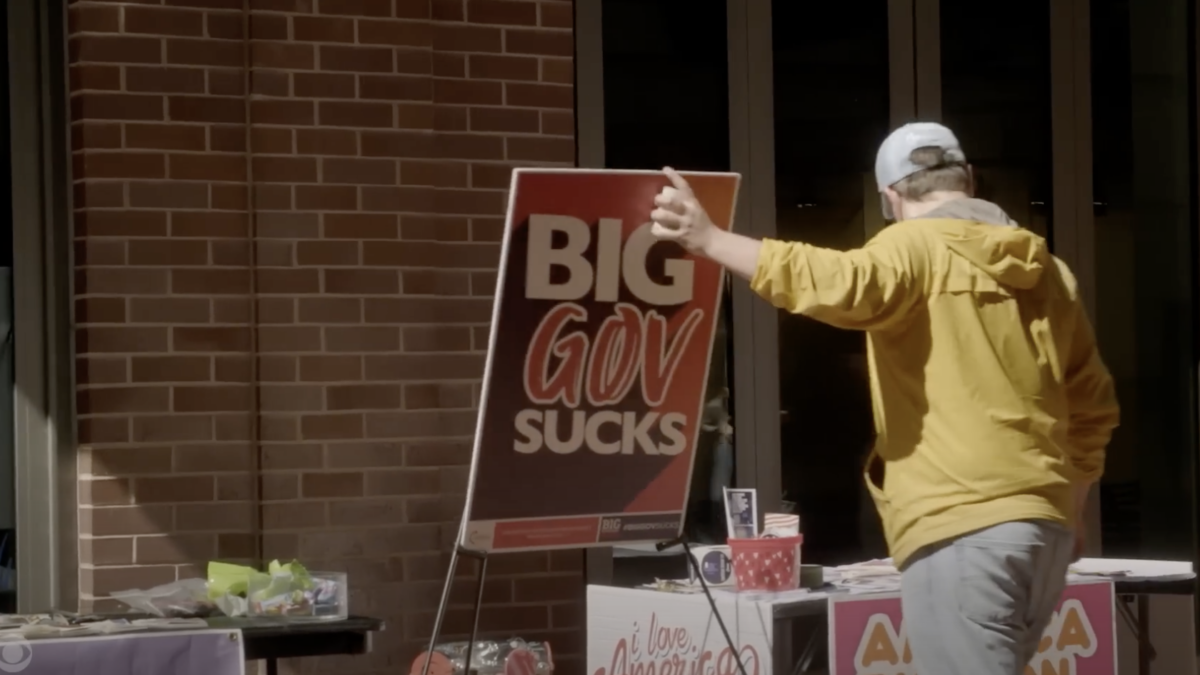

Protester holds sign criticizing big government.

Author M.D. Kittle profile

M.D. KITTLE

MORE ARTICLES

Free speech may have taken a beating in the U.S. Supreme Court’s ruling giving Big Government and Big Tech free rein over the First Amendment, but an attorney for the private plaintiffs in the case says the battle is far from over. 

“We are not giving up. … We are pursuing it on the merits … in the district court, and we want to get more discovery,” Jenin Younes, litigation counsel for the New Civil Liberties Alliance tells me in the latest edition of “The Federalist Radio Hour” podcast.   

NCLA represents the private plaintiffs in the ruling that saw a 6-3 majority in Murthy v. Missouri reverse a lower court’s injunction that blocked the federal government from partnering with social media giants to silence posts it doesn’t like. As my colleague Shawn Fleetwood wrote, the decision — based on an absurd standing argument — effectively frees the Biden administration to continue its censoring operations during the 2024 election. 

“The Supreme Court majority has practically erased the First Amendment and permitted government to co-opt private entities, like social media platforms, to accomplish its censorship aims,” NCLA said in a press release following the ruling. 

In the majority opinion, Justice Amy Coney Barrett wrote that the plaintiffs failed to establish standing because they did not “demonstrate a substantial risk that, in the near future, they will suffer an injury that is traceable to a Government defendant and redressable by the injunction they seek.”

“Because no plaintiff has carried that burden, none has standing to seek a preliminary injunction,” the decision opines. 

‘Truth Can Get You Fired’

But if the past is truly an indicator of the future, it’s difficult to reconcile the standing argument with the speech suppression that occurred, particularly against those who rightly questioned the government’s Covid policies and voiced legitimate concerns over Covid vaccines. 

NCLA’s clients, Drs. Jayanta BhattacharyaMartin KulldorffAaron Kheriaty, and Jill Hines, were all censored for daring to challenge the government’s “disinformation” campaign on the pandemic. It cost Kulldorff his job as a respected professor at Harvard. 

“I am no longer a professor of medicine at Harvard. The Harvard motto is Veritas, Latin for truth. But, as I discovered, truth can get you fired. This is my story — a story of a Harvard biostatistician and infectious-disease epidemiologist, clinging to the truth as the world lost its way during the Covid pandemic,” he wrote earlier this year in a column for City Journal. Kulldorff had questioned the lockdowns and vaccine mandates. 

‘Factual Errors’

No one was hurt by the government? The majority opinion asserts that while the Big Tech speech suppressors did have content moderation policies and may have been censoring users, the plaintiffs provided no documentation showing the government coerced the social media giants to do so. As censor-in-chief Joe Biden would say, that’s malarkey. 

Younes said the ruling is rooted in some “factual errors” by the majority. The Louisiana District Court Judge who on July 4, 2023, issued the injunction against the government said the executive branch “seems to have assumed a role similar to an Orwellian ‘Ministry of Truth.’” U.S. District Judge Terry Doughty conducted a thorough review of voluminous records showing dozens of agencies communicating with Big Tech companies, according to Younes.

“[There were] probably close to 100 federal officials that we know of who were colluding with, coercing, pressuring, influencing the companies to effectuate their censorship desires,” the attorney said, adding that the justices in the majority appear to have “read the government’s brief and just believed everything they said.” 

In his dissent, Justice Samuel Alito warned that the government’s conduct was “blatantly unconstitutional, and the country may come to regret the Court’s failure to say so.” 

“Officials who read today’s decision together with Vullo will get the message. If a coercive campaign is carried out with enough sophistication, it may get by. That is not a message this Court should send.”

Difficult but Not Impossible 

While the high court remanded the case to the lower court “for further proceedings consistent with this opinion,” Younes said expanded discovery might just stop the overreaching government yet. NCLA plans to go after government and Big Tech communications involving its clients to show the direct harm caused, as demanded in the majority’s standing argument. 

“The district court has shown that it believes in our case and … said this is arguably the most massive attack on free speech in the history of the United States, which I agree with,” Younes said. “The federal government was censoring entire narratives, entire lines of thought. If you questioned the efficacy of the vaccines in 2021, even if you were a vaccine expert like our client, Martin Kulldorff, you would be censored on social media, as he was.”

The case may also get an assist from a presidential candidate. Robert F. Kennedy Jr., now running as an independent, had sought to intervene in the Supreme Court case but was turned back by the majority. If anyone knows censorship, it’s RFK Jr., who was blocked from social media as part of what the government and corporate media have described as the “Disinformation Dozen” for challenging the government’s faulty narrative on Covid vaccines. Kennedy has lots of emails showing the Biden administration trying to silence his speech. 

As government water carrier USA Today reported, one email shows the Biden administration pouncing after Kennedy suggested baseball legend Hank Aaron’s death may have been caused by his Covid-19 vaccine. 

“Wanted to flag the below tweet and am wondering if we can get moving on the process for having it removed ASAP,” the digital director for the White House’s Covid response team wrote in an email to an official at Twitter, the publication reported. 

Alito also dissented in the court’s rejection of Kennedy’s motion to join the lawsuit, suggesting standing could be a problem and RFK Jr. could help take away that argument. 

“[The Supreme Court is] making it very difficult to bring the case, but they’re not making it impossible,” Younes said.

If the Supreme Court won’t stand up to assaults on the First Amendment, Congress must, said plaintiff Jill Hines, NCLA client and co-director of Health Freedom Louisiana.

“After reviewing the shocking and incriminating evidence indicating a massive government censorship scheme, the Justices erroneously determined to allow the government access to social media companies for the purpose of undermining free speech,” she said in the press release. “Congress must act immediately to defund agencies and third parties actively involved in this broadly pervasive and unconstitutional censorship scheme.”

Matt Kittle is a senior elections correspondent for The Federalist. An award-winning investigative reporter and 30-year veteran of print, broadcast, and online journalism, Kittle previously served as the executive director of Empower Wisconsin.

6 Takeaways from the Biden Admin’s Court Quest to Keep Censoring Americans Online


BY: JOY PULLMANN | AUGUST 14, 2023

Read more at https://thefederalist.com/2023/08/14/6-takeaways-from-the-biden-admins-court-quest-to-keep-censoring-americans-online/

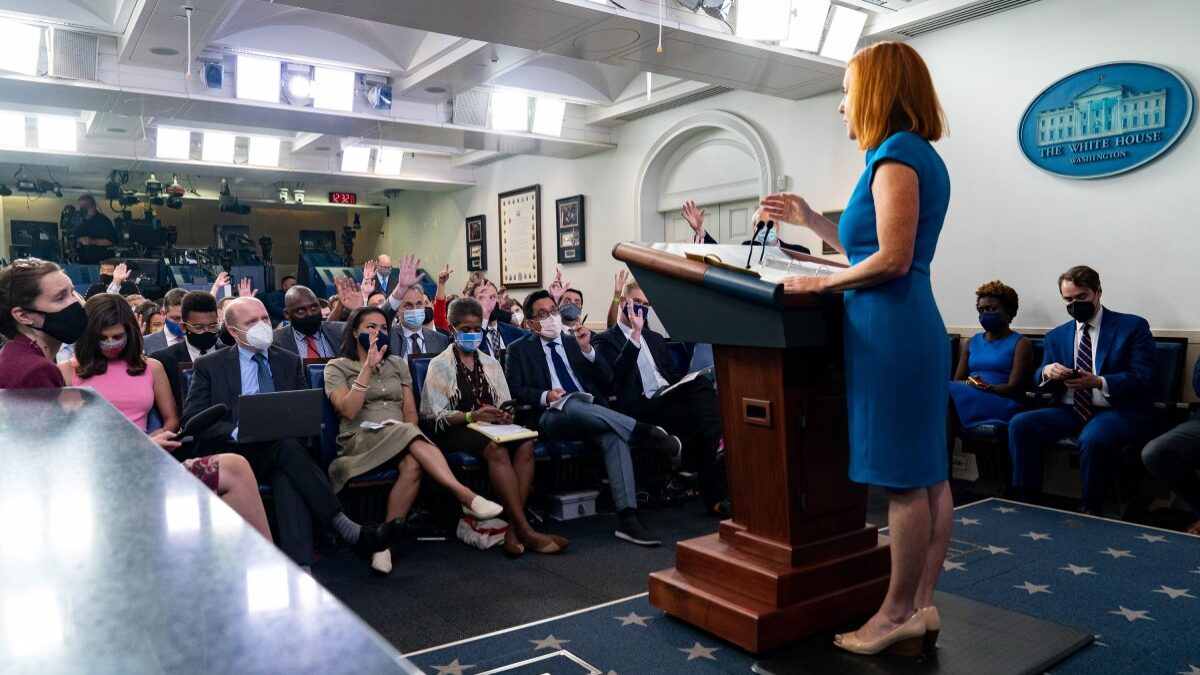
Jen Psaki

Author Joy Pullmann profile

JOY PULLMANN

VISIT ON TWITTER@JOYPULLMANN

MORE ARTICLES

On Thursday afternoon, three Fifth Circuit Court of Appeals judges heard Biden administration arguments to let government keep pressuring social media monopolies to ban ideas they don’t like from the internet. On July 4, a lower court had ordered the Biden administration to cease what it called “arguably … the most massive attack against free speech in United States’ history.” The Fifth Circuit paused that injunction on July 14 and heard oral arguments against it on Aug. 10 in Missouri v. Biden.

In this major case likely to hit the U.S. Supreme Court, the Biden administration is fighting to stop American citizens from sharing messages government officials don’t like. This case uncovered reams of White House and other high-level officials threatening internet monopolies with the end of their entire business model if they didn’t ban speech by Democrats’ political opponents.

“It’s far beyond the scope of what people realize,” says a lawyer for the plaintiffs, Zhonette Brown, of the public interest firm New Civil Liberties Alliance (NCLA).

Internal documents Twitter divulged under new owner Elon Musk provided more proof that social media monopolies are silencing Americans from Tucker Carlson and Robert F. Kennedy Jr. to millions of non-famous citizens at the behest of government pressure. Here are some key takeaways from Thursday’s oral arguments and earlier revelations from this massive First Amendment case.

1. By the Government’s Own Definition, It’s Censoring

Key to Thursday’s arguments was the question of coercion: Did government demands of internet monopolies equal coercion, or were those merely officials advocating for their views?

“If the government was doing something like that in a coercive manner, then that could be the subject of a proper injunction,” Department of Justice lawyer Daniel Bentele Hahs Tenny told the court in his opening remarks. “The problem is that what you would have to do is say, ‘Here is what the government is doing that’s coercive, and I’m enjoining that.’”

Judge Don Willett responded: “How do you define coercive?”

Tenny: “I don’t think there’s too much disagreement on this point. Coercive is where a reasonable person would construe it to be backed by a threat of government action against a party if it didn’t comply.”

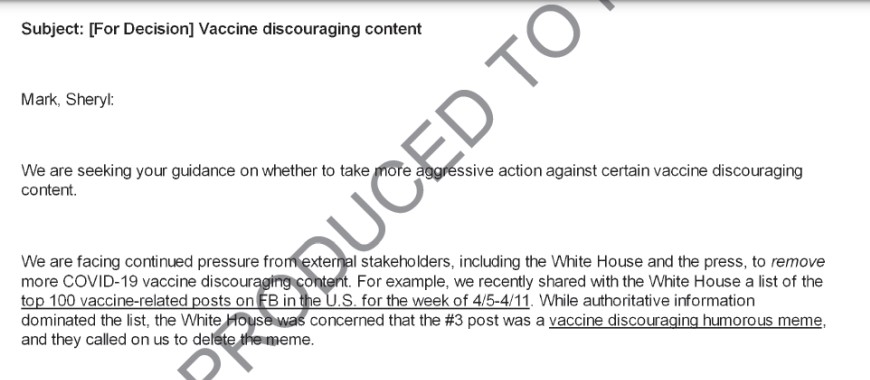
That’s exactly what the government did, the voluminous documents already discovered in this case show. In just one of the examples, Meta executive Nick Clegg, a former high-ranking U.K. official, told his bosses Mark Zuckerberg and Sheryl Sandberg: “We are facing continued pressure from external stakeholders, including the White House and the press, to remove more COVID-19 vaccine discouraging content” (emphasis original).

Clegg also characterized to colleagues an interaction with Andy Slavitt, a White House Covid adviser, this way: “[H]e was outraged – not too strong a word to describe his reaction – that we did not remove this post” of a meme about trial lawyers getting 10 years of vaccine-injured clients from government mandates.

2. Government Officials Treated Internet Monopolies Like Their Subordinates

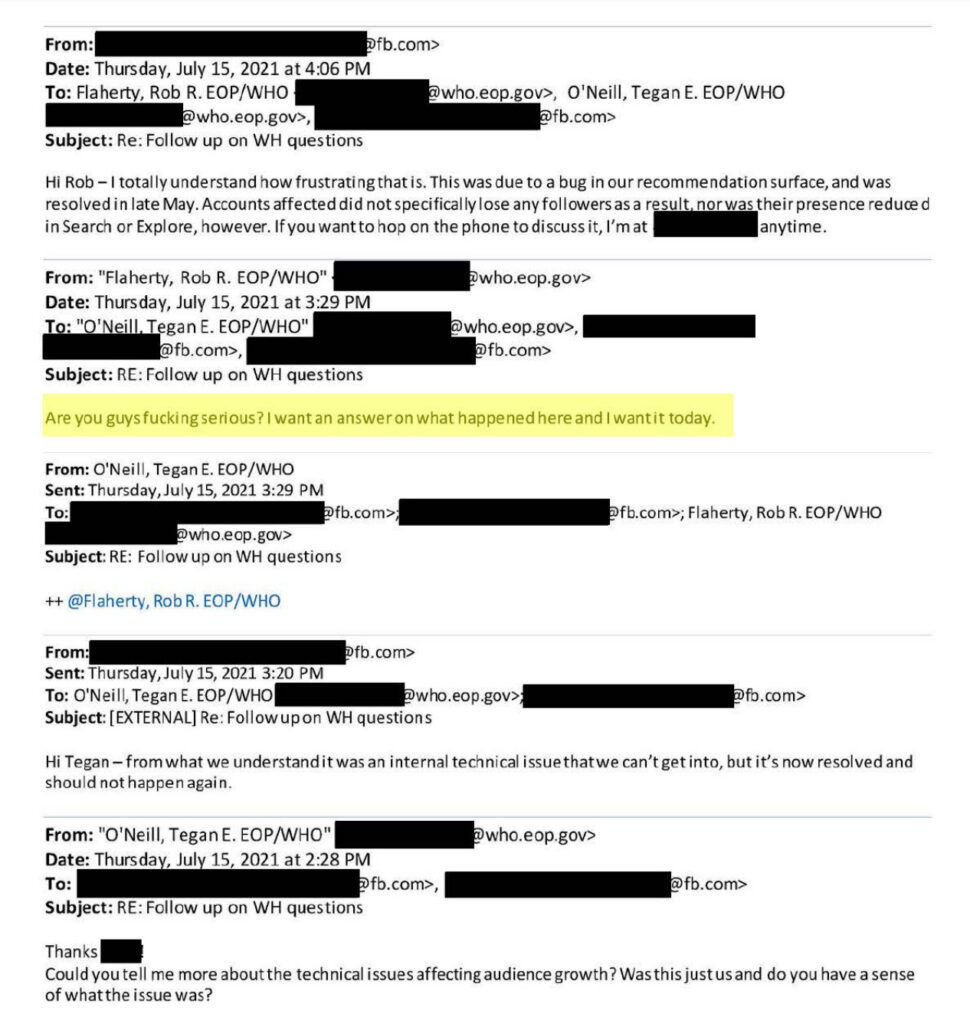
The Fifth Circuit panel demonstrated familiarity with the numerous examples of this kind of government behavior, such as this email exchange between White House digital director Rob Flaherty and Facebook, in which Flaherty swears at Facebook engineers, “Are you guys f-cking serious? I want an answer on what happened here and I want it today.”

“What appears to be in the record are these irate messages from time to time from high-ranking government officials that say, “You didn’t do this yet,’” Judge Jennifer Walker Elrod told Tenny. “And that’s my toning down the language. … So it’s like, ‘Jump!’ and, ‘How high?’”

The judges also noted the White House publicly threatened the business model of all online communications monopolies through potentially revoking Section 230 and launching antitrust lawsuits. The lawsuit documentation shows leading Democrats making the same public threats, including House Speaker Nancy Pelosi and multiple U.S. senators.

Joe Biden even threatened to hold Zuckerberg criminally liable for not running Facebook the way Biden wanted. In office, Biden also famously accused Facebook of “killing people” by not doing enough to spread the administration’s message and suppress opposing messages. FBI agent Elvis Chan‘s deposition in this case noted federal officials showed adverse legislation to social media monopolies’ leaders as examples of what the government would do to them if they didn’t ban Americans’ speech.

“It’s not like, ‘We think this would be a good public policy and we want to explain to you why that would be a good policy,” Elrod said. “There seems to be some very close relationship that they’re having these — ‘This isn’t being done fast enough’ you know, like it’s a supervisor complaining about a worker.”

3. Judges Likened Government Behavior to Mobsters

Tenny claimed there was no “or else” explaining what the government “would do” if the internet monopolies didn’t obey, so there was no government coercion present.

“This is an analogy, probably an inapt analogy, so if you’ll excuse me — like if somebody is in these movies we see with the mob or something. They don’t spell out things but they have these ongoing relationships and they never actually say, ‘Go do this or else you’re going to have this consequence,’ but everybody just knows,” Elrod replied. “And I’m certainly not equating the federal government with anybody in illegal organized crime, but there are certain relationships that people know things without always saying the ‘Or else.’”

Willett followed that up by commenting the case documentation makes it look like the government is “relying on a fairly unsubtle kind of strong-arming and veiled or not so veiled threats. ‘That’s a really nice social media platform you got there, it’d be a shame if something happened to it.’”

4. Censorship Is Election Interference

The lead attorney for the plaintiffs, John Sauer, initiated this case as Louisiana’s solicitor general. In representing state government interests to the judges, he noted that elected officials have to pay attention to what their constituents are saying online, or they won’t have a good read on what voters what them to do in office.

“We’ve gotta be able to craft messages and know what policies we’re adopting to be responsive to our citizens,” he summarized from statements submitted to the court from multiple state officials. “…Going back to 1863, as everyone knows, going back to the Federalist number 56 where [Bill of Rights author James] Madison said it, everyone knows state legislators have a sovereign interest in knowing what their constituents think and feel, and that’s directly impacted.”

When the federal government silences some Americans’ views online, Sauer said, it makes it harder for elected representatives to actually represent them. Two of the state injuries the plaintiffs assert against the federal government’s censorship are “Interference with our ability to hear our constituents’ voices on social media” and “interference with our ability to have a fair and unbiased process for our people to organize and petition the government for grievances.”

Court documents also revealed the Cybersecurity and Infrastructure Security Agency, a federal agency, set up a private entity to ban and throttle election-related online speech Democrats dislike. Much of the information choked by this algorithmic censorship operation is true, such as the legitimacy of Hunter Biden’s laptop, investigations and members of Congress have noted.

“They invented a whole new word, ‘mal-information,’ to justify going after the censorship of true speech and ideas,” Sauer said last month in a public discussion of the case that YouTube banned.

5. Democrats Want Free Speech for Themselves While Banning It for Their Enemies

The oral arguments also got into the FBI’s 2020 election interference in telling online monopolies that The New York Post’s reporting on Hunter Biden’s laptop was foreign disinformation. Tenny claimed the FBI refused to comment on the laptop because it was a pending investigation.

Yet the FBI and other federal intelligence agencies actually did comment on the laptop by calling it “foreign disinformation,” both privately to the internet monopolies and publicly. This was false, and the FBI knew it. The lower court ruled this deception constituted coercion because it caused people to act on false information.

As Ben Weingarten notes, these lies and FBI-demanded online content bans to protect them benefitted Joe Biden in the 2020 election:

According to Elvis Chan (pdf), an FBI official leading engagement with the social media platforms, while the bureau didn’t explicitly ask the companies to change their hacked material policies, it did frequently follow up to ask whether they had changed said policies, as the FBI wanted to know how they would treat such materials.

The judges almost broached an important question: If the First Amendment protects the FBI’s lies that Hunter Biden’s laptop was disinformation, for which not one federal employee has been disciplined, how can it allow for criminalizing the same behavior by average Americans by labeling their views “disinformation” and “mal-information”?

6. Today’s Internet Is Still Massively Rigged

Taibbi also noted that court documents show the Biden administration got mad enough to fire the F-bomb at social media companies when the algorithmic censorship they demand affected Biden’s Instagram account. Instagram instantly fixed the issue for the White House, but not for non-powerful Americans.

It’s clear from the case documents and other disclosures such as the “Twitter Files” and “Facebook Files” that the algorithms controlling what Americans see online are now deeply, massively rigged. That rigging is multilayered. It includes all this government coercion of entities including Apple, Google, LinkedIn, Meta, Snapchat, Tiktok, and Twitter going back to at least 2017, as well as pressure operations from corporate media and internal employee groups.

Beyond algorithm changes, social media monopolies have also changed their terms of service in response to government demands, the NCLA attorneys noted last month. So government control of public discourse will continue even if the Fifth Circuit reinstates the injunction.

Tenny told the Fifth Circuit the Covid-era censorship that ignited this case is over because the government currently deems Covid not an emergency. In court, Sauer cited YouTube banning two weeks ago a video of attorneys discussing this case as more proof this massive censorship persists. He also cited court documents showing Americans still can’t post social media messages about censored topics.

“Attorneys present gave estimates ranging from a few weeks to two months for the panel to rule” on whether to reinstate an injunction against more of this government behavior, reported Taibbi, who attended the oral arguments in New Orleans, Louisiana. The previous injunction includes exceptions for crimes such as sex trafficking.

“The government wants to be doing something that it shouldn’t be doing, and they really, really want to be doing it,” said NCLA attorney John Vecchione in the discussion YouTube banned.


Joy Pullmann is executive editor of The Federalist, a happy wife, and the mother of six children. Her latest ebook is “101 Strategies For Living Well Amid Inflation.” Her bestselling ebook is “Classic Books for Young Children.” An 18-year education and politics reporter, Joy has testified before nearly two dozen legislatures on education policy and appeared on major media from Fox News to Ben Shapiro to Dennis Prager. Joy is a grateful graduate of the Hillsdale College honors and journalism programs who identifies as native American and gender natural. Her several books include “The Education Invasion: How Common Core Fights Parents for Control of American Kids,” from Encounter Books.

Tag Cloud