Increased enforcement of a ban on imported products made with forced labor has led to cargo stoppages and complaints from importers, The Wall Street Journal reported.
Customs and Border Protection (CBP) officers are charged with enforcing the ban on goods, such a cotton and tomato products from the Xinjiang region of China, where Uyghurs are detained in forced labor camps. The bans were first put in place during the Trump administration in an effort to remove forced labor from import supply chains, the WSJ reported.
The ban on cotton from the region has had an impact on retailers who rely heavily on the commodity and must prove their supply chains don’t rely on slave labor, the WSJ reported. Importers have three months from the time of detainment to prove products pass CBP standards, if not, cargoes will be exported or abandoned.
Retailer Uniqlo Co, had a shipment of men’s shirts detained in January at the ports of Los Angeles and Long Beach because customs officers suspected it violated the December ban on Xinjiang cotton, according to internal CBP documents, the WSJ reported.
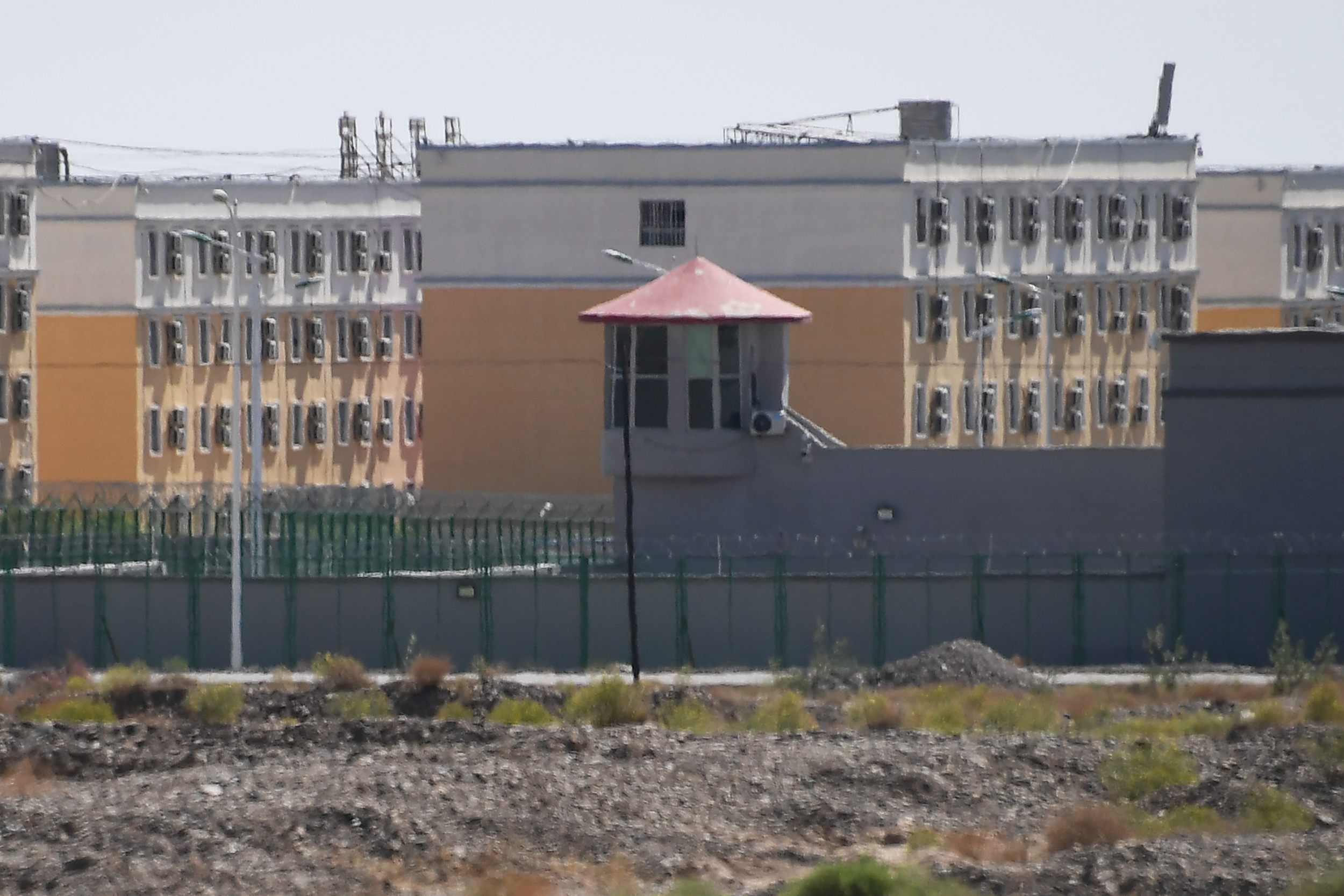
This photo taken on June 2, 2019 shows buildings at the Artux City Vocational Skills Education Training Service Center, believed to be a re-education camp where mostly Muslim ethnic minorities are detained, north of Kashgar in China’s northwestern Xinjiang region. (Photo by GREG BAKER/AFP via Getty Images)
Uniqlo objected, providing documents that showed the cotton came from Australia, Brazil and the U.S., the WSJ reported. But CBP still did not release the cargo, citing that the company was unable to prove the shirts weren’t made using forced labor.
Representatives for the retail industry say the burden of proof is too high and that expectations are unclear, the WSJ reported.
“It turns U.S. jurisprudence on its head. As opposed to innocent until proven guilty, it is now guilty until proven innocent,” said Nate Herman, senior vice president of policy at American Apparel & Footwear Association, the WSJ reported. ”Companies don’t know what they are trying to prove because they don’t know what part of the shipment triggered the detention or why it was in violation.”
One possible factor for the lack of transparency and stalled imports could be a shortage of CBP staff, which “limits its ability to pursue forced labor investigations,” a Government Accountability Office report said in October.
Trade lawyers and business groups said they expect more import bans and disputed shipments, due to an increasing focus on human rights, the WSJ reported.
“As President Biden made clear at the recent G7 summit, the United States will not tolerate modern-day slavery in our supply chains,” said Secretary of Homeland Security, Alejandro N. Mayorkas in a press release Thursday. “This Withhold Release Order demonstrates we continue to protect human rights and international labor standards and promote a more fair and competitive global marketplace by fulfilling the Biden-Harris Administration’s commitment to ending forced labor.”
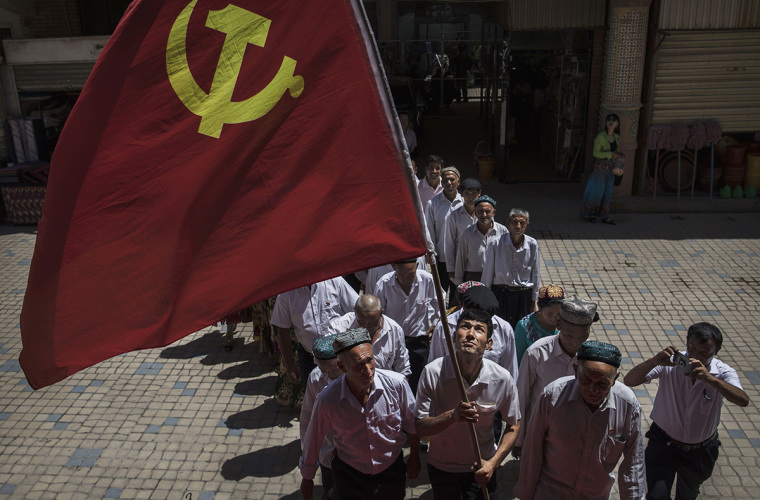
Ethnic Uyghur members of the Communist Party of China carry a flag as they take part in an organized tour on June 30, 2017, in the old town of Kashgar, in the far western Xinjiang province, China. Kashgar has long been considered the cultural heart of Xinjiang for the province’s nearly 10 million Muslim Uyghurs. At an historic crossroads linking China to Asia, the Middle East, and Europe, the city has changed under Chinese rule with government development, unofficial Han Chinese settlement to the western province, and restrictions imposed by the Communist Party. Beijing says it regards Kashgar’s development as an improvement to the local economy, but many Uyghurs consider it a threat that is eroding their language, traditions, and cultural identity. | Kevin Frayer/Getty Images
Women imprisoned in China’s network of internment camps in Xinjiang are subject to horrific torture, systematic rape, and sexual abuse as the country’s Communist leadership seeks to “destroy” those it sees as a threat, a graphic new report has revealed.
A report from the BBC highlights interviews from several former detainees and a guard who shared firsthand accounts of their horrific experiences in China’s internment camps in the Xinjiang region. Estimates suggest that over 1 million to as many as 3 million Uyghur Muslims and other minority groups in Western China have been subject to these internment camps, which are intended to strip Uyghurs and other minorities “of their culture, language and religion, and indoctrinate them into mainstream Chinese culture.”
Tursunay Ziawudun, a woman who spent nine months inside one of these camps before fleeing to the U.S., told the BBC that women were removed from the cells “every night” and raped by one or more masked Chinese men. She said she was tortured and later gang-raped on three occasions, each time by two or three men. She also recalled how police tortured her with electric shocks and, in one instance, violently abused her when she was unsure of her husband’s whereabouts, kicking her with their heavy boots. Because of the severity of the abuse, rape, and torture, Ziawudun said that there were “many people in those cells who lost their minds.”
“Their goal is to destroy everyone,” she said. “And everybody knows it.”
Gulzira Auelkhan, a Kazakh woman from Xinjiang who was detained for 18 months in the camp system, recounted how she was forced to strip Uyghur women naked and handcuff them before leaving them alone with Chinese men.
“My job was to remove their clothes above the waist and handcuff them so they cannot move,” she recalled. “Then I would leave the women in the room and a man would enter — some Chinese man from outside or policeman. I sat silently next to the door, and when the man left the room I took the woman for a shower.”
The Chinese men “would pay money to have their pick of the prettiest young inmates,” she said, stressing that the physical violence she witnessed amounted to “rape.”
Qelbinur Sedik, an Uzbek woman from Xinjiang, who was forced to give language lessons to the detainees, said the women’s camp was “tightly controlled.” She said there were “four kinds of electric shock” women would be subjected to — “the chair, the glove, the helmet, and anal rape with a stick.”
“The screams echoed throughout the building,” she told the BBC.“I could hear them during lunch and sometimes when I was in class.”
Sedik said that one time, she asked a Chinese camp policewoman about the rumors of rape. The women replied, “Yes, the rape has become a culture. It is gang rape and the Chinese police not only rape them but also electrocute them. They are subject to horrific torture.”
Interviewees also shared how they were required to watch propaganda videos praising Chinese President Xi Jinping and sing patriotic songs. They were also forced to undergo medical tests, take pills, and were forcibly injected every 15 days with a “vaccine” that brought on nausea and numbness. Women were also forcibly injected with IUDs or sterilized.
One former prison guard shared how women were forced to memorize books about Xi Jinping. Those who failed to complete the task were punished with food deprivation and beatings.
“I entered those camps. I took detainees into those camps,” he said. “I saw those sick, miserable people. They definitely experienced various types of torture. I am sure about that.”
China has repeatedly denied that it is persecuting ethnic groups in Xinjiang; however, reports reveal it is actually expanding its network of detention facilities.
An earlier report documented how hospitals in Xinjiang were ordered to abort and kill all babies born in excess of China’s mandated family planning limits — including newborns born after being carried to full term. The orders were part of strict family-planning policies intended to restrict Uyghurs and other ethnic minorities to three children.
In January, the former Trump administration officially designated China’s persecution of minorities in western Xinjiang Province as “genocide” and “crimes against humanity.”
“I believe this genocide is ongoing, and that we are witnessing the systematic attempt to destroy Uyghurs by the Chinese party-state,” former Secretary of State Mike Pompeo said at the time, adding that the Chinese Communist Party — which he described as a “Marxist-Leninist regime that exerts power over the long-suffering Chinese people through brainwashing and brute force” — is “engaged in the forced assimilation and eventual erasure of a vulnerable ethnic and religious minority group.”
The Biden administration has not stated whether it would maintain the previous administration’s declaration that China is committing genocide against its Uyghur population. White House Press Secretary Psaki told reporters at a press briefing that Biden has “spoken before to the horrific treatment” of Uyghurs, but she will “check”what the Biden administration’s policy will be, RCP previously reported. However, U.S. Secretary of State Antony Blinken has said that he believes genocide had been committed against the Uyghurs.
Christian leaders have urged Christians in the West to care about the persecution of Uyghur Muslims and other minorities. In September, Southern Baptist ethicist Russell Moore said that the crimes being perpetrated against religious minorities in China and elsewhere rely on invisibility “where the rest of the world doesn’t pay attention” and “tribalism.”
“The way of Jesus Christ says that we pay attention to our neighbor on the side of the road who is persecuted, who is being beaten,” he said. “So let’s pray for the Uyghur [and] for other persecuted peoples. Let’s pray not just individually, but together, and pray for them by name.”
“Let’s be the people who stand up for whoever is being made invisible, whoever is being intimidated and bullied in our own neighborhoods and in our own communities because we’re the people of Jesus Christ.”
American Family Association
American Family Association (AFA), a non-profit 501(c)(3) organization, was founded in 1977 by Donald E. Wildmon, who was the pastor of First United Methodist Church in Southaven, Mississippi, at the time. Since 1977, AFA has been on the frontlines of Ame
NEWSMAX
News, Opinion, Interviews, Research and discussion
Opinion
American Family Association
American Family Association (AFA), a non-profit 501(c)(3) organization, was founded in 1977 by Donald E. Wildmon, who was the pastor of First United Methodist Church in Southaven, Mississippi, at the time. Since 1977, AFA has been on the frontlines of Ame
American Family Association
American Family Association (AFA), a non-profit 501(c)(3) organization, was founded in 1977 by Donald E. Wildmon, who was the pastor of First United Methodist Church in Southaven, Mississippi, at the time. Since 1977, AFA has been on the frontlines of Ame
You Version
Bible Translations, Devotional Tools and Plans, BLOG, free mobile application; notes and more
Political
American Family Association
American Family Association (AFA), a non-profit 501(c)(3) organization, was founded in 1977 by Donald E. Wildmon, who was the pastor of First United Methodist Church in Southaven, Mississippi, at the time. Since 1977, AFA has been on the frontlines of Ame
NEWSMAX
News, Opinion, Interviews, Research and discussion
Spiritual
American Family Association
American Family Association (AFA), a non-profit 501(c)(3) organization, was founded in 1977 by Donald E. Wildmon, who was the pastor of First United Methodist Church in Southaven, Mississippi, at the time. Since 1977, AFA has been on the frontlines of Ame
Bible Gateway
The Bible Gateway is a tool for reading and researching scripture online — all in the language or translation of your choice! It provides advanced searching capabilities, which allow readers to find and compare particular passages in scripture based on




 What Did You Say?
You must be logged in to post a comment.