Perspectives; Thoughts; Comments; Opinions; Discussions

Posts tagged ‘uaw’

Ford CEO says company will ‘think carefully’ about where it builds vehicles after UAW strike


By Daniella Genovese FOXBusiness

Read more at https://www.foxbusiness.com/markets/ford-ceo-company-think-carefully-where-builds-vehicles-after-uaw-strike

Ford’s top boss, CEO Jim Farley, said Thursday that the company will “think carefully” about where it builds future vehicles following the United Auto Workers (UAW) strike. The strike came with a heavy price for the Detroit automaker. For one, the company’s Kentucky Truck Plant in Louisville was the first to shut down when thousands of UAW union members walked off the job. It was a major play in the UAW’s strike last fall against Detroit’s Big Three automakers — Ford, General Motors and Stellantis.

THE UAW STRIKE MIGHT BE OVER, BUT WILL CONSUMERS FEEL IT LATER?

During the Wolfe Research Global Auto Conference in New York, Farley said the strike had been “an extremely difficult moment” for the company, noting Ford had “prided itself on not having a strike since ’70.” 

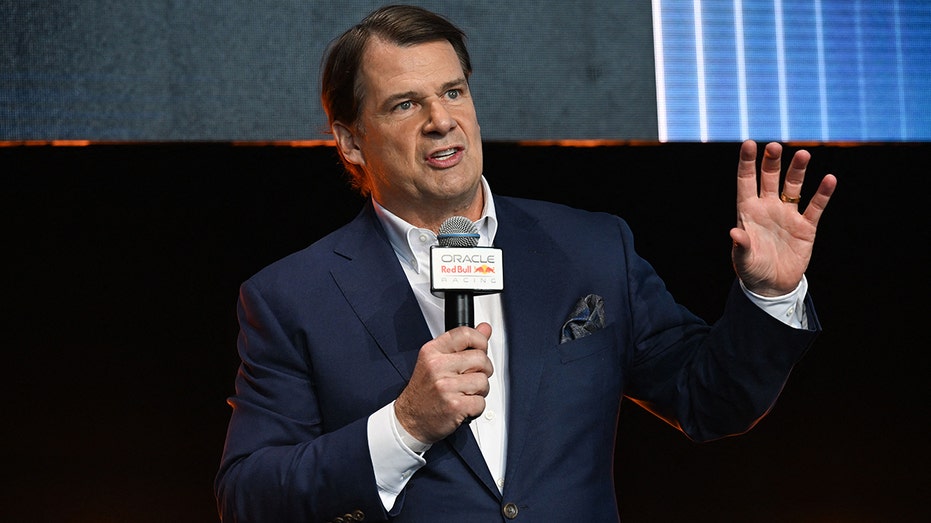
Ford CEO Jim Farley
Ford CEO Jim Farley attends a Red Bull Racing unveiling of the team’s new Formula One car during a launch event in New York City on Feb. 3. (ED JONES/AFP via Getty Images / Getty Images)

He continued by saying that Ford, unlike its competitors, has 57,000 UAW workers and that 100% of its trucks are made by such workers in the U.S. 

“Our competitors do not do that. They went through bankruptcy, and they moved production to Mexico and other places. So it has always been a cost for us. And we always thought it was the right kind of cost,” he said.

UAW HITS GM AGAIN, STRIKING AT AUTOMAKER’S LARGEST PLANT

The moment Ford’s plant shut down was a “watershed moment.” 

“Really, our relationship has changed,” Farley told the conference. “Does this have business impact? Yes.” 

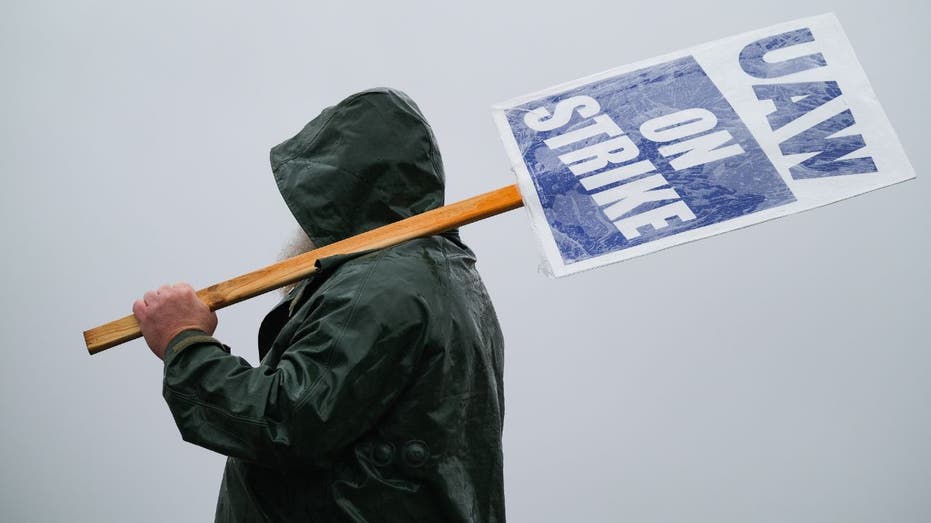
UAW member walking away with strike sign
A “UAW On Strike” sign is held by a picketer outside the General Motors Co. Spring Hill Manufacturing plant in Spring Hill, Tennessee, on Oct. 30, 2023. (Kevin Wurm/Bloomberg via Getty Images / Getty Images)

In a statement to The Associated Press, UAW President Shawn Fain argued that Ford should “find a CEO who’s interested in the future of this country’s auto industry.”

“Maybe Ford doesn’t need to move factories to find the cheapest labor on Earth,” he said. “Maybe it needs to recommit to American workers.”

GET FOX BUSINESS ON THE GO BY CLICKING HERE

President Biden marched alongside the UAW last September and told union members to “stick with it.” 

TickerSecurityLastChangeChange %
FFORD MOTOR CO.12.30-0.22-1.76%

It was the first time a president appeared alongside striking workers in modern history. 

The work stoppage cost the industry billions of dollars, and the Big Three all ratified record contracts with the union in order to get production lines running again.

Leaked Messages From UAW Official Reveal a Big Cause of Unions’ Decline


By: Rachel Greszler / September 28, 2023

Read more at https://www.dailysignal.com/2023/09/28/leaked-messages-uaw-official-reveal-big-cause-unions-decline/

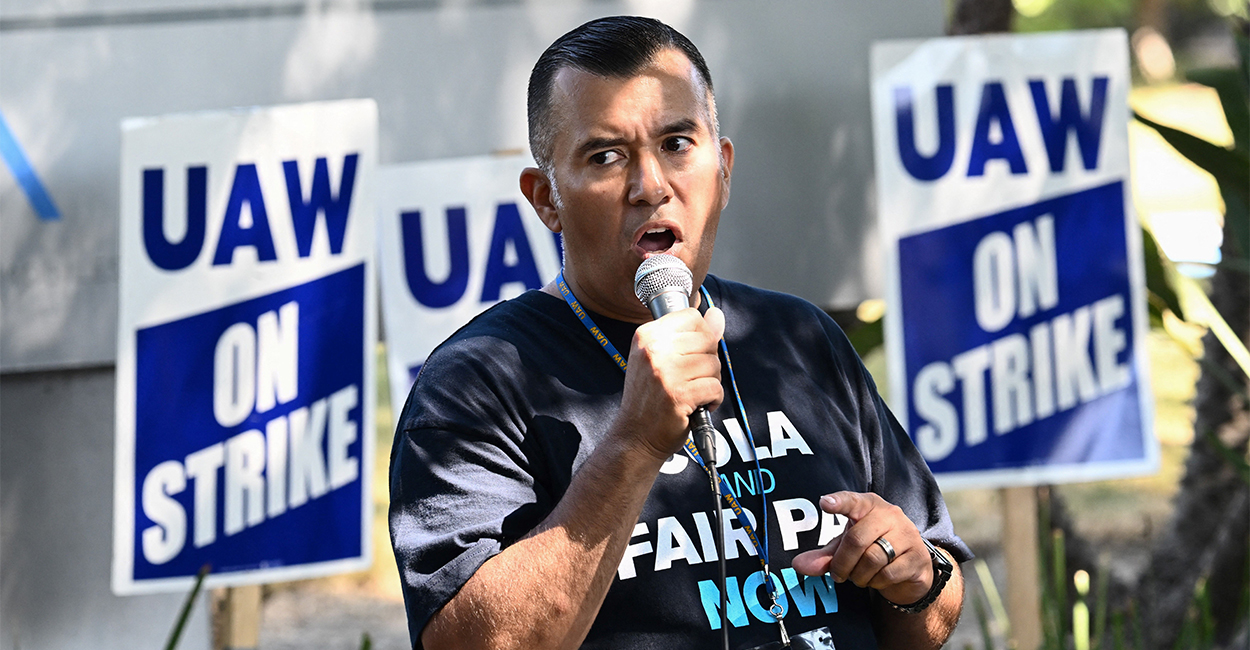
A local UAW president speaks on a picket line

A leaked UAW official’s message reveals the union’s strategy for wounding and weakening U.S. companies—the very companies its members rely on for their paychecks. Pictured: Jesse Ramirez, president of the United Auto Workers Local 230, speaks on a picket line during a strike outside a Stellantis distribution center in Ontario, California, on Sept. 26, 2023. (Photo: Patrick T. Fallon, AFP/Getty Images)

“If we can keep them wounded for months, they don’t know what to do … this is recurring reputations damage and operation chaos.”

That leaked statement, first reported by The Detroit News, is not a military tactic nor a hostile takeover plan. Rather, it’s a strategy for wounding and weakening American companies, with collateral damage that includes the American economy. And it’s the strategy—expressed in a private group chat on X (formerly Twitter) by United Auto Workers communications director Jonah Furman—of an organization whose foremost mission statement is to “improve and protect” the compensation and work environment of UAW members.

The utter disconnect between the UAW’s strategy of wounding, damaging, and inflicting chaos on the companies upon which its members’ jobs and compensation prospects depend is astounding. Big Labor’s increasingly distorted understanding of unions’ role in America—and of free enterprise and democracy—are a cause of their decline. At their heyday, unions represented about 35% of workers in the U.S. Today, they represent 10% of workers, and only 6% of private sector workers.

Workers realize that the viability of their jobs and the compensation they receive are interwoven with the success of their employers. In science, this is referred to as a symbiotic relationship: two groups working together toward a common goal.

(There will, of course, always be some bad employers who take advantage of workers or deny them a voice in the workplace. And when that happens, the best remedies are for workers to either seek better job opportunities or for those who want to band together collectively to do so.)

But despite surveys that show that teamwork and good relationships with managers are primary components of employees’ engagement and satisfaction, Big Labor seems intent on convincing workers that they must be at war with their employers.

When critiquing the suggestion that unions would do better to abandon their focus on politics and adversarial tactics, two Teamsters union attorneys essentially admitted that creating conflict is how they survive, saying, “It is no secret that such a ‘non-adversarial’ approach would gravely weaken organized labor.” That’s where unions have gone astray, thinking that “it’s us or them.”

Even in 1950, when the only cars Americans could buy were those made by the Big Three automakers, that flawed interpretation of labor unions’ roles was short-sighted. Yes, the UAW was able to drive up compensation above market wages to the benefit of its members, but the result of higher car prices meant fewer families could afford cars and, thus, fewer cars were produced and fewer workers were needed to produce them.

Now, in the globally competitive 21st century, unions inflicting damage and chaos are at odds with unions’ short- and long-term goals. How can companies whose reputations have been crippled and who’ve suffered financial losses somehow pay workers 40% more for 20% less work? That’s like eliminating 11 players from the Arizona Cardinals roster, not allowing players to access to their practice stadium, and expecting them to win the Super Bowl.

Understandably, the Big Three automakers are frustrated.

A Stellantis spokesperson said that the reported comments “are incredibly disturbing and strongly indicate that the UAW’s approach to these talks is not in the best interest of the workforce. We are disappointed that it appears our employees are being used as pawns in an agenda that is not intended to meet their needs.”

GM said that it’s “now clear that the UAW leadership has always intended to cause months-long disruption, regardless of the harm it causes to its members and their communities.” GM also said this “calls into question who is actually in charge of UAW strategy and shows a callous disregard for the seriousness of what is at stake. UAW leadership needs to put the interests of its members and the country over their own ideological and personal agendas.”

And a Ford spokesperson said, “It’s disappointing, to say the least, given what is at stake for our employees, the companies, and this region,” and noted, “For our part, we will continue to work day and night, bargaining in good faith, to reach an agreement that rewards our workforce and allows Ford to invest in a vibrant and growing future.”

If union officials actually want to protect UAW jobs and improve workers’ compensation, then they have to want the Big Three American automakers to succeed and to grow. Considering that U.S. auto production is less than half of what it was two decades ago, success is likely going to require that the UAW work alongside—rather than against—U.S. automakers to help them become more competitive.

To the extent that involves lobbying policymakers, the focus should be on getting the government out of the business of picking winners and losers by its subsidizing of more expensive electric vehicles that require 40% less labor while also seeking to ban gas-powered vehicles that Americans still overwhelmingly desire.  

And if unions across America want to increase their membership, they should appeal directly to workers by offering things they value instead of using their dues to get politicians to go against their interests by doing things like attacking secret ballot union elections, restricting employers’ ability to share important information with workers before union elections, and establishing a pathway to force an employer to bargain with a union even if workers don’t want to be represented by it.

COMMENTARY BY

Rachel Greszler

Rachel Greszler is a research fellow in economics, budget, and entitlements in the Grover M. Hermann Center for the Federal Budget, of the Institute for Economic Freedom, at The Heritage Foundation. Read her research.
UAW Sings the Blues Because of the Greens


By: Diana Furchtgott-Roth / September 22, 2023

Read more at https://www.dailysignal.com/2023/09/22/uaw-sings-the-blues-because-of-the-greens/

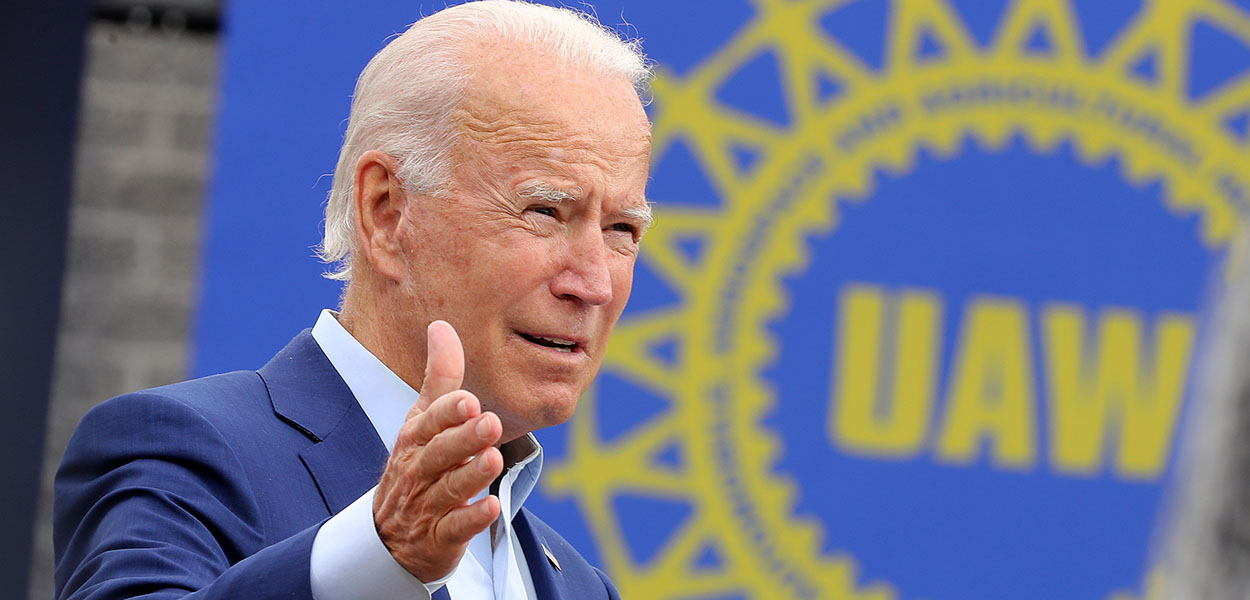
At stake in this strike is the financial power of the United Auto Workers union and the future of the Democratic Party as a representative of blue-collar workers. Pictured: Presidential candidate Joe Biden speaks Sept. 9, 2020, in a parking lot outside United Auto Workers offices in Warren, Michigan. (Photo: Chip Somodevilla/Getty Images)

The big economic news at the end of last week was the start of a strike by the United Auto Workers union against all three major U.S. automakers. This is the first strike against President Joe Biden’s green agenda, pitting two parts of the traditional Democratic coalition against each other—the environmentalists against the blue-collar workers. Or simply the greens against the blues.

At stake is the financial power of the UAW and the future of the Democratic Party as a representative of blue-collar workers. The greens and the blues generally have come together to elect a series of Democratic presidents.

Yes, there was a split over the Keystone XL pipeline, which the blues wanted for the jobs and the greens rejected because of the heavy crude that would be coming in from Canada. No matter that Biden then begged the Venezuelans to sell America a similar heavy crude, this time coming to U.S. refineries by tanker rather than pipeline.

This time, however, the green energy agenda is driving the UAW to strike—because banning the internal combustion engine is equivalent to banning auto jobs. 

The UAW is singing the blues because of the greens. UAW President Shawn Fain has refused to endorse Biden for another term because of the president’s insistence on following California’s lead by ending sales of new vehicles with internal combustion engines by 2035.

The blue-collar workers want their jobs, but the greens care more about trees. It doesn’t help that inflation is up for the second month in a row, and American Airlines employees, West Coast dockworkers, and United Parcel Service employees all have gained pay raises of 30% to 40% over the next four years. 

The UAW is demanding a 35% hike in pay and benefits over four years, moderating its initial request for a 45% hike. The union is asking for automatic cost-of-living adjustments just as in the 1970s and a four-day work week rather than a five-day one. The inflationary 1970s are calling Biden, and they want their benefits back—with a post-pandemic four-day twist.

Ford Motor Co. President Bob Farley estimates that the industry will need 40% fewer workers to produce electric vehicles rather than gas-powered cars and light trucks. That’s 200,000 fewer jobs in 2030 and 400,000 fewer jobs in the long run. 

Dwindling jobs lead to dwindling income. Many of the new jobs in EVs and batteries with Inflation Reduction Act funding are being created in right-to-work states, where wages are lower and workers don’t have to join a union as a condition of employment. 

Other jobs are being created in China, which has a lock on a substantial share of minerals required for EV batteries, such as lithium, graphite, and cobalt. Mindful of the world’s concerns about China’s dominance in this area, Beijing is setting up factories in Indonesia to take advantage of minerals there, and the Chinese-built, high-speed rail across the country from Jakarta to Bandung opened this month.

This is why switching to electric vehicles is not only a major threat to the UAW and ithe union’s ability to negotiate higher wages for auto workers, but a mortal danger to the paycheck for Fain, as well as to the finances and political clout of the UAW.

Fain was elected UAW president in March. Financial disclosure forms showing his salary aren’t currently available, but the union’s former president, Ray Curry, was paid $273,000 in 2021, according to UnionFacts.com, a nonprofit which compiles data from required Labor Department disclosure forms. 

On the UAW’s 2021 financial disclosure form, Fain was listed as an administrative assistant with total compensation of $156,000 annually. That’s more than three times what the Bureau of Labor Statistics lists as an average salary for administrative assistants: $45,000.

The United Auto Workers has $1.2 billion in assets and 372,000 members, according to UnionFacts.com. The UAW Political Action Committee has donated $50 million to Democrats and $2 million to Republicans.

And that’s the rub—despite the spending, the blue UAW can’t protect its members against the green government that it elected. Electrification is leading not only to shrinking worker incomes but to a fundamental fracturing of the Democratic Party coalition.

That might be the most damaging part of the UAW strike.

This commentary originally was published by National Review

COMMENTARY BY

Diana Furchtgott-Roth

Diana Furchtgott-Roth is the director of the Center for Energy, Climate and Environment and the Herbert and Joyce Morgan Fellow at The Heritage Foundation.

Today’s Additional Politically INCORRECT Cartoons


HTTP://TOWNHALL.COM

https://tribunecontentagency.com/premium-content/editorial-cartoons/conservative-cartoons/dana-summers/

Tag Cloud