Perspectives; Thoughts; Comments; Opinions; Discussions

Posts tagged ‘U.S. Army’

I’d Like to Call Human Resources on Hostile HR Thought Police


BY: CHASE SPEARS | AUGUST 28, 2023

Read more at https://thefederalist.com/2023/08/28/id-like-to-call-human-resources-on-hostile-hr-thought-police/

New York National Guard

Author Chase Spears profile

CHASE SPEARS

MORE ARTICLES

The theme of my career over the past year has been the transition of departing military service and reintegrating among the civilian populace. As I approached this season, I have heard one particular phrase frequently circulated among much of corporate communication: “Bring your authentic self to work.”

But more recently I have heard cautions for those of us in uniform to be anything but open as we return to the society from which we were drawn. I find this deeply concerning. The nation should beware of prioritizing deception as social currency. 

Last summer I began attending the transition briefings required prior to separation from the service. At one particular event, a retired military man — now working for a large national company — warned us that it’s very important to keep a low social media profile because of perceptual risk from hiring managers. He told of unfriending his sister on Facebook because he didn’t want anyone from his workplace to associate them with each other. That moment got my attention.

If the sister posts deviant content, I would probably keep some distance in online spaces for the sake of my sanity. But what if the sister is merely someone who expresses facts that just happen to be inconvenient to the current sociopolitical moment? We have seen time and again that facts disputed by corporate media, social media companies, and government officials frequently turn out to be true.   

The call to sacrificially appease the human resources syndicate renewed itself in another employment seminar I attended this year. Again, I encountered the caution through a LinkedIn discussion. I was warned that employers fear that an employee who expresses a thought on his or her own time might also express a thought in the workplace. Such thinking from clearly well-intentioned people seems backward to me, as if we should not encounter ideas and ways of thinking that might challenge our own.

People of faith-directed moral principles routinely encounter rhetoric that is contrary to their own beliefs and sometimes condescending. The reality is that many companies, corporations, and government institutions tolerate “politically correct” expressions in the workplace while shaming voices aligned with a traditional worldview. My time in the U.S. Army contains such instances, and I’m not alone.

This is in spite of protections offered by the U.S. Constitution, civil law, and military regulation. Culture and political sway always trump the rules. When you look at where people are being pressured, disciplined, or fired for sharing their beliefs at work, it is usually an incident of discrimination against speaking the truth by military commanders or civilian managers who have adopted a form of leftist social orthodoxy.  

Part of the argument for why we should present as neutral in online spaces revolves around a belief that people cannot be taught how to engage productively on tough issues. Society has lost the ability to think, reason, and respectfully debate. Shall we then remove anything related to thinking skills from educational curriculum? The point of identifying a deficiency is so that it can be addressed. We should not accept a lack of skills in dialogue and thought as normal and then strike them from the list of disciplines to be pursued. Because one generation has not been taught something important does not mean people should abandon it entirely.  

Rather than calling for an end to societal discourse, we should work to recapture the skill. I am not advocating that we bring cable news-style fights to the job site or that everyone abandons all expressive caution, manner, and restraint. But we must end the fear and spirals of silence that have become too frequent across workplaces, especially for workers who hold to a morality that was understood to be normal until 15 minutes ago.

By overusing a mantra that demands we avoid talking about religion or politics at the dinner table, we have robbed entire generations of the chance to develop the intellectual discipline that is foundational to reasoning and thought. These skills were expected of all citizens in the early republic. The nation’s current deficit in the tools of discourse paved the way for a cultural capture of the West at the hands of confessional Marxists. In their own words, such people aim to deconstruct and dismantle rather than defend and preserve.  

Deliberately or unwittingly, those who argue in favor of self-neutrality demonstrate a worldview that places all power and personal allegiance in the hands of employers. Of course, there is wisdom in avoiding individuals who demonstrate a lack of restraint or courtesy in their manner of expression. But telling people that their employment is purchased with a lifestyle of silence is an elevation of employer to magistrate and priest. It turns employees into quieted servants and enables a soft social credit system that reduces human beings to machines. Such thinking is among the reasons my transition is focused on finding a mission rather than a corporate role.

The Greek general and politician Pericles is quoted as saying, “We do not say that a man who takes no interest in politics is a man who minds his own affairs; we say that he has no business here at all.” The problem is not so much that managers have an aversion to politics. It is that secularists generally have an aversion to ideas that contradict the prevailing winds of culture. They live convinced that policy advocacy on matters in alignment with their belief is not a matter of politics but of principle. The two, however, are inseparable. When one tells you to keep your principles to yourself, that itself is an ideological competitor’s political act of silencing you.

Beliefs turn into expressed ideas, which beget social doctrines. The First Amendment is of little meaning if we make it inferior to social demands of the moment. As a nation, we should beware of allowing momentary fears to become anchored going forward, and we should refuse to cede moral principles to satisfy the increasingly leftist human resources syndicate.  


Chase Spears is a retiring U.S. Army officer, concluding a 20-year career in military public affairs. His opinions are his own and should not be construed to be those of the U.S. Army, Department of Defense, U.S. Government, or any other affiliated agencies.

Here’s How America’s ‘Rainbow’ Military Commemorated This 4th Of July Weekend


BY: SHAWN FLEETWOOD | JULY 05, 2023

Read more at https://thefederalist.com/2023/07/05/heres-how-americas-rainbow-military-commemorated-this-4th-of-july-weekend/

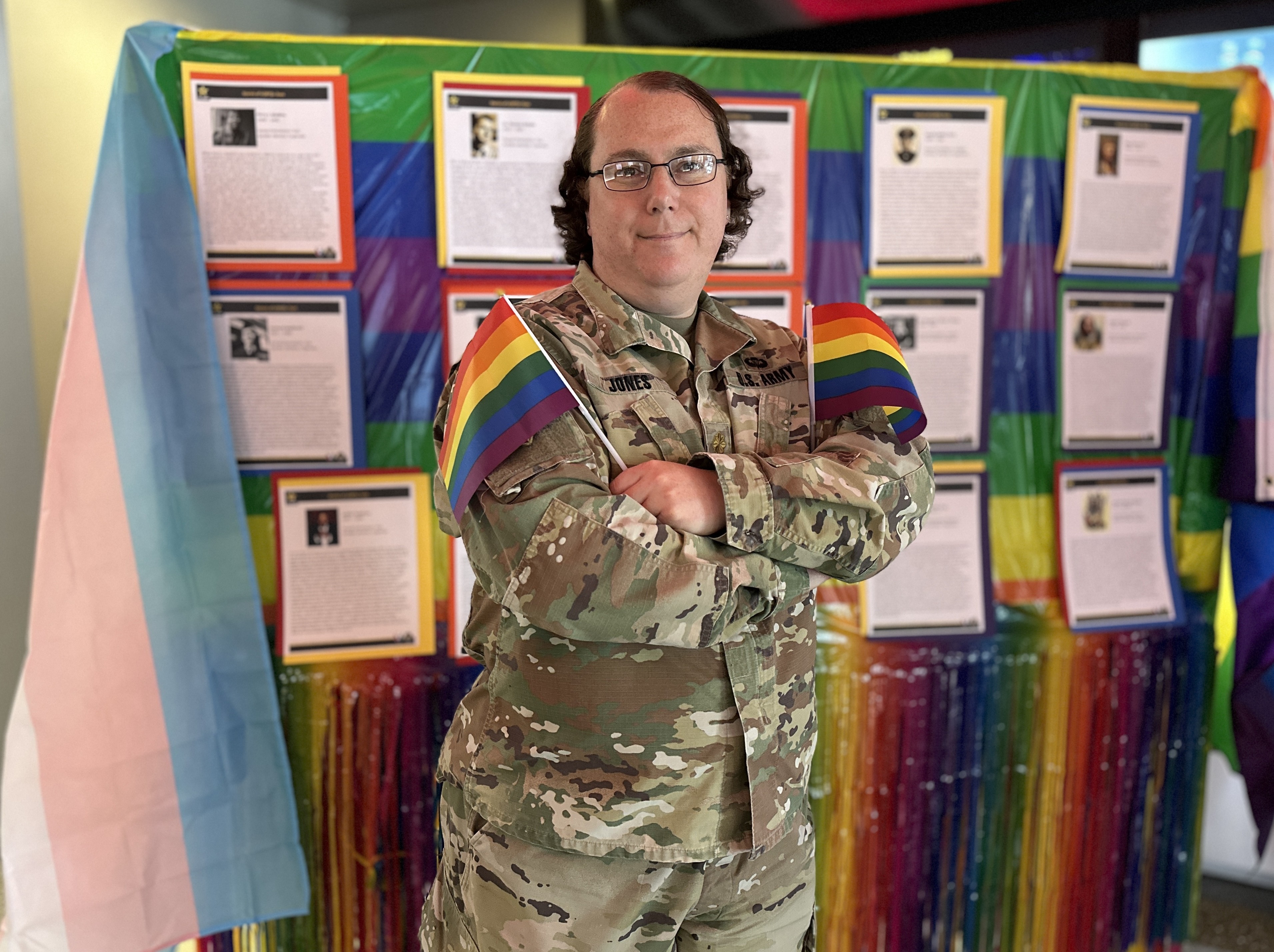
Maj. Rachel Jones posing with pride flags

The U.S. military issued a series of social media posts commemorating LGBT-themed “diversity” on the same weekend millions of Americans came together to celebrate the nation’s founding.

The first of such incidents occurred on Sunday when the Defense Department’s official Twitter account posted a June 22 article detailing the “coming out journey” of U.S. Army Maj. Rachel Jones, a man who identifies as a “transgender female.” In a tweet accompanying the first post, the agency claimed that Jones “faced deep-rooted challenges on her path to self-acceptance” and that his “resilience shines as a hope for others facing similar struggles.”

You do not become a Major overnight. This confused individual has been in Army leadership for some time. Think that through. How many more of these “confused” people do we haev in our military?

You know our enemies are laughing themselves silly with this knowledge that America has sexually confused, obsessed, leaders in its forces. Does that sound prepared for war to you?

In the attached article — which was published on the Army’s official website — Jones described his process of “accept[ing] and lov[ing]” himself and further claimed it “was very risky to [his] career to be seen in public as a transwoman” during the Trump administration when transgender-identifying individuals were not permitted to openly serve in the military. Upon taking office, President Joe Biden signed an executive order reversing the policy, which allowed Jones to “come out publicly as transgender” to his colleagues.

“People here have been amazing. I know how lucky I am to work in an organization with such acceptance and everyone here has been really supportive,” Jones said. “I was initially a bit fearful of coming out as my true self and how I would be perceived, but I had nothing to worry about.”

To commemorate “pride month,” Jones also recorded a video claiming that for him, “pride” is about “celebrating that diversity is our strength, as a nation and as an Army.”

A similar incident exemplifying the military’s increased focus on so-called “diversity” occurred on Friday and Sunday, when the U.S. Navy posted two separate Instagram clips highlighting the importance of removing alleged “barriers” for LGBT service members’ “total inclusion” in the fleet.

“It’s a necessary effort to make sure that the chief of naval operation and our operational commanders are getting the very best from the 6 to 8 to 10 percent of our force that identifies as LGBTQ+,” said Rear Admiral Mike Brown in the Friday clip.

I am a Combat Marine Veteran. There is no possible way for me to trust anyone like this into combat. As adults they are confused about the way they “feel”, makes every other aspect of their lives questionable.

When asked in the second video what it means to have a “diverse force,” Brown further claimed it’s important for the Navy to be “inclusive of all parts of the American population.”

“Inclusion means recognizing that we have a diverse force and getting the most of every part of our force, every individual sailor,” Brown said. ”We will not be able to compete and win if we don’t continue to pull from the amazing talent that resides in every corner of the United States, harness that talent, respect it, and use it.”

It’s worth mentioning that both the Army and Navy are expected to miss their recruiting goals for the 2023 fiscal year.

Since Biden’s inauguration, the Defense Department has seemingly ramped up its push for military leadership to adopt discriminatory “DEI” ideology. DEI — which stands for diversity, equity, and inclusion — is a divisive and poisonous ideology that dismisses merit to discriminate based on characteristics such as skin color and sexual preferences. Individuals who qualify for a certain position due to their merits but don’t meet the discriminating entity’s goal of being more “diverse” are passed over in favor of those who meet the preferred identitarian standards.

[READ: Legal Group Demands Navy Investigate Active-Duty Drag Queen For Allegedly Violating Military Protocol]

Last month, for instance, the Air Force went all out to celebrate “pride month” by authorizing the use of U.S. taxpayer dollars to cover the travel costs for service members seeking to attend the branch’s June “pride” events. Several Air Force bases also held LGBT-related events on their respective grounds last month.


Shawn Fleetwood is a staff writer for The Federalist and a graduate of the University of Mary Washington. He previously served as a state content writer for Convention of States Action and his work has been featured in numerous outlets, including RealClearPolitics, RealClearHealth, and Conservative Review. Follow him on Twitter @ShawnFleetwood

Author Shawn Fleetwood profile

SHAWN FLEETWOOD

VISIT ON TWITTER@SHAWNFLEETWOOD

MORE ARTICLES

U.S. Attorney: Military Ballots, Cast for Trump, Found Discarded in Pennsylvania


Reported by JOSHUA CAPLAN | 

URL of the originating web site: https://www.breitbart.com/2020-election/2020/09/24/u-s-attorney-military-ballots-cast-for-trump-found-discarded-in-pennsylvania/

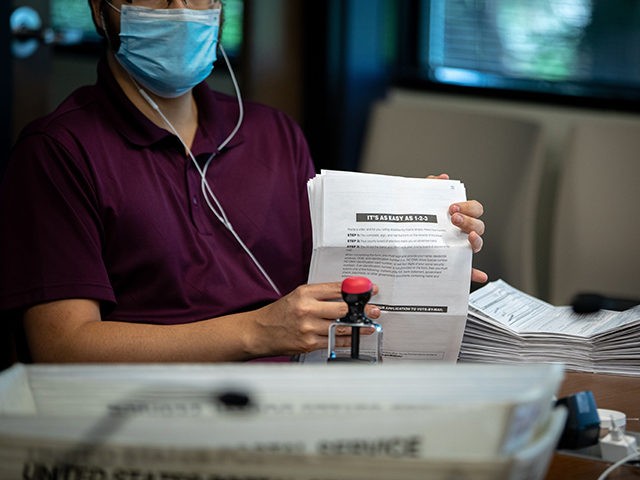
Absentee ballot election workers stuff ballot applications at the Mecklenburg County Board of Elections office in Charlotte, North Carolina on September 4, 2020. – The US election is officially open: North Carolina on September 4, 2020 launched vote-by-mail operations for the November 3 contest between President Donald Trump and Joe … Logan Cyrus/AFP/Getty Images

Of the nine ballots that were discarded and then recovered, 7 were cast for presidential candidate Donald Trump. Two of the discarded ballots had been resealed inside their appropriate envelopes by Luzerne elections staff prior to recovery by the FBI and the contents of those 2 ballots are unknown.

Read Breitbart News’ original story below:

Several discarded military ballots cast for President Donald Trump have been recovered after federal authorities opened an unspecified investigation regarding mail-in ballots in Luzerne County, Pennsylvania.

The U.S. Attorney’s Office Middle District of Pennsylvania said in a Thursday statement:

On Monday, September 21, 2020, at the request of Luzerne County District Attorney Stefanie Salavantis, the Office of the United States Attorney along with the Federal Bureau of Investigation, Scranton Resident Office, began an inquiry into reports of potential issues with a small number of mail-in ballots at the Luzerne County Board of Elections.

Since Monday, FBI personnel working together with the Pennsylvania State Police have conducted numerous interviews and recovered and reviewed certain physical evidence. Election officials in Luzerne County have been cooperative. At this point we can confirm that a small number of military ballots were discarded. Investigators have recovered nine ballots at this time. Some of those ballots can be attributed to specific voters and some cannot. All nine ballots were cast for presidential candidate Donald Trump.

It is presently unclear how many ballots were discarded.

The development comes as U.S. Postal Service officials are investigating trays of mail discovered in a ditch in Greenville, Wisconsin, on Tuesday. In a statement, the Outagamie County Sheriff’s Office said the three trays were found at 8 a.m. near the Appleton International Airport. A USPS spokesman confirmed to FOX 11 that the mail included absentee ballots.

Speaking to the Washington Examinerthe sheriff’s office said the “mail going to the post office.”

“The United States Postal Inspection Service immediately began investigating and we reserve further comment on this matter until that is complete,” USPS spokesman Bob Sheehan said.

On Monday, a federal judge ruled that the Postal Service must prioritize election mail.

“The right to vote is too vital a value in our democracy to be left in a state of suspense in the minds of voters weeks before a presidential election, raising doubts as to whether their votes will ultimately be counted,” stated U.S. District Judge Victor Marrero.

“Conflicting, vague, and ambivalent managerial signals could also sow substantial doubt about whether the USPS is up to the task, whether it possesses the institutional will power and commitment to its historical mission, and so to handle the exceptional burden associated with a profoundly critical task in our democratic system, that of collecting and delivering election mail a few weeks from now,”  the judge added.

President Donald Trump has repeatedly warned of voter fraud associated with voting by mail, though he has expressed support for obtaining an absentee ballot if a person was in another state or had a medical condition

“We’re not going to destroy this country by allowing things like that to happen. We’re not destroying our country,” Trump has said. “This has more to do with fairness and honesty and, really, our country itself.”

“People take them where they force people to vote,” he previously warned. “They harvest … They take many, many ballots, and they put them all together, and then they just dump them, and nobody has any idea whether they’re crooked or not.”

READ MORE AT https://www.breitbart.com/2020-election/2020/09/24/u-s-attorney-military-ballots-cast-for-trump-found-discarded-in-pennsylvania/

US Army To Give Soldiers New 1-Ounce Hidden Weapons That Will Change the Game


Reported By Jack Davis | February 2, 2019 at 7:37pm

Army units will soon be equipped with pocket-sized drones to give them an edge on the battlefield.

The Army has awarded FLIR Systems a $39.6 million contract to provide Black Hornet personal-reconnaissance drones, the company said in a release on its website.

The drones are 6.6 inches long and weigh 1.16 ounces, the company said. They can fly in day or night conditions for up to 1.24 miles. The drones have a maximum speed of 20 feet per second.

The drones can remain airborne for about 25 minutes.

Once the army gets the drones, they will be deployed with a Brigade Combat Team. The location of that team has not been announced.

The drones “will give our soldiers operating at the squad level immediate situational awareness of the battlefield through its ability to gather intelligence, provide surveillance, and conduct reconnaissance,” Army spokesman Lt. Col. Isaac Taylor said, according to Task and Purpose.

The company said that the “nano unmanned aerial vehicle (UAV) systems” are “small enough for a dismounted soldier to carry on a utility belt.”

“The highly capable nano-unmanned aerial vehicle (UAV) systems delivered under this contract will support platoon and small unit level surveillance and reconnaissance capabilities as part of the Soldier Borne Sensor (SBS) Program,” FLIR said in a statement.

“We are proud to be selected by the U.S. Army for the SBS Program of Record. This contract represents a significant milestone with the operational large-scale deployment of nano-UAVs into the world’s most powerful Army,” said Jim Cannon, President and CEO of FLIR.

“This contract is a major win for the newly established Unmanned Systems & Integrated Solutions business division at FLIR and demonstrates the strong and urgent demand for nano-UAV technology offered by FLIR. Protecting U.S. warfighters with our unmanned solutions is a key objective for FLIR,” he said.

Cannon has said that having the drones available “represents a key opportunity to provide soldiers in every U.S. Army squad a critical advantage on the modern battlefield,” CNET has reported.

The Marines have tested similar technology, according to the Army Times.  FLIR also recently announced that it would be supplying similar technology to French forces.

Stars and Stripes said that British forces in Afghanistan have used similar devices.

ABOUT THE REPORTER:

Summary

More Info Recent Posts Contact

Jack Davis is a free-lance writer who joined The Western Journal in July 2015 and chronicled the campaign that saw President Donald Trump elected. Since then, he has written extensively for The Western Journal on the Trump administration as well as foreign policy and military issues.

Read the Absurd Presentation the U.S. Army is Pushing About “White Privilege”


waving flagWritten by Philip Hodges, Mar 9, 2016

URL of the original posting site: http://constitution.com/read-the-absurd-presentation-the-u-s-army-is-pushing-about-white-privilege

Propaganda Alert

Through a Freedom of Information Act (FOIA) request, Judicial Watch obtained training materials used by the U.S. Army in teaching soldiers about white privilege, as well as male, heterosexual privilege. The documents pertained to an Equal Opportunity briefing on April 2, 2015, to the 67th Signal Battalion at Fort Gordon, Georgia.

Here are some of the topics covered using a PowerPoint presentation in the briefing at Fort Gordon, reported by Judicial Watch:

  • Privilege exists when one group has something of value that is denied to others simply because of the groupsDeath of a nation they belong to, rather than because of anything they’ve done or failed to do.
  • Privilege has become one of those loaded words we need to reclaim so that we can use it to name and illuminate the truth
  • Race privilege gives whites little reason to pay a lot of attention to African Americans or to how white privilege affects them. “To be white in American [sic] means not having to think about it” [Quotation not attributed]
  • Our society attaches privilege to being white and male and heterosexual regardless of your social class. [Emphasis added]
  • Imagine a school or a workplace where all kinds of people feel comfortable showing up. [sic] valued, accepted, supported, appreciated, respected, belonging. [sic] Something very powerful keeps this from us.
  • The truth of this powerful forces [sic] is everywhere, but we don’t know how to talk about it and so we act as though it doesn’t exist
  • The trouble we’re in privileges [sic] some groups at the expense of others.
  • It creates a yawning divide in levels of income, wealth, dignity, safety, health and quality of life.
  • It promotes fear, suspicion, discrimination, harassment, and violence.
  • Consider the “black woman” in Africa who has not experienced white racism and does not identify herself as a “black woman”.  African, a woman, but not black.
  • She only became “black” when she came to the U.S. where privilege is organized according to race, where she is assigned to a social category that bears that name and she is treated differently as a result. [Emphasis added]
  • The trouble we’re in can’t be solved unless the “privileged” make the problem of privilege their problem and do something about it.
  • The fact that it’s so easy for me and other people in dominant groups not to do this is the single most powerful barrier to change.Alinsky affect

A few years ago, Judicial Watch had obtained a 133-page document used by the U.S. Air Force, which included a “student guide” to extremist groups and hate groups. According to the student guide, “Nowadays, instead of dressing in sheets or publically espousing hate messages, many extremists will talk of individual liberties, states’ rights, and how to make the world a better place.”of domenstic terrorist

Regarding “extremist ideologies,” the document listed two historical examples: one, “the colonists who sought to free themselves from British rule”; and two, “the Confederate states who sought to secede from the Northern states.”

Partyof Deceit Spin and Lies engineering2 Die true battle Picture1 In God We Trust freedom combo 2


More straight dope on Jade Helm 2015 and the ‘Human Domain’


Coolest dudes on the planet, no matter whose pond they're wading in. (Image: U.S. Navy SEALs)
Coolest dudes on the planet, no matter whose pond they’re wading in. (Image: U.S. Navy SEALs)

Back in March, I wrote that Texas wasn’t being invaded in exercise Jade Helm 2015.  The exercise isn’t about confiscating guns, and it won’t involve violations of Posse Comitatus.

I’ve updated information as it has come along on the exercise: when Texas Governor Greg Abbott decided to have the Guard monitor it (which I support), and when it became clear that the exercise is to be spread geographically further across Texas than originally briefed (which bears watching).

Now it’s time to take on a theme that has taken off over the last month.  The Jade Helm exercise motto is “Master the Human Domain,” which has been a head-scratcher for many.  The expression “human domain” comes from a Department of Defense effort, dating from the mid-2000s, to codify and plan for the environment of human activity in which the military has to operate during non-traditional missions.

  • There are three things to say up front.  One, it does matter that this was chosen as the motto of the exercise.  It’s not just a cute slogan; it means the exercise is focused on “mastering the human domain.”
  • Two, almost all of the speculation I’ve seen out there on what “mastering the human domain” is about appears to be profoundly mistaken.  It’s not about eugenics, for example.  Nor do attempts to break down the words “Jade” and “Helm” as acronyms lead to anything validly connected to the DOD human domain effort.*
  • Three, the human domain aspect does illuminate some things for us, and it does suggest a particular area of concern, especially for an exercise series that is supposed to be held among the communities of the American people.

(If you’re already convinced about the DOD programmatic origins of the human domain concept – a number of websites have provided discussions of it – and if you understand that it is very much about information technology and intelligence, you can skip to the segments on “application to Jade Helm,” below.)

Notional geography for Exercise Jade Helm 2015.  (Army Special Operations Command briefing)

The “human domain”

The need for a “human domain” effort became clear as the operations in Afghanistan and Iraq unfolded.  Counterinsurgency, with its aspects of embeddedness and pervasive contact across all segments of society, just isn’t the same thing as the more conventional model of rolling in hot, blasting military targets to bits, and forcing a political settlement on a recognized authority in a capital city somewhere.

But information connectedness is also a key to understanding the idea of the human domain.  Modern insurgents and other disruptive elements make tremendous use of information technology (IT) – and that in turn means that DOD wants to find ways to use it even smarter than the bad guys do.  Instead of detection and intelligence systems being stovepiped and specialized, a modern military needs to move and breathe in a pulsating environment of smart data on the human domain, if it’s to be the most agile, fastest-moving actor in the conflict problem.  The smart data can cover everything from local social customs and economic activities to alerts gleaned from social media and the “meta-patterns” of cell phone use.

For obvious reasons, special forces – the ones whose disciplines are being exercised in Jade Helm 15 – find the human domain to be an especially big deal.  Because of the tasks they are assigned, the human domain is particularly likely to be relevant to their operations.  And the link between the human domain push in DOD, and the human domain motto of Jade Helm 15, has left a traceable paper trail.

When DOD issued the first strategic guidance for the “human domain” of warfare in 2010, the military services hopped on board with their individual program lines to do R&D and develop doctrine in their respective warfighting spheres.  Figure 1, from an Air Force presentation on human domain factors modeling, shows a snapshot of the Army, Navy, and Marine Corps players from 2011.  The focus on irregular warfare is clear (although the effort still lacked programmatic specificity at that point.)

Figure 1.  Service programs to optimize operations in the human domain.  "HSCB" refers to Human Social, Cultural, Behavioral factors. (Graphic: Briefing by Dr. Mark T. Maybury, Chief Scientist, USAF. Link in text)

The broad extent of the human domain effort can be seen in figure 2, from the Defense Technical Information Center.  It depicts several years’ worth of related studies and projects contracted by DOD entities – both the DOD staff and the services – through a DOD program launched in 2008 called the Minerva Initiative.  The high-level interest in the human domain as a focus of warfighting was affirmed in a white paper from the Army, Marine Corps, and Special Operations Command in 2013.

Figure 2.  List of DOD Minerva initiative studies commissioned with universities, 2009-2016. Most related directly to human domain requirements. (Graphic: DTIC.  See link in text)

The thread we are most interested in is the one that runs through the Army, whose special forces command, USASOC (U.S. Army Special Operations Command), has been on point to the public for Jade Helm.  The Army was already on the trail of human domain warfighting at the time DOD adopted it as an official line of effort.  By 2007, the Army had cobbled together an Army Human Terrain System (official website here), which deployed Human Terrain Teams to try to operationalize insights from anthropology and related disciplines to improve operational methods and outcomes in Afghanistan.  The project has, admittedly, come in for intense criticism from multiple vectors (e.g., here, here, and here).

But Army doctrine authorities remain committed to human domain programming (i.e., training for it, developing systems for it, having doctrine for it).  And Army special operations forces are building their plan for the future force around it, as laid out in the ARSOF 2022 planning document.

In doing this, ARSOF planners draw their authority partly from the joint Special Operations Command (SOCOM), whose vision for a force in 2020 is cited on page 7 of the ARSOF 2022 document:

“SOCOM must not only continue to pursue terrorists wherever we may find them, we must rebalance the force and tenaciously embrace indirect operations in the Human Domain — the totality of the physical, cultural and social environments that influence human behavior in a population-centric conflict.” …

“While SOF is designed to contribute to or support efforts in every domain of warfare, the vast majority of SOF expertise lies in the Human Domain of competition, conflict and war. The Human Domain is about developing understanding of, and nurturing influence among critical populaces. Operating in the Human Domain is a core competency for SOF and we are uniquely suited for successful operations or campaigns to win population-centric conflicts.”

It would require too much space here to discuss all the elements taken into account in “population-centric conflicts.”  For further reading, I recommend a study updated for USASOC in 2013 called Human Factors Considerations of Undergrounds in Insurgencies.

The SOF emphasis on the human domain is significant because Jade Helm is a SOF exercise.  But it’s also significant because Jade Helm is designed to feature interoperation between special forces and conventional forces.  That point has been emphasized in the public briefs on the exercise, and Jade Helm makes so much of it because of a recent trend in thinking about such interoperability in the Department of Defense, both within the SOF community and at the higher levels of command that subsume all warfare communities.

See background links within the text of my March post on Jade Helm – but also see here: an Army War College paper from 2013 on “Interdependence between U.S. Army Special Operations Force and Conventional Forces.”  This paper has been broadly cited in community discussions of the needs and future of SOF, and it too places a significant emphasis on the human domain.

Unquestionably, the capstone SOF exercise of a generation – which is what Jade Helm 2015 is – will be about operating in the human domain.  The motto “Master the Human Domain” reflects that.

Application to Jade Helm: Cultural understanding

But what does that mean for the exercise this summer?  A lot of websites out there are trying to make this about population control of some kind (i.e., through deception, subversion, detention), up to and including a eugenics push.  (Just do a search on “Jade Helm” and “eugenics” and you’ll come right to the websites.) It is, however, nothing of the sort.

For one thing, nothing in the background material on the human domain effort can legitimately be read in that light.  The essential premise of the military’s human domain concept is quite clearly that populations and their cultures and routine activities take moral and political precedence over military tasks.  The military posture will be one of adapting – working within the constraints of local norms – and, if possible (as mission-appropriate), influencing and persuading.  Whether SOF or conventional forces, the U.S. military expects to operate frequently in an environment dictated by local human conditions – not to dictate those things to the local people.

The strategic utility of this mindset, and whether America ought to be sending forces out to operate in this way, are topics for another time.  (I don’t dispute that it’s legitimate to question using military force in this way.)  The point here is that mastering the human domain is predicated on it, and the exercise play in Jade Helm will be too.

This point underlies one of two key aspects of Jade Helm that we can extract from the emphasis on “mastering the human domain.”  I’ll address the second aspect in the segment below on “intelligence operations.”

Regarding the first aspect, which I refer to generally as “cultural understanding”: we know that Jade Helm is an unconventional warfare exercise, meaning that it’s about the irregular warfare discipline of supporting foreign insurgencies against hostile governments (again, see my March post).  There are two big clues as to what that means for the exercise.

One clue was embedded in the USASOC brief shopped around Texas in March and April.  Slide 7 of that brief explained why Texas was chosen for the live-play terrain:

The United States Special Operations Command (USSOCOM) has conducted numerous exercises in Texas because Texans are historically supportive of efforts to prepare our soldiers, airmen, marines and sailors to fight the enemies of the United States.

The second bullet on that slide provides a good compilation of operating requirements that are common to SOF and all human domain warfighting:

To hone advanced skills, the military and interagency require large areas of undeveloped land with low population densities with access to towns.  The proposed areas offer the conditions conducive to quality training because of real obstacles to challenge joint and IA personnel during planning and execution of their tasks.  These challenges include:

– Operating outside the normal support mechanisms

– Adapting to unfamiliar terrain, social and economic conditions

– Operating in and around communities where anything out the ordinary will be spotted and reported (locals are the first to notice something out of place)

The opportunity to work with civilians to gain their trust and understanding of the issues

In an interview with blogger Aaron Wilson, the Army spokesman for Jade Helm, LTC Mark Lastoria, added some depth to that earlier clue:

Q: [Wilson] What is this “blending in” that you talked about in Bastrop [TX]?

A: [Lastoria] We want to get the Midwest mindset going, it is an adaptive technique, a subtly [sic] we need to master, quite different than Atlantic Coast style.

What Lastoria is talking about is learning and adapting to cultural cues in the human domain.  He points out (elliptically, but you know this if you know where ARSOF regularly conduct exercises) that the cultural conditions in Texas will be somewhat different from those on the Atlantic Coast.  (Primarily North Carolina.)  That’s a desirable feature for a robust training evolution.

But put that together with the original point from the briefing: that Texas was chosen because of the traditional friendliness of the population.  That characteristic fits well with the population profile SOF would expect if it deployed abroad for unconventional warfare.  The U.S. would deploy SOF to link up with friendly elements of local populations for an unconventional warfare mission.

Putting it all together now: we might know going in that these foreign populations were friendly (like Texas) in the sense of sharing a political goal with us.  But SOF would still need to understand their local norms to operate among them successfully.  That, in sum, is the live-play proposition of Jade Helm.

The other big clue to this “cultural understanding” aspect of the human domain in Jade Helm is also from Lastoria’s interview with Aaron Wilson.  It’s this brief passage:

Q:  What does the wooden clog symbolize in your logo center between the crossed arrows and dagger?

A:  It relates to N. European resistance to tyranny going back some 70 years and a reuniting with a democratic form of governance.

Frankly, although I didn’t key on the clog, I immediately thought of the U.S. connection with European resistance movements when I first saw the original briefing back in March, and connected it with the meaning of “unconventional warfare.”  The main example that occurred to me was the French resistance in World War II.  The clog would symbolize equally the resistance movements in the Netherlands and Belgium.  (Although Lastoria refers to “northern Europe,” other examples from the same period would be the resistance movements in Greece and the Balkans.)

image: http://libertyunyield.wpengine.netdna-cdn.com/wp-content/uploads/2015/06/Jade-Helm-logo.jpg

Jade Helm logoJade Helm, in other words, really is about practicing the skills needed to embed with a resistance movement in a foreign population, where the government is hostile.  “Mastering the human domain” relates to the requirements and skills for that mission.

I don’t believe the exercise scenario designates the state government of Texas as a hostile entity.  There is no indication of that.  Given the fact that straightforward conclusions about Jade Helm make sense based on DOD policy, and on what has actually been said about the exercise, there appears to be no reason to speculate fancifully on this head.

“Hostile,” where it is played live in these exercises, is typically played by a separate force drawn from the designated agency or service participants, and organized to act independently.  In this case that would include DOD entities and players from other agencies, such as homeland security and the FBI.  (If you’d like a concurring opinion on that from another vet, I can recommend the very sensible post here.)

Application to Jade Helm: Intelligence operations

That said, the second key aspect of Jade Helm should be of concern to us.  And the validity of this concern is revealed most clearly by filtering the Jade Helm event through the prism of the “human domain.”

To put it briefly: from the perspective of American citizens, collecting and processing intelligence for human domain operations is likely to be intrusive and unacceptable in the IT realm.

Almost nothing has been said in public about the IT element in human domain operations, as it relates to Jade Helm.  But if you investigate human domain theory, IT figures hugely in it.  Much of operationalizing the human domain concept is about leveraging – wait for it – “Big Data”: that universe of data now floating around on people and events.

An example that would probably apply to an exercise like Jade Helm is monitoring the routine communications of the local population, whether by scooping in data from social media or by some means of watching patterns in communications metadata (e.g., big spikes in cell-phone calls just before major events, or just after something unique has been detected by the locals).  These are simplified examples, meant to suggest the categories of phenomena that human domain intelligence would be looking for.

Figure 3.  Schematic of old-style intelligence collection and analysis: stovepiped “INTs” tasked against specific targets, and compared and analyzed with a focus on those targets to produce an assessment.  Note the arrow at the top pushing outward from the grab-bag of INTs. (Graphic: Chandler P. Atwood, National Defense University. Link in text)

But the Big Data aspect of the approach is what’s most important.  (Hang in there with me; I promise you, this all matters.)  The concept of human domain intelligence explicitly says that the old-style collection of data – against designated targets, and once those targets are thought to be meaningful – is inadequate.  See figure 3 for a representation of this old-style mode of collection.

What human domain intelligence envisions is using the Big Data construct of persistent surveillance, meaning that the types of activity from which you can sometimes need to draw conclusions should be collected constantly and comprehensively, and then stored, and “pulled” from – data-mined – at the moment of need.  (See figures 4 and 5.)

Figure 4.  Schematic of “activity based intelligence” (ABI): persistent, all-INT collection from which network connections in the human domain can be developed, and which can be data-mined for specific current needs.  Note how the orange arrow is inverted, “reaching into” the Big Data database for what is needed for a particular problem.  (Graphic: Chandler P. Atwood, National Defense University. Link in text)

If this sounds like the description of NSA’s notorious database – the trillions and trillions of bits of unfiltered metadata being collected and stored on Americans’ IT activities over the past decade – that’s because it is.  The chirpy tone in which DOD briefers and contractors discuss the need for a persistent, Big Data approach indicates how routine and accepted the concept is today in government planning.

(For additional perspective, see the entire brief here from which figure 5 is an excerpt, and note the proposed application for emergency management and law enforcement use in slides 30-32.  The vision for using Big Data involves massive and persistent “mapping” of human activity.  In DOD’s human domain approach, Big Data is focused through the lens of an analytical rubric called Activity Based Intelligence, or ABI, which is discussed in the slide presentations linked above as well as here and here.)

Figure 5.  The emphasis on "persistent surveillance" as a core element of activity based intelligence. The idea is to record activities, or events, as they occur, store them in a massive database, and mine them later as necessary.  GEOINT refers to geospatial intelligence, which includes human activities referenced to terrain as well as natural physical features. (Graphic: Joseph D. Fargnoli, RITRE Corp. Link in text)

Now, constant collection is a very fine thing against foreign targets. If our special forces deploy into foreign territory to assist an insurgency we support against a hostile government, I hope the military is collecting the living snot out of the whole environment, IT included, as persistently and intrusively as we can manage.

But if an exercise is being held in the state of Texas – whose IT environment is being persistently collected against, to simulate the conditions special forces need for mastering the human domain?  What are they doing with the data?  What happens to the data afterward?  Is this something the citizens of Texas would approve?

Interestingly, in spite of the cloak of secrecy that always attends special operations, I’ve seen one reference to IT surveillance in reporting on Jade Helm, from this Gawker post by William M. Arkin in May:

Jade Helm is particularly focused on what’s called intelligence preparation of the battlespace (IPB), and the skills of surveillance and cellphone interception—targeting—that goes on in the Middle East and Africa.

Arkin doesn’t say what the source of this factual assertion is, but it does fit in with the common focal points of special operations and human domain operations.  And Arkin gets some other things right, like his allusion to “Phase Zero” as the earliest preparing-the-battlespace phase of a campaign’s life cycle.  We can assume with confidence that he’s correct here.

Concerns about Jade Helm 2015

That’s why I conclude this post with a reiteration of concern about Jade Helm.  The more we know, the better defined our concerns can be.  Initially, my main issue was that Americans should not simply accept being conditioned to having military exercises unfold in the midst of our communities.  We need not imagine that anyone has bad intentions, to recognize that that is still a bad idea.  It opens a door to misuse, down the road, of inherently dangerous activities we’ve become complacent about.

The other concern is what exactly will be going on with the IT-oriented, persistent-surveillance-plus-Big-Data aspect of Jade Helm and its human domain focus.  Someone in Texas – ideally, starting with the governor – should know what’s being done in that regard.

Big Data and the human domain: a simplified schematic of the mass of collectible "event" data available for characterizing the human domain in which a military force will operate.  It's one thing if this schematic is overlaid on Afghanistan.  It looks a little different if it's overlaid on Texas.  Whose data and "events" are being recorded, to map the human domain?

In fact, a condition of holding this kind of exercise in a state should be that the governor can select some people to be read into the requisite defense programs, and watch what’s being done in real time.

Senators and congressmen certainly have the right to inquire into this on behalf of their constituents.  There’s a valid need for operational secrecy, but if the American people are being collected on by any agency of the government, they have the right to critical, skeptical, even adversarial representation.  Ideally, more than one branch or level of government should be looking out for their interests.  One of the purposes of checks and balances is to ensure against just such a situation as unchecked presumptions being made in favor of the executive branch.

Government collecting Big Data on the American people, for general purposes, is a whole separate question, and I won’t get into it here.  But the necessity of doing it for a military exercise – assuming that is in fact what’s being planned – is a distinct question in and of itself.  The line protecting Americans’ rights becomes very shaky if military exercises start treating the citizens as if we are foreign collection targets, just because that can be done undetectably, without citizens being aware of it. 

* A number of websites are repeating a theme that “Jade” stands for Joint Assistant for Deployment and Execution, and that this planning software is connected somehow to the human domain aspect of the exercise.  This is incorrect (indeed, rather laughably so).

The Air Force commissioned a DARPA project in 1997 to produce a computerized tool that would help build a fearsome deployment-planning database known to harassed mid-grade officers as the TPFDD (“tip-fid,” or Time-Phased Force Deployment Data).  The project ran through 2001, and was reported out here.  It has nothing whatsoever to do with the human domain effort.

The word Helm, meanwhile, is not an acronym for “Homeland Eradication (or Elimination) of Local Militants.”
freedom combo 2

Tag Cloud