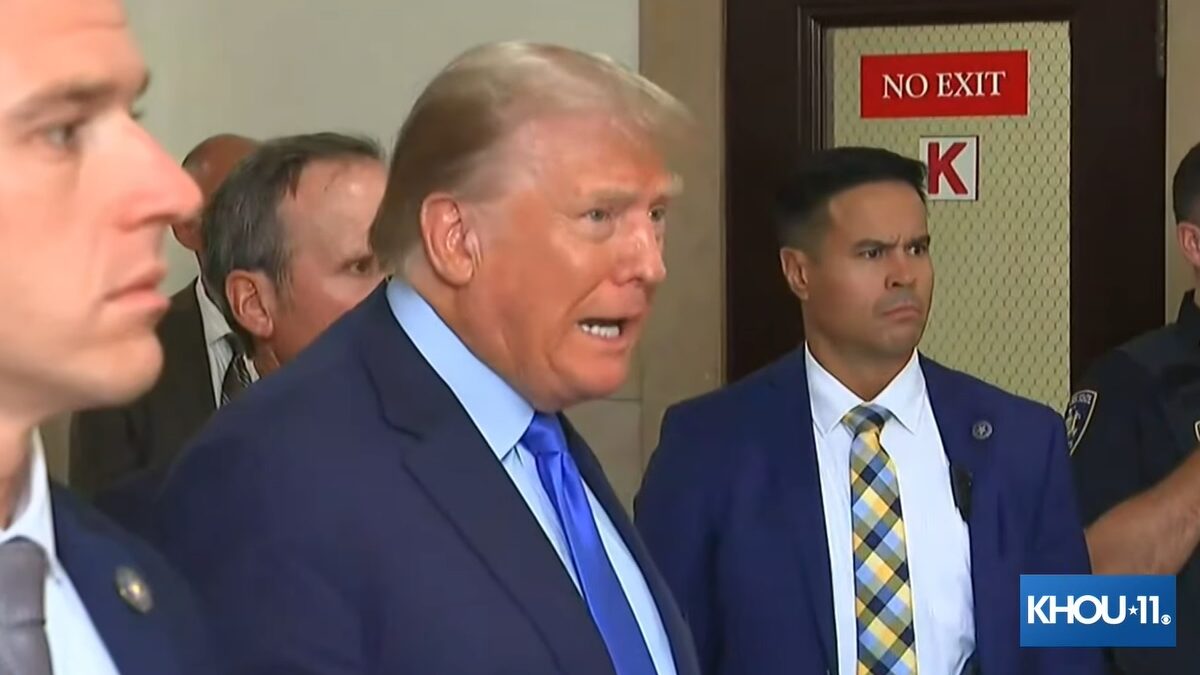
Special Counsel Jack Smith hunted information on X users who liked or retweeted posts published by former President Donald Trump, according to redacted search warrants and other documents released Monday.
According to the heavily redacted document issued to then-Twitter in January, the court ordered the social media giant to forfeit a bevy of information regarding Trump’s account, including “advertising information, including advertising IDs, ad activity, and ad topic preferences,” as well as IP addresses “used to create, login, and use the account” and privacy and account settings.
The warrant also demanded information such as Trump’s search history, direct messages, and “content of all tweets created, drafted, favorited/liked, or retweeted” by his account from October 2020 to January 2021.
Though the warrant was first covered in August, it was again released as part of a court order after numerous media organizations filed to obtain the document to shed light on the Smith-led special counsel’s “investigation into Trump’s actions leading up to the Jan. 6, 2021, riot at the US Capitol,” according to the New York Post. Smith previously indicted Trump in August on several bogus charges related to the former president’s challenging of the 2020 election results in the lead-up to Jan. 6, 2021.
But it wasn’t just Trump’s Twitter account that Smith and his cronies were targeting. The special counsel’s warrant also sought data on Twitter users who interacted with the former president’s account. Among the information Smith sought was a list of every user Trump “followed, unfollowed, muted, unmuted, blocked, or unblocked” during the aforementioned timeframe. Smith similarly demanded that Twitter, which has since rebranded as X, fork over a list of users who took any of the same actions with Trump’s account.
Smith and his team went even further, seeking to acquire data on Twitter users who engaged with Trump’s tweets in the months leading up to Jan. 6, 2021. This included “all lists of Twitter users who have favorited or retweeted tweets posted by [Trump], as well as all tweets that include the username associated with [Trump’s account] (i.e. ‘mentions’ or ‘replies’).”
According to the Post, Smith’s warrant was issued to then-Twitter “along with a nondisclosure order, instructing the company not to notify Trump about the search.” Twitter initially bucked Smith’s demand, arguing that to forfeit such information to the government constituted a violation of the First Amendment. The social media giant ultimately complied with the warrant but was fined $350,000 for failing to meet the special counsel’s demands by deadline.
In the heavily redacted court filing opposing Twitter’s legal attempts to notify Trump of the search, Smith baselessly claimed that telling the former president about the unprecedented seizure “would result in a statutorily cognizable harm,” as Trump is “a sophisticated actor with an expansive platform.”
“The [Non-Disclosure Order] was granted based on facts showing that notifying the former president would result in destruction of or tampering with evidence, intimidation of potential witnesses, or other serious jeopardy to an investigation or delaying of trial,” said the U.S. District Court for the District of Columbia. Nearly every other word listed under “The Non-Disclosure Order” section of the filing is redacted.
Smith’s seizure of Trump’s personal social media information and those who engaged with the then-president’s posts isn’t all that surprising given the special counsel’s weaponization of the government against Trump thus far. In addition to indicting Trump, Smith filed a motion in September to institute a gag order on the 45th president, effectively stifling his First Amendment right to criticize the very government attempting to silence him. That gag order was ultimately approved by D.C. District Judge Tanya Chutkan, a left-wing Obama appointee with a track record of highly partisan court rulings.
Trump’s legal team has since appealed the order to the D.C. Circuit Court of Appeals and has threatened to take the matter to the U.S. Supreme Court given the “unconstitutional” nature of the mandate.
Shawn Fleetwood is a staff writer for The Federalist and a graduate of the University of Mary Washington. He previously served as a state content writer for Convention of States Action and his work has been featured in numerous outlets, including RealClearPolitics, RealClearHealth, and Conservative Review. Follow him on Twitter @ShawnFleetwood
When the New York Post dropped its bombshell reporting on documents recovered from Hunter Biden’s abandoned laptop in October of 2020, Twitter did not reach out to the FBI to ask whether the reporting was Russian disinformation — despite extensive coordination with the FBI to prepare to combat foreign election interference. Instead, according to testimony at Wednesday’s House Oversight Committee hearing, Twitter relied on the tweets of supposed experts, making the tech giant’s decision to censor the Post’s story even more outrageous.
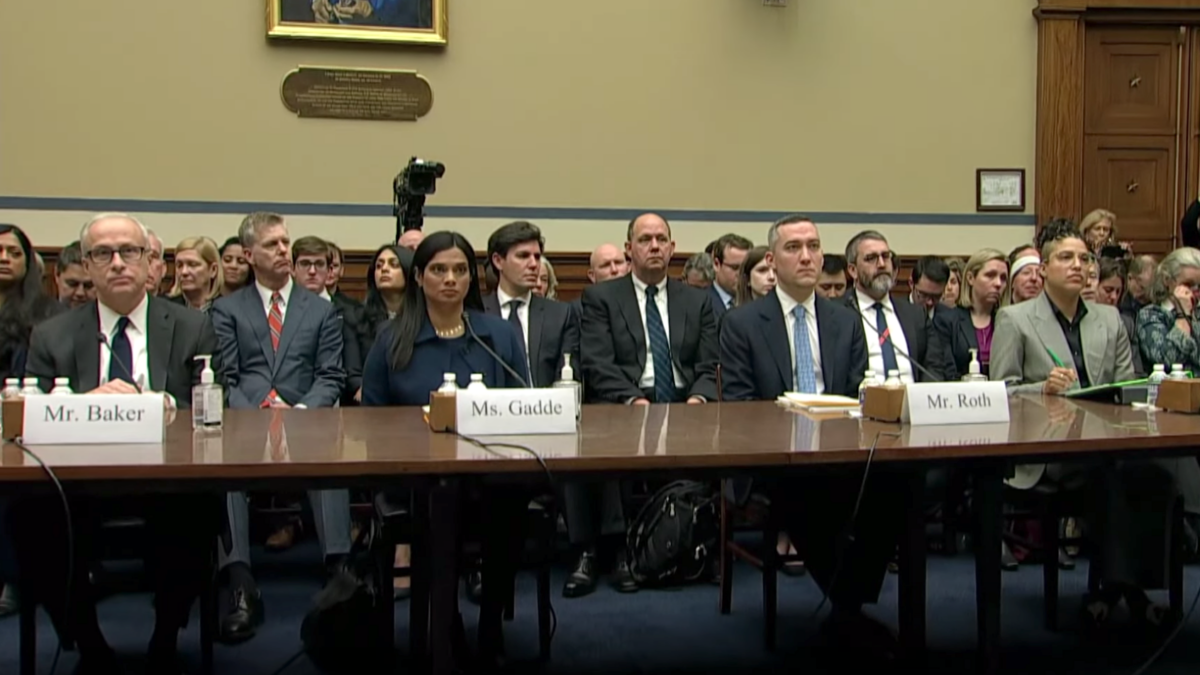
The House Oversight Committee, now in the hands of Republicans, questioned four former Twitter executives on their decision to censor the Hunter Biden laptop story. Rep. Andy Biggs, R-Ariz., pushed Twitter’s former global head of trust and safety, Yoel Roth, to explain the timing of Twitter’s decision to censor the New York Post story.
Biggs noted that in an 8:51 a.m. email on Oct. 14, 2020, Roth had taken the position that the laptop “isn’t clearly violative of our Hacked Materials Policy.” But then, by 10:12, Roth emailed his colleagues with Twitter’s decision to censor the story, stating that “the key factor informing our approach is consensus from experts monitoring election security and disinformation that this looks a lot like a hack-and-leak operation.”
What cybersecurity experts had Roth consulted between 9 a.m. and 10:15 a.m. on Oct. 14, 2020, the morning the Post story broke, Biggs asked the former Twitter executive.
Roth responded that the experts were ones the Twitter heads were following on the platform. “We were following discussions about this as they unfolded on Twitter,” Roth explained. “Cybersecurity experts were tweeting about this incident and sharing their perspectives, and that informed some of Twitter’s judgment here.”
Rep. Kelly Armstrong, R-N.D., was incredulous: “After 2016, you set up all these teams to deal with Russian interference, foreign interference, having regular meetings with the FBI, you have connections with all of these different government agencies, and you didn’t reach out to them once?”
“That’s right,” Roth said, noting he didn’t think it would be appropriate.
Instead, Twitter relied on the tweets of supposed national security experts.
Who those experts were, Roth didn’t say, but here we have another strange coincidence: In his testimony on Wednesday, Roth told the committee that a few weeks before the Post story dropped, he had participated in an exercise hosted by the Aspen Institute, with other media outlets and social media companies, that posed a hack and leak October surprise involving Hunter Biden. Roth testified that Garrett Graff facilitated that event.
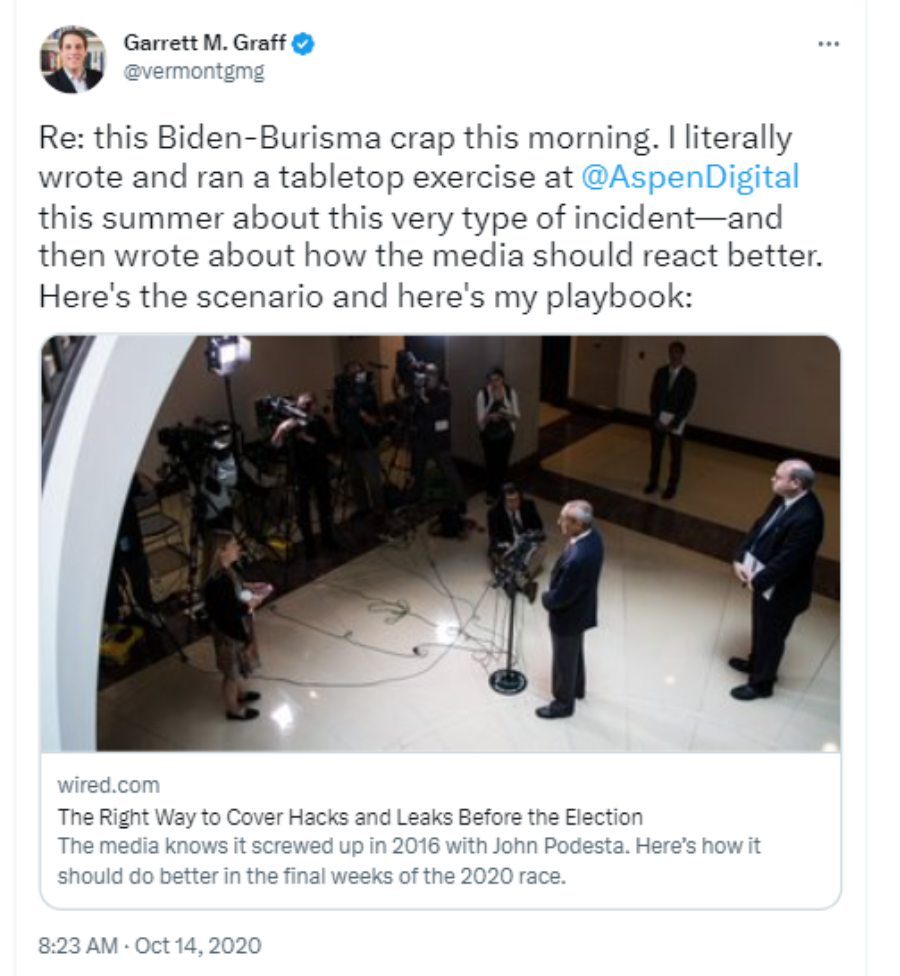
And at 8:23 a.m. on Oct. 14, 2020, after the Post story broke, Graff tweeted his playbook for how the media should react to “this Biden-Burisma crap.”
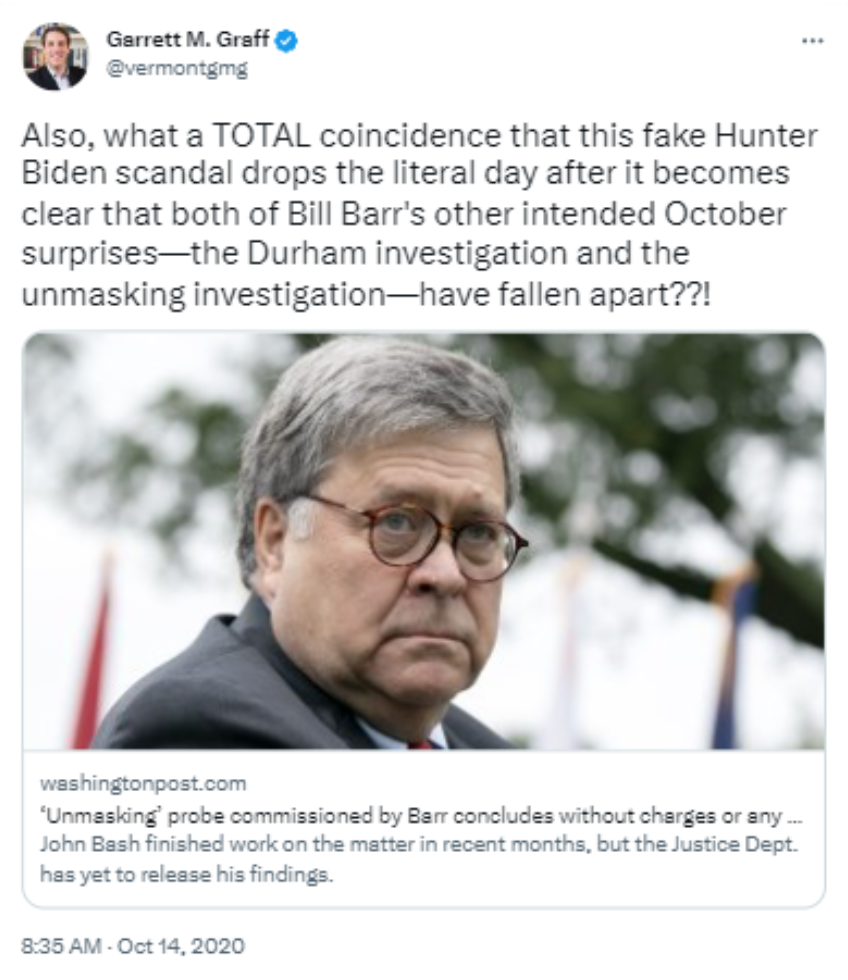
Graff followed about some 10 minutes later, tweeting, “Also, what a TOTAL coincidence that this fake Hunter Biden scandal drops the literal day after it becomes clear that both of Bill Barr’s other intended October surprises—the Durham investigation and the unmasking investigation—have fallen apart??!”
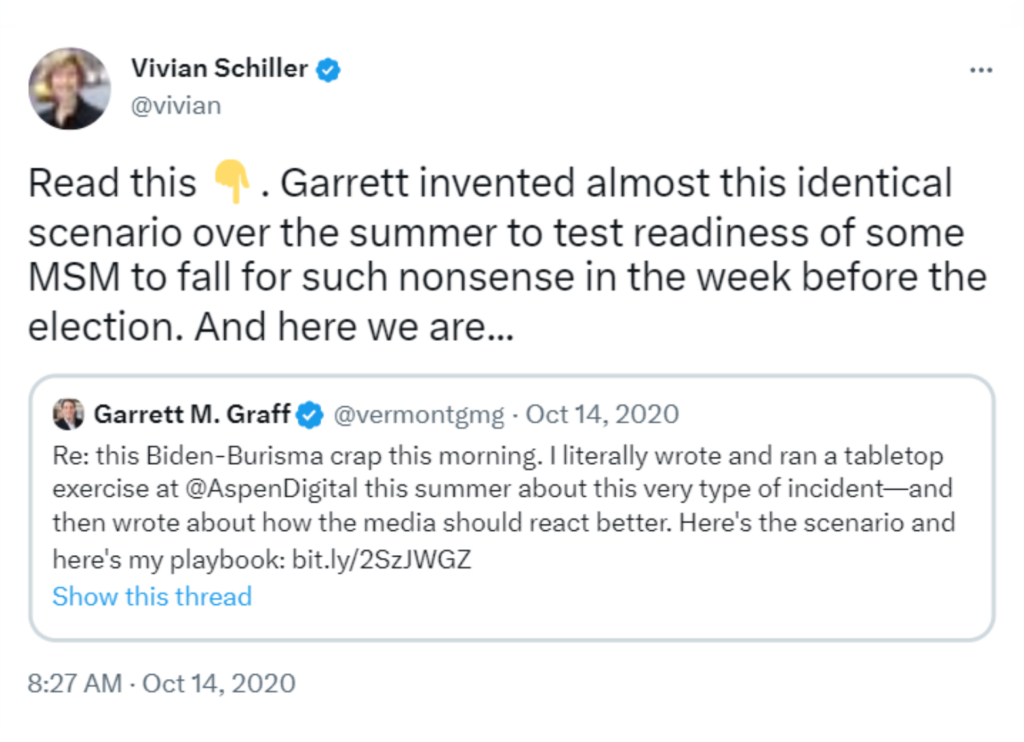
Not long after Graff began pushing the “fake” Hunter Biden scandal narrative, Vivian Schiller joined in, calling the Hunter Biden story “nonsense” and claiming Graff’s exercise was “to test readiness of some MSM.”
And who is Schiller? According to Graff, Schiller “designed and ran” the Hunter Biden tabletop exercise that Roth participated in. She was also the former head of news at Twitter, in addition to previously being the CEO of NPR, among other gigs.
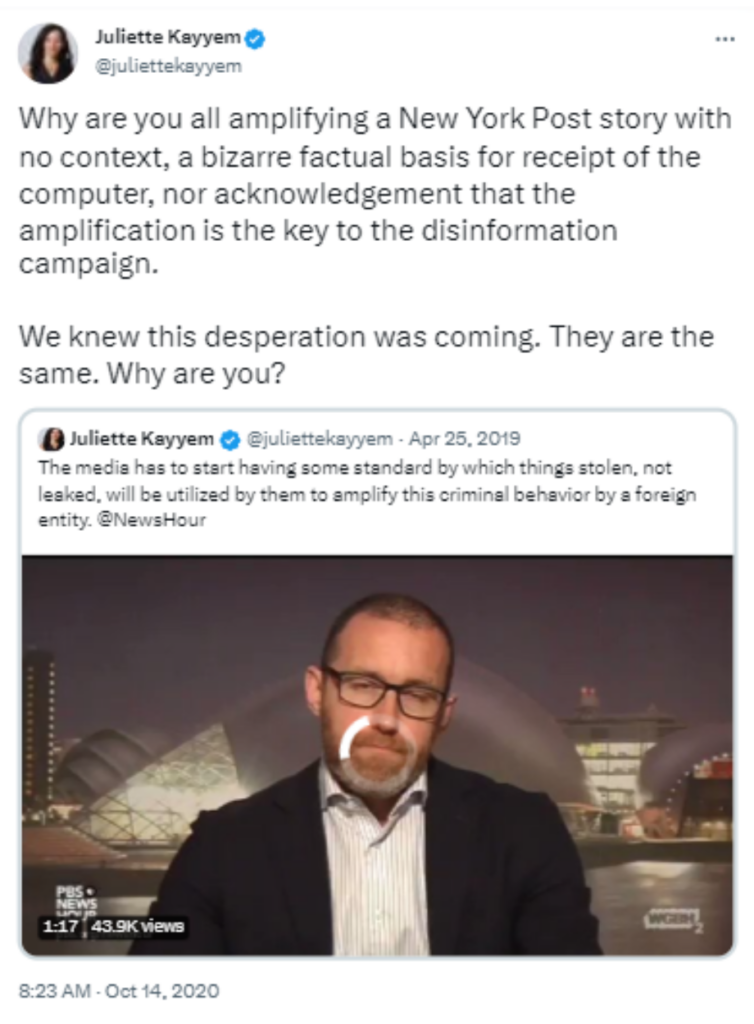
In addition to Graff and Schiller, CNN’s consultant and so-called national-security expert weighed in at 8:23 a.m., questioning the “amplifying” of the New York Post’s story, stressing that “amplification is the key to disinformation.”
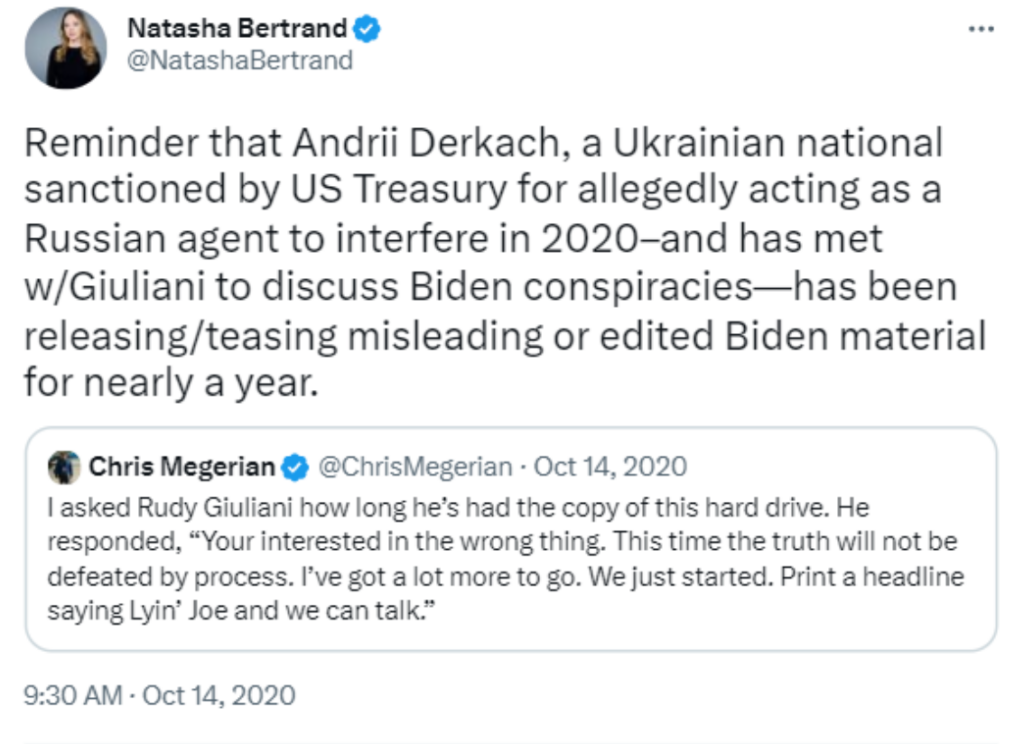
Natasha Bertrand also tweeted an early morning “warning” that a Russian agent had been “teasing misleading or edited Biden material for nearly a year.”
Bertrand, also known as Fusion Natasha for falling for Fusion GPS’s Steele dossier and Alfa Bank hoax, was joined in pushing the disinformation narrative by The Washington Post’s alleged fact-checker Glenn Kessler.
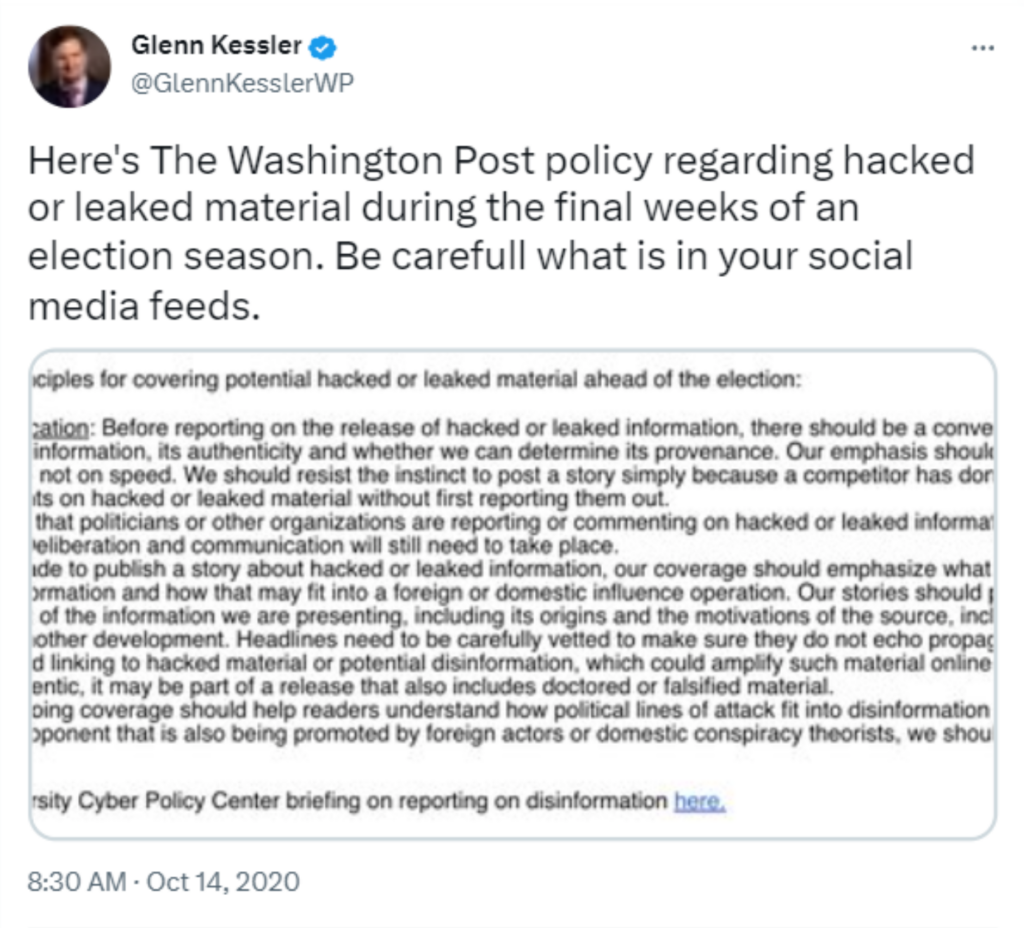
By 8:30 a.m., Kessler had shared The Washington Post’s policy “regarding hacked or leaked materials,” and told Twitter users to “be careful what is in your social media feeds.”
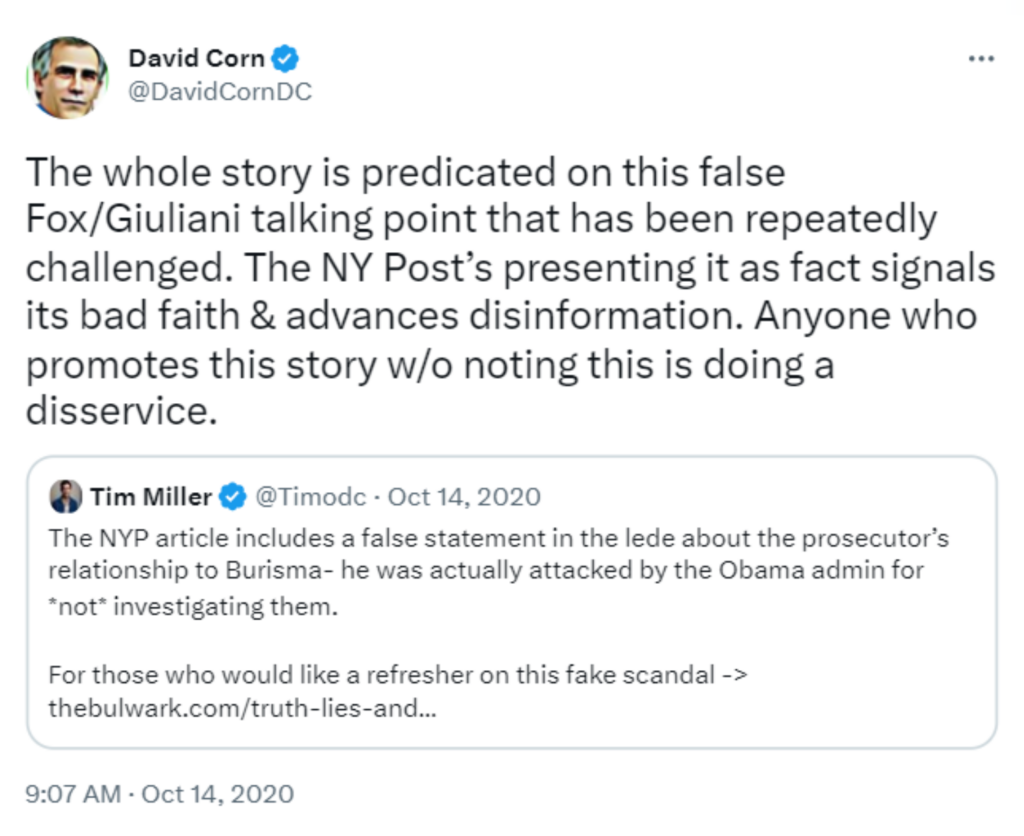
Mother Jones’ D.C. bureau chief David Corn followed with a 9:07 tweet declaring that the “whole story” was predicated on “false Fox/Giuliani talking points” and pronouncing the Post as advancing “disinformation.”
Twitter’s decision to censor the Hunter Biden story was bad enough before, but to think the executives may have relied on so-called experts like these raises the outrage another octave.
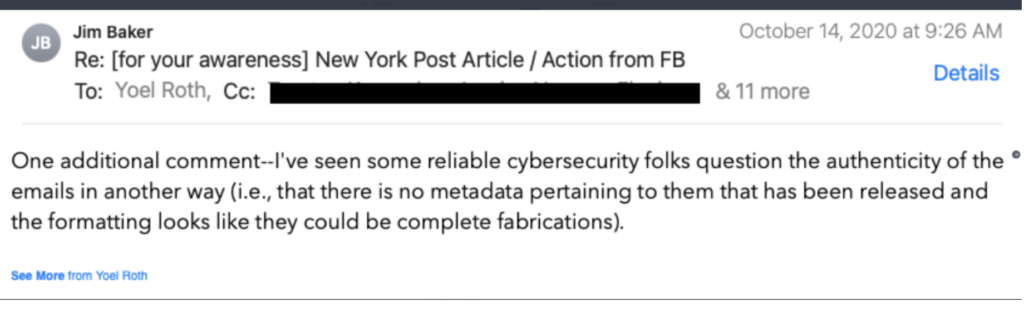
Former Twitter Deputy General Counsel James Baker likewise indicated in an email that he had “seen some reliable cybersecurity folks question the authenticity of the emails in another way (i.e., that there is no metadata pertaining to them that has been released and the formatting looks like they could be complete fabrications.)” Baker, however, did not say whether he had spoken with the “cybersecurity folks,” and given that when pushed by the committee he hid behind attorney-client privilege, getting any more answers from Baker seems unlikely.
Beyond learning that Twitter executives opted to rely on the tweets of so-called experts over asking the FBI if the laptop was fake, Wednesday’s hearing consisted mainly of grandstanding — some on both sides of the aisle — and Democrats attempting to make the hearing about Trump when they weren’t complaining that the entire session was a waste of time. One additional salient fact came out, however, in addition to a review of the basics of Twitter’s censorship efforts.
Specifically, Roth clarified for the House committee that the FBI had not previously warned that an expected “hack-and-leak” operation was rumored to likely involve Hunter Biden. Rather, according to Roth’s testimony, the rumor that the hack-and-leak operation would target the Biden son came from another tech company.
Roth claimed in his Wednesday testimony that his Dec. 21, 2020, statement to the Federal Election Commission was being misinterpreted. In that statement, Roth had attested that “since 2018 he had regular meetings with the Office of the Director of National Intelligence, the Department of Homeland Security, the FBI, and industry peers regarding election security.” His signed declaration then noted that the “expectations of hack-and-leak operations were discussed throughout 2020. I also learned in these meetings that there were rumors that a hack-and-leak operation would involve Hunter Biden.”
According to Roth, he should have worded his statement differently because it was not the FBI that had raised Hunter Biden as a potential subject of the hack and leak, but a peer company. One would think, however, that Roth would have clarified this point to his lawyer some two-plus years ago when Twitter’s Covington & Burling attorney represented to the FEC in a cover letter that accompanied Roth’s statement that “reports from the law enforcement agencies even suggested there were rumors that such a hack-and-leak operation would be related to Hunter Biden.”
Clearly, the former Twitter executives seek to separate themselves from the FBI, but “The Twitter Files” make that next to impossible to accomplish. And, really, being beholden to the so-called experts tweeting out warnings of supposed Russian disinformation would hardly be an improvement.
Margot Cleveland is The Federalist’s senior legal correspondent. She is also a contributor to National Review Online, the Washington Examiner, Aleteia, and Townhall.com, and has been published in the Wall Street Journal and USA Today. Cleveland is a lawyer and a graduate of the Notre Dame Law School, where she earned the Hoynes Prize—the law school’s highest honor. She later served for nearly 25 years as a permanent law clerk for a federal appellate judge on the Seventh Circuit Court of Appeals. Cleveland is a former full-time university faculty member and now teaches as an adjunct from time to time. As a stay-at-home homeschooling mom of a young son with cystic fibrosis, Cleveland frequently writes on cultural issues related to parenting and special-needs children. Cleveland is on Twitter at @ProfMJCleveland. The views expressed here are those of Cleveland in her private capacity.
American Family Association
American Family Association (AFA), a non-profit 501(c)(3) organization, was founded in 1977 by Donald E. Wildmon, who was the pastor of First United Methodist Church in Southaven, Mississippi, at the time. Since 1977, AFA has been on the frontlines of Ame
NEWSMAX
News, Opinion, Interviews, Research and discussion
Opinion
American Family Association
American Family Association (AFA), a non-profit 501(c)(3) organization, was founded in 1977 by Donald E. Wildmon, who was the pastor of First United Methodist Church in Southaven, Mississippi, at the time. Since 1977, AFA has been on the frontlines of Ame
American Family Association
American Family Association (AFA), a non-profit 501(c)(3) organization, was founded in 1977 by Donald E. Wildmon, who was the pastor of First United Methodist Church in Southaven, Mississippi, at the time. Since 1977, AFA has been on the frontlines of Ame
You Version
Bible Translations, Devotional Tools and Plans, BLOG, free mobile application; notes and more
Political
American Family Association
American Family Association (AFA), a non-profit 501(c)(3) organization, was founded in 1977 by Donald E. Wildmon, who was the pastor of First United Methodist Church in Southaven, Mississippi, at the time. Since 1977, AFA has been on the frontlines of Ame
NEWSMAX
News, Opinion, Interviews, Research and discussion
Spiritual
American Family Association
American Family Association (AFA), a non-profit 501(c)(3) organization, was founded in 1977 by Donald E. Wildmon, who was the pastor of First United Methodist Church in Southaven, Mississippi, at the time. Since 1977, AFA has been on the frontlines of Ame
Bible Gateway
The Bible Gateway is a tool for reading and researching scripture online — all in the language or translation of your choice! It provides advanced searching capabilities, which allow readers to find and compare particular passages in scripture based on




 What Did You Say?
You must be logged in to post a comment.