
Kamala’s True Grit: Harris Embraces a Gun Vilified During the Biden-Harris Administration
By: Jonathan Turley | October 8, 2024

The reinvention of Vice President Kamala Harris in this election has been a thing to behold. In politics, candidates often reconstruct their records to secure votes, but Harris appears to have constructed an entirely mythical being. Once ranked to the left of socialist Sen. Bernie Sanders and viewed as among the most liberal members of the Senate, Harris has sought to convince the public that she is actually a frack-loving, gun-toting, border-defending moderate. This last week, Harris sounded like she has hired Neo as her new campaign manager from the Matrix. When asked “what do you need, besides a miracle?” Neo replied “Guns. Lots of Guns.”
Recently, that remake was on full display during a softball interview with Oprah, who has endorsed Harris. The Vice President declared that she is a gun owner and “if somebody breaks into my house, they’re getting shot.” She repeated the claim in a CBS Sixty Minutes interview and noted that she has fired the gun at a pistol range. The gun is reportedly a semiautomatic Glock handgun. Many Glocks are semiautomatics that use 9mm ammunition.
When CBS’s Bill Whitaker expressed shock at her gun-toting persona on the campaign trail, he asked if she actually fired it. Harris then did her best Rooster Cogburn, who noted “Well a gun that ain’t loaded, ain’t much good for nuthin.” Harris said that she has of course fired the gun in her trips to the firing range.
While she was referring to defending her home, Harris’s pledge to gun down intruders stands in stark contrast to her opposition to stand your ground laws. When she was the San Fransisco District Attorney, Kamala Harris was one of the signatories on the District Attorneys’ amicus brief in District of Columbia v. Heller — in support the handgun ban. The Court rejected the position of Harris and her fellow Democratic DAs and held that there is an individual right to bear arms under the Second Amendment.
Harris’ true grit has delighted activists who are trying to lure male voters back to the Democratic Party. It may not be as thrilling to some in the Biden-Harris Administration including President Joe Biden.
As we have previously discussed, Biden and other Democrats have repeatedly denounced semiautomatics and some have suggested that, with a change in the Supreme Court, they might be banned. While the Administration has repeatedly called for a ban on AR-15s, the most popular weapon in America, President Biden has suggested in the past that he might seek to ban 9mm weapons.
In reference to guns that use 9mm ammunition, Biden declared “there’s simply no rational basis for it in terms of thinking about self-protection.”
It is a call that has been echoed in Canada where Prime Minister Justin Trudeau announced that his government is introducing legislation to “implement a national freeze on handgun ownership.” He said Canadians would no longer be able “to buy, sell, transfer or import handguns anywhere in Canada,” adding that “there is no reason anyone in Canada should need guns in their everyday lives.”

While the White House subsequently tried to walk back his comments, Biden saying there’s “no rational basis” to own 9mms makes the new Harris look . . . well . . . irrational. Both Biden and Harris have made sweeping, unsupportable statements about guns and constitutional protections. For example, despite being repeatedly corrected, President Biden continues to repeat the same false statements about bans on weapons when the Second Amendment was ratified.
Likewise, in support of the ban on AR-15s, Harris declared: “Do you know what an assault weapon is? It was designed for a specific purpose, to kill a lot of human beings quickly. An assault weapon is a weapon of war, with no place, no place in a civil society.”
Yet, courts likely would press a Harris administration on why it is seeking to ban this model when other higher-caliber weapons are sold. AR-15s can handle a variety of calibers. However, they are no more powerful than other semi-automatic rifles of the same caliber and actually have a lower caliber than some commonly sold weapons which use .30-06, .308 and .300 ammunition; many of these guns fire at the same — or near the same rate — as the AR-15. None of these weapons are classified as actual military “assault weapons,” and most civilians cannot own an automatic weapon.
As discussed earlier, President Biden showed the same disconnect as Harris between the factual and the rhetorical basis for some gun-control measures. He condemned “high-caliber weapons” like 9mm handguns and said “a .22-caliber bullet will lodge in the lung, and we can probably get it out — may be able to get it and save the life. A 9mm bullet blows the lung out of the body.”
Biden has not made any comment on Harris promising to blow away anyone coming into her house with her own Glock.
Yet, before condemning Harris for her implied threat to “blow lungs out of bodies,” Biden should again check both the constitutional and practical statements about handguns.
Gun experts mocked the notion that 9mm rounds blow organs out of bodies, but 9mm ammunition is the most popular handgun caliber in the U.S., with more than half of all handguns produced in 2019 using that round, according to Shooting Industry magazine. If Biden pushed a ban, he would target more than 40 percent of all pistols produced in the U.S., including many Glocks.
Again, in fairness to Harris, she is not the first politician to reinvent herself on the campaign trail. For now, Harris wants to be clear that “I have a Glock, and I’ve had it for quite some time.” For critics, the reload is a bit much given her record. Yet, in a close election, many activists want voters in states like Pennsylvania to know that Harris is the virtual Jed Clampett of the Beverly Hills set. Indeed, you get the impression that she would use her Glock to frack, if only she could.
While 9mm’s have been vilified by the Biden-Harris Administration, it just happens to be one of the most popular guns in the United States . . . and Harris wants people to know that she has one and knows how to use it.
As a politician reinventing herself in a higher-caliber image, she chose wisely. Indeed, other politicians may want to take heed and listen to Deputy Marshall Sam Gerard in U.S. Marshalls: “Get yourself a Glock and get rid of the nickel-plated sissy-pistol.”

The Largest-Ever Survey of American Gun Owners Finds That Defensive Use of Firearms Is Common
The results also confirm that “assault weapons” and “large capacity” magazines are widely used for lawful purposes.
Jacob Sullum | 9.9.2022 5:05 PM
Share on FacebookShare on XShare on RedditShare by emailPrint friendly versionCopy page URL
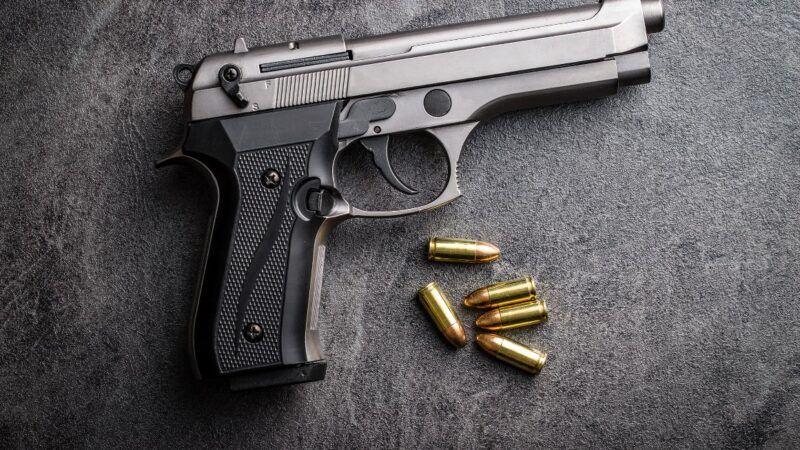
(Jiri Hera/Dreamstime)
The largest and most comprehensive survey of American gun owners ever conducted suggests that they use firearms in self-defense about 1.7 million times a year. It also confirms that AR-15-style rifles and magazines that hold more than 10 rounds, frequent targets of gun control legislation, are in common use for lawful purposes, which the Supreme Court has said is the test for arms covered by the Second Amendment.
The online survey, which was conducted by Centiment in February and March of 2021, was based on a representative sample of about 54,000 adults, 16,708 of whom were gun owners. Georgetown University political economist William English, who commissioned the survey as part of a book project, presents its major findings in a recent paper available on the Social Science Research Network.
The overall adult gun ownership rate estimated by the survey, 32 percent, is consistent with recent research by Gallup and the Pew Research Center. So is the finding that the rate varies across racial and ethnic groups: It was about 25 percent among African Americans, 28 percent among Hispanics, 19 percent among Asians, and 34 percent among whites. Men accounted for about 58 percent of gun owners.
Because of the unusually large sample, the survey was able to produce state-specific estimates that are apt to be more reliable than previous estimates. Gun ownership rates ranged from about 16 percent in Massachusetts and Hawaii to more than 50 percent in Idaho and West Virginia.
The survey results indicate that Americans own some 415 million firearms, including 171 million handguns, 146 million rifles, and 98 million shotguns. About 30 percent of respondents reported that they had ever owned AR-15s or similar rifles, which are classified as “assault weapons” under several state laws and a proposed federal ban. Such legislation also commonly imposes a limit on magazine capacity, typically 10 rounds. Nearly half of the respondents (48 percent) said they had ever owned magazines that can hold more than 10 rounds.
Those results underline the practical challenges that legislators face when they try to eliminate “assault weapons” or “large capacity” magazines. The survey suggests that up to 44 million AR-15-style rifles and up to 542 million magazines with capacities exceeding 10 rounds are already in circulation.
Those are upper-bound estimates, since people who reported that they ever owned such rifles or magazines may have subsequently sold them. But even allowing for some double counting, these numbers suggest how unrealistic it is to suppose that bans will have a significant impact on criminal use of the targeted products. At the same time, widespread ownership of those products by law-abiding Americans makes the bans vulnerable to constitutional challenges.
Two-thirds of the respondents who reported owning AR-15-style rifles said they used them for recreational target shooting, while half mentioned hunting and a third mentioned competitive shooting. Sixty-two percent said they used such rifles for home defense, and 35 percent cited defense outside the home. Yet politicians who want to ban these rifles insist they are good for nothing but mass murder.
Owners of “large capacity” magazines likewise cited a variety of lawful uses. Recreational target shooting (64 percent) was the most common, followed by home defense (62 percent), hunting (47 percent), defense outside the home (42 percent), and competitive shooting (27 percent).
Politicians who favor a 10-round limit argue that no one except for criminals and police officers really needs a larger magazine. Yet respondents described various situations, based on their personal experiences, where “it would have been useful for defensive purposes to have a firearm with a magazine capacity in excess of 10 rounds.” These ranged from muggings and home invasions by multiple attackers to encounters with wild animals.
Maybe these gun owners were wrong to think the ability to fire more than 10 rounds without reloading was important in those situations. But judging from the responses that English quotes, they had cogent reasons for believing that. Bans on “large capacity” magazines routinely exempt current and retired police officers, on the theory that they are especially likely to face threats (such as multiple assailants) that may require more than 10 rounds. It strains credulity to suggest that ordinary citizens never face such threats, and this survey provides further reason to doubt that assumption.
Thirty-one percent of the gun owners said they had used a firearm to defend themselves or their property, often on multiple occasions. As in previous research, the vast majority of such incidents (82 percent) did not involve firing a gun, let alone injuring or killing an attacker. In more than four-fifths of the cases, respondents reported that brandishing or mentioning a firearm was enough to eliminate the threat.
That reality helps explain the wide divergence in estimates of defensive gun uses. The self-reports of gun owners may not be entirely reliable, since they could be exaggerated, mistaken, or dishonest. But limiting the analysis to cases in which an attacker was wounded or killed, or to incidents that were covered by newspapers or reported to the police, is bound to overlook much more common encounters with less dramatic outcomes.
About half of the defensive gun uses identified by the survey involved more than one assailant. Four-fifths occurred inside the gun owner’s home or on his property, while 9 percent happened in a public place and 3 percent happened at work. The most commonly used firearms were handguns (66 percent), followed by shotguns (21 percent) and rifles (13 percent).
Based on the number of incidents that gun owners reported, English estimates that “guns are used defensively by firearms owners in approximately 1.67 million incidents per year.” That number does not include cases where people defended themselves with guns owned by others, which could help explain why English’s figure is lower than a previous estimate by Florida State University criminologists Gary Kleck and Marc Gertz. Based on a 1993 telephone survey with a substantially smaller sample, Kleck and Gertz put the annual number at more than 2 million.
Although less than one in 10 of the defensive gun uses identified by English’s survey happened in public places, most of the respondents (56 percent) said they had carried handguns for self-defense. More than a third (35 percent) said they did so “sometimes,” “often,” or “always or almost always.” About the same percentage reported that they had wanted to carry handguns in circumstances where local rules prohibited it.
At the time of the survey, the ability to legally carry handguns in public varied widely across jurisdictions. Some states had highly restrictive laws that gave local officials wide discretion to reject carry permit applications, a policy that the Supreme Court recently deemed unconstitutional. Even after that ruling, some states plan to enforce licensing requirements and/or location restrictions that make it difficult for residents to carry handguns for self-defense. Depending on your perspective, the results of this survey demonstrate either the wisdom or the injustice of that strategy.
English’s survey also asked about incidents in which respondents believed that the visible presence of a gun had neutralized a potentially violent threat. He says that category would include, for example, “a situation in which a combative customer calmed down after noticing that shop owner had a handgun on his or her hip, or a situation in which a trespasser cooperatively left a property when questioned by a landowner who had a rifle slung over his or her shoulder, or a situation in which a friend showed up with a firearm to help [defuse] a dangerous situation.”
Nearly a third of gun owners reported such incidents, and some said they had witnessed them more than once. English says the results imply “approximately 1.5 million incidents per year [in] which the presence of a firearm deterred crime.” That estimate, of course, depends on the respondents’ subjective impressions, so it is probably less reliable than the estimate of explicit defensive uses, which itself is open to the usual questions about the accuracy of respondents’ interpretations and recollections. But even taken with the appropriate measure of salt, the results suggest that competing studies may grossly underestimate the defensive value of guns.

 What Did You Say?
You must be logged in to post a comment.