Perspectives; Thoughts; Comments; Opinions; Discussions

Posts tagged ‘The Federalist’

Mollie Hemingway Delivers Masterclass Explainer on The ‘Government-Funded’ War on Free Speech


By: Shawn Fleetwood | March 25, 2025

Read more at https://thefederalist.com/2025/03/25/mollie-hemingway-delivers-masterclass-explainer-on-the-government-funded-war-on-free-speech/

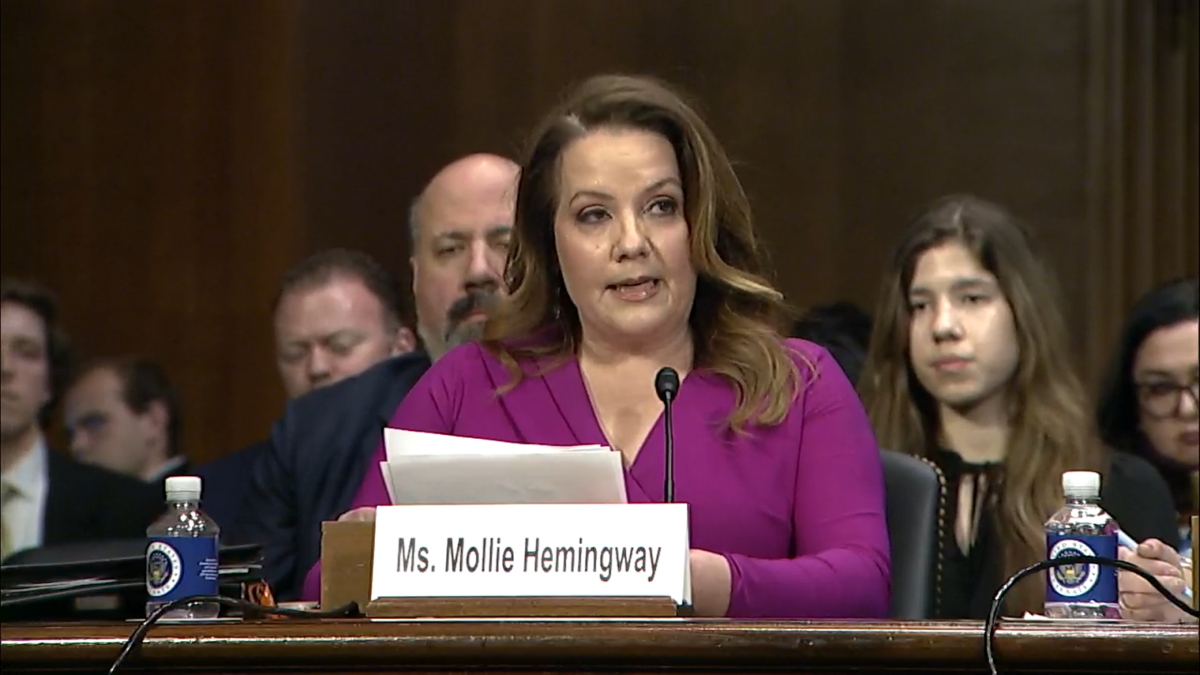
Mollie Hemingway testifying before Congress.
‘They know our voice is so powerful and influential that they can’t accomplish their goals unless they shut us down. They will not succeed.’

Author Shawn Fleetwood profile

Shawn Fleetwood

Visit on Twitter@ShawnFleetwood

More Articles

Americans constitutionally protected right to free speech “has been under worse attack in the last decade than at any other point in our nation’s history,” Federalist Editor-in-Chief Mollie Hemingway told lawmakers during a Senate Judiciary subcommittee hearing on Tuesday.

“The tentacles of the censorship-industrial complex are choking out freedom of expression, debate, and the right to criticize powerful institutions such as corporate media and the government,” Hemingway said.

Throughout her opening statement, The Federalist’s editor-in-chief highlighted how the federal and state governments have “fund[ed] and promote[d] censorship and blacklisting technology,” and have even gone as far as to “direct Big Tech companies to censor American speech and debate.” She specifically cited how academic institutions “such as Stanford University and the University of Texas are given large grants, not to defend free speech, but to conduct research on so-called ‘disinformation’ for use by the censorship regime.”

“Non-profit think tanks such as the Aspen Institute post so-called ‘disinformation’ seminars to groom journalists to publish pro-censorship propaganda and to suppress important stories, such as the Hunter Biden laptop bombshell,” Hemingway said. “Non-profit censorship groups such as the Global Disinformation Index and for-profit censorship businesses such as NewsGuard produce widely used censorship tools and blacklists to favor left-wing media while working to silence media that fight false narratives.”

As described by Hemingway, censorship tools employed by groups such as GDI and NewsGuard “routinely rate leftwing news outlets, that are no threat to the permanent bureaucracy, higher than those that challenge prevailing orthodoxies.” These deceptively crafted lists are subsequently used by companies to “boycott some publications and reward others with advertising,” she explained.

“The Washington Post and New York Times routinely receive the highest marks. Those publications won Pulitzers for their role in the Russia collusion hoax, and we have some participants in that hoax here on this subcommittee,” Hemingway said. “My publication, The Federalist, exposed that hoax through dogged reporting and investigation, as we did with the media’s vicious lies against Justice Brett Kavanaugh. We exposed much of the censorship industrial complex, too, even suing the State Department after discovering its role in promoting and marketing censorship tools that are being used against us even as we sit here today.”

As noted by Hemingway, The Federalist is no stranger to being a target of the expansive censorship-industrial complex.

During the summer of 2020, for example, the left-wing Center for Countering Digital Hate colluded with NBC News to try and strip The Federalist of its Google ad revenue. As The Federalist’s Jordan Boyd reported, “NBC News reported that Google banned The Federalist due to a shoddy report from the network’s ‘verification unit,’ and the Center for Countering Digital Hate took issue with The Federalist’s reporting about the race-motivated rioting and violence that plagued the nation during the summer of rage.”

Hemingway also cited a 2023 report by the House Select Subcommittee on the Weaponization of the Federal Government “documenting how Stanford University colluded with two governmental entities to pressure social media companies into censoring true information, jokes, satire, political reporting, and analysis, all of which they claimed was ‘disinformation.’” The Federalist editor-in-chief noted how she and Federalist CEO Sean Davis were targeted by this censorship operation.

“One of the censored items was a story about a TV appearance in which I said of the media, ‘They lie, they lie, they lie, and then they lie.’ Gallup reported in February that my view is held by 70 percent of Americans, who say they don’t trust corporate media to report news accurately, fairly, or fully,” Hemingway said.

Hemingway concluded her opening statement by noting the difficulties in “facing” the vast censorship-industrial complex, and that while it “would have been easy to fold,” doing so is “exactly what censors want: to make it impossible to report the truth about their lies.”

“They know our voice is so powerful and influential that they can’t accomplish their goals unless they shut us down. They will not succeed,” Hemingway said. “We will never stop. The more they try to shut us down, the harder we’re going to work to stay open, because it’s not about us — it’s about whether we will have a civilization where people are allowed to say and think things tyrants don’t want us to.”


Shawn Fleetwood is a staff writer for The Federalist and a graduate of the University of Mary Washington. He previously served as a state content writer for Convention of States Action and his work has been featured in numerous outlets, including RealClearPolitics, RealClearHealth, and Conservative Review. Follow him on Twitter @ShawnFleetwood

The Federalist’s 2024 Battleground State Elections Guide


By: The Federalist Staff | October 10, 2024

Read more at https://thefederalist.com/2024/10/10/the-federalists-2024-battleground-state-elections-guide/

'I voted' sticker.

Author The Federalist Staff profile

The Federalist Staff

More Articles

With Election Day less than a month away, election processes and early voting are kicking into gear in several swing states around the country. With different election laws and court rulings governing election administration in each state, it can be tough to keep up with the myriad guidelines and rules governing the electoral process. That’s why The Federalist’s 2024 Battleground State Elections Guide is here to help.

From ballot return deadlines to mail-in voting rules, here are all the key dates and information you’ll need to understand the election process in swing states throughout the country this cycle.

Arizona

In-Person Early VotingBegan on Oct. 9 and ends on Nov. 1.

Mail-In Voting: Ballots began to be mailed out Oct. 9.

Ballot Return Deadlines: Mail-in ballots must be returned by 7 p.m. local time on Election Day to be counted. These ballots can be returned via mail or delivered in person. Polling locations for in-person voting on Election Day also close at 7 p.m. local time.

Ballot HarvestingArizona law stipulates that only a “family member, household member or caregiver of the voter” may return the elector’s mail-in ballot.

Mail-In Ballot Signature Requirements: All absentee voters are required to sign the affidavit on the ballot envelope in order for their vote to be tabulated. The envelope signature must match the signature on the voter’s registration form.

Voter ID: Arizona requires in-person voters to present one type of acceptable photo ID or two types of non-photo ID.

Citizenship Requirements: The U.S. Supreme Court recently allowed part of a state law to go into effect that requires eligible electors to provide documentary proof of citizenship when registering to vote via state registration form. Arizonans may still register as federal-only voters with no proof of citizenship. The Arizona Constitution further specifies only U.S. citizens can vote in elections.

Post-Election Day Ballot CuringArizona law permits a “curing” period, in which local officials are authorized to contact voters to correct signature issues on their mail ballots. Any issue must be corrected “not later than the fifth business day after a primary, general or special election that includes a federal office or the third business day after any other election.”

Major Ballot Initiatives: Arizona’s ballot is expected to be stacked with roughly a dozen ballot initiatives this November. Among the most notable are constitutional amendments to effectively legalize late-term abortion (Proposition 139), raise the threshold for citizen-initiated ballot measures (Proposition 134), give the state legislature power to limit the governor’s emergency powers (Proposition 135), and prohibit open primary elections (Proposition 133).

Also set to appear on the ballot is a constitutional amendment that would institute open primaries and allow for the adoption of ranked-choice voting for general elections (Proposition 140). Despite the discovery that roughly 38,000 pairs of signatures gathered in support of the measure were duplicates, the Arizona Supreme Court ruled that votes cast for the measure may count.

For more information on the full list of Arizona ballot measures, see here.

Biggest Election Fights: In September, Arizona election officials discovered roughly 98,000 registered voters lacking documentary proof of citizenship (DPOC) due to an error stemming from how the state’s Motor Vehicle Division shares driver’s license information with the voter registration system. As noted above, individuals who do not provide DPOC may still register as “federal-only” voters and can only cast ballots in federal races.

According to the secretary of state’s office, most of the affected voters are registered Republicans. The Arizona Supreme Court granted these electors the ability to vote full-ballot this November.

The secretary of state’s office revealed on Sept. 30 that election officials found an additional 120,000 voters affected by the issue who lack DPOC.

Georgia

In-Person Early VotingBegins on Oct. 15 and ends on Nov. 1. 

Mail-In VotingAbsentee ballots were sent to UOCAVA voters on Sept. 17.  Registrars began sending out absentee ballots for the general public on Oct. 7. The last day to request a mail-in ballot is Oct. 25. 

Ballot Return Deadlines: Absentee ballots (excluding UOCAVA ballots) must be returned by 7 p.m. local time on Election Day to be counted. These ballots can be returned in person, through the mail, or at a drop box location. Polling locations for in-person voting on Election Day also close at 7 p.m. local time. 

Ballot Harvesting: Georgia does not permit ballot harvesting, but only allows certain family members or a household member to return a voter’s ballot. (A caretaker may also return a disabled voter’s ballot.)

Mail-In Ballot Signature Requirements: Absentee ballot envelopes contain an “oath which must be signed by the voter.” Georgia also “requires the voter’s driver’s license number or state identification card number, which is compared with the voter’s registration record,” according to the National Conference of State Legislatures. If a voter is unable to sign his ballot, Georgia “law requires the voter make a mark,” according to Carroll County’s election website. Ballots lacking a signature or mark are rejected, according to Carroll County. 

Voter ID: “Georgia law requires photo identification when voting, either in person or absentee,” according to the secretary of state’s website. Acceptable forms of identification include any state or federal government-issued photo ID (including a driver’s license or a valid passport), a student ID from a Georgia public college or university, or a military or tribal photo ID.

Citizenship Requirements: Since 2010, Georgians registering to vote have been required to provide evidence of their U.S. citizenship, including a driver’s license or driver’s license number as long as the registrant has previously provided proof of citizenship to the Department of Driver Services. For those who don’t possess any of the accepted citizenship documents, Georgia law tasks the State Election Board with establishing “other documents or methods” for proving a person’s citizenship. However, it appears certain voters may be able to evade some of the safeguards in place.  

Post-Election Day Ballot Curing: Georgia law permits a “curing” period, in which local officials are authorized to contact voters to correct signature issues on their absentee ballots. The “last day for voters to cure timely submitted absentee ballots if they failed to sign the oath or information mismatch” is Nov. 8. 

Major Ballot Initiatives: Georgia will have three initiatives on the November ballot. One would create a Georgia Tax Court “with judicial power and statewide jurisdiction,” the second would provide “for a local option homestead property tax exemption,” and the third “exempts property that is valued at less than $20,000 from the personal property tax,” according to Ballotpedia

Biggest Election Fights: The conservative-led State Election Board has clashed with Democrats and Georgia’s Republican-led secretary of state’s office recently, especially on the topic of whether election officials should be forced to rubber-stamp election results even if they have concerns about the election’s administration.

Republican officials like Fulton County election board member Julie Adams argue they should be able to investigate concerns about the administration of an election before certifying the results, rather than rubber-stamping results they believe are legally dubious.

Democrats are also waging a series of legal challenges against the State Election Board, which has passed a series of rules aimed at ensuring the number of ballots cast matches the number of voters who voted, among other election integrity measures.

Michigan

Voter Registration: Michiganders can register to vote at any time up to 8 p.m. on Election Day. They can register to vote online, by mail, or in person at the local clerk’s office.

In-Person Early Voting: The Michigan Department of State tells voters early voting will be available “for a minimum of nine consecutive days, ending on the Sunday before an election.” So early voting will start Oct. 26 at the latest, but communities can start the process earlier, allowing it to run for as many as 29 days.

Mail-In Voting: Absentee ballots are available beginning 40 days ahead of every election. Voters can request a ballot from the local clerk, and can opt-in to receive absentee ballots ahead of every federal, state, and local election. After Michigan voters approved no-excuse absentee voting in 2018, Proposal 2, which passed in 2022, further instituted mail-in voting practices and myriad other election policies supported by the left.

Ballot Return Deadlines: Voters must return absentee ballots to the local clerk’s office by 8 p.m. on Election Day to be counted, but overseas voters simply need their ballots to be postmarked by Election Day and received by clerks within six days after the election.

Ballot Harvesting: Michigan law allows an immediate family member or “individual residing in your household” to return a voter’s ballot. A voter may also request the clerk who issued a ballot help return it. 

Mail-In Ballot Signature Requirements: Absentee voters must sign the envelope with a signature matching their state ID or voter registration application.

Voter ID: The state requires in-person voters to show a photo ID or sign an affidavit claiming they don’t have one. Acceptable documents include a current student ID or government ID such as (but not limited to) a U.S. passport or state driver’s license. Michigan does not require a copy of an ID to vote by mail.

Citizenship Requirements: It is illegal for noncitizens to vote in federal elections, and voter registration forms and ballot applications require a person to attest that he is a citizen, but Michigan does not require documentary proof of citizenship from would-be voters.

Post-Election Day Ballot Curing: If a signature does not match that in the local clerk’s records, Michigan law requires clerks to contact the voter to “cure” the signature and solve the issue. According to the secretary of state’s office, voters may cure their signatures until 5 p.m. the third day after the election.

Major Ballot Initiatives: Michigan will have no statewide ballot measures in November.

Biggest Election Fights: Democrat Secretary of State Jocelyn Benson fought to keep third-party candidate Robert F. Kennedy Jr. on the ballot and remove independent Cornel West from the ballot, both of which actions would likely help Vice President Kamala Harris’ chances.

The Republican National Committee has filed multiple lawsuits against Benson for her guidance to clerks on handling ballots and her alleged failure to clean the state’s voter rolls. The Public Interest Legal Foundation has also sued Benson for an alleged lack of voter roll maintenance.

Nevada

Voter Registration: The deadline to register online is Oct. 23. Mailed voter registration forms had to be postmarked by Oct. 8.

Nevada also offers same-day registration, in which eligible electors may register and vote in person during the early voting period or on Election Day. Those who choose this option must present a valid Nevada driver’s license or Nevada ID card. Voters will receive their ballots to vote after the registration process is completed.

In-Person Early VotingBegins on Oct. 19 and ends on Nov. 1.

Mail-In Voting: Every registrant listed as “active” on Nevada’s voter rolls is automatically mailed a ballot every election. Voters can request to opt out of this mailing list.

According to the National Conference of State Legislatures, Nevada law does not specify when election officials may start sending mail-in ballots to voters. State law does, however, require these officials to send electors their ballots “not later than the 14 days before the election.”

Ballot Return Deadlines: All ballots that are dropped off in person must be submitted by 7 p.m. local time on Election Day. According to the Nevada secretary of state’s office, “Mail-in ballots that are postmarked on or before the day of the election AND received by the 4th day after election day by 5 p.m., will be accepted as received and processed according to Nevada State law.”

Ballot Harvesting: Nevada law permits any “person authorized by the voter [to] return the mail ballot on behalf of the voter by mail or personal delivery to the county clerk, or any ballot drop box established in the county.”

Mail-In Ballot Signature Requirements: All electors voting via mail must sign the ballot envelope for it to be counted. The envelope signature must match the signature on the voter’s registration form.

Voter ID: Nevada does not require a person to show ID to vote. As summarized by Ballotpedia, state law requires a Nevada in-person voter to “sign his or her name in the election board register at his or her polling place.” That signature is then “compared with the signature on the voter’s original application to vote or another form of identification, such as a driver’s license, a state identification card, military identification, or another government-issued ID.”

Citizenship Requirements: Nevada law requires all eligible residents to be U.S. citizens to vote, although the state constitution does not explicitly stipulate only U.S. citizens can vote. The state does not require documentary proof of citizenship from people voting or registering to vote.

Post-Election Day Ballot CuringNevada law permits a “curing” period, in which local officials are required to contact voters to allow them to correct signature issues on their mail-in ballots or otherwise confirm the signature affixed to the ballot belonged to them. The voter “must provide a signature or a confirmation, as applicable, not later than 5 p.m. on the sixth day following the election” for the ballot to be counted.

Major Ballot Initiatives: There will be seven measures appearing on Nevada’s 2024 ballot, six of which are constitutional amendment proposals. Among the most notable are initiatives instituting ranked-choice voting (Question 3), effectively legalizing late-term abortion (Question 6), and requiring electors to present a valid form of ID in order to vote (Question 7).

[RELATED: Ranked-Choice Voting Is A Nightmare — And It’s On The Ballot In Nevada]

Biggest Election Fights: The top issue raising concerns among election integrity activists in the state is the accuracy of Nevada’s voter rolls. Organizations such as the Public Interest Legal Foundation have documented what appear to be alarming inaccuracies within the voter registration lists, such as finding some registrants’ addresses listed at bars and casinos. Efforts by the Citizen Outreach Foundation to file citizen-led challenges to have these allegedly ineligible registrants removed have been met with resistance by Democrat Secretary of State Cisco Aguilar, whose office recently issued a memo instructing local officials to stop processing the group’s challenges.

North Carolina

Voter Registration: The standard deadline to register to vote is 5 p.m., Oct. 11. However, North Carolinians can register to vote after the Oct. 11 deadline in person at early voting locations.

In-Person Early VotingBegins Oct. 17 and ends at 3 p.m. on Nov. 2.

Mail-In Voting: Any registered voter in North Carolina can vote by mail for any reason. Voters must request the ballot using an absentee ballot request form, either online or with a paper form. This year, voters must request absentee ballots by Oct. 29 at 5 p.m.

Ballot Return Deadlines: Ballots must be returned by Election Day, Nov. 5 at 7:30 p.m. (with exceptions for UOCAVA voters).

Ballot Harvesting: North Carolina law permits a near relative or legal guardian to return a voter’s absentee ballot. It is otherwise a class I felony for anyone to deliver a ballot to a voter or return it for them.

Mail-In Ballot Signature Requirements: Voters must sign their absentee ballot envelope.

Absentee ballots must be filled out in the presence of two adult witnesses who are not disqualified by other state statutes. Those two persons must print and sign their names on the application and certificate, as well as provide their addresses. Voters can also fulfill the requirement with the seal and signature of one notary public.

Voter ID: A photo ID is generally required to vote in North Carolina, but the address on the ID “does not have to match the voter registration records.”

If an in-person voter does not have a voter ID, he will be asked to either complete an ID exception form and vote provisionally, or vote provisionally and return to his county elections office with a valid ID “by the day before [the] county canvass.” North Carolinians voting by mail are required to provide a copy of a photo ID when returning their ballot, but they can also fill out an exception form. Counties are required to count provisional ballots as long as the ID exception forms are “properly completed.”

Exceptions for not showing an ID are expansive, and range from a disability to “work or school schedule” to a religious objection to being photographed. (Being the victim of a declared natural disaster occurring withing 100 days of Election Day also qualifies a voter for an ID exception.) Mail-in voters who are somehow unable to attach a copy of their ID must include either their driver’s license number or the last four digits of their Social Security number.

North Carolina does not require photo ID for voters covered under the Uniformed and Overseas Citizens Absentee Voting Act.

Citizenship Requirements: North Carolina law requires U.S. citizenship to register to vote. However, citizenship documents are not required to register.

Post-Election Day Ballot Curing: North Carolina allows for ballot curing in certain circumstances, including if the voter “did not sign the voter certification,” “signed the application in the wrong place,” or failed to include a copy of a photo ID with an absentee ballot.

Major Ballot Initiatives: North Carolina only has one ballot initiative certified to appear on the ballot this November. The Citizenship Requirement for Voting Amendment was referred to voters by the state legislature and would amend the state constitution to provide that only eligible U.S. citizens can vote in the state. The amendment would prohibit local governments from allowing noncitizens to vote.

Biggest Election Fights: The RNC has filed several lawsuits against the North Carolina State Board of Elections.

The western part of the state was also significantly damaged by Hurricane Helene, which will make it more difficult to vote in the deep-red region of the state, though state officials are in the process of implementing emergency election procedures.

Pennsylvania

Voter Registration: The deadline to register to vote in Pennsylvania is Oct. 21. The state implemented automatic voter registration in September 2023 through the Department of Motor Vehicles. Since then, anyone who gets a driver’s license and is eligible to vote is automatically registered unless they intentionally opted out of voter registration. Pennsylvanians may also register online, by mail, or in person at their county election office.   

In-Person Early Voting: Pennsylvania treats early voting and mail-in voting the same. Voters can go to their county election office, receive a mail-in ballot, vote, and submit this ballot “all in the same visit.” In-person voting starts as soon as counties start mailing out ballots, but that date is different for each county. Voters may check online with the Pennsylvania Department of State to see when their counties’ ballots are ready.

Mail-In Voting: The deadline for requesting a mail-in ballot is Oct. 29. Any registered voter may request a mail-in ballot.

Ballot Return Deadlines: The county must receive a completed ballot by 8 p.m. on Election Day, Nov. 5. Counties will not accept ballots with a postmark of Nov. 5 at 8 p.m.; the ballot must be in hand by then. 

Ballot Harvesting: Voters must return their own ballots, although there are some exceptions for voters with a disability to designate someone, in writing, to deliver their ballot. Former Democratic Gov. Tom Wolf created a stir in 2021 when he casually admitted in a radio interview that his wife violated this rule, by dropping off his ballot for him. It is not allowed in Pennsylvania, even between spouses.

Mail-In Ballot Signature Requirements: Voters mail ballots in a two-envelope system. The inner, secrecy envelope is not marked, but the outer, mailing envelope must be signed and dated.

Voter ID: Voters must provide a driver’s license number or the last four digits of their Social Security number when registering to vote, as required by federal law. Identification is also required the first time a voter casts a vote in a precinct where they will sign a voter roll book, though the ID does not have to include a photo (voters can use a utility bill or bank statement as long as it includes their name and address). After that, no identification is required as long as the voter continues in the same precinct because they sign the book each election. If a Pennsylvania voter moves to a new precinct, he will need to show identification again.

Voters who qualify for a ballot under the Uniformed and Overseas Citizens Absentee Voting Act (UOCAVA) or the Voting Accessibility for the Elderly and Handicapped Act do not need to show ID.

Citizenship Requirements: You must be a U.S. citizen and a resident of Pennsylvania at least 30 days before the next election to register to vote.

Military voters, and those who are registered in Pennsylvania but out of the country, may register to vote through UOCAVA. They may participate in federal and local elections. Pennsylvania also allows voters who once lived in the state but now live overseas and have no intention of returning to vote as “federal” UOCAVA voters. These voters may vote in federal-level elections such as president, vice president, U.S. senator, and congressional representative. They cannot vote in Pennsylvania’s local elections.

Post-Election Day Ballot CuringSome counties give voters notice and opportunity to “cure” mistakes, and some do not. State law tells counties not to count improperly marked ballots, but the Pennsylvania Department of State has issued guidance telling counties to flag ballots in need of curing so voters will receive an automatic notice informing voters they can cure their ballots. This has become a point of controversy.

Biggest Election Fights: Mail-in ballot curing has been under dispute, and in the courts for several years, and in multiple cases. Should counties toss out improperly marked ballots as the election code directs? Or does Pennsylvania Secretary of State Al Schmidt have the authority to override the law and issue guidance to mail-in voters offering them a second chance to mark their outer envelope properly? Counties have been choosing to either follow the law or the guidance, giving voters different responses to the same problem, depending on where they live.

The Republican National Committee (RNC) and the Republican Party of Pennsylvania challenged Schmidt and Pennsylvania’s 67 county boards of elections over this matter. The RNC believes voters should be held to the law as written by the elected General Assembly, which does have the authority to change the law, and so far, hasn’t. Last week, the state supreme court declined to rule on the issue before Election Day.

Wisconsin

Voter Registration: Wisconsin offers same-day voter registration, so eligible Wisconsinites can register to vote in person on Tuesday, Nov. 5, 2024 (Election Day). The deadline to register to vote by mail or online is Oct. 16.

In-Person Early Voting: Counties can offer early voting from Oct. 22 until Nov. 3, although the dates and office hours “vary by municipality.” 

Mail-In Voting: Absentee ballots begin being mailed out 47 days before November’s general election. 

Ballot Return Deadlines: All absentee ballots must be delivered no later than 8 p.m. local time on Election Day. The ballots may be returned via mail or hand-delivered to the polling place or clerk’s election office. 

Ballot Harvesting: Wisconsin law implies that only the voter shall mail the ballot or deliver it in person to the municipal clerk’s office that issued the ballot.

Mail-In Ballot Signature Requirements: All absentee voters must sign and seal the ballot certificate envelope. A witness also is required to sign the envelope and include his address.  Ballots that fail to include the required information are rejected.  

Voter ID: Wisconsin requires in-person voters to show the “original copy of their photo ID” to vote. 

Citizenship Requirements: Wisconsin’s constitution states that “Every United States citizen age 18 or older who is a resident of an election district in this state” is eligible to vote. “Citizenship is documented through a U.S. birth certificate or a Certificate of Naturalization, but proof of citizenship is not required to vote,” notes the Wisconsin Elections Commission. 

Post-Election Day Ballot Curing: This has been an on-again, off-again issue in the Badger State for several years. In February, the Wisconsin Elections Commission voted 5-1 on guidance advising clerks to accept ballots with incomplete ballot witness addresses following a Dane County Court ruling on the curing question. A Waukesha County judge in 2022 had ruled that clerks completing or fixing missing information on absentee ballot envelopes on behalf of the voter violated state law. Concerns over improperly “fixed” ballot envelopes were at issue in the 2020 election, and a subject of unsuccessful Trump campaign lawsuits challenging the results of the election in Wisconsin. A federal judge earlier this year tossed out a lawsuit by Democrat Party fixer Marc Elias’ lawfare group seeking to block Wisconsin election law requiring a witness to sign a voter’s absentee ballot.

Major Ballot Initiatives: Wisconsin voters will decide whether to amend Wisconsin’s constitution to provide that “only” U.S. citizens 18 or older may vote in national, state or local elections. Currently the constitution states that “every” U.S. citizen 18 or older may vote. Citizen Only Voting Amendment advocates argue the existing language leaves a loophole that would allow Wisconsin municipalities and the state to open elections to noncitizens, as has been done in other states and the District of Columbia. 

Biggest Election Fights: Wisconsin’s four-year battle over the widespread use of absentee ballot drop boxes was decided by a new liberal-led court, just in time for the 2024 general election. In a 4-3 ruling in July, the court endorsed the return of absentee ballot drop boxes, opening the door to the same kind of election shenanigans that plagued the Badger State in 2020. The decision overturned the Wisconsin Supreme Court’s 4-3 ruling by the conservative majority in 2022 banning the widespread use of the drop boxes.

For more election news and updates, visit electionbriefing.com.
State Of Texas Joins the Federalist, Daily Wire in Suing the Federal Censorship-Industrial Complex


BY: JOY PULLMANN | DECEMBER 06, 2023

Read more at https://thefederalist.com/2023/12/06/state-of-texas-joins-the-federalist-daily-wire-in-suing-the-federal-censorship-industrial-complex/

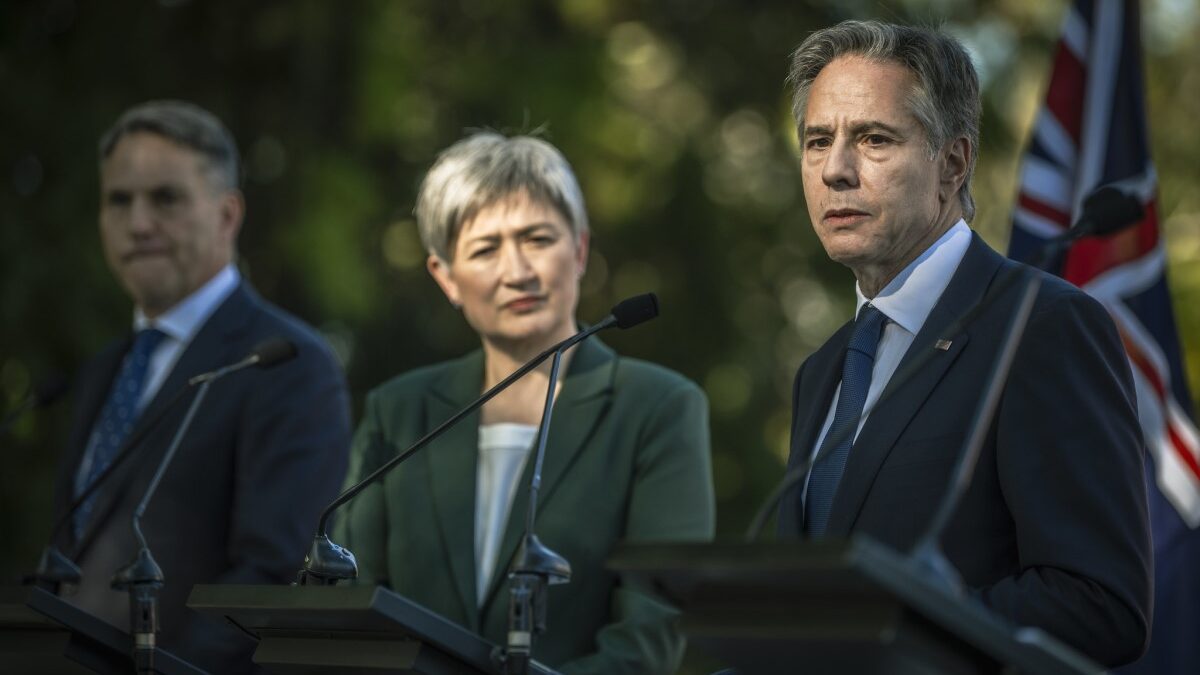
Antony Blinken, Secretary of State

Author Joy Pullmann profile

JOY PULLMANN

VISIT ON TWITTER@JOYPULLMANN

MORE ARTICLES

The U.S. State Department is violating the U.S. Constitution by funding technology to silence Americans who question government claims, says a lawsuit filed Tuesday by The Federalist, The Daily Wire, and the state of Texas.

The three are suing to stop “one of the most audacious, manipulative, secretive, and gravest abuses of power and infringements of First Amendment rights by the federal government in American history,” says the lawsuit. It exposes federal censorship activities even beyond the dramatic discoveries in a pending U.S. Supreme Court case, Murthy v. Missouri (also known as Missouri v. Biden).

This lawsuit alleges the State Department is illegally using a counterterrorism center intended to fight foreign “disinformation” instead to stop American citizens from speaking and listening to information government officials dislike. Other recent investigations have also found government counterterrorism resources and tactics being used to shape American public opinion and policy.

Through grants and product development assistance to private entities including the Global Disinformation Index (GDI) and NewsGuard, the lawsuit alleges, the State Department “is actively intervening in the news-media market to render disfavored press outlets unprofitable by funding the infrastructure, development, and marketing and promotion of censorship technology and private censorship enterprises to covertly suppress speech of a segment of the American press.”

This is just the latest in a series of major investigations and court cases in the last year to uncover multiple federal censorship efforts laundered through private cutouts. The “Twitter Files,” a series of investigative journalist reports, uncovered that dozens of federal agencies pressured virtually all social media monopolies to hide and punish tens of millions of posts and users.

Missouri v. Biden found this federal censorship complex has included government officials changing the content moderation and user policies of social media monopolies through threats to destroy their business models. House of Representatives investigations have uncovered U.S. national security and spy agencies creating “private” organizations to circumvent the Constitution’s prohibition on federal officials abridging Americans’ speech. These false-front organizations deliberately avoid creating records subject to transparency laws and congressional oversight, public records show.

Congressional investigations in November revealed that federal officials have specifically targeted The Federalist’s reporting for internet censorship.

The U.S. Justice Department is even about to put a U.S. citizen in prison for sharing election jokes on Twitter.

‘Coordinating the Government’s Efforts to Silence Speech’

The Fifth Circuit refrained from stopping the State Department’s participation in the “vast censorship enterprise” that Murthy v. Missouri uncovered because, the court said, it hadn’t seen enough evidence of that agency’s involvement. This new lawsuit from Texas, The Federalist, and The Daily Wire provides such evidence.

Even though Congress and the Constitution have banned the federal government from silencing Americans, the State Department’s Global Engagement Center (GEC) has morphed into “the lead in coordinating the government’s efforts to silence speech,” the lawsuit says. The lawsuit names as defendants the U.S. State Department, GEC, and multiple department officials including Secretary of State Antony Blinken. GEC originated as a counterterrorism agency created by an executive order from President Obama.

Through GEC, the State Department evaluated more than 365 different tools for scrubbing the internet of disfavored information, the lawsuit says. The department also pays millions to develop multiple internet disinformation “tools.” It also runs tests on censorship technologies and awards government prize money to those most effective at controlling what Americans say and hear online, the lawsuit says.

[LISTEN: Margot Cleveland Breaks Down Explosive New Federalist Lawsuit Against State Department]

State then shares these censorship technologies with companies, favored media outlets, academics, and government agencies. It markets these government-funded censorship technologies to Silicon Valley companies including Facebook, X, and LinkedIn. The tools included “supposed fact-checking technologies, media literacy tools, media intelligence platforms, social network mapping, and machine learning/artificial intelligence technology,” the lawsuit says.

At least two of the censorship tools the State Department has funded, developed, and awarded have targeted The Federalist and The Daily Wire, the lawsuit says. NewsGuard and GDI wield these tools developed with government assistance to deprive government-criticizing news outlets, including The Federalist and The Daily Wire, of operating funds.

They do this by rating conservative outlets poorly, falsely claiming these outlets purvey “disinformation” and are “unreliable.” That deprives leftists’ media competitors of high-value ad dollars from the big companies that use these rating systems. Such companies include YouTube, Facebook, Snapchat, Best Buy, Exxon Mobil, Kellogg, MasterCard, and Verizon.

“Advertising companies that subscribe to GDI’s blacklist refuse to place ads with disfavored news sources, cutting off revenue streams and leaving the blacklisted outlets unable to compete with the approved ‘low risk’ media outlets — often legacy news,” the lawsuit says.

Boosting Disinformation While Claiming the Opposite

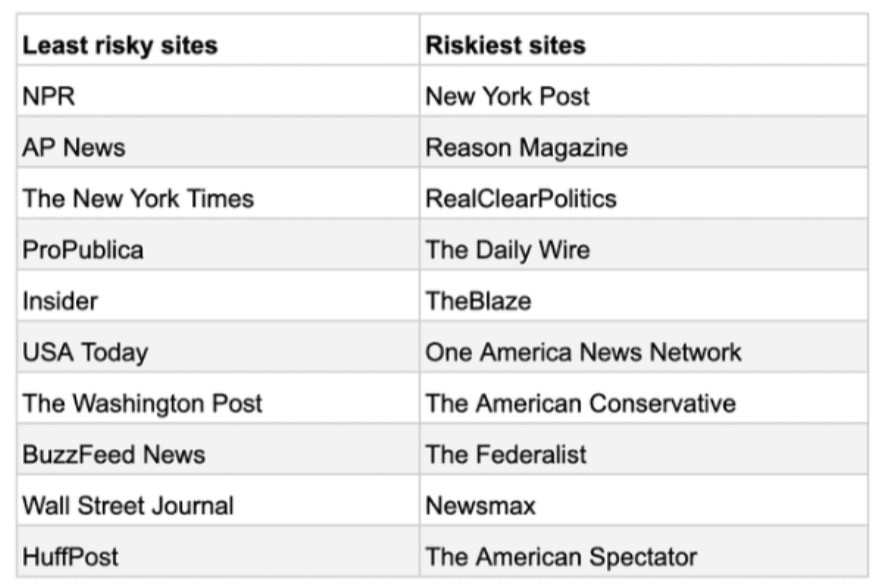
Ratings companies like NewsGuard and GDI base their low ratings of outlets like The Federalist at least in part on politically charged “fact checks” of a tiny percentage of the outlets’ articles. While these companies’ full ratings criteria are secret, in December 2022 GDI published a top 10 list of its most favored and most disfavored news outlets. The Federalist and Daily Wire appear on GDI’s 10 “riskiest” list.

All of the outlets on GDI’s “least risky” list have helped spread some of the government’s biggest disinformation operations in the last decade. Those include the Russia-collusion hoax and Hunter Biden laptop stories, which influenced national elections in favor of Democrats. The 10 “least risky” outlets have also widely published notable misinformation such as claims that Covid vaccines prevent disease transmission, the Covington student insult hoax, and evidence-free claims that Supreme Court Justice Brett Kavanaugh is a serial gang rapist.

This federal censorship-industrial complex’s numerous disinformation operations include the Hamilton 68 effort. In contrast, The Federalist not only reported all these stories accurately from the beginning but for most led the reporting pack that proved it. GDI rated The Daily Wire’s “risk level” as “high” and The Federalist’s “risk level” as “maximum.”

While technologies and enterprises the State Department promotes push corporate media’s biggest purveyors of propaganda, they also “blacklist” The Federalist and Daily Wire, the lawsuit says, “negatively impacting Media Plaintiffs’ ability to circulate and distribute their publications to both current and potential audiences, and intentionally destroying the Media Plaintiffs’ ability to obtain advertisers.” Microsoft, for example, uses NewsGuard technology “to train Bing Chat.”

The lawsuit is filed in the U.S. federal court for the Eastern District of Texas. It seeks a court declaration that the State Department’s funding, testing, pressuring, and promoting of internet censorship tools is unconstitutional and an order that it end.


Joy Pullmann is executive editor of The Federalist, a happy wife, and the mother of six children. Her ebooks include “The Read-Aloud Advent Calendar,” “The Advent Prepbook,” and “101 Strategies For Living Well Amid Inflation.” An 18-year education and politics reporter, Joy has testified before nearly two dozen legislatures on education policy and appeared on major media from Fox News to Ben Shapiro to Dennis Prager. Joy is a grateful graduate of the Hillsdale College honors and journalism programs who identifies as native American and gender natural. Her traditionally published books include “The Education Invasion: How Common Core Fights Parents for Control of American Kids,” from Encounter Books.

Masculinity Isn’t Toxic, Our Erasure of It Is


BY: TRISTAN JUSTICE | JANUARY 17, 2023

Read more at https://thefederalist.com/2023/01/17/masculinity-isnt-toxic-our-erasure-of-it-is/

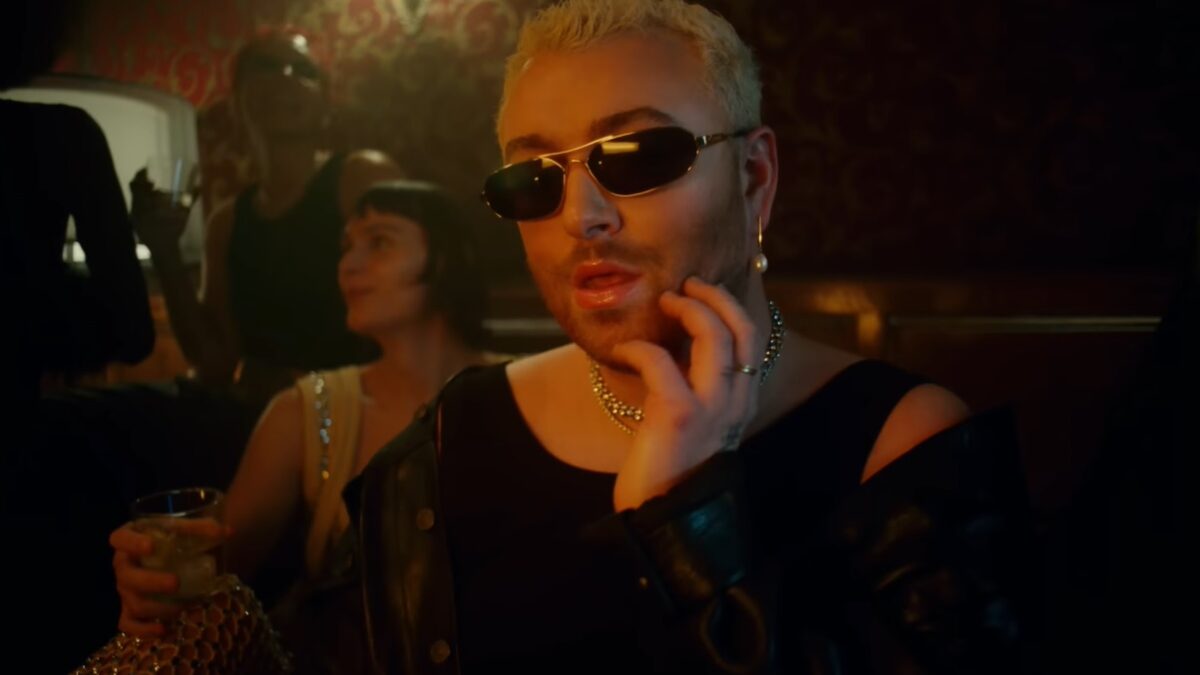
Sam Smith
Those who wrote off masculinity as ‘toxic’ never truly understood the concept.

Author Tristan Justice profile

TRISTAN JUSTICE

VISIT ON TWITTER@JUSTICETRISTAN

MORE ARTICLES

Sam Smith does not look healthy.

Last week, conservative journalist Andy Ngo published screenshots of the singer’s Instagram page. On the left, Smith is seen handsomely seated with his prestigious Oscar. The ensuing photos highlight his attempt to transition into someone who is “non-binary,” or a person who believes he was born a third sex or above the sexes altogether. The logic defies everything we know about human biology down to the binary nature of our chromosomes.

No one seems to know what a woman is these days, but does anyone even remember what a man is? Smith’s progression in Ngo’s photos underscores the erasure of cultural masculinity declared “toxic” by millennials. When you lose sight of what it means to be a man — what it means to look like a man, act like a man, and live like a man — you de facto lose the values that form the foundation of healthy masculinity. But our culture doesn’t even know what a man is.

Around this time last year, my Federalist colleague John Daniel Davidson provided a definition.

“If we’re going to defend manliness as good and virtuous and necessary for a healthy republic, then we need to be clear about what it is and what it is not,” he wrote, continuing:

Yes, men should be physically strong. They should also exemplify traditional masculine virtues like courage, independence, and assertiveness. But why? Not so they can sh-tpost about how ripped or good-looking they are compared to libs, but so they can protect and defend those who are weak.

That is the organizing principle behind the entire concept of manliness: it is not a style or a pose or an adornment. It is a way of being, of living according to the principle that you are responsible for the welfare of others, and should sacrifice yourself for their sake.

What does that mean in practice? It means stepping in to help those in need, whether it’s a woman being harassed or a stranger whose car has broken down. It means risking your own safety to protect someone being attacked, instead of just filming the attack on your phone and posting it online like a beta.

It also means marrying and remaining faithful to the same woman your entire life, and raising a family with her. It means working whatever hours and at whatever job in order to provide for that family. It means going to church every Sunday, whether you feel like it or not, to pass your faith on to your kids. It means getting up in the middle of the night to feed a colicky baby. It means taking your two-year-old daughter to swim class and singing all the songs — your own sense of dignity be damned.

I’m not sure I could write a better definition, amplifying the stoic virtues of physical strength, mental fortitude, and sacrificial living driven by a desire to strengthen the weak and protect the vulnerable.

Where we break is sexuality, and writing as a gay man, I know we don’t see eye to eye on certain fundamental differences. I may never live up to the picture of masculinity Davidson’s worldview prescribes, and I may never have children, but we can agree to disagree like adults. And that’s where the left has gone mad.

Gay men are often allergic to any kind of conversation surrounding masculinity because they’ve been mocked by a class of macho men as “queer,” a slur-turned-term-of-endearment that now qualifies one for the left’s privilege points. True masculinity, however, extends safety for the victims. Those who vilified it never truly understood the concept.

Before Davidson’s column, I’m not sure I remember even thinking critically about manhood — perhaps during a conversation with my father in high school. But beyond that, these discussions seem to have been choked out by a culture eager to dismiss masculinity as universally toxic.

If you question Smith’s regression — the legitimacy of it, the integrity of it, and even the consequences of it — you’re a heretic to the woketopian ruling class that’s hellbent on dictating acceptable speech.

But it isn’t just Smith. There’s a deeper mentally disturbed current pulsing beneath the decline of healthy masculinity and femininity. Consider that nearly 60 percent of people who call themselves “non-binary” report having a mental health issue. And that’s despite both difficulties in diagnosing mental illnesses and the fact that gender dysphoria itself is a mental sickness included in the latest psychiatric manual of mental disorders, meaning the real percentage is far higher.

See for yourself. How is this not a mental illness? Why are we not allowed to call it that? And why on Earth is it unacceptable to ask questions about the twisted state of the sexes?

These people are obviously struggling with a pain that’s very real. Their so-called gender identities might be made up, but their pain undeniably exists. Contrary to parental blackmail by family therapists, data shows gender-confused people are even more likely to commit suicide if they move forward with some kind of transgender transition.

The intolerance of questions surrounding gender dysphoria is baked into the elimination of masculine virtues, which promises peace and coexistence — or the allure of a projected $5 billion surgical industry by the end of the decade. But we need to understand what in the world is going on with men, and we need to be able to ask these questions.

Men today are not working. Their suicide rates are rising as high as their testosterone levels are falling low: While men make up nearly half the population, they represent 80 percent of suicides, and testosterone levels have dropped by double digits since the 1980s.

Men’s low testosterone levels reflect a population that’s not eating right, not exercising right, and not acting on their underlying ambitions. They’re becoming apathetic pot smokers stuck in the pursuit of cheap dopamine hits through Netflix and porn. And these low “T” levels are threatening fertility, which is already on the decline, in the long term, while guaranteeing a generation of fat, lazy men with no hormonal motivation in the short term.

The death of masculinity — its public execution brought about by its supposed toxicity — is the existential crisis nobody’s talking about.

Note: this is the first post in the author’s new conservative newsletter on culture, health, and wellness. If you liked this post and the topics addressed, consider subscribing here.


Tristan Justice is the western correspondent for The Federalist. He has also written for The Washington Examiner and The Daily Signal. His work has also been featured in Real Clear Politics and Fox News. Tristan graduated from George Washington University where he majored in political science and minored in journalism. Follow him on Twitter at @JusticeTristan or contact him at Tristan@thefederalist.com.

This Reports and Commentary Every Patriot Needs to Read


Your daily update of new content from The Federalist
Be lovers of freedom and anxious for the fray
01/07/2021
The Capitol Riot Will Hurt The People Who Were Already Hurting Most
Emily Jashinsky
The Capitol riot will hurt the people who were already hurting most, the decent rally goers continually ignored and smeared, now saddled with the baggage of violence they did not commit.
Georgia Confirms The Pre-Trump GOP Is Dead And Gone
John Daniel Davidson
Trump leaves his party in better shape than his previous two predecessors left theirs, but the GOP is still at war with itself.
If West Point Tolerates Cheating, It Violates Its Own Honor Code
James McDonough
It appears that the belief in widespread dishonesty among American youth has become an excuse to lower standards for the presumed gradual ‘development’ of more recently joined cadets.
28 Times Media And Democrats Excused Or Endorsed Violence Committed By Left-Wing Activists
Tristan Justice
After excusing and ignoring riots from leftists all year, Democrats and their allies in the media are ready to condemn riots now that the turmoil has shifted to fit their narrative.
Spare Me. Biden And Democrats Never Cared About Law And Order
Evita Duffy
What happened Wednesday at the U.S. Capitol was horrifying — but so was Kenosha, Minneapolis, Chaz, and Portland. Joe Biden only denounces violence when it serves him politically.
The Republican Party Must Return To Being The Party America Needs It To Be
Joshua Lawson
The Republican Party of the future cannot — not in the slightest, not tacitly, not cloyingly — encourage grievance or stoke anger.
Capitol Breach ‘Stole From The Hundreds Of Thousands’ Of Peaceful Protesters Concerned About Election Integrity
The Federalist Staff
‘Groups that attacked police officers and [perpetrated] riots and burned buildings have their own park named after them right in front of the White House.’
Capitol Riots Prove Lauren Boebert Is Exactly Right To Carry In Congress
Tristan Justice
The security failures on Capitol Hill served as powerful vindication for Colorado Rep. Lauren Boebert pledging to carry her gun to Congress.
Months After Meltdown Over Tom Cotton ‘Send In The Troops’ Op-Ed, New York Times Condemns Capitol Riot
Jordan Davidson
After going to bat for leftist rioters, multiple Times journalists condemned Trump supporter riots and President Trump for not calling in federal law enforcement or condemning the violence fast enough.
What U.S. Nerd Entertainment Must Learn From Japanese Comics And ‘The Mandalorian’
Peter Pischke
2020 was a horrible year, but it did one useful thing. It showed us ‘Get woke, Go Broke’ isn’t just a meme, it’s almost a law of nature.
Washington D.C. Chaos: Where Do We Go From Here?
On this episode of The Federalist Radio Hour, Culture Editor Emily Jashinsky and Western…
Subscribe
SIGN UP FOR A FREE TRIAL HERE.
The Transom is a daily email newsletter written by publisher of The Federalist Ben Domenech for political and media insiders, which arrives in your inbox each morning, collecting news, notes, and thoughts from around the web.

“You must read The Transom. With brilliant political analysis and insight into the news that matters most, it is essential to understanding this incredible moment in history. I read it every day!” – Newt Gingrich

Sent to: mrb562@roadrunner.com

Unsubscribe

The Federalist, 611 Pennsylvania Ave SE, #247, Washington, DC 20003, United States


What Big Tech Didn’t Want You To See On The Federalist In 2020


Reported by Joy Pullmann  29, 2020

Leftist media has skewed U.S. politics for decades, but Big Tech’s amplified influence over global discourse and governments is new. While Congress passed no legislation related to this political and national security emergency, we the people were held captive in lockdowns during a major election while crucial public information was filtered, hidden, and surveilled by unaccountable companies with no allegiance to the United States and obvious disdain for hundreds of millions of its inhabitants.

This is a huge social problem. Regaining our freedom to speak and to share and compare information may be the first task towards redressing our grievances against those who claim to govern us. For how can consent of the governed be truly granted when the people’s ability to inform their consent is manipulated? It cannot.

To regain our self-governance, then, we all need to develop new habits of information-gathering and -sharing. As a tiny part of and precursor to more of that effort, here is an accounting of Federalist work that Google, Facebook, and Twitter tried to keep people from seeing in 2020.

You will notice it fits the pattern of big tech censorship that big tech claims isn’t censorship: it all goes one way politically. All of it also comprises election-meddling by effectively promoting misinformation and disinformation on key voting issues.

Just Plain Hiding the News They Can’t Use

In June, a foreign think tank, NBC, and Google colluded in an attempt to demonetize The Federalist in retaliation for our coverage of Black Lives Matter rioting. The tech giant demanded we end our commenting section, and continues to refuse to allow it back. Google-owned YouTube also continues to shadowban Federalist content and choke our engagement.

In July, Google claimed it had “mistakenly” made it impossible for people to find a slew of conservative news sites, including CNSNews.com, The Washington Free Beacon, Breitbart, Twitchy, RedState, PJ Media, The Blaze, Townhall, LifeNews, PragerU, and The Daily Wire.

After the election, Instagram slapped a warning label on a post in which President Trump honored Pearl Harbor Day. Instagram, which is owned by Facebook, put an automatic “fact check” on Trump’s post that claimed Joe Biden won the election, although Trump’s post included nothing about the election results. Instagram later removed the “warning.”

In October, “Twitter suspended U.S. Customs and Border Protection (CBP) Commissioner Mark Morgan for a post celebrating the success of the U.S. southern border wall keeping violent criminals from reaching American communities,” reported The Federalist’s Tristan Justice.

The online publisher banned Morgan, a public official, from communicating the elected president’s publicly stated priorities, telling him in an automated message the post violated the publisher’s “hateful conduct” policies. Morgan had written: “@CBP & @USACEHQ continue to build new wall every day. Every mile helps us stop gang members, murderers, sexual predators, and drugs from entering our country. It’s a fact, walls work.” If this is hate speech, all conservatives are criminals.

Evidence of Biden Family Corruption

Infamously, Twitter and Facebook tampered with the 2020 election in October by immediately and actively suppressing public knowledge of a federal corruption investigation into Joe Biden’s son, Hunter, related to information found on a Delaware laptop.

Yesterday, the computer store owner who turned the laptop over to federal investigators sued Twitter for defamation. Twitter’s ban was predicated on alleging the laptop containing “hacked” material, even though, as The Federalist documented, Twitter regularly allows the circulation of hacked and hoax information. The laptop owner says he did not hack it, he owns it, and that Twitter claiming otherwise has significantly damaged his reputation and employment.

In October, Twitter openly admitted it was pre-emptively choking the story on their platform even before deploying their Chinese- and Democrat-funded “fact-checking” organizations to explain away what are obviously politically motivatedselectively enforced, anti-truth information operations designed to help Democrats control the United States.

Twitter also pre-emptively blocked The New York Post’s subsequent reporting on its Hunter Biden laptop scoop, despite those containing additional corroborating details, and although witnesses and additional evidence also surfaced to independently corroborate the story. Twitter banned members of Congress and the president’s campaign from posting information about the story. It kept the Post locked out of its Twitter account for weeks following the breaking story in the run-up to the election.

Lest we all become too dulled to this successful attempt to control the nation without the people’s consent because we’re all used to leftists refusing fair play and equal treatment, we all need to remember that enough Biden voters to swing the election decisively to Trump said they would have changed their votes if they knew about this corruption story. Big tech bias is not a trivial issue. It is the difference between a fair election and a corrupted one, between self-rule and a corrupted oligarchy.

Evidence of Election Tampering and Errors

From May 2018 to October 2020, Twitter and Facebook restricted posts from President Trump at least 65 times, according to a media study. They did this precisely zero times to Joe Biden (or Hillary Clinton), and it’s not because he’s the most accurate politician alive.

In June, the anti-Trump bias ridiculously caused Twitter to put a warning label on an obvious parody video about a “racist baby.” More seriously, at the same time Twitter repeatedly throttled as “false” President Trump’s claims that mail-in ballots are an insecure voting method. That is absolutely true and it made the 2020 election ripe for fraud, abuse, and contested results.

On election night, Twitter flagged a post from President Trump that said: “We are up BIG, but they are trying to STEAL the Election. We will never let them do it. Votes cannot be cast after the Polls are closed!” Twitter claimed this was “disputed and might be misleading” and banned users from sharing the tweet. Later it was shown that Pennsylvania indeed counted post-election ballots against its own law forbidding that.

On Nov. 4, Twitter slapped a “warning label” about “disputed information” in a tweet from Federalist Cofounder Sean Davis, whose offending tweet accurately summarized the Pennsylvania Supreme Court’s ruling that ballots brought in after election day would be counted.

On Nov. 9, Twitter put a warning label on a quote from and link to an affidavit of sworn testimony alleging election fraud tweeted by Federalist Senior Contributor Ben Weingarten. “This claim about election fraud is disputed,” Twitter claimed, preventing people from retweeting it without adding their own comments. It later removed the choke without explanation.

In December, Federalist Senior Editor Mollie Hemingway explored the disqualifying errors in a “fact-check” done by one of Facebook’s partners of allegations of election fraud in Georgia. Facebook used the same fact-check she fisked to pre-emptively ban her article from its platform.

COVID-19

Big communications companies rabidly policed discussions about COVID-19 in 2020. Big tech seemed especially pouncy about information related to face masks. This included Amazon’s Nov. 24 ban of a book by former New York Times reporter Alex Berenstein’s book discussing the scientific evidence that mask mandates are ineffective.

It extended to repeated bans and chokes on Federalist content about masks, many by a supposed Facebook “fact check” that didn’t fact check any Federalist articles. It was just a generic fact check applied against anyone questioning the efficacy of cloth masks and generic mask mandates, even when such individuals cited scientific evidence from reputable sources.

Former White House Coronavirus Task Force advisor Dr. Scott Atlas was banned from publishing references to scientific studies on masks. CNN anchor Jake Tapper and CNN commentator Dr. Sanjay Gupta, a professor of neurosurgery, cheered Twitter on. Google-owned YouTube infamously pulled down a June interview of Atlas.

Weirdly, in April Facebook had blocked DIY cloth mask-making sites while banning the sale of medical-grade masks and sanitizer. Yet just a few months later Facebook’s blocking activities supported the use of makeshift masks made out of any material and blocked information, including from The Federalist, pointing out that all masks are not equally effective at virus and other particle filtering. Perhaps pointing out that research has found that gaiter-style or scarf masks actually may increase virus transmission may get this article banned too.

Social media bans on mask information from The Federalist included the well-read Oct. 29 article that quoted and linked to high-quality studies from reputable sources, “These 12 Graphs Show Mask Mandates Do Nothing To Stop COVID,” which was also throttled on LinkedIn.

YOU ALL MIGHT WANT TO TRY TWO NEWER SOCIAL MEDIA SITES. https://mewe.com/ and https://parler.com/

Spygate

In October, Twitter began publicly testing stronger information controls, which resulted in it warning users who tried to tweet a Federalist article breaking new information about the Spygate scandal. Spygate, of course, is the Obama administration’s documented and so far unpunished use of federal surveillance and policing powers to baselessly persecute, prosecute, and hamstring their political opponents.

The article Twitter impeded reported handwritten notes from Obama CIA Director John Brennan that showed President Obama was made aware months before the 2016 election that the Russian government may have been influencing Hillary Clinton’s false collusion smear against Donald Trump. Sean Davis reported more in that piece for The Federalist:

There is no evidence the FBI ever took any action to ensure that Russian knowledge of Clinton’s plans did not lead to infiltration of that campaign’s operation by Russian intelligence agents. The CIA referral, specifically its reference to a ‘CROSSFIRE HURRICANE fusion cell,’ suggests that the Obama administration’s anti-Trump investigation may not have been limited to the FBI, but may have included the use of CIA assets and surveillance capabilities, raising troubling questions about whether the nation’s top spy service was weaponized against a U.S. political campaign.

Seemingly Random Acts of Censorship

In September, Facebook employed abortionists to “fact-check” two videos from Live Action explaining why abortion is never medically necessary. Numerous obstetrics professionals and a national OB-GYN organization supported Live Action’s statement as accurate, but that didn’t matter to Facebook, which choked Live Action’s page.

In November, Instagram and Facebook’s sweeps caught up an innocent and completely apolitical local charity that used Facebook to coordinate donors and volunteers. Oathkeepers Causeplay may sound like it’s a conservative group, but it’s not (and even if it were, there’s nothing wrong with being conservative). It’s a group of people who dress up like TV and movie superheroes and other characters to cheer up disabled and sick children.

The act of random censorship hurt sick kids by depriving the charity of funds and volunteers. It also scared people away from associating with the charity — which, again, not only did nothing “wrong” but actively does good — out of fears they’d also lose their Facebook-mediated access to friendships and social activity. Good job, Facebook.

Also in October — see a pattern here? — Facebook users who searched for the Christian group Let Us Worship were given a warning message falsely claiming the group was affiliated with QAnon. “This is a peaceful movement from across the political spectrum and they are suppressing it by linking us to Q,” the group’s founder, Sean Feucht, told The Federalist. Facebook claimed the mislabeling was a glitch. Yet nobody shut down their traffic over their inaccurate statements despite the harm they caused others.

Again in October, Facebook demonetized the satire website Babylon Bee for making a Monty Python joke in a headline. Facebook claimed the Bee’s silly headline “Senator Hirono Demands ACB Be Weighed Against A Duck To See If She Is A Witch” “incited violence,” and refused to alter its decision after a review. In a self-parody that is impossible to top, Snopes and Twitter also frequently “fact-check” and throttle the clean satire site. I guess humor is now too conservative to allow.

It wasn’t just 2020, either. This has been going on for years. In fact, you might say Twitter, Google, Facebook, and others have been perfecting their ability to shut down non-leftist discourse and project public opinion cascades. In retrospect, earlier tech bans on speech look like dress rehearsals for the 2020 election bleep show.

In 2018, for example, The Federalist published a theologian’s story about how Facebook banned him from expressing Christian views about teaching young children about LGBT sex and gender identities. Earlier that year, Project Veritas released undercover video of a former Twitter employee verifying the company’s practice of “shadowbanning,” called that at the time because the practice was covert. In 2019, Google banned a conservative think tank from buying online advertising because a scholar affiliated with the think tank had critiqued multiculturalism.

Punishing the Conservative Base While Monetizing Them

Once a website’s content has begun to be flagged as “false” even if it is not, search engines and social media increasingly throttle traffic to the entire site, not just the flagged content. This further serves leftist information control by making publications reluctant to challenge what the unelected tech arbiters of reality have decided we must see and say. This means Google, Facebook, and Twitter ultimately don’t want you to see anything from The Federalist. They also hope you don’t notice.

“[S]tories from right-wing media outlets with false and misleading claims about discarded ballots, miscounted votes and skewed tallies were among the most popular news stories on” Facebook directly after the election, reported The New York Times. Facebook responded with deeper cuts into the reach of information from right-leaning outlets and greater amplification for articles from leftist media:

employees proposed an emergency change to the site’s news feed algorithm, which helps determine what more than two billion people see every day. It involved emphasizing the importance of what Facebook calls ‘news ecosystem quality’ scores, or N.E.Q., a secret internal ranking it assigns to news publishers based on signals about the quality of their journalism.

…The change was part of the ‘break glass’ plans Facebook had spent months developing for the aftermath of a contested election.

Unnamed sources told the New York Times Facebook is working on ways to control information while still keeping users, and that the tools it has developed for this mostly affect right-leaning content. The company may also make permanent some information control mechanisms developed specifically for the 2020 election. But they have to be careful about this, the NYT reported, because when people notice the information control they stop using Facebook so much.

Right-leaning information is consistently among the most popular content on Facebook and YouTube. This means people who consume right-leaning information provide Facebook and Twitter millions of dollars because their time spent on site lures advertising. This allows Facebook to put competing information outlets out of business by siphoning away all advertising revenue while not paying for the content creation that draws the eyeballs, reinforcing their information monopolies.

Nice little racket. Tailor-made for people who don’t believe Americans ought to be allowed to make their own decisions.

ABOUT THE AUTHOR:
Joy Pullmann is executive editor of The Federalist, a happy wife, and the mother of six children. Her newest ebook is “The Family Read-Aloud Advent Calendar,” and her bestselling ebook is “Classic Books for Young Children.” A Hillsdale College honors graduate, @JoyPullmann is also the author of “The Education Invasion: How Common Core Fights Parents for Control of American Kids,” from Encounter Books.

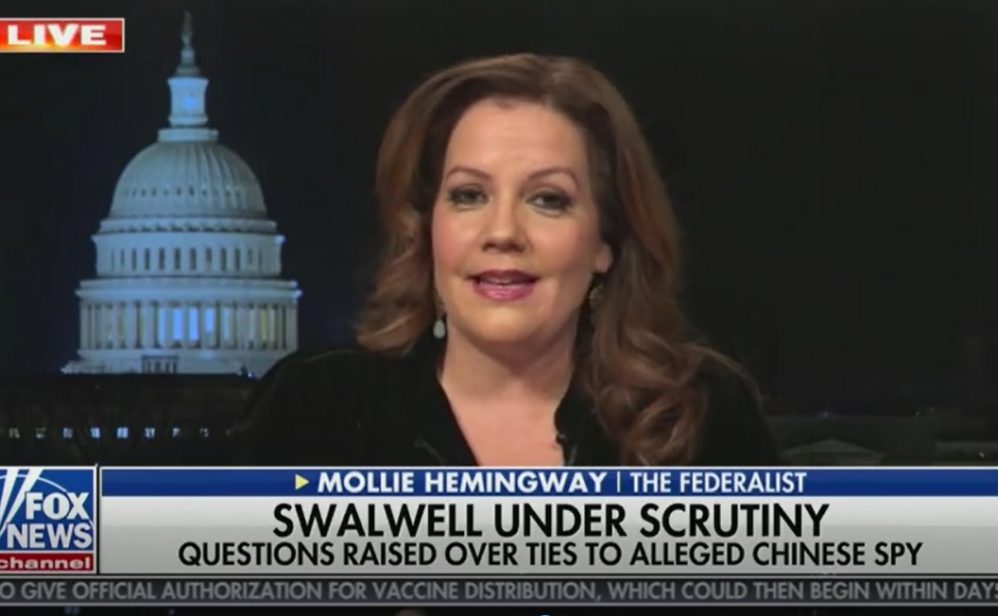
Mollie Hemingway: Swalwell Story Increases Concern That China Controls Democrats


Mollie Hemingway: Swalwell Story Increases Concern That China Controls Democrats

Federalist Senior Editor Mollie Hemingway said Thursday that recent revelations about California Rep. Eric Swalwell’s deep partnership with a Chinese spy heightens worries the Chinese have developed compromising influence on the Democratic Party.

“I think there’s a lot of concern that the Democratic Party, that the Chinese have too much control over the Democratic Party and its agenda, in the same way that they have too much control over Hollywood and the NBA,” Hemingway said. “This is a big issue for the entire party.”

“I think it’s important to note that Devin Nunes and the House Republicans tried to focus on China when they had control of the committee,” Hemingway said. That was before Democrats took control of the House in 2018 and shifted the conversation to Russia under the leadership of California Rep. Adam Schiff spinning conspiracies of Russian collusion culminating in a failed deep-state coup.

That senior members of the House intelligence committee might have known of Swalwell’s allegedly romantic relationship with a Chinese operative, Hemingway added, “makes that look even worse than it did at the time that they were trying to dissuade House intel from looking into China.”

ABOUT THE AUTHOR:
Tristan Justice is a staff writer at The Federalist focusing on the 2020 presidential campaigns. Follow him on Twitter at @JusticeTristan or contact him at Tristan@thefederalist.com.
Photo Grabien screengrab

Tag Cloud