Perspectives; Thoughts; Comments; Opinions; Discussions

Posts tagged ‘state legislatures’

If Democrats Love ‘Democracy,’ Why Do They Attack Election Security Measures Voters Want?


BY: SHAWN FLEETWOOD | FEBRUARY 02, 2024

Read more at https://thefederalist.com/2024/02/02/if-democrats-love-democracy-why-do-they-attack-election-security-measures-voters-want/

Voter registration sign.

Author Shawn Fleetwood profile

SHAWN FLEETWOOD

VISIT ON TWITTER@SHAWNFLEETWOOD

MORE ARTICLES

“We are the party of democracy!”

That’s the asinine campaign message Democrats are using heading into the 2024 election to convince voters that Donald Trump and his “MAGA Republican” supporters are an existential threat to the republic. Because as everyone knows, the political party that attempts to throw its primary political opponent off the ballot and into prisonprosecutes praying pro-lifers; targets practicing Catholics; interferes in elections to its candidates’ benefit; and coordinates with Big Tech to silence dissent online is the standard-bearer of “democracy.”

For all their disingenuous rhetoric about upholding the will of the people, Democrats are actively fighting against Americans’ wishes — especially when it comes to the integrity of U.S. elections.

Last week, the Honest Elections Project (HEP) released a report recommending 14 policies for states to implement to ensure an electoral process that’s fair and accountable to the people. Democrats are actively fighting against many of the commonsense practices outlined in the analysis despite their popularity amongst the American electorate.

Take, for instance, voter ID requirements. In July, the HEP released survey data showing that a whopping 88 percent of U.S. voters back laws requiring eligible citizens to show a form of identification in order to cast their ballot. Polling by Gallup in 2022 produced similar results, with 79 percent of respondents in favor of a photo ID requirement. But that doesn’t seem to matter to Democrats, whose acolytes have spent years ignoring voters’ wishes and engaging in dishonest lawfare to dismantle states’ existing voter ID requirements.

From Ohio to New Hampshire, leftist lawyers and groups have filed frivolous lawsuits aimed at gutting voter ID statutes. Many of these suits are based on unsubstantiated claims that such laws “disenfranchise” nonwhite voters.

While courts across the country have repeatedly determined their “voter suppression” arguments to be bogus, Democrats’ continuous use of nonwhite voters as a crutch to smear popular voter ID laws shows how little respect they have for “democracy.” The aforementioned HEP poll also showed the vast majority of black (82 percent) and Hispanic (83 percent) voters support such requirements in order to vote. Gallup found that 77 percent of nonwhite respondents supported photo ID laws. If Democrats truly respected the will of the American voter, as they regularly claim to do, why are they trying to undercut a policy most of them support?

But it’s not just voter ID requirements. Democrats are actively waging a nationwide campaign to demolish numerous policies recommended by the HEP that ensure secure elections and are supported by the majority of U.S. voters.

While most of the electorate (89 percent) believes “American elections should only be for American citizens,” that hasn’t stopped Democrats from attempting to authorize noncitizen voting throughout the country. Last year, for example, Rhode Island Democrats introduced legislation to authorize localities to allow illegal aliens to vote in their municipal elections. Some cities, such San Francisco, New York City, and Washington, D.C, have already passed measures permitting certain noncitizen voting.

In response to left-wing nonprofits dumping hundreds of millions of Zuckbucks into local election offices during the 2020 election to benefit Joe Biden, elected officials and voters in 27 states enacted measures restricting election offices’ ability to accept and use private monies to administer elections. In response, several of those same Democrat-aligned groups formalized the U.S. Alliance for Election Excellence as a way of circumventing these “Zuckbucks” bans and therefore violating the will of the people in the aforementioned states.

The same dynamic can also be seen regarding mail-in voting. Most voters (66 percent) support terminating no-excuse mail voting “as long as states offer two weeks of early in-person voting, including weekends.” Meanwhile, Democrats — who used the Covid lockdowns as a pretext for expanding the use of vote-by-mail and other insecure election practices — have continued to push unsupervised mail balloting across the country. Some states, such as Nevada, automatically mail individuals listed on the state’s voter rolls a ballot ahead of elections.

Whether it’s banning foreign money in elections, ensuring transparency in the elections process, or backing election audits, the story remains the same: Democrats actively oppose policies supported by voters that bring accountability and security to the U.S. elections system. Their screeds about being the party of “democracy” are a dishonest talking point designed to obfuscate their contradictory actions and smear their political opponents as extremists.


Shawn Fleetwood is a staff writer for The Federalist and a graduate of the University of Mary Washington. He previously served as a state content writer for Convention of States Action and his work has been featured in numerous outlets, including RealClearPolitics, RealClearHealth, and Conservative Review. Follow him on Twitter @ShawnFleetwood

By ‘Protecting Election Workers,’ Democrats Mean Protecting Control Over Election Administration


BY: SHAWN FLEETWOOD | JANUARY 22, 2024

Read more at https://thefederalist.com/2024/01/22/by-protecting-election-workers-democrats-mean-protecting-control-over-election-administration/

Poll worker cleaning a voting booth.

Author Shawn Fleetwood profile

SHAWN FLEETWOOD

VISIT ON TWITTER@SHAWNFLEETWOOD

MORE ARTICLES

When regime-approved “journalists” aren’t pretending election illegalities don’t exist, they’re fomenting unsubstantiated conspiracy theories about Republican voters.

In the months leading up to and following the 2022 midterms, legacy media have run story after story decrying the avalanche of alleged “threats” levied against election workers by GOP voters, whom they cast as extremists seeking to disrupt “democracy.” Predictions of such widespread interference in the 2022 contests have (unsurprisingly) never materialized and numbers from President Biden’s own Justice Department have undermined such a narrative. But nevertheless, the scaremongering from the “Democracy Dies in Darkness” crowd persists.

This seemingly coordinated effort has prompted Democrats in state legislatures throughout the country to base legislation on such election falsehoods. In Virginia, for example, a Democrat state senator filed a bill this month that would classify threatening an individual because of his roles as a current or former election official as a “hate crime.” The bill could also “result in a net increase in periods of imprisonment” for Virginians charged with crimes related to threatening election officials.

And, of course, the bill is written so loosely that any accusation fits their narrative. MORE SOCIALISM.

Threatening election workers is already explicitly prohibited under both Virginia and federal law. SB 364 is currently awaiting action from the Senate Courts of Justice Committee. Despite Democrats’ insistence, evidence does not support the notion that election workers everywhere are facing constant threats from conservatives.

During his August 2022 testimony before the U.S. Senate, Kenneth A. Polite Jr., the assistant attorney general for the criminal division of the DOJ, claimed the agency’s Election Threats Task Force — which was launched in July 2021 to address this alleged “rise in threats” against election workers — had reviewed and assessed roughly 1,000 allegedly “threatening and harassing” communications directed toward election officials. But two days before Polite’s testimony, the DOJ issued a press release disclosing that only about 11 percent of those 1,000 communications “met the threshold for a federal criminal investigation” and that the “remaining reported contacts did not provide a predication” for further investigation. According to an agency press release a year later, the Justice Department’s Election Threats Task Force had “charged 14 cases involving threats against the election community and secured nine convictions” as of Aug. 31, 2023.

Got that? In a country with a population of more than 335 million people, only about 100 individuals were investigated by the DOJ for supposedly threatening election workers, and only 14 of them were officially charged.

The Conspiracy Spreads

Virginia isn’t the only state where Democrats are pushing legislation based upon the media’s phony “election workers are under siege!” narrative. Leftist legislators in FloridaMissouri, and Washington introduced bills in recent weeks seeking to increase penalties for those convicted of threatening election officials.

Even worse, some elected Republicans have lent credence to this baseless talking point by prioritizing Democrat proposals. GOP legislators in New Jersey and Nebraska joined their respective Democrat colleagues in cosponsoring legislation cracking down on threats towards election workers this year. In South Dakota, Secretary of State Monae Johnson, a Republican, is spearheading a bill that would deem “Any person who, directly or indirectly, utters or addresses any threat or intimidation to an election official or election worker with the intent to improperly influence an election … guilty of a Class 1 misdemeanor.”

The measure unanimously passed the Senate State Affairs Committee (8-0) on Wednesday, even after Deputy Secretary of State Tom Deadrick told senators that South Dakota “hasn’t yet experienced threats against poll workers.”

Meanwhile, GOP governors such as Joe Lombardo of Nevada and Kevin Stitt of Oklahoma signed respective bills last year into law that similarly increased penalties for threatening election officials. The Oklahoma bill was sponsored by three Republicans.

Other states that have passed laws inspired by Democrats’ election lies include CaliforniaColoradoMaineNew MexicoOregon, and Vermont.

Republicans Must Fight Democrat Lies

Much like Democrats’ war against basic election security measures like voter ID, their lying about widespread threats against election officials is a strategy aimed at bringing less — not more — integrity to U.S. elections.

Their strategy of using anecdotal incidents to cast a broader narrative about Republicans isn’t just crafted to scare away independents and moderate voters from the GOP. It’s also designed to dissuade conservatives from partaking in legitimate forms of election oversight, such as poll watching.

Ahead of the 2022 midterms, for example, the Republican National Committee recruited more than 70,000 new poll watchers and workers ahead of Election Day to “help deliver the election transparency that voters deserve.” And of course, Democrats went berserk, parroting the same “threat to democracy” talking point.

Federal law already prohibits individuals from threatening and harassing election workers. Performative proposals to enhance state charges against such crimes are less about protecting people and more about furthering Democrats’ unsubstantiated talking points and scaring away conservatives engaged in the elections process.


Shawn Fleetwood is a staff writer for The Federalist and a graduate of the University of Mary Washington. He previously served as a state content writer for Convention of States Action and his work has been featured in numerous outlets, including RealClearPolitics, RealClearHealth, and Conservative Review. Follow him on Twitter @ShawnFleetwood

Idaho Takes An Axe To Ranked-Choice Voting In Elections, And North Dakota And Arizona Could Follow Suit


BY: SHAWN FLEETWOOD | APRIL 03, 2023

Read more at https://thefederalist.com/2023/04/03/idaho-takes-an-axe-to-ranked-choice-voting-in-elections-and-north-dakota-and-arizona-could-follow-suit/

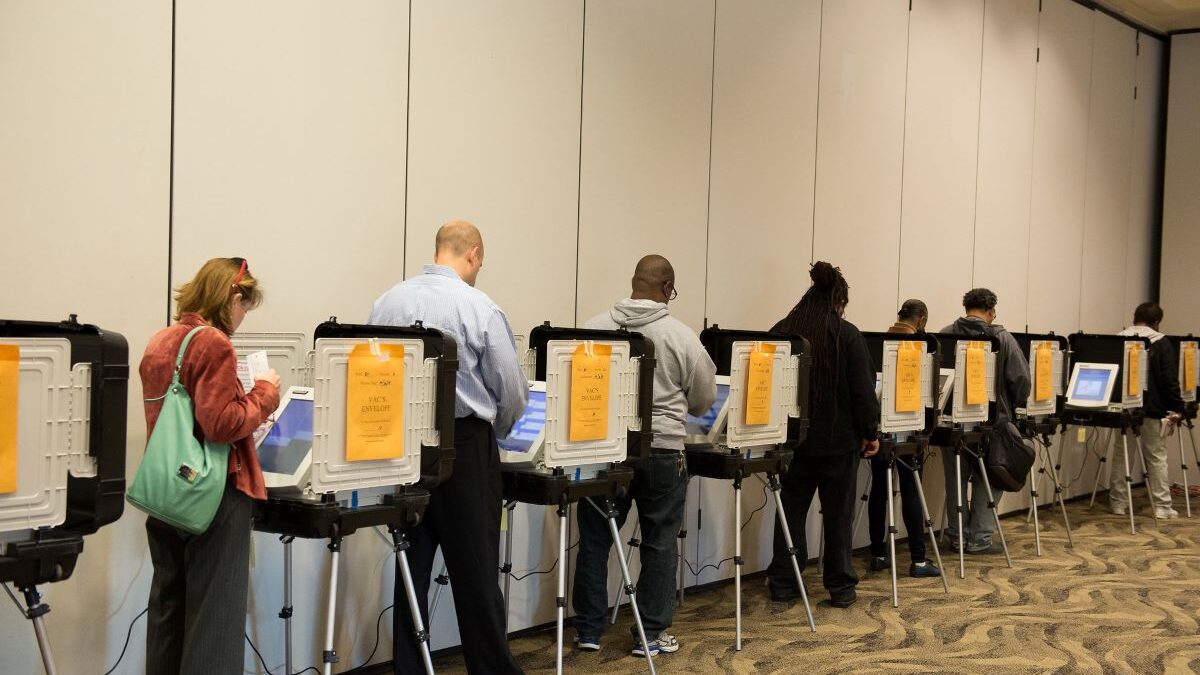
Maryland residents voting in an election

Idaho scored a major win for election integrity last month by banning the use of ranked-choice voting (RCV) in elections, with North Dakota and Arizona potentially following suit. On March 24, Idaho Gov. Brad Little signed HB 179, which prohibits county election offices from using “ranked choice voting or instant runoff voting to conduct an election or nomination of any candidate in this state for any local government, statewide, or federal elective office.” The bill passed the Idaho House of Representatives (56-12) and Senate (28-7) earlier last month.

Under RCV, which critics often refer to as “rigged-choice voting,” voters rank candidates in order of preference. If no candidate receives a majority of first-choice votes in the first round of voting, the last-place finisher is eliminated, and his votes are reallocated to the voter’s second-choice candidate. Such a process continues until one candidate receives a majority of votes.

In addition to Idaho, South Dakota banned the use of ranked-choice voting last month. Florida and Tennessee also passed similar bans last year.

Meanwhile, North Dakota Republicans put their state one step closer to banning the confusing system following the state Senate’s passage (33-13) of HB 1273 on Friday. The measure had previously cleared the House of Representatives (74-19) earlier this month and will soon head to Republican Gov. Doug Burgum’s desk for approval. When pressed on whether Burgum intends to sign the bill, Burgum spokesman Mike Nowatzki declined to answer, saying “We have not received HB 1273 from the Legislature yet, and the governor generally does not comment on legislation before it reaches his desk.”

In addition to Idaho and North Dakota, Arizona Republicans are also working to outlaw the use of ranked-choice voting in their state’s elections. The legislature is attempting to pass a ban on ranked-choice voting in the form of HB 2552, which passed the House last month and is now being considered by the Senate.

While Maine and Alaska are the only two states to employ RCV so far, their respective elections since implementing the system have produced outcomes that clearly contradict the desires of voters. In Maine, then-incumbent GOP Rep. Bruce Poliquin lost to Democrat Jared Golden during the 2018 midterms, despite Poliquin winning the most votes in the first round of voting. That outcome was due to the state’s ranked-choice voting system.

Similarly, in Alaska, Democrat Mary Peltola won the state’s at-large congressional seat last year even though “nearly 60 percent of voters [cast] their ballots for a Republican.” RCV also played a major role in helping Alaska GOP Sen. Lisa Murkowski fend off a challenge from Trump-backed Kelly Tshibaka during the 2022 midterms. The system allowed her to win due to being listed second on Alaska Democrats’ ranked-choice ballots.

Other states considering bans on ranked-choice voting include AlaskaTexas, and Montana.


Shawn Fleetwood is a Staff Writer for The Federalist and a graduate of the University of Mary Washington. He also serves as a state content writer for Convention of States Action and his work has been featured in numerous outlets, including RealClearPolitics, RealClearHealth, and Conservative Review. Follow him on Twitter @ShawnFleetwood

Author Shawn Fleetwood profile

SHAWN FLEETWOOD

VISIT ON TWITTER@SHAWNFLEETWOOD

MORE ARTICLES

Partisans Cheating By Ignoring Election Law Is A Problem As Big As Vote Fraud


Reported by Margot Cleveland NOVEMBER 13, 2020

Fraud represents only one aspect of concern over the results from last week’s election. Of equal import when judging the legitimacy of the next president of the United States is whether states complied with the election rules established by their legislatures. These are not questions of mere “technical errors,” but raise significant constitutional concerns.

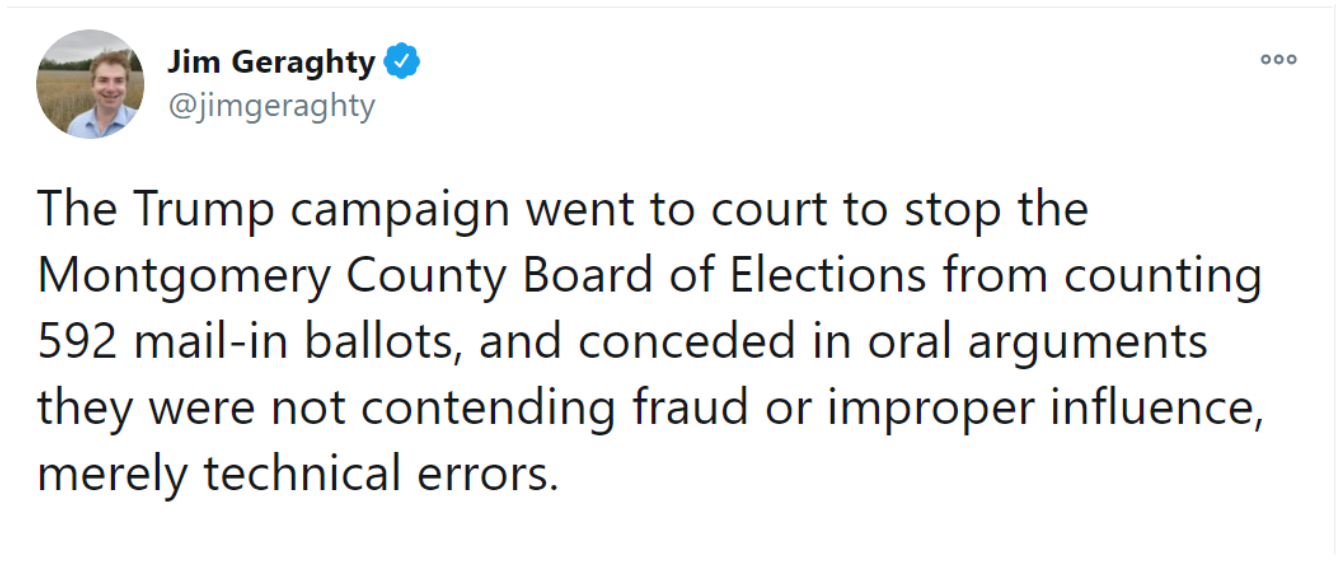
On Wednesday, Jim Geraghty of National Review tweeted his “Morning Jolt” summary of post-election lawsuits. “The Trump campaign,” Geraghty stressed, “conceded in oral arguments they were not contending fraud or improper influence, merely technical errors,” he wrote of a recent election case. Geraghty’s article, linked in his tweet, continued: “It is one thing to fume on Twitter that there is a sinister effort to steal an election; it is another thing to assert that sweeping claim in a court of law, before a judge, under penalty of perjury and/or disbarment.”

Not to pick on Geraghty, whom I respect immensely, but he is conflating two separate issues: fraud and violations of the election code. Those are two distinct problems, yet there has been little analysis of the latter, which over the next several weeks might prove more significant.

There are multiple allegations of fraud, such as the middle-of-the-night arrival of unsecured ballots in Detroit or the dead man voting in Nevada. Then there’s the even more devastating suggestion that votes for Donald Trump were swapped to Joe Biden via vulnerable computer systems. Frankly, this idea strikes me as unbelievable, but then again, so did the idea that the FBI would obtain illegal secret court warrants to spy on the Trump campaign, and we know how that turned out.

Election Code Violations Might as Well Be ‘Fraud’

Violations of the election code, however, are a different matter, and unfortunately, sometimes the public views election officials’ bending of the rules as a harmless ignoring of technicalities. As the attorney in the Montgomery County Board of Elections case noted after “conceding” he was not alleging fraud: “The election code is technical.”

That makes technical violations constitutionally significant because Article II, Section 1, Clause 2 grants state legislatures the ultimate authority to appoint the electors who choose the president: “Each state shall appoint, in such manner as the Legislature thereof may direct, a number of electors, equal to the whole number of Senators and Representatives to which the State may be entitled in the Congress.”

In Bush v. Gore, former Supreme Court Justice William Rehnquist stressed the significance of this constitutional provision in a concurrence joined by Justice Clarence Thomas and former Justice Antonin Scalia. As Rehnquist wrote, that clause “convey[s] the broadest power of determination” and “leaves it to the legislature exclusively to define the method” of appointment of electors. Furthermore, “a significant departure from the legislative scheme for appointing Presidential electors presents a federal constitutional question.”

The three concurring justices in Bush v. Gore concluded that the Florida Supreme Court’s order directing election officials to count improperly marked ballots was a “significant departure from the legislative scheme,” and “in a Presidential election the clearly expressed intent of the legislature must prevail.” Accordingly, those justices would have declared the Florida recount unconstitutional under Article 2, Section 1, Clause 2.

While the concurrence in Bush v. Gore failed to garner support by a majority of the justices, the Supreme Court’s composition has changed dramatically since then, and the reasoning of this concurrence provides a strong basis to view deviations from the technicalities of the election code as unconstitutional. As Rehnquist stressed, “[I]n a Presidential election the clearly expressed intent of the legislature must prevail.”

So, if the legislative branch mandates voter signatures, or verification of signatures, or internal secrecy sleeves, or counting only in the presences of poll-watchers from each party, it is no answer to say it is a technicality and not fraud at issue. The state legislatures, through the election code, define the validity of votes, and allowing state officials or courts to read those provisions out of the law raises serious questions under Article 2 of the Constitution.

Ignoring the Election Code Denies Equal Protection

Allowing state officials to fudge on the mandates of the election code raises a second significant constitutional issue, this one under the Equal Protection Clause, which served as the basis for the majority opinion in Bush v. Gore. The majority in Bush v. Gore held that the varying standards violated the Equal Protection Clause of the Constitution, reasoning: “The right to vote is protected in more than the initial allocation of the franchise. Equal protection applies as well to the manner of its exercise. Having once granted the right to vote on equal terms, the State may not, by later arbitrary and disparate treatment, value one person’s vote over that of another.”

When state officials ignore the technicalities of the election code, however, it virtually guarantees voters will be denied equal treatment. The proof is in Pennsylvania. There, for instance, even though the election code prohibited inspecting ballots before Election Day, some county officials — those in larger counties with access to mail-sorting machines that could weigh ballots — weighed the ballots to determine if the voter failed to include the required inner secrecy sleeve.

Then those officials, again contrary to the election code, provided information to representatives of the Democratic Party so they could identify the voters whose ballots would be canceled. Voters whose election officials abided by the technicalities of the election code, however, did not receive that notice nor the opportunity to “cure” their ballot.

Now thanks to the unprecedented push toward mail-in voting over the last year, we are seeing this same pattern repeat itself throughout the country. Some election officials bent (or broke) the rules the legislative branch had set, while others followed the letter of the law. As a result, voters in different counties in the same state were treated disparately and on an arbitrary basis. Unlike the situation in Bush v. Gore, however, it is not the state courts altering the plain language of the election code, but secretaries of state or local election officials.

The majority in Bush v. Gore recognized the rightful place of election officials to interpret and apply the rules established by the legislative branch. This difference provides some leeway to states, which through interpretative guidance tweak the technicalities of the election code. But as in other areas of the law, such interpretations must be reasonable and must not violate the clearly expressed intent of the legislature.

The Supreme Court will likely decide where that line will be drawn in the coming days.

Margot Cleveland is a senior contributor to The Federalist. Cleveland served nearly 25 years as a permanent law clerk to a federal appellate judge and is a former full-time faculty member and adjunct instructor at the college of business at the University of Notre Dame. The views expressed here are those of Cleveland in her private capacity.

Why President Trump Has A Strong Supreme Court Case To Contest Pennsylvania


Reported by Matt Beebe By  13, 2020

As arguments about voter fraud have escalated across the country, it’s time to recognize that despite what an unmitigated disaster widespread expansion of absentee balloting has been, concerns about its abuse aren’t the most important argument in the ongoing fight over the legitimacy of this election. Sure, the media and Big Tech’s widespread white-washing and censoring of very real voter fraud concerns are damaging to the social fabric in existential ways, just as ignoring norms (and in some cases laws) requiring transparency destroys public trust and confidence in the outcome.

The Pennsylvania lawsuit isn’t yet proof that election-altering fraud occurred, although it does present compelling evidence that if proved shatters the media narrative on election security. A closer look at the allegations of direct fraud weighed against the likelihood of proving that enough occurred to alter the outcome — on a shortened timeline — reveals a daunting task for the president’s legal team.

President Trump’s lawyers, however, aren’t making the same argument as your uncle on Facebook; they’re playing for keeps. Some Republicans have been content to publicly call for the “process to play out” while privately predicting losses or maybe a few favorable rulings on some esoteric technicalities. But the president is not tired of winning yet.

Shortly after the filing, Jenna Ellis, a senior legal adviser to the Trump campaign, put it succinctly: “Pennsylvania is irredeemably compromised.”

The thrust of their legal argument doesn’t hinge on the numbers of fraudulent ballots cast, but on the inconsistent and illegal application of Pennsylvania election law, which dilutes legally cast votes — so-called disparate treatment, from which the U.S. Constitution is supposed to protect us.

The other key legal argument is that those changes in the election law, which were implemented by an unelected appointee of Pennsylvania’s executive branch, namely Secretary of the Commonwealth Kathy Boockvar, were an impermissible usurpation of the legislature’s prerogative even if Pennsylvania’s judicial branch approved them.

Bush v. Gore Already Wrestled with These Concerns

Underlying the president’s legal argument is the recognition that the Pennsylvania legislature implemented an imperfect regime that rationally valued security of the election as more important than avoiding disenfranchising any voters. Even amid a pandemic, the Pennsylvania legislature understood that their expansion of ballot-by-mail increased risks to election security, and thus sought to mitigate that as best they could. It was partisan state courts that unilaterally overrode those determinations in the middle of a presidential campaign in an unconstitutional way.

The discussion about what types of fraud, and how much, is important because it goes to the very heart of election integrity, and our system cannot stand without trust in the outcome. That argument, however, won’t decide the Pennsylvania case from a legal standpoint. It will come down to whether a ministerial appointee of Pennsylvania’s executive branch can work with Pennsylvania’s judicial branch to subvert the expressed will of the legislature, and hastily put in place an election process wherein citizens who chose to vote differently had their votes disparately treated.

Recall that in 2000, the legal argument that eventually carried the day was equal-protection grounds; by implementing different methods for recounts and different scrutiny for different counties, voters were receiving unequal treatment. The Supreme Court held 7-2 that “Upon due consideration of the difficulties identified to this point, it is obvious that the recount cannot be conducted in compliance with the requirements of equal protection and due process without substantial additional work.”

Twenty years is a long time as far as the public attention span goes, and most have allowed the “selected not elected” mantra to pervade our consciousness. Contra the prevailing narrative, however, Justices William Rehnquist, Antonin Scalia, and Clarence Thomas framed their decision as one of judicial restraint that saw a key part of the court’s role was in protecting the Florida legislature from impermissible interference by the Florida courts:

In most cases, comity and respect for federalism compel us to defer to the decisions of state courts on issues of state law. That practice reflects our understanding that the decisions of state courts are definitive pronouncements of the will of the States as sovereigns. Of course, in ordinary cases, the distribution of powers among the branches of a State’s government raises no questions of federal constitutional law, subject to the requirement that the government be republican in character. But there are a few exceptional cases in which the Constitution imposes a duty or confers a power on a particular branch of a State’s government. This is one of them. … Thus, the text of the election law itself, and not just its interpretation by the courts of the States, takes on independent significance.

A significant departure from the legislative scheme for appointing Presidential electors presents a federal constitutional question.

If we are to respect the legislature’s Article II powers, therefore, we must ensure that postelection state-court actions do not frustrate the legislative desire to attain the ‘safe harbor’ provided by §5. (Rehnquist concurring, but writing separately; Citations and dicta omitted)

Admittedly, this “Article II view” was a more expansive view on why the ongoing Florida recount was suspect than the Supreme Court ultimately held, but clearly, at least three justices believed that the courts — even state courts, which usually receive great deference to interpreting state law — don’t have a right to tweak the express will of the state legislature about presidential electors.

To be sure, the equal-protection claims also present differently, so they aren’t a slam-dunk here, and the Rehnquist concurrence isn’t controlling precedent (two of the three justices who signed on to the opinion are no longer on the court), so it might not carry the day.

Three of the young lawyers on the Bush team advocating this view of the law in 2000 have received pretty notable promotions since that time, however, and three other guys likely to have a say have signaled their belief in exactly this interpretation, stating recently, “The provisions of the Federal Constitution conferring on state legislatures, not state courts, the authority to make rules governing federal elections would be meaningless if a state court could override the rules adopted by the legislature simply by claiming that a state constitutional provision gave the courts the authority to make whatever rules it thought appropriate for the conduct of a fair election.”

It’s anyone’s guess how the Supreme Court would rule if it gets to that point, but when three current justices (Thomas, Samuel Alito, and Neil Gorsuch) have signaled they’re sympathetic to the basic legal argument, and three other justices (John Roberts, Brett Kavanaugh, and Amy Coney Barrett) were part of the team that advanced very similar legal arguments in Bush v. Gore, the president and his team must like their chances.

The Changes Disproportionately Helped Biden

Pundits and some Trump supporters have engaged in navel-gazing and resigned themselves to the line of reasoning that “maybe Trump shouldn’t have down-talked absentee voting.” We know in addition to increased risk of fraud, however, voters who cast absentee ballots have historically had a significantly greater likelihood of being disenfranchised than in-person voters.

For Trump to push his supporters to vote in ways that were more likely to count isn’t irrational. It instead raises the question of why former Vice President Joe Biden wasn’t concerned with his voters being disenfranchised if they voted absentee, given the historical risks.

Both the potential for fraud and increased probability of disenfranchising voters sound intuitively like things we should fix, but the Pennsylvania legislature didn’t. They saw fit to keep the bar high to offset the risk of fraud and associated effects to public confidence in the election that unrestricted mail balloting would cause.

There’s a rational basis for that, and the entire saga has played out nationally. With the non-legislative changes, absentee voters were significantly less likely to be disenfranchised than before — indeed, Boockvar’s unilateral changes in Pennsylvania removed nearly every barrier the duly elected state legislature had put in place.

This created an environment where the constitutional guarantee of one person, one vote was tilted significantly in the direction of a voting modality (mail balloting versus in-person balloting). Not only was this ripe for greater abuse, but that tilting of the playing field disproportionately benefited the voters of one presidential candidate. Making this even more obvious are new revelations that show how the larger Democratic strongholds were equipped to quickly pre-sort potentially invalid ballots, and Democratic operatives were gearing up to capitalize on the eventual changes to the statutory pre-canvass period before Boockvar’s office even announced them.

What if the Supreme Court Invalidates a State’s Election

For conservatives, an intellectual challenge now presents itself: If you were OK with the Supreme Court stopping the Florida recount in 2000, you need to prepare yourself to be comfortable with the same court invalidating the Pennsylvania electors. Indeed, you should want them to, whether or not there was underlying direct fraud sufficient enough to affect the outcome. Alternatively, you should start working on your tortuous rationale for why, on constitutional grounds, what was legitimate in 2000 is not legitimate in 2020.

Whether you’re persuaded by the equal protection reasoning in the Bush v. Gore holding or in the minority’s separate concurrence emphasizing the plenary powers of the Pennsylvania legislature under Article II, Section 1, Clause 2, if the case makes it to the Supreme Court it won’t hinge on some threshold level of fraud that tipped the scales against Trump, nor will it be about the raw power of a conservative court to hand the election to Trump (which will certainly be the media narrative if it gets to that point). It will be, and always has been, about the rule of law.

Where the actual fraud becomes important — an actual measure of it, and whether it delivered an illegitimate win to Biden — is in how the Pennsylvania legislature, and potentially Congress, should react to the Court prohibiting the certification of the November election with respect to presidential electors. There is nothing wrong or abhorrent to our constitutional system if the elected representatives of the citizens of Pennsylvania are required to weigh in and clean this up on behalf of their voters. They need to be prepared to make their case to their voters if the predominant media narrative remains that the fraud wasn’t significant enough to affect the election outcome in Pennsylvania.

Regardless of how the Pennsylvania case gets resolved, it won’t change the overall outcome on its own. The 20 electoral votes wouldn’t be enough to swing the election to Trump if existing media projections for Arizona, Nevada, Georgia, Wisconsin, and Michigan stay in Biden’s column. If any of those changes, whether through ongoing canvassing efforts or other simultaneous legal challenges — such as the president’s filing Wednesday in Michigan making similar constitutional claims — well, Katy, bar the door.

Our way of government is strong enough to endure this. The only way through is through.
For nearly twenty years, Matt Beebe served as a countermeasures engineer in the Air Force and a contractor in the intelligence community before launching an IT and computer security firm in San Antonio, Texas. He is active in Texas politics and can be found on Twitter @theMattBeebe.

Tag Cloud