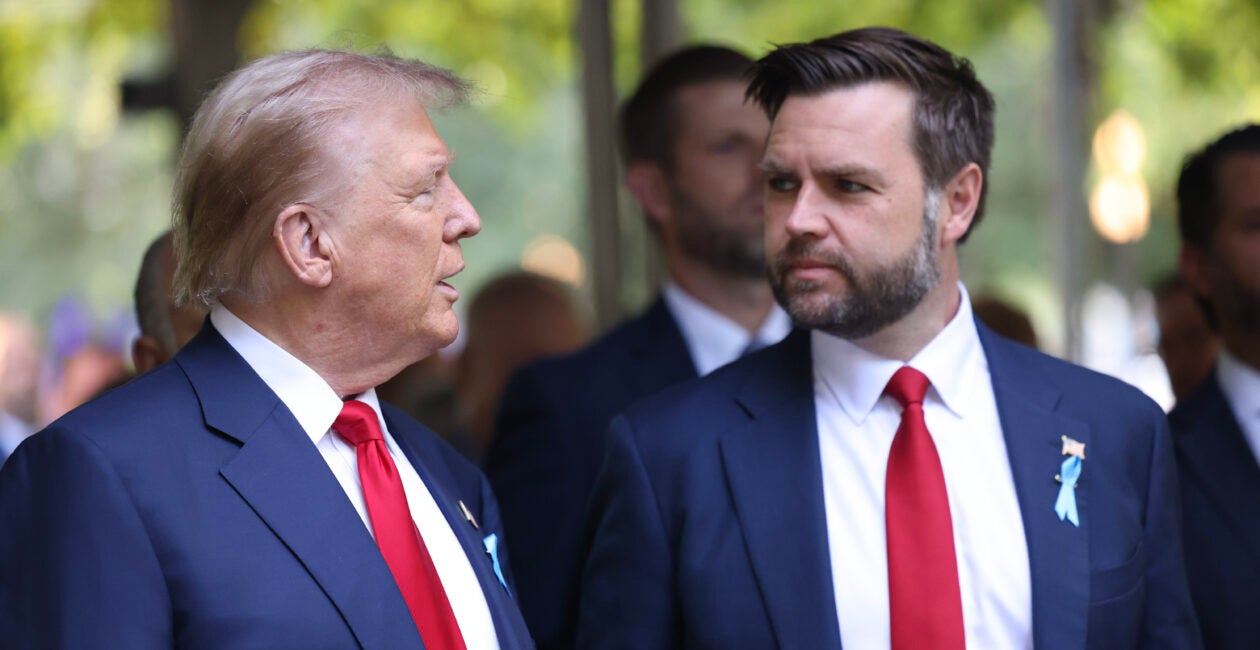
President-elect Donald Trump and Republican vice president-elect JD Vance. (Michael M. Santiago/Getty Images)
President-elect Donald Trump and Vice President-elect JD Vance want House Speaker Mike Johnson and Republicans on Capitol Hill to play hardball with obstructionist Democrats in the ongoing government funding fight.
On Tuesday night, Congressional leadership released the text of the continuing resolution that will fund the government until March 14, 2025. With funding set to expire on Dec. 20, Congress needs to act in order to avert a government shutdown on the eve of a new Congress and the presidential transition of power.
Republicans are in a tough spot—especially Johnson. Though Republicans earned a mandate victory in November, Republicans won’t actually have their trifecta until January. A Democratic senate and Democratic president still have to sign off on any plan to fund the government.
Which helps explain why the continuing resolution runs 1,547 pages and includes over $100 billion in additional government spending. The bulk of the additional funding is $110.4 billion in disaster relief aid, ostensibly for damage caused by hurricanes Helene and Milton.
The continuing resolution includes language committing the federal government to completely pay for the rebuilding of Baltimore’s Francis Scott Key Bridge, which collapsed in March.
It also gives an additional $10 billion in economic assistance for farmers along with a one-year extension of the farm bill.
Hundreds of pages in the continuing resolution pertains to changes in health care policy. The package includes increased flexibility for telehealth under Medicare, pandemic prevention provisions, and a reauthorization of legislation aimed at ending the opioid crisis.
Furthermore, other pieces of the continuing resolution provide a pay raise for members of Congress, the transfer of authority to D.C. over RFK stadium, and hotel and ticket price transparency.
While Johnson said Tuesday that the House originally aimed at passing “a very simple, very clean” continuing resolution, a “couple of intervening things” resulted in a larger package than anticipated. Members of Johnson’s Republican conference are expressing their disdain for the package.
“It’s not a CR, which is a continuation of the budget. It’s turning into an omnibus,” Rep. Marjorie Taylor Greene, R-Ga., told reporters.
“Why? Because freaking Christmas is right around the corner,” Roy added. “It’s the same dang thing every year. Legislate by crisis, legislate by calendar. Not legislate because it’s the right thing to do.”
Also frustrating Republicans on the Hill is the fact that many of the provisions that have turned the continuing resolution into a longer package are a grab-bag of Democratic priorities. Democrats have laid a trap, and House Republicans from top to bottom have walked right into it.
In this lame duck period, Democrats have no incentive to deal with Republicans in good faith. This is Democrat’s last chance to protect their priorities until at least 2027, and they’re taking full advantage of their current advantages. The first advantage for Democrats is the timing: Republicans are perceived as the party in power, but don’t yet fully have it. If the government shuts down, it appears that Republicans are unable to govern immediately after the American people chose the party to do so. The second advantage is structural: Democrats are always willing to spend more money than Republicans to keep the government open, and use their profligate spending as evidence that Republicans are to blame for any government shutdown.
House Minority Leader Hakeem Jeffries suggested as much in an X post. “House Republicans have been ordered to shut down the government. And hurt the working-class Americans they claim to support,” Jeffries claimed. “You break the bipartisan agreement; you own the consequences that follow.”
Johnson is trying to rebuff claims that the continuing resolution is an omnibus. “This is not an omnibus, OK? This is a small CR that we had to add things to that were out of our control,”Johnson claimed. “These are not man-made disasters. These are things that are—the federal government has an appropriate role to do.”
“So, I wish it weren’t necessary. I wish we hadn’t had record hurricanes in the fall. And I wish our farmers were not in a bind so much that creditors are not able to lend to them. We have to be able to help those who are in these dire straits,” the speaker added.
Trump and Vance weighed in on the fight via a joint-statement Wednesday afternoon. The incoming president and vice president threw Congress a nasty curveball by demanding the debt ceiling, the suspension of which ends January 1, 2025, is also addressed in the continuing resolution.
A statement from President Donald J. Trump and Vice President-Elect JD Vance:
The most foolish and inept thing ever done by Congressional Republicans was allowing our country to hit the debt ceiling in 2025. It was a mistake and is now something that must be addressed.…
“Increasing the debt ceiling is not great but we’d rather do it on Biden’s watch. If Democrats won’t cooperate on the debt ceiling now, what makes anyone think they would do it in June during our administration? Let’s have this debate now. And we should pass a streamlined spending bill that doesn’t give Chuck Schumer and the Democrats everything they want,” the statement read.
“Republicans want to support our farmers, pay for disaster relief, and set our country up for success in 2025,” the statement continued. “The only way to do that is with a temporary funding bill WITHOUT DEMOCRAT GIVEAWAYS combined with an increase in the debt ceiling. Anything else is a betrayal of our country.”
Trump and Vance also acknowledged that Democrats have no incentive to act in good faith: “Republicans must GET SMART and TOUGH. If Democrats threaten to shut down the government unless we give them everything they want, then CALL THEIR BLUFF. It is Schumer and Biden who are holding up aid to our farmers and disaster relief.”
Previously, Republican House leaders agreed to give members 72 hours to review legislation before voting. Johnson has reaffirmed his commitment to the 72-hour rule, which would have the House voting on the continuing resolution on Friday. The backlash has been so intense, however, that Johnson is now being forced to consider scrapping the rule in case the continuing resolution fails and Congressional leaders are forced back to the drawing board. But Trump and Vance’s statement has made forcing a vote through the House a very risky play.
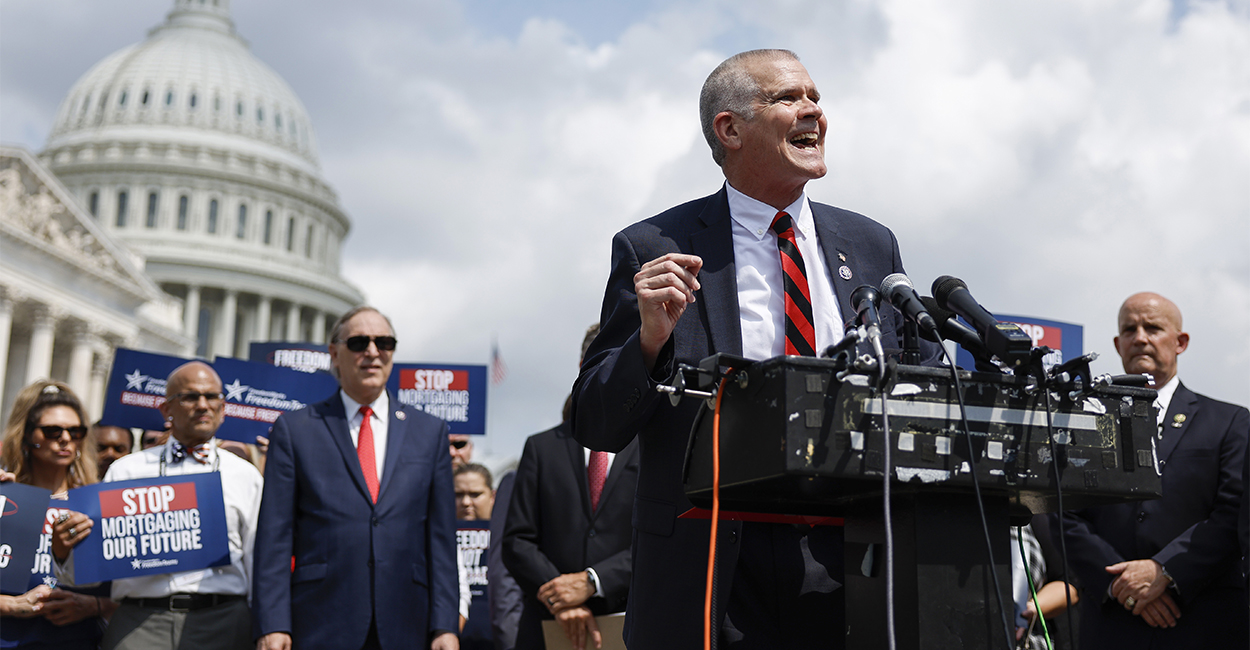
The U.S. House has 12 spending bills to fund the government for the upcoming fiscal year. With the national debt at $32 trillion, interest rates at a 22-year high, and ongoing inflation, Congress must pass some serious cuts. Pictured: Rep. Matt Rosendale, R-Mont., speaks at a House Freedom Caucus-held the news conference with other members of the caucus outside the U.S. Capitol Building on July 25, 2023. (Photo: Anna Moneymaker/Getty Images)
The U.S. House of Representatives left Washington July 27 for its lengthy summer recess having only passed 1 of 12 spending bills required to fund the government for the upcoming fiscal year beginning Oct. 1. While all 12 bills have welcome reductions, they lack the more substantial cuts necessary to trim the deficit and stop the rampant inflation being caused by excessive government spending.
While funding for the Veterans Administration passed on party lines, House leadership canceled an expected vote on funding for the Department of Agriculture due to a lack of consensus within the GOP caucus. This same dynamic affects the other 10 spending bills as well. The debate over spending levels will likely be the central legislative battleground for the next few months, and it’s vital for Americans to understand what’s at stake.
There has been an ongoing back-and-forth between House Speaker Kevin McCarthy, R-Calif., and conservatives in the House Freedom Caucus over where to set spending levels for fiscal year 2024. The Freedom Caucus has pushed for a reduction to 2022 levels, which Republicans agreed to in passing the Limit, Save, Grow Act this spring. Unfortunately, the flawed bipartisan debt limit deal supplanted Limit, Save, Grow, and in the process, set up tens of billions of dollars in budget gimmicks. This meant that not only would there not be the type of spending cuts needed to help fight inflationary deficit spending, but there could very well be a spending increase when all is said and done.
The House Appropriations Committee has now produced initial versions of all 12 of the annual spending bills. In response, members of the Freedom Caucus have demanded lower spending levels through a combination of dumping fraudulent gimmicks and imposing stronger spending cuts on the swampy federal bureaucracy. There’s no agreement yet between House leadership and the conservatives, meaning it’s unclear what will happen in the fall when Congress resumes work on the spending bills.
The spending bills as they currently stand provide plenty of details to inform congressional negotiators and the public about the worthwhile spending reductions already in the bills and the vital opportunities for further cuts that remain on the table.
Praiseworthy spending reductions in the House bills include:
A 15% cut to the Department of Education, which is irredeemably captured by the Left.
A 12% cut to housing programs, which are an often-overlooked part of the welfare state.
An over 40% cut to Environmental Protection Agency grants to states, many of which are done in service to the Green New Deal.
An over 30% reduction for U.S. Agency for International Development “development assistance,” recognizing that handouts from the U.S. to poor countries are neither effective nor affordable.
Eliminating wasteful spending by entirely defunding programs such as the Endowments for the Arts and Humanities, the duplicative Agency for Healthcare Research and Quality, and the long-failed Job Corps.
However, there are many areas where the Appropriations Committee either increased funding or gave minor haircuts rather than doing the cutting that’s necessary for the sake of responsible budgeting. Examples include:
Cutting less than 10% of the National Institutes of Health budget, which has been badly discredited as the public learns more about the corruption surrounding Dr. Anthony Fauci and handling of the COVID-19 pandemic. In addition, the agency’s funding has exploded in recent decades, and it has suffered from a variety of dysfunctions even before the pandemic.
Increasing spending on the National Science Foundation, which is part of the Big Science/Big Education complex that helps fund the infrastructure of the Left.
Placing tens of billions into the Disaster Relief Fund. While there is understandable sympathy for people suffering from disasters such as hurricanes, a handful of states receive the vast majority of disaster funds. This means adding to the federal debt to give handouts to these states at a time when Uncle Sam is going broke and states are passing tax cuts.
Retaining almost all Department of Energy spending on “efficiency and renewable energy” and the Office of Science. The Department of Energy provides a handful of worthwhile services but spends far too much in support of the Left’s environmental agenda.
Failing to account for faster-than-inflation spending hikes that dozens of nondefense bureaus and programs have received since the end of the Obama administration.
All told, there are tens of billions of dollars in potential savings still on the table.
A complicating factor in spending discussions is that the House Appropriations Committee is touting cuts to things passed by Democrats in recent years, such as the hiring spree for the IRS, in an attempt to “balance” the lack of meaningful reduction to overall spending levels. On one hand, such cuts would be an excellent idea in isolation. On the other hand, the committee is using this approach to shield much of the federal bureaucracy from the sort of dramatic cuts that would actually drain the swamp.
The bottom line: With the national debt at $32.6 trillion, the Federal Reserve raising interest rates to a 22-year high as inflation remains above pre-pandemic levels, and the Biden administration pushing a radical agenda thanks in part to the excessive size and scope of the government, it’s long past time for Congress to pass serious deficit reduction and combat federal bloat.
While the House Appropriations Committee has done some good work, conservatives are right to push for more.
David Ditch is a policy analyst specializing in budget and transportation policy in the Grover M. Hermann Center for the Federal Budget at The Heritage Foundation.
American Family Association
American Family Association (AFA), a non-profit 501(c)(3) organization, was founded in 1977 by Donald E. Wildmon, who was the pastor of First United Methodist Church in Southaven, Mississippi, at the time. Since 1977, AFA has been on the frontlines of Ame
NEWSMAX
News, Opinion, Interviews, Research and discussion
Opinion
American Family Association
American Family Association (AFA), a non-profit 501(c)(3) organization, was founded in 1977 by Donald E. Wildmon, who was the pastor of First United Methodist Church in Southaven, Mississippi, at the time. Since 1977, AFA has been on the frontlines of Ame
American Family Association
American Family Association (AFA), a non-profit 501(c)(3) organization, was founded in 1977 by Donald E. Wildmon, who was the pastor of First United Methodist Church in Southaven, Mississippi, at the time. Since 1977, AFA has been on the frontlines of Ame
You Version
Bible Translations, Devotional Tools and Plans, BLOG, free mobile application; notes and more
Political
American Family Association
American Family Association (AFA), a non-profit 501(c)(3) organization, was founded in 1977 by Donald E. Wildmon, who was the pastor of First United Methodist Church in Southaven, Mississippi, at the time. Since 1977, AFA has been on the frontlines of Ame
NEWSMAX
News, Opinion, Interviews, Research and discussion
Spiritual
American Family Association
American Family Association (AFA), a non-profit 501(c)(3) organization, was founded in 1977 by Donald E. Wildmon, who was the pastor of First United Methodist Church in Southaven, Mississippi, at the time. Since 1977, AFA has been on the frontlines of Ame
Bible Gateway
The Bible Gateway is a tool for reading and researching scripture online — all in the language or translation of your choice! It provides advanced searching capabilities, which allow readers to find and compare particular passages in scripture based on




 What Did You Say?
You must be logged in to post a comment.