Perspectives; Thoughts; Comments; Opinions; Discussions

Posts tagged ‘small businesses’

Small Businesses Like Mine Didn’t Cause COVID, But Governments Are Making Us Pay For It


Small Businesses Like Mine Didn’t Cause COVID, But Governments Are Making Us Pay For It

Back in 2000, I left my job in San Francisco working for an entrepreneur named Bruce Carlisle. From scratch, Bruce had co-founded an online advertising agency named SFInteractive, eventually growing the business to 200 employees. I successfully started his analytics department, and then flew the coop. Los Angeles was calling me, and I’ve never looked back. The day I left, I made a pact with myself to never work for anyone else. I saw what Bruce had created and set out to create something of my own. Outside of a short stint working for the city of Malibu and a Christmas gig at Williams Sonoma in L.A., that’s exactly what I’ve done.

In 2003, my wife and I were expecting our first child, and we hadn’t figured out how to pay for her arrival yet. We were both freelancing reading movie scripts for film companies. It was enough for the two of us, and a lot of fun, but we didn’t have enough steady income to raise a family.

A wise acquaintance once said to me, “Every baby comes with its own basket of bread.” Interesting idea, I thought. Sometime after, almost on cue, my old roommate from New York reached out and asked if I knew anyone who could sell French tours on the internet to Americans.

After some serious convincing on my part (I’d never worked in travel before), my roommate vouched for me and we got the contract. Our business and child arrived at virtually the same time. We were off to the races.

For almost 20 years now my wife, Laura, and I have run Link Paris, a small boutique French travel company. We’ve had our ups and downs, but we survived the great recession in 2008, the aftermath of the terror attacks in Paris in 2015 and 2016, and the reality of giant competitors eventually moving into our niche.

On the upside, we’ve served more than 80,000 happy customers and in 2014 we were voted the “Best Online Tour Operator” by the French Government Tourist Office. We truly love this business and our customers.

Our No. 1 product is a day trip from Paris to visit the landing beaches in Normandy. It is a destination every American should see if he or she visits France. We are very proud to have helped so many people visit this hallowed ground.

Now, here we are, 10 months into COVID. Our revenue is down more than 99 percent. We’ve had a total of two clients since March — a father and daughter who were receiving medical treatment in Paris. They, and others like them, are among the very few Americans allowed abroad.

We’re still standing, but how much longer can we? How much longer can any disrupted small business last? We are hurting in my industry and many others.

This is a horrible virus and I fully understand and support the fight against it. The worry is that the government is implicitly saying to us, and a million other small businesses, that we’re simply collateral damage of the pandemic. “Yes, you had a decent life, but that is over now. You need to accept your limited prospects and move on. Tough break. But, you know, the virus.”

Yes, there has been some aid. The Paycheck Protection Program helped, and the Economic Injury Disaster Loan helped even more. But, after ten months of zero revenue, it isn’t enough.

To complicate matters, the Small Business Administration lowered the maximum EIDL loan amount from $500,000 to $150,000 in April — although not before people like Rep. Ilhan Omar’s husband, Tim Mynett, and others got their loans approved for the full amount.

Mynett’s company made $2.2 million this year from Omar’s reelection campaign. Where exactly did he suffer an “economic injury?” I’m sure there are many examples on the other side of the aisle as well. This isn’t a partisan issue, but the point is the same: the well-connected aren’t just barely getting by — they’re thriving.

Indeed, we wouldn’t have even received the EIDL loan if it hadn’t been for a Reddit user who helped us, along with a thousand other people, resubmit our application. When I originally submitted, I’d had made an error, and the SBA was so overwhelmed at the time that amending an application was near impossible — until I found the EIDL subreddit and an anonymous user named Cue378. He (or she) knew exactly what to do and we got it fixed. When someone else started a GoFundMe page for this person as a thank you, more than $100,000 was raised.

In the end, we received a loan. We are grateful for it, but compare it to the $500 million credit facility that our main competitor (Trip Advisor) initiated, and it’s essentially nothing. That is the unintended, or intended, consequence of all of this. The big and connected are getting much stronger, while the small are having their dreams destroyed.

No small business could’ve prepared for this. What started as “15 days to slow the spread” has turned into something far different. I get it — six weeks to beat the Germans in World War I turned into four long years of trench warfare. Things change.

But Washington needs to give small businesses a genuine, real chance to survive. Big business may do the heavy lifting, but we make up 45 percent of America’s GDP. Small business is the lifeblood of this economy. Don’t let us bleed dry.

John Romano is the co-founder and operator of LinkParis.com, a small boutique French travel company.

Small Business Optimism Soars to Pre-pandemic Levels


Reported by JOHN CARNEY | 

Read more at https://www.breitbart.com/economy/2020/10/13/small-business-optimism/

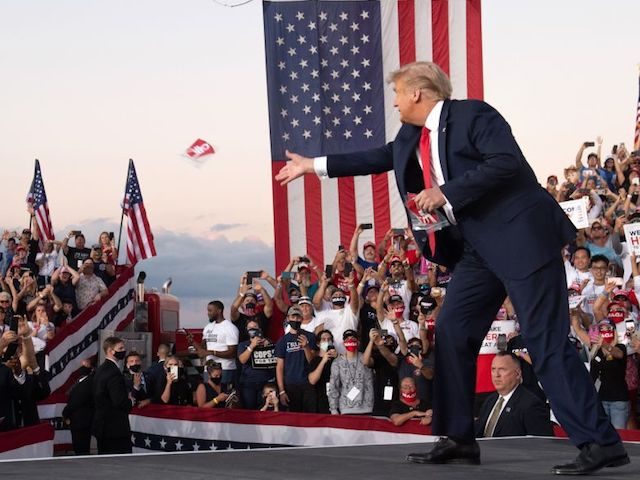
US President Donald Trump throws masks to supporters as he arrives to hold a Make America Great Again rally as he campaigns at Orlando Sanford International Airport in Sanford, Florida, October 12, 2020. (Photo by SAUL LOEB / AFP) (Photo by SAUL LOEB/AFP via Getty Images)

The National Federal of Independent Business said Tuesday its optimism index rose 3.8 points to 204, a level it last reached in January. That is among the highest readings recorded in the closely watched gauge of business confidence. Economists had expected the index to more or less hold steady near last month’s reading of 100.2. The range of estimates was between 99 and 102, so this was twice as strong as the most bullish forecast.

The improvement comes as many businesses have been able to open more fully. It suggests that the end of small-business relief programs, which mostly wrapped up in August, did not hurt business owners as much as feared.

The threat of a second round of shutdowns, however, still hangs over businesses. The NFIB’s uncertainty index climbed to 92, higher than it was when infections were at their height this summer or lockdowns were at their most stringent this spring.

“As parts of the country continue to open, small businesses are seeing some improvements in foot traffic and sales,” said NFIB Chief Economist Bill Dunkelberg. “However, some small businesses are still struggling financially to operate at full capacity while navigating state and local regulations and are uncertain about what will happen in the future.”

Every component of the index apart from expected credit conditions improved. With interest rates already extremely low, there is not much room for credit conditions to improve. Plans to increase employment, make capital outlays, and grow inventories all rose. So did the share of business owners expecting economic conditions to get better over the next three months. Expectations for sales also improved and more owners said now is a good time to expand.

The NFIB is a trade association for small business owners.

Survey Says 87% of Small Businesses Saw Increase in Healthcare Costs Under Obamacare


waving flagBy Bethany Blankley April 6, 2016

Six years of Obamacare (the Affordable Care Act (ACA)) has cost millions of Americans in job and healthcare losses, forcing them to lose their existing, affordable plans, to have no insurance at all, or to pay more for a worse health insurance plan. Six years of Obamacare have caused health insurance premiums to skyrocket, while many health insurance companies required to operate within the Obamacare exchanges have lost millions of dollars. And according to a recent poll, it’s only going to get worse– for everyone– but small businesses will suffer the most.

Complete MessageAccording to an online survey produced by LevelFunded Health, (LFH) a national health insurance agency “with a hyper-focus on Affordable Care Act ‘alternative’ employee benefit programs for the small employer market segment,” 87 percent of small businesses that offer “group health care” suffered from a 25 percent increase in health insurance premium costs since 2014. It reports that 12 percent of small businesses experienced increases of 50 percent or more to their premium costs.

Small businesses are at a significant disadvantage because they will unlikely be able to absorb higher health insurance costs, which is why many have canceled their health insurance benefits completely. Larger companies can more easily absorb increased costs. But they are not immune from the tragedy of Obamacare. UnitedHealth Group, for example, the nation’s largest health insurer, recently announced it’s expecting more than $500 million in losses on 2016 Obamacare plans alone.

These increased costs affect more than financial outcomes. They affect being able to employ workers, and more importantly, quality workers. The LFH survey reports that health insurance costs affect the quality and skill-level of employees who are drawn to particular businesses because of the benefits they offer. Small businesses are more likely to lose quality job applicants to large corporations that can offer better benefits.Complete Message

The LFH survey found that 56 percent of the 2,500 small businesses it polled reported that they are losing quality employees and candidates because of how expensive employer-provided health care plans are under Obamacare, compared to significantly lower costs and more options prior to Obamacare.

Included as part of the ACA is the Small Business Health Options Program (SHOP) marketplace, allegedly designed to aid small businesses. Kaiser Health News reported in 2015 that, “Employers with fewer than 50 full-time workers are eligible to buy coverage on SHOP. The federal government even offers businesses an incentive, a tax credit worth up to half of an employer’s share of their workers’ premiums. Among the conditions: The firm must employ fewer than 25 workers and their average salary cannot exceed $50,000.”

But, in 2015, only 85,000 people out of 11,000 small businesses received coverage through SHOP– a number significantly less than the 1 million people Obama and the Congressional Budget Office expected.Complete Message

And increased costs affect more than losing quality workers. The ACA and SHOP’s failure to aid small businesses has forced them to decide more than choosing between letting go their employees and providing health insurance to their employees, to now raising prices for their customers.

The real burden that few discussed regarding Obamacare was the hidden fines, fees, and taxes that the 2,000+ law created, which began to go into effect in 2016 and 2017.

Already, the small businesses that have 50 or more full-time employees and don’t provide health insurance must pay an “Employer Shared Responsibility” fine. Complete Message

According to HealthCare.gov: “Some employers with 50 or more [full-time] employees who don’t offer insurance, or whose offer of coverage is not affordable or doesn’t meet certain minimum standards, are subject to Employer Shared Responsibility provisions. They may owe a payment if at least one of their full-time employees enrolls in a plan through the Health Insurance Marketplace and receives a premium tax credit.”

As a result, to avoid Obamacare penalties and fines associated with the 50-employee rule, small businesses are outsourcing jobs to online freelancers and not hiring more staff.

Six years of Obamacare has resulted in more regulations as well, which means increased audits, and more paperwork and headaches for small business owners. Many experts anticipate that Department of Labor audits will also increase, which piles on even more costs for small businesses.Complete Message

What small business can continue to exist in the nightmare that Obama and every Democrat who voted for it, created? How will they survive more regulations, additional costs associated with fines, fees, and increased taxes, not to mention the likelihood of being audited for failing to comply with these increased number of regulations. But their ability to compete with larger companies for quality employees will be even more difficult than it already is. Finding and keeping quality employees is essential to small business owners. But Obamacare has made this necessity nearly impossible in 2016 and beyond, as more people continue to lose their jobs and their health insurance, both of which they had prior to Obamacare.

Picture1 true battle Picture1 In God We Trust freedom combo 2

Tag Cloud