
Perspectives; Thoughts; Comments; Opinions; Discussions

Posts tagged ‘Senate confirmation hearing’

Senate Republicans Grill Biden’s Pick for Joint Chiefs Chair Over DEI, Transgenderism in the Military


BY: SHAWN FLEETWOOD | JULY 12, 2023
Read more at https://thefederalist.com/2023/07/12/senate-republicans-grill-bidens-pick-for-joint-chiefs-chair-over-dei-transgenderism-in-the-military/

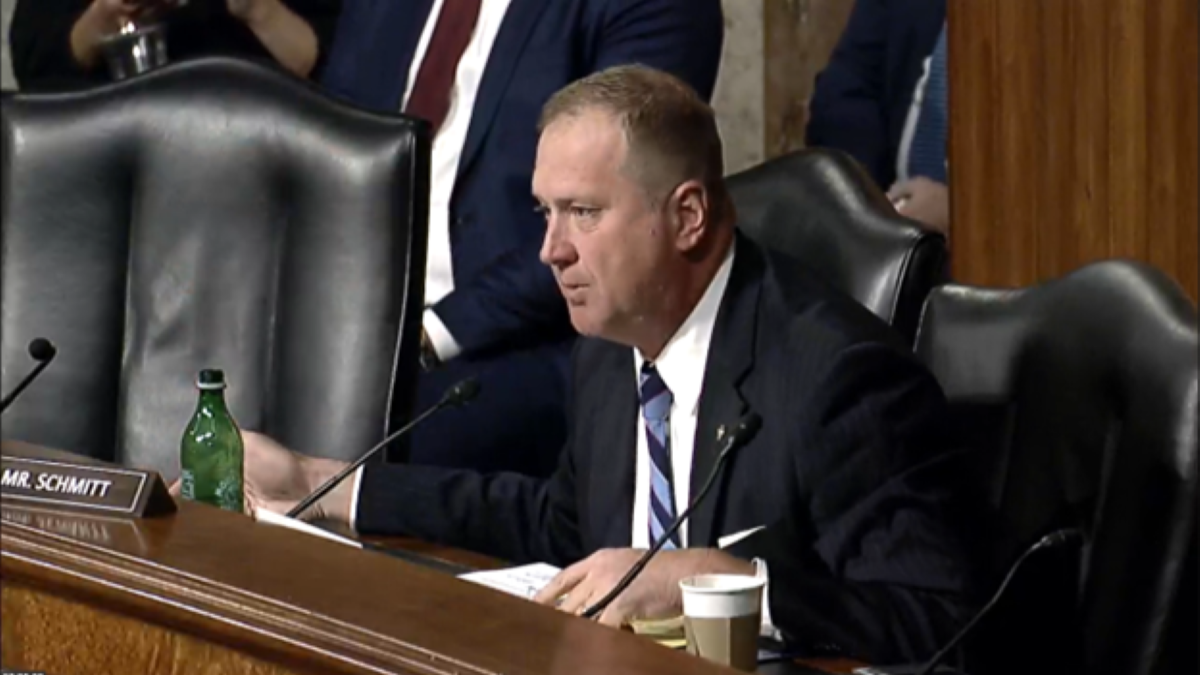
Sen. Eric Schmitt grilling Joint Chiefs nominee Charles Brown at a Senate confirmation hearing

Author Shawn Fleetwood profile

SHAWN FLEETWOOD

VISIT ON TWITTER@SHAWNFLEETWOOD

MORE ARTICLES

Senate Republicans grilled Gen. Charles Q. Brown over racial politics and transgenderism throughout the U.S. military during a committee confirmation hearing on Tuesday. Brown, who serves as Air Force chief of staff, was nominated by President Joe Biden to replace Gen. Mark Milley as chairman of the Joint Chiefs of Staff in May.

Among the more contentious issues raised during Tuesday’s Senate Armed Services Committee hearing was an August 2022 Air Force memo Brown signed, directing the Air Force Academy and Air Education and Training Command to “develop a diversity and inclusion outreach plan” aimed at “achieving a force more representative of our Nation.” When pressed on the memo by Sen. Eric Schmitt, R-Mo., Brown claimed the recruiting targets stratified by race and sex in the memo are based “on application goals, not the make-up of the force,” and that “those numbers are based on the demographics of the nation.”

As The Federalist previously reported, Brown has a documented history of supporting the same so-called “diversity, equity, and inclusion” (DEI) ideology wreaking havoc on the U.S. military. DEI initiatives employ a divisive and poisonous ideology dismissive of merit to discriminate based on characteristics such as skin color and sexual attraction.

While participating in a virtual discussion hosted by the Chicago Council on Global Affairs in November 2020, for instance, Brown indicated that “[a]t the higher level of the Air Force, diversity ha[d] moved to the forefront of personnel decisions such as promotions and hiring.” During the same event, the Air Force general also admitted to using his post to increase opportunities for so-called “diverse candidates” in the Air Force, saying he “hire[d] for diversity” when building his staff.
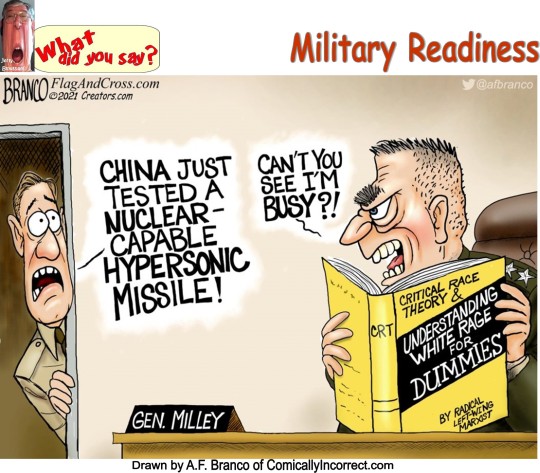
Brown has also previously pushed back against congressional Republicans who have expressed concerns about the Biden administration’s attempt to spread DEI instruction throughout the military.

[RELATED: Biden’s Pick For Joint Chiefs Chair Made ‘Diversity’ And ‘Inclusion’ Focal Points In Air Force Personnel Decisions]

“This administration has infused abortion politics into our military, Covid politics into our military, DEI politics into our military, and it is a cancer on the best military in the history of the world. Those men and women deserve better than this,” Schmitt said. “I believe we … ought to be recruiting in various areas to make sure we have the best and the brightest from every community. … But that’s not what DEI is.”

Schmitt further admonished DEI as “an ideology based in cultural Marxism” and expressed concerns about how the military can continue to have leadership that advocates for “this divisive policy.”

The Center for Military Readiness, a public policy group that analyzes military matters, sent a letter to committee members on Monday, encouraging them to press Brown on issues such as “[r]acial discrimination known to exist in military service academy admissions” and “[m]andates to increase percentages of minority persons, while consciously reducing non-minority (white males) in aviation and other demanding occupations,” among other things.

Schmitt also raised the issue of the more than 8,000 U.S. service members kicked out of the military for not getting the experimental Covid jab due to medical or religious reasons. When pressed on how he would personally recruit these individuals back into service, Brown said he would “provide them the opportunity to re-apply.”

“I just don’t think that’s good enough,” Schmitt replied. “We did a great disservice to this country by firing people because they made that decision. I think they ought to be reinstated with rank and backpay. I have not heard that from anybody that’s come before this committee.”

Another problem raised during the hearing was transgenderism in the military. Shortly after his inauguration, Biden issued an executive order allowing transgender-identifying individuals to serve in the U.S. armed forces, marking a policy reversal from that of the Trump administration.

During his line of questioning, Sen. Mike Rounds, R-S.D., referenced an alleged “young woman in the South Dakota National Guard [who] experienced a situation at basic training where she was sleeping in open bays and showering” with female-identifying males who had not undergone surgery, “but were documented as females because they had begun the drug therapy process.” 

According to Rounds, this 18-year-old woman “was uncomfortable with her situation but had limited options on how to deal with it” because “she feared she’d be targeted for retaliation.” When asked how he would handle such issues as Joint Chiefs chair, Brown didn’t offer a specific answer, instead saying that “as you’re being inclusive, you also don’t want to make other individuals uncomfortable” and that if confirmed, he would “take a look to see if [the military] can improve on how [it] approach[es] situations like this.”

Meanwhile, several Democrats spent their time attacking fellow committee member Tommy Tuberville, R-Ala., who has been holding up Biden’s DOD civilian and general flag officer nominees in response to the Pentagon’s radical abortion policies. As The Federalist’s Jordan Boyd previously reported, Defense Secretary Lloyd Austin “announced in February that the taxpayer-funded Pentagon would grant up to three weeks of paid time off and travel for U.S. military members and their family members to obtain abortions.”

According to Tuberville, the policy — which “would subsidize thousands of ‘non-covered abortions‘” without congressional authorization or taxpayer approval — is “immoral and arguably illegal.”

“One of my colleagues is exercising a prerogative to place a hold on 250 generals and flag officers. I’m unaware of anything that they have done … that would warrant them being disrespected or punished or delayed in their careers,” Sen. Tim Kaine, D-Va., said in reference to Tuberville. Sens. Elizabeth Warren, D-Mass., and Jacky Rosen, D-Nev., also criticized Tuberville, with Rosen indirectly accusing the Alabama senator of partaking in an “extreme, anti-choice agenda.”

A committee vote on Brown’s confirmation will be held at a later date.


Shawn Fleetwood is a staff writer for The Federalist and a graduate of the University of Mary Washington. He previously served as a state content writer for Convention of States Action and his work has been featured in numerous outlets, including RealClearPolitics, RealClearHealth, and Conservative Review. Follow him on Twitter @ShawnFleetwood

The Five Dumbest Questions Put to Gorsuch. Supreme Court nominee forced to field array of inane queries from preening senators


Authored by Brendan Kirby | Updated 22 Mar 2017 at 10:19 AM

URL of the original posting site: http://www.lifezette.com/polizette/the-five-dumbest-questions-put-to-gorsuch/

In addition to the physically taxing experience of sitting through more than 10 hours of interrogation at his Senate confirmation hearing Tuesday, Supreme Court nominee Neil Gorsuch had to endure many questions that were silly or downright dumb.

Such is the price to be paid for a lifetime appointment to one of the nation’s most powerful positions.

The queries ranged from gotcha questions about cases that Gorsuch could not possibly answer to the repetitive — there are only so many different ways the appeals court judge could give a response to a question about a trucker’s lawsuit — to attempts to smear the nominee with the words of other people.

Gorsuch’s supporters gave his performance a thumbs up. Leonard Leo, an adviser to President Donald Trump who is on leave from the Federalist Society, argued that Gorsuch should easily clear the 60-vote threshold to avoid a possible filibuster.

“If the Democrats won’t give the president 60 votes for Neil Gorsuch, then there is no Republican Supreme Court nominee they will ever support,” he said in a prepared statement.

Democrats on the Senate Judiciary Committee might come to a different conclusion. Based on suggestions from legal scholars and conservative political activists, here are some of the dumbest questions senators asked:


The questioner: Sen. Dick Durbin (D-Ill.).

The issue: Durbin employed a classic guilt-by-association tactic by confronting Gorsuch with controversial statements made by people he has worked with over the years. He noted that retired Oxford University professor John Finnis, who was Gorsuch’s dissertation supervisor, wrote in 2009 that the English people had “largely given up … bearing children at a rate consistent with their community’s medium-term survival” and that it was causing its “own replacement as a people” and that European countries in the 21st century were on a “trajectory of demographic and cultural decay.”

The question: “Do you feel that what Professor Finnis wrote about purity of culture and such is something that we should condemn or congratulate?”

The answer: Gorsuch said he would want to read the entire writing and not just hear excerpts before passing judgment. “And Senator, I’ve had a lot of professors,” he said. “I’ve been blessed with some wonderful professors. And I didn’t agree with everything they’ve said, and I wouldn’t expect them to agree with everything I’ve said.”

The questioner: Sen. Amy Klobuchar (D-Minn.).

The issue: Klobuchar pressed Gorsuch about his views on originalism, a concept in which judges adhere to the strict meaning of the Constitution when it was written.

The question:So when the Constitution refers, like, 30-some times to ‘his’ or ‘he’ when describing the president of the United States,  you would see that as, well back then, they thought a woman actually could be president of the United States even though women couldn’t vote?”

The answer: “I’m not looking to take us back to quill pens and horses … Of course women can be president of the United States. I’m the father of two daughters. And I hope one of them turns out to be president.” In response to a similar question about the Air Force, which did not exist at the time of the Constitutional convention, he said, “Senator, I think the generals of the Air Force can rest easy.”

The questioner: Sen. Sheldon Whitehouse (D-R.I.).

The issue: So-called “dark money” in politics, which followed the Supreme Court’s Citizens United decision that struck down limits on political spending by independent groups that were not connected to candidates. Whitehouse took umbrage to Gorsuch’s suggestion that the ruling does not mean the court was inserting itself into politics.

The question: “Do you really think that a Supreme Court that decided Citizens United doesn’t get involved in politics?” He followed up:

The answer: Gorsuch explained that Congress had broad authority to pass further laws on campaign finance. Lawmakers could impose new requirements that outside groups disclose donors, for instance. “Senator, I think every justice on the Supreme Court of the United States is a remarkable person trying their level best to apply the law, faithfully.”

The questioner: Sen. Al Franken (D-Minn.).

The issue: Gorsuch’s by now well-known dissent in the TransAm Trucking v. Administrative Review Board case. The 10th U.S. Circuit Court of Appeals ruled last year that the company had to rehire a trucker who had been fired for leaving a malfunctioning rig in freezing weather. Several senators have browbeat the nominee already for his dissent, but Franken couldn’t resist taking another pass Tuesday.

The question: Referring to testimony that the driver was suffering hypothermia and that the brakes were failing, the senator said, “I don’t think you’d want to be on the road with him, would you, Judge?”

The answer: Gorsuch said he does not blame the driver for doing what he did and added that he empathizes with him but explained — again — that his dissent was based on the language of the statute, which protected a worker from dismissal for refusal to operate an unsafe vehicle. But the driver did operate the truck, he said. Gorsuch also explained that Franken incorrectly described the doctrine of absurdity, which the senator had argued allowed for a departure from applying the statute as literally written. The judge said that neither side in the case even raised that issue. “And it usually applies when there’s a scrivener’s error, not when we just disagree with the policy or the statute,” he said.

The questioner: Sen. Al Franken (D-Minn.). 

The issue: More guilt by association. Franken referred to comments by White House Chief of Staff Reince Priebus at the Conservative Political Action Conference that Gorsuch could mean the “change of potentially 40 years of law.” At the same conference, White House strategist Stephen Bannon contended that the administration’s goal was the “deconstruction of the administrative state.”

The question: “What do you think that Mr. Priebus was talking about? Do you think he was saying that you’d be in a position to shape the court’s decisions for 40 years? Or was he suggesting that you could reach back 40 years?” About Bannon, he asked if the comments applied only to Cabinet nominees.

The answer: Gorsuch said he could not speak for others. “Respectfully, Senator, Mr. Priebus doesn’t speak for me, and I don’t speak for him,” he said. He had a similar to response to the Bannon question: “Respectfully, that’s a question best posed to Mr. Bannon.”

Tag Cloud