Perspectives; Thoughts; Comments; Opinions; Discussions

Posts tagged ‘Russian disinformation’

Feds Started A Dangerous Game With Hunter Biden’s Laptop, But GOP Lawmakers Can Finish It


BY: MARGOT CLEVELAND | MAY 11, 2023

Read more at https://thefederalist.com/2023/05/11/feds-started-a-dangerous-game-with-hunter-bidens-laptop-but-gop-lawmakers-can-finish-it/

laptop sitting in a dark room

Author Margot Cleveland profile

MARGOT CLEVELAND

VISIT ON TWITTER@PROFMJCLEVELAND

MORE ARTICLES

The interim report of the House Intelligence Committee and Weaponization Subcommittee released Wednesday established extensive coordination between the Biden campaign and those behind the statement signed by 51 former intelligence officials that painted the Hunter Biden laptop as Russian disinformation. More explosive, however, is the fact, first reported on Tuesday by The Federalist, that a Central Intelligence Agency employee solicited a former CIA officer to sign the statement. 

Yet there is still much more to unravel to expose the breadth and depth of the info op painting the infamous laptop as Russian disinformation and the government actors involved. Here are five threads that will lead to the truth.

Subpoena All 51 Signatories

As its title stated, the House’s report focused on “How Senior Intelligence Community Officials and the Biden Campaign Worked to Mislead American Voters.” While the October 2020 letter signed by the former intelligence officials is only part of the scandal, it’s a solid entry point to learning the identity of many of those involved. 

The report already established Secretary of State Antony Blinken — then a senior adviser to the Biden campaign — contacted Obama’s CIA acting director, Mike Morell, to discuss the New York Post’s reporting on Hunter Biden’s laptop. Morell also testified that speaking with Blinken spurred him to craft the letter in question so Biden could reference it during his final debate against then-President Trump. 

The House report highlighted several other plays involved in gathering signatories for the letter and revealed that at least one CIA employee solicited an individual to sign the letter. 

The House stressed its investigation is continuing but that neither Blinken nor the CIA have yet to provide documents requested by the committees relating to both the statement and the interactions between its signatories and the CIA. The committees also reportedly scheduled interviews with former CIA Director John Brennan and former Director of National Intelligence James Clapper. 

But it is not merely Brennan and Clapper who should be interviewed. While they are two of the most prominent former intelligence officials to have signed the letter, every signatory should be questioned and asked to provide relevant communications. If they refuse, subpoenas should be served and enforced.

Specifically, Brennan, Clapper, and other signatories should be asked to identify anyone they communicated with, or tried to, about the laptop or the letter to reveal the identity of the “nine additional former IC officers” who were unnamed but represented as supporting the letter’s conclusions.

Those 60 people should be asked about everyone with whom they spoke or attempted to speak about the laptop or the letter at any time, including those connected to: 1) the Biden family, 2) the Biden campaign, 3) elected officials, 4) the Democrat Party, 5) politicians opposed to Trump, 6) the media, 7) current government officials, 8) other signatories, 9) foreign governments, and 10) anyone else. All related communications should be obtained.

Based on those findings, any individuals not previously known should be added to the list of those to be questioned and subpoenaed. Those names will likely include many members or allies of the Biden campaign. We already know former Deputy Assistant Secretary of Defense and Biden adviser Michael Carpenter and Andrew Bates, then a Biden campaign spokesman and the director of his “rapid response” team, were involved in pushing the “Russian disinformation” narrative.

Additionally, from Morell’s testimony to House investigators, we know the head of Biden’s campaign, Steve Ricchetti, was involved, given that he arranged to personally thank Morell for the letter. Morell also said Jeremy Bash, whom Morell knew through Beacon Global Strategies, arranged Morell’s conversation with Ricchetti, raising the possibility that Beacon Global Strategies played a role in the plot. 

These individuals should be further questioned on their roles related to the letter: Did they draft any language? Propose revisions to the language? We know some of this already from the House report, but there’s more to probe.

Furthermore, all of the signatories should be asked: Had they read the New York Post articles? Did they know of the existence of the laptop or the FBI’s seizure of it? Why did they supposedly believe it was Russian disinformation? Did they have any doubts? Did they watch the final Trump-Biden debate and, if so, did they believe Biden had accurately described their letter? What about Politico’s infamous “Russian disinfo” article? Did they believe Biden or Politico had misrepresented their letter? If so, to whom, if anyone, did they express their concerns? If not, why not? 

Probe FBI’s Involvement

The aforementioned strategy is a good starting point, but because members of the Biden campaign and others involved outside the government may not know — or be honest — about who inside the government participated in the election-interference scheme, investigators should simultaneously work from the FBI out.

Congressional oversight committees should start by interviewing and obtaining all relevant documents, voluntarily or by subpoena, from the FBI agents with knowledge of the laptop. They should begin with those who first learned of its existence when the father of John Paul Mac Isaac — the owner of the computer repair store where Hunter had abandoned his laptop — contacted the agency. 

According to Mac Isaac, in October 2019, his father, a retired Air Force colonel, reported the laptop to FBI agents in the Albuquerque, New Mexico field office. Mac Isaac’s father spoke with an agent, telling him that his son had “the laptop of the son of a presidential candidate” and that it “has a lot of bad stuff on it, and he needs your help.” 

Mac Isaac’s father also told the agent the hard drive contained pornographic material and content that was “geopolitically sensitive,” including “dealing with foreign interests, a pay-for-play scheme linked to the former administration, lots of foreign money.” And while Mac Isaac’s father offered the FBI a copy of the laptop, the agent instead asked to review the repair contract.

After reviewing it, the agent reportedly “consulted with a regional legal officer,” then told Mac Isaac’s father they should “lawyer up” and not “talk to anyone about this.” The agent then directed the repairman’s father to the door. 

An agent later reportedly contacted Mac Isaac’s father, who provided the agent with his son’s contact information. Then, “on December 9, 2019, the FBI served a subpoena on John Paul for the computer, the hard drive, and all related paperwork,” which Mac Isaac provided. 

Mac Isaac would later claim one of the two FBI agents who retrieved the laptop from his Delaware store suggested he keep quiet. According to Mac Isaac, as the agents were leaving, he quipped, “Hey, lads, I’ll remember to change your names when I write the book.”

At that point, Mac Isaac claimed, “Agent DeMeo paused and turned to face me,” replying: “It is our experience that nothing ever happens to people that don’t talk about these things.”

After seizing the laptop, the “local FBI leadership told employees, ‘You will not look at that Hunter Biden laptop,’” according to multiple whistleblowers. The whistleblowers further alleged that “the FBI did not begin to examine the contents of Hunter Biden’s laptop until after the 2020 presidential election — potentially a year after” retrieving it.

These details give congressional investigators ample leads to uncover who in the FBI knew about the Hunter Biden laptop, beginning in Albuquerque and then moving to the FBI’s Baltimore field office, which holds jurisdiction over Delaware-based investigations.

The agents involved should be questioned to learn what they knew, what they did, and with whom they spoke, including whether they communicated with any member of the Biden family, campaign, or media. Investigators should also obtain the various FBI reports, the subpoena, the warrant used to obtain the subpoena, the chain of custody for the laptop and other seized material, and all written or electronic communications. 

Focusing on the FBI is especially important because the day after the Post broke the laptop story, Russia-collusion hoaxer Ken Dilanian, ran an “exclusive” at NBC, reporting that “federal investigators are examining whether emails allegedly describing activities by Joe Biden and his son Hunter and found on a laptop at a Delaware repair shop are linked to a foreign intelligence operation.” The next day, USA Today similarly reported the FBI’s supposed involvement in investigating whether a Russian influence operation was at play. On Oct. 17, 2020, USA Today reiterated that the “federal authorities” are investigating whether the laptop is “disinformation pushed by Russia.”

However, the FBI was not investigating whether the laptop was related to a “foreign intelligence operation,” but instead was investigating Hunter Biden. This FBI leak nonetheless furthered the “Russia disinformation” narrative. In fact, Blinken went on to share one of the USA Today articles with Morell. Then Morell referenced the nonexistent FBI investigation as a justification for the letter, as a text included in the House report shows. 

Specifically, Morell texted Marc Polymeropoulos, a former CIA acting chief of operations, saying, “I’m thinking of writing something that says the FBI is investigating whether there is Russia involvement in this thing and that makes sense because it has the feel of a Russian op.” Morell asked Polymeropoulos if he wanted to help with the effort, leading the duo to draft the initial version of the statement together.

Questioning the FBI agents with knowledge of the laptop and obtaining relevant communications would help establish who was behind the leak and whether anyone from the FBI communicated with the Biden campaign, the CIA, or any of the letter’s signatories. Likewise, this line of inquiry would establish if anyone with knowledge of the laptop cautioned social media companies — or suggested other FBI agents warn Big Tech — to expect a “hack-and-leak” operation.

Probe DEA’s Involvement

A third line of inquiry requires looking to the Drug Enforcement Administration and its role in executing a search warrant on the Massachusetts office of Hunter Biden’s former psychiatrist Keith Ablow. 

On Oct. 30, 2020, NBC News first reported that during a February 2020 DEA raid on Ablow’s office, agents reportedly recovered a second laptop belonging to Hunter Biden from a safe in Ablow’s basement. The DEA then returned the computer to Hunter’s lawyer George Mesires.

For a year, Ablow had reportedly “made repeated efforts to persuade Hunter Biden to retrieve his computer.” But then the DEA raided Ablow’s office just a few months after the FBI had seized Hunter’s other laptop from Mac Isaac. 

The DEA agents involved should be asked whether they knew Ablow possessed the laptop and whether that fact motivated the execution of the search warrant. Did the DEA agents speak with any FBI agents? Did the DEA know of the Delaware U.S. attorney’s investigation into Hunter? Did agents review the laptop before returning it? If not, why not? If so, what information did they discover, and why was the laptop not retained as evidence? 

This line of inquiry may prove a dead end, or it could reveal more election interferers.

Dig Into Biden Briefings

Next, investigators should review the intelligence briefings provide to Biden since October 2019 when the FBI first learned of the laptop’s existence. Given the incriminating evidence contained on it, the intelligence briefings should have alerted Joe Biden to the national security risk.

If the briefings included details about the laptop, the individuals involved should be questioned and documents subpoenaed to learn who knew what and did what with the information. But if the briefings did not mention the laptop, investigators should ask those responsible for putting together the briefings about their knowledge of the laptop and their explanation for omitting mention of it. 

Investigate the Giuliani Investigators

A fifth line of inquiry should look to those behind the investigation of Rudy Giuliani. 

The New York Post’s Miranda Devine previously reported: “[T]he FBI spied on the former mayor’s cloud for two years from May, 2019, a month after he began working as then president Donald Trump’s personal attorney. … So the FBI had access to all Giuliani’s emails and iMessages for two years,” meaning it’s possible the FBI saw Bob Costello’s Aug. 27, 2020, email to Giuliani “telling him of Mac Isaac’s ‘amazing discovery.’”

In that email, Costello wrote: “I am arranging to get a complete copy of the hard drive as it contains lots of materials beyond the Ukraine stuff according to the owner. … The five emails he sent show that Hunter was directly involved in orchestrating his father Joe Biden’s intervention to stop the Ukrainian investigation of Burisma.” The email continued: “I believe that we are on the verge of a game changing production of indisputable evidence of the corruption we have long suspected involving the Biden’s and Ukraine — but there is more.”

The joint committees’ investigation should run down the possibility that those investigating Giuliani had access to his emails and learned of the laptop before the Post’s stories. If so, with whom did the agents share that knowledge? Again, interviews and documents are necessary to determine if any of these FBI agents were responsible for the leaks or communicated with the Biden campaign or Big Tech.

Wednesday’s report provides crucial details about the info ops run on Americans, but there is much more left to investigate to uncover all of the players who helped interfere in the 2020 election.
Margot Cleveland is The Federalist’s senior legal correspondent. She is also a contributor to National Review Online, the Washington Examiner, Aleteia, and Townhall.com, and has been published in the Wall Street Journal and USA Today. Cleveland is a lawyer and a graduate of the Notre Dame Law School, where she earned the Hoynes Prize—the law school’s highest honor. She later served for nearly 25 years as a permanent law clerk for a federal appellate judge on the Seventh Circuit Court of Appeals. Cleveland is a former full-time university faculty member and now teaches as an adjunct from time to time. As a stay-at-home homeschooling mom of a young son with cystic fibrosis, Cleveland frequently writes on cultural issues related to parenting and special-needs children. Cleveland is on Twitter at @ProfMJCleveland. The views expressed here are those of Cleveland in her private capacity.

The Russia Hoax Orbiting Hunter Biden’s Laptop Is So Much Bigger Than Blinken


BY: MARGOT CLEVELAND | APRIL 27, 2023

Read more at https://thefederalist.com/2023/04/27/the-russia-hoax-orbiting-hunter-bidens-laptop-is-so-much-bigger-than-blinken/

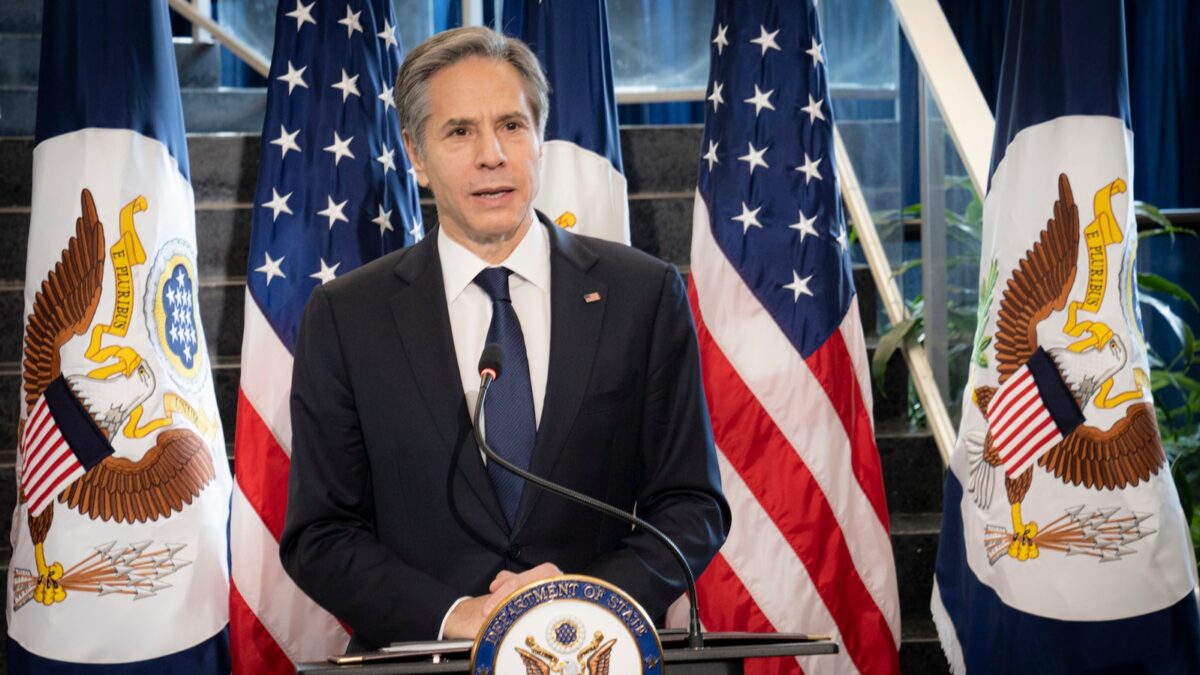
Antony Blinken stands in front of flags
While Blinken provides an entry point to unraveling the Russian-disinformation hoax, there is much more to learn.

Author Margot Cleveland profile

MARGOT CLEVELAND

VISIT ON TWITTER@PROFMJCLEVELAND

MORE ARTICLES

Antony Blinken represents neither the beginning nor the end of the info ops run to convince voters the Hunter Biden laptop was Russian disinformation. Revisiting the contemporaneous coverage of the laptop story in light of last week’s revelations about Blinken reveals the scandal extends far beyond the Biden campaign and involves government agents. 

Last week, news broke that a former top CIA official, Michael Morell, testified as part of a House Judiciary Committee investigation that Blinken, now-secretary of state and then-Biden campaign senior adviser, had contacted Morell to discuss the New York Post’s Hunter Biden laptop story.

Blinken and Morell reportedly “discussed possible Russian involvement in the spreading of information related to Hunter Biden.” According to Morell, Blinken’s outreach “set in motion” what led to the public statement signed by 51 former intelligence agents that falsely framed the laptop as Russian disinformation.

This revelation is huge — but it’s only a start to understanding the scope of the plot to interfere in the 2020 election by framing the laptop exposing Biden family corruption as foreign disinformation.

The First Clue

The first hint that Blinken’s outreach to Morell was a single spoke in the wheel of the Biden campaign’s deception came from a follow-up email Blinken sent Morell on Oct. 17, 2020. In it, Blinken shared a USA Today article that reported “the FBI was examining whether the Hunter Biden laptop was part of a ‘disinformation campaign.’” The very bottom of Blinken’s email contained the signature block of Andrew Bates, then a Biden campaign spokesman and the director of his “rapid response” team, suggesting Bates had sent the article to Blinken for him to forward to Morell.

Blinken forwarding an article claiming the FBI was investigating the laptop as a potential “disinformation campaign” is hugely significant because we know the FBI was doing no such thing. The FBI knew both that the laptop was authentic and that John Paul Mac Isaac had possession of the hard drive, just as the New York Post had reported, albeit without identifying the computer-store owner by name. 

The USA Today article nonetheless furthered the narrative that Morell and the other former intelligence officials would soon parrot in their “Public Statement on the Hunter Biden Emails” — that the emails have “all the classic earmarks of a Russian information operation.”

For those who lived through the Russia-collusion hoax, it was the USA Today article and the presidential campaign’s use of Russia to deflect attention from the Biden scandal that bore the “classic earmarks” of an information operation — one that mimicked Hillary Clinton’s ploy four years prior. Given the similarities between the two Russia hoaxes, it seemed likely the Biden campaign worked with the press to push the Russian-disinformation narrative. 

USA Today Didn’t Start the Falsehood 

Sure enough, the legacy press began pushing the narrative days before Blinken emailed Morell the article on Oct. 17.

On Oct. 14, 2020, the same day the New York Post broke the first laptop story, Politico ran an article, co-authored by Russia-hoaxer extraordinaire “Fusion Natasha” Bertrand, raising questions about the authenticity of said laptop. “This is a Russian disinformation operation. I’m very comfortable saying that,” Bertrand quoted former Deputy Assistant Secretary of Defense and Biden adviser Michael Carpenter.

At the time, Carpenter also ran the Penn Biden Center — the same place a cache of classified documents from Biden’s time as vice president and senator were discovered in a closet.

Politico also quoted Bates, whose signature block would later appear on Blinken’s email to Morell. Bates spun the scandal as one about Rudy Giuliani, who had provided a copy of the hard drive to the Post, and Giuliani’s supposed connection “to Russian intelligence.” 

Intel Community Helped Peddle Russia Hoax 2.0

As was the case with the Russia-collusion hoax, the Biden campaign received an assist from the intelligence community. On Oct. 14, 2020, The New York Times reported that U.S. intelligence analysts “had picked up Russian chatter that stolen Burisma emails” would be released as an “October surprise.” 

Burisma, of course, was the Ukrainian energy company that paid Hunter Biden nearly $1 million to sit on its board during his father’s final year as vice president. 

The chief concern of the intelligence analysts, the Times reported, “was that the Burisma material would be leaked alongside forged materials in an attempt to hurt Mr. Biden’s candidacy.”

Lying Leakers Advance the Narrative

The next day, another foundational Russia-collusion hoaxer, Ken Dilanian, published an “exclusive” at NBC. Citing “two people familiar with the matter,” Dilanian claimed that “federal investigators are examining whether emails allegedly describing activities by Joe Biden and his son Hunter and found on a laptop at a Delaware repair shop are linked to a foreign intelligence operation.” Dilanian also quoted Bates, who again focused on Giuliani and his alleged connection to Russia.

The Washington Post also embraced the narrative on Oct. 15, reporting, “U.S. intelligence agencies warned the White House last year that President Trump’s personal lawyer Rudolph W. Giuliani was the target of an influence operation by Russian intelligence.” Based on “four former officials,” The Washington Post reported that Giuliani had interacted with people tied to Russian intel.

More Lies Leaked to USA Today 

This brings us to USA Today’s Oct. 16, 2020, article, “FBI Probing Whether Emails in New York Post Story About Hunter Biden Are Tied to Russian Disinformation.”

Federal authorities are investigating whether a Russian influence operation was behind the disclosure of emails purporting to document the Ukrainian and Chinese business dealings of Hunter Biden, the son of Democratic nominee Joe Biden,” USA Today opened its article, citing “a person briefed on the matter” and immediately bringing up Giuliani. 

According to USA Today, that person “confirmed the FBI’s involvement but did not elaborate on the scope of the bureau’s review.”

The next day, Oct. 17, USA Today followed up with the article, “A Tabloid Got a Trove of Data on Hunter Biden from Rudy Giuliani. Now, the FBI is Probing a Possible Disinformation Campaign.”

It began by saying the New York Post portrayed the laptop contents as a “smoking gun.” “Enter the FBI,” USA Today interjected, reporting that “federal authorities” are investigating whether the laptop is “disinformation pushed by Russia” and claiming there are many questions about the laptop data’s authenticity.

Experts say the story has many hallmarks of a disinformation campaign,” it continued, using language strikingly similar to what the former intel officials would use days later.

Blinken Uses Reporting to Prod Morell

It is unclear which of the two USA Today pieces Blinken forwarded to Morell because both articles included the FBI investigation claims. It seems likely, however, that Blinken sent Morrel the second article because USA Today’s Oct. 17 coverage included a quote from supposed “experts” who said the New York Post “story has many hallmarks of a disinformation campaign.” 

That language tracked near-perfectly the wording used by the 51 former intelligence officials in their infamous Oct. 19 statement, which claimed the laptop “has all the classic earmarks of a Russian information operation.” 

That’s Not All

Morell’s contact with Blinken reportedly went beyond the phone call and email. According to CNN, following his conversation with Blinken, “Morell had conversations with other former intelligence community officials, which is what led to the letter,” and then Morell “circled back to the Biden campaign to let them know that the letter efforts were underway.” 

In testimony to House oversight investigators, Morell told how Biden’s campaign helped strategize releasing the statement, according to a letter Reps. Jim Jordan and Michael Turner sent to Blinken last week. Specifically, “Morell testified that he sent an email telling Nick Shapiro, former Deputy Chief of Staff and Senior Advisor to the Director of the CIA John Brennan, that the Biden campaign wanted the statement to go to a particular reporter at the Washington Post first and that he should send the statement to the campaign when he sent the letter to the reporter.” Shapiro was another signatory of the statement.

Politico, however, eventually first broke the story and published the statement, under the headline “Hunter Biden Story is Russian Disinfo, Dozens of Former Intel Officials Say.”

Mission Accomplished 

In his testimony to House investigators, Morell “explained that one of his two goals in releasing the statement was to help then-Vice President Biden in the debate and to assist him in winning the election,” Jordan and Turner wrote. In fact, according to attorney Mark Zaid, who represents several of the signatories, “when the draft [statement] was sent out to people to sign, the cover email made clear that it was an effort to help the Biden campaign.”

Both parts of the ploy worked. When the final presidential debate arrived on Oct. 22, 2020, and then-President Trump confronted Biden with the details revealed in Hunter’s “laptop from hell,” Biden responded by telling the American public:

There are 50 former national intelligence folks who said that what he’s accusing me of is a Russian plant. They have said that this has all the … five former heads of the CIA, both parties, say what he’s saying is a bunch of garbage. Nobody believes it except him and his good friend, Rudy Giuliani.

Biden Campaign Thanks Morell for the Assist

Morell testified that after the debate he received a call from Jeremy Bash, who was one of the 51 signatories of the statement. Bash asked Morell if he had a minute to talk to Steve Ricchetti, head of the Biden campaign. Bash testified that he said “yes,” Bash got Ricchetti on the line, and the Biden campaign representative thanked Morell “for putting the statement out.” 

More Than Dirty Politics

Morell’s testimony revealed Blinken and the Biden campaign’s role in prompting the bunk statement from the former intel officials. But the contemporaneous media reporting exposes a larger scandal: Representatives of our government helped promote that narrative by falsely telling media outlets the FBI was investigating whether the Hunter Biden laptop was part of a Russian-disinformation campaign. 

The FBI’s role in assisting the Biden campaign’s plot transforms this case from one about dirty politics to a scandal involving government interference in the 2020 election. Accordingly, the House oversight committees need to determine which members of the FBI or intelligence agencies were responsible for the false media leak and whether anyone working on behalf of the Biden campaign collaborated with those government actors.

The committees thus need to gather evidence and question not merely Blinken, but every signatory of the statement, especially Bash; members of the Biden campaign, such as Bates and Ricchetti; and Biden advisers, including Carpenter. 

While Blinken provides an entry point to unraveling the Russian-disinformation hoax, there is much more to learn.


Margot Cleveland is The Federalist’s senior legal correspondent. She is also a contributor to National Review Online, the Washington Examiner, Aleteia, and Townhall.com, and has been published in the Wall Street Journal and USA Today. Cleveland is a lawyer and a graduate of the Notre Dame Law School, where she earned the Hoynes Prize—the law school’s highest honor. She later served for nearly 25 years as a permanent law clerk for a federal appellate judge on the Seventh Circuit Court of Appeals. Cleveland is a former full-time university faculty member and now teaches as an adjunct from time to time. As a stay-at-home homeschooling mom of a young son with cystic fibrosis, Cleveland frequently writes on cultural issues related to parenting and special-needs children. Cleveland is on Twitter at @ProfMJCleveland. The views expressed here are those of Cleveland in her private capacity.

Twitter Execs Testify That Their Election-Meddling Decisions Were Even Flimsier Than Previously Claimed


BY: MARGOT CLEVELAND | FEBRUARY 09, 2023

Read more at https://thefederalist.com/2023/02/09/twitter-execs-testify-that-their-election-meddling-decisions-were-even-flimsier-than-previously-claimed/

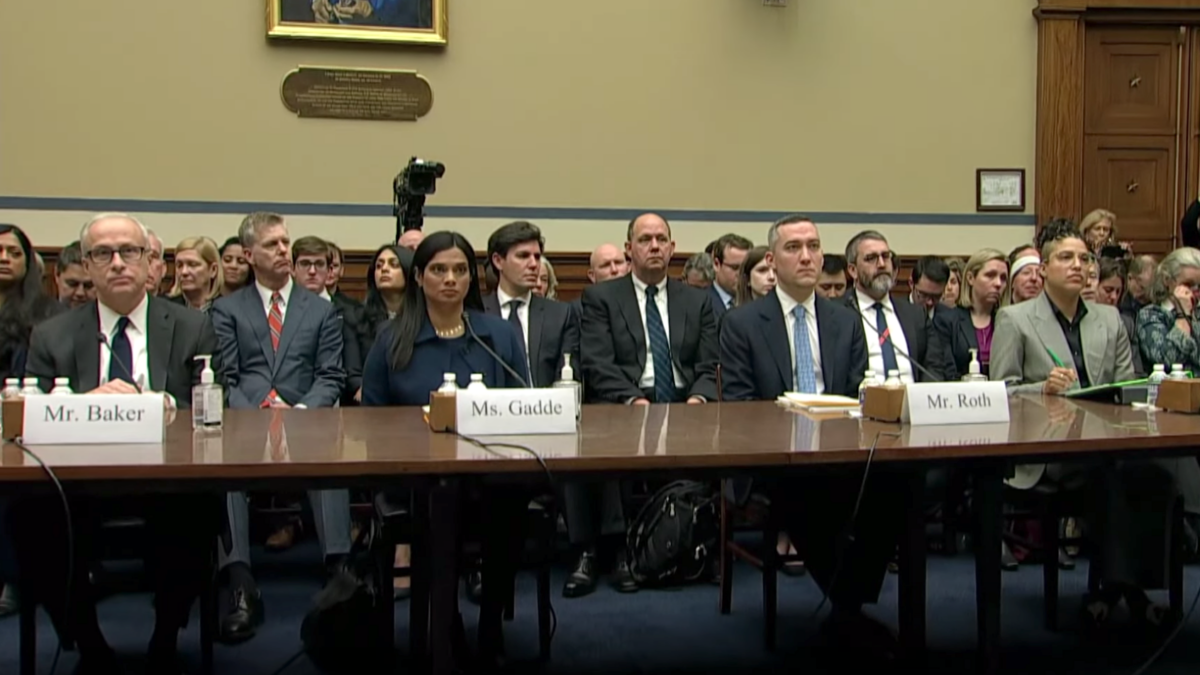
Twitter executives sit behind table at House hearing
Twitter executives being beholden to so-called experts’ tweets is hardly better than doing the FBI’s bidding.

Author Margot Cleveland profile

MARGOT CLEVELAND

VISIT ON TWITTER@PROFMJCLEVELAND

MORE ARTICLES

When the New York Post dropped its bombshell reporting on documents recovered from Hunter Biden’s abandoned laptop in October of 2020, Twitter did not reach out to the FBI to ask whether the reporting was Russian disinformation — despite extensive coordination with the FBI to prepare to combat foreign election interference. Instead, according to testimony at Wednesday’s House Oversight Committee hearing, Twitter relied on the tweets of supposed experts, making the tech giant’s decision to censor the Post’s story even more outrageous.

The House Oversight Committee, now in the hands of Republicans, questioned four former Twitter executives on their decision to censor the Hunter Biden laptop story. Rep. Andy Biggs, R-Ariz., pushed Twitter’s former global head of trust and safety, Yoel Roth, to explain the timing of Twitter’s decision to censor the New York Post story. 

Biggs noted that in an 8:51 a.m. email on Oct. 14, 2020, Roth had taken the position that the laptop “isn’t clearly violative of our Hacked Materials Policy.” But then, by 10:12, Roth emailed his colleagues with Twitter’s decision to censor the story, stating that “the key factor informing our approach is consensus from experts monitoring election security and disinformation that this looks a lot like a hack-and-leak operation.”

What cybersecurity experts had Roth consulted between 9 a.m. and 10:15 a.m. on Oct. 14, 2020, the morning the Post story broke, Biggs asked the former Twitter executive. 

Roth responded that the experts were ones the Twitter heads were following on the platform. “We were following discussions about this as they unfolded on Twitter,” Roth explained. “Cybersecurity experts were tweeting about this incident and sharing their perspectives, and that informed some of Twitter’s judgment here.”

Rep. Kelly Armstrong, R-N.D., was incredulous: “After 2016, you set up all these teams to deal with Russian interference, foreign interference, having regular meetings with the FBI, you have connections with all of these different government agencies, and you didn’t reach out to them once?”

“That’s right,” Roth said, noting he didn’t think it would be appropriate. 

Instead, Twitter relied on the tweets of supposed national security experts. 

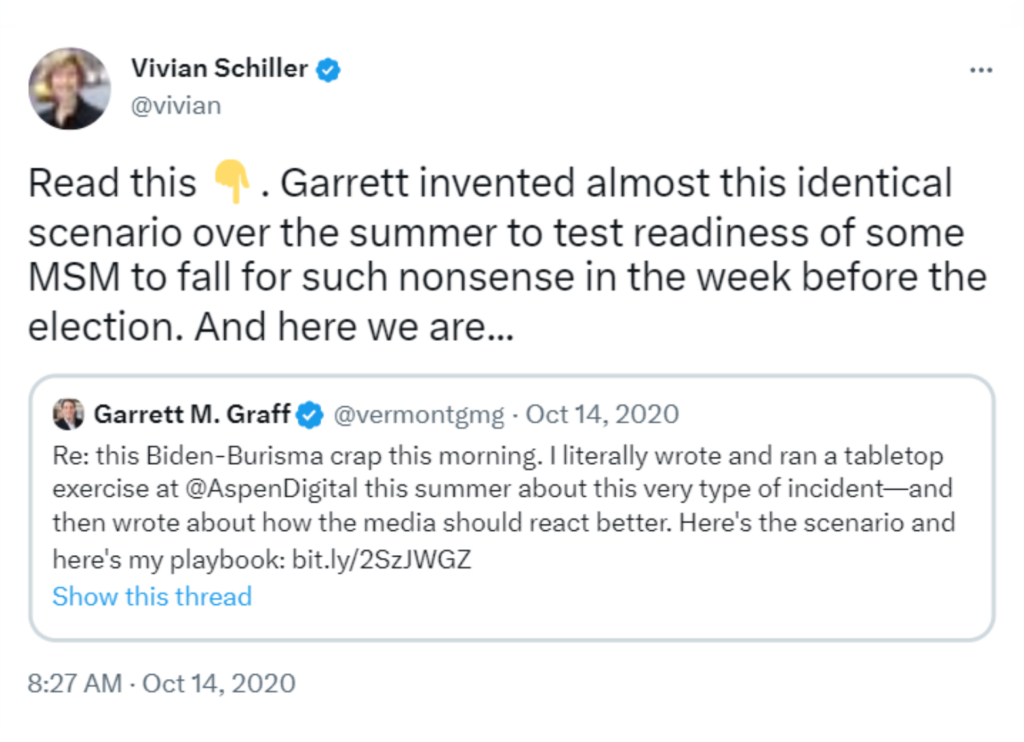
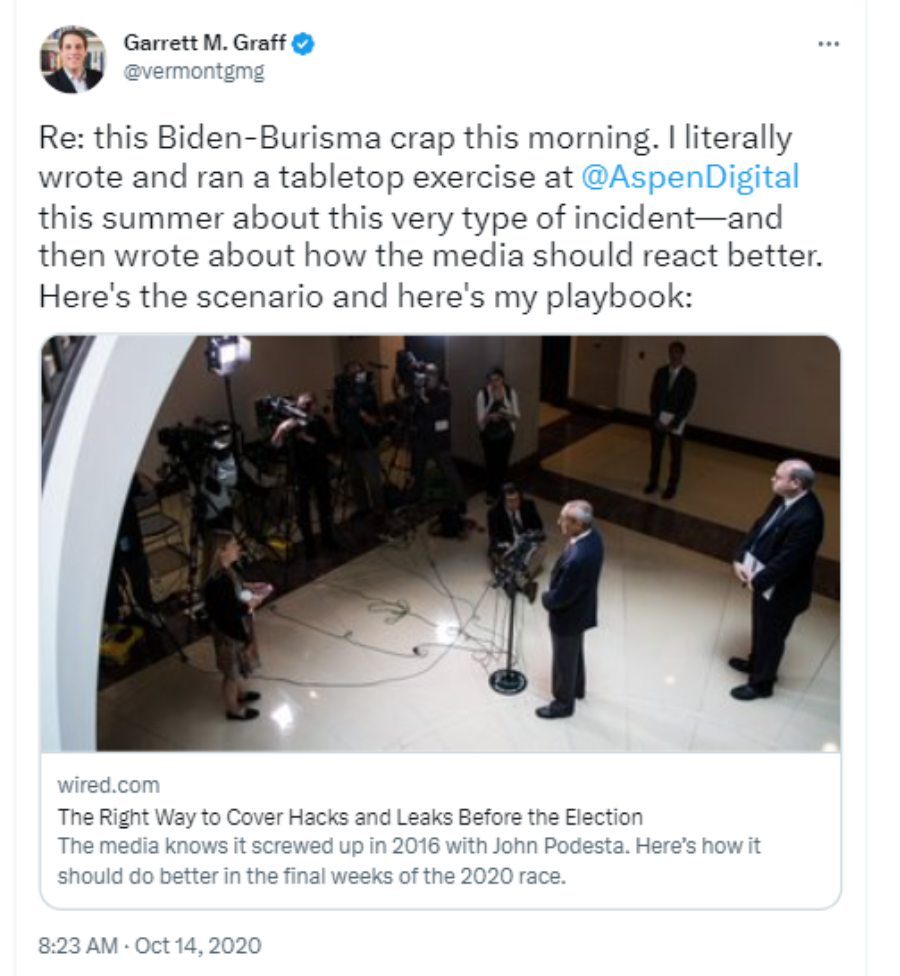
Who those experts were, Roth didn’t say, but here we have another strange coincidence: In his testimony on Wednesday, Roth told the committee that a few weeks before the Post story dropped, he had participated in an exercise hosted by the Aspen Institute, with other media outlets and social media companies, that posed a hack and leak October surprise involving Hunter Biden. Roth testified that Garrett Graff facilitated that event.

And at 8:23 a.m. on Oct. 14, 2020, after the Post story broke, Graff tweeted his playbook for how the media should react to “this Biden-Burisma crap.”

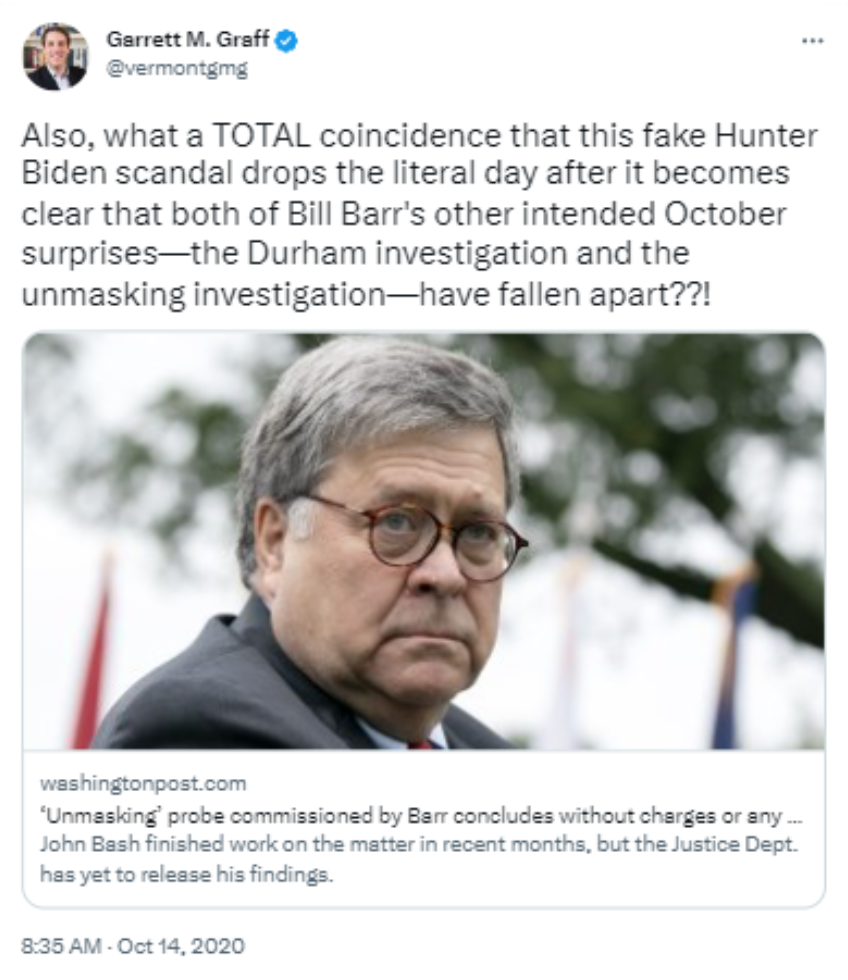
Graff followed about some 10 minutes later, tweeting, “Also, what a TOTAL coincidence that this fake Hunter Biden scandal drops the literal day after it becomes clear that both of Bill Barr’s other intended October surprises—the Durham investigation and the unmasking investigation—have fallen apart??!” 

Not long after Graff began pushing the “fake” Hunter Biden scandal narrative, Vivian Schiller joined in, calling the Hunter Biden story “nonsense” and claiming Graff’s exercise was “to test readiness of some MSM.” 

And who is Schiller? According to Graff, Schiller “designed and ran” the Hunter Biden tabletop exercise that Roth participated in. She was also the former head of news at Twitter, in addition to previously being the CEO of NPR, among other gigs.

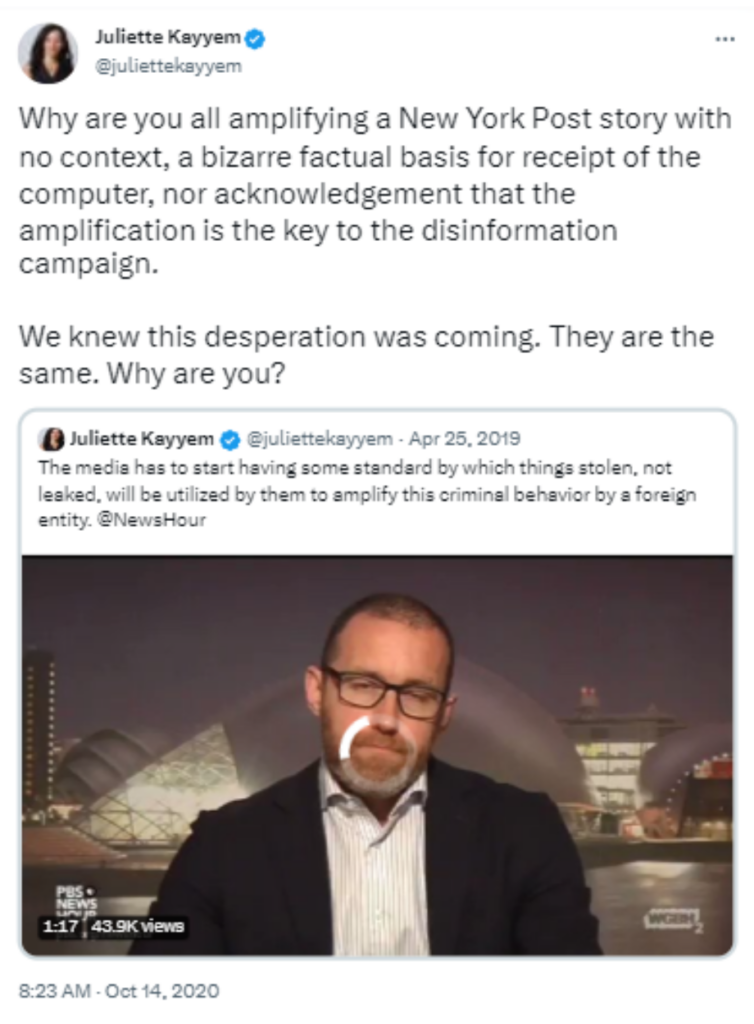
In addition to Graff and Schiller, CNN’s consultant and so-called national-security expert weighed in at 8:23 a.m., questioning the “amplifying” of the New York Post’s story, stressing that “amplification is the key to disinformation.”

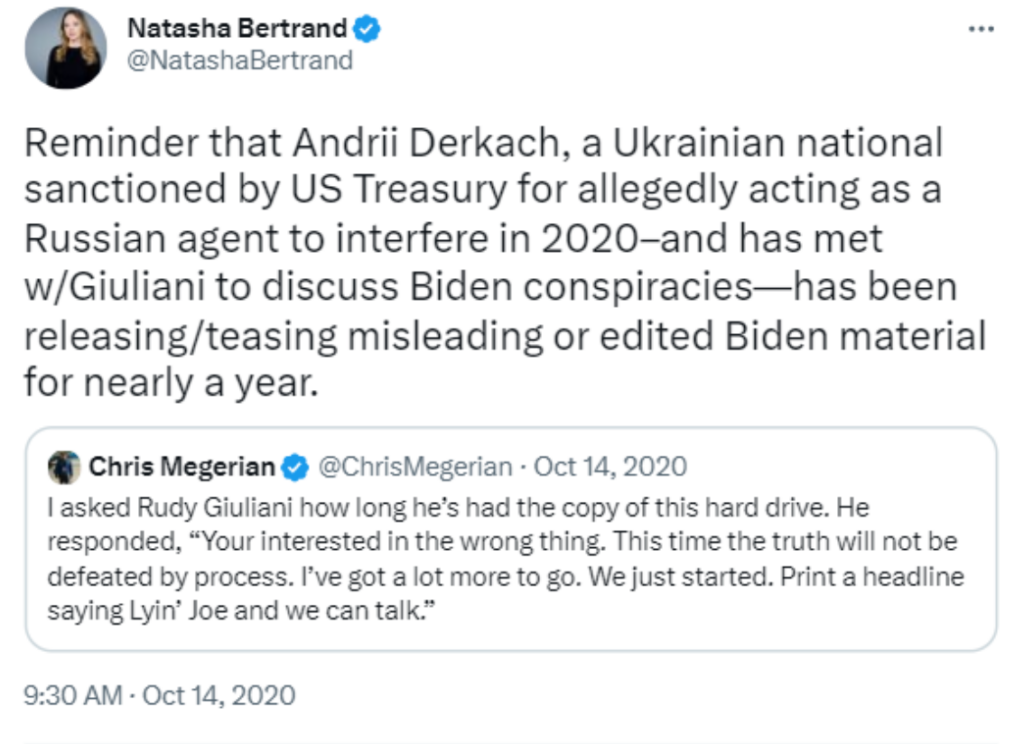
Natasha Bertrand also tweeted an early morning “warning” that a Russian agent had been “teasing misleading or edited Biden material for nearly a year.”  

Bertrand, also known as Fusion Natasha for falling for Fusion GPS’s Steele dossier and Alfa Bank hoax, was joined in pushing the disinformation narrative by The Washington Post’s alleged fact-checker Glenn Kessler. 

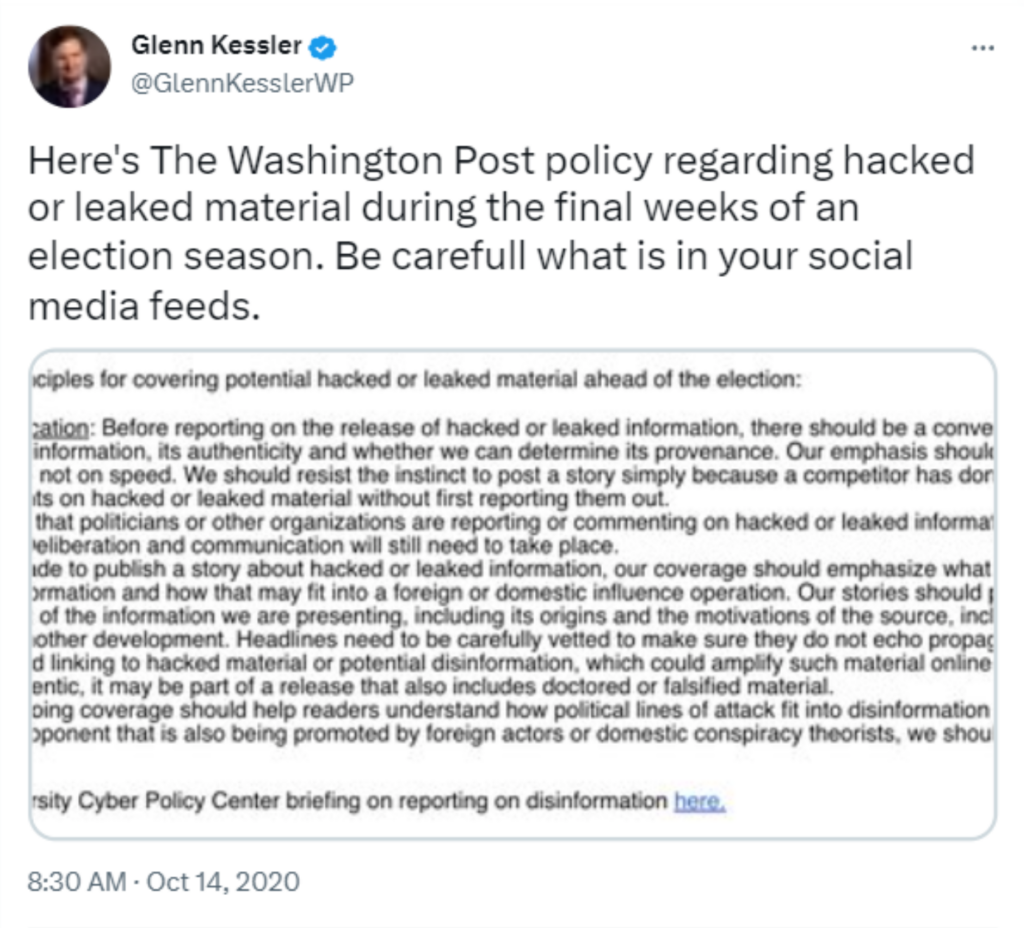
By 8:30 a.m., Kessler had shared The Washington Post’s policy “regarding hacked or leaked materials,” and told Twitter users to “be careful what is in your social media feeds.”

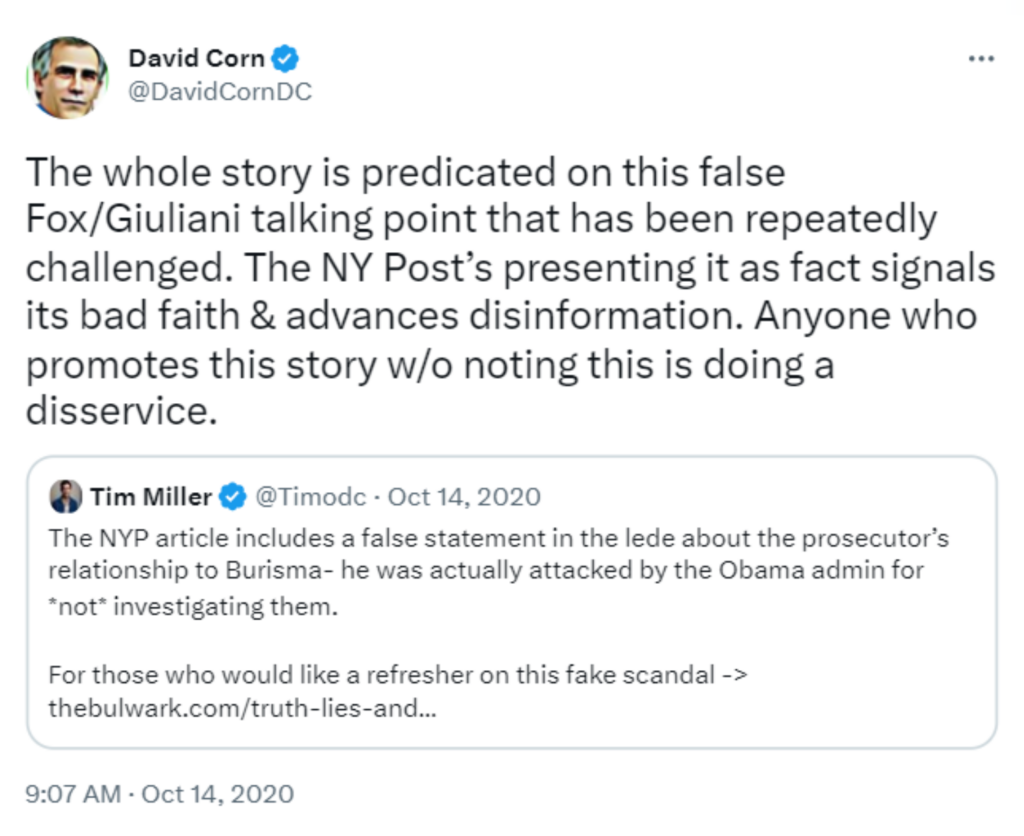
Mother Jones’ D.C. bureau chief David Corn followed with a 9:07 tweet declaring that the “whole story” was predicated on “false Fox/Giuliani talking points” and pronouncing the Post as advancing “disinformation.”  

Twitter’s decision to censor the Hunter Biden story was bad enough before, but to think the executives may have relied on so-called experts like these raises the outrage another octave. 

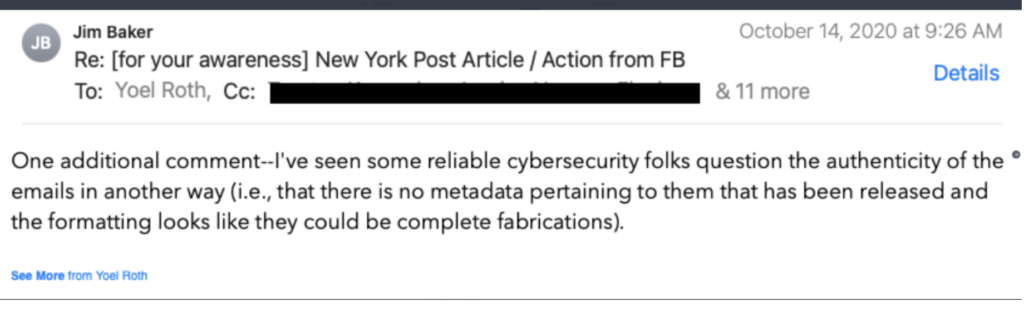
Former Twitter Deputy General Counsel James Baker likewise indicated in an email that he had “seen some reliable cybersecurity folks question the authenticity of the emails in another way (i.e., that there is no metadata pertaining to them that has been released and the formatting looks like they could be complete fabrications.)” Baker, however, did not say whether he had spoken with the “cybersecurity folks,” and given that when pushed by the committee he hid behind attorney-client privilege, getting any more answers from Baker seems unlikely. 

Beyond learning that Twitter executives opted to rely on the tweets of so-called experts over asking the FBI if the laptop was fake, Wednesday’s hearing consisted mainly of grandstanding — some on both sides of the aisle — and Democrats attempting to make the hearing about Trump when they weren’t complaining that the entire session was a waste of time. One additional salient fact came out, however, in addition to a review of the basics of Twitter’s censorship efforts.

Specifically, Roth clarified for the House committee that the FBI had not previously warned that an expected “hack-and-leak” operation was rumored to likely involve Hunter Biden. Rather, according to Roth’s testimony, the rumor that the hack-and-leak operation would target the Biden son came from another tech company.

Roth claimed in his Wednesday testimony that his Dec. 21, 2020, statement to the Federal Election Commission was being misinterpreted. In that statement, Roth had attested that “since 2018 he had regular meetings with the Office of the Director of National Intelligence, the Department of Homeland Security, the FBI, and industry peers regarding election security.” His signed declaration then noted that the “expectations of hack-and-leak operations were discussed throughout 2020. I also learned in these meetings that there were rumors that a hack-and-leak operation would involve Hunter Biden.” 

According to Roth, he should have worded his statement differently because it was not the FBI that had raised Hunter Biden as a potential subject of the hack and leak, but a peer company. One would think, however, that Roth would have clarified this point to his lawyer some two-plus years ago when Twitter’s Covington & Burling attorney represented to the FEC in a cover letter that accompanied Roth’s statement that “reports from the law enforcement agencies even suggested there were rumors that such a hack-and-leak operation would be related to Hunter Biden.”

Clearly, the former Twitter executives seek to separate themselves from the FBI, but “The Twitter Files” make that next to impossible to accomplish. And, really, being beholden to the so-called experts tweeting out warnings of supposed Russian disinformation would hardly be an improvement.


Margot Cleveland is The Federalist’s senior legal correspondent. She is also a contributor to National Review Online, the Washington Examiner, Aleteia, and Townhall.com, and has been published in the Wall Street Journal and USA Today. Cleveland is a lawyer and a graduate of the Notre Dame Law School, where she earned the Hoynes Prize—the law school’s highest honor. She later served for nearly 25 years as a permanent law clerk for a federal appellate judge on the Seventh Circuit Court of Appeals. Cleveland is a former full-time university faculty member and now teaches as an adjunct from time to time. As a stay-at-home homeschooling mom of a young son with cystic fibrosis, Cleveland frequently writes on cultural issues related to parenting and special-needs children. Cleveland is on Twitter at @ProfMJCleveland. The views expressed here are those of Cleveland in her private capacity.

Fox News anchor confronts former CIA officer for endorsing claim that Hunter Biden laptop was Russian disinformation


By CHRIS ENLOE | October 12, 2022

Read more at https://www.theblaze.com/news/bret-baier-confronts-david-priess-hunter-biden-laptop-story/

Image source: Fox News screenshot

Fox News anchor Bret Baier confronted a former CIA officer on Tuesday for endorsing claims that the Hunter Biden laptop story was Russian disinformation.

After the New York Post dropped the pre-election bombshell in October 2020, the laptop story was quickly denounced as Russian disinformation. The media pushed a letter from dozens of former intelligence officials that claimed the story had “all the classic earmarks of a Russian information operation.” No real evidence, however, was ever presented to corroborate that claim.

Of course, the laptop story is not Russian disinformation, and media outlets like the New York Times and Politico have since verified the authenticity of the laptop.

While interviewing former CIA officer David Priess — one of that infamous letter’s signatories — Baier directly asked about his decision to advance false claims.

“Why did you sign on to that?” Baier asked.

Priess, however, defended his endorsement and tried to claim the letter was neutral, such that it did not outright call the laptop story Russian “disinformation.”

“Because of what it says. It has all of the classic earmarks of one of these operations,” he said. “You’ll note elsewhere in the letter, if you read it, that it also says we don’t know if this is a Russian operation at all. That has been dramatically changed in the retelling of the story.”

“The letter is merely pointing out that this is the kind of thing that time after time after time that people who study Russian disinformation, intelligence officers who look at Russian tactics, over the long period of time — this is the kind of thing they like to amplify, to sow discord within target countries,” he continued. “The fact is, the tactic is an old one, a tried and true one, and it’s been successful in the past.”

“But in this case it was not true — it was not true,” Baier fired back, citing media outlets that authenticated it.

But the former CIA officer remained stalwart. Priess told Baier he does not regret signing the letter and claimed it did not change the outcome of the 2020 election, despite President Joe Biden citing the letter during a debate with Donald Trump. Priess, in fact, said the letter was not wrong because it did not call the laptop story “Russian disinformation,” but one that has the “earmarks of a Russian information operation.”

“It’s not my fault if people don’t look up definitions,” Priess said smugly.

“I know, but the purpose of the letter is to have an effect,” Baier shot back. “And the nuance that you’re talking about never made it to candidate Biden, because he said it plainly on a debate stage.”

While the nuance that Priess drew out may be true, one wonders why those intelligence officers did not rush to correct the media and Biden if they were wrong by calling the laptop clear Russian disinformation. As Baier pointed out, the intelligence officials allowed the letter to be used as “Biden information,” rhetoric that helped his campaign.

Tag Cloud